EP0752470B1 - Verfahren zur Massenkultivierung von Ciliaten - Google Patents
Verfahren zur Massenkultivierung von Ciliaten Download PDFInfo
- Publication number
- EP0752470B1 EP0752470B1 EP96110354A EP96110354A EP0752470B1 EP 0752470 B1 EP0752470 B1 EP 0752470B1 EP 96110354 A EP96110354 A EP 96110354A EP 96110354 A EP96110354 A EP 96110354A EP 0752470 B1 EP0752470 B1 EP 0752470B1
- Authority
- EP
- European Patent Office
- Prior art keywords
- procedure
- accordance
- ciliates
- stirrer
- cells
- Prior art date
- Legal status (The legal status is an assumption and is not a legal conclusion. Google has not performed a legal analysis and makes no representation as to the accuracy of the status listed.)
- Expired - Lifetime
Links
Images


Classifications
-
- C—CHEMISTRY; METALLURGY
- C12—BIOCHEMISTRY; BEER; SPIRITS; WINE; VINEGAR; MICROBIOLOGY; ENZYMOLOGY; MUTATION OR GENETIC ENGINEERING
- C12M—APPARATUS FOR ENZYMOLOGY OR MICROBIOLOGY; APPARATUS FOR CULTURING MICROORGANISMS FOR PRODUCING BIOMASS, FOR GROWING CELLS OR FOR OBTAINING FERMENTATION OR METABOLIC PRODUCTS, i.e. BIOREACTORS OR FERMENTERS
- C12M23/00—Constructional details, e.g. recesses, hinges
- C12M23/02—Form or structure of the vessel
- C12M23/08—Flask, bottle or test tube
-
- C—CHEMISTRY; METALLURGY
- C12—BIOCHEMISTRY; BEER; SPIRITS; WINE; VINEGAR; MICROBIOLOGY; ENZYMOLOGY; MUTATION OR GENETIC ENGINEERING
- C12M—APPARATUS FOR ENZYMOLOGY OR MICROBIOLOGY; APPARATUS FOR CULTURING MICROORGANISMS FOR PRODUCING BIOMASS, FOR GROWING CELLS OR FOR OBTAINING FERMENTATION OR METABOLIC PRODUCTS, i.e. BIOREACTORS OR FERMENTERS
- C12M27/00—Means for mixing, agitating or circulating fluids in the vessel
- C12M27/02—Stirrer or mobile mixing elements
-
- C—CHEMISTRY; METALLURGY
- C12—BIOCHEMISTRY; BEER; SPIRITS; WINE; VINEGAR; MICROBIOLOGY; ENZYMOLOGY; MUTATION OR GENETIC ENGINEERING
- C12N—MICROORGANISMS OR ENZYMES; COMPOSITIONS THEREOF; PROPAGATING, PRESERVING, OR MAINTAINING MICROORGANISMS; MUTATION OR GENETIC ENGINEERING; CULTURE MEDIA
- C12N1/00—Microorganisms; Compositions thereof; Processes of propagating, maintaining or preserving microorganisms or compositions thereof; Processes of preparing or isolating a composition containing a microorganism; Culture media therefor
- C12N1/10—Protozoa; Culture media therefor
Definitions
- the invention relates to a method for cultivating ciliates in Spinner flasks.
- Ciliates represent a promising source of biogenic resources, such as Enzymes (I. Munro, 1985, Process Biochem., 20, 139), unsaturated fatty acids (Y. Gosselin et al., 1989, Biotechnol. Lett., 11, 423) and "single cell protein" (A. Ayerbe, 1980, Enzyme Microb. Technol., 2, 54).
- a method for cultivating ciliates in. would be desirable Mass cultures. Such a system is a prerequisite for assessment or Use of these organisms as a source of biogenic materials.
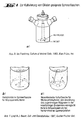
- the present invention thus relates to a method for cultivating Ciliaten while stirring the culture medium, which is characterized in that as Culture vessel a culture bottle, which has a magnetic core provided stirrer, which is suspended in the head part of the culture bottle, that the agitator does not touch the bottom of the bottle, the agitator using a magnetic field is driven, preferably a so-called Spinner bottle, is used.
- Culture vessel a culture bottle, which has a magnetic core provided stirrer, which is suspended in the head part of the culture bottle, that the agitator does not touch the bottom of the bottle, the agitator using a magnetic field is driven, preferably a so-called Spinner bottle, is used.
- Colpodea e.g. Colpoda, Platyophrya
- Holotrichia e.g. Tetrahymena, Paramecium, Colpidium
- Peritrichia e.g. Vorticella
- Spirotrichia e.g. Blepharisma, Stentor, Euplotes, Stylonichia
- the breeding temperature is between 13 and 35 ° C, but preferably between 20 and 30 ° C.
- the ciliates can be grown in axenic media (Tetrahymena e.g. on PPYS medium or skimmed milk medium), in monoxenic media (Blepharisma e.g. with Bacillus subtilis or Pseudomonas fluorescens as feed bacteria) or in breed polyxenic media.
- axenic media Tetrahymena e.g. on PPYS medium or skimmed milk medium
- monoxenic media Blepharisma e.g. with Bacillus subtilis or Pseudomonas fluorescens as feed bacteria
- breed polyxenic media in breed polyxenic media.
- the cultivation can be batch fermentation, fed batch fermentation (regular feeding of a substrate) or fermentation with cyclical Medium exchange can be carried out.
- super spinner bottles are also suitable (Fig. 2) by a membrane gassing for bubble-free fumigation of the medium, for the cultivation of ciliates, So far, super spinner bottles have been used to produce monoclonal antibodies from hybridoma cells.
- the stirring mode can be used as a pendulum mixing technique as well Pendulum mixing technology can be designed with a change of direction.
Landscapes
- Health & Medical Sciences (AREA)
- Life Sciences & Earth Sciences (AREA)
- Engineering & Computer Science (AREA)
- Chemical & Material Sciences (AREA)
- Wood Science & Technology (AREA)
- Organic Chemistry (AREA)
- Bioinformatics & Cheminformatics (AREA)
- Zoology (AREA)
- Genetics & Genomics (AREA)
- Biotechnology (AREA)
- Biomedical Technology (AREA)
- Microbiology (AREA)
- Biochemistry (AREA)
- General Engineering & Computer Science (AREA)
- General Health & Medical Sciences (AREA)
- Sustainable Development (AREA)
- Clinical Laboratory Science (AREA)
- Medicinal Chemistry (AREA)
- Tropical Medicine & Parasitology (AREA)
- Virology (AREA)
- Micro-Organisms Or Cultivation Processes Thereof (AREA)
- Preparation Of Compounds By Using Micro-Organisms (AREA)
- Apparatus Associated With Microorganisms And Enzymes (AREA)
Description
Claims (12)
- Verfahren zur Kultivierung von Ciliaten unter Rühren des Kulturmediums, dadurch gekennzeichnet, daß als Zuchtgefäß eine Kulturflasche verwendet wird, welche über einen mit einem Magnetkern versehenen Rührer verfügt, der im Kopfteil der Kulturflasche so aufgehängt ist, daß das Rührwerk den Flaschenboden nicht berührt, wobei der Rührer mittels eines Magnetfeldes angetrieben wird.
- Verfahren nach Anspruch 1, dadurch gekennzeichnet, daß der Rührer als Membranbegasungsrührer ausgestaltet ist.
- Verfahren nach einem der Ansprüche 1 oder 2, dadurch gekennzeichnet, daß die Kultivierung als Fed-Batch-Fermentation durchgeführt wird.
- Verfahren nach einem der Ansprüche 1 oder 2, dadurch gekennzeichnet, daß die Kultivierung unter zyklischem Mediumaustausch durchgeführt wird.
- Verfahren nach einem der Ansprüche 1 bis 4, dadurch gekennzeichnet, daß die Rührgeschwindigkeit 1 - 70 upm beträgt.
- Verfahren nach Anspruch 5, dadurch gekennzeichnet, daß die Rührgeschwindigkeit 10 - 40 upm beträgt.
- Verfahren nach einem der Ansprüche 1 bis 6, dadurch gekennzeichnet, daß der Rührmodus als Pendelmischtechnik ausgelegt ist.
- Verfahren nach Anspruch 7, dadurch gekennzeichnet, daß der Rührmodus als Pendelmischtechnik mit Drehrichtungswechsel ausgelegt ist.
- Verfahren nach einem der Ansprüche 1 bis 8, dadurch gekennzeichnet, daß die Ciliaten der Gruppe der Colpodia angehören.
- Verfahren nach einem der Ansprüche 1 bis 8, dadurch gekennzeichnet, daß die Ciliaten der Gruppe der Holotrichia angehören.
- Verfahren nach einem der Ansprüche 1 bis 8, dadurch gekennzeichnet, daß die Ciliaten der Gruppe der Peritrichia angehören.
- Verfahren nach einem der Ansprüche 1 bis 8, dadurch gekennzeichnet, daß die Ciliaten der Gruppe der Spirotrichia angehören.
Applications Claiming Priority (2)
| Application Number | Priority Date | Filing Date | Title |
|---|---|---|---|
| DE19524307 | 1995-07-07 | ||
| DE19524307A DE19524307A1 (de) | 1995-07-07 | 1995-07-07 | Verfahren zur Massenkultivierung von Ciliaten |
Publications (3)
| Publication Number | Publication Date |
|---|---|
| EP0752470A2 EP0752470A2 (de) | 1997-01-08 |
| EP0752470A3 EP0752470A3 (de) | 2000-04-05 |
| EP0752470B1 true EP0752470B1 (de) | 2002-09-25 |
Family
ID=7765964
Family Applications (1)
| Application Number | Title | Priority Date | Filing Date |
|---|---|---|---|
| EP96110354A Expired - Lifetime EP0752470B1 (de) | 1995-07-07 | 1996-06-27 | Verfahren zur Massenkultivierung von Ciliaten |
Country Status (7)
| Country | Link |
|---|---|
| US (1) | US6593128B1 (de) |
| EP (1) | EP0752470B1 (de) |
| JP (1) | JPH0923785A (de) |
| AT (1) | ATE224948T1 (de) |
| CA (1) | CA2180607A1 (de) |
| DE (2) | DE19524307A1 (de) |
| ES (1) | ES2186748T3 (de) |
Families Citing this family (17)
| Publication number | Priority date | Publication date | Assignee | Title |
|---|---|---|---|---|
| DE19741489A1 (de) * | 1997-09-19 | 1999-03-25 | Hoechst Ag | Fermentationsverfahren mit kontinuierlicher Massenkultivierung von Ciliaten (Protozoa) zur Produktion biogener Wertstoffe |
| DE19903095C2 (de) * | 1999-01-27 | 2003-05-22 | Nutrinova Gmbh | Gewinnung von gamma-Linolensäure aus Protozoen der Gattung Colpidium |
| JP4139215B2 (ja) * | 2000-11-02 | 2008-08-27 | シリアン アクチェンゲゼルシャフト | 消化を促進するための薬剤としての繊毛虫から得られた酵素の使用 |
| DE10260691A1 (de) * | 2002-12-23 | 2004-07-08 | Technische Universität München | Vorrichtung und Verfahren zur parallelen, automatisierten Kultivierung von Zellen unter technischen Bedingungen |
| ES2662589T3 (es) * | 2005-06-15 | 2018-04-09 | Zhejiang Jinyishengshi Bioengineering Co., Ltd. | Recipientes para cultivo en suspensión |
| WO2006138143A1 (en) | 2005-06-15 | 2006-12-28 | Amprotein Corporation | Suspension culture vessels |
| US8822209B2 (en) | 2007-07-12 | 2014-09-02 | Brooks Automation, Inc. | Disposable spinner flask |
| ES2347300T3 (es) * | 2008-02-13 | 2010-10-27 | Inve Technologies Nv | Metodo para tratar quistes de artemia. |
| WO2010030823A1 (en) * | 2008-09-10 | 2010-03-18 | Phycosystems Inc. | Mixed microorganism communities for the production of biomass |
| JP5636296B2 (ja) | 2011-01-20 | 2014-12-03 | 公益財団法人微生物化学研究会 | 塩分含有有機廃液処理剤、並びに、塩分濃度低下剤、塩分含有有機廃液の処理方法、及び包括固定担体 |
| CN102907377B (zh) * | 2012-10-25 | 2013-12-18 | 中国水产科学研究院黄海水产研究所 | 刺参体内寄生性后口虫液体培养基制备及培养方法 |
| WO2016061526A1 (en) | 2014-10-17 | 2016-04-21 | Sani-Tech West, Inc. | Mixing and filtering system and method |
| JP6855508B2 (ja) | 2016-05-31 | 2021-04-07 | コーニング インコーポレイテッド | インペラぐらつきの低減された細胞培養のための容器およびスピナーフラスコ |
| CN113727775B (zh) * | 2019-05-02 | 2024-08-20 | 环球生命科技咨询美国有限责任公司 | 用于生物处理系统的叶轮组件 |
| CN114933969B (zh) * | 2022-06-09 | 2023-02-07 | 中国海洋大学 | 一株具有促进植物种子萌发和幼苗生长作用的纤毛虫原生动物 |
| CN115747009B (zh) * | 2022-11-18 | 2023-04-21 | 青岛中仁澳兰生物工程有限公司 | 一种病毒悬浮培养装置 |
| CN118542265A (zh) * | 2024-06-20 | 2024-08-27 | 贵州省烟草公司安顺市公司 | 一种规模化养殖涡虫的方法 |
Family Cites Families (5)
| Publication number | Priority date | Publication date | Assignee | Title |
|---|---|---|---|---|
| JPS5695394A (en) * | 1979-12-29 | 1981-08-01 | Sogo Hirouchi | Method and device for sewage treatment |
| JPS6023832B2 (ja) * | 1980-10-28 | 1985-06-10 | 日立プラント建設株式会社 | 原生動物及び微小後生動物の培養装置 |
| SE8306190L (sv) * | 1983-11-10 | 1985-05-11 | Ivar Wergeland | Forfarande och anordning for forbettrad syrsettning av biologiska kulturer |
| US4649118A (en) * | 1984-04-05 | 1987-03-10 | The Virtis Company, Inc. | Cell culturing apparatus with improved stirring and filter means |
| JPH08133980A (ja) * | 1994-11-09 | 1996-05-28 | Harima Chem Inc | 血圧降下剤 |
-
1995
- 1995-07-07 DE DE19524307A patent/DE19524307A1/de not_active Withdrawn
-
1996
- 1996-06-27 DE DE59609710T patent/DE59609710D1/de not_active Expired - Fee Related
- 1996-06-27 ES ES96110354T patent/ES2186748T3/es not_active Expired - Lifetime
- 1996-06-27 EP EP96110354A patent/EP0752470B1/de not_active Expired - Lifetime
- 1996-06-27 AT AT96110354T patent/ATE224948T1/de not_active IP Right Cessation
- 1996-07-05 CA CA002180607A patent/CA2180607A1/en not_active Abandoned
- 1996-07-05 JP JP8176130A patent/JPH0923785A/ja active Pending
- 1996-07-08 US US08/676,971 patent/US6593128B1/en not_active Expired - Fee Related
Also Published As
| Publication number | Publication date |
|---|---|
| DE19524307A1 (de) | 1997-01-09 |
| EP0752470A3 (de) | 2000-04-05 |
| DE59609710D1 (de) | 2002-10-31 |
| US6593128B1 (en) | 2003-07-15 |
| EP0752470A2 (de) | 1997-01-08 |
| CA2180607A1 (en) | 1997-01-08 |
| JPH0923785A (ja) | 1997-01-28 |
| ES2186748T3 (es) | 2003-05-16 |
| ATE224948T1 (de) | 2002-10-15 |
Similar Documents
| Publication | Publication Date | Title |
|---|---|---|
| DE19524307A1 (de) | Verfahren zur Massenkultivierung von Ciliaten | |
| Yamada et al. | l-Serine production by a glycine-resistant mutant of methylotrophic Hyphomicrobium methylovorum | |
| THIELE et al. | A new method for axenic mass cultivation of Paramecium tetraurelia | |
| JPS60244295A (ja) | (十)‐トランス‐シクロプロパンカルボン酸の製造方法 | |
| Mori et al. | Growth behavior of immobilized acetic acid bacteria | |
| DE69738080T2 (de) | Biokatalysatoren mit amin-acylase aktivität | |
| RU2090610C1 (ru) | Штамм дрожжей candida famata - продуцент кормовой биомассы | |
| SU991954A3 (ru) | Способ получени монокариотического мицели гриба coRIoLUS VeRSIcoLoR (FR) QUeL | |
| Querijero-Palacpac et al. | Mass cultivation of the nitrogen-fixing cyanobacterium Gloeotrichia natans, indigenous to rice-fields | |
| US6716617B1 (en) | Fermentation method with continuous mass cultivation of ciliates (protozoa) for producing biogenous valuable substances | |
| Veliky et al. | Physiology of, an enzyme production by, plant cell cultures | |
| Takahashi et al. | Diacetyl production by immobilized citrate-positive Lactococcus lactis subsp. lactis 3022 in the fibrous Ca-alginate gel | |
| DE4115029C2 (de) | ||
| SU721480A1 (ru) | Способ выращивани микроорганизмов | |
| RU2112387C1 (ru) | Способ производства сухого бактериального концентрата для кисломолочного продукта | |
| RU2627182C1 (ru) | Штамм Aneurinibacillus migulanus и его применение для получения грамицидина С | |
| RU1804479C (ru) | Способ получени культуральной жидкости SеRRатIа маRсеSсеNS, обладающей хитиназной активностью | |
| NO326120B1 (no) | Mikroorganisme som produserer 5-aminolevulinsyre og fremgangsmåte for fremstilling av 5-aminolevulinsyre ved anvendelse derav | |
| SU1449579A1 (ru) | Питательна среда дл выращивани АRтнRовастеR LUтеUS - продуцента рестриктазы AI и I | |
| US2488248A (en) | Seed cultures of filamentous organisms | |
| SU810812A1 (ru) | Способ отбора штаммов микроорганизмов,уСТОйчиВыХ K СОдЕРжАНиюМиКРОэлЕМЕНТОВ B пиТАТЕльНОйСРЕдЕ | |
| RU2738726C1 (ru) | Штамм клубеньковых бактерий mesorhizobium rcam02723 - стимулятор урожайности нута и способ получения инокулята для нута | |
| SU531527A1 (ru) | Способ отбора молочнокислых бактерий дл сыродели | |
| RU2103349C1 (ru) | Способ обогащения растительного сырья микробным белком | |
| SU1652341A1 (ru) | Штамм бактерий РSеUDомоNаS SтUтZеRI - продуцент рестриктазы PSU I |
Legal Events
| Date | Code | Title | Description |
|---|---|---|---|
| PUAI | Public reference made under article 153(3) epc to a published international application that has entered the european phase |
Free format text: ORIGINAL CODE: 0009012 |
|
| AK | Designated contracting states |
Kind code of ref document: A2 Designated state(s): AT BE CH DE DK ES FI FR GB GR IE IT LI LU NL PT SE |
|
| RAP1 | Party data changed (applicant data changed or rights of an application transferred) |
Owner name: AVENTIS RESEARCH & TECHNOLOGIES GMBH & CO. KG |
|
| PUAL | Search report despatched |
Free format text: ORIGINAL CODE: 0009013 |
|
| AK | Designated contracting states |
Kind code of ref document: A3 Designated state(s): AT BE CH DE DK ES FI FR GB GR IE IT LI LU NL PT SE |
|
| RAP1 | Party data changed (applicant data changed or rights of an application transferred) |
Owner name: AXIVA GMBH |
|
| 17P | Request for examination filed |
Effective date: 20001005 |
|
| RAP1 | Party data changed (applicant data changed or rights of an application transferred) |
Owner name: CELANESE VENTURES GMBH |
|
| GRAG | Despatch of communication of intention to grant |
Free format text: ORIGINAL CODE: EPIDOS AGRA |
|
| 17Q | First examination report despatched |
Effective date: 20011128 |
|
| GRAG | Despatch of communication of intention to grant |
Free format text: ORIGINAL CODE: EPIDOS AGRA |
|
| GRAH | Despatch of communication of intention to grant a patent |
Free format text: ORIGINAL CODE: EPIDOS IGRA |
|
| GRAH | Despatch of communication of intention to grant a patent |
Free format text: ORIGINAL CODE: EPIDOS IGRA |
|
| GRAA | (expected) grant |
Free format text: ORIGINAL CODE: 0009210 |
|
| AK | Designated contracting states |
Kind code of ref document: B1 Designated state(s): AT BE CH DE DK ES FI FR GB GR IE IT LI LU NL PT SE |
|
| PG25 | Lapsed in a contracting state [announced via postgrant information from national office to epo] |
Ref country code: IE Free format text: LAPSE BECAUSE OF FAILURE TO SUBMIT A TRANSLATION OF THE DESCRIPTION OR TO PAY THE FEE WITHIN THE PRESCRIBED TIME-LIMIT Effective date: 20020925 Ref country code: GR Free format text: LAPSE BECAUSE OF FAILURE TO SUBMIT A TRANSLATION OF THE DESCRIPTION OR TO PAY THE FEE WITHIN THE PRESCRIBED TIME-LIMIT Effective date: 20020925 Ref country code: FI Free format text: LAPSE BECAUSE OF FAILURE TO SUBMIT A TRANSLATION OF THE DESCRIPTION OR TO PAY THE FEE WITHIN THE PRESCRIBED TIME-LIMIT Effective date: 20020925 |
|
| REF | Corresponds to: |
Ref document number: 224948 Country of ref document: AT Date of ref document: 20021015 Kind code of ref document: T |
|
| REG | Reference to a national code |
Ref country code: GB Ref legal event code: FG4D Free format text: NOT ENGLISH |
|
| REG | Reference to a national code |
Ref country code: CH Ref legal event code: EP |
|
| REG | Reference to a national code |
Ref country code: IE Ref legal event code: FG4D Free format text: GERMAN |
|
| REF | Corresponds to: |
Ref document number: 59609710 Country of ref document: DE Date of ref document: 20021031 |
|
| RAP2 | Party data changed (patent owner data changed or rights of a patent transferred) |
Owner name: NUTRINOVA NUTRITION SPECIALTIES & FOOD INGREDIENTS |
|
| GBT | Gb: translation of ep patent filed (gb section 77(6)(a)/1977) |
Effective date: 20021101 |
|
| PG25 | Lapsed in a contracting state [announced via postgrant information from national office to epo] |
Ref country code: SE Free format text: LAPSE BECAUSE OF FAILURE TO SUBMIT A TRANSLATION OF THE DESCRIPTION OR TO PAY THE FEE WITHIN THE PRESCRIBED TIME-LIMIT Effective date: 20021225 Ref country code: DK Free format text: LAPSE BECAUSE OF FAILURE TO SUBMIT A TRANSLATION OF THE DESCRIPTION OR TO PAY THE FEE WITHIN THE PRESCRIBED TIME-LIMIT Effective date: 20021225 |
|
| PG25 | Lapsed in a contracting state [announced via postgrant information from national office to epo] |
Ref country code: PT Free format text: LAPSE BECAUSE OF FAILURE TO SUBMIT A TRANSLATION OF THE DESCRIPTION OR TO PAY THE FEE WITHIN THE PRESCRIBED TIME-LIMIT Effective date: 20021226 |
|
| NLT2 | Nl: modifications (of names), taken from the european patent patent bulletin |
Owner name: NUTRINOVA |
|
| ET | Fr: translation filed | ||
| REG | Reference to a national code |
Ref country code: ES Ref legal event code: FG2A Ref document number: 2186748 Country of ref document: ES Kind code of ref document: T3 |
|
| REG | Reference to a national code |
Ref country code: IE Ref legal event code: FD4D Ref document number: 0752470E Country of ref document: IE |
|
| PGFP | Annual fee paid to national office [announced via postgrant information from national office to epo] |
Ref country code: GB Payment date: 20030605 Year of fee payment: 8 |
|
| PGFP | Annual fee paid to national office [announced via postgrant information from national office to epo] |
Ref country code: FR Payment date: 20030618 Year of fee payment: 8 |
|
| PG25 | Lapsed in a contracting state [announced via postgrant information from national office to epo] |
Ref country code: LU Free format text: LAPSE BECAUSE OF NON-PAYMENT OF DUE FEES Effective date: 20030627 Ref country code: AT Free format text: LAPSE BECAUSE OF NON-PAYMENT OF DUE FEES Effective date: 20030627 |
|
| PG25 | Lapsed in a contracting state [announced via postgrant information from national office to epo] |
Ref country code: ES Free format text: LAPSE BECAUSE OF NON-PAYMENT OF DUE FEES Effective date: 20030628 |
|
| PG25 | Lapsed in a contracting state [announced via postgrant information from national office to epo] |
Ref country code: LI Free format text: LAPSE BECAUSE OF NON-PAYMENT OF DUE FEES Effective date: 20030630 Ref country code: CH Free format text: LAPSE BECAUSE OF NON-PAYMENT OF DUE FEES Effective date: 20030630 Ref country code: BE Free format text: LAPSE BECAUSE OF NON-PAYMENT OF DUE FEES Effective date: 20030630 |
|
| PLBE | No opposition filed within time limit |
Free format text: ORIGINAL CODE: 0009261 |
|
| STAA | Information on the status of an ep patent application or granted ep patent |
Free format text: STATUS: NO OPPOSITION FILED WITHIN TIME LIMIT |
|
| PGFP | Annual fee paid to national office [announced via postgrant information from national office to epo] |
Ref country code: DE Payment date: 20030816 Year of fee payment: 8 |
|
| 26N | No opposition filed |
Effective date: 20030626 |
|
| BERE | Be: lapsed |
Owner name: *NUTRINOVA NUTRITION SPECIALITIES & FOOD INGREDIEN Effective date: 20030630 |
|
| PG25 | Lapsed in a contracting state [announced via postgrant information from national office to epo] |
Ref country code: NL Free format text: LAPSE BECAUSE OF NON-PAYMENT OF DUE FEES Effective date: 20040101 |
|
| REG | Reference to a national code |
Ref country code: CH Ref legal event code: PL |
|
| NLV4 | Nl: lapsed or anulled due to non-payment of the annual fee |
Effective date: 20040101 |
|
| PG25 | Lapsed in a contracting state [announced via postgrant information from national office to epo] |
Ref country code: GB Free format text: LAPSE BECAUSE OF NON-PAYMENT OF DUE FEES Effective date: 20040627 |
|
| REG | Reference to a national code |
Ref country code: ES Ref legal event code: FD2A Effective date: 20030628 |
|
| PG25 | Lapsed in a contracting state [announced via postgrant information from national office to epo] |
Ref country code: DE Free format text: LAPSE BECAUSE OF NON-PAYMENT OF DUE FEES Effective date: 20050101 |
|
| GBPC | Gb: european patent ceased through non-payment of renewal fee |
Effective date: 20040627 |
|
| PG25 | Lapsed in a contracting state [announced via postgrant information from national office to epo] |
Ref country code: FR Free format text: LAPSE BECAUSE OF NON-PAYMENT OF DUE FEES Effective date: 20050228 |
|
| REG | Reference to a national code |
Ref country code: FR Ref legal event code: ST |
|
| PG25 | Lapsed in a contracting state [announced via postgrant information from national office to epo] |
Ref country code: IT Free format text: LAPSE BECAUSE OF NON-PAYMENT OF DUE FEES;WARNING: LAPSES OF ITALIAN PATENTS WITH EFFECTIVE DATE BEFORE 2007 MAY HAVE OCCURRED AT ANY TIME BEFORE 2007. THE CORRECT EFFECTIVE DATE MAY BE DIFFERENT FROM THE ONE RECORDED. Effective date: 20050627 |