EP0749941A1 - Titan-Verbindungen mit Hydrotalcit-Struktur - Google Patents
Titan-Verbindungen mit Hydrotalcit-Struktur Download PDFInfo
- Publication number
- EP0749941A1 EP0749941A1 EP96109673A EP96109673A EP0749941A1 EP 0749941 A1 EP0749941 A1 EP 0749941A1 EP 96109673 A EP96109673 A EP 96109673A EP 96109673 A EP96109673 A EP 96109673A EP 0749941 A1 EP0749941 A1 EP 0749941A1
- Authority
- EP
- European Patent Office
- Prior art keywords
- titanium
- titanium compounds
- hydrotalcite
- compounds
- iii
- Prior art date
- Legal status (The legal status is an assumption and is not a legal conclusion. Google has not performed a legal analysis and makes no representation as to the accuracy of the status listed.)
- Withdrawn
Links
- GDVKFRBCXAPAQJ-UHFFFAOYSA-A dialuminum;hexamagnesium;carbonate;hexadecahydroxide Chemical group [OH-].[OH-].[OH-].[OH-].[OH-].[OH-].[OH-].[OH-].[OH-].[OH-].[OH-].[OH-].[OH-].[OH-].[OH-].[OH-].[Mg+2].[Mg+2].[Mg+2].[Mg+2].[Mg+2].[Mg+2].[Al+3].[Al+3].[O-]C([O-])=O GDVKFRBCXAPAQJ-UHFFFAOYSA-A 0.000 title claims abstract description 38
- 150000003609 titanium compounds Chemical class 0.000 title claims description 26
- 229910052719 titanium Inorganic materials 0.000 claims abstract description 11
- 229960001545 hydrotalcite Drugs 0.000 claims abstract description 9
- 229910001701 hydrotalcite Inorganic materials 0.000 claims abstract description 9
- 229910021645 metal ion Inorganic materials 0.000 claims abstract description 8
- 150000002891 organic anions Chemical class 0.000 claims abstract description 6
- 239000000203 mixture Substances 0.000 claims description 21
- 150000001875 compounds Chemical class 0.000 claims description 17
- 239000011777 magnesium Substances 0.000 claims description 16
- FYYHWMGAXLPEAU-UHFFFAOYSA-N Magnesium Chemical compound [Mg] FYYHWMGAXLPEAU-UHFFFAOYSA-N 0.000 claims description 14
- 229910052749 magnesium Inorganic materials 0.000 claims description 14
- 239000010936 titanium Substances 0.000 claims description 14
- RTAQQCXQSZGOHL-UHFFFAOYSA-N Titanium Chemical compound [Ti] RTAQQCXQSZGOHL-UHFFFAOYSA-N 0.000 claims description 11
- PXHVJJICTQNCMI-UHFFFAOYSA-N Nickel Chemical compound [Ni] PXHVJJICTQNCMI-UHFFFAOYSA-N 0.000 claims description 10
- 229910052782 aluminium Inorganic materials 0.000 claims description 9
- XAGFODPZIPBFFR-UHFFFAOYSA-N aluminium Chemical compound [Al] XAGFODPZIPBFFR-UHFFFAOYSA-N 0.000 claims description 9
- 238000002360 preparation method Methods 0.000 claims description 9
- XEEYBQQBJWHFJM-UHFFFAOYSA-N Iron Chemical compound [Fe] XEEYBQQBJWHFJM-UHFFFAOYSA-N 0.000 claims description 8
- HCHKCACWOHOZIP-UHFFFAOYSA-N Zinc Chemical compound [Zn] HCHKCACWOHOZIP-UHFFFAOYSA-N 0.000 claims description 8
- 238000000034 method Methods 0.000 claims description 8
- OYPRJOBELJOOCE-UHFFFAOYSA-N Calcium Chemical compound [Ca] OYPRJOBELJOOCE-UHFFFAOYSA-N 0.000 claims description 7
- BVKZGUZCCUSVTD-UHFFFAOYSA-L Carbonate Chemical compound [O-]C([O-])=O BVKZGUZCCUSVTD-UHFFFAOYSA-L 0.000 claims description 7
- 229910052791 calcium Inorganic materials 0.000 claims description 7
- 239000011575 calcium Substances 0.000 claims description 7
- 229910052725 zinc Inorganic materials 0.000 claims description 6
- 239000011701 zinc Substances 0.000 claims description 6
- VYZAMTAEIAYCRO-UHFFFAOYSA-N Chromium Chemical compound [Cr] VYZAMTAEIAYCRO-UHFFFAOYSA-N 0.000 claims description 5
- RYGMFSIKBFXOCR-UHFFFAOYSA-N Copper Chemical compound [Cu] RYGMFSIKBFXOCR-UHFFFAOYSA-N 0.000 claims description 5
- 150000001449 anionic compounds Chemical class 0.000 claims description 5
- 229910017052 cobalt Inorganic materials 0.000 claims description 5
- 239000010941 cobalt Substances 0.000 claims description 5
- GUTLYIVDDKVIGB-UHFFFAOYSA-N cobalt atom Chemical compound [Co] GUTLYIVDDKVIGB-UHFFFAOYSA-N 0.000 claims description 5
- -1 hydroxide ions Chemical class 0.000 claims description 5
- 229910052759 nickel Inorganic materials 0.000 claims description 5
- QTBSBXVTEAMEQO-UHFFFAOYSA-M Acetate Chemical compound CC([O-])=O QTBSBXVTEAMEQO-UHFFFAOYSA-M 0.000 claims description 4
- VEXZGXHMUGYJMC-UHFFFAOYSA-M Chloride anion Chemical compound [Cl-] VEXZGXHMUGYJMC-UHFFFAOYSA-M 0.000 claims description 4
- NHNBFGGVMKEFGY-UHFFFAOYSA-N Nitrate Chemical compound [O-][N+]([O-])=O NHNBFGGVMKEFGY-UHFFFAOYSA-N 0.000 claims description 4
- WPYMKLBDIGXBTP-UHFFFAOYSA-N benzoic acid Chemical compound OC(=O)C1=CC=CC=C1 WPYMKLBDIGXBTP-UHFFFAOYSA-N 0.000 claims description 4
- 229910052804 chromium Inorganic materials 0.000 claims description 4
- 239000011651 chromium Substances 0.000 claims description 4
- 229910052802 copper Inorganic materials 0.000 claims description 4
- 239000010949 copper Substances 0.000 claims description 4
- XLYOFNOQVPJJNP-UHFFFAOYSA-M hydroxide Chemical compound [OH-] XLYOFNOQVPJJNP-UHFFFAOYSA-M 0.000 claims description 4
- 229910052742 iron Inorganic materials 0.000 claims description 4
- 229910052720 vanadium Inorganic materials 0.000 claims description 4
- GPPXJZIENCGNKB-UHFFFAOYSA-N vanadium Chemical compound [V]#[V] GPPXJZIENCGNKB-UHFFFAOYSA-N 0.000 claims description 4
- 229910002651 NO3 Inorganic materials 0.000 claims description 3
- QAOWNCQODCNURD-UHFFFAOYSA-L Sulfate Chemical compound [O-]S([O-])(=O)=O QAOWNCQODCNURD-UHFFFAOYSA-L 0.000 claims description 3
- KKEYFWRCBNTPAC-UHFFFAOYSA-L terephthalate(2-) Chemical compound [O-]C(=O)C1=CC=C(C([O-])=O)C=C1 KKEYFWRCBNTPAC-UHFFFAOYSA-L 0.000 claims description 3
- QVGXLLKOCUKJST-UHFFFAOYSA-N atomic oxygen Chemical compound [O] QVGXLLKOCUKJST-UHFFFAOYSA-N 0.000 claims description 2
- 229910052751 metal Inorganic materials 0.000 claims description 2
- 239000002184 metal Substances 0.000 claims description 2
- 229910052760 oxygen Inorganic materials 0.000 claims description 2
- 239000001301 oxygen Substances 0.000 claims description 2
- 150000001450 anions Chemical class 0.000 description 7
- HEMHJVSKTPXQMS-UHFFFAOYSA-M Sodium hydroxide Chemical compound [OH-].[Na+] HEMHJVSKTPXQMS-UHFFFAOYSA-M 0.000 description 6
- XLYOFNOQVPJJNP-UHFFFAOYSA-N water Chemical compound O XLYOFNOQVPJJNP-UHFFFAOYSA-N 0.000 description 5
- TWRXJAOTZQYOKJ-UHFFFAOYSA-L Magnesium chloride Chemical compound [Mg+2].[Cl-].[Cl-] TWRXJAOTZQYOKJ-UHFFFAOYSA-L 0.000 description 4
- CDBYLPFSWZWCQE-UHFFFAOYSA-L Sodium Carbonate Chemical compound [Na+].[Na+].[O-]C([O-])=O CDBYLPFSWZWCQE-UHFFFAOYSA-L 0.000 description 4
- 238000002441 X-ray diffraction Methods 0.000 description 3
- 239000000470 constituent Substances 0.000 description 3
- 150000004679 hydroxides Chemical class 0.000 description 3
- 230000004048 modification Effects 0.000 description 3
- 238000012986 modification Methods 0.000 description 3
- 239000002244 precipitate Substances 0.000 description 3
- 238000001556 precipitation Methods 0.000 description 3
- 239000004411 aluminium Substances 0.000 description 2
- VSCWAEJMTAWNJL-UHFFFAOYSA-K aluminium trichloride Chemical compound Cl[Al](Cl)Cl VSCWAEJMTAWNJL-UHFFFAOYSA-K 0.000 description 2
- SNAAJJQQZSMGQD-UHFFFAOYSA-N aluminum magnesium Chemical compound [Mg].[Al] SNAAJJQQZSMGQD-UHFFFAOYSA-N 0.000 description 2
- 238000004458 analytical method Methods 0.000 description 2
- 238000005349 anion exchange Methods 0.000 description 2
- 125000000129 anionic group Chemical group 0.000 description 2
- 125000005587 carbonate group Chemical group 0.000 description 2
- 239000003054 catalyst Substances 0.000 description 2
- 238000010586 diagram Methods 0.000 description 2
- 229910001412 inorganic anion Inorganic materials 0.000 description 2
- 229910001629 magnesium chloride Inorganic materials 0.000 description 2
- 238000004519 manufacturing process Methods 0.000 description 2
- 239000000463 material Substances 0.000 description 2
- 150000002823 nitrates Chemical class 0.000 description 2
- 239000006259 organic additive Substances 0.000 description 2
- 230000003647 oxidation Effects 0.000 description 2
- 238000007254 oxidation reaction Methods 0.000 description 2
- 230000005855 radiation Effects 0.000 description 2
- 229910000029 sodium carbonate Inorganic materials 0.000 description 2
- 239000002904 solvent Substances 0.000 description 2
- 239000000126 substance Substances 0.000 description 2
- YONPGGFAJWQGJC-UHFFFAOYSA-K titanium(iii) chloride Chemical compound Cl[Ti](Cl)Cl YONPGGFAJWQGJC-UHFFFAOYSA-K 0.000 description 2
- TYKCBTYOMAUNLH-MTOQALJVSA-J (z)-4-oxopent-2-en-2-olate;titanium(4+) Chemical compound [Ti+4].C\C([O-])=C\C(C)=O.C\C([O-])=C\C(C)=O.C\C([O-])=C\C(C)=O.C\C([O-])=C\C(C)=O TYKCBTYOMAUNLH-MTOQALJVSA-J 0.000 description 1
- 229910010038 TiAl Inorganic materials 0.000 description 1
- SXSVTGQIXJXKJR-UHFFFAOYSA-N [Mg].[Ti] Chemical compound [Mg].[Ti] SXSVTGQIXJXKJR-UHFFFAOYSA-N 0.000 description 1
- 239000003463 adsorbent Substances 0.000 description 1
- 230000032683 aging Effects 0.000 description 1
- 229910001854 alkali hydroxide Inorganic materials 0.000 description 1
- 150000008044 alkali metal hydroxides Chemical class 0.000 description 1
- BVKZGUZCCUSVTD-UHFFFAOYSA-N carbonic acid Chemical compound OC(O)=O BVKZGUZCCUSVTD-UHFFFAOYSA-N 0.000 description 1
- 230000003197 catalytic effect Effects 0.000 description 1
- 150000001805 chlorine compounds Chemical class 0.000 description 1
- 230000001419 dependent effect Effects 0.000 description 1
- 238000010335 hydrothermal treatment Methods 0.000 description 1
- 229910044991 metal oxide Inorganic materials 0.000 description 1
- 150000004706 metal oxides Chemical class 0.000 description 1
- 150000002739 metals Chemical class 0.000 description 1
- 238000002156 mixing Methods 0.000 description 1
- 239000004033 plastic Substances 0.000 description 1
- 229920003023 plastic Polymers 0.000 description 1
- 239000000843 powder Substances 0.000 description 1
- 229910052706 scandium Inorganic materials 0.000 description 1
- SIXSYDAISGFNSX-UHFFFAOYSA-N scandium atom Chemical compound [Sc] SIXSYDAISGFNSX-UHFFFAOYSA-N 0.000 description 1
- 239000011734 sodium Substances 0.000 description 1
- 239000007787 solid Substances 0.000 description 1
- 238000001179 sorption measurement Methods 0.000 description 1
- 239000003381 stabilizer Substances 0.000 description 1
- 238000003756 stirring Methods 0.000 description 1
- XJDNKRIXUMDJCW-UHFFFAOYSA-J titanium tetrachloride Chemical compound Cl[Ti](Cl)(Cl)Cl XJDNKRIXUMDJCW-UHFFFAOYSA-J 0.000 description 1
Images

Classifications
-
- C—CHEMISTRY; METALLURGY
- C01—INORGANIC CHEMISTRY
- C01G—COMPOUNDS CONTAINING METALS NOT COVERED BY SUBCLASSES C01D OR C01F
- C01G23/00—Compounds of titanium
- C01G23/003—Titanates
- C01G23/006—Alkaline earth titanates
-
- C—CHEMISTRY; METALLURGY
- C01—INORGANIC CHEMISTRY
- C01G—COMPOUNDS CONTAINING METALS NOT COVERED BY SUBCLASSES C01D OR C01F
- C01G1/00—Methods of preparing compounds of metals not covered by subclasses C01B, C01C, C01D, or C01F, in general
-
- C—CHEMISTRY; METALLURGY
- C01—INORGANIC CHEMISTRY
- C01P—INDEXING SCHEME RELATING TO STRUCTURAL AND PHYSICAL ASPECTS OF SOLID INORGANIC COMPOUNDS
- C01P2002/00—Crystal-structural characteristics
- C01P2002/20—Two-dimensional structures
- C01P2002/22—Two-dimensional structures layered hydroxide-type, e.g. of the hydrotalcite-type
Definitions
- the present invention relates to new titanium compounds with a hydrotalcite structure and a process for their preparation.
- these are mixed hydroxide salts of divalent and trivalent metals in Double-layer structures with brucite-like layers of the general formula [Me (II) 1-x Me (III) x (OH) 2 ] x + B z .
- hydrotalcite compounds A characteristic of all hydrotalcite compounds is a structure consisting of positively charged mixed hydroxide layers (polycations) between which there are anions to balance the charge. In addition to the anions, there are usually also solvent molecules between the positively charged units.
- the structure of the mixed hydroxides in particular the spacing of the layers from one another, can be determined by X-ray diffractometry. These layer distances are usually dependent on the nature of the anions B and can be between about 4 and 45 ⁇ .
- hydrotalcite compounds are known, the layers of which e.g. contain the elements magnesium, zinc, iron, copper, nickel, aluminum, chromium, scandium or cobalt.
- hydrotalcite compounds are known, the layers of which contain vanadium.
- Titanium-containing hydrotalcite compounds have not previously been described. In Catal. Today 11 (1991) pages 173 to 301 on pages 182 and 183 the non-existence of these compounds is described and attributed to the instability of Ti 3+ .
- the object of the present invention was therefore to remedy the disadvantages mentioned above.
- Titanium compounds I Characteristic of the titanium compounds I is their hydrotalcite structure, which can be seen from the typical X-ray diffractogram.
- the X-ray diffractograms of the compounds show a diffraction pattern which corresponds to the diffractogram of the reference hydrotalcite stored in the JCPDS file as index 22-700 .
- the position of the X-ray lines (in particular the (003) and (006) peaks) can shift in a known manner .
- the presence of a hydrotalcite structure can be seen by the person skilled in the art from the typical pattern of the X-ray diffractogram (Catal. Today 11 (1991), pages 192 to 194).
- the titanium is generally a constituent of the hydrotalcite layers, preferably the titanium is 50 to 100%, preferably 70 to 100%, particularly 90 to 100%, in particular 100% a constituent of the hydrotalcite layers.
- the titanium compounds according to the invention can be prepared as follows:
- Solution A which contains a soluble titanium compound and at least one divalent element in a soluble compound
- solution B which contains hydroxide ions and optionally further anions, at temperatures of 20 to 150 ° C., preferably 40 to 120 ° C. particularly preferably 50 to 100 ° C and pH values of 7 to 14, preferably 8 to 12, particularly preferably 8 to 10 combine.
- the titanium compound with hydrotalcite structure usually precipitates out of this mixture and can be separated off as a pure phase.
- a soluble titanium compound such as, for example, titanium (III) chloride or titanium (IV) acetylacetonate, particularly preferably compounds of trivalent titanium
- Suitable divalent elements are, for example, magnesium, zinc, nickel, cobalt, copper, calcium or mixtures thereof, preferably magnesium, zinc, calcium or mixtures thereof, for example in the form of their soluble Chlorides or nitrates. Magnesium is particularly preferred.
- the solution can also contain trivalent elements in soluble form, for example aluminum, iron, vanadium, chromium or their mixtures, for example as soluble nitrates.
- Solution B generally contains dissolved alkali hydroxide, preferably in water.
- solution B generally contains one or more additional anions in dissolved form, for example inorganic anions such as carbonate, sulfate, hydroxide, chloride, nitrate or mixtures thereof, preferably carbonate, for example as Na 2 CO 3 or organic anions such as Acetate, benzoate, terephthalate or mixtures thereof.
- inorganic anions such as carbonate, sulfate, hydroxide, chloride, nitrate or mixtures thereof, preferably carbonate, for example as Na 2 CO 3 or organic anions such as Acetate, benzoate, terephthalate or mixtures thereof.
- these solutions are generally prepared and reacted essentially in the absence of oxygen, preferably in an oxygen-free atmosphere, particularly preferably in an oxygen-free atmosphere and in an oxygen-free solvent, preferably water.
- the two solutions A and B are generally at temperatures from 20 to 150 ° C., preferably 40 to 120 ° C., particularly preferably 50 to 100 ° C. and constant or variable pH values from 7 to 14, preferably 7.5 to 12, particularly preferably 8 to 10 combined. This is usually done by mixing the two solutions with intensive stirring.
- the titanium compounds I according to the invention generally fail.
- the precipitation can be an aging step and / or a hydrothermal treatment, e.g. be connected in an autoclave.
- the precipitate obtained can be separated by known methods, e.g. filtered off and washed.
- the titanium-containing compound with a hydrotalcite structure can - as is characteristic of hydrotalcite compounds - be subsequently modified in many ways. For example, anion exchange, temperature treatment or treatment with an organic additive (e.g. for hydrophobization) is possible.
- hydrotalcite compounds are, for example, analogous to Catal. Today 11 (1991), pages 173 to 301 possible.
- the modification of hydrotalcite compounds with organic additives is described, for example, in DE-A-43 25 237.
- hydrotalcite compounds In addition to the preparation of hydrotalcite compounds by precipitation, there are also other synthetic possibilities for these compounds.
- the compounds can also be prepared starting from pure metal oxides.
- titanium compounds according to the invention with hydrotalcite structure can, if appropriate after one of the modifications mentioned above, be used as adsorbents, catalysts - in particular as oxidation catalysts - or as stabilizers (e.g. for plastics).
- Oxygen-free water was used for all solutions and all operations were carried out under an inert atmosphere.
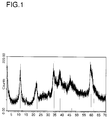
- the diagram shows the typical diffraction patterns of a compound with a hydrotalcite structure.
- the position of the diffraction lines of magnesium aluminum hydrotalcite (JCPDS file index 22-700) is outlined in Figure 1.
- the X-ray diffraction pattern of the material was recorded with Cu-K ⁇ radiation and is shown in Figure 2.
- the diagram shows the typical diffraction patterns of a compound with a hydrotalcite structure.
- the position of the diffraction lines of magnesium aluminum hydrotalcite (JCPDS file index 22-700) is outlined in Figure 2.
Landscapes
- Chemical & Material Sciences (AREA)
- Organic Chemistry (AREA)
- Inorganic Chemistry (AREA)
- Life Sciences & Earth Sciences (AREA)
- Environmental & Geological Engineering (AREA)
- General Life Sciences & Earth Sciences (AREA)
- Geology (AREA)
- Compounds Of Alkaline-Earth Elements, Aluminum Or Rare-Earth Metals (AREA)
- Compounds Of Iron (AREA)
- Solid-Sorbent Or Filter-Aiding Compositions (AREA)
Abstract
Titanverbindungen der Zusammensetzung [Me(II)1-x Tix Me(III)y (OH)2] Bz in der Me(II): ein 2-wertiges Metallion, Me(III): ein 3-wertiges Metallion, B: ein anorganisches oder organisches Anion, x: 0,05 bis 0,4, y: 0 bis 0,4 und; z: die Summe aus 1-x, x und y bedeuten, die eine Hydrotalcit-Struktur besitzt und das Titan zu 50 bis 100% in die Hydrotalcit-Schichten eingebaut ist, sowie ein Verfahren zu deren Herstellung.
Description
- Die vorliegende Erfindung betrifft neue Titan-Verbindungen mit Hydrotalcit-Struktur und ein Verfahren zu deren Herstellung.
- Aus Chimia 24 (1970), Seite 99 bis 108 und Catal. Today 11 (1991), Seite 173 bis 301 sind Hydrotalcit-Verbindungen (Anionische Tone, Anionic clays, Hydrotalcit-ähnliche Verbindungen, Layered double hydroxides = LDH, Feitknecht-Verbindungen oder Doppelschichtstrukturen), das sind Mischhydroxid-Salzen zwei- und dreiwertiger Metalle in Doppelschichtstrukturen mit brucitähnlichen Schichtionen der allgemeinen Formel [Me(II)1-x Me(III)x (OH)2]x+ Bz.
- Charakteristisch für alle Hydrotalcit-Verbindungen ist eine Struktur, welche aus positiv geladenen Mischhydroxid-Schichten (Polykationen) besteht, zwischen denen sich zum Ladungsausgleich Anionen befinden. Zwischen den positiv geladenen Einheiten befinden sich neben den Anionen in der Regel auch Lösungsmittelmoleküle.
- Die Struktur der Mischhydroxide, insbesondere der Abstand der Schichten voneinander, kann durch Röntgendiffraktometrie ermittelt werden. Diese Schichtabstände sind in der Regel von der Natur der Anionen B abhängig und können zwischen ca. 4 und 45 Å betragen.
- Bisher sind Hydrotalcit-Verbindungen bekannt, deren Schichten z.B. die Elemente Magnesium, Zink, Eisen, Kupfer, Nickel, Aluminium, Chrom, Scandium oder Kobalt enthalten, beschrieben.
- Aus Inorg. Chem. 32, 5000 (1993) sind Hydrotalcit-Verbindung bekannt, deren Schichten Vanadin enthalten.
- Titan-haltige Hydrotalcit-Verbindungen wurden bisher nicht beschrieben. In Catal. Today 11 (1991) Seite 173 bis 301 auf den Seiten 182 und 183 wird die Nichtexistenz dieser Verbindungen beschrieben und auf die Instabilität von Ti3+ zurückgeführt.
- Die bislang bekannten Hydrotalcit-Verbindungen lassen in ihren Eigenschaften zu wünschen übrig.
- Der vorliegenden Erfindung lag daher die Aufgabe zugrunde, den zuvor genannten Nachteilen abzuhelfen.
- Demgemäß wurden neue Titanverbindungen der Zusammensetzung
[Me(II)1-x Tix Me(III)y (OH)2] Bz (I)
in der - Me(II)
- ein 2-wertiges Metallion,
- Me(III)
- ein 3-wertiges Metallion,
- B
- ein anorganisches oder organisches Anion,
- x
- 0,05 bis 0,4,
- y
- 0 bis 0,4 und
- z
- die Summe aus 1-x, x und y bedeuten,
- Charakteristisch für die Titan-Verbindungen I ist ihre Hydrotalcit-Struktur, welche sich aus dem typischen Röntgendiffraktogramm ersehen läßt.
- Liegen die erfindungsgemäßen Titan-Verbindungen I in der Carbonat-Form vor (B = CO3 2-), so zeigen die Röntgendiffraktogramme der Verbindungen ein Beugungsmuster, welches dem Diffraktogramm des in der JCPDS-Datei als Index 22-700 gespeicherten Referenz-Hydrotalcits entspricht.
- Falls die erfindungsgemäßen Titan-Verbindungen I in einer anderen als der Carbonat-Form vorliegen und sich damit der Hydrotalcit-Schichtabstand ändert, können sich die Lage der Röntgenlinien (insbesondere der (003)- und des (006)-Peaks) in bekannter Weise verschieben. Für den Fachmann ist aber in jedem Fall das Vorliegen einer Hydrotalcit-Struktur aus dem typische Muster des Röntgendiffraktogramms ersichtlich (Catal. Today 11 (1991), Seiten 192 bis 194).
- Bei den erfindungsgemäßen Titan-Verbindungen I ist das Titan in der Regel ein Bestandteil der Hydrotalcit-Schichten, bevorzugt ist das Titan zu 50 bis 100%, bevorzugt zu 70 bis 100%, besonders zu 90 bis 100%, insbesondere zu 100% ein Bestandteil der Hydrotalcit-Schichten.
- Die Bestandteile und die Indizes der erfindungsgemäßen Titanverbindungen I haben folgende Bedeutungen:
- Me(II)
- ein 2-wertiges Metallion wie beispielsweise Magnesium, Zink, Nickel, Cobalt, Kupfer, Calcium oder deren Gemische, bevorzugt Magnesium, Zink, Calcium oder deren Gemische, besonders bevorzugt Magnesium,
- Me(III)
- ein 3-wertiges Metallion wie beispielsweise Aluminium, Eisen, Vanadin, Chrom oder deren Gemische, bevorzugt Aluminium,
- B
- ein anorganisches oder organisches Anion, beispielsweise anorganische Anionen wie Carbonat, Sulfat, Hydroxid, Chlorid, Nitrat oder deren Gemische, bevorzugt Carbonat, oder organische Anionen wie Acetat, Benzoat oder Terephthalat,
- x
- 0,05 bis 0,4, bevorzugt 0,07 bis 0,35, besonders bevorzugt 0,1 bis 0,3,
- y
- 0 bis 0,4, bevorzugt 0 bis 0,35, besonders bevorzugt 0 bis 0,3 und
- z
- die Summe aus 1-x, x und y.
- Es eignen sich im Prinzip alle Präparationsmethoden für Hydrotalcit-Verbindungen, beispielsweise diejenigen, die in Chimia 24 (1970), Seite 99 bis 108 und Catal. Today 11 (1991), Seite 173 bis 301 beschrieben sind. Besonders bevorzugt für die Herstellung ist die nachstehend beschriebene Methode der Fällung.
- Man kann eine Lösung A, die eine lösliche Titanverbindung sowie mindestens ein zweiwertiges Element in einer löslichen Verbindung enthält, mit einer Lösung B, die Hydroxidionen und gegebenenfalls weitere Anionen enthält, bei Temperaturen von 20 bis 150°C, bevorzugt 40 bis 120°C, besonders bevorzugt 50 bis 100°C und pH-Werten von 7 bis 14, bevorzugt 8 bis 12, besonders bevorzugt 8 bis 10 vereinigen. Die Titan-Verbindung mit Hydrotalcit-Struktur fällt in der Regel aus dieser Mischung aus und kann als reine Phase abgetrennt werden.
- In der Lösung A kann als Titanverbindung bevorzugt eine lösliche Titanverbindung wie z.B. Titan-(III)-chlorid oder Titan-(IV)-acetylacetonat, besonders bevorzugt Verbindungen des dreiwertigen Titans eingesetzt werden. Als zweiwertige Elemente [Me(II)] eignen sich beispielsweise Magnesium, Zink, Nickel, Cobalt, Kupfer, Calcium oder deren Gemische, bevorzugt Magnesium, Zink, Calcium oder deren Gemische z.B. in Form ihrer löslichen Chloride oder Nitrate. Besonders bevorzugt ist Magnesium. Zusätzlich kann die Lösung auch dreiwertige Elemente in löslicher Form enthalten, beispielsweise Aluminium, Eisen, Vanadin, Chrom oder deren Gemische, z.B. als lösliche Nitrate.
- Die Lösung B enthält in der Regel gelöstes Alkalihydroxid, bevorzugt in Wasser. Zusätzlich enthält die Lösung B in der Regel kann die Lösung ein oder mehrere zusätzliche Anionen in gelöster Form, beispielsweise anorganische Anionen wie Carbonat, Sulfat, Hydroxid, Chlorid, Nitrat oder deren Gemische, bevorzugt Carbonat, z.B. als Na2CO3 oder organische Anionen wie Acetat, Benzoat, Terephthalat oder deren Gemische.
- Um eine mögliche Oxidation der Komponenten in den Lösungen A und B zu unterdrücken, werden diese Lösungen in der Regel im wesentlichen in Abwesenheit von Sauerstoff, bevorzugt in sauerstoffreier Atmosphäre, besonders bevorzugt in sauerstoffreier Atmosphäre und in sauerstoffreiem Lösungsmittel, bevorzugt Wasser hergestellt und umgesetzt.
- Die beiden Lösungen A und B werden in der Regel bei Temperaturen von 20 bis 150°C, bevorzugt 40 bis 120°C, besonders bevorzugt 50 bis 100°C und konstanten oder variablen pH-Werten von 7 bis 14, bevorzugt 7,5 bis 12, besonders bevorzugt 8 bis 10 vereinigt. Dies geschieht in der Regel so, daß die beiden Lösungen unter intensivem Rühren miteinander gemischt werden. Dabei fallen die erfindungsgemäßen Titan-Verbindungen I in der Regel aus.
- Der Fällung kann ein Alterungsschritt und/oder eine hydrothermale Behandlung, z.B. in einem Autoklaven angeschlossen werden. Der erhaltene Niederschlag kann nach bekannten Methoden abgetrennt, z.B. abfiltriert und gewaschen werden.
- Die Titan-haltige Verbindung mit Hydrotalcit-Struktur kann - wie für Hydrotalcit-Verbindungen charakteristisch - in vielfacher Weise nachträglich modifiziert werden. So ist beispielsweise ein Anionenaustausch, eine Temperaturbehandlung oder eine Behandlung mit einem organischen Additiv (z.B. zur Hydrophobierung) möglich.
- Anionenaustausch und Temperaturbehandlung von Hydrotalcit-Verbindungen sind z.B. analog Catal. Today 11 (1991), Seite 173 bis 301 möglich. Die Modifikation von Hydrotalcit-Verbindungen mit organischen Additiven ist z.B. in DE-A-43 25 237 beschrieben.
- Derartige Modifikationen können die Eigenschaften der Verbindung, insbesondere die Adsorptions- und katalytischen Eigenschaften der Verbindung, wesentlich beeinflussen.
- Neben der Herstellung von Hydrotalcit-Verbindungen durch Fällung gibt es auch weitere Synthese-Möglichkeiten dieser Verbindungen. Beispielsweise können die Verbindungen auch ausgehend von reinen Metalloxiden präpariert werden.
- Die erfindungsgemäßen Titan-Verbindungen mit Hydrotalcit-Struktur können, gegebenenfalls nach einer der oben angeführten Modifikationen, als Adsorbentien, Katalysatoren - insbesondere als Oxidationskatalysatoren - oder als Stabilisatoren (z.B. für Kunststoffe) eingesetzt werden.
- Für alle Lösungen wurde sauerstofffreies Wasser eingesetzt und alle Operationen wurden unter inerter Atmosphäre durchgeführt.
- 200 ml einer Mischung aus einer 0,5-molaren Titanchlorid- und einer 1-molaren Magnesiumchloridlösung, wurde tropfenweise zu 250 ml einer Mischung aus einer 0,8-molaren Natriumcarbonat- und einer 2,8-molaren Natriumhydroxidlösung zugegeben, 2 Stunden bei Raumtemperatur gerührt und 4 Tage bei 150°C in einem Autoklaven hydrothermal behandelt. Anschließend wurde der Feststoff filtriert, gewaschen und bei 120°C 5 Stunden getrocknet. Die chemische Analyse des Niederschlags ergab 12,5 Gew.-% Titan und 23 Gew.-% Magnesium, woraus sich als Zusammensetzung [Mg6Ti2(OH)16]CO3 · 4 H2O ergab.
- Das Röntgenbeugungsdiagramm des Materials wurde mit Cu-Kα-Strahlung aufgenommen und ist in Abbildung 1 dargestellt.
- Das Diagramm zeigt die typische Beugungsmuster einer Verbindung mit Hydrotalcit-Struktur. Zum Vergleich ist in Abbildung 1 die Lage der Beugungslinien von Magnesium-Aluminium-Hydrotalcit (JCPDS-Datei Index 22-700) skizziert.
- Die auf 80°C erwärmten Mischung aus 100 ml einer 2-molaren Titan-(III)-chlorid- und 100 ml einer 2-molaren Aluminiumchloridlösung, die zu 600 ml einer 2-molaren Magnesiumchloridlösung gegeben wurde eine Mischung aus 160 g Natriumhydroxid und 42,4 g Natriumcarbonat gelöst in 1000 ml Wasser wurden bei einem annähernd kostanten pH-Wert von 9 innerhalb 30 Minuten zusammengegeben, 2 Stunden bei 80°C gerührt, abfiltriert, gewaschen und bei 120°C 5 Stunden getrocknet. Man erhielt 162,3 g eines weißes Pulvers, das nach chemischer Analyse 7,5 Gew.-% Titan, 4,2 Gew.-% Aluminium und 23,1 Gew.-% Magnesium aufwies, woraus sich als Zusammensetzung [Mg6TiAl(OH)16]CO3 · 4 H2O ergab.
- Das Röntgenbeugungsdiagramm des Materials wurde mit Cu-Kα-Strahlung aufgenommen und ist in Abbildung 2 dargestellt.
- Das Diagramm zeigt die typische Beugungsmuster einer Verbindung mit Hydrotalcit-Struktur. Zum Vergleich ist in Abbildung 2 die Lage der Beugungslinien von Magnesium-Aluminium-Hydrotalcit (JCPDS-Datei Index 22-700) skizziert.
Claims (9)
- Titanverbindungen der Zusammensetzung
[Me(II)1-x Tix Me(III)y (OH)2] Bz (I)
in derMe(II) ein 2-wertiges Metallion,Me(III) ein 3-wertiges Metallion,B ein anorganisches oder organisches Anion,x 0,05 bis 0,4,y 0 bis 0,4 undz die Summe aus 1-x, x und y bedeuten,dadurch gekennzeichnet, daß die Verbindung eine Hydrotalcit-Struktur besitzt und das Titan zu 50 bis 100% in die Hydrotalcit-Schichten eingebaut ist. - Titanverbindungen nach Anspruch 1, dadurch gekennzeichnet, daß Me(II) für Magnesium, Zink, Nickel, Cobalt, Kupfer, Calclium oder deren Gemische, Me(III) für Aluminium, Eisen, Vanadin, Chrom oder deren Gemische und B für Carbonat, Sulfat, Hydroxid, Chlorid, Nitrat, Acetat, Benzoat, Terephthalat oder deren Gemische steht.
- Titanverbindungen nach den Ansprüchen 1 und 2, dadurch gekennzeichnet, daß Me(II) für Magnesium steht.
- Titanverbindungen nach den Ansprüchen 1 bis 3, dadurch gekennzeichnet, daß Me(III) für Aluminium steht.
- Titanverbindungen nach den Ansprüchen 1 bis 4, dadurch gekennzeichnet, daß B für Carbonat steht.
- Verfahren zur Herstellung von Titan-Verbindungen mit Hydrotalcit-Struktur nach den Ansprüchen 1 bis 5, dadurch gekennzeichnet, daß man eine Lösung, die mindestens eine gelöste Titanverbindung und mindestens eine Verbindung eines zweiwertigen Metalls enthält, mit einer Lösung, die mindestens Hydroxidionen enthält, bei einem pH-Wert 7 bis 14 umsetzt.
- Verfahren zur Herstellung von Titan-Verbindungen mit Hydrotalcit-Struktur nach Anspruch 6, dadurch gekennzeichnet, daß man die Lösungen bei einem pH-Wert 7,5 bis 12 umsetzt.
- Verfahren zur Herstellung von Titan-Verbindungen mit Hydrotalcit-Struktur nach den Ansprüchen 6 und 7, dadurch gekennzeichnet, daß man als lösliche Titanverbindungen Verbindungen des dreiwertigen Titans einsetzt.
- Verfahren zur Herstellung von Titan-Verbindungen mit Hydrotalcit-Struktur nach den Ansprüchen 6 und 8, dadurch gekennzeichnet, daß man die Umsetzung im wesentlichen in Abwesenheit von Sauerstoff durchführt.
Applications Claiming Priority (2)
| Application Number | Priority Date | Filing Date | Title |
|---|---|---|---|
| DE19523053 | 1995-06-24 | ||
| DE19523053A DE19523053A1 (de) | 1995-06-24 | 1995-06-24 | Titan-Verbindungen mit Hydrotalcit-Struktur |
Publications (1)
| Publication Number | Publication Date |
|---|---|
| EP0749941A1 true EP0749941A1 (de) | 1996-12-27 |
Family
ID=7765207
Family Applications (1)
| Application Number | Title | Priority Date | Filing Date |
|---|---|---|---|
| EP96109673A Withdrawn EP0749941A1 (de) | 1995-06-24 | 1996-06-17 | Titan-Verbindungen mit Hydrotalcit-Struktur |
Country Status (2)
| Country | Link |
|---|---|
| EP (1) | EP0749941A1 (de) |
| DE (1) | DE19523053A1 (de) |
Cited By (2)
| Publication number | Priority date | Publication date | Assignee | Title |
|---|---|---|---|---|
| EP2174926A2 (de) | 2008-10-08 | 2010-04-14 | Bayer MaterialScience AG | Verfahren zur Herstellung von Diarylcarbonaten |
| KR101028350B1 (ko) * | 2010-04-08 | 2011-04-11 | 신원산업 주식회사 | 층상 구조의 Mg-Ti-Al 복합금속 수산화물 및 이의 제조방법 |
Citations (3)
| Publication number | Priority date | Publication date | Assignee | Title |
|---|---|---|---|---|
| EP0547666A1 (de) * | 1991-12-18 | 1993-06-23 | Unilever N.V. | Mineralien, die Metall-Ionen mit antibakterieller Wirkung freisetzen |
| WO1994014700A1 (en) * | 1992-12-21 | 1994-07-07 | Amoco Corporation | Method for preparing synthesis gas using nickel catalysts |
| WO1995021127A1 (de) * | 1994-02-03 | 1995-08-10 | Chemson Polymer-Additive Gesellschaft Mbh | Basische schichtgitterverbindungen |
-
1995
- 1995-06-24 DE DE19523053A patent/DE19523053A1/de not_active Withdrawn
-
1996
- 1996-06-17 EP EP96109673A patent/EP0749941A1/de not_active Withdrawn
Patent Citations (3)
| Publication number | Priority date | Publication date | Assignee | Title |
|---|---|---|---|---|
| EP0547666A1 (de) * | 1991-12-18 | 1993-06-23 | Unilever N.V. | Mineralien, die Metall-Ionen mit antibakterieller Wirkung freisetzen |
| WO1994014700A1 (en) * | 1992-12-21 | 1994-07-07 | Amoco Corporation | Method for preparing synthesis gas using nickel catalysts |
| WO1995021127A1 (de) * | 1994-02-03 | 1995-08-10 | Chemson Polymer-Additive Gesellschaft Mbh | Basische schichtgitterverbindungen |
Cited By (6)
| Publication number | Priority date | Publication date | Assignee | Title |
|---|---|---|---|---|
| EP2174926A2 (de) | 2008-10-08 | 2010-04-14 | Bayer MaterialScience AG | Verfahren zur Herstellung von Diarylcarbonaten |
| DE102008050828A1 (de) | 2008-10-08 | 2010-04-15 | Bayer Materialscience Ag | Verfahren zur Herstellung von Diarylcarbonaten |
| KR101028350B1 (ko) * | 2010-04-08 | 2011-04-11 | 신원산업 주식회사 | 층상 구조의 Mg-Ti-Al 복합금속 수산화물 및 이의 제조방법 |
| WO2011126168A1 (ko) * | 2010-04-08 | 2011-10-13 | 신원화학 주식회사 | 층상 구조의 Mg-Ti-Al 복합금속 수산화물 및 이의 제조방법 |
| CN102884001A (zh) * | 2010-04-08 | 2013-01-16 | 信元化学株式会社 | 具有层状结构的Mg-Ti-Al复合金属氢氧化物及其制造方法 |
| US8623320B2 (en) | 2010-04-08 | 2014-01-07 | Shin Won Chemical Co., Ltd. | Mg-Ti-Al composite metal hydroxide having a laminated structure, and a production method therefore |
Also Published As
| Publication number | Publication date |
|---|---|
| DE19523053A1 (de) | 1997-01-02 |
Similar Documents
| Publication | Publication Date | Title |
|---|---|---|
| DE69126759T2 (de) | Schichtenförmige doppelhydroxide mit zwischengeschalteten polyoxometalaten | |
| EP0807086B1 (de) | Verfahren zur herstellung von hydrotalciten | |
| DE3485888T2 (de) | Synthetische expandierte schichtminerale und verfahren zu ihrer herstellung. | |
| DE69633437T2 (de) | Anorganische binder | |
| DE2302658C3 (de) | Verfahren zur Herstellung eines Kupfer-Trägerkatalysators | |
| DE2748097C2 (de) | Verfahren zur Herstellung von primären, gesättigten und geradkettigen Alkoholen | |
| DE69214079T2 (de) | Vereinfachte Herstellung von hydrotalcit-ähnlichen Tonen | |
| DE2061114C2 (de) | Verfahren zur Herstellung von zusammengesetzten Metallhydroxyden mit einer Schichtkristallstruktur | |
| DE60007533T2 (de) | Polytypisches magnesiumaluminiumhydrotalcit | |
| DE60224006T2 (de) | Verfahren zur herstellung von anionischer tonerde und böhmit-enthaltenden zusammensetzungen, zusammensetzungen die anionische tonerde und böhmit enthalten und daraus hergestellte katalysatoren | |
| DE2730228A1 (de) | Waermebestaendiger aluminiumoxid- aluminiumphosphat-verbundniederschlag und verfahren zur herstellung desselben | |
| DD157669A5 (de) | Katalysator und verfahren zur herstellung desselben | |
| DE69105630T2 (de) | Verfahren zur Herstellung von Methacrolein. | |
| DE60038236T2 (de) | Verfahren zur herstellung von nicht-aluminiumenthaltenden anionischen magnesiumtonerden | |
| DE2112144C3 (de) | Verfahren zur Herstellung eines Katalysators für die Oxidation von Methanol zu Formaldehyd | |
| DE3228482A1 (de) | Verfahren zur reaktion von kohlenmonoxid mit wasserdampf unter bildung von kohlendioxid und wasserstoff und verwendung eines katalysators hierfuer | |
| DE3006262C2 (de) | Verfahren zur Herstellung von fasrigen Titansäure-Metallsalzen | |
| EP0091640B1 (de) | Verfahren zur Herstellung von Ferriten aus Eisen(II)-Sulfat | |
| DE4203220A1 (de) | Verfahren zur herstellung von cyclohexen durch partielle hydrierung von benzol | |
| DE60201577T2 (de) | In situ geformte, anionischen ton enthaltende körper | |
| DE3111401A1 (de) | "stabiler molybdaenkatalysator zur umwandlung von c(pfeil abwaerts)3(pfeil abwaerts)- und c(pfeil abwaerts)4(pfeil abwaerts)-olefinen in ungesaettigte aldehyde und saeuren" | |
| EP0634990B1 (de) | Chromfreier katalysator auf basis eisenoxid zur konvertierung von kohlenmonoxid | |
| DE2922235A1 (de) | Verfahren zum herstellen von kobaltmetallpulver in extrafeiner koernchengroesse | |
| DE19523053A1 (de) | Titan-Verbindungen mit Hydrotalcit-Struktur | |
| DE69108488T2 (de) | Verfahren und Katalysator zur Herstellung aromatischer Verbindungen. |
Legal Events
| Date | Code | Title | Description |
|---|---|---|---|
| PUAI | Public reference made under article 153(3) epc to a published international application that has entered the european phase |
Free format text: ORIGINAL CODE: 0009012 |
|
| 17P | Request for examination filed |
Effective date: 19961014 |
|
| AK | Designated contracting states |
Kind code of ref document: A1 Designated state(s): BE DE FR GB NL |
|
| 17Q | First examination report despatched |
Effective date: 19970625 |
|
| STAA | Information on the status of an ep patent application or granted ep patent |
Free format text: STATUS: THE APPLICATION HAS BEEN WITHDRAWN |
|
| 18W | Application withdrawn |
Withdrawal date: 19971025 |