EP0747366B1 - Durch nichtkatalytisches, unter Hochdruck arbeitendes Verfahren hergestelltes Melamin von verbesserter Reinheit - Google Patents
Durch nichtkatalytisches, unter Hochdruck arbeitendes Verfahren hergestelltes Melamin von verbesserter Reinheit Download PDFInfo
- Publication number
- EP0747366B1 EP0747366B1 EP96303675A EP96303675A EP0747366B1 EP 0747366 B1 EP0747366 B1 EP 0747366B1 EP 96303675 A EP96303675 A EP 96303675A EP 96303675 A EP96303675 A EP 96303675A EP 0747366 B1 EP0747366 B1 EP 0747366B1
- Authority
- EP
- European Patent Office
- Prior art keywords
- melamine
- pressure
- temperature
- liquid
- psi
- Prior art date
- Legal status (The legal status is an assumption and is not a legal conclusion. Google has not performed a legal analysis and makes no representation as to the accuracy of the status listed.)
- Revoked
Links
- JDSHMPZPIAZGSV-UHFFFAOYSA-N melamine Chemical compound NC1=NC(N)=NC(N)=N1 JDSHMPZPIAZGSV-UHFFFAOYSA-N 0.000 title claims abstract description 81
- 229920000877 Melamine resin Polymers 0.000 title claims abstract description 78
- 238000000034 method Methods 0.000 title claims abstract description 28
- 230000003197 catalytic effect Effects 0.000 title claims abstract description 9
- QGZKDVFQNNGYKY-UHFFFAOYSA-N Ammonia Chemical compound N QGZKDVFQNNGYKY-UHFFFAOYSA-N 0.000 claims abstract description 46
- 239000007788 liquid Substances 0.000 claims abstract description 32
- XSQUKJJJFZCRTK-UHFFFAOYSA-N Urea Chemical compound NC(N)=O XSQUKJJJFZCRTK-UHFFFAOYSA-N 0.000 claims abstract description 27
- 239000004202 carbamide Substances 0.000 claims abstract description 27
- 238000001816 cooling Methods 0.000 claims abstract description 25
- 238000005406 washing Methods 0.000 claims abstract description 4
- 239000000047 product Substances 0.000 claims description 23
- CURLTUGMZLYLDI-UHFFFAOYSA-N Carbon dioxide Chemical compound O=C=O CURLTUGMZLYLDI-UHFFFAOYSA-N 0.000 claims description 18
- 239000007789 gas Substances 0.000 claims description 15
- 238000010791 quenching Methods 0.000 claims description 11
- 230000000171 quenching effect Effects 0.000 claims description 9
- 239000007787 solid Substances 0.000 claims description 8
- 229910000069 nitrogen hydride Inorganic materials 0.000 claims description 6
- YZEZMSPGIPTEBA-UHFFFAOYSA-N 2-n-(4,6-diamino-1,3,5-triazin-2-yl)-1,3,5-triazine-2,4,6-triamine Chemical compound NC1=NC(N)=NC(NC=2N=C(N)N=C(N)N=2)=N1 YZEZMSPGIPTEBA-UHFFFAOYSA-N 0.000 claims description 5
- YSRVJVDFHZYRPA-UHFFFAOYSA-N melem Chemical compound NC1=NC(N23)=NC(N)=NC2=NC(N)=NC3=N1 YSRVJVDFHZYRPA-UHFFFAOYSA-N 0.000 claims description 5
- 239000007795 chemical reaction product Substances 0.000 claims description 4
- 238000010924 continuous production Methods 0.000 claims description 2
- 238000000746 purification Methods 0.000 claims description 2
- 238000005201 scrubbing Methods 0.000 claims description 2
- 238000001953 recrystallisation Methods 0.000 abstract description 5
- 239000000843 powder Substances 0.000 abstract description 3
- 229910021529 ammonia Inorganic materials 0.000 description 18
- 229910002092 carbon dioxide Inorganic materials 0.000 description 10
- 239000012535 impurity Substances 0.000 description 10
- 239000001569 carbon dioxide Substances 0.000 description 7
- 230000015572 biosynthetic process Effects 0.000 description 4
- 238000006243 chemical reaction Methods 0.000 description 4
- 239000000126 substance Substances 0.000 description 4
- 239000006227 byproduct Substances 0.000 description 3
- 238000002844 melting Methods 0.000 description 3
- 230000008018 melting Effects 0.000 description 3
- MASBWURJQFFLOO-UHFFFAOYSA-N ammeline Chemical compound NC1=NC(N)=NC(O)=N1 MASBWURJQFFLOO-UHFFFAOYSA-N 0.000 description 2
- 238000009835 boiling Methods 0.000 description 2
- 239000003054 catalyst Substances 0.000 description 2
- 239000003795 chemical substances by application Substances 0.000 description 2
- 230000001627 detrimental effect Effects 0.000 description 2
- 238000010586 diagram Methods 0.000 description 2
- 239000013067 intermediate product Substances 0.000 description 2
- 239000000203 mixture Substances 0.000 description 2
- 238000003786 synthesis reaction Methods 0.000 description 2
- -1 99+ percent Chemical compound 0.000 description 1
- KXDHJXZQYSOELW-UHFFFAOYSA-M Carbamate Chemical compound NC([O-])=O KXDHJXZQYSOELW-UHFFFAOYSA-M 0.000 description 1
- 229910000975 Carbon steel Inorganic materials 0.000 description 1
- LFQSCWFLJHTTHZ-UHFFFAOYSA-N Ethanol Chemical compound CCO LFQSCWFLJHTTHZ-UHFFFAOYSA-N 0.000 description 1
- JHEXGENUDVZLKI-UHFFFAOYSA-N [(4,6-diamino-1,3,5-triazin-2-yl)amino]urea Chemical compound NC(=O)NNC1=NC(N)=NC(N)=N1 JHEXGENUDVZLKI-UHFFFAOYSA-N 0.000 description 1
- PNEYBMLMFCGWSK-UHFFFAOYSA-N aluminium oxide Inorganic materials [O-2].[O-2].[O-2].[Al+3].[Al+3] PNEYBMLMFCGWSK-UHFFFAOYSA-N 0.000 description 1
- YSKUZVBSHIWEFK-UHFFFAOYSA-N ammelide Chemical compound NC1=NC(O)=NC(O)=N1 YSKUZVBSHIWEFK-UHFFFAOYSA-N 0.000 description 1
- 238000004458 analytical method Methods 0.000 description 1
- 125000001951 carbamoylamino group Chemical group C(N)(=O)N* 0.000 description 1
- 239000010962 carbon steel Substances 0.000 description 1
- 238000010960 commercial process Methods 0.000 description 1
- 239000000110 cooling liquid Substances 0.000 description 1
- 238000005260 corrosion Methods 0.000 description 1
- 230000007797 corrosion Effects 0.000 description 1
- 238000002425 crystallisation Methods 0.000 description 1
- 230000008025 crystallization Effects 0.000 description 1
- 230000009615 deamination Effects 0.000 description 1
- 238000006481 deamination reaction Methods 0.000 description 1
- 238000005516 engineering process Methods 0.000 description 1
- 239000012065 filter cake Substances 0.000 description 1
- 238000001914 filtration Methods 0.000 description 1
- 238000010438 heat treatment Methods 0.000 description 1
- 238000004519 manufacturing process Methods 0.000 description 1
- 239000000155 melt Substances 0.000 description 1
- 238000010926 purge Methods 0.000 description 1
- 239000000376 reactant Substances 0.000 description 1
- 229920006395 saturated elastomer Polymers 0.000 description 1
- 238000004062 sedimentation Methods 0.000 description 1
- 238000007086 side reaction Methods 0.000 description 1
- XLYOFNOQVPJJNP-UHFFFAOYSA-N water Substances O XLYOFNOQVPJJNP-UHFFFAOYSA-N 0.000 description 1
Images

Classifications
-
- C—CHEMISTRY; METALLURGY
- C07—ORGANIC CHEMISTRY
- C07D—HETEROCYCLIC COMPOUNDS
- C07D251/00—Heterocyclic compounds containing 1,3,5-triazine rings
- C07D251/02—Heterocyclic compounds containing 1,3,5-triazine rings not condensed with other rings
- C07D251/12—Heterocyclic compounds containing 1,3,5-triazine rings not condensed with other rings having three double bonds between ring members or between ring members and non-ring members
- C07D251/26—Heterocyclic compounds containing 1,3,5-triazine rings not condensed with other rings having three double bonds between ring members or between ring members and non-ring members with only hetero atoms directly attached to ring carbon atoms
- C07D251/40—Nitrogen atoms
- C07D251/54—Three nitrogen atoms
- C07D251/56—Preparation of melamine
- C07D251/60—Preparation of melamine from urea or from carbon dioxide and ammonia
Definitions
- the present invention is directed to a high-pressure, non-catalytic, non-aqueous process for producing melamine from urea wherein the melamine is recovered directly as a dry powder without washing or recrystallization. More particularly, the present invention is directed to an improvement wherein the melamine as provided has consistently a purity of 99.0% by weight or above.
- Melamine is commercially produced by heating urea to provide melamine and ammonia and carbon dioxide as by products.
- the basic reaction is The commercial processes are either high-pressure, non-catalytic or low-pressure and catalytic using a catalyst such as alumina.
- a catalyst such as alumina.
- catalytic processes the melamine is recovered in an impure form and, subsequently, recrystallized using a chemical treatment to provide melamine which is essentially 100% pure. Similar, chemical treatment and recrystallization steps were used in producing pure melamine with the high-pressure, non-catalytic process.
- United States Patent Specification No. 4,565,867 describes a high-pressure process wherein the melamine is recovered at a relatively high purity and used in that form without a crystallization step. The process is highly efficient and provides a low cost. melamine.
- urea melt is fed into a scrubber unit at from about 103.4 to 172.4 bar (1500 to 2500 psi) pressure, preferably from about 117.2 to 151.7 bar (1700 to 2200 psi), and at a temperature above the melting point of urea.
- the liquid urea contacts reaction offgases principally composed of CO 2 and NH 3 and containing melamine. The urea, in molten condition, scrubs the melamine from the offgas.
- the offgases are cooled from about the temperature of the reactor, i.e., from about 354 to 427°C (670° to 800°F) to from about 177 to 232°C (350° to 450°F).
- the temperature and pressure are interrelated.
- the minimum temperature of the scrubber will vary from about 177 to 182°C (350° to 360°F); whereas if the scrubber is at the high end of the pressure range, i.e., 137.9 to 151.7 bar (2000 to 2200 psi), the minimum temperature can be increased to about 182 to 193°C (360° to 380°F).
- the minimum temperature ammonia and CO 2 condense in the bottom of the scrubber and may form carbamate which can be detrimental.
- the higher the pressure the higher the required minimum temperature. Above about 260°C (500°F) the urea may react to form intermediate products. These intermediate products can be detrimental.
- a gas separator is provided in the system wherein liquid melamine is separated from offgases, and liquid melamine is collected in the bottom of the separator.
- the separator is held at a temperature above the melting point of melamine.
- the gaseous ammonia and carbon dioxide saturated with melamine vapor are removed overhead and fed into the urea scrubber.
- the liquid melamine is removed from the gas separator on level control and injected into a product cooling unit.
- a unique feature of the process described in the '867 patent is the cooling unit wherein liquid melamine recovered from the separator is depressurized and rapidly cooled with a liquid medium which will form a gas at the temperature of the liquid melamine.
- the liquid melamine is directly converted to a solid powder having a high purity without washing or further purification.
- the liquid quenching agent is a low boiling liquid which gasifies with the gas being readily separated from the solid melamine product. Suitable quenching agents are ammonia, water, or a low boiling alcohol.
- the pressure of the quenching can be atmospheric pressure or a pressure up to about 41.4 bar (600 psi). According to the '867 patent, it was preferred to operate at a pressure of about 13.8 to 27.6 bar (200 to 400 psi) and a temperature of from about 49 to 74°C (120° to 165°F).
- the pressure as above defined, is the same in the scrubber, reactor, and gas separator.
- the offgases removed from the gas separator are at the same temperature as the reactor and separator until they reach the scrubber where they are cooled in the process of being scrubbed with the molten urea.
- the liquid melamine transferred from the gas separator enters the product cooling unit at the same temperature range as the reactor and gas separator.
- the process of the '867 patent has produced melamine in the range of 96 to 99.5% by weight melamine which contains low levels of melem and melam
- the process of the '867 patent in commercial operation has only produced melamine in the range of about 97.5% by weight with the main impurities being melem, melam, ureidomelamine and ammeline.
- this product is usable in most melamine markets, it is limited in some because of the impurities.
- the impurities are removed by using a chemical treatment and then a recrystallization process. The impurities are converted to components that can be removed from the product by either filtration or sedimentation or both. This reduces the yield of melamine from urea by removing these impurities and also increases the disposal cost by having to dispose of the filter cake.
- melamine melt or liquid melamine
- the liquid is rapidly cooled and depressurized using a liquid medium that is a vapor at the conditions of the cooling unit, preferably ammonia. Dry melamine powder is formed. The melamine powder is removed from the bottom of the product cooling unit.
- the product cooling unit is preferably maintained at a temperature below the melt point of melamine and the reaction temperature of urea. The minimum temperature is the vapor temperature equilibrium of the cooling liquid.
- the pressure of the cooling unit is the critical feature of the present invention along with the rapid cooling of the melamine.
- a pressure of at least 41.4 bar (600 psi) is essential to prevent the formation of melam, melem, and the other impurities to obtain melamine of 99+ percent purity.
- the preferred pressure is a pressure from about 82.7 to 110.3 bar (1200 to about 1600 psi). It is theorized that the high pressure prevents side reactions and deamination as the rapid quench and cooling occurs, and in this way prevents the formation of any unwanted impurities.
- FIGURE 1 diagrammatically illustrates the present invention.
- Urea is fed through line 20 to scrubber unit 22 at a temperature above the melting point of urea, and preferably at about 138°C (280°F); and at a pressure of from about 117.2 to 241.3 bar (1700 to 3500 psi).
- scrubber unit 22 is also fed through line 23 with offgases from separator 24.
- the offgases consisting primarily of ammonia, carbon dioxide and melamine, will be at a temperature of approximately 371 to 427°C (700° to 800°F), and at a pressure of from about 117.2 to 241.3 bar (1700 to 3500 psi), i.e., the reaction conditions of the reactor and separator unit.
- the stream composition from the separator unit will be approximately 45 to 65% ammonia, 30 to 50% carbon dioxide, and 3 to 10% melamine.
- The-molten urea will be used to "scrub" the melamine from the offgases, giving off heat energy to preheat the urea and reducing the temperature of the offgases to about 177 to 232°C (350 to 450°F).
- the urea containing the melamine will settle at the bottom of the scrubber 22.
- the purified ammonia and carbon dioxide gases at the reduced temperature is fed through line 26 to a urea plant for utilization in producing urea, or any unit that utilizes the NH 3 /CO 2 blend or separates it so that the ammonia can be used.
- the scrubber bottoms are removed from the bottom of the scrubber and fed through line 27 by means of a pump 28 at a temperature of from about 177 to 232°C (350° to 450°F), and a pressure of from about 117.2 to 241.3 bar (1700 to 3500 psi) into reactor 29.
- Ammonia from a suitable ammonia source is pumped through line 32 into the urea stream from the scrubber.
- the hot ammonia which is injected into the line carrying the scrubber bottoms acts as a purge to keep the bottom of the reactor from plugging and supplies excess ammonia to react with any deammoniation product which may be present.
- the reactor will also be maintained at an operating temperature of from about 371 to 427°C (700° to 800°F), and a pressure of from 117.2 to 241.3 bar (1700 to 3500 psi).
- the reactor which is resistant to corrosion, i.e., titanium-clad carbon steel; preferably includes means to circulate the reactant within the reactor.
- the preferred reactor temperature is about 410°C (770°F) and the preferred pressure is 137.9 bar (2000 psi).
- the reactor is temperature controlled using conventional heat control systems including thermo-couples.
- the product of the reactor comprised primarily of ammonia, carbon dioxide and melamine, is fed to gas separator 24.
- the reaction product is released into the top of the separator.
- the gaseous by-products consisting of ammonia, carbon dioxide and melamine which are fed to the scrubber unit 22 through line 23 are removed from the top of the separator.
- Liquid melamine is removed from substantially the bottom one-third of the separator controlled by level indicator at a temperature of approximately 371 to 427°C (700° to 800°F), and a pressure of about 117.2 to 241.3 bar (1700 to 3500 psi), and fed through line 36 to the product cooling unit 38.
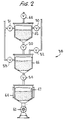
- the product cooling unit comprises three compartments 45, 46 and 47.
- the liquid melamine from line 36 is let down through valve 44 into compartment 45 with liquid ammonia being simultaneously flushed into compartment 45 through line 40 to quench and rapidly cool the liquid melamine to provide solid melamine.
- Ammonia is cooled and recirculated from compartment 45 through valve 51.
- the pressure within compartment 45 after quenching is at approximately 82.7 bar (1200 psi) and at a temperature of 177 to 232°C (350° to 450°F).
- the pressure of compartments 45 and 46 is equalized by feeding ammonia vapor through valve 52 into compartment 46. When the two compartments are at an equal pressure, the solid melamine is let down from compartment 45 into compartment 46 through valve 50.
- valve 50 is closed and the pressure within compartment 46 is reduced to atmospheric by releasing ammonia through valve 53 for recirculation.
- valve 54 is opened and the solid melamine product is continuously removed from compartment 47 through a rotary valve 60 controlled by a level control 64.
- the melamine product is released through rotary valve 60 onto a suitable conveyor 66 for subsequent bagging or the like.
- Sample No. 1 is a process as defined in the '867 patent where the cooling unit is at a pressure of about 41.4 bar (600 psi) and at a temperature of about 66°C (150°F).
- Samples Nos. 2 through 6 are produced according to the present invention, where the pressure within the cooling unit is in the range of 51.2 to 96.5 bar (800 to 1400 psi) and at a temperature of about 177 to 232°C (350° to 450°F).
- the level of impurities is substantially reduced. This level of reduction of impurities is surprising and is unexpected, providing an enhanced commercial system.
- Sample No. 1 is a process as defined in the '867 patent where the cooling unit is at a pressure of about 41.4 bar (600 psi) and at a temperature of about 66°C (150°F).
- Samples Nos. 2 through 6 are produced according to the present invention, where the pressure within the cooling unit is in the range of 51.2 to 96.5 bar (800 to 1400 p
- the present invention is not directed to any specific high temperature process but, preferably, is a high pressure process such as described in the '867 patent.
- the invention can be utilized, however, with other high-pressure, non-catalyst systems.
Landscapes
- Chemical & Material Sciences (AREA)
- Organic Chemistry (AREA)
- Organic Low-Molecular-Weight Compounds And Preparation Thereof (AREA)
- Phenolic Resins Or Amino Resins (AREA)
- Catalysts (AREA)
- Low-Molecular Organic Synthesis Reactions Using Catalysts (AREA)
- Chemical And Physical Treatments For Wood And The Like (AREA)
Claims (9)
- Kontinuierliches Verfahren zum Herstellen von Melamin aus Harnstoff, welches umfasst: Pyrolysieren von Harnstoff in einem Reaktor bei einem Druck von etwa 103,4 bis 241,3 bar (1500 bis 3500 psi) und bei einer Temperatur von etwa 354 bis 454°C (670° bis 850°F), um ein Umsetzungsprodukt herzustellen, welches flüssiges Melamin, CO2 und NH3 enthält; Übertragen des besagten Umsetzungsprodukts unter Druck als einen gemischten Strom auf eine Abscheidereinheit; Halten der besagten Abscheidereinheit bei im Wesentlichen dem gleichen Druck und der gleichen Temperatur wie besagter Reaktor; Trennen des besagten Umsetzungsprodukts in besagter Abscheidereinheit in CO2- und NH3-Abgase, welche Melamindämpfe enthalten, und flüssiges Melamin; gleichzeitig Übertragen vonund dadurch gekennzeichnet, dass die Kühleinheit bei einem Druck über 41,4 bar (600 psi) gehalten wird, um ein kommerziell brauchbares, festes Melaminprodukt mit einer Reinheit über 99% ohne Waschen oder weitere Reinigung herzustellen.(a) besagten CO2- und NH3-Abgasen, welche Melamin enthalten, bei einer Temperatur und einem Druck von im Wesentlichen der/dem gleichen, wie besagter Temperatur und besagtem Druck der besagten Abscheidereinheit, auf eine Gaswäschereinheit und Waschen besagter Abgase mit geschmolzenem Harnstoff, um besagten Harnstoff vorzuheizen und besagte Abgase zu kühlen und daraus das besagte Melamin zu entfernen, und danach Entfernen von NH3- und CO2-Gasen aus besagter Gaswäschereinheit bei einer Temperatur von etwa 177 bis 232°C (350° bis 450°F) und Einspeisen von besagtem vorgeheizten geschmolzenen Harnstoff, welcher besagtes Melamin enthält, in besagten Reaktor, und(b) besagtem flüssigen Melamin auf eine Produktkühleinheit; und Druck ablassen und Löschen von besagtem flüssigen Melamin mit einem flüssigen Medium, welches bei der Temperatur von besagtem flüssigen Melamin in besagter Produktkühleinheit ein Gas bilden wird,
- Verfahren nach Anspruch 1, wobei besagtes Melaminprodukt eine Reinheit von etwa 99,5 bis 99,8% Melamin aufweist und nicht mehr als etwa 1,5% Melem und Melam enthält.
- Verfahren nach Anspruch 1, wobei sich besagter Reaktor bei einem Druck von 117,2 bis 241 bar (1700 bis 3500 psi) und bei einer Temperatur von 371 bis 454°C (700° bis 850°F) befindet, besagter Gasabscheider bei im Wesendlichen dem besagten Druck und der besagten Temperatur von besagtem Reaktor gehalten wird und besagter Gaswäscher bei im Wesentlichen dem gleichen Druck wie besagter Reaktor gehalten wird.
- Verfahren nach Anspruch 3, wobei die besagte Flüssigkeit zum Löschen von besagtem flüssigen Melamin wasserfreies, flüssiges Ammoniak ist.
- Verfahren nach Anspruch 4, wobei die Produktkühleinheit bei einem Druck von etwa 82,7 bis 96,5 bar (1200 bis 1400 psi) und bei einer Temperatur von etwa 177 bis 232°C (350° bis 450°F) gehalten wird.
- Nicht-katalytisches Hochdruckverfahren zur Herstellung von Melamin aus Harnstoff, wobei flüssiges Melamin hergestellt und in eine Kühleinheit eingespeist wird, wo es mit einem flüssigen Medium gelöscht wird, welches bei der Temperatur von besagtem flüssigen Melamin ein Gas bilden wird, um festes Melaminpulver vorzusehen, dadurch gekennzeichnet, dass besagtes Löschen bei einem Druck über 41,4 bar (600 psi) durchgeführt wird, um Melamin mit einer Reinheit über 99 Gew.-% vorzusehen.
- Verfahren nach Anspruch 6, wobei der Druck von 68,9 bis 110,3 bar (1000 bis 1600 psi) beträgt und die Temperatur bei etwa 177 bis 232°C (350° bis 450°F) liegt.
- Verfahren nach Ansprüchen 6 und 7, wobei die zum Löschen des flüssigen Melamins verwendete Flüssigkeit wasserfreies flüssiges Ammoniak ist.
- Verfahren nach Anspruch 6, wobei der Druck von etwa 68,9 bis 172,4 bar (1000 bis 2500 psi) beträgt und die Temperatur bei etwa 177 bis 232°C (350° bis 450°F) liegt.
Applications Claiming Priority (2)
| Application Number | Priority Date | Filing Date | Title |
|---|---|---|---|
| US478088 | 1990-02-09 | ||
| US08/478,088 US5514796A (en) | 1995-06-07 | 1995-06-07 | Melamine of improved purity produced by high-pressure, non-catalytic process |
Publications (3)
| Publication Number | Publication Date |
|---|---|
| EP0747366A2 EP0747366A2 (de) | 1996-12-11 |
| EP0747366A3 EP0747366A3 (de) | 1999-02-10 |
| EP0747366B1 true EP0747366B1 (de) | 2002-04-03 |
Family
ID=23898467
Family Applications (1)
| Application Number | Title | Priority Date | Filing Date |
|---|---|---|---|
| EP96303675A Revoked EP0747366B1 (de) | 1995-06-07 | 1996-05-23 | Durch nichtkatalytisches, unter Hochdruck arbeitendes Verfahren hergestelltes Melamin von verbesserter Reinheit |
Country Status (19)
| Country | Link |
|---|---|
| US (1) | US5514796A (de) |
| EP (1) | EP0747366B1 (de) |
| JP (1) | JPH0912559A (de) |
| KR (1) | KR100472913B1 (de) |
| AT (1) | ATE215534T1 (de) |
| AU (1) | AU706404B2 (de) |
| BR (1) | BR9602673A (de) |
| CA (1) | CA2177521A1 (de) |
| DE (1) | DE69620298T2 (de) |
| EG (1) | EG22590A (de) |
| ES (1) | ES2175034T3 (de) |
| NO (1) | NO307338B1 (de) |
| NZ (1) | NZ286589A (de) |
| PL (1) | PL185494B1 (de) |
| RO (1) | RO119194B1 (de) |
| RU (1) | RU2161608C2 (de) |
| TW (1) | TW334429B (de) |
| UA (1) | UA46722C2 (de) |
| ZA (1) | ZA963945B (de) |
Families Citing this family (40)
| Publication number | Priority date | Publication date | Assignee | Title |
|---|---|---|---|---|
| AT402294B (de) * | 1994-12-23 | 1997-03-25 | Agrolinz Melamin Gmbh | Verfahren zur herstellung von hochreinem melamin |
| AT403579B (de) * | 1995-12-07 | 1998-03-25 | Agrolinz Melamin Gmbh | Verfahren zur herstellung von hochreinem melamin |
| US6380385B1 (en) | 1995-12-07 | 2002-04-30 | Agrolinz Melanin Gmbh | Process for the preparation of pure melamine |
| NL1002669C2 (nl) * | 1996-03-21 | 1997-09-23 | Dsm Nv | Werkwijze voor de bereiding van melamine. |
| NL1003105C2 (nl) * | 1996-05-14 | 1997-11-18 | Dsm Nv | Werkwijze voor de bereiding van melamine. |
| NL1003328C2 (nl) * | 1996-06-13 | 1997-12-17 | Dsm Nv | Werkwijze voor het bereiden van melamine. |
| NL1003709C2 (nl) | 1996-07-30 | 1998-02-05 | Dsm Nv | Werkwijze voor het bereiden van melamine. |
| NL1003923C2 (nl) | 1996-08-30 | 1998-03-04 | Dsm Nv | Werkwijze voor de bereiding van ureum. |
| WO1998027071A1 (en) * | 1996-12-16 | 1998-06-25 | Dsm N.V. | Method for the preparation of melamine |
| NL1004814C2 (nl) * | 1996-12-18 | 1998-06-19 | Dsm Nv | Werkwijze voor het bereiden van melamine. |
| NL1006095C2 (nl) * | 1997-05-21 | 1998-11-25 | Dsm Nv | Werkwijze voor het bereiden van melamine. |
| AU728549B2 (en) | 1997-05-21 | 2001-01-11 | Dsm Ip Assets B.V. | Method for preparing melamine |
| NL1006147C2 (nl) * | 1997-05-28 | 1998-12-01 | Dsm Nv | Werkwijze voor het bereiden van melamine. |
| CN1130353C (zh) | 1997-05-28 | 2003-12-10 | Dsm有限公司 | 制备蜜胺的方法 |
| NL1006191C2 (nl) * | 1997-06-02 | 1998-12-03 | Dsm Nv | Kristallijn melamine. |
| NL1006192C2 (nl) * | 1997-06-02 | 1998-12-03 | Dsm Nv | Werkwijze voor het bereiden van melamine. |
| EP0986547A1 (de) * | 1997-06-02 | 2000-03-22 | Dsm N.V. | Verfahren zur herstellung von melamin |
| DE69837432T2 (de) * | 1997-06-02 | 2007-12-13 | Dsm Ip Assets B.V. | Kristallines melamin |
| US6355797B2 (en) | 1998-01-30 | 2002-03-12 | Agrolinz Melamin Gmbh | Process for cooling melamine |
| NL1008571C2 (nl) * | 1998-03-12 | 1999-07-28 | Dsm Nv | Kristallijn melamine. |
| GB2337259B (en) * | 1998-05-12 | 2000-03-29 | Dsm Nv | Method for preparing melamine |
| US6303781B1 (en) | 1998-05-12 | 2001-10-16 | Dsm N.V. | Method for preparing melamine |
| EP1035117A1 (de) * | 1999-03-08 | 2000-09-13 | Dsm N.V. | Verfahren zur Herstellung von Melamin aus Harnstoff |
| NL1013456C2 (nl) * | 1999-11-02 | 2001-05-03 | Dsm Nv | Kristallijn melamine en de toepassing in aminoformaldehydeharsen. |
| EP1138676A1 (de) | 2000-03-27 | 2001-10-04 | Casale Chemicals SA | Verfahren zur Herstellung von Melamin hoher Reinheit |
| AT410210B (de) * | 2000-08-07 | 2003-03-25 | Agrolinz Melamin Gmbh | Verfahren zur herstellung von melamin |
| EP1188751A1 (de) * | 2000-09-13 | 2002-03-20 | Casale Chemicals SA | Verfahren zur Herstellung von von hochreinem Melamin aus Harnstoff |
| CN100518896C (zh) * | 2001-11-16 | 2009-07-29 | Ami-阿格罗林茨蜜胺有限公司 | 纯化三聚氰胺设备废气的方法 |
| AU2002351684B2 (en) * | 2001-11-16 | 2008-02-07 | Ami-Agrolinz Melamine International Gmbh | Method for producing melem-free melamine and quenching agents |
| NL1022764C2 (nl) * | 2003-02-24 | 2004-08-26 | Dsm Nv | Natte quench. |
| DE10326827A1 (de) * | 2003-06-12 | 2004-12-30 | Ami-Agrolinz Melamine International Gmbh | Verfahren und Vorrichtung zur Herstellung von Melamin im einphasigen Rohrreaktor |
| DE502004003874D1 (de) * | 2004-01-17 | 2007-07-05 | Casale Chemicals Sa | Verfahren zur schonenden Abkühlung und Kristallisation von Melamin aus einer Melaminschmelze oder aus der Gasphase |
| DE102004051432A1 (de) * | 2004-10-20 | 2006-04-27 | Ami-Agrolinz Melamine International Gmbh | Verfahren zur Behandlung von triazinhaltigem Wasser einer Melaminanlage |
| DE102005028665A1 (de) * | 2005-06-15 | 2007-01-04 | Ami-Agrolinz Melamine International Gmbh | Verfahren zur Reinigung von Abwässern aus Melaminanlagen |
| US7153962B1 (en) | 2005-07-12 | 2006-12-26 | Casale Chemicals S.A. | Process for gently cooling and crystallizing melamine from a melamine melt or from the gaseous phase |
| DE102006055571B4 (de) * | 2006-11-20 | 2018-09-27 | Urea Casale S.A. | Verfahren und Vorrichtung zur Aufarbeitung einer Melaminschmelze |
| CN101863848B (zh) * | 2010-05-28 | 2012-07-18 | 四川金象赛瑞化工股份有限公司 | 用于制备三聚氰胺的系统及方法 |
| RU2495875C1 (ru) * | 2012-10-11 | 2013-10-20 | Открытое Акционерное Общество "Научно-Исследовательский И Проектный Институт Карбамида И Продуктов Органического Синтеза" (Оао Ниик) | Способ охлаждения расплава меламина |
| EP2907567A1 (de) * | 2014-02-18 | 2015-08-19 | Casale Sa | Kombinierter Reaktor für Hochdrucksynthese von Melamin |
| CN114452897A (zh) * | 2022-01-06 | 2022-05-10 | 四川金象赛瑞化工股份有限公司 | 一种尿素加料装置、加料方法及三聚氰胺生产装置和方法 |
Family Cites Families (5)
| Publication number | Priority date | Publication date | Assignee | Title |
|---|---|---|---|---|
| US3116294A (en) * | 1963-12-31 | Process- for preparing high-purity melamine from urea | ||
| HU184277B (en) * | 1979-05-03 | 1984-07-30 | Stamicarbon | Process for preparing melamine |
| US4565867A (en) * | 1984-01-05 | 1986-01-21 | Melamine Chemicals, Inc. | Anhydrous high-pressure melamine synthesis |
| IE57911B1 (en) * | 1984-01-05 | 1993-05-19 | Melamine Chemicals Inc | Production of melamine |
| FI96028C (fi) * | 1993-07-01 | 1996-04-25 | Kemira Oy | Menetelmä melamiinin valmistamiseksi |
-
1995
- 1995-06-07 US US08/478,088 patent/US5514796A/en not_active Expired - Fee Related
-
1996
- 1996-05-15 NZ NZ286589A patent/NZ286589A/en unknown
- 1996-05-17 ZA ZA963945A patent/ZA963945B/xx unknown
- 1996-05-23 DE DE69620298T patent/DE69620298T2/de not_active Revoked
- 1996-05-23 AT AT96303675T patent/ATE215534T1/de not_active IP Right Cessation
- 1996-05-23 ES ES96303675T patent/ES2175034T3/es not_active Expired - Lifetime
- 1996-05-23 EP EP96303675A patent/EP0747366B1/de not_active Revoked
- 1996-05-24 TW TW085106165A patent/TW334429B/zh not_active IP Right Cessation
- 1996-05-26 EG EG44896A patent/EG22590A/xx active
- 1996-05-28 CA CA002177521A patent/CA2177521A1/en not_active Abandoned
- 1996-06-05 BR BR9602673A patent/BR9602673A/pt not_active IP Right Cessation
- 1996-06-05 AU AU54732/96A patent/AU706404B2/en not_active Ceased
- 1996-06-05 NO NO962339A patent/NO307338B1/no unknown
- 1996-06-05 KR KR1019960020039A patent/KR100472913B1/ko not_active Expired - Fee Related
- 1996-06-06 JP JP8166788A patent/JPH0912559A/ja not_active Ceased
- 1996-06-06 RO RO96-01159A patent/RO119194B1/ro unknown
- 1996-06-07 UA UA96062268A patent/UA46722C2/uk unknown
- 1996-06-07 RU RU96112135/04A patent/RU2161608C2/ru not_active IP Right Cessation
- 1996-06-07 PL PL96314673A patent/PL185494B1/pl not_active IP Right Cessation
Also Published As
| Publication number | Publication date |
|---|---|
| TW334429B (en) | 1998-06-21 |
| AU706404B2 (en) | 1999-06-17 |
| DE69620298T2 (de) | 2002-11-28 |
| ZA963945B (en) | 1996-12-10 |
| BR9602673A (pt) | 1998-11-10 |
| CA2177521A1 (en) | 1996-12-08 |
| DE69620298D1 (de) | 2002-05-08 |
| NZ286589A (en) | 1998-04-27 |
| UA46722C2 (uk) | 2002-06-17 |
| NO307338B1 (no) | 2000-03-20 |
| NO962339D0 (no) | 1996-06-05 |
| JPH0912559A (ja) | 1997-01-14 |
| AU5473296A (en) | 1996-12-19 |
| EP0747366A2 (de) | 1996-12-11 |
| RO119194B1 (ro) | 2004-05-28 |
| US5514796A (en) | 1996-05-07 |
| PL185494B1 (pl) | 2003-05-30 |
| EP0747366A3 (de) | 1999-02-10 |
| ES2175034T3 (es) | 2002-11-16 |
| EG22590A (en) | 2003-04-30 |
| PL314673A1 (en) | 1996-12-09 |
| KR100472913B1 (ko) | 2005-08-17 |
| NO962339L (no) | 1996-12-09 |
| ATE215534T1 (de) | 2002-04-15 |
| RU2161608C2 (ru) | 2001-01-10 |
| KR970001336A (ko) | 1997-01-24 |
Similar Documents
| Publication | Publication Date | Title |
|---|---|---|
| US5514796A (en) | Melamine of improved purity produced by high-pressure, non-catalytic process | |
| US5721363A (en) | Process for the production of highly pure melamine | |
| US4565867A (en) | Anhydrous high-pressure melamine synthesis | |
| RU96112135A (ru) | Меламин повышенной чистоты, полученный при высоком давлении не каталитическим способом | |
| EP0808836B1 (de) | Verfahren zur Herstellung von Melamin | |
| AU767818B2 (en) | Method for producing pure melamine | |
| NZ210678A (en) | High pressure melamine synthesis | |
| AU715825B2 (en) | Method for the preparation of melamine | |
| US20030028020A1 (en) | Process for the synthesis of high purity melamine | |
| US3321603A (en) | Recovery of urea from off-gases from the synthesis of melamine from urea in the gas phase which have been freed from melamine | |
| KR100509078B1 (ko) | 멜라민의 제조방법 | |
| US3578664A (en) | Process for the recovery of melamine from a synthesis gas mixture containing hot melamine vapour | |
| US6380385B1 (en) | Process for the preparation of pure melamine | |
| US6235902B1 (en) | Method for preparing melamine | |
| US6303781B1 (en) | Method for preparing melamine | |
| MXPA98007746A (en) | Method for the preparation of melam | |
| MXPA99007028A (en) | Process for preparing urea | |
| MXPA97004638A (en) | Procedure for the production of high pur melamine |
Legal Events
| Date | Code | Title | Description |
|---|---|---|---|
| PUAI | Public reference made under article 153(3) epc to a published international application that has entered the european phase |
Free format text: ORIGINAL CODE: 0009012 |
|
| AK | Designated contracting states |
Kind code of ref document: A2 Designated state(s): AT DE ES FR GB IE IT NL |
|
| RAP1 | Party data changed (applicant data changed or rights of an application transferred) |
Owner name: DSM MELAMINE BV |
|
| PUAL | Search report despatched |
Free format text: ORIGINAL CODE: 0009013 |
|
| AK | Designated contracting states |
Kind code of ref document: A3 Designated state(s): AT DE ES FR GB IE IT NL |
|
| 17P | Request for examination filed |
Effective date: 19990203 |
|
| 17Q | First examination report despatched |
Effective date: 20001122 |
|
| GRAG | Despatch of communication of intention to grant |
Free format text: ORIGINAL CODE: EPIDOS AGRA |
|
| GRAG | Despatch of communication of intention to grant |
Free format text: ORIGINAL CODE: EPIDOS AGRA |
|
| GRAH | Despatch of communication of intention to grant a patent |
Free format text: ORIGINAL CODE: EPIDOS IGRA |
|
| REG | Reference to a national code |
Ref country code: GB Ref legal event code: IF02 |
|
| GRAH | Despatch of communication of intention to grant a patent |
Free format text: ORIGINAL CODE: EPIDOS IGRA |
|
| GRAA | (expected) grant |
Free format text: ORIGINAL CODE: 0009210 |
|
| AK | Designated contracting states |
Kind code of ref document: B1 Designated state(s): AT DE ES FR GB IE IT NL |
|
| REF | Corresponds to: |
Ref document number: 215534 Country of ref document: AT Date of ref document: 20020415 Kind code of ref document: T |
|
| REF | Corresponds to: |
Ref document number: 69620298 Country of ref document: DE Date of ref document: 20020508 |
|
| REG | Reference to a national code |
Ref country code: IE Ref legal event code: FG4D |
|
| ET | Fr: translation filed | ||
| REG | Reference to a national code |
Ref country code: ES Ref legal event code: FG2A Ref document number: 2175034 Country of ref document: ES Kind code of ref document: T3 |
|
| PLBQ | Unpublished change to opponent data |
Free format text: ORIGINAL CODE: EPIDOS OPPO |
|
| PLBI | Opposition filed |
Free format text: ORIGINAL CODE: 0009260 |
|
| PLBF | Reply of patent proprietor to notice(s) of opposition |
Free format text: ORIGINAL CODE: EPIDOS OBSO |
|
| 26 | Opposition filed |
Opponent name: AGROLINZ MELAMIN GMBH Effective date: 20021230 |
|
| PLBF | Reply of patent proprietor to notice(s) of opposition |
Free format text: ORIGINAL CODE: EPIDOS OBSO |
|
| NLR1 | Nl: opposition has been filed with the epo |
Opponent name: AGROLINZ MELAMIN GMBH |
|
| PLBB | Reply of patent proprietor to notice(s) of opposition received |
Free format text: ORIGINAL CODE: EPIDOSNOBS3 |
|
| PGFP | Annual fee paid to national office [announced via postgrant information from national office to epo] |
Ref country code: AT Payment date: 20070502 Year of fee payment: 12 |
|
| PGFP | Annual fee paid to national office [announced via postgrant information from national office to epo] |
Ref country code: NL Payment date: 20070524 Year of fee payment: 12 |
|
| PGFP | Annual fee paid to national office [announced via postgrant information from national office to epo] |
Ref country code: ES Payment date: 20070528 Year of fee payment: 12 |
|
| PGFP | Annual fee paid to national office [announced via postgrant information from national office to epo] |
Ref country code: IE Payment date: 20070530 Year of fee payment: 12 |
|
| PGFP | Annual fee paid to national office [announced via postgrant information from national office to epo] |
Ref country code: DE Payment date: 20070702 Year of fee payment: 12 |
|
| RDAF | Communication despatched that patent is revoked |
Free format text: ORIGINAL CODE: EPIDOSNREV1 |
|
| APBP | Date of receipt of notice of appeal recorded |
Free format text: ORIGINAL CODE: EPIDOSNNOA2O |
|
| APAH | Appeal reference modified |
Free format text: ORIGINAL CODE: EPIDOSCREFNO |
|
| PGFP | Annual fee paid to national office [announced via postgrant information from national office to epo] |
Ref country code: GB Payment date: 20070525 Year of fee payment: 12 |
|
| PGFP | Annual fee paid to national office [announced via postgrant information from national office to epo] |
Ref country code: IT Payment date: 20070525 Year of fee payment: 12 |
|
| APBU | Appeal procedure closed |
Free format text: ORIGINAL CODE: EPIDOSNNOA9O |
|
| PGFP | Annual fee paid to national office [announced via postgrant information from national office to epo] |
Ref country code: FR Payment date: 20070517 Year of fee payment: 12 |
|
| RDAG | Patent revoked |
Free format text: ORIGINAL CODE: 0009271 |
|
| STAA | Information on the status of an ep patent application or granted ep patent |
Free format text: STATUS: PATENT REVOKED |
|
| 27W | Patent revoked |
Effective date: 20080415 |
|
| GBPR | Gb: patent revoked under art. 102 of the ep convention designating the uk as contracting state |
Effective date: 20080415 |
|
| NLR2 | Nl: decision of opposition |
Effective date: 20080415 |