EP0745587B1 - Verfahren zur Herstellung von Aminoxiden - Google Patents
Verfahren zur Herstellung von Aminoxiden Download PDFInfo
- Publication number
- EP0745587B1 EP0745587B1 EP96108220A EP96108220A EP0745587B1 EP 0745587 B1 EP0745587 B1 EP 0745587B1 EP 96108220 A EP96108220 A EP 96108220A EP 96108220 A EP96108220 A EP 96108220A EP 0745587 B1 EP0745587 B1 EP 0745587B1
- Authority
- EP
- European Patent Office
- Prior art keywords
- bis
- alkyl
- amine oxides
- cycloalkyl
- preparing amine
- Prior art date
- Legal status (The legal status is an assumption and is not a legal conclusion. Google has not performed a legal analysis and makes no representation as to the accuracy of the status listed.)
- Expired - Lifetime
Links
Classifications
-
- C—CHEMISTRY; METALLURGY
- C07—ORGANIC CHEMISTRY
- C07D—HETEROCYCLIC COMPOUNDS
- C07D295/00—Heterocyclic compounds containing polymethylene-imine rings with at least five ring members, 3-azabicyclo [3.2.2] nonane, piperazine, morpholine or thiomorpholine rings, having only hydrogen atoms directly attached to the ring carbon atoms
- C07D295/22—Heterocyclic compounds containing polymethylene-imine rings with at least five ring members, 3-azabicyclo [3.2.2] nonane, piperazine, morpholine or thiomorpholine rings, having only hydrogen atoms directly attached to the ring carbon atoms with hetero atoms directly attached to ring nitrogen atoms
- C07D295/24—Oxygen atoms
-
- C—CHEMISTRY; METALLURGY
- C07—ORGANIC CHEMISTRY
- C07C—ACYCLIC OR CARBOCYCLIC COMPOUNDS
- C07C291/00—Compounds containing carbon and nitrogen and having functional groups not covered by groups C07C201/00 - C07C281/00
- C07C291/02—Compounds containing carbon and nitrogen and having functional groups not covered by groups C07C201/00 - C07C281/00 containing nitrogen-oxide bonds
- C07C291/04—Compounds containing carbon and nitrogen and having functional groups not covered by groups C07C201/00 - C07C281/00 containing nitrogen-oxide bonds containing amino-oxide bonds
Definitions
- the present invention relates to a method for manufacturing of amine oxides by heterogeneous catalytic conversion of amines with hydrogen / oxygen mixtures on a new oxidation catalyst based on titanium or vanadium silicates with zeolite structure and a content of platinum metals.
- the present invention relates to a method for manufacturing of amine oxides by reacting amines with hydrogen / oxygen mixtures elements in the presence of oxidation catalysts the VIII. group of the periodic table on titanium silicates, vanadium silicates or their mixtures with zeolite structure.
- trialkylamine oxides by implementation of the corresponding Amines with hydrogen peroxide is in water as a solvent from US-A-4 994 614, EP-A-320 694 and EP-A-426 084, in organic solvents or their mixtures from EP-A-553 552, EP-A-401 503, US-A-5 055 233, US-A-5 082 600, US-A-5 130 488 and EP-A-307 184 are known. From DE-A-43 06 609 the polymer-analogous conversion of polyvinylpyridine to polyvinylpyridine-N-oxides known.
- the disadvantage of the described method is the use of hydrogen peroxide as an expensive raw material.
- the present invention was therefore based on the object to remedy the aforementioned disadvantages, especially one way to find trialkylamine oxides without expensive Having to use hydrogen peroxide.
- a pressure apparatus for example a pressure vessel such as an autoclave, one Shake bomb and a fixed bed reactor, particularly preferred in to an autoclave or a pressure-resistant steel reactor and with a hydrogen / oxygen mixture at temperatures of (-5) to 90 ° C, preferably 15 to 80 ° C, particularly preferably 20 to 75 ° C and pressures (total pressures) from 1 to 100 bar, preferably 5
- the invention Oxidation in the liquid phase, in the gas phase or in the supercritical Phase.
- the catalyst preferably used as a suspension for liquids, while in gas phase or supercritical driving a fixed bed arrangement is an advantage.
- oxidation is carried out in the liquid phase, one works usually at a pressure of 1 to 50 bar, advantageously at 1 to 10 bar and in a suspension procedure in Presence of solvents.
- solvents e.g. Methanol, ethanol, iso-propanol or tert-butanol, Ketones such as Acetone, diethyl ketone, methyl isobutyl ketone or nitriles such as acetonitrile or mixtures thereof and in particular Water. Mixtures of the above can also be used Use solvent with water. In certain cases the use of water or water-based solvent systems a significant increase in selectivity of the desired Amine oxide compared to pure alcohols as a solvent.
- the molar ratio of amine to oxygen is generally 1: 1 to 3: 1, preferably 1.5: 1 to 1.7: 1.
- Any inert gas can be supplied as the carrier gas; nitrogen is particularly suitable.
- Group VIII oxidation catalysts are suitable of the periodic table of the elements on titanium silicates, vanadium silicates or mixtures thereof with a zeolite structure, are preferred with one or more elements from the group iron, cobalt, Nickel, ruthenium, rhodium, palladium, osmium, iridium and platinum, preferably ruthenium, rhodium, palladium, osmium, iridium and platinum, particularly preferably palladium, which are characterized are that the platinum metals each in at least there are two different binding energy states.
- Oxidation catalyst is 0.01 to 30% by weight, preferably 0.1 to 15% by weight, in particular 0.2 to 5 wt .-%, based on the total mass of the oxidation catalyst and thus the proportion of titanium silicates, vanadium silicates or mixtures thereof with a zeolite structure, preferably 99.99 to 70% by weight, particularly preferably 99.9 to 85% by weight, in particular 99.8 to 95% by weight.
- the invention can Oxidation catalyst optionally with an additional or more elements from the group of rhenium, silver and gold be modified. These elements are usually in one Amount of 0.01 to 10% by weight, in particular 0.05 to 5% by weight, based on the total mass of the oxidation catalyst.
- the oxidation catalyst should generally be preferred its use in the special modification of the mixture different binding energy states.
- the different binding energy states correspond formally different, i.e. two or more oxidation levels of Metals. These are usually different Binding energy states.
- the oxidation catalysts according to the invention are the Elements of group VIII of the periodic table in two, three, four or five, particularly preferably in two, three or four, especially in two or three different binding energy states in front.
- this can be a mixture of species of the oxidation state 0 and (+1), 0 and (+2), 0 and (+3) or 0 and (+4) be.
- the two species are usually in the ratio of 5:95 to 95: 5, in particular 10:90 to 90:10.
- this can be a mixture of species of the oxidation state 0, (+1) and (+2) or 0, (+2) and (+3) or 0, (+2) and (+4) or 0, (+1) and (+3) or 0, (+1) and (+4) or 0, (+3) and (+4).
- the three species are usually in the Ratio of (0.05 to 20): (0.05 to 20): 1, especially (0.1 to 10): (0.1 to 10): 1 before.
- Oxidation levels are present, for example from 0, (+1), (+2) and (+3) or 0, (+1), (+2) and (+4) or 0, (+2), (+3) and (+4) or 0, (+1), (+3) and (+4) or 0, (+1), (+2), (+3) and (+4).
- the species are in similar weight ratios to each other as with the mixtures of 2 or 3 different oxidation levels.
- Palladium is preferred among the platinum metals.
- the palladium is in two or three different binding energy states.
- titanium or vanadium silicates with a zeolite structure, preferably with pentasil zeolite structure, especially the types with X-ray assignment to the MFI, MEL or MFI / MEL mixed structure.
- Zeolites of this type are described, for example, in W.M. Meier and D.H. Olson, Atlas of Zeolite Structure Types, Butterworths, 2nd Ed., 1987. Titanium-containing ones are also conceivable Zeolites with the structure of ZSM-48, ferrierite, beta zeolite or ZSM-12.
- the titanium of Silicalits partially or completely replaced by vanadium be.
- the molar ratio of titanium and / or vanadium to The sum of silicon plus titanium and / or vanadium is in the Usually in the range from 100: 1 to 5: 1, preferably 80: 1 to 10: 1, particularly preferably 60: 1 to 20: 1.
- the oxidation catalyst according to the invention is expedient by impregnating or reacting titanium or vanadium silicates with zeolite structure with salt solutions, chelate complexes or carbonyl complexes of the platinum metals, this method of production is characterized in that Connection to the impregnation or implementation by suitable reducing or oxidizing conditions the required Distribution of the binding energy states of the platinum metals.
- the application of the platinum metals by Impregnation with a platinum metal salt solution especially in the oxidation state (+2) to (+4), from purely aqueous, pure alcoholic or aqueous-alcoholic mixture at temperatures from 20 to 90 ° C, especially 30 to 60 ° C.
- Salts can e.g. the corresponding chlorides, acetates or their tetramine complexes are used in the case of Palladium is said to be palladium (II) halides, such as chlorides or bromides, palladium (II) acetate and the palladium (II) tetramine chloro complex to be named.
- the amount of Metal salts to choose so that on the resulting oxidation catalyst Concentrations of 0.01 to 20 wt .-% of platinum metal be achieved.
- the distribution of the binding energy states is preferred by partial reduction of existing higher oxidation levels the platinum metals, especially by hydrogenation in one Hydrogen atmosphere, set. Are the platinum metals already in the oxidation state 0, so when applying as Carbonyl complexes, must be partially oxidized.
- the invention Oxidation catalyst with salt solutions of the platinum metals in the Oxidation level (+2) to (+4) impregnated and then the dried catalyst is hydrogenated in a hydrogen atmosphere, this method of production is characterized in that the hydrogenation at temperatures from 20 to 120 ° C, preferably 25 up to 100 ° C, particularly preferably 30 to 70 ° C.
- the aforementioned titanium or vanadium silicates with a zeolite structure are usually made by using a Synthesis gel, consisting of water, a titanium or vanadium source and silicon dioxide in a suitable manner with the addition of organic nitrogenous compounds (template compounds) under hydrothermal conditions and if necessary with the addition of ammonia, alkali or fluoride as mineralizers crystallized.
- organic nitrogenous compounds come for example 1,6-diaminohexane or salts or the free hydroxide of tetraalkylammonium, especially tetrapropylammonium, into consideration.
- the crystallization of the phase-pure structure of the titanium or Vanadium silicates are preferably carried out at temperatures of 140 up to 190 ° C, in particular 160 to 180 ° C, within a period of time from 2 to 7 days, with already good after about 4 days crystalline product is obtained.
- primary crystallites of 0.05 to are advantageous 0.5 ⁇ m, but especially those with sizes less than 0.2 ⁇ m in the average particle diameter.
- the titanium or vanadium silicalite filtered off by known methods, washed and at 100 to 120 ° C can be dried.
- amine or Tetraalkylammonium compounds can the material one more subjected to thermal treatment in air or under nitrogen will. It is advantageous to burn off the template under conditions that increase the temperature Limit values ⁇ 550 ° C.
- the methods of deformation known in the current state of the art can be modified with the aid of a binder, ion exchange and surface modification, for example via chemical vapor deposition (CVD) or chemical derivatization such as silylation.
- CVD chemical vapor deposition
- chemical derivatization such as silylation.
- the presence of the catalyst functions required for an oxidation reaction can be checked by IR spectroscopy: significant bands occur at 550 cm -1 and at 960 cm -1 , which indicate the presence of the desired solid-state crystallinity and the required oxidation activity.
- a regeneration of the oxidation catalysts according to the invention is also possible.
- Deactivated catalysts can controlled burning of carbon deposits in the temperature range from 350 to 650 ° C and subsequent reduction, for example returned to an active form with hydrogen will.
- the catalyst can also be replaced by a simple one Washing process can be regenerated again.
- the washing process can be carried out in the neutral, acidic or basic pH range be performed. If necessary, also by means of the activity of a mineral acid hydrogen peroxide solution be regenerated again.
- polymer-analogous reaction e.g. Polyalkylene amines converted to the corresponding polyalkylene amine N-oxides will.
- polymeric pyridines such as for example in the conversion of polyvinyl pyridine to polyvinyl pyridine N-oxide.
- Typical examples of the amines II are dimethyloctylamine, diethyloctylamine, Dimethylbutylamine, diethylhexylamine, dimethylisobutylamine, Diethyl-2-ethylhexylamine, dimethyldecylamine, dimethyldodecylamine, Dimethyltetradecylamine, dimethylhexadecylamine, Dimethyloctadecylamine, tributylamine, trimethylamine, butyldiethylamine, Triethanolamine, dimethylethanolamine, methyldiethanolamine, Dibenzylbutylamine, dicyclohexylmethylamine, N-methylmorpholine, N-butylmorpholine, N-methylpiperidine, N-butylpyrrolidine.
- Preferred amines II are the two short-chain alkyl radicals such as methyl and ethyl in addition to a long-chain residue with 6 to 20 Contain carbon atoms such as Dimethyloctylamine, dimethyldecylamine, Dimethyldodecylamine, dimethyltetradecylamine, dimethyloctadecylamine or amines, the nitrogen atom of which is part of a heterocyclic Ringes is like butylpiperidine or propylpyrrolidine or methylmorpholine or mixtures thereof.
- the method according to the invention is particularly suitable for oxidation of N-methylmorpholine to N-methylmorpholine oxide.
- Tertiary amine oxides are widely used as chemicals and intermediates (Kirk, Othmer, 4th edition vol. 2, page 357 ff.).
- the oxides of amines with a long alkyl chain such as dimethyldodecylamine, are components of wash-active formulations.
- N-methylmorpholine-N-oxide is a very suitable solvent for cellulose for the production of cellulose fibers (see, for example, DE-A-16 94 048).
- it is used as an oxidizing agent in the dihydroxylation of olefins [J. At the. Chem. Soc. 98 , 1986 to 1987 (1976)] and is thus used in the manufacture of intermediates, for example for pharmaceuticals.
- 155 g of 455 g of tetraethyl orthosilicate were added within 30 minutes Tetraisopropyl orthotitanate, then 800 g of one 20% by weight aqueous tetrapropylammonium hydroxide solution (Alkali content ⁇ 10 ppm) added, stirred for 1 hour and at Distilled 90 to 100 ° C.
- the bottom was deionized 1.5 liters Water was added and in a stirred autoclave for 92 hours kept at a temperature of 175 ° C.
- the cooled reaction mixture was centrifuged off, washed neutral with water, dried at 110 ° C within 24 hours (weight 149 g) and in air at 500 ° C in 5 hours that which is still present in the zeolite Template burned off (loss of calcination: 14% by weight).
- the product had a Ti content of 1.5% by weight and a residual alkali (potassium) content of less than ⁇ 0.01% by weight.
- the yield (based on SiO 2 used ) was 97%.
- the crystallite size was approx. 0.1 to 0.15 ⁇ m and the product showed typical IR bands at 960 cm -1 and 550 cm -1 .
- N-methylmorpholine In an autoclave, 3.66 g of N-methylmorpholine, 141.3 ml of dist. Water and 2 g of catalyst B at room temperature and 20 bar of oxygen and 20 bar of hydrogen for 2 hours at 30 ° C. After relaxing, centrifuging off the catalyst and washing the catalyst, the content of N-methylmorpholine and N-methylmorpholine oxide in the discharge and wash solution was determined by titration with 1 N hydrochloric acid. The results are summarized in Table 1. Mass [g] N-methylmorpholine [% by weight] N-methylmorpholine oxide [% by weight] Product solution 147.3 2.03 0.3 Washing solution 98.1 0.07 0 N-methylmorpholine conversion 16.5% selectivity 62% N-methylmorpholine oxide yield 10.4%
- N-methylmorpholine 5 g were reacted analogously to Example 1 at a reaction temperature of 60 ° C. and a reaction time of 5 hours.
- the results are summarized in Table 2.
Landscapes
- Chemical & Material Sciences (AREA)
- Organic Chemistry (AREA)
- Organic Low-Molecular-Weight Compounds And Preparation Thereof (AREA)
- Catalysts (AREA)
- Low-Molecular Organic Synthesis Reactions Using Catalysts (AREA)
Description

- R1,R2,R3
- C1- bis C30-Alkyl, C3- bis C12-Cycloalkyl, C1- bis C30-Hydroxyalkyl, C1- bis C30-Aminoalkyl, C2- bis C30-Alkoxyalkyl, Aryl, C7- bis C20-Aralkyl, C7- bis C20-Alkylaryl, durch C1- bis C8-Alkyl, C1- bis C8-Alkoxy, Halogen ein- bis fünffach substituiertes C3- bis C12-Cycloalkyl, Aryl, C7- bis C20-Aralkyl, C7- bis C20-Alkylaryl, -[(CH2)2-O]n-R4, -{[CH(CH3)CH2]2-O}m-R5, oder R1 und R2 gemeinsam eine gegebenenfalls durch Sauerstoff, Stickstoff oder Schwefel unterbrochene C3-bie C12-Alkylendikette
- R4,R5
- C1- bis C12-Alkyl, C3- bis C12-Cycloalkyl, Hydroxy, -COR6 oder -CH2-COOR7 C12-Cycloalkyl, Aryl, C7- bis C20-Aralkyl, C7- bis C20-Alkylaryl,
- R6, R7
- C1- bis C12-Alkyl oder C3- bis C12-Cycloalkyl und
- m, n
- 1 bis 40

- C3- bis C12-Cycloalkyl, bevorzugt C3- bis C8-Cycloalkyl wie Cyclopropyl, Cyclobutyl, Cyclopentyl, Cyclohexyl, Cycloheptyl und Cyclooctyl, besonders bevorzugt Cyclopentyl, Cyclohexyl und Cyclooctyl,
- Aryl wie Phenyl, 1-Naphthyl, 2-Naphthyl, 1-Anthryl, 2-Anthryl und 9-Anthryl, bevorzugt Phenyl, 1-Naphthyl und 2-Naphthyl, besonders bevorzugt Phenyl,
- C7- bis C20-Aralkyl, bevorzugt C7- bis C12-Phenylalkyl wie Benzyl, 1-Phenethyl, 2-Phenethyl, 1-Phenyl-propyl, 2-Phenylpropyl, 3-Phenyl-propyl, 1-Phenyl-butyl, 2-Phenyl-butyl, 3-Phenyl-butyl und 4-Phenyl-butyl, besonders bevorzugt Benzyl, 1-Phenethyl und 2-Phenethyl,
- C7- bis C20-Alkylaryl, bevorzugt C7- bis C12-Alkylphenyl wie 2-Methylphenyl, 3-Methylphenyl, 4-Methylphenyl, 2,4-Dimethylphenyl, 3,5-Dimethylphenyl, 2,6-Dimethylphenyl, 3, 4-Dimethylphenyl, 3,5-Dimethylphenyl, 2,3,4-Trimethylphenyl, 2,3,5-Trimethylphenyl, 2,3,6-Trimethylphenyl, 2,4,6-Trimethylphenyl, 2-Ethylphenyl, 3-Ethylphenyl, 4-Ethylphenyl, 2-n-Propylphenyl, 3-n-Propylphenyl und 4-n-Propylphenyl,
- C1- bis C30-Alkyl, bevorzugt C1- bis C20-Alkyl wie Methyl, Ethyl, n-Propyl, iso-Propyl, n-Butyl, iso-Butyl, sec.-Butyl, tert.-Butyl, n-Pentyl, iso-Pentyl, sec.-Pentyl, neo-Pentyl, 1,2-Dimethylpropyl, n-Hexyl, iso-Hexyl, sec.-Hexyl, n-Heptyl, iso-Heptyl, n-Octyl, iso-Octyl, n-Nonyl, iso-Nonyl, n-Decyl, iso-Decyl, n-Undecyl, iso-Undecyl, n-Dodecyl, iso-Dodecyl, n-Tetradecyl, n-Hexadecyl und n-Octadecyl, besonders bevorzugt Methyl, Ethyl, n-Propyl, iso-Propyl, n-Butyl, iso-Butyl, sec.-Butyl, tert.-Butyl, n-Octyl, n-Decyl, n-Dodecyl, n-Tetradecyl, n-Hexadecyl und n-Octadecyl,
- C1- bis C30-Hydroxyalkyl, bevorzugt C1- bis C8-Hydroxyalkyl, besonders bevorzugt C1- bis C4-Hydroxyalkyl wie Hydroxymethyl, 1-Hydroxyethyl, 2-Hydroxyethyl, 1-Hydroxy-n-propyl, 2-Hydroxy-n-propyl, 3-Hydroxy-n-propyl und 1-Hydroxy-methylethyl,
- C1- bis C30-Aminoalkyl, bevorzugt C1- bis C20-Aminoalkyl, besonders bevorzugt C1- bis C8-Aminoalkyl wie Aminomethyl, 1-Aminoethyl, 2-Aminoethyl, 1-Amino-n-propyl, 2-Amino-n-propyl, 3-Amino-n-propyl und 1-Aminomethyl-ethyl,
- C2- bis C30-Alkoxyalkyl, bevorzugt C2- bis C20-Alkoxyalkyl, besonders bevorzugt C2- bis C8-Alkoxyalkyl wie Methoxymethyl, Ethoxymethyl, n-Propoxymethyl, iso-Propoxymethyl, n-Butoxymethyl, iso-Butoxymethyl, sec.-Butoxymethyl, tert.-Butoxymethyl, 1-Methoxyethyl und 2-Methoxyethyl,
- durch C1- bis C8-Alkyl, C1- bis C8-Alkoxy, Halogen ein- bis fünffach substituiertes C3- bis C12-Cycloalkyl, bevorzugt durch C1- bis C4-Alkyl, C1- bis C4-Alkoxy, Halogen ein- bis dreifach substituiertes C3- bis C8-Cycloalkyl, besonders bevorzugt durch C1- bis C2-Alkyl, C1- bis C2-Alkoxy, Halogen ein- bis dreifach substituiertes C5- bis C8-Cycloalkyl,
- durch C1- bis C8-Alkyl, C1- bis C8-Alkoxy, Halogen ein- bis fünffach substituiertes Aryl, bevorzugt durch C1- bis C4-Alkyl, C1- bis C4-Alkoxy, Halogen ein- bis dreifach substituiertes Phenyl, besonders bevorzugt durch C1- bis C2-Alkyl, C1- bis C2-Alkoxy, Halogen ein- bis dreifach substituiertes Phenyl,
- durch C1- bis C8-Alkyl, C1- bis C8-Alkoxy, Halogen ein- bis fünffach substituiertes C7- bis C20-Aralkyl, bevorzugt durch C1- bis C4-Alkyl, C1- bis C4-Alkoxy, Halogen ein- bis dreifach substituiertes C7- bis C16-Phenalkyl, besonders bevorzugt durch C1- bis C2-Alkyl, C1- bis C2-Alkoxy, Halogen ein- bis dreifach substituiertes C7- bis C12-Phenalkyl,
- durch C1- bis C8-Alkyl, C1- bis C8-Alkoxy, Halogen ein- bis fünffach substituiertes C7- bis C20-Alkylaryl, bevorzugt durch C1- bis C4-Alkyl, C1- bis C4-Alkoxy, Halogen ein- bis dreifach substituiertes C7- bis C16-Alkylphenyl, besonders bevorzugt durch C1- bis C2-Alkyl, C1- bis C2-Alkoxy, Halogen ein- bis dreifach substituiertes C7- bis C12-Alkylphenyl,
- -[(CH2)2-O]n-R4,
- -{[CH(CH3)CH2]-O}m-R5,
- eine C3- bie C12-Alkylendikette wie -(CH2)3-, -[(CH3)CH-CH2]-, -(CH2)4-, -[CH2-(CH3)CH-CH2]-, -[(CH3)CH-(CH2)2]-, -(CH2)5-, -(CH2)6-, -(CH2)7-, -(CH2)8-, -(CH2)9-, -(CH2)10-, -(CH2)11- und -(CH2)12-, bevorzugt eine C3- bie C8-Alkylendikette wie -(CH2)3-, -[(CH3)CH-CH2]-, - (CH2)4-, -[CH2-(CH3)CH-CH2]-, -[(CH3)CH-(CH2)2]-, -(CH2)5-, -(CH2)6-, -(CH2)7- und -(CH2)8-,
- eine durch Sauerstoff, Stickstoff oder Schwefel unterbrochene C3- bie C12-Alkylendikette, bevorzugt eine durch Sauerstoff oder Stickstoff unterbrochene C3- bie C8-Alkylendikette, besonders bevorzugt eine durch Sauerstoff oder Stickstoff unterbrochene C4- bie C6-Alkylendikette -[(CH2)2-N-(CH2)2]-, -[(CH2)2-O-(CH2)2]-, -[(CH2)3-N-(CH2)2]-, -[(CH2)3-O-(CH2)2]-, -[(CH2)4-N-(CH2)2]-, -[(CH2)4-O-(CH2)2]-, -[(CH2)3-N-(CH2)3]- und -[(CH2)3-O-(CH2)3]-,
- Hydroxy,
- -COR6 oder
- -CH2-COOR7,
- C1- bis C12-Alkyl, bevorzugt C1- bis C8-Alkyl wie Methyl, Ethyl, n-Propyl, iso-Propyl, n-Butyl, iso-Butyl, sec.-Butyl, tert.-Butyl, n-Pentyl, iso-Pentyl, sec.-Pentyl, neo-Pentyl, 1,2-Dimethylpropyl, n-Hexyl, iso-Hexyl, sec.-Hexyl, n-Heptyl, iso-Heptyl, n-Octyl, iso-Octyl, besonders bevorzugt C1- bis C4-Alkyl wie Methyl, Ethyl, n-Propyl, iso-Propyl, n-Butyl, iso-Butyl, sec.-Butyl und tert.-Butyl und
- eine ganze Zahl von 1 bis 40, bevorzugt 2 bis 20 wie 2, 3, 4, 5, 6, 7, 8, 9, 10, 11, 12, 13, 14, 15, 16, 17, 18, 19 und 20, besonders bevorzugt 3 bis 15 wie 3, 4, 5, 6, 7, 8, 9, 10, 11, 12, 13, 14 und 15.
| Masse [g] | N-Methylmorpholin [Gew.-%] | N-Methylmorpholinoxid [Gew.-%] | |
| Produktlösung | 147,3 | 2,03 | 0,3 |
| Waschlösung | 98,1 | 0,07 | 0 |
| N-Methylmorpholin-Umsatz | 16,5% |
| Selektivität | 62% |
| N-Methylmorpholinoxid-Ausbeute | 10,4% |
| Masse [g] | N-Methylmorpholin [Gew.-%] | N-Methylmorpholinoxid [Gew.-%] | |
| Produktlösung | 148,1 | 0 | 2,7 |
| Waschlösung | 57,5 | 0,03 | 0 |
| N-Methylmorpholin-Umsatz | 98% |
| Selektivität | 73% |
| N-Methylmorpholinoxid-Ausbeute | 72% |
| Masse [g] | N-Methylmorpholin [Gew.-%] | N-Methylmorpholinoxid [Gew.-%] | |
| Produktlösung | 148,5 | 2,5 | 4,53 |
| Waschlösung | 67,5 | 0,17 | 0,34 |
| N-Methylmorpholin-Umsatz | 74% |
| Selektivität | 54% |
| N-Methylmorpholinoxid-Ausbeute | 40% |
| Masse [g] | N-Methylmorpholin [Gew.-%] | N-Methylmorpholinoxid [Gew.-%] | |
| Produktlösung | 145,5 | 1,2 | 5,63 |
| Waschlösung | 62,2 | 0,17 | 0,66 |
| N-Methylmorpholin-Umsatz | 88% |
| Selektivität | 57% |
| N-Methylmorpholinoxid-Ausbeute | 50% |
| Masse [g] | N-Methylmorpholin [Gew.-%] | N-Methylmorpholinoxid [Gew.-%] | |
| Produktlösung | 136,9 | 7,7 | 0 |
| Waschlösung | 80,3 | 0,49 | 0 |
| Masse [g] | N-Methylmorpholin [Gew.-%] | N-Methylmorpholinoxid [Gew.-%] | |
| Produktlösung | 148 | 2,91 | 0 |
| Waschlösung | 53,7 | < 0,1 | 0 |
Claims (10)
- Verfahren zur Herstellung von Aminoxiden der allgemeinen Formel Iin der
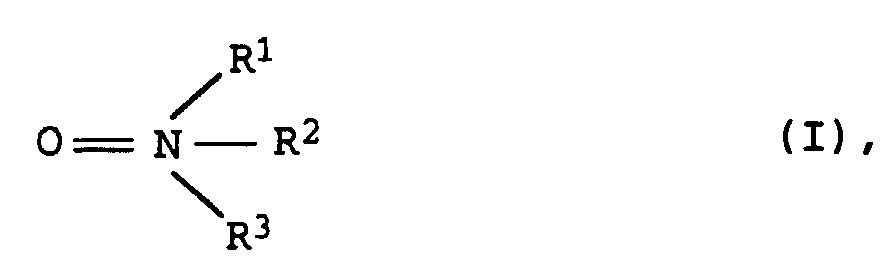
- R1,R2,R3
- C1- bis C30-Alkyl, C3- bis C12-Cycloalkyl, C1- bis C30-Hydroxyalkyl, C1- bis C30-Aminoalkyl, C2- bis C30-Alkoxyalkyl, Aryl, C7- bis C20-Aralkyl, C7- bis C20-Alkylaryl, durch C1- bis C8-Alkyl, C1- bis C8-Alkoxy, Halogen ein- bis fünffach substituiertes C3- bis C12-Cycloalkyl, Aryl, C7- bis C20-Aralkyl, C7- bis C20-Alkylaryl, -[(CH2)2-O]n-R4, -{[CH(CH3)CH2]-O}m-R5, oder R1 und R2 gemeinsam eine gegebenenfalls durch Sauerstoff, Stickstoff oder Schwefel unterbrochene C3- bis C12-Alkylendikette
- R4,R5
- C1- bis C12-Alkyl, C3- bis C12-Cycloalkyl, Hydroxy, -COR6 oder -CH2-COOR7, C3- bis C12-Cycloalkyl, Aryl, C7- bis C20-Aralkyl, C7- bis C20-Alkylaryl,
- R6,R7
- C1- bis C12-Alkyl oder C3- bis C12-Cycloalkyl und
- m, n
- 1 bis 40
in der R1, R2 und R3,die oben genannten Bedeutungen haben, mit Wasserstoff/Sauerstoffgemischen bei Temperaturen von (-5) bis 90°C und Drücken von 1 bis 100 bar in Gegenwart von Oxidationskatalysatoren, dadurch gekennzeichnet, daß man als Oxidationskatalysatoren solche der VIII. Gruppe des Periodensystems der Elemente auf Titansilikaten, Vanadiumsilikaten oder deren Gemische mit Zeolith-Struktur einsetzt.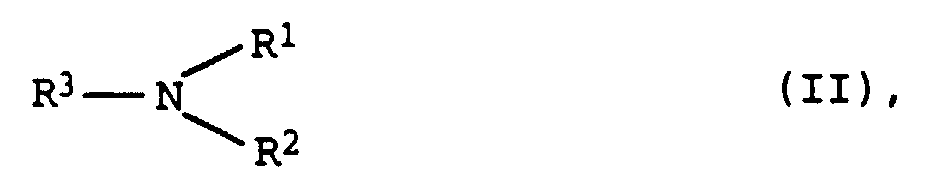
- Verfahren zur Herstellung von Aminoxiden I nach Anspruch 1, dadurch gekennzeichnet, daß die Oxidationskatalysatoren 0,01 bis 20 Gew.-% der Elemente der VIII. Gruppe des Periodensystems der Elemente enthalten.
- Verfahren zur Herstellung von Aminoxiden I nach den Ansprüchen 1 bis 2, dadurch gekennzeichnet, daß die Oxidationskatalysatoren als Elemente der VIII. Gruppe des Periodensystems der Elemente Ruthenium, Rhodium, Palladium, Osmium, Iridium, Platin oder deren Gemische enthalten.
- Verfahren zur Herstellung von Aminoxiden I nach den Ansprüchen 1 bis 3, dadurch gekennzeichnet, daß die Oxidationskatalysatoren zusätzlichen ein oder mehrere Elemente aus der Gruppe Rhenium, Silber und Gold enthalten.
- Verfahren zur Herstellung von Aminoxiden I nach den Ansprüchen 1 bis 3, dadurch gekennzeichnet, daß die Oxidationskatalysatoren aus 0,01 bis 20 Gew.-% der Elemente der VIII. Gruppe des Periodensystems der Elemente und 99,99 bis 80 Gew.-% Titansilikaten, Vanadiumsilikaten oder deren Gemische mit Zeolith-Struktur bestehen.
- Verfahren zur Herstellung von Aminoxiden I nach den Ansprüchen 1 bis 5, dadurch gekennzeichnet, daß die Elemente der VIII. Gruppe des Periodensystems der Elemente in mindestens zwei verschiedenen Bindungsenergiezuständen vorliegen.
- Verfahren zur Herstellung von Aminoxiden I nach den Ansprüchen 1 bis 6, dadurch gekennzeichnet, daß die Oxidationskatalysatoren als Elemente der VIII. Gruppe des Periodensystems der Elemente Palladium, das in zwei oder drei verschiedenen Bindungsenergiezuständen vorliegt, enthalten.
- Verfahren zur Herstellung von Aminoxiden I nach den Ansprüchen 1 bis 7, dadurch gekennzeichnet, daß das Molverhältnis von Silicium zum Titan, Vanadium oder deren Gemische im Oxidationskatalysator 100:1 bis 5:1 beträgt.
- Verfahren zur Herstellung von Aminoxiden I nach den Ansprüchen 1 bis 8, dadurch gekennzeichnet, daß R1,R2,R3 C1-bis C4-Alkyl, R1 und R2 gemeinsam-(CH2)2-O-(CH2)2- oder -(CH2)2-NR1-(CH2)2-, R3 zusätzlich n-Decyl, n-Dodecyl, n-Tetradecyl, n-Hexadecyl und n-Octadecyl bedeuten.
- Verfahren zur Herstellung von Aminoxiden I nach den Ansprüchen 1 bis 9, dadurch gekennzeichnet, daß R1 und R2 gemeinsam -(CH2)2-O-(CH2)2- und R3 Methyl bedeuten.
Applications Claiming Priority (3)
| Application Number | Priority Date | Filing Date | Title |
|---|---|---|---|
| DE19520270A DE19520270A1 (de) | 1995-06-02 | 1995-06-02 | Verfahren zur Herstellung von Aminoxiden |
| DE19520270 | 1995-06-02 | ||
| US08/656,412 US5639880A (en) | 1995-06-02 | 1996-05-30 | Preparation of amine oxides |
Publications (2)
| Publication Number | Publication Date |
|---|---|
| EP0745587A1 EP0745587A1 (de) | 1996-12-04 |
| EP0745587B1 true EP0745587B1 (de) | 1998-12-09 |
Family
ID=26015702
Family Applications (1)
| Application Number | Title | Priority Date | Filing Date |
|---|---|---|---|
| EP96108220A Expired - Lifetime EP0745587B1 (de) | 1995-06-02 | 1996-05-23 | Verfahren zur Herstellung von Aminoxiden |
Country Status (4)
| Country | Link |
|---|---|
| US (1) | US5639880A (de) |
| EP (1) | EP0745587B1 (de) |
| JP (1) | JPH093033A (de) |
| DE (1) | DE19520270A1 (de) |
Families Citing this family (7)
| Publication number | Priority date | Publication date | Assignee | Title |
|---|---|---|---|---|
| JP2001505184A (ja) * | 1996-07-01 | 2001-04-17 | ザ・ダウ・ケミカル・カンパニー | オレフィン類のオレフィンオキシド類への直接酸化方法 |
| US6294514B1 (en) | 1998-11-24 | 2001-09-25 | The Procter & Gamble Company | Process for preparing mono-long chain amine oxide surfactants with low nitrite, nitrosamine and low residual peroxide |
| JP4656353B2 (ja) * | 2000-09-28 | 2011-03-23 | 株式会社豊田中央研究所 | 常温触媒 |
| AU2002356941A1 (en) * | 2001-11-15 | 2003-06-10 | Pq Holding, Inc. | Method for controlling synthesis conditions during molecular sieve synthesis using combinations of quaternary ammonium hydroxides and halides |
| JP4784760B2 (ja) * | 2006-10-20 | 2011-10-05 | 信越化学工業株式会社 | レジスト材料及びパターン形成方法 |
| KR20100052948A (ko) * | 2008-11-11 | 2010-05-20 | 삼성전자주식회사 | 라디칼 중합용 조성물 및 이를 이용한 패턴 형성 방법 |
| CN103920530B (zh) * | 2014-04-10 | 2015-12-09 | 四川之江高新材料股份有限公司 | 2-羟基-5-烷基苯乙酮肟及所用催化剂的制备法 |
Family Cites Families (13)
| Publication number | Priority date | Publication date | Assignee | Title |
|---|---|---|---|---|
| IT1127311B (it) * | 1979-12-21 | 1986-05-21 | Anic Spa | Materiale sintetico,cristallino,poroso costituito da ossidi di silicio e titanio,metodo per la sua preparazione e suoi usi |
| EP0092862B1 (de) * | 1982-04-21 | 1986-03-12 | THE PROCTER & GAMBLE COMPANY | Verfahren zur Oxidation von tertiären Aminen zu Aminoxiden |
| US4565891A (en) * | 1984-07-19 | 1986-01-21 | The Procter & Gamble Company | Oxidation of tertiary amines using octacyanomolybdate or iron (III) salts as catalysts |
| AU615471B2 (en) * | 1987-09-08 | 1991-10-03 | Ethyl Corporation | Amine oxide process |
| US4994614A (en) * | 1987-12-14 | 1991-02-19 | Ethyl Corporation | Amine oxide process |
| US5130488A (en) * | 1989-04-26 | 1992-07-14 | Ethyl Corporation | Process for preparing tert-amine oxides |
| US5082600A (en) * | 1989-04-26 | 1992-01-21 | Ethyl Corporation | Transparent soap bar process using trialkylamine oxide dihydrate |
| CA2014201A1 (en) * | 1989-04-26 | 1990-10-26 | Albemarle Corporation | Solid non-hygroscopic trialkylamine oxides |
| US5055233A (en) * | 1989-04-26 | 1991-10-08 | Ethyl Corporation | Detergent bar process using trialkylamine oxide dihydrate |
| DE69000827T2 (de) * | 1989-10-30 | 1993-05-19 | Ethyl Corp | Verfahren zur herstellung von aminoxiden. |
| IT1243402B (it) * | 1990-11-30 | 1994-06-10 | Enichem Sintesi | Procedimento per la preparazione dei radicali nitrosilici delle amminestericamente impedite. |
| US5216154A (en) * | 1992-01-27 | 1993-06-01 | Texaco Chemical Company | Process for the preparation of n-methylmorpholine oxide |
| DE4306609A1 (de) * | 1993-03-03 | 1994-09-08 | Basf Ag | Verfahren zur Herstellung von Polyvinylpyridin-N-oxiden |
-
1995
- 1995-06-02 DE DE19520270A patent/DE19520270A1/de not_active Withdrawn
-
1996
- 1996-05-23 EP EP96108220A patent/EP0745587B1/de not_active Expired - Lifetime
- 1996-05-30 JP JP8137031A patent/JPH093033A/ja not_active Withdrawn
- 1996-05-30 US US08/656,412 patent/US5639880A/en not_active Expired - Fee Related
Also Published As
| Publication number | Publication date |
|---|---|
| US5639880A (en) | 1997-06-17 |
| DE19520270A1 (de) | 1996-12-05 |
| EP0745587A1 (de) | 1996-12-04 |
| JPH093033A (ja) | 1997-01-07 |
Similar Documents
| Publication | Publication Date | Title |
|---|---|---|
| EP0772491B1 (de) | Oxidationskatalysator, und oxidationsverfahren unter verwendung des oxidationskatalysators | |
| DE68919134T2 (de) | Katalytischer Prozess für die Herstellung von Oximen. | |
| DE69832349T3 (de) | Verfahren zur Herstellung von gebundenen Zeolithen | |
| EP0885206B1 (de) | Edelmetallfreie katalysatorzusammensetzung | |
| EP0543247B1 (de) | Verfahren zur Herstellung von im wesentlichen alkalifreien Titansilikat-Kristallen mit Zeolithstruktur | |
| EP3209650B1 (de) | Verfahren zur herstellung von glycerinsäurecarbonat | |
| DE1542155C3 (de) | Verwendung von einem an sich bekannten Kohlenwasserstoffkrackkatalysator und einem synthetischen Zeolith als Katalysator zum Kracken von Kohlenwasserstoffen | |
| EP0671977B1 (de) | Oxidationskatalysatoren | |
| DE3310685A1 (de) | Silberkatalysatoren, verfahren zu ihrer herstellung und ihre verwendung zur herstellung von ethylenoxid | |
| DE69215050T2 (de) | Verfahren zum Aktivieren eines Katalysators | |
| EP0745587A1 (de) | Verfahren zur Herstellung von Aminoxiden | |
| EP0784593B1 (de) | Verfahren zur herstellung von hydroxylaminen aus ammoniak oder den entsprechenden aminen, wasserstoff und sauerstoff | |
| DE2224160B2 (de) | Verfahren zur Herstellung von Katalysatoren für die Herstellung von Pyridin und 3-Methylpyridin | |
| DE60013733T2 (de) | Verfahren zur Entfernung von Templat aus synthetischen Zeolithen | |
| DE60021153T2 (de) | Verfahren für die Regenerierung von zeolitischem Titanium enthaltende Katalysatoren | |
| EP1699751A1 (de) | Verfahren zur herstellung eines ethylamins | |
| DE4424625A1 (de) | Mikroporöse Heteropolyoxometallate und Verfahren zu ihrer Herstellung | |
| DE2354425B2 (de) | Verfahren zur herstellung von essigsaeure durch gasphasenoxidation von butenen | |
| DE69019301T2 (de) | Herstellungsverfahren von Indolen. | |
| EP0263463A2 (de) | Verfahren zur Herstellung von 1,4-Diazabicyclo(2,2,2)-octanen | |
| WO2006094746A1 (de) | Katalysator zur acetoxylierung von c2-c9-kohlenwasserstoffen | |
| DE60203622T2 (de) | Verfahren zur aktivierung von titanhaltigen zeolithischen katalysatoren und deren verwendung bei oxidationsreaktionen | |
| WO2014154509A1 (de) | Passivierung eines zeolith-katalysators für die dehydroaromatisierung | |
| EP0723809B1 (de) | Verfahren zur Herstellung eines Hydrierungskatalysators | |
| DE60317378T2 (de) | Verfahren zur herstellung von pyridin und picolinen |
Legal Events
| Date | Code | Title | Description |
|---|---|---|---|
| PUAI | Public reference made under article 153(3) epc to a published international application that has entered the european phase |
Free format text: ORIGINAL CODE: 0009012 |
|
| AK | Designated contracting states |
Kind code of ref document: A1 Designated state(s): BE DE FR GB IT NL |
|
| 17P | Request for examination filed |
Effective date: 19961015 |
|
| GRAG | Despatch of communication of intention to grant |
Free format text: ORIGINAL CODE: EPIDOS AGRA |
|
| 17Q | First examination report despatched |
Effective date: 19980327 |
|
| GRAG | Despatch of communication of intention to grant |
Free format text: ORIGINAL CODE: EPIDOS AGRA |
|
| GRAH | Despatch of communication of intention to grant a patent |
Free format text: ORIGINAL CODE: EPIDOS IGRA |
|
| GRAH | Despatch of communication of intention to grant a patent |
Free format text: ORIGINAL CODE: EPIDOS IGRA |
|
| GRAA | (expected) grant |
Free format text: ORIGINAL CODE: 0009210 |
|
| AK | Designated contracting states |
Kind code of ref document: B1 Designated state(s): BE DE FR GB IT NL |
|
| REF | Corresponds to: |
Ref document number: 59600937 Country of ref document: DE Date of ref document: 19990121 |
|
| GBT | Gb: translation of ep patent filed (gb section 77(6)(a)/1977) |
Effective date: 19990107 |
|
| ITF | It: translation for a ep patent filed | ||
| ET | Fr: translation filed | ||
| PLBE | No opposition filed within time limit |
Free format text: ORIGINAL CODE: 0009261 |
|
| STAA | Information on the status of an ep patent application or granted ep patent |
Free format text: STATUS: NO OPPOSITION FILED WITHIN TIME LIMIT |
|
| 26N | No opposition filed | ||
| REG | Reference to a national code |
Ref country code: GB Ref legal event code: IF02 |
|
| PGFP | Annual fee paid to national office [announced via postgrant information from national office to epo] |
Ref country code: DE Payment date: 20020518 Year of fee payment: 7 |
|
| PGFP | Annual fee paid to national office [announced via postgrant information from national office to epo] |
Ref country code: FR Payment date: 20030414 Year of fee payment: 8 |
|
| PGFP | Annual fee paid to national office [announced via postgrant information from national office to epo] |
Ref country code: NL Payment date: 20030415 Year of fee payment: 8 |
|
| PGFP | Annual fee paid to national office [announced via postgrant information from national office to epo] |
Ref country code: BE Payment date: 20030514 Year of fee payment: 8 |
|
| PGFP | Annual fee paid to national office [announced via postgrant information from national office to epo] |
Ref country code: GB Payment date: 20030519 Year of fee payment: 8 |
|
| PG25 | Lapsed in a contracting state [announced via postgrant information from national office to epo] |
Ref country code: DE Free format text: LAPSE BECAUSE OF THE APPLICANT RENOUNCES Effective date: 20030630 |
|
| PG25 | Lapsed in a contracting state [announced via postgrant information from national office to epo] |
Ref country code: GB Free format text: LAPSE BECAUSE OF NON-PAYMENT OF DUE FEES Effective date: 20040523 |
|
| PG25 | Lapsed in a contracting state [announced via postgrant information from national office to epo] |
Ref country code: BE Free format text: LAPSE BECAUSE OF NON-PAYMENT OF DUE FEES Effective date: 20040531 |
|
| BERE | Be: lapsed |
Owner name: *BASF A.G. Effective date: 20040531 |
|
| PG25 | Lapsed in a contracting state [announced via postgrant information from national office to epo] |
Ref country code: NL Free format text: LAPSE BECAUSE OF NON-PAYMENT OF DUE FEES Effective date: 20041201 |
|
| GBPC | Gb: european patent ceased through non-payment of renewal fee |
Effective date: 20040523 |
|
| PG25 | Lapsed in a contracting state [announced via postgrant information from national office to epo] |
Ref country code: FR Free format text: LAPSE BECAUSE OF NON-PAYMENT OF DUE FEES Effective date: 20050131 |
|
| NLV4 | Nl: lapsed or anulled due to non-payment of the annual fee |
Effective date: 20041201 |
|
| REG | Reference to a national code |
Ref country code: FR Ref legal event code: ST |
|
| PG25 | Lapsed in a contracting state [announced via postgrant information from national office to epo] |
Ref country code: IT Free format text: LAPSE BECAUSE OF NON-PAYMENT OF DUE FEES Effective date: 20050523 |