EP0742837B1 - Procede de decouverte de ligands - Google Patents
Procede de decouverte de ligands Download PDFInfo
- Publication number
- EP0742837B1 EP0742837B1 EP95907093A EP95907093A EP0742837B1 EP 0742837 B1 EP0742837 B1 EP 0742837B1 EP 95907093 A EP95907093 A EP 95907093A EP 95907093 A EP95907093 A EP 95907093A EP 0742837 B1 EP0742837 B1 EP 0742837B1
- Authority
- EP
- European Patent Office
- Prior art keywords
- target
- ligands
- oligonucleotides
- array
- ligand
- Prior art date
- Legal status (The legal status is an assumption and is not a legal conclusion. Google has not performed a legal analysis and makes no representation as to the accuracy of the status listed.)
- Expired - Lifetime
Links
- 239000003446 ligand Substances 0.000 title claims abstract description 82
- 238000000034 method Methods 0.000 title claims abstract description 49
- 108091034117 Oligonucleotide Proteins 0.000 claims abstract description 101
- JLCPHMBAVCMARE-UHFFFAOYSA-N [3-[[3-[[3-[[3-[[3-[[3-[[3-[[3-[[3-[[3-[[3-[[5-(2-amino-6-oxo-1H-purin-9-yl)-3-[[3-[[3-[[3-[[3-[[3-[[5-(2-amino-6-oxo-1H-purin-9-yl)-3-[[5-(2-amino-6-oxo-1H-purin-9-yl)-3-hydroxyoxolan-2-yl]methoxy-hydroxyphosphoryl]oxyoxolan-2-yl]methoxy-hydroxyphosphoryl]oxy-5-(5-methyl-2,4-dioxopyrimidin-1-yl)oxolan-2-yl]methoxy-hydroxyphosphoryl]oxy-5-(6-aminopurin-9-yl)oxolan-2-yl]methoxy-hydroxyphosphoryl]oxy-5-(6-aminopurin-9-yl)oxolan-2-yl]methoxy-hydroxyphosphoryl]oxy-5-(6-aminopurin-9-yl)oxolan-2-yl]methoxy-hydroxyphosphoryl]oxy-5-(6-aminopurin-9-yl)oxolan-2-yl]methoxy-hydroxyphosphoryl]oxyoxolan-2-yl]methoxy-hydroxyphosphoryl]oxy-5-(5-methyl-2,4-dioxopyrimidin-1-yl)oxolan-2-yl]methoxy-hydroxyphosphoryl]oxy-5-(4-amino-2-oxopyrimidin-1-yl)oxolan-2-yl]methoxy-hydroxyphosphoryl]oxy-5-(5-methyl-2,4-dioxopyrimidin-1-yl)oxolan-2-yl]methoxy-hydroxyphosphoryl]oxy-5-(5-methyl-2,4-dioxopyrimidin-1-yl)oxolan-2-yl]methoxy-hydroxyphosphoryl]oxy-5-(6-aminopurin-9-yl)oxolan-2-yl]methoxy-hydroxyphosphoryl]oxy-5-(6-aminopurin-9-yl)oxolan-2-yl]methoxy-hydroxyphosphoryl]oxy-5-(4-amino-2-oxopyrimidin-1-yl)oxolan-2-yl]methoxy-hydroxyphosphoryl]oxy-5-(4-amino-2-oxopyrimidin-1-yl)oxolan-2-yl]methoxy-hydroxyphosphoryl]oxy-5-(4-amino-2-oxopyrimidin-1-yl)oxolan-2-yl]methoxy-hydroxyphosphoryl]oxy-5-(6-aminopurin-9-yl)oxolan-2-yl]methoxy-hydroxyphosphoryl]oxy-5-(4-amino-2-oxopyrimidin-1-yl)oxolan-2-yl]methyl [5-(6-aminopurin-9-yl)-2-(hydroxymethyl)oxolan-3-yl] hydrogen phosphate Polymers Cc1cn(C2CC(OP(O)(=O)OCC3OC(CC3OP(O)(=O)OCC3OC(CC3O)n3cnc4c3nc(N)[nH]c4=O)n3cnc4c3nc(N)[nH]c4=O)C(COP(O)(=O)OC3CC(OC3COP(O)(=O)OC3CC(OC3COP(O)(=O)OC3CC(OC3COP(O)(=O)OC3CC(OC3COP(O)(=O)OC3CC(OC3COP(O)(=O)OC3CC(OC3COP(O)(=O)OC3CC(OC3COP(O)(=O)OC3CC(OC3COP(O)(=O)OC3CC(OC3COP(O)(=O)OC3CC(OC3COP(O)(=O)OC3CC(OC3COP(O)(=O)OC3CC(OC3COP(O)(=O)OC3CC(OC3COP(O)(=O)OC3CC(OC3COP(O)(=O)OC3CC(OC3COP(O)(=O)OC3CC(OC3COP(O)(=O)OC3CC(OC3CO)n3cnc4c(N)ncnc34)n3ccc(N)nc3=O)n3cnc4c(N)ncnc34)n3ccc(N)nc3=O)n3ccc(N)nc3=O)n3ccc(N)nc3=O)n3cnc4c(N)ncnc34)n3cnc4c(N)ncnc34)n3cc(C)c(=O)[nH]c3=O)n3cc(C)c(=O)[nH]c3=O)n3ccc(N)nc3=O)n3cc(C)c(=O)[nH]c3=O)n3cnc4c3nc(N)[nH]c4=O)n3cnc4c(N)ncnc34)n3cnc4c(N)ncnc34)n3cnc4c(N)ncnc34)n3cnc4c(N)ncnc34)O2)c(=O)[nH]c1=O JLCPHMBAVCMARE-UHFFFAOYSA-N 0.000 claims abstract description 71
- 230000003993 interaction Effects 0.000 claims abstract description 56
- 239000007787 solid Substances 0.000 claims abstract description 8
- 108091032973 (ribonucleotides)n+m Proteins 0.000 claims description 27
- 238000009739 binding Methods 0.000 claims description 23
- 230000027455 binding Effects 0.000 claims description 22
- 150000007523 nucleic acids Chemical group 0.000 claims description 14
- 230000000295 complement effect Effects 0.000 claims description 12
- 102000039446 nucleic acids Human genes 0.000 claims description 12
- 108020004707 nucleic acids Proteins 0.000 claims description 12
- 239000003795 chemical substances by application Substances 0.000 claims description 8
- 239000000126 substance Substances 0.000 claims description 6
- 108090000994 Catalytic RNA Proteins 0.000 claims description 3
- 102000053642 Catalytic RNA Human genes 0.000 claims description 3
- 230000001419 dependent effect Effects 0.000 claims description 3
- 239000000138 intercalating agent Substances 0.000 claims description 3
- 108091092562 ribozyme Proteins 0.000 claims description 3
- 108090000765 processed proteins & peptides Proteins 0.000 claims description 2
- 230000000717 retained effect Effects 0.000 claims description 2
- 239000002738 chelating agent Substances 0.000 claims 1
- 150000002170 ethers Chemical class 0.000 claims 1
- 238000006467 substitution reaction Methods 0.000 claims 1
- 238000009396 hybridization Methods 0.000 description 38
- 238000003491 array Methods 0.000 description 31
- 210000004027 cell Anatomy 0.000 description 26
- 230000000692 anti-sense effect Effects 0.000 description 24
- 239000000243 solution Substances 0.000 description 18
- 239000011521 glass Substances 0.000 description 14
- 230000000694 effects Effects 0.000 description 13
- 239000000203 mixture Substances 0.000 description 13
- 238000004458 analytical method Methods 0.000 description 12
- 238000006243 chemical reaction Methods 0.000 description 12
- 108090000623 proteins and genes Proteins 0.000 description 12
- 239000003153 chemical reaction reagent Substances 0.000 description 11
- 108020004566 Transfer RNA Proteins 0.000 description 10
- 238000013461 design Methods 0.000 description 10
- 238000002474 experimental method Methods 0.000 description 9
- 102000040650 (ribonucleotides)n+m Human genes 0.000 description 8
- LFQSCWFLJHTTHZ-UHFFFAOYSA-N Ethanol Chemical compound CCO LFQSCWFLJHTTHZ-UHFFFAOYSA-N 0.000 description 8
- 238000013459 approach Methods 0.000 description 8
- 230000015572 biosynthetic process Effects 0.000 description 8
- 239000000758 substrate Substances 0.000 description 8
- 108020000948 Antisense Oligonucleotides Proteins 0.000 description 7
- 239000000074 antisense oligonucleotide Substances 0.000 description 7
- 238000012230 antisense oligonucleotides Methods 0.000 description 7
- 239000003814 drug Substances 0.000 description 7
- 238000003786 synthesis reaction Methods 0.000 description 7
- 108020004414 DNA Proteins 0.000 description 6
- 229920002521 macromolecule Polymers 0.000 description 6
- 108020004999 messenger RNA Proteins 0.000 description 6
- 230000008569 process Effects 0.000 description 6
- 230000015556 catabolic process Effects 0.000 description 5
- 230000035772 mutation Effects 0.000 description 5
- 102000004169 proteins and genes Human genes 0.000 description 5
- RTZKZFJDLAIYFH-UHFFFAOYSA-N Diethyl ether Chemical compound CCOCC RTZKZFJDLAIYFH-UHFFFAOYSA-N 0.000 description 4
- FAPWRFPIFSIZLT-UHFFFAOYSA-M Sodium chloride Chemical compound [Na+].[Cl-] FAPWRFPIFSIZLT-UHFFFAOYSA-M 0.000 description 4
- 230000008901 benefit Effects 0.000 description 4
- 238000006731 degradation reaction Methods 0.000 description 4
- 229940079593 drug Drugs 0.000 description 4
- 238000011160 research Methods 0.000 description 4
- IAZDPXIOMUYVGZ-UHFFFAOYSA-N Dimethylsulphoxide Chemical compound CS(C)=O IAZDPXIOMUYVGZ-UHFFFAOYSA-N 0.000 description 3
- 230000031018 biological processes and functions Effects 0.000 description 3
- 239000005547 deoxyribonucleotide Substances 0.000 description 3
- 125000002637 deoxyribonucleotide group Chemical group 0.000 description 3
- 238000002515 oligonucleotide synthesis Methods 0.000 description 3
- 229920001343 polytetrafluoroethylene Polymers 0.000 description 3
- 239000002243 precursor Substances 0.000 description 3
- 239000002904 solvent Substances 0.000 description 3
- 238000012360 testing method Methods 0.000 description 3
- QGZKDVFQNNGYKY-UHFFFAOYSA-N Ammonia Chemical compound N QGZKDVFQNNGYKY-UHFFFAOYSA-N 0.000 description 2
- 108020005098 Anticodon Proteins 0.000 description 2
- 101150029409 CFTR gene Proteins 0.000 description 2
- 102000004190 Enzymes Human genes 0.000 description 2
- 108090000790 Enzymes Proteins 0.000 description 2
- TWRXJAOTZQYOKJ-UHFFFAOYSA-L Magnesium chloride Chemical compound [Mg+2].[Cl-].[Cl-] TWRXJAOTZQYOKJ-UHFFFAOYSA-L 0.000 description 2
- 229930193140 Neomycin Natural products 0.000 description 2
- 101710163270 Nuclease Proteins 0.000 description 2
- 108010038807 Oligopeptides Proteins 0.000 description 2
- 102000015636 Oligopeptides Human genes 0.000 description 2
- 241000283973 Oryctolagus cuniculus Species 0.000 description 2
- 101710086015 RNA ligase Proteins 0.000 description 2
- 108091028664 Ribonucleotide Proteins 0.000 description 2
- 240000004808 Saccharomyces cerevisiae Species 0.000 description 2
- 241000700605 Viruses Species 0.000 description 2
- 230000003197 catalytic effect Effects 0.000 description 2
- 238000010511 deprotection reaction Methods 0.000 description 2
- 238000011161 development Methods 0.000 description 2
- 239000001177 diphosphate Substances 0.000 description 2
- 230000002708 enhancing effect Effects 0.000 description 2
- 239000012634 fragment Substances 0.000 description 2
- 230000006870 function Effects 0.000 description 2
- 230000014509 gene expression Effects 0.000 description 2
- 238000000338 in vitro Methods 0.000 description 2
- 230000002401 inhibitory effect Effects 0.000 description 2
- 230000008863 intramolecular interaction Effects 0.000 description 2
- 239000000463 material Substances 0.000 description 2
- 238000012986 modification Methods 0.000 description 2
- 230000004048 modification Effects 0.000 description 2
- 229960004927 neomycin Drugs 0.000 description 2
- 239000002773 nucleotide Substances 0.000 description 2
- 229940124276 oligodeoxyribonucleotide Drugs 0.000 description 2
- 230000037361 pathway Effects 0.000 description 2
- 239000002336 ribonucleotide Substances 0.000 description 2
- 125000002652 ribonucleotide group Chemical group 0.000 description 2
- 239000011780 sodium chloride Substances 0.000 description 2
- 229940124597 therapeutic agent Drugs 0.000 description 2
- 230000001225 therapeutic effect Effects 0.000 description 2
- 238000002560 therapeutic procedure Methods 0.000 description 2
- 238000013519 translation Methods 0.000 description 2
- 230000014616 translation Effects 0.000 description 2
- JKMHFZQWWAIEOD-UHFFFAOYSA-N 2-[4-(2-hydroxyethyl)piperazin-1-yl]ethanesulfonic acid Chemical compound OCC[NH+]1CCN(CCS([O-])(=O)=O)CC1 JKMHFZQWWAIEOD-UHFFFAOYSA-N 0.000 description 1
- 241000272525 Anas platyrhynchos Species 0.000 description 1
- 108020005544 Antisense RNA Proteins 0.000 description 1
- 241000894006 Bacteria Species 0.000 description 1
- 201000003883 Cystic fibrosis Diseases 0.000 description 1
- KCXVZYZYPLLWCC-UHFFFAOYSA-N EDTA Chemical compound OC(=O)CN(CC(O)=O)CCN(CC(O)=O)CC(O)=O KCXVZYZYPLLWCC-UHFFFAOYSA-N 0.000 description 1
- 241000206602 Eukaryota Species 0.000 description 1
- 108700024394 Exon Proteins 0.000 description 1
- 239000007995 HEPES buffer Substances 0.000 description 1
- 102100021519 Hemoglobin subunit beta Human genes 0.000 description 1
- 108091005904 Hemoglobin subunit beta Proteins 0.000 description 1
- 101100166894 Homo sapiens CFTR gene Proteins 0.000 description 1
- 229910001209 Low-carbon steel Inorganic materials 0.000 description 1
- FYYHWMGAXLPEAU-UHFFFAOYSA-N Magnesium Chemical compound [Mg] FYYHWMGAXLPEAU-UHFFFAOYSA-N 0.000 description 1
- JLVVSXFLKOJNIY-UHFFFAOYSA-N Magnesium ion Chemical compound [Mg+2] JLVVSXFLKOJNIY-UHFFFAOYSA-N 0.000 description 1
- 241001465754 Metazoa Species 0.000 description 1
- OKIZCWYLBDKLSU-UHFFFAOYSA-M N,N,N-Trimethylmethanaminium chloride Chemical compound [Cl-].C[N+](C)(C)C OKIZCWYLBDKLSU-UHFFFAOYSA-M 0.000 description 1
- JGFZNNIVVJXRND-UHFFFAOYSA-N N,N-Diisopropylethylamine (DIPEA) Chemical compound CCN(C(C)C)C(C)C JGFZNNIVVJXRND-UHFFFAOYSA-N 0.000 description 1
- 206010028980 Neoplasm Diseases 0.000 description 1
- 108091028043 Nucleic acid sequence Proteins 0.000 description 1
- 239000004677 Nylon Substances 0.000 description 1
- CTQNGGLPUBDAKN-UHFFFAOYSA-N O-Xylene Chemical compound CC1=CC=CC=C1C CTQNGGLPUBDAKN-UHFFFAOYSA-N 0.000 description 1
- OAICVXFJPJFONN-UHFFFAOYSA-N Phosphorus Chemical compound [P] OAICVXFJPJFONN-UHFFFAOYSA-N 0.000 description 1
- 239000004698 Polyethylene Substances 0.000 description 1
- 108010021757 Polynucleotide 5'-Hydroxyl-Kinase Proteins 0.000 description 1
- 102000008422 Polynucleotide 5'-hydroxyl-kinase Human genes 0.000 description 1
- 108091027981 Response element Proteins 0.000 description 1
- 108091081024 Start codon Proteins 0.000 description 1
- QAOWNCQODCNURD-UHFFFAOYSA-N Sulfuric acid Chemical compound OS(O)(=O)=O QAOWNCQODCNURD-UHFFFAOYSA-N 0.000 description 1
- RYYWUUFWQRZTIU-UHFFFAOYSA-N Thiophosphoric acid Chemical class OP(O)(S)=O RYYWUUFWQRZTIU-UHFFFAOYSA-N 0.000 description 1
- 239000007983 Tris buffer Substances 0.000 description 1
- 235000010724 Wisteria floribunda Nutrition 0.000 description 1
- 238000002441 X-ray diffraction Methods 0.000 description 1
- 239000003570 air Substances 0.000 description 1
- 229910021529 ammonia Inorganic materials 0.000 description 1
- 239000003242 anti bacterial agent Substances 0.000 description 1
- 229940088710 antibiotic agent Drugs 0.000 description 1
- 239000002246 antineoplastic agent Substances 0.000 description 1
- 230000004071 biological effect Effects 0.000 description 1
- 229920001222 biopolymer Polymers 0.000 description 1
- 230000000903 blocking effect Effects 0.000 description 1
- 238000004364 calculation method Methods 0.000 description 1
- 201000011510 cancer Diseases 0.000 description 1
- 150000001720 carbohydrates Chemical class 0.000 description 1
- 229910052799 carbon Inorganic materials 0.000 description 1
- 238000012512 characterization method Methods 0.000 description 1
- 230000009920 chelation Effects 0.000 description 1
- 239000002131 composite material Substances 0.000 description 1
- 150000001875 compounds Chemical class 0.000 description 1
- 238000010276 construction Methods 0.000 description 1
- 238000004132 cross linking Methods 0.000 description 1
- 210000004748 cultured cell Anatomy 0.000 description 1
- 230000000593 degrading effect Effects 0.000 description 1
- 229910003460 diamond Inorganic materials 0.000 description 1
- 239000010432 diamond Substances 0.000 description 1
- 238000005553 drilling Methods 0.000 description 1
- 238000009510 drug design Methods 0.000 description 1
- 238000011156 evaluation Methods 0.000 description 1
- 230000002349 favourable effect Effects 0.000 description 1
- 230000004907 flux Effects 0.000 description 1
- 102000018146 globin Human genes 0.000 description 1
- 108060003196 globin Proteins 0.000 description 1
- 229930182470 glycoside Natural products 0.000 description 1
- 150000002338 glycosides Chemical class 0.000 description 1
- 208000006454 hepatitis Diseases 0.000 description 1
- 231100000283 hepatitis Toxicity 0.000 description 1
- IIRDTKBZINWQAW-UHFFFAOYSA-N hexaethylene glycol Chemical compound OCCOCCOCCOCCOCCOCCO IIRDTKBZINWQAW-UHFFFAOYSA-N 0.000 description 1
- 230000006801 homologous recombination Effects 0.000 description 1
- 238000002744 homologous recombination Methods 0.000 description 1
- 229910052739 hydrogen Inorganic materials 0.000 description 1
- 239000001257 hydrogen Substances 0.000 description 1
- 230000002209 hydrophobic effect Effects 0.000 description 1
- 230000008105 immune reaction Effects 0.000 description 1
- 238000011065 in-situ storage Methods 0.000 description 1
- 238000011534 incubation Methods 0.000 description 1
- 239000012678 infectious agent Substances 0.000 description 1
- 208000015181 infectious disease Diseases 0.000 description 1
- 230000005764 inhibitory process Effects 0.000 description 1
- 238000009830 intercalation Methods 0.000 description 1
- 230000002687 intercalation Effects 0.000 description 1
- 238000003754 machining Methods 0.000 description 1
- 229910052749 magnesium Inorganic materials 0.000 description 1
- 239000011777 magnesium Substances 0.000 description 1
- 229910001629 magnesium chloride Inorganic materials 0.000 description 1
- 229910001425 magnesium ion Inorganic materials 0.000 description 1
- 238000005259 measurement Methods 0.000 description 1
- 230000007246 mechanism Effects 0.000 description 1
- 239000012528 membrane Substances 0.000 description 1
- 239000002207 metabolite Substances 0.000 description 1
- 238000000329 molecular dynamics simulation Methods 0.000 description 1
- 238000000302 molecular modelling Methods 0.000 description 1
- 125000003729 nucleotide group Chemical group 0.000 description 1
- 229920001778 nylon Polymers 0.000 description 1
- 244000045947 parasite Species 0.000 description 1
- 230000035515 penetration Effects 0.000 description 1
- 230000035699 permeability Effects 0.000 description 1
- 150000008300 phosphoramidites Chemical class 0.000 description 1
- 125000005642 phosphothioate group Chemical group 0.000 description 1
- 239000002985 plastic film Substances 0.000 description 1
- -1 polyethylene Polymers 0.000 description 1
- 229920000573 polyethylene Polymers 0.000 description 1
- 229920000642 polymer Polymers 0.000 description 1
- 108091033319 polynucleotide Proteins 0.000 description 1
- 102000040430 polynucleotide Human genes 0.000 description 1
- 239000002157 polynucleotide Substances 0.000 description 1
- 238000002360 preparation method Methods 0.000 description 1
- 102000004196 processed proteins & peptides Human genes 0.000 description 1
- 230000002285 radioactive effect Effects 0.000 description 1
- 230000014493 regulation of gene expression Effects 0.000 description 1
- 230000010076 replication Effects 0.000 description 1
- 238000012552 review Methods 0.000 description 1
- 239000000523 sample Substances 0.000 description 1
- 229920002379 silicone rubber Polymers 0.000 description 1
- 239000004945 silicone rubber Substances 0.000 description 1
- 239000007790 solid phase Substances 0.000 description 1
- 230000009870 specific binding Effects 0.000 description 1
- 150000003431 steroids Chemical class 0.000 description 1
- 238000003860 storage Methods 0.000 description 1
- 239000001117 sulphuric acid Substances 0.000 description 1
- 235000011149 sulphuric acid Nutrition 0.000 description 1
- 238000013518 transcription Methods 0.000 description 1
- 230000035897 transcription Effects 0.000 description 1
- BPSIOYPQMFLKFR-UHFFFAOYSA-N trimethoxy-[3-(oxiran-2-ylmethoxy)propyl]silane Chemical compound CO[Si](OC)(OC)CCCOCC1CO1 BPSIOYPQMFLKFR-UHFFFAOYSA-N 0.000 description 1
- LENZDBCJOHFCAS-UHFFFAOYSA-N tris Chemical compound OCC(N)(CO)CO LENZDBCJOHFCAS-UHFFFAOYSA-N 0.000 description 1
- 230000003612 virological effect Effects 0.000 description 1
- 239000008096 xylene Substances 0.000 description 1
Images







Classifications
-
- C—CHEMISTRY; METALLURGY
- C12—BIOCHEMISTRY; BEER; SPIRITS; WINE; VINEGAR; MICROBIOLOGY; ENZYMOLOGY; MUTATION OR GENETIC ENGINEERING
- C12Q—MEASURING OR TESTING PROCESSES INVOLVING ENZYMES, NUCLEIC ACIDS OR MICROORGANISMS; COMPOSITIONS OR TEST PAPERS THEREFOR; PROCESSES OF PREPARING SUCH COMPOSITIONS; CONDITION-RESPONSIVE CONTROL IN MICROBIOLOGICAL OR ENZYMOLOGICAL PROCESSES
- C12Q1/00—Measuring or testing processes involving enzymes, nucleic acids or microorganisms; Compositions therefor; Processes of preparing such compositions
- C12Q1/68—Measuring or testing processes involving enzymes, nucleic acids or microorganisms; Compositions therefor; Processes of preparing such compositions involving nucleic acids
- C12Q1/6811—Selection methods for production or design of target specific oligonucleotides or binding molecules
-
- B—PERFORMING OPERATIONS; TRANSPORTING
- B01—PHYSICAL OR CHEMICAL PROCESSES OR APPARATUS IN GENERAL
- B01J—CHEMICAL OR PHYSICAL PROCESSES, e.g. CATALYSIS OR COLLOID CHEMISTRY; THEIR RELEVANT APPARATUS
- B01J19/00—Chemical, physical or physico-chemical processes in general; Their relevant apparatus
- B01J19/0046—Sequential or parallel reactions, e.g. for the synthesis of polypeptides or polynucleotides; Apparatus and devices for combinatorial chemistry or for making molecular arrays
-
- C—CHEMISTRY; METALLURGY
- C07—ORGANIC CHEMISTRY
- C07H—SUGARS; DERIVATIVES THEREOF; NUCLEOSIDES; NUCLEOTIDES; NUCLEIC ACIDS
- C07H21/00—Compounds containing two or more mononucleotide units having separate phosphate or polyphosphate groups linked by saccharide radicals of nucleoside groups, e.g. nucleic acids
-
- C—CHEMISTRY; METALLURGY
- C12—BIOCHEMISTRY; BEER; SPIRITS; WINE; VINEGAR; MICROBIOLOGY; ENZYMOLOGY; MUTATION OR GENETIC ENGINEERING
- C12N—MICROORGANISMS OR ENZYMES; COMPOSITIONS THEREOF; PROPAGATING, PRESERVING, OR MAINTAINING MICROORGANISMS; MUTATION OR GENETIC ENGINEERING; CULTURE MEDIA
- C12N15/00—Mutation or genetic engineering; DNA or RNA concerning genetic engineering, vectors, e.g. plasmids, or their isolation, preparation or purification; Use of hosts therefor
- C12N15/09—Recombinant DNA-technology
- C12N15/10—Processes for the isolation, preparation or purification of DNA or RNA
- C12N15/1034—Isolating an individual clone by screening libraries
- C12N15/1048—SELEX
-
- C—CHEMISTRY; METALLURGY
- C12—BIOCHEMISTRY; BEER; SPIRITS; WINE; VINEGAR; MICROBIOLOGY; ENZYMOLOGY; MUTATION OR GENETIC ENGINEERING
- C12Q—MEASURING OR TESTING PROCESSES INVOLVING ENZYMES, NUCLEIC ACIDS OR MICROORGANISMS; COMPOSITIONS OR TEST PAPERS THEREFOR; PROCESSES OF PREPARING SUCH COMPOSITIONS; CONDITION-RESPONSIVE CONTROL IN MICROBIOLOGICAL OR ENZYMOLOGICAL PROCESSES
- C12Q1/00—Measuring or testing processes involving enzymes, nucleic acids or microorganisms; Compositions therefor; Processes of preparing such compositions
- C12Q1/68—Measuring or testing processes involving enzymes, nucleic acids or microorganisms; Compositions therefor; Processes of preparing such compositions involving nucleic acids
- C12Q1/6813—Hybridisation assays
- C12Q1/6834—Enzymatic or biochemical coupling of nucleic acids to a solid phase
- C12Q1/6837—Enzymatic or biochemical coupling of nucleic acids to a solid phase using probe arrays or probe chips
-
- C—CHEMISTRY; METALLURGY
- C40—COMBINATORIAL TECHNOLOGY
- C40B—COMBINATORIAL CHEMISTRY; LIBRARIES, e.g. CHEMICAL LIBRARIES
- C40B40/00—Libraries per se, e.g. arrays, mixtures
- C40B40/04—Libraries containing only organic compounds
- C40B40/06—Libraries containing nucleotides or polynucleotides, or derivatives thereof
-
- C—CHEMISTRY; METALLURGY
- C40—COMBINATORIAL TECHNOLOGY
- C40B—COMBINATORIAL CHEMISTRY; LIBRARIES, e.g. CHEMICAL LIBRARIES
- C40B50/00—Methods of creating libraries, e.g. combinatorial synthesis
- C40B50/06—Biochemical methods, e.g. using enzymes or whole viable microorganisms
-
- B—PERFORMING OPERATIONS; TRANSPORTING
- B01—PHYSICAL OR CHEMICAL PROCESSES OR APPARATUS IN GENERAL
- B01J—CHEMICAL OR PHYSICAL PROCESSES, e.g. CATALYSIS OR COLLOID CHEMISTRY; THEIR RELEVANT APPARATUS
- B01J2219/00—Chemical, physical or physico-chemical processes in general; Their relevant apparatus
- B01J2219/00274—Sequential or parallel reactions; Apparatus and devices for combinatorial chemistry or for making arrays; Chemical library technology
- B01J2219/00277—Apparatus
- B01J2219/00351—Means for dispensing and evacuation of reagents
- B01J2219/00427—Means for dispensing and evacuation of reagents using masks
- B01J2219/0043—Means for dispensing and evacuation of reagents using masks for direct application of reagents, e.g. through openings in a shutter
-
- B—PERFORMING OPERATIONS; TRANSPORTING
- B01—PHYSICAL OR CHEMICAL PROCESSES OR APPARATUS IN GENERAL
- B01J—CHEMICAL OR PHYSICAL PROCESSES, e.g. CATALYSIS OR COLLOID CHEMISTRY; THEIR RELEVANT APPARATUS
- B01J2219/00—Chemical, physical or physico-chemical processes in general; Their relevant apparatus
- B01J2219/00274—Sequential or parallel reactions; Apparatus and devices for combinatorial chemistry or for making arrays; Chemical library technology
- B01J2219/00277—Apparatus
- B01J2219/00497—Features relating to the solid phase supports
- B01J2219/00527—Sheets
-
- B—PERFORMING OPERATIONS; TRANSPORTING
- B01—PHYSICAL OR CHEMICAL PROCESSES OR APPARATUS IN GENERAL
- B01J—CHEMICAL OR PHYSICAL PROCESSES, e.g. CATALYSIS OR COLLOID CHEMISTRY; THEIR RELEVANT APPARATUS
- B01J2219/00—Chemical, physical or physico-chemical processes in general; Their relevant apparatus
- B01J2219/00274—Sequential or parallel reactions; Apparatus and devices for combinatorial chemistry or for making arrays; Chemical library technology
- B01J2219/00583—Features relative to the processes being carried out
- B01J2219/0059—Sequential processes
-
- B—PERFORMING OPERATIONS; TRANSPORTING
- B01—PHYSICAL OR CHEMICAL PROCESSES OR APPARATUS IN GENERAL
- B01J—CHEMICAL OR PHYSICAL PROCESSES, e.g. CATALYSIS OR COLLOID CHEMISTRY; THEIR RELEVANT APPARATUS
- B01J2219/00—Chemical, physical or physico-chemical processes in general; Their relevant apparatus
- B01J2219/00274—Sequential or parallel reactions; Apparatus and devices for combinatorial chemistry or for making arrays; Chemical library technology
- B01J2219/00583—Features relative to the processes being carried out
- B01J2219/00596—Solid-phase processes
-
- B—PERFORMING OPERATIONS; TRANSPORTING
- B01—PHYSICAL OR CHEMICAL PROCESSES OR APPARATUS IN GENERAL
- B01J—CHEMICAL OR PHYSICAL PROCESSES, e.g. CATALYSIS OR COLLOID CHEMISTRY; THEIR RELEVANT APPARATUS
- B01J2219/00—Chemical, physical or physico-chemical processes in general; Their relevant apparatus
- B01J2219/00274—Sequential or parallel reactions; Apparatus and devices for combinatorial chemistry or for making arrays; Chemical library technology
- B01J2219/00583—Features relative to the processes being carried out
- B01J2219/00603—Making arrays on substantially continuous surfaces
- B01J2219/00605—Making arrays on substantially continuous surfaces the compounds being directly bound or immobilised to solid supports
-
- B—PERFORMING OPERATIONS; TRANSPORTING
- B01—PHYSICAL OR CHEMICAL PROCESSES OR APPARATUS IN GENERAL
- B01J—CHEMICAL OR PHYSICAL PROCESSES, e.g. CATALYSIS OR COLLOID CHEMISTRY; THEIR RELEVANT APPARATUS
- B01J2219/00—Chemical, physical or physico-chemical processes in general; Their relevant apparatus
- B01J2219/00274—Sequential or parallel reactions; Apparatus and devices for combinatorial chemistry or for making arrays; Chemical library technology
- B01J2219/00583—Features relative to the processes being carried out
- B01J2219/00603—Making arrays on substantially continuous surfaces
- B01J2219/00605—Making arrays on substantially continuous surfaces the compounds being directly bound or immobilised to solid supports
- B01J2219/00612—Making arrays on substantially continuous surfaces the compounds being directly bound or immobilised to solid supports the surface being inorganic
-
- B—PERFORMING OPERATIONS; TRANSPORTING
- B01—PHYSICAL OR CHEMICAL PROCESSES OR APPARATUS IN GENERAL
- B01J—CHEMICAL OR PHYSICAL PROCESSES, e.g. CATALYSIS OR COLLOID CHEMISTRY; THEIR RELEVANT APPARATUS
- B01J2219/00—Chemical, physical or physico-chemical processes in general; Their relevant apparatus
- B01J2219/00274—Sequential or parallel reactions; Apparatus and devices for combinatorial chemistry or for making arrays; Chemical library technology
- B01J2219/00583—Features relative to the processes being carried out
- B01J2219/00603—Making arrays on substantially continuous surfaces
- B01J2219/00605—Making arrays on substantially continuous surfaces the compounds being directly bound or immobilised to solid supports
- B01J2219/00623—Immobilisation or binding
- B01J2219/00626—Covalent
-
- B—PERFORMING OPERATIONS; TRANSPORTING
- B01—PHYSICAL OR CHEMICAL PROCESSES OR APPARATUS IN GENERAL
- B01J—CHEMICAL OR PHYSICAL PROCESSES, e.g. CATALYSIS OR COLLOID CHEMISTRY; THEIR RELEVANT APPARATUS
- B01J2219/00—Chemical, physical or physico-chemical processes in general; Their relevant apparatus
- B01J2219/00274—Sequential or parallel reactions; Apparatus and devices for combinatorial chemistry or for making arrays; Chemical library technology
- B01J2219/00583—Features relative to the processes being carried out
- B01J2219/00603—Making arrays on substantially continuous surfaces
- B01J2219/00605—Making arrays on substantially continuous surfaces the compounds being directly bound or immobilised to solid supports
- B01J2219/00632—Introduction of reactive groups to the surface
- B01J2219/00637—Introduction of reactive groups to the surface by coating it with another layer
-
- B—PERFORMING OPERATIONS; TRANSPORTING
- B01—PHYSICAL OR CHEMICAL PROCESSES OR APPARATUS IN GENERAL
- B01J—CHEMICAL OR PHYSICAL PROCESSES, e.g. CATALYSIS OR COLLOID CHEMISTRY; THEIR RELEVANT APPARATUS
- B01J2219/00—Chemical, physical or physico-chemical processes in general; Their relevant apparatus
- B01J2219/00274—Sequential or parallel reactions; Apparatus and devices for combinatorial chemistry or for making arrays; Chemical library technology
- B01J2219/00583—Features relative to the processes being carried out
- B01J2219/00603—Making arrays on substantially continuous surfaces
- B01J2219/00659—Two-dimensional arrays
-
- B—PERFORMING OPERATIONS; TRANSPORTING
- B01—PHYSICAL OR CHEMICAL PROCESSES OR APPARATUS IN GENERAL
- B01J—CHEMICAL OR PHYSICAL PROCESSES, e.g. CATALYSIS OR COLLOID CHEMISTRY; THEIR RELEVANT APPARATUS
- B01J2219/00—Chemical, physical or physico-chemical processes in general; Their relevant apparatus
- B01J2219/00274—Sequential or parallel reactions; Apparatus and devices for combinatorial chemistry or for making arrays; Chemical library technology
- B01J2219/00718—Type of compounds synthesised
- B01J2219/0072—Organic compounds
- B01J2219/00722—Nucleotides
-
- C—CHEMISTRY; METALLURGY
- C40—COMBINATORIAL TECHNOLOGY
- C40B—COMBINATORIAL CHEMISTRY; LIBRARIES, e.g. CHEMICAL LIBRARIES
- C40B60/00—Apparatus specially adapted for use in combinatorial chemistry or with libraries
- C40B60/14—Apparatus specially adapted for use in combinatorial chemistry or with libraries for creating libraries
-
- Y—GENERAL TAGGING OF NEW TECHNOLOGICAL DEVELOPMENTS; GENERAL TAGGING OF CROSS-SECTIONAL TECHNOLOGIES SPANNING OVER SEVERAL SECTIONS OF THE IPC; TECHNICAL SUBJECTS COVERED BY FORMER USPC CROSS-REFERENCE ART COLLECTIONS [XRACs] AND DIGESTS
- Y10—TECHNICAL SUBJECTS COVERED BY FORMER USPC
- Y10T—TECHNICAL SUBJECTS COVERED BY FORMER US CLASSIFICATION
- Y10T436/00—Chemistry: analytical and immunological testing
- Y10T436/14—Heterocyclic carbon compound [i.e., O, S, N, Se, Te, as only ring hetero atom]
- Y10T436/142222—Hetero-O [e.g., ascorbic acid, etc.]
- Y10T436/143333—Saccharide [e.g., DNA, etc.]
Definitions
- the present invention describes novel ways of discovering combinations of ligands which act together to produce more specific and stronger interaction than can be achieved by a single ligand.
- WO 93/09668 describes a method and device for forming large arrays of polymers such as oligopeptides or oligonucleotides on a substrate.
- WO 94/05394 describes a method and apparatus for synthesising a combinatorial library of families of biopolymers such as oligopeptides in an array on a solid phase plate.
- the invention provides a method of studying the tertiary structure of a target which is a polymeric molecule having a known sequence, which method comprises providing a plurality of different ligands in the form of an array on a solid surface, said different ligands being complementary to different segments of the target; applying the target in solution to the array of ligands under conditions which preserve the tertiary structure of the target; and observing quantitative differences between interactions of the target with the different ligands of the array; provided that, when the ligands are not oligonucleotides or oligonucleotide analogues, then the target is a nucleic acid.
- the invention also provides a method of determining combinations of ligands specific for a target, which method comprises the steps of:
- a target is a polymeric molecule having an intramolecular structure such as a nucleic acid (DNA or RNA) or a protein or carbohydrate, or a macromolecular assembly such as a membrane.
- Targets which are compound molecules such as glycosylated nucleic acids are envisaged.
- a ligand is a molecule capable of interaction with a target which interaction can form the basis of therapeutic intervention or a biological test. The nature of the interaction is not material to the invention, and may for example be hybridisation or an immune reaction or any other specific binding reaction including covalent binding. Examples of ligands are oligonucleotides, peptides, steroids and glycosides.
- the invention is concerned with targets that have tertiary structure. So far as nucleic acids are concerned, RNA targets often have more structure than DNA targets, and are accordingly preferred. Interaction between a target and ligands on a solid surface is effected under conditions such that the tertiary structure of the target is retained. For hybridisations between polynucleotide sequences for example, such conditions are well known and are different from the more stringent conditions generally used for standard DNA hybridisation reactions.
- Antisense oligonucleotides and RNAs have potential as therapeutic agents, and offer one of very few methods for rational design of therapies for a range of infectious agents including viruses, bacteria and parasites, and for the treatment of cancer. For basic biological studies, they offer a way of finding a link between a gene and its functions. The need for this becomes more important as genome analysis produces increasing amounts of sequence data from uncharacterised genes. In some systems, most notably the yeasts, genes can be targetted by homologous recombination of cloned sequences, but other systems, particularly higher eukaryotes, are less amenable and antisense methods could provide simpler and more general means of attenuating or removing gene activity.
- antisense agents are their potential to target any gene of known sequence; molecules can be designed to interact specifically with DNA and/or RNA molecules and interfere with expression by blocking replication, transcription or translation or by causing degradation by nucleases, or in the case of ribozymes, by directly degrading the target RNA.
- the feasibility of using antisense oligonucleotides as therapeutic agents has been demonstrated in the case of duck hepatitis virus where phosphorothioate analogues were shown to cause complete inhibition of infection in cultured cells and in animals [Offensperger et al., 1993].
- the methods described below provide a rational strategy for choosing antisense reagents based on novel experimental systems which can be used to measure the strength of interaction between a target sequence and all potential antisense reagents.
- the methods can be used to find those oligonucleotides or analogues which bind most effectively to a target sequence.
- the methods can be extended to find combinations of oligonucleotides which act cooperatively to open up the structure of the target, enhancing each other's binding.
- Antisense reagents to different RNAs providing cooperative attenuation of the activity in a biological process involving more than one gene product, can readily be found by analysing the RNAs in the way described. The same methods can be used to find antisense targets in cells where nothing is known about specific gene expression. These targets may be single RNAs or mixtures.
- Many biological macromolecules including proteins, RNA and DNA, are folded into relatively stable structures which are important for biological activity.
- the structure is dependent on the primary sequence of the macromolecule, and also on weak intramolecular interactions based on hydrogen bonding, hydrophobic interactions etc.
- the macromolecule may also be bound up with other molecules, as for example would be a mRNA with proteins in a cell.
- a consequence of molecular folding is that some residues in the molecule are more accessible to interaction with ligands than others; this is of great importance in the design of drugs, which must bind to their target molecule.
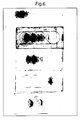
- RNA was hybridised to a general array of the type N 3 X 2 N 3 , under non-stringent conditions which would retain the folded structure of the RNA molecule.
- the pattern revealed that only a few regions of the 76 base sequence were open to hybridisation (Fig. 3 and the legend which describes the construction of the array).
- a scanning array was then made in which the oligonucleotides comprised twelve sets, each of 76 oligonucleotides, ranging in length from mononucleotides to 12mers, representing the complement of the sequence of yeast tRNA phe .
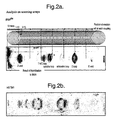
- Such an array can be made in one 76 step synthesis (Fig. 2a).
- Hybridisation of labelled tRNA to this array gives a pattern which shows how the oligonucleotides interact with all regions of the native molecule (Fig. 2a).
- the target presented to the general array of the type N 3 X 2 N 3 was so short (76 bases) that it was possible to make a scanning array of oligonucleotides representing the entire sequence.
- the general array would be used to identify regions of interest which would then be explored more thoroughly by means of one or more scanning arrays.
- the strength of interaction measured from the intensity of hybridisation, is very variable, with more than 10000-fold ratio of the strongest to the weakest. It is a major benefit of the technique that the strength of interaction can be seen immediately from examination of the hybridisation pattern. It is also possible to distinguish effects due to structure in the target from those which are due to structure in the oligonucleotides; this is important information for making choices of oligonucleotides for antisense applications.
- a striking feature of all analyses we have done with natural RNAs is that only a very small number of sites interact strongly with complementary oligonucleotides, and we often find that the strength of interaction changes abruptly as a result of adding or subtracting a single base (e.g. the HIV-TAR analysis shown in Fig.2b).
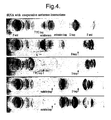
- oligonucleotides of these sequences were added to the tRNA probe, hybridisation to the scanning array showed dramatic increase in binding to regions which bound weakly or not at all in the absence of added oligonucleotide (Fig. 4).
- the process can be repeated - oligonucleotides that bind in the presence of the pioneer are included with it in the hybridisation - yet other regions are opened up and seen on the scanning array. Continuation of this procedure can bring most or all of the target into duplex with oligonucleotides.
- the combined oligonucleotides identified by this rational stepwise analysis will produce a stronger "antisense" activity than can be achieved by any single oligonucleotide.
- a further benefit of this as an approach to antisense design is that multiple short oligonucleotides are likely to be more specific to the target, to be taken up more effectively by cells, to be effective at lower concentrations [Morgan et al ., 1993], and may be less prone to degradation than longer ones.
- interactions involving very short oligonucleotides - tetra-, tri- and even dinucleotides- are stronger than any between long, fully complementary oligonucleotides; it is unlikely that these interactions are due to conventional Watson-Crick pairing and thus represent unexpected interactions which are revealed by the method proposed here, and which are relevant to the design of antisense reagents.
- Antisense reagents are not normally composed of oligonucleotides made from natural nucleotides, but from analogues. The important features are that:
- the target, the solution ligand and the ligands on the array need not necessarily be of the same molecular type.
- arrays of oligonucleotides could be used in conjunction with intercalating agents in solution, and vice versa to study effects of different intercalating agents on oligonucleotide binding; different types of drugs could be used in solution and on the array to study interactions with a target protein.
- oligonucleotides open up different regions of tRNA phe , and that each interaction permits its own set of interactions with other oligonucleotides. This analysis was done with each solution oligonucleotide separately. If it were possible to identify the bound solution oligonucleotide after the complex with the target were bound to the array, the solution ligands could comprise a mixture of all oligonucleotide sequences in a given size range. Ways to identify individual oligonucleotides or other analytes after they have been coupled to an array in this way are described in an earlier patent application GB 93 15 847.5 filed 30 July 1993.
- Pairs or higher multiples of ligands act to increase binding to a folded molecule by inhibiting the competing reaction - reformation of the internal structure of the target molecule. They will also increase the rate of binding by opening the structure of the target. Both of these processes could be enhanced if the ligands were joined so that trimolecular or higher order interactions were reduced to bimolecular interactions. It is easy to imagine that a pair of oligonucleotides, including short ones such as di-, tri- and tetra-nucleotides, or other ligands, could be joined by a flexible linker that would allow them both to bind.
- the effect of linking the interacting moieties together could be further extended by enhancing the binding of one or more of the ligands to the target, for example, by covalent crosslinking, by chelation, by intercalation, or by charge or van der Waals interaction with the target molecule. This would allow other ligands more time to bind to the target. Linkers with other desirable qualities, such as greater cell permeability, could further improve the ligands' properties.
- a ligand could form the basis of a ribozyme, e.g. by having at least one portion for interacting with a target and another portion with catalytic activity.
- the device used to form the cell must make a good seal against the substrate on which synthesis takes place.
- Ptfe is the only material we have found which makes a good seal to glass and withstands the solvents and chemicals used in oligonucleotide synthesis.
- the surface of the cell must be finished before machining the walls that create the reaction chamber, and we have been able to make a diamond shaped template that creates a good seal when pressed against a glass surface (Southern et al 1994).
- a circular template can be cut in a lathe in such a way that the surface tooling runs in the same lines as the cuts used when it is pressed against the glass surface (Fig.2a).
- the depth of the cell is ca.0.5mm.
- Inlet and outlet ports were made by drilling 1.0mm diameter holes at the top and bottom of the circle and fitting sawn-off 19 gauge (1.1mm o.d.) syringe needles through from the back.
- the ptfe cell was mounted on a rail fitted with a lead screw that was used to displace the glass plate relative to the ptfe reaction cell.
- the rail was mounted on the front of the frame of an ABI 381A oligonucleotide synthesiser so that the delivery lines normally connected to the column could be connected to the reaction cell.
- Oligonucleotide synthesis used standard reagents for phosphoramidite chemistry, omitting the capping step.
- the ABI 381A was programmed to couple bases in the order corresponding to the complement of the target sequence, with an interrupt after deprotection.
- the scale was for 0.2 ⁇ mol. synthesis, adjusted slightly to provide volumes that would just fill the reaction chamber.
- RNA phe (10 pmol, Sigma) was dissolved in HEPES buffer (50mM, pH7.4; 20mM MgCl 2 , 3.3mM DTT, 1 ⁇ M ATP, 10 ⁇ g/ml BSA, 10% DMSO) with cytosine-3',5'-diphosphate (3000Ci/mmol, Amersham), and T4 RNA ligase (9 units, Pharmacia), after 30min incubation at 37°, the reaction was separated in a spun column and the labelled RNA dissolved in 3.5M TMA (10ml). Hybridisation was carried out by applying ca.
- cold oligonucleotides corresponding to the D-loop GCTCTCCCAACT, the variable loop GACCTCCAGATT, or the TpsiC loop AACACAGGACCT were incubated with the tRNA in the hybridisation conditions for at least 18h before being applied to the plate.
- An illustrative array comprising all tetranucleotide sequences. This is one sixteenth the size of the smallest usable array comprising all hexanucleotides, which would be too complex to display in this format.
- the letters along the top and down the left hand side show the order in which base precursors were applied in columns and rows during the synthesis of the oligonucleotides.
- the letters in each cell show the sequence of the oligonucleotide synthesised in that cell. Larger arrays are made by simply ovelaying increasingly wide rows and columns such that each successive row or column embraces four from the previous layer. In all cases, the array comprises all 4 s possible oligonucleotide sequences of length s.
- Fig. 3 More complex arrays can be made by applying mixtures of all four bases at certain stages in the synthesis; for example, all octanucleotides can be made in 4096 cells by applying four mixed bases in the two central positions, to produce an array of the type N 3 X 2 N 3 . In this case, each cell comprises a mixture of 16 different octanucleotides.
- Fig. 3 The results of hybridisation to such an array are shown in Fig. 3.
- Scanning arrays are made by applying oligonucleotide precursors to the glass substrate in a circular patch.
- the first base corresponding to the complement of the 5' end base of the target sequence, is applied to the left end of the plate, which is then moved by a predetermined off-set, and the second base added. The process is repeated for the whole of the sequence.
- Oligonucleotides ranging in size down to a single base are made in the segments flanking the centre line.
- the upper panel shows a scanning array representing the 76 bases of tRNA phe , hybridised to end labelled tRNA. Note the strong hybridisation in the region of the D-loop, more moderate hybridisation to the variable loop, and very weak hybridisation to the anticodon loop and the 5'-end of the molecule.
- the lower panel shows a scanning array representing 76 bases of HIV TAR element hybridised to an in vitro labelled transcript: of the same region. Note the strong hybridisation to a single 12-mer, which is tenfold stronger than hybridisation elsewhere. This 12-mer corresponds to the region of the loop which has been shown by others [Ecker et al ., 1992] to form a pseudo-half-knot with an adjacent 12-mer.
- Cooperative antisense oligonucleotides against rabbit ß-globin mRNA Cooperative antisense oligonucleotides against rabbit ß-globin mRNA.
- arrays were made of complements to the same sequence, a region of the human CFTR gene (mutations in this gene are responsible for cystic fibrosis).
- the arrays were made as described in Southern et al (1994) on a glass substrate derivatised with a hexaethylene glycol linker.
- the arrays were all hybridised under identical conditions (3.5 M tetramethylammonium chloride, 4°C) with the sequence CCTGGCACCATTAAAGAAAATATCATCTTTGGTGTTTCCTAT, part of exon 10 of the CFTR gene covered by the array.
- deoxyribonucleotides give essentially the same result in both chemical orientations, but the analogues, the deoxyribophosphothioates and ribonucleotides, give quite different results. Although a difference may be expected, this experiments shows the difficulty in extrapolating data from one analogue to others, and further demonstrates the power of the array technique in identifying candidates for antisense reagents, including analogues.
- the Rev response element (RRE) of HIV is considered to be a good potential target for therapeutic intervention by antisense oligonucleotides because of its central place in the regulation of gene expression from the viral genome.
- molecular modelling in the computer suggests that this region of HIV RNA is likely to have a complex folded structure, and this has been confirmed by analysing the susceptibility of the RNA to nucleases. This structure makes it difficult to select regions for antisense targetting.
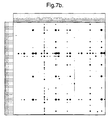
- the method used to make the universal arrays produces oligonucleotides half the length of the major oligonucleotides in lines which intersperse them.
- a surprising result of the analysis is that some of these tri- and tetranucleotides interact strongly with the target (see the lines of uniform intensity in Figs. 7a and b). With other targets we see the same feature, but with different oligonucleotide sequences. In one case (Southern et al, 1994), we have seen interaction between a target and a dinucleotide.
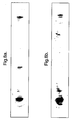
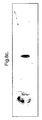
- Fig. 7 The region of the RRE analysed in Fig. 7 was also analysed on a scanning array made of oligodeoxyribooligonucleotides with 17mers as the longest. Only one oligonucleotide in the Rev binding region showed strong interaction at 37°C in 3.5 M TMACl (Fig. 8a). When this oligonucleotide was bound to the target in solution and the complex again applied to the array, several sites showed interaction with oligonucleotides which had not bound in the absence of the solution oligonucleotide (Fig. 8b). [The same region bound when the RRE target was analysed on an array of phosphothioate analogue oligonucleotides at 20°C in 1 M NaCl (Fig. 8c)].
- neomycin a drug which is known to act by binding to RNA molecules.
- the presence of neomycin substantially altered the pattern of interaction of RRE with some oligonucleotides. (Figs. 9a and b). In particular, regions which bind poorly in its absence bind more strongly in its presence.
- the TAR element is another important target for HIV.
- we selected an antisense sequence as the "pioneer" Fig. 2b and 11a
- the arrays and the cooperative ligands used in the examples were made of a variety of chemical types, illustrating the generality of the approach.
Landscapes
- Chemical & Material Sciences (AREA)
- Organic Chemistry (AREA)
- Life Sciences & Earth Sciences (AREA)
- Health & Medical Sciences (AREA)
- Engineering & Computer Science (AREA)
- Biochemistry (AREA)
- Molecular Biology (AREA)
- Zoology (AREA)
- Wood Science & Technology (AREA)
- Genetics & Genomics (AREA)
- Biotechnology (AREA)
- General Health & Medical Sciences (AREA)
- Bioinformatics & Cheminformatics (AREA)
- Proteomics, Peptides & Aminoacids (AREA)
- Microbiology (AREA)
- General Engineering & Computer Science (AREA)
- Chemical Kinetics & Catalysis (AREA)
- Physics & Mathematics (AREA)
- Biophysics (AREA)
- Analytical Chemistry (AREA)
- Immunology (AREA)
- General Chemical & Material Sciences (AREA)
- Medicinal Chemistry (AREA)
- Biomedical Technology (AREA)
- Bioinformatics & Computational Biology (AREA)
- Crystallography & Structural Chemistry (AREA)
- Plant Pathology (AREA)
- Measuring Or Testing Involving Enzymes Or Micro-Organisms (AREA)
- Organic Low-Molecular-Weight Compounds And Preparation Thereof (AREA)
Claims (13)
- Procédé pour étudier la structure tertiaire d'une cible à savoir une molécule polymère possédant une séquence connue, ledit procédé comprenant le fait de procurer plusieurs ligands différents sous la forme d'un arrangement sur une surface solide, lesdits différents ligands étant complémentaires à différents segments de la cible; appliquer la cible en solution sur l'arrangement de ligands dans des conditions qui conservent la structure tertiaire de la cible; et observer les différences quantitatives entre les interactions de la cible avec les différents ligands de l'arrangement; à condition que, lorsque les ligands ne sont pas des oligonucléotides ou des analogues d'oligonucléotides, la cible est un acide nucléique.
- Procédé pour déterminer des combinaisons de ligands spécifiques pour une cible, ledit procédé comprenant les étapes consistant à :a) lier au moins un ligand à la cible pour former un complexe cible,b) appliquer le complexe cible sur d'autres ligands qui forment un arrangement sur une surface solide dans des conditions qui permettent une interaction entre les autres ligands et le complexe cible, etc) identifier au moins un autre ligand qui agit de manière réciproque avec le complexe cible.
- Procédé selon la revendication 2, comprenant les étapes supplémentaires consistant à lier ledit ou lesdits autres ligands au complexe cible, puis à répéter les étapes b) et c).
- Procédé selon la revendication 2 ou 3, dans lequel un ligand est un oligonucléotide ou un analogue d'oligonucléotides et un autre ligand est un peptide.
- Procédé selon l'une quelconque des revendications 2 à 4, dans lequel deux ligands sont joints l'un à l'autre à l'aide d'un lieur.
- Procédé selon l'une quelconque des revendications 2 à 5, dans lequel ledit ligand ou lesdits ligands à lier à la cible pour former un complexe cible à l'étape a) sont choisis en mélangeant la cible avec une bibliothèque de ligands et en choisissant à partir de la bibliothèque au moins un ligand qui se lie à la cible.
- Procédé selon l'une quelconque des revendications 1 à 6, dans lequel la cible est un acide nucléique et les ligands sont des oligonucléotides ou des analogues d'oligonucléotides.
- Procédé selon la revendication 7, dans lequel les ligands sont des analogues d'oligonucléotides modifiés par l'addition ou la substitution d'autres fractions chimiques choisies parmi le groupe comprenant des éthers oligoaliphatiques, des agents d'intercalation, des résidus chargés positivement, des agents de chélation et des agents lipophiles.
- Procédé selon l'une quelconque des revendications 1 à 8, dans lequel les ligands forment la base d'un ribozyme.
- Procédé selon l'une quelconque des revendications 1 à 9, dans lequel la cible et un ou plusieurs ligands sont de types chimiques différents.
- Procédé selon l'une quelconque des revendications 1 à 10, dans lequel au moins un ligand se lie de manière covalente à la cible.
- Procédé selon l'une quelconque des revendications 1 à 11, dans lequel la cible est un ARN.
- Procédé selon l'une quelconque des revendications 2 et 3 à 12, pour autant qu'elle dépende de la revendication 2, dans lequel la cible est une molécule possédant une structure secondaire ou tertiaire et est mise en interaction avec l'arrangement de ligands dans des conditions telles que la structure secondaire ou tertiaire est conservée.
Applications Claiming Priority (3)
| Application Number | Priority Date | Filing Date | Title |
|---|---|---|---|
| GB9401833 | 1994-02-01 | ||
| GB9401833A GB9401833D0 (en) | 1994-02-01 | 1994-02-01 | Method for discovering ligands |
| PCT/GB1995/000209 WO1995021265A1 (fr) | 1994-02-01 | 1995-02-01 | Procede de decouverte de ligands |
Publications (2)
| Publication Number | Publication Date |
|---|---|
| EP0742837A1 EP0742837A1 (fr) | 1996-11-20 |
| EP0742837B1 true EP0742837B1 (fr) | 2001-06-13 |
Family
ID=10749622
Family Applications (1)
| Application Number | Title | Priority Date | Filing Date |
|---|---|---|---|
| EP95907093A Expired - Lifetime EP0742837B1 (fr) | 1994-02-01 | 1995-02-01 | Procede de decouverte de ligands |
Country Status (7)
| Country | Link |
|---|---|
| US (2) | US6080585A (fr) |
| EP (1) | EP0742837B1 (fr) |
| JP (1) | JPH09508791A (fr) |
| AT (1) | ATE202148T1 (fr) |
| DE (1) | DE69521298T2 (fr) |
| GB (1) | GB9401833D0 (fr) |
| WO (1) | WO1995021265A1 (fr) |
Cited By (1)
| Publication number | Priority date | Publication date | Assignee | Title |
|---|---|---|---|---|
| US7138506B2 (en) | 2001-05-09 | 2006-11-21 | Genetic Id, Na, Inc. | Universal microarray system |
Families Citing this family (132)
| Publication number | Priority date | Publication date | Assignee | Title |
|---|---|---|---|---|
| US7375198B2 (en) | 1993-10-26 | 2008-05-20 | Affymetrix, Inc. | Modified nucleic acid probes |
| US6156501A (en) * | 1993-10-26 | 2000-12-05 | Affymetrix, Inc. | Arrays of modified nucleic acid probes and methods of use |
| NO314334B1 (no) * | 1994-03-07 | 2003-03-10 | Toennesen Svein Olav | Innstillbart feste for skulderstropper på en ryggsekk |
| US5663064A (en) * | 1995-01-13 | 1997-09-02 | University Of Vermont | Ribozymes with RNA protein binding site |
| US6458530B1 (en) | 1996-04-04 | 2002-10-01 | Affymetrix Inc. | Selecting tag nucleic acids |
| ES2288760T3 (es) | 1996-04-25 | 2008-01-16 | Bioarray Solutions Ltd. | Ensamblaje electrocinetico controlado por luz de particulas proximas a superficies. |
| GB9620749D0 (en) * | 1996-10-04 | 1996-11-20 | Brax Genomics Ltd | Identifying antisense oligonucleotides |
| WO1998050403A1 (fr) * | 1997-05-05 | 1998-11-12 | Third Wave Technologies,Inc. | Reactions dependantes des cibles, utilisant des oligonucleotides de pontage de structures |
| US6242246B1 (en) * | 1997-12-15 | 2001-06-05 | Somalogic, Inc. | Nucleic acid ligand diagnostic Biochip |
| US20070166741A1 (en) | 1998-12-14 | 2007-07-19 | Somalogic, Incorporated | Multiplexed analyses of test samples |
| US6087102A (en) | 1998-01-07 | 2000-07-11 | Clontech Laboratories, Inc. | Polymeric arrays and methods for their use in binding assays |
| GB2335035B (en) * | 1998-03-03 | 2003-05-28 | Brax Genomics Ltd | Screening for functional antisense agents |
| US6979728B2 (en) * | 1998-05-04 | 2005-12-27 | Baylor College Of Medicine | Articles of manufacture and methods for array based analysis of biological molecules |
| US7211390B2 (en) * | 1999-09-16 | 2007-05-01 | 454 Life Sciences Corporation | Method of sequencing a nucleic acid |
| US7244559B2 (en) * | 1999-09-16 | 2007-07-17 | 454 Life Sciences Corporation | Method of sequencing a nucleic acid |
| AU2001272993B2 (en) | 2000-06-21 | 2005-03-10 | Bioarray Solutions, Ltd. | Multianalyte molecular analysis |
| US9709559B2 (en) | 2000-06-21 | 2017-07-18 | Bioarray Solutions, Ltd. | Multianalyte molecular analysis using application-specific random particle arrays |
| US20020187482A1 (en) * | 2000-09-25 | 2002-12-12 | Zicai Liang | Methods and means of RNA analysis |
| AU2002220087A1 (en) * | 2000-11-10 | 2002-05-21 | Stratagene | Gene monitoring and gene identification using cdna arrays |
| WO2002068579A2 (fr) * | 2001-01-10 | 2002-09-06 | Pe Corporation (Ny) | Kits tels que des dosages d'acides nucleiques comprenant une majorite d'exons ou de transcrits humains, destines a detecter l'expression et pouvant avoir d'autres applications |
| GB0105789D0 (en) * | 2001-03-08 | 2001-04-25 | Expresson Biosystems Ltd | Detecting interactions between oligonucleotides and RNA using fluorescence resonance energy transfer (FRET) |
| GB0105790D0 (en) * | 2001-03-08 | 2001-04-25 | Expresson Biosystems Ltd | Detecting binding of mRNA to an oligonnucleotide array using RNA dependent nucleic acid modifying enzymes |
| GB0105787D0 (en) * | 2001-03-08 | 2001-04-25 | Expresson Biosystems Ltd | Complex element micro-array and methods of use |
| EP2465943A3 (fr) | 2001-03-16 | 2012-10-03 | Kalim Mir | Affichage de polymère linéaire |
| PT1401853E (pt) | 2001-05-25 | 2010-12-07 | Univ Duke | Modulador de oligonucleotídeos |
| US20030027133A1 (en) * | 2001-05-31 | 2003-02-06 | Cawse James Norman | Method of improving a mixture experiment |
| US7262063B2 (en) | 2001-06-21 | 2007-08-28 | Bio Array Solutions, Ltd. | Directed assembly of functional heterostructures |
| US20050009022A1 (en) * | 2001-07-06 | 2005-01-13 | Weiner Michael P. | Method for isolation of independent, parallel chemical micro-reactions using a porous filter |
| US7297553B2 (en) * | 2002-05-28 | 2007-11-20 | Nanosphere, Inc. | Method for attachment of silylated molecules to glass surfaces |
| US7687437B2 (en) * | 2001-07-13 | 2010-03-30 | Nanosphere, Inc. | Method for immobilizing molecules onto surfaces |
| US20030054396A1 (en) * | 2001-09-07 | 2003-03-20 | Weiner Michael P. | Enzymatic light amplification |
| KR20040068122A (ko) * | 2001-10-15 | 2004-07-30 | 바이오어레이 솔루션스 리미티드 | 공동 검색과 효소-매개된 탐지에 의한 다형성 좌위의 다중분석 |
| US20070264641A1 (en) * | 2001-10-15 | 2007-11-15 | Li Alice X | Multiplexed analysis of polymorphic loci by concurrent interrogation and enzyme-mediated detection |
| US6956114B2 (en) | 2001-10-30 | 2005-10-18 | '454 Corporation | Sulfurylase-luciferase fusion proteins and thermostable sulfurylase |
| US6902921B2 (en) | 2001-10-30 | 2005-06-07 | 454 Corporation | Sulfurylase-luciferase fusion proteins and thermostable sulfurylase |
| US20050124022A1 (en) * | 2001-10-30 | 2005-06-09 | Maithreyan Srinivasan | Novel sulfurylase-luciferase fusion proteins and thermostable sulfurylase |
| EP1481090A4 (fr) | 2002-02-15 | 2006-08-09 | Somalogic Inc | Methodes et reactifs destines a la detection d'une liaison de cibles par des ligands d'acides nucleiques |
| US6916621B2 (en) * | 2002-03-27 | 2005-07-12 | Spectral Genomics, Inc. | Methods for array-based comparitive binding assays |
| US8048623B1 (en) | 2002-04-24 | 2011-11-01 | The University Of North Carolina At Greensboro | Compositions, products, methods and systems to monitor water and other ecosystems |
| US9126165B1 (en) | 2002-04-24 | 2015-09-08 | The University Of North Carolina At Greensboro | Nucleic acid arrays to monitor water and other ecosystems |
| US7214492B1 (en) | 2002-04-24 | 2007-05-08 | The University Of North Carolina At Greensboro | Nucleic acid arrays to monitor water and other ecosystems |
| US8383342B2 (en) | 2002-04-24 | 2013-02-26 | The University Of North Carolina At Greensboro | Compositions, products, methods and systems to monitor water and other ecosystems |
| AU2003298655A1 (en) | 2002-11-15 | 2004-06-15 | Bioarray Solutions, Ltd. | Analysis, secure access to, and transmission of array images |
| US7575865B2 (en) * | 2003-01-29 | 2009-08-18 | 454 Life Sciences Corporation | Methods of amplifying and sequencing nucleic acids |
| AU2004209001B2 (en) * | 2003-01-29 | 2007-10-11 | 454 Life Sciences Corporation | Bead emulsion nucleic acid amplification |
| US20050233390A1 (en) * | 2003-04-09 | 2005-10-20 | Allen John W | Device including a proteinaceous factor, a recombinant proteinaceous factor, and a nucleotide sequence encoding the proteinaceous factor |
| WO2005029705A2 (fr) | 2003-09-18 | 2005-03-31 | Bioarray Solutions, Ltd. | Codage numerique pour identification de sous-types des types de supports solides codes |
| US7595279B2 (en) | 2003-09-22 | 2009-09-29 | Bioarray Solutions Ltd. | Surface immobilized polyelectrolyte with multiple functional groups capable of covalently bonding to biomolecules |
| EP1692298A4 (fr) | 2003-10-28 | 2008-08-13 | Bioarray Solutions Ltd | Optimisation de l'analyse de l'expression genique a l'aide de sondes de capture immobilisees |
| NZ547495A (en) | 2003-10-29 | 2008-05-30 | Bioarray Solutions Ltd | Multiplexed nucleic acid analysis by fragmentation of double-stranded DNA |
| EP2290072B1 (fr) | 2004-05-28 | 2014-12-17 | Asuragen, Inc. | Procédés et compositions impliquant du microARN |
| JP3916086B2 (ja) * | 2004-06-29 | 2007-05-16 | ソニー株式会社 | ハイブリダイゼーションなどの相互作用を検出する方法及び検出部、該検出部を備えるバイオアッセイ用基板、ハイブリダイゼーションなどの相互作用を検出する装置、並びに試薬キット |
| US7848889B2 (en) | 2004-08-02 | 2010-12-07 | Bioarray Solutions, Ltd. | Automated analysis of multiplexed probe-target interaction patterns: pattern matching and allele identification |
| ES2534304T3 (es) | 2004-11-12 | 2015-04-21 | Asuragen, Inc. | Procedimientos y composiciones que implican miARN y moléculas inhibidoras de miARN |
| EP2604703B1 (fr) | 2005-03-14 | 2017-02-01 | The Board of Trustees of the Leland Stanford Junior University | Procédés permettant d'évaluer la survie d'un greffon chez un destinataire d'une transplantation d'organe solide |
| US8486629B2 (en) | 2005-06-01 | 2013-07-16 | Bioarray Solutions, Ltd. | Creation of functionalized microparticle libraries by oligonucleotide ligation or elongation |
| EP1731620A1 (fr) | 2005-06-07 | 2006-12-13 | Institut National De La Sante Et De La Recherche Medicale (Inserm) | Procédé diagnostique d'une tolérance immunitaire dans une greffe |
| WO2008008284A2 (fr) | 2006-07-14 | 2008-01-17 | The Regents Of The University Of California | Biomarqueurs du cancer et méthodes d'utilisation |
| WO2008036765A2 (fr) | 2006-09-19 | 2008-03-27 | Asuragen, Inc. | Micro arn exprimés par différenciation dans les maladies du pancréas, et leur utilisation |
| EP2145001A2 (fr) | 2006-09-19 | 2010-01-20 | Asuragen, Inc. | Gènes régulés mir-15, mir-26, mir -31,mir -145, mir-147, mir-188, mir-215, mir-216 mir-331, mmu-mir-292-3p et voies de signalisation utiles comme cibles dans une intervention thérapeutique |
| US7855054B2 (en) | 2007-01-16 | 2010-12-21 | Somalogic, Inc. | Multiplexed analyses of test samples |
| US20110136099A1 (en) | 2007-01-16 | 2011-06-09 | Somalogic, Inc. | Multiplexed Analyses of Test Samples |
| AU2008210421B2 (en) | 2007-01-30 | 2014-03-13 | Pharmacyclics Llc | Methods for determining cancer resistance to histone deacetylase inhibitors |
| EP1961825A1 (fr) | 2007-02-26 | 2008-08-27 | INSERM (Institut National de la Santé et de la Recherche Medicale) | Procédé pour prévoir l'apparition de métastase dans les patients souffrant d'un cancer du sein |
| US8906700B2 (en) | 2007-11-06 | 2014-12-09 | Ambergen, Inc. | Methods and compositions for phototransfer |
| US8658379B2 (en) | 2008-01-29 | 2014-02-25 | University of Pittsburgh—of the Commonwealth System of Higher Education | Follistatin-like protein-1 as a biomarker for sepsis |
| WO2009097424A1 (fr) | 2008-01-29 | 2009-08-06 | University Of Pittsburgh-Of The Commonwealth System Of Higher Education | Fstl-1 en tant que biomarqueur de l'inflammation |
| US8258111B2 (en) | 2008-05-08 | 2012-09-04 | The Johns Hopkins University | Compositions and methods related to miRNA modulation of neovascularization or angiogenesis |
| WO2010021696A1 (fr) | 2008-08-18 | 2010-02-25 | The Board Of Trustees Of The Leland Stanford Junior University | Procédés et compositions pour déterminer un phénotype tolérant à une greffe chez un sujet |
| EP2329259B1 (fr) | 2008-08-29 | 2016-04-20 | Janssen Biotech, Inc. | Marqueurs et procédés pour évaluer et pour traiter une recto-colite hémorragique et des troubles associés à l'aide d'un ensemble de 20 gènes |
| WO2010054195A2 (fr) | 2008-11-07 | 2010-05-14 | Centocor Ortho Biotech Inc. | Marqueurs et procédés d'évaluation et de traitement de patients atteints de lupus sensibles à la photoprovocation |
| ES2399711T3 (es) | 2009-08-22 | 2013-04-02 | The Board Of Trustees Of The University Of The Leland Stanford Junior University | Obtención de imágenes y evaluación de embriones, ovocitos y células madre |
| US9290813B2 (en) | 2009-12-02 | 2016-03-22 | The Board Of Trustees Of The Leland Stanford Junior University | Biomarkers for determining an allograft tolerant phenotype |
| GB0922085D0 (en) | 2009-12-17 | 2010-02-03 | Cambridge Entpr Ltd | Cancer diagnosis and treatment |
| EP2542678B1 (fr) | 2010-03-04 | 2017-04-12 | InteRNA Technologies B.V. | Molécule de miarn définie par sa source et ses utilisations thérapeutiques pour cancers associés à l'emt |
| MX2012012235A (es) | 2010-04-19 | 2012-11-23 | Procter & Gamble | Firmas geneticas y matrices geneticas asociadas con la administracion de corriente de radio frecuencia conducida electricamente a la piel y metodos y tratamiento relacionados a ellos. |
| KR101490573B1 (ko) | 2010-04-19 | 2015-02-05 | 시네론 메디컬 리미티드 | 포유류 피부의 상태를 조절하기 위한 조합된 에너지 및 국소 조성물 적용 |
| EP3508854A1 (fr) | 2010-04-27 | 2019-07-10 | The Regents of The University of California | Biomarqueurs du cancer et leurs procédés d'utilisation |
| EP3369817A1 (fr) | 2010-07-06 | 2018-09-05 | InteRNA Technologies B.V. | Arnmi, son diagnostic et ses usages thérapeutiques dans des maladies ou des pathologies associées à un mélanome ou dans des maladies ou pathologies associées à une voie braf activée |
| WO2012019099A2 (fr) | 2010-08-05 | 2012-02-09 | University Of Pittsburgh - Of The Commonwealth System Of Higher Education | Protéine 1 analogue à la follistatine utilisable en tant que biomarqueur des troubles inflammatoires |
| MY166040A (en) | 2010-09-15 | 2018-05-21 | Almac Diagnostics Ltd | Molecular diagnostic test for cancer |
| ES2629890T3 (es) | 2010-11-17 | 2017-08-16 | Interpace Diagnostics, Llc | miARN como biomarcadores para distinguir entre neoplasias de tiroides benignas y malignas |
| EP2474617A1 (fr) | 2011-01-11 | 2012-07-11 | InteRNA Technologies BV | MIR pour traiter une nouvelle angiogenèse |
| JP2014507664A (ja) | 2011-02-23 | 2014-03-27 | ザ ボード オブ トラスティーズ オブ ザ レランド スタンフォード ジュニア ユニバーシティー | ヒト胚における異数性の検出方法 |
| MX2013009863A (es) | 2011-02-28 | 2013-12-06 | Univ Iowa Res Found | Cambios de la hormona anti-mulleriana en el embarazo y prediccion de sexo y de resultados adversos en el embarazo. |
| EA025926B1 (ru) | 2011-06-02 | 2017-02-28 | Олмак Дайэгностикс Лимитед | Молекулярно-диагностический тест на рак |
| US9644241B2 (en) | 2011-09-13 | 2017-05-09 | Interpace Diagnostics, Llc | Methods and compositions involving miR-135B for distinguishing pancreatic cancer from benign pancreatic disease |
| US20130157884A1 (en) | 2011-10-26 | 2013-06-20 | Asuragen, Inc. | Methods and compositions involving mirna expression levels for distinguishing pancreatic cysts |
| US20130142728A1 (en) | 2011-10-27 | 2013-06-06 | Asuragen, Inc. | Mirnas as diagnostic biomarkers to distinguish benign from malignant thyroid tumors |
| WO2013087789A1 (fr) | 2011-12-13 | 2013-06-20 | Glykos Finland Ltd. | Réseaux d'isoformes d'anticorps et procédés associés |
| EP2870263A1 (fr) | 2012-07-03 | 2015-05-13 | InteRNA Technologies B.V. | Portefeuille de diagnostic et ses utilisations |
| WO2014055117A1 (fr) | 2012-10-04 | 2014-04-10 | Asuragen, Inc. | Micro-arn diagnostiques utilisés dans le diagnostic différentiel de lésions kystiques pancréatiques de découverte fortuite |
| AU2013353839A1 (en) | 2012-12-03 | 2015-06-18 | Almac Diagnostics Limited | Molecular diagnostic test for cancer |
| EP2971132B1 (fr) | 2013-03-15 | 2020-05-06 | Baylor Research Institute | Biomarqueurs de miarn à base de tissu et de sang pour le diagnostic, le pronostic et le potentiel prédictif de métastases dans le cancer colorectal |
| EP2971149B1 (fr) | 2013-03-15 | 2018-05-09 | Baylor Research Institute | Marqueurs d'une néoplasie colorectale associée à la colite ulcéreuse (uc) |
| WO2014144666A2 (fr) | 2013-03-15 | 2014-09-18 | The University Of Chicago | Procédés et compositions associés à l'activité des lymphocytes t |
| GB201409479D0 (en) | 2014-05-28 | 2014-07-09 | Almac Diagnostics Ltd | Molecular diagnostic test for cancer |
| EP3194623B1 (fr) | 2014-08-12 | 2022-01-05 | Wayne State University | Systèmes et méthodes de détection du stress dans les cellules souches et leurs utilisations |
| EP3227687A4 (fr) | 2014-12-05 | 2018-10-24 | Prelude, Inc. | Récurrence de carcinome canalaire in situ (dcis) et cancer du sein invasif |
| GB201512869D0 (en) | 2015-07-21 | 2015-09-02 | Almac Diagnostics Ltd | Gene signature for minute therapies |
| CN109073654A (zh) | 2016-04-20 | 2018-12-21 | 苏州爱尔迪思生物科技有限公司 | 用于预测早产的方法和组合物 |
| CN109196362A (zh) | 2016-05-17 | 2019-01-11 | 苏州爱尔迪思生物科技有限公司 | 用于提供子痫前期评估的方法和组合物 |
| EP3704250A1 (fr) | 2017-11-03 | 2020-09-09 | InteRNA Technologies B.V. | Molécule de micro-arn, équivalent, antagomir, ou source de cette molécule pour le traitement et/ou le diagnostic d'une affection et/ou d'une maladie associée à une déficience neuronale ou pour la (ré)génération neuronale |
| WO2019104155A2 (fr) | 2017-11-22 | 2019-05-31 | The University Of Chicago | Évaluation sonde chimique-dépendante de l'activité protéique et ses utilisations |
| US11957695B2 (en) | 2018-04-26 | 2024-04-16 | The Broad Institute, Inc. | Methods and compositions targeting glucocorticoid signaling for modulating immune responses |
| WO2019213660A2 (fr) | 2018-05-04 | 2019-11-07 | The Broad Institute, Inc. | Compositions et procédés de modulation de la signalisation du cgrp pour réguler les réponses inflammatoires des cellules lymphoïdes innées |
| WO2020036926A1 (fr) | 2018-08-17 | 2020-02-20 | Cellecta, Inc. | Préparation multiplex de fragments d'adn spécifiques à un gène à code à barres |
| EP3850368A4 (fr) | 2018-09-14 | 2022-11-23 | Prelude Corporation | Méthode de sélection pour le traitement d'individus présentant un risque de cancer du sein invasif |
| WO2020077135A1 (fr) | 2018-10-10 | 2020-04-16 | Dana-Farber Cancer Institute, Inc. | Modulation de la résistance à des inhibiteurs de bcl -2 |
| US12402610B2 (en) | 2018-11-09 | 2025-09-02 | The Broad Institute, Inc. | Methods and compositions for modulating innate lymphoid cell pathogenic effectors |
| JP7709379B2 (ja) | 2019-02-27 | 2025-07-16 | マデラ セラピューティクス,エルエルシー | イミプリドン様薬剤に対する薬物反応のバイオマーカとしてのカゼイン分解プロテアーゼpの機能の使用 |
| US20220154282A1 (en) | 2019-03-12 | 2022-05-19 | The Broad Institute, Inc. | Detection means, compositions and methods for modulating synovial sarcoma cells |
| WO2020186235A1 (fr) | 2019-03-14 | 2020-09-17 | The Broad Institute, Inc. | Compositions et procédés de modulation de la signalisation du cgrp pour réguler des cellules lymphoïdes innées intestinales |
| WO2020191079A1 (fr) | 2019-03-18 | 2020-09-24 | The Broad Institute, Inc. | Compositions et méthodes de modulation de régulateurs métaboliques de pathogénicité de lymphocytes t |
| WO2020191069A1 (fr) | 2019-03-18 | 2020-09-24 | The Broad Institute, Inc. | Modulation de l'immunité de type 2 par ciblage de la signalisation clec-2 |
| EP3947727A4 (fr) | 2019-04-05 | 2023-01-04 | Board of Regents, The University of Texas System | Procédés et applications pour le codage à barres de cellules |
| US12441716B2 (en) | 2019-04-12 | 2025-10-14 | The Regents Of The University Of California | Compositions and methods for increasing muscle mass and oxidative metabolism |
| US20220282333A1 (en) | 2019-08-13 | 2022-09-08 | The General Hospital Corporation | Methods for predicting outcomes of checkpoint inhibition and treatment thereof |
| US12421557B2 (en) | 2019-08-16 | 2025-09-23 | The Broad Institute, Inc. | Methods for predicting outcomes and treating colorectal cancer using a cell atlas |
| US12195725B2 (en) | 2019-10-03 | 2025-01-14 | Dana-Farber Cancer Institute, Inc. | Compositions and methods for modulating and detecting tissue specific TH17 cell pathogenicity |
| US11981922B2 (en) | 2019-10-03 | 2024-05-14 | Dana-Farber Cancer Institute, Inc. | Methods and compositions for the modulation of cell interactions and signaling in the tumor microenvironment |
| US11793787B2 (en) | 2019-10-07 | 2023-10-24 | The Broad Institute, Inc. | Methods and compositions for enhancing anti-tumor immunity by targeting steroidogenesis |
| US11844800B2 (en) | 2019-10-30 | 2023-12-19 | Massachusetts Institute Of Technology | Methods and compositions for predicting and preventing relapse of acute lymphoblastic leukemia |
| WO2021127610A1 (fr) | 2019-12-20 | 2021-06-24 | EDWARD Via COLLEGE OF OSTEOPATHIC MEDICINE | Signatures de cancer, procédés de génération de signatures de cancer et leurs utilisations |
| US12165747B2 (en) | 2020-01-23 | 2024-12-10 | The Broad Institute, Inc. | Molecular spatial mapping of metastatic tumor microenvironment |
| EP4192486A4 (fr) | 2020-08-07 | 2024-05-01 | The Broad Institute, Inc. | Ciblage thérapeutique d'une dérégulation du phosphate dans le cancer par l'intermédiaire du complexe protéique xpr1 : kidins220 |
| WO2022192419A2 (fr) | 2021-03-09 | 2022-09-15 | Massachusetts Institute Of Technology | Méthodes de traitement d'une maladie inflammatoire de l'intestin (mii) avec un blocage anti-tnf |
| WO2024028794A1 (fr) | 2022-08-02 | 2024-02-08 | Temple Therapeutics BV | Méthodes de traitement de troubles de l'endomètre et de l'hyperprolifération ovarienne |
| WO2024124044A1 (fr) | 2022-12-07 | 2024-06-13 | The Brigham And Women’S Hospital, Inc. | Compositions et procédés ciblant sat1 pour améliorer l'immunité antitumorale pendant la progression d'une tumeur |
| WO2024192141A1 (fr) | 2023-03-13 | 2024-09-19 | Dana-Farber Cancer Institute, Inc. | Traitement de cancers présentant un état de cellule mésenchymateuse résistant aux médicaments |
| WO2024226838A2 (fr) | 2023-04-25 | 2024-10-31 | The Brigham And Women's Hospital, Inc. | Traitement de maladies auto-immunes à état pathogène des lymphocytes t |
| WO2025248505A1 (fr) | 2024-05-31 | 2025-12-04 | Wayne State University | Méthodes de traitement de troubles d'hyperprolifération endométriale et ovarienne |
Family Cites Families (13)
| Publication number | Priority date | Publication date | Assignee | Title |
|---|---|---|---|---|
| US4563417A (en) * | 1984-08-31 | 1986-01-07 | Miles Laboratories, Inc. | Nucleic acid hybridization assay employing antibodies to intercalation complexes |
| US4921788A (en) * | 1988-04-12 | 1990-05-01 | The Research Foundation Of State University Of New York | Competitive nucleic acid immunoassay for the detection of analytes |
| US5700637A (en) * | 1988-05-03 | 1997-12-23 | Isis Innovation Limited | Apparatus and method for analyzing polynucleotide sequences and method of generating oligonucleotide arrays |
| US5143854A (en) * | 1989-06-07 | 1992-09-01 | Affymax Technologies N.V. | Large scale photolithographic solid phase synthesis of polypeptides and receptor binding screening thereof |
| US5270163A (en) * | 1990-06-11 | 1993-12-14 | University Research Corporation | Methods for identifying nucleic acid ligands |
| CA2084987C (fr) * | 1990-06-11 | 2007-02-13 | Gilead Sciences, Inc. | Ligands d'acide nucleique |
| US5474796A (en) * | 1991-09-04 | 1995-12-12 | Protogene Laboratories, Inc. | Method and apparatus for conducting an array of chemical reactions on a support surface |
| US5846708A (en) * | 1991-11-19 | 1998-12-08 | Massachusetts Institiute Of Technology | Optical and electrical methods and apparatus for molecule detection |
| DE69233087T2 (de) * | 1991-11-22 | 2003-12-24 | Affymetrix, Inc. (N.D.Ges.D.Staates Delaware) | Verfahren zur Herstellung von Polymerarrays |
| US5412087A (en) * | 1992-04-24 | 1995-05-02 | Affymax Technologies N.V. | Spatially-addressable immobilization of oligonucleotides and other biological polymers on surfaces |
| US5585275A (en) * | 1992-09-02 | 1996-12-17 | Arris Pharmaceutical Corporation | Pilot apparatus for peptide synthesis and screening |
| US5635385A (en) * | 1993-09-15 | 1997-06-03 | Temple University-Of The Commonwealth System Of Higher Education | Multi-unit ribozyme inhibition of oncogene gene expression |
| US5429807A (en) * | 1993-10-28 | 1995-07-04 | Beckman Instruments, Inc. | Method and apparatus for creating biopolymer arrays on a solid support surface |
-
1994
- 1994-02-01 GB GB9401833A patent/GB9401833D0/en active Pending
-
1995
- 1995-02-01 DE DE69521298T patent/DE69521298T2/de not_active Expired - Fee Related
- 1995-02-01 AT AT95907093T patent/ATE202148T1/de not_active IP Right Cessation
- 1995-02-01 EP EP95907093A patent/EP0742837B1/fr not_active Expired - Lifetime
- 1995-02-01 US US08/676,140 patent/US6080585A/en not_active Expired - Fee Related
- 1995-02-01 WO PCT/GB1995/000209 patent/WO1995021265A1/fr not_active Ceased
- 1995-02-01 JP JP7520455A patent/JPH09508791A/ja not_active Ceased
-
2000
- 2000-04-26 US US09/559,402 patent/US20020031766A1/en not_active Abandoned
Cited By (1)
| Publication number | Priority date | Publication date | Assignee | Title |
|---|---|---|---|---|
| US7138506B2 (en) | 2001-05-09 | 2006-11-21 | Genetic Id, Na, Inc. | Universal microarray system |
Also Published As
| Publication number | Publication date |
|---|---|
| EP0742837A1 (fr) | 1996-11-20 |
| WO1995021265A1 (fr) | 1995-08-10 |
| US6080585A (en) | 2000-06-27 |
| US20020031766A1 (en) | 2002-03-14 |
| DE69521298D1 (de) | 2001-07-19 |
| ATE202148T1 (de) | 2001-06-15 |
| JPH09508791A (ja) | 1997-09-09 |
| GB9401833D0 (en) | 1994-03-30 |
| DE69521298T2 (de) | 2002-05-08 |
Similar Documents
| Publication | Publication Date | Title |
|---|---|---|
| EP0742837B1 (fr) | Procede de decouverte de ligands | |
| US11242523B2 (en) | Compositions, methods and apparatus for oligonucleotides synthesis | |
| US7132519B2 (en) | Releasable nonvolatile mass-label molecules | |
| EP1308523B1 (fr) | détection de variations dans les séquences d'ADN | |
| AU746737B2 (en) | Compositions and methods for immobilizing nucleic acids to solid supports | |
| Heise et al. | Immobilization of DNA on microarrays | |
| CA2377567A1 (fr) | Systeme d'analyse extremement productif | |
| US20030171325A1 (en) | Proofreading, error deletion, and ligation method for synthesis of high-fidelity polynucleotide sequences | |
| US20030032035A1 (en) | Microfluidic device for analyzing nucleic acids and/or proteins, methods of preparation and uses thereof | |
| JP2006061157A (ja) | エレメント規定による配列複雑度の低減化 | |
| US7544793B2 (en) | Making nucleic acid sequences in parallel and use | |
| JP2022503873A (ja) | インデックス及びバーコードを使用してアレイ上のリガンドを識別するための方法及び組成物 | |
| US20010055760A1 (en) | Nucleic acid arrays | |
| US7955798B2 (en) | Reusable substrate for DNA microarray production | |
| Southern et al. | Discovering antisense reagents by hybridization of RNA to oligonucleotide arrays | |
| JP4404328B2 (ja) | 生体高分子配列薄片の製造方法 | |
| US20030017483A1 (en) | Modulation of molecular interaction sites on RNA and other biomolecules | |
| EP1629884A1 (fr) | Support réutilisable pour la fabrication des microréseaux a ADN | |
| US20100047875A1 (en) | Making nucleic acid sequences in parallel and use | |
| RU2353653C2 (ru) | Биологический микрочип с иммобилизованными олигорибонуклеотидами, способ его изготовления и способ анализа взаимодействия рнк с рнк-связывающимися молекулами с его использованием | |
| JP5394045B2 (ja) | マウスAcidicribosomalphosphoproteinP0遺伝子の検出方法 | |
| Wada et al. | for High-Efficiency Gene Cloning | |
| Jäschke | Sonja Keiper, Dirk Bebenroth, Friedrich Stuhlmann, and | |
| JP2005055365A (ja) | 核酸分子を固定化するための固体支持体 | |
| HK1020197B (en) | Compositions and methods for immobilizing nucleic acids to solid supports |
Legal Events
| Date | Code | Title | Description |
|---|---|---|---|
| PUAI | Public reference made under article 153(3) epc to a published international application that has entered the european phase |
Free format text: ORIGINAL CODE: 0009012 |
|
| 17P | Request for examination filed |
Effective date: 19960830 |
|
| AK | Designated contracting states |
Kind code of ref document: A1 Designated state(s): AT BE CH DE FR GB IT LI LU NL SE |
|
| 17Q | First examination report despatched |
Effective date: 19970127 |
|
| RAP1 | Party data changed (applicant data changed or rights of an application transferred) |
Owner name: OXFORD GENE TECHNOLOGY LIMITED |
|
| GRAG | Despatch of communication of intention to grant |
Free format text: ORIGINAL CODE: EPIDOS AGRA |
|
| 17Q | First examination report despatched |
Effective date: 19970127 |
|
| GRAG | Despatch of communication of intention to grant |
Free format text: ORIGINAL CODE: EPIDOS AGRA |
|
| GRAH | Despatch of communication of intention to grant a patent |
Free format text: ORIGINAL CODE: EPIDOS IGRA |
|
| GRAH | Despatch of communication of intention to grant a patent |
Free format text: ORIGINAL CODE: EPIDOS IGRA |
|
| GRAA | (expected) grant |
Free format text: ORIGINAL CODE: 0009210 |
|
| RIN1 | Information on inventor provided before grant (corrected) |
Inventor name: CASE-GREEN, STEPHEN, CHARLES Inventor name: MIR, KALIM, ULLAH Inventor name: SOUTHERN, EDWIN, MELLOR |
|
| AK | Designated contracting states |
Kind code of ref document: B1 Designated state(s): AT BE CH DE FR GB IT LI LU NL SE |
|
| REF | Corresponds to: |
Ref document number: 202148 Country of ref document: AT Date of ref document: 20010615 Kind code of ref document: T |
|
| REG | Reference to a national code |
Ref country code: CH Ref legal event code: NV Representative=s name: PATENTANWAELTE SCHAAD, BALASS, MENZL & PARTNER AG |
|
| REF | Corresponds to: |
Ref document number: 69521298 Country of ref document: DE Date of ref document: 20010719 |
|
| ET | Fr: translation filed | ||
| ITF | It: translation for a ep patent filed | ||
| REG | Reference to a national code |
Ref country code: GB Ref legal event code: IF02 |
|
| PGFP | Annual fee paid to national office [announced via postgrant information from national office to epo] |
Ref country code: SE Payment date: 20020206 Year of fee payment: 8 |
|
| PGFP | Annual fee paid to national office [announced via postgrant information from national office to epo] |
Ref country code: FR Payment date: 20020212 Year of fee payment: 8 |
|
| PGFP | Annual fee paid to national office [announced via postgrant information from national office to epo] |
Ref country code: LU Payment date: 20020213 Year of fee payment: 8 Ref country code: AT Payment date: 20020213 Year of fee payment: 8 |
|
| PGFP | Annual fee paid to national office [announced via postgrant information from national office to epo] |
Ref country code: CH Payment date: 20020214 Year of fee payment: 8 |
|
| PGFP | Annual fee paid to national office [announced via postgrant information from national office to epo] |
Ref country code: DE Payment date: 20020227 Year of fee payment: 8 |
|
| PGFP | Annual fee paid to national office [announced via postgrant information from national office to epo] |
Ref country code: NL Payment date: 20020228 Year of fee payment: 8 |
|
| PGFP | Annual fee paid to national office [announced via postgrant information from national office to epo] |
Ref country code: BE Payment date: 20020418 Year of fee payment: 8 |
|
| PLBE | No opposition filed within time limit |
Free format text: ORIGINAL CODE: 0009261 |
|
| STAA | Information on the status of an ep patent application or granted ep patent |
Free format text: STATUS: NO OPPOSITION FILED WITHIN TIME LIMIT |
|
| REG | Reference to a national code |
Ref country code: GB Ref legal event code: 732E |
|
| 26N | No opposition filed | ||
| PG25 | Lapsed in a contracting state [announced via postgrant information from national office to epo] |
Ref country code: LU Free format text: LAPSE BECAUSE OF NON-PAYMENT OF DUE FEES Effective date: 20030201 Ref country code: AT Free format text: LAPSE BECAUSE OF NON-PAYMENT OF DUE FEES Effective date: 20030201 |
|
| PG25 | Lapsed in a contracting state [announced via postgrant information from national office to epo] |
Ref country code: SE Free format text: LAPSE BECAUSE OF NON-PAYMENT OF DUE FEES Effective date: 20030202 |
|
| PG25 | Lapsed in a contracting state [announced via postgrant information from national office to epo] |
Ref country code: LI Free format text: LAPSE BECAUSE OF NON-PAYMENT OF DUE FEES Effective date: 20030228 Ref country code: CH Free format text: LAPSE BECAUSE OF NON-PAYMENT OF DUE FEES Effective date: 20030228 Ref country code: BE Free format text: LAPSE BECAUSE OF NON-PAYMENT OF DUE FEES Effective date: 20030228 |
|
| PG25 | Lapsed in a contracting state [announced via postgrant information from national office to epo] |
Ref country code: NL Free format text: LAPSE BECAUSE OF NON-PAYMENT OF DUE FEES Effective date: 20030901 |
|
| PG25 | Lapsed in a contracting state [announced via postgrant information from national office to epo] |
Ref country code: DE Free format text: LAPSE BECAUSE OF NON-PAYMENT OF DUE FEES Effective date: 20030902 |
|
| EUG | Se: european patent has lapsed | ||
| REG | Reference to a national code |
Ref country code: CH Ref legal event code: PL |
|
| PG25 | Lapsed in a contracting state [announced via postgrant information from national office to epo] |
Ref country code: FR Free format text: LAPSE BECAUSE OF NON-PAYMENT OF DUE FEES Effective date: 20031031 |
|
| NLV4 | Nl: lapsed or anulled due to non-payment of the annual fee |
Effective date: 20030901 |
|
| REG | Reference to a national code |
Ref country code: FR Ref legal event code: ST |
|
| PGFP | Annual fee paid to national office [announced via postgrant information from national office to epo] |
Ref country code: GB Payment date: 20040128 Year of fee payment: 10 |
|
| PG25 | Lapsed in a contracting state [announced via postgrant information from national office to epo] |
Ref country code: IT Free format text: LAPSE BECAUSE OF NON-PAYMENT OF DUE FEES;WARNING: LAPSES OF ITALIAN PATENTS WITH EFFECTIVE DATE BEFORE 2007 MAY HAVE OCCURRED AT ANY TIME BEFORE 2007. THE CORRECT EFFECTIVE DATE MAY BE DIFFERENT FROM THE ONE RECORDED. Effective date: 20050201 Ref country code: GB Free format text: LAPSE BECAUSE OF NON-PAYMENT OF DUE FEES Effective date: 20050201 |
|
| GBPC | Gb: european patent ceased through non-payment of renewal fee |
Effective date: 20050201 |