EP0720592B1 - Verfahren zur herstellung von calciumaluminaten ausgehend von aluminiumschlacken-rückständen - Google Patents
Verfahren zur herstellung von calciumaluminaten ausgehend von aluminiumschlacken-rückständen Download PDFInfo
- Publication number
- EP0720592B1 EP0720592B1 EP19940926751 EP94926751A EP0720592B1 EP 0720592 B1 EP0720592 B1 EP 0720592B1 EP 19940926751 EP19940926751 EP 19940926751 EP 94926751 A EP94926751 A EP 94926751A EP 0720592 B1 EP0720592 B1 EP 0720592B1
- Authority
- EP
- European Patent Office
- Prior art keywords
- mixture
- calcium
- process according
- aluminum
- dross
- Prior art date
- Legal status (The legal status is an assumption and is not a legal conclusion. Google has not performed a legal analysis and makes no representation as to the accuracy of the status listed.)
- Expired - Lifetime
Links
- XAGFODPZIPBFFR-UHFFFAOYSA-N aluminium Chemical compound [Al] XAGFODPZIPBFFR-UHFFFAOYSA-N 0.000 title claims abstract description 65
- 229910052782 aluminium Inorganic materials 0.000 title claims abstract description 55
- 238000000034 method Methods 0.000 title claims abstract description 54
- 230000008569 process Effects 0.000 title claims abstract description 46
- 239000011575 calcium Substances 0.000 title claims abstract description 31
- -1 calcium aluminates Chemical class 0.000 title claims abstract description 31
- 229910052791 calcium Inorganic materials 0.000 title claims abstract description 30
- 238000002360 preparation method Methods 0.000 title claims abstract description 11
- ODINCKMPIJJUCX-UHFFFAOYSA-N calcium oxide Inorganic materials [Ca]=O ODINCKMPIJJUCX-UHFFFAOYSA-N 0.000 claims abstract description 72
- 239000000203 mixture Substances 0.000 claims abstract description 63
- 239000000292 calcium oxide Substances 0.000 claims abstract description 43
- 238000001354 calcination Methods 0.000 claims abstract description 15
- 239000002243 precursor Substances 0.000 claims abstract description 14
- BRPQOXSCLDDYGP-UHFFFAOYSA-N calcium oxide Chemical compound [O-2].[Ca+2] BRPQOXSCLDDYGP-UHFFFAOYSA-N 0.000 claims abstract description 13
- WUKWITHWXAAZEY-UHFFFAOYSA-L calcium difluoride Chemical compound [F-].[F-].[Ca+2] WUKWITHWXAAZEY-UHFFFAOYSA-L 0.000 claims abstract description 11
- 229910001634 calcium fluoride Inorganic materials 0.000 claims abstract description 9
- 238000002156 mixing Methods 0.000 claims abstract description 6
- PNEYBMLMFCGWSK-UHFFFAOYSA-N aluminium oxide Inorganic materials [O-2].[O-2].[O-2].[Al+3].[Al+3] PNEYBMLMFCGWSK-UHFFFAOYSA-N 0.000 claims description 31
- 239000000463 material Substances 0.000 claims description 21
- 238000002844 melting Methods 0.000 claims description 19
- 230000008018 melting Effects 0.000 claims description 19
- XLYOFNOQVPJJNP-UHFFFAOYSA-N water Substances O XLYOFNOQVPJJNP-UHFFFAOYSA-N 0.000 claims description 17
- 239000007787 solid Substances 0.000 claims description 10
- 239000000428 dust Substances 0.000 claims description 7
- 238000007493 shaping process Methods 0.000 claims description 4
- 230000000063 preceeding effect Effects 0.000 claims 6
- 238000005367 electrostatic precipitation Methods 0.000 claims 2
- 229910052593 corundum Inorganic materials 0.000 claims 1
- 239000008247 solid mixture Substances 0.000 claims 1
- 229910001845 yogo sapphire Inorganic materials 0.000 claims 1
- 239000002245 particle Substances 0.000 abstract description 10
- KRHYYFGTRYWZRS-UHFFFAOYSA-M Fluoride anion Chemical compound [F-] KRHYYFGTRYWZRS-UHFFFAOYSA-M 0.000 abstract description 4
- 229910000831 Steel Inorganic materials 0.000 abstract description 4
- 229910001338 liquidmetal Inorganic materials 0.000 abstract description 4
- 239000010959 steel Substances 0.000 abstract description 4
- 230000001681 protective effect Effects 0.000 abstract description 3
- 238000001816 cooling Methods 0.000 abstract 1
- VYPSYNLAJGMNEJ-UHFFFAOYSA-N Silicium dioxide Chemical compound O=[Si]=O VYPSYNLAJGMNEJ-UHFFFAOYSA-N 0.000 description 18
- 238000006243 chemical reaction Methods 0.000 description 17
- 239000000047 product Substances 0.000 description 17
- 235000019738 Limestone Nutrition 0.000 description 13
- 239000006028 limestone Substances 0.000 description 13
- QGZKDVFQNNGYKY-UHFFFAOYSA-N Ammonia Chemical compound N QGZKDVFQNNGYKY-UHFFFAOYSA-N 0.000 description 12
- PMHQVHHXPFUNSP-UHFFFAOYSA-M copper(1+);methylsulfanylmethane;bromide Chemical compound Br[Cu].CSC PMHQVHHXPFUNSP-UHFFFAOYSA-M 0.000 description 12
- 239000000126 substance Substances 0.000 description 12
- 235000008733 Citrus aurantifolia Nutrition 0.000 description 11
- 235000011941 Tilia x europaea Nutrition 0.000 description 11
- 239000004571 lime Substances 0.000 description 11
- 238000010438 heat treatment Methods 0.000 description 10
- CPLXHLVBOLITMK-UHFFFAOYSA-N Magnesium oxide Chemical compound [Mg]=O CPLXHLVBOLITMK-UHFFFAOYSA-N 0.000 description 9
- 239000000654 additive Substances 0.000 description 9
- 239000000377 silicon dioxide Substances 0.000 description 9
- 239000002893 slag Substances 0.000 description 8
- 229910052596 spinel Inorganic materials 0.000 description 8
- 230000000996 additive effect Effects 0.000 description 7
- 239000012717 electrostatic precipitator Substances 0.000 description 7
- VTYYLEPIZMXCLO-UHFFFAOYSA-L Calcium carbonate Chemical compound [Ca+2].[O-]C([O-])=O VTYYLEPIZMXCLO-UHFFFAOYSA-L 0.000 description 6
- XFWJKVMFIVXPKK-UHFFFAOYSA-N calcium;oxido(oxo)alumane Chemical compound [Ca+2].[O-][Al]=O.[O-][Al]=O XFWJKVMFIVXPKK-UHFFFAOYSA-N 0.000 description 6
- 238000004519 manufacturing process Methods 0.000 description 6
- 230000015572 biosynthetic process Effects 0.000 description 5
- 239000004568 cement Substances 0.000 description 5
- 239000000395 magnesium oxide Substances 0.000 description 5
- 150000003839 salts Chemical class 0.000 description 5
- 239000011029 spinel Substances 0.000 description 5
- 229910021529 ammonia Inorganic materials 0.000 description 4
- 238000004458 analytical method Methods 0.000 description 4
- 229910052681 coesite Inorganic materials 0.000 description 4
- 229910052906 cristobalite Inorganic materials 0.000 description 4
- 229910052500 inorganic mineral Inorganic materials 0.000 description 4
- 239000011707 mineral Substances 0.000 description 4
- 239000002994 raw material Substances 0.000 description 4
- 238000009628 steelmaking Methods 0.000 description 4
- 229910052682 stishovite Inorganic materials 0.000 description 4
- 229910052905 tridymite Inorganic materials 0.000 description 4
- 229910026161 MgAl2O4 Inorganic materials 0.000 description 3
- 238000002441 X-ray diffraction Methods 0.000 description 3
- 230000002411 adverse Effects 0.000 description 3
- 230000008901 benefit Effects 0.000 description 3
- 229910000019 calcium carbonate Inorganic materials 0.000 description 3
- 150000001875 compounds Chemical class 0.000 description 3
- JEIPFZHSYJVQDO-UHFFFAOYSA-N iron(III) oxide Inorganic materials O=[Fe]O[Fe]=O JEIPFZHSYJVQDO-UHFFFAOYSA-N 0.000 description 3
- 239000007788 liquid Substances 0.000 description 3
- 229910052751 metal Inorganic materials 0.000 description 3
- 239000002184 metal Substances 0.000 description 3
- 229910000838 Al alloy Inorganic materials 0.000 description 2
- OYPRJOBELJOOCE-UHFFFAOYSA-N Calcium Chemical compound [Ca] OYPRJOBELJOOCE-UHFFFAOYSA-N 0.000 description 2
- 239000005997 Calcium carbide Substances 0.000 description 2
- DGAQECJNVWCQMB-PUAWFVPOSA-M Ilexoside XXIX Chemical compound C[C@@H]1CC[C@@]2(CC[C@@]3(C(=CC[C@H]4[C@]3(CC[C@@H]5[C@@]4(CC[C@@H](C5(C)C)OS(=O)(=O)[O-])C)C)[C@@H]2[C@]1(C)O)C)C(=O)O[C@H]6[C@@H]([C@H]([C@@H]([C@H](O6)CO)O)O)O.[Na+] DGAQECJNVWCQMB-PUAWFVPOSA-M 0.000 description 2
- XEEYBQQBJWHFJM-UHFFFAOYSA-N Iron Chemical compound [Fe] XEEYBQQBJWHFJM-UHFFFAOYSA-N 0.000 description 2
- 229910000805 Pig iron Inorganic materials 0.000 description 2
- 239000003513 alkali Substances 0.000 description 2
- 229910021502 aluminium hydroxide Inorganic materials 0.000 description 2
- WNROFYMDJYEPJX-UHFFFAOYSA-K aluminium hydroxide Chemical compound [OH-].[OH-].[OH-].[Al+3] WNROFYMDJYEPJX-UHFFFAOYSA-K 0.000 description 2
- VSCWAEJMTAWNJL-UHFFFAOYSA-K aluminium trichloride Chemical compound Cl[Al](Cl)Cl VSCWAEJMTAWNJL-UHFFFAOYSA-K 0.000 description 2
- BYFGZMCJNACEKR-UHFFFAOYSA-N aluminium(i) oxide Chemical compound [Al]O[Al] BYFGZMCJNACEKR-UHFFFAOYSA-N 0.000 description 2
- QVGXLLKOCUKJST-UHFFFAOYSA-N atomic oxygen Chemical compound [O] QVGXLLKOCUKJST-UHFFFAOYSA-N 0.000 description 2
- 229910001570 bauxite Inorganic materials 0.000 description 2
- 239000011230 binding agent Substances 0.000 description 2
- 239000007795 chemical reaction product Substances 0.000 description 2
- 230000003009 desulfurizing effect Effects 0.000 description 2
- 229910001679 gibbsite Inorganic materials 0.000 description 2
- 229910044991 metal oxide Inorganic materials 0.000 description 2
- 150000004706 metal oxides Chemical class 0.000 description 2
- 238000010310 metallurgical process Methods 0.000 description 2
- VNWKTOKETHGBQD-UHFFFAOYSA-N methane Chemical compound C VNWKTOKETHGBQD-UHFFFAOYSA-N 0.000 description 2
- 229910000069 nitrogen hydride Inorganic materials 0.000 description 2
- 230000001590 oxidative effect Effects 0.000 description 2
- 239000001301 oxygen Substances 0.000 description 2
- 229910052760 oxygen Inorganic materials 0.000 description 2
- 239000008188 pellet Substances 0.000 description 2
- 238000010587 phase diagram Methods 0.000 description 2
- 230000002035 prolonged effect Effects 0.000 description 2
- 239000000376 reactant Substances 0.000 description 2
- 239000011541 reaction mixture Substances 0.000 description 2
- 239000011833 salt mixture Substances 0.000 description 2
- 239000011734 sodium Substances 0.000 description 2
- 229910052708 sodium Inorganic materials 0.000 description 2
- 239000007858 starting material Substances 0.000 description 2
- CLZWAWBPWVRRGI-UHFFFAOYSA-N tert-butyl 2-[2-[2-[2-[bis[2-[(2-methylpropan-2-yl)oxy]-2-oxoethyl]amino]-5-bromophenoxy]ethoxy]-4-methyl-n-[2-[(2-methylpropan-2-yl)oxy]-2-oxoethyl]anilino]acetate Chemical compound CC1=CC=C(N(CC(=O)OC(C)(C)C)CC(=O)OC(C)(C)C)C(OCCOC=2C(=CC=C(Br)C=2)N(CC(=O)OC(C)(C)C)CC(=O)OC(C)(C)C)=C1 CLZWAWBPWVRRGI-UHFFFAOYSA-N 0.000 description 2
- VHUUQVKOLVNVRT-UHFFFAOYSA-N Ammonium hydroxide Chemical compound [NH4+].[OH-] VHUUQVKOLVNVRT-UHFFFAOYSA-N 0.000 description 1
- PXGOKWXKJXAPGV-UHFFFAOYSA-N Fluorine Chemical compound FF PXGOKWXKJXAPGV-UHFFFAOYSA-N 0.000 description 1
- FYYHWMGAXLPEAU-UHFFFAOYSA-N Magnesium Chemical compound [Mg] FYYHWMGAXLPEAU-UHFFFAOYSA-N 0.000 description 1
- JLVVSXFLKOJNIY-UHFFFAOYSA-N Magnesium ion Chemical compound [Mg+2] JLVVSXFLKOJNIY-UHFFFAOYSA-N 0.000 description 1
- KKCBUQHMOMHUOY-UHFFFAOYSA-N Na2O Inorganic materials [O-2].[Na+].[Na+] KKCBUQHMOMHUOY-UHFFFAOYSA-N 0.000 description 1
- GRYLNZFGIOXLOG-UHFFFAOYSA-N Nitric acid Chemical compound O[N+]([O-])=O GRYLNZFGIOXLOG-UHFFFAOYSA-N 0.000 description 1
- MXRIRQGCELJRSN-UHFFFAOYSA-N O.O.O.[Al] Chemical compound O.O.O.[Al] MXRIRQGCELJRSN-UHFFFAOYSA-N 0.000 description 1
- FEWJPZIEWOKRBE-UHFFFAOYSA-N Tartaric acid Natural products [H+].[H+].[O-]C(=O)C(O)C(O)C([O-])=O FEWJPZIEWOKRBE-UHFFFAOYSA-N 0.000 description 1
- QDYUJDJOHVVJKF-UHFFFAOYSA-N [Al+3].[Ca++].[O-][N+]([O-])=O.[O-][N+]([O-])=O.[O-][N+]([O-])=O.[O-][N+]([O-])=O.[O-][N+]([O-])=O Chemical class [Al+3].[Ca++].[O-][N+]([O-])=O.[O-][N+]([O-])=O.[O-][N+]([O-])=O.[O-][N+]([O-])=O.[O-][N+]([O-])=O QDYUJDJOHVVJKF-UHFFFAOYSA-N 0.000 description 1
- 238000010521 absorption reaction Methods 0.000 description 1
- 150000004645 aluminates Chemical class 0.000 description 1
- SNAAJJQQZSMGQD-UHFFFAOYSA-N aluminum magnesium Chemical compound [Mg].[Al] SNAAJJQQZSMGQD-UHFFFAOYSA-N 0.000 description 1
- 239000000908 ammonium hydroxide Substances 0.000 description 1
- 239000007864 aqueous solution Substances 0.000 description 1
- 239000010426 asphalt Substances 0.000 description 1
- 230000009286 beneficial effect Effects 0.000 description 1
- 239000003795 chemical substances by application Substances 0.000 description 1
- 239000004567 concrete Substances 0.000 description 1
- 239000000356 contaminant Substances 0.000 description 1
- 229910052878 cordierite Inorganic materials 0.000 description 1
- 230000002939 deleterious effect Effects 0.000 description 1
- 238000010586 diagram Methods 0.000 description 1
- JSKIRARMQDRGJZ-UHFFFAOYSA-N dimagnesium dioxido-bis[(1-oxido-3-oxo-2,4,6,8,9-pentaoxa-1,3-disila-5,7-dialuminabicyclo[3.3.1]nonan-7-yl)oxy]silane Chemical compound [Mg++].[Mg++].[O-][Si]([O-])(O[Al]1O[Al]2O[Si](=O)O[Si]([O-])(O1)O2)O[Al]1O[Al]2O[Si](=O)O[Si]([O-])(O1)O2 JSKIRARMQDRGJZ-UHFFFAOYSA-N 0.000 description 1
- 238000004090 dissolution Methods 0.000 description 1
- 238000009826 distribution Methods 0.000 description 1
- 230000000694 effects Effects 0.000 description 1
- 230000007613 environmental effect Effects 0.000 description 1
- 239000003344 environmental pollutant Substances 0.000 description 1
- 230000005496 eutectics Effects 0.000 description 1
- 238000001704 evaporation Methods 0.000 description 1
- 238000010304 firing Methods 0.000 description 1
- 239000011737 fluorine Substances 0.000 description 1
- 229910052731 fluorine Inorganic materials 0.000 description 1
- 150000002222 fluorine compounds Chemical class 0.000 description 1
- 230000004907 flux Effects 0.000 description 1
- 239000000295 fuel oil Substances 0.000 description 1
- 230000004927 fusion Effects 0.000 description 1
- 239000007789 gas Substances 0.000 description 1
- 239000013056 hazardous product Substances 0.000 description 1
- 150000004677 hydrates Chemical class 0.000 description 1
- 230000000887 hydrating effect Effects 0.000 description 1
- 239000001257 hydrogen Substances 0.000 description 1
- 229910052739 hydrogen Inorganic materials 0.000 description 1
- 125000004435 hydrogen atom Chemical class [H]* 0.000 description 1
- 150000004679 hydroxides Chemical class 0.000 description 1
- 239000012535 impurity Substances 0.000 description 1
- 238000013383 initial experiment Methods 0.000 description 1
- 229910052742 iron Inorganic materials 0.000 description 1
- UQSXHKLRYXJYBZ-UHFFFAOYSA-N iron oxide Inorganic materials [Fe]=O UQSXHKLRYXJYBZ-UHFFFAOYSA-N 0.000 description 1
- 235000013980 iron oxide Nutrition 0.000 description 1
- VBMVTYDPPZVILR-UHFFFAOYSA-N iron(2+);oxygen(2-) Chemical class [O-2].[Fe+2] VBMVTYDPPZVILR-UHFFFAOYSA-N 0.000 description 1
- 239000011777 magnesium Substances 0.000 description 1
- 229910052749 magnesium Inorganic materials 0.000 description 1
- 229910001425 magnesium ion Inorganic materials 0.000 description 1
- AXZKOIWUVFPNLO-UHFFFAOYSA-N magnesium;oxygen(2-) Chemical compound [O-2].[Mg+2] AXZKOIWUVFPNLO-UHFFFAOYSA-N 0.000 description 1
- 239000002923 metal particle Substances 0.000 description 1
- 238000005272 metallurgy Methods 0.000 description 1
- 239000003345 natural gas Substances 0.000 description 1
- 229910017604 nitric acid Inorganic materials 0.000 description 1
- 230000003647 oxidation Effects 0.000 description 1
- 238000007254 oxidation reaction Methods 0.000 description 1
- TWNQGVIAIRXVLR-UHFFFAOYSA-N oxo(oxoalumanyloxy)alumane Chemical compound O=[Al]O[Al]=O TWNQGVIAIRXVLR-UHFFFAOYSA-N 0.000 description 1
- 231100000719 pollutant Toxicity 0.000 description 1
- 239000000843 powder Substances 0.000 description 1
- 230000009257 reactivity Effects 0.000 description 1
- 230000009467 reduction Effects 0.000 description 1
- 238000010992 reflux Methods 0.000 description 1
- 239000011819 refractory material Substances 0.000 description 1
- 238000005245 sintering Methods 0.000 description 1
- 239000000161 steel melt Substances 0.000 description 1
- 238000003786 synthesis reaction Methods 0.000 description 1
- 235000002906 tartaric acid Nutrition 0.000 description 1
- 239000011975 tartaric acid Substances 0.000 description 1
- 230000009466 transformation Effects 0.000 description 1
- 238000005406 washing Methods 0.000 description 1
Images

Classifications
-
- C—CHEMISTRY; METALLURGY
- C04—CEMENTS; CONCRETE; ARTIFICIAL STONE; CERAMICS; REFRACTORIES
- C04B—LIME, MAGNESIA; SLAG; CEMENTS; COMPOSITIONS THEREOF, e.g. MORTARS, CONCRETE OR LIKE BUILDING MATERIALS; ARTIFICIAL STONE; CERAMICS; REFRACTORIES; TREATMENT OF NATURAL STONE
- C04B35/00—Shaped ceramic products characterised by their composition; Ceramics compositions; Processing powders of inorganic compounds preparatory to the manufacturing of ceramic products
- C04B35/01—Shaped ceramic products characterised by their composition; Ceramics compositions; Processing powders of inorganic compounds preparatory to the manufacturing of ceramic products based on oxide ceramics
- C04B35/44—Shaped ceramic products characterised by their composition; Ceramics compositions; Processing powders of inorganic compounds preparatory to the manufacturing of ceramic products based on oxide ceramics based on aluminates
-
- C—CHEMISTRY; METALLURGY
- C04—CEMENTS; CONCRETE; ARTIFICIAL STONE; CERAMICS; REFRACTORIES
- C04B—LIME, MAGNESIA; SLAG; CEMENTS; COMPOSITIONS THEREOF, e.g. MORTARS, CONCRETE OR LIKE BUILDING MATERIALS; ARTIFICIAL STONE; CERAMICS; REFRACTORIES; TREATMENT OF NATURAL STONE
- C04B7/00—Hydraulic cements
- C04B7/32—Aluminous cements
-
- C—CHEMISTRY; METALLURGY
- C21—METALLURGY OF IRON
- C21C—PROCESSING OF PIG-IRON, e.g. REFINING, MANUFACTURE OF WROUGHT-IRON OR STEEL; TREATMENT IN MOLTEN STATE OF FERROUS ALLOYS
- C21C7/00—Treating molten ferrous alloys, e.g. steel, not covered by groups C21C1/00 - C21C5/00
- C21C7/04—Removing impurities by adding a treating agent
- C21C7/064—Dephosphorising; Desulfurising
- C21C7/0645—Agents used for dephosphorising or desulfurising
-
- Y—GENERAL TAGGING OF NEW TECHNOLOGICAL DEVELOPMENTS; GENERAL TAGGING OF CROSS-SECTIONAL TECHNOLOGIES SPANNING OVER SEVERAL SECTIONS OF THE IPC; TECHNICAL SUBJECTS COVERED BY FORMER USPC CROSS-REFERENCE ART COLLECTIONS [XRACs] AND DIGESTS
- Y02—TECHNOLOGIES OR APPLICATIONS FOR MITIGATION OR ADAPTATION AGAINST CLIMATE CHANGE
- Y02P—CLIMATE CHANGE MITIGATION TECHNOLOGIES IN THE PRODUCTION OR PROCESSING OF GOODS
- Y02P10/00—Technologies related to metal processing
- Y02P10/20—Recycling
Definitions
- the invention relates to a process for the preparation of calcium aluminates by calcining a mixture of aluminum dross residues and raw lime or limestone.
- Calcium aluminates such as 3CaO ⁇ Al 2 O 3 ; CaO ⁇ Al 2 O 3 ; CaO ⁇ 2Al 2 O 3 and CaO ⁇ 6Al 2 O 3 and 12CaO ⁇ 7Al 2 O 3 are extremely useful in many fields of metallurgy and in general as refractory materials.
- Calcium aluminates are used in large amounts in the steel industry as a steel slag flux and as a desulfurizing agent for steel melts.
- Schwer in U.S. Patent 4,490,173 discloses a composition as an additive used in steelmaking.
- the proposed additive compositions include lime and a compound selected from a group comprising bauxite (which is the ore containing alumina) and mixtures of calcium aluminate and bauxite.
- Calcium aluminates are also important components in the preparation of cements, particularly aluminous cements.
- Aluminum dross is formed whenever aluminum or an aluminum alloy is melted in air or other oxidizing atmosphere, and is thus obtained in large quantities in aluminum production and fabrication plants. Such dross is normally treated either by a plasma or in a conventional furnace with a salt mixture, to remove recoverable aluminum metal, leaving a dross residue having reduced aluminum content.
- the main components in dross residues include alumina, aluminum nitride, aluminum metallic, spinel (MgAl 2 O 4 ) and other minor components (Fe 2 O 3 , SiO 2 , MgO). Dubé et al. in U.S.
- Patents 4,959,100 and 4,960,460 disclose treatment processes for recovering aluminum from aluminum dross hence producing the aluminum dross residue known in the trade as NOVALTM brand aluminum dross residues (trademark of Alcan International Limited, Montreal, Canada). The composition of NOVALTM brand aluminum dross residues is discussed in the '100 patent. Aluminum dross residues are frequently classified as hazardous material. Consequently, the disposal or transformation of the dross residues is of prime economic and environmental importance.
- calcium aluminates may be obtained from aluminum dross or aluminum dross residues.
- the possibility is well known in the industry to produce calcium aluminates by fusion of lime (calcium oxide CaO) and alumina (aluminum oxide Al 2 O 3 ).
- Gens discloses a process, in U.S. Patent 5,135,565, for heating aluminum dross (not the residue) and lime at temperatures in excess of the dross slag melting point of approximately 1400°C to produce two main products, aluminum metal and calcium aluminate.
- Morozova et al. in Cement & Concrete Research. 1988 , 18 , 375-388 proposes the dissolution of calcium carbonate in an aqueous solution of aluminum chloride followed by a reaction with ammonium hydroxide to produce mixed Al-Ca hydroxides, which are dried and calcined to form CaO ⁇ Al 2 O 3 , CaO ⁇ 2Al 2 O 3 , CaO ⁇ 6Al 2 O 3 and 12CaO ⁇ 7Al 2 O 3 , which are used in high alumina cement.
- Nerad describes the preparation of 3CaO ⁇ Al 2 O 3 and 12CaO ⁇ 7Al 2 O 3 by a precursor method, which consists in dissolving metallic aluminum and calcium carbonate in diluted nitric acid and reacting of the aluminum-calcium nitrates with tartaric acid, heating the resulting mixture, evaporating the liquids, and calcining the remaining solid to give the above calcium aluminates.
- U.S. Patent 4,941,914 disclose a desulfurizing additive for molten pig iron.
- the additive is comprised mainly of calcium carbide and a minor admixture of a calcium aluminate slag.
- the calcium carbide is said to act as a mechanical binding agent in the additive mixture.
- asphalt is proposed as providing better cohesion to the additive mixture.
- the calcium aluminate slag can be prepared by heating and melting a mixture of 50 to 65% lime, 25 to 35% alumina, and 0 to 10% calcium fluoride. It is to be noted that the melting point of such mixture is reported in the prior art as being approximatively 1 400 to 2 000° C (figure 231, « Metal Oxide Systems » , page 102).
- WO-91-10 629 discloses the conversion of a dross residue containing AIN into a refractory product by addition of a metal oxide such as CaO and precursors thereof.
- the temperature of the reaction is 1 000 - 2 300°C.
- JP-63 291 678 discloses a method of handling aluminum dross which comprises the steps of mixing aluminum dross and fossil seashells (containing notably calcium and silica) and of firing said mixture at a temperature of 500°C to 1 300°C.
- calcium fluoride (CaF 2 ) or other suitable fluoride is added to the mixture of step a) above, if it is not already contained in the aluminum dross residue.
- the calcination is performed in a rotary kiln, and the temperature in step b) is preferably between 1200-1400°C, and most preferably between 1250 and 1300°C.
- the friable sintered particles can be ground to the desired size.
- the aluminum dross residues are aluminum dross residues having a particle size smaller than (1 ⁇ 2") 1.27 cm.
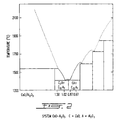
- Figure 2 is an expended portion of Figure 1 wherein the X-axis shows the CaO ⁇ Al 2 O 3 ratio rather than the weight percent.
- the novel process of the present invention comprises the use of aluminum dross residue as a source of alumina for the preparation of calcium aluminates.
- Dross residues such as NOVALTM brand aluminum dross residues
- NOVALTM brand aluminum dross residues are preferred to either pure alumina or alumina from other sources because its use surprisingly results in complete reaction with lime or limestone at temperatures as low as 1200°C. This in turn results in the formation of large product particles which can then be ground and classified.
- pure alumina for example, results in the production of small easily fractured particles.
- impurities found in the dross residue (such as aluminum nitride and aluminum metal) facilitate the sintering process, as it will be discussed below.
- a more conventional way of treating aluminum dross to remove contained aluminum is to heat the dross in a conventional furnace with a salt mixture which reduces the surface tension of the molten aluminum and causes the aluminum droplets to coalesce.
- this salt-containing dross residue while it can be used directly in the process of the present invention is generally unsatisfactory because the salt adversely affects the nature of the product.
- the dross residue obtained from the salt process should therefore be washed with water in order to dissolve its salt content before being used in the process of the present invention. After such washing, the dross residue is wet and should be dried to remove adhering water.
- the dross residue produced by either of the above processes has a high alumina to silica ratio. It usually contains a minimum of 50% alumina (or alumina precursor) and generally at least 65%.
- the presence of alkali (K 2 O, Na 2 O), iron oxides and silica during the heat treatment potentially contribute to lower the melting point of the clinker and, therefore, favours the production of a material having a melting point lower than 1400°C to 2000°C.
- the presence of MgO adversely affects the melting point of the product unless it is complexed with silica and alumina to form cordierite 2MgO ⁇ 2Al 2 O 3 ⁇ 5SiO 2 .
- dross residues contain aluminum nitride which decomposes into alumina and ammonia gas upon prolonged exposure to moisture (e.g. in landfill sites).
- the heat treatment at high temperature i.e. between 1250°C and 1375°C
- oxidizing conditions i.e. air
- This reaction is highly exothermic and provides heat to the system.
- the presence of aluminum nitride in the dross residues thus represent a significant advantage for the process of the present invention.
- the starting mixtures must also exhibit sufficient size and mechanical resistance to avoid loss of material in the draft of the kiln. It is has been found, surprisingly and unexpectedly, that treatment of dross residue with water allows water to act as a chemical and mechanical binding agent to form advantageous shapes of mixtures of dross residue and calcium oxide or its precursors to essentially avoid the previous problem experienced of loss of material in the draft of the kiln.
- dross residues such as NOVALTM brand aluminum dross residues contain aluminum nitride and free aluminum metal. It is theorized that those substances can react exothermically, slowly at ambient temperatures with water or water vapour to form rehydratable Al 2 O 3 , and rapidly, at higher temperatures with oxygen to form crystalline forms of Al 2 O 3 . At high temperature the exothermic reaction has been found to supply a significant amount of heat to the reaction mixture, and hence reduce the amount of external heat required to achieve the conversion reaction to calcium aluminates.
- Al(OH) 3 aluminum hydroxide
- NH 3 ammonia
- H 2 hydrogen
- AlN + 3H 2 O NH 3 + Al(OH) 3
- Al + 3H 2 O 3/2H 2 + Al(OH) 3
- the ammonia produced in the first reaction can be collected so as to avoid pollution as opposed to a similar reaction taking place at a landfill site.
- the resulting mixture containing rehydratable alumina can be combined with lime or limestone and then mixed with sufficient water and transferred to a shaper such as a pelletizer, granulator or extruder where particles are allowed to reach a desired size, the shapes are then allowed to age for a period of not more than 12 hours. During that time the reaction with water will provide chemical bonds between the particles thereby conferring excellent mechanical resistance properties to the pellets.
- the mixture is then charged in a kiln and heated to at least 1200°C, and preferably 1250°C to 1300°C, and kept at that temperature for between 5 minutes or more thereby converting the mixture to calcium aluminates.
- the mixture is not required to be heated to the temperatures reaching the mixture's molten state.
- additional alumina dust such as E lectro S tatic P recipitator (ESP) dust
- ESP E lectro S tatic P recipitator
- Dross residues also contain variable quantities of magnesium oxide in the form of spinel (MgAl 2 O 4 ), particularly if the dross residues originated from magnesium-aluminum alloys. Small amounts of silica and other refractory oxides may also be present. Traces of alkali fluorides are also present in the dross residues.
- a typical aluminum dross residue composition is shown in Table 1. Chemical composition of Dross Residue.
- the fluoride associated with either the sodium or calcium will react to form sodium or calcium aluminum oxy-fluoride compounds.
- These compounds which have a eutectic around 1475°C may possibly have also a beneficial effect on the melting point of the reaction mixture and be responsible for the high reactivity of the dross residue with the calcium oxide.
- the magnesium ions present will remain unchanged as magnesium spinel (MgAl 2 O 4 ), but this compound has a high melting point and has no deleterious effects on the product. It should be noted however, that the aluminum values in the spinel will not be converted into calcium aluminate.
- Limestone has a chemical composition much less variable than aluminum dross residue.
- StalcoTM manufactured and sold by Graybec Calc. Inc., Joliette, Quebec, and CalcoTM, manufactured and sold by Les Carrines Calco, Portneuf, Quebec.
- Table 2 Chemical composition of StalcoTM and CalcoTM Component StalcoTM CalcoTM (wt %) CaCO 3 96.0 94.4 SiO 2 2.0 2.9 Al 2 O 3 0.3 0.7 Fe 2 O 3 0.2 0.17 K 2 O - 0.18
- Calcium oxide or its precursor such as, lime or limestone
- limestone is a preferred product.
- the calculations must be made with respect to the amount of calcium oxide that will be provided, since it is this product that reacts with alumina.
- the process of the present invention essentially comprises the co-calcination of lime or limestone and dross residues in appropriate proportions and at temperature suitable to form a clinker of calcium aluminates containing mainly 12CaO ⁇ 7Al 2 O 3 .
- the size of the particles of dross residues is preferably lower than 1.27 cm (1 ⁇ 2") to ensure that all the aluminum nitride contained therein reacts with oxygen.
- Lime and limestone are generally available as powders, and therefore can be used as such.
- the preferred (theoretical) concentrations of starting materials in the compositions to be calcined are obtained from the phase diagram illustrated in Figure 1, after taking into consideration the loss on ignition of gaseous CO 2 if limestone is used as a starting material.
- the sintered material obtained with the process of the present invention comprises calcium aluminates such as 3CaO ⁇ Al 2 O 3 , CaO ⁇ Al 2 O 3 , CaO ⁇ 2Al 2 O 3 and CaO ⁇ 6Al 2 O 3 and 12 CaO ⁇ 7Al 2 O 3 ; the latter being present predominantly.
- the material possesses inter alia a low melting point, i.e. ⁇ 1400°C, good absorption properties of contaminants of liquid metals, and protection against gaseous pick-up from the atmosphere, which makes it appropriate for covering liquid metals in metallurgical processes, particularly in steel-making.
- a cover slag it is necessary that the sintered material be in liquid form. Therefore, the temperature involved in the metallurgical process must be at least above the melting point of the sintered material.
- the process of the present invention surprisingly requires very little energy input during calcination, since dross residues contain several components which react exothermically during the calcination and liberate important amounts of energy.
- the process of the present invention has also the benefit of disposing of dross residue in an effective and environmentally responsible manner.
- a first series of tests were directed to the production of a sintered material having a CaO/Al 2 O 3 ratio of 0.87, while another series had for target a 1.02 ratio.
- the preparation mode of raw materials to achieved these ratios is discussed below.
- Dross residue (plasma treated) described in Table 1 and limestone CalcoTM were mixed in approximate proportion to produce a material suitable in composition to meet the requirement of a ratio of 0.87 CaO/Al 2 O 3 ., and heated in a rotary kiln at 1315°C for about 30 minutes, until the product started to agglomerate. The kiln was then adjusted to retain the raw material mixture for 1 hour in the heating area at a temperature of 1315°C. The resulting product was a hard agglomerate, similar in texture to a clinker. A representative sample was cut, ground into particles of about 0.09 mm (150 mesh) and submitted to X-ray diffraction and heating microscope.
- the chemical analysis gave 43.0% by weight of CaO and 49.8% by weight of Al 2 O 3 , for a CaO/Al 2 O 3 ratio of 0.863.
- the material was found to also contain 2.7% by weight of SiO 2 , 3.9% by weight of MgO, 0.34% by weight Fe 2 O 3 , 1.36% by weight of fluorine (likely in the form of CaF 2 ) and a loss on ignition of 0.2% by weight.
- NOVALTM brand aluminum dross residues are mixed with from 20 to 50 parts (preferably 20 parts) of calcium oxide, and optionally with about 5 parts of rehydratable alumina, such as E lectro S tatic P recipitator (ESP) dust, and 12 parts of water.
- ESP E lectro S tatic P recipitator
- the mixture is then transferred to a pan pelletizer and shapes, during the shaping, another 6 parts of water are added, shaping is continued until the shapes reach the desired size, usually between 1 ⁇ 4 and 1 ⁇ 2 inch in diameter.
- the shapes are then placed in a container equipped with a simple air reflux to retain the water vapor, and allowed to age for a period of about 6 to 12 hours during which time there is an exothermic reaction as the water hydrates the rehydratable alumina present in the mixture to make strong hydrate bonds in the shape and raise the temperature of the hydrating agglomerate to 100°C or higher. If necessary the container is cooled during this reaction to keep the temperature of the contents below 100°C.
- the resulting shapes exhibit good mechanical resistance and can be charged in a rotary kiln or in a packed bed furnace, fired by natural gas, fuel oil, electrically, by gas plasma or micro waves, and heated to 1250°C to 1300°C and kept at the temperature for between 5 to 15 minutes.
- the resulting sintered mass containing mainly calcium aluminates, can be easily ground to required size distributions and provides good mechanical and chemical properties for its intended use, for example as an additive in steelmaking.
- Example 2 The mixture of Example 2 is prepared without the addition of ESP dust. Calcium fluoride is added if not present in the NOVALTM brand aluminum dross residues to provide at leat 1 part per 100 parts of total mixture of NOVALTM brand aluminum dross residues and lime or its precursor. The procedure of Example 2 is then followed. The resulting product is of similar chemical composition and properties as that of Example 2.
Landscapes
- Chemical & Material Sciences (AREA)
- Engineering & Computer Science (AREA)
- Ceramic Engineering (AREA)
- Materials Engineering (AREA)
- Organic Chemistry (AREA)
- Structural Engineering (AREA)
- Manufacturing & Machinery (AREA)
- Metallurgy (AREA)
- Compounds Of Alkaline-Earth Elements, Aluminum Or Rare-Earth Metals (AREA)
- Processing Of Solid Wastes (AREA)
- Curing Cements, Concrete, And Artificial Stone (AREA)
- Compositions Of Oxide Ceramics (AREA)
Claims (14)
- Verfahren zur Herstellung eines im wesentlichen Calciumaluminate enthaltenden Sintermaterialgemischs, welches die Stufenumfaßt.a) Vermischen von Calciumoxid oder einem seiner Vorläufer mit Aluminiumschlackerückstand in im wesentlichen fester Form,b) Calcinieren des immer noch in im wesentlichen fester Form vorliegenden Gemischs über einen Zeitraum von etwa 5 Minuten oder länger bei einer Temperatur von zwischen 1 200 und 1 400 °C in einem Drehrohrofen undc) Gewinnen eines Sinterprodukts, das sich leicht zermahlen oder zerreiben läßt und eine Textur besitzt, die der einer Sinterschlacke ähnelt,
- Verfahren zur Herstellung eines im wesentlichen Calciumaluminate enthaltenden Sintermaterialgemischs, welches die Stufenumfaßt.a) Vermischen von Calciumoxid oder einem seiner Vorläufer mit Aluminiumschlackerückstand und Calciumfluorid in im wesentlichen fester Form derart, daß der Calciumfluoridanteil im resultierenden Gemisch 0,5 bis 10 Gew.-% beträgt,b) Calcinieren des immer noch in im wesentlichen fester Form vorliegenden Gemischs über einen Zeitraum von etwa 5 Minuten oder länger bei einer Temperatur von zwischen 1 200 und 1 400 °C undc) Gewinnen des Sintergemischs
- Verfahren zur Herstellung eines im wesentlichen Calciumaluminate enthaltenden Sintermaterialgemischs, welches die Stufenumfaßt.a) Vermischen von Calciumoxid oder einem seiner Vorläufer mit Aluminiumschlackerückstand in im wesentlichen fester Form,b) In-Berührung-Bringen des erhaltenen Gemischs mit Wasser,c) Formen des erhaltenen Gemischs zu Grünlingen, die im allgemeinen kleiner als 2,54 cm (1 Zoll Durchmesser) sind,d) Calcinieren der immer noch in im wesentlichen fester Form vorliegenden Grünlinge über einen Zeitraum von etwa 5 Minuten oder länger bei einer Temperatur von mindestens 1 200 °C unde) Gewinnen des Sintermaterials
- Verfahren nach Anspruch 2, worin der Calciumfluoridanteil im Gemisch 1 bis 2 Gew.-% beträgt.
- Verfahren nach Anspruch 3, worin durch das In-Berührung-Bringen des erhaltenen Gemischs mit Wasser die Rehydratation von in diesem Gemisch vorhandenem rehydratisierbarem Aluminiumoxid bewirkt wird.
- Verfahren nach Anspruch 3, worin in im wesentlichen fester Form vorliegendes rehydratisierbares Aluminiumoxid mit dem Calciumoxid oder dessen Vorläufer und dem Aluminiumschlakkerückstand vermischt wird und durch das In-Berührung-Bringen des resultierenden Gemischs mit Wasser die Rehydratation des im Feststoffgemisch vorhandenen rehydratisierbaren Aluminiumoxids bewirkt wird.
- Verfahren nach einem der vorhergehenden Ansprüche, worin der Schlackerückstand ein Schlackerückstand der Marke NOVAL™ ist.
- Verfahren nach einem der vorhergehenden Ansprüche, worin die Temperatur in der Calcinierungsstufe zwischen 1 250 und 1 300 °C beträgt.
- Verfahren nach einem der Ansprüche 3, 5 und 6, worin die Grünlinge vor dem Calcinieren nicht länger als 12 Stunden in feuchter Umgebung gealtert werden.
- Verfahren nach Anspruch 6, worin das rehydratisierbare Aluminiumoxid Staub aus der elektrostatischen Abscheidung (ESA) ist.
- Verfahren nach einem der vorhergehenden Ansprüche, worin das Gemisch auf 50 bis 70 Teile Schlackerückstände 20 bis 50 Teile Calciumoxid oder dessen äquivalente Menge eines seiner Vorläufer enthält.
- Verfahren nach einem der vorhergehenden Ansprüche, worin das Sintermaterial hauptsächlich 12CaO·7Al2O3 enthält.
- Verfahren nach einem der vorhergehenden Ansprüche, worin der Schmelzpunkt des Sintermaterials unter 1 400 °C liegt.
- Verfahren nach einem der vorhergehenden Ansprüche, worin der Schlackerückstand aus Teilchen besteht, die kleiner als 1,27 cm (1/2 Zoll) sind.
Applications Claiming Priority (3)
| Application Number | Priority Date | Filing Date | Title |
|---|---|---|---|
| US08/125,594 US5407459A (en) | 1993-09-23 | 1993-09-23 | Process for the preparation of calcium aluminates from aluminum dross residues |
| US125594 | 1993-09-23 | ||
| PCT/CA1994/000509 WO1995008516A1 (en) | 1993-09-23 | 1994-09-19 | Process for the preparation of calcium aluminates from aluminum dross residues |
Publications (2)
| Publication Number | Publication Date |
|---|---|
| EP0720592A1 EP0720592A1 (de) | 1996-07-10 |
| EP0720592B1 true EP0720592B1 (de) | 1998-12-02 |
Family
ID=22420472
Family Applications (1)
| Application Number | Title | Priority Date | Filing Date |
|---|---|---|---|
| EP19940926751 Expired - Lifetime EP0720592B1 (de) | 1993-09-23 | 1994-09-19 | Verfahren zur herstellung von calciumaluminaten ausgehend von aluminiumschlacken-rückständen |
Country Status (9)
| Country | Link |
|---|---|
| US (1) | US5407459A (de) |
| EP (1) | EP0720592B1 (de) |
| AT (1) | ATE174018T1 (de) |
| AU (1) | AU702805B2 (de) |
| DE (1) | DE69415033T2 (de) |
| ES (1) | ES2124425T3 (de) |
| NO (1) | NO314034B1 (de) |
| WO (1) | WO1995008516A1 (de) |
| ZA (1) | ZA947315B (de) |
Cited By (1)
| Publication number | Priority date | Publication date | Assignee | Title |
|---|---|---|---|---|
| EP2385018A4 (de) * | 2009-01-20 | 2016-11-30 | Asturiana De Aleaciones S A | Verfahren zur gewinnung von calcium-aluminat aus durch die bearbeitung von salzschlacken auf der produktion von sekundäraluminium entstandenem abfall |
Families Citing this family (28)
| Publication number | Priority date | Publication date | Assignee | Title |
|---|---|---|---|---|
| NL9500579A (nl) * | 1995-03-24 | 1996-11-01 | Hoogovens Staal Bv | Werkwijze voor het verwerken van NMP uit dros. |
| US5613996A (en) * | 1995-05-08 | 1997-03-25 | Plasma Processing Corporation | Process for treatment of reactive fines |
| US6051049A (en) * | 1997-05-29 | 2000-04-18 | Exothermic Distribution Corporation | Utilization of strontium aluminate in steelmaking |
| DE19722788A1 (de) * | 1997-05-30 | 1998-12-03 | Segl | Bodenauskleidung einer Aluminiumelektrolysezelle |
| US6238633B1 (en) * | 1997-06-30 | 2001-05-29 | Aluminum Waste Technology, Inc. | Process for preparing calcium aluminate from aluminum dross |
| CN1056415C (zh) * | 1998-04-07 | 2000-09-13 | 幸超 | 含铝预熔渣及其制备方法以及含有该渣的钢水脱硫剂和净化剂 |
| US6082641A (en) * | 1998-04-08 | 2000-07-04 | Skurko; Richard | Dross processing |
| DE19857733A1 (de) * | 1998-12-15 | 2000-06-21 | Almamet Gmbh | Entschwefelungsmittel |
| KR20010027546A (ko) * | 1999-09-14 | 2001-04-06 | 정방규 | 형석 대용물질의 제조방법 |
| US6417136B2 (en) * | 1999-09-17 | 2002-07-09 | Phillips Petroleum Company | Hydrocarbon hydrogenation catalyst and process |
| EP1262568A1 (de) * | 2001-05-31 | 2002-12-04 | Corus Aluminium Voerde GmbH | Drehrohröfen mit Schutzauskleidung auf Basis von einem Erdalkali-Aluminat |
| DE10259335B4 (de) * | 2002-12-18 | 2005-04-14 | Refratechnik Holding Gmbh | Abdeckmittel für eine Topschlacke, Verfahren zu seiner Herstellung und Verwendung des Abdeckmittels |
| HUP0400630A2 (en) * | 2004-03-23 | 2006-01-30 | Istvan Tamas | New, molecule-size desulphurizing agents consisting of non metallic and metallic components for reducing the sulphur content of iron melts to an ultra low level (0<s%<0,001) and a method for producing said material |
| US7727328B2 (en) * | 2006-05-16 | 2010-06-01 | Harsco Corporation | Regenerated calcium aluminate product and process of manufacture |
| CA2610918C (en) * | 2006-12-28 | 2009-03-10 | Groupe Conseil Procd Inc. | Processes for treating aluminium dross residues |
| WO2009004565A2 (en) * | 2007-07-02 | 2009-01-08 | Bumatech (Pty) Limited | Flux and method of making same |
| CA2608973C (en) * | 2007-07-16 | 2009-01-27 | Groupe Conseil Procd Inc. | Processes for treating aluminium dross residues |
| TWM453678U (zh) * | 2013-01-11 | 2013-05-21 | Jia Jye Metal Co Ltd | 鋁集塵灰及鋁金屬冶煉爐渣再利用結構 |
| US9382595B2 (en) | 2013-02-12 | 2016-07-05 | 9253-8444 Quebec Inc. | Method for the production and the purification of molten calcium aluminate using contaminated aluminum dross residue |
| RU2568554C2 (ru) * | 2013-07-30 | 2015-11-20 | Федеральное государственное бюджетное учреждение науки "Институт физики им. Х.И. Амирханова Дагестанского научного центра РАН" | Мишень для ионно-плазменного распыления |
| JP6257362B2 (ja) * | 2014-02-06 | 2018-01-10 | 株式会社神戸製鋼所 | 鉄鋼精錬用副資材 |
| ES2603605B1 (es) * | 2015-07-28 | 2017-12-13 | Consejo Superior De Investigaciones Científicas (Csic) | Procedimiento de obtención de aluminatos de calcio a partir de escorias de aluminio no salinas |
| CZ305816B6 (cs) * | 2015-09-02 | 2016-03-23 | Kvs Ekodivize A.S. | Způsob výroby syntetické, sintrované vápenato-hlinité strusky |
| CN106892441A (zh) * | 2017-02-24 | 2017-06-27 | 南通大学 | 铝灰利用方法 |
| FR3087769B1 (fr) * | 2018-10-31 | 2022-05-06 | Imertech | Procede de fabrication d'un liant hydraulique |
| WO2020111829A1 (ko) * | 2018-11-28 | 2020-06-04 | 한양대학교 에리카산학협력단 | 칼슘 알루미네이트 무기물 및 그 제조방법, 그리고 이를 포함하는 시멘트 조성물 |
| CN111977677B (zh) * | 2020-08-25 | 2021-11-23 | 中国科学院过程工程研究所 | 一种利用铝灰制备铝酸钙的方法 |
| CN116445729A (zh) * | 2023-03-13 | 2023-07-18 | 新疆中环节能技术设计研究有限公司 | 一种铝灰渣清洁利用复合材料及其制备方法 |
Family Cites Families (10)
| Publication number | Priority date | Publication date | Assignee | Title |
|---|---|---|---|---|
| US4014685A (en) * | 1973-11-27 | 1977-03-29 | Foseco International Limited | Manufacture of steel |
| DE3111510A1 (de) * | 1981-03-24 | 1982-10-07 | Hoechst Ag, 6000 Frankfurt | Entschwefelungsgemisch und verfahren zu seiner herstellung |
| US4490173A (en) * | 1982-09-30 | 1984-12-25 | Schwer John W | Steelmaking additive composition |
| US4769067A (en) * | 1986-12-24 | 1988-09-06 | Aluminum Company Of America | Process for production of aluminum by carbothermic production of an alkaline earth metal aluminide such as calcium aluminide and recycling of reactant byproducts |
| JPS63291678A (ja) * | 1987-05-22 | 1988-11-29 | Mitsubishi Corp | アルミドロスの処理方法 |
| US4959100A (en) * | 1987-12-22 | 1990-09-25 | Alcan International Limited | Recovery of non-ferrous metals from dross |
| US4997476A (en) * | 1988-12-08 | 1991-03-05 | Plasma Energy Corporation | Recovery of free aluminum from aluminum dross using plasma energy without use of a salt flux |
| US4941914A (en) * | 1989-05-18 | 1990-07-17 | Elkem Metals Company | Desulfurization agent |
| US5132246A (en) * | 1990-01-22 | 1992-07-21 | Alcan International Limited | Process for using dross residues to produce refractory products |
| US5135565A (en) * | 1991-04-16 | 1992-08-04 | The Boc Group, Inc. | Recovery of aluminum from dross using the plasma torch |
-
1993
- 1993-09-23 US US08/125,594 patent/US5407459A/en not_active Expired - Lifetime
-
1994
- 1994-09-19 WO PCT/CA1994/000509 patent/WO1995008516A1/en not_active Ceased
- 1994-09-19 DE DE69415033T patent/DE69415033T2/de not_active Expired - Lifetime
- 1994-09-19 EP EP19940926751 patent/EP0720592B1/de not_active Expired - Lifetime
- 1994-09-19 AU AU76499/94A patent/AU702805B2/en not_active Ceased
- 1994-09-19 ES ES94926751T patent/ES2124425T3/es not_active Expired - Lifetime
- 1994-09-19 AT AT94926751T patent/ATE174018T1/de not_active IP Right Cessation
- 1994-09-20 ZA ZA947315A patent/ZA947315B/xx unknown
-
1996
- 1996-03-22 NO NO19961199A patent/NO314034B1/no not_active IP Right Cessation
Cited By (1)
| Publication number | Priority date | Publication date | Assignee | Title |
|---|---|---|---|---|
| EP2385018A4 (de) * | 2009-01-20 | 2016-11-30 | Asturiana De Aleaciones S A | Verfahren zur gewinnung von calcium-aluminat aus durch die bearbeitung von salzschlacken auf der produktion von sekundäraluminium entstandenem abfall |
Also Published As
| Publication number | Publication date |
|---|---|
| ES2124425T3 (es) | 1999-02-01 |
| AU702805B2 (en) | 1999-03-04 |
| EP0720592A1 (de) | 1996-07-10 |
| WO1995008516A1 (en) | 1995-03-30 |
| US5407459A (en) | 1995-04-18 |
| NO961199L (no) | 1996-05-23 |
| NO314034B1 (no) | 2003-01-20 |
| DE69415033T2 (de) | 1999-04-29 |
| AU7649994A (en) | 1995-04-10 |
| DE69415033D1 (de) | 1999-01-14 |
| ZA947315B (en) | 1995-05-10 |
| NO961199D0 (no) | 1996-03-22 |
| ATE174018T1 (de) | 1998-12-15 |
Similar Documents
| Publication | Publication Date | Title |
|---|---|---|
| EP0720592B1 (de) | Verfahren zur herstellung von calciumaluminaten ausgehend von aluminiumschlacken-rückständen | |
| US9382595B2 (en) | Method for the production and the purification of molten calcium aluminate using contaminated aluminum dross residue | |
| CN1101785A (zh) | 由冶金炉渣制造水泥的方法 | |
| JP2006272144A (ja) | 重金属不溶化材及び重金属処理方法 | |
| Benkhelif et al. | Synthesis of pure magnesium aluminate spinel (MgAl2O4) from waste aluminum dross | |
| JP3040343B2 (ja) | アルミニウム浮滓およびアルミニウム浮滓残渣をアルミン酸カルシウムに処理する方法 | |
| US4396422A (en) | Process for producing iron and refractory material | |
| JP2001089135A (ja) | 均質性に優れたカルシウムアルミネート | |
| US4814005A (en) | Flux material for steelmaking | |
| CA2170533C (en) | Process for the preparation of calcium aluminates from aluminium dross residues | |
| JP3659076B2 (ja) | カルシウムアルミネートの製造方法 | |
| KR20190084437A (ko) | 알루미늄 드로스의 처리방법 | |
| EP3222597A1 (de) | Sekundäre aluminiumoxidzusammensetzung mit verringerter ammoniakemission | |
| US4366257A (en) | Process for producing a calcia clinker | |
| JP2008115065A (ja) | 使用済みマグネシア質、スピネル質およびアルミナ質耐火物のリサイクル方法 | |
| US4909844A (en) | Flux material for steelmaking | |
| US4330336A (en) | Method of producing low-line aluminous cement from aluminum smelting residue | |
| JP3936442B2 (ja) | アルミニウム残灰よりアルミナセメントを製造する方法 | |
| JP4234118B2 (ja) | 鉄鋼添加剤 | |
| JP2006052428A5 (de) | ||
| JP2006052428A (ja) | フッ素溶出抑制剤用組成物及び該組成物を使用した溶出フッ素の固定方法 | |
| JPH1081572A (ja) | 不定形耐火物 | |
| KR20240070368A (ko) | 레드머드 및 알루미늄 함유 산업 부산물로부터 환원철이 포함된 블랙파우더를 제조하는 방법 | |
| WO2025046104A1 (en) | Composition for use in a steel making process | |
| JPH11158523A (ja) | 溶銑脱硫剤 |
Legal Events
| Date | Code | Title | Description |
|---|---|---|---|
| PUAI | Public reference made under article 153(3) epc to a published international application that has entered the european phase |
Free format text: ORIGINAL CODE: 0009012 |
|
| 17P | Request for examination filed |
Effective date: 19960322 |
|
| AK | Designated contracting states |
Kind code of ref document: A1 Designated state(s): AT BE CH DE DK ES FR GB GR IE IT LI LU MC NL PT SE |
|
| AX | Request for extension of the european patent |
Free format text: LT PAYMENT 960322;SI PAYMENT 960322 |
|
| RAX | Requested extension states of the european patent have changed |
Free format text: LT PAYMENT 960322;SI PAYMENT 960322 |
|
| 17Q | First examination report despatched |
Effective date: 19960625 |
|
| RAP1 | Party data changed (applicant data changed or rights of an application transferred) |
Owner name: HUARD, YVAN Owner name: ALCAN INTERNATIONAL LIMITED |
|
| RAP1 | Party data changed (applicant data changed or rights of an application transferred) |
Owner name: 31025273 QUEBEC INC. Owner name: ALCAN INTERNATIONAL LIMITED |
|
| RIN1 | Information on inventor provided before grant (corrected) |
Inventor name: TREMBLAY, SYLVAIN, PAUL Inventor name: BREAULT, RAYMOND Inventor name: MATHIEU, GILLES Inventor name: HUARD, YVAN |
|
| GRAG | Despatch of communication of intention to grant |
Free format text: ORIGINAL CODE: EPIDOS AGRA |
|
| GRAG | Despatch of communication of intention to grant |
Free format text: ORIGINAL CODE: EPIDOS AGRA |
|
| GRAG | Despatch of communication of intention to grant |
Free format text: ORIGINAL CODE: EPIDOS AGRA |
|
| GRAH | Despatch of communication of intention to grant a patent |
Free format text: ORIGINAL CODE: EPIDOS IGRA |
|
| GRAH | Despatch of communication of intention to grant a patent |
Free format text: ORIGINAL CODE: EPIDOS IGRA |
|
| GRAA | (expected) grant |
Free format text: ORIGINAL CODE: 0009210 |
|
| AK | Designated contracting states |
Kind code of ref document: B1 Designated state(s): AT BE CH DE DK ES FR GB GR IE IT LI LU MC NL PT SE |
|
| AX | Request for extension of the european patent |
Free format text: LT PAYMENT 960322;SI PAYMENT 960322 |
|
| LTIE | Lt: invalidation of european patent or patent extension | ||
| PG25 | Lapsed in a contracting state [announced via postgrant information from national office to epo] |
Ref country code: NL Free format text: LAPSE BECAUSE OF FAILURE TO SUBMIT A TRANSLATION OF THE DESCRIPTION OR TO PAY THE FEE WITHIN THE PRESCRIBED TIME-LIMIT Effective date: 19981202 Ref country code: LI Free format text: LAPSE BECAUSE OF FAILURE TO SUBMIT A TRANSLATION OF THE DESCRIPTION OR TO PAY THE FEE WITHIN THE PRESCRIBED TIME-LIMIT Effective date: 19981202 Ref country code: IT Free format text: LAPSE BECAUSE OF FAILURE TO SUBMIT A TRANSLATION OF THE DESCRIPTION OR TO PAY THE FEE WITHIN THE PRESCRIBED TIME-LIMIT;WARNING: LAPSES OF ITALIAN PATENTS WITH EFFECTIVE DATE BEFORE 2007 MAY HAVE OCCURRED AT ANY TIME BEFORE 2007. THE CORRECT EFFECTIVE DATE MAY BE DIFFERENT FROM THE ONE RECORDED. Effective date: 19981202 Ref country code: GR Free format text: LAPSE BECAUSE OF NON-PAYMENT OF DUE FEES Effective date: 19981202 Ref country code: CH Free format text: LAPSE BECAUSE OF FAILURE TO SUBMIT A TRANSLATION OF THE DESCRIPTION OR TO PAY THE FEE WITHIN THE PRESCRIBED TIME-LIMIT Effective date: 19981202 Ref country code: BE Free format text: LAPSE BECAUSE OF FAILURE TO SUBMIT A TRANSLATION OF THE DESCRIPTION OR TO PAY THE FEE WITHIN THE PRESCRIBED TIME-LIMIT Effective date: 19981202 Ref country code: AT Free format text: LAPSE BECAUSE OF FAILURE TO SUBMIT A TRANSLATION OF THE DESCRIPTION OR TO PAY THE FEE WITHIN THE PRESCRIBED TIME-LIMIT Effective date: 19981202 |
|
| REF | Corresponds to: |
Ref document number: 174018 Country of ref document: AT Date of ref document: 19981215 Kind code of ref document: T |
|
| REG | Reference to a national code |
Ref country code: CH Ref legal event code: EP |
|
| REF | Corresponds to: |
Ref document number: 69415033 Country of ref document: DE Date of ref document: 19990114 |
|
| ET | Fr: translation filed | ||
| REG | Reference to a national code |
Ref country code: IE Ref legal event code: FG4D |
|
| REG | Reference to a national code |
Ref country code: ES Ref legal event code: FG2A Ref document number: 2124425 Country of ref document: ES Kind code of ref document: T3 |
|
| PG25 | Lapsed in a contracting state [announced via postgrant information from national office to epo] |
Ref country code: SE Free format text: LAPSE BECAUSE OF FAILURE TO SUBMIT A TRANSLATION OF THE DESCRIPTION OR TO PAY THE FEE WITHIN THE PRESCRIBED TIME-LIMIT Effective date: 19990302 Ref country code: PT Free format text: LAPSE BECAUSE OF FAILURE TO SUBMIT A TRANSLATION OF THE DESCRIPTION OR TO PAY THE FEE WITHIN THE PRESCRIBED TIME-LIMIT Effective date: 19990302 Ref country code: DK Free format text: LAPSE BECAUSE OF FAILURE TO SUBMIT A TRANSLATION OF THE DESCRIPTION OR TO PAY THE FEE WITHIN THE PRESCRIBED TIME-LIMIT Effective date: 19990302 |
|
| NLV1 | Nl: lapsed or annulled due to failure to fulfill the requirements of art. 29p and 29m of the patents act | ||
| REG | Reference to a national code |
Ref country code: CH Ref legal event code: PL |
|
| PGFP | Annual fee paid to national office [announced via postgrant information from national office to epo] |
Ref country code: MC Payment date: 19990802 Year of fee payment: 6 |
|
| PG25 | Lapsed in a contracting state [announced via postgrant information from national office to epo] |
Ref country code: LU Free format text: LAPSE BECAUSE OF NON-PAYMENT OF DUE FEES Effective date: 19990919 Ref country code: IE Free format text: LAPSE BECAUSE OF NON-PAYMENT OF DUE FEES Effective date: 19990919 |
|
| PLBE | No opposition filed within time limit |
Free format text: ORIGINAL CODE: 0009261 |
|
| STAA | Information on the status of an ep patent application or granted ep patent |
Free format text: STATUS: NO OPPOSITION FILED WITHIN TIME LIMIT |
|
| 26N | No opposition filed | ||
| REG | Reference to a national code |
Ref country code: IE Ref legal event code: MM4A |
|
| PG25 | Lapsed in a contracting state [announced via postgrant information from national office to epo] |
Ref country code: MC Free format text: THE PATENT HAS BEEN ANNULLED BY A DECISION OF A NATIONAL AUTHORITY Effective date: 20000930 |
|
| REG | Reference to a national code |
Ref country code: GB Ref legal event code: IF02 |
|
| REG | Reference to a national code |
Ref country code: FR Ref legal event code: TP Ref country code: FR Ref legal event code: CD |
|
| REG | Reference to a national code |
Ref country code: FR Ref legal event code: TQ Ref country code: FR Ref legal event code: CD |
|
| REG | Reference to a national code |
Ref country code: FR Ref legal event code: RERR Free format text: IL Y A LIEU DE REMPLACER: LE CODE NATURE TRANSMISSION PARTIELLE DE PROPRIETE (TP PAR : LE CODE NATURE CHNAGEMENT DE NOM OU DE DENOMINATION (CD) Ref country code: FR Ref legal event code: RERR Free format text: CORRECTION DE BOPI 06/02 - CHANGEMENT DE NOM, E DENOMINATION: IL Y A LIEU DE REMPLACER : LE CODE NATURE CHNAGEMENT DE NOM OU DE DENOMINATION (CD) PAR : LE CODE NATURE TRANSMISSION PARTIELLE DE PROPRIETE (PT) |
|
| PGFP | Annual fee paid to national office [announced via postgrant information from national office to epo] |
Ref country code: DE Payment date: 20100929 Year of fee payment: 17 |
|
| PGFP | Annual fee paid to national office [announced via postgrant information from national office to epo] |
Ref country code: GB Payment date: 20110926 Year of fee payment: 18 Ref country code: ES Payment date: 20110926 Year of fee payment: 18 Ref country code: FR Payment date: 20111005 Year of fee payment: 18 |
|
| GBPC | Gb: european patent ceased through non-payment of renewal fee |
Effective date: 20120919 |
|
| REG | Reference to a national code |
Ref country code: FR Ref legal event code: ST Effective date: 20130531 |
|
| PG25 | Lapsed in a contracting state [announced via postgrant information from national office to epo] |
Ref country code: GB Free format text: LAPSE BECAUSE OF NON-PAYMENT OF DUE FEES Effective date: 20120919 Ref country code: DE Free format text: LAPSE BECAUSE OF NON-PAYMENT OF DUE FEES Effective date: 20130403 |
|
| PG25 | Lapsed in a contracting state [announced via postgrant information from national office to epo] |
Ref country code: FR Free format text: LAPSE BECAUSE OF NON-PAYMENT OF DUE FEES Effective date: 20121001 |
|
| REG | Reference to a national code |
Ref country code: DE Ref legal event code: R119 Ref document number: 69415033 Country of ref document: DE Effective date: 20130403 |
|
| REG | Reference to a national code |
Ref country code: ES Ref legal event code: FD2A Effective date: 20131021 |
|
| PG25 | Lapsed in a contracting state [announced via postgrant information from national office to epo] |
Ref country code: ES Free format text: LAPSE BECAUSE OF NON-PAYMENT OF DUE FEES Effective date: 20120920 |