EP0718626B1 - Kalibrierung und Prüfung von Immunoassays zur Verminderung von Störungen - Google Patents
Kalibrierung und Prüfung von Immunoassays zur Verminderung von Störungen Download PDFInfo
- Publication number
- EP0718626B1 EP0718626B1 EP95309354A EP95309354A EP0718626B1 EP 0718626 B1 EP0718626 B1 EP 0718626B1 EP 95309354 A EP95309354 A EP 95309354A EP 95309354 A EP95309354 A EP 95309354A EP 0718626 B1 EP0718626 B1 EP 0718626B1
- Authority
- EP
- European Patent Office
- Prior art keywords
- time
- rate
- liquids
- over
- cross
- Prior art date
- Legal status (The legal status is an assumption and is not a legal conclusion. Google has not performed a legal analysis and makes no representation as to the accuracy of the status listed.)
- Expired - Lifetime
Links
- 238000012360 testing method Methods 0.000 title claims abstract description 48
- 238000003018 immunoassay Methods 0.000 title claims abstract description 28
- 239000007788 liquid Substances 0.000 claims abstract description 97
- 239000012491 analyte Substances 0.000 claims abstract description 69
- 102000001554 Hemoglobins Human genes 0.000 claims abstract description 59
- 108010054147 Hemoglobins Proteins 0.000 claims abstract description 59
- 238000000034 method Methods 0.000 claims abstract description 30
- 238000003556 assay Methods 0.000 claims abstract description 13
- 239000000523 sample Substances 0.000 claims abstract description 12
- 239000013610 patient sample Substances 0.000 claims abstract description 11
- 102000003992 Peroxidases Human genes 0.000 claims abstract description 10
- 108040007629 peroxidase activity proteins Proteins 0.000 claims abstract description 10
- 238000001514 detection method Methods 0.000 claims description 6
- 108010001336 Horseradish Peroxidase Proteins 0.000 claims description 5
- 239000003153 chemical reaction reagent Substances 0.000 claims description 5
- 239000000758 substrate Substances 0.000 claims description 5
- 210000001124 body fluid Anatomy 0.000 claims description 4
- 239000010839 body fluid Substances 0.000 claims description 4
- 239000000203 mixture Substances 0.000 claims description 4
- 238000002372 labelling Methods 0.000 abstract 1
- 229960005156 digoxin Drugs 0.000 description 16
- 229960002036 phenytoin Drugs 0.000 description 16
- LTMHDMANZUZIPE-AMTYYWEZSA-N Digoxin Natural products O([C@H]1[C@H](C)O[C@H](O[C@@H]2C[C@@H]3[C@@](C)([C@@H]4[C@H]([C@]5(O)[C@](C)([C@H](O)C4)[C@H](C4=CC(=O)OC4)CC5)CC3)CC2)C[C@@H]1O)[C@H]1O[C@H](C)[C@@H](O[C@H]2O[C@@H](C)[C@H](O)[C@@H](O)C2)[C@@H](O)C1 LTMHDMANZUZIPE-AMTYYWEZSA-N 0.000 description 15
- LTMHDMANZUZIPE-PUGKRICDSA-N digoxin Chemical compound C1[C@H](O)[C@H](O)[C@@H](C)O[C@H]1O[C@@H]1[C@@H](C)O[C@@H](O[C@@H]2[C@H](O[C@@H](O[C@@H]3C[C@@H]4[C@]([C@@H]5[C@H]([C@]6(CC[C@@H]([C@@]6(C)[C@H](O)C5)C=5COC(=O)C=5)O)CC4)(C)CC3)C[C@@H]2O)C)C[C@@H]1O LTMHDMANZUZIPE-PUGKRICDSA-N 0.000 description 15
- LTMHDMANZUZIPE-UHFFFAOYSA-N digoxine Natural products C1C(O)C(O)C(C)OC1OC1C(C)OC(OC2C(OC(OC3CC4C(C5C(C6(CCC(C6(C)C(O)C5)C=5COC(=O)C=5)O)CC4)(C)CC3)CC2O)C)CC1O LTMHDMANZUZIPE-UHFFFAOYSA-N 0.000 description 15
- CXOFVDLJLONNDW-UHFFFAOYSA-N Phenytoin Chemical compound N1C(=O)NC(=O)C1(C=1C=CC=CC=1)C1=CC=CC=C1 CXOFVDLJLONNDW-UHFFFAOYSA-N 0.000 description 14
- 239000002736 nonionic surfactant Substances 0.000 description 8
- 239000007853 buffer solution Substances 0.000 description 7
- PEDCQBHIVMGVHV-UHFFFAOYSA-N Glycerine Chemical compound OCC(O)CO PEDCQBHIVMGVHV-UHFFFAOYSA-N 0.000 description 6
- METFEORCOGUCCZ-UHFFFAOYSA-N n-(3,5-dichloro-4-hydroxyphenyl)acetamide Chemical compound CC(=O)NC1=CC(Cl)=C(O)C(Cl)=C1 METFEORCOGUCCZ-UHFFFAOYSA-N 0.000 description 6
- JOCBASBOOFNAJA-UHFFFAOYSA-N N-tris(hydroxymethyl)methyl-2-aminoethanesulfonic acid Chemical compound OCC(CO)(CO)NCCS(O)(=O)=O JOCBASBOOFNAJA-UHFFFAOYSA-N 0.000 description 5
- 108091003079 Bovine Serum Albumin Proteins 0.000 description 4
- -1 Poly(ethylene terephthalate) Polymers 0.000 description 4
- 239000011324 bead Substances 0.000 description 4
- 229940098773 bovine serum albumin Drugs 0.000 description 4
- 229940079593 drug Drugs 0.000 description 4
- 239000003814 drug Substances 0.000 description 4
- 229920000036 polyvinylpyrrolidone Polymers 0.000 description 4
- 239000001267 polyvinylpyrrolidone Substances 0.000 description 4
- 235000013855 polyvinylpyrrolidone Nutrition 0.000 description 4
- 238000000576 coating method Methods 0.000 description 3
- 230000007423 decrease Effects 0.000 description 3
- BADXJIPKFRBFOT-UHFFFAOYSA-N dimedone Chemical compound CC1(C)CC(=O)CC(=O)C1 BADXJIPKFRBFOT-UHFFFAOYSA-N 0.000 description 3
- 239000011159 matrix material Substances 0.000 description 3
- WXTMDXOMEHJXQO-UHFFFAOYSA-N 2,5-dihydroxybenzoic acid Chemical compound OC(=O)C1=CC(O)=CC=C1O WXTMDXOMEHJXQO-UHFFFAOYSA-N 0.000 description 2
- DVLFYONBTKHTER-UHFFFAOYSA-N 3-(N-morpholino)propanesulfonic acid Chemical compound OS(=O)(=O)CCCN1CCOCC1 DVLFYONBTKHTER-UHFFFAOYSA-N 0.000 description 2
- SZXKSDXHODZTFS-UHFFFAOYSA-N 4-[4,5-bis[4-(dimethylamino)phenyl]-1H-imidazol-2-yl]-2,6-dimethoxyphenol Chemical compound COC1=C(O)C(OC)=CC(C=2NC(=C(N=2)C=2C=CC(=CC=2)N(C)C)C=2C=CC(=CC=2)N(C)C)=C1 SZXKSDXHODZTFS-UHFFFAOYSA-N 0.000 description 2
- CIWBSHSKHKDKBQ-JLAZNSOCSA-N Ascorbic acid Chemical compound OC[C@H](O)[C@H]1OC(=O)C(O)=C1O CIWBSHSKHKDKBQ-JLAZNSOCSA-N 0.000 description 2
- FBPFZTCFMRRESA-KVTDHHQDSA-N D-Mannitol Chemical compound OC[C@@H](O)[C@@H](O)[C@H](O)[C@H](O)CO FBPFZTCFMRRESA-KVTDHHQDSA-N 0.000 description 2
- 102000004190 Enzymes Human genes 0.000 description 2
- 108090000790 Enzymes Proteins 0.000 description 2
- 108010010803 Gelatin Proteins 0.000 description 2
- 229930195725 Mannitol Natural products 0.000 description 2
- PPBRXRYQALVLMV-UHFFFAOYSA-N Styrene Chemical compound C=CC1=CC=CC=C1 PPBRXRYQALVLMV-UHFFFAOYSA-N 0.000 description 2
- 239000002253 acid Substances 0.000 description 2
- 239000011248 coating agent Substances 0.000 description 2
- 239000008199 coating composition Substances 0.000 description 2
- 230000002860 competitive effect Effects 0.000 description 2
- 239000012530 fluid Substances 0.000 description 2
- 229920000159 gelatin Polymers 0.000 description 2
- 239000008273 gelatin Substances 0.000 description 2
- 235000019322 gelatine Nutrition 0.000 description 2
- 235000011852 gelatine desserts Nutrition 0.000 description 2
- 238000007756 gravure coating Methods 0.000 description 2
- 239000000594 mannitol Substances 0.000 description 2
- 235000010355 mannitol Nutrition 0.000 description 2
- 125000002496 methyl group Chemical group [H]C([H])([H])* 0.000 description 2
- 229920002401 polyacrylamide Polymers 0.000 description 2
- 229920000139 polyethylene terephthalate Polymers 0.000 description 2
- 239000005020 polyethylene terephthalate Substances 0.000 description 2
- 229910052708 sodium Inorganic materials 0.000 description 2
- 239000011734 sodium Substances 0.000 description 2
- 159000000000 sodium salts Chemical class 0.000 description 2
- 239000004094 surface-active agent Substances 0.000 description 2
- UUUGYDOQQLOJQA-UHFFFAOYSA-L vanadyl sulfate Chemical compound [V+2]=O.[O-]S([O-])(=O)=O UUUGYDOQQLOJQA-UHFFFAOYSA-L 0.000 description 2
- 229940041260 vanadyl sulfate Drugs 0.000 description 2
- 229910000352 vanadyl sulfate Inorganic materials 0.000 description 2
- 102000004316 Oxidoreductases Human genes 0.000 description 1
- 108090000854 Oxidoreductases Proteins 0.000 description 1
- 101710132575 Peroxidase 6 Proteins 0.000 description 1
- 235000010323 ascorbic acid Nutrition 0.000 description 1
- 229960005070 ascorbic acid Drugs 0.000 description 1
- 239000011668 ascorbic acid Substances 0.000 description 1
- 210000004369 blood Anatomy 0.000 description 1
- 239000008280 blood Substances 0.000 description 1
- 238000011088 calibration curve Methods 0.000 description 1
- 239000003638 chemical reducing agent Substances 0.000 description 1
- 238000012875 competitive assay Methods 0.000 description 1
- 238000002967 competitive immunoassay Methods 0.000 description 1
- 238000007865 diluting Methods 0.000 description 1
- 239000012895 dilution Substances 0.000 description 1
- 238000010790 dilution Methods 0.000 description 1
- 229940120889 dipyrone Drugs 0.000 description 1
- 230000000694 effects Effects 0.000 description 1
- 238000013213 extrapolation Methods 0.000 description 1
- 229960005219 gentisic acid Drugs 0.000 description 1
- 238000013198 immunometric assay Methods 0.000 description 1
- 238000012886 linear function Methods 0.000 description 1
- 238000005259 measurement Methods 0.000 description 1
- DJGAAPFSPWAYTJ-UHFFFAOYSA-M metamizole sodium Chemical compound [Na+].O=C1C(N(CS([O-])(=O)=O)C)=C(C)N(C)N1C1=CC=CC=C1 DJGAAPFSPWAYTJ-UHFFFAOYSA-M 0.000 description 1
- LPXPTNMVRIOKMN-UHFFFAOYSA-M sodium nitrite Substances [Na+].[O-]N=O LPXPTNMVRIOKMN-UHFFFAOYSA-M 0.000 description 1
- 239000007787 solid Substances 0.000 description 1
- 239000000243 solution Substances 0.000 description 1
- 239000000126 substance Substances 0.000 description 1
- 238000010998 test method Methods 0.000 description 1
Images



Classifications
-
- G—PHYSICS
- G01—MEASURING; TESTING
- G01N—INVESTIGATING OR ANALYSING MATERIALS BY DETERMINING THEIR CHEMICAL OR PHYSICAL PROPERTIES
- G01N33/00—Investigating or analysing materials by specific methods not covered by groups G01N1/00 - G01N31/00
- G01N33/48—Biological material, e.g. blood, urine; Haemocytometers
- G01N33/50—Chemical analysis of biological material, e.g. blood, urine; Testing involving biospecific ligand binding methods; Immunological testing
- G01N33/53—Immunoassay; Biospecific binding assay; Materials therefor
- G01N33/543—Immunoassay; Biospecific binding assay; Materials therefor with an insoluble carrier for immobilising immunochemicals
- G01N33/54366—Apparatus specially adapted for solid-phase testing
- G01N33/54386—Analytical elements
-
- G—PHYSICS
- G01—MEASURING; TESTING
- G01N—INVESTIGATING OR ANALYSING MATERIALS BY DETERMINING THEIR CHEMICAL OR PHYSICAL PROPERTIES
- G01N33/00—Investigating or analysing materials by specific methods not covered by groups G01N1/00 - G01N31/00
- G01N33/48—Biological material, e.g. blood, urine; Haemocytometers
- G01N33/50—Chemical analysis of biological material, e.g. blood, urine; Testing involving biospecific ligand binding methods; Immunological testing
- G01N33/58—Chemical analysis of biological material, e.g. blood, urine; Testing involving biospecific ligand binding methods; Immunological testing involving labelled substances
- G01N33/581—Chemical analysis of biological material, e.g. blood, urine; Testing involving biospecific ligand binding methods; Immunological testing involving labelled substances with enzyme label (including co-enzymes, co-factors, enzyme inhibitors or substrates)
-
- Y—GENERAL TAGGING OF NEW TECHNOLOGICAL DEVELOPMENTS; GENERAL TAGGING OF CROSS-SECTIONAL TECHNOLOGIES SPANNING OVER SEVERAL SECTIONS OF THE IPC; TECHNICAL SUBJECTS COVERED BY FORMER USPC CROSS-REFERENCE ART COLLECTIONS [XRACs] AND DIGESTS
- Y10—TECHNICAL SUBJECTS COVERED BY FORMER USPC
- Y10S—TECHNICAL SUBJECTS COVERED BY FORMER USPC CROSS-REFERENCE ART COLLECTIONS [XRACs] AND DIGESTS
- Y10S435/00—Chemistry: molecular biology and microbiology
- Y10S435/962—Prevention or removal of interfering materials or reactants or other treatment to enhance results, e.g. determining or preventing nonspecific binding
-
- Y—GENERAL TAGGING OF NEW TECHNOLOGICAL DEVELOPMENTS; GENERAL TAGGING OF CROSS-SECTIONAL TECHNOLOGIES SPANNING OVER SEVERAL SECTIONS OF THE IPC; TECHNICAL SUBJECTS COVERED BY FORMER USPC CROSS-REFERENCE ART COLLECTIONS [XRACs] AND DIGESTS
- Y10—TECHNICAL SUBJECTS COVERED BY FORMER USPC
- Y10S—TECHNICAL SUBJECTS COVERED BY FORMER USPC CROSS-REFERENCE ART COLLECTIONS [XRACs] AND DIGESTS
- Y10S435/00—Chemistry: molecular biology and microbiology
- Y10S435/97—Test strip or test slide
-
- Y—GENERAL TAGGING OF NEW TECHNOLOGICAL DEVELOPMENTS; GENERAL TAGGING OF CROSS-SECTIONAL TECHNOLOGIES SPANNING OVER SEVERAL SECTIONS OF THE IPC; TECHNICAL SUBJECTS COVERED BY FORMER USPC CROSS-REFERENCE ART COLLECTIONS [XRACs] AND DIGESTS
- Y10—TECHNICAL SUBJECTS COVERED BY FORMER USPC
- Y10S—TECHNICAL SUBJECTS COVERED BY FORMER USPC CROSS-REFERENCE ART COLLECTIONS [XRACs] AND DIGESTS
- Y10S436/00—Chemistry: analytical and immunological testing
- Y10S436/805—Optical property
-
- Y—GENERAL TAGGING OF NEW TECHNOLOGICAL DEVELOPMENTS; GENERAL TAGGING OF CROSS-SECTIONAL TECHNOLOGIES SPANNING OVER SEVERAL SECTIONS OF THE IPC; TECHNICAL SUBJECTS COVERED BY FORMER USPC CROSS-REFERENCE ART COLLECTIONS [XRACs] AND DIGESTS
- Y10—TECHNICAL SUBJECTS COVERED BY FORMER USPC
- Y10S—TECHNICAL SUBJECTS COVERED BY FORMER USPC CROSS-REFERENCE ART COLLECTIONS [XRACs] AND DIGESTS
- Y10S436/00—Chemistry: analytical and immunological testing
- Y10S436/815—Test for named compound or class of compounds
Definitions
- This invention relates to a method of calibrating and testing immunoassays that are susceptible to interferences, especially hemoglobin, using dried slide test elements.
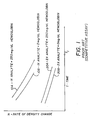
- Immunoassays are commonly done as rate assays, that is, they are measured as a rate of change over time, for example, the rate of increase or decrease in density of a dye.
- the dye chemistry can be, for example, one that relies upon an enzyme to catalyze a leuco dye to change into a colored dye.
- a class of enzymes that is frequently used for this purpose is oxidases, preferably peroxidase, or "POD". Most preferably, the peroxidase is horseradish peroxidase, hereinafter "HRP".
- Immunoassays involve the measurement of limited amounts of POD, unlike other assays which can use excess amounts of POD. (Excess amounts of course are relatively insensitive to interferents that imitate or react with the POD.)
- An immunoassay is usually either “competitive” or “sandwich”.
- “competitive” assays a labeled analog of the target analyte to be determined is placed in competition with the analyte for a fixed amount of an appropriate, immobilized antibody which can react with either the target analyte or a target analyte analog.
- the label on the analog can be appropriately detected in either its “free” or its complexed (that is, reacted) form. Signal level then will tell the user how much target analyte is in the sample being tested.
- the target analyte is contacted with two or more receptor molecules, for example, antibodies, which bind to the target analyte at different epitopic sites.
- receptor molecules for example, antibodies
- One receptor molecule is typically appropriately labeled and the other is either immobilized on a solid substrate, or is capable of being immobilized thereon.
- the amount of target analyte is directly proportional to the amount of bound complex among the target analyte and the two receptors.
- hemoglobin interference we have discovered some properties of the hemoglobin interference that have allowed us to overcome the above-noted problems. That is, we have discovered a) that the rate of impact of interferents such as hemoglobin at a fixed concentration, that is, the bias effect, varies depending on the concentration of the analyte; and b) that the rate of change of the signal produced by a selected amount of target analyte and a fixed amount of interferent, for example, hemoglobin, say 250 mg/dl, decreases over time faster than the rate of change of signal produced by that same amount of target analyte with zero amount of interferent (hemoglobin).
- the method comprises the steps of:
- a calibration method of reducing hemoglobin bias in calibration values for testing for a target analyte in an immunoassay that uses horseradish peroxidase and a substrate to produce a dye density that changes over time.
- the method comprises the steps of:
- a method for testing patient body fluids for a target analyte to reduce any hemoglobin bias in an immunoassay that uses horse radish peroxidase and a leuco dye to produce a dye density that changes over time, the method comprising the steps of
- rate immunoassays can be conducted using a POD detection scheme, while at the same time reducing the bias that is normally created when certain interferents are present.
- a cross-over time is ascertained for a first liquid having x amount of the target analyte and a non-negligible amount of hemoglobin, and a second liquid having said x amount of the target analyte and zero amount of hemoglobin.
- the invention is useful for interferents other than hemoglobin, or if the second liquid has a negligible amount of hemoglobin, which as used herein means from zero to 50 mg/dl, and where the two liquids never reach a time in which their rates are exactly equal.
- cross-over means, when the rates of change of the slide test elements bearing the respective two liquids are either substantially the same, or, when they first reach a steady-state minimum difference having minimized bias - a condition that can occur especially for very low levels of target analyte.
- the preferred embodiments feature assays in which the rate of change of dye density for a given immunoassay decreases over time as shown for particular preferred analytes, and wherein the optimal read time values are shown as a continuous polynomial curve determined by using more than two, that is, three cross-over points from three calibrator liquids of a known hemoglobin concentration.
- the invention is useful for sandwich and competitive immunoassays regardless of the analyte of choice, and regardless of whether the optimal read times are a graphic plot or look-up table, calculated as a polynomial function or a linear function from more than two cross-over points of calibrators, or only two, respectively; so long as the immunoassay chemistry uses POD to produce the dye density.
- interferent biases can be reduced in a similar manner, if the interferent, hereinafter "interferent of choice", produces a cross-over point in time as herein defined, of the measured rates of change, when tested with both negligible and non-negligible amounts of the interferent, respectively.
- interferents include: reducing agents such as gentisic acid, ascorbic acid, dipyrone, and so forth
- the preferred slide test elements for assaying phenytoin and digoxin comprise the following:
- Elements for the detection of digoxin were prepared using conventional procedures and the general structure of slide test elements available under the trademark "Ektachem”® from the Clinical Diagnostics Division, formerly of Eastman Kodak Co., but having the following coating formulations.
- the gravure and receptor coatings detailed below diffused into the porous spreading coating to form separate zones near the boundaries of the dried porous spreading layer.
- Such elements were prepared similarly to those described above for digoxin except that they had reagents suitable for detection of diphenylhydantoin.
- the elements were coated using conventional procedures and equipment and had the following basic coating compositions and structure: Element Structure Dry Coverage (g/m 2 ) [gravure coating] Diphenylhydantoin-horseradish peroxidase conjugate 1.3 x 10 -5 Bovine serum albumin 2.15 x 10 -4 3',5'-dichloro-4'-hydroxyacetanilide 9.95 x 10 -3 3-(N-morpholino) propanesulfonic acid buffer (pH 7) 4.50 x 10 -3 TRITONTTM X-100 nonionic surfactant 4.30 x 10 -3 Polyacrylamide 1.08 x 10 -3 4,5-dihydroxy-3-(6,8-disulfo-2-naphthylazo)-2,7-napthalene-disulfonic acid, sodium salt 5.38 x 10
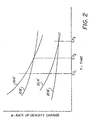
- curves 10A' and 20A' each have a definite amount of hemoglobin interferent present, for example, 250 mg/dL, whereas 10B' and 20B' have none.
- the curves 20A' and 20B' represent 2x the amount of analyte of curves 10A' and 10B'.
- This cross-over phenomenon of Fig. 2 represents, of course, the point of minimum hemoglobin bias, and the optimal point in time when the unknown sample should be read for its rate, for this particular concentration of target analyte, for example, 1X amount for curves 10A' and 10B'.
- the rest of the method of the invention is a procedure so that an "optimal" time of reading is selected that is close to, if not exactly the same as, the cross-over time for that exact amount of target analyte. Hence, the amount of bias from hemoglobin is minimized.
- Fig. 3 the calibration portion of the invention is illustrated therein. That is, calibration is conventionally achieved by taking a set of slide test elements that are substantially identical, all for the same target immuno-analyte, for example digoxin, and testing on an analyzer one, two or three calibrator fluids of varying concentration (C 1 , C 2 , and C 3 ) of the target immuno-analyte, to determine their rate of change over time using some of said set of test elements. Such testing produces, Fig. 3, curves 30B, 40B, and 50B, respectively. These liquids however have negligible, for example, zero, amounts of hemoglobin.
- the calibration procedure adds to this, the steps of ascertaining the similar rate curves 30A, 40A, and 50A, using other of said set of slide test elements on the same analyzer, using however calibration liquids having concentrations C 1 , C 2 , or C 3, , respectively, and a non-negligible amount of hemoglobin, for example, 250 mg/dl.
- the non-negligible amount of hemoglobin is the same for all of these additional calibration liquids, but it need not be.
- the next step is to determine the points in time when each pair of curves reaches its cross-over time.
- those are, respectively, times T 2 , T 3 , and T 4 , when the rates of change within a pair are substantially equal (shown as points P 2 , P 3 , and P 4 ).
- These times are each the optimal read time for that particular concentration of immuno-analyte in sample liquids, if such concentrations can be known or approximated. That is, the invention can be practiced by picking only one of these cross-over points for the corresponding concentration of analyte, regardless of whatever read times are used at other analyte concentrations.
- the next step is to calculate the corresponding cross-over points in time for analyte concentrations other than C 1 , C 2 , or C 3 . This of course is done by interpolating the other cross-over points, by best-fitting a curve to points P 2 , P 3 , and P 4 .
- test procedure on such a patient sample is as follows, using such curve 60, Fig. 4.
- the patient sample is deposited and the rate of change detected in the same kind of analyzer used for the calibration.
- An extensive set of data points, represented by curve S (for "sample"), is ascertained, from at least time T initial to a time T final .
- T initial which is early in the read times (for example, averaged over the first 30 sec.)
- R initial the corresponding rate of change for that sample is ascertained.
- T optimal read is selected from curve 60, arrow 100. That optimal read time is then used, on curve S, to ascertain (arrow 200) the "final" rate of change at that optimal time, that is then conventionally converted (from a calibration table) into a concentration.
- T initial can be taken during the time periods covered by curve 60, provided that said same T initial is used throughout all assays.
- R optimal is the value corresponding to the actual cross-over point P s , where curve S crosses over curve 40B. Nevertheless, this is a value for R final that is much closer to R optimal than most other readings that could be selected from curve S', for example, at a time T bad .
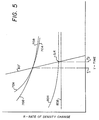
- the optimal read time curve 60 is vertical or substantially vertical for a given target immuno-analyte, only one pair of curves needs to be ascertained to identify a single cross-over point for use with all assays of that analyte.
- This condition is shown in Fig. 5, which also shows a cross-over condition where the paired curves never are equal, but establish a steady state minimum difference ⁇ R.
- a plot of calibration liquids having C x concentration of analyte and 200 or 5 mg/dl hemoglobin produces, respectively, curves 70A and 70B that have a cross-over point on time T 1 , where the rates are substantially equal.
- curves 80A and 80B result (curve 80A being for a liquid with non-negligible amounts of 180 mg/dl of hemoglobin).
- the cross-over point in time is then ascertained to be time T 2 , where a steady-state minimum difference to ⁇ R is first obtained.
- any one of the two read times T 1 or T 2 is selected to be used thereafter as the optimal read time for all testing of patient sample liquids for this particular immunoassay.
- the calibration liquids had the following formulas:
- PVP polyvinylpyrrolidone
- Fig. 6 illustrates the calibration plot and the curve 60" of the optimal read time achieved by the three pairs of calibration liquids, shown as curves 30A", 30B"; 40A", 40B”; and 50A", 50B". That is, curves 30A" and 30B" are for Liquid 1 the contents of which are described above, and curves 40A", 40B” are for Liquid 2 and curves 50A", 50B” for Liquid 3.
- the bias in Table 1 comes from the fact that a time of reading of 1 minute is too late for the liquid 1 case, and too early for liquids 2 and 3, regarding their cross-over times, something that would, of course be unknown if they were samples instead of calibrators.
- the phenytoin assays can be calibrated and assayed in the manner described in the next example, although it clearly is not optimal since the ends of the range are not optimized.
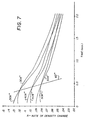
- curves 30A''' and 30B''' represent Liquid 1 prepared as described for Example 1, except that the analyte was 1 ng/mL of digoxin.
- Curves 40A''' and 40B''' represent Liquid 2 prepared as described for Example 1, except that the analyte was 2 ng/mL of digoxin.
- Curves 50A''' and 50B''' represent Liquid 3, prepared as described for Example 1, except that the analyte was 4 ng/mL of digoxin.
- the "A" curves are the respective liquids with 250 mg/dL of hemoglobin present, and the "B" curves have zero amounts of hemoglobin present.
Landscapes
- Health & Medical Sciences (AREA)
- Life Sciences & Earth Sciences (AREA)
- Engineering & Computer Science (AREA)
- Immunology (AREA)
- Molecular Biology (AREA)
- Biomedical Technology (AREA)
- Chemical & Material Sciences (AREA)
- Hematology (AREA)
- Urology & Nephrology (AREA)
- Food Science & Technology (AREA)
- Biochemistry (AREA)
- Cell Biology (AREA)
- Biotechnology (AREA)
- Medicinal Chemistry (AREA)
- Physics & Mathematics (AREA)
- Analytical Chemistry (AREA)
- Microbiology (AREA)
- General Health & Medical Sciences (AREA)
- General Physics & Mathematics (AREA)
- Pathology (AREA)
- Investigating Or Analysing Biological Materials (AREA)
- Measuring Or Testing Involving Enzymes Or Micro-Organisms (AREA)
- Investigating Or Analysing Materials By Optical Means (AREA)
- Analysing Materials By The Use Of Radiation (AREA)
- Investigating Or Analysing Materials By The Use Of Chemical Reactions (AREA)
Claims (8)
- Verfahren zur Verringerung der Abweichung, die durch einen ausgewählten Interferenten verursacht wird, wenn ein Immunassay unter der Verwendung eines getrockneten Testelements, enthaltend Nachweisreagenzien umfassend Peroxidase und ein Substrat, das eine nachweisbare Dichteveränderung bei verschiedenen Raten ergibt, wobei die Peroxidase in einer vorbestimmten begrenzten Menge vorhanden ist, durchgeführt wird, wobei das Verfahren die Schritte umfaßt von:a) Kalibrieren eines Immunoassay eines Zielanalyten durch Ermitteln der Zeit, bei der die Rate von Dichteveränderung, die durch ein erstes Set der Testelemente für den Zielanalyten, der mit mindestens einer Flüssigkeit kontaktiert wurde, die eine bekannte Menge von ausgewähltem Interferenten und eine bekannte Menge von Zielanalyt aufweist, produziert wird, die Rate von Dichteveränderung, die durch ein zweites Set von Testelementen produziert werden, das im wesentlichen zu dem ersten Set von Testelementen identisch ist, das mit einer Flüssigkeit, die die bekannte Menge von Zielanalyt in Kontakt gebracht wurde, aber eine vernachlässigbare Menge von ausgewählten Interferenten enthält, bei einer Überschneidungszeit überschneidet oder minimiert, undb) Durchführen eines Tests mit einer Patientenprobe von unbekannter Menge des Zielanalyten durch Lesen der Veränderungsrate in einem ausgewählten Element der Testelemente der ersten oder zweiten Sets, die durch die Probe, die mit dem ausgewählten Element in Kontakt kommt, zu einer Zeit, verursacht wird, die der in Schritt a) ermittelten Überschneidungszeit entspricht.
- Verfahren wie definiert in Anspruch 1 und weiter einschließend die Schritte a') von Wiederholen des Schrittes a) mit mindestens einer zweiten Flüssigkeit, die die bekannte Menge von ausgewählten Interferent und eine bekannte Menge von dem Zielanalyten, die sich von der Menge von der mindestens einen Flüssigkeit unterscheidet, aufweist und a") wiederholen von Schritt a) mit einer dritten Flüssigkeit, die die bekannte Menge von Analyten der zweiten Flüssigkeit, aber eine vernachlässigbare Menge von ausgewähltem Interferenten aufweist, um die Überschneidungszeit für die zweiten und dritten Flüssigkeiten zu ermitteln, und
Ermitteln einer Beziehung zwischen der in Schritt a) von Anspruch 1 bestimmten Zeit und der in Schritten a') und a") für die zweiten und dritten Flüssigkeiten bestimmten Zeit, was allgemein für eine Vielzahl von Mengen von Zielanalyt in Probenflüssigkeiten anwendbar ist. - Kalibrierungsverfahren zur Verringerung von Hämoglobinabweichungen in Kalibrierungswerten zum Testen auf ein Zielanalyt in einem Immunoassay, der Rettichperoxidase und ein Substrat verwendet, um eine Färbungsdichte zu ergeben, die sich über die Zeit verändert, wobei das Verfahren die Schritte umfaßt vona) Ermitteln der Veränderungsrate in der Farbdichte, die durch mindestens zwei Flüssigkeiten, die zwei verschiedene und vorgewählte bekannte Mengen des Zielanalyten und Nullmengen von Hemoglobin aufweisen erzeugt wird für eine Vielzahl von Zeitpunkten unter der Verwendung von einiger von einer Vielzahl von Schlitten-Testelementen von identischer Zusammensetzung;b) Ermitteln der Veränderungsrate der Farbdichte, die durch die mindestens zwei Flüssigkeiten erzeugt wurde, denen eine vorgewählte nicht-vernachlässigbare Menge von Hämoglobin hinzugefügt wurden, die dieselbe für beide der mindestens der zwei Flüssigkeiten ist für die Vielzahl von Zeitpunkten unter der Verwendung von zusätzlichen Mitgliedern der Schlittenträger Testelemente von identischer Zusammensetzung;c) Bestimmung der Überschneidungspunkte in der Zeit, wann die Veränderungsrate von den mindestens zwei Flüssigkeiten, die die nicht-Nullmengen von Hämoglobin enthalten, die Veränderungsrate für die entsprechenden zwei Flüssigkeiten, in denen jedoch jedes Hemoglobin fehlt, überschneidet oder minimiert, wodurch Überkreuzungszeiten erhalten werden, die eine minimalisierte Abweichung aufweisen; undd) Auswählen der Überschneidungszeit für eine von den mindestens zwei Flüssigkeiten als die optimale Lesezeit zur nachfolgenden Flüssigkeitsproben-Überprüfung, die eine anfängliche Veränderungsrate aufweist, die mit einer der mindestens zwei Flüssigkeiten übereinstimmt.
- Kalibrierungsverfahren wie definiert in Anspruch 3, wobei Schritt d) weiterhin die Schritte umfaßt von:d')Berechnen entsprechender Überschneidungszeitpunkte für Konzentrationen des Zielanalyten, die zwischen den Konzentrationswerten von Analyten für die mindestens zwei Flüssigkeiten liegen; unde) Übertragen der Überschneidungszeitpunkte von Schritten c) und d') in eine Tabelle von Werten von optimalen Lesezeiten zur Verwendung in nachfolgenden Überprüfungen von unbekannten Patientenprobe.
- Verfahren wie definiert in Anspruch 4, wobei der Schritt b) ein Ermitteln der Veränderungsrate für nur zwei von den mindestens drei Flüssigkeiten umfaßt, und wobei der Schritt d) ein Berechnen eines linearen Zusammenhangs von Überschneidungszeiten für Konzentrationswerte zwischen denen von den nur zwei Flüssigkeiten umfaßt.
- Verfahren wie definiert in Anspruch 4, wobei der Schritt b) ein Ermitteln der Veränderungsrate für mehr als zwei Flüssigkeiten von den mindestens drei Flüssigkeiten umfaßt, und wobei der Schritt d) ein Berechnen einer polynominalen Beziehung von Überschneidungszeiten für Konzentrationswerte zwischen denen von den mehr als zwei Flüssigkeiten umfaßt.
- Verfahren zur Überprüfung von Patientenkörperflüssigkeiten auf einen Zielanalyten in einem Immunoassay, der Rettichperoxidase und einen Leukofarbstoff verwendet, um eine Farbdichte zu erzeugen die sich über die Zeit ändert, wobei das Verfahren die Schritte umfaßt vona) Ermitteln der Veränderungsrate in der Dichte über die Zeit von einer bestimmten Patientenkörperflüssigkeit mit einer unbekannten Menge des Analyten in einem Analysegerät, das mindestens einen übertragenen Überschneidungszeitpunkt als eine optimale Lesezeit aufweist, die in Übereinstimmung mit dem Kalibrierungsverfahren von Anspruch 3 oder 4 berechnet wurde;b) Auswählen eines zeitlichen Fixpunkts vor jedem der übertragenen Überschneidungszeiten als einer Anfangslesezeit;c) Ermitteln von dem Zeitpunkt, der in Schritt b) ausgewählt wurde, die Anfangsrate für diese Zeit von den Werten, die in Schritt a) ermittelt wurden;d) Ermitteln für die Anfangsrate, die in Schritt c) ermittelt wurde, eine optimale Überschneidungslesezeit, die mit der Anfangsrate übereinstimmt; unde) Ermitteln von den in Schritt a) bestimmten Raten, die Veränderungsrate der Patientenprobe, die bei der optimalen Lesezeit auftritt.
- Verfahren zur Überprüfung, wie in Anspruch 7 definiert, wobei die optimale Lesezeit dieselbe für alle in Schritt c) ermittelten anfänglichen Raten ist.
Applications Claiming Priority (2)
| Application Number | Priority Date | Filing Date | Title |
|---|---|---|---|
| US363099 | 1989-06-07 | ||
| US08/363,099 US5571682A (en) | 1994-12-22 | 1994-12-22 | Calibrating and testing immunoassays to minimize interferences |
Publications (3)
| Publication Number | Publication Date |
|---|---|
| EP0718626A2 EP0718626A2 (de) | 1996-06-26 |
| EP0718626A3 EP0718626A3 (de) | 1998-06-10 |
| EP0718626B1 true EP0718626B1 (de) | 2001-10-04 |
Family
ID=23428799
Family Applications (1)
| Application Number | Title | Priority Date | Filing Date |
|---|---|---|---|
| EP95309354A Expired - Lifetime EP0718626B1 (de) | 1994-12-22 | 1995-12-21 | Kalibrierung und Prüfung von Immunoassays zur Verminderung von Störungen |
Country Status (7)
| Country | Link |
|---|---|
| US (1) | US5571682A (de) |
| EP (1) | EP0718626B1 (de) |
| JP (1) | JP3672991B2 (de) |
| AT (1) | ATE206519T1 (de) |
| AU (1) | AU4056395A (de) |
| CA (1) | CA2165935C (de) |
| DE (1) | DE69523027T2 (de) |
Families Citing this family (13)
| Publication number | Priority date | Publication date | Assignee | Title |
|---|---|---|---|---|
| US8688188B2 (en) | 1998-04-30 | 2014-04-01 | Abbott Diabetes Care Inc. | Analyte monitoring device and methods of use |
| US8346337B2 (en) | 1998-04-30 | 2013-01-01 | Abbott Diabetes Care Inc. | Analyte monitoring device and methods of use |
| US9066695B2 (en) | 1998-04-30 | 2015-06-30 | Abbott Diabetes Care Inc. | Analyte monitoring device and methods of use |
| US8480580B2 (en) | 1998-04-30 | 2013-07-09 | Abbott Diabetes Care Inc. | Analyte monitoring device and methods of use |
| US8465425B2 (en) | 1998-04-30 | 2013-06-18 | Abbott Diabetes Care Inc. | Analyte monitoring device and methods of use |
| US6175752B1 (en) | 1998-04-30 | 2001-01-16 | Therasense, Inc. | Analyte monitoring device and methods of use |
| US6949816B2 (en) | 2003-04-21 | 2005-09-27 | Motorola, Inc. | Semiconductor component having first surface area for electrically coupling to a semiconductor chip and second surface area for electrically coupling to a substrate, and method of manufacturing same |
| US8974386B2 (en) | 1998-04-30 | 2015-03-10 | Abbott Diabetes Care Inc. | Analyte monitoring device and methods of use |
| US6560471B1 (en) | 2001-01-02 | 2003-05-06 | Therasense, Inc. | Analyte monitoring device and methods of use |
| WO2004055494A2 (en) * | 2002-12-12 | 2004-07-01 | Strategic Diagnostics Inc. | Compositions and methods for detecting animal by product in feed |
| JP4285012B2 (ja) * | 2003-01-31 | 2009-06-24 | 株式会社日立製作所 | 学習状況判断プログラム及びユーザ状況判断システム |
| WO2007143225A2 (en) | 2006-06-07 | 2007-12-13 | Abbott Diabetes Care, Inc. | Analyte monitoring system and method |
| US9023599B2 (en) * | 2011-09-25 | 2015-05-05 | Chang Gung Medical Foundation, Linkou Branch | Method of detecting the presence of pneumococcal neuraminidases in Streptococcus pneumoniae-infected samples |
Family Cites Families (8)
| Publication number | Priority date | Publication date | Assignee | Title |
|---|---|---|---|---|
| US4022577A (en) * | 1976-03-12 | 1977-05-10 | The University Of Virginia | Automated radioimmunoassay |
| US4184923A (en) * | 1977-11-03 | 1980-01-22 | Eastman Kodak Company | Reduction of gentisic acid interference in analytical elements |
| JPS58140636A (ja) * | 1982-02-16 | 1983-08-20 | Asahi Chem Ind Co Ltd | 赤血球膜電位の測定法 |
| US4835110A (en) * | 1985-12-23 | 1989-05-30 | Beckman Instruments, Inc. | Method for enhancing analysis timing in kinetic nephelometry |
| US5171688A (en) * | 1988-08-30 | 1992-12-15 | Cholestech Corporation | Self-corrected assay device |
| JPH02167446A (ja) * | 1988-09-01 | 1990-06-27 | Konica Corp | 液体試料分析方法 |
| JP2646731B2 (ja) * | 1989-02-28 | 1997-08-27 | 株式会社島津製作所 | 生化学分析方法 |
| EP0606950A3 (de) * | 1993-01-13 | 1995-07-12 | Eastman Kodak Co | Verfahren zur Reaktionsgeschwindigkeitsmessung von Analyten. |
-
1994
- 1994-12-22 US US08/363,099 patent/US5571682A/en not_active Expired - Lifetime
-
1995
- 1995-12-19 AU AU40563/95A patent/AU4056395A/en not_active Abandoned
- 1995-12-21 DE DE69523027T patent/DE69523027T2/de not_active Expired - Lifetime
- 1995-12-21 EP EP95309354A patent/EP0718626B1/de not_active Expired - Lifetime
- 1995-12-21 AT AT95309354T patent/ATE206519T1/de not_active IP Right Cessation
- 1995-12-21 JP JP33354795A patent/JP3672991B2/ja not_active Expired - Fee Related
- 1995-12-21 CA CA002165935A patent/CA2165935C/en not_active Expired - Fee Related
Also Published As
| Publication number | Publication date |
|---|---|
| JPH08233818A (ja) | 1996-09-13 |
| EP0718626A3 (de) | 1998-06-10 |
| AU4056395A (en) | 1996-06-27 |
| JP3672991B2 (ja) | 2005-07-20 |
| EP0718626A2 (de) | 1996-06-26 |
| ATE206519T1 (de) | 2001-10-15 |
| US5571682A (en) | 1996-11-05 |
| DE69523027T2 (de) | 2002-03-14 |
| CA2165935C (en) | 2009-10-20 |
| CA2165935A1 (en) | 1996-06-23 |
| DE69523027D1 (de) | 2001-11-08 |
Similar Documents
| Publication | Publication Date | Title |
|---|---|---|
| JP4183308B2 (ja) | 臨床的に重要な分析対象物比を得るための装置及び方法 | |
| EP0071934B1 (de) | Verfahren zur Herstellung eines farbstabilisierten chromogenen Testelements | |
| Zuk et al. | Enzyme immunochromatography--a quantitative immunoassay requiring no instrumentation. | |
| EP0718626B1 (de) | Kalibrierung und Prüfung von Immunoassays zur Verminderung von Störungen | |
| JPH0249161A (ja) | 免疫クロマトグラフイー分析方法 | |
| US5204267A (en) | Method of glucose stabilization and analysis in dried blood spot samples | |
| EP0252750B1 (de) | Zusammensetzung und analytisches Element mit stabilisiertem Peroxydase | |
| JPH1062412A (ja) | クレアチニンを検出する方法 | |
| JPH0629852B2 (ja) | 偏倚乾式分析要素を用いた液体試料中の被検物質の定量分析方法 | |
| JP3424831B2 (ja) | 結合アッセイ | |
| KR100730900B1 (ko) | 체액샘플에서 분석물의 준정량적 측정의 정확도를 개선시키는 방법 | |
| Bakker | Immunoturbidimetry of urinary albumin: prevention of adsorption of albumin; influence of other urinary constituents. | |
| Litman et al. | An internally referenced test strip immunoassay for morphine. | |
| US4230601A (en) | Calibrator composition based upon dialyzed blood serum | |
| EP0693552B1 (de) | Analytisches Element, Zusammensetzung und Verfahren unter Verwendung von modifizierter Apo-Meerrettich-Peroxidase | |
| EP0239222A1 (de) | Analytisches Element mit einer lichtempfindlichen Verbindung und Filterschicht und Verfahren zur Benutzung | |
| EP0684477A2 (de) | Kalibriermatrix | |
| Murthy et al. | Activity concentration and mass concentration (monoclonal antibody immunoenzymometric method) compared for creatine kinase MB isoenzyme in serum. | |
| CN114112957B (zh) | 一种脂联素测定试剂盒及其应用 | |
| US20020009732A1 (en) | Version with markings to show changes made | |
| US5079150A (en) | High sensitivity detection of peroxidase activity | |
| Thompson et al. | Homogeneous dry reagent immunoassay strips for the determination of therapeutic drugs in human serum or plasma | |
| Boguslaski et al. | Multilayer film immunoassay | |
| JP2521074B2 (ja) | 免疫反応の調節法 | |
| Monroe | Enzyme Channelling Immunoassay (ECIA): A Unique and Rapid Quantitative Technique |
Legal Events
| Date | Code | Title | Description |
|---|---|---|---|
| PUAI | Public reference made under article 153(3) epc to a published international application that has entered the european phase |
Free format text: ORIGINAL CODE: 0009012 |
|
| AK | Designated contracting states |
Kind code of ref document: A2 Designated state(s): AT BE CH DE DK ES FR GB GR IE IT LI LU MC NL PT SE |
|
| AX | Request for extension of the european patent |
Free format text: SI PAYMENT 960103 |
|
| RAX | Requested extension states of the european patent have changed |
Free format text: SI PAYMENT 960103 |
|
| PUAL | Search report despatched |
Free format text: ORIGINAL CODE: 0009013 |
|
| AK | Designated contracting states |
Kind code of ref document: A3 Designated state(s): AT BE CH DE DK ES FR GB GR IE IT LI LU MC NL PT SE |
|
| AX | Request for extension of the european patent |
Free format text: SI PAYMENT 960103 |
|
| 17P | Request for examination filed |
Effective date: 19981113 |
|
| GRAG | Despatch of communication of intention to grant |
Free format text: ORIGINAL CODE: EPIDOS AGRA |
|
| 17Q | First examination report despatched |
Effective date: 20001211 |
|
| GRAG | Despatch of communication of intention to grant |
Free format text: ORIGINAL CODE: EPIDOS AGRA |
|
| GRAH | Despatch of communication of intention to grant a patent |
Free format text: ORIGINAL CODE: EPIDOS IGRA |
|
| GRAH | Despatch of communication of intention to grant a patent |
Free format text: ORIGINAL CODE: EPIDOS IGRA |
|
| GRAA | (expected) grant |
Free format text: ORIGINAL CODE: 0009210 |
|
| AK | Designated contracting states |
Kind code of ref document: B1 Designated state(s): AT BE CH DE DK ES FR GB GR IE IT LI LU MC NL PT SE |
|
| AX | Request for extension of the european patent |
Free format text: SI PAYMENT 19960103 |
|
| PG25 | Lapsed in a contracting state [announced via postgrant information from national office to epo] |
Ref country code: NL Free format text: LAPSE BECAUSE OF FAILURE TO SUBMIT A TRANSLATION OF THE DESCRIPTION OR TO PAY THE FEE WITHIN THE PRESCRIBED TIME-LIMIT Effective date: 20011004 Ref country code: LI Free format text: LAPSE BECAUSE OF FAILURE TO SUBMIT A TRANSLATION OF THE DESCRIPTION OR TO PAY THE FEE WITHIN THE PRESCRIBED TIME-LIMIT Effective date: 20011004 Ref country code: IT Free format text: LAPSE BECAUSE OF FAILURE TO SUBMIT A TRANSLATION OF THE DESCRIPTION OR TO PAY THE FEE WITHIN THE PRE;WARNING: LAPSES OF ITALIAN PATENTS WITH EFFECTIVE DATE BEFORE 2007 MAY HAVE OCCURRED AT ANY TIME BEFORE 2007. THE CORRECT EFFECTIVE DATE MAY BE DIFFERENT FROM THE ONE RECORDED.SCRIBED TIME-LIMIT Effective date: 20011004 Ref country code: GR Free format text: LAPSE BECAUSE OF NON-PAYMENT OF DUE FEES Effective date: 20011004 Ref country code: CH Free format text: LAPSE BECAUSE OF FAILURE TO SUBMIT A TRANSLATION OF THE DESCRIPTION OR TO PAY THE FEE WITHIN THE PRESCRIBED TIME-LIMIT Effective date: 20011004 Ref country code: BE Free format text: LAPSE BECAUSE OF FAILURE TO SUBMIT A TRANSLATION OF THE DESCRIPTION OR TO PAY THE FEE WITHIN THE PRESCRIBED TIME-LIMIT Effective date: 20011004 Ref country code: AT Free format text: LAPSE BECAUSE OF FAILURE TO SUBMIT A TRANSLATION OF THE DESCRIPTION OR TO PAY THE FEE WITHIN THE PRESCRIBED TIME-LIMIT Effective date: 20011004 |
|
| REF | Corresponds to: |
Ref document number: 206519 Country of ref document: AT Date of ref document: 20011015 Kind code of ref document: T |
|
| REG | Reference to a national code |
Ref country code: CH Ref legal event code: EP |
|
| REF | Corresponds to: |
Ref document number: 69523027 Country of ref document: DE Date of ref document: 20011108 |
|
| REG | Reference to a national code |
Ref country code: IE Ref legal event code: FG4D |
|
| PG25 | Lapsed in a contracting state [announced via postgrant information from national office to epo] |
Ref country code: MC Free format text: LAPSE BECAUSE OF NON-PAYMENT OF DUE FEES Effective date: 20011221 Ref country code: LU Free format text: LAPSE BECAUSE OF NON-PAYMENT OF DUE FEES Effective date: 20011221 Ref country code: IE Free format text: LAPSE BECAUSE OF FAILURE TO SUBMIT A TRANSLATION OF THE DESCRIPTION OR TO PAY THE FEE WITHIN THE PRESCRIBED TIME-LIMIT Effective date: 20011221 |
|
| REG | Reference to a national code |
Ref country code: GB Ref legal event code: IF02 |
|
| PG25 | Lapsed in a contracting state [announced via postgrant information from national office to epo] |
Ref country code: SE Free format text: LAPSE BECAUSE OF FAILURE TO SUBMIT A TRANSLATION OF THE DESCRIPTION OR TO PAY THE FEE WITHIN THE PRESCRIBED TIME-LIMIT Effective date: 20020104 Ref country code: PT Free format text: LAPSE BECAUSE OF FAILURE TO SUBMIT A TRANSLATION OF THE DESCRIPTION OR TO PAY THE FEE WITHIN THE PRESCRIBED TIME-LIMIT Effective date: 20020104 Ref country code: DK Free format text: LAPSE BECAUSE OF FAILURE TO SUBMIT A TRANSLATION OF THE DESCRIPTION OR TO PAY THE FEE WITHIN THE PRESCRIBED TIME-LIMIT Effective date: 20020104 |
|
| ET | Fr: translation filed | ||
| NLV1 | Nl: lapsed or annulled due to failure to fulfill the requirements of art. 29p and 29m of the patents act | ||
| REG | Reference to a national code |
Ref country code: CH Ref legal event code: PL |
|
| PG25 | Lapsed in a contracting state [announced via postgrant information from national office to epo] |
Ref country code: ES Free format text: LAPSE BECAUSE OF FAILURE TO SUBMIT A TRANSLATION OF THE DESCRIPTION OR TO PAY THE FEE WITHIN THE PRESCRIBED TIME-LIMIT Effective date: 20020430 |
|
| PLBE | No opposition filed within time limit |
Free format text: ORIGINAL CODE: 0009261 |
|
| STAA | Information on the status of an ep patent application or granted ep patent |
Free format text: STATUS: NO OPPOSITION FILED WITHIN TIME LIMIT |
|
| 26N | No opposition filed | ||
| REG | Reference to a national code |
Ref country code: IE Ref legal event code: MM4A |
|
| PGFP | Annual fee paid to national office [announced via postgrant information from national office to epo] |
Ref country code: FR Payment date: 20101224 Year of fee payment: 16 |
|
| PGFP | Annual fee paid to national office [announced via postgrant information from national office to epo] |
Ref country code: GB Payment date: 20101215 Year of fee payment: 16 |
|
| PGFP | Annual fee paid to national office [announced via postgrant information from national office to epo] |
Ref country code: DE Payment date: 20101215 Year of fee payment: 16 |
|
| GBPC | Gb: european patent ceased through non-payment of renewal fee |
Effective date: 20111221 |
|
| REG | Reference to a national code |
Ref country code: FR Ref legal event code: ST Effective date: 20120831 |
|
| REG | Reference to a national code |
Ref country code: DE Ref legal event code: R119 Ref document number: 69523027 Country of ref document: DE Effective date: 20120703 |
|
| PG25 | Lapsed in a contracting state [announced via postgrant information from national office to epo] |
Ref country code: DE Free format text: LAPSE BECAUSE OF NON-PAYMENT OF DUE FEES Effective date: 20120703 Ref country code: GB Free format text: LAPSE BECAUSE OF NON-PAYMENT OF DUE FEES Effective date: 20111221 |
|
| PG25 | Lapsed in a contracting state [announced via postgrant information from national office to epo] |
Ref country code: FR Free format text: LAPSE BECAUSE OF NON-PAYMENT OF DUE FEES Effective date: 20120102 |