EP0711362B1 - Tag reagent and assay method - Google Patents
Tag reagent and assay method Download PDFInfo
- Publication number
- EP0711362B1 EP0711362B1 EP94922966A EP94922966A EP0711362B1 EP 0711362 B1 EP0711362 B1 EP 0711362B1 EP 94922966 A EP94922966 A EP 94922966A EP 94922966 A EP94922966 A EP 94922966A EP 0711362 B1 EP0711362 B1 EP 0711362B1
- Authority
- EP
- European Patent Office
- Prior art keywords
- reagent
- analyte
- reagents
- moiety
- oligonucleotide
- Prior art date
- Legal status (The legal status is an assumption and is not a legal conclusion. Google has not performed a legal analysis and makes no representation as to the accuracy of the status listed.)
- Expired - Lifetime
Links
Images



Classifications
-
- C—CHEMISTRY; METALLURGY
- C12—BIOCHEMISTRY; BEER; SPIRITS; WINE; VINEGAR; MICROBIOLOGY; ENZYMOLOGY; MUTATION OR GENETIC ENGINEERING
- C12Q—MEASURING OR TESTING PROCESSES INVOLVING ENZYMES, NUCLEIC ACIDS OR MICROORGANISMS; COMPOSITIONS OR TEST PAPERS THEREFOR; PROCESSES OF PREPARING SUCH COMPOSITIONS; CONDITION-RESPONSIVE CONTROL IN MICROBIOLOGICAL OR ENZYMOLOGICAL PROCESSES
- C12Q1/00—Measuring or testing processes involving enzymes, nucleic acids or microorganisms; Compositions therefor; Processes of preparing such compositions
- C12Q1/68—Measuring or testing processes involving enzymes, nucleic acids or microorganisms; Compositions therefor; Processes of preparing such compositions involving nucleic acids
- C12Q1/6869—Methods for sequencing
- C12Q1/6874—Methods for sequencing involving nucleic acid arrays, e.g. sequencing by hybridisation
-
- C—CHEMISTRY; METALLURGY
- C07—ORGANIC CHEMISTRY
- C07F—ACYCLIC, CARBOCYCLIC OR HETEROCYCLIC COMPOUNDS CONTAINING ELEMENTS OTHER THAN CARBON, HYDROGEN, HALOGEN, OXYGEN, NITROGEN, SULFUR, SELENIUM OR TELLURIUM
- C07F7/00—Compounds containing elements of Groups 4 or 14 of the Periodic Table
- C07F7/02—Silicon compounds
- C07F7/08—Compounds having one or more C—Si linkages
- C07F7/18—Compounds having one or more C—Si linkages as well as one or more C—O—Si linkages
- C07F7/1804—Compounds having Si-O-C linkages
-
- C—CHEMISTRY; METALLURGY
- C07—ORGANIC CHEMISTRY
- C07H—SUGARS; DERIVATIVES THEREOF; NUCLEOSIDES; NUCLEOTIDES; NUCLEIC ACIDS
- C07H21/00—Compounds containing two or more mononucleotide units having separate phosphate or polyphosphate groups linked by saccharide radicals of nucleoside groups, e.g. nucleic acids
-
- C—CHEMISTRY; METALLURGY
- C12—BIOCHEMISTRY; BEER; SPIRITS; WINE; VINEGAR; MICROBIOLOGY; ENZYMOLOGY; MUTATION OR GENETIC ENGINEERING
- C12N—MICROORGANISMS OR ENZYMES; COMPOSITIONS THEREOF; PROPAGATING, PRESERVING, OR MAINTAINING MICROORGANISMS; MUTATION OR GENETIC ENGINEERING; CULTURE MEDIA
- C12N15/00—Mutation or genetic engineering; DNA or RNA concerning genetic engineering, vectors, e.g. plasmids, or their isolation, preparation or purification; Use of hosts therefor
- C12N15/09—Recombinant DNA-technology
- C12N15/10—Processes for the isolation, preparation or purification of DNA or RNA
- C12N15/1034—Isolating an individual clone by screening libraries
- C12N15/1075—Isolating an individual clone by screening libraries by coupling phenotype to genotype, not provided for in other groups of this subclass
-
- C—CHEMISTRY; METALLURGY
- C12—BIOCHEMISTRY; BEER; SPIRITS; WINE; VINEGAR; MICROBIOLOGY; ENZYMOLOGY; MUTATION OR GENETIC ENGINEERING
- C12Q—MEASURING OR TESTING PROCESSES INVOLVING ENZYMES, NUCLEIC ACIDS OR MICROORGANISMS; COMPOSITIONS OR TEST PAPERS THEREFOR; PROCESSES OF PREPARING SUCH COMPOSITIONS; CONDITION-RESPONSIVE CONTROL IN MICROBIOLOGICAL OR ENZYMOLOGICAL PROCESSES
- C12Q1/00—Measuring or testing processes involving enzymes, nucleic acids or microorganisms; Compositions therefor; Processes of preparing such compositions
- C12Q1/68—Measuring or testing processes involving enzymes, nucleic acids or microorganisms; Compositions therefor; Processes of preparing such compositions involving nucleic acids
- C12Q1/6813—Hybridisation assays
- C12Q1/6816—Hybridisation assays characterised by the detection means
-
- C—CHEMISTRY; METALLURGY
- C12—BIOCHEMISTRY; BEER; SPIRITS; WINE; VINEGAR; MICROBIOLOGY; ENZYMOLOGY; MUTATION OR GENETIC ENGINEERING
- C12Q—MEASURING OR TESTING PROCESSES INVOLVING ENZYMES, NUCLEIC ACIDS OR MICROORGANISMS; COMPOSITIONS OR TEST PAPERS THEREFOR; PROCESSES OF PREPARING SUCH COMPOSITIONS; CONDITION-RESPONSIVE CONTROL IN MICROBIOLOGICAL OR ENZYMOLOGICAL PROCESSES
- C12Q1/00—Measuring or testing processes involving enzymes, nucleic acids or microorganisms; Compositions therefor; Processes of preparing such compositions
- C12Q1/68—Measuring or testing processes involving enzymes, nucleic acids or microorganisms; Compositions therefor; Processes of preparing such compositions involving nucleic acids
- C12Q1/6813—Hybridisation assays
- C12Q1/6834—Enzymatic or biochemical coupling of nucleic acids to a solid phase
- C12Q1/6837—Enzymatic or biochemical coupling of nucleic acids to a solid phase using probe arrays or probe chips
-
- C—CHEMISTRY; METALLURGY
- C12—BIOCHEMISTRY; BEER; SPIRITS; WINE; VINEGAR; MICROBIOLOGY; ENZYMOLOGY; MUTATION OR GENETIC ENGINEERING
- C12Q—MEASURING OR TESTING PROCESSES INVOLVING ENZYMES, NUCLEIC ACIDS OR MICROORGANISMS; COMPOSITIONS OR TEST PAPERS THEREFOR; PROCESSES OF PREPARING SUCH COMPOSITIONS; CONDITION-RESPONSIVE CONTROL IN MICROBIOLOGICAL OR ENZYMOLOGICAL PROCESSES
- C12Q1/00—Measuring or testing processes involving enzymes, nucleic acids or microorganisms; Compositions therefor; Processes of preparing such compositions
- C12Q1/68—Measuring or testing processes involving enzymes, nucleic acids or microorganisms; Compositions therefor; Processes of preparing such compositions involving nucleic acids
- C12Q1/6869—Methods for sequencing
- C12Q1/6872—Methods for sequencing involving mass spectrometry
-
- Y—GENERAL TAGGING OF NEW TECHNOLOGICAL DEVELOPMENTS; GENERAL TAGGING OF CROSS-SECTIONAL TECHNOLOGIES SPANNING OVER SEVERAL SECTIONS OF THE IPC; TECHNICAL SUBJECTS COVERED BY FORMER USPC CROSS-REFERENCE ART COLLECTIONS [XRACs] AND DIGESTS
- Y10—TECHNICAL SUBJECTS COVERED BY FORMER USPC
- Y10S—TECHNICAL SUBJECTS COVERED BY FORMER USPC CROSS-REFERENCE ART COLLECTIONS [XRACs] AND DIGESTS
- Y10S435/00—Chemistry: molecular biology and microbiology
- Y10S435/8215—Microorganisms
- Y10S435/911—Microorganisms using fungi
- Y10S435/912—Absidia
Definitions
- analyte molecules labelled with reporter groups In biological and chemical analyses, the use of analyte molecules labelled with reporter groups is routine.
- This invention addresses the idea of providing reagents having at least two analyte groups linked to one or more reporter groups. Such reagents can be used, in ways described below, to generate much more analytical information than can simple labelled analytes. It is possible to code reporter groups so that reagents carrying multiple analyte groups and multiple reporter groups can by synthesised combinatorially and used simultaneously and the reporter groups resolved in the analytical stage.
- WO 93/06121 (Affymax) describes a synthetic oligomer library comprising a plurality of different members, each member comprising an oligomer composed of a sequence of monomers linked to one or more identifier tags identifying the sequence of monomers in the oligomer.
- the linkage between the oligomer and the identifier tag preferably comprises a solid particle.
- the identifier tag is preferably an oligonucleotide.
- the present invention provides a reagent comprising
- the analyte moiety is linked to the tag moiety by a link which is cleavable, e.g. photocleavable.
- a linker group to which the analyte moiety and the tag moiety are both attached.
- the analyte moiety is a chain of n analyte residues
- the tag moiety is a chain of up to n reporter groups, the reporter group at each position of the tag chain being chosen to designate the analyte residue at a corresponding position of the analyte chain.
- n is an integer of at least 2, preferably 3 to 20.
- the invention may be used for the detection of all analytes of interest. These include, but are not limited to, a protein/peptide chain so that the analyte residues are amino acid residues; a nucleic acid/oligonucleotide chain so that the analyte residues are nucleotide residues; a carbohydrate chain so that the analyte residues are sugar residues. Additionally the analyte may be a class of small molecules with biological, pharmacological or therapeutic activity. For example it could be a core molecule with the ability to vary various substituent groups eg. alkyl, esters, amines, ethers etc in a combinatorial manner with mass spectrometry tags.
- substituent groups eg. alkyl, esters, amines, ethers etc in a combinatorial manner with mass spectrometry tags.
- the tag moiety and/or the or each reporter group in it is capable of being observed/detected/ analysed so as to provide information about the nature of the analyte moiety, and/or the analyte residues in it.
- the reagent has the formula A - L - R where A is a chain of n analyte residues constituting the analyte moiety, L is the linker, R is a chain of up to n reporter groups constituting the tag moiety, and n is 2 - 20, wherein the tag moiety contains information defining the location of analyte residues in the analyte moiety.
- the tag moiety consists of one or more reporter groups distinguishable by mass and thus capable of being analysed by mass spectrometry.
- the reporter groups may be chemically different and thus distinguished from one another by molecular weight. Or the reporter groups may be chemically identical, but distinguished from one another by containing different isotopes (e.g. 12 C/ 13 C and 1 H/ 2 H as discussed below).
- the tag moiety is, and/or the reporter groups are, suitable or adapted for analysis by mass spectrometry e.g. after cleavage by photochemical or other means from the reagent.
- mass spectrometry as a detection system is: its great sensitivity - only a few hundred molecules are needed to give a good signal; its wide dynamic range and high resolving power - molecules in the mass range 100 to 200,000 Daltons can be resolved with a resolution better than 0.01; its versatility - molecules of many different chemical structures are readily analysed; the potential to image analytes by combining mass spectrometry with, for example, scanning laser desorption: and the ability to make quantitative as opposed to merely qualitative measurements.
- mass-labelling combines advantages of radioactivity and fluorescence and has additional attributes which suggest novel applications.
- the invention provides a library of the above reagents, wherein the library consists of a plurality of reagents each comprising a different analyte moiety of n analyte residues.
- the library may consist of 4 n reagents each comprising a different oligonucleotide chain of n nucleotide residues.
- the reagents of the library may be present mixed together in solution.
- the invention provides an assay method which comprises the steps of: providing a target substance; incubating the target substance with the said library of reagents under conditions to cause at least one reagent to bind to the target substance; removing non-bound reagents; recovering the tag moieties of the or each bound reagent; and analysing the recovered tag moieties as an indication of the nature of the analyte moieties bound to the target substance.
- the target substance may be immobilised, as this provides a convenient means for separating bound from non-bound reagent.
- the target substance may be an organism or tissue or group of cells, and the assay may be performed to screen a family of candidate drugs.
- the target substance may be a nucleic acid, and this aspect is discussed in greater detail below.
- the principle of the method used for tagging multiple analytes simultaneously is similar to that proposed by Brenner and Lerner (1992) for coding peptides with attached nucleic acid sequences.
- the intention of their idea is to add a tag which can be amplified by the polymerase chain reaction and read by sequencing the DNA molecule produced.
- reagents The structure of reagents is best illustrated by considering how they could be made. Synthesis starts with a bivalent or multivalent linker which can be extended stepwise in one direction to add a residue to the analyte and in another to add residue-specific reporter groups (Fig. 1). Suppose we wish to make a mixture of organic compounds, introducing different residues at each stage in the synthesis.
- the mixture could comprise a set of peptides with different amino acid sequences or of oligonucleotides with different base sequences, or a set of variants with potential pharmacological activity with different groups attached to a core structure; in each case we wish to label each structural variant with a unique tag. This is done by dividing the synthesis at each step where different residues are added to the compound of interest, and adding corresponding residues to the tag.
- the linker and reporter groups are .
- the linker should have one group that is compatible with analyte synthesis - hydroxyl, amino or sulphydryl group are all suitable for initiating oligonucleotide synthesis, and similar groups can be found to initiate other pathways, for example, synthesis of polypeptides.
- a "core" compound which forms part of the analyte.
- the choice of the group(s) for starting addition of reporters depends on the nature of the reporter groups and the chemistry used to couple them. This chemistry has to be compatible with that used for synthesising the analyte.
- oligonucleotide synthesis there are a number of alternatives.
- the established method uses benzoyl and isopropyl groups to protect the bases, acid-labile trityl groups for temporary protection of the 5'-OH groups during coupling, and ⁇ -cyanoethyl groups to protect the phosphates.
- the method used for coupling the reporters should not attack these protecting groups or other bonds in the oligonucleotide, and the synthesis of the tags should not be affected by the coupling, oxidation, and deprotection used in the extension of the oligonucleotide.
- the coupling of the reporter monomers or the capping of the chain may be incomplete at each step (Fig. 2, B and C) , so that the analyte is coupled to a nested set of reporter structures. This will make it easier to deduce the structure of the analyte from the composition of the tag (Fig. 1; Fig. 3).
- the linker may be attached to a solid support by a linkage which can be cleaved without degrading the analyte or the reporter groups.
- the linker may carry a group such as a charged group or a lipophilic group which enables separation of intermediates and the final product from reagents.
- the reporter groups could take many forms, the main consideration is the need to read the composition or sequence of the tag by mass spectrometry. Possibilities include groups with different atomic or formula weights, such as aliphatic chains of different lengths or different isotopic composition. Using isotopically labelled methylene groups, it is possible to assign a group of unique formula weight to each of four different reporters (Table 1).
- these tags can make a set which allows the base at each position in the oligonucleotide to be read from the incremental masses of the partial products in the series (Table 2). All oligonucleotide sequences will give a unique series of tag fragment weights provided the smallest increment in adding a reporter is larger than the mass difference between the smallest and the largest reporter.
- tags should be compatible with the chemical and biochemical processes used in the analysis: for the example of oligonucleotides used in molecular hybridisation or for one of the proposed sequencing methods, they must be soluble and they must not inhibit certain enzymatic reactions which may be used in the analysis.
- oligoethylene glycol linkages similar to the methylene analogues shown in Table 1, are compatible with molecular reassociation of oligonucleotides.
- linkages are compatible with at least some enzymatic reactions as we have shown that oligonucleotides tethered to glass through a hexaethylene glycol linker can be converted to a 5'-phosphomonoester by treatment with polynucleotide kinase and ATP.
- the linker molecule has the following properties:
- linker should be possible to link it to a solid support to allow for synthetic cycles to produce the analyte and corresponding tags to proceed without the need for cumbersome purification of intermediates. Following synthesis cycles, the linker should be removable from the solid support under conditions which leave the analyte and tags intact.
- the functional group for tag synthesis should be such that it allows for the ready synthesis of tags which are distinguishable from each other by mass spectrometry.
- the linker should have protected functional groups that allow for the extension of the analyte and the tags separately, under conditions in which the chemistry for one does not interfere with that of the other.
- the linker should preferably carry a charged group so that mass spectrometry can be carried out in the absence of a matrix. Further to this aim, it is desirable that the tags should comprise compounds which are volatile enough to evaporate in the mass spectrometer, without recourse to complex techniques such as the electrospray. The tags should either produce stable ions or ions which fragment to characteristic patterns that can be used to identify the corresponding analyte.
- the link between the tag and analyte should preferably be photocleavable, so that tags can be directly cleaved in the mass spectrometer by laser irradiation, and further cleavage to remove them completely to allow biochemical steps such as ligation, can be carried out conveniently by exposure to a lamp.
- the linked products should preferably be soluble in aqueous solvents, so that they can be used in biochemical reactions.
- the photocleavable group has been based on the known photolabile o-nitrobenzyl group. This group has been used as a protecting group for both the phosphate group and 2' hydroxy group in oligo nucleotide synthesis [see the review by Pillai Synthesis 1 (1980)]. In itself the o-nitrobenzyl group lacks further functionalisation for subsequent attachment of a linker between tags and analyte. Available from commercial sources is the compound 5-hydroxy-2-nitrobenzyl alcohol. It is known that OMe groups can be added in the 5,4 position without significant reduction in photolabile properties (see Pillai review). Thus, the 5-hydroxy-2-nitrobenzyl alcohol was used as a starting point with the aim of extending DNA synthesis from the benzyl alcohol and the linker chain to the tags from an ether coupling at the 5-hydroxy group.
- linker arm is therefore required from the photocleavable group to the required functional group for tag synthesis. It is also a preferment that the combinatorial synthesis be carried out on a solid support. Thus, the linker arm must be bivalent in functional groups and have orthogonal protecting groups to permit selective synthetic transformation.
- Preferred tag reagents contain glycol linkages/ether linkages. For synthesis oligonucleotides are normally linked to a long chain amino CPG support via the 3' hydroxy and a succinic ester link. Thus the functional groups required were deemed to be alcohols.
- This comprises an aromatic linker carrying:
- the 2-nitrobenzyl group is stable under most of the conditions of peptide synthesis and it and related analogues have already been used as photo labile groups in peptide synthesis (see Pillai review and the references contained therein). There are already several resins suited to peptide synthesis with different modes of cleavage.
- the orthogonal protecting groups for analyte and tag synthesis would be based on t-butoxycarbonyl and 2-methoxyethoxymethyl. The t-butoxycarbonyl group would be used to protect the amino group in the amino acids with cleavage being effected by a trifluoroacetic acid treatment.
- the 2-methoxyethoxymethyl would be used to protect the tagging groups and the tags based on mass diffentiated on 1, n alkyldiol derivatives as before.
- the cleavage of t-butoxycarbonyl groups has been shown to be compatible with the 2-methoxyethoxymethyl protecting groups.
- the 2-methoxyethoxymethyl protecting groups can be selectively cleaved with zinc bromide in dichloromethane. While the above illustrates the procedure those skilled in the art will recognise that this set of orthogonal protecting groups is by no means limiting but serves as a representative example.
- Photocleavage is the favoured method of releasing tags from analytes; it is fast, can be carried out in the dry state, and scanning lasers can be used to image at a very small scale, small enough to image features within cells (de Vries et al ., 1992), so that the proposed method could be used to detect the positions of specific analytes that had been used to "stain" the surface or the insides of cells, or different cells in a tissue slice, such as may be required to image interactions between ligands, e.g. candidate drugs, and their receptors.
- ligands e.g. candidate drugs
- Photosensitive protecting groups are available for a very wide range of chemical residues [reviewed in Pillai, 1980].
- the photolabile o-nitro benzyl group which can be used as a protecting group for a wide range of compounds forms an ideal starting point for a linker for many analytes that could be envisaged, peptides and oligonucleotides among them. Taking the example of oligonucleotides, it provides a photosensitive link that can be broken quantitatively to give a hydroxyl group. This will permit the deprotected oligonucleotide to take place in the ligation extension as described in the sequencing method below. Furthermore, the group is known to be stable during oligonucleotide synthesis.
- the proposed molecular tags would be analysed by one of several forms of mass spectrometry. For many purposes, although it will be desirable to cleave the tags from the analytes, it will not be necessary to fragment the tags, and indeed it may be undesirable as it could lead to ambiguities. Recent developments in mass spectrometry allow the measurement of very large molecules without too much fragmentation; and as it is possible to design the linker so that it is readily cleaved, under conditions where the rest of the tag is stable, fragmentation of the tag during measurement should be avoidable.
- the analyte group will, in most cases, be less volatile than the tag, and in many applications will be bound to a solid substrate, and thus prevented from interfering with mass spectrometry.
- the linker illustrated above is very labile to photon irradiation under conditions which will cause no cleavage of the great majority of covalent chemical bonds.
- a suitable instrument has been described [de Vries et al ., 1992]. This uses a laser that can be focussed down to a spot smaller than 1 ⁇ m. Images of up to 250mm are scanned by moving a stage that can be positioned to 0.1 ⁇ m.
- This instrument also allows for ionisation of the species to be measured by shining an ionising laser across the surface of the stage so that it interacts with the species lifted by the desorption laser. This could be useful for the present method if it were not possible to include a charged residue in the tags, or if fragmentation is desirable for reading the tags.
- the invention provides a method of sequencing a target nucleic acid, which method comprises the steps of:
- the sequence to be determined is first hybridised in step b) to an oligonucleotide attached to a solid support. If the DNA to be sequenced has been cloned in a single strand vector such as bacteriophage M 13 , the "primer" oligonucleotide on the solid support can be chosen to be part of the vector sequence.
- the solid support carrying the hybrids from step b) is incubated with a solution of the coded oligonucleotide reagents, e.g. with the aforesaid library, comprising all sequences of a given length, say 4096 hexanucleotides (4 n n-mers, in general).
- step d ligase is introduced so that the hexanucleotide complementary to the first six bases in the target DNA is joined to the immobilised primer oligonucleotide.
- a first coded oligonucleotide reagent from the library is joined, by ligation of its oligonucleotide chain to the immobilised primer oligonucleotide, and is herein referred to as a ligated first reagent.
- step e non-ligated reagents are removed, e.g. by washing.
- step f the linker of the ligated first reagent is broken to detach the tag chain, which is recovered and analysed as a indication of the sequence of a first part of the target DNA.
- removal of the linker also exposes a hydroxyl or phosphate group at the end of the first oligonucleotide chain, making it available for ligation with the oligonucleotide chain of a second reagent.
- Several methods for breaking the linker including photochemical and enzymatic and chemical hydrolysis, can be used to generate the 3'-hydroxyl or 5'-phosphate group needed for further ligation.
- Steps c), d), e) and f) are then repeated. These steps involve hybridisation of a second reagent from the library, ligation recovery and analysis of the tag chain of the ligated second reagent, and generation of another 3'-hydroxyl or 5'-phosphate group needed for further ligation. The process can be repeated until the whole DNA sequence has been read or until yields in the reaction become too low to be useful.
- the first diagram corresponds to the situation at the end of step e) first time round.
- the second diagram corresponds to the situation at the end of step f).
- the third diagram corresponds to the position at the end of step c) second time round.
- the fourth diagram corresponds to the situation at the end of step d) second time round.
- the cyclic nature of the technique is indicated.
- oligonucleotides For fingerprinting and for sequence determination, oligonucleotides must be applied either singly or in small sets so that the hybridisation patterns are not too complex to interpret; as a consequence, only a small proportion of templates give signal at each round of analysis. If the signal from each hybridisation contained coded information which allowed its sequence to be determined, more complex mixtures could be used and much more information collected at each round of hybridisation. The complexity of the mixture would depend on the length of the DNA templates and on the ability of the analytical method to resolve sequences in mixed oligonucleotides.
- Nucleic acid probes encoded with these mass spectrometry tags or reporter groups will be very valuable where the use of multiple probes is advantageous eg. DNA fingerprinting or mutation analysis.
- the mass spectrometry tags offer the advantage of multiplexing.
- a number of different probes each labelled with its own unique and appropriate mass spectrometry tag can be used together in typical nucleic acid hybridisation assays.
- the sequence of each individual probe which hybridises can be uniquely determined in the presence of others because of the separation and resolution of the tags in the mass spectrum.
- the invention provides a method of sequencing a target nucleic acid, which method comprises the steps of:
- nucleic acid sequences from the pattern of duplexes formed when they are hybridised to an array of oligonucleotides.
- the length of sequence that can be determined is approximately the square root of the size of the array: if an array of all 65,536 octanucleotides is used, the sequences to be determined should be around 200bp [Southern et al ., 1992].
- the limit in size is imposed by the constraint that no run of eight bases should occur more than once in the sequence to be determined.
- the array and its use in sequence determination are described in International patent application WO 89/10977; and a method of providing an array of oligonucleotides immobilised e.g. by their 5'-ends or their 3'-ends on a surface is described in International application WO 90/03382.
- the sequence length that can be determined can be greatly extended.
- the method comprises the steps of:
- cleavage of the tag chain at each spaced location is effected photochemically by means of a laser.
- analysis of the tag chains is by mass spectrometry.
- the hybridisation, ligation, cleavage and analysis steps are repeated cyclically, as described above, so as to obtain additional information about the sequence of the target nucleic acid.
- a preferred sequence of operations is shown in the four diagrams constituting Figure 5.
- the first diagram shows the position at the start of step b).
- the second diagram shows the position at the end of step b) - a portion of the target nucleic acid has become hybridised to a tethered oligonucleotide forming part of the array.
- the third diagram shows the position at the end of step c), and the fourth diagram shows the position at the end of step d); a reagent from the library has become hybridised to the target nucleic acid and ligated to the immobilised oligonucleotide.
- Examples 1 to 6 show steps, according to the following Reaction Scheme 1, in the synthesis of a compound (8) comprising an aromatic linker carrying: a methyloxytrityl group (-CH 2 ODMT) for analyte synthesis; an o-nitro group for photocleavage; an O-t-butyl diphenyl silyl group (OTBDPS) for tag synthesis; a tertiary amino group for conversion to a positively charged group for analysis by mass spectrometry; and an N-hydroxysuccinimidyl group for attachment to a support.
- a methyloxytrityl group (-CH 2 ODMT) for analyte synthesis
- an o-nitro group for photocleavage
- an O-t-butyl diphenyl silyl group (OTBDPS) for tag synthesis
- OTBDPS O-t-butyl diphenyl silyl group
- N-hydroxysuccinimidyl group for attachment to a support.
- Examples 9 and 10 show steps, according to the following reaction Scheme 3, of preparing reporter groups (13) based on propan -1,3-diol.
- Examples 11 to 13 show steps, according to the following Reaction Scheme 4, involved in attaching a protected propan -1,3-diol residue as a reporter group to compound (6).
- Examples 14 to 19 describe the preparation, characterisation and use of various reagents according to the invention.
- 5-Hydroxy-2-nitrobenzyl alcohol was purchased from Aldrich, long chain alkylamino controlled pore glass from Sigma.
- Anhydrous solvents refer to Aldrich Sure Seal grade material packed under Nitrogen.
- Triethylamine was predistilled from calcium hydride and stored under nitrogen prior to use.
- Other solvents and reagents are available from a range of commercial sources.
- Infra Reds were obtained on a Nicolet 5DXC F.T. IR machine either as a potassium bromide disc or chloroform solution as indicated.
- Tlcs were run on Kieselgel 60F 254 aluminium backed Tlc plates using the solvent system indicated.
- the plates were visualised by both ultra violet and/or dipping in a 3% w/v ethanolic solution of molybdophosphoric acid and then heating with a hot air gun. Trityl containing species show up as a bright orange spot, alcohols as a blue spot.
- Silica gel chromatography was performed using flash grade silica gel, particles size 40 ⁇ 63 ⁇ m.
- the pyridine was then removed by rotary evaporation, with the last traces being removed by co-evaporation with toluene (x2).
- the resultant gum was dissolved up in ethyl acetate and the solution washed with water (x1) and brine (x1).
- the ethyl acetate solution was then dried over anhydrous magnesium sulphate and evaporated to a reddish brown gum.
- the gum was dissolved in CH 2 Cl 2 (20 ml) and then applied to a silica gel column (14 cm x 6.5 cm) which was eluated with ether/ pet. ether 40 - 60°C, 65%/35%.
- IR (KBr disc), 1610, 1509, 1447, 1334, 1248, 1090, 1060, 1033, 828 cm -1 .
- IR (KBr disc) 3100, 1430, 1114, 1080, 969, 749, 738, 707 cm -1 .
- the ethyl acetate extracts were then combined and dried over anhydrous magnesium sulphate.
- the ethyl acetate was then removed by rotary evaporation to give a brown gum from which a crystalline product slowly formed.
- the minimum amount of ethyl acetate was added to dissolve up the residual gum such that the crystalline product could be filtered, the hydrogen bromide salt of compound 5.
- the ethyl acetate solution was then applied to a silica gel column (13 cm x 6.5 cm) which was eluted with ethyl acetate. Insufficient separation of residual compound 3 and the desired product was obtained from this column so the product fractions were combined and evaporated to a gum.
- This gum was dissolved up in the minimum of ethyl acetate necessary and applied to another silica gel column (14 cm x 6.5 cm) eluting using a gradient eluation, first ethyl acetate/pet. ether 40 ⁇ 60°C, 50%/50% followed by ethyl acetate.
- the product fractions were combined and the solvent removed by rotary evaporation to give compound 6 as a gum.
- the last traces of solvent were removed by placing the gum under high vacuum for one hour.
- the yield of product was 7.64 g, 71%.
- IR (KBr disc), 1608, 1579, 1509, 1287, 1251, 1232, 1112, 1092, 1064, 1035, 826, 754, 703, 613 cm -1 .
- the solvent was removed by rotary evaporation with the last traces of pyridine being removed by co-evaporation with toluene (x2).
- the resultant gum was then partitioned between chloroform and water.
- the organic phase was separated and the aqueous phase further extracted with chloroform (x1).
- the organic phases were then combined and washed with brine (x1).
- the chloroform solution was then dried with anhydrous magnesium sulphate and evaporated to a gum.
- the last traces of solvent were then removed by placing the gum under high vacuum for one hour to give compound 7, 6.75 g. This product was used in the next step without further purification.
- the mixture was then gently agitated for a total of 18 hours after which time the beads were given multiple washes of pyridine (7 x 10 ml), methanol (5 x 15 ml) and chloroform (5 x 15 ml) and then dried in vacuo.
- the THF was then removed by rotary evaporation and the residue partitioned between dichloromethane and 0.1M sodium bicarbonate solution.
- the dichloromethane solution was separated off and washed with brine (x1).
- the dichloromethane solution was then dried over magnesium sulphate and evaporated down to an oil. This oil was applied to a silica gel column (16 cm x 5 cm) which was eluted with an ether/pet. ether 40 ⁇ 60°C, 30%/70% mixture.
- the product fractions were combined and rotary evaporated down to provide the desired 1,3-propanediol derivative.
- IR (KBr disc) 1386, 1329, 1274, 1258, 1185, 1164, 1137, 1094, 941, 763, 506 cm -1 .
- Controlled pore glass carrying linkers 9 and 10 (compounds 9 and 10 in Scheme 2) was loaded into the columns used in the automatic oligonucleotide synthesiser (ABI 381A); the amounts used provided for 0.2 or 1 ⁇ mol scale synthesis. The columns were inserted in the automatic synthesiser which was then programmed for appropriate cycles. Two different types of nucleotide precursors were used: normal phosphoramidites, with dimethoxytrityl protecting groups on the 5' hydroxyls; "reverse synthons" with 5' phosphoramidites and dimethoxytrityl protecting groups on the 3' hydroxyls.
- oligonucleotides which have a phosphate group at the 5' end. Such a group is necessary if the oligonucleotide is to be used as the donor in a ligation reaction; and it is a useful way of introducing a radioactive group to test biochemical properties.
- the oligonucleotides A 5 , A 10 , and T 5 were made with the tags R9 and R10 attached to the 3' ends, with and without the silyl protecting group removed (This was achieved by treating the oligonucleotide, still on the solid support, with a 5mM solution of tetrabutylammonium fluoride in acetonitrile, at room temperature for 15 min.) These oligonucleotides were phosphorylated using T4 polynucleotide kinase and gamma- 33 P-ATP using standard protocols recommended by the supplier. Thin layer chromatography of the products on polyethyleneimine (PEI) impregnated cellulose developed in 0.5M ammonium bicarbonate showed in each case that the labelled phosphorus had been transferred almost completely to the oligonucleotide.
- PEI polyethyleneimine
- tagged oligonucleotides For some applications of tagged oligonucleotides, it will be useful to ligate them to a receptor. We have shown that tagged oligonucleotides can take place in enzymatic ligation by the following tests:
- the template was 5' ATCAAGTCAGAAAAATATATA (SEQ ID No. 1). This was hybridised to the donor, 3' TAGTTCAGTC (SEQ ID No. 2), which had been phosphorylated at its 5'-end using radioactive phosphorus.
- Four ligation reactions were carried out, each with a modification of the sequence T 5 , which could ligate to the 5' phosphorylated end of the donor after hybridising to the run of 5 A's in the template.
- the four oligoT's used in the reactions differed in the nature of their 5'-end. One had a dimethoxytrityl group attached through the hydroxyl.
- the second and third had tags R9 and R10 attached to the 5'-end through a phosphodiester bond.
- the fourth was a positive control, with a normal 5'OH.
- a negative control lacked any oligoT.
- Ligation reactions were performed using T4 ligase according to the suppliers' instructions. Reactions were analysed by TLC on PEI-cellulose, developed in 0.75M ammonium bicarbonate solution. All four reactions showed an additional spot on the chromatogram, of lower mobility than the donor; as expected, the negative control showed no additional spot. This illustrates how oligonucleotides with different tags can take part in sequence-specific ligation reactions.
- Cozzarelli et al (1967) have shown that polynucleotides attached to solid supports can be ligated to an acceptor in the presence of a complementary template.
- Example 16b shows that tagged oligonucleotides can take part in ligation reactions, inferring that they can also take part in duplex formation in solution, as ligation depends on this process.
- the following experiment shows that they can also form duplexes with oligonucleotides tethered to a solid support.
- T 10 was synthesised on the surface of a sheet of aminated polypropylene according to the manufacturer's instructions. It is known that this process yields around 10 pmols of oligonucleotide per mm 2 .
- tags by photolysis would greatly enhance their usefulness: it would allow for direct analysis by laser desorption in the mass spectrometer; it would provide a simple method of removing the tags to allow other biochemical or chemical processes.
- nitrobenzyl group is known to be labile to irradiation at 305nm.
- Solutions of R10A 10 and R10T 5 in water were irradiated at 2 cm. from a transilluminator for 20 min. under conditions known to cause no detectable damage to nucleic acids.
- Analysis by HPLC showed the expected products of photocleavage, with no detectable residue of the original compound.
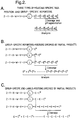
- Fig. 1 General scheme for synthesis of molecules with specific tags.
- Synthesis starts from a linker (L) with at least one site for the addition of groups for synthesising the analyte and one for synthesising the tag.
- the linker may also be attached reversibly to a solid support during synthesis, and may have sites for generating groups such as charged groups which may help in analysis).
- P a and P r are temporary protecting groups for the analyte precursors and the reporters respectively; they will be removable by different treatments.
- P a may be an acid or base labile group such as trityl, F-MOC or t-BOC, and P r a group removable by treatment with fluoride such as a silyl residue.
- Groups U-Z may also have protecting groups which must be stable to the reagents used to remove P a and P r . Coupling chemistries will be different for different analyte types; standard methods are available for oligonucleotide and peptide synthesis.
- each extension of the tag is carried out with a reporter which is specific for both position and type of residue added to the analyte. Capping is not important for this scheme.
- position is defined by the total mass of reporter reached at the stage in synthesis when the residue is added to the analyte. In this case it is important to terminate part of the extension of the tag by capping a portion of the molecules.
- the second and third schemes differ from each other in the way the reporters are added. In the second they are in the extension agents; in the third they are in the caps.
- Fig. 2 Three types of molecule-specific tags.
- the qroup-specific information is contained in the residues used to extend the synthesis.
- the information could be provided using mass isotopes.
- every addition of a CH 2 residue labelled with the isotopes of C and H to P-(CH 2 ) n X adds further sites that can provide different mass to the reporter.
- the masses of the (CH 2 ) n range from 14n to 17n and there are 4 + 3(n-1) different masses in the range.
- the ethylene group there are seven distinct masses in the range 28 to 34, and for the propylene group, ten in the range 42 to 51.
Landscapes
- Chemical & Material Sciences (AREA)
- Life Sciences & Earth Sciences (AREA)
- Organic Chemistry (AREA)
- Health & Medical Sciences (AREA)
- Proteomics, Peptides & Aminoacids (AREA)
- Engineering & Computer Science (AREA)
- Wood Science & Technology (AREA)
- Zoology (AREA)
- Genetics & Genomics (AREA)
- Biochemistry (AREA)
- Biotechnology (AREA)
- Molecular Biology (AREA)
- General Health & Medical Sciences (AREA)
- General Engineering & Computer Science (AREA)
- Bioinformatics & Cheminformatics (AREA)
- Physics & Mathematics (AREA)
- Biophysics (AREA)
- Microbiology (AREA)
- Immunology (AREA)
- Analytical Chemistry (AREA)
- Biomedical Technology (AREA)
- Spectroscopy & Molecular Physics (AREA)
- Crystallography & Structural Chemistry (AREA)
- Bioinformatics & Computational Biology (AREA)
- Plant Pathology (AREA)
- Measuring Or Testing Involving Enzymes Or Micro-Organisms (AREA)
- Investigating Or Analysing Biological Materials (AREA)
- Other Investigation Or Analysis Of Materials By Electrical Means (AREA)
- Automatic Analysis And Handling Materials Therefor (AREA)
- Saccharide Compounds (AREA)
- Pyrrole Compounds (AREA)
Priority Applications (1)
| Application Number | Priority Date | Filing Date | Title |
|---|---|---|---|
| EP96119962A EP0778280B1 (en) | 1993-07-30 | 1994-08-01 | Tag reagent and assay method |
Applications Claiming Priority (3)
| Application Number | Priority Date | Filing Date | Title |
|---|---|---|---|
| GB9315847 | 1993-07-30 | ||
| GB939315847A GB9315847D0 (en) | 1993-07-30 | 1993-07-30 | Tag reagent and assay method |
| PCT/GB1994/001675 WO1995004160A1 (en) | 1993-07-30 | 1994-08-01 | Tag reagent and assay method |
Related Child Applications (2)
| Application Number | Title | Priority Date | Filing Date |
|---|---|---|---|
| EP96119962A Division EP0778280B1 (en) | 1993-07-30 | 1994-08-01 | Tag reagent and assay method |
| EP96119962.7 Division-Into | 1996-12-12 |
Publications (2)
| Publication Number | Publication Date |
|---|---|
| EP0711362A1 EP0711362A1 (en) | 1996-05-15 |
| EP0711362B1 true EP0711362B1 (en) | 1997-10-29 |
Family
ID=10739735
Family Applications (2)
| Application Number | Title | Priority Date | Filing Date |
|---|---|---|---|
| EP94922966A Expired - Lifetime EP0711362B1 (en) | 1993-07-30 | 1994-08-01 | Tag reagent and assay method |
| EP96119962A Expired - Lifetime EP0778280B1 (en) | 1993-07-30 | 1994-08-01 | Tag reagent and assay method |
Family Applications After (1)
| Application Number | Title | Priority Date | Filing Date |
|---|---|---|---|
| EP96119962A Expired - Lifetime EP0778280B1 (en) | 1993-07-30 | 1994-08-01 | Tag reagent and assay method |
Country Status (16)
| Country | Link |
|---|---|
| US (4) | US5770367A (enExample) |
| EP (2) | EP0711362B1 (enExample) |
| JP (1) | JP3289911B2 (enExample) |
| CN (1) | CN1088758C (enExample) |
| AT (2) | ATE159767T1 (enExample) |
| AU (1) | AU695349B2 (enExample) |
| CA (1) | CA2168010C (enExample) |
| DE (2) | DE69406544T2 (enExample) |
| DK (1) | DK0711362T3 (enExample) |
| ES (1) | ES2108479T3 (enExample) |
| FI (1) | FI960403A0 (enExample) |
| GB (1) | GB9315847D0 (enExample) |
| HU (1) | HU220967B1 (enExample) |
| NO (1) | NO960370L (enExample) |
| RU (1) | RU2158310C2 (enExample) |
| WO (1) | WO1995004160A1 (enExample) |
Cited By (3)
| Publication number | Priority date | Publication date | Assignee | Title |
|---|---|---|---|---|
| US6027890A (en) * | 1996-01-23 | 2000-02-22 | Rapigene, Inc. | Methods and compositions for enhancing sensitivity in the analysis of biological-based assays |
| US6312893B1 (en) | 1996-01-23 | 2001-11-06 | Qiagen Genomics, Inc. | Methods and compositions for determining the sequence of nucleic acid molecules |
| US7052846B2 (en) | 1996-01-23 | 2006-05-30 | Operon Biotechnologies, Inc. | Methods and compositions for analyzing nucleic acid molecules utilizing sizing techniques |
Families Citing this family (261)
| Publication number | Priority date | Publication date | Assignee | Title |
|---|---|---|---|---|
| US5800992A (en) | 1989-06-07 | 1998-09-01 | Fodor; Stephen P.A. | Method of detecting nucleic acids |
| EP0834575B1 (en) | 1990-12-06 | 2001-11-28 | Affymetrix, Inc. (a Delaware Corporation) | Identification of nucleic acids in samples |
| US5605798A (en) * | 1993-01-07 | 1997-02-25 | Sequenom, Inc. | DNA diagnostic based on mass spectrometry |
| GB9315847D0 (en) | 1993-07-30 | 1993-09-15 | Isis Innovation | Tag reagent and assay method |
| US6401267B1 (en) | 1993-09-27 | 2002-06-11 | Radoje Drmanac | Methods and compositions for efficient nucleic acid sequencing |
| BR9407712A (pt) * | 1993-09-27 | 1997-02-12 | Arch Dev Corp | Métodos e composiçoes para sequenciamento eficaz de ácidos nuclêicos |
| US6015880A (en) * | 1994-03-16 | 2000-01-18 | California Institute Of Technology | Method and substrate for performing multiple sequential reactions on a matrix |
| US5679773A (en) * | 1995-01-17 | 1997-10-21 | Affymax Technologies N.V | Reagants and methods for immobilized polymer synthesis and display |
| WO1996000378A1 (en) * | 1994-06-23 | 1996-01-04 | Affymax Technologies N.V. | Photolabile compounds and methods for their use |
| US5604097A (en) * | 1994-10-13 | 1997-02-18 | Spectragen, Inc. | Methods for sorting polynucleotides using oligonucleotide tags |
| US6974666B1 (en) * | 1994-10-21 | 2005-12-13 | Appymetric, Inc. | Methods of enzymatic discrimination enhancement and surface-bound double-stranded DNA |
| US5891742A (en) * | 1995-01-19 | 1999-04-06 | Chiron Corporation | Affinity selection of ligands by mass spectroscopy |
| GB9504598D0 (en) | 1995-03-03 | 1995-04-26 | Imp Cancer Res Tech | Method of nucleic acid analysis |
| GB9507238D0 (en) | 1995-04-07 | 1995-05-31 | Isis Innovation | Detecting dna sequence variations |
| US5750341A (en) * | 1995-04-17 | 1998-05-12 | Lynx Therapeutics, Inc. | DNA sequencing by parallel oligonucleotide extensions |
| US5624711A (en) * | 1995-04-27 | 1997-04-29 | Affymax Technologies, N.V. | Derivatization of solid supports and methods for oligomer synthesis |
| US5830655A (en) | 1995-05-22 | 1998-11-03 | Sri International | Oligonucleotide sizing using cleavable primers |
| GB9517661D0 (en) * | 1995-08-30 | 1995-11-01 | Smithkline Beecham Plc | Novel compounds |
| US5780231A (en) * | 1995-11-17 | 1998-07-14 | Lynx Therapeutics, Inc. | DNA extension and analysis with rolling primers |
| US5763175A (en) * | 1995-11-17 | 1998-06-09 | Lynx Therapeutics, Inc. | Simultaneous sequencing of tagged polynucleotides |
| JP2000503845A (ja) * | 1996-01-23 | 2000-04-04 | ラピジーン,インコーポレイテッド | サイジング技術を用いる核酸分子の分析のための方法および組成物 |
| HUP9901321A3 (en) * | 1996-01-23 | 2001-10-29 | Rapigene Inc Bothell | Methods and compositions for determining the sequence of nucleic acid molecules |
| EP0992511B1 (en) | 1996-01-23 | 2009-03-11 | Operon Biotechnologies, Inc. | Methods and compositions for determining the sequence of nucleic acid molecules |
| EP0962464A3 (en) * | 1996-01-23 | 2004-02-11 | Qiagen Genomics, Inc. | Methods and compositions for detecting binding of ligand pair using non-fluorescent label |
| KR100538669B1 (ko) * | 1996-01-23 | 2005-12-26 | 퀴아진 지노믹스, 인코포레이티드 | 리간드 쌍의 결합 검출에 사용되는 화합물, 이를 포함하는조성물 및 키트 |
| CA2248084A1 (en) * | 1996-03-04 | 1997-09-12 | Genetrace Systems, Inc. | Methods of screening nucleic acids using mass spectrometry |
| CA2242171A1 (en) * | 1996-04-08 | 1997-10-16 | Glaxo Group Limited | Mass-based encoding and qualitative analysis of combinatorial libraries |
| CA2255599C (en) | 1996-04-25 | 2006-09-05 | Bioarray Solutions, Llc | Light-controlled electrokinetic assembly of particles near surfaces |
| US5958342A (en) * | 1996-05-17 | 1999-09-28 | Incyte Pharmaceuticals, Inc. | Jet droplet device |
| US5965363A (en) * | 1996-09-19 | 1999-10-12 | Genetrace Systems Inc. | Methods of preparing nucleic acids for mass spectrometric analysis |
| US5777324A (en) * | 1996-09-19 | 1998-07-07 | Sequenom, Inc. | Method and apparatus for maldi analysis |
| US7094609B2 (en) | 1996-09-20 | 2006-08-22 | Burstein Technologies, Inc. | Spatially addressable combinatorial chemical arrays in encoded optical disk format |
| EP1164203B1 (en) | 1996-11-06 | 2007-10-10 | Sequenom, Inc. | DNA Diagnostics based on mass spectrometry |
| DE69735445T2 (de) * | 1996-12-10 | 2006-08-10 | Sequenom, Inc., San Diego | Abspaltbare, nicht-flüchtige moleküle zur massenmarkierung |
| IL130885A (en) * | 1997-01-15 | 2005-05-17 | Xzillion Gmbh & Co Kg | Hybridisation probes comprising a base sequence cleavably linked to a mass label and uses thereof |
| JP2001508308A (ja) * | 1997-01-15 | 2001-06-26 | ブラックス グループ リミテッド | 核酸配列決定 |
| US6699668B1 (en) * | 1997-01-15 | 2004-03-02 | Xzillion Gmbh & Co. | Mass label linked hybridisation probes |
| GB9707980D0 (en) * | 1997-04-21 | 1997-06-11 | Brax Genomics Ltd | Characterising DNA |
| GB9714716D0 (en) | 1997-07-11 | 1997-09-17 | Brax Genomics Ltd | Characterising nucleic acids |
| AU8234898A (en) * | 1997-07-11 | 1999-02-08 | Brax Group Limited | Characterising nucleic acid |
| WO1999002728A1 (en) * | 1997-07-11 | 1999-01-21 | Brax Group Limited | Characterising nucleic acids |
| CN1264319A (zh) | 1997-07-22 | 2000-08-23 | 拉普吉恩公司 | 用于将溶液排列到固体支持物上的装置和方法 |
| CA2298117A1 (en) | 1997-07-22 | 1999-02-04 | Rapigene Inc. | Computer method and system for correlating sequencing data by ms |
| US6248521B1 (en) | 1997-07-22 | 2001-06-19 | Qiagen Genomics, Inc. | Amplification and other enzymatic reactions performed on nucleic acid arrays |
| AU738237B2 (en) * | 1997-07-22 | 2001-09-13 | Qiagen Genomics, Inc. | Methods and compositions for analyzing nucleic acid molecules utilizing sizing techniques |
| GB9718921D0 (en) | 1997-09-05 | 1997-11-12 | Brax Genomics Ltd | Catalytically generated mass labels |
| US6607878B2 (en) * | 1997-10-06 | 2003-08-19 | Stratagene | Collections of uniquely tagged molecules |
| US6101946A (en) * | 1997-11-21 | 2000-08-15 | Telechem International Inc. | Microarray printing device including printing pins with flat tips and exterior channel and method of manufacture |
| CA2312052A1 (en) * | 1997-12-05 | 1999-06-17 | Max-Planck-Gesellschaft Zur Forderung Der Wissenschaften E.V. | Method for identifying nucleic acids by means of matrix-assisted laser desorption/ionisation mass spectrometry |
| EP2241542A1 (en) | 1998-01-05 | 2010-10-20 | Neogenesis, Inc. | Apparatus for producing mass-coded combinatorial libraries |
| US6207861B1 (en) * | 1998-01-05 | 2001-03-27 | Neogenesis, Inc. | Method for producing and screening mass coded combinatorial libraries for drug discovery and target validation |
| EP1728776A3 (en) * | 1998-01-05 | 2006-12-13 | Neogenesis, Inc. | Method for identifying a member of a mass-coded combinatorial library |
| US6265163B1 (en) * | 1998-01-09 | 2001-07-24 | Lynx Therapeutics, Inc. | Solid phase selection of differentially expressed genes |
| US6562567B2 (en) | 1998-01-27 | 2003-05-13 | California Institute Of Technology | Method of detecting a nucleic acid |
| WO1999060007A2 (en) * | 1998-05-15 | 1999-11-25 | Isis Innovation Limited | Libraries of oligomers labelled with different tags |
| US6104028A (en) | 1998-05-29 | 2000-08-15 | Genetrace Systems Inc. | Volatile matrices for matrix-assisted laser desorption/ionization mass spectrometry |
| US6218118B1 (en) * | 1998-07-09 | 2001-04-17 | Agilent Technologies, Inc. | Method and mixture reagents for analyzing the nucleotide sequence of nucleic acids by mass spectrometry |
| US7399844B2 (en) * | 1998-07-09 | 2008-07-15 | Agilent Technologies, Inc. | Method and reagents for analyzing the nucleotide sequence of nucleic acids |
| US5998175A (en) * | 1998-07-24 | 1999-12-07 | Lumigen, Inc. | Methods of synthesizing and amplifying polynucleotides by ligation of multiple oligomers |
| US6232067B1 (en) | 1998-08-17 | 2001-05-15 | The Perkin-Elmer Corporation | Adapter directed expression analysis |
| US20040242521A1 (en) * | 1999-10-25 | 2004-12-02 | Board Of Regents, The University Of Texas System | Thio-siRNA aptamers |
| US6867289B1 (en) * | 1998-10-26 | 2005-03-15 | Board Of Regents, The University Of Texas Systems | Thio-modified aptamer synthetic methods and compositions |
| EP1192274A2 (en) * | 1999-03-25 | 2002-04-03 | Hyseq, Inc. | Solution-based methods and materials for sequence analysis by hybridization |
| WO2000060116A1 (en) * | 1999-04-02 | 2000-10-12 | Tropix, Inc. | High throughput and high sensitivity detection assays |
| US7244559B2 (en) * | 1999-09-16 | 2007-07-17 | 454 Life Sciences Corporation | Method of sequencing a nucleic acid |
| US7211390B2 (en) * | 1999-09-16 | 2007-05-01 | 454 Life Sciences Corporation | Method of sequencing a nucleic acid |
| JP3668075B2 (ja) * | 1999-10-12 | 2005-07-06 | 光夫 板倉 | 遺伝物質シーケンス決定用懸濁系、その懸濁系を用いた遺伝物質シーケンス決定方法およびその懸濁系を用いたSNPs高速スコアリング方法 |
| US7582420B2 (en) | 2001-07-12 | 2009-09-01 | Illumina, Inc. | Multiplex nucleic acid reactions |
| US20040014102A1 (en) * | 2000-02-22 | 2004-01-22 | Shiping Chen | High density parallel printing of microarrays |
| AU6291301A (en) | 2000-02-22 | 2001-09-03 | Genospectra, Inc. | Microarray fabrication techniques and apparatus |
| WO2001062377A2 (en) | 2000-02-22 | 2001-08-30 | Genospectra, Inc. | Microarray fabrication techniques and apparatus |
| GB0006141D0 (en) | 2000-03-14 | 2000-05-03 | Brax Group Ltd | Mass labels |
| DE10021204A1 (de) * | 2000-04-25 | 2001-11-08 | Epigenomics Ag | Verfahren zur hochparallelen Analyse von Polymorphismen |
| WO2001094639A1 (en) * | 2000-06-08 | 2001-12-13 | The Regents Of The University Of California | Address/capture tags for flow-cytometry based minisequencing |
| US6660229B2 (en) | 2000-06-13 | 2003-12-09 | The Trustees Of Boston University | Use of nucleotide analogs in the analysis of oligonucleotide mixtures and in highly multiplexed nucleic acid sequencing |
| CA2413978C (en) | 2000-06-21 | 2008-12-16 | Bioarray Solutions, Ltd. | Multianalyte molecular analysis |
| US9709559B2 (en) | 2000-06-21 | 2017-07-18 | Bioarray Solutions, Ltd. | Multianalyte molecular analysis using application-specific random particle arrays |
| US6680203B2 (en) * | 2000-07-10 | 2004-01-20 | Esperion Therapeutics, Inc. | Fourier transform mass spectrometry of complex biological samples |
| US20060057565A1 (en) * | 2000-09-11 | 2006-03-16 | Jingyue Ju | Combinatorial fluorescence energy transfer tags and uses thereof |
| US6627748B1 (en) | 2000-09-11 | 2003-09-30 | The Trustees Of Columbia University In The City Of New York | Combinatorial fluorescence energy transfer tags and their applications for multiplex genetic analyses |
| US9708358B2 (en) | 2000-10-06 | 2017-07-18 | The Trustees Of Columbia University In The City Of New York | Massive parallel method for decoding DNA and RNA |
| EP1790736A3 (en) * | 2000-10-06 | 2007-08-15 | The Trustees Of Columbia University In The City Of New York | Massive parallel method for decoding DNA and RNA |
| AU2001296718A1 (en) | 2000-10-06 | 2002-04-15 | Novozymes A/S | Methods for monitoring multiple gene expression |
| US7635571B2 (en) * | 2000-12-07 | 2009-12-22 | Siemens Healthcare Diagnostics Products Gmbh | Amplified signal in binding assays |
| RU2195668C2 (ru) * | 2001-02-12 | 2002-12-27 | Мешандин Алексей Гаврилович | Способ постановки реакции агглютинационного иммунологического анализа |
| US7718354B2 (en) * | 2001-03-02 | 2010-05-18 | Ibis Biosciences, Inc. | Methods for rapid identification of pathogens in humans and animals |
| US20030027135A1 (en) | 2001-03-02 | 2003-02-06 | Ecker David J. | Method for rapid detection and identification of bioagents |
| US20040121310A1 (en) * | 2002-12-18 | 2004-06-24 | Ecker David J. | Methods for rapid detection and identification of bioagents in forensic studies |
| US20040121313A1 (en) | 2002-12-06 | 2004-06-24 | Ecker David J. | Methods for rapid detection and identification of bioagents in organs for transplantation |
| US20040121314A1 (en) * | 2002-12-06 | 2004-06-24 | Ecker David J. | Methods for rapid detection and identification of bioagents in containers |
| US7226739B2 (en) | 2001-03-02 | 2007-06-05 | Isis Pharmaceuticals, Inc | Methods for rapid detection and identification of bioagents in epidemiological and forensic investigations |
| US7666588B2 (en) | 2001-03-02 | 2010-02-23 | Ibis Biosciences, Inc. | Methods for rapid forensic analysis of mitochondrial DNA and characterization of mitochondrial DNA heteroplasmy |
| ATE335754T1 (de) * | 2001-03-19 | 2006-09-15 | Harvard College | Entwicklung neuer molekularer funktionen |
| WO2002081752A2 (en) * | 2001-04-03 | 2002-10-17 | Thermo Finnigan Corporation | Methods and kits useful for the simplification of complex peptide mixtures |
| WO2002102820A1 (en) | 2001-06-20 | 2002-12-27 | Nuevolution A/S | Nucleoside derivatives for library preparation |
| US7262063B2 (en) | 2001-06-21 | 2007-08-28 | Bio Array Solutions, Ltd. | Directed assembly of functional heterostructures |
| US7217510B2 (en) | 2001-06-26 | 2007-05-15 | Isis Pharmaceuticals, Inc. | Methods for providing bacterial bioagent characterizing information |
| US8073627B2 (en) | 2001-06-26 | 2011-12-06 | Ibis Biosciences, Inc. | System for indentification of pathogens |
| US6855538B2 (en) * | 2001-06-27 | 2005-02-15 | The Regents Of The University Of California | High-efficiency microarray printing device |
| US7402286B2 (en) * | 2001-06-27 | 2008-07-22 | The Regents Of The University Of California | Capillary pins for high-efficiency microarray printing device |
| WO2003004690A2 (en) * | 2001-07-06 | 2003-01-16 | 454$m(3) CORPORATION | Method for isolation of independent, parallel chemical micro-reactions using a porous filter |
| US20030087309A1 (en) * | 2001-08-27 | 2003-05-08 | Shiping Chen | Desktop drug screening system |
| US10539561B1 (en) | 2001-08-30 | 2020-01-21 | Customarray, Inc. | Enzyme-amplified redox microarray detection process |
| US20030054396A1 (en) * | 2001-09-07 | 2003-03-20 | Weiner Michael P. | Enzymatic light amplification |
| DK1425586T3 (da) * | 2001-09-14 | 2008-02-11 | Electrophoretics Ltd | Massemarkörer |
| US20070264641A1 (en) * | 2001-10-15 | 2007-11-15 | Li Alice X | Multiplexed analysis of polymorphic loci by concurrent interrogation and enzyme-mediated detection |
| ES2661167T3 (es) * | 2001-10-15 | 2018-03-27 | Bioarray Solutions Ltd. | Análisis multiplexado de loci polimórficos mediante consulta simultánea y detección mediada por enzimas |
| US6956114B2 (en) | 2001-10-30 | 2005-10-18 | '454 Corporation | Sulfurylase-luciferase fusion proteins and thermostable sulfurylase |
| US20050124022A1 (en) * | 2001-10-30 | 2005-06-09 | Maithreyan Srinivasan | Novel sulfurylase-luciferase fusion proteins and thermostable sulfurylase |
| US6902921B2 (en) | 2001-10-30 | 2005-06-07 | 454 Corporation | Sulfurylase-luciferase fusion proteins and thermostable sulfurylase |
| WO2003042697A1 (en) * | 2001-11-14 | 2003-05-22 | Genospectra, Inc. | Biochemical analysis system with combinatorial chemistry applications |
| US7057026B2 (en) * | 2001-12-04 | 2006-06-06 | Solexa Limited | Labelled nucleotides |
| GB0129012D0 (en) | 2001-12-04 | 2002-01-23 | Solexa Ltd | Labelled nucleotides |
| GB0131014D0 (en) | 2001-12-28 | 2002-02-13 | James Peter | Method for molecule-mlecule analysis |
| US10731151B2 (en) | 2002-03-15 | 2020-08-04 | Nuevolution A/S | Method for synthesising templated molecules |
| AU2003214031A1 (en) | 2002-03-15 | 2003-09-29 | Nuevolution A/S | An improved method for synthesising templated molecules |
| US8383342B2 (en) | 2002-04-24 | 2013-02-26 | The University Of North Carolina At Greensboro | Compositions, products, methods and systems to monitor water and other ecosystems |
| US8048623B1 (en) | 2002-04-24 | 2011-11-01 | The University Of North Carolina At Greensboro | Compositions, products, methods and systems to monitor water and other ecosystems |
| US9126165B1 (en) | 2002-04-24 | 2015-09-08 | The University Of North Carolina At Greensboro | Nucleic acid arrays to monitor water and other ecosystems |
| US7214492B1 (en) | 2002-04-24 | 2007-05-08 | The University Of North Carolina At Greensboro | Nucleic acid arrays to monitor water and other ecosystems |
| GB0210535D0 (en) * | 2002-05-08 | 2002-06-19 | Novartis Ag | Organic compounds |
| EP1520040A2 (en) * | 2002-06-20 | 2005-04-06 | Nuevolution A/S | Microarrays displaying encoded molecules |
| US7074597B2 (en) * | 2002-07-12 | 2006-07-11 | The Trustees Of Columbia University In The City Of New York | Multiplex genotyping using solid phase capturable dideoxynucleotides and mass spectrometry |
| WO2004013070A2 (en) | 2002-08-01 | 2004-02-12 | Nuevolution A/S | Multi-step synthesis of templated molecules |
| JP4657919B2 (ja) * | 2002-08-19 | 2011-03-23 | プレジデント アンド フェローズ オブ ハーバード カレッジ | 進化する新しい分子機能 |
| US7414116B2 (en) | 2002-08-23 | 2008-08-19 | Illumina Cambridge Limited | Labelled nucleotides |
| US11008359B2 (en) | 2002-08-23 | 2021-05-18 | Illumina Cambridge Limited | Labelled nucleotides |
| EP1530578B1 (en) | 2002-08-23 | 2013-03-13 | Illumina Cambridge Limited | Modified nucleotides for polynucleotide sequencing |
| EP1572978A4 (en) * | 2002-10-16 | 2006-05-24 | Univ Texas | BEAD-BOUND COMBINATORY OLIGONUCLEOSIDE-PHOSPHOROTHIOAT AND PHOSPHORODITHIOAT-APTAMIBLE BIBLIOTEKEN |
| CN106337046B (zh) | 2002-10-30 | 2021-03-23 | 纽韦卢森公司 | 合成双功能复合物的方法 |
| US20040091850A1 (en) * | 2002-11-08 | 2004-05-13 | Travis Boone | Single cell analysis of membrane molecules |
| US7526114B2 (en) | 2002-11-15 | 2009-04-28 | Bioarray Solutions Ltd. | Analysis, secure access to, and transmission of array images |
| EP1578399A4 (en) | 2002-12-06 | 2007-11-28 | Isis Pharmaceuticals Inc | Methods for rapid identification of pathogens in humans and animals |
| WO2004055160A2 (en) * | 2002-12-13 | 2004-07-01 | The Trustees Of Columbia University In The City Of New York | Biomolecular coupling methods using 1,3-dipolar cycloaddition chemistry |
| EP2175019A3 (en) | 2002-12-19 | 2011-04-06 | Nuevolution A/S | Quasirandom structure and function guided synthesis methods |
| JP4768598B2 (ja) * | 2003-01-29 | 2011-09-07 | 454 ライフ サイエンシズ コーポレーション | ビーズエマルジョン核酸増幅 |
| US7575865B2 (en) * | 2003-01-29 | 2009-08-18 | 454 Life Sciences Corporation | Methods of amplifying and sequencing nucleic acids |
| JP2004235111A (ja) * | 2003-01-31 | 2004-08-19 | Ebara Corp | イオン伝導体及びその製造方法 |
| WO2004074429A2 (en) | 2003-02-21 | 2004-09-02 | Nuevolution A/S | Method for producing second-generation library |
| DE602004019764D1 (de) | 2003-03-20 | 2009-04-16 | Nuevolution As | Ligationsvermittelnde codierung von kleinen molekülen |
| GB0306756D0 (en) * | 2003-03-24 | 2003-04-30 | Xzillion Gmbh & Co Kg | Mass labels |
| US8017323B2 (en) * | 2003-03-26 | 2011-09-13 | President And Fellows Of Harvard College | Free reactant use in nucleic acid-templated synthesis |
| US20050233390A1 (en) * | 2003-04-09 | 2005-10-20 | Allen John W | Device including a proteinaceous factor, a recombinant proteinaceous factor, and a nucleotide sequence encoding the proteinaceous factor |
| US8046171B2 (en) | 2003-04-18 | 2011-10-25 | Ibis Biosciences, Inc. | Methods and apparatus for genetic evaluation |
| US8057993B2 (en) | 2003-04-26 | 2011-11-15 | Ibis Biosciences, Inc. | Methods for identification of coronaviruses |
| EP1623020A4 (en) * | 2003-05-09 | 2007-05-09 | Sigma Aldrich Co | GENOMIC AND PROTEOMIC APPROACHES FOR THE DEVELOPMENT OF A CELLULAR MEDIUM |
| US8158354B2 (en) | 2003-05-13 | 2012-04-17 | Ibis Biosciences, Inc. | Methods for rapid purification of nucleic acids for subsequent analysis by mass spectrometry by solution capture |
| US7964343B2 (en) | 2003-05-13 | 2011-06-21 | Ibis Biosciences, Inc. | Method for rapid purification of nucleic acids for subsequent analysis by mass spectrometry by solution capture |
| CA2526691A1 (en) * | 2003-05-23 | 2005-04-28 | Board Of Regents - The University Of Texas System | High throughput screening of aptamer libraries for specific binding to proteins on viruses and other pathogens |
| US7910523B2 (en) * | 2003-05-23 | 2011-03-22 | Board Of Regents, The University Of Texas System | Structure based and combinatorially selected oligonucleoside phosphorothioate and phosphorodithioate aptamer targeting AP-1 transcription factors |
| WO2005003778A2 (en) * | 2003-07-02 | 2005-01-13 | Nuevolution A/S | A method for identifying a synthetic molecule having affinity towards a target |
| US20050118611A1 (en) * | 2003-07-24 | 2005-06-02 | Board Of Regents, The University Of Texas System | Thioaptamers enable discovery of physiological pathways and new therapeutic strategies |
| GB0320059D0 (en) * | 2003-08-27 | 2003-10-01 | Solexa Ltd | A method of sequencing |
| US7198900B2 (en) * | 2003-08-29 | 2007-04-03 | Applera Corporation | Multiplex detection compositions, methods, and kits |
| US20050069895A1 (en) * | 2003-08-29 | 2005-03-31 | Applera Corporation | Compositions, methods, and kits for fabricating coded molecular tags |
| US20050048498A1 (en) * | 2003-08-29 | 2005-03-03 | Applera Corporation | Compositions, methods, and kits for assembling probes |
| US8288523B2 (en) | 2003-09-11 | 2012-10-16 | Ibis Biosciences, Inc. | Compositions for use in identification of bacteria |
| US8546082B2 (en) | 2003-09-11 | 2013-10-01 | Ibis Biosciences, Inc. | Methods for identification of sepsis-causing bacteria |
| US8097416B2 (en) | 2003-09-11 | 2012-01-17 | Ibis Biosciences, Inc. | Methods for identification of sepsis-causing bacteria |
| US11118215B2 (en) | 2003-09-18 | 2021-09-14 | Nuevolution A/S | Method for obtaining structural information concerning an encoded molecule and method for selecting compounds |
| US7927796B2 (en) | 2003-09-18 | 2011-04-19 | Bioarray Solutions, Ltd. | Number coding for identification of subtypes of coded types of solid phase carriers |
| PT1664722E (pt) | 2003-09-22 | 2011-12-28 | Bioarray Solutions Ltd | Polielectrólito imobilizado à superfície com grupos funcionais múltiplos capazes de se ligarem covalentemente às biomoléculas |
| JP2007521017A (ja) | 2003-10-28 | 2007-08-02 | バイオアレイ ソリューションズ リミテッド | 固定化捕捉プローブを用いる遺伝子発現分析法の最適化 |
| AU2004287069B2 (en) | 2003-10-29 | 2009-07-16 | Bioarray Solutions, Ltd. | Multiplexed nucleic acid analysis by fragmentation of double-stranded DNA |
| WO2005042716A2 (en) * | 2003-10-31 | 2005-05-12 | President And Fellows Of Harvard College | Nucleic acid binding oligonucleotides |
| KR101300315B1 (ko) * | 2003-12-17 | 2013-08-28 | 프래시스 파마슈티컬즈 인코포레이티드 | 코드된 라이브러리의 합성 방법 |
| EP2216640A1 (en) | 2004-01-09 | 2010-08-11 | Novozymes, Inc. | Bacillus licheniformis chromosome |
| US7666592B2 (en) | 2004-02-18 | 2010-02-23 | Ibis Biosciences, Inc. | Methods for concurrent identification and quantification of an unknown bioagent |
| US8119336B2 (en) | 2004-03-03 | 2012-02-21 | Ibis Biosciences, Inc. | Compositions for use in identification of alphaviruses |
| CA2557818A1 (en) * | 2004-03-03 | 2005-09-15 | The Trustees Of Columbia University In The City Of New York | Photocleavable fluorescent nucleotides for dna sequencing on chip constructed by site-specific coupling chemistry |
| WO2005090566A2 (en) | 2004-03-22 | 2005-09-29 | Nuevolution A/S | Ligational encoding using building block oligonucleotides |
| US20050239134A1 (en) * | 2004-04-21 | 2005-10-27 | Board Of Regents, The University Of Texas System | Combinatorial selection of phosphorothioate single-stranded DNA aptamers for TGF-beta-1 protein |
| WO2006073436A2 (en) * | 2004-04-29 | 2006-07-13 | The Trustees Of Columbia University In The City Of New York | Mass tag pcr for multiplex diagnostics |
| JP4810533B2 (ja) | 2004-05-24 | 2011-11-09 | アイビス バイオサイエンシズ インコーポレイティッド | ディジタルスレショルド化による選択的イオン濾過作用を用いた質量分光測定法 |
| US20050266411A1 (en) | 2004-05-25 | 2005-12-01 | Hofstadler Steven A | Methods for rapid forensic analysis of mitochondrial DNA |
| US7811753B2 (en) | 2004-07-14 | 2010-10-12 | Ibis Biosciences, Inc. | Methods for repairing degraded DNA |
| EP2299275B1 (en) | 2004-07-30 | 2018-03-07 | Adeza Biomedical Corporation | Classification of the oncofetal fibronection level for pregnancy-related indications |
| US7848889B2 (en) | 2004-08-02 | 2010-12-07 | Bioarray Solutions, Ltd. | Automated analysis of multiplexed probe-target interaction patterns: pattern matching and allele identification |
| WO2006135400A2 (en) | 2004-08-24 | 2006-12-21 | Isis Pharmaceuticals, Inc. | Methods for rapid identification of recombinant organisms |
| US20060102471A1 (en) | 2004-11-18 | 2006-05-18 | Karl Maurer | Electrode array device having an adsorbed porous reaction layer |
| EP2230316A1 (en) | 2005-02-01 | 2010-09-22 | AB Advanced Genetic Analysis Corporation | Nucleic acid sequencing by performing successive cycles of duplex extension |
| US8084207B2 (en) | 2005-03-03 | 2011-12-27 | Ibis Bioscience, Inc. | Compositions for use in identification of papillomavirus |
| US8182992B2 (en) | 2005-03-03 | 2012-05-22 | Ibis Biosciences, Inc. | Compositions for use in identification of adventitious viruses |
| US20070034513A1 (en) | 2005-03-25 | 2007-02-15 | Combimatrix Corporation | Electrochemical deblocking solution for electrochemical oligomer synthesis on an electrode array |
| US9394167B2 (en) | 2005-04-15 | 2016-07-19 | Customarray, Inc. | Neutralization and containment of redox species produced by circumferential electrodes |
| US8486629B2 (en) | 2005-06-01 | 2013-07-16 | Bioarray Solutions, Ltd. | Creation of functionalized microparticle libraries by oligonucleotide ligation or elongation |
| EP1889047B1 (en) | 2005-06-07 | 2011-08-10 | Centre National De La Recherche Scientifique -Cnrs- | Use of conjugates with linkers cleavable by photodissociation or fragmentation for mass spectrometry analysis of tissue sections |
| US9169510B2 (en) * | 2005-06-21 | 2015-10-27 | The Trustees Of Columbia University In The City Of New York | Pyrosequencing methods and related compositions |
| AU2006272776B2 (en) | 2005-07-21 | 2012-01-19 | Ibis Biosciences, Inc. | Methods for rapid identification and quantitation of nucleic acid variants |
| GB0515323D0 (en) | 2005-07-26 | 2005-08-31 | Electrophoretics Ltd | Mass labels |
| GB0517097D0 (en) * | 2005-08-19 | 2005-09-28 | Solexa Ltd | Modified nucleosides and nucleotides and uses thereof |
| GB0518585D0 (en) | 2005-09-12 | 2005-10-19 | Electrophoretics Ltd | Mass labels |
| US20070065877A1 (en) | 2005-09-19 | 2007-03-22 | Combimatrix Corporation | Microarray having a base cleavable succinate linker |
| US8855955B2 (en) * | 2005-09-29 | 2014-10-07 | Custom Array, Inc. | Process and apparatus for measuring binding events on a microarray of electrodes |
| WO2007061981A2 (en) * | 2005-11-21 | 2007-05-31 | Lumera Corporation | Surface plasmon resonance spectrometer with an actuator-driven angle scanning mechanism |
| EP1957983A4 (en) * | 2005-11-21 | 2010-03-24 | Univ Columbia | DIGITAL MULTIPLEX IMMUNE PRESENCE USING A LIBRARY OF PHOTOSPARABLE MASS DAYS |
| DK3305900T3 (da) | 2005-12-01 | 2021-10-25 | Nuevolution As | Enzymatic encoding methods for efficient synthesis of large libraries |
| US7463358B2 (en) * | 2005-12-06 | 2008-12-09 | Lumera Corporation | Highly stable surface plasmon resonance plates, microarrays, and methods |
| EP3561071B1 (en) | 2006-02-13 | 2020-12-16 | Fluidigm Canada Inc. | Gene expression assays conducted by elemental analysis |
| EP2007907A2 (en) * | 2006-04-19 | 2008-12-31 | Applera Corporation | Reagents, methods, and libraries for gel-free bead-based sequencing |
| WO2007146158A1 (en) * | 2006-06-07 | 2007-12-21 | The Trustees Of Columbia University In The City Of New York | Dna sequencing by nanopore using modified nucleotides |
| JP5420412B2 (ja) | 2006-09-14 | 2014-02-19 | アイビス バイオサイエンシズ インコーポレイティッド | 病原体の同定のための標的全ゲノム増幅方法 |
| US8399188B2 (en) | 2006-09-28 | 2013-03-19 | Illumina, Inc. | Compositions and methods for nucleotide sequencing |
| EP2099818A2 (en) | 2006-11-29 | 2009-09-16 | Novozymes Inc. | Bacillus licheniformis chromosome |
| WO2008069973A2 (en) | 2006-12-01 | 2008-06-12 | The Trustees Of Columbia University In The City Of New York | Four-color dna sequencing by synthesis using cleavable fluorescent nucleotide reversible terminators |
| US8133701B2 (en) * | 2006-12-05 | 2012-03-13 | Sequenom, Inc. | Detection and quantification of biomolecules using mass spectrometry |
| US7897737B2 (en) * | 2006-12-05 | 2011-03-01 | Lasergen, Inc. | 3′-OH unblocked, nucleotides and nucleosides, base modified with photocleavable, terminating groups and methods for their use in DNA sequencing |
| US7893227B2 (en) * | 2006-12-05 | 2011-02-22 | Lasergen, Inc. | 3′-OH unblocked nucleotides and nucleosides base modified with non-cleavable, terminating groups and methods for their use in DNA sequencing |
| US7902345B2 (en) * | 2006-12-05 | 2011-03-08 | Sequenom, Inc. | Detection and quantification of biomolecules using mass spectrometry |
| WO2008104002A2 (en) | 2007-02-23 | 2008-08-28 | Ibis Biosciences, Inc. | Methods for rapid forensic dna analysis |
| GB0704764D0 (en) | 2007-03-12 | 2007-04-18 | Electrophoretics Ltd | Isobarically labelled reagents and methods of their use |
| WO2008151023A2 (en) | 2007-06-01 | 2008-12-11 | Ibis Biosciences, Inc. | Methods and compositions for multiple displacement amplification of nucleic acids |
| US20090060786A1 (en) * | 2007-08-29 | 2009-03-05 | Gibum Kim | Microfluidic apparatus for wide area microarrays |
| EP2195452B1 (en) | 2007-08-29 | 2012-03-14 | Sequenom, Inc. | Methods and compositions for universal size-specific polymerase chain reaction |
| EP2207900B1 (en) | 2007-10-19 | 2015-04-29 | The Trustees of Columbia University in the City of New York | Design and synthesis of cleavable fluorescent nucleotides as reversible terminators for dna sequencing by synthesis |
| EP3431615A3 (en) | 2007-10-19 | 2019-02-20 | The Trustees of Columbia University in the City of New York | Dna sequencing with non-fluorescent nucleotide reversible terminators cleavable label modified nucleotide terminators |
| GB0809488D0 (en) | 2008-05-23 | 2008-07-02 | Electrophoretics Ltd | Mass spectrometric analysis |
| KR101677772B1 (ko) | 2008-06-11 | 2016-11-18 | 레이저젠, 인코퍼레이티드 | 뉴클레오타이드 및 뉴클레오사이드 그리고 시퀀싱에서의 이들의 이용 방법 |
| WO2010033625A1 (en) | 2008-09-16 | 2010-03-25 | Ibis Biosciences, Inc. | Microplate handling systems and related computer program products and methods |
| EP2349549B1 (en) | 2008-09-16 | 2012-07-18 | Ibis Biosciences, Inc. | Mixing cartridges, mixing stations, and related kits, and system |
| EP2347254A2 (en) | 2008-09-16 | 2011-07-27 | Ibis Biosciences, Inc. | Sample processing units, systems, and related methods |
| WO2010093943A1 (en) | 2009-02-12 | 2010-08-19 | Ibis Biosciences, Inc. | Ionization probe assemblies |
| DK3211126T3 (da) | 2009-02-13 | 2020-12-21 | X Chem Inc | Fremgangsmåder til dannelse og screening af dna-kodede biblioteker |
| WO2010107946A2 (en) * | 2009-03-18 | 2010-09-23 | Sequenom, Inc. | Use of thermostable endonucleases for generating reporter molecules |
| WO2011008971A1 (en) | 2009-07-17 | 2011-01-20 | Ibis Biosciences, Inc. | Lift and mount apparatus |
| WO2011008972A1 (en) | 2009-07-17 | 2011-01-20 | Ibis Biosciences, Inc. | Systems for bioagent identification |
| US10174368B2 (en) * | 2009-09-10 | 2019-01-08 | Centrillion Technology Holdings Corporation | Methods and systems for sequencing long nucleic acids |
| US10072287B2 (en) * | 2009-09-10 | 2018-09-11 | Centrillion Technology Holdings Corporation | Methods of targeted sequencing |
| EP2957641B1 (en) | 2009-10-15 | 2017-05-17 | Ibis Biosciences, Inc. | Multiple displacement amplification |
| US9927434B2 (en) | 2010-01-20 | 2018-03-27 | Customarray, Inc. | Multiplex microarray of serially deposited biomolecules on a microarray |
| US20110192723A1 (en) * | 2010-02-08 | 2011-08-11 | Genia Technologies, Inc. | Systems and methods for manipulating a molecule in a nanopore |
| US9605307B2 (en) * | 2010-02-08 | 2017-03-28 | Genia Technologies, Inc. | Systems and methods for forming a nanopore in a lipid bilayer |
| US9678055B2 (en) | 2010-02-08 | 2017-06-13 | Genia Technologies, Inc. | Methods for forming a nanopore in a lipid bilayer |
| US8324914B2 (en) | 2010-02-08 | 2012-12-04 | Genia Technologies, Inc. | Systems and methods for characterizing a molecule |
| ES2713873T3 (es) | 2010-04-16 | 2019-05-24 | Nuevolution As | Complejos bifuncionales y métodos para hacer y utilizar tales complejos |
| DK2588144T3 (en) | 2010-07-02 | 2018-07-23 | Ventana Med Syst Inc | Detection of targets using mass markers and mass spectrometry |
| CN103282518B (zh) | 2010-12-17 | 2016-11-16 | 纽约哥伦比亚大学理事会 | 使用经修饰的核苷酸和纳米孔检测的dna边合成边测序 |
| US8845880B2 (en) | 2010-12-22 | 2014-09-30 | Genia Technologies, Inc. | Nanopore-based single DNA molecule characterization, identification and isolation using speed bumps |
| US9581563B2 (en) | 2011-01-24 | 2017-02-28 | Genia Technologies, Inc. | System for communicating information from an array of sensors |
| US9110478B2 (en) | 2011-01-27 | 2015-08-18 | Genia Technologies, Inc. | Temperature regulation of measurement arrays |
| WO2012162429A2 (en) | 2011-05-23 | 2012-11-29 | The Trustees Of Columbia University In The City Of New York | Dna sequencing by synthesis using raman and infrared spectroscopy detection |
| CA2848023C (en) | 2011-09-07 | 2022-03-15 | X-Chem, Inc. | Methods for tagging dna-encoded libraries |
| JP6196972B2 (ja) | 2011-09-13 | 2017-09-13 | レーザーゲン インコーポレイテッド | 5−メトキシ3’−oh非遮断高速光開裂性末端ヌクレオチドおよび核酸配列決定のための方法 |
| US8986629B2 (en) | 2012-02-27 | 2015-03-24 | Genia Technologies, Inc. | Sensor circuit for controlling, detecting, and measuring a molecular complex |
| CN104379761B (zh) | 2012-04-09 | 2017-03-01 | 纽约哥伦比亚大学理事会 | 纳米孔的制备方法和其用途 |
| JP2015525077A (ja) | 2012-06-15 | 2015-09-03 | ジェニア・テクノロジーズ・インコーポレイテッド | チップの構成および高精度な核酸配列決定 |
| US20150119259A1 (en) | 2012-06-20 | 2015-04-30 | Jingyue Ju | Nucleic acid sequencing by nanopore detection of tag molecules |
| JP6426604B2 (ja) | 2012-07-13 | 2018-11-21 | エックス−ケム インコーポレイテッド | ポリメラーゼによって読み取れないコードオリゴヌクレオチドリンケージを有するdnaコード化ライブラリー |
| US9605309B2 (en) | 2012-11-09 | 2017-03-28 | Genia Technologies, Inc. | Nucleic acid sequencing using tags |
| US9759711B2 (en) | 2013-02-05 | 2017-09-12 | Genia Technologies, Inc. | Nanopore arrays |
| CN105102627B (zh) | 2013-03-15 | 2018-10-19 | 纽约哥伦比亚大学理事会 | 用于检测样品中多种预定化合物的方法 |
| WO2014144883A1 (en) | 2013-03-15 | 2014-09-18 | The Trustees Of Columbia University In The City Of New York | Raman cluster tagged molecules for biological imaging |
| CA2903095C (en) | 2013-03-15 | 2018-02-13 | Xiaohai Liu | Modified nucleosides or nucleotides |
| US9551697B2 (en) | 2013-10-17 | 2017-01-24 | Genia Technologies, Inc. | Non-faradaic, capacitively coupled measurement in a nanopore cell array |
| EP3640349A3 (en) | 2013-10-23 | 2020-07-29 | Roche Sequencing Solutions, Inc. | High speed molecular sensing with nanopores |
| US9567630B2 (en) | 2013-10-23 | 2017-02-14 | Genia Technologies, Inc. | Methods for forming lipid bilayers on biochips |
| US10240195B2 (en) | 2014-03-24 | 2019-03-26 | The Trustees Of Columbia University In The City Of New York | Chemical methods for producing tagged nucleotides |
| CN105131035B (zh) * | 2015-08-05 | 2017-03-22 | 延边大学 | 氨基官能团化合物及糖链标记带正电荷质谱衍生化试剂 |
| JP6657721B2 (ja) | 2015-09-30 | 2020-03-04 | ソニー株式会社 | 細胞の分析方法、細胞分析用チップ、細胞分析用試薬、細胞分析用キット及び細胞分析用装置 |
| KR102873902B1 (ko) * | 2024-04-03 | 2025-10-20 | 건국대학교 산학협력단 | 질량 변환이 용이한 광분해성 질량 태그 물질 및 이를 이용한 분자진단 방법 |
| EP4667939A1 (en) | 2024-06-21 | 2025-12-24 | Commissariat à l'Energie Atomique et aux Energies Alternatives | Multiplex cancer cell profiling using ms-tagged probes containing an iminosydnone cleavable linker |
Family Cites Families (10)
| Publication number | Priority date | Publication date | Assignee | Title |
|---|---|---|---|---|
| US5258506A (en) * | 1984-10-16 | 1993-11-02 | Chiron Corporation | Photolabile reagents for incorporation into oligonucleotide chains |
| IL86164A0 (en) * | 1987-04-28 | 1988-11-15 | Tamir Biotechnology Ltd | Improved dna probes |
| GB8810400D0 (en) | 1988-05-03 | 1988-06-08 | Southern E | Analysing polynucleotide sequences |
| US5003059A (en) * | 1988-06-20 | 1991-03-26 | Genomyx, Inc. | Determining DNA sequences by mass spectrometry |
| GB8822228D0 (en) | 1988-09-21 | 1988-10-26 | Southern E M | Support-bound oligonucleotides |
| DE473984T1 (de) * | 1990-09-07 | 1992-08-13 | The Board Of Governors Of Wayne State University, Detroit, Mich. | 1,2-dioxetan-verbindungen als chemilumineszierende markierungen fuer organische und biologische molekuele. |
| WO1993005183A1 (en) * | 1991-09-09 | 1993-03-18 | Baylor College Of Medicine | Method and device for rapid dna or rna sequencing determination by a base addition sequencing scheme |
| DE69217497T2 (de) | 1991-09-18 | 1997-06-12 | Affymax Tech Nv | Verfahren zur synthese der verschiedenen sammlungen von oligomeren |
| GB9315847D0 (en) | 1993-07-30 | 1993-09-15 | Isis Innovation | Tag reagent and assay method |
| WO2002092128A1 (en) | 2001-05-11 | 2002-11-21 | Genzyme Corporation | Compositions and methods to regulate serum phosphate |
-
1993
- 1993-07-30 GB GB939315847A patent/GB9315847D0/en not_active Ceased
-
1994
- 1994-08-01 CA CA002168010A patent/CA2168010C/en not_active Expired - Fee Related
- 1994-08-01 DK DK94922966.0T patent/DK0711362T3/da active
- 1994-08-01 AU AU72691/94A patent/AU695349B2/en not_active Ceased
- 1994-08-01 AT AT94922966T patent/ATE159767T1/de not_active IP Right Cessation
- 1994-08-01 ES ES94922966T patent/ES2108479T3/es not_active Expired - Lifetime
- 1994-08-01 HU HU9600027A patent/HU220967B1/hu not_active IP Right Cessation
- 1994-08-01 DE DE69406544T patent/DE69406544T2/de not_active Expired - Lifetime
- 1994-08-01 CN CN94193442A patent/CN1088758C/zh not_active Expired - Fee Related
- 1994-08-01 JP JP50568795A patent/JP3289911B2/ja not_active Expired - Fee Related
- 1994-08-01 US US08/586,875 patent/US5770367A/en not_active Expired - Fee Related
- 1994-08-01 RU RU96103646/13A patent/RU2158310C2/ru not_active IP Right Cessation
- 1994-08-01 WO PCT/GB1994/001675 patent/WO1995004160A1/en not_active Ceased
- 1994-08-01 EP EP94922966A patent/EP0711362B1/en not_active Expired - Lifetime
- 1994-08-01 AT AT96119962T patent/ATE230409T1/de not_active IP Right Cessation
- 1994-08-01 EP EP96119962A patent/EP0778280B1/en not_active Expired - Lifetime
- 1994-08-01 DE DE69431967T patent/DE69431967D1/de not_active Expired - Lifetime
-
1996
- 1996-01-29 NO NO960370A patent/NO960370L/no unknown
- 1996-01-29 FI FI960403A patent/FI960403A0/fi not_active IP Right Cessation
-
1997
- 1997-12-10 US US08/988,384 patent/US6218111B1/en not_active Expired - Fee Related
-
2001
- 2001-03-19 US US09/810,162 patent/US20010031472A1/en not_active Abandoned
- 2001-12-06 US US10/003,830 patent/US6576426B2/en not_active Expired - Fee Related
Cited By (6)
| Publication number | Priority date | Publication date | Assignee | Title |
|---|---|---|---|---|
| US6027890A (en) * | 1996-01-23 | 2000-02-22 | Rapigene, Inc. | Methods and compositions for enhancing sensitivity in the analysis of biological-based assays |
| US6312893B1 (en) | 1996-01-23 | 2001-11-06 | Qiagen Genomics, Inc. | Methods and compositions for determining the sequence of nucleic acid molecules |
| US6815212B2 (en) | 1996-01-23 | 2004-11-09 | Qiagen Genomics, Inc. | Methods and compositions for enhancing sensitivity in the analysis of biological-based assays |
| US7052846B2 (en) | 1996-01-23 | 2006-05-30 | Operon Biotechnologies, Inc. | Methods and compositions for analyzing nucleic acid molecules utilizing sizing techniques |
| US7247434B2 (en) | 1996-01-23 | 2007-07-24 | Operon Biotechnologies, Inc. | Methods and compositions for determining the sequence of nucleic acid molecules |
| US7642344B2 (en) | 1996-01-23 | 2010-01-05 | Operon Biotechnologies, Inc. | Methods and compositions for determining the sequence of nucleic acid molecules |
Also Published As
| Publication number | Publication date |
|---|---|
| CA2168010A1 (en) | 1995-02-09 |
| WO1995004160A1 (en) | 1995-02-09 |
| US20010031472A1 (en) | 2001-10-18 |
| US5770367A (en) | 1998-06-23 |
| US20020115091A1 (en) | 2002-08-22 |
| EP0711362A1 (en) | 1996-05-15 |
| GB9315847D0 (en) | 1993-09-15 |
| FI960403A7 (fi) | 1996-01-29 |
| ATE230409T1 (de) | 2003-01-15 |
| DK0711362T3 (da) | 1997-12-22 |
| US6576426B2 (en) | 2003-06-10 |
| JP3289911B2 (ja) | 2002-06-10 |
| ES2108479T3 (es) | 1997-12-16 |
| EP0778280B1 (en) | 2003-01-02 |
| NO960370D0 (no) | 1996-01-29 |
| US6218111B1 (en) | 2001-04-17 |
| HU220967B1 (hu) | 2002-07-29 |
| EP0778280A3 (en) | 1999-01-27 |
| DE69431967D1 (de) | 2003-02-06 |
| AU695349B2 (en) | 1998-08-13 |
| HUT73802A (en) | 1996-09-30 |
| AU7269194A (en) | 1995-02-28 |
| NO960370L (no) | 1996-03-28 |
| ATE159767T1 (de) | 1997-11-15 |
| HU9600027D0 (en) | 1996-03-28 |
| FI960403A0 (fi) | 1996-01-29 |
| RU2158310C2 (ru) | 2000-10-27 |
| CA2168010C (en) | 2002-10-01 |
| DE69406544T2 (de) | 1998-02-26 |
| CN1131440A (zh) | 1996-09-18 |
| JPH09501830A (ja) | 1997-02-25 |
| DE69406544D1 (de) | 1997-12-04 |
| EP0778280A2 (en) | 1997-06-11 |
| CN1088758C (zh) | 2002-08-07 |
Similar Documents
| Publication | Publication Date | Title |
|---|---|---|
| EP0778280B1 (en) | Tag reagent and assay method | |
| US6780981B1 (en) | Libraries of oligomers labeled with different tags | |
| US7553958B2 (en) | Linkers and co-coupling agents for optimization of oligonucleotide synthesis and purification on solid supports | |
| AU746737B2 (en) | Compositions and methods for immobilizing nucleic acids to solid supports | |
| Gupta et al. | A general method for the synthesis of 3′-sulfhydryl and phosphate group containing oligonucleotides | |
| US5258506A (en) | Photolabile reagents for incorporation into oligonucleotide chains | |
| WO1997037041A9 (en) | Dna sequencing by mass spectrometry | |
| US20030028012A1 (en) | Polynucleotide synthesis | |
| EP0198207A1 (en) | Specific iodination of nucleic acid | |
| US20030195351A1 (en) | Methods for the integrated synthesis and purification of oligonucleotides | |
| AU2002300406B9 (en) | Compositions and Methods for Immobilizing Nucleic Acids to Solid Supports | |
| HK1020197B (en) | Compositions and methods for immobilizing nucleic acids to solid supports | |
| Narayanaswami | Development of oligonucleotide arrays and characterization of array surfaces using laser based mass spectrometry | |
| AU2002300406A1 (en) | Compositions and Methods for Immobilizing Nucleic Acids to Solid Supports | |
| AU2005203605A1 (en) | Compositions and methods for immobilizing nucleic acids to solid supports |
Legal Events
| Date | Code | Title | Description |
|---|---|---|---|
| PUAI | Public reference made under article 153(3) epc to a published international application that has entered the european phase |
Free format text: ORIGINAL CODE: 0009012 |
|
| 17P | Request for examination filed |
Effective date: 19960119 |
|
| AK | Designated contracting states |
Kind code of ref document: A1 Designated state(s): AT BE CH DE DK ES FR GB IT LI NL SE |
|
| GRAG | Despatch of communication of intention to grant |
Free format text: ORIGINAL CODE: EPIDOS AGRA |
|
| 17Q | First examination report despatched |
Effective date: 19960813 |
|
| GRAH | Despatch of communication of intention to grant a patent |
Free format text: ORIGINAL CODE: EPIDOS IGRA |
|
| GRAH | Despatch of communication of intention to grant a patent |
Free format text: ORIGINAL CODE: EPIDOS IGRA |
|
| GRAA | (expected) grant |
Free format text: ORIGINAL CODE: 0009210 |
|
| RAP1 | Party data changed (applicant data changed or rights of an application transferred) |
Owner name: OXFORD GENE TECHNOLOGY LIMITED |
|
| ITF | It: translation for a ep patent filed | ||
| AK | Designated contracting states |
Kind code of ref document: B1 Designated state(s): AT BE CH DE DK ES FR GB IT LI NL SE |
|
| REF | Corresponds to: |
Ref document number: 159767 Country of ref document: AT Date of ref document: 19971115 Kind code of ref document: T |
|
| XX | Miscellaneous (additional remarks) |
Free format text: TEILANMELDUNG 96119962.7 EINGEREICHT AM 12/12/96. |
|
| REG | Reference to a national code |
Ref country code: CH Ref legal event code: EP |
|
| REG | Reference to a national code |
Ref country code: CH Ref legal event code: NV Representative=s name: ISLER & PEDRAZZINI AG |
|
| REF | Corresponds to: |
Ref document number: 69406544 Country of ref document: DE Date of ref document: 19971204 |
|
| REG | Reference to a national code |
Ref country code: ES Ref legal event code: FG2A Ref document number: 2108479 Country of ref document: ES Kind code of ref document: T3 |
|
| REG | Reference to a national code |
Ref country code: DK Ref legal event code: T3 |
|
| ET | Fr: translation filed | ||
| PLBE | No opposition filed within time limit |
Free format text: ORIGINAL CODE: 0009261 |
|
| STAA | Information on the status of an ep patent application or granted ep patent |
Free format text: STATUS: NO OPPOSITION FILED WITHIN TIME LIMIT |
|
| 26N | No opposition filed | ||
| REG | Reference to a national code |
Ref country code: GB Ref legal event code: IF02 |
|
| REG | Reference to a national code |
Ref country code: GB Ref legal event code: 732E |
|
| PGFP | Annual fee paid to national office [announced via postgrant information from national office to epo] |
Ref country code: AT Payment date: 20020813 Year of fee payment: 9 |
|
| PGFP | Annual fee paid to national office [announced via postgrant information from national office to epo] |
Ref country code: ES Payment date: 20020829 Year of fee payment: 9 |
|
| PGFP | Annual fee paid to national office [announced via postgrant information from national office to epo] |
Ref country code: BE Payment date: 20021017 Year of fee payment: 9 |
|
| PG25 | Lapsed in a contracting state [announced via postgrant information from national office to epo] |
Ref country code: AT Free format text: LAPSE BECAUSE OF NON-PAYMENT OF DUE FEES Effective date: 20030801 |
|
| PG25 | Lapsed in a contracting state [announced via postgrant information from national office to epo] |
Ref country code: ES Free format text: LAPSE BECAUSE OF NON-PAYMENT OF DUE FEES Effective date: 20030802 |
|
| PG25 | Lapsed in a contracting state [announced via postgrant information from national office to epo] |
Ref country code: BE Free format text: LAPSE BECAUSE OF NON-PAYMENT OF DUE FEES Effective date: 20030831 |
|
| BERE | Be: lapsed |
Owner name: *OXFORD GENE TECHNOLOGY LTD Effective date: 20030831 |
|
| REG | Reference to a national code |
Ref country code: CH Ref legal event code: PUE Owner name: OXFORD GENE TECHNOLOGY IP LIMITED Free format text: OXFORD GENE TECHNOLOGY LIMITED#12 SCHOOL ROAD#KIDLINGTON, OXFORD OX5 2HB (GB) -TRANSFER TO- OXFORD GENE TECHNOLOGY IP LIMITED#12 SCHOOL ROAD,#KIDLINGTON, OXFORDSHIRE OX5 2HB (GB) |
|
| REG | Reference to a national code |
Ref country code: CH Ref legal event code: NV Representative=s name: ISLER & PEDRAZZINI AG |
|
| REG | Reference to a national code |
Ref country code: ES Ref legal event code: FD2A Effective date: 20030802 |
|
| NLS | Nl: assignments of ep-patents |
Owner name: OXFORD GENE TECHNOLOGY IP LIMITED |
|
| REG | Reference to a national code |
Ref country code: FR Ref legal event code: TP |
|
| REG | Reference to a national code |
Ref country code: CH Ref legal event code: PCAR Free format text: ISLER & PEDRAZZINI AG;POSTFACH 1772;8027 ZUERICH (CH) |
|
| PGFP | Annual fee paid to national office [announced via postgrant information from national office to epo] |
Ref country code: DK Payment date: 20100222 Year of fee payment: 16 Ref country code: CH Payment date: 20100222 Year of fee payment: 16 |
|
| PGFP | Annual fee paid to national office [announced via postgrant information from national office to epo] |
Ref country code: FR Payment date: 20100311 Year of fee payment: 16 |
|
| PGFP | Annual fee paid to national office [announced via postgrant information from national office to epo] |
Ref country code: GB Payment date: 20100222 Year of fee payment: 16 Ref country code: DE Payment date: 20100226 Year of fee payment: 16 |
|
| PGFP | Annual fee paid to national office [announced via postgrant information from national office to epo] |
Ref country code: NL Payment date: 20100215 Year of fee payment: 17 |
|
| PGFP | Annual fee paid to national office [announced via postgrant information from national office to epo] |
Ref country code: SE Payment date: 20100222 Year of fee payment: 16 |
|
| REG | Reference to a national code |
Ref country code: DK Ref legal event code: EBP |
|
| EUG | Se: european patent has lapsed | ||
| PG25 | Lapsed in a contracting state [announced via postgrant information from national office to epo] |
Ref country code: IT Free format text: LAPSE BECAUSE OF NON-PAYMENT OF DUE FEES Effective date: 20090801 |
|
| REG | Reference to a national code |
Ref country code: CH Ref legal event code: PL |
|
| GBPC | Gb: european patent ceased through non-payment of renewal fee |
Effective date: 20100801 |
|
| PG25 | Lapsed in a contracting state [announced via postgrant information from national office to epo] |
Ref country code: LI Free format text: LAPSE BECAUSE OF NON-PAYMENT OF DUE FEES Effective date: 20100831 Ref country code: CH Free format text: LAPSE BECAUSE OF NON-PAYMENT OF DUE FEES Effective date: 20100831 |
|
| REG | Reference to a national code |
Ref country code: FR Ref legal event code: ST Effective date: 20110502 |
|
| REG | Reference to a national code |
Ref country code: DE Ref legal event code: R119 Ref document number: 69406544 Country of ref document: DE Effective date: 20110301 |
|
| PG25 | Lapsed in a contracting state [announced via postgrant information from national office to epo] |
Ref country code: DE Free format text: LAPSE BECAUSE OF NON-PAYMENT OF DUE FEES Effective date: 20110301 Ref country code: FR Free format text: LAPSE BECAUSE OF NON-PAYMENT OF DUE FEES Effective date: 20100831 |
|
| PGFP | Annual fee paid to national office [announced via postgrant information from national office to epo] |
Ref country code: IT Payment date: 20100223 Year of fee payment: 16 |
|
| PGRI | Patent reinstated in contracting state [announced from national office to epo] |
Ref country code: IT Effective date: 20110616 |
|
| PG25 | Lapsed in a contracting state [announced via postgrant information from national office to epo] |
Ref country code: DK Free format text: LAPSE BECAUSE OF NON-PAYMENT OF DUE FEES Effective date: 20100831 Ref country code: GB Free format text: LAPSE BECAUSE OF NON-PAYMENT OF DUE FEES Effective date: 20100801 |
|
| REG | Reference to a national code |
Ref country code: NL Ref legal event code: V1 Effective date: 20120301 |
|
| PG25 | Lapsed in a contracting state [announced via postgrant information from national office to epo] |
Ref country code: NL Free format text: LAPSE BECAUSE OF NON-PAYMENT OF DUE FEES Effective date: 20120301 |
|
| PG25 | Lapsed in a contracting state [announced via postgrant information from national office to epo] |
Ref country code: SE Free format text: LAPSE BECAUSE OF NON-PAYMENT OF DUE FEES Effective date: 20100802 |
|
| PGRI | Patent reinstated in contracting state [announced from national office to epo] |
Ref country code: IT Effective date: 20110616 |