EP0683963B1 - Apparatuses and mobile stations for providing packet data communication in digital tdma cellular systems - Google Patents
Apparatuses and mobile stations for providing packet data communication in digital tdma cellular systems Download PDFInfo
- Publication number
- EP0683963B1 EP0683963B1 EP95903477A EP95903477A EP0683963B1 EP 0683963 B1 EP0683963 B1 EP 0683963B1 EP 95903477 A EP95903477 A EP 95903477A EP 95903477 A EP95903477 A EP 95903477A EP 0683963 B1 EP0683963 B1 EP 0683963B1
- Authority
- EP
- European Patent Office
- Prior art keywords
- packet data
- mobile station
- packet
- mobile
- msc
- Prior art date
- Legal status (The legal status is an assumption and is not a legal conclusion. Google has not performed a legal analysis and makes no representation as to the accuracy of the status listed.)
- Expired - Lifetime
Links
Images


Classifications
-
- H—ELECTRICITY
- H04—ELECTRIC COMMUNICATION TECHNIQUE
- H04W—WIRELESS COMMUNICATION NETWORKS
- H04W48/00—Access restriction; Network selection; Access point selection
- H04W48/20—Selecting an access point
-
- H—ELECTRICITY
- H04—ELECTRIC COMMUNICATION TECHNIQUE
- H04W—WIRELESS COMMUNICATION NETWORKS
- H04W76/00—Connection management
- H04W76/10—Connection setup
- H04W76/12—Setup of transport tunnels
-
- H—ELECTRICITY
- H04—ELECTRIC COMMUNICATION TECHNIQUE
- H04W—WIRELESS COMMUNICATION NETWORKS
- H04W76/00—Connection management
- H04W76/10—Connection setup
-
- H—ELECTRICITY
- H04—ELECTRIC COMMUNICATION TECHNIQUE
- H04W—WIRELESS COMMUNICATION NETWORKS
- H04W76/00—Connection management
- H04W76/20—Manipulation of established connections
-
- H—ELECTRICITY
- H04—ELECTRIC COMMUNICATION TECHNIQUE
- H04W—WIRELESS COMMUNICATION NETWORKS
- H04W88/00—Devices specially adapted for wireless communication networks, e.g. terminals, base stations or access point devices
- H04W88/14—Backbone network devices
-
- H—ELECTRICITY
- H04—ELECTRIC COMMUNICATION TECHNIQUE
- H04W—WIRELESS COMMUNICATION NETWORKS
- H04W92/00—Interfaces specially adapted for wireless communication networks
- H04W92/02—Inter-networking arrangements
-
- H—ELECTRICITY
- H04—ELECTRIC COMMUNICATION TECHNIQUE
- H04W—WIRELESS COMMUNICATION NETWORKS
- H04W92/00—Interfaces specially adapted for wireless communication networks
- H04W92/16—Interfaces between hierarchically similar devices
- H04W92/24—Interfaces between hierarchically similar devices between backbone network devices
Definitions
- This invention relates to digital TDMA (Time Division Multiple Access) cellular radio mobile telecommunications systems. More specifically, the present invention is directed towards apparatuses and mobile stations for providing packet data communications services in current TDMA cellular systems as defined in the preambles of claims 1 and 30.
- TDMA Time Division Multiple Access
- a mobile data network should:
- TDMA packet data services
- Examples of potential TDMA platforms include:
- a mobile station requesting packet data service is assigned to a particular packet data channel using essentially regular cellular signalling.
- the system may include Packet Access Points (PAPs) for interfacing with packet data networks.
- PAPs Packet Access Points
- each packet data radio channel is connected to one particular PAP and is thus capable of multiplexing data calls associated with that PAP.
- System initiated handover (handoff) is employed, to a large extent similar to the type of handover used in the same system for voice calls. A new type of handover is added for handling situations when the capacity of a packet channel is insufficient.
- This document describes (for one of the embodiments) a new packet mode cellular radio system architecture, and a new procedure for routing (voice and/or data) packets to a mobile station.
- Base stations, public switches via trunk interface units, and a cellular control unit are linked together via a wide area network.
- the routing procedure is based on mobile station initiated handover and on adding to the header of any packet transmitted from a mobile station (during a call) an identifier of the base station through which the packet passes.
- the mobile station may transmit extra control packets for the sole purpose of conveying cell location information.
- the cellular control unit is primarily involved at call establishment, when it assigns to the call a call control number. It then notifies the mobile station of the call control number and the trunk interface unit of the call control number and the identifier of the initial base station.
- packets are then routed directly between the trunk interface unit and the currently serving base station.
- CDPD Cellular Digital Packet Data
- CDPD is a new concept for providing packet data services, utilizing available radio channels on current Advanced Mobile Phone Service AMPS systems (i.e. the North American Analog Cellular System).
- CDPD is a comprehensive, open specification endorsed by a group of U.S. cellular operators. Items covered include external interfaces, air interfaces, services, network architecture, network management, and administration.
- the CDPD system specified is to a large extent based on an independent infrastructure. Common denominators with AMPS systems are limited to utilization of the same type of radio frequency channels and the same base station sites (the base station itself, used by CDPD, is new and CDPD specific), and employment of a signalling interface for coordinating channel assignments between the two systems.
- Routing a packet to a mobile station is based on, first routing the packet to a home network node (home Mobile Data Intermediate System, MD-IS) equipped with a home location register (HLR), based on the mobile station address; then, when necessary, routing the packet to a visited, serving MD-IS based on HLR information; and finally transferring the packet from the serving MD-IS via the current base station, based on the mobile station reporting its cell location to its serving MD-IS.
- a home network node home Mobile Data Intermediate System, MD-IS
- HLR home location register
- This document describes a concept of providing packet data services in GSM based on first using regular GSM signalling and authentication to establish a virtual channel between a packet mobile station and an "Agent", handling access to packet data services.
- regular signalling modified for fast channel setup and release, regular traffic channels are then used for packet transfer.
- documents d) and e) directly relate to a TDMA cellular system.
- Documents d) and e) directly relate to a TDMA cellular system.
- Documents d) although outlining a possible organisation of an optimized shared packet data channel, do not deal with the aspects of integrating packet data channels in a total system solution.
- system initiated handover in GSM is based on allocating 1/26 of a traffic channel capacity during a call for signalling related to monitoring and controlling signal quality (for a single mobile station) in preparation for a possible handover.
- Canadian Patent Application No. 2,063,901 describes a cellular overlay system.
- the cellular data overlay system monitors the use of voice channels used by the voice communication system. If there is an absence of voice communication on the associated voice channel, the data basestation transmits an available-channel signature to identify the data-allocated channel as available for data service.
- the overall object of the present invention is to provide system concepts for providing general purpose packet data communication services in current digital TDMA cellular systems, based on providing spectrum efficient shared packet data channels optimized for packet data and compatible with cellular requirements.
- Target systems include GSM systems, systems based on GSM architecture but operating in other frequency bands (e.g. the 1800 and 1900 MHZ bands), D-AMPS and PDC systems.
- an object of the invention is to provide an "integrated" system concept that provides the new packet data services in a closely integrated way, utilizing the current TDMA cellular infrastructure to the extent possible consistent with packet data functional and performance requirements.
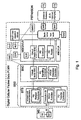
- FIG. 1 illustrates an embodiment of the "integrated" system concept applied to a GSM system ("Embodiment I"), by showing a block diagram of a GSM system enhanced with packet data (PD) functions, the major PD function blocks shown with bold contour lines.
- PD packet data
- FIG. 2 illustrates an intranetwork protocol and interworking example (Internet Protocol IP) for Embodiment I.
- FIG. 3 illustrates an intranetwork protocol and interworking example (X.25) for Embodiment I.
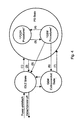
- FIG. 4 illustrates a new PD state (PD mode), introduced in Embodiment I, in relation to regular GSM idle state (mode) and call-connected state (mode).
- PD mode a new PD state
- mode regular GSM idle state
- mode call-connected state
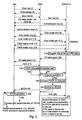
- FIG 5 shows a sequence diagram illustrating establishment of PD state (PD mode), initiated from a mobile station (MS).
- PD mode PD state
- MS mobile station
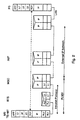
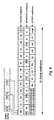
- FIG 6 shows an example of a 51-frame Master packet data channel (MPDCH) downlink multiframe, together with the multiframe cycle in FIG. 7 provided for coordinating listening to MPDCH with listening to regular GSM broadcast channels (applicable both to Embodiment I and "Embodiment II" below).
- MPDCH Master packet data channel
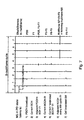
- FIG. 7 shows an example of a multiframe cycle formed by 8 MPDCH downlink multiframes (illustrated in FIG. 6), and an example of scheduling adequate times for listening to regular GSM broadcast channels.
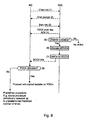
- FIG. 8 shows a sequence diagram illustrating allocation of a packet data channel (PDCH) on demand, initiated from an MS (applicable to Embodiment I).
- PDCH packet data channel
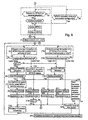
- FIG. 9 shows a flow chart, illustrating the process of dynamically allocating PDCHs based on throughput measurements (applicable both to Embodiment I and II).
- FIG. 10 shows a sequence diagram illustrating an example of a mobile originated packet transfer in Embodiment I.
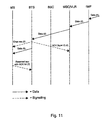
- FIG. 11 shows a sequence diagram illustrating an example of a mobile terminated packet transfer (using "immediate channel reservation") in Embodiment I.
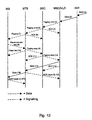
- FIG. 12 shows a sequence diagram illustrating an example of a mobile terminated packet transfer (using paging) in Embodiment I.
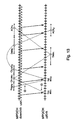
- FIG. 13 shows examples of a mobile originated and a mobile terminated packet transfer on an MPDCH, thereby illustrating the principles of using Uplink State Flags (USFs) and a type of paging that reserves an access slot for the MS to respond (applicable both to Embodiment I and II).
- USFs Uplink State Flags
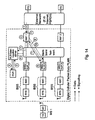
- FIG. 14 illustrates an example of routing from an interworking function (IWF) to an MS's currently serving Mobile services Switching Centre (MSC) in Embodiment I, when the addressing scheme chosen is such that an MS's IP address identifies the MS as belonging to a particular public land mobile network (or group of MSCs).
- IWF interworking function
- MSC Mobile services Switching Centre
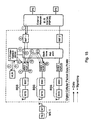
- FIG. 15 illustrates an example of routing from an IWF to an MS's currently serving MSC in Embodiment I, when the addressing scheme chosen is such that an MS's IP address identifies the MS as belonging to a particular MSC.
- GSM system An embodiment of the invention is described, which is applied to a digital TDMA cellular system with a GSM type of architecture. Although this type of system may operate in another frequency band (such as the 1800 or 1900 MHZ band) than that specified for GSM, it is in the following description referred to as a "GSM system".
- the present invention is directed towards providing the new packet data services in a closely integrated way, utilizing the current infrastructure to the extent possible, consistent with functional and performance requirements.
- FIG. 1 illustrates a GSM system enhanced with packet data (PD) functions, the major PD function blocks shown with bold contour lines.
- MT Mobile Termination
- TE Terminal Equipment
- a group of BTSs is controlled by a Base Station Controller (BSC), and these together form a Base Station System (BSS).
- BSC Base Station Controller
- One or more BSSs are served by a Mobile services Switching Centre (MSC) with an associated Visitor Location Register (VLR).
- MSC Mobile services Switching Centre
- VLR Visitor Location Register
- An MSC controls calls to and from other networks such as PSTN (Public Switched Telephone Network), ISDN (Integrated Services Digital Network), or other PLMN networks.
- An MSC equipped for routing incoming calls is referred to as a Gateway MSC (GMSC).
- GMSC Gateway MSC
- MSC/VLR(s) are via a CCITT (International Canal & Telephone Consultative Committee) Common Channel Signalling (CCS) system No. 7 network connected to a Home Location Register (HLR), which is a data base comprising information on all subscribers, including location information identifying the MSC/VLR where a subscriber is currently (or was last) registered.
- HLR Home Location Register
- AUC Authentication Centre
- EIR Equipment Identity Register
- an Operations and Maintenance Centre OMC
- OMC Operations and Maintenance Centre
- the packet data functionality added in BTS includes capability to provide one or more shared packet data channels (here referred to as "PDCHs"), depending on demand.
- PDCHs shared packet data channels
- a PDCH may be allocated temporarily on user demand.
- one or more PDCHs may either be allocated on a semi-permanent basis, or be allocated dynamically, adapted to the current load situation.
- the allocation of PDCHs is controlled from BSC.
- the degree of PDCH support in a cell may be configurable.
- a PDCH is a new type of logical channel on a physical TDMA channel (time slot), optimized for shared packet transfer to and from multiple packet data capable MSs (supporting packet data only, or packet data combined with ordinary voice/circuit data services in different modes of operation) .
- PDCHs are used for data transfer and associated control signalling.
- a "reservation-Aloha" type of protocol is employed.
- Uplinks and downlinks are basically used as independent channel resources. In a certain TDMA frame, a PDCH uplink may carry data from one MS and the downlink data to another.
- the packet data radio link protocol over the PDCH(s) allocated in a cell is handled by a "PD transfer controller" in BTS.
- the PD transfer controller In a BTS with at least one PDCH allocated, the PD transfer controller has a, normally unique, physical connection for packet transfer to and from MSC, utilizing ordinary internode trunks.
- a "PD router” is provided for routing packets to and from the MSC service area. Furthermore, a “PD controller” is provided for handling signalling exchange with the "circuit mode MSC", and for handling control, monitoring and parameter storage functions related to packet data MSs.
- the PD controller comprises processor, memory, signalling interface functions, and software.
- IWFs interworking functions
- IWFs provide internetworking with external network(s), such as Internet (i.e. IP network) and/or PSPDN (Packet Switched Public Data Network, i.e. X.25 network) , thus interconnecting Fixed Stations (FSs) with the MSs.
- An IWF may perform protocol conversion and address translation, as required. It may also route packet data traffic between cooperating PLMNs. Packet data traffic between MSs in different MSC service areas in the same PLMN is normally routed directly between the respective MSCs, across the backbone network.
- HLR may, via a "HLR interrogation server", be interrogated from entities on the backbone network.
- the HLR interrogation server provides necessary functions to enable such interrogation from the packet data network.
- HLR, AUC, EIR and OMC, are also enhanced to support the new types of subscriptions, services and equipments.
- IP connectionless network
- IP is here used to denote the Internet Protocol (the de facto standard IP protocol used in the TCP/IP protocol suite) or the ISO (International Standards Organisation) Internetwork protocol (ISO 8473). (Possibly both these protocols may be supported.)
- Value-added services including multicast, broadcast and electronic mail services., may be provided by Network Application Server(s) (NAS(s)), attached to the backbone network and accessed by using higher layer protocols on top of IP.
- NAS(s) Network Application Server
- the PLMN basically appears as an IP network.
- the protocol architecture is illustrated in FIG. 2.
- the figure shows an example of communication between an MS and a fixed station (FS), e.g. a host computer, attached to an external IP network.
- IWF and MSC then both have the role of IP (layer 3) routers, and MS and FS may communicate end-to-end using a TCP (Transmission Control Protocol) transport (layer 4) protocol.
- the MT and TE parts of the MS are in this example integrated in one unit.
- BTS acts as a link layer (layer 2) relay between the radio link protocol (denoted RL2 in the figure) and the link protocol (denoted L2) used across the trunk connection.
- the radio protocol handled by BTS is an ARQ (Automatic Repeat reQuest) type of protocol, based on dividing each frame in equal size blocks and retransmitting blocks in error.
- ARQ Automatic Repeat reQuest
- encryption/decryption is performed between MT and MSC.
- An MS is identified, on layer 3 with an IP address, and on layer 2 with standard GSM identities, International Mobile Subscriber Identity (IMSI) or, normally, Temporary Mobile Subscriber Identity (TMSI).
- IMSI International Mobile Subscriber Identity
- TMSI Temporary Mobile Subscriber Identity
- Standard connection-oriented network (X. 25) services may also be provided by employing a connection- oriented transport protocol across the PLMN, on top of the IP protocol.
- an X.25 DCE-DTE interface is provided between MT and TE.
- IWF and MT both perform protocol conversion and map any X.25 virtual circuit on to a transport connection between the two entities, using the intra-PLMN transport protocol (denoted L4).
- IWF and MT also translate between X.121 and IP address.
- the L4 protocol may be utilized to provide optional data compression.
- this transport connection is then maintained for the duration of the X.25 virtual call, even if the MS moves to the service area of another MSC.
- this is achieved by, as part of the connection establishment procedure, informing the MT of the IP address of the IWF. MT then addresses all packets associated with this connection to this IWF. MSC, in its turn, merely routes packets based on their IP address.
- the IWF is updated with new routing information when the MS moves to a new MSC, as described below.
- TE and FS may communicate end-to-end via a transport protocol (such as ISO transport, protocol Class 1).
- the packet data services subscribed to are available to an MS after a procedure that brings the MS from an initial GSM idle mode to a new "PD mode".
- This procedure may be initiated either by the MS making a request for packet data service or by the MSC, currently serving the MS, receiving a packet addressed to the MS.
- the procedure is based on standard GSM signalling and utilizes standard GSM authentication.
- the PD mode establishment procedure also includes initiating parameters for packet encryption/ decryption in the MS and its current MSC/VLR. After completed procedure, the MS is registered in its current MSC/VLR as being in PD mode. The system then provides access to PDCHs in any cell. It also provides other system mechanisms for fast packet transfer, including:
- an MS performs cell selection and location updating based on GSM idle mode procedures. (Handover, in the GSM sense, is not used.)
- the MS When roaming between cells, the MS, from information broadcasted on BCCH, identifies the PDCH that may be used for intiating packet transfer in a cell. Initiation of packet transfer to an MS from its currently serving MSC is guided by monitoring the MS's cell location based on any previous packet transfer. Depending on the recentness of the cell location information, and on other MS operational parameters (e.g. mobile or stationary mode of operation), the packet transfer may be initiated with or without paging.
- MS operational parameters e.g. mobile or stationary mode of operation
- the PD mode registration and any associated information stored at the MS's currently serving MSC/VLR is transferred from the old to the new MSC/VLR.
- Peer entities of any routes established to the MS's current MSC are also updated with routing information to the new MSC.
- PD Mode in relation to regular GSM idle mode and call-connected mode is illustrated in FIG. 4.
- the denomination "state” is used as a synonym for "mode”.
- An MS in idle mode may change to PD mode (transition (1) in FIG. 4) by a procedure based on regular GSM signalling and authentication.
- the procedure may be initiated either by the MS, or by the MSC, currently serving the MS, receiving a packet addressed to the MS.
- the procedure in the former case is exemplified by the sequence diagram in FIG. 5. Initiation of the procedure may, as determined by a system parameter, be allowed only in cells where a PDCH is allocated or is allocatable on user demand.
- the signalling sequence (1)-(13) in the figure is based on standard GSM signalling and authentication procedures used for setting up regular GSM voice/circuit data calls.
- a new type of service request (signal (3)) is used to request PD mode establishment.
- the optional sequence (8)-(13) is employed to allocate the MS a TMSI (Temporary Mobile Subscriber Identity) and/or to initiate packet encryption/decryption parameters in the MS and its current MSC.
- TMSI Temporal Mobile Subscriber Identity
- the MS is registered in its current MSC/VLR as being in PD mode and (optional) encryption parameters are stored (block (14)).
- the sequence (15)-(17) also based on regular GSM signalling, confirms the PD mode registration and makes the MS change to PD mode. If a PDCH is not already allocated in the cell in question, the PDCH allocation controller in BSC (FIG. 1) attempts to allocate a PDCH on demand (blocks (18)-(20)).
- BSC sends a command to BTS to activate a PDCH and to broadcast channel defining information on BCCH (block (21)).
- An optional channel defining signal may also be sent directly to the MS, in order to provide a faster notification that a PDCH is allocated.
- the MS determines if a PDCH is allocated. If this is the case, the MS may initiate a packet transfer on the defined PDCH. If no PDCH is allocated, the MS may proceed with a predefined procedure, such as periodically initiating a PDCH on demand allocation procedure (described in section I.C below). MSC/VLR is then, via the signal denoted (23), informed that the PD mode establishing procedure is completed.
- Signal (23) conveys information on the MS's cell location and, optionally, on whether a PDCH is allocated in the cell. This information is stored, linked to the PD mode registration (block (24)). As also indicated in block (24), if PD mode is monitored by a timer and/or inactivity timer, these timers, located in the PD controller (FIG. 1), are initiated.
- the PD mode establishment procedure is primarily based on ordinary GSM signalling functions, controlled from the circuit mode MSC (FIG. 1), although some adaptations are required e.g. for handling the new type of service request and the new encryption parameters.
- PD mode When PD mode is established for an MS, parameters related to the MS are also transferred to a data base portion of the PD controller.
- This data base may be regarded as an extension of VLR for packet data MSs.
- An example of functional division between VLR and this PD controller data base is as follows (alternative realizations are not precluded):
- Location updating for an MS in PD mode is based on idle mode location updating procedures.
- the new VLR automatically receives the related subscription parameters (from HLR), as part of regular idle mode location updating.
- the location updating procedure is enhanced such that the new MSC/VLR is informed that the MS is in PD mode, and is provided information on the backbone network address of the previous MSC/VLR.
- the MS's operational parameters are then transferred (across the backbone network) from the PD controller in the previous MSC/VLR, and the data bases of the two PD controllers are updated.
- the PD controller in the new MSC/VLR also provides updated routing information to peer entities of any routes established to the MS's current MSC.
- a PD mode establishment procedure may also be initiated when a PD router in an MSC, currently serving an MS in idle mode, receives a packet addressed to the MS.
- the PD router then signals to the PD controller identifying the destination IP address.
- the PD controller finds that the MS is not in PD mode and, after translating the IP address to IMSI, requests the circuit mode MSC to initiate a PD mode establishment procedure.
- the MS is in idle mode, the request is accepted and the circuit mode MSC initiates the procedure using regular GSM paging, but with a special "PD indicator".
- the procedure is then very similar to the one described above for the mobile originated case.
- the normal situation for an MS in PD mode is that it is located in a cell with at least one PDCH allocated.
- the first PDCH allocated in a cell, on which packet transfers are initiated, is here designated “Master PDCH” (MPDCH).
- MPDCH Master PDCH
- the MS performs what is here referred to as “PDCH procedures” (the upper smaller circle in FIG. 4).
- the available framework for regular GSM broadcast control channels are utilized for performing cell selection.
- the cell selection criteria may be somewhat modified compared to idle mode, if a user (e.g. with a keyboard command) selects to operate the MS in "stationary mode".
- the MS In stationary mode, the MS retains the current cell as long as the signal quality is above a certain threshold value. The purpose is to reduce the probability of "unnecessarily" changing cell due to fluctuations in the radio environment, e.g. caused by reflections from moving objects. If the signal quality falls below the threshold value, the MS automatically returns to normal "mobile mode" of operation.
- the MS informs the PD controller in its currently serving MSC/VLR of its mode of operation, by sending a mobile/stationary mode indicator at least every time it changes from mobile to stationary mode, or vice versa.
- paging may then be limited to a single cell, or data may be sent directly (as "immediate data” / "immediate channel reservation” followed by data) without previous paging.
- the modified cell selection criteria may be employed also for an MS in mobile mode. Provided that the information on the MS's cell location (stored in the PD controller) is sufficiently recently updated, packet transfer to the MS may be initiated in a similar way as to a "stationary" MS.
- Coordination of the above procedures may be accomplished by employing for the MPDCH downlink a multiframe scheme similar to and synchronized with the 51-frame multiframe schemes used for regular GSM downlink control channels.
- a multiframe scheme similar to and synchronized with the 51-frame multiframe schemes used for regular GSM downlink control channels.
- an MS may listen to broadcast channels at any time except during its assigned (sleep mode) paging block, more extensive coordination is required for an MS in PD mode, and specifically when the MS is in normal paging mode. In the latter case, the time an MS is available for downlink messages needs to be maximized, while allowing sufficient time for the broadcast listening tasks.
- a multiframe coordination scheme with this purpose is exemplified in FIG. 6 and FIG. 7.
- FIG. 6 shows an example of a 51-frame MPDCH multiframe, synchronized with the corresponding GSM Broadcast Channel (BCH) / Common Control Channel (CCCH) and Stand-alone Dedicated Control Channel (SDCCH) multiframes.
- BCH GSM Broadcast Channel
- CCCH Common Control Channel
- SDCCH Stand-alone Dedicated Control Channel
- 8 MPDCH multiframes form a multiframe cycle (synchronized with the corresponding BCH/CCCH and SDCCH multiframe cycles).
- FIG. 7 also illustrates an example of scheduling adequate times for the tasks of listening to and reading information from ordinary GSM broadcast channels.
- the MPDCH multiframe (FIG. 6) comprises:
- an MS listens to one of the paging blocks (depending on its IMSI) in a subset of the multiframes in the cycle, as determined by a system parameter (giving a sleep mode period ranging between approximately 0.25 and 2 seconds). Multiframes 5 and 7 every Nth cycle are excluded, as these (as illustrated in FIG. 7) are scheduled for listening to adjacent BCCH.
- an MS may be paged in all paging blocks, and at any time not scheduled for other purposes (see below). The same is true for "immediate data” /"immediate channel reservation".
- PDCH broadcast may, with a sleep mode parameter, be limited to a defined subset of the multiframes.
- the sleep mode parameter may be different from that used for paging.
- PDCH broadcast is used for providing system information, including PDCH specific parameters, and a flag indication when relevant information on current BCCH has changed. MSs should then read BCCH and "extended BCCH" (if any), starting with the next multiframe and until the relevant information contents of all 8 multiframes have been read (see FIG. 7). PDCH broadcast may also be used for different kinds of user information services.
- block F3-F6 may (when not allocated for other purposes; see FIG. 7) be utilized for multicast messages. (Other multicast allocation alternatives exist.)
- the BCH/CCCH multiframe is included in FIG. 6 to show the allocation of FCCH (marked F), SCH (marked S), and BCCH (marked B) used in the cell selection process.
- "Extended BCCH” (if provided) is allocated in the first "C” block from the left, in multiframes 4-7 (see FIG. 7).
- the purpose of showing the SDCCH multiframe in FIG. 6, is to indicate the allocation of cell broadcast SMs. These are allocated a subchannel utilizing the block marked "D2", in multiframes 0-3 (as shown in FIG. 7). A possible way to schedule listening to these broadcast channels is shown in the diagram of FIG. 7. The more precise block/frame allocation in the respective multiframe is defined in the column at the right hand side.
- An MS that needs to read information from BCCH of an adjacent cell should read at least one BCCH block from multiframes 2, 3, 6 or 7 in a multiframe cycle. This is achieved with the reading schedule in FIG. 7, again taking into account that multiframes of adjacent and current cells may be unsynchronized.
- the time indicated for reading adjacent BCCH is assigned once every N:th cycle, where N is a system parameter.
- an MS in PD mode temporarily has to be "off PDCH” and use ordinary GSM channels and perform what is here denoted “GSM procedures”. It is then accessable by and has access to the same signalling as in idle mode. It also performs cell selection exactly as in idle mode.
- GSM procedures Common situations when the MS changes to these "GSM procedures" (transition marked (3) in FIG. 4) are:
- An MS in PD mode may make or receive a regular GSM (voice/circuit data/point-to-point short message) call with the PD mode maintained as "pending" during the call and returned to "active" when the call is completed.
- GSM procedures voice/circuit data/point-to-point short message
- the MS if it was using "PDCH procedures”, first changes to "GSM procedures” (transition (3) in FIG. 4).
- GSM procedures the MS initiates a call in a regular GSM manner and, when the call is set up, changes to call-connected mode (transition (6)). Via the circuit mode MSC (FIG.
- the PD mode is marked as "pending" in VLR and in the data base portion of the PD controller (FIG. 1).
- the MS returns to "active" PD mode (transition (7) in FIG. 4) and is marked accordingly in VLR and the PD controller.
- the circuit mode MSC If an ordinary GSM call to an MS in PD mode is received by a circuit mode MSC, the circuit mode MSC, after finding from VLR that the MS is in PD mode, requests the PD controller to initiate paging of the MS. If the PD controller has information on the procedures used by the MS, paging is initiated accordingly using either MPDCH, for which special paging types are provided to convey GSM calls, or ordinary GSM paging channel (via the circuit mode MSC). Should such information not be available in the PD controller, paging may involve both types of channels in different cells. If the MS indicates "accept” in its paging response, the call, after the MS having changed to "GSM procedures" as required, is set up and PD mode is kept “pending" during the call in a similar way as discribed above for a mobile initiated call.
- a packet, addressed to an MS in GSM call-connected mode is received by a PD router (FIG. 1)
- the associated PD controller finds that the MS is not in PD mode, requests the circuit mode MSC to initiate a PD mode establishment procedure as described above.
- the request is rejected. This may result in the PD router sending an upstream error report, indicating that the MS is unreachable.
- the circuit mode MSC does not need to be involved, as the MS mode information is available in the PD controller. For an MS subscribing to mail service, the message delivery in these and similar situations may be deferred until the MS becomes available.
- PD mode for an MS may be monitored by a timer and/or inactivity timer, handled by the PD controller in the MSC/VLR currently serving the MS.
- timeout period a predetermined period of time
- the inactivity timer is reset and reinitiated for any packet received from or sent to the MS.
- the time out periods may be subscription parameters. Termination of PD mode and return to idle mode (transition (2) in FIG. 4) may be initiated by a termination request from the MS, or by a termination command from the PD controller when a timeout occurs.
- the PD mode is terminated, by first changing the MS mode to idle (transition (2)), and then marking the MS as "detached” in VLR according to ordinary idle mode procedures.
- An MS wishing to initiate an explicit “detach” first initiates a change to idle mode (transition (2)) and then sends an "IMSI detach" as an idle mode.
- the main function blocks involved in providing PDCHs are (see FIG. 1):
- interface functions and some common control functions in BTS are adapted to support the new PD functions (FIG. 1).
- the first PDCH in a cell (the "master PDCH” MPDCH), that is capable of carrying the necessary control signalling for initiating packet transfer as well as packet data and that is defined by cell specific information on BCCH, may be allocated either by system configuration or on user demand.
- "PDCH on demand" support may be of particular interest in a low capacity (e.g. single carrier) cell, only occasionally visited by a packet data user.
- an MPDCH may be allocated when an actual need for packet transfer arises:
- SPDCHs slave PDCHs
- the PDCHs may be used as a set of "trunked" channels utilizing a dynamic assignment protocol.
- MPDCH is then used for access control signalling (including channel request, channel reservation and paging) and, as far as capacity admits, data, whereas SPDCH(s) are used for reserved data transfer.
- MPDCH becomes a bottleneck
- a group of (m) MPDCHs may be used together with a group of (s) SPDCHs.
- Each MS is then assigned to a particular MPDCH determined by an algorithm based on the MS's identity (IMSI) and on control information broadcasted on BCCH and/or one or more of the MPDCHs.
- IMSI MS's identity
- the process of dynamically allocating/releasing PDCH(s) in a cell is based on measuring throughput and comparing with predetermined limits as illustrated in FIG. 9.
- the upper dotted part of the flowchart illustrates allocation of a first MPDCH either on demand or as a result of system configuration.
- the counts of allocated MPDCHs (m) and SPDCHs (s) are initiated.
- the average throughput across MPDCHs is measured (in BTS) over predetermined period(s) of time.
- Packet transfer between the PD router in MSC/VLR (FIG. 1) and MSs in the MSC service area is to a large extent determined by the radio link (layer 2) service provided by PDCHs.
- Variable length packets up to some maximum size (such as approximately 600 octets, depending on the PDCH protocol) from layer 3 are accepted by the layer 2 entity in the PD router and by the MT part of MSs respectively.
- Each packet normally after encryption, forms the information field of a layer 2 frame.
- each frame is divided into fixed size blocks (of approximately 25 information octets, corresponding to 4 TDMA bursts).
- BTS or MT respectively performs channel coding, burst formatting, and interleaving (per block).
- a selective repeat type of ARQ protocol between BTS and MT then provides retransmission of blocks in error.
- an MS makes a random access request (signal (1) in the figure) on the MPDCH uplink (using the same type of access burst as in ordinary GSM), when allowed to do so, as determined by "uplink state flags" (USFs) on the MPDCH downlink.
- the access burst includes a random number providing an initial identification of the MS, and may also include class of service type of information.
- BTS normally responds with a channel reservation command (signal (2)) on the MPDCH downlink, reserving channel capacity for uplink data transfer and downlink acknowledgement (ACK).
- ACK uplink data transfer and downlink acknowledgement
- the channel reservation command includes the same random number as received in the access burst, and timing alignment/power control (TA/PC) commands.
- TA/PC timing alignment/power control
- the data frame (signal (3) in the figure) from the MS is followed by a positive acknowledgement (signal (4)) from BTS (as no retransmissions are assumed in this example), and the frame is relayed to the PD router in MSC/VLR.
- the MS's cell location is determined by associating the frame (which includes the MS's identity TMSI in the frame header) with the (for each cell unique) physical connection on which the frame is received.
- the MS's cell location may be identified by providing in the PD transfer controller in BTS the additional function of inserting a cell identifier in the frame header, in a similar way as described in the cited US.A-4,916,691.
- the cell location identity and the associated time when the frame was received are, together with MS parameters (such as mobile/stationary indicator, class of service) that may be conveyed in the frame header from BTS, stored in the PD controller data base, linked to the MS's identity.
- MS parameters such as mobile/stationary indicator, class of service
- the packet normally after decryption, is then available at the layer 3 entity of the PD router for routing to the destination (in the example in FIG. 10 via an IWF).
- the PD controller uses a software algorithm to select method for initiating the packet transfer:
- This method is used if the MS is in stationary mode. It may be used also when the MS is in mobile mode, provided that the modified cell selection criteria employed in stationary mode (described in section I.B) is employed also for MSs in mobile mode, and provided that the cell location information is sufficiently recently updated.
- the frame header in the transfer to BTS includes TMSI, an indicator of the MS's paging mode, IMSI (if the MS is in PD sleep mode), and possible class of service information. If the MS is in PD sleep mode, BTS then initiates the data transfer across PDCH(s) using paging (in a single cell). Otherwise, the data transfer is initiated with "immediate channel reservation", or data may be sent directly as "immediate data" on MPDCH.
- An "immediate channel reservation" transfer sequence is exemplified in FIG.11.
- the channel reservation (signal (5)) on the MPDCH downlink informs the MS of the channel on which the data frame (signal (6)) is to be received. If the data transfer takes place on an MPDCH, channel reservation may not be needed.
- the data frame includes reservation of an access slot on the MPDCH uplink for the MS to respond.
- the response burst (signal (7)) one bit is allocated for acknowledging the data frame. If, as in the example, the acknowledgement is positive, the sequence is completed.
- BTS sends a channel reservation for a more specified negative acknowledgement from the MS (defining blocks to be retransmitted), and for retransmission from BTS.
- This channel reservation also includes TA/PC commands.
- the retransmission then includes channel reservation for the MS to acknowledge and for a possible further retransmission.
- paging is limited to the smallest possible group of cells based on available cell location information. Paging is initiated by a "high level command" (including information on IMSI, TMSI, location area, cell location and recentness of this information, and paging mode) from the PD controller to the PD signalling controller (FIG. 1) in affected BSC(s). (Alternative divisions of paging functions between MSC and BSC are not precluded.) As described in section I.B, depending on system configuration, the paging may include paging on both MPDCH and ordinary GSM paging channel and may thus involve also the "circuit mode" portion of BSC(s).
- a special type of paging message may be employed which combines paging with reservation of an access slot for the MS to respond.
- An example of using this type of paging is shown in the sequence diagram in FIG. 12. With the signal marked (5) in the figure, the paging command initiated by MSC reaches BTS. The PD transfer controller in BTS then generates a paging message (signal (7)) on the MPDCH downlink which includes reservation of an access slot on the MPDCH uplink for the MS to send a response burst (signal (8)).
- the paging response (signal (9) and (12)) transferred back to MSC includes information on the MS's cell location, which information (with the associated time when the paging response was received) is stored in the PD controller data base.
- the paging response also results in a channel reservation (signal 10)) on the MPDCH downlink for the data transfer.
- the channel reservation also includes TA/PC commands.
- data is received from MSC (signal (13))
- it is transferred on the reserved PDCH downlink (signal (16)).
- Channel reservation for an acknowledgement from the MS (signal (17)) and for possible retransmission may either be combined with the data frame (signal (16)) or included in the initial channel reservation (signal (10)).
- the need for renewal within a certain period of time imposes restrictions on maximum packet size.
- the TA/PC commands included in the channel reservation (signal (10)) in FIG. 12 should, with a maximum size packet in the data frame (signal (16)), allow adequate timing alignment and power control at least until the acknowledgement (signal (17)) is received from the MS.
- a maximum packet size of approximately 600 octets should provide sufficient margins.
- additional TA/PC commands (as well as channel reservation commands) may be included in later parts of a sequence, combined with negative acknowledgement(s) or retransmission(s).
- the principles for the mentioned uplink state flags (USFs) and for the type of paging that reserves an access slot for the MS to respond are illustrated by the examples in FIG. 13.
- the series of slots that depict MPDCH downlink and uplink respectively represent time slots in consecutive TDMA frames.
- the figure shows two simple transfer examples, one mobile originated (with index 1) and one mobile terminated (with index 2). All control messages (except access bursts) comprise one block (i.e. 4 bursts).
- An USF on the MPDCH downlink marks a corresponding access slot on the MPDCH uplink as either "free" (for random access) or "reserved".
- USFs are coded individually per MPDCH downlink burst (by allocating a group of redundant bits, carrying one bit of information, for this purpose).
- An USF in TDMA frame n governs access in TDMA frame n + m.
- m 1.
- the mobile originated data transfer starts with a random access burst from mobile station MS 1 in an access slot that is marked as "free" by an USF.
- BTS responds with a channel reservation command on the downlink and changes USF to "reserved” for the duration of the subsequent uplink data transfer.
- a downlink acknowledgement then completes the transfer sequence.
- the mobile terminated transfer is initiated by a paging message to mobile station MS 2 providing the MS a reserved slot for its response burst.
- the paging response is followed by a channel reservation command and a subsequent downlink data transfer. After an acknowledgement from the MS in a reserved uplink block, the sequence is completed.
- a paging message may include paging of more than one MS and then includes reservations of individual access slots for the MSs to respond.
- the reservations may be explicit (in the form of pointers) or implicit, in which case the next few reserved slots are allocated to the MSs in the order they appear in the paging message.
- USFs may alternatively be included in the block channel coding and interleaving, and thus be provided on a per block basis. After receiving a block, an MS then knows the USFs (which may still be associated with individual access slots) for the 4 following access slots.
- Routing of packets from entities on the backbone network (FIG. 1) to an MS in PD mode is, as mentioned, based on establishing and maintaining routes to the MS's currently serving MSC, by means of:
- HLR is enhanced to provide, at the initial interrogation when a route is being established, the IP address of the MSC currently serving the MS in question. HLR is informed of this IP address by means of an extension, for packet data MSs, of the procedure used when an MS registers in an MSC/VLR. The information sent from MSC/VLR to HLR at registration is then extended to include the MSC's IP address.
- each route may be monitored by an inactivity timer, handled by the PD controller in the MSC/VLR currently serving the MS.
- the inactivity timer is initiated to count a predetermined period of time (timeout period).
- the inactivity timer is reset and reinitiated for any packet received from the route, addressed to the MS.
- the timer is reset and reinitiated also for any packet from the MS to the route, when the route is a bidirectional route between the MS's current MSC and another MS's current MSC, linked to the two MSs' respective PD mode registrations.
- the timeout period may be a subscription parameter.
- the method used for routing packets in the mobile terminated direction to an MS's currently serving MSC depends on the IP addressing scheme chosen for the packet data PLMN. If the addressing scheme is such that the network identifying portion of an MS's IP address identifies the MS as belonging to a particular PLMN, or subdomain of a PLMN including a group of MSCs, the routing method illustrated by the example in FIG. 14 may be used. Referring to the sequential steps indicated in the figure:
- the PD router in an MSC/VLR receives a packet instead originated from an MS (MS 1) within the MSC service area
- the network identifying portion of the destination IP address is first analysed. If the destination address is not within the range of addresses assigned to MSs belonging to the PLMN, the packet is routed according to normal IP routing rules. If, on the other hand, the destination address is within this range of addresses and thus belongs to an MS (MS 2), the "extended VLR data base" in the PD controller is interrogated.
- the routing method may then comprise the following steps:
- the network identifying portion of an MS's IP address identifies the MS as belonging to a specific MSC/VLR. Routing of packets in the mobile terminated direction may in this case be based on the method exemplified in FIG. 15. The sequential steps indicated in the figure are as follows:
- the routing method may comprise the following steps:
- all packets to an MS are routed via the MS's "predetermined MSC". It may therefore be advantageous to (optionally) initiate establishment of a route from the "predetermined MSC" to the MS's current MSC also when the PD router (in the MS's current MSC) receives a packet from the MS. Then, if it is found that the packet is not addressed to an MS located within the MSC service area, and that the mentioned route is not already established, the PD controller may initiate route establishment by:
- HLR interrogation for any subsequent response packet e.g. in query/response type of applications
- a PLMN that provides connection-oriented (X.25) network services between MSs and an external X.25 network, and that employs an addressing scheme of the first type described above.
- the PD router in an MS's current MSC, from the MS receives a packet carrying a "transport connection request" (e.g. identified by a "class of service identifier" in the frame header)
- the X.25 IWF to which the packet is to be routed is determined based on stored routing information.
- the packet is "encapsulated" (with the IWF's IP address as destination address and the MSC's IP address as source address) and routed to the IWF. This initiates establishment of a route from the IWF to the MS's current MSC. HLR interrogation can thus be avoided for the response packet from the IWF. (In case a route is already established, the packet may be routed from the MSC to the IWF without encapsulation by merely inserting the IWF's IP address as destination address.)
- MS I.F Mobile Station
- a packet data MS (“PD only", or combining PD with ordinary GSM functions) comprises:
- a range of MT versions providing different standard interfaces towards TE will be available, depending on market requirements. Examples include:
- the MT comprises two main function blocks:
- the major PD functions that the transceiver performs may be summarized as follows:
Landscapes
- Engineering & Computer Science (AREA)
- Computer Networks & Wireless Communication (AREA)
- Signal Processing (AREA)
- Computer Security & Cryptography (AREA)
- Mobile Radio Communication Systems (AREA)
- Data Exchanges In Wide-Area Networks (AREA)
- Time-Division Multiplex Systems (AREA)
Priority Applications (1)
| Application Number | Priority Date | Filing Date | Title |
|---|---|---|---|
| EP01128387A EP1191800B1 (en) | 1993-12-10 | 1994-11-23 | Apparatuses and mobile stations for providing packet data communication in digital TDMA cellular systems |
Applications Claiming Priority (3)
| Application Number | Priority Date | Filing Date | Title |
|---|---|---|---|
| SE9304119A SE9304119D0 (sv) | 1993-12-10 | 1993-12-10 | Apparatuses and mobile stations for providing packet data communication in digital TDMA cellular systems |
| SE9304119 | 1993-12-10 | ||
| PCT/SE1994/001120 WO1995016330A1 (en) | 1993-12-10 | 1994-11-23 | Apparatuses and mobile stations for providing packet data communication in digital tdma cellular systems |
Related Child Applications (1)
| Application Number | Title | Priority Date | Filing Date |
|---|---|---|---|
| EP01128387A Division EP1191800B1 (en) | 1993-12-10 | 1994-11-23 | Apparatuses and mobile stations for providing packet data communication in digital TDMA cellular systems |
Publications (2)
| Publication Number | Publication Date |
|---|---|
| EP0683963A1 EP0683963A1 (en) | 1995-11-29 |
| EP0683963B1 true EP0683963B1 (en) | 2002-12-11 |
Family
ID=20392067
Family Applications (2)
| Application Number | Title | Priority Date | Filing Date |
|---|---|---|---|
| EP95903477A Expired - Lifetime EP0683963B1 (en) | 1993-12-10 | 1994-11-23 | Apparatuses and mobile stations for providing packet data communication in digital tdma cellular systems |
| EP01128387A Expired - Lifetime EP1191800B1 (en) | 1993-12-10 | 1994-11-23 | Apparatuses and mobile stations for providing packet data communication in digital TDMA cellular systems |
Family Applications After (1)
| Application Number | Title | Priority Date | Filing Date |
|---|---|---|---|
| EP01128387A Expired - Lifetime EP1191800B1 (en) | 1993-12-10 | 1994-11-23 | Apparatuses and mobile stations for providing packet data communication in digital TDMA cellular systems |
Country Status (14)
| Country | Link |
|---|---|
| US (1) | US5590133A (ref) |
| EP (2) | EP0683963B1 (ref) |
| JP (2) | JPH08506713A (ref) |
| KR (1) | KR100353773B1 (ref) |
| CN (1) | CN1092010C (ref) |
| AU (1) | AU675898B2 (ref) |
| CA (1) | CA2153871C (ref) |
| DE (2) | DE69434250T2 (ref) |
| ES (1) | ES2188650T3 (ref) |
| FI (1) | FI114844B (ref) |
| SE (1) | SE9304119D0 (ref) |
| SG (1) | SG43755A1 (ref) |
| TW (1) | TW276382B (ref) |
| WO (1) | WO1995016330A1 (ref) |
Cited By (1)
| Publication number | Priority date | Publication date | Assignee | Title |
|---|---|---|---|---|
| US8989787B2 (en) | 1996-02-26 | 2015-03-24 | Nokia Corporation | Communication network terminal supporting a plurality of applications |
Families Citing this family (317)
| Publication number | Priority date | Publication date | Assignee | Title |
|---|---|---|---|---|
| US6847611B1 (en) | 1990-12-10 | 2005-01-25 | At&T Corp. | Traffic management for frame relay switched data service |
| FI98687C (fi) * | 1993-09-20 | 1997-07-25 | Nokia Telecommunications Oy | Matkaviestinjärjestelmä ja menetelmä etätyöaseman kytkemiseksi matkaviestinverkon kautta dataverkkoon |
| NL9302170A (nl) * | 1993-12-13 | 1995-07-03 | Nederland Ptt | Mobiel telecommunicatiesysteem omvattende een processorinrichting voor het verwerken van signaleringsberichten, alsmede basisstation voor toepassing in het telecommunicatiesysteem en mobiele terminal voor toepassing in het telecommunicatiesysteem. |
| FI95984C (fi) * | 1994-04-08 | 1996-04-10 | Nokia Telecommunications Oy | Menetelmä ja järjestely sijainninhallintaa varten pakettidatasiirron yhteydessä matkaviestinjärjestelmässä |
| US5793762A (en) * | 1994-04-12 | 1998-08-11 | U S West Technologies, Inc. | System and method for providing packet data and voice services to mobile subscribers |
| US6631133B1 (en) * | 1994-05-05 | 2003-10-07 | Sprint Communications Company L.P. | Broadband telecommunications system |
| US5991301A (en) * | 1994-05-05 | 1999-11-23 | Sprint Communications Co. L.P. | Broadband telecommunications system |
| US5926482A (en) | 1994-05-05 | 1999-07-20 | Sprint Communications Co. L.P. | Telecommunications apparatus, system, and method with an enhanced signal transfer point |
| US5920562A (en) | 1996-11-22 | 1999-07-06 | Sprint Communications Co. L.P. | Systems and methods for providing enhanced services for telecommunication call |
| CA2189253C (en) * | 1994-05-05 | 2002-12-31 | Joseph Michael Christie | Method, system and apparatus for telecommunications control |
| FR2719959B1 (fr) * | 1994-05-10 | 1996-06-21 | Alcatel Mobile Comm France | Procédé d'accès paquet dans un système de radiocommunication numérique cellulaire. |
| US6404761B1 (en) | 1994-06-17 | 2002-06-11 | Home Wireless Networks, Inc. | Communications webs with personal communications links for PSTN subscribers |
| US6058104A (en) * | 1994-06-17 | 2000-05-02 | Home Wireless Networks, Inc. | Communications webs for PSTN subscribers |
| CA2151868C (en) * | 1994-08-01 | 1999-08-03 | Mark Jeffrey Foladare | Personal mobile communication system |
| US5606595A (en) * | 1994-08-19 | 1997-02-25 | Lucent Technologies Inc. | Equal access to inter-exchange carriers in a mobile wireless packet data communication system |
| JPH0888665A (ja) * | 1994-09-20 | 1996-04-02 | Nec Corp | 端末アダプター、交換機付加装置およびデータ通信システム |
| FI96557C (fi) * | 1994-09-27 | 1996-07-10 | Nokia Telecommunications Oy | Menetelmä datasiirtoa varten TDMA-matkaviestinjärjestelmässä sekä menetelmän toteuttava matkaviestinjärjestelmä |
| FI98586C (fi) * | 1995-01-10 | 1997-07-10 | Nokia Telecommunications Oy | Pakettiradiojärjestelmä ja menetelmiä datapaketin reitittämiseksi protokollariippumattomasti pakettiradioverkoissa |
| JP3251797B2 (ja) * | 1995-01-11 | 2002-01-28 | 富士通株式会社 | ワイヤレスlanシステム |
| US6009325A (en) * | 1995-02-01 | 1999-12-28 | Motorola, Inc. | Method of and apparatus for operating a cellular phone in one of two modes |
| US5940385A (en) * | 1995-02-23 | 1999-08-17 | Ntt Mobile Communications Network, Inc. | Multicellular transmission method and apparatus |
| GB2340349B (en) * | 1995-04-18 | 2000-05-03 | Mitsubishi Electric Corp | Radio data transmission system |
| GB2340698B (en) * | 1995-04-18 | 2000-07-19 | Mitsubishi Electric Corp | Radio data transmission system |
| AU722770B2 (en) * | 1995-04-18 | 2000-08-10 | Mitsubishi Denki Kabushiki Kaisha | Radio data transmission system |
| AU721153B2 (en) * | 1995-04-18 | 2000-06-22 | Mitsubishi Denki Kabushiki Kaisha | Radio data transmission system |
| JP3231575B2 (ja) * | 1995-04-18 | 2001-11-26 | 三菱電機株式会社 | 無線データ伝送装置 |
| FI98023C (fi) * | 1995-05-09 | 1997-03-25 | Nokia Telecommunications Oy | Liukuvaan ikkunaan perustuva datavuonohjaus, joka käyttää säädettävää ikkunakokoa |
| US5742845A (en) | 1995-06-22 | 1998-04-21 | Datascape, Inc. | System for extending present open network communication protocols to communicate with non-standard I/O devices directly coupled to an open network |
| DE19524659C1 (de) | 1995-07-06 | 1996-10-31 | Siemens Ag | Verfahren zur Übertragung von Datenpaketen gemäß einem Paketdatendienst in einem für Sprach- und Datenübertragung vorgesehenen zellularen Mobilfunknetz |
| AU6721096A (en) * | 1995-08-14 | 1997-03-19 | Ericsson Inc. | Method and apparatus for modifying a standard internetwork protocol layer header |
| DE59610785D1 (de) * | 1995-08-31 | 2003-11-27 | Siemens Ag | Verfahren und System zur Übertragung von Nachrichten zwischen Einrichtungen eines Mobilfunknetzes |
| JPH0983432A (ja) * | 1995-09-08 | 1997-03-28 | Matsushita Electric Ind Co Ltd | 無線通信システム及び無線通信装置 |
| US5742588A (en) * | 1995-09-18 | 1998-04-21 | Telefonaktiebolaget Lm Ericsson | Packet switched traffic management in a cellular telecommunications system |
| US6097700A (en) * | 1995-09-18 | 2000-08-01 | Telefonaktiebolaget L M Ericsson (Publ) | Packet switched radio channel congestion control |
| US5666348A (en) * | 1995-09-18 | 1997-09-09 | Telefonaktiebolaget L M Ericsson (Publ.) | Packet switched radio channel admission control in a cellular telecommunications system |
| US5757772A (en) * | 1995-09-18 | 1998-05-26 | Telefonaktiebolaget Lm Ericsson | Packet switched radio channel traffic supervision |
| SE506619C2 (sv) * | 1995-09-27 | 1998-01-19 | Ericsson Telefon Ab L M | Metod för kryptering av information |
| JP3885236B2 (ja) * | 1995-10-11 | 2007-02-21 | ソニー株式会社 | 携帯型通信端末 |
| US6563820B1 (en) * | 1995-10-11 | 2003-05-13 | Mannesmann Ag | Process and device for forwarding non speech-bound information |
| WO1997014108A1 (en) * | 1995-10-11 | 1997-04-17 | Block Financial Corporation | Financial information access system |
| US6016428A (en) * | 1995-10-18 | 2000-01-18 | Telefonaktiebolaget Lm Ericsson | Registration control of mobile stations in a wireless communication system |
| US5768267A (en) * | 1995-10-18 | 1998-06-16 | Telefonaktiebolaget Lm Ericsson | Method for system registration and cell reselection |
| US6091960A (en) * | 1995-10-18 | 2000-07-18 | Telefonaktiebolaget Lm Ericsson | Method for paging mobile stations |
| SE505444C2 (sv) * | 1995-10-18 | 1997-08-25 | Ericsson Telefon Ab L M | Anordning och förfarande för överföring av information som tillhör en mobil abonnent som förflyttar sig inom ett cellulärt telekommunikationssystem |
| US5729531A (en) * | 1995-10-18 | 1998-03-17 | Telefonaktiebolaget Lm Ericsson | Bandwidth allocation |
| US5806007A (en) * | 1995-10-18 | 1998-09-08 | Telefonaktiebolaget Lm Ericsson | Activity control for a mobile station in a wireless communication system |
| US5845215A (en) * | 1995-10-18 | 1998-12-01 | Telefonaktiebolaget Lm Ericsson | Operating mobile stations of wireless communication systems in multiple modes by external control |
| DE59611313D1 (de) * | 1995-10-23 | 2006-01-26 | Siemens Ag | Verfahren und Anordnung zur Übertragung von Daten zwischen einem zellular aufgebauten Mobilfunknetz und einer Funkteilnehmerstation |
| FI101184B1 (fi) * | 1995-10-30 | 1998-04-30 | Nokia Telecommunications Oy | Digitaalisen matkaviestinverkon suora dataliityntä dataverkkoihin |
| DE19541398A1 (de) * | 1995-11-07 | 1997-05-15 | Sel Alcatel Ag | Netzanpassungszentrale für ein Mobilfunknetz |
| GB2307827A (en) * | 1995-12-01 | 1997-06-04 | Northern Telecom Ltd | Providing Packet Data to a Mobile Communications System |
| GB2307828A (en) * | 1995-12-01 | 1997-06-04 | Northern Telecom Ltd | Providing Packet Data to a Mobile Communications System |
| GB9603582D0 (en) | 1996-02-20 | 1996-04-17 | Hewlett Packard Co | Method of accessing service resource items that are for use in a telecommunications system |
| WO1997022216A1 (en) * | 1995-12-13 | 1997-06-19 | Northern Telecom Limited | Integrated cellular voice and digital packet data telecommunications systems and methods for their operation |
| FI101670B (fi) * | 1995-12-15 | 1998-07-31 | Nokia Mobile Phones Ltd | Menetelmä matkaviestinverkon ja matkaviestimen välisen tiedonsiirron s alauksen ilmaisemiseksi |
| US5878036A (en) * | 1995-12-20 | 1999-03-02 | Spartz; Michael K. | Wireless telecommunications system utilizing CDMA radio frequency signal modulation in conjunction with the GSM A-interface telecommunications network protocol |
| US5706442A (en) * | 1995-12-20 | 1998-01-06 | Block Financial Corporation | System for on-line financial services using distributed objects |
| AU714005B2 (en) | 1995-12-26 | 1999-12-16 | Ntt Mobile Communications Network, Inc. | Mobile wireless data communications system |
| FI102234B (fi) * | 1996-01-16 | 1998-10-30 | Nokia Telecommunications Oy | Digitaalinen matkaviestinjärjestelmä ja menetelmiä päättyvän puhelun k äsittelemiseksi |
| US5732074A (en) * | 1996-01-16 | 1998-03-24 | Cellport Labs, Inc. | Mobile portable wireless communication system |
| US5873035A (en) * | 1996-01-30 | 1999-02-16 | Motorola, Inc. | Conducting handoff of a data transmission |
| WO1997028622A1 (en) | 1996-02-02 | 1997-08-07 | Sprint Communications Company, L.P. | Atm gateway system |
| DE19605223A1 (de) * | 1996-02-13 | 1997-08-14 | Sel Alcatel Ag | Verfahren zum Betreiben einer Breitband-Verbindung zwischen einem Mobilfunk-Endgerät und einer netzseitigen Mobilfunkeinrichtung sowie Mobilfunk-Endgerät, netzseitige Mobilfunkeinrichtung und Mobilfunksystem |
| US7088990B1 (en) | 1996-02-26 | 2006-08-08 | Nokia Mobile Phones, Ltd. | Communication network terminal supporting a plurality of applications |
| EP0828398A4 (en) * | 1996-03-08 | 2005-06-22 | Nippon Telegraph & Telephone | DATA PACKET TRANSMISSION PROCESS FOR MOBILE DATA-COMMUNICATION SYSTEM |
| US6185198B1 (en) * | 1996-03-20 | 2001-02-06 | Aeris Communications, Inc. | Time division multiple access downlink personal communications system voice and data debit billing method |
| WO1997036434A1 (en) * | 1996-03-28 | 1997-10-02 | Markport Limited | Routing of short messages for telecommunications networks |
| US6154445A (en) * | 1996-04-18 | 2000-11-28 | Bell Atlantic Network Services, Inc. | Telephony communication via varied redundant networks |
| US6069890A (en) | 1996-06-26 | 2000-05-30 | Bell Atlantic Network Services, Inc. | Internet telephone service |
| KR100203355B1 (ko) * | 1996-05-28 | 1999-06-15 | 유기범 | 발신 전용 휴대 전화 시스템 |
| US6021126A (en) * | 1996-06-26 | 2000-02-01 | Bell Atlantic Network Services, Inc. | Telecommunication number portability |
| US6014379A (en) * | 1996-06-26 | 2000-01-11 | Bell Atlantic Network Services, Inc. | Telecommunications custom calling services |
| FI103247B1 (fi) | 1996-06-28 | 1999-05-14 | Nokia Telecommunications Oy | Menetelmä ja järjestely datapuhelun muodostamiseksi sekä sovitinlaitteisto |
| US6049774A (en) * | 1996-07-08 | 2000-04-11 | At&T Corp. | Machine, method and medium for dynamic optimization for resource allocation |
| CN1235739A (zh) * | 1996-07-10 | 1999-11-17 | 艾里斯通讯公司 | 可变突发远程接入应用通信的方法和设备 |
| US6073015A (en) * | 1996-07-11 | 2000-06-06 | Telefonaktiebolaget L M Ericsson (Publ) | System and method of providing services when the mobile is home registered in a microcellular network and receives support from a macrocellular network |
| FI103850B (fi) * | 1996-07-12 | 1999-09-30 | Nokia Mobile Phones Ltd | Tiedonsiirtotilan automaattinen ohjaus |
| US5887252A (en) * | 1996-09-10 | 1999-03-23 | Nokia Mobile Phones Limited | Multicast transmission for DS-CDMA cellular telephones |
| US5708656A (en) * | 1996-09-11 | 1998-01-13 | Nokia Mobile Phones Limited | Method and apparatus for packet data transmission |
| US5905719A (en) * | 1996-09-19 | 1999-05-18 | Bell Communications Research, Inc. | Method and system for wireless internet access |
| US5923659A (en) | 1996-09-20 | 1999-07-13 | Bell Atlantic Network Services, Inc. | Telecommunications network |
| US5923648A (en) * | 1996-09-30 | 1999-07-13 | Amsc Subsidiary Corporation | Methods of dynamically switching return channel transmissions of time-division multiple-access (TDMA) communication systems between signalling burst transmissions and message transmissions |
| US6570871B1 (en) * | 1996-10-08 | 2003-05-27 | Verizon Services Corp. | Internet telephone service using cellular digital vocoder |
| GB9621243D0 (en) * | 1996-10-11 | 1996-11-27 | Nokia Mobile Phones Ltd | Dect/gcm interworking |
| US6219547B1 (en) | 1996-10-31 | 2001-04-17 | Nortel Networks Corporation | System and method for routing in a cellular digital packet data network |
| ZA979449B (en) * | 1996-11-01 | 1998-05-12 | Ericsson Telefon Ab L M | Multi-frame synchronization for parallel channel transmissions. |
| US6205157B1 (en) * | 1996-11-01 | 2001-03-20 | Telefonaktiebolaget L M Ericsson (Publ) | Method for propagation delay control |
| UA53669C2 (uk) * | 1996-11-18 | 2003-02-17 | Сіменс Акцієнгезельшафт | Спосіб та система базової станції для конфігурування радіоінтерфейсу між мобільною станцією та базовою станцією мобільної радіосистеми пакетної передачі даних з часовим мультиплексуванням |
| US6195425B1 (en) | 1996-11-21 | 2001-02-27 | Bell Atlantic Network Services, Inc. | Telecommunications system with wide area internetwork control |
| US6667982B2 (en) | 1996-11-22 | 2003-12-23 | Sprint Communications Company, L.P. | Broadband telecommunications system interface |
| US6031832A (en) * | 1996-11-27 | 2000-02-29 | Telefonaktiebolaget L M Ericsson (Publ) | Method and apparatus for improving performance of a packet communications system |
| US6078582A (en) | 1996-12-18 | 2000-06-20 | Bell Atlantic Network Services, Inc. | Internet long distance telephone service |
| US6230009B1 (en) * | 1996-12-27 | 2001-05-08 | At&T Wireless Services, Inc. | Method and apparatus for alerting a station in one network of a requested communication from a second network |
| US6496704B2 (en) * | 1997-01-07 | 2002-12-17 | Verizon Laboratories Inc. | Systems and methods for internetworking data networks having mobility management functions |
| US5930241A (en) * | 1997-01-17 | 1999-07-27 | Telefonaktiebolaget L M Ericsson | Centralized radio control in a mobile communication system wherein an operator can select either the fixed network or the mobile to control the radio traffic therebetween |
| FI103083B1 (fi) * | 1997-01-20 | 1999-04-15 | Nokia Telecommunications Oy | Pakettiradioverkko ja menetelmä reititysalueen päivittämiseksi |
| FI103084B1 (fi) | 1997-01-20 | 1999-04-15 | Nokia Telecommunications Oy | Pakettiradioverkko ja menetelmä reititysalueen päivittämiseksi |
| FI113138B (fi) * | 1997-01-20 | 2004-02-27 | Nokia Corp | Signalointikuormituksen vähentäminen pakettiradioverkossa |
| DE19707261C1 (de) * | 1997-02-24 | 1998-04-23 | Siemens Ag | Verfahren und Basisstationssystem zum Rufen von Mobilstationen fü eine Paketdatenübertragung |
| US6157636A (en) * | 1997-03-06 | 2000-12-05 | Bell Atlantic Network Services, Inc. | Network session management with gateway-directory services and authorization control |
| US6075783A (en) * | 1997-03-06 | 2000-06-13 | Bell Atlantic Network Services, Inc. | Internet phone to PSTN cellular/PCS system |
| US6839340B1 (en) | 1997-09-16 | 2005-01-04 | Bell Atlantic Network Services | Network session management |
| US6157648A (en) * | 1997-03-06 | 2000-12-05 | Bell Atlantic Network Services, Inc. | Network session management |
| US6137869A (en) | 1997-09-16 | 2000-10-24 | Bell Atlantic Network Services, Inc. | Network session management |
| US6721306B1 (en) * | 1997-03-11 | 2004-04-13 | Verizon Services Corp. | Public wireless/cordless internet gateway |
| US6574216B1 (en) | 1997-03-11 | 2003-06-03 | Verizon Services Corp. | Packet data network voice call quality monitoring |
| US6870827B1 (en) | 1997-03-19 | 2005-03-22 | Verizon Services Corp. | Voice call alternative routing through PSTN and internet networks |
| US6137791A (en) * | 1997-03-25 | 2000-10-24 | Ericsson Telefon Ab L M | Communicating packet data with a mobile station roaming within an incompatible mobile network |
| FI104877B (fi) * | 1997-03-27 | 2000-04-14 | Nokia Networks Oy | Resurssinvarausmekanismi pakettiradioverkossa |
| EP0869692A1 (en) * | 1997-04-01 | 1998-10-07 | ICO Services Ltd. | User authentication across multiple telecommunications network |
| KR19980076546A (ko) * | 1997-04-10 | 1998-11-16 | 송재인 | 이동통신망의 가입자간 데이타 통신을 위한 데이타망 연동 시스템 및 그 제어방법 |
| FI105136B (fi) | 1997-04-21 | 2000-06-15 | Nokia Mobile Phones Ltd | Yleinen pakettiradiopalvelu |
| FI106601B (fi) * | 1997-04-23 | 2001-02-28 | Nokia Networks Oy | Tiedonsiirto matkaviestinverkossa |
| WO1998048528A1 (fr) * | 1997-04-24 | 1998-10-29 | Ntt Mobile Communications Network Inc. | Procede et systeme de communication mobile |
| US6052594A (en) * | 1997-04-30 | 2000-04-18 | At&T Corp. | System and method for dynamically assigning channels for wireless packet communications |
| US7133380B1 (en) | 2000-01-11 | 2006-11-07 | At&T Corp. | System and method for selecting a transmission channel in a wireless communication system that includes an adaptive array |
| US6018657A (en) * | 1997-05-05 | 2000-01-25 | Highwaymaster Communications, Inc. | System and method for communicating a message using a cellular telephone network |
| US6178170B1 (en) | 1997-05-13 | 2001-01-23 | Sprint Communications Company, L. P. | System and method for transporting a call |
| US6393014B1 (en) * | 1997-06-03 | 2002-05-21 | At&T Wireless Services, Inc. | Method and system for providing data communication with a mobile station |
| US6122263A (en) * | 1997-06-10 | 2000-09-19 | Telefonaktiebolaget Lm Ericsson | Internet access for cellular networks |
| GB2326310B (en) * | 1997-06-11 | 2002-04-17 | Dsc Telecom Lp | Establishing a wireless link between a central terminal and a subscriber terminal of a wireless telecommunications system |
| US7290288B2 (en) | 1997-06-11 | 2007-10-30 | Prism Technologies, L.L.C. | Method and system for controlling access, by an authentication server, to protected computer resources provided via an internet protocol network |
| NZ330703A (en) * | 1997-06-17 | 2000-03-27 | Telecom Wireless Solutions Inc | Electronic mail system for interconnecting computer networks with digital mobile phone network |
| US6295457B1 (en) * | 1997-06-27 | 2001-09-25 | Lucent Technologies Inc. | Integrated cellular telephone basestation with Internet gateway |
| US6081524A (en) | 1997-07-03 | 2000-06-27 | At&T Corp. | Frame relay switched data service |
| KR100258221B1 (ko) | 1997-07-25 | 2000-06-01 | 윤종용 | 통신시스템의 패킷 트래픽 채널의 초기화 방법 |
| US6510145B1 (en) | 1997-07-25 | 2003-01-21 | Samsung Electronics, Co., Ltd. | Method and apparatus for providing packet data service in a communication system |
| FI110467B (fi) * | 1997-08-19 | 2003-01-31 | Nokia Corp | Informaation siirto tietoliikennejärjestelmässä |
| FI104875B (fi) * | 1997-08-25 | 2000-04-14 | Nokia Networks Oy | Tiedonsiirtomenetelmä solukkoradioverkon tukiasemajärjestelmässä |
| US6047194A (en) * | 1997-09-23 | 2000-04-04 | Telefonaktiebolaget L M Ericsson (Publ) | Method, and associated apparatus, for selectively permitting transmission of packet data to a mobile terminal |
| FI973850L (fi) * | 1997-09-30 | 1999-03-31 | Nokia Telecommunications Oy | Menetelmä solukkoradioverkon radiotoistimen radiotaajuuden säätämiseksi |
| US6223035B1 (en) | 1997-09-30 | 2001-04-24 | Motorola, Inc. | Method and apparatus for providing a subscriber record for packet data registration of a mobile station |
| US6567416B1 (en) * | 1997-10-14 | 2003-05-20 | Lucent Technologies Inc. | Method for access control in a multiple access system for communications networks |
| US6400722B1 (en) * | 1997-10-14 | 2002-06-04 | Lucent Technologies Inc. | Optimum routing system |
| AU1083599A (en) * | 1997-10-20 | 1999-05-10 | Comsat Corporation | A method for uplink power control for distributed satellite networks to compensate for rain fade |
| US6226279B1 (en) * | 1997-10-22 | 2001-05-01 | Telefonaktiebolaget L M Ericsson (Publ) | Allowing several multiple access schemes for packet data in a digital cellular communication system |
| US6038223A (en) * | 1997-10-22 | 2000-03-14 | Telefonaktiebolaget Lm Ericsson (Publ) | Access scheme for packet data in a digital cellular communication system |
| KR100469234B1 (ko) * | 1998-07-09 | 2005-06-20 | 엘지전자 주식회사 | 인터넷/패킷망접속을위한시스템네트웍 |
| KR100447158B1 (ko) * | 1998-08-11 | 2004-10-14 | 엘지전자 주식회사 | 인터넷/패킷망 접속을 위한 시스템 네트웍 |
| US5978685A (en) * | 1997-12-15 | 1999-11-02 | Telefonaktiebolaget L/M Ericsson | Digital cellular telecommunications with short message service over the packet channel |
| US6519252B2 (en) * | 1997-12-31 | 2003-02-11 | Ericsson Inc. | System and method for connecting a call to a mobile subscriber connected to the Internet |
| FI106831B (fi) | 1998-01-14 | 2001-04-12 | Nokia Networks Oy | Pääsyn kontrollointimenetelmä matkaviestinjärjestelmää varten |
| US6925568B1 (en) | 1998-01-16 | 2005-08-02 | Sonera Oyj | Method and system for the processing of messages in a telecommunication system |
| FI980085A0 (fi) * | 1998-01-16 | 1998-01-16 | Finland Telecom Oy | Kryptering av kortmeddelanden och annullering av krypteringen |
| KR100281083B1 (ko) * | 1998-01-23 | 2001-02-01 | 서평원 | 이동데이터단말기간무선데이터통신방법 |
| US6631140B1 (en) | 1998-01-29 | 2003-10-07 | Telefonaktiebolaget Lm Ericsson (Publ) | Shared communications protocol layer for interfacing between wireless networks |
| FI105976B (fi) * | 1998-02-09 | 2000-10-31 | Nokia Networks Oy | Matkaviestimen suurinopeuksinen liityntä TCP/IP-verkkoon |
| US6188892B1 (en) * | 1998-02-13 | 2001-02-13 | Qualcomm Inc. | System and method for base station initiated call setup |
| US6501745B1 (en) * | 1998-02-13 | 2002-12-31 | Telefonaktiebolaget Lm Ericsson (Publ) | Method for variable block scheduling indication by an uplink state flag in a packet data communication system |
| SE513244C2 (sv) * | 1998-03-13 | 2000-08-07 | Ericsson Telefon Ab L M | En anordning, ett system och ett förfarande relaterande till paketdatakommunikation |
| EP0948148B1 (de) * | 1998-03-31 | 2005-03-23 | Siemens Aktiengesellschaft | Verfahren zum drahtlosen Übertragen von Sprachsignaldaten und Allgemeindaten und Endeinrichtung zur Realisierung eines solchen Verfahrens |
| CN1139198C (zh) * | 1998-04-25 | 2004-02-18 | 三星电子株式会社 | 移动通信系统中基站和移动台之间的功率电平仲裁 |
| WO1999057643A1 (en) * | 1998-04-30 | 1999-11-11 | Motorola Inc. | System and method for dynamically reconfiguring communication system performance threshold data |
| KR100381012B1 (ko) | 1998-05-04 | 2003-08-19 | 한국전자통신연구원 | 부호분할 다중접속 방식에서 상향 공통 채널의 임의 접속 장치및 방법 |
| SE9801630L (sv) * | 1998-05-11 | 1999-11-12 | Ericsson Telefon Ab L M | Förfarande och anordning vid ett kommunikationsnät |
| US6463055B1 (en) | 1998-06-01 | 2002-10-08 | Telefonaktiebolaget L M Ericsson (Publ) | Integrated radio telecommunications network and method of interworking an ANSI-41 network and the general packet radio service (GPRS) |
| US6389008B1 (en) * | 1998-12-21 | 2002-05-14 | Telefonaktiebolaget L M Ericsson (Publ) | Integrated radio telecommunications network and method of interworking an ANSI-41 network and the general packet radio service (GPRS) |
| GB2383723B (en) * | 1998-06-03 | 2003-09-10 | Orange Personal Comm Serv Ltd | Mobile communications |
| JP3587984B2 (ja) * | 1998-06-04 | 2004-11-10 | 株式会社日立製作所 | 移動通信システム、パケットゲートウェイ装置、位置情報管理方法、および、位置情報通知方法 |
| US6594238B1 (en) * | 1998-06-19 | 2003-07-15 | Telefonaktiebolaget Lm Ericsson (Publ) | Method and apparatus for dynamically adapting a connection state in a mobile communications system |
| US6522644B2 (en) * | 1998-06-25 | 2003-02-18 | Telefonaktiebolaget Lm Ericsson (Publ) | Method for decorrelating background interference in a time-synchronized mobile communications system |
| SE523431C2 (sv) * | 1998-06-26 | 2004-04-20 | Ericsson Telefon Ab L M | Metod och anordning i ett cellulärt radiokommunikationssystem |
| JP2000023236A (ja) * | 1998-06-29 | 2000-01-21 | Nec Corp | 端末位置追跡システムおよび端末位置追跡方法、並びに記録媒体 |
| US6104709A (en) * | 1998-07-17 | 2000-08-15 | Motorola, Inc. | Channel assignment within a broad-band communication system |
| CN1134937C (zh) | 1998-07-21 | 2004-01-14 | 塔奇昂公司 | 通信系统内用于多址接入的方法和装置 |
| US6519248B1 (en) * | 1998-07-24 | 2003-02-11 | Telefonaktiebolaget Lm Ericsson (Publ) | Packet data network having distributed database |
| AU4792499A (en) | 1998-07-24 | 2000-02-14 | Nortel Networks Limited | Enhanced call delivery system |
| US6587684B1 (en) * | 1998-07-28 | 2003-07-01 | Bell Atlantic Nynex Mobile | Digital wireless telephone system for downloading software to a digital telephone using wireless data link protocol |
| EP1101307A4 (en) * | 1998-08-07 | 2002-04-10 | Ihab H Elzind | MODEM NETWORK WITH CELLULAR INTERNET PROTOCOL |
| CN1115906C (zh) * | 1998-08-13 | 2003-07-23 | 西门子公司 | 用于在异步数据包中传输语音数据的无线通信系统 |
| FI106909B (fi) | 1998-09-02 | 2001-04-30 | Nokia Networks Oy | Menetelmä radiokanavan saantiviiveen pienentämiseksi GPRS-järjestelmässä ja pakettiradiojärjestelmä |
| FI107217B (fi) * | 1998-09-25 | 2001-06-15 | Ericsson Telefon Ab L M | Signalointi telekommunikaatiojärjestelmässä |
| US6308082B1 (en) * | 1998-10-06 | 2001-10-23 | Telefonaktiebolaget L M Ericsson (Publ) | Cell-level throughput adjustment in digital cellular systems |
| FI108391B (fi) * | 1998-10-27 | 2002-01-15 | Nokia Corp | Sijaintipalvelut pakettiradioverkossa |
| AU1435200A (en) * | 1998-11-06 | 2000-05-29 | Telefonaktiebolaget Lm Ericsson (Publ) | Layer 2 tunneling for data communications in wireless networks |
| US6201965B1 (en) * | 1998-11-10 | 2001-03-13 | Nortel Networks Limited | Telecommunication subscriber connection using a domain name system |
| JP2000151641A (ja) * | 1998-11-13 | 2000-05-30 | Sony Corp | 伝送制御方法及び伝送装置 |
| US6597680B1 (en) * | 1998-11-16 | 2003-07-22 | Telefonaktiebolaget Lm Ericsson (Publ) | Packet traffic channel reassignment |
| US6195422B1 (en) | 1998-11-17 | 2001-02-27 | Bell Atlantic Network Services, Inc. | Method for providing equal access dialing for pre-paid telecommunication services |
| US6353607B1 (en) * | 1998-11-20 | 2002-03-05 | Ericsson Inc. | IP base GSM inter-MSC handover |
| US6760311B1 (en) * | 1998-11-20 | 2004-07-06 | Ericsson Inc. | Thermal transmission control of wireless data modem |
| US6512925B1 (en) * | 1998-12-03 | 2003-01-28 | Qualcomm, Incorporated | Method and apparatus for controlling transmission power while in soft handoff |
| JP3093740B2 (ja) * | 1998-12-09 | 2000-10-03 | 日本電気株式会社 | Cdma移動通信システムにおける無線チャネル多重通信方式 |
| US6714217B2 (en) | 1998-12-18 | 2004-03-30 | Sprint Communication Company, L.P. | System and method for providing a graphical user interface to, for building, and/or for monitoring a telecommunication network |
| US6504839B2 (en) * | 1998-12-21 | 2003-01-07 | Ericsson Inc. | Apparatus, methods and systems for routing information from a packet-switched network to a mobile device communicating with a wireless telecommunications network |
| US6888823B1 (en) * | 1998-12-24 | 2005-05-03 | Cingular Wireless Ii, Inc. | Method for providing alternative network-associated service address mobile registration |
| SE516334C2 (sv) * | 1998-12-29 | 2001-12-17 | Ericsson Telefon Ab L M | Distribuering av funktionerna i ett trådlöst kommunikationssystem |
| US6463054B1 (en) | 1998-12-31 | 2002-10-08 | Telefonaktiebolaget Lm Ericsson | Retrieving cell information in an overlaid circuit switched and packet switched wireless telecommunication network |
| DE50011113D1 (de) * | 1999-01-13 | 2005-10-13 | Siemens Ag | Verfahren zum umschalten einer kommunikationsverbindung auf einen anderen kanal (handover) |
| US6665537B1 (en) * | 1999-01-21 | 2003-12-16 | Qualcomm, Incorporated | Automatic invocation of mobile IP registration in a wireless communication network |
| FI106762B (fi) * | 1999-02-16 | 2001-03-30 | Nokia Mobile Phones Ltd | Menetelmä ja järjestelmä eräiden neuvottelujen toteuttamiseksi pakettidataverkossa |
| US7079530B1 (en) | 1999-02-25 | 2006-07-18 | Sprint Communications Company L.P. | System and method for caching toll free number information |
| US6741575B1 (en) | 1999-02-26 | 2004-05-25 | Hughes Electronics Corporation | Apparatus and method for efficient delivery of multicast data over personal access communications system (PACS) |
| US6847633B1 (en) * | 1999-02-26 | 2005-01-25 | The Directv Group, Inc. | Internet-augmented radio port controller unit (RPCU) of personal acces communications systems (PACS) |
| USRE47895E1 (en) | 1999-03-08 | 2020-03-03 | Ipcom Gmbh & Co. Kg | Method of allocating access rights to a telecommunications channel to subscriber stations of a telecommunications network and subscriber station |
| US6452940B1 (en) | 1999-03-31 | 2002-09-17 | Telefonaktiebolaget L M Ericsson (Publ) | Mobile station migration from D-AMPS packet system to edge/GPRS packet system in an integrated wireless network |
| US6885678B2 (en) | 1999-04-14 | 2005-04-26 | Verizon Services Corp. | Telecommunications network |
| US7218630B1 (en) * | 1999-04-30 | 2007-05-15 | Lucent Technologies Inc. | Data session setup system for wireless network |
| US7103068B1 (en) | 1999-05-04 | 2006-09-05 | Sprint Communication Company L.P. | System and method for configuring bandwidth transmission rates for call connections |
| DE19922288A1 (de) * | 1999-05-14 | 2000-11-23 | Siemens Ag | Anordnung zur mobilen Kommunikation |
| US6298234B1 (en) * | 1999-05-18 | 2001-10-02 | Telefonaktiebolaget L M Ericsson (Publ) | System and method for providing access to the internet via a radio telecommunications network |
| US6335933B1 (en) * | 1999-05-21 | 2002-01-01 | Broadcom Homenetworking, Inc. | Limited automatic repeat request protocol for frame-based communication channels |
| US6895088B1 (en) | 1999-05-21 | 2005-05-17 | Sprint Communications Company L.P. | System and method for controlling a call processing system |
| JP2000349827A (ja) * | 1999-06-09 | 2000-12-15 | Nec Corp | Tcp/ip通信ネットワークから移動通信ネットワークへの発信方法及び発着信システム |
| US20040160917A1 (en) * | 1999-06-22 | 2004-08-19 | Eliznd Ihab H. | Multibeam antenna for a wireless network |
| DE60033090T2 (de) * | 1999-06-23 | 2007-11-08 | Alcatel Lucent | Verfahren und System zum Übertragen von Daten in einem Funkkommunikationssystem |
| ES2424390T3 (es) * | 1999-07-05 | 2013-10-01 | Telefonaktiebolaget L M Ericsson (Publ) | Método para aumentar la flexibilidad de una red de comunicación con control de llamada y control de portador independientes |
| US6731617B1 (en) * | 1999-07-16 | 2004-05-04 | Nortel Networks Limited | Tunneling signaling method and apparatus |
| US6549776B1 (en) * | 1999-07-30 | 2003-04-15 | Telefonaktiebolaget Lm Ericsson (Publ) | System, method, and apparatus for pushing data in a direct digital call environment |
| CN1315333C (zh) * | 1999-08-23 | 2007-05-09 | 摩托罗拉公司 | 域选择系统和方法 |
| US6603972B1 (en) * | 1999-08-26 | 2003-08-05 | Lucent Technologies Inc. | Apparatus, method and system for voice communication hand-off in a mobile packet data network environment |
| US7561895B1 (en) | 1999-09-08 | 2009-07-14 | Qwest Communications International, Inc. | Reverse sectorization wireless communication |
| US6831902B1 (en) | 1999-09-08 | 2004-12-14 | Qwest Communications International, Inc. | Routing information packets in a distributed network |
| US8005077B1 (en) | 1999-09-08 | 2011-08-23 | Qwest Communications International Inc. | Distributively routed VDSL and high-speed information packets |
| US7388846B1 (en) | 1999-09-08 | 2008-06-17 | Qwest Communications International Inc. | Cellularized packetized voice and data |
| US6987769B1 (en) | 1999-09-08 | 2006-01-17 | Qwest Communications International Inc. | System and method for dynamic distributed communication |
| US6483470B1 (en) | 1999-09-08 | 2002-11-19 | Qwest Communications International, Inc. | Power supply for a light pole mounted wireless antenna |
| KR100680072B1 (ko) * | 1999-09-14 | 2007-02-09 | 유티스타콤코리아 유한회사 | 비동기 이동통신 시스템에서 호 처리 및 핸드오프 처리 방법 |
| US6311081B1 (en) * | 1999-09-15 | 2001-10-30 | Ericsson Inc. | Low power operation in a radiotelephone |
| WO2001030094A1 (en) * | 1999-10-21 | 2001-04-26 | Nokia Corporation | Mobile station execution of packet control channel (pcch) transition during broadcast control channel (bcch) update |
| EP1094636A1 (en) * | 1999-10-22 | 2001-04-25 | Alcatel | Method for multiple-access communication |
| US6748233B1 (en) | 1999-10-28 | 2004-06-08 | Telcordia Technologies, Inc. | System and method for energy-efficient transmission power control, routing and transmission scheduling in wireless communication networks |
| WO2001031945A1 (en) * | 1999-10-28 | 2001-05-03 | Telcordia Technologies, Inc. | System and method for energy-efficient transmission power control, routing and transmission scheduling in wireless communication networks |
| KR20010048891A (ko) * | 1999-11-30 | 2001-06-15 | 조정남 | 무선통신용 단말기간 데이터통신 연결방법 |
| US6704314B1 (en) | 1999-12-15 | 2004-03-09 | Sprint Communications Company, L.P. | Method and apparatus to control cell substitution |
| US6424639B1 (en) * | 1999-12-22 | 2002-07-23 | Qualcomm, Incorporated | Notifying a mobile terminal device of a change in point of attachment to an IP internetwork to facilitate mobility |
| EP1122959A1 (en) * | 2000-02-03 | 2001-08-08 | Telefonaktiebolaget Lm Ericsson | Handling of circuit-switched data services in IP-based GSM networks |
| US6693886B1 (en) * | 2000-02-07 | 2004-02-17 | Nokia Ip, Inc. | Method and apparatus for conducting mobile communication over IP networks |
| US7032241B1 (en) | 2000-02-22 | 2006-04-18 | Microsoft Corporation | Methods and systems for accessing networks, methods and systems for accessing the internet |
| US7444669B1 (en) | 2000-05-05 | 2008-10-28 | Microsoft Corporation | Methods and systems for providing variable rates of service for accessing networks, methods and systems for accessing the internet |
| US6834341B1 (en) | 2000-02-22 | 2004-12-21 | Microsoft Corporation | Authentication methods and systems for accessing networks, authentication methods and systems for accessing the internet |
| JP2001245355A (ja) * | 2000-03-01 | 2001-09-07 | Mitsubishi Electric Corp | 移動通信におけるパケット伝送システム |
| US6760580B2 (en) | 2000-03-06 | 2004-07-06 | America Online, Incorporated | Facilitating instant messaging outside of user-defined buddy group in a wireless and non-wireless environment |
| US6714793B1 (en) | 2000-03-06 | 2004-03-30 | America Online, Inc. | Method and system for instant messaging across cellular networks and a public data network |
| US9736209B2 (en) | 2000-03-17 | 2017-08-15 | Facebook, Inc. | State change alerts mechanism |
| US7624172B1 (en) | 2000-03-17 | 2009-11-24 | Aol Llc | State change alerts mechanism |
| US6801512B1 (en) * | 2000-03-23 | 2004-10-05 | Motorola, Inc. | Method and apparatus for providing a distributed architecture digital wireless communication system |
| GB0007518D0 (en) * | 2000-03-28 | 2000-05-17 | Simco International Limited | Mobile radio communications system |
| US6724801B1 (en) * | 2000-04-05 | 2004-04-20 | Nortel Networks Limited | Method and system enabling communications between a switched telephone network and a wireless network |
| US6757263B1 (en) * | 2000-04-13 | 2004-06-29 | Motorola, Inc. | Wireless repeating subscriber units |
| US8321542B1 (en) | 2000-05-05 | 2012-11-27 | Ipr Licensing, Inc. | Wireless channel allocation in a base station processor |
| US6693909B1 (en) | 2000-05-05 | 2004-02-17 | Fujitsu Network Communications, Inc. | Method and system for transporting traffic in a packet-switched network |
| US7385917B1 (en) | 2000-05-05 | 2008-06-10 | Fujitsu Limited | Method and system for providing a protection path for connectionless signals in a telecommunications network |
| US7047176B2 (en) * | 2000-05-05 | 2006-05-16 | Fujitsu Limited | Method and system for hardware simulation |
| US7149896B1 (en) * | 2000-05-05 | 2006-12-12 | Microsoft Corporation | Methods and systems for providing security for accessing networks, methods and systems for providing security for accessing the internet |
| US7133403B1 (en) | 2000-05-05 | 2006-11-07 | Fujitsu Limited | Transport network and method |
| US6775229B1 (en) | 2000-05-05 | 2004-08-10 | Fujitsu Network Communications, Inc. | Method and system for providing a protection path for connection-oriented signals in a telecommunications network |
| US6654610B1 (en) * | 2000-05-05 | 2003-11-25 | Lucent Technologies Inc. | Two-way packet data protocol methods and apparatus for a mobile telecommunication system |
| US7075927B2 (en) * | 2000-05-05 | 2006-07-11 | Fujitsu Limited | Method and system for quality of service (QoS) support in a packet-switched network |
| US7173912B2 (en) * | 2000-05-05 | 2007-02-06 | Fujitsu Limited | Method and system for modeling and advertising asymmetric topology of a node in a transport network |
| US7058730B2 (en) * | 2000-05-05 | 2006-06-06 | Fujitsu Limited | Unique address space and method for a transport network |
| US7151773B1 (en) | 2000-05-05 | 2006-12-19 | Fujitsu Limited | System and method for connectionless/connection oriented signal transport |
| JP2002064851A (ja) * | 2000-08-18 | 2002-02-28 | Nec Corp | 移動通信システム及び移動通信端末の在圏位置情報整合方法 |
| US20020085536A1 (en) * | 2000-12-29 | 2002-07-04 | Rudrapatna Ashok N. | System and method for implementing a wireless isochronous data service |
| US20030235206A1 (en) * | 2001-02-15 | 2003-12-25 | Tantivy Communications, Inc. | Dual proxy approach to TCP performance improvements over a wireless interface |
| US7706336B2 (en) | 2001-02-28 | 2010-04-27 | Motorola, Inc. | Mobile station architectures for circuit and packet modes and methods therefor |
| US7002936B2 (en) * | 2001-03-30 | 2006-02-21 | Telcordia Technologies, Inc. | Distributed soft handoff among IP-based base stations |
| US6985746B2 (en) * | 2001-04-30 | 2006-01-10 | Ipr Licensing, Inc. | Wireless communication system having mobility-based content delivery |
| US6915473B2 (en) | 2001-05-14 | 2005-07-05 | Interdigital Technology Corporation | Method and system for implicit user equipment identification |
| US7180879B2 (en) | 2001-08-17 | 2007-02-20 | Ragulan Sinnarajah | Method and apparatus for call setup latency reduction |
| US7570952B2 (en) * | 2001-09-10 | 2009-08-04 | Telefonaktiebolaget Lm Ericsson (Publ) | Advance resource allocations for association state transitions for wireless LAN system |
| US7248570B2 (en) * | 2001-09-17 | 2007-07-24 | Microsoft Corporation | System and method for coordinating bandwidth usage of a communication channel by wireless network nodes |
| KR100797462B1 (ko) | 2001-10-13 | 2008-01-24 | 엘지전자 주식회사 | 통신 시스템에서 패킷 데이터 전송 방법 |
| EP1895684B1 (en) | 2001-09-29 | 2012-05-16 | LG Electronics, Inc. | Method for transferring and/or receiving data in communication system and apparatus thereof |
| US7283496B2 (en) * | 2001-10-17 | 2007-10-16 | Alcatel Lucent | Network paging system and method |
| US20030081599A1 (en) * | 2001-10-30 | 2003-05-01 | Chui-Tsang Wu | System and method for data transmission control |
| FI20012404L (fi) * | 2001-12-05 | 2003-06-06 | Nokia Corp | Puhelunohjausmenetelmä ja -järjestely |
| US7443859B2 (en) | 2001-12-18 | 2008-10-28 | Nokia Corporation | Method and apparatus for address allocation in GPRS networks that facilitates end-to-end security |
| US20030134614A1 (en) * | 2002-01-11 | 2003-07-17 | Dye Stephen M. | Mobile virtual network operator platform and method of and system for using same |
| US6701155B2 (en) * | 2002-01-11 | 2004-03-02 | Nokia Corporation | Network initialized packet data protocol context activation for multicast/broadcast services |
| KR100871118B1 (ko) * | 2002-05-18 | 2008-11-28 | 엘지전자 주식회사 | 멀티캐스트 그룹 관리 방법 |
| DE10224798A1 (de) * | 2002-06-04 | 2004-01-08 | Infineon Technologies Ag | Verfahren und Vorrichtung zum Steuern von kombinierten UMTS/GSM/EDGE-Funksystemen |
| US20040036597A1 (en) * | 2002-08-20 | 2004-02-26 | Bluespan, L.L.C. | Directional finding system implementing a rolling code |
| KR100492958B1 (ko) * | 2002-09-10 | 2005-06-07 | 삼성전자주식회사 | 무선 고속 데이터 시스템에서 공중망과 사설망의 공통사용 방법 및 시스템 |
| SE0202782D0 (sv) * | 2002-09-17 | 2002-09-17 | Ericsson Telefon Ab L M | Method and system of failure avodance |
| US7606587B2 (en) * | 2002-09-20 | 2009-10-20 | Nokia Corporation | Multicast transmission in a cellular network |
| JP3971984B2 (ja) * | 2002-10-15 | 2007-09-05 | 松下電器産業株式会社 | 通信装置および通信方法 |
| US7899862B2 (en) | 2002-11-18 | 2011-03-01 | Aol Inc. | Dynamic identification of other users to an online user |
| US8701014B1 (en) | 2002-11-18 | 2014-04-15 | Facebook, Inc. | Account linking |
| US8965964B1 (en) | 2002-11-18 | 2015-02-24 | Facebook, Inc. | Managing forwarded electronic messages |
| US7428580B2 (en) | 2003-11-26 | 2008-09-23 | Aol Llc | Electronic message forwarding |
| US7590696B1 (en) | 2002-11-18 | 2009-09-15 | Aol Llc | Enhanced buddy list using mobile device identifiers |
| US8122137B2 (en) | 2002-11-18 | 2012-02-21 | Aol Inc. | Dynamic location of a subordinate user |
| US7640306B2 (en) | 2002-11-18 | 2009-12-29 | Aol Llc | Reconfiguring an electronic message to effect an enhanced notification |
| WO2004046867A2 (en) | 2002-11-18 | 2004-06-03 | America Online, Inc. | People lists |
| US8005919B2 (en) | 2002-11-18 | 2011-08-23 | Aol Inc. | Host-based intelligent results related to a character stream |
| WO2004068424A2 (en) | 2003-01-28 | 2004-08-12 | Cellport Systems, Inc. | Secure telematics |
| US7603417B2 (en) | 2003-03-26 | 2009-10-13 | Aol Llc | Identifying and using identities deemed to be known to a user |
| US7120443B2 (en) * | 2003-05-12 | 2006-10-10 | Qualcomm Incorporated | Method and apparatus for fast link setup in a wireless communication system |
| US7653693B2 (en) | 2003-09-05 | 2010-01-26 | Aol Llc | Method and system for capturing instant messages |
| CN1327719C (zh) * | 2003-08-27 | 2007-07-18 | 华为技术有限公司 | 一种共享iwf资源设备的方法 |
| US7200405B2 (en) | 2003-11-18 | 2007-04-03 | Interdigital Technology Corporation | Method and system for providing channel assignment information used to support uplink and downlink channels |
| KR100584446B1 (ko) * | 2004-02-11 | 2006-05-26 | 삼성전자주식회사 | 광대역 무선 접속 통신 시스템에서 단말의 동작 모드 제어방법 |
| US7423986B2 (en) * | 2004-03-26 | 2008-09-09 | Cisco Technology, Inc. | Providing a multicast service in a communication network |
| EP1738597B1 (en) * | 2004-04-21 | 2011-10-12 | Alcatel Lucent | Restrictive and preferential routing in a distributed mobile switching center environment with media gateway clusters |
| US8103279B2 (en) | 2004-04-21 | 2012-01-24 | Alcatel Lucent | Restrictive and preferential routing in a distributed mobile switching center environment with media gateway clusters |
| US7346370B2 (en) | 2004-04-29 | 2008-03-18 | Cellport Systems, Inc. | Enabling interoperability between distributed devices using different communication link technologies |
| US7502409B2 (en) * | 2004-08-13 | 2009-03-10 | Kyocera Wireless Corp. | Mobile broadband modem and related access sharing technique |
| KR100751101B1 (ko) * | 2004-11-05 | 2007-08-22 | 주식회사 팬택앤큐리텔 | 이동통신 단말기에 할당된 ip 관리 시스템 및 방법 |
| RU2406236C2 (ru) * | 2005-12-22 | 2010-12-10 | Интердиджитал Текнолоджи Корпорейшн | Способ и устройство для выполнения защиты данных и автоматического запроса повторной передачи в системе беспроводной связи |
| GB2435152A (en) * | 2006-02-08 | 2007-08-15 | Samsung Electronics Co Ltd | Mobile communications systems |
| CN102300228B (zh) * | 2006-03-20 | 2013-12-25 | 上海贝尔股份有限公司 | 一种实现数据/话音业务统一平台的装置及其方法 |
| KR101354630B1 (ko) * | 2006-03-22 | 2014-01-22 | 삼성전자주식회사 | 이동통신 시스템에서의 타이머 기반의 자원 요청 방법 |
| MY187399A (en) * | 2006-04-28 | 2021-09-22 | Qualcomm Inc | Method and apparatus for enhanced paging |
| US7813736B2 (en) * | 2006-06-28 | 2010-10-12 | At&T Intellectual Property I, L.P. | Method and apparatus for improving network performance in a communication system |
| CA3045683C (en) | 2006-11-02 | 2021-10-26 | Voip-Pal.Com, Inc. | Producing routing messages for voice over ip communications |
| CN101584150A (zh) | 2006-11-29 | 2009-11-18 | 迪吉福尼卡(国际)有限公司 | 监听基于ip的语音通信和其它数据通信 |
| CA2681984C (en) | 2007-03-26 | 2019-04-02 | Digifonica (International) Limited | Emergency assistance calling for voice over ip communications systems |
| EP2048881A1 (en) * | 2007-07-30 | 2009-04-15 | Lg Electronics Inc. | A host device, a point of deployment (POD), and a method of identifying an operation mode |
| EP2028836A3 (en) * | 2007-07-30 | 2010-07-14 | LG Electronics Inc. | A host device, a point of deployment (POD), and a method of identifying an operation mode |
| JP4531825B2 (ja) * | 2008-03-28 | 2010-08-25 | 京セラ株式会社 | 無線端末装置 |
| CA2732148C (en) | 2008-07-28 | 2018-06-05 | Digifonica (International) Limited | Mobile gateway |
| KR20110083722A (ko) * | 2008-11-10 | 2011-07-20 | 알까뗄 루슨트 | 인터워킹 기능부(iwf)를 포함하는 패킷 온리 모바일 시스템을 통한 cs 도메인 서비스들을 지원하는 방법들 및 장치들 |
| US8238538B2 (en) | 2009-05-28 | 2012-08-07 | Comcast Cable Communications, Llc | Stateful home phone service |
| EP2478678B1 (en) | 2009-09-17 | 2016-01-27 | Digifonica (International) Limited | Uninterrupted transmission of internet protocol transmissions during endpoint changes |
| WO2011067862A1 (ja) * | 2009-12-04 | 2011-06-09 | 富士通株式会社 | 基地局装置、移動端末、通信システムおよび無線通信方法 |
| CN103004239B (zh) | 2010-05-03 | 2016-08-03 | 交互数字专利控股公司 | 在短消息服务(sms)传输期间网际协议(ip)地址的分配和使用 |
Family Cites Families (19)
| Publication number | Priority date | Publication date | Assignee | Title |
|---|---|---|---|---|
| JPS6387838A (ja) * | 1986-09-30 | 1988-04-19 | Nec Corp | 通信ネツトワ−クにおける監視方式 |
| US4870408A (en) * | 1987-04-30 | 1989-09-26 | Motorola, Inc. | Method for dynamically allocating data channels on a trunked communication system |
| US4887265A (en) * | 1988-03-18 | 1989-12-12 | Motorola, Inc. | Packet-switched cellular telephone system |
| US4916691A (en) * | 1988-10-28 | 1990-04-10 | American Telephone And Telegraph Company | Telecommunications switching system |
| SE464438B (sv) * | 1989-08-25 | 1991-04-22 | Eritel Ab | Foerfarande foer att anpassa radiokommunikationssystem med basstation och flera mobilstationer till trafik och prestandakrav |
| SE500157C2 (sv) * | 1989-09-13 | 1994-04-25 | Ericsson Telefon Ab L M | Förfarande för att välja basstation, radiokanal och tidslucka vid en mobilstation |
| JPH0822100B2 (ja) * | 1989-09-19 | 1996-03-04 | 日本電信電話株式会社 | 移動通信無線制御チャネル構成方式 |
| US5124697A (en) * | 1989-10-16 | 1992-06-23 | Motorola, Inc. | Acknowledge-back pager |
| US5371780A (en) * | 1990-10-01 | 1994-12-06 | At&T Corp. | Communications resource assignment in a wireless telecommunications system |
| US5384826A (en) * | 1990-10-01 | 1995-01-24 | At&T Bell Laboratories | Distributed packetized switching cellular radio telephone communication system with handoff |
| CA2063901C (en) * | 1991-03-25 | 2002-08-13 | Arunas G. Slekys | Cellular data overlay system |
| US5404392A (en) * | 1991-06-12 | 1995-04-04 | International Business Machines Corp. | Digital Cellular Overlay Network (DCON) |
| US5195090A (en) * | 1991-07-09 | 1993-03-16 | At&T Bell Laboratories | Wireless access telephone-to-telephone network interface architecture |
| US5289179A (en) * | 1991-11-27 | 1994-02-22 | At&T Bell Laboratories | Maintaining stable virtual circuit data connections with spare protocol handler |
| US5396543A (en) * | 1991-11-27 | 1995-03-07 | At&T Corp. | Signaling arrangements in a cellular mobile telecommunications switching system |
| CA2093843A1 (en) * | 1992-04-17 | 1993-10-18 | Stanley Kay | Cellular telephone with datagram and dispatch operation |
| SE500565C2 (sv) * | 1992-10-26 | 1994-07-18 | Ericsson Telefon Ab L M | Metod att åstadkomma slumpmässig access i ett mobilradiosystem |
| FI97517C (fi) * | 1993-09-06 | 1996-12-27 | Nokia Mobile Phones Ltd | Pakettidatan siirto digitaalisessa solukkoverkossa |
| SG52560A1 (en) | 1993-09-08 | 1998-09-28 | Pacific Comm Sciences Inc | A portable communications and data terminal having multiple modes of operation |
-
1993
- 1993-12-10 SE SE9304119A patent/SE9304119D0/xx unknown
-
1994
- 1994-11-23 ES ES95903477T patent/ES2188650T3/es not_active Expired - Lifetime
- 1994-11-23 EP EP95903477A patent/EP0683963B1/en not_active Expired - Lifetime
- 1994-11-23 CN CN94191082A patent/CN1092010C/zh not_active Expired - Lifetime
- 1994-11-23 TW TW083110908A patent/TW276382B/zh not_active IP Right Cessation
- 1994-11-23 CA CA002153871A patent/CA2153871C/en not_active Expired - Lifetime
- 1994-11-23 DE DE69434250T patent/DE69434250T2/de not_active Expired - Lifetime
- 1994-11-23 KR KR1019950703333A patent/KR100353773B1/ko not_active Expired - Lifetime
- 1994-11-23 EP EP01128387A patent/EP1191800B1/en not_active Expired - Lifetime
- 1994-11-23 SG SG1996000606A patent/SG43755A1/en unknown
- 1994-11-23 JP JP7516134A patent/JPH08506713A/ja active Pending
- 1994-11-23 DE DE69431870T patent/DE69431870T2/de not_active Expired - Lifetime
- 1994-11-23 AU AU12515/95A patent/AU675898B2/en not_active Expired
- 1994-11-23 WO PCT/SE1994/001120 patent/WO1995016330A1/en not_active Ceased
- 1994-12-09 US US08/354,874 patent/US5590133A/en not_active Expired - Lifetime
-
1995
- 1995-08-09 FI FI953775A patent/FI114844B/fi not_active IP Right Cessation
-
2002
- 2002-05-27 JP JP2002152760A patent/JP3426225B2/ja not_active Expired - Lifetime
Cited By (1)
| Publication number | Priority date | Publication date | Assignee | Title |
|---|---|---|---|---|
| US8989787B2 (en) | 1996-02-26 | 2015-03-24 | Nokia Corporation | Communication network terminal supporting a plurality of applications |
Also Published As
| Publication number | Publication date |
|---|---|
| JPH08506713A (ja) | 1996-07-16 |
| SG43755A1 (en) | 1997-11-14 |
| FI114844B (fi) | 2004-12-31 |
| EP0683963A1 (en) | 1995-11-29 |
| WO1995016330A1 (en) | 1995-06-15 |
| FI953775A0 (fi) | 1995-08-09 |
| DE69434250D1 (de) | 2005-03-03 |
| DE69434250T2 (de) | 2005-07-07 |
| AU1251595A (en) | 1995-06-27 |
| CA2153871A1 (en) | 1995-06-15 |
| EP1191800A3 (en) | 2002-08-07 |
| DE69431870D1 (de) | 2003-01-23 |
| KR100353773B1 (ko) | 2003-01-06 |
| SE9304119D0 (sv) | 1993-12-10 |
| JP3426225B2 (ja) | 2003-07-14 |
| CN1117335A (zh) | 1996-02-21 |
| DE69431870T2 (de) | 2004-02-19 |
| JP2003047068A (ja) | 2003-02-14 |
| EP1191800B1 (en) | 2005-01-26 |
| ES2188650T3 (es) | 2003-07-01 |
| US5590133A (en) | 1996-12-31 |
| CN1092010C (zh) | 2002-10-02 |
| AU675898B2 (en) | 1997-02-20 |
| KR960701566A (ko) | 1996-02-24 |
| HK1014123A1 (en) | 1999-09-17 |
| FI953775A7 (fi) | 1995-08-09 |
| TW276382B (ref) | 1996-05-21 |
| CA2153871C (en) | 2005-07-26 |
| EP1191800A2 (en) | 2002-03-27 |
Similar Documents
| Publication | Publication Date | Title |
|---|---|---|
| EP0683963B1 (en) | Apparatuses and mobile stations for providing packet data communication in digital tdma cellular systems | |
| AU784505B2 (en) | Advanced method and arrangement for transferring information in a packet radio service | |
| FI104877B (fi) | Resurssinvarausmekanismi pakettiradioverkossa | |
| US5784362A (en) | Temporary frame identification for ARQ in a reservation-slotted-ALOHA type of protocol | |
| US6430163B1 (en) | Allocation of control channel in packet radio network | |
| CA2274842C (en) | Optimal use of logical channels within a mobile telecommunications network | |
| JP3246663B2 (ja) | パケットデータ転送方法 | |
| US8571055B2 (en) | Sending permission assignment in telecommunications system | |
| US20040002330A1 (en) | Method and system for coordinating services in integrated WLAN-cellular systems | |
| JP4515678B2 (ja) | スケジュールされた移動体のアップリンク検出 | |
| US6389039B1 (en) | Asynchronous transfer on the cellular radio link | |
| KR100312319B1 (ko) | 교환국과 기지국간의 링크자원 할당방법 | |
| HK1014123B (en) | Apparatuses and mobile stations for providing packet data communication in digital tdma cellular systems |
Legal Events
| Date | Code | Title | Description |
|---|---|---|---|
| PUAI | Public reference made under article 153(3) epc to a published international application that has entered the european phase |
Free format text: ORIGINAL CODE: 0009012 |
|
| 17P | Request for examination filed |
Effective date: 19950703 |
|
| AK | Designated contracting states |
Kind code of ref document: A1 Designated state(s): DE DK ES FR GB GR IT NL SE |
|
| 17Q | First examination report despatched |
Effective date: 20000323 |
|
| GRAG | Despatch of communication of intention to grant |
Free format text: ORIGINAL CODE: EPIDOS AGRA |
|
| GRAG | Despatch of communication of intention to grant |
Free format text: ORIGINAL CODE: EPIDOS AGRA |
|
| GRAH | Despatch of communication of intention to grant a patent |
Free format text: ORIGINAL CODE: EPIDOS IGRA |
|
| GRAG | Despatch of communication of intention to grant |
Free format text: ORIGINAL CODE: EPIDOS AGRA |
|
| GRAH | Despatch of communication of intention to grant a patent |
Free format text: ORIGINAL CODE: EPIDOS IGRA |
|
| GRAH | Despatch of communication of intention to grant a patent |
Free format text: ORIGINAL CODE: EPIDOS IGRA |
|
| GRAA | (expected) grant |
Free format text: ORIGINAL CODE: 0009210 |
|
| AK | Designated contracting states |
Kind code of ref document: B1 Designated state(s): DE DK ES FR GB GR IT NL SE |
|
| PG25 | Lapsed in a contracting state [announced via postgrant information from national office to epo] |
Ref country code: NL Free format text: LAPSE BECAUSE OF FAILURE TO SUBMIT A TRANSLATION OF THE DESCRIPTION OR TO PAY THE FEE WITHIN THE PRESCRIBED TIME-LIMIT Effective date: 20021211 Ref country code: IT Free format text: LAPSE BECAUSE OF FAILURE TO SUBMIT A TRANSLATION OF THE DESCRIPTION OR TO PAY THE FEE WITHIN THE PRESCRIBED TIME-LIMIT;WARNING: LAPSES OF ITALIAN PATENTS WITH EFFECTIVE DATE BEFORE 2007 MAY HAVE OCCURRED AT ANY TIME BEFORE 2007. THE CORRECT EFFECTIVE DATE MAY BE DIFFERENT FROM THE ONE RECORDED. Effective date: 20021211 Ref country code: GR Free format text: LAPSE BECAUSE OF FAILURE TO SUBMIT A TRANSLATION OF THE DESCRIPTION OR TO PAY THE FEE WITHIN THE PRESCRIBED TIME-LIMIT Effective date: 20021211 |
|
| REG | Reference to a national code |
Ref country code: GB Ref legal event code: FG4D |
|
| RIN1 | Information on inventor provided before grant (corrected) |
Inventor name: PERSSON, BENGT, YNGVE Inventor name: DAHLIN, JAN, ERIK, AKE, STEINAR Inventor name: WETTERBORG, LARS, E. Inventor name: BILLSTROEM, LARS, AXEL |
|
| REF | Corresponds to: |
Ref document number: 69431870 Country of ref document: DE Date of ref document: 20030123 |
|
| PG25 | Lapsed in a contracting state [announced via postgrant information from national office to epo] |
Ref country code: SE Free format text: LAPSE BECAUSE OF FAILURE TO SUBMIT A TRANSLATION OF THE DESCRIPTION OR TO PAY THE FEE WITHIN THE PRESCRIBED TIME-LIMIT Effective date: 20030311 Ref country code: DK Free format text: LAPSE BECAUSE OF FAILURE TO SUBMIT A TRANSLATION OF THE DESCRIPTION OR TO PAY THE FEE WITHIN THE PRESCRIBED TIME-LIMIT Effective date: 20030311 |
|
| ET | Fr: translation filed | ||
| NLV1 | Nl: lapsed or annulled due to failure to fulfill the requirements of art. 29p and 29m of the patents act | ||
| REG | Reference to a national code |
Ref country code: ES Ref legal event code: FG2A Ref document number: 2188650 Country of ref document: ES Kind code of ref document: T3 |
|
| PLBE | No opposition filed within time limit |
Free format text: ORIGINAL CODE: 0009261 |
|
| STAA | Information on the status of an ep patent application or granted ep patent |
Free format text: STATUS: NO OPPOSITION FILED WITHIN TIME LIMIT |
|
| 26N | No opposition filed |
Effective date: 20030912 |
|
| PGFP | Annual fee paid to national office [announced via postgrant information from national office to epo] |
Ref country code: GB Payment date: 20131127 Year of fee payment: 20 Ref country code: DE Payment date: 20131127 Year of fee payment: 20 Ref country code: FR Payment date: 20131118 Year of fee payment: 20 |
|
| PGFP | Annual fee paid to national office [announced via postgrant information from national office to epo] |
Ref country code: ES Payment date: 20131126 Year of fee payment: 20 |
|
| REG | Reference to a national code |
Ref country code: DE Ref legal event code: R071 Ref document number: 69431870 Country of ref document: DE |
|
| REG | Reference to a national code |
Ref country code: DE Ref legal event code: R071 Ref document number: 69431870 Country of ref document: DE |
|
| REG | Reference to a national code |
Ref country code: GB Ref legal event code: PE20 Expiry date: 20141122 |
|
| PG25 | Lapsed in a contracting state [announced via postgrant information from national office to epo] |
Ref country code: GB Free format text: LAPSE BECAUSE OF EXPIRATION OF PROTECTION Effective date: 20141122 |
|
| REG | Reference to a national code |
Ref country code: ES Ref legal event code: FD2A Effective date: 20150330 |
|
| PG25 | Lapsed in a contracting state [announced via postgrant information from national office to epo] |
Ref country code: ES Free format text: LAPSE BECAUSE OF EXPIRATION OF PROTECTION Effective date: 20141124 |