EP0681007B1 - Mischungen von faserreaktiven Farbstoffen und deren Verwendung zum Färben von Fasermaterialien - Google Patents
Mischungen von faserreaktiven Farbstoffen und deren Verwendung zum Färben von Fasermaterialien Download PDFInfo
- Publication number
- EP0681007B1 EP0681007B1 EP95106234A EP95106234A EP0681007B1 EP 0681007 B1 EP0681007 B1 EP 0681007B1 EP 95106234 A EP95106234 A EP 95106234A EP 95106234 A EP95106234 A EP 95106234A EP 0681007 B1 EP0681007 B1 EP 0681007B1
- Authority
- EP
- European Patent Office
- Prior art keywords
- formula
- dye
- hydrogen
- group
- dyes
- Prior art date
- Legal status (The legal status is an assumption and is not a legal conclusion. Google has not performed a legal analysis and makes no representation as to the accuracy of the status listed.)
- Expired - Lifetime
Links
- GRJDORFAGIRUOT-UHFFFAOYSA-N CC(C)(CC(C)=Cc1cc([N+]([O-])=C)c2C)C=Cc1c2[O]=C Chemical compound CC(C)(CC(C)=Cc1cc([N+]([O-])=C)c2C)C=Cc1c2[O]=C GRJDORFAGIRUOT-UHFFFAOYSA-N 0.000 description 1
Classifications
-
- C—CHEMISTRY; METALLURGY
- C09—DYES; PAINTS; POLISHES; NATURAL RESINS; ADHESIVES; COMPOSITIONS NOT OTHERWISE PROVIDED FOR; APPLICATIONS OF MATERIALS NOT OTHERWISE PROVIDED FOR
- C09B—ORGANIC DYES OR CLOSELY-RELATED COMPOUNDS FOR PRODUCING DYES, e.g. PIGMENTS; MORDANTS; LAKES
- C09B67/00—Influencing the physical, e.g. the dyeing or printing properties of dyestuffs without chemical reactions, e.g. by treating with solvents grinding or grinding assistants, coating of pigments or dyes; Process features in the making of dyestuff preparations; Dyestuff preparations of a special physical nature, e.g. tablets, films
- C09B67/0033—Blends of pigments; Mixtured crystals; Solid solutions
- C09B67/0046—Mixtures of two or more azo dyes
- C09B67/0047—Mixtures of two or more reactive azo dyes
-
- D—TEXTILES; PAPER
- D06—TREATMENT OF TEXTILES OR THE LIKE; LAUNDERING; FLEXIBLE MATERIALS NOT OTHERWISE PROVIDED FOR
- D06P—DYEING OR PRINTING TEXTILES; DYEING LEATHER, FURS OR SOLID MACROMOLECULAR SUBSTANCES IN ANY FORM
- D06P1/00—General processes of dyeing or printing textiles, or general processes of dyeing leather, furs, or solid macromolecular substances in any form, classified according to the dyes, pigments, or auxiliary substances employed
- D06P1/38—General processes of dyeing or printing textiles, or general processes of dyeing leather, furs, or solid macromolecular substances in any form, classified according to the dyes, pigments, or auxiliary substances employed using reactive dyes
- D06P1/382—General processes of dyeing or printing textiles, or general processes of dyeing leather, furs, or solid macromolecular substances in any form, classified according to the dyes, pigments, or auxiliary substances employed using reactive dyes reactive group directly attached to heterocyclic group
Definitions
- the invention is in the technical field of fiber-reactive dyes.
- new dye mixtures which are capable of dyeing hydroxy- and / or carbonamide group-containing fiber materials, such as cellulose fiber materials and wool, in brilliant orange to red tones.
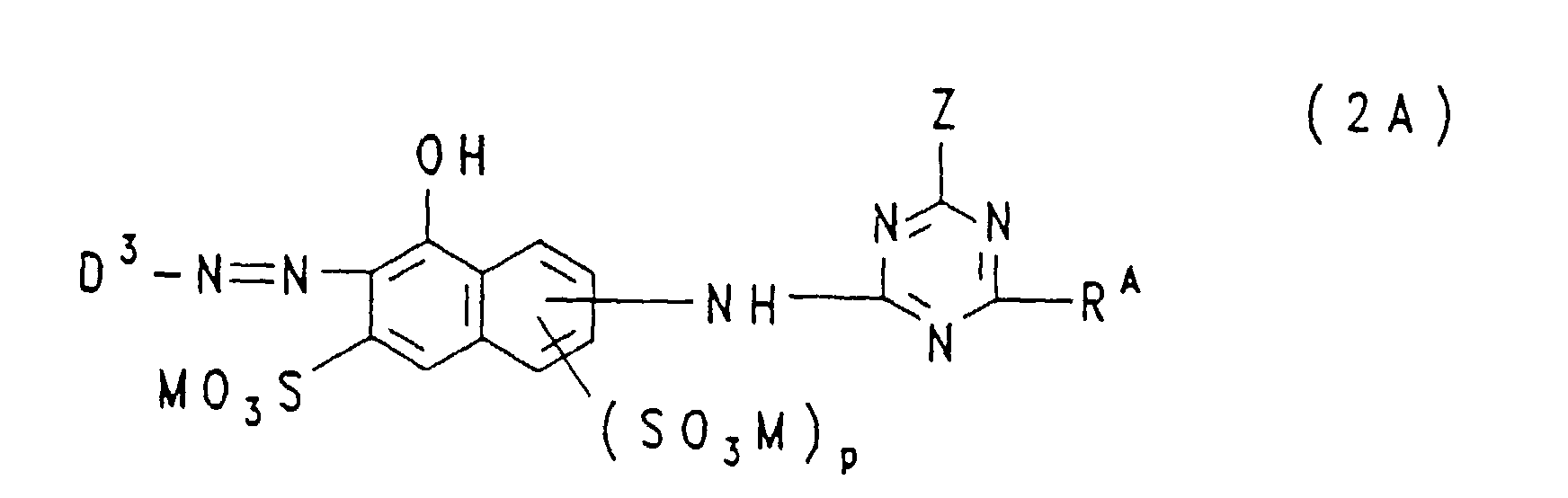
- the mixtures contain one or more, such as 2, 3 or 4, disazo dyes corresponding to the general formula (1) and one or more, such as 2 or 3, monoazo dyes corresponding to the general formula (2A) or (2B) or (2C) or a mixture of these monoazo dyes.
- the dyes of the general formula (1) are 95 to 50 wt .-%, the Dyes of the general formulas (2) to 5 to 50 wt .-%, each based on the total amount of these dyes of the general formulas (1) and (2), in the Mixtures included.
- the groups —NH — connected to the triazine residue are preferably in the 1-position to the respective 8-hydroxy-naphthalene residue, where m and n each represent the number 1 and these groups —SO 3 M in each case 3 or in the 4-position are bound to the respective 8-hydroxy-naphthalene radical; in the formulas (2A), (2B) and (2C), p is preferably the number zero and the group -NH- is preferably in the 2- or 3-position, particularly preferably in the 3-position, on the 8-hydroxy-naphthalene -Rest bound.
- the dyes contained in the mixtures according to the invention are known (e.g. from German Offenlegungsschriften No. 27 48 965 and 27 48 966, Japanese Patent Application Publications Hei-2-073 870 and Hei-2-202 956 and Korean Patent No. 86/594) or can be produced analogously to the information given there.
- Alkaline eliminable substituents which are in the ⁇ -position of the ethyl group of Y or Y 1 are, for example, halogen atoms, such as bromine and chlorine, ester groups of organic carboxylic and sulfonic acids, such as alkylcarboxylic acids, optionally substituted benzenecarboxylic acids and optionally substituted benzenesulfonic acids, such as the groups alkanoyloxy from 2 to 5 carbon atoms, of which in particular acetyloxy, benzoyloxy, sulfobenzoyloxy, phenylsulfonyloxy and tolylsulfonyloxy, furthermore acidic ester groups of inorganic acids, such as phosphoric acid, sulfuric acid and thiosulfuric acid (phosphato, sulfato and thiosulfato alkyl groups of each), as well as dialkylamino groups 1 to 4 carbon atoms, such as dimethylamin
- Y is preferably ⁇ -sulfatoethyl or vinyl and particularly preferably ⁇ -sulfatoethyl and Y 1 is ⁇ -sulfatoethyl, ⁇ -chloroethyl or vinyl and particularly preferably ⁇ -sulfatoethyl or vinyl.
- sulfo groups mean groups corresponding to the general formula -SO 3 M carboxy groups corresponding to the general formula -COOM, thiosulfato groups corresponding to the general formula -S-SO 3 M, phosphato groups corresponding to the general formula -OPO 3 M 2 and sulfato groups corresponding to the group general formula -OSO 3 M, in which M has the meaning given above.
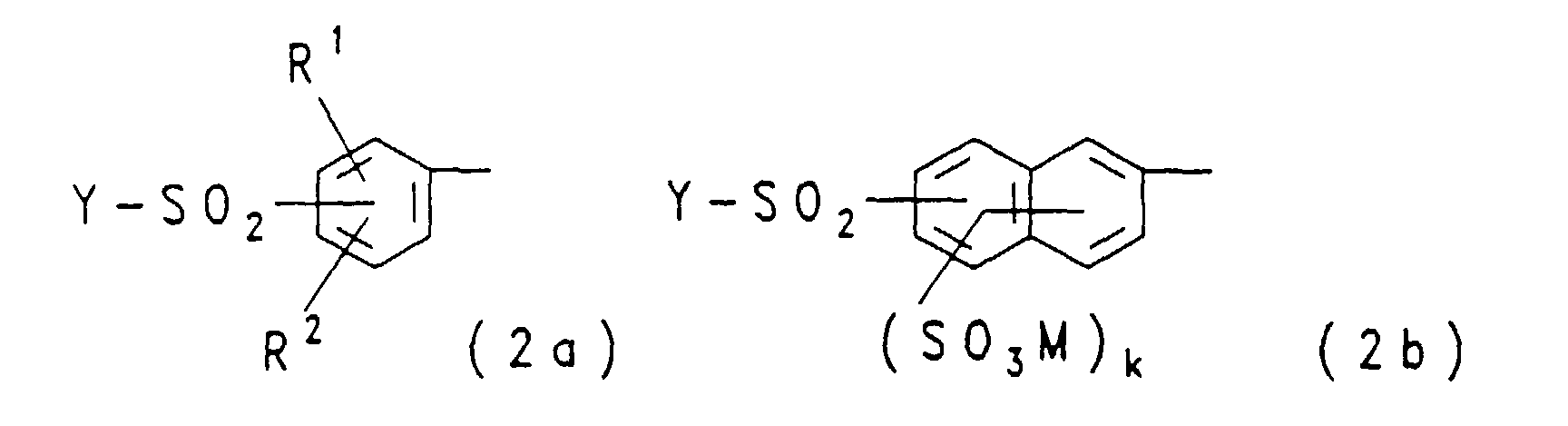
- Residues of the general formulas (2a) and (2b) are for example 3- ( ⁇ -sulfatoethylsulfonyl) phenyl, 4- ( ⁇ -sulfatoethylsulfonyl) phenyl, 2-methyl-5-methoxy-4- ( ⁇ -sulfatoethylsulfonyl) phenyl, 2-methoxy-5- ( ⁇ -sulfatoethylsulfonyl) phenyl, 2,5-dimethoxy-4- ( ⁇ -sulfatoethylsulfonyl) phenyl, 1-sulfo-6- ( ⁇ -sulfatoethylsulfonyl) naphth-2-yl, 6-sulfo-8- ( ⁇ -sulfatoethylsulfonyl) -naphth-2-yl, 8-sulfo-6- ( ⁇ -sulfatoethylsulfon
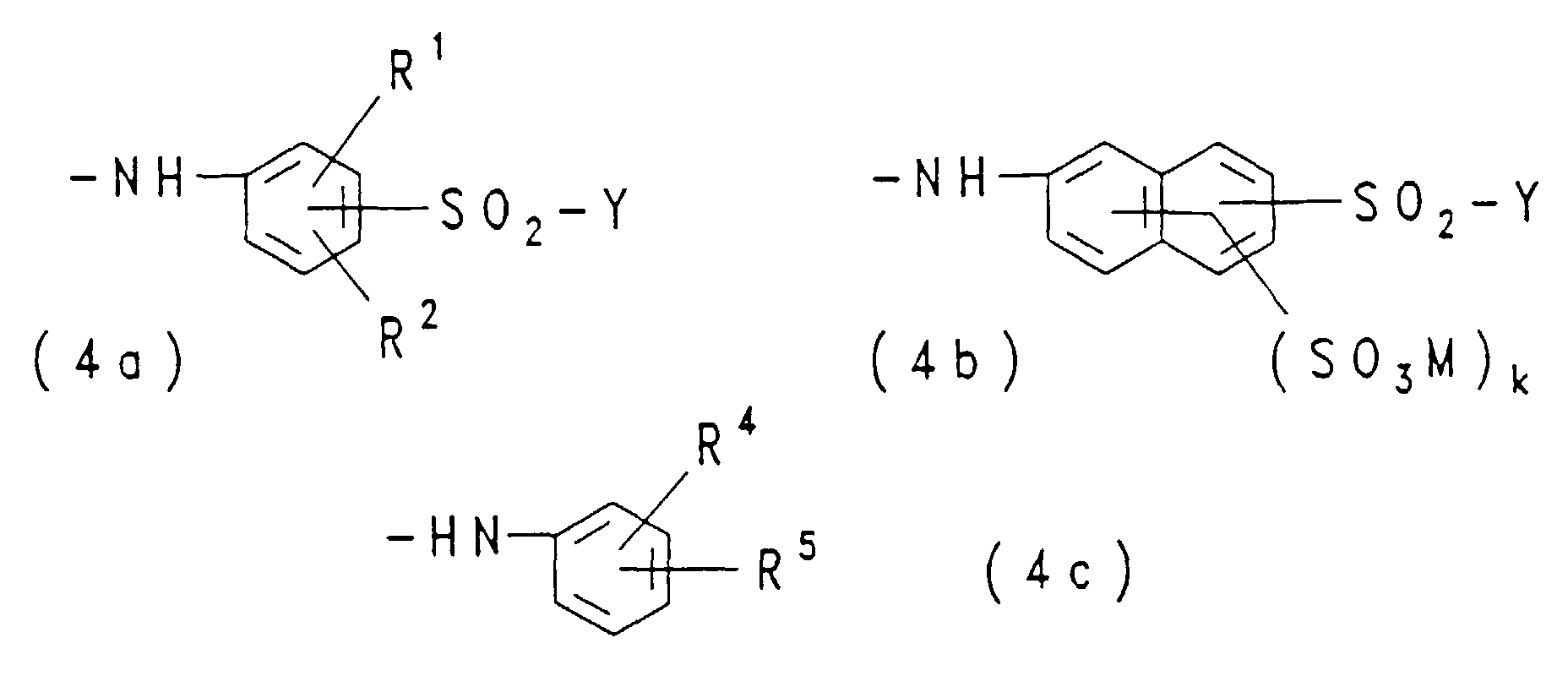
- Residues of the general formulas (4a), (4b) and (4c) are for example 3- ( ⁇ -sulfatoethylsulfonyl) phenyl, 4- ( ⁇ -sulfatoethylsulfonyl) phenyl, 2-methyl-5-methoxy-4- ( ⁇ -sulfatoethylsulfonyl) phenyl, 2-methoxy-5- ( ⁇ -sulfatoethylsulfonyl) phenyl, 2,5-dimethoxy-4- ( ⁇ -sulfatoethylsulfonyl) phenyl, 1-sulfo-6- ( ⁇ -sulfatoethylsulfonyl) naphth-2-yl, 6-sulfo-8- ( ⁇ -sulfatoethylsulfonyl) -naphth-2-yl, 8-sulfo-6- ( ⁇ -sulfatoethyls
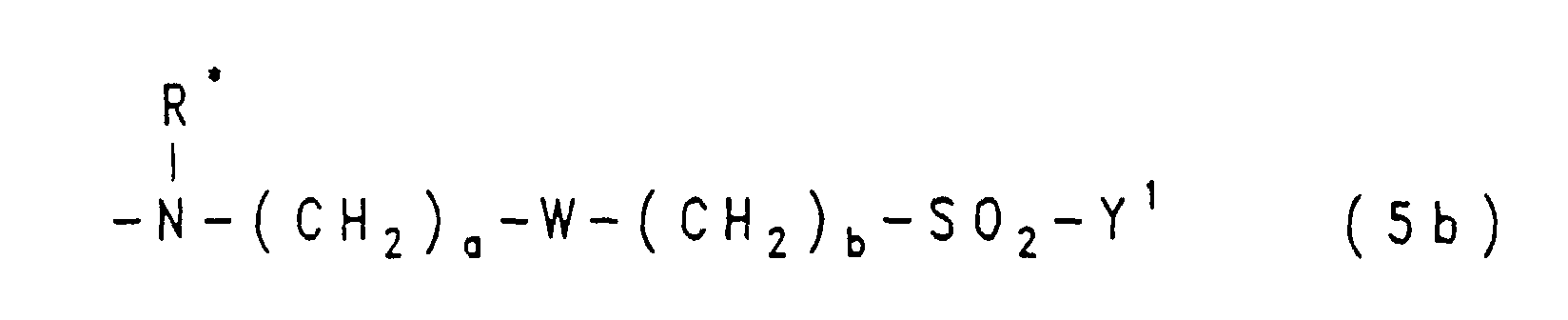
- Residues of the general formulas (5a), (5b) and (5c) are for example ⁇ - ( ⁇ -sulfatoethylsulfonyl) propylamino, N-phenyl-N- [ ⁇ - ( ⁇ '-sulfatoethylsulfonyl) propyl] amino, ⁇ - ( ⁇ '-chloroethylsulfonyl) ethylamino, N-phenyl-N- [ ⁇ - ( ⁇ '-sulfatoethylsulfonyl) ethyl] amino, Bis-N, N- [ ⁇ - ( ⁇ '-chloroethylsulfonyl) ethyl] amino, Bis-N, N- [ ⁇ - (vinylsulfonyl) ethyl] amino, 3- ( ⁇ -sulfatoethylsulfonyl) phenylamino, 4- ( ⁇ -sulfatoethyl
- the dye mixtures according to the invention preferably contain the or the 90 to 50% by weight of disazo dyes of the formula (1) and the or Monoazo dyes of the formulas (2) at 10 to 50 wt .-%; are preferred dye mixtures from the dyes of the general formulas (1) and (2) 85 to 55% by weight of the disazo dyestuff of the formula (1) and the monoazo dye or formulas (2) to 15 to 45 wt .-% contain.
- the dyes of the formulas (1) and (2) can have different structures with regard to the fiber-reactive groups -SO 2 -Y and -SO 2 -Y 1 .
- the dye mixtures can contain dyes of the same chromophore according to the general formula (1) and dyes of the same chromophore according to one of the general formulas (2) in which the fiber-reactive groups -SO 2 -Y and -SO 2 -Y 1 contain vinylsulfonyl groups and other ⁇ -chloroethylsulfonyl or thiosulfatoethylsulfonyl or preferably ⁇ -sulfatoethylsulfonyl groups.
- the dye mixtures contain the respective dye components in the form of a vinylsulfonyl dye
- the amount of dye in the respective vinylsulfonyl dye in relation to the respective ⁇ -chloro or ⁇ -thiosulfato or sulfatoethylsulfonyl dye is up to about 30 mol%, based on the respective dye chromophore , in front.
- Dye mixtures in which the proportion of the vinylsulfonyl dyes to the ⁇ -sulfatoethylsulfonyl dyes in Molar ratio is between 5:95 and 30:70.
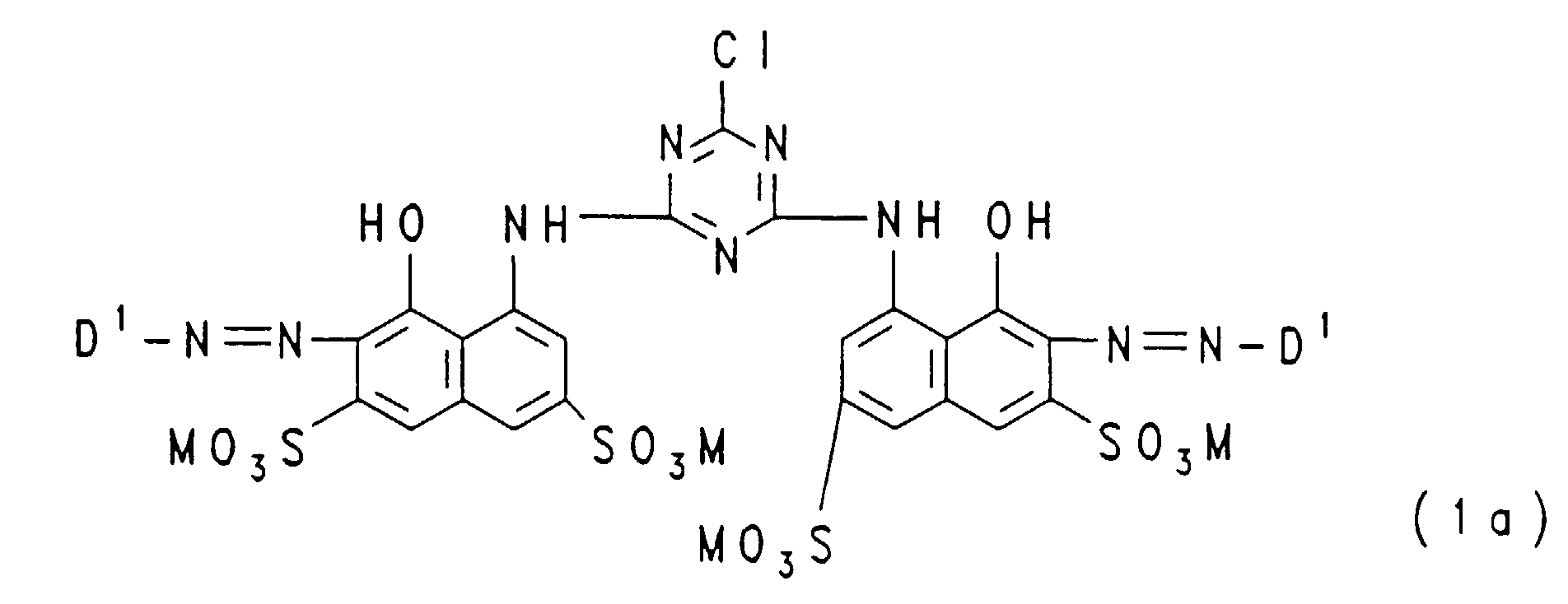
- dyes of the general formula (1a) are preferred in which D 1 each represents one of the, particularly preferred, groups described above for the formulas (2a) and (2b).
- D 3 is 2-methoxy-5- ( ⁇ -sulfatoethylsulfonyl) phenyl or 2,5-dimethoxy-4- ( ⁇ -sulfatoethylsulfonyl) phenyl or vinylsulfonyl
- p represents the number zero, the triazinylamino group in the 2- or 3-position, preferably in the 3-position, to which the 8-naphthol radical is bonded
- Z represents chlorine or preferably fluorine and R A is chlorine , Morpholino or a group of the general formula (4c) given above, in which R 4 is hydrogen, sulfo, methyl or methoxy and R 5 is hydrogen, sulfo or methyl.
- Dye mixtures of one or more disazo dyes corresponding to the general formula (1) are preferred, in which m and n have the meanings given above, X is chlorine and D 1 and D 2 are identical or different from one another, one of the abovementioned for the formula radical ( 2a) or (2b) is a radical, and one or more monoazo dyes corresponding to the general formula (2A), in which m and p have the meanings given above, D 3 is 3- or 4- ( ⁇ -thiosulfatoethylsulfonyl) phenyl or 3 - or 4- (vinylsulfonyl) phenyl or 3- or 4- ( ⁇ -sulfatoethylsulfonyl) phenyl, Z is chlorine and R A is chlorine or 4-hydroxy-3-sulfo-phenylamino, in which case both Vinylsulfonyl and ⁇ -sulfatoethylsulfonyl groups are present in the dye mixtures, and the m
- the dye mixtures according to the invention can be prepared in solid form or in liquid (dissolved) form. They generally contain the at water-soluble and in particular fiber-reactive dyes usual Electrolyte salts such as sodium chloride, potassium chloride and sodium sulfate, and can also contain the usual auxiliaries in commercial dyes, such as Buffer substances that have a pH in aqueous solution between 3 and 7 able to adjust, such as sodium acetate, sodium borate, Sodium bicarbonate, sodium dihydrogen phosphate and Disodium hydrogenphosphate, when in solid form, small amounts of Desiccant and in liquid, aqueous solution (including the content of Thickeners, as they are common with printing pastes) substances that Ensure durability of these preparations, such as anti-mold agents.
- Electrolyte salts such as sodium chloride, potassium chloride and sodium sulfate
- auxiliaries in commercial dyes such as Buffer substances that have a pH in aqueous solution between 3 and 7 able to adjust, such as sodium a
- the dye mixtures are in the form of a dye powder Content of electrolyte salt, which is also referred to as adjusting agent, from 10 to 80% by weight, based on the dye powder or the preparation.
- This Dye powder can also contain the buffer substances mentioned in one Total amount of up to 5%, based on the dye powder.
- the content of the mixtures according to the invention is in these aqueous solutions between 0.1 and 55 wt .-%, usually between 5 and 50 wt .-%.
- the electrolyte salt content in these aqueous solutions is preferably below 10% by weight, based on the aqueous solution; the aqueous solutions (liquid preparations) contain the mentioned Buffer substances usually in an amount of 0.1 to 5 wt .-%, preferred from 0.3 to 2% by weight.
- the dye mixtures according to the invention can be prepared in a customary manner, for example by mechanical mixing of the individual dyes in the required proportions or, if D 2 and D 3 are D 1 , by synthesis using the customary diazotization and coupling reactions using appropriate mixtures of diazo - And coupling components in a manner familiar to the person skilled in the art and the proportions required for this.
- aqueous solutions of the corresponding two coupling components such as a bis- (mono- or disulfo-hydroxynaphthylamino) chlorotriazine as coupling component of the dyes of the general formula (1) and a coupling component of the general formula (6 ) with M, p, Z and R B of the meaning given above and aqueous solutions or suspensions of the diazo components of the compounds of the general formula D 1 -NH 2 with D 1 of the meaning given above in the corresponding proportions with one another at a pH between 3 and 6 implements (couples).
- the dye mixture obtained in this way can be isolated from the solution in a customary manner, for example by salting out with an electrolyte salt, such as sodium chloride, potassium chloride or lithium chloride, or by spray drying.
- Dye mixtures in which the dye chromophores, for example in addition to a .beta.-chloroethylsulfonyl or .beta.-thiosulfatoethylsulfonyl or .beta.-sulfatoethylsulfonyl group, also contain portions having vinylsulfonyl groups can, in addition to the above-mentioned method, also be prepared by using appropriate vinylsulfonyl starting anilines in such a way that the dye mixture in which Y and / or Y 1 represents a ⁇ -chloroethyl or ⁇ -thiosulfatoethyl or ⁇ -sulfatoethyl radical is reacted with an amount of alkali required only for a part of these groups, and in this case part of the stated ⁇ -substituted ethylsulfonyl groups converted into the vinylsulfonyl groups.
- the dye mixtures according to the invention from the dyes of the formulas (1) and (2) provide numerous after those in the art for fiber-reactive dyes described application and fixing methods on hydroxy and / or Fiber materials containing carbonamide groups with orange to red dyeings good color build-up and good washability of unfixed dye components.
- the dyeings obtained can be easily etched.
- they are Mixtures very well as combination dyes in combination dyes with other dyes.
- the present invention therefore also relates to the use of dye mixtures according to the invention or of the dyes of the formulas (1) and (2) together for dyeing (including printing and in the Combination dyeing) of hydroxyl and / or carbonamide groups Fiber materials or processes for dyeing such fiber materials under Use of a dye mixture according to the invention or the dyes of the formulas (1) and (2) together, by applying them in solution to the Applied substrate and the dyes by the action of an alkaline acting agent or by heat or by both measures on the fiber fixed.
- Materials containing hydroxyl groups are natural or synthetic materials containing hydroxyl groups, such as cellulose fiber materials, also in the form of paper, or their regenerated products and polyvinyl alcohols.
- Cellulose fiber materials are preferably cotton, but also others Vegetable fibers such as linen, hemp, jute and ramie fibers; regenerated Cellulose fibers are, for example, cellulose and viscose rayon.
- Materials containing carbonamide groups are, for example, synthetic and natural polyamides and polyurethanes, especially in the form of fibers, for example wool and other animal hair, silk, leather, polyamide-6,6, Polyamide-6, polyamide-11 and polyamide-4.
- the dye mixtures according to the invention are used after generally known methods for dyeing and printing fiber materials according to the known application techniques for fiber-reactive dyes.
- the dyes of the dye mixtures according to the invention to one another show good combination behavior
- the invention Dye mixtures are also used with advantage in the pull-out dyeing process become. Accordingly, they can be obtained with cellulose fibers, for example after pulling out from a long liquor at temperatures between 40 and 105 ° C, optionally at temperatures up to 130 ° C under pressure, and optionally in the presence of conventional dyeing aids
- Use of acid-binding agents and optionally neutral salts, such as sodium chloride or sodium sulfate dyeings in very good color yields and with an excellent color structure and the same nuance.
- the acid-binding and the fixation of the dyes on the cellulose fibers effecting agents are, for example, water-soluble basic salts of Alkali metals and the alkaline earth metals of inorganic or organic Acids, as well as compounds that release alkali in the heat.
- the alkali metal hydroxides and alkali metal salts of to name weak to moderate inorganic or organic acids, of the alkali compounds preferably the sodium and Potassium compounds are meant.
- Such acid-binding agents are for example sodium hydroxide, potassium hydroxide, sodium carbonate, Sodium bicarbonate, potassium carbonate, sodium formate, Sodium dihydrogen phosphate and disodium hydrogen phosphate.
- the dyes of the invention are chemically attached to the cellulose fiber bound; in particular the cellulose dyeings show the usual Post-treatment by rinsing to remove unfixed ones Dye proportions have excellent wet fastness properties, especially since they did not fix Wash out dye parts easily because of their good cold water solubility to let.
- the dyeings on polyurethane and polyamide fibers are usually made from acidic environment. So you can, for example, the dyebath acetic acid and / or ammonium sulfate or acetic acid and ammonium acetate or Add sodium acetate to get the desired pH.
- leveling aids such as based on a Reaction product of cyanuric chloride with three times the molar amount of one Aminobenzenesulfonic acid or aminonaphthalenesulfonic acid or based on a Reaction product of, for example, stearylamine with ethylene oxide.
- the material to be colored is at a temperature of around 40 ° C Bath introduced, moved there for some time, then the dye bath on the desired weakly acidic, preferably weakly acetic acid pH adjusted and the actual coloring at a temperature between 60 and 98 ° C carried out.
- the dyeings can also at boiling temperature or at temperatures up to 120 ° C (under pressure).
- Parts by weight are Parts by weight, the percentages are percentages by weight, if not noted otherwise. Parts by weight are in relation to parts by volume Kilograms to liters.
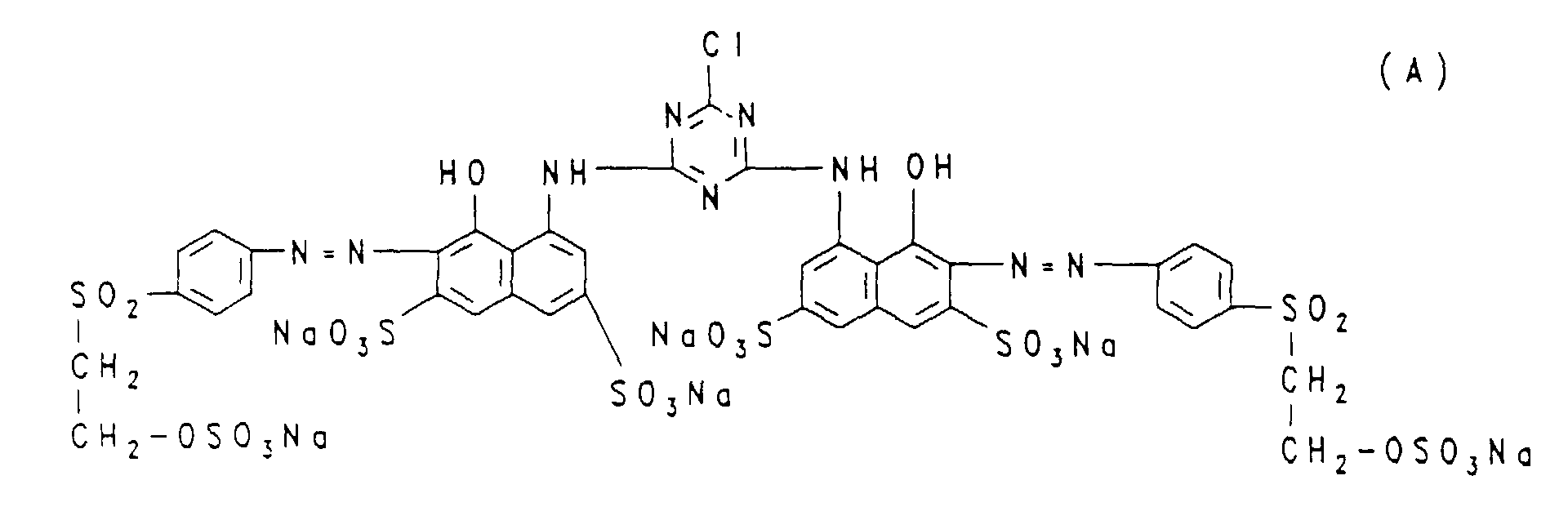
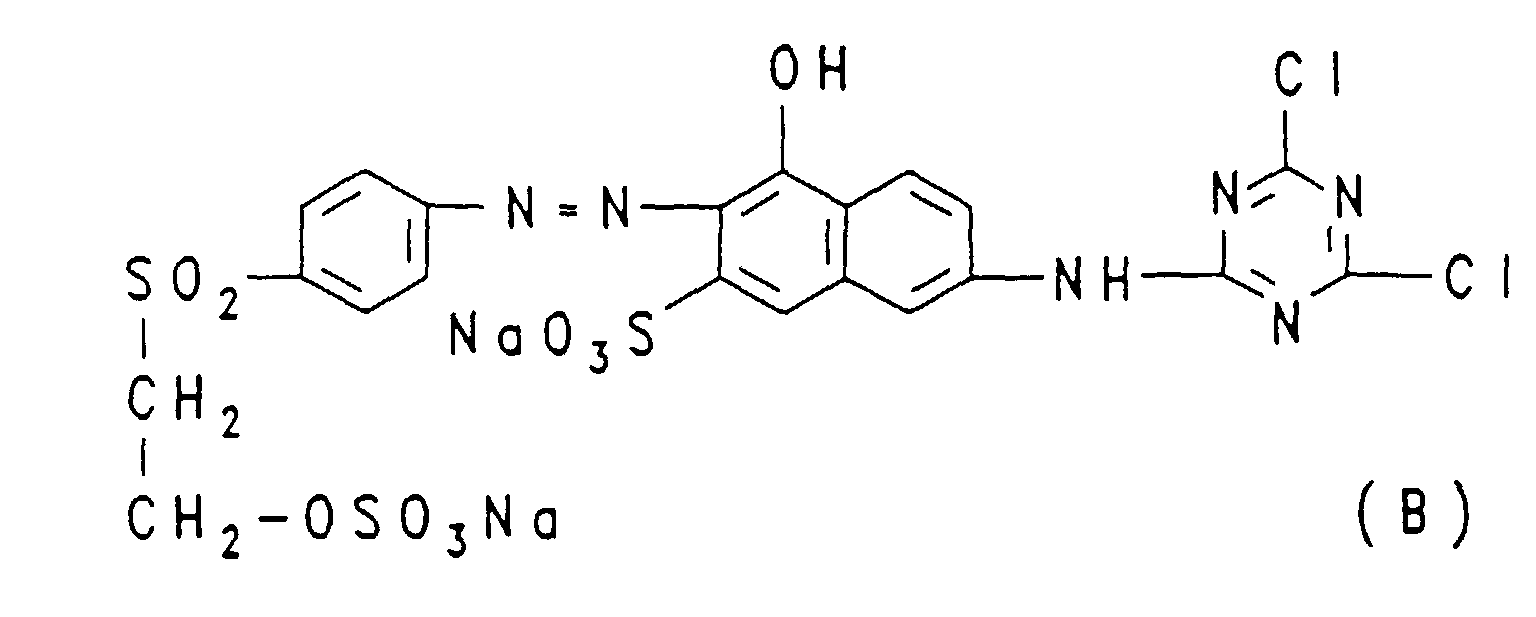
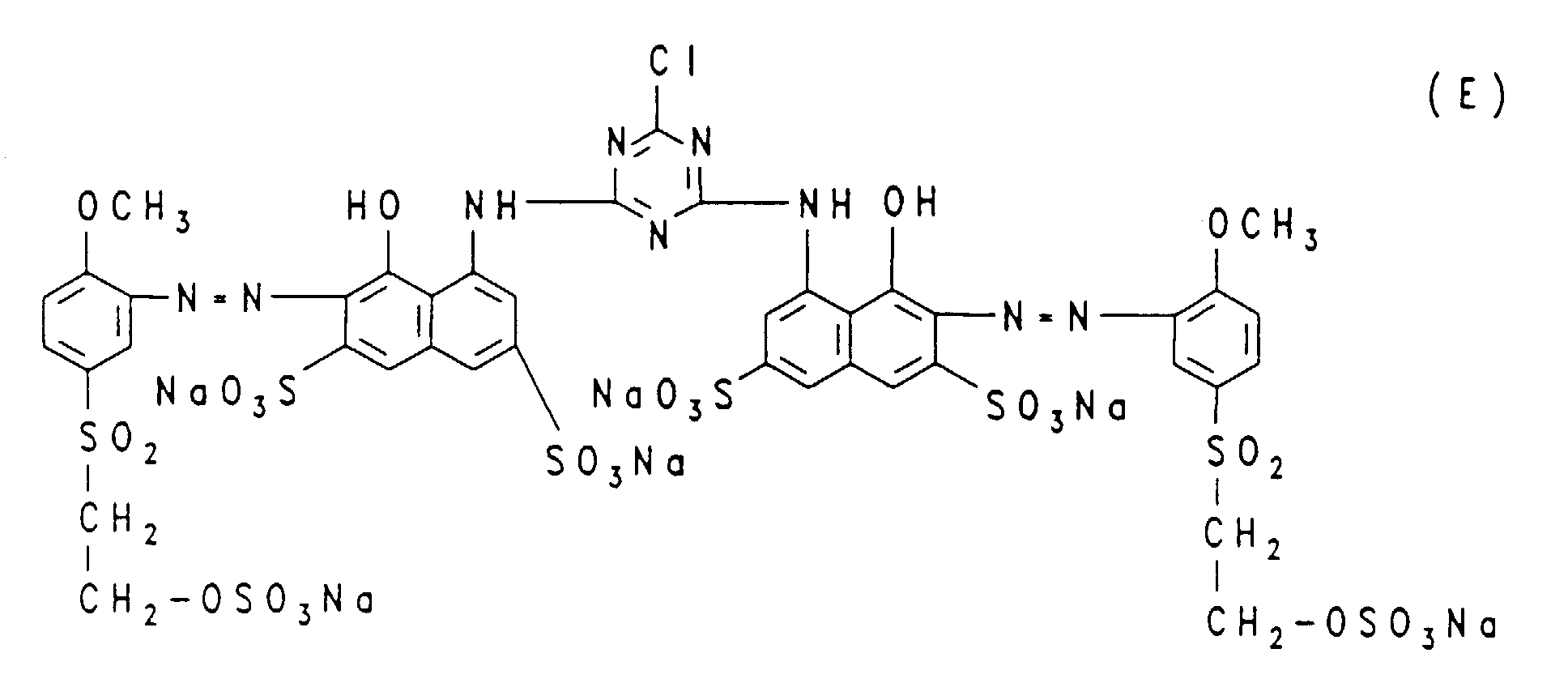
- an electrolyte-containing dye powder which contains the red disazo dye of the formula (A) (known from Example 1 of German Patent 2,748,965) contains 50%, 72.6 parts of an electrolyte-containing dye powder which contains the orange monoazo dye of the formula (B) contains 50%, mixed in a mechanical mixer.
- the dye mixture according to the invention obtained, in accordance with the application and fixing processes customary in the art for fiber-reactive dyes, gives dyeings and prints in deep orange tones, for example on cellulose fibers.
- Example 1 Formulas (A) and (B) in a ratio of 40:60 Man receives a dye solution in which the dyes mentioned in Example 1 Formulas (A) and (B) in a ratio of 40:60 are included.
- This Dye solution can be made by adding 5 parts of a sodium phosphate buffer be adjusted to a pH of 4.5. By further dilution with Water or by evaporating the solution can make it liquid.
- dye mixture to the desired strength for one Liquid preparation can be set, which in the usual way either directly, optionally after adding the appropriate amount of an alkaline acting agent, used as a dye bath or as a dyeing liquor or Preparation of a dye bath or dye liquor can be supplied.
- Man receives deep orange colorations with this dye mixture.
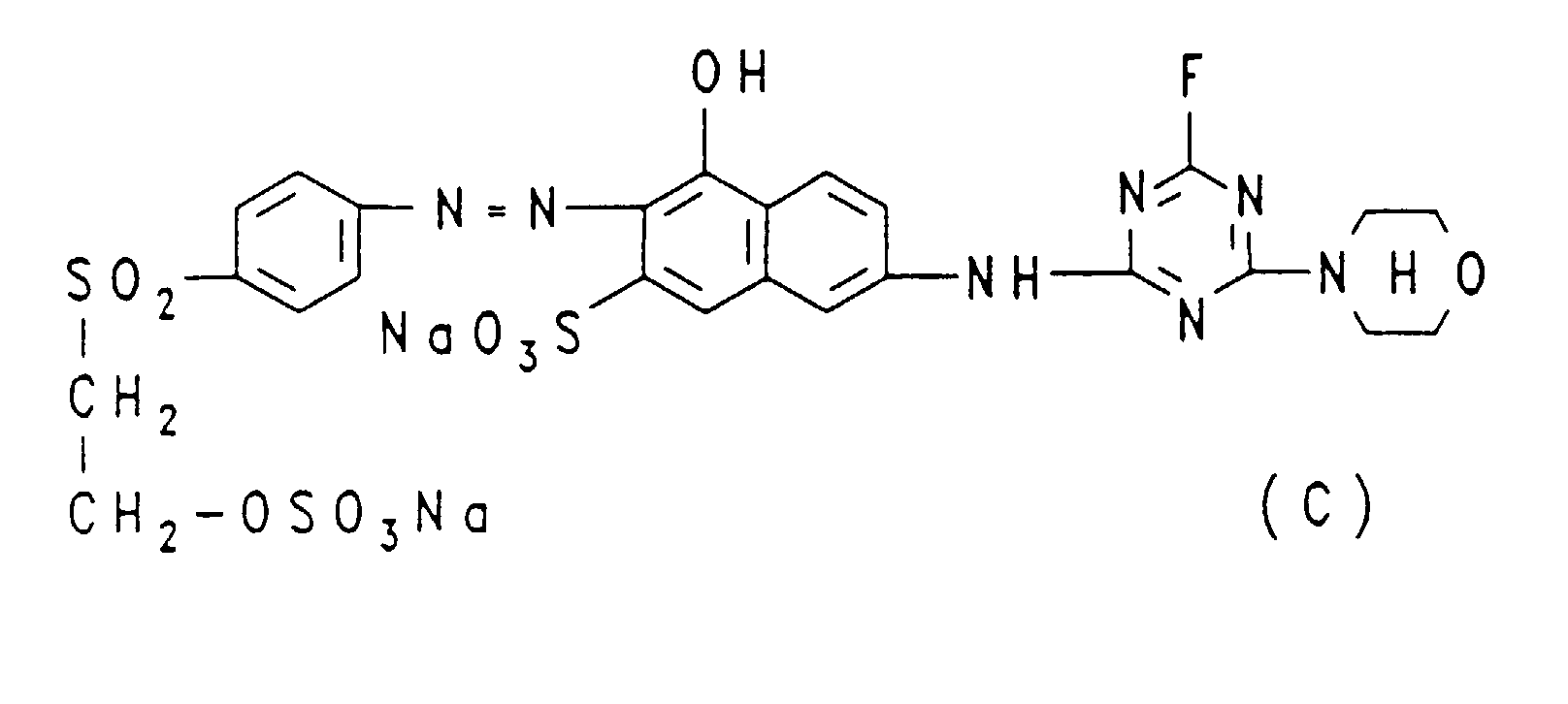
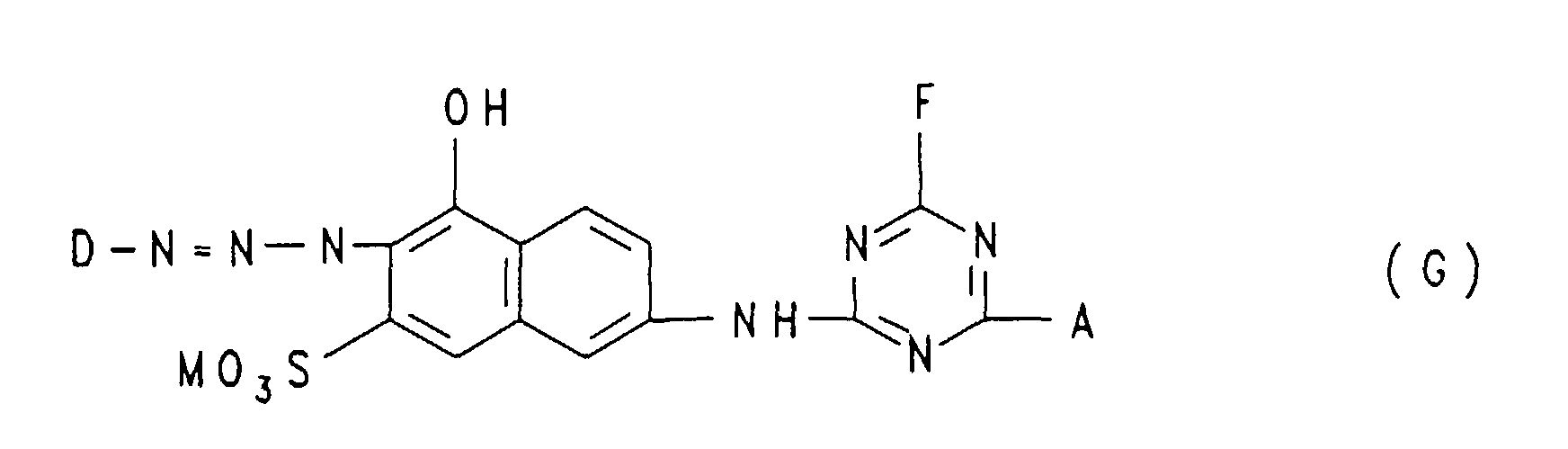
- Dye of formula (G) Mix hue Rest D Rest A ratio (A) :( G) in% by weight 7 1,5-disulfonaphth-2-yl ⁇ - ( ⁇ '-sulfato-ethylsulfonyl) propylamino 75: 25 red 8th dito dito 50: 50 orange 9 dito dito 65: 35 Red orange 10th dito N-phenyl-N- [ ⁇ - ( ⁇ '-sulfatoethylsulfonyl) propyl] amino 55: 45 orange 11 dito dito 70:30 red 12th dito N-phenyl-N- [ ⁇ - ( ⁇ '-sulfatoethylsulfonyl) ethyl] amino 60: 40 orange 13 dito dito 75: 25 red 14 dito Bis-N, N- [ ⁇ - ( ⁇ '-chloroethylsulfonyl) ethyl] amino 60: 40 orange 15 dito dito 65: 35 red 16 dito Bis
Landscapes
- Chemical & Material Sciences (AREA)
- Chemical Kinetics & Catalysis (AREA)
- Organic Chemistry (AREA)
- Engineering & Computer Science (AREA)
- Textile Engineering (AREA)
- Coloring (AREA)
- Heterocyclic Carbon Compounds Containing A Hetero Ring Having Nitrogen And Oxygen As The Only Ring Hetero Atoms (AREA)
- Organic Low-Molecular-Weight Compounds And Preparation Thereof (AREA)
Description



- M
- ist Wasserstoff oder ein Alkalimetall, wie Natrium, Kalium oder Lithium;
- D1
- ist eine Gruppe der allgemeinen Formel (2a) oder (2b)
in welchen
- R1
- Wasserstoff, Methyl, Ethyl, Methoxy, Ethoxy, Sulfo oder Carboxy, bevorzugt Wasserstoff, ist,
- R2
- Wasserstoff, Methyl, Ethyl, Methoxy, Ethoxy oder Sulfo, bevorzugt Wasserstoff oder Methoxy, insbesondere Wasserstoff, ist,
- Y
- Vinyl ist oder Ethyl ist, das in β-Stellung einen Substituenten enthält, der durch Alkali unter Bildung der Vinylgruppe eliminierbar ist,
- M
- die obengenannte Bedeutung hat und
- k
- für die Zahl Null, 1 oder 2 steht (wobei im Falle von k gleich Null diese Gruppe für Wasserstoff steht);
- D2
- hat eine der für D1 angegebenen Bedeutungen;
- D3
- hat eine der für D1 angegebenen Bedeutungen;
- D
- ist eine Gruppe der allgemeinen Formel (3a) oder (3b)
in welchen

- R3
- Wasserstoff, Methoxy, Ethoxy, Methyl oder Ethyl ist,
- M
- die obengenannte Bedeutung hat,
- r
- für die Zahl Null, 1 oder 2 steht (wobei im Falle von r gleich Null diese Gruppe Wasserstoff bedeutet) und
- s
- die Zahl 1, 2 oder 3 ist;
- X
- ist Chlor, Fluor, Hydroxy, Cyanoamino oder Alkylamino von 1 bis 4 C-Atomen, wie Methylamino oder Ethylamino, bevorzugt Chlor oder Fluor;
- m
- ist die Zahl Null oder 1 (wobei im Falle von m gleich Null diese Gruppe Wasserstoff bedeutet);
- n
- ist die Zahl Null oder 1 (wobei im Falle von n gleich Null diese Gruppe Wasserstoff bedeutet);
- p
- ist die Zahl Null oder 1 (wobei im Falle von p gleich Null diese Gruppe Wasserstoff bedeutet);
- Z
- ist Chlor oder Fluor;
- RA
- ist Chlor, Hydroxy, Phenoxy, Morpholino oder eine Gruppe der
allgemeinen Formel (4a), (4b) oder (4c)
in welchen
- R1, R2, Y, M und k
- eine der obengenannten Bedeutungen haben,
- R4
- Wasserstoff, Sulfo, Carboxy, Methyl, Ethyl, Methoxy, Ethoxy oder Hydroxy ist und
- R5
- Wasserstoff, Sulfo, Methyl, Ethyl, Methoxy oder Ethoxy bedeutet;
- RB
- ist eine Gruppe der allgemeinen Formel (5a), (5b) oder (5c)

 in welchen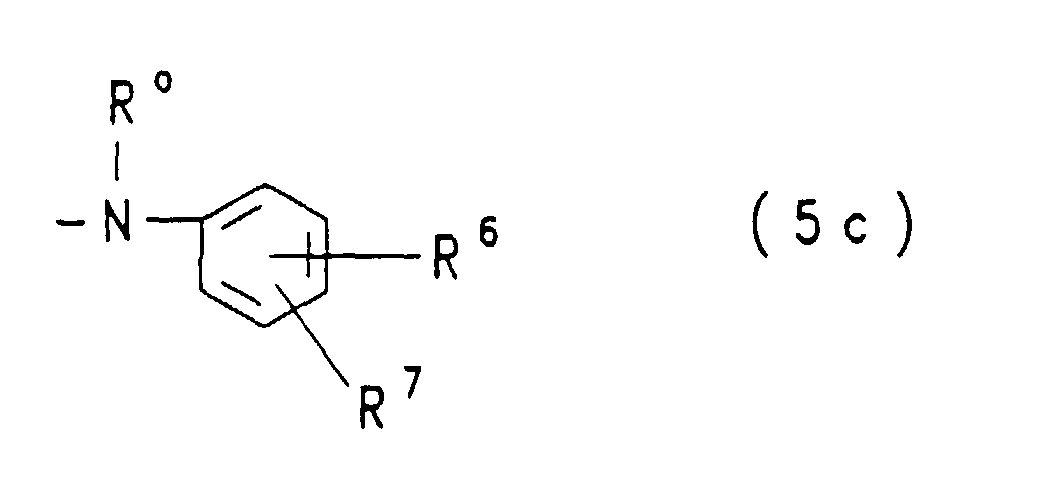
- Y1
- eine der obengenannten Bedeutungen hat,
- R
- Wasserstoff oder Phenyl ist, das durch 1 oder 2 Substituenten aus der Gruppe Methyl, Ethyl, Methoxy, Ethoxy, Sulfo und Carboxy substituiert sein kann, oder Alkyl von 1 bis 4 C-Atomen, wie Ethyl oder Methyl, ist oder eine Gruppe der allgemeinen Formel -(CH2)a-SO2-Y1 mit Y1 der oben angegebenen Bedeutung und mit a gleich der Zahl 1, 2 oder 3 ist,
- a
- die Zahl 1, 2 oder 3 ist,
- b
- die Zahl 2 oder 3 ist,
- W
- für eine Gruppe der Formel -O- oder -NH- steht,
- R*
- Wasserstoff oder Phenyl ist, das durch 1 oder 2 Substituenten aus der Gruppe Methyl, Ethyl, Methoxy, Ethoxy, Sulfo und Carboxy substituiert sein kann, oder Alkyl von 1 bis 4 C-Atomen, wie Ethyl oder Methyl, ist oder eine Gruppe der allgemeinen Formel -(CH2)a-W-(CH2)b-SO2-Y1 mit a, b, W und Y1 der oben angegebenen Bedeutung ist,
- Ro
- Wasserstoff, Methyl, Ethyl oder β-Sulfoethyl ist,
- R6
- Wasserstoff, Methyl, Ethyl, Methoxy, Ethoxy, Sulfo, Carboxy, Hydroxy oder eine Gruppe der allgemeinen Formel -(CH2)a-SO2-Y mit Y und a der obengenannten Bedeutung ist und
- R7
- Wasserstoff, Methoxy, Ethoxy oder Sulfo bedeutet.

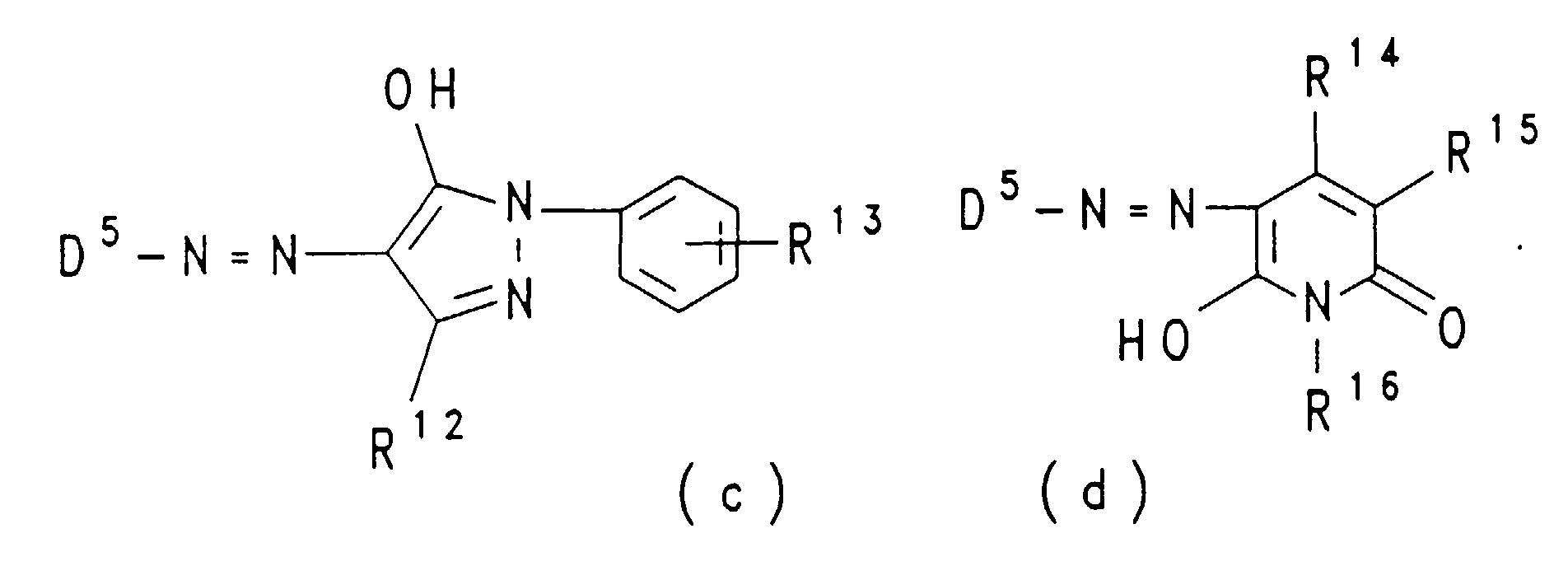
- D5
- ist 3-(β-Sulfatoethylsulfonyl)-phenyl, 4-(β-Sulfatoethylsulfonyl)-phenyl, 3-Vinylsulfonyl-phenyl, 4-Vinylsulfonyl-phenyl, 2-Methoxy-5-(β-sulfatoethylsulfonyl)-phenyl oder 2-Methoxy-5-vinylsulfonyl-phenyl;
- M
- hat eine der obengenannten Bedeutungen;
- R10
- ist Acetyl, Benzoyl, 4,6-Di-cyanamido-1,3,5-triazin-2-yl, 4-Cyanamido-6-(sulfophenylamino)-1,3,5-triazin-2-yl, 4-(N-Morpholino)-6-(sulfophenylamino)-1,3,5-triazin-2-yl oder 4-(N-Morpholino)-6-(sulfophenylamino)-1,3,5-triazin-2-yl, das im Benzolkern durch Methyl oder Methoxy substituiert ist;
- R11
- ist Acetyl, Carbamoyl, 4,6-Di-cyanamido-1,3,5-triazin-2-yl, 4-Cyanamido-6-(sulfophenylamino)-1,3,5-triazin-2-yl, 4-(N-Morpholino)-6-(sulfophenylamino)-1,3,5-triazin-2-yl oder 4-(N-Morpholino)-6-(sulfophenylamino)-1,3,5-triazin-2-yl, das im Benzolkern durch Methyl oder Methoxy substituiert ist;
- R12
- ist Methyl oder Carboxy;
- R13
- ist Sulfo, β-Chlorethylsulfonyl oder β-Sulfatoethylsulfonyl;
- R14
- ist Wasserstoff oder Methyl;
- R15
- ist Wasserstoff, Cyano, Carbamoyl, Carboxy oder Sulfomethyl;
- R16
- ist Methyl, Ethyl oder β-Sulfoethyl.



| Bsp. | Farbstoff der Formel (G) | Mischungs | Farbton | |
| Rest D | Rest A | verhältnis (A):(G) in Gew.-% | ||
| 7 | 1,5-Disulfo-naphth-2-yl | γ-(β'-Sulfato-ethylsulfonyl)-propylamino | 75 : 25 | rot |
| 8 | dito | dito | 50 : 50 | orange |
| 9 | dito | dito | 65 : 35 | rotorange |
| 10 | dito | N-Phenyl-N-[γ-(β'-sulfatoethylsulfonyl)-propyl]-amino | 55 : 45 | orange |
| 11 | dito | dito | 70 : 30 | rot |
| 12 | dito | N-Phenyl-N-[β-(β'-sulfatoethylsulfonyl)-ethyl]-amino | 60 : 40 | orange |
| 13 | dito | dito | 75 : 25 | rot |
| 14 | dito | Bis-N,N-[β-(β'-chlorethylsulfonyl)-ethyl]-amino | 60 : 40 | orange |
| 15 | dito | dito | 65 : 35 | rot |
| 16 | dito | Bis-N,N-(β-vinylsulfonyl-ethyl)-amino | 60 : 40 | orange |
| 17 | dito | dito | 50 : 50 | orange |
| 18 | dito | 3-(β-Sulfatoethylsulfonyl)-phenylamino | 60 : 40 | orange |
| 19 | 4-Methyl-2-sulfophenyl | γ-(β'-Sulfatoethylsulfonyl)-propylamino | 75 : 25 | rot |
| 20 | dito | N-Phenyl-N-[γ-(β'-sulfatoethylsulfonyl)-propyl]-amino | 60 : 40 | orange |
| 21 | dito | dito | 75 : 25 | rot |
| 22 | dito | N-Phenyl-N-[β-(β'-sulfatoethylsulfonyl)-ethyl]-amino | 60 : 40 | orange |
| 23 | dito | dito | 70 : 30 | scharlach |
| 24 | dito | Bis-N,N-[β-(β'chlorethylsulfonyl)-ethyl]-amino | 60 : 40 | orange |
| 25 | dito | dito | 75 : 25 | rot |
| 26 | dito | Bis-N,N-(β-vinylsulfonyl-ethyl)-amino | 65 : 35 | rotorange |
| 27 | dito | dito | 75 : 25 | rot |
| 28 | dito | 3-(β-Sulfatoethylsulfonyl)-phenylamino | 60 : 40 | orange |
Claims (7)
- Farbstoffmischung, enthaltend einen oder mehrere Disazofarbstoffe entsprechend der allgemeinen Formel (1) und einen oder mehrere Monoazofarbstoffe der allgemeinen Formel (2A) oder (2B) oder (2C) oder eine Mischung dieser Monoazofarbstoffe in einem Verhältnis der Farbstoffe (1) zu den Farbstoffen (2) von 95 bis 50 Gew.-% zu 5 bis 50 Gew.-%:

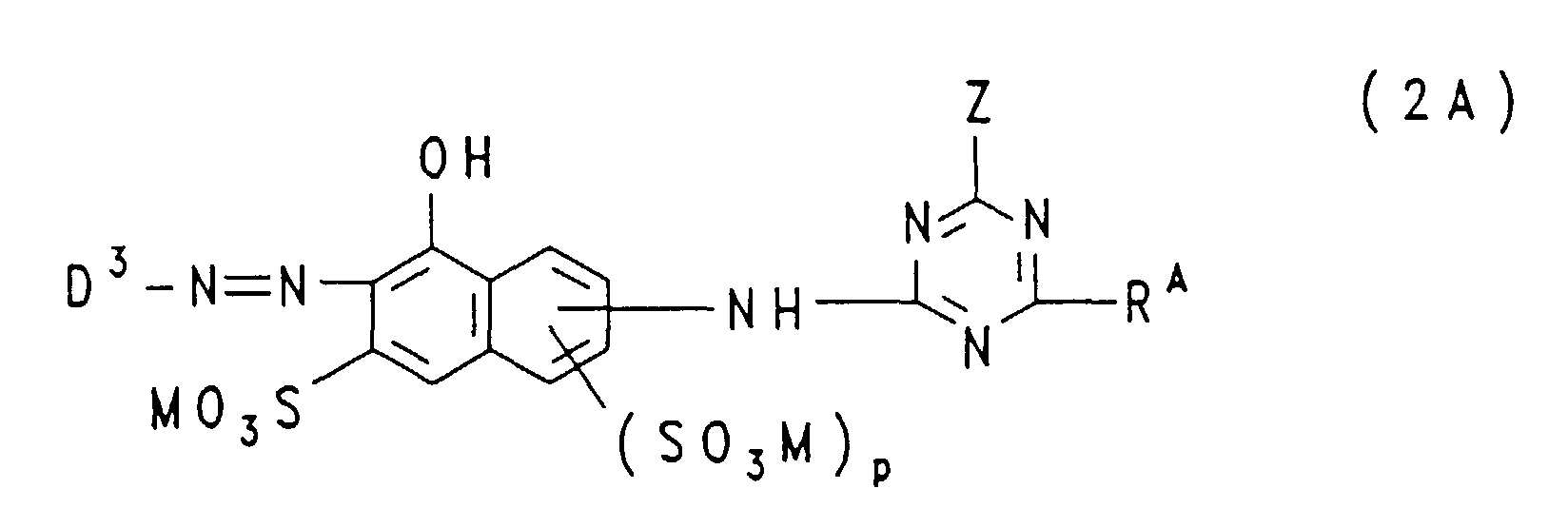
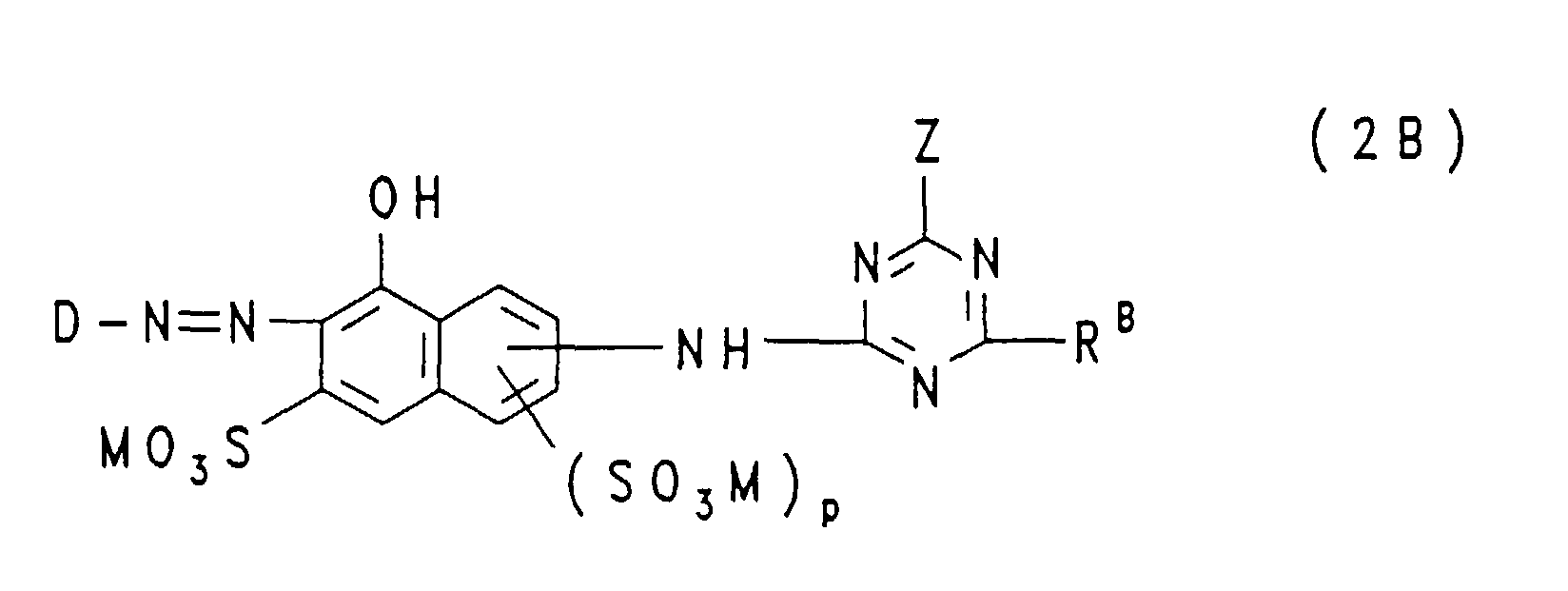 In diesen Formeln bedeuten: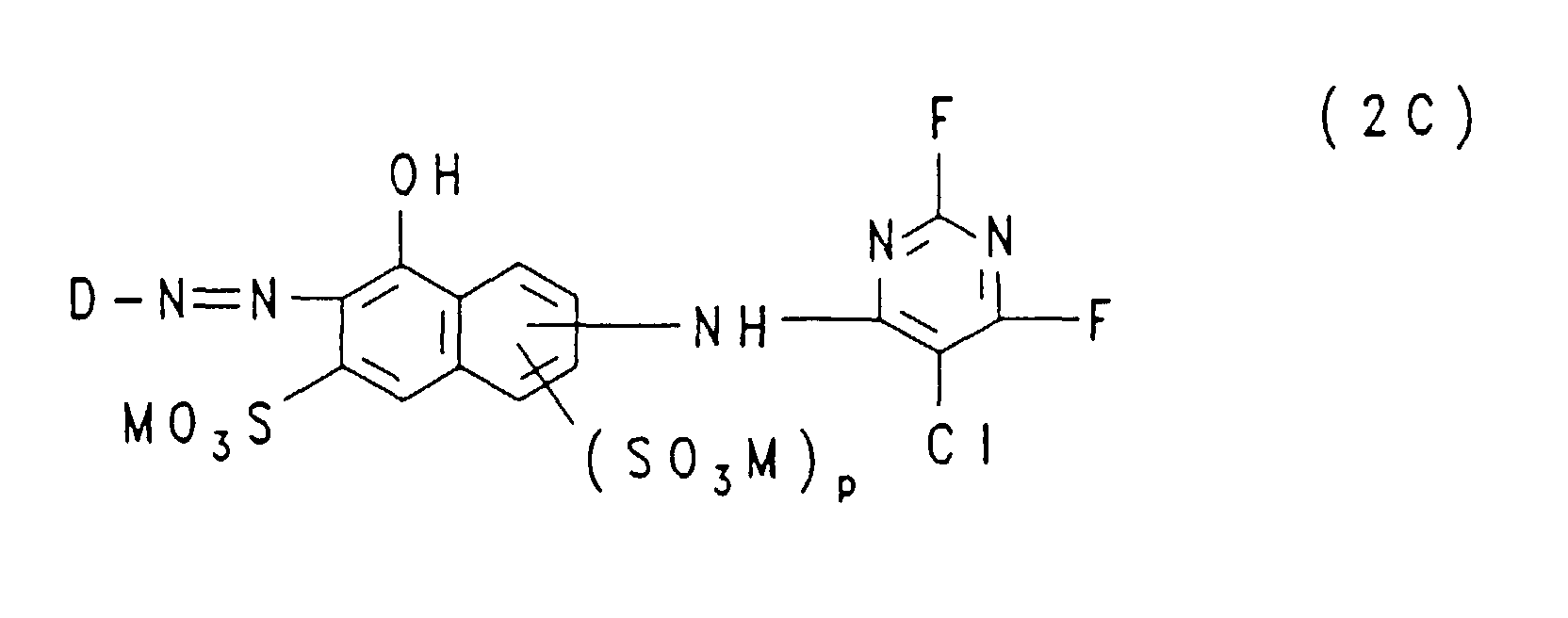
- M
- ist Wasserstoff oder ein Alkalimetall;
- D1
- ist eine Gruppe der allgemeinen Formel (2a) oder (2b)
in welchen

- R1
- Wasserstoff, Methyl, Ethyl, Methoxy, Ethoxy, Sulfo oder Carboxy,
- R2
- Wasserstoff, Methyl, Ethyl, Methoxy, Ethoxy oder Sulfo ist,
- Y
- Vinyl ist oder Ethyl ist, das in β-Stellung einen Substituenten enthält, der durch Alkali unter Bildung der Vinylgruppe eliminierbar ist,
- M
- die obengenannte Bedeutung hat und
- k
- für die Zahl Null, 1 oder 2 steht (wobei im Falle von k gleich Null diese Gruppe für Wasserstoff steht);
- D2
- hat eine der für D1 angegebenen Bedeutungen;
- D3
- hat eine der für D1 angegebenen Bedeutungen;
- D
- ist eine Gruppe der allgemeinen Formel (3a) oder (3b)
in welchen
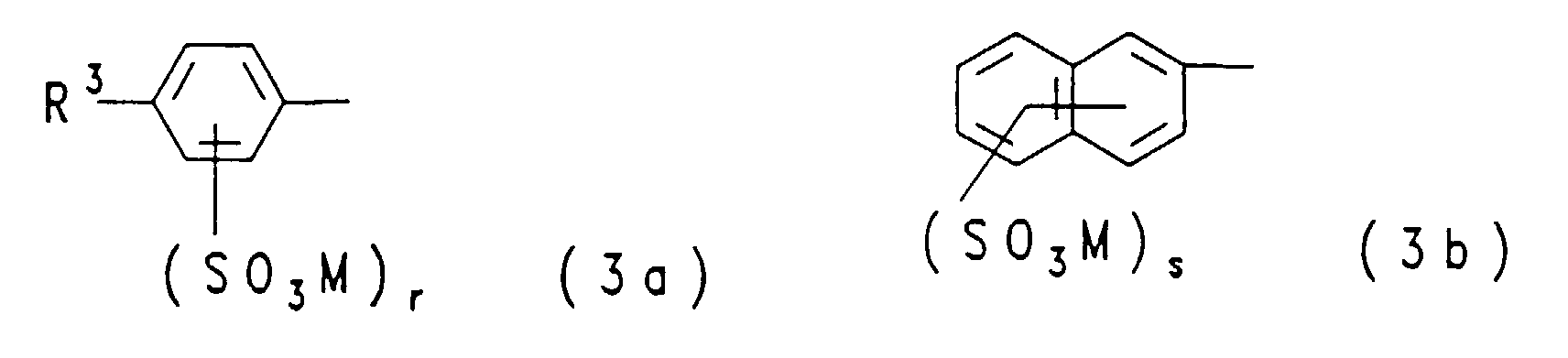
- R3
- Wasserstoff, Methoxy, Ethoxy, Methyl oder Ethyl ist,
- M
- die obengenannte Bedeutung hat,
- r
- für die Zahl Null, 1 oder 2 steht (wobei im Falle von r gleich Null diese Gruppe Wasserstoff bedeutet) und
- s
- die Zahl 1, 2 oder 3 ist;
- X
- ist Chlor, Fluor, Hydroxy, Cyanoamino oder Alkylamino von 1 bis 4 C-Atomen;
- m
- ist die Zahl Null oder 1 (wobei im Falle von m gleich Null diese Gruppe Wasserstoff bedeutet);
- n
- ist die Zahl Null oder 1 (wobei im Falle von n gleich Null diese Gruppe Wasserstoff bedeutet);
- p
- ist die Zahl Null oder 1 (wobei im Falle von p gleich Null diese Gruppe Wasserstoff bedeutet);
- Z
- ist Chlor oder Fluor;
- RA
- ist Chlor, Hydroxy, Phenoxy, Morpholino oder eine Gruppe der
allgemeinen Formel (4a), (4b) oder (4c)
in welchen
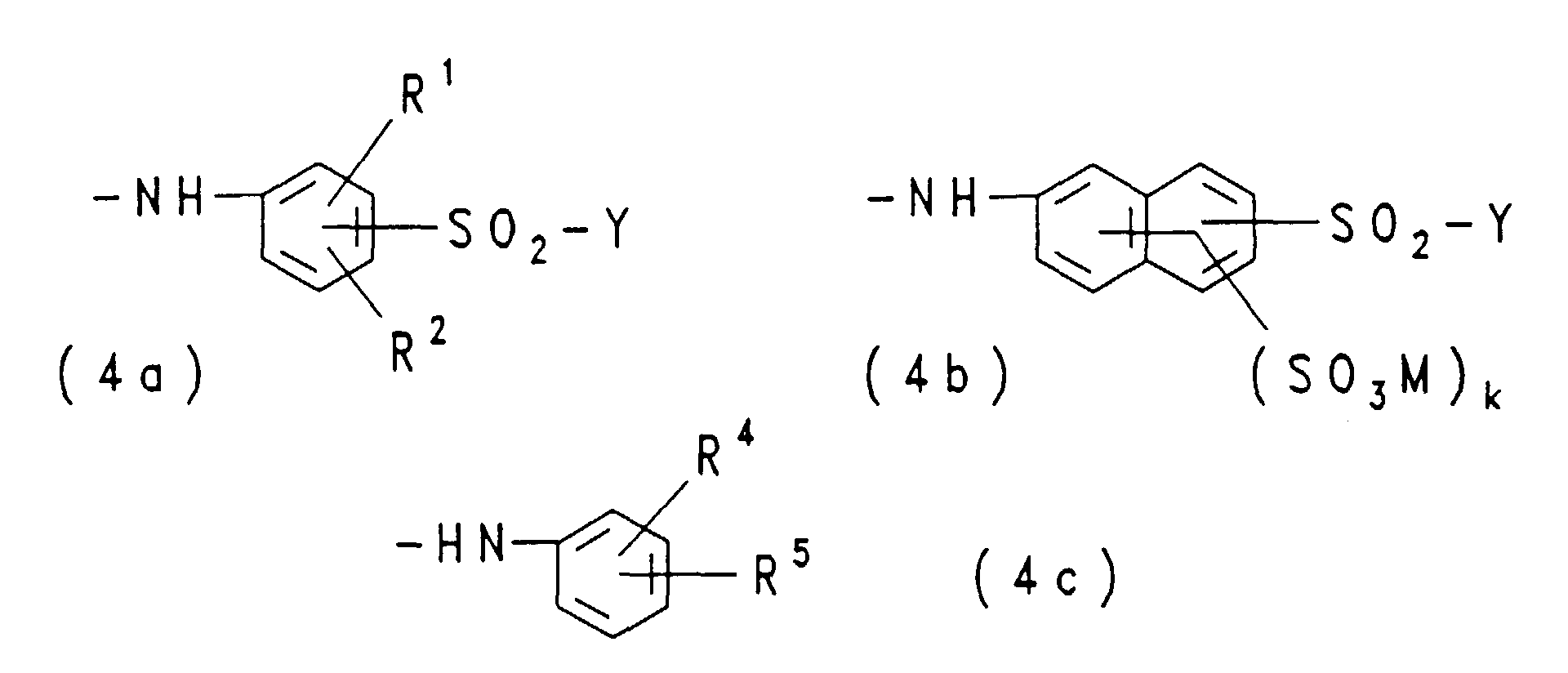
- R1, R2, Y, M und k
- eine der obengenannten Bedeutungen haben;
- R4
- Wasserstoff, Sulfo, Carboxy, Methyl, Ethyl, Methoxy, Ethoxy oder Hydroxy ist und
- R5
- Wasserstoff, Sulfo, Methyl, Ethyl, Methoxy oder Ethoxy bedeutet;
- RB
- ist eine Gruppe der allgemeinen Formel (5a), (5b) oder (5c)
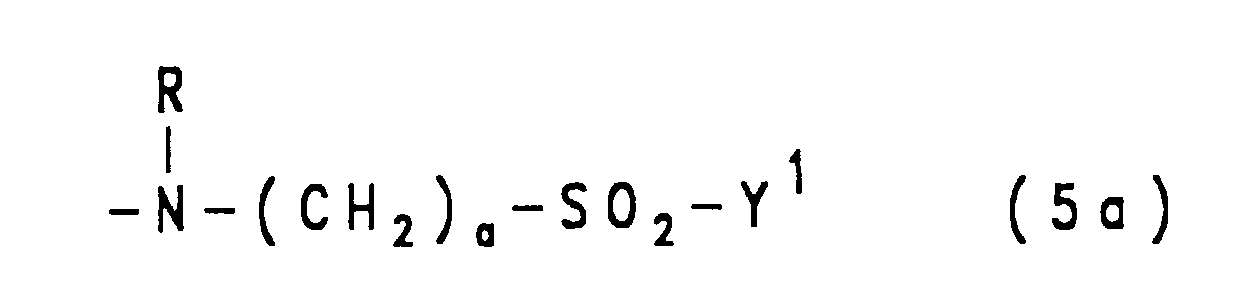
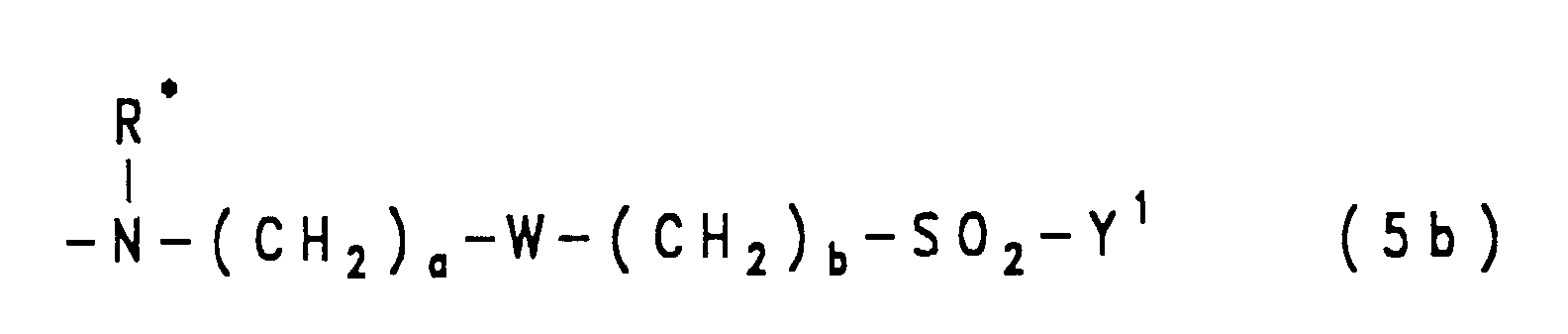 in welchen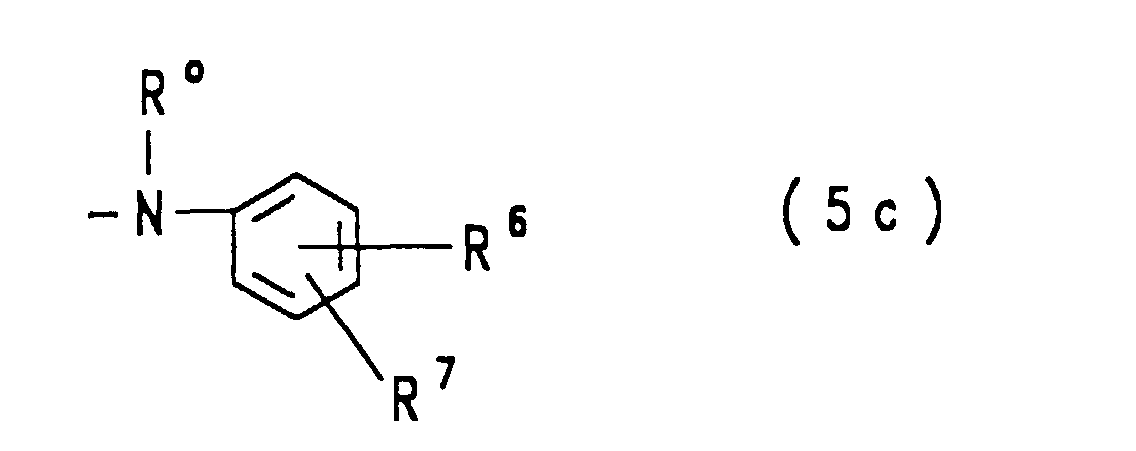
- Y1
- eine der oben für Y genannten Bedeutungen hat,
- R
- Wasserstoff oder Phenyl ist, das durch 1 oder 2 Substituenten aus der Gruppe Methyl, Ethyl, Methoxy, Ethoxy, Sulfo und Carboxy substituiert sein kann, oder Alkyl von 1 bis 4 C-Atomen ist oder eine Gruppe der allgemeinen Formel -(CH2)a-SO2-Y1 mit Y1 der oben angegebenen Bedeutung und mit a gleich der Zahl 1, 2 oder 3 ist,
- a
- die Zahl 1, 2 oder 3 ist,
- b
- die Zahl 2 oder 3 ist,
- W
- für eine Gruppe der Formel -O- oder -NH- steht,
- R*
- Wasserstoff oder Phenyl ist, das durch 1 oder 2 Substituenten aus der Gruppe Methyl, Ethyl, Methoxy, Ethoxy, Sulfo und Carboxy substituiert sein kann, oder Alkyl von 1 bis 4 C-Atomen ist oder eine Gruppe der allgemeinen Formel -(CH2)a-W-(CH2)b-SO2-Y1 mit a, b, W und Y1 der oben angegebenen Bedeutung ist,
- Ro
- Wasserstoff, Methyl, Ethyl oder β-Sulfoethyl ist,
- R6
- Wasserstoff, Methyl, Ethyl, Methoxy, Ethoxy, Sulfo, Carboxy, Hydroxy oder eine Gruppe der allgemeinen Formel -(CH2)a-SO2-Y mit Y und a der obengenannten Bedeutung ist und
- R7
- Wasserstoff, Methoxy, Ethoxy oder Sulfo bedeutet.
- Farbstoffmischung nach Anspruch 1, enthaltend den oder die Farbstoffe der Formel (1) und den oder die Farbstoffe der Formeln (2) im Mischungsverhältnis von 90-50 : 10-50 Gew.-%.
- Farbstoffmischung nach Anspruch 1 oder 2, dadurch gekennzeichnet, daß im Farbstoff der Formel (1) der Rest X gleich Chlor ist.
- Farbstoffmischung nach mindestens einem der Ansprüche 1 bis 3, dadurch gekennzeichnet, daß der Farbstoff der allgemeinen Formel (1) ein Farbstoff der allgemeinen Formel (1a)ist, in welchen M die in Anspruch 1 angegebene Bedeutung besitzt und D1 jedes 3-(β-Sulfatoethylsulfonyl)-phenyl, 4-(β-Sulfatoethylsulfonyl)phenyl, 2-Methoxy-5-(β-sulfatoethylsulfonyl)-phenyl oder 2,5-Dimethoxy-4-(β-sulfatoethylsulfonyl)-phenyl ist.

- Farbstoffmischung nach mindestens einem der Ansprüche 1 bis 4, dadurch gekennzeichnet, daß Y und Y1, zueinander gleich oder voneinander verschieden, jedes Vinyl oder β-Sulfatoethyl ist.
- Verwendung einer Farbstoffmischung nach mindestens einem der Ansprüche 1 bis 5 oder der Farbstoffe (1) und (2) gemeinsam zum Färben von hydroxy- und/oder carbonamidgruppenhaltigem Fasermaterial.
- Verfahren zum Färben von hydroxy- und/oder carbonamidgruppenhaltigem Fasermaterial, gemäß dem man Farbstoffe in gelöster Form auf das Material aufbringt und die Farbstoffe auf dem Material mittels Wärme oder mit Hilfe eines alkalisch wirkenden Mittels oder mittels Wärme und mit Hilfe eines alkalisch wirkenden Mittels fixiert, dadurch gekennzeichnet, daß man als Farbstoffe eine Farbstoffmischung von mindestens einem der Ansprüche 1 bis 5 oder die Farbstoffe (1) und (2) gemeinsam auf das Fasermaterial appliziert und fixiert.
Applications Claiming Priority (2)
| Application Number | Priority Date | Filing Date | Title |
|---|---|---|---|
| DE4415313 | 1994-05-02 | ||
| DE4415313A DE4415313A1 (de) | 1994-05-02 | 1994-05-02 | Mischungen von faserreaktiven Farbstoffen und deren Verwendung zum Färben von Fasermaterialien |
Publications (3)
| Publication Number | Publication Date |
|---|---|
| EP0681007A2 EP0681007A2 (de) | 1995-11-08 |
| EP0681007A3 EP0681007A3 (de) | 1996-01-17 |
| EP0681007B1 true EP0681007B1 (de) | 2000-01-26 |
Family
ID=6516995
Family Applications (1)
| Application Number | Title | Priority Date | Filing Date |
|---|---|---|---|
| EP95106234A Expired - Lifetime EP0681007B1 (de) | 1994-05-02 | 1995-04-26 | Mischungen von faserreaktiven Farbstoffen und deren Verwendung zum Färben von Fasermaterialien |
Country Status (9)
| Country | Link |
|---|---|
| US (1) | US5556435A (de) |
| EP (1) | EP0681007B1 (de) |
| JP (1) | JP3969753B2 (de) |
| CN (1) | CN1112947A (de) |
| AT (1) | ATE189248T1 (de) |
| BR (1) | BR9501874A (de) |
| DE (2) | DE4415313A1 (de) |
| ES (1) | ES2142967T3 (de) |
| PT (1) | PT681007E (de) |
Families Citing this family (24)
| Publication number | Priority date | Publication date | Assignee | Title |
|---|---|---|---|---|
| JP4056593B2 (ja) * | 1996-08-26 | 2008-03-05 | チバ スペシャルティ ケミカルズ ホールディング インコーポレーテッド | 染料混合物、その製造方法及びその用途 |
| DE19821573A1 (de) * | 1998-05-14 | 2000-02-10 | Dystar Textilfarben Gmbh & Co | Farbstoffmischung von wasserlöslichen faserreaktiven Azofarbstoffen, Verfahren zu ihrer Herstellung und ihre Verwendung |
| TW460545B (en) * | 1998-07-21 | 2001-10-21 | Dystar Textilfarben Gmbh & Amp | Dye mixture |
| DE19836661A1 (de) * | 1998-08-13 | 2000-02-17 | Dystar Textilfarben Gmbh & Co | Farbstoffmischung von wasserlöslichen faserreaktiven Azofarbstoffen, Verfahren zu ihrer Herstellung und ihre Verwendung |
| DE19851497A1 (de) * | 1998-11-09 | 2000-05-18 | Dystar Textilfarben Gmbh & Co | Farbstoffmischungen von faserreaktiven Azofarbstoffen und ihre Verwendung |
| US6090163A (en) * | 1998-12-21 | 2000-07-18 | Dystar Textilfarben Gmbh & Co. Deutschland Kg | Red-dyeing dye mixtures of water-soluble fiber-reactive azo dyes and their use |
| TWI260334B (en) * | 1999-11-01 | 2006-08-21 | Clariant Int Ltd | Azo dyestuffs |
| DE10017555A1 (de) | 2000-04-08 | 2001-10-11 | Dystar Textilfarben Gmbh & Co | Farbstoffmischung von wasserlöslichen faserreaktiven Azofarbstoffen, Verfahren zu ihrer Herstellung und ihre Verwendung |
| JP4538906B2 (ja) * | 2000-06-12 | 2010-09-08 | 住友化学株式会社 | 反応染料組成物及びその繊維材料への適用 |
| US20070289072A1 (en) * | 2000-12-18 | 2007-12-20 | Vilmax S.A.C.I.F.I.A. | New anionic coloring agents to dye leather, paper, cardboard and textile substrates: mixtures of coloring agents including these new products, and substrates dyed using the above coloring agents |
| AR027004A1 (es) * | 2000-12-18 | 2003-03-12 | Vilmax S A C I F I A | Nuevos colorantes anionicos para el tenido de cuero, papel, caton y sustratos textiles; mezclas de colorantes que incluyen estos nuevos productos ysustratos tenidos utilizando los colorantes mencionados. |
| DE10212769A1 (de) * | 2002-03-22 | 2003-10-02 | Dystar Textilfarben Gmbh & Co | Farbstoffmischungen von faserreaktiven Azofarbstoffen, ihre Herstellung und ihre Verwendung |
| CN100404628C (zh) * | 2002-12-27 | 2008-07-23 | 上海染料化工八厂 | 大红色染料组合物及其制备与应用 |
| CN100404629C (zh) * | 2002-12-27 | 2008-07-23 | 上海染料化工八厂 | 红色染料组合物及其制备与应用 |
| DE10337636A1 (de) | 2003-08-16 | 2005-03-17 | Dystar Textilfarben Gmbh & Co. Deutschland Kg | Farbstoffmischungen von faserreaktiven Azofarbstoffen, ihre Herstellung und ihre Verwendung |
| KR100671401B1 (ko) | 2004-04-30 | 2007-01-18 | 주식회사 에이스 디지텍 | 표시 장치용 염료 |
| CN104292881B (zh) * | 2014-07-28 | 2017-02-15 | 浙江科永化工有限公司 | 一种活性红染料组合物和染料制品 |
| CN108148446A (zh) * | 2016-12-05 | 2018-06-12 | 湖北丽源科技股份有限公司 | 一种红色活性染料混合物及其应用 |
| KR101960807B1 (ko) * | 2017-11-07 | 2019-03-21 | (주)경인양행 | 친환경 반응성 염료 제조방법 |
| CN108102421B (zh) * | 2017-11-30 | 2020-03-31 | 浙江科永化工有限公司 | 一种活性红染料组合物 |
| CN111117293A (zh) * | 2019-12-23 | 2020-05-08 | 湖北丽源科技股份有限公司 | 复合活性艳红染料组合物及其制备方法和应用 |
| CN112679981B (zh) * | 2020-12-21 | 2021-12-14 | 江苏德美科化工有限公司 | 一种高温用高耐氯棉用活性红色染料及其制备方法 |
| KR102591925B1 (ko) * | 2021-06-29 | 2023-10-23 | 주식회사 오영 | 반응성 적색 염료 조성물 및 이를 이용한 섬유의 염색방법 |
| CN116715979A (zh) * | 2023-04-06 | 2023-09-08 | 泰兴锦云染料有限公司 | 一种高性能喷墨印花活性红色染料及其制备方法和应用 |
Family Cites Families (10)
| Publication number | Priority date | Publication date | Assignee | Title |
|---|---|---|---|---|
| DE2748965C3 (de) * | 1977-11-02 | 1981-10-01 | Hoechst Ag, 6000 Frankfurt | Wasserlösliche Farbstoffe, Verfahren zu deren Herstellung, ihre Verwendung als faserreaktive Farbstoffe zum Färben und Bedrucken von Fasermaterialien |
| DE2748966C3 (de) * | 1977-11-02 | 1980-08-21 | Hoechst Ag, 6000 Frankfurt | Wasserlösliche Farbstoffe, Verfahren zu deren Herstellung, ihre Verwendung als faserreaktive Farbstoffe zum Färben und Bedrucken von Cellulose- und Polyamid-Fasermaterialien |
| DE3019936A1 (de) * | 1980-05-24 | 1981-12-03 | Hoechst Ag, 6000 Frankfurt | Wasserloesliche farbige verbindungen, verfahren zu deren herstellung und ihre verwendung als farbstoffe |
| JP2517220B2 (ja) * | 1985-07-17 | 1996-07-24 | 住友化学工業株式会社 | 水性液状反応染料組成物 |
| JPH02202956A (ja) * | 1989-01-24 | 1990-08-13 | Rika Sangyo Kk | 反応性黒色染料組成物 |
| DE4021067A1 (de) * | 1990-07-03 | 1992-01-09 | Hoechst Ag | Disazoverbindungen, verfahren zu deren herstellung und ihre verwendung als farbstoffe |
| ES2079627T3 (es) * | 1990-07-24 | 1996-01-16 | Ciba Geigy Ag | Uso de colorantes poliazoicos para la tincion de cuero. |
| DE59109196D1 (de) * | 1990-09-25 | 2000-10-05 | Ciba Sc Holding Ag | Faserreaktive Farbstoffe und deren Verwendung |
| DE4113838A1 (de) * | 1991-04-27 | 1992-10-29 | Basf Ag | Azofarbstoffe mit mehreren reaktiven ankergruppen |
| US5330539A (en) * | 1991-12-18 | 1994-07-19 | Hoechst Celanese Corporation | Fiber reactive dyes - applications with low salt |
-
1994
- 1994-05-02 DE DE4415313A patent/DE4415313A1/de not_active Withdrawn
-
1995
- 1995-04-26 ES ES95106234T patent/ES2142967T3/es not_active Expired - Lifetime
- 1995-04-26 AT AT95106234T patent/ATE189248T1/de active
- 1995-04-26 EP EP95106234A patent/EP0681007B1/de not_active Expired - Lifetime
- 1995-04-26 PT PT95106234T patent/PT681007E/pt unknown
- 1995-04-26 DE DE59507672T patent/DE59507672D1/de not_active Expired - Lifetime
- 1995-04-28 JP JP10628595A patent/JP3969753B2/ja not_active Expired - Fee Related
- 1995-04-28 CN CN95105192A patent/CN1112947A/zh active Pending
- 1995-05-02 BR BR9501874A patent/BR9501874A/pt not_active Application Discontinuation
- 1995-05-02 US US08/433,700 patent/US5556435A/en not_active Expired - Lifetime
Also Published As
| Publication number | Publication date |
|---|---|
| EP0681007A2 (de) | 1995-11-08 |
| JPH0848904A (ja) | 1996-02-20 |
| JP3969753B2 (ja) | 2007-09-05 |
| DE59507672D1 (de) | 2000-03-02 |
| ATE189248T1 (de) | 2000-02-15 |
| ES2142967T3 (es) | 2000-05-01 |
| CN1112947A (zh) | 1995-12-06 |
| US5556435A (en) | 1996-09-17 |
| BR9501874A (pt) | 1995-11-28 |
| DE4415313A1 (de) | 1995-11-09 |
| PT681007E (pt) | 2000-06-30 |
| EP0681007A3 (de) | 1996-01-17 |
Similar Documents
| Publication | Publication Date | Title |
|---|---|---|
| EP0094055B1 (de) | Monoazoverbindungen, Verfahren zu ihrer Herstellung und ihre Verwendung als Farbstoffe | |
| DE4415313A1 (de) | Mischungen von faserreaktiven Farbstoffen und deren Verwendung zum Färben von Fasermaterialien | |
| EP0681008B1 (de) | Schwarze Farbstoffmischungen von faserreaktiven Azofarbstoffen und ihre Verwendung zum Färben von hydroxy- und/oder carbonamidgruppenhaltigem Fasermaterial | |
| DE4405358A1 (de) | Reaktivfarbstoffmischungen | |
| EP0679697A2 (de) | Schwarze Farbstoffmischungen von faserreaktiven Azofarbstoffen und ihre Verwendung zum Färben von hydroxy- und/oder carbonamidgruppenhaltigem Fasermaterial | |
| EP1000983B1 (de) | Farbstoffmischung, Verfahren zu ihrer Herstellung und ihre Verwendung | |
| EP0999240B1 (de) | Farbstoffmischungen von wasserlöslichen faserreaktiven Azofarbstoffen und ihre Verwendung | |
| EP0832939B1 (de) | Blaufärbende Mischungen von faserreaktiven Farbstoffen und ihre Verwendung zum Färben von hydroxy- und/oder carbonamidgruppenhaltigem Fasermaterial | |
| DE19836661A1 (de) | Farbstoffmischung von wasserlöslichen faserreaktiven Azofarbstoffen, Verfahren zu ihrer Herstellung und ihre Verwendung | |
| EP0719841B1 (de) | Farbstoffmischung von wasserlöslichen faserreaktiven Azofarbstoffen, Verfahren zu ihrer Herstellung und ihre Verwendung | |
| EP0957137B1 (de) | Farbstoffmischung von wasserlöslichen faserreaktiven Azofarbstoffen, Verfahren zu ihrer Herstellung und ihre Verwendung | |
| EP1054043A2 (de) | Orange- und scharlachfarbige Mischungen von Reaktivfarbstoffen | |
| DE69912227T2 (de) | Rotfärbende Farbstoffmischungen von faserreaktiven Azofarbstoffen und deren Verwendung | |
| DE69901275T2 (de) | Orange Farbstoffmischungen von faserreaktiven Azofarbstoffen und ihre Verwendung zum Färben von hydroxy- und/oder carbonamidgruppenhaltigem Material | |
| EP1000982B1 (de) | Farbstoffmischungen von faserreaktiven Azofarbstoffen und ihre Verwendung | |
| EP0629666B1 (de) | Wasserlösliche Azoverbindungen, Verfahren zu ihrer Herstellung und ihre Verwendung als Farbstoffe | |
| DE10064496A1 (de) | Schwarze Farbstoffmischungen von faserreaktiven Azofarbstoffen und ihre Verwendung zum Färben von hydroxy- und/oder carbonamidgruppenhaltigem Fasermaterial | |
| DE60002644T2 (de) | Farbstoffmischungen von faserreaktiven Azofarbstoffen und ihre Verwendung zum Färben von hydroxy- und/oder carbonamidgruppenhaltigem Material | |
| DE60004597T2 (de) | Farbstoffmischungen von faserreaktiven Azofarbstoffen und ihre Verwendung zum Färben von hydroxy- und/oder carbonamidgruppenhaltigem Material | |
| EP0974622B1 (de) | Farbstoffmischung von wasserlöslichen faserreaktiven Azofarbstoffen, Verfahren zu ihrer Herstellung und ihre Verwendung | |
| EP0992546B1 (de) | Farbstoffmischungen von wasserlöslichen faserreaktiven Azofarbstoffen, Verfahren zu ihrer Herstellung und ihre Verwendung | |
| EP0688831B1 (de) | Wasserlösliche Anthrachinonverbindungen, Verfahren zu ihrer Herstellung und ihre Verwendung als Farbstoffe | |
| EP0380070B1 (de) | Wasserlösliche Disazoverbindungen, Verfahren zu ihrer Herstellung und ihre Verwendung als Farbstoffe | |
| EP1043366A2 (de) | Mischungen von faserreaktiven Farbstoffen, Verfahren zu deren Herstellung und deren Verwendung zum Färben von Fasermaterial | |
| DE19743099A1 (de) | Wasserlösliche Azoverbindungen, Verfahren zu ihrer Herstellung und ihre Verwendung als Farbstoffe |
Legal Events
| Date | Code | Title | Description |
|---|---|---|---|
| PUAI | Public reference made under article 153(3) epc to a published international application that has entered the european phase |
Free format text: ORIGINAL CODE: 0009012 |
|
| AK | Designated contracting states |
Kind code of ref document: A2 Designated state(s): AT CH DE ES FR GB IT LI NL PT |
|
| PUAL | Search report despatched |
Free format text: ORIGINAL CODE: 0009013 |
|
| AK | Designated contracting states |
Kind code of ref document: A3 Designated state(s): AT CH DE ES FR GB IT LI NL PT |
|
| 17P | Request for examination filed |
Effective date: 19960717 |
|
| RAP1 | Party data changed (applicant data changed or rights of an application transferred) |
Owner name: DYSTAR TEXTILFARBEN GMBH & CO. DEUTSCHLAND KG |
|
| GRAG | Despatch of communication of intention to grant |
Free format text: ORIGINAL CODE: EPIDOS AGRA |
|
| 17Q | First examination report despatched |
Effective date: 19990521 |
|
| GRAG | Despatch of communication of intention to grant |
Free format text: ORIGINAL CODE: EPIDOS AGRA |
|
| GRAH | Despatch of communication of intention to grant a patent |
Free format text: ORIGINAL CODE: EPIDOS IGRA |
|
| GRAH | Despatch of communication of intention to grant a patent |
Free format text: ORIGINAL CODE: EPIDOS IGRA |
|
| GRAA | (expected) grant |
Free format text: ORIGINAL CODE: 0009210 |
|
| AK | Designated contracting states |
Kind code of ref document: B1 Designated state(s): AT CH DE ES FR GB IT LI NL PT |
|
| REF | Corresponds to: |
Ref document number: 189248 Country of ref document: AT Date of ref document: 20000215 Kind code of ref document: T |
|
| REG | Reference to a national code |
Ref country code: CH Ref legal event code: EP |
|
| REF | Corresponds to: |
Ref document number: 59507672 Country of ref document: DE Date of ref document: 20000302 |
|
| ITF | It: translation for a ep patent filed | ||
| GBT | Gb: translation of ep patent filed (gb section 77(6)(a)/1977) |
Effective date: 20000322 |
|
| ET | Fr: translation filed | ||
| REG | Reference to a national code |
Ref country code: ES Ref legal event code: FG2A Ref document number: 2142967 Country of ref document: ES Kind code of ref document: T3 |
|
| REG | Reference to a national code |
Ref country code: PT Ref legal event code: SC4A Free format text: AVAILABILITY OF NATIONAL TRANSLATION Effective date: 20000314 |
|
| PLBE | No opposition filed within time limit |
Free format text: ORIGINAL CODE: 0009261 |
|
| STAA | Information on the status of an ep patent application or granted ep patent |
Free format text: STATUS: NO OPPOSITION FILED WITHIN TIME LIMIT |
|
| 26N | No opposition filed | ||
| REG | Reference to a national code |
Ref country code: GB Ref legal event code: IF02 |
|
| REG | Reference to a national code |
Ref country code: NL Ref legal event code: SD Effective date: 20110124 |
|
| REG | Reference to a national code |
Ref country code: GB Ref legal event code: 732E Free format text: REGISTERED BETWEEN 20110303 AND 20110309 |
|
| PGFP | Annual fee paid to national office [announced via postgrant information from national office to epo] |
Ref country code: FR Payment date: 20110426 Year of fee payment: 17 Ref country code: ES Payment date: 20110518 Year of fee payment: 17 Ref country code: DE Payment date: 20110317 Year of fee payment: 17 Ref country code: CH Payment date: 20110412 Year of fee payment: 17 Ref country code: PT Payment date: 20110426 Year of fee payment: 17 |
|
| PGFP | Annual fee paid to national office [announced via postgrant information from national office to epo] |
Ref country code: NL Payment date: 20110420 Year of fee payment: 17 Ref country code: AT Payment date: 20110412 Year of fee payment: 17 Ref country code: GB Payment date: 20110420 Year of fee payment: 17 |
|
| REG | Reference to a national code |
Ref country code: FR Ref legal event code: TP |
|
| PGFP | Annual fee paid to national office [announced via postgrant information from national office to epo] |
Ref country code: IT Payment date: 20110422 Year of fee payment: 17 |
|
| REG | Reference to a national code |
Ref country code: PT Ref legal event code: MM4A Free format text: LAPSE DUE TO NON-PAYMENT OF FEES Effective date: 20121026 |
|
| REG | Reference to a national code |
Ref country code: NL Ref legal event code: V1 Effective date: 20121101 |
|
| REG | Reference to a national code |
Ref country code: CH Ref legal event code: PL |
|
| REG | Reference to a national code |
Ref country code: AT Ref legal event code: MM01 Ref document number: 189248 Country of ref document: AT Kind code of ref document: T Effective date: 20120426 |
|
| GBPC | Gb: european patent ceased through non-payment of renewal fee |
Effective date: 20120426 |
|
| REG | Reference to a national code |
Ref country code: FR Ref legal event code: ST Effective date: 20121228 |
|
| PG25 | Lapsed in a contracting state [announced via postgrant information from national office to epo] |
Ref country code: GB Free format text: LAPSE BECAUSE OF NON-PAYMENT OF DUE FEES Effective date: 20120426 Ref country code: CH Free format text: LAPSE BECAUSE OF NON-PAYMENT OF DUE FEES Effective date: 20120430 Ref country code: AT Free format text: LAPSE BECAUSE OF NON-PAYMENT OF DUE FEES Effective date: 20120426 Ref country code: LI Free format text: LAPSE BECAUSE OF NON-PAYMENT OF DUE FEES Effective date: 20120430 |
|
| PG25 | Lapsed in a contracting state [announced via postgrant information from national office to epo] |
Ref country code: IT Free format text: LAPSE BECAUSE OF NON-PAYMENT OF DUE FEES Effective date: 20120426 Ref country code: PT Free format text: LAPSE BECAUSE OF NON-PAYMENT OF DUE FEES Effective date: 20121026 Ref country code: FR Free format text: LAPSE BECAUSE OF NON-PAYMENT OF DUE FEES Effective date: 20120430 |
|
| REG | Reference to a national code |
Ref country code: DE Ref legal event code: R119 Ref document number: 59507672 Country of ref document: DE Effective date: 20121101 |
|
| PG25 | Lapsed in a contracting state [announced via postgrant information from national office to epo] |
Ref country code: NL Free format text: LAPSE BECAUSE OF NON-PAYMENT OF DUE FEES Effective date: 20121101 |
|
| REG | Reference to a national code |
Ref country code: ES Ref legal event code: FD2A Effective date: 20130715 |
|
| PG25 | Lapsed in a contracting state [announced via postgrant information from national office to epo] |
Ref country code: ES Free format text: LAPSE BECAUSE OF NON-PAYMENT OF DUE FEES Effective date: 20120427 |
|
| PG25 | Lapsed in a contracting state [announced via postgrant information from national office to epo] |
Ref country code: DE Free format text: LAPSE BECAUSE OF NON-PAYMENT OF DUE FEES Effective date: 20121101 |