EP0671378B1 - Verfahren zur Herstellung von (1R,4S)-4-Hydroxy-1,2,2-trimethylcyclopentyl-methylketon sowie Derivaten und Steroisomeren dieser Verbindung - Google Patents
Verfahren zur Herstellung von (1R,4S)-4-Hydroxy-1,2,2-trimethylcyclopentyl-methylketon sowie Derivaten und Steroisomeren dieser Verbindung Download PDFInfo
- Publication number
- EP0671378B1 EP0671378B1 EP95102924A EP95102924A EP0671378B1 EP 0671378 B1 EP0671378 B1 EP 0671378B1 EP 95102924 A EP95102924 A EP 95102924A EP 95102924 A EP95102924 A EP 95102924A EP 0671378 B1 EP0671378 B1 EP 0671378B1
- Authority
- EP
- European Patent Office
- Prior art keywords
- general formula
- tert
- derivative
- tetramethyl
- hydrogen
- Prior art date
- Legal status (The legal status is an assumption and is not a legal conclusion. Google has not performed a legal analysis and makes no representation as to the accuracy of the status listed.)
- Expired - Lifetime
Links
- 238000002360 preparation method Methods 0.000 title claims description 41
- 238000000034 method Methods 0.000 title claims description 17
- AOTWFKPTHZJOOZ-YXUGBTPSSA-N 1,3-bis[(1r,4s)-4-hydroxy-1,2,2-trimethylcyclopentyl]propan-2-one Chemical compound CC1(C)C[C@H](O)C[C@]1(C)CC(=O)C[C@]1(C)C(C)(C)C[C@H](O)C1 AOTWFKPTHZJOOZ-YXUGBTPSSA-N 0.000 title description 19
- -1 alkylarylsilyl Chemical group 0.000 claims description 53
- 150000001875 compounds Chemical class 0.000 claims description 30
- 238000006243 chemical reaction Methods 0.000 claims description 29
- 229910052739 hydrogen Inorganic materials 0.000 claims description 29
- 239000001257 hydrogen Substances 0.000 claims description 28
- 125000006239 protecting group Chemical group 0.000 claims description 25
- 125000004435 hydrogen atom Chemical group [H]* 0.000 claims description 19
- YEYVIWYEMFCMDX-VIFPVBQESA-N (1s)-3,4,5,5-tetramethylcyclohex-3-en-1-ol Chemical compound CC1=C(C)C(C)(C)C[C@@H](O)C1 YEYVIWYEMFCMDX-VIFPVBQESA-N 0.000 claims description 18
- 239000000203 mixture Substances 0.000 claims description 18
- 239000002841 Lewis acid Substances 0.000 claims description 17
- 150000007517 lewis acids Chemical class 0.000 claims description 17
- 125000001412 tetrahydropyranyl group Chemical group 0.000 claims description 17
- 125000006177 alkyl benzyl group Chemical group 0.000 claims description 16
- 125000001584 benzyloxycarbonyl group Chemical group C(=O)(OCC1=CC=CC=C1)* 0.000 claims description 16
- 125000005448 ethoxyethyl group Chemical group [H]C([H])([H])C([H])([H])OC([H])([H])C([H])([H])* 0.000 claims description 16
- 125000001797 benzyl group Chemical group [H]C1=C([H])C([H])=C(C([H])=C1[H])C([H])([H])* 0.000 claims description 15
- UYWQUFXKFGHYNT-UHFFFAOYSA-N phenylmethyl ester of formic acid Chemical group O=COCC1=CC=CC=C1 UYWQUFXKFGHYNT-UHFFFAOYSA-N 0.000 claims description 15
- 125000000999 tert-butyl group Chemical group [H]C([H])([H])C(*)(C([H])([H])[H])C([H])([H])[H] 0.000 claims description 15
- 125000001449 isopropyl group Chemical group [H]C([H])([H])C([H])(*)C([H])([H])[H] 0.000 claims description 14
- 125000002777 acetyl group Chemical group [H]C([H])([H])C(*)=O 0.000 claims description 10
- 125000002887 hydroxy group Chemical group [H]O* 0.000 claims description 10
- ZPVOLGVTNLDBFI-UHFFFAOYSA-N 2,2,6-Trimethyl cyclohexanone Natural products CC1CCCC(C)(C)C1=O ZPVOLGVTNLDBFI-UHFFFAOYSA-N 0.000 claims description 8
- IMNFDUFMRHMDMM-UHFFFAOYSA-N N-Heptane Chemical class CCCCCCC IMNFDUFMRHMDMM-UHFFFAOYSA-N 0.000 claims description 8
- 125000004665 trialkylsilyl group Chemical group 0.000 claims description 8
- 125000005106 triarylsilyl group Chemical group 0.000 claims description 8
- 125000001981 tert-butyldimethylsilyl group Chemical group [H]C([H])([H])[Si]([H])(C([H])([H])[H])[*]C(C([H])([H])[H])(C([H])([H])[H])C([H])([H])[H] 0.000 claims description 7
- 230000008030 elimination Effects 0.000 claims description 6
- 238000003379 elimination reaction Methods 0.000 claims description 6
- 238000004519 manufacturing process Methods 0.000 claims description 6
- 238000006317 isomerization reaction Methods 0.000 claims description 5
- QDMCSUZBGLPYHO-UHFFFAOYSA-N 1,2,2,6-tetramethylcyclohexane-1,4-diol Chemical class CC1CC(O)CC(C)(C)C1(C)O QDMCSUZBGLPYHO-UHFFFAOYSA-N 0.000 claims description 4
- 125000003236 benzoyl group Chemical group [H]C1=C([H])C([H])=C(C([H])=C1[H])C(*)=O 0.000 claims description 4
- 150000004965 peroxy acids Chemical class 0.000 claims description 4
- LXXAUFIHHGJZMV-WPRPVWTQSA-N 1-[(1r,4s)-4-hydroxy-1,2,2-trimethylcyclopentyl]ethanone Chemical compound CC(=O)[C@]1(C)C[C@@H](O)CC1(C)C LXXAUFIHHGJZMV-WPRPVWTQSA-N 0.000 claims description 3
- 238000007239 Wittig reaction Methods 0.000 claims description 3
- 125000004183 alkoxy alkyl group Chemical group 0.000 claims description 3
- 125000000217 alkyl group Chemical group 0.000 claims description 3
- 125000003118 aryl group Chemical group 0.000 claims description 3
- 125000005002 aryl methyl group Chemical group 0.000 claims description 3
- 230000000536 complexating effect Effects 0.000 claims description 3
- LGRLWUINFJPLSH-UHFFFAOYSA-N methanide Chemical compound [CH3-] LGRLWUINFJPLSH-UHFFFAOYSA-N 0.000 claims description 3
- XYDYWTJEGDZLTH-UHFFFAOYSA-N methylenetriphenylphosphorane Chemical compound C=1C=CC=CC=1P(C=1C=CC=CC=1)(=C)C1=CC=CC=C1 XYDYWTJEGDZLTH-UHFFFAOYSA-N 0.000 claims description 3
- 239000001301 oxygen Substances 0.000 claims description 3
- 229910052760 oxygen Inorganic materials 0.000 claims description 3
- 150000003839 salts Chemical class 0.000 claims description 3
- AUCXIGOESXVILY-UHFFFAOYSA-N 1,2,3,3-tetramethylcyclohexene Chemical class CC1=C(C)C(C)(C)CCC1 AUCXIGOESXVILY-UHFFFAOYSA-N 0.000 claims description 2
- BLUGRXWYJHRIKP-UHFFFAOYSA-N 1,5,5,6-tetramethyl-7-oxabicyclo[4.1.0]heptane Chemical class C1CCC(C)(C)C2(C)OC21C BLUGRXWYJHRIKP-UHFFFAOYSA-N 0.000 claims description 2
- QVGXLLKOCUKJST-UHFFFAOYSA-N atomic oxygen Chemical compound [O] QVGXLLKOCUKJST-UHFFFAOYSA-N 0.000 claims description 2
- 125000001589 carboacyl group Chemical group 0.000 claims description 2
- ZWAJLVLEBYIOTI-UHFFFAOYSA-N cyclohexene oxide Chemical class C1CCCC2OC21 ZWAJLVLEBYIOTI-UHFFFAOYSA-N 0.000 claims description 2
- 150000002432 hydroperoxides Chemical class 0.000 claims description 2
- RIOQSEWOXXDEQQ-UHFFFAOYSA-N triphenylphosphine Chemical compound C1=CC=CC=C1P(C=1C=CC=CC=1)C1=CC=CC=C1 RIOQSEWOXXDEQQ-UHFFFAOYSA-N 0.000 claims description 2
- CSCPPACGZOOCGX-UHFFFAOYSA-N Acetone Chemical compound CC(C)=O CSCPPACGZOOCGX-UHFFFAOYSA-N 0.000 claims 4
- ZPVOLGVTNLDBFI-ZETCQYMHSA-N (6s)-2,2,6-trimethylcyclohexan-1-one Chemical compound C[C@H]1CCCC(C)(C)C1=O ZPVOLGVTNLDBFI-ZETCQYMHSA-N 0.000 claims 2
- TUPJGSPDSBPZTJ-UHFFFAOYSA-N 1-(1,2,2-trimethylcyclopentyl)ethanone Chemical class CC(=O)C1(C)CCCC1(C)C TUPJGSPDSBPZTJ-UHFFFAOYSA-N 0.000 claims 2
- LXXAUFIHHGJZMV-SCZZXKLOSA-N 1-[(1r,4r)-4-hydroxy-1,2,2-trimethylcyclopentyl]ethanone Chemical compound CC(=O)[C@]1(C)C[C@H](O)CC1(C)C LXXAUFIHHGJZMV-SCZZXKLOSA-N 0.000 claims 1
- YMWUJEATGCHHMB-UHFFFAOYSA-N Dichloromethane Chemical compound ClCCl YMWUJEATGCHHMB-UHFFFAOYSA-N 0.000 description 84
- VLKZOEOYAKHREP-UHFFFAOYSA-N n-Hexane Chemical compound CCCCCC VLKZOEOYAKHREP-UHFFFAOYSA-N 0.000 description 21
- 239000000047 product Substances 0.000 description 21
- XLYOFNOQVPJJNP-UHFFFAOYSA-N water Substances O XLYOFNOQVPJJNP-UHFFFAOYSA-N 0.000 description 20
- RTZKZFJDLAIYFH-UHFFFAOYSA-N Diethyl ether Chemical compound CCOCC RTZKZFJDLAIYFH-UHFFFAOYSA-N 0.000 description 15
- 235000012658 paprika extract Nutrition 0.000 description 15
- 239000001688 paprika extract Substances 0.000 description 15
- GVOIABOMXKDDGU-XRODXAHISA-N (3S,3'S,5R,5'R)-3,3'-dihydroxy-kappa,kappa-carotene-6,6'-dione Chemical compound O=C([C@@]1(C)C(C[C@H](O)C1)(C)C)/C=C/C(/C)=C/C=C/C(/C)=C/C=C/C=C(C)C=CC=C(C)C=CC(=O)[C@]1(C)C[C@@H](O)CC1(C)C GVOIABOMXKDDGU-XRODXAHISA-N 0.000 description 14
- GVOIABOMXKDDGU-LOFNIBRQSA-N (3S,3'S,5R,5'R)-3,3'-dihydroxy-kappa,kappa-carotene-6,6'-dione Natural products CC(=C/C=C/C=C(C)/C=C/C=C(C)/C=C/C(=O)C1(C)CC(O)CC1(C)C)C=CC=C(/C)C=CC(=O)C2(C)CC(O)CC2(C)C GVOIABOMXKDDGU-LOFNIBRQSA-N 0.000 description 14
- GVOIABOMXKDDGU-SUKXYCKUSA-N Capsorubin Natural products O=C(/C=C/C(=C\C=C\C(=C/C=C/C=C(\C=C\C=C(/C=C/C(=O)[C@@]1(C)C(C)(C)C[C@H](O)C1)\C)/C)\C)/C)[C@@]1(C)C(C)(C)C[C@H](O)C1 GVOIABOMXKDDGU-SUKXYCKUSA-N 0.000 description 14
- 235000009132 capsorubin Nutrition 0.000 description 14
- 239000011541 reaction mixture Substances 0.000 description 14
- 239000002904 solvent Substances 0.000 description 13
- 0 CC(C)(CC(C1)O*)C1(C)C(C)=O Chemical compound CC(C)(CC(C1)O*)C1(C)C(C)=O 0.000 description 12
- 230000015572 biosynthetic process Effects 0.000 description 12
- 239000012074 organic phase Substances 0.000 description 12
- 238000003786 synthesis reaction Methods 0.000 description 11
- UFHFLCQGNIYNRP-UHFFFAOYSA-N Hydrogen Chemical compound [H][H] UFHFLCQGNIYNRP-UHFFFAOYSA-N 0.000 description 10
- AOTWFKPTHZJOOZ-LSOMNZGLSA-N 1,3-bis[(1S,4S)-4-hydroxy-1,2,2-trimethylcyclopentyl]propan-2-one Chemical compound O[C@H]1CC([C@](C1)(C)CC(=O)C[C@]1(C(C[C@@H](C1)O)(C)C)C)(C)C AOTWFKPTHZJOOZ-LSOMNZGLSA-N 0.000 description 9
- 238000006735 epoxidation reaction Methods 0.000 description 9
- JOXIMZWYDAKGHI-UHFFFAOYSA-N toluene-4-sulfonic acid Chemical compound CC1=CC=C(S(O)(=O)=O)C=C1 JOXIMZWYDAKGHI-UHFFFAOYSA-N 0.000 description 9
- NHQDETIJWKXCTC-UHFFFAOYSA-N 3-chloroperbenzoic acid Chemical compound OOC(=O)C1=CC=CC(Cl)=C1 NHQDETIJWKXCTC-UHFFFAOYSA-N 0.000 description 8
- 238000004587 chromatography analysis Methods 0.000 description 8
- 150000002431 hydrogen Chemical group 0.000 description 7
- KZMGYPLQYOPHEL-UHFFFAOYSA-N Boron trifluoride etherate Chemical compound FB(F)F.CCOCC KZMGYPLQYOPHEL-UHFFFAOYSA-N 0.000 description 6
- XTHFKEDIFFGKHM-UHFFFAOYSA-N Dimethoxyethane Chemical compound COCCOC XTHFKEDIFFGKHM-UHFFFAOYSA-N 0.000 description 6
- QAOWNCQODCNURD-UHFFFAOYSA-N Sulfuric acid Chemical compound OS(O)(=O)=O QAOWNCQODCNURD-UHFFFAOYSA-N 0.000 description 6
- YXFVVABEGXRONW-UHFFFAOYSA-N Toluene Chemical compound CC1=CC=CC=C1 YXFVVABEGXRONW-UHFFFAOYSA-N 0.000 description 6
- 229920006395 saturated elastomer Polymers 0.000 description 6
- VYPSYNLAJGMNEJ-UHFFFAOYSA-N Silicium dioxide Chemical compound O=[Si]=O VYPSYNLAJGMNEJ-UHFFFAOYSA-N 0.000 description 5
- JHIVVAPYMSGYDF-UHFFFAOYSA-N cyclohexanone Chemical compound O=C1CCCCC1 JHIVVAPYMSGYDF-UHFFFAOYSA-N 0.000 description 5
- 239000007789 gas Substances 0.000 description 5
- 239000005457 ice water Substances 0.000 description 5
- 150000003254 radicals Chemical class 0.000 description 5
- 239000000741 silica gel Substances 0.000 description 5
- 229910002027 silica gel Inorganic materials 0.000 description 5
- AOTWFKPTHZJOOZ-TWKYDXJASA-N 1,3-bis[(1R,4R)-4-hydroxy-1,2,2-trimethylcyclopentyl]propan-2-one Chemical compound O[C@@H]1CC([C@@](C1)(C)CC(=O)C[C@@]1(C(C[C@H](C1)O)(C)C)C)(C)C AOTWFKPTHZJOOZ-TWKYDXJASA-N 0.000 description 4
- IAZDPXIOMUYVGZ-UHFFFAOYSA-N Dimethylsulphoxide Chemical compound CS(C)=O IAZDPXIOMUYVGZ-UHFFFAOYSA-N 0.000 description 4
- 239000004593 Epoxy Substances 0.000 description 4
- JUJWROOIHBZHMG-UHFFFAOYSA-N Pyridine Chemical compound C1=CC=NC=C1 JUJWROOIHBZHMG-UHFFFAOYSA-N 0.000 description 4
- WYURNTSHIVDZCO-UHFFFAOYSA-N Tetrahydrofuran Chemical compound C1CCOC1 WYURNTSHIVDZCO-UHFFFAOYSA-N 0.000 description 4
- 239000007858 starting material Substances 0.000 description 4
- 238000003756 stirring Methods 0.000 description 4
- CSPVUHYZUZZRGF-RNFRBKRXSA-N (4R,6R)-hydroxy-2,2,6-trimethylcyclohexanone Chemical compound C[C@@H]1C[C@@H](O)CC(C)(C)C1=O CSPVUHYZUZZRGF-RNFRBKRXSA-N 0.000 description 3
- LUTKTOHGYZHKRH-UHFFFAOYSA-N 1,3-bis(1,2,2-trimethylcyclopentyl)propan-2-one Chemical compound CC1(C)CCCC1(C)CC(=O)CC1(C)C(C)(C)CCC1 LUTKTOHGYZHKRH-UHFFFAOYSA-N 0.000 description 3
- LKENTYLPIUIMFG-UHFFFAOYSA-N 1-cyclopentylethanone Chemical class CC(=O)C1CCCC1 LKENTYLPIUIMFG-UHFFFAOYSA-N 0.000 description 3
- YHCIKUXPWFLCFN-MTGLMCJBSA-N Crocetin dialdehyde Natural products CC(=C/C=C/C(=C/C=C/C=C(C)/C=C/C=C(C)/C=O)/C)C=O YHCIKUXPWFLCFN-MTGLMCJBSA-N 0.000 description 3
- XEKOWRVHYACXOJ-UHFFFAOYSA-N Ethyl acetate Chemical compound CCOC(C)=O XEKOWRVHYACXOJ-UHFFFAOYSA-N 0.000 description 3
- 239000002253 acid Substances 0.000 description 3
- 238000009835 boiling Methods 0.000 description 3
- 235000021466 carotenoid Nutrition 0.000 description 3
- 150000001747 carotenoids Chemical class 0.000 description 3
- 239000003054 catalyst Substances 0.000 description 3
- YHCIKUXPWFLCFN-QHUUTLAPSA-N crocetin dialdehyde Chemical compound O=CC(/C)=C/C=C/C(/C)=C/C=C/C=C(\C)/C=C/C=C(\C)C=O YHCIKUXPWFLCFN-QHUUTLAPSA-N 0.000 description 3
- 239000012043 crude product Substances 0.000 description 3
- 239000013078 crystal Substances 0.000 description 3
- 150000002118 epoxides Chemical class 0.000 description 3
- 239000000543 intermediate Substances 0.000 description 3
- 125000002496 methyl group Chemical group [H]C([H])([H])* 0.000 description 3
- YULMNMJFAZWLLN-UHFFFAOYSA-N methylenecyclohexane Chemical class C=C1CCCCC1 YULMNMJFAZWLLN-UHFFFAOYSA-N 0.000 description 3
- 230000001681 protective effect Effects 0.000 description 3
- 239000011734 sodium Substances 0.000 description 3
- RRQIRWZGFSZUNM-NHSZFOGYSA-N (1r)-3,3,5-trimethyl-4-methylidenecyclohexan-1-ol Chemical compound CC1C[C@@H](O)CC(C)(C)C1=C RRQIRWZGFSZUNM-NHSZFOGYSA-N 0.000 description 2
- BIUSTIDMUUHDSD-QNSHHTMESA-N (1r,3r,6s)-1,5,5,6-tetramethyl-7-oxabicyclo[4.1.0]heptan-3-ol Chemical compound C1[C@H](O)CC(C)(C)[C@]2(C)O[C@@]21C BIUSTIDMUUHDSD-QNSHHTMESA-N 0.000 description 2
- HKHCULRSKFQADD-TYPHKJRUSA-N (1r,3s,6s)-1,5,5,6-tetramethyl-3-(naphthalen-2-ylmethoxy)-7-oxabicyclo[4.1.0]heptane Chemical compound C1=CC=CC2=CC(CO[C@@H]3C[C@@]4([C@@](C(C)(C)C3)(C)O4)C)=CC=C21 HKHCULRSKFQADD-TYPHKJRUSA-N 0.000 description 2
- BIUSTIDMUUHDSD-UJNFCWOMSA-N (1s,3s,6r)-1,5,5,6-tetramethyl-7-oxabicyclo[4.1.0]heptan-3-ol Chemical compound C1[C@@H](O)CC(C)(C)[C@@]2(C)O[C@]21C BIUSTIDMUUHDSD-UJNFCWOMSA-N 0.000 description 2
- WZUHASWXJYAMOP-INIZCTEOSA-N (5s)-1,2,3,3-tetramethyl-5-phenylmethoxycyclohexene Chemical compound C1C(C)=C(C)C(C)(C)C[C@H]1OCC1=CC=CC=C1 WZUHASWXJYAMOP-INIZCTEOSA-N 0.000 description 2
- ZPVMSYQXXHJLST-ABLWVSNPSA-N (5s)-5-(1-ethoxyethoxy)-1,2,3,3-tetramethylcyclohexene Chemical compound CCOC(C)O[C@H]1CC(C)=C(C)C(C)(C)C1 ZPVMSYQXXHJLST-ABLWVSNPSA-N 0.000 description 2
- DSSYKIVIOFKYAU-XCBNKYQSSA-N (R)-camphor Chemical compound C1C[C@@]2(C)C(=O)C[C@@H]1C2(C)C DSSYKIVIOFKYAU-XCBNKYQSSA-N 0.000 description 2
- 229930007886 (R)-camphor Natural products 0.000 description 2
- RKYPDPDCHFIGOT-IBGZPJMESA-N 1-tert-butyl-4-[[(1s)-3,4,5,5-tetramethylcyclohex-3-en-1-yl]oxymethyl]benzene Chemical compound C1C(C)=C(C)C(C)(C)C[C@H]1OCC1=CC=C(C(C)(C)C)C=C1 RKYPDPDCHFIGOT-IBGZPJMESA-N 0.000 description 2
- YTZHMTYNSRIGLG-FQEVSTJZSA-N 2-[[(1s)-3,4,5,5-tetramethylcyclohex-3-en-1-yl]oxymethyl]naphthalene Chemical compound C1C(C)=C(C)C(C)(C)C[C@H]1OCC1=CC=C(C=CC=C2)C2=C1 YTZHMTYNSRIGLG-FQEVSTJZSA-N 0.000 description 2
- OCKGFTQIICXDQW-ZEQRLZLVSA-N 5-[(1r)-1-hydroxy-2-[4-[(2r)-2-hydroxy-2-(4-methyl-1-oxo-3h-2-benzofuran-5-yl)ethyl]piperazin-1-yl]ethyl]-4-methyl-3h-2-benzofuran-1-one Chemical compound C1=C2C(=O)OCC2=C(C)C([C@@H](O)CN2CCN(CC2)C[C@H](O)C2=CC=C3C(=O)OCC3=C2C)=C1 OCKGFTQIICXDQW-ZEQRLZLVSA-N 0.000 description 2
- IJGRMHOSHXDMSA-UHFFFAOYSA-N Atomic nitrogen Chemical compound N#N IJGRMHOSHXDMSA-UHFFFAOYSA-N 0.000 description 2
- 229910015900 BF3 Inorganic materials 0.000 description 2
- 240000004160 Capsicum annuum Species 0.000 description 2
- LFQSCWFLJHTTHZ-UHFFFAOYSA-N Ethanol Chemical compound CCO LFQSCWFLJHTTHZ-UHFFFAOYSA-N 0.000 description 2
- CSNNHWWHGAXBCP-UHFFFAOYSA-L Magnesium sulfate Chemical compound [Mg+2].[O-][S+2]([O-])([O-])[O-] CSNNHWWHGAXBCP-UHFFFAOYSA-L 0.000 description 2
- 238000005481 NMR spectroscopy Methods 0.000 description 2
- KFSLWBXXFJQRDL-UHFFFAOYSA-N Peracetic acid Chemical compound CC(=O)OO KFSLWBXXFJQRDL-UHFFFAOYSA-N 0.000 description 2
- 238000005882 aldol condensation reaction Methods 0.000 description 2
- 150000001338 aliphatic hydrocarbons Chemical class 0.000 description 2
- 150000004945 aromatic hydrocarbons Chemical class 0.000 description 2
- VKONPUDBRVKQLM-UHFFFAOYSA-N cyclohexane-1,4-diol Chemical class OC1CCC(O)CC1 VKONPUDBRVKQLM-UHFFFAOYSA-N 0.000 description 2
- JBDSSBMEKXHSJF-UHFFFAOYSA-N cyclopentanecarboxylic acid Chemical compound OC(=O)C1CCCC1 JBDSSBMEKXHSJF-UHFFFAOYSA-N 0.000 description 2
- 238000004821 distillation Methods 0.000 description 2
- 238000001035 drying Methods 0.000 description 2
- FJKIXWOMBXYWOQ-UHFFFAOYSA-N ethenoxyethane Chemical compound CCOC=C FJKIXWOMBXYWOQ-UHFFFAOYSA-N 0.000 description 2
- 238000000605 extraction Methods 0.000 description 2
- 150000008282 halocarbons Chemical class 0.000 description 2
- 238000005984 hydrogenation reaction Methods 0.000 description 2
- HJOVHMDZYOCNQW-UHFFFAOYSA-N isophorone Chemical compound CC1=CC(=O)CC(C)(C)C1 HJOVHMDZYOCNQW-UHFFFAOYSA-N 0.000 description 2
- 150000002576 ketones Chemical class 0.000 description 2
- USSBDBZGEDUBHE-UHFFFAOYSA-L magnesium;2-oxidooxycarbonylbenzoate Chemical compound [Mg+2].[O-]OC(=O)C1=CC=CC=C1C([O-])=O USSBDBZGEDUBHE-UHFFFAOYSA-L 0.000 description 2
- DVSDBMFJEQPWNO-UHFFFAOYSA-N methyllithium Chemical compound C[Li] DVSDBMFJEQPWNO-UHFFFAOYSA-N 0.000 description 2
- 239000003960 organic solvent Substances 0.000 description 2
- LPNYRYFBWFDTMA-UHFFFAOYSA-N potassium tert-butoxide Chemical compound [K+].CC(C)(C)[O-] LPNYRYFBWFDTMA-UHFFFAOYSA-N 0.000 description 2
- 239000002243 precursor Substances 0.000 description 2
- UMJSCPRVCHMLSP-UHFFFAOYSA-N pyridine Natural products COC1=CC=CN=C1 UMJSCPRVCHMLSP-UHFFFAOYSA-N 0.000 description 2
- ZDYVRSLAEXCVBX-UHFFFAOYSA-N pyridinium p-toluenesulfonate Chemical compound C1=CC=[NH+]C=C1.CC1=CC=C(S([O-])(=O)=O)C=C1 ZDYVRSLAEXCVBX-UHFFFAOYSA-N 0.000 description 2
- 238000006722 reduction reaction Methods 0.000 description 2
- 229910052708 sodium Inorganic materials 0.000 description 2
- GEHJYWRUCIMESM-UHFFFAOYSA-L sodium sulfite Chemical compound [Na+].[Na+].[O-]S([O-])=O GEHJYWRUCIMESM-UHFFFAOYSA-L 0.000 description 2
- 239000000725 suspension Substances 0.000 description 2
- FBCGDFZKRHFJQQ-AWEZNQCLSA-N tert-butyl-dimethyl-[(1s)-3,4,5,5-tetramethylcyclohex-3-en-1-yl]oxysilane Chemical compound CC1=C(C)C(C)(C)C[C@@H](O[Si](C)(C)C(C)(C)C)C1 FBCGDFZKRHFJQQ-AWEZNQCLSA-N 0.000 description 2
- CIHOLLKRGTVIJN-UHFFFAOYSA-N tert‐butyl hydroperoxide Chemical compound CC(C)(C)OO CIHOLLKRGTVIJN-UHFFFAOYSA-N 0.000 description 2
- FPGGTKZVZWFYPV-UHFFFAOYSA-M tetrabutylammonium fluoride Chemical compound [F-].CCCC[N+](CCCC)(CCCC)CCCC FPGGTKZVZWFYPV-UHFFFAOYSA-M 0.000 description 2
- YLQBMQCUIZJEEH-UHFFFAOYSA-N tetrahydrofuran Natural products C=1C=COC=1 YLQBMQCUIZJEEH-UHFFFAOYSA-N 0.000 description 2
- LEKWBQRCPUWFEA-UHFFFAOYSA-N (1,5,5,6-tetramethyl-7-oxabicyclo[4.1.0]heptan-3-yl) acetate Chemical compound CC1(C)CC(OC(=O)C)CC2(C)OC21C LEKWBQRCPUWFEA-UHFFFAOYSA-N 0.000 description 1
- KZUDUUMSOHOAEG-FPMFFAJLSA-N (1R,4S,6S)-4-(2-ethoxyethoxy)-1,2,2,6-tetramethyl-7-oxabicyclo[4.1.0]heptane Chemical compound C(C)OCCO[C@@H]1C[C@@]2(O[C@@]2(C(C1)(C)C)C)C KZUDUUMSOHOAEG-FPMFFAJLSA-N 0.000 description 1
- JCPHBGXFSDWXEP-WMQCIHAUSA-N (1S,4S,6R)-4-[(4-tert-butylphenyl)methoxy]-1,2,2,6-tetramethyl-7-oxabicyclo[4.1.0]heptane Chemical compound C1=CC(C(C)(C)C)=CC=C1CO[C@H]1CC(C)(C)[C@]2(C)O[C@]2(C)C1 JCPHBGXFSDWXEP-WMQCIHAUSA-N 0.000 description 1
- YEYVIWYEMFCMDX-SECBINFHSA-N (1r)-3,4,5,5-tetramethylcyclohex-3-en-1-ol Chemical compound CC1=C(C)C(C)(C)C[C@H](O)C1 YEYVIWYEMFCMDX-SECBINFHSA-N 0.000 description 1
- VSOKYEXNTRNPIJ-UAGQMJEPSA-N (1r,3s,6s)-1,5,5,6-tetramethyl-3-phenylmethoxy-7-oxabicyclo[4.1.0]heptane Chemical compound O([C@@H]1C[C@@]2([C@@](C(C)(C)C1)(C)O2)C)CC1=CC=CC=C1 VSOKYEXNTRNPIJ-UAGQMJEPSA-N 0.000 description 1
- KZUDUUMSOHOAEG-YUTCNCBUSA-N (1r,3s,6s)-3-(2-ethoxyethoxy)-1,5,5,6-tetramethyl-7-oxabicyclo[4.1.0]heptane Chemical compound CC1(C)C[C@H](OCCOCC)C[C@@]2(C)O[C@]21C KZUDUUMSOHOAEG-YUTCNCBUSA-N 0.000 description 1
- KXXFNFLERFGMMV-UHFFFAOYSA-N (3,4,5,5-tetramethylcyclohex-3-en-1-yl) acetate Chemical class CC(=O)OC1CC(C)=C(C)C(C)(C)C1 KXXFNFLERFGMMV-UHFFFAOYSA-N 0.000 description 1
- VYIRVAXUEZSDNC-TXDLOWMYSA-N (3R,3'S,5'R)-3,3'-dihydroxy-beta-kappa-caroten-6'-one Chemical compound C([C@H](O)CC=1C)C(C)(C)C=1/C=C/C(/C)=C/C=C/C(/C)=C/C=C/C=C(C)C=CC=C(C)C=CC(=O)[C@]1(C)C[C@@H](O)CC1(C)C VYIRVAXUEZSDNC-TXDLOWMYSA-N 0.000 description 1
- QDMCSUZBGLPYHO-CCNFQMFXSA-N (4r)-1,2,2,6-tetramethylcyclohexane-1,4-diol Chemical compound CC1C[C@@H](O)CC(C)(C)C1(C)O QDMCSUZBGLPYHO-CCNFQMFXSA-N 0.000 description 1
- QDMCSUZBGLPYHO-ZCUBBSJVSA-N (4s)-1,2,2,6-tetramethylcyclohexane-1,4-diol Chemical compound CC1C[C@H](O)CC(C)(C)C1(C)O QDMCSUZBGLPYHO-ZCUBBSJVSA-N 0.000 description 1
- CSPVUHYZUZZRGF-RQJHMYQMSA-N (4s,6r)-4-hydroxy-2,2,6-trimethylcyclohexan-1-one Chemical class C[C@@H]1C[C@H](O)CC(C)(C)C1=O CSPVUHYZUZZRGF-RQJHMYQMSA-N 0.000 description 1
- 239000001321 (6R)-2,2,6-trimethylcyclohexan-1-one Substances 0.000 description 1
- WVCGHSCRZZMFMZ-UHFFFAOYSA-N 1,1,3-trimethyl-2-methylidenecyclohexane Chemical class CC1CCCC(C)(C)C1=C WVCGHSCRZZMFMZ-UHFFFAOYSA-N 0.000 description 1
- AOTWFKPTHZJOOZ-UHFFFAOYSA-N 1,3-bis(4-hydroxy-1,2,2-trimethylcyclopentyl)propan-2-one Chemical class CC1(C)CC(O)CC1(C)CC(=O)CC1(C)C(C)(C)CC(O)C1 AOTWFKPTHZJOOZ-UHFFFAOYSA-N 0.000 description 1
- LXXAUFIHHGJZMV-UHFFFAOYSA-N 1-(4-hydroxy-1,2,2-trimethylcyclopentyl)ethanone Chemical compound CC(=O)C1(C)CC(O)CC1(C)C LXXAUFIHHGJZMV-UHFFFAOYSA-N 0.000 description 1
- QZNQSIHCDAGZIA-UHFFFAOYSA-N 1-(bromomethyl)-4-tert-butylbenzene Chemical compound CC(C)(C)C1=CC=C(CBr)C=C1 QZNQSIHCDAGZIA-UHFFFAOYSA-N 0.000 description 1
- XYPISWUKQGWYGX-UHFFFAOYSA-N 2,2,2-trifluoroethaneperoxoic acid Chemical compound OOC(=O)C(F)(F)F XYPISWUKQGWYGX-UHFFFAOYSA-N 0.000 description 1
- AYJXHIDNNLJQDT-UHFFFAOYSA-N 2,6,6-Trimethyl-2-cyclohexene-1,4-dione Chemical compound CC1=CC(=O)CC(C)(C)C1=O AYJXHIDNNLJQDT-UHFFFAOYSA-N 0.000 description 1
- RUHJZSZTSCSTCC-UHFFFAOYSA-N 2-(bromomethyl)naphthalene Chemical compound C1=CC=CC2=CC(CBr)=CC=C21 RUHJZSZTSCSTCC-UHFFFAOYSA-N 0.000 description 1
- MDZLOGGFCYQSRU-LSLKUGRBSA-N 2-[(1s)-3,4,5,5-tetramethylcyclohex-3-en-1-yl]oxyoxane Chemical compound C1C(C)=C(C)C(C)(C)C[C@H]1OC1OCCCC1 MDZLOGGFCYQSRU-LSLKUGRBSA-N 0.000 description 1
- GLVYLTSKTCWWJR-UHFFFAOYSA-N 2-carbonoperoxoylbenzoic acid Chemical compound OOC(=O)C1=CC=CC=C1C(O)=O GLVYLTSKTCWWJR-UHFFFAOYSA-N 0.000 description 1
- 238000012584 2D NMR experiment Methods 0.000 description 1
- SWPMTVXRLXPNDP-UHFFFAOYSA-N 3-hydroxy-beta-cyclocitral Natural products CC1=C(C=O)C(C)(C)CC(O)C1 SWPMTVXRLXPNDP-UHFFFAOYSA-N 0.000 description 1
- CSPVUHYZUZZRGF-UHFFFAOYSA-N 4-hydroxy-2,2,6-trimethylcyclohexan-1-one Chemical class CC1CC(O)CC(C)(C)C1=O CSPVUHYZUZZRGF-UHFFFAOYSA-N 0.000 description 1
- VYIRVAXUEZSDNC-LOFNIBRQSA-N Capsanthyn Natural products CC(=C/C=C/C=C(C)/C=C/C=C(C)/C=C/C1=C(C)CC(O)CC1(C)C)C=CC=C(/C)C=CC(=O)C2(C)CC(O)CC2(C)C VYIRVAXUEZSDNC-LOFNIBRQSA-N 0.000 description 1
- 235000002567 Capsicum annuum Nutrition 0.000 description 1
- 235000008534 Capsicum annuum var annuum Nutrition 0.000 description 1
- 235000007862 Capsicum baccatum Nutrition 0.000 description 1
- ITZNDVRDABSNRE-VUWSZMCHSA-N Cryptocapsin Chemical compound CC=1CCCC(C)(C)C=1\C=C\C(\C)=C\C=C\C(\C)=C\C=C\C=C(/C)\C=C\C=C(/C)\C=C\C(=O)[C@]1(C)C[C@@H](O)CC1(C)C ITZNDVRDABSNRE-VUWSZMCHSA-N 0.000 description 1
- ITZNDVRDABSNRE-WZLJTJAWSA-N Cryptocapsin Natural products CC(=C/C=C/C=C(C)/C=C/C=C(C)/C=C/C1=C(C)CCCC1(C)C)C=CC=C(/C)C=CC(=O)C2(C)CC(O)CC2(C)C ITZNDVRDABSNRE-WZLJTJAWSA-N 0.000 description 1
- ZNZYKNKBJPZETN-WELNAUFTSA-N Dialdehyde 11678 Chemical compound N1C2=CC=CC=C2C2=C1[C@H](C[C@H](/C(=C/O)C(=O)OC)[C@@H](C=C)C=O)NCC2 ZNZYKNKBJPZETN-WELNAUFTSA-N 0.000 description 1
- BUDQDWGNQVEFAC-UHFFFAOYSA-N Dihydropyran Chemical compound C1COC=CC1 BUDQDWGNQVEFAC-UHFFFAOYSA-N 0.000 description 1
- MYMOFIZGZYHOMD-UHFFFAOYSA-N Dioxygen Chemical compound O=O MYMOFIZGZYHOMD-UHFFFAOYSA-N 0.000 description 1
- 238000003747 Grignard reaction Methods 0.000 description 1
- VEXZGXHMUGYJMC-UHFFFAOYSA-N Hydrochloric acid Chemical compound Cl VEXZGXHMUGYJMC-UHFFFAOYSA-N 0.000 description 1
- SCKXCAADGDQQCS-UHFFFAOYSA-N Performic acid Chemical compound OOC=O SCKXCAADGDQQCS-UHFFFAOYSA-N 0.000 description 1
- UIIMBOGNXHQVGW-UHFFFAOYSA-M Sodium bicarbonate Chemical class [Na+].OC([O-])=O UIIMBOGNXHQVGW-UHFFFAOYSA-M 0.000 description 1
- WLLIXJBWWFGEHT-UHFFFAOYSA-N [tert-butyl(dimethyl)silyl] trifluoromethanesulfonate Chemical compound CC(C)(C)[Si](C)(C)OS(=O)(=O)C(F)(F)F WLLIXJBWWFGEHT-UHFFFAOYSA-N 0.000 description 1
- 125000003668 acetyloxy group Chemical group [H]C([H])([H])C(=O)O[*] 0.000 description 1
- 125000002252 acyl group Chemical group 0.000 description 1
- 125000005037 alkyl phenyl group Chemical group 0.000 description 1
- YEIBOQAOCFPHDB-INIZCTEOSA-N benzyl (1s)-3,4,5,5-tetramethylcyclohex-3-ene-1-carboxylate Chemical compound C1C(C)=C(C)C(C)(C)C[C@H]1C(=O)OCC1=CC=CC=C1 YEIBOQAOCFPHDB-INIZCTEOSA-N 0.000 description 1
- AGEZXYOZHKGVCM-UHFFFAOYSA-N benzyl bromide Chemical compound BrCC1=CC=CC=C1 AGEZXYOZHKGVCM-UHFFFAOYSA-N 0.000 description 1
- HSDAJNMJOMSNEV-UHFFFAOYSA-N benzyl chloroformate Chemical compound ClC(=O)OCC1=CC=CC=C1 HSDAJNMJOMSNEV-UHFFFAOYSA-N 0.000 description 1
- 235000018889 capsanthin Nutrition 0.000 description 1
- WRANYHFEXGNSND-LOFNIBRQSA-N capsanthin Natural products CC(=C/C=C/C=C(C)/C=C/C=C(C)/C=C/C1=C(C)CC(O)CC1(C)C)C=CC=C(/C)C=CC(=O)C2(C)CCC(O)C2(C)C WRANYHFEXGNSND-LOFNIBRQSA-N 0.000 description 1
- 239000001511 capsicum annuum Substances 0.000 description 1
- 125000000342 capsorubin group Chemical group 0.000 description 1
- 230000003197 catalytic effect Effects 0.000 description 1
- 239000007795 chemical reaction product Substances 0.000 description 1
- 239000003638 chemical reducing agent Substances 0.000 description 1
- 239000003795 chemical substances by application Substances 0.000 description 1
- 238000010276 construction Methods 0.000 description 1
- 238000001816 cooling Methods 0.000 description 1
- 150000003997 cyclic ketones Chemical class 0.000 description 1
- XCIXKGXIYUWCLL-HOSYLAQJSA-N cyclopentanol Chemical group O[13CH]1CCCC1 XCIXKGXIYUWCLL-HOSYLAQJSA-N 0.000 description 1
- 125000001511 cyclopentyl group Chemical group [H]C1([H])C([H])([H])C([H])([H])C([H])(*)C1([H])[H] 0.000 description 1
- 238000010511 deprotection reaction Methods 0.000 description 1
- 230000000694 effects Effects 0.000 description 1
- 238000004817 gas chromatography Methods 0.000 description 1
- 230000006698 induction Effects 0.000 description 1
- 238000005907 ketalization reaction Methods 0.000 description 1
- 229910052943 magnesium sulfate Inorganic materials 0.000 description 1
- 235000019341 magnesium sulphate Nutrition 0.000 description 1
- NXPHGHWWQRMDIA-UHFFFAOYSA-M magnesium;carbanide;bromide Chemical compound [CH3-].[Mg+2].[Br-] NXPHGHWWQRMDIA-UHFFFAOYSA-M 0.000 description 1
- LSEFCHWGJNHZNT-UHFFFAOYSA-M methyl(triphenyl)phosphanium;bromide Chemical compound [Br-].C=1C=CC=CC=1[P+](C=1C=CC=CC=1)(C)C1=CC=CC=C1 LSEFCHWGJNHZNT-UHFFFAOYSA-M 0.000 description 1
- 125000001570 methylene group Chemical group [H]C([H])([*:1])[*:2] 0.000 description 1
- WPHGSKGZRAQSGP-UHFFFAOYSA-N methylenecyclohexane Natural products C1CCCC2CC21 WPHGSKGZRAQSGP-UHFFFAOYSA-N 0.000 description 1
- 238000002156 mixing Methods 0.000 description 1
- 125000001624 naphthyl group Chemical group 0.000 description 1
- 229910052757 nitrogen Inorganic materials 0.000 description 1
- 230000003287 optical effect Effects 0.000 description 1
- 230000033116 oxidation-reduction process Effects 0.000 description 1
- XCRBXWCUXJNEFX-UHFFFAOYSA-N peroxybenzoic acid Chemical compound OOC(=O)C1=CC=CC=C1 XCRBXWCUXJNEFX-UHFFFAOYSA-N 0.000 description 1
- 125000001997 phenyl group Chemical group [H]C1=C([H])C([H])=C(*)C([H])=C1[H] 0.000 description 1
- LEVJVKGPFAQPOI-UHFFFAOYSA-N phenylmethanone Chemical compound O=[C]C1=CC=CC=C1 LEVJVKGPFAQPOI-UHFFFAOYSA-N 0.000 description 1
- 239000000049 pigment Substances 0.000 description 1
- 239000002244 precipitate Substances 0.000 description 1
- 239000001044 red dye Substances 0.000 description 1
- 239000001054 red pigment Substances 0.000 description 1
- 238000010992 reflux Methods 0.000 description 1
- 238000001896 rotating frame Overhauser effect spectroscopy Methods 0.000 description 1
- 238000001577 simple distillation Methods 0.000 description 1
- 235000010265 sodium sulphite Nutrition 0.000 description 1
- 238000004611 spectroscopical analysis Methods 0.000 description 1
- 238000001228 spectrum Methods 0.000 description 1
- 230000000707 stereoselective effect Effects 0.000 description 1
- MYDIYSGWPUIFFS-MAZHCROVSA-N tert-butyl-dimethyl-[[(1r,3s,6s)-1,5,5,6-tetramethyl-7-oxabicyclo[4.1.0]heptan-3-yl]oxy]silane Chemical compound CC1(C)C[C@H](O[Si](C)(C)C(C)(C)C)C[C@@]2(C)O[C@]21C MYDIYSGWPUIFFS-MAZHCROVSA-N 0.000 description 1
- CMPGARWFYBADJI-UHFFFAOYSA-L tungstic acid Chemical compound O[W](O)(=O)=O CMPGARWFYBADJI-UHFFFAOYSA-L 0.000 description 1
- 238000005406 washing Methods 0.000 description 1
Classifications
-
- C—CHEMISTRY; METALLURGY
- C07—ORGANIC CHEMISTRY
- C07D—HETEROCYCLIC COMPOUNDS
- C07D303/00—Compounds containing three-membered rings having one oxygen atom as the only ring hetero atom
- C07D303/02—Compounds containing oxirane rings
- C07D303/12—Compounds containing oxirane rings with hydrocarbon radicals, substituted by singly or doubly bound oxygen atoms
- C07D303/18—Compounds containing oxirane rings with hydrocarbon radicals, substituted by singly or doubly bound oxygen atoms by etherified hydroxyl radicals
- C07D303/20—Ethers with hydroxy compounds containing no oxirane rings
- C07D303/22—Ethers with hydroxy compounds containing no oxirane rings with monohydroxy compounds
-
- C—CHEMISTRY; METALLURGY
- C07—ORGANIC CHEMISTRY
- C07C—ACYCLIC OR CARBOCYCLIC COMPOUNDS
- C07C29/00—Preparation of compounds having hydroxy or O-metal groups bound to a carbon atom not belonging to a six-membered aromatic ring
- C07C29/36—Preparation of compounds having hydroxy or O-metal groups bound to a carbon atom not belonging to a six-membered aromatic ring increasing the number of carbon atoms by reactions with formation of hydroxy groups, which may occur via intermediates being derivatives of hydroxy, e.g. O-metal
- C07C29/38—Preparation of compounds having hydroxy or O-metal groups bound to a carbon atom not belonging to a six-membered aromatic ring increasing the number of carbon atoms by reactions with formation of hydroxy groups, which may occur via intermediates being derivatives of hydroxy, e.g. O-metal by reaction with aldehydes or ketones
- C07C29/40—Preparation of compounds having hydroxy or O-metal groups bound to a carbon atom not belonging to a six-membered aromatic ring increasing the number of carbon atoms by reactions with formation of hydroxy groups, which may occur via intermediates being derivatives of hydroxy, e.g. O-metal by reaction with aldehydes or ketones with compounds containing carbon-to-metal bonds
-
- C—CHEMISTRY; METALLURGY
- C07—ORGANIC CHEMISTRY
- C07C—ACYCLIC OR CARBOCYCLIC COMPOUNDS
- C07C43/00—Ethers; Compounds having groups, groups or groups
- C07C43/02—Ethers
- C07C43/18—Ethers having an ether-oxygen atom bound to a carbon atom of a ring other than a six-membered aromatic ring
- C07C43/188—Unsaturated ethers
-
- C—CHEMISTRY; METALLURGY
- C07—ORGANIC CHEMISTRY
- C07C—ACYCLIC OR CARBOCYCLIC COMPOUNDS
- C07C45/00—Preparation of compounds having >C = O groups bound only to carbon or hydrogen atoms; Preparation of chelates of such compounds
- C07C45/56—Preparation of compounds having >C = O groups bound only to carbon or hydrogen atoms; Preparation of chelates of such compounds from heterocyclic compounds
- C07C45/57—Preparation of compounds having >C = O groups bound only to carbon or hydrogen atoms; Preparation of chelates of such compounds from heterocyclic compounds with oxygen as the only heteroatom
- C07C45/58—Preparation of compounds having >C = O groups bound only to carbon or hydrogen atoms; Preparation of chelates of such compounds from heterocyclic compounds with oxygen as the only heteroatom in three-membered rings
-
- C—CHEMISTRY; METALLURGY
- C07—ORGANIC CHEMISTRY
- C07C—ACYCLIC OR CARBOCYCLIC COMPOUNDS
- C07C49/00—Ketones; Ketenes; Dimeric ketenes; Ketonic chelates
- C07C49/29—Saturated compounds containing keto groups bound to rings
- C07C49/337—Saturated compounds containing keto groups bound to rings containing hydroxy groups
-
- C—CHEMISTRY; METALLURGY
- C07—ORGANIC CHEMISTRY
- C07C—ACYCLIC OR CARBOCYCLIC COMPOUNDS
- C07C69/00—Esters of carboxylic acids; Esters of carbonic or haloformic acids
- C07C69/96—Esters of carbonic or haloformic acids
-
- C—CHEMISTRY; METALLURGY
- C07—ORGANIC CHEMISTRY
- C07D—HETEROCYCLIC COMPOUNDS
- C07D303/00—Compounds containing three-membered rings having one oxygen atom as the only ring hetero atom
- C07D303/02—Compounds containing oxirane rings
- C07D303/12—Compounds containing oxirane rings with hydrocarbon radicals, substituted by singly or doubly bound oxygen atoms
- C07D303/14—Compounds containing oxirane rings with hydrocarbon radicals, substituted by singly or doubly bound oxygen atoms by free hydroxyl radicals
-
- C—CHEMISTRY; METALLURGY
- C07—ORGANIC CHEMISTRY
- C07D—HETEROCYCLIC COMPOUNDS
- C07D303/00—Compounds containing three-membered rings having one oxygen atom as the only ring hetero atom
- C07D303/02—Compounds containing oxirane rings
- C07D303/12—Compounds containing oxirane rings with hydrocarbon radicals, substituted by singly or doubly bound oxygen atoms
- C07D303/16—Compounds containing oxirane rings with hydrocarbon radicals, substituted by singly or doubly bound oxygen atoms by esterified hydroxyl radicals
-
- C—CHEMISTRY; METALLURGY
- C07—ORGANIC CHEMISTRY
- C07D—HETEROCYCLIC COMPOUNDS
- C07D407/00—Heterocyclic compounds containing two or more hetero rings, at least one ring having oxygen atoms as the only ring hetero atoms, not provided for by group C07D405/00
- C07D407/02—Heterocyclic compounds containing two or more hetero rings, at least one ring having oxygen atoms as the only ring hetero atoms, not provided for by group C07D405/00 containing two hetero rings
- C07D407/12—Heterocyclic compounds containing two or more hetero rings, at least one ring having oxygen atoms as the only ring hetero atoms, not provided for by group C07D405/00 containing two hetero rings linked by a chain containing hetero atoms as chain links
-
- C—CHEMISTRY; METALLURGY
- C07—ORGANIC CHEMISTRY
- C07B—GENERAL METHODS OF ORGANIC CHEMISTRY; APPARATUS THEREFOR
- C07B2200/00—Indexing scheme relating to specific properties of organic compounds
- C07B2200/07—Optical isomers
-
- C—CHEMISTRY; METALLURGY
- C07—ORGANIC CHEMISTRY
- C07C—ACYCLIC OR CARBOCYCLIC COMPOUNDS
- C07C2601/00—Systems containing only non-condensed rings
- C07C2601/12—Systems containing only non-condensed rings with a six-membered ring
- C07C2601/16—Systems containing only non-condensed rings with a six-membered ring the ring being unsaturated
-
- Y—GENERAL TAGGING OF NEW TECHNOLOGICAL DEVELOPMENTS; GENERAL TAGGING OF CROSS-SECTIONAL TECHNOLOGIES SPANNING OVER SEVERAL SECTIONS OF THE IPC; TECHNICAL SUBJECTS COVERED BY FORMER USPC CROSS-REFERENCE ART COLLECTIONS [XRACs] AND DIGESTS
- Y02—TECHNOLOGIES OR APPLICATIONS FOR MITIGATION OR ADAPTATION AGAINST CLIMATE CHANGE
- Y02P—CLIMATE CHANGE MITIGATION TECHNOLOGIES IN THE PRODUCTION OR PROCESSING OF GOODS
- Y02P20/00—Technologies relating to chemical industry
- Y02P20/50—Improvements relating to the production of bulk chemicals
- Y02P20/55—Design of synthesis routes, e.g. reducing the use of auxiliary or protecting groups
Definitions
- the invention relates to a process for the preparation of (1R, 4S) -4-hydroxy-1,2,2-trimethyl-cyclopentyl-methylketone and O-protected derivatives as essential precursors for the wished red dye capsorubin as well as stereoisomers of this compound and new ones Intermediates of general formulas V and VIII.
- Capsorubin is a pigment of red peppers (Capsicum annuum with the following structure: Characteristic of this red pigment is therefore the presence of cyclopentanol units in the molecule. The complicated stereochemistry of the capsorubin end groups is unusual for carotenoids and was only finally clarified in the 1960s (cf. J. Chem. Soc. 1961 , page 4019 ff.).
- optically active capsorubin was achieved from (+) - camphor (see J. Mol. Struct. 226 (1992) pages 91-96) or isophorone (see Quim. Nova 14 (1991) pages 22-25) as a source for the optically active cyclopentyl building block and crocetin dialdehyde.
- (+) - camphor see J. Mol. Struct. 226 (1992) pages 91-96
- isophorone see Quim. Nova 14 (1991) pages 22-25
- the 4-hydroxy-2,2,6-trimethyl-cyclohexan-1-ones of the general formula II required as starting products for the process according to the invention in which R stands for hydrogen, can be obtained from the technically easily accessible oxoisophorone by fermentative reduction and subsequent chemical reduction of the optically active saturated ketone obtained, with a suitable choice of the conditions predominantly being the one required for the synthesis of capsorubin (4R, 6R) Isomer is formed (cf. Helv. Chim. Acta 59 (1976) pages 1832-49, especially 1839).
- Protective groups can be introduced into the hydroxyl group of cyclohexanone in a manner known per se.
- methylgrignard compounds such as CH 3 MgCl are advantageously used as methyl carbanions , CH 3 MgBr and CH 3 MgJ, or methyl lithium.
- a protective gas such as N 2 .
- reaction conditions have proven particularly suitable for the acid-catalyzed elimination of the tertiary hydroxyl group from the 1,4-dihydroxy-1,2,2,6-tetramethylcyclohexane of the general formula IV:
- an inert organic solvent which forms an azeotrope with water
- the 1,4-dihydroxy-cyclohexane derivatives of the general formula IV are briefly heated to boiling under the addition of traces of an acid, such as H 2 SO 4 , H 3 PO 4 or p-toluenesulfonic acid, whereby a selective elimination of the tertiary and not the secondary hydroxy group succeeds.
- an acid such as H 2 SO 4 , H 3 PO 4 or p-toluenesulfonic acid
- the acid-catalyzed double bond isomerization of the methylene cyclohexane compounds of the general formula VI into the tetramethylcyclohexene-1 derivatives of the general formula V is generally carried out in inert organic solvents, such as aliphatic or aromatic hydrocarbons or halogenated hydrocarbons with the addition of catalytic amounts of an acid, such as H 2 SO 4 , H 3 PO 4 or p-toluenesulfonic acid, at temperatures from 60 to 150 ° C., preferably 80 to 140 ° C, especially 90-120 ° C.
- inert organic solvents such as aliphatic or aromatic hydrocarbons or halogenated hydrocarbons
- an acid such as H 2 SO 4 , H 3 PO 4 or p-toluenesulfonic acid
- Peroxyacids such as peroxy formic acid, peroxyacetic acid, peroxybenzoic acid, peroxytrifluoroacetic acid, monoperoxyphthalic acid, per tungstic acid, permolybdic acid or 3-chloro-peroxybenzoic acid, salts of peroxy acids, such as magnesium peroxyphthalate or hydrochloride or pervanadroperate, or pervanadroperate (Pervanadro) as (Pervanadro), such as magnesium peroxyphthalate or Pervanadroate (Pervanadro), such as 3 -CO-CH 2 -CO-) 3 ; tert-butyl hydroperoxide / MnO 2 or VO (CH 3 -CO-CH 2 -CO-) 3 / H 2 O 2 .
- the epoxidation agent is generally used in amounts of 1 to 1.8, preferably 1 to 1.5, in particular 1 to 1.2 moles per mole of the compound of the general formula V, Va or Vb.
- Aliphatic or aromatic hydrocarbons or halogenated hydrocarbons are particularly suitable as solvents for this epoxidation.
- Suitable reaction temperatures are temperatures from -30 to + 40 ° C, preferably -10 to + 30 ° C, in particular -5 to + 25 ° C.
- the epoxidation is advantageously carried out in the absence of light.
- protective groups with a strong donor function examples include: arylmethyloxycarbonyl groups such as the benzyloxycarbonyl group, alkyloxyalkyl groups such as the ethoxyethyl group and the methoxyisopropyl group, alkanoyl groups such as the acetyl group, arylalkanoyl groups such as the benzoyl group or a tetrahydropyranoyl group.
- the following groups may be mentioned as protective groups with a highly voluminous, non-coordinating and non-complexing character: bulky alkyl groups, such as the tert-butyl group or the isopropyl group, aryl groups, such as the phenyl, an alkylphenyl, a naphthyl or an alkylnaphthyl group, or but arylmethyl groups such as the benzyl group or 2-naphthylmethyl group, an alkylarylmethyl group such as the tert-butyl-benzyl group, a trialkylsilyl group such as the tert-butyldimethylsilyl group, a triarylsilyl group such as the triphenylsilyl group or an alkylarylsilyl group such as the dimethylphenylsilyl group.
- bulky alkyl groups such as the tert-butyl group or the isopropyl group
- aryl groups such as the
- the starting compound used for the process according to the invention is (4S, 6R) -4-hydroxy-2,2,6-trimethyl-cyclohexan-1-one derivatives of the general formula IIc in which R represents hydrogen or a benzyloxycarbonyl, tetrahydropyranyl, ethoxyethyl, acetyl, benzoyl, alkylbenzoyl or methoxyisopropenyl radical, reaction steps A. and B.
- the Lewis acids which can be used according to the invention are, for example: MgCl 2 , MgBr 2 , MgJ 2 , CaCl 2 , CaBr 2 , FeCl 3 , AlCl 3 , TiCl 4 , SnCl 4 , BF 3 ⁇ (C 2 H 5 ) 2 O, SbCl 3 or ZnCl 2 .
- FeCl 3 , AlCl 3 , TiCl 4 are advantageously used; BF 3 ⁇ (C 2 H 5 ) 2 O, or SnCl 4 , especially FeCl 3 , BF 3 ⁇ (C 2 H 5 ) 2 O or AlCl 3 .
- the Lewis acids are used in amounts of about 0.01 to 1 equivalent per equivalent of the epoxy compound.
- the crude product obtained was treated on 150 g of silica gel with a hexane / ethyl acetate (ESE) mixture in the ratio (4: 1) chromatographed.
- the desired product was obtained in the form of 2.5 g of light yellow crystals in a purity of 96.4% (GC analysis). This corresponds to a selectivity of 71% of theory.
- Example 5B The epoxide obtained according to Example 5B was obtained analogously to Example 3C by reaction with BF3 etherate in methylene chloride Ia with a diastereomer excess of 78%.
- the diastereoisomers can be separated by distillation or by chromatography.
- This compound can be converted into (1S, 4S) -4-hydroxy-1,2,2-trimethyl-cyclopentylmethyl ketone analogously to Examples 6B and 6C.
- this compound can be converted into (1S, 4S) -4-hydroxy-1,2,2-trimethylcyclopentylmethyl ketone (Ib) analogously to Examples 6B and 6C.
- This compound can be obtained analogously to Example 1A using (4S, 6R) -4-hydroxy-2,6,6-trimethyl-cyclohexan-1-one as starting material.
- This compound can be obtained from that of Example 9A analogously to Example 1B.
Landscapes
- Chemical & Material Sciences (AREA)
- Organic Chemistry (AREA)
- Chemical Kinetics & Catalysis (AREA)
- Organic Low-Molecular-Weight Compounds And Preparation Thereof (AREA)
- Epoxy Compounds (AREA)
- Pyrane Compounds (AREA)
Description
- Die Erfindung betrifft ein Verfahren zur Herstellung von (1R,4S)-4-Hydroxy-1,2,2-trimethyl-cyclopentyl-methylketon und O-geschützten Derivaten als essentiellen Vorprodukten für den begehrten roten Farbstoff Capsorubin sowie von Stereoisomeren dieser Verbindung sowie neue Zwischenprodukte der allgemeinen Formeln V und VIII.
- Capsorubin ist neben Capsanthin und Kryptocapsin ein Pigment der roten Paprika (Capsicum annuum mit folgender Struktur:

- Aufgrund der guten Farbwirkung von Capsorubin wurden schon frühzeitig Versuche zu seiner synthetischen Herstellung unternommen. Die erste Synthese von optisch inaktivem Capsorubin gelang Weedon (vgl. Pure Appl. Chem. 14 (1967) Seiten 265-78) in einer Sequenz von 8 Reaktionsstufen, wobei der letzte Schritt aus einer Aldolkondensation von 2 Äquivalenten racemischem 4-Hydroxy-1,2,2-Trimethyl-cyclopentyl-methylketon mit einem Äquivalent an dem C20-Dialdehyd, Crocetindialdehyd, besteht.
- Nachdem der Aufbau eines entsprechenden Cyclopentylcarbonsäureesters mit Chiralitätszentrum in 4 Stufen ausgehend von (+)-Campher (vgl. Acta Chem. Scand. B 28 (1974) Seiten 492-500) sowie die Herstellung der optisch aktiven Endgruppe des Capsorubins aus (3R)-3-Hydroxy-β-cyclocitral (vgl. Pure Appl. Chem. 51 (1979) 535-64) gelungen war, war der Weg für die Synthese von optisch aktivem Capsorubin frei (vgl. Helv. Chim. Acta 66, 7 (1983) Nr. 192, Seiten 1939 - 60).
- Ein weiterer Zugang zu optisch aktivem Capsorubin gelang ausgehend von (+)-Campher (vgl. J. Mol. Struct. 226 (1992) Seiten 91-96) oder Isophoron (vgl. Quim. Nova 14 (1991) Seiten 22-25) als Quelle für den optisch aktiven Cyclopentylbaustein und Crocetindialdehyd. Nachteilig an allen bisher beschriebenen Synthesen des Capsorubins ist, daß die einzelnen Reaktionsschritte zu aufwendig und daher nicht für eine technische Durchführung geeignet sind.
- Da sich die aus Helv. Chim. Acta 66 (1983) Seiten 1939 - 60 bekannte Aldolkondensation von (1R, 4S)-4-Hydroxy-1,2,2-trimethylcyclopentyl-methylketon mit Crocetindialdehyd jedoch auch in technischem Maßstab recht gut durchführen läßt, war es für die synthetische Herstellung von Capsorubin wichtig, einen leicht durchführbaren Weg zur Herstellung von (1R, 4S)-4-Hydroxy-1,2,2-trimethyl-cyclopentyl-methylketon der Formel I oder dessen O-geschützter Derivate zu entwickeln.

- Gegenstand der Erfindung ist ein Verfahren zur Herstellung von 1,2,2-Trimethyl-cyclopentylmethylketon-derivaten der allgemeinen Formel I

- A. ein 2,2,6-Trimethyl-cyclohexan-l-on der allgemeinen Formel II

CH3 -M+ (III),
in der M für Li, MgCl, MgBr oder MgJ steht, umsetzt
und das erhaltene 1,4-Dihydroxy-1,2,2,6-tetramethyl-cyclohexan-derivat der allgemeinen Formel IV

oder aber das 2,2,6-Trimethyl-cyclohexan-1-on der allgemeinen Formel II in einer Wittig-Reaktion mit einem Triphenylmethylenphosphoran der Formel VII
(C6H5)3P = CH2 (VII)
direkt in die Verbindung der allgemeinen Formel VI überführt, - B. die erhaltene Verbindung der allgemeinen Formel VI durch säurekatalysierte Doppelbindungsisomerisierung in die Verbindung der allgemeinen Formel V überführt,
- C. die Doppelbindung in der Verbindung der allgemeinen Formel V

- D. die erhaltenen 7-Oxa-bicyclo[4.1.0]heptan-derivate der allgemeinen Formel VIII

- Es war zwar aus "Carotenoid Chem. Biochem. Proc. Int. Symp. Carotenoids, 6th Meeting, Date 1981, Seiten 71-86, insbesondere 78-79, Edited by: Britton G.; Goodwen T.W., Pergamon Oxford" schon bekannt, daß man durch Epoxydieren optisch aktiver 1-Acetoxy-3,4,5,5-tetramethyl-3-cyclohexenderivate optisch aktive 3-Acetoxy-7-oxa-1,5,5,6-tetramethyl-bicyclo[4.1.0]heptane herstellen und diese durch Umsetzen mit Lewis-Säuren in optisch aktive 4-Hydroxy-1,2,2-trimethyl-cyclopentylmethylketone überführen kann, jedoch ist einerseits die hier beschriebene Herstellung der Ausgangsverbindung aus Hydroxycyclocitral technisch sehr aufwendig und andererseits kann durch die hier als Schutzgruppe verwendete Acetoxy-Gruppe keine ausreichende Stereokontrolle der Reaktion erzielt werden.
- Für die Herstellung des als Capsorubinvorprodukt besonders begehrten (1R, 4S)-4-Hydroxy-1,2,2-trimethyl-cyclopentylmethylketons der allgemeinen Formel Ia

Reaktionsschritt C. ein (1S)-3,4,5,5-Tetramethyl-3-cyclohexenderivat der allgemeinen Formel Va
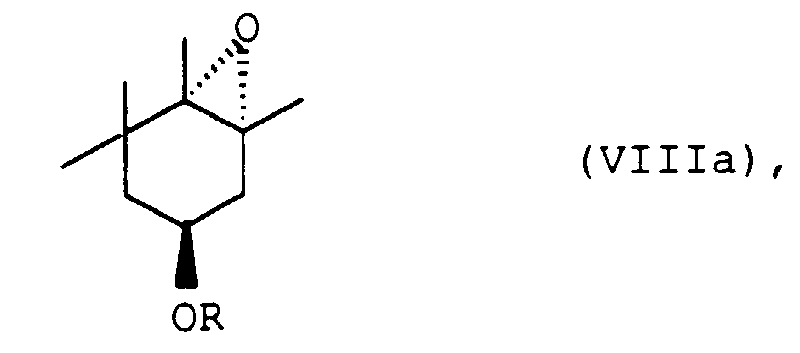
- D. das so erhaltene (1R, 3S, 6S)-7-Oxa-bicyclo[4.1.0]heptan-derivat der allgemeinen Formel VIIIa

Mit Vorteil geht man erfindungsgemäß zur Herstellung eines ggf. mit einer Schutzgruppe versehenen (1R, 4S)-4-Hydroxy-1,2,2-trimethyl-cyclopentylmethylketons der allgemeinen Formel Ia
- A. ein (4R, 6R)-4-Hydroxy-2,2,6-trimethyl-cyclohexan-1-on der allgemeinen Formel IIa


- C. das so erhaltene (1S)-3,4,5,5-Tetramethyl-3-cyclohexen-1-ol-derivat der allgemeinen Formel Va

- D. das so erhaltene (1R,3S,6S)-7-Oxa-bicyclo[4.1.0]heptan-derivat der allgemeinen Formel VIIIa

Zur Herstellung von einem (1S,4S)-1,2,2-Trimethyl-cyclopentylmethylketon der allgemeinen Formel Ib

- D. das erhaltene (1S,3S,6R)-7-Oxa-1,5,5,6-tetramethyl-bicyclo[4.1.0]heptan der allgemeinen Formel VIIIb

Mit Vorteil geht man erfindungsgemäß zur Herstellung von einem (1S,4S)-1,2,2-Trimethyl-cyclopentylmethylketon der allgemeinen Formel Ib


- C. dieses stereoselektiv epoxydiert und
- D. das so erhaltene (1S,3S,6R)-7-Oxa-1,5,5,6-tetramethyl-bicyclo[4.1.0]heptan-derivat der allgemeinen Formel VIIIb

- Von den Zwischenprodukten dieses vorteilhaften Verfahrens der Erfindung sind die 1,4-Dihydroxy-1,2,2,6-tetramethyl-cyclohexan-derivate der allgemeinen Formel IV

die 3,4,5,5-Tetramethyl-3-cyclohexen-derivate der allgemeinen Formel V
die 3,5,5-Trimethyl-4-methylen-cyclohexan-derivate der allgemeinen Formel VI
und die 7-Oxa-1,5,5,6-tetramethyl-bicyclo[4.1.0]heptan-derivate der allgemeinen Formel VIII
- Die als Ausgangsprodukte für das erfindungsgemäße Verfahren benötigten 4-Hydroxy-2,2,6-Trimethyl-cyclohexan-1-one der allgemeinen Formel II

- Die Einführung von Schutzgruppen in die Hydroxygruppe des Cyclohexanons kann in an sich bekannter Weise erfolgen.
- Für die Überführung der 2,2,6-Trimethyl-cyclohexan-1-on-derivate der allgemeinen Formel II in die 1,4-Dihydroxy-cyclohexan-derivate der allgemeinen Formel IV verwendet man als Methylcarbanionen mit Vorteil Methylgrignardverbindungen, wie CH3MgCl, CH3MgBr und CH3MgJ, oder aber Methyl-Lithium. Bezüglich näherer Einzelheiten über die Durchführung der Grignard-Reaktion bzw. der Umsetzung mit Methyllithium verweisen wir beispielsweise auf "Organikum, Organisch-chemisches Grundpraktikum", 16. Auflage, VEB Deutscher Verlag der Wissenschaften, Berlin 1986, Seiten 499-502. Die Umsetzung wird im allgemeinen unter einem Schutzgas, wie N2, durchgeführt.
- Für die säurekatalysierte Eliminierung der tertiären Hydroxylgruppe aus dem 1,4-Dihydroxy-1,2,2,6-tetramethyl-cyclohexan der allgemeinen Formel IV haben sich folgende Reaktionsbedingungen besonders bewährt: In einem inerten organischen Lösungsmittel, das mit Wasser ein Azeotrop bildet, werden die 1,4-Dihydroxy-cyclohexanderivate der allgemeinen Formel IV unter Zusatz von Spuren einer Säure, wie H2SO4, H3PO4 oder p-Toluolsulfonsäure, kurzzeitig unter Rückfluß zum Sieden erhitzt, wodurch eine selektive Eliminierung der tertiären und nicht der sekundären Hydroxygruppe gelingt. Gleichzeitig besteht unter diesen Bedeutungen die Möglichkeit zu einer quantitativen Isomerisierung der exo-Methylengruppe in Verbindungen der allgemeinen Formel VI in die interne Doppelbindung von Verbindungen der allgemeinen Formel V.
- Auch die Umsetzung der 2,2,6-Trimethyl-cyclohexan-1-on-derivate der allgemeinen Formel II mit Triphenylmethylenphosphoranen der Formel VII in die Methylencyclohexan-Verbindungen der allgemeinen Formel VI erfolgt in an sich bekannter Weise. Bezüglich näherer Einzelheiten über die Durchführung von Wittig-Reaktionen mit cyclischen Ketonen verweisen wir beispielsweise auf "Organikum, Organisch-chemisches Grundpraktikum" 16. Auflage, VEB Deutscher Verlag der Wissenschaften, Berlin 1986, Seiten 465-66.
- Die säurekatalysierte Doppelbindungsisomerisierung von der Methylencyclohexan-Verbindungen der allgemeinen Formel VI in die Tetramethylcyclohexen-1-derivate der allgemeinen Formel V

- Für die Isomerisierungsreaktion setzt man entweder das bei der Umsetzung mit Methylcarbanionen und nachfolgende Wassereliminierung erhaltene Gemisch aus den Verbindungen der Formel V und VI ein oder aber das bei der Umsetzung mit dem Triphenylmethylenphosphoran erhaltene Methylencyclohexan der Formel VI.
- Für die nachfolgende Epoxidierung der Doppelbindung in den Verbindungen der allgemeinen Formel V haben sich folgende Reaktionsbedingungen besonders bewährt:
- Als Epoxidierungsmittel verwendet man im allgemeinen Peroxysäuren, wie Peroxyameisensäure, Peroxyessigsäure, Peroxybenzoesäure, Peroxytrifluoressigsäure, Monoperoxyphthalsäure, Perwolframsäure, Permolybdänsäure oder 3-Chlor-peroxybenzoesäure, Salze von Peroxysäuren, wie Magnesiumperoxyphthalat oder Pervanadate, oder Hydroperoxide, wie tert.-Butylhydroperoxid/VO(CH3-CO-CH2-CO-)3; tert.-Butylhydroperoxid/MnO2 oder VO(CH3-CO-CH2-CO-)3/H2O2. Das Epoxydierungsmittel verwendet man im allgemeinen in Mengen von 1 bis 1,8, vorzugsweise 1 bis 1,5, insbesondere 1 bis 1,2 Mol pro Mol der Verbindung der allgemeinen Formel V, Va oder Vb.
- Als Lösungsmittel für diese Epoxidierung sind aliphatische oder aromatische Kohlenwasserstoffe oder Halogenkohlenwasserstoffe besonders geeignet.
- Geeignete Reaktionstemperaturen sind Temperaturen von -30 bis +40°C, vorzugsweise -10 bis +30°C, insbesondere -5 bis +25°C.
- Die Epoxidierung wird mit Vorteil unter Lichtausschluß durchgeführt.
- Die Epoxydierung von (1S)-3,4,5,5-Tetramethyl-3-cyclohexen-1-ol der Formel Va


Die Einführung von Schutzgruppen R mit starker Donorfunktion, die zur Ausbildung von Wasserstoffbrückenbindungen führen bzw. zur Komplexierung von Epoxidierungskatalysatoren dienen, ermöglicht eine Erhöhung der Stereoselektivität für diese Art der Reaktion.
Als Schutzgruppen mit starker Donorfunktion seien beispielsweise genannt: Arylmethyloxycarbonylgruppen, wie die Benzyloxycarbonylgruppe, Alkyloxyalkylgruppen, wie die Ethoxyethylgruppe und die Methoxyisopropylgruppe, Alkanoylgruppen, wie die Acetylgruppe, Arylalkanoylgruppen, wie die Benzoylgruppe oder eine Tetrahydropyranoylgruppe. - Führt man dagegen an der Hydroxygruppe von (1S)-3,4,5,5-Tetramethyl-3-cyclohexen-1-ol der Formel Va Schutzgruppen mit stark voluminösem Charakter ein, so wird die Diastereoselektivität der Epoxidierungsreaktion invertiert.
- Als Schutzgruppen mit stark voluminösem, nicht koordinierendem und nicht komplexierendem Charakter seien beispielsweise folgende Gruppen genannt: voluminöse Alkylgruppen, wie die tert.-Butylgruppe oder die Isopropylgruppe, Arylgruppen, wie die Phenyl-, eine Alkylphenyl-, eine Naphthyl- oder eine Alkylnaphthylgruppe, oder aber Arylmethylgruppen, wie die Benzylgruppe oder 2-Naphthyl-methylgruppe, eine Alkylarylmethylgruppe, wie die tert.-Butyl-benzylgruppe, eine Trialkylsilylgruppe, wie die tert.-Butyldimethylsilylgruppe, eine Triarylsilylgruppe, wie die Triphenylsilylgruppe oder eine Alkylarylsilylgruppe, wie die Dimethylphenylsilylgruppe.
- Werden die so stereochemisch unterschiedlich aufgebauten Epoxide mit Lewis-Säuren umgesetzt, so läßt sich in kurzer Zeit eine Ringverengung unter Ausbildung der entsprechenden Cyclopentylmethylketone erreichen. Diese Ringverengungen verlaufen mit hoher Selektivität stark stereokontrolliert. Während das Epoxid mit syn-Orientierung der Hydroxygruppierung bei der Ringverengung (1S,4S)-1,2,2-Trimethyl-cyclopentylmethylketone der Formel Ib ergibt, liefert die Ringverengung der Epoxidverbindung mit anti-Orientierung der Hydroxyfunktion das für die Herstellung des begehrten Capsorubins benötigte (1R,4S)-4-Hydroxy-1,2,2-trimethylcyclopentylmethylketon bzw. dessen Derivate der Formel Ia.
- Verwendet man dagegen als Ausgangsverbindung für das erfindungsgemäße Verfahren (4S,6R)-4-Hydroxy-2,2,6-trimethyl-cyclohexan-1-on-derivate der allgemeinen Formel IIc


- Diese Sequenz ist jedoch infolge der deutlich höheren Stufenzahl für die Herstellung von Capsorubin weniger von Bedeutung.
- Als Lewis-Säuren kann man erfindungsgemäß beispielsweise einsetzen: MgCl2, MgBr2, MgJ2, CaCl2, CaBr2, FeCl3, AlCl3, TiCl4, SnCl4, BF3·(C2H5)2O, SbCl3 oder ZnCl2.
- Mit Vorteil verwendet man FeCl3, AlCl3, TiCl4; BF3·(C2H5)2O, oder SnCl4, insbesondere FeCl3, BF3·(C2H5)2O oder AlCl3. Die Lewis-Säuren verwendet man in Mengen von etwa 0,01 bis 1 Äquivalent pro Äquivalent der Epoxiverbindung.
- Es war sehr überraschend, daß die Ringverengung der Epoxide der allgemeinen Formel VIIIa-c nahezu stereoselektiv verläuft und darüber hinaus bei der Ringverengung im wesentlichen nur ein Reaktionsprodukt, aktionsprodukt, nämlich Cyclopentylmethylketone der allgemeinen Formeln I bzw. Ia, Ib und Ic gebildet werden.
- Mit Hilfe des erfindungsgemäßen Verfahrens kann das für die technische Herstellung von Capsorubin benötigte (1R,4S)-4-Hydroxy-1,2,2-trimethyl-cyclopentylmethylketon der Formel Ia mit R=H sowie Derivate oder Stereoisomere dieser Verbindung ausgehend von einem technisch leicht zugänglichen Ausgangsstoff auf technisch relativ einfache Weise und mit recht guten Ausbeuten über neue Zwischenprodukte hergestellt werden.
- In 9 ml einer 3 m Lösung von Methylmagnesiumbromid (26,6 mmol) in Diethylether(Ether) ließ man unter Aufrecherhalten von Raumtemperatur (RT) durch Außenkühlung unter Stickstoff als Schutzgas innerhalb von 15 Minuten (min) eine Lösung von 1,11 g (7,2 mmol) (4R,6R)-4-Hydroxy-2,6,6-trimethyl-cyclohexan-1-on in 50 ml absolutem Tetrahydrofuran (THF) hineintropfen. Man erhielt dabei eine trübe, gelblich gefärbte Lösung, die noch 12 Stunden (h) bei RT und N2 nachgerührt wurde. Anschließend wurde das Reaktionsgemisch mit 10 ml einer 5 gew.-%igen wäßrigen Schwefelsäure versetzt und 2 mal mit 50 ml Ether extrahiert. Durch Abdestillieren des Lösungsmittels wurden 1,05 g eines Rohproduktes erhalten. Es handelte sich um ein Diastereomerengemisch, bezogen sowohl auf das Zentrum 1 als auch das Zentrum 6.
- 4 g (23,2 mmol) eines gemäß Beispiel 1A erhaltenen Diastereomerengemisches wurden in 50 ml Toluol aufgenommen, die Lösung mit einer Spatelspitze (etwa 4 mg) p-Toluolsulfonsäure (p-TsOH) versetzt und 45 min unter Rückfluß zum Sieden erhitzt. Anschließend wurde das Reaktionsgemisch in 50 ml Wasser gegeben und 2 mal mit 50 ml Ether extrahiert. Die erhaltene organische Phase wurde mit 50 ml einer gesättigten wäßrigen NaHCO3-Lösung gewaschen, über MgSO4 getrocknet und unter vermindertem Druck vom Lösungsmittel befreit. Das erhaltene Rohprodukt wurde an 150 g Kieselgel mit einem Hexan/Essigsäureethylester (ESE)-Gemisch im Verhältnis (4:1) chromatographiert. Man erhielt das gewünschte Produkt in Form von 2,5 g hellgelber Kristalle in einer Reinheit von 96,4 % (GC-Analyse). Das entspricht einer Selektivität von 71 % der Theorie.
- 2,5 g (16,2 mmol) des gemäß Beispiel 1B erhaltenen (1S)-3,4,5,5-Tetramethyl-3-cyclohexen-1-ols wurden unter N2-Schutz in 50 ml Methylenchlorid gelöst, die Lösung auf 0°C abgekühlt und danach unter Lichtausschluß mit 5,1 g einer 55 gew.-%igen Lösung von 3-Chlor-peroxybenzoesäure in Methylenchlorid (MCPBA; entsprechend 16,2 mmol) versetzt und das Reaktionsgemisch noch 1 h bei RT gerührt. Anschließend wurde das Reaktionsgemisch in 50 ml Eiswasser eingetragen, mit 50 ml Methylenchlorid versetzt. Nach intensivem Vermischen wurde die organische Phase abgetrennt, mit 100 ml Wasser, dann mit 50 ml einer 5%igen Na2CO3-Lösung und dann mit 50 ml Wasser gewaschen, anschließend getrocknet und vom Lösungsmittel befreit. Man erhielt 2,56 g (entsprechend 93 % der Theorie) der gewünschten Epoxydverbindung. Durch Chromatographie an 75 g Kieselgel mit Hexan/ESE (4:1) erhielt man 2,05 g der gewünschten Verbindung. Die Ausbeute an reinem Produkt betrug 75 %, die Aufklärung der relativen Konfiguration gelang durch Anwendung von 2 D-NMR-Experimenten.
- 1 g (5,87 mmol) des gemäß Beispiel 1C erhaltenen (1S, 3S, 6R)-3-Hydroxy-7-oxa-1,5,5,6-tetramethyl-bicyclo[4.1.0]heptans wurden in 25 ml absolutem (über Alox B filtriertem) Methylenchlorid gelöst und die Lösung bei RT 2mal mit 0,36 ml (5,88 mmol) BF3x(C2H5)2O versetzt und dann 2 h bei RT gerührt. Anschließend wurde das Reaktionsgemisch mit 25 ml Methylenchlorid verdünnt, mit 25 ml Wasser gewaschen und dann getrocknet. Durch Entfernen des Lösungsmittels unter vermindertem Druck wurden 0,92 g eines rotbraunen Rohproduktes erhalten. Chromatographie an 50 g Kieselgel mit Hexan/ESE (5:1) ergab 321 mg des oben genannten Cyclopentylmethylketons. Der Vergleich der Spektren der isolierten Verbindung mit Literaturdaten ergab eine sehr gute Übereinstimmung. Die Bestimmung der relativen Konfiguration des neu im System entstandenen Stereozentrums erfolgte über CH-Correlations- und ROESY-Spektroskopie (NMR-spektroskopische Methode zur zweifelsfreien Zuordnung von H-Resonanzen und deren räumlichem Verhältnis zueinander).
- Eine Lösung von 2,5 g (6,86 mmol) Methyltriphenylphosphoniumbromid in 10 ml Dimethylsulfoxid (DMSO) wurde unter N2-Schutzgas mit 0,79 g (6,86 mmol) Kalium-tert-butylat (KOtBu) versetzt und anschließend 30 min bei RT gerührt. Zu diesem Gemisch wurden 0,36 g (2,29 mmol) (4R, 6R)-4-Hydroxy-2,2,6-trimethyl-cyclohexan-1-on addiert und das Reaktionsgemisch noch 5 min bei RT nachgerührt, wobei ein weißer Niederschlag ausfiel. Anschließend wurde das Reaktionsgemisch für 15 min bei 60°C gerührt, dann auf RT abgekühlt, in 150 ml Eiswasser gegossen und 2mal mit 50 ml Methylenchlorid extrahiert. Nach Waschen der abgetrennten organischen Phase mit 50 ml einer 5%igen wäßrigen Na2CO3-Lösung und 50 ml Wasser sowie Trocknen über MgSO4 wurde das Lösungsmittel unter vermindertem Druck entfernt.
- 4 g eines gemäß Beispiel 2A erhaltenen (1R)-3,3,5-Trimethyl-4-methylen-cyclohexan-1-ols wurden in 50 ml Toluol gelöst, mit ca. 6 mg p-Toluolsulfonsäure versetzt und für 45 min unter Rückfluß zum Sieden erhitzt. Anschließend wurde das Reaktionsgemisch in 50 ml Wasser gegeben und 2mal mit 50 ml Ether extrahiert. Die abgetrennte organische Phase wurde mit 50 ml einer gesättigten NaHCO3-Lösung gewaschen, über MgSO4 getrocknet und unter vermindertem Druck vom Lösungsmittel befreit. Der Rückstand wurde an 150 g Kieselgel mit Hexan/ESE (4:1) chromatographiert. Man erhielt 3,7 g des oben genannten Produkts in Form hellgelber Kristalle, das nach GC 97 % rein war.
- 0,8 (5,2 mmol) des Beispiel 2B erhaltenen (1S)-3,4,5,5-Tetramethyl-3-cyclohexen-1-ol wurden in 5 ml absolutem Methylenchlorid gelöst, die Lösung mit 0,5 ml Pyridin versetzt und auf 0°C abgekühlt. Anschließend wurde mit 1,54 g (5,7 mmol) Trifluormethansulfonsäure-tert.-butyldimethylsilylester versetzt, das Reaktionsgemisch noch 15 min bei 0°C gerührt und dann in 10 ml Wasser gegossen. Nach Extraktion mit 10 ml Methylenchlorid wurde die organische Phase mit 10 ml einer 0,1 m H2SO4, 10 ml einer gesättigten NaHCO3-Lösung und 10 ml Wasser gewaschen, über MgSO4 getrocknet und eingeengt. Man erhielt 1,3 g (92 % der Theorie) des oben genannten Produktes.
- 1,25 g (4,7 mmol) des gemäß Beispiel 1C erhaltenen (1S)-1-tert.-Butyldimethylsilyloxy-3,4,5,5-tetramethyl-3-cyclohexens wurden in 25 ml absolutem Methylenchlorid gelöst, die Lösung auf 0°C abgekühlt, dann mit 1,5 g 3-Chlor-peroxybenzoesäure in Methylenchlorid (MC PBA; entsprechend 4,7 mmol) versetzt, 1 h bei 0°C gerührt und dann in 25 ml Eiswasser eingetragen. Anschließend wurden noch 25 ml Methylenchlorid zugefügt, intensiv vermischt, die abgetrennte organische Phase mit 25 ml einer 5%igen Na2SO3-Lösung und 25 ml Wasser gewaschen, getrocknet und vom Lösungsmittel befreit. Man erhielt 1,18 g (88 % d. Theorie) farbloser Kristalle. Der Diastereomerenüberschuß liegt gemäß NMR-Analyse bei 20 %.
- 1,1 g (3,87 mmol) des gemäß Beispiel 2 D erhaltenen (1R,3S,6S)-3-(tert.-Butyldimethylsilyloxy)-7-oxa-1,5,5,6-tetramethyl-bicyclo[4.1.0]heptans wurden in 25 ml Methylenchlorid gelöst, die Lösung bei RT mit 0,24 ml (1,93 mmol) BF3(C2H5)2O versetzt, das Reaktionsgemisch 1 h bei RT gerührt, dann mit 25 ml Wasser versetzt und die abgetrennte organische Phase mit Wasser gewaschen und eingeengt. Zur quantitativen Entfernung der Schutzgruppe wurden dem Rückstand 3,7 ml (6,1 mmol) einer 1,1 m Tetrabutylammoniumfluoridlösung zugesetzt. Es wurde erneut mit Wasser gewaschen und die organische Phase abgetrennt. Chromatographie an Kieselgel mit einem Hexan/ESE (5:1)-Gemisch ergab 0,9 g eines Produktes mit einem Diastereomerenüberschuß von 20 %.
- 2 g (13 mmol) eines gemäß Beispiel 1A und 1B hergestellten (1S)-3,4,5,5-Tetramethyl-3-cyclohexen-1-ols wurden in 10 ml Dimethoxyethan (DME) gelöst und zur Alkoholatbildung bei RT zu einer Suspension von 965 mg (38.9 mmol) NaH in 10 ml DME getropft. Nach abgeschlossener Gasentwicklung wurden 14 mmol Benzylbromid zugetropft. Nach 12 h Rühren bei RT lag vollständiger Umsatz vor. Der Ansatz wurde dann mit 50 ml Wasser versetzt und 2mal mit 50 ml Ether extrahiert. Chromatographie des Rückstands mit Hexan/ESE(4:1) ergab 3 g (86 %) des obengenannten Produktes.
- 1,9 g (7.77 mmol) des gemäß Beispiel 3A hergestellten (1S)-1-Benzyloxy-3,4,5,5-tetramethyl-3-cyclohexens wurden in 40 ml Methylenchlorid gelöst und auf 0°C abgekühlt. Man setzte 2.44 g 3-Chlor-peroxybenzoesäure in Methylenchlorid (entsprechend 7,77 mmol)zu und rührte 1 h bei 0°C nach; anschließend wurde auf 150 ml Eiswasser gegeben und 2mal mit 50 ml Methylenchlorid extrahiert. Die organischen Phasen wurden dann mit 50 ml einer 5%igen Natriumsulfit-Lösung und 50 ml Wasser gewaschen, getrocknet und vom Lösungsmittel befreit. Man erhielt 2 g (96 %) des Produkts. Der Diastereomerenüberschuß beträgt 65 %.
- 1,64 g (6,5 mmol) des gemäß Beispiel 3B hergestellten (1R,3S,6S)-3-Benzyloxy-7-oxa-1,5,5,6-tetramethylbicyclo(4.1.0]heptans wurden in 25 ml Methylenchlorid gelöst und bei RT mit 0,4 ml Bortrifluorid-Etherat versetzt. Man ließ 1 h bei RT nachrühren. Aufarbeitung erfolgte analog Beispiel 2E. Man erhielt nach Chromatographie 0,98 g Produkt. Zur Abspaltung der Schutzgruppe wurde der Rückstand in 50 ml Ethanol aufgenommen, mit 150 mg 10 % Pd/C versetzt und unter Normaldruck bei RT hydriert. Nach 45 min war die Hydrierung beendet. Der Katalysator wurde abgetrennt und das Lösungsmittel unter vermindertem Druck entfernt. Man erhielt 0,96 g des oben genannten Produkts mit einer Diastereoselektivität von 65 %.
- 2 g (13 mmol) eines gemäß Beispiel 2A und 2B hergestellten (1S)-3,4,5,5-Tetramethyl-3-cyclohexen-1-ols wurden in 10 ml DME gelöst und bei RT zu einer Suspension von 965 mg (38,9 mmol) NaH in 10 ml DME getropft. Nach abgeschlossener Gasentwicklung wurden 14 mmol 2-Brom-methylnaphthalin zugetropft. Nach 12 h Rühren bei RT war der Umsatz vollständig. Das Reaktionsgemisch wurde mit 50 ml Wasser versetzt und dann 2mal mit 50 ml Ether extrahiert. Durch Chromatographie des Rückstands analog Beispiel 3A wurden 3,7 g (97 %) des oben genannten Produkts erhalten.
- 4 g (13,6 mmol) eines gemäß Beispiel 4A hergestellten (1S)-1-(2-Naphthylmethyl-oxy)-3,4,5,5-tetramethyl-3-cyclohexens wurden analog Beispiel 2D mit 4,3 g (13,6 mmol) 55 %iger MCPBA umgesetzt.
Man erhielt 4,1 g des oben genannten Produkts (entsprechend 97 % der Theorie) mit einer Diastereoselektivität von 68 %. - 4 g (1,3 mmol) (1R,3S,6S)-3-(2-Naphthylmethyloxy)-7-oxa1,5,5,6-tetramethylbicyclo[4.1.0]heptan wurden analog Beispiel 3C in Methylenchlorid mit Bortrifluoridetherat umgesetzt. Nach der Hydrierung wurde der Katalysator abgetrennt, das Lösungsmittel entfernt. Man erhielt das oben genannte Produkt mit 78 % Diastereoselektivität. Die Trennung der Diastereomeren erfolgte durch einfache Destillation.
- Durch Umsetzen von (1S)-3,4,5,5-Tetramethyl-3-cyclohexen-1-ol in DME mit 4-tert.-Butylbenzylbromid analog Beispiel 3A wurde das oben genannte Produkt in 97%iger Ausbeute erhalten.
- Durch Umsetzen des gemäß Beispiel 5A erhaltenen (1S)-1-(4-tert.-Butylbenzyl-oxy)-3,4,5,5-tetramethyl-3-cyclohexens mit MCPBA analog Beispiel 3B wurde das oben genannte Produkt mit 92 %iger Ausbeute erhalten.
- Aus dem gemäß Beispiel 5B erhaltenen Epoxid wurde analog Beispiel 3C durch Umsetzen mit BF3etherat in Methylenchlorid Ia mit einem Diastereomerenüberschuß von 78 % erhalten. Die Diastereoisomeren sind destillativ oder durch Chromatographie trennbar.
- 0,8 g (5,2 mmol) (1S)-3,4,5,5-Tetramethyl-3-cyclohexen-1-ol wurden unter N2-Schutz in 5 ml absolutem Methylenchlorid gelöst, die Lösung auf 0°C abgekühlt und mit 260 mg (1,04 mmol) Pyridinium-p-Toluolsulfonat und danach mit 0,45 mg (6,2 mmol) Ethylvinylether versetzt. Anschließend wurde das Reaktionsgemisch 1 h bei 0°C gerührt, dann in eine gesättigte wäßrige NaHCO3-Lösung eingetragen, mit Methylenchlorid extrahiert und der Extrakt über MgSO4 getrocknet und eingeengt. Der Rückstand wurde durch Destillation gereinigt und ergab 1,1 g (entsprechend 97 % der Theorie) des oben genannten Produkts.
- 0,6 g (2,65 mmol) (1S)-1-Ethoxy-ethoxy-3,4,5,5-tetramethyl-3-cyclohexen wurden in 12 ml Methylenchlorid gelöst und die Lösung auf 0°C abgekühlt, dann mit 0,83 g einer 55 %igen Lösung von 3-Chlor-perbenzoesäure in Methylenchlorid (entsprechend 2,65 mmol) versetzt und anschließend 1 h bei 0°C gerührt. Durch Aufarbeitung analog Beispiel 2D wurden 0,9 g (82 % d. Theorie) erhalten. Der Diastereomerenüberschuß betrug ca. 60 %.
- 1,2 g (4,95 mmol) (1S,3S,6R)-3-(Ethoxyethoxy)-7-oxa-1,5,5,6-tetramethylbicyclo-[4.1.0]heptan wurden in 25 ml Methylenchlorid gelöst und bei RT mit 0,3 ml (2,48 mmol) Bortrifluorid-Etherat versetzt. Nach 1 h Rühren bei RT wurde der Ansatz auf 25 ml Wasser gegeben und mit 25 ml Methylenchlorid extrahiert. Zur Abspaltung der Schutzgruppe wurden der organischen Phase 2 ml einer 0,1 M Schwefelsäure zugesetzt und der Ansatz für 1 h bei RT gerührt. Anschließend wurde die organische Phase mehrfach mit Wasser gewaschen, über Magnesiumsulfat getrocknet und vom Lösungmittel befreit. Nach Chromatographie mit Hexan/ESE (3:1) wurden 0,39 g Produkt erhalten. Der Diastereomerenüberschußt betrug 60 %.
- 0,8 g (5,2 mmol) eines gemäß Beispiel 2A hergestellten (1S)-3,4,5,5-Tetramethyl-3-cyclohexen-1-ol wurden unter N2-Schutz in 5 ml absolutem Methylenchlorid gelöst, die Lösung auf 0°C abgekühlt und dann zunächst mit 260 mg (1,04 mmol) Pyridinium-p-Toluolsulfonat und dann mit 450 mg (6,2 mmol)3,4-Dihydropyran versetzt. Anschließend wurde das Reaktionsgemisch 1 h bei 0°C gerührt, dann in gesättigte NaHCO3-Lösung eingegossen und mit Methylenchlorid extrahiert. Der Extrakt wurde über MgSO4 getrocknet und eingeengt. Man erhielt 1,1 g (entsprechend 89 % d.Th.) an dem gewünschten Produkt.
- Diese Verbindung kann analog Beispiel 6B und 6C in (1S,4S)-4-Hydroxy-1,2,2-trimethyl-cyclopentylmethylketon überführt werden.
- 2 g (13 mmol) (1S)-3,4,5,5-Tetramethyl-3-cyclohexen-1-ol wurden in 20 ml abs. Methylenchlorid gelöst. Bei RT wurde 1 ml (13 mmol) Pyridin und 1,5 ml (13 mmol) Chlorameisensäurebenzylester zugegeben. Man ließ 4 h bei RT rühren und gab das Reaktionsgemisch dann auf 100 ml Eiswasser. Nach Extraktion mit Methylenchlorid wurde die organische Phase mit 50 ml 0,1 M Schwefelsäure, 50 ml gesättigter Natriumhydrogencarbonatlösung und 50 ml Wasser gewaschen. Nach Trocknung und Entfernung des Lösungsmittels wurden 2,8 g (98 %) des oben genannten Produktes erhalten.
- Durch Epoxidieren und Behandeln mit BF3etherat kann diese Verbindung analog den Beispielen 6B und 6C in (1S, 4S)-4-Hydroxy-1,2,2-trimethylcyclopentylmethylketon (Ib) überführt werden.
- Diese Verbindung kann analog Beispiel 1A unter Verwendung von (4S,6R)-4-Hydroxy-2,6,6-trimethyl-cyclohexan-1-on als Edukt gewonnen werden.
- Diese Verbindung kann aus der von Beispiel 9A analog zu Beispiel 1B erhalten werden.
- Die Synthese erfolgt in Analogie zu Beispiel 1C und liefert in vergleichbarer Ausbeute die oben genannte Verbindung.
- In Analogie zu Beispiel 1D führte die Umsetzung von (1R,3R,6S)-3-Hydroxy-7-oxa-1,5,5,6-tetramethyl-bicyclo[4.1.0]heptan in vergleichbaren Ausbeuten und Diastereoselektivitäten zu der oben genannten Verbindung.
Claims (11)
- Verfahren zur Herstellung von 1,2,2-Trimethyl-cyclopentylmethylketon-derivaten der allgemeinen Formel I
 A. ein 2,2,6-Trimethyl-cyclohexan-1-on der allgemeinen Formel II
CH3 -M+ (III),
in der M+ für Li, MgCl, MgBr oder MgJ steht, umsetzt
und das erhaltene 1,4-Dihydroxy-1,2,2,6-tetramethylcyclohexan-derivat der allgemeinen Formel IV

(C6H5)3P = CH2 (VII)
direkt in die Verbindung der allgemeinen Formel VI überführt,B. die erhaltene Verbindung der allgemeinen Formel VI durch säurekatalysierte Doppelbindungsisomerisierung in die Verbindung der allgemeinen Formel V überführt,C. die Doppelbindung in der Verbindung der allgemeinen Formel V D. die erhaltenen 7-Oxa-bicyclo[4.1.0]heptane der allgemeinen Formel VIII
- Verfahren gemäß Anspruch 1, dadurch gekennzeichnet, daß man zur Herstellung von (1R, 4S)-1,2,2-Trimethyl-cyclopentylmethylketon-derivaten der allgemeinen Formel Ia
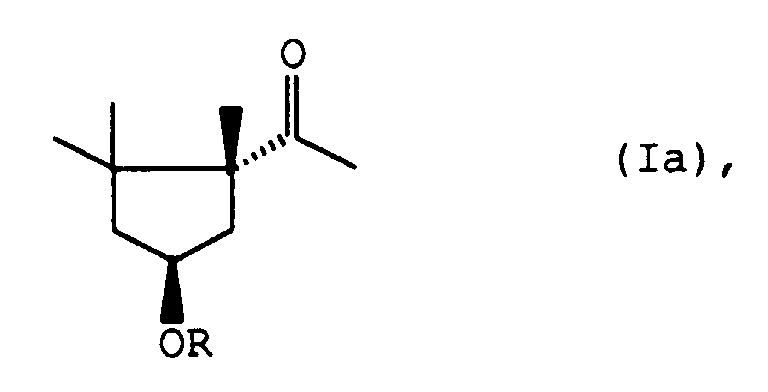

D. das so erhaltene (1R, 3S, 6S)-7-Oxa-bicyclo[4.1.0]heptan der allgemeinen Formel VIIIa
- Verfahren gemäß Anspruch 1, dadurch gekennzeichnet, daß man zur Herstellung eines ggf. mit einer Schutzgruppe versehenen (1R, 4S)-4-Hydroxy-1,2,2-trimethyl-cyclopentylmethylketons der allgemeinen Formel Ia
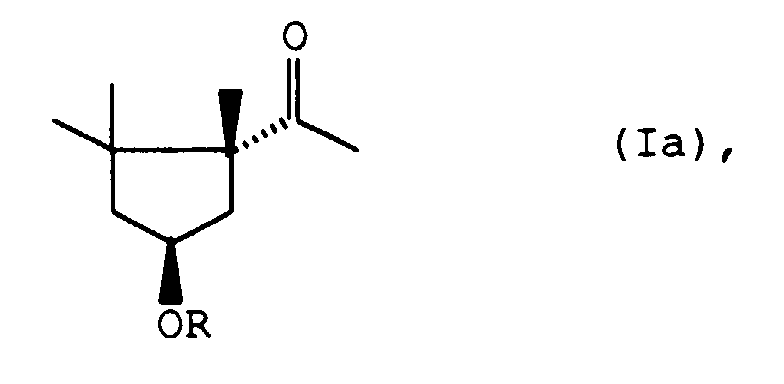 A. ein (4R, 6R)-2,2,6-Trimethyl-cyclohexan-1-on-derivat der allgemeinen Formel IIa
 C. das so erhaltene (1S)-3,4,5,5-Tetramethyl-3-cyclo-hexen-1-ol-derivat der allgemeinen Formel Va
 D. das so erhaltene (1R,35,65)-7-Oxa-bicyclo[4.1.0]heptan-derivat der allgemeinen Formel VIIIa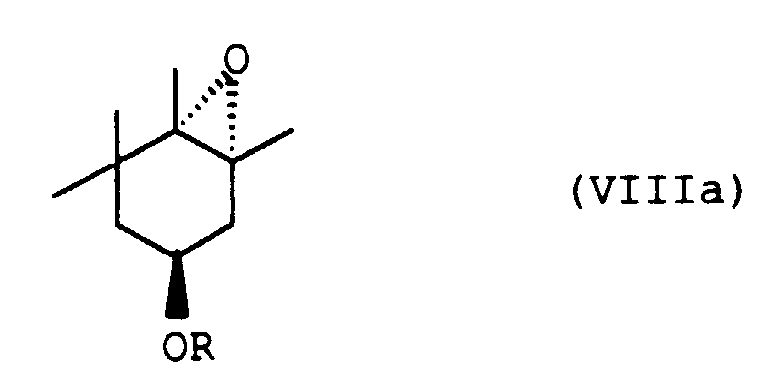
- Verfahren gemäß Anspruch 1, dadurch gekennzeichnet, daß man zur Herstellung von einem (1S,4S)-1,2,2-Trimethyl-cyclopentylmethylketon-derivat der allgemeinen Formel Ib


D. das erhaltene (1S,3S,6R)-7-Oxa-1,5,5,6-tetramethyl-bicyclo[4.1.0]heptan-derivat der allgemeinen Formel VIIIb
- Verfahren gemäß Anspruch 1, dadurch gekennzeichnet, daß man zur Herstellung von einem (1S,45)-1,2,2-Trimethyl-cyclopentylmethylketon der allgemeinen Formel Ib


 C. dieses stereoselektiv epoxidiert undD. das so erhaltene (1S,3S,6R)-7-Oxa-1,5,5,6-tetramethyl-bicyclo[4.1.0]heptan-derivat der allgemeinen Formel VIIIb
- Verfahren gemäß Anspruch 1, dadurch gekennzeichnet, daß man zur Herstellung von einem (1R,4R)-1,2,2-Trimethyl-cyclopentylmethylketon-derivat der Formel Ic

im Reaktionsschritt C. ein (1R)-3,4,5,5-Tetramethyl-3-cyclohexen-derivat der allgemeinen Formel Vb
D. das erhaltene (1R,3R,6S)-7-Oxa-1,5,5,6-tetramethyl-bicyclo[4.1.0]heptan-derivat der allgemeinen Formel VIIIc
- Verfahren gemäß Anspruch 1, dadurch gekennzeichnet, daß man zur Herstellung von (1R,4R)-4-Hydroxy-1,2,2-trimethyl-cyclopentylmethylketon der allgemeinen Formel Ic


D. das so erhaltene (1R, 3R, 6S)-7-Oxa-1,5,5,6-tetramethylbicyclo[4.1.0]heptan-derivat der allgemeinen Formel VIIIc
- 3,4,5,5-Tetramethyl-3-cyclohexen-derivate der allgemeinen Formel V
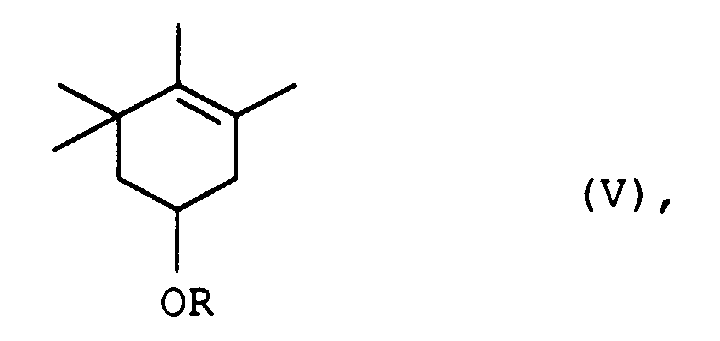


- 7-Oxa-1,5,5,6-tetramethyl-bicyclo[4.1.0]heptan-derivate der allgemeinen Formel VIII


(1S,3S,6R)-Isomeren der allgemeinen Formel VIIIb
und (1R,3R,6S)-Isomeren der allgemeinen Formel VIIIc
- (1S)-3,4,5,5-Tetramethyl-3-cyclohexen-derivate der allgemeinen Formel Va

- (1R,3S,6S)-7-Oxa-1,5,5,6-tetramethyl-bicyclo[4.1.0]heptan-derivate der allgemeinen Formel VIIIa
Applications Claiming Priority (2)
| Application Number | Priority Date | Filing Date | Title |
|---|---|---|---|
| DE4407464 | 1994-03-07 | ||
| DE4407464A DE4407464A1 (de) | 1994-03-07 | 1994-03-07 | Verfahren zur Herstellung von (1R,4S)-4-Hydroxy-1,2,2-trimethyl-cyclopentyl-methylketon sowie Derivaten und Stereoisomeren dieser Verbindung |
Publications (2)
| Publication Number | Publication Date |
|---|---|
| EP0671378A1 EP0671378A1 (de) | 1995-09-13 |
| EP0671378B1 true EP0671378B1 (de) | 1997-01-29 |
Family
ID=6512018
Family Applications (1)
| Application Number | Title | Priority Date | Filing Date |
|---|---|---|---|
| EP95102924A Expired - Lifetime EP0671378B1 (de) | 1994-03-07 | 1995-03-02 | Verfahren zur Herstellung von (1R,4S)-4-Hydroxy-1,2,2-trimethylcyclopentyl-methylketon sowie Derivaten und Steroisomeren dieser Verbindung |
Country Status (5)
| Country | Link |
|---|---|
| US (1) | US6111125A (de) |
| EP (1) | EP0671378B1 (de) |
| JP (1) | JPH07316086A (de) |
| CA (1) | CA2143992A1 (de) |
| DE (2) | DE4407464A1 (de) |
Family Cites Families (7)
| Publication number | Priority date | Publication date | Assignee | Title |
|---|---|---|---|---|
| JPS6360948A (ja) * | 1986-09-02 | 1988-03-17 | Ono Pharmaceut Co Ltd | アルデヒド類の製造方法 |
| JPH01275545A (ja) * | 1988-04-27 | 1989-11-06 | Shinkyowa Petrochem Co Ltd | 3−シクロアルケノンの製造方法 |
| JP2951989B2 (ja) * | 1990-02-15 | 1999-09-20 | ダイセル化学工業株式会社 | 水酸基を有するエポキシ化合物の製造方法 |
| ATE159238T1 (de) * | 1991-04-17 | 1997-11-15 | Rhone Poulenc Chimie | Synthesezwischenprodukte mit einem hexanring und verfahren zu ihrer herstellung |
| US5382676A (en) * | 1991-08-28 | 1995-01-17 | Daicel Chemical Industries, Ltd. | Purified 3,4-epoxycyclohexyl methyl(meth)acrylate, a process for the preparation thereof and a 3,4-epoxycyclohexyl methyl(meth)acrylate composition |
| WO1995008546A1 (en) * | 1993-09-22 | 1995-03-30 | Kyowa Hakko Kogyo Co., Ltd. | Epoxycyclohexenedione derivative |
| WO1996008481A1 (en) * | 1994-09-14 | 1996-03-21 | Sagami Chemical Research Center | Epoxycyclohexane derivative and plant growth regulator |
-
1994
- 1994-03-07 DE DE4407464A patent/DE4407464A1/de not_active Withdrawn
-
1995
- 1995-03-02 EP EP95102924A patent/EP0671378B1/de not_active Expired - Lifetime
- 1995-03-02 DE DE59500101T patent/DE59500101D1/de not_active Expired - Fee Related
- 1995-03-03 US US08/398,643 patent/US6111125A/en not_active Expired - Fee Related
- 1995-03-06 JP JP7045887A patent/JPH07316086A/ja not_active Withdrawn
- 1995-03-06 CA CA002143992A patent/CA2143992A1/en not_active Abandoned
Also Published As
| Publication number | Publication date |
|---|---|
| US6111125A (en) | 2000-08-29 |
| CA2143992A1 (en) | 1995-09-08 |
| DE59500101D1 (de) | 1997-03-13 |
| DE4407464A1 (de) | 1995-09-28 |
| EP0671378A1 (de) | 1995-09-13 |
| JPH07316086A (ja) | 1995-12-05 |
Similar Documents
| Publication | Publication Date | Title |
|---|---|---|
| EP0633258B1 (de) | Verbessertes Verfahren zur Herstellung von Astaxanthin, neue Zwischenprodukte hierfür sowie ein Verfahren zu deren Herstellung | |
| DE10145223A1 (de) | Verfahren zur Herstellung von meso-Zeaxanthin | |
| DE2801908C2 (de) | ||
| DE2520186A1 (de) | Verfahren zur herstellung von carbonylverbindungen | |
| EP0129252B1 (de) | Verfahren zur Herstellung von optisch aktiven Hydrochinonderivaten sowie von d-alpha-Tocopherol | |
| EP0671378B1 (de) | Verfahren zur Herstellung von (1R,4S)-4-Hydroxy-1,2,2-trimethylcyclopentyl-methylketon sowie Derivaten und Steroisomeren dieser Verbindung | |
| DE3705785A1 (de) | Verfahren zur herstellung von polyenaldehyden | |
| EP0001089B1 (de) | Verfahren zur Herstellung von halogenvinylsubstituierten Tetrahydrofuran-2-onen, bestimmte halogenvinylsubstituierte Tetrahydrofuran-2-one | |
| DE69812997T2 (de) | Reaktion von alkenen mit epoxiden, die produkte davon und ihre verwendung als riechstoffe | |
| FR2498592A1 (fr) | Procede de preparation de derives d'oxocyclopentene et nouveaux produits ainsi obtenus | |
| DE69308965T2 (de) | Verfahren zum Herstellen einer gesättigten monocyclischen Kohlenwasserstoffverbindung und ein Zwischenprodukt für dieses | |
| EP0882709B1 (de) | Verfahren zur Herstellung von Zeaxanthin, Zwischenprodukte für dieses Verfahren und Verfahren zu deren Herstellung | |
| DE10246038B3 (de) | Verfahren zur Herstellung von alpha-Bisabolol aus Nerolidol | |
| EP0120341A2 (de) | Verfahren zur Herstellung von Pentadienol-Derivaten | |
| EP0842926A1 (de) | Verfahren zur Herstellung von Rosenoxid | |
| DE69718282T2 (de) | Neue Epoxiden, Verfahren zu ihrer Herstellung und ihre Verwendung für die Herstellung von Riechstoff-Bestandteilen | |
| EP0114612B1 (de) | Racemisches und optisch aktives 3-Hydroxy-alpha-cyclocitral, deren Acetale und optisch aktive 3-Oxo-alpha-cyclocitralacetale sowie Herstellung und Verwendung dieser Verbindungen | |
| EP0131130B1 (de) | Verfahren zur Herstellung von Cycloalkenylalkinen | |
| DE60315391T2 (de) | Optisch aktive Epoxyverbindungen und Verfahren zu deren Herstellung | |
| EP0585828B1 (de) | Verfahren zur Herstellung eines Gemisches von 6-(2,6,6 Trimethyl-cyclohex-1-en-1-yl)-4-methyl-hex-3-en-1-ol und -4-en-1-ol | |
| DE3244272A1 (de) | (omega),(omega)-diacyloxy-2,6-dimethyl-octatriencarbonsaeureester und -aldehyde, verfahren zu ihrer herstellung und verwendung zur synthese von terpenverbindungen | |
| DE1643644C3 (de) | Derivate des 3,7-Dimethyl-2,7octadien-1 -als und Verfahren zu deren Herstellung | |
| DE2166797C2 (de) | Optisch aktive tricyclische Lactonaldehyde und Verfahren zu deren Herstellung | |
| EP0044440B1 (de) | Verfahren zur Herstellung von alpha- und beta-Cyclocitral sowie die N-Methylaldimine dieser Verbindungen | |
| DE69315014T2 (de) | Cyclohexen und Cyclohexenonderivate und Verfahren zum Herstellen von Cyclohexenderivaten |
Legal Events
| Date | Code | Title | Description |
|---|---|---|---|
| PUAI | Public reference made under article 153(3) epc to a published international application that has entered the european phase |
Free format text: ORIGINAL CODE: 0009012 |
|
| AK | Designated contracting states |
Kind code of ref document: A1 Designated state(s): CH DE FR GB LI NL |
|
| 17P | Request for examination filed |
Effective date: 19950901 |
|
| GRAG | Despatch of communication of intention to grant |
Free format text: ORIGINAL CODE: EPIDOS AGRA |
|
| 17Q | First examination report despatched |
Effective date: 19960528 |
|
| GRAH | Despatch of communication of intention to grant a patent |
Free format text: ORIGINAL CODE: EPIDOS IGRA |
|
| GRAH | Despatch of communication of intention to grant a patent |
Free format text: ORIGINAL CODE: EPIDOS IGRA |
|
| GRAA | (expected) grant |
Free format text: ORIGINAL CODE: 0009210 |
|
| AK | Designated contracting states |
Kind code of ref document: B1 Designated state(s): CH DE FR GB LI NL |
|
| REG | Reference to a national code |
Ref country code: CH Ref legal event code: EP |
|
| GBT | Gb: translation of ep patent filed (gb section 77(6)(a)/1977) |
Effective date: 19970212 |
|
| REF | Corresponds to: |
Ref document number: 59500101 Country of ref document: DE Date of ref document: 19970313 |
|
| ET | Fr: translation filed | ||
| PLBE | No opposition filed within time limit |
Free format text: ORIGINAL CODE: 0009261 |
|
| STAA | Information on the status of an ep patent application or granted ep patent |
Free format text: STATUS: NO OPPOSITION FILED WITHIN TIME LIMIT |
|
| 26N | No opposition filed | ||
| PGFP | Annual fee paid to national office [announced via postgrant information from national office to epo] |
Ref country code: NL Payment date: 20010228 Year of fee payment: 7 |
|
| REG | Reference to a national code |
Ref country code: GB Ref legal event code: IF02 |
|
| PG25 | Lapsed in a contracting state [announced via postgrant information from national office to epo] |
Ref country code: NL Free format text: LAPSE BECAUSE OF NON-PAYMENT OF DUE FEES Effective date: 20021001 |
|
| NLV4 | Nl: lapsed or anulled due to non-payment of the annual fee |
Effective date: 20021001 |
|
| PGFP | Annual fee paid to national office [announced via postgrant information from national office to epo] |
Ref country code: DE Payment date: 20070222 Year of fee payment: 13 |
|
| PGFP | Annual fee paid to national office [announced via postgrant information from national office to epo] |
Ref country code: GB Payment date: 20070228 Year of fee payment: 13 |
|
| PGFP | Annual fee paid to national office [announced via postgrant information from national office to epo] |
Ref country code: CH Payment date: 20070301 Year of fee payment: 13 |
|
| PGFP | Annual fee paid to national office [announced via postgrant information from national office to epo] |
Ref country code: FR Payment date: 20070308 Year of fee payment: 13 |
|
| REG | Reference to a national code |
Ref country code: CH Ref legal event code: PL |
|
| GBPC | Gb: european patent ceased through non-payment of renewal fee |
Effective date: 20080302 |
|
| REG | Reference to a national code |
Ref country code: FR Ref legal event code: ST Effective date: 20081125 |
|
| PG25 | Lapsed in a contracting state [announced via postgrant information from national office to epo] |
Ref country code: LI Free format text: LAPSE BECAUSE OF NON-PAYMENT OF DUE FEES Effective date: 20080331 Ref country code: DE Free format text: LAPSE BECAUSE OF NON-PAYMENT OF DUE FEES Effective date: 20081001 Ref country code: CH Free format text: LAPSE BECAUSE OF NON-PAYMENT OF DUE FEES Effective date: 20080331 |
|
| PG25 | Lapsed in a contracting state [announced via postgrant information from national office to epo] |
Ref country code: FR Free format text: LAPSE BECAUSE OF NON-PAYMENT OF DUE FEES Effective date: 20080331 |
|
| PG25 | Lapsed in a contracting state [announced via postgrant information from national office to epo] |
Ref country code: GB Free format text: LAPSE BECAUSE OF NON-PAYMENT OF DUE FEES Effective date: 20080302 |