EP0664158B1 - Procédé de réalisation d'un composite actif et composite actif réalisé à partir de ce procédé - Google Patents
Procédé de réalisation d'un composite actif et composite actif réalisé à partir de ce procédé Download PDFInfo
- Publication number
- EP0664158B1 EP0664158B1 EP95400082A EP95400082A EP0664158B1 EP 0664158 B1 EP0664158 B1 EP 0664158B1 EP 95400082 A EP95400082 A EP 95400082A EP 95400082 A EP95400082 A EP 95400082A EP 0664158 B1 EP0664158 B1 EP 0664158B1
- Authority
- EP
- European Patent Office
- Prior art keywords
- active
- active agent
- support
- active composite
- graphite
- Prior art date
- Legal status (The legal status is an assumption and is not a legal conclusion. Google has not performed a legal analysis and makes no representation as to the accuracy of the status listed.)
- Expired - Lifetime
Links
- 238000000034 method Methods 0.000 title claims abstract description 14
- 239000002131 composite material Substances 0.000 title claims description 27
- OKTJSMMVPCPJKN-UHFFFAOYSA-N Carbon Chemical compound [C] OKTJSMMVPCPJKN-UHFFFAOYSA-N 0.000 claims abstract description 31
- 229910002804 graphite Inorganic materials 0.000 claims abstract description 31
- 239000010439 graphite Substances 0.000 claims abstract description 31
- 239000013543 active substance Substances 0.000 claims abstract description 23
- 239000000203 mixture Substances 0.000 claims abstract description 20
- 150000001875 compounds Chemical class 0.000 claims description 13
- 238000001035 drying Methods 0.000 claims description 4
- 238000004519 manufacturing process Methods 0.000 claims description 3
- 239000000758 substrate Substances 0.000 claims 7
- 238000003825 pressing Methods 0.000 claims 1
- 238000005470 impregnation Methods 0.000 abstract description 3
- 238000007906 compression Methods 0.000 abstract 1
- 150000003839 salts Chemical class 0.000 description 15
- 235000019354 vermiculite Nutrition 0.000 description 13
- 239000010455 vermiculite Substances 0.000 description 12
- 229910052902 vermiculite Inorganic materials 0.000 description 12
- 238000006243 chemical reaction Methods 0.000 description 11
- CSCPPACGZOOCGX-UHFFFAOYSA-N Acetone Chemical compound CC(C)=O CSCPPACGZOOCGX-UHFFFAOYSA-N 0.000 description 10
- LFQSCWFLJHTTHZ-UHFFFAOYSA-N Ethanol Chemical compound CCO LFQSCWFLJHTTHZ-UHFFFAOYSA-N 0.000 description 9
- 239000000243 solution Substances 0.000 description 9
- 239000007788 liquid Substances 0.000 description 8
- 239000007787 solid Substances 0.000 description 7
- RTZKZFJDLAIYFH-UHFFFAOYSA-N Diethyl ether Chemical compound CCOCC RTZKZFJDLAIYFH-UHFFFAOYSA-N 0.000 description 6
- 239000003795 chemical substances by application Substances 0.000 description 6
- 239000013078 crystal Substances 0.000 description 6
- 239000000047 product Substances 0.000 description 6
- 238000000354 decomposition reaction Methods 0.000 description 5
- 239000002245 particle Substances 0.000 description 5
- 238000003786 synthesis reaction Methods 0.000 description 5
- 238000010521 absorption reaction Methods 0.000 description 4
- 230000015572 biosynthetic process Effects 0.000 description 4
- 239000003153 chemical reaction reagent Substances 0.000 description 4
- 238000003795 desorption Methods 0.000 description 4
- 238000001179 sorption measurement Methods 0.000 description 4
- 230000008602 contraction Effects 0.000 description 3
- 239000000843 powder Substances 0.000 description 3
- PEDCQBHIVMGVHV-UHFFFAOYSA-N Glycerine Chemical compound OCC(O)CO PEDCQBHIVMGVHV-UHFFFAOYSA-N 0.000 description 2
- FAPWRFPIFSIZLT-UHFFFAOYSA-M Sodium chloride Chemical compound [Na+].[Cl-] FAPWRFPIFSIZLT-UHFFFAOYSA-M 0.000 description 2
- 239000003463 adsorbent Substances 0.000 description 2
- 238000009792 diffusion process Methods 0.000 description 2
- HWJHWSBFPPPIPD-UHFFFAOYSA-N ethoxyethane;propan-2-one Chemical compound CC(C)=O.CCOCC HWJHWSBFPPPIPD-UHFFFAOYSA-N 0.000 description 2
- 238000007654 immersion Methods 0.000 description 2
- 229910052500 inorganic mineral Inorganic materials 0.000 description 2
- 239000011707 mineral Substances 0.000 description 2
- 229910021382 natural graphite Inorganic materials 0.000 description 2
- 239000010451 perlite Substances 0.000 description 2
- 235000019362 perlite Nutrition 0.000 description 2
- 239000000126 substance Substances 0.000 description 2
- 239000000725 suspension Substances 0.000 description 2
- 229910018072 Al 2 O 3 Inorganic materials 0.000 description 1
- 229910021591 Copper(I) chloride Inorganic materials 0.000 description 1
- 101100496858 Mus musculus Colec12 gene Proteins 0.000 description 1
- 229910004298 SiO 2 Inorganic materials 0.000 description 1
- 229910021536 Zeolite Inorganic materials 0.000 description 1
- 239000002250 absorbent Substances 0.000 description 1
- 230000002745 absorbent Effects 0.000 description 1
- 229910052782 aluminium Inorganic materials 0.000 description 1
- XAGFODPZIPBFFR-UHFFFAOYSA-N aluminium Chemical compound [Al] XAGFODPZIPBFFR-UHFFFAOYSA-N 0.000 description 1
- 230000015556 catabolic process Effects 0.000 description 1
- 150000003841 chloride salts Chemical class 0.000 description 1
- OXBLHERUFWYNTN-UHFFFAOYSA-M copper(I) chloride Chemical compound [Cu]Cl OXBLHERUFWYNTN-UHFFFAOYSA-M 0.000 description 1
- 238000002425 crystallisation Methods 0.000 description 1
- 230000008025 crystallization Effects 0.000 description 1
- 238000006731 degradation reaction Methods 0.000 description 1
- DGVMNQYBHPSIJS-UHFFFAOYSA-N dimagnesium;2,2,6,6-tetraoxido-1,3,5,7-tetraoxa-2,4,6-trisilaspiro[3.3]heptane;hydrate Chemical compound O.[Mg+2].[Mg+2].O1[Si]([O-])([O-])O[Si]21O[Si]([O-])([O-])O2 DGVMNQYBHPSIJS-UHFFFAOYSA-N 0.000 description 1
- HNPSIPDUKPIQMN-UHFFFAOYSA-N dioxosilane;oxo(oxoalumanyloxy)alumane Chemical compound O=[Si]=O.O=[Al]O[Al]=O HNPSIPDUKPIQMN-UHFFFAOYSA-N 0.000 description 1
- 238000004299 exfoliation Methods 0.000 description 1
- 235000011187 glycerol Nutrition 0.000 description 1
- 239000013529 heat transfer fluid Substances 0.000 description 1
- 230000003993 interaction Effects 0.000 description 1
- 239000000463 material Substances 0.000 description 1
- 229910052751 metal Inorganic materials 0.000 description 1
- 239000002184 metal Substances 0.000 description 1
- 238000002360 preparation method Methods 0.000 description 1
- 239000012429 reaction media Substances 0.000 description 1
- 229920006395 saturated elastomer Polymers 0.000 description 1
- 239000012047 saturated solution Substances 0.000 description 1
- 239000011780 sodium chloride Substances 0.000 description 1
- 230000007928 solubilization Effects 0.000 description 1
- 238000005063 solubilization Methods 0.000 description 1
- 230000003381 solubilizing effect Effects 0.000 description 1
- XLYOFNOQVPJJNP-UHFFFAOYSA-N water Substances O XLYOFNOQVPJJNP-UHFFFAOYSA-N 0.000 description 1
- 239000010457 zeolite Substances 0.000 description 1
Images

Classifications
-
- C—CHEMISTRY; METALLURGY
- C09—DYES; PAINTS; POLISHES; NATURAL RESINS; ADHESIVES; COMPOSITIONS NOT OTHERWISE PROVIDED FOR; APPLICATIONS OF MATERIALS NOT OTHERWISE PROVIDED FOR
- C09K—MATERIALS FOR MISCELLANEOUS APPLICATIONS, NOT PROVIDED FOR ELSEWHERE
- C09K5/00—Heat-transfer, heat-exchange or heat-storage materials, e.g. refrigerants; Materials for the production of heat or cold by chemical reactions other than by combustion
-
- B—PERFORMING OPERATIONS; TRANSPORTING
- B01—PHYSICAL OR CHEMICAL PROCESSES OR APPARATUS IN GENERAL
- B01J—CHEMICAL OR PHYSICAL PROCESSES, e.g. CATALYSIS OR COLLOID CHEMISTRY; THEIR RELEVANT APPARATUS
- B01J21/00—Catalysts comprising the elements, oxides, or hydroxides of magnesium, boron, aluminium, carbon, silicon, titanium, zirconium, or hafnium
- B01J21/16—Clays or other mineral silicates
-
- B—PERFORMING OPERATIONS; TRANSPORTING
- B01—PHYSICAL OR CHEMICAL PROCESSES OR APPARATUS IN GENERAL
- B01J—CHEMICAL OR PHYSICAL PROCESSES, e.g. CATALYSIS OR COLLOID CHEMISTRY; THEIR RELEVANT APPARATUS
- B01J21/00—Catalysts comprising the elements, oxides, or hydroxides of magnesium, boron, aluminium, carbon, silicon, titanium, zirconium, or hafnium
- B01J21/18—Carbon
-
- Y—GENERAL TAGGING OF NEW TECHNOLOGICAL DEVELOPMENTS; GENERAL TAGGING OF CROSS-SECTIONAL TECHNOLOGIES SPANNING OVER SEVERAL SECTIONS OF THE IPC; TECHNICAL SUBJECTS COVERED BY FORMER USPC CROSS-REFERENCE ART COLLECTIONS [XRACs] AND DIGESTS
- Y02—TECHNOLOGIES OR APPLICATIONS FOR MITIGATION OR ADAPTATION AGAINST CLIMATE CHANGE
- Y02P—CLIMATE CHANGE MITIGATION TECHNOLOGIES IN THE PRODUCTION OR PROCESSING OF GOODS
- Y02P20/00—Technologies relating to chemical industry
- Y02P20/10—Process efficiency
- Y02P20/129—Energy recovery, e.g. by cogeneration, H2recovery or pressure recovery turbines
-
- Y—GENERAL TAGGING OF NEW TECHNOLOGICAL DEVELOPMENTS; GENERAL TAGGING OF CROSS-SECTIONAL TECHNOLOGIES SPANNING OVER SEVERAL SECTIONS OF THE IPC; TECHNICAL SUBJECTS COVERED BY FORMER USPC CROSS-REFERENCE ART COLLECTIONS [XRACs] AND DIGESTS
- Y10—TECHNICAL SUBJECTS COVERED BY FORMER USPC
- Y10S—TECHNICAL SUBJECTS COVERED BY FORMER USPC CROSS-REFERENCE ART COLLECTIONS [XRACs] AND DIGESTS
- Y10S165/00—Heat exchange
- Y10S165/905—Materials of manufacture
Definitions
- the present invention relates to a method of production of an active composite consisting of a support and of an active agent.
- the support is porous and chemically inert, so as to allow interactions between the agent active, dispersed in the support, and a gas flow or liquid.
- the present invention also relates to a such active composite.
- This active composite is designed to be used exclusively in thermochemical systems.
- the active composite prepared according to the method described in document WO 91/15292 does not not entirely satisfactory.
- absorption of the gas in the salt causes an expansion of volume of salt crystals, causing deformation of graphite sheets around the crystals.
- the salt crystals contract. The physical attraction between the crystals and the sheets of graphite causes deformation of these sheets during the contraction of the crystals.
- This type of active composite finds use in thermochemical systems in which a block of the composite is placed in a metal enclosure, the wall of the block being in contact with an exchanger, this being external to the block in contact with a reactor-exchanger, or to the otherwise internal in contact with exchanger tubes crossing the block.
- the contraction of the crystals, and deformation of the sheets cause a general contraction of the block with as consequence of the block wall coming off from the inside of the enclosure. This significantly reduces the heat transfer coefficient between the block and the enclosure.
- Document FR-A-2626496 describes a method of improvement absorption and desorption characteristics of a gas by a reaction medium in which the medium is mixed reaction, consisting of a salt, with expanded graphite and a second expanded product with a rigid and strong structure penetrability.
- This second product includes a mineral exfoliated hydrated lamellar, for example vermiculite or perlite.
- the mixture described in document FR-A-2624696 is in the form low density powder, and contains salt in the form powdery. It is not envisaged in this document to recompress the powder mixture to form a block of reagent such as that described in document WO 91/15292.
- this block would suffer the disadvantages described above, because the particles of salt in this mixture being dispersed at both between the expanded graphite sheets and between the strips of vermiculite, would cause the same deformation structure during adsorption and desorption of gas, made of salt particles in the sheets graphite.
- the subject of the present invention is an active composite which is able to dampen changes in agent volume active it contains.
- exfoliated lamellar compound means products obtained from hydrated exfoliated lamellar minerals. These products may in particular be vermiculite, perlite or products obtained by exfoliation, in particular from oxides of the SiO 2 , Al 2 O 3 type (clays).
- the group of kandites (sheet thickness of 7 A O ) and illites (sheet thickness of 1O A O ) is less interesting than smectites and than the group of vermiculite (sheet thickness of 14.5 to 15 A O ). Only vermiculites have the property of expanding so considerably.
- the exfoliated lamellar compound comprises vermiculite, an aluminum and magnesium silicate hydrate.
- the particular porous structure of the lamellar compound exfoliated results in that during the impregnation of the support by the active agent, the latter is fixed so preferable over the exfoliated lamellar compound thanks to its very high absorption capacity of the solution.
- the active agent crystallizes inside the lamellar compound exfoliated and not between the sheets of expanded graphite. This results in the composite active according to the invention does not have the disadvantages of that described in document WO 91/15292.
- a method for produce an active composite in which the support comprises expanded graphite and vermiculite and the active agent contains a salt, is carried out as follows:
- a support is produced in the form of a block of graphite density between 0.03 and 0.5 kg / dm 3 from a mixture of pulverulent expanded graphite with a density between 0.0001 and 0.02 and of vermiculite in the form of particles having a particle size between 1 mm and 5 mm, this mixture being recompressed in order to form the block. Then prepare a saturated or unsaturated solution of the salt to be used, then immerse the block in the solution. Due to the extremely porous structure of the vermiculite, the solution is absorbed preferentially by the vermiculite and only infiltrates to a small degree in the interstices of the expanded graphite. The block thus impregnated is then dried, which causes the crystallization of the salt between the sheets of vermiculite, a very small percentage of the salt crystallizing between the sheets of graphite.
- a mixture is prepared containing, by weight, 48% of expanded natural graphite, with a density of 0.01, and 52% of vermiculite with a particle size between 1 mm and 5 mm.
- This mixture is recompressed in a piston - cylinder assembly in order to form a support whose apparent density of graphite is 0.18 kg / l.
- the resulting block is impregnated with a saturated solution of MnCl 2 , in order to form an active composite, in such a way that after drying of the block, the composition in% by weight is 59.5% of MnCl 2 , 21% vermiculite and 19.5% natural graphite.
- Each sample used was a composite cylinder active, with a diameter of 15cm and a height of 10cm, provided with an axial passage for gas diffusion.
- the sample was placed in a reaction chamber comprising heat exchangers at the periphery.
- the successive cycles represented in the figure were carried out with a progress of the reaction from 0.2 to 0.8, which corresponds, on average, to a synthesis of MnCl 2 .2,8NH 3 to MnCl 2 .5,2NH 3 and a decomposition of MnCl 2 .5,2NH 3 to MnCl 2 .2,8NH 3 .
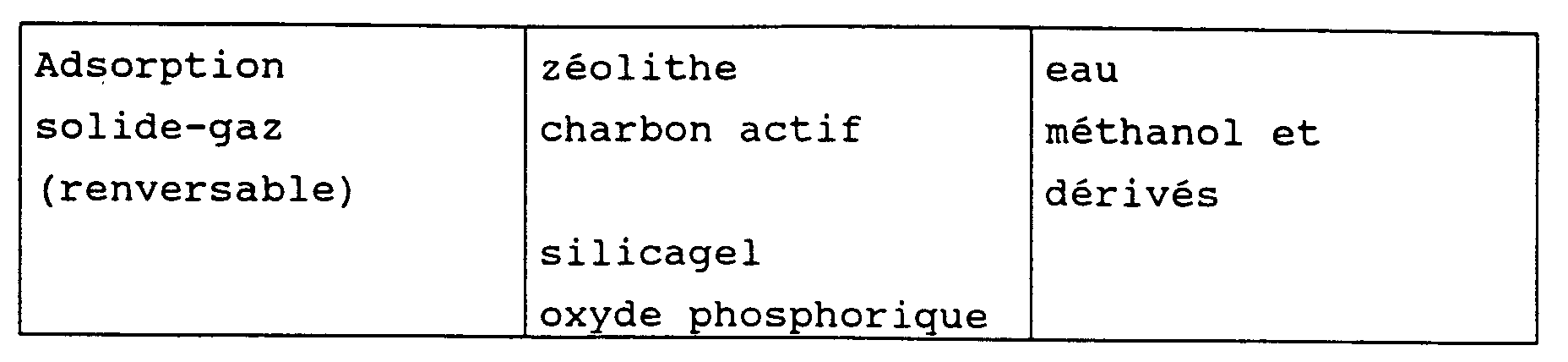
- active agent for example a reactive solid, an adsorbent solid or an absorbent liquid.
- Impregnating liquid Active Agent solubilization suspension CaCl 2 water or alcohol, acetone MnCl 2 alcohol ether, NH 3 liquid BaCl 2 alcohol NiCl 2 alcohol, NH 4 OH NH 3 liquid CuCl 2 acetone CoCl 2 alcohol, acetone ether SrCl 2 alcohol, acetone NH 3 liquid NaCl 2 glycerin FeCl 2 alcohol, acetone ether NH 4 Cl alcohol, NH 3 liquid acetone, ether CdCl 2 alcohol acetone, ether
- an active composite from a compound exfoliated lamellar as described above has for result of allowing the composite to absorb salt volume changes that occur during chemical reactions with a gas.
- a block of the active composite no longer undergoes degradations such as those which were present in known reagent blocks.
- the contact between an active composite block according to the invention and the wall of a reactor chamber, in which the block is press fit, stays intimate even after a series important reactions. The heat transfer between the block and the wall is, therefore, maintained at a significant level.
Landscapes
- Chemical & Material Sciences (AREA)
- Engineering & Computer Science (AREA)
- Materials Engineering (AREA)
- Organic Chemistry (AREA)
- Chemical Kinetics & Catalysis (AREA)
- Dispersion Chemistry (AREA)
- Thermal Sciences (AREA)
- Combustion & Propulsion (AREA)
- Physics & Mathematics (AREA)
- Solid-Sorbent Or Filter-Aiding Compositions (AREA)
- Carbon And Carbon Compounds (AREA)
- Battery Electrode And Active Subsutance (AREA)
- Acyclic And Carbocyclic Compounds In Medicinal Compositions (AREA)
- Pharmaceuticals Containing Other Organic And Inorganic Compounds (AREA)
- Sorption Type Refrigeration Machines (AREA)
- Porous Artificial Stone Or Porous Ceramic Products (AREA)
Description
- mélange de graphite expansé et d'un composé lamellaire exfolié,
- recompression du mélange afin de former un support ayant une densité de graphite comprise entre 0,03 et 0,5 kg/dm3.
- imprégnation du support par l'agent actif.
- préparation d'une solution de l'agent actif ;
- immersion du support dans la solution ; et
- séchage du support imprégné.
- 10 à 80 % d'agent actif,
- 2 à 20 % de composé lamellaire exfolié,
- 10 à 90 % de graphite expansé, le total des composants étant égal à 100 %.
- Pression de NH3 : 2 bars
- Température du fluide caloporteur :
- lors de la synthèse de MnCl2.2NH3 en MnCl2.6NH3 = 51°C
- lors de la décomposition de MnCl2.6NH3 en MnCl2.2NH3 = 145°C

| Liquide d'imprégnation | ||
| Agent actif | de solubilisation | de suspension |
| CaCl2 | eau ou alcool, acétone | |
| MnCl2 | alcool | éther,NH3 liquide |
| BaCl2 | alcool | |
| NiCl2 | alcool, NH4OH | NH3 liquide |
| CuCl2 | acétone | |
| CoCl2 | alcool, acétone éther | |
| SrCl2 | alcool, acétone | NH3 liquide |
| NaCl2 | glycérine | |
| FeCl2 | alcool, acétone | éther |
| NH4Cl | alcool, NH3 liquide | acétone, éther |
| CdCl2 | alcool | acétone, éther |
- de 10 à 80 % d'agent actif,
- de 2 à 20 % de composé expansé lamellaire, et
- de 10 à 90 % de graphite expansé, le total des composants étant égal à 100 %.
Claims (3)
- Procédé de réalisation d'un composite actif constitué d'un support et d'un agent actif, comportant les étapes de :mélange de graphite expansé et d'un composé lamellaire exfolié,recompression du mélange afin de former un support ayant une densité de graphite comprise entre 0,03 et 0,5, etimprégnation de support par l'agent actif
- Procédé selon la revendication 1 caractérisé en ce que l'étape d'imprégnation du support par l'agent actif comprend les étapes de :préparation d'une solution de l'agent actif,immersion du support dans la solution ; etséchage du support imprégné.
- Composite actif réalisé à partir du procédé de la revendication 1 comprenant un support formé d'un mélange de graphite expansé, et un agent actif, caractérisé en ce qu'il comprend en poids :10 à 80 % d'agent actif ;2 à 21 % de composé lamellaire exfolié ;10 à 90 % de graphite expansé, le total des composants étant égal à 100 %.
Applications Claiming Priority (2)
| Application Number | Priority Date | Filing Date | Title |
|---|---|---|---|
| FR9400513A FR2715082B1 (fr) | 1994-01-19 | 1994-01-19 | Procédé de réalisation d'un composite actif et composite actif réalisé à partir de ce procédé. |
| FR9400513 | 1994-01-19 |
Publications (2)
| Publication Number | Publication Date |
|---|---|
| EP0664158A1 EP0664158A1 (fr) | 1995-07-26 |
| EP0664158B1 true EP0664158B1 (fr) | 1998-09-09 |
Family
ID=9459163
Family Applications (1)
| Application Number | Title | Priority Date | Filing Date |
|---|---|---|---|
| EP95400082A Expired - Lifetime EP0664158B1 (fr) | 1994-01-19 | 1995-01-17 | Procédé de réalisation d'un composite actif et composite actif réalisé à partir de ce procédé |
Country Status (8)
| Country | Link |
|---|---|
| US (1) | US5607889A (fr) |
| EP (1) | EP0664158B1 (fr) |
| JP (1) | JPH07257917A (fr) |
| KR (1) | KR950031212A (fr) |
| AT (1) | ATE170775T1 (fr) |
| CA (1) | CA2140486A1 (fr) |
| DE (1) | DE69504538D1 (fr) |
| FR (1) | FR2715082B1 (fr) |
Families Citing this family (19)
| Publication number | Priority date | Publication date | Assignee | Title |
|---|---|---|---|---|
| FR2754740B1 (fr) * | 1996-10-21 | 1998-12-04 | Elf Aquitaine | Composite actif a structure feuilletee comprenant un agent actif sous forme de granules |
| WO1998050140A1 (fr) * | 1997-05-08 | 1998-11-12 | Boris Mikhailovich Kovalenko | Procede de granulation d'un sorbant a base de carbone |
| WO2000024508A1 (fr) * | 1998-10-27 | 2000-05-04 | Dochernee Aktsionernoe Obschestvo 'orgenergogaz' Oao Gazprom | Procede de production d'un sorbant a base de graphite |
| RU2134155C1 (ru) * | 1998-11-03 | 1999-08-10 | Коваленко Борис Михайлович | Способ получения графитового сорбента |
| US6224842B1 (en) * | 1999-05-04 | 2001-05-01 | Rocky Research | Heat and mass transfer apparatus and method for solid-vapor sorption systems |
| CH710862B1 (de) | 1999-11-26 | 2016-09-15 | Imerys Graphite & Carbon Switzerland Sa | Verfahren zur Herstellung von Graphitpulvern mit erhöhter Schüttdichte. |
| AU2002349317A1 (en) * | 2001-10-08 | 2003-04-22 | Timcal Ag | Electrochemical cell |
| DE10250249A1 (de) * | 2002-10-28 | 2004-05-13 | Sgl Carbon Ag | Mischungen für Wärmespeicher |
| WO2004056709A1 (fr) * | 2002-12-23 | 2004-07-08 | Aleksej Kazenov | Procede de neutralisation de substances toxiques, de pesticides et de leurs hydrolysats |
| FR2860512B1 (fr) * | 2003-10-06 | 2006-02-03 | Silva Serge Da | Procede de fabrication d'objets composites utilisant du graphite et de la vermiculite expanses |
| US20070015267A1 (en) * | 2004-10-05 | 2007-01-18 | Serge Da Silva | Method for producing composite objects using expanded graphite and vermiculite |
| FR2924263B1 (fr) * | 2007-11-22 | 2012-10-12 | Univ Toulouse 3 Paul Sabatier | Procede de fabrication d'un solide conducteur thermique et/ou electrique. |
| DE102008033280A1 (de) | 2008-07-11 | 2010-01-14 | BAM Bundesanstalt für Materialforschung und -prüfung | Verfahren zur Modifizierung von expandiertem Graphit und Verwendung des modifizierten expandierten Graphits |
| RU2428249C2 (ru) * | 2009-07-13 | 2011-09-10 | Закрытое акционерное общество "Научно-производственная компания МЕДИАНА-ФИЛЬТР" | Гранулированный наносорбент и способ его получения |
| RU2429906C1 (ru) * | 2009-12-29 | 2011-09-27 | Общество с ограниченной ответственностью Научно-производственное предприятие "Лисскон" | Комплексный гранулированный наносорбент |
| RU2503496C2 (ru) * | 2012-03-11 | 2014-01-10 | Федеральное Государственное Бюджетное Образовательное Учреждение Высшего Профессионального Образования "Саратовский Государственный Университет Имени Н.Г. Чернышевского" | Гранулированный модифицированный наноструктурированный сорбент, способ его получения и состав для его получения |
| FR2993640B1 (fr) * | 2012-07-17 | 2018-11-30 | Coldway | Systeme de sous-refroidissement d'un systeme de refrigeration a compression |
| KR101575989B1 (ko) * | 2014-12-24 | 2015-12-09 | 고영신 | 팽창흑연을 이용한 경량화된 흡음내화 단열재 및 그 제조방법 |
| FR3115473B1 (fr) * | 2020-10-22 | 2023-11-17 | Coldway Tech | Réactif pour machine thermique |
Family Cites Families (6)
| Publication number | Priority date | Publication date | Assignee | Title |
|---|---|---|---|---|
| FR2461687A1 (fr) * | 1979-07-18 | 1981-02-06 | Argiles Mineraux | Materiau mixte argile cuite-charbon actif |
| DE3524160A1 (de) * | 1985-07-05 | 1987-01-15 | Sued Chemie Ag | Katalysator zur verminderung des stickoxidgehalts von verbrennungsabgasen |
| US5059568A (en) * | 1987-03-05 | 1991-10-22 | Uop | Intercalated clay having large interlayer spacing |
| FR2626496B1 (fr) * | 1988-01-29 | 1990-06-01 | Elf Aquitaine | Procede d'amelioration des caracteristiques d'absorption et de desorption d'un gaz par un milieu reactionnel |
| US5283219A (en) * | 1990-04-11 | 1994-02-01 | Societe Nationale Elf Aquitaine | Active composite and its use as reaction medium |
| DE4140455A1 (de) * | 1991-12-05 | 1993-06-09 | Zentralinstitut Fuer Physikalische Chemie, O-1199 Berlin, De | Abriebfeste und poroese komposit-formlinge und verfahren ihrer herstellung |
-
1994
- 1994-01-19 FR FR9400513A patent/FR2715082B1/fr not_active Expired - Fee Related
-
1995
- 1995-01-17 DE DE69504538T patent/DE69504538D1/de not_active Expired - Lifetime
- 1995-01-17 EP EP95400082A patent/EP0664158B1/fr not_active Expired - Lifetime
- 1995-01-17 AT AT95400082T patent/ATE170775T1/de active
- 1995-01-18 JP JP7005790A patent/JPH07257917A/ja active Pending
- 1995-01-18 CA CA002140486A patent/CA2140486A1/fr not_active Abandoned
- 1995-01-18 KR KR1019950000730A patent/KR950031212A/ko not_active Withdrawn
- 1995-01-19 US US08/374,868 patent/US5607889A/en not_active Expired - Fee Related
Also Published As
| Publication number | Publication date |
|---|---|
| CA2140486A1 (fr) | 1995-07-20 |
| JPH07257917A (ja) | 1995-10-09 |
| EP0664158A1 (fr) | 1995-07-26 |
| DE69504538D1 (de) | 1998-10-15 |
| FR2715082B1 (fr) | 1996-02-23 |
| FR2715082A1 (fr) | 1995-07-21 |
| US5607889A (en) | 1997-03-04 |
| ATE170775T1 (de) | 1998-09-15 |
| KR950031212A (ko) | 1995-12-18 |
Similar Documents
| Publication | Publication Date | Title |
|---|---|---|
| EP0664158A1 (fr) | Procédé de réalisation d'un composite actif et composite actif réalisé à partir de ce procédé | |
| EP0477343B1 (fr) | Composite actif et son utilisation comme milieu reactionnel | |
| FR3009299B1 (fr) | Materiau zeolithique a base de zeolithe mesoporeuse | |
| JPH05161843A (ja) | 炭酸ガス吸着剤 | |
| CN1188643C (zh) | 相变热沉物料的制备方法 | |
| EP3474984B1 (fr) | Adsorbant zéolithique sous forme d'agglomérés à faible tortuosité | |
| FR2854819A3 (fr) | Adsorbant sous forme monolithe a porosite en faisceaux pour la purification ou la separation de gaz | |
| WO2016135133A1 (fr) | Véhicule comprenant un système de stockage et un moteur à combustion, le système de stockage comprend un récipient et au moins une cuve de stockage | |
| EP0837116A1 (fr) | Composite actif à structure feuilletée comprenant un agent actif sous forme de granules | |
| EP0485322B1 (fr) | Feuille plate pour l'adsorption de CO2 | |
| EP0646635A1 (fr) | Procédé de réalisation d'un composite actif | |
| EP3130835A1 (fr) | Véhicule comprenant un système de stockage et moteur à combustion interne, système de stockage comprenant un récipient et au moins un récipient de stockage entrouré d'une enveloppe | |
| EP0735124A1 (fr) | Composite actif à structure feuilletée et son utilisation comme milieu réactionnel | |
| JPH11248097A (ja) | 水素吸蔵合金の容器およびその製造方法 | |
| JP6792774B2 (ja) | ケミカルヒートポンプ用コンポジットとその製造方法 | |
| JPH07232972A (ja) | 熱化学系用粒子状反応体 | |
| CN1158496C (zh) | 制冷剂物料制备 | |
| US5861207A (en) | Active composite with foliated structure and its use as reaction medium | |
| DE19800395A1 (de) | Vorrichtung zur Adsorption fluider Stoffe und Verfahren zu ihrer Herstellung | |
| CA2119288A1 (fr) | Procede de realisation d'un composite actif | |
| FR2875432A1 (fr) | Matrice poreuse solide contenant un materiau a changement de phase microencapsule | |
| US20150360334A1 (en) | Compaction apparatus and method for heat exchange unit | |
| WO2022084311A1 (fr) | Reactif pour machine thermique | |
| JPH07280492A (ja) | 水素吸蔵合金を用いた熱交換器 | |
| EP3130834A1 (fr) | Véhicule comprenant un système de stockage et un moteur à combustion interne, le système de stockage comprenant un récipient et au moins deux récipients de stockage |
Legal Events
| Date | Code | Title | Description |
|---|---|---|---|
| PUAI | Public reference made under article 153(3) epc to a published international application that has entered the european phase |
Free format text: ORIGINAL CODE: 0009012 |
|
| 17P | Request for examination filed |
Effective date: 19950120 |
|
| AK | Designated contracting states |
Kind code of ref document: A1 Designated state(s): AT BE CH DE DK ES FR GB GR IE IT LI LU NL PT SE |
|
| 17Q | First examination report despatched |
Effective date: 19970218 |
|
| GRAG | Despatch of communication of intention to grant |
Free format text: ORIGINAL CODE: EPIDOS AGRA |
|
| GRAG | Despatch of communication of intention to grant |
Free format text: ORIGINAL CODE: EPIDOS AGRA |
|
| GRAH | Despatch of communication of intention to grant a patent |
Free format text: ORIGINAL CODE: EPIDOS IGRA |
|
| GRAH | Despatch of communication of intention to grant a patent |
Free format text: ORIGINAL CODE: EPIDOS IGRA |
|
| GRAA | (expected) grant |
Free format text: ORIGINAL CODE: 0009210 |
|
| AK | Designated contracting states |
Kind code of ref document: B1 Designated state(s): AT BE CH DE DK ES FR GB GR IE IT LI LU NL PT SE |
|
| PG25 | Lapsed in a contracting state [announced via postgrant information from national office to epo] |
Ref country code: NL Free format text: LAPSE BECAUSE OF FAILURE TO SUBMIT A TRANSLATION OF THE DESCRIPTION OR TO PAY THE FEE WITHIN THE PRESCRIBED TIME-LIMIT Effective date: 19980909 Ref country code: IT Free format text: LAPSE BECAUSE OF FAILURE TO SUBMIT A TRANSLATION OF THE DESCRIPTION OR TO PAY THE FEE WITHIN THE PRE;WARNING: LAPSES OF ITALIAN PATENTS WITH EFFECTIVE DATE BEFORE 2007 MAY HAVE OCCURRED AT ANY TIME BEFORE 2007. THE CORRECT EFFECTIVE DATE MAY BE DIFFERENT FROM THE ONE RECORDED.SCRIBED TIME-LIMIT Effective date: 19980909 Ref country code: GR Free format text: LAPSE BECAUSE OF NON-PAYMENT OF DUE FEES Effective date: 19980909 Ref country code: GB Free format text: LAPSE BECAUSE OF FAILURE TO SUBMIT A TRANSLATION OF THE DESCRIPTION OR TO PAY THE FEE WITHIN THE PRESCRIBED TIME-LIMIT Effective date: 19980909 Ref country code: ES Free format text: THE PATENT HAS BEEN ANNULLED BY A DECISION OF A NATIONAL AUTHORITY Effective date: 19980909 Ref country code: AT Free format text: LAPSE BECAUSE OF FAILURE TO SUBMIT A TRANSLATION OF THE DESCRIPTION OR TO PAY THE FEE WITHIN THE PRESCRIBED TIME-LIMIT Effective date: 19980909 |
|
| REF | Corresponds to: |
Ref document number: 170775 Country of ref document: AT Date of ref document: 19980915 Kind code of ref document: T |
|
| REG | Reference to a national code |
Ref country code: CH Ref legal event code: EP |
|
| REF | Corresponds to: |
Ref document number: 69504538 Country of ref document: DE Date of ref document: 19981015 |
|
| REG | Reference to a national code |
Ref country code: IE Ref legal event code: FG4D Free format text: FRENCH |
|
| PG25 | Lapsed in a contracting state [announced via postgrant information from national office to epo] |
Ref country code: SE Free format text: LAPSE BECAUSE OF FAILURE TO SUBMIT A TRANSLATION OF THE DESCRIPTION OR TO PAY THE FEE WITHIN THE PRESCRIBED TIME-LIMIT Effective date: 19981209 Ref country code: DK Free format text: LAPSE BECAUSE OF FAILURE TO SUBMIT A TRANSLATION OF THE DESCRIPTION OR TO PAY THE FEE WITHIN THE PRESCRIBED TIME-LIMIT Effective date: 19981209 |
|
| PG25 | Lapsed in a contracting state [announced via postgrant information from national office to epo] |
Ref country code: DE Free format text: LAPSE BECAUSE OF FAILURE TO SUBMIT A TRANSLATION OF THE DESCRIPTION OR TO PAY THE FEE WITHIN THE PRESCRIBED TIME-LIMIT Effective date: 19981210 |
|
| PG25 | Lapsed in a contracting state [announced via postgrant information from national office to epo] |
Ref country code: PT Free format text: LAPSE BECAUSE OF FAILURE TO SUBMIT A TRANSLATION OF THE DESCRIPTION OR TO PAY THE FEE WITHIN THE PRESCRIBED TIME-LIMIT Effective date: 19981214 |
|
| PG25 | Lapsed in a contracting state [announced via postgrant information from national office to epo] |
Ref country code: LU Free format text: LAPSE BECAUSE OF NON-PAYMENT OF DUE FEES Effective date: 19990117 |
|
| PG25 | Lapsed in a contracting state [announced via postgrant information from national office to epo] |
Ref country code: LI Free format text: LAPSE BECAUSE OF NON-PAYMENT OF DUE FEES Effective date: 19990131 Ref country code: CH Free format text: LAPSE BECAUSE OF NON-PAYMENT OF DUE FEES Effective date: 19990131 Ref country code: BE Free format text: LAPSE BECAUSE OF NON-PAYMENT OF DUE FEES Effective date: 19990131 |
|
| NLV1 | Nl: lapsed or annulled due to failure to fulfill the requirements of art. 29p and 29m of the patents act | ||
| GBV | Gb: ep patent (uk) treated as always having been void in accordance with gb section 77(7)/1977 [no translation filed] |
Effective date: 19980909 |
|
| PG25 | Lapsed in a contracting state [announced via postgrant information from national office to epo] |
Ref country code: IE Free format text: LAPSE BECAUSE OF NON-PAYMENT OF DUE FEES Effective date: 19990504 |
|
| REG | Reference to a national code |
Ref country code: IE Ref legal event code: FD4D |
|
| PLBE | No opposition filed within time limit |
Free format text: ORIGINAL CODE: 0009261 |
|
| STAA | Information on the status of an ep patent application or granted ep patent |
Free format text: STATUS: NO OPPOSITION FILED WITHIN TIME LIMIT |
|
| BERE | Be: lapsed |
Owner name: ELF AQUITAINE Effective date: 19990131 |
|
| 26N | No opposition filed | ||
| REG | Reference to a national code |
Ref country code: CH Ref legal event code: PL |
|
| PG25 | Lapsed in a contracting state [announced via postgrant information from national office to epo] |
Ref country code: FR Free format text: LAPSE BECAUSE OF NON-PAYMENT OF DUE FEES Effective date: 19990930 |
|
| REG | Reference to a national code |
Ref country code: FR Ref legal event code: ST |