EP0652575A2 - Herstellungsverfahren für einer Festelektrolytkondensator - Google Patents
Herstellungsverfahren für einer Festelektrolytkondensator Download PDFInfo
- Publication number
- EP0652575A2 EP0652575A2 EP94117023A EP94117023A EP0652575A2 EP 0652575 A2 EP0652575 A2 EP 0652575A2 EP 94117023 A EP94117023 A EP 94117023A EP 94117023 A EP94117023 A EP 94117023A EP 0652575 A2 EP0652575 A2 EP 0652575A2
- Authority
- EP
- European Patent Office
- Prior art keywords
- oxide film
- recited
- pellet
- conducting polymer
- monomer compound
- Prior art date
- Legal status (The legal status is an assumption and is not a legal conclusion. Google has not performed a legal analysis and makes no representation as to the accuracy of the status listed.)
- Granted
Links
Images

Classifications
-
- H—ELECTRICITY
- H01—ELECTRIC ELEMENTS
- H01G—CAPACITORS; CAPACITORS, RECTIFIERS, DETECTORS, SWITCHING DEVICES, LIGHT-SENSITIVE OR TEMPERATURE-SENSITIVE DEVICES OF THE ELECTROLYTIC TYPE
- H01G9/00—Electrolytic capacitors, rectifiers, detectors, switching devices, light-sensitive or temperature-sensitive devices; Processes of their manufacture
- H01G9/004—Details
- H01G9/022—Electrolytes; Absorbents
- H01G9/025—Solid electrolytes
-
- H—ELECTRICITY
- H01—ELECTRIC ELEMENTS
- H01G—CAPACITORS; CAPACITORS, RECTIFIERS, DETECTORS, SWITCHING DEVICES, LIGHT-SENSITIVE OR TEMPERATURE-SENSITIVE DEVICES OF THE ELECTROLYTIC TYPE
- H01G9/00—Electrolytic capacitors, rectifiers, detectors, switching devices, light-sensitive or temperature-sensitive devices; Processes of their manufacture
-
- H—ELECTRICITY
- H01—ELECTRIC ELEMENTS
- H01G—CAPACITORS; CAPACITORS, RECTIFIERS, DETECTORS, SWITCHING DEVICES, LIGHT-SENSITIVE OR TEMPERATURE-SENSITIVE DEVICES OF THE ELECTROLYTIC TYPE
- H01G11/00—Hybrid capacitors, i.e. capacitors having different positive and negative electrodes; Electric double-layer [EDL] capacitors; Processes for the manufacture thereof or of parts thereof
- H01G11/22—Electrodes
- H01G11/30—Electrodes characterised by their material
- H01G11/48—Conductive polymers
-
- H—ELECTRICITY
- H01—ELECTRIC ELEMENTS
- H01G—CAPACITORS; CAPACITORS, RECTIFIERS, DETECTORS, SWITCHING DEVICES, LIGHT-SENSITIVE OR TEMPERATURE-SENSITIVE DEVICES OF THE ELECTROLYTIC TYPE
- H01G11/00—Hybrid capacitors, i.e. capacitors having different positive and negative electrodes; Electric double-layer [EDL] capacitors; Processes for the manufacture thereof or of parts thereof
- H01G11/54—Electrolytes
- H01G11/56—Solid electrolytes, e.g. gels; Additives therein
-
- Y—GENERAL TAGGING OF NEW TECHNOLOGICAL DEVELOPMENTS; GENERAL TAGGING OF CROSS-SECTIONAL TECHNOLOGIES SPANNING OVER SEVERAL SECTIONS OF THE IPC; TECHNICAL SUBJECTS COVERED BY FORMER USPC CROSS-REFERENCE ART COLLECTIONS [XRACs] AND DIGESTS
- Y02—TECHNOLOGIES OR APPLICATIONS FOR MITIGATION OR ADAPTATION AGAINST CLIMATE CHANGE
- Y02E—REDUCTION OF GREENHOUSE GAS [GHG] EMISSIONS, RELATED TO ENERGY GENERATION, TRANSMISSION OR DISTRIBUTION
- Y02E60/00—Enabling technologies; Technologies with a potential or indirect contribution to GHG emissions mitigation
- Y02E60/13—Energy storage using capacitors
Definitions
- the invention relates to a method for manufacturing a solid electrolytic capacitor having electrically conductive high polymer as a solid electrolyte, and more particularly to a method for manufacturing such a solid electrolytic capacitor having a superior frequency characteristic.
- a solid electrolytic capacitor in general, includes a first electrode or an anode composed of porous compact of valve action metal such as tantalum (Ta) and aluminum (Al), a dielectric substance composed of oxide film of the anode, and a second electrode or a cathode composed of solid electrolyte such as manganese dioxide (MnO2) and 7,7,8,8-tetracyanoquinodimethane (TCNQ) complex salt.
- the solid electrolyte is required to have functions for electrically connecting an entire dielectric substance disposed in the porous compact to leads of the electrodes, and for repairing electrical short-circuit derived from defects of the dielectric oxide film.
- manganese dioxide MnO2
- MnO2 manganese dioxide
- a solid electrolytic capacitor having manganese dioxide (MnO2) as a part of an electrode cannot have a sufficiently large electrical conductivity, and hence has to have a large impedance in high frequency band.
- such a solid electrolytic capacitor can have only a poor thermal resistance, because TCNQ complex salt is easy to be thermally decomposed.
- a conducting polymer including conjugate high polymer such as polyacetylene, poly-p-phenylene, polypyrrole and polyaniline to which is added a dopant or an electron donative and/or electron attractive compound.
- Japanese Unexamined Patent Public Disclosure No. 64-24410 has suggested a method for manufacturing a conducting polymer layer by introducing monomer of conducting polymer into a surface of oxide film which plays a role of dielectric substance in liquid phase, and then adding thereto an oxidizer solution including an organic acid.
- electrodes each composed of a graphite layer and a silver paste layer.
- Japanese Unexamined Patent Public Disclosure No.2-74019 has suggested a method of manufacturing a composite layer composed of a high polymer layer and a conducting polymer layer, including the steps of covering oxide film with high polymer film in which an oxidizer is distributed in advance, and contacting the oxide film with monomer of conducting polymer.
- the invention provides a method for manufacturing a solid electrolytic capacitor having oxide film of valve action metal as a dielectric substance and conducting polymer as solid electrolyte, the method including the steps of forming solid monomer compound on a surface of the oxide film by applying monomer compound solution to the surface of the oxide film and then drying the monomer compound solution, and forming a conducting polymer layer by polymerizing the solid monomer compound with an oxidizer.
- the monomer compound solution has a concentration of at least 1% by weight.
- the method further includes the step of increasing a surface area of the valve action metal prior to forming the solid monomer compound on a surface of the valve action metal.
- the surface area of the valve action metal is increased by forming a mass of irregularities on the surface of the valve action metal.
- the oxide film is formed by means of anodic oxidation.
- the oxide film is formed over the irregularities by means of anodic oxidation.
- the conducting polymer layer is formed so that the layer deeply penetrates the irregularities.
- the method further includes the step of forming a cathode on the conducting polymer layer oppositely to the solid monomer compound.
- the method further includes the step of forming a carbon layer between the conducting polymer layer and the cathode.
- the carbon layer is a graphite layer.
- the method further includes the step of sealing a resultant with epoxy resin.
- the invention further provides a method for manufacturing a solid electrolytic capacitor having oxide film of valve action metal as a dielectric substance and conducting polymer as solid electrolyte, the method including the steps of anodizing a pellet composed of sintered tantalum powder, drying the anodized pellet, immersing the pellet in aniline salt solution, drying again the pellet, immersing the pellet in oxidant solution, polymerizing the pellet to form oxide film composed of polyaniline on the oxide film, immersing the pellet in acid solution and then drying, and repeating third to seventh steps in a desired number of times.
- the method further includes the step of applying carbon paste to a resultant subsequently to the step of repeating third to seventh steps.
- the method further includes the step of applying silver paste to a resultant subsequently to the step of applying carbon paste.
- the invention provides advantages that a capacitor having a greatly enlarged surface can be manufactured, for instance, by forming a mass of irregularities on a surface of a conducting polymer layer, and that a solid electrolytic capacitor having a superior high frequency characteristic can be easily manufactured. Comparing to a conventional method in which liquid monomer is merely polymerized with an oxidizer on oxide film, the method in accordance with the invention has advantages over the conventional method that the method can manufacture a capacitor having a high capacity attainment rate even from a capacitor having an enlarged surface.
- the method in accordance with the invention forms conducting polymer, which has a high electrical conductivity, directly on oxide film, and hence the invention provides advantages over the conventional method that the invention provides a capacitor having a quite small impedance in resonant frequency and also having a superior high frequency characteristic.
- Fig. 1 is a flow chart showing the steps of the method in accordance with the invention.
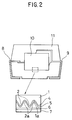
- Fig. 2 is a schematic cross-sectional view of a solid electrolytic capacitor manufactured in accordance with the embodiment of the invention.
- step 1 a mass of irregularities 2 are formed on a surface 1a of valve action metal 1 which will operate as an anode, in order to increase a surface area of the surface 1a of the valve action metal 1, as illustrated in a partially enlarged figure included in Fig. 2.
- oxide film 4 operating as a dielectric substance are formed by means of anodic oxidation over the surface 1a of the valve action metal 1 on which the irregularities 2 are formed.
- step 2 monomer compound solution is applied to a surface of the oxide film 4. Then, the monomer compound solution is solidified by drying so that solid electrolyte 5 composed of the solidified monomer compound solution and operating as a conducting polymer layer deeply penetrates concave portions 2a of the irregularities 2.
- step 3 the conducting polymer layer 5 is polymerized with oxidizer solution to thereby form a chemically oxidized, polymerized, conducting polymer film.
- a metal electrode 7 operating as a cathode is attached to the conducting polymer layer 5. Between the cathode 7 and the conducting polymer layer 5 may be disposed a carbon layer or a graphite layer 6 for maintaining an appropriate contact of the cathode 7 with the layer 5. Then, as illustrated in Fig. 4, a pair of electrode leads 8 and 9 are formed protruding from the thus manufactured resultant 10. Finally, around the resultant 10 having the electrode leads 8 and 9 protruding therefrom is surrounded by epoxy resin 11. Thus, a solid electrolytic capacitor is manufactured.
- Ta sintered tantalum
- aniline salt solution by mixing a solvent containing 70% by weight of ethanol and 30 % by weight of water with aniline and p-toluenesulfonic acid equal to aniline in an amount in mol so that the aniline and p-toluenesulfonic acid occupy 15% by weight on the basis of a weight of the solvent. Then, the sintered pellet was soaked in the aniline solution for 30 seconds while the pellet was maintained at 0 degree of temperature, and subsequently the pellet was stood for 10 minutes at a room temperature. As a result, aniline salt in solid was precipitated on a surface and inside of the sintered pellet.
- the sintered pellet was soaked for 30 seconds at 0 degree of temperature in a solution containing 5% by weight of ammonium dichromate and 40% by weight of p-toluenesulfonic acid, and subsequently was stood for 30 minutes at a room temperature.
- the polymerization was achieved and hence black-colored polyaniline was formed on a surface of oxide film.
- the pellet was soaked for 5 minutes in an acidic solution containing p-toluenesulfonic acid by 7% by weight diluted with a solvent containing 50% by weight of ethanol and 50% by weight of water, and then was stood for 30 minutes at a room temperature.
- a pellet composed of sintered tantalum (Ta) fine powder and cylindrically shaped having 1 mm of diameter and 1 mm of height, and having 27,000/g of a CV product value was anodic-oxidized with a voltage of 13V in a solution containing 0.1 % by weight of phosphoric acid. Then, the pellet was washed and dried. Then, there was prepared aniline salt solution by mixing a solvent containing 70% by weight of methanol and 30 % by weight of water with aniline and p-toluenesulfonic acid equal to aniline in an amount in mol so that the aniline and p-toluenesulfonic acid occupy 15% by weight on the basis of a weight of the solvent.
- the sintered pellet was soaked in the aniline solution for 30 seconds while the pellet was maintained at 0 degree of temperature, and subsequently the pellet was stood for 10 minutes at a room temperature.
- aniline salt in solid was precipitated on a surface and inside of the sintered pellet.
- the sintered pellet was soaked for 30 seconds at 0 degree of temperature in a solution containing 15% by weight of ammonium peroxodisulfate and 15% by weight of p-toluenesulfonic acid, and subsequently was stood for 30 minutes at a room temperature.
- the polymerization was achieved and hence black-colored polyaniline was formed on a surface of oxide film.
- a solid electrolytic capacitor was manufactured.
- sample 3 a pellet identical to that used in sample 2.
- aniline salt solution by mixing a solvent containing 70% by weight of ethanol and 30 % by weight of water with aniline and benzenesulfonic acid equal to aniline in an amount in mol so that the aniline and benzenesulfonic acid occupy 15% by weight on the basis of a weight of the solvent. Then, the sintered pellet was soaked in the aniline solution for 30 seconds while the pellet was maintained at 0 degree of temperature, and subsequently the pellet was stood for 10 minutes at a room temperature. As a result, aniline salt in solid was precipitated on [a surface and inside of the sintered pellet.
- comparative sample 1 a pellet composed of sintered tantalum (Ta) fine powder and shaped in rectangular parallelopiped having 1 mm of length, 1 mm of width and 1 mm of thickness, namely, identical to that used in sample 1.
- aniline solution by mixing a solvent containing 70% by weight of ethanol and 30 % by weight of water with aniline so that the aniline occupies 15% by weight on the basis of a weight of the solvent. Then, the sintered pellet was soaked in the aniline solution for 30 seconds while the pellet was maintained at 0 degree of temperature, and subsequently the pellet was stood for 10 minutes at a room temperature.
- aniline salt in solid on a surface and inside of the sintered pellet.
- comparative sample 2 a pellet composed of sintered tantalum (Ta) fine powder and shaped in rectangular parallelopiped having 1 mm of length, 1 mm of width and 1 mm of thickness, namely, identical to that used in sample 1.
- aniline salt solution by mixing a solvent containing 70% by weight of ethanol and 30 % by weight of water with aniline and p-toluenesulfonic acid equal to aniline in an amount in mol so that the aniline and p-toluenesulfonic acid occupy 0.8% by weight on the basis of a weight of the solvent.
- the sintered pellet was soaked in the aniline solution for 30 seconds while the pellet was maintained at 0 degree of temperature, and subsequently the pellet was stood for 10 minutes at a room temperature.
- aniline salt in solid was precipitated on a surface and inside of the sintered pellet.
- Table 1 shows CV product values, a mixture rate by weight of the monomer solution, the concentration of monomer relative to a weight of solvent, the number of polymerization, the obtained capacitor attainment rate C/C0 wherein C0 indicates a capacity in electrolytic solution, leak current (LC), and a resonant frequency impedance (Z) each obtained in samples 1 to 3 and comparative samples 1 and 2.
- the table 1 shows that a solid electrolytic capacitor in accordance with the invention provides a large capacitor attainment rate even applied to a capacitor element having a greatly enlarged surface, and has only a small impedance in resonant frequency together with a superior high frequency characteristic.
Landscapes
- Engineering & Computer Science (AREA)
- Power Engineering (AREA)
- Chemical & Material Sciences (AREA)
- Chemical Kinetics & Catalysis (AREA)
- Electrochemistry (AREA)
- Microelectronics & Electronic Packaging (AREA)
- Materials Engineering (AREA)
- Macromolecular Compounds Obtained By Forming Nitrogen-Containing Linkages In General (AREA)
- Polyoxymethylene Polymers And Polymers With Carbon-To-Carbon Bonds (AREA)
- Fixed Capacitors And Capacitor Manufacturing Machines (AREA)
Applications Claiming Priority (2)
| Application Number | Priority Date | Filing Date | Title |
|---|---|---|---|
| JP5275337A JP2765453B2 (ja) | 1993-11-04 | 1993-11-04 | 固体電解コンデンサの製造方法 |
| JP275337/93 | 1993-11-04 |
Publications (3)
| Publication Number | Publication Date |
|---|---|
| EP0652575A2 true EP0652575A2 (de) | 1995-05-10 |
| EP0652575A3 EP0652575A3 (de) | 1995-07-05 |
| EP0652575B1 EP0652575B1 (de) | 1996-09-18 |
Family
ID=17554068
Family Applications (1)
| Application Number | Title | Priority Date | Filing Date |
|---|---|---|---|
| EP94117023A Expired - Lifetime EP0652575B1 (de) | 1993-11-04 | 1994-10-27 | Herstellungsverfahren für einer Festelektrolytkondensator |
Country Status (5)
| Country | Link |
|---|---|
| US (1) | US5567209A (de) |
| EP (1) | EP0652575B1 (de) |
| JP (1) | JP2765453B2 (de) |
| KR (1) | KR0140159B1 (de) |
| DE (1) | DE69400566T2 (de) |
Cited By (3)
| Publication number | Priority date | Publication date | Assignee | Title |
|---|---|---|---|---|
| EP0913840A1 (de) * | 1997-10-31 | 1999-05-06 | Kemet Electronics Corporation | Dotierte Polyanilinlösungen |
| EP0923083A1 (de) * | 1997-12-09 | 1999-06-16 | Kemet Electronics Corporation | Polyaniline-Lösung mit Lösungsmittel von bicyclischen Terpen |
| EP0893807A3 (de) * | 1997-07-24 | 2001-04-11 | Nec Corporation | Herstellungsverfahren von einem Festelektrolytkondensator |
Families Citing this family (13)
| Publication number | Priority date | Publication date | Assignee | Title |
|---|---|---|---|---|
| JP3092512B2 (ja) * | 1996-04-19 | 2000-09-25 | 日本電気株式会社 | 固体電解コンデンサの製造方法 |
| KR19980081610A (ko) * | 1997-04-23 | 1998-11-25 | 우치가사키이사오 | 고체전해콘덴서의 전해질형성용 조성물 및 고체전해콘덴서 |
| US6310765B1 (en) * | 1997-06-20 | 2001-10-30 | Matsushita Electric Industrial Co., Ltd. | Electrolytic capacitor and method for manufacturing the same |
| US5980723A (en) * | 1997-08-27 | 1999-11-09 | Jude Runge-Marchese | Electrochemical deposition of a composite polymer metal oxide |
| JP3228323B2 (ja) * | 1997-09-10 | 2001-11-12 | 日本電気株式会社 | 固体電解コンデンサおよびその製造方法 |
| JP3273761B2 (ja) * | 1997-10-31 | 2002-04-15 | 松下電器産業株式会社 | 電解コンデンサおよびその製造方法 |
| US6088218A (en) * | 1997-10-31 | 2000-07-11 | Matsushita Electric Industrial Co., Ltd. | Electrolytic capacitor and method for producing the same |
| US6328874B1 (en) | 1998-01-05 | 2001-12-11 | Mcdonnell Douglas Corporation | Anodically formed intrinsically conductive polymer-aluminum oxide composite as a coating on aluminum |
| US6136176A (en) * | 1999-05-21 | 2000-10-24 | Kemet Electronics Corporation | Capacitor with conductive polymer |
| US6334945B1 (en) | 2000-09-07 | 2002-01-01 | Kemet Electronics Corporation | Aging process for solid electrode capacitor |
| US6334966B1 (en) * | 2000-11-06 | 2002-01-01 | Kemet Electronics Corporation | Chemical oxidative preparation of conductive polymers |
| KR20030063512A (ko) * | 2002-01-22 | 2003-07-31 | 주식회사 기노리텍 | 하이브리드 커패시터 제조방법 |
| DE102005043829A1 (de) * | 2005-09-13 | 2007-04-05 | H.C. Starck Gmbh | Verfahren zur Herstellung von Elektrolytkondensatoren mit hoher Nennspannung |
Family Cites Families (12)
| Publication number | Priority date | Publication date | Assignee | Title |
|---|---|---|---|---|
| DE3636100A1 (de) * | 1986-10-23 | 1988-05-05 | Roederstein Kondensatoren | Festkoerperkondensator mit einem elektrisch leitfaehigen polymeren als bestandteil des festelektrolyten |
| JPS6424410A (en) * | 1987-07-21 | 1989-01-26 | Asahi Glass Co Ltd | Manufacture of solid electrolytic capacitor |
| EP0342998B1 (de) * | 1988-05-20 | 1996-01-17 | Sanyo Electric Co., Ltd | Verfahren zum Herstellen einer Elektrode für einen Festelektrolytkondensator |
| JPH0274019A (ja) * | 1988-09-09 | 1990-03-14 | Matsushita Electric Ind Co Ltd | 固体電解コンデンサの製造方法 |
| EP0447165A3 (en) * | 1990-03-12 | 1992-08-05 | Matsushita Electric Industrial Co., Ltd | Solid electrolytic capacitors and method for manufacturing the same |
| JP3158453B2 (ja) * | 1991-02-08 | 2001-04-23 | 日本電気株式会社 | ヒューズ付きチップ型固体電解コンデンサの製造方法 |
| JPH0736375B2 (ja) * | 1991-04-05 | 1995-04-19 | 松下電器産業株式会社 | 固体電解コンデンサの製造方法 |
| US5227092A (en) * | 1991-07-10 | 1993-07-13 | Allied-Signal Inc. | Process for forming conjugated backbone block copolymers |
| US5223002A (en) * | 1991-10-31 | 1993-06-29 | Sprague Electric Company | Method of making polyaniline solid electrolyte capacitor |
| JPH05136007A (ja) * | 1991-11-08 | 1993-06-01 | Nec Corp | 固体電解コンデンサおよびその製造方法 |
| US5315474A (en) * | 1992-04-07 | 1994-05-24 | Rohm Co., Ltd. | Solid electrolytic capacitor |
| JP4037473B2 (ja) * | 1996-07-11 | 2008-01-23 | 光洋機械産業株式会社 | 高流動コンクリートの製造方法及び製造設備 |
-
1993
- 1993-11-04 JP JP5275337A patent/JP2765453B2/ja not_active Expired - Lifetime
-
1994
- 1994-10-27 EP EP94117023A patent/EP0652575B1/de not_active Expired - Lifetime
- 1994-10-27 DE DE69400566T patent/DE69400566T2/de not_active Expired - Fee Related
- 1994-11-03 KR KR1019940028795A patent/KR0140159B1/ko not_active Expired - Fee Related
-
1995
- 1995-06-07 US US08/487,633 patent/US5567209A/en not_active Expired - Lifetime
Cited By (3)
| Publication number | Priority date | Publication date | Assignee | Title |
|---|---|---|---|---|
| EP0893807A3 (de) * | 1997-07-24 | 2001-04-11 | Nec Corporation | Herstellungsverfahren von einem Festelektrolytkondensator |
| EP0913840A1 (de) * | 1997-10-31 | 1999-05-06 | Kemet Electronics Corporation | Dotierte Polyanilinlösungen |
| EP0923083A1 (de) * | 1997-12-09 | 1999-06-16 | Kemet Electronics Corporation | Polyaniline-Lösung mit Lösungsmittel von bicyclischen Terpen |
Also Published As
| Publication number | Publication date |
|---|---|
| KR0140159B1 (ko) | 1998-07-01 |
| KR950015439A (ko) | 1995-06-16 |
| EP0652575B1 (de) | 1996-09-18 |
| DE69400566D1 (de) | 1996-10-24 |
| EP0652575A3 (de) | 1995-07-05 |
| JP2765453B2 (ja) | 1998-06-18 |
| JPH07130579A (ja) | 1995-05-19 |
| DE69400566T2 (de) | 1997-02-20 |
| US5567209A (en) | 1996-10-22 |
Similar Documents
| Publication | Publication Date | Title |
|---|---|---|
| EP0652575B1 (de) | Herstellungsverfahren für einer Festelektrolytkondensator | |
| US6154358A (en) | Solid electrolytic capacitor using a conducting polymer | |
| JP2765462B2 (ja) | 固体電解コンデンサおよびその製造方法 | |
| KR0158236B1 (ko) | 고체 전해 캐패시터 제조방법 | |
| US5461537A (en) | Solid electrolytic capacitor and method of manufacturing the same | |
| US5454147A (en) | Method of manufacturing solid electrolytic capacitor | |
| KR20030035883A (ko) | 고체 전해 콘덴서 및 그 제조 방법 | |
| US5471365A (en) | Solid electrolytic capacitor and its manufacturing method | |
| JPH10149954A (ja) | 固体電解コンデンサの製造方法 | |
| JP3515938B2 (ja) | 固体電解コンデンサおよびその製造方法 | |
| EP0477584A1 (de) | Verfahren zur Herstellung eines Festelektrolytkondensators | |
| KR20000053593A (ko) | 고체 전해 콘덴서의 제조방법 | |
| JPH10340831A (ja) | 固体電解コンデンサの製造方法 | |
| JP3030054B2 (ja) | 固体電解コンデンサの製造方法 | |
| JP3991429B2 (ja) | 電解コンデンサおよびその製造方法 | |
| JP2000133551A (ja) | 固体電解コンデンサおよびその製造方法 | |
| JPH10284351A (ja) | 固体電解コンデンサ及びその製造方法 | |
| JP2775762B2 (ja) | 固体電解コンデンサ | |
| JP3401447B2 (ja) | 固体電解コンデンサ及びその製造方法 | |
| KR20020085539A (ko) | 고체 전해 커패시터 및 그 제조방법 | |
| KR0148613B1 (ko) | 고체 전해 커패시터 및 그의 제조방법 | |
| JP3454733B2 (ja) | 固体電解コンデンサの製造方法 | |
| CN115240985A (zh) | 固体电解电容器及制造固体电解电容器的方法 | |
| JPH1126315A (ja) | 固体電解コンデンサの製造方法 | |
| JPH11135366A (ja) | 固体電解コンデンサ |
Legal Events
| Date | Code | Title | Description |
|---|---|---|---|
| PUAI | Public reference made under article 153(3) epc to a published international application that has entered the european phase |
Free format text: ORIGINAL CODE: 0009012 |
|
| AK | Designated contracting states |
Kind code of ref document: A2 Designated state(s): DE FR GB NL |
|
| PUAL | Search report despatched |
Free format text: ORIGINAL CODE: 0009013 |
|
| AK | Designated contracting states |
Kind code of ref document: A3 Designated state(s): DE FR GB NL |
|
| 17P | Request for examination filed |
Effective date: 19950531 |
|
| 17Q | First examination report despatched |
Effective date: 19951116 |
|
| GRAH | Despatch of communication of intention to grant a patent |
Free format text: ORIGINAL CODE: EPIDOS IGRA |
|
| GRAA | (expected) grant |
Free format text: ORIGINAL CODE: 0009210 |
|
| GRAH | Despatch of communication of intention to grant a patent |
Free format text: ORIGINAL CODE: EPIDOS IGRA |
|
| AK | Designated contracting states |
Kind code of ref document: B1 Designated state(s): DE FR GB NL |
|
| REF | Corresponds to: |
Ref document number: 69400566 Country of ref document: DE Date of ref document: 19961024 |
|
| ET | Fr: translation filed | ||
| PLBE | No opposition filed within time limit |
Free format text: ORIGINAL CODE: 0009261 |
|
| STAA | Information on the status of an ep patent application or granted ep patent |
Free format text: STATUS: NO OPPOSITION FILED WITHIN TIME LIMIT |
|
| 26N | No opposition filed | ||
| REG | Reference to a national code |
Ref country code: GB Ref legal event code: IF02 |
|
| REG | Reference to a national code |
Ref country code: GB Ref legal event code: 732E |
|
| NLS | Nl: assignments of ep-patents |
Owner name: NEC TOKIN CORPORATION |
|
| PGFP | Annual fee paid to national office [announced via postgrant information from national office to epo] |
Ref country code: FR Payment date: 20021008 Year of fee payment: 9 |
|
| PGFP | Annual fee paid to national office [announced via postgrant information from national office to epo] |
Ref country code: GB Payment date: 20021023 Year of fee payment: 9 |
|
| PGFP | Annual fee paid to national office [announced via postgrant information from national office to epo] |
Ref country code: NL Payment date: 20021031 Year of fee payment: 9 Ref country code: DE Payment date: 20021031 Year of fee payment: 9 |
|
| REG | Reference to a national code |
Ref country code: FR Ref legal event code: TP |
|
| PG25 | Lapsed in a contracting state [announced via postgrant information from national office to epo] |
Ref country code: GB Free format text: LAPSE BECAUSE OF NON-PAYMENT OF DUE FEES Effective date: 20031027 |
|
| PG25 | Lapsed in a contracting state [announced via postgrant information from national office to epo] |
Ref country code: NL Free format text: LAPSE BECAUSE OF NON-PAYMENT OF DUE FEES Effective date: 20040501 Ref country code: DE Free format text: LAPSE BECAUSE OF NON-PAYMENT OF DUE FEES Effective date: 20040501 |
|
| GBPC | Gb: european patent ceased through non-payment of renewal fee |
Effective date: 20031027 |
|
| PG25 | Lapsed in a contracting state [announced via postgrant information from national office to epo] |
Ref country code: FR Free format text: LAPSE BECAUSE OF NON-PAYMENT OF DUE FEES Effective date: 20040630 |
|
| NLV4 | Nl: lapsed or anulled due to non-payment of the annual fee |
Effective date: 20040501 |
|
| REG | Reference to a national code |
Ref country code: FR Ref legal event code: ST |