EP0646648B1 - Verfahren zur Herstellung eines Polypeptides - Google Patents
Verfahren zur Herstellung eines Polypeptides Download PDFInfo
- Publication number
- EP0646648B1 EP0646648B1 EP94115590A EP94115590A EP0646648B1 EP 0646648 B1 EP0646648 B1 EP 0646648B1 EP 94115590 A EP94115590 A EP 94115590A EP 94115590 A EP94115590 A EP 94115590A EP 0646648 B1 EP0646648 B1 EP 0646648B1
- Authority
- EP
- European Patent Office
- Prior art keywords
- group
- formula
- same
- integer
- compound
- Prior art date
- Legal status (The legal status is an assumption and is not a legal conclusion. Google has not performed a legal analysis and makes no representation as to the accuracy of the status listed.)
- Expired - Lifetime
Links
Classifications
-
- C—CHEMISTRY; METALLURGY
- C12—BIOCHEMISTRY; BEER; SPIRITS; WINE; VINEGAR; MICROBIOLOGY; ENZYMOLOGY; MUTATION OR GENETIC ENGINEERING
- C12P—FERMENTATION OR ENZYME-USING PROCESSES TO SYNTHESISE A DESIRED CHEMICAL COMPOUND OR COMPOSITION OR TO SEPARATE OPTICAL ISOMERS FROM A RACEMIC MIXTURE
- C12P21/00—Preparation of peptides or proteins
- C12P21/02—Preparation of peptides or proteins having a known sequence of two or more amino acids, e.g. glutathione
-
- Y—GENERAL TAGGING OF NEW TECHNOLOGICAL DEVELOPMENTS; GENERAL TAGGING OF CROSS-SECTIONAL TECHNOLOGIES SPANNING OVER SEVERAL SECTIONS OF THE IPC; TECHNICAL SUBJECTS COVERED BY FORMER USPC CROSS-REFERENCE ART COLLECTIONS [XRACs] AND DIGESTS
- Y10—TECHNICAL SUBJECTS COVERED BY FORMER USPC
- Y10S—TECHNICAL SUBJECTS COVERED BY FORMER USPC CROSS-REFERENCE ART COLLECTIONS [XRACs] AND DIGESTS
- Y10S435/00—Chemistry: molecular biology and microbiology
- Y10S435/8215—Microorganisms
- Y10S435/822—Microorganisms using bacteria or actinomycetales
- Y10S435/848—Escherichia
- Y10S435/849—Escherichia coli
Definitions
- the present invention relates to a method for producing polypeptides.
- the present inventors have intensively studied the method for producing polypeptides in the cell-free translation system, and have found that the condensation of a precursor comprising amino acids and adaptors can be effectively performed in the absence of the energy source such as ATP and GTP, and soluble protein factors but in the presence of rRNAs and an aromatic tertiary amine other than GTP or ATP.
- the present invention provides a method for producing a polypeptide, which comprises condensing precursors comprising an amino acid and an adaptor in the absence of soluble protein factors, GTP and ATP in the presence of rRNAs, and an aromatic tertiary amine other than GTP or ATP.
- the condensation of precursors comprising an amino acid and an adaptor can be effectively carried out without energy source such as ATP and GTP and soluble protein factors but in the presence of rRNAs and an aromatic tertiary amine other than GTP or ATP.
- a polypeptide which comprises condensing precursors comprising an amino acid and an adaptor in the absence of soluble protein factors, GTP and ATP in the presence of rRNAs, and in the presence of an aromatic tertiary amine other than GTP or ATP.
- the condensation reaction of the precursors is usually carried out in the absence of soluble protein factors, GTP and ATP in the presence of rRNAs, and in the presence of an aromatic tertiary amine other than GTP or ATP.
- Ribosomes, the rRNA or the larger ribosomal subunit are obtained by a conventional method such as extraction from cell organs or organisms which can be obtained from nature or purchased.
- the ribosomes of the E. coli are obtained by the following procedures. For example, E, coli cells are mixed with a buffer solution and crushed with a mortar or pressed by the French press to give a suspension, which is then subjected to ultracentrifugation to give a supernatant. Then the supernatant is separated by centrifugation to give the ribosomes of E. coli. Furthermore, the larger ribosomal subunit can be obtained by the known sucrose density gradient method.
- the organisms which may be eucaryote or procaryote include, for example, mammals, insects, plants such as algae, mosses, fern, gymnosperm, angiosperm, fungi, bacteria, molds and yeasts.
- mammals including rat, mouse, cow and goat; algae including green algae and blue-green algae; angiosperm including wheat, rice, tobacco, tomato and the like; bacteria including Escherichia , Bacillus , Pseudomonas and the like; molds including Neurospora , Aspergillus , Penicillium and the like; and yeasts including Saccharomyces and the like.
- Thermophilic bacteria such as Bacillus strearothermophilus , aquiatucus and Thermus thermophilus which are not only resistant to high temperature but also less sensitive to denaturation by an organic solvent are preferably used as the source of the ribosomes, the rRNA or the larger ribosomal subunit.
- the ribosomes washed with an aqueous cation solution of high concentration may be used in the present invention.
- the extraction of the ribosomal protein is carried out by conventional methods such as described in "Ribosomes and Protein Synthesis A practical Approach (G. Spedding, Oxford University Press, 1990)".
- the aromatic tertiary amine compounds to be used in the present process include pyridine compounds, imidazole compounds, purine base compounds and pyrimidine base compounds.
- the pyridine compounds to be used in the present method can be represented by the formula I: wherein R independently represents a member selected from the group of a hydrogen atom, a halogen atom, a C 1 -C 4 aliphatic hydrocarbon group, an amino group, a C 5 -C 8 alicyclic hydrocarbon group, a C 6 -C 10 aromatic hydrocarbon group, a hydroxyl group, a sulfhydryl group and a heterocyclic group having at least one heteroatom, all of which except the hydrogen atom and the halogen atom may be optionally substituted; alternatively R represents a group of the formula: -COQ, wherein Q represents a hydrogen atom, a C 1 -C 4 aliphatic hydrocarbon group, an amino group, a C 5 -C 8 alicyclic hydrocarbon group, a C 6 -C 10 aromatic hydrocarbon group, a hydroxyl group a sulfhydryl group or a heterocyclic group having at least one heteroatom,
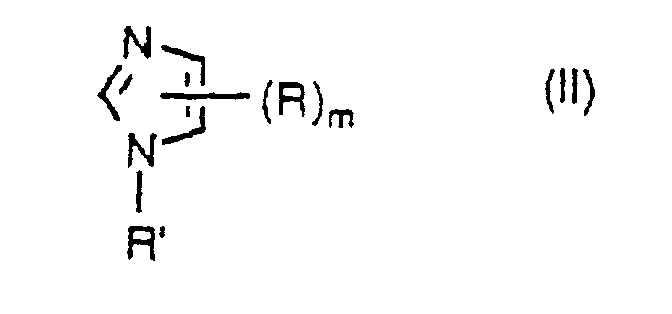
- the imidazole compounds to be used in the present method may be represented by the formula II: wherein R is the same as defined above; R' represents the same atoms or groups as those given in R provided that it excludes a halogen atom, an amino group, a hydroxyl group and a sulfhydryl group, and those atoms and groups are also excluded in Q; R and R' are independent from each other; and m represents an integer of 1 to 3.
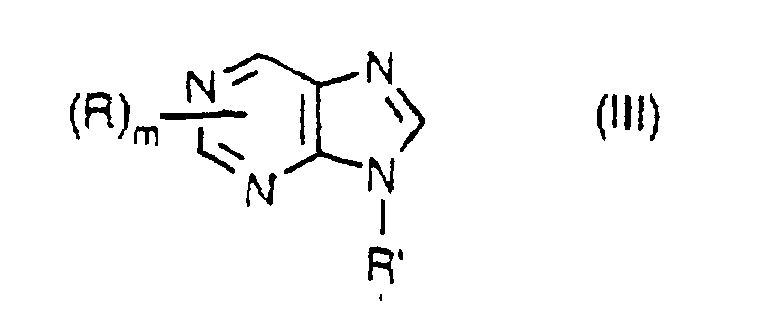
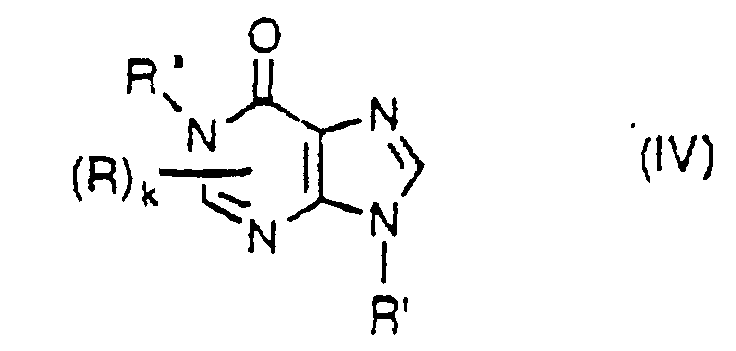
- the purine base compounds include a compound represented by the formula III: wherein R and R' are the same as defined above and independent from each other; and m represents an integer of 1 to 3, and a compound of the formula IV: wherein R and R' are the same as defined above, R" represents the same atoms or groups with those given in R provided that it excludes a halogen atom, an amino group, a hydroxyl group and a sulfhydryl group, and those atom and groups are also excluded in Q; R, R' and R" are independent from each other; and k represents an integer of 1 or 2.
- the pyrimidine base compounds include a compound represented by the formula V: wherein R is the same as defined above and n represents an integer of 1 to 4; a compound of the formula VI: wherein R, R' and n are the same as defined above and R and R' are independent from each other; and a compound of the formula VII: wherein R and R' are the same as defined above and independent from each other, and m represents an integer of 1 to 3.
- examples of the C 1 -C 4 aliphatic hydrocarbon group for R, R' and R" are a methyl group, an ethyl group, a n-propyl group, an isopropyl group, a n-butyl group, a sec.-butyl group, an isobutyl group and a tert.-butyl group.
- Examples of the C 5 -C 8 alicyclic hydrocarbon group are a cyclopentyl group, a cyclohexyl group, a cyclohepty group and a cyclooctyl group.
- Examples of the C 6 -C 10 aromatic hydrocarbon group are a phenyl group and a naphthyl group.
- halogen atom examples include a fluorine atom, a chlorine atom, a bromine atom and an iodine atom.
- heteroatom in the heterocyclic group examples include an oxygen atom, a nitrogen atom or a sulfur atom.
- examples of the heterocyclic group having at least one heteroatom which group may be optionally substituted are a ribosyl group, a deoxyribosyl group and monophosphate, phosphodiester and triphosphate derivative thereof.
- Examples of the pyridine compound are ⁇ -picoline, ⁇ -picoline, ⁇ -picoline, 2-aminopyridine, 3-aminopyridine, 4-aminopyridine and 4-dimethylaminopyridine.
- imidazole compound examples include imidazole and 1-methylimidazole.
- purine base compound examples include guanine, adenine, 9-methyladenine, 7-methyladenine, adenosine, 2'-deoxyadenosine, adenosine 5'-monophosphate and adenosine 5'-diphosphate
- pyrimidine base compound examples include cytosine, uracil, thymine, cytidine, 2'-deoxycytidine, cytidyl 5'-monophosphate and cytidyl 5'-diphosphate.
- aromatic tertiary amines are not limited thereto.
- the concentration of the aromatic tertiary amine is not specified and the preferable concentration of the aromatic tertiary amine varies according to the kinds of the base.
- the preferable concentration of the aromatic tertiary amine is usually within the range of from the saturation concentration to water to 1/10 9 or preferably 1/10 6 of the saturation concentration.
- the preferable concentration for pyridine, pyrimidine or imidazole is 10nM to about 10M; 1nM to about 1M for purine, 2-aminopyridine, 4-aminopyridine or 4-dimethylaminopyridine; 100pM to about 100mM for adenosine 5'-diphosphate or cytidyl 5'-diphosphate; and 10pM to about 10mM for adenine or guanine.
- the pH of the condensation reaction solvent is not specified, however, preferably 5 to 11, more preferably 6 to 10 in terms of the yield.
- the present condensation reaction is preferably carried out in the presence of appropriate cations such as a magnesium ion and at least one ion selected from a potassium ion and an ammonium ion to proceed the condensation reaction more efficiently.
- appropriate cations such as a magnesium ion and at least one ion selected from a potassium ion and an ammonium ion to proceed the condensation reaction more efficiently.
- the concentration of the potassium ion or ammonium ion is preferably 50mM to 500nM, more preferably 100mM to 300mM.
- the concentration of the magnesium ion it is preferably 1mM to 500mM, more preferably 5mM to 300mM.
- a metal ion such as a zinc ion, an iron ion, a copper ion or a manganese ion may be added to accelerate the condensation reaction.
- the reaction temperature is usually 0 to 90°C.
- the reaction can be carried out at the range of 30 to 90°C.
- the reaction temperature is preferably 30 to 80°C.
- the reaction temperature is preferably 30 to 70°C, more preferably 30 to 60°C.
- the present condensation reaction may be conducted in the presence of other additives to accelerate the condensation reaction.
- additives include polyamines such as spermine and spermidine, polyethylene glycols, glyrerols and alcohols.
- the present reaction is preferably conducted in the presence of a template molecule comprising a nucleic acid which interacts with the adaptor molecules.
- Examples of such a template molecule include an mRNA of interest or the derivatives thereof that is present in living cells or an mRNA obtained by synthetic or enzymatic methods. Furthermore, a compound such as polyuridylic acid (poly(U)), polyadenylic acid (poly(A)) or a block copolymer thereof (e.g., poly(UA)) that represents the synthetic functions of the mRNA may also be used as the template.
- poly(U) polyuridylic acid
- poly(A) polyadenylic acid
- a block copolymer thereof e.g., poly(UA)
- a nucleic acid coding for a useful protein may be also used as the template.
- the useful proteins are a biologically active peptide such as human growth hormones, protein pharmaceuticals, proteins involved in antigen-antibody reaction and enzymes that catalyze the biological processes.
- the precursors comprising amino acids and adaptors includes an aminoacyl-tRNA, which is usually obtained by reacting an amino acid with the tRNA molecule as the adaptor in the presence of aminoacyl-tRNA synthetase or may be chemically synthesized from an amino acid and a corresponding adaptor.
- the amino acids to be used in the present invention may be a compound having a carboxylic acid group and an amino group in the same molecule and may also be a naturally occurring or non-naturally occurring type.
- the carbon atom to which the amino group is bonded may be at any position of the carbon chain to which the carboxylic acid group is bonded, and the number of the amino group and the carboxylic acid group present in the molecule is not limited.
- the said amino acids possess a chiral center they include an L-amino acid, a D-amino acid and a racemic mixture thereof.
- amino acid to be used in the present method are: protein constituent (naturally occurring) amino acids such as alanine, arginine, asparagine, aspartic acid, cysteine, glutamine, glutamic acid, glycine histidine, isoleucine, leucine, lysine, methionine, phenylalanine, proline, serine, threonine, tryptophan, tyrosine, valine and derivatives thereof; ⁇ -alanine, ⁇ -aminobutyric acid, 5-aminolevulinic acid and derivatives thereof, all of which are present in living cells; and amino acids that do not exist in the living cells such as p-, m- or o-aminobeozoic acid.
- protein constituent (naturally occurring) amino acids such as alanine, arginine, asparagine, aspartic acid, cysteine, glutamine, glutamic acid, glycine histidine, isoleucine, leucine
- adaptors include nucleic acids such as tRNAs (for example, those described in G.Fasman, ed, "Handbook of Biochemistry and Molecular Biology” 3rd Ed., Vol 2, p. 423 CRR press (1975), and D.H. Gauss, M.Sprizl, Nucleic Acids Res, 9, r1 (1981)) or a variant thereof that can be specifically combined to the corresponding amino acids which are present in living cells or obtainable by an enzymatic or synthetic methods.
- tRNAs for example, those described in G.Fasman, ed, "Handbook of Biochemistry and Molecular Biology” 3rd Ed., Vol 2, p. 423 CRR press (1975), and D.H. Gauss, M.Sprizl, Nucleic Acids Res, 9, r1 (1981)
- the reaction of the adaptor with the amino acid is, for example, carried out in the presence of the aminoacyl-tRNA synthetase, which can be obtained by such a method as described in "Seikagaku Jikken Koza", vol. 7, Chapter 1, Edited by Biochemical society of Japan, 1975.
- the reaction may be also conducted by a synthetic method.
- the reaction of the adaptors with the amino acids may be, for example, carried out in a single reaction vessel or in separate reaction vessels for each of the amino acids at about 37°C.
- the solution is supplied for the subsequent condensation reaction while the concentrations of the reactants are adjusted to specified concentrations, if necessary.
- the precursor such as an aminoacyl-tRNA After the precursor such as an aminoacyl-tRNA is obtained, it can be recovered from the reaction mixture and then supplied to the condensation reaction.
- the polypeptide can be obtained by a conventional post-treatment.
- a 280 /ml aminoacyl-tRNA synthetase (the designation expresses the concentration of the aminoacyl-tRNA synthetase with an absorbance value at 280nm for 1ml of the solution ), which was obtained from the cell extract solution of E. coli A19, in 200 ⁇ l was prepared.
- the extraction of the enzyme was carried out according to the method described in "Seikagaku Jikken Koza", vol. 7, Chapter 1, Edited by Biochemical society of Japan, 1975.
- the resultant reaction mixture was allowed to react at 37°C for 5 min to obtain a phenylalanyl-tRNA (which will be referred to as "[ 14 C]Phenylalanyl-tRNA or Phe-tRNA Phe " hereinafter) as the precursor for condensation. Then the [ 14 C]Phenylalanyl-tRNA was recovered after phenol extraction using a centrifugal concentration (Microcon-10, Amicon; 12,000rpm, at 0°C, for 1 hr, three times). The final stock buffer contained 37.5 ⁇ g/ml(1,500cpm/ ⁇ l) Phe-tRNA Phe , 20mM NaOAc (pH 4.5) and 5mM MgCl 2 .
- One of the solutions prepared above was made an aqueous 50 % pyridine solution, and then allowed to react at 37°C for 60 min to give polyphenylalanine,
- polyphenylalanine is a polypeptide composed of more than ten amino acids by the HPLC(high performance liquid chromatography) analysis.
- the reaction was carried out in a similar manner to that in the Example 1 but using Thermus thermophilus , HB 27 in place of the E. coli , and yielded polyphenylalanine.
- the reaction was carried out in a similar manner to that in the Example 1 but using Thermus thermophilus , HB 27 in place of the E. coli at 60°C, and yielded polyphenylalanine.
- Ribosomes obtained from the E. coli was subjected to centrifugation using 10 %-20 % sucrose density gradient to separate the larger subunit and the smaller subunit. Among the obtained subunits, only the larger subunit could effectively produce polyphenylalanine as in the Example 1.
- Ribosomes obtained from the E. coli was contacted with phenols to remove the protein to yield the ribosomal RNA and the condensation reaction was carried out in the presence of the ribosomal RNA and in a similar manner to that in the Example 1, and yielded polyphenylalanine.
- Ribosomes were digested by 1mg/ml of the proteinase K in the presence of 0.5% sodium dodecyl sulfate at 37°C for 1 hour to remove the ribosomal protein.
- the condensation reaction was carried out in the presence of the rRNA in place of the ribosomes and in a similar manner to that in the Example 1, and yielded polyphenylalanine.
- condensation reaction was carried out in a similar manner to that in the Example 7 except that an aromatic tertiary amine such as N,N-dimethylaniline, 4-dimethylaminopyridine, adenine, adenosine, adenosinetriphosphate, guanine, guanosine and /or guanosinetriphosphate were used in place of the pyridine, and yielded polyphenylalanine.
- aromatic tertiary amine such as N,N-dimethylaniline, 4-dimethylaminopyridine, adenine, adenosine, adenosinetriphosphate, guanine, guanosine and /or guanosinetriphosphate were used in place of the pyridine, and yielded polyphenylalanine.
- condensation reaction was carried out in a similar manner to that In the Example 7 except that a ribosomal RNA obtained by removing proteins from the whole ribosome using phenol or the like was used in place of the whole ribosomes derived from the E. coli , and yielded polyphenylalanine.
- Table 4 shows the results of the experiments where the pyridines, imidazoles, purine bases and pyrimidines were used and it also provides the yield of polyphenylalanine.
- Ribosomes were digested by 1mg/ml of the proteinase K in the presence of 0.5 % sodium dodecyl sulfate at 37°C for 1 hour to remove the ribosomal protein.
- rRNA was used in place of the ribosomes to produce polyphenylalanine in a similar manner to that in the Example 7, which yielded polyphenylalanine.
- thermophilic bacterial Thermus thermophilus , HB 27
- HB 27 Thermus thermophilus
- Polylysine was produced from lysine using ribosomes of E. coli as in the Example 7 or using ribosomes of thermophilic bacterial (Thermus thermophilus , HB 27) as in the Example 50 and the polyadenilyic acid as the template.
- the dihydrofolic acid reductase was produced from the twenty natural amino acids using an RNA coding for the dihydrofolic acid reductase as the template while other reaction conditions were the same as employed in the Example 7.
- the ribosomes obtained from the E. coli were subjected to centrifugation using 10 %-20 % sucrose density gradient to separate the larger subunit and the smaller subunit.
- the larger subunit was effective for producing polyphenylalanine when used in place of the ribosomes used in the Example 7.
Landscapes
- Life Sciences & Earth Sciences (AREA)
- Chemical & Material Sciences (AREA)
- Organic Chemistry (AREA)
- Engineering & Computer Science (AREA)
- Wood Science & Technology (AREA)
- Health & Medical Sciences (AREA)
- Zoology (AREA)
- General Chemical & Material Sciences (AREA)
- Bioinformatics & Cheminformatics (AREA)
- Microbiology (AREA)
- Proteomics, Peptides & Aminoacids (AREA)
- Chemical Kinetics & Catalysis (AREA)
- Biotechnology (AREA)
- Biochemistry (AREA)
- Molecular Biology (AREA)
- General Engineering & Computer Science (AREA)
- General Health & Medical Sciences (AREA)
- Genetics & Genomics (AREA)
- Preparation Of Compounds By Using Micro-Organisms (AREA)
- Peptides Or Proteins (AREA)
- Medicines That Contain Protein Lipid Enzymes And Other Medicines (AREA)
Claims (6)
- Verfahren zur Herstellung eines Polypeptids, umfassend die Kondensation von Vorläufern, die eine Aminosäure und einen Nucleinsäureadaptor umfassen, in Abwesenheit von löslichen Proteinfaktoren und sowohl von GTP als auch ATP, jedoch in Anwesenheit von rRNAs und einem aromatischen tertiären Amin, das nicht GTP oder ATP ist.
- Verfahren zur Herstellung eines Polypeptids, welches die Schritte umfaßt:(a) Umsetzung einer Aminosäure mit einem Nucleinsäureadaptormolekül in Anwesenheit von Aminoacyl-tRNA-Synthetase, um einen Vorläufer zu erhalten, welcher eine Aminosäure und einen Nucleinsäureadaptor umfaßt; und(b) Kondensation der Vorläufer in Abwesenheit von löslichen Proteinfaktoren und sowohl von GTP als auch ATP, jedoch in Anwesenheit von rRNAs und einem aromatischen tertiären Amin, das nicht GTP oder ATP ist.
- Verfahren zur Herstellung eines Polypeptids nach Anspruch 1 oder 2, wobei die Kondensation der Vorläufer in Anwesenheit eines Matrizenmoleküls durchgeführt wird, bestehend aus einer Nucleinsäure, welche mit dem Adaptermolekül interagiert.
- Verfahren zur Herstellung eines Polypeptids nach Anspruch 3, wobei die aromatische tertiäre Aminverbindung ausgewählt ist aus der Gruppe bestehend auswobei R wie oben definiert ist und n eine ganze Zahl von 1 bis 4 bedeutet;(a) einer Pyridinverbindung der Formel I:wobei R unabhängig ausgewählt ist aus der Gruppe bestehend aus einem Wasserstoff-, einem Halogenatom, einem aliphatischen C1-C4-Kohlenwasserstoffrest, einer Aminogruppe, einem alicyclischen C5-C8-Kohlenwasserstoffrest, einen aromatischen C6-C10-Kohlenwasserstoffrest, einer Hydroxyl-, einer Sulfhydrylgruppe oder einem heterocyclischen Rest mit mindestens einem Heteroatom, wobei alle, mit Ausnahme des Wasserstoffatoms und des Halogenatoms, gegebenenfalls substituiert sein können; R in einer anderen Ausführungsform einen Rest der Formel -COQ bedeutet, wobei Q ein Wasserstoffatom, einen aliphatischen C1-C4-Kohlenwasserstoffrest, eine Aminogruppe, einen alicyclischen C5-C8-Kohlenwasserstoffrest, einen aromatischen C6-C10-Kohlenwasserstoffrest, eine Hydroxyl-, eine Sulfhydrylgruppe oder einen heterocyclischen Rest mit mindestens einem Heteroatom bedeutet, wobei alle Reste gegebenenfalls substituiert sein können, und p eine ganze Zahl von 1 bis 5 bedeutet;
 (b) einer Imidazol-Verbindung der Formel II:wobei R wie oben definiert ist; R' die gleichen Atome oder Reste wie für R angegeben bedeutet, mit der Maßgabe, dass ein Halogenatom, eine Amino-, eine Hydroxyl- und eine Sulfhydrylgruppe ausgeschlossen sind und solche Atome und Reste auch in Q ausgeschlossen sind; R und R' unabhängig voneinander sind und m eine ganze Zahl von 1 bis 3 bedeutet;
 (c) einer Purinbasenverbindung dargestellt durch die Formel III:wobei R und R' wie oben definiert sind und unabhängig voneinander sind und m eine ganze Zahl von 1 bis 3 bedeutet, oder die Formel IV:
 wobei R und R' wie oben definiert sind; R" die gleichen Atome oder Reste wie die in R angegeben bedeutet, mit der Maßgabe, dass ein Halogenatom, eine Amino-, eine Hydroxyl- und eine Sulfhydrylgruppe ausgeschlossen sind und solche Atome und Reste auch in Q ausgeschlossen sind; R, R' und R" unabhängig voneinander sind und k eine ganze Zahl 1 oder 2 bedeutet, und
 (d) einer Pyrimidinbasenverbindung dargestellt durch die Formel V:
die Formel VI:wobei R, R' und n wie oben definiert sind und R und R' unabhängig voneinander sind; oder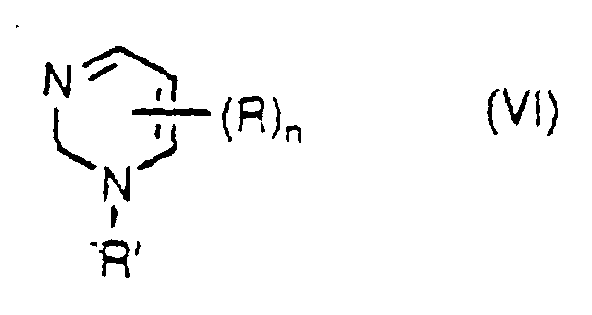
die Formel VII:wobei R und R' wie oben definiert sind und unabhängig voneinander sind und m eine ganze Zahl von 1 bis 3 bedeutet.
- Verfahren zur Herstellung von Polypeptiden nach Anspruch 4, wobei R ein Wasserstoffatom, eine Methyl-, eine Amino- oder eine Dimethylaminogruppe bedeutet, und R' und R" unabhängig voneinander ein Wasserstoffatom, eine Methyl-, eine Ribosyl-, eine Desoxyribosyl-, eine 5'-Monophosphoribosyl-, eine 5'-Monophosphodesoxyribosyl-, eine 5'-Diphosphoribosyl- oder eine 5'-Diphosphodesoxyribosylgruppe bedeutet.
- Verfahren zur Herstellung von Polypeptiden nach Anspruch 4, wobei die Pyridinverbindung α-Picolin, β-Picolin, γ-Picolin, 2-Aminopyridin, 3-Aminopyridin, 4-Aminopyridin oder 4-Dimethylaminopyridin ist; die Imidazolverbindung Imidazol oder 1-Methylimidazol ist; die Purinverbindung Guanin, Adenin, 9-Methyladenin, 7-Methyladenin, Adenosin, 2'-Desoxyadenosin, Adenosin-5'-monophosphat oder Adenosin-5'-diphosphat ist; und die Pyrimidinverbindung Cytosin, Uracil, Thymin, Cytidin, 2'-Desoxycytidin, Cytidyl-5'-monophosphat oder Cytidyl-5'-diphosphat ist.
Applications Claiming Priority (15)
| Application Number | Priority Date | Filing Date | Title |
|---|---|---|---|
| JP248168/93 | 1993-10-04 | ||
| JP24816893 | 1993-10-04 | ||
| JP24816893 | 1993-10-04 | ||
| JP3483594 | 1994-03-04 | ||
| JP3483494 | 1994-03-04 | ||
| JP34835/94 | 1994-03-04 | ||
| JP3483594 | 1994-03-04 | ||
| JP34834/94 | 1994-03-04 | ||
| JP3483494 | 1994-03-04 | ||
| JP10286194A JP3603330B2 (ja) | 1993-10-04 | 1994-05-17 | アミノ酸重縮合体の製造方法 |
| JP10286194 | 1994-05-17 | ||
| JP102862/94 | 1994-05-17 | ||
| JP10286294 | 1994-05-17 | ||
| JP10286294A JP3555170B2 (ja) | 1994-03-04 | 1994-05-17 | アミノ酸重縮合体の製造方法 |
| JP102861/94 | 1994-05-17 |
Publications (2)
| Publication Number | Publication Date |
|---|---|
| EP0646648A1 EP0646648A1 (de) | 1995-04-05 |
| EP0646648B1 true EP0646648B1 (de) | 2002-01-30 |
Family
ID=27521640
Family Applications (1)
| Application Number | Title | Priority Date | Filing Date |
|---|---|---|---|
| EP94115590A Expired - Lifetime EP0646648B1 (de) | 1993-10-04 | 1994-10-04 | Verfahren zur Herstellung eines Polypeptides |
Country Status (5)
| Country | Link |
|---|---|
| US (1) | US5643744A (de) |
| EP (1) | EP0646648B1 (de) |
| AT (1) | ATE212673T1 (de) |
| CA (1) | CA2133355A1 (de) |
| DE (1) | DE69429758T2 (de) |
Families Citing this family (23)
| Publication number | Priority date | Publication date | Assignee | Title |
|---|---|---|---|---|
| US20020061897A1 (en) | 2000-03-30 | 2002-05-23 | Elliott Richard L. | Neuropeptide Y antagonists |
| US7459290B1 (en) | 2004-03-30 | 2008-12-02 | Iowa State University Research Foundation, Inc. | Methods of using functional 30S subunits |
| US7858629B2 (en) | 2006-04-14 | 2010-12-28 | Merck Sharp & Dohme Corp. | Substituted imidazole 4-carboxamides as cholecystokinin-1 receptor modulators |
| BRPI0709972A2 (pt) | 2006-04-14 | 2011-08-02 | Merck & Co Inc | composto, composição farmacêutica, e, uso de um composto |
| DE602007007594D1 (de) | 2006-04-14 | 2010-08-19 | Merck Sharp & Dohme | Substituierte imidazol-4-carboxamide als cholecystokinin-1-rezeptor-modulatoren |
| US20100144738A1 (en) * | 2006-09-05 | 2010-06-10 | William Bornmann | Inhibitors of c-met and uses thereof |
| EP2061316A4 (de) * | 2006-09-11 | 2011-08-24 | Southern Res Inst | Azolnukleoside und verwendung als hemmer variabler rna- und dna-polymerasen |
| AU2008210455A1 (en) * | 2007-01-31 | 2008-08-07 | Vertex Pharmaceuticals Incorporated | 2-aminopyridine derivatives useful as kinase inhibitors |
| KR20100041798A (ko) * | 2007-06-29 | 2010-04-22 | 한국화학연구원 | 신규 hiv 역전사효소 억제제 |
| AR067181A1 (es) * | 2007-06-29 | 2009-09-30 | Gilead Sciences Inc | Inhibidores de transcriptasa inversa de hiv, composicion farmaceutica, uso del compuesto para preparar un medicamento, agente de combinacion farmaceutica y metodo de inhibicion de la replicacion de un retrovirus |
| WO2009085797A1 (en) * | 2007-12-21 | 2009-07-09 | Gilead Sciences, Inc. | Processes for preparing hiv reverse transcriptase inhibitors |
| EP2318407B1 (de) | 2008-07-23 | 2013-01-02 | Vertex Pharmaceuticals Incorporated | Pyrazolpyridine als kinaseinhibitoren |
| EP2328896B1 (de) | 2008-07-23 | 2013-10-23 | Vertex Pharmaceuticals Incorporated | Tricyclische pyrazolopyridine als kinaseinhibitoren |
| US8569337B2 (en) | 2008-07-23 | 2013-10-29 | Vertex Pharmaceuticals Incorporated | Tri-cyclic pyrazolopyridine kinase inhibitors |
| AU2009279611A1 (en) * | 2008-08-06 | 2010-02-11 | Vertex Pharmaceuticals Incorporated | Aminopyridine kinase inhibitors |
| EP2427464A1 (de) | 2009-05-06 | 2012-03-14 | Vertex Pharmaceuticals Incorporated | Pyrazolopyridine |
| MX2012008641A (es) | 2010-01-27 | 2012-11-23 | Vertex Pharma | Inhibidores de cinasas de pirazolopirazinas. |
| EP2582702A1 (de) | 2010-01-27 | 2013-04-24 | Vertex Pharmaceuticals Incorporated | Pyrazolopyrimidinkinasehemmer |
| AU2011209726A1 (en) | 2010-01-27 | 2012-08-09 | Vertex Pharmaceuticals Incorporated | Pyrazolopyridine kinase inhibitors |
| CN103467552B (zh) * | 2013-09-22 | 2015-05-27 | 河南师范大学 | 8-环己基-2-氟阿糖腺苷、制备方法及其应用 |
| CA3026149A1 (en) | 2016-06-02 | 2017-12-07 | Cadent Therapeutics, Inc. | Potassium channel modulators |
| HUE057710T2 (hu) | 2017-01-23 | 2022-05-28 | Cadent Therapeutics Inc | Káliumcsatorna modulátorok |
| MA53978A (fr) | 2018-10-22 | 2021-09-01 | Cadent Therapeutics Inc | Formes cristallines de modulateurs des canaux potassiques |
Citations (1)
| Publication number | Priority date | Publication date | Assignee | Title |
|---|---|---|---|---|
| EP0312617B1 (de) * | 1987-04-29 | 1993-03-03 | Institut Belka Akademii Nauk Sssr | Verfahren zur herstellung von polypeptiden in zellfreien translationssystemen |
Family Cites Families (4)
| Publication number | Priority date | Publication date | Assignee | Title |
|---|---|---|---|---|
| US4440676A (en) * | 1981-12-24 | 1984-04-03 | The British Petroleum Company P.L.C. | Process for the production of a dipeptide, a polypeptide or a protein |
| JP2668701B2 (ja) * | 1987-04-24 | 1997-10-27 | 湧永製薬株式会社 | 非天然型アミノ酸を含む蛋白質の製造法 |
| CA1337936C (en) * | 1987-08-07 | 1996-01-16 | Akiva Tuvia Gross | Vibriolysin coupling process |
| JPH04200390A (ja) * | 1990-11-30 | 1992-07-21 | Shigeyuki Yokoyama | 無細胞ポリペプチド合成系によるポリペプチドの製造方法 |
-
1994
- 1994-09-30 CA CA002133355A patent/CA2133355A1/en not_active Abandoned
- 1994-10-04 DE DE69429758T patent/DE69429758T2/de not_active Expired - Lifetime
- 1994-10-04 US US08/317,356 patent/US5643744A/en not_active Expired - Lifetime
- 1994-10-04 EP EP94115590A patent/EP0646648B1/de not_active Expired - Lifetime
- 1994-10-04 AT AT94115590T patent/ATE212673T1/de not_active IP Right Cessation
Patent Citations (1)
| Publication number | Priority date | Publication date | Assignee | Title |
|---|---|---|---|---|
| EP0312617B1 (de) * | 1987-04-29 | 1993-03-03 | Institut Belka Akademii Nauk Sssr | Verfahren zur herstellung von polypeptiden in zellfreien translationssystemen |
Also Published As
| Publication number | Publication date |
|---|---|
| DE69429758D1 (de) | 2002-03-14 |
| CA2133355A1 (en) | 1995-04-05 |
| DE69429758T2 (de) | 2002-08-22 |
| EP0646648A1 (de) | 1995-04-05 |
| ATE212673T1 (de) | 2002-02-15 |
| US5643744A (en) | 1997-07-01 |
Similar Documents
| Publication | Publication Date | Title |
|---|---|---|
| EP0646648B1 (de) | Verfahren zur Herstellung eines Polypeptides | |
| Iwata-Reuyl | Biosynthesis of the 7-deazaguanosine hypermodified nucleosides of transfer RNA | |
| Murguia et al. | A salt-sensitive 3′(2′), 5′-bisphosphate nucleotidase involved in sulfate activation | |
| Eliasson et al. | Characterization of components of the anaerobic ribonucleotide reductase system from Escherichia coli. | |
| US4572894A (en) | Process for synthesizing peptides or peptide derivatives | |
| Ohshima et al. | Continuous production of 3‐fluoro‐l‐alanine with alanine dehydrogenase | |
| EP0247819B1 (de) | Verfahren zur Herstellung von Diadenosintetraphosphat und Derivaten davon | |
| KR102425040B1 (ko) | 단백질 내 트리술파이드 수준을 감소시키기 위한 방법 | |
| US7148042B2 (en) | Method of preparing a guanosine-group compound and an intermediate thereof | |
| RU2145976C1 (ru) | Способ получения полипептида (варианты) | |
| KISHIMOTO et al. | Effect of ferrous ion on amino acid metabolism in mildiomycin production by Streptoverticillium rimofaciens | |
| Wondrack et al. | Substitution of nucleoside triphosphates for ascorbate in the thymine 7-hydroxylase reaction of Rhodotorula glutinis. | |
| JPH0143557B2 (de) | ||
| JPH029800B2 (de) | ||
| JP2003284583A (ja) | アミノ酸デヒドロゲナーゼによるl−アミノ酸の製造方法 | |
| JP3603330B2 (ja) | アミノ酸重縮合体の製造方法 | |
| Furness | The identification of para-aminobenzoyl polyglutamates in extracts of E. coli | |
| JPH0254077B2 (de) | ||
| JPH0143558B2 (de) | ||
| Godert | Investigating the biosynthesis of thio-quinolobactin and the development of a proteomics probe for thiamin utilizing enzymes | |
| JPH0335915B2 (de) | ||
| Yanagidani et al. | Purification and Characterization of NAD: Penicillamine ADP Transferase from Bacillus sphaericus | |
| JPS60196196A (ja) | ペプチドの合成法 | |
| Barciszewskil et al. | Studies on the Mechanism of the Aminoacylation Reaction of Transfer Ribonucleic Acid at High Pressure | |
| JP2003284584A (ja) | トランスアミナーゼおよびアミノ酸デヒドロゲナーゼを用いたl−アミノ酸の製造方法 |
Legal Events
| Date | Code | Title | Description |
|---|---|---|---|
| PUAI | Public reference made under article 153(3) epc to a published international application that has entered the european phase |
Free format text: ORIGINAL CODE: 0009012 |
|
| AK | Designated contracting states |
Kind code of ref document: A1 Designated state(s): AT BE CH DE DK ES FR GB GR IE IT LI LU MC NL PT SE |
|
| 17P | Request for examination filed |
Effective date: 19950920 |
|
| 17Q | First examination report despatched |
Effective date: 19980824 |
|
| GRAG | Despatch of communication of intention to grant |
Free format text: ORIGINAL CODE: EPIDOS AGRA |
|
| GRAG | Despatch of communication of intention to grant |
Free format text: ORIGINAL CODE: EPIDOS AGRA |
|
| GRAH | Despatch of communication of intention to grant a patent |
Free format text: ORIGINAL CODE: EPIDOS IGRA |
|
| GRAH | Despatch of communication of intention to grant a patent |
Free format text: ORIGINAL CODE: EPIDOS IGRA |
|
| GRAA | (expected) grant |
Free format text: ORIGINAL CODE: 0009210 |
|
| REG | Reference to a national code |
Ref country code: GB Ref legal event code: IF02 |
|
| AK | Designated contracting states |
Kind code of ref document: B1 Designated state(s): AT BE CH DE DK ES FR GB GR IE IT LI LU MC NL PT SE |
|
| PG25 | Lapsed in a contracting state [announced via postgrant information from national office to epo] |
Ref country code: NL Free format text: LAPSE BECAUSE OF FAILURE TO SUBMIT A TRANSLATION OF THE DESCRIPTION OR TO PAY THE FEE WITHIN THE PRESCRIBED TIME-LIMIT Effective date: 20020130 Ref country code: LI Free format text: LAPSE BECAUSE OF FAILURE TO SUBMIT A TRANSLATION OF THE DESCRIPTION OR TO PAY THE FEE WITHIN THE PRESCRIBED TIME-LIMIT Effective date: 20020130 Ref country code: IT Free format text: LAPSE BECAUSE OF FAILURE TO SUBMIT A TRANSLATION OF THE DESCRIPTION OR TO PAY THE FEE WITHIN THE PRESCRIBED TIME-LIMIT;WARNING: LAPSES OF ITALIAN PATENTS WITH EFFECTIVE DATE BEFORE 2007 MAY HAVE OCCURRED AT ANY TIME BEFORE 2007. THE CORRECT EFFECTIVE DATE MAY BE DIFFERENT FROM THE ONE RECORDED. Effective date: 20020130 Ref country code: GR Free format text: LAPSE BECAUSE OF FAILURE TO SUBMIT A TRANSLATION OF THE DESCRIPTION OR TO PAY THE FEE WITHIN THE PRESCRIBED TIME-LIMIT Effective date: 20020130 Ref country code: CH Free format text: LAPSE BECAUSE OF FAILURE TO SUBMIT A TRANSLATION OF THE DESCRIPTION OR TO PAY THE FEE WITHIN THE PRESCRIBED TIME-LIMIT Effective date: 20020130 Ref country code: BE Free format text: LAPSE BECAUSE OF FAILURE TO SUBMIT A TRANSLATION OF THE DESCRIPTION OR TO PAY THE FEE WITHIN THE PRESCRIBED TIME-LIMIT Effective date: 20020130 Ref country code: AT Free format text: LAPSE BECAUSE OF FAILURE TO SUBMIT A TRANSLATION OF THE DESCRIPTION OR TO PAY THE FEE WITHIN THE PRESCRIBED TIME-LIMIT Effective date: 20020130 |
|
| REF | Corresponds to: |
Ref document number: 212673 Country of ref document: AT Date of ref document: 20020215 Kind code of ref document: T |
|
| REG | Reference to a national code |
Ref country code: CH Ref legal event code: EP |
|
| REF | Corresponds to: |
Ref document number: 69429758 Country of ref document: DE Date of ref document: 20020314 |
|
| REG | Reference to a national code |
Ref country code: IE Ref legal event code: FG4D |
|
| PG25 | Lapsed in a contracting state [announced via postgrant information from national office to epo] |
Ref country code: SE Free format text: LAPSE BECAUSE OF FAILURE TO SUBMIT A TRANSLATION OF THE DESCRIPTION OR TO PAY THE FEE WITHIN THE PRESCRIBED TIME-LIMIT Effective date: 20020430 Ref country code: PT Free format text: LAPSE BECAUSE OF FAILURE TO SUBMIT A TRANSLATION OF THE DESCRIPTION OR TO PAY THE FEE WITHIN THE PRESCRIBED TIME-LIMIT Effective date: 20020430 Ref country code: DK Free format text: LAPSE BECAUSE OF FAILURE TO SUBMIT A TRANSLATION OF THE DESCRIPTION OR TO PAY THE FEE WITHIN THE PRESCRIBED TIME-LIMIT Effective date: 20020430 |
|
| NLV1 | Nl: lapsed or annulled due to failure to fulfill the requirements of art. 29p and 29m of the patents act | ||
| ET | Fr: translation filed | ||
| PG25 | Lapsed in a contracting state [announced via postgrant information from national office to epo] |
Ref country code: ES Free format text: LAPSE BECAUSE OF FAILURE TO SUBMIT A TRANSLATION OF THE DESCRIPTION OR TO PAY THE FEE WITHIN THE PRESCRIBED TIME-LIMIT Effective date: 20020730 |
|
| REG | Reference to a national code |
Ref country code: CH Ref legal event code: PL |
|
| PG25 | Lapsed in a contracting state [announced via postgrant information from national office to epo] |
Ref country code: LU Free format text: LAPSE BECAUSE OF NON-PAYMENT OF DUE FEES Effective date: 20021004 Ref country code: IE Free format text: LAPSE BECAUSE OF NON-PAYMENT OF DUE FEES Effective date: 20021004 |
|
| PLBE | No opposition filed within time limit |
Free format text: ORIGINAL CODE: 0009261 |
|
| STAA | Information on the status of an ep patent application or granted ep patent |
Free format text: STATUS: NO OPPOSITION FILED WITHIN TIME LIMIT |
|
| 26N | No opposition filed | ||
| PG25 | Lapsed in a contracting state [announced via postgrant information from national office to epo] |
Ref country code: MC Free format text: LAPSE BECAUSE OF NON-PAYMENT OF DUE FEES Effective date: 20030501 |
|
| REG | Reference to a national code |
Ref country code: IE Ref legal event code: MM4A |
|
| PGFP | Annual fee paid to national office [announced via postgrant information from national office to epo] |
Ref country code: DE Payment date: 20100929 Year of fee payment: 17 |
|
| PGFP | Annual fee paid to national office [announced via postgrant information from national office to epo] |
Ref country code: GB Payment date: 20110928 Year of fee payment: 18 |
|
| PGFP | Annual fee paid to national office [announced via postgrant information from national office to epo] |
Ref country code: FR Payment date: 20111103 Year of fee payment: 18 |
|
| GBPC | Gb: european patent ceased through non-payment of renewal fee |
Effective date: 20121004 |
|
| REG | Reference to a national code |
Ref country code: FR Ref legal event code: ST Effective date: 20130628 |
|
| PG25 | Lapsed in a contracting state [announced via postgrant information from national office to epo] |
Ref country code: GB Free format text: LAPSE BECAUSE OF NON-PAYMENT OF DUE FEES Effective date: 20121004 Ref country code: DE Free format text: LAPSE BECAUSE OF NON-PAYMENT OF DUE FEES Effective date: 20130501 |
|
| REG | Reference to a national code |
Ref country code: DE Ref legal event code: R119 Ref document number: 69429758 Country of ref document: DE Effective date: 20130501 |
|
| PG25 | Lapsed in a contracting state [announced via postgrant information from national office to epo] |
Ref country code: FR Free format text: LAPSE BECAUSE OF NON-PAYMENT OF DUE FEES Effective date: 20121031 |