EP0626135A2 - Fungizide Wirkstoffkombinationen - Google Patents
Fungizide Wirkstoffkombinationen Download PDFInfo
- Publication number
- EP0626135A2 EP0626135A2 EP94105879A EP94105879A EP0626135A2 EP 0626135 A2 EP0626135 A2 EP 0626135A2 EP 94105879 A EP94105879 A EP 94105879A EP 94105879 A EP94105879 A EP 94105879A EP 0626135 A2 EP0626135 A2 EP 0626135A2
- Authority
- EP
- European Patent Office
- Prior art keywords
- active ingredient
- group
- formula
- weight
- parts
- Prior art date
- Legal status (The legal status is an assumption and is not a legal conclusion. Google has not performed a legal analysis and makes no representation as to the accuracy of the status listed.)
- Granted
Links
- 0 *SN(C(c1c2cccc1)=O)C2=O Chemical compound *SN(C(c1c2cccc1)=O)C2=O 0.000 description 1
- PYZSVQVRHDXQSL-UHFFFAOYSA-N N#CC1=C(C#N)SC(C(c2ccccc2C2=O)=O)=C2S1 Chemical compound N#CC1=C(C#N)SC(C(c2ccccc2C2=O)=O)=C2S1 PYZSVQVRHDXQSL-UHFFFAOYSA-N 0.000 description 1
Classifications
-
- A—HUMAN NECESSITIES
- A01—AGRICULTURE; FORESTRY; ANIMAL HUSBANDRY; HUNTING; TRAPPING; FISHING
- A01N—PRESERVATION OF BODIES OF HUMANS OR ANIMALS OR PLANTS OR PARTS THEREOF; BIOCIDES, e.g. AS DISINFECTANTS, AS PESTICIDES OR AS HERBICIDES; PEST REPELLANTS OR ATTRACTANTS; PLANT GROWTH REGULATORS
- A01N37/00—Biocides, pest repellants or attractants, or plant growth regulators containing organic compounds containing a carbon atom having three bonds to hetero atoms with at the most two bonds to halogen, e.g. carboxylic acids
- A01N37/18—Biocides, pest repellants or attractants, or plant growth regulators containing organic compounds containing a carbon atom having three bonds to hetero atoms with at the most two bonds to halogen, e.g. carboxylic acids containing the group —CO—N<, e.g. carboxylic acid amides or imides; Thio analogues thereof
- A01N37/22—Biocides, pest repellants or attractants, or plant growth regulators containing organic compounds containing a carbon atom having three bonds to hetero atoms with at the most two bonds to halogen, e.g. carboxylic acids containing the group —CO—N<, e.g. carboxylic acid amides or imides; Thio analogues thereof the nitrogen atom being directly attached to an aromatic ring system, e.g. anilides
-
- A—HUMAN NECESSITIES
- A01—AGRICULTURE; FORESTRY; ANIMAL HUSBANDRY; HUNTING; TRAPPING; FISHING
- A01N—PRESERVATION OF BODIES OF HUMANS OR ANIMALS OR PLANTS OR PARTS THEREOF; BIOCIDES, e.g. AS DISINFECTANTS, AS PESTICIDES OR AS HERBICIDES; PEST REPELLANTS OR ATTRACTANTS; PLANT GROWTH REGULATORS
- A01N37/00—Biocides, pest repellants or attractants, or plant growth regulators containing organic compounds containing a carbon atom having three bonds to hetero atoms with at the most two bonds to halogen, e.g. carboxylic acids
- A01N37/18—Biocides, pest repellants or attractants, or plant growth regulators containing organic compounds containing a carbon atom having three bonds to hetero atoms with at the most two bonds to halogen, e.g. carboxylic acids containing the group —CO—N<, e.g. carboxylic acid amides or imides; Thio analogues thereof
- A01N37/22—Biocides, pest repellants or attractants, or plant growth regulators containing organic compounds containing a carbon atom having three bonds to hetero atoms with at the most two bonds to halogen, e.g. carboxylic acids containing the group —CO—N<, e.g. carboxylic acid amides or imides; Thio analogues thereof the nitrogen atom being directly attached to an aromatic ring system, e.g. anilides
- A01N37/24—Biocides, pest repellants or attractants, or plant growth regulators containing organic compounds containing a carbon atom having three bonds to hetero atoms with at the most two bonds to halogen, e.g. carboxylic acids containing the group —CO—N<, e.g. carboxylic acid amides or imides; Thio analogues thereof the nitrogen atom being directly attached to an aromatic ring system, e.g. anilides containing at least one oxygen or sulfur atom being directly attached to the same aromatic ring system
Definitions
- the present application relates to new combinations of active ingredients which consist of a compound of the formula I. on the one hand and other known fungicidal active ingredients on the other hand and are very suitable for combating phytopathogenic fungi.
- the active ingredient of formula (I) is known (EP-A-339 418).
- the components also present in the combinations according to the invention are also known.
- the active compound combinations according to the invention contain at least one active ingredient from the compounds of groups (A) to ( ⁇ ). They can also contain other fungicidally active components.
- the weight ratios of the active ingredients in the active ingredient combinations can be varied within a relatively wide range.
- 1 part by weight of active compound of the formula (I) 0.5 to 50 parts by weight, preferably 0.5 to 10 parts by weight of active ingredient propineb (D) 0.5 to 50 parts by weight, preferably 0.5 to 10 parts by weight of active ingredient Mancozeb (F) 0.5 to 50 parts by weight, preferably 0.5 to 10 parts by weight of active ingredient TMTD (E) 0.5 to 50 parts by weight, preferably 0.5 to 10 parts by weight of active ingredient Metiram (W) 0.5 to 50 parts by weight, preferably 0.5 to 20 parts by weight of active ingredient dichlofluanide (A) 0.5 to 50 parts by weight, preferably 0.5 to 20 parts by weight of active ingredient tolylfluanid (B) 0.5 to 50 parts by weight, preferably 0.5 to 20 parts by weight of active ingredient
- the active compound combinations according to the invention are particularly suitable for combating cereal diseases, such as Erysiphe, Cochliobolus, Pyrenophora and Leptosphaeria, and against fungal attack on vegetables, wine and fruit, for example against Venturia on apples, Botrytis on beans and Phytophthora on tomatoes.
- cereal diseases such as Erysiphe, Cochliobolus, Pyrenophora and Leptosphaeria
- fungal attack on vegetables, wine and fruit for example against Venturia on apples, Botrytis on beans and Phytophthora on tomatoes.
- the active compound combinations according to the invention can be converted into the customary formulations, such as solutions, emulsions, suspensions, powders, foams, pastes, granules, aerosols, very fine encapsulations in polymeric substances and in coating compositions for seeds, and ULV formulations.
- customary formulations such as solutions, emulsions, suspensions, powders, foams, pastes, granules, aerosols, very fine encapsulations in polymeric substances and in coating compositions for seeds, and ULV formulations.
- formulations are prepared in a known manner, for example by mixing the active ingredients or the active ingredient combinations with extenders, that is to say liquid solvents, pressurized liquefied gases and / or solid carriers, optionally using surface-active agents, that is to say emulsifiers and / or dispersants and / or foam-generating agents. If water is used as an extender, organic solvents can, for example, also be used as auxiliary solvents.
- extenders that is to say liquid solvents, pressurized liquefied gases and / or solid carriers, optionally using surface-active agents, that is to say emulsifiers and / or dispersants and / or foam-generating agents.
- surface-active agents that is to say emulsifiers and / or dispersants and / or foam-generating agents.
- organic solvents can, for example, also be used as auxiliary solvents.
- aromatics such as xylene, toluene or alkylnaphthalenes
- chlorinated aromatics or chlorinated aliphatic hydrocarbons such as chlorobenzenes, chlorethylenes or methylene chloride
- aliphatic hydrocarbons such as cyclohexane or paraffins, for example petroleum fractions
- alcohols such as butanol or glycol, and the like their ethers and esters
- ketones such as acetone, methyl ethyl ketone, methyl isobutyl ketone or cyclohexanone
- strongly polar solvents such as dimethylformamide and dimethyl sulfoxide, and water.
- Liquefied gaseous extenders or carriers refer to liquids which are gaseous at normal temperature and under normal pressure, for example aerosol propellants, such as halogenated hydrocarbons, and also butane, propane, nitrogen and carbon dioxide.
- aerosol propellants such as halogenated hydrocarbons, and also butane, propane, nitrogen and carbon dioxide.
- solid carriers for example natural rock powders, such as kaolins, clays, talc, chalk, quartz, attapulgite, montmorillonite or diatomaceous earth and synthetic rock powders, such as finely divided silica, aluminum oxide and silicates.
- Possible solid carriers for granules are: e.g.
- emulsifiers and / or foam-generating agents are: for example nonionic and anionic emulsifiers, such as polyoxyethylene fatty acid esters, polyoxyethylene fatty alcohol ethers, for example alkylaryl polyglycol ethers, alkyl sulfonates, alkyl sulfates, aryl sulfonates and protein hydrolyzates.
- Possible dispersants are, for example, lignin sulfite liquor and methyl cellulose.
- Adhesives such as carboxymethyl cellulose, natural and synthetic powdery, granular or latex-shaped polymers, such as gum arabic, polyvinyl alcohol, polyvinyl acetate, and also natural phospholipids, such as cephalins and lecithins, and synthetic phospholipids can be used in the formulations.
- Other additives can be mineral and vegetable oils.
- Dyes such as inorganic pigments, e.g. Iron oxide, titanium oxide, ferrocyan blue and organic dyes such as alizarin, azo and metal phthalocyanine dyes and trace nutrients such as salts of iron, manganese, boron, copper, cobalt, molybdenum and zinc can be used.
- the formulations generally contain between 0.1 and 95 percent by weight of active compound, preferably between 0.5 and 90%.
- the active compound combinations according to the invention can be present in the formulations in a mixture with other known active compounds, such as fungicides, insecticides, acaricides and herbicides, and in mixtures with fertilizers or plant growth regulators.
- the active compound combinations can be used as such, in the form of their formulations or the use forms prepared therefrom, such as ready-to-use solutions, emulsifiable concentrates, emulsions, suspensions, wettable powders, soluble powders and granules.
- the active compound concentrations in the use forms can be varied within a substantial range. They are generally between 1 and 0.0001% by weight, preferably between 0.5 and 0.001%.
- active ingredient 0.001 to 50 g per kilogram of seed, preferably 0.01 to 10 g, are generally required.
- active ingredient concentrations of 0.00001 to 0.1% by weight, preferably 0.0001 to 0.02% by weight, are required at the site of action.
- the good fungicidal activity of the active compound combinations according to the invention can be seen from the examples below. While the individual active ingredients have weaknesses in their fungicidal action, the combinations show an action that goes beyond a simple summation of action.
- Fungicides always have a synergistic effect if the fungicidal activity of the active ingredient combinations is greater than the sum of the effects of the individually applied active ingredients.
- the combination of the combination is superadditive, ie there is a synergistic effect.
- the actually observed efficiency must be greater than the value for the expected efficiency (E) calculated from the above formula:
- Botrytis test (bean) / protective
- active compound formulations (individual active compounds or combinations of active compounds) are diluted with water to the desired concentration.
- active compound 1 part by weight of active compound is mixed with the stated amounts of solvent and emulsifier, and the concentrate is diluted with water to the desired concentration.
- the plants are placed in a greenhouse at a temperature of 15 ° C and a relative humidity of approx. 80%.
- Evaluation is carried out 10 days after the inoculation.
- active compound 1 part by weight of active compound is mixed with the stated amounts of solvent and emulsifier, and the concentrate is diluted with water to the desired concentration.
- the plants are placed in a greenhouse at a temperature of 20 ° C and a relative humidity of about 80% in order to promote the development of mildew pustules.
- Evaluation is carried out 7 days after the inoculation.
- active compound 1 part by weight of active compound is mixed with the stated amounts of solvent and emulsifier, and the concentrate is diluted with water to the desired concentration.
- the plants are placed in a greenhouse at a temperature of 20 ° C and a relative humidity of approx. 80% to promote the development of mildew pustules.
- Evaluation is carried out 7 days after the inoculation.
- active compound 1 part by weight of active compound is mixed with the stated amounts of solvent and emulsifier, and the concentrate is diluted with water to the desired concentration.
- the plants are placed in a greenhouse at a temperature of 20 ° C and a relative humidity of approx. 80% to promote the development of mildew pustules.
- Evaluation is carried out 7 days after the inoculation.
- active compound 1 part by weight of active compound is mixed with the stated amounts of solvent and emulsifier, and the concentrate is diluted with water to the desired concentration.
- the plants are placed in a greenhouse at a temperature of 15 ° C and a relative humidity of approx. 80%.
- Evaluation is carried out 10 days after the inoculation.
- active compound 1 part by weight of active compound is mixed with the stated amounts of solvent and emulsifier, and the concentrate is diluted with water to the desired concentration.
- the plants are placed in a greenhouse at a temperature of 20 ° C and a relative humidity of approx. 80%.
- Evaluation is carried out 7 days after the inoculation.
Landscapes
- Life Sciences & Earth Sciences (AREA)
- Wood Science & Technology (AREA)
- Environmental Sciences (AREA)
- Plant Pathology (AREA)
- Health & Medical Sciences (AREA)
- Engineering & Computer Science (AREA)
- Dentistry (AREA)
- Pest Control & Pesticides (AREA)
- General Health & Medical Sciences (AREA)
- Zoology (AREA)
- Agronomy & Crop Science (AREA)
- Agricultural Chemicals And Associated Chemicals (AREA)
- Heterocyclic Compounds Containing Sulfur Atoms (AREA)
- Pyridine Compounds (AREA)
- Nitrogen Condensed Heterocyclic Rings (AREA)
- Indole Compounds (AREA)
- Organic Low-Molecular-Weight Compounds And Preparation Thereof (AREA)
Abstract
Description
- Die vorliegende Anmeldung betrifft neue Wirkstoffkombinationen, die aus einer Verbindung der Formel I

einerseits und weiteren bekannten fungiziden Wirkstoffen andererseits bestehen und sehr gut zur Bekämpfung von phytopathogenen Pilzen geeignet sind. - Es ist bereits bekannt, daß die Verbindungen der Formel (I) fungizide Eigenschaften besitzt (vgl. EP-A 339 418). Die Wirksamkeit dieses Stoffes ist gut; sie läßt jedoch bei niedrigen Aufwandmengen in manchen Fällen zu wünschen übrig.
- Ferner ist schon bekannt, daß zahlreiche Azol-Derivate, aromatische Carbonsäure-Derivate, Morpholin-Verbindungen und andere Heterocyclen zur Bekämpfung von Pilzen eingesetzt werden können (vgl. K.H. Büchel "Pflanzenschutz und Schädlingsbekämpfung" Seiten 87, 136, 140, 141 und 146 bis 153, Georg Thieme Verlag, Stuttgart 1977). Die Wirkung der betreffenden Stoffe ist aber bei niedrigen Aufwandmengen nicht immer befriedigend.
- Es wurde nun gefunden, daß die neuen Wirkstoffkombinationen aus einer Verbindung der Formel I

und - (A) Dichlofluanid der Formel

- (B) Tolylfluanid der Formel

- (C) Tetrachlor-isophthalo-dinitril der Formel

- (D) Propineb der Formel

- (E) Tetramethyl-thiuram-disulfid der Formel

- (F) Mancozeb der Formel

- (G) Anilazin der Formel

- (H) Kupfer-Oxychloride
und/oder - (I) Captan der Formel

- (K) einem Morpholin-Derivat der Formel

- (L) Dithianon der Formel

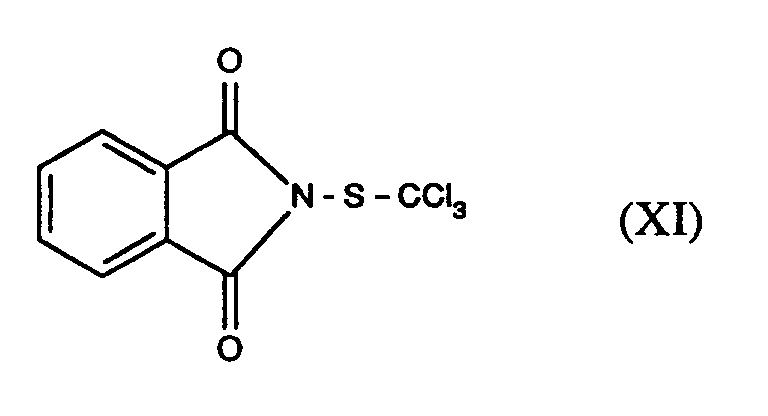
- (M) Phaltan der Formel
- (N) Cymoxanil der Formel

- (O) Benzimidazol-2-carbamidsäuremethylester der Formel

- (P) Fosetyl der Formel

und/oder - (Q) Metalaxyl der Formel

- (R) Oxadixyl der Formel

- (S) Fluazinam der Formel

- (T) 1 -(4-Chlorphenyl)-4,4-dimethyl-3-(1,2,4-triazol-1-yl-ethyl)-pentan-3-ol der Formel

- (U) einem Azol-Derivat der Formel

(XIX)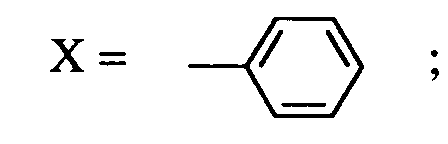
(XIX) X = Cl;
und/oder - (V) einem Azol-Derivat aus der Gruppe
- a) Difenconazole
- b) Penconazole
- c) Flusilazole
- d) Hexaconazole
- e) Myclobutanil
- f) Prochloraz
- (W) Metiram
und/oder - (X) Pyrimethanil
und/oder - (Y) Diethofencarb
und/oder - (Z) Mepanipyrim
und/oder - (α) Phenylpyrrol
und/oder - (β) Iprodione
und/oder - (γ) Vinclozolin
und/oder - (δ) Procymidone
und/oder - (ε) Benomyl
und/oder - (

und/oder - (Π) Schwefel
und/oder - (η) Verbindungen der Formeln

- Der Wirkstoff der Formel (I) ist bekannt (EP-A-339 418). Die in den erfindungsgemäßen Kombinationen außerdem vorhandenen Komponente sind ebenfalls bekannt.
- Die erfindungsgemäßen Wirkstoffkombinationen enthalten neben dem Wirkstoff der Formel (I) mindestens einen Wirkstoff von den Verbindungen der Gruppen (A) bis (Π). Sie können darüber hinaus auch weitere fungizid wirksame Zumischkomponenten enthalten.
- Wenn die Wirkstoffe in den erfindungsgemäßen Wirkstoffkombinationen in bestimmten Gewichtsverhältnissen vorhanden sind, zeigt sich der synergistische Effekt besonders deutlich. Jedoch können die Gewichtsverhältnisse der Wirkstoffe in den Wirkstoffkombinationen in einem relativ großen Bereich variiert werden. Im allgemeinen entfallen auf 1 Gewichtsteil an Wirkstoff der Formel (I)
0,5 bis 50 Gewichtsteile, vorzugsweise
0,5 bis 10 Gewichtsteile an Wirkstoff Propineb (D)
0,5 bis 50 Gewichtsteile, vorzugsweise
0,5 bis 10 Gewichtsteile an Wirkstoff Mancozeb (F)
0,5 bis 50 Gewichtsteile, vorzugsweise
0,5 bis 10 Gewichtsteile an Wirkstoff TMTD (E)
0,5 bis 50 Gewichtsteile, vorzugsweise
0,5 bis 10 Gewichtsteile an Wirkstoff Metiram (W)
0,5 bis 50 Gewichtsteile, vorzugsweise
0,5 bis 20 Gewichtsteile an Wirkstoff Dichlofluanid (A)
0,5 bis 50 Gewichtsteile, vorzugsweise
0,5 bis 20 Gewichtsteile an Wirkstoff Tolylfluanid (B)
0,5 bis 50 Gewichtsteile, vorzugsweise
0,5 bis 20 Gewichtsteile an Wirkstoff Phaltan (M)
0,5 bis 50 Gewichtsteile, vorzugsweise
0,5 bis 20 Gewichtsteile an Wirkstoff Captan (I)
1 bis 50 Gewichtsteile, vorzugsweise
1 bis 20 Gewichtsteile an Wirkstoff Cu-Oxichlorid (H)
1 bis 50 Gewichtsteile, vorzugsweise
1 bis 20 Gewichtsteile an Wirkstoff Schwefel (Π)
0,5 bis 50 Gewichtsteile, vorzugsweise
0,5 bis 10 Gewichtsteile an Wirkstoff Anilazine (G)
0,5 bis 50 Gewichtsteile, vorzugsweise
0,5 bis 10 Gewichtsteile an Wirkstoff Chlorothalonil (C)
0,5 bis 50 Gewichtsteile, vorzugsweise
0,5 bis 10 Gewichtsteile an Wirkstoff Dithianon (L)
0,1 bis 10 Gewichtsteile, vorzugsweise
0,5 bis 5 Gewichtsteile an Wirkstoff Fluazinam (S)
0,1 bis 10 Gewichtsteile, vorzugsweise
0,5 bis 5 Gewichtsteile an Wirkstoff Pyrimetanil (X)
0,1 bis 10 Gewichtsteile, vorzugsweise
0,5 bis 5 Gewichtsteile an Wirkstoff Diethofencarb (Y)
0,1 bis 10 Gewichtsteile, vorzugsweise
0,5 bis 5 Gewichtsteile an Wirkstoff Mepanipyrin (Z)
0,1 bis 10 Gewichtsteile, vorzugsweise
0,5 bis 5 Gewichtsteile an Wirkstoff Phenylpyrrol (Saphire) (α)
0,1 bis 20 Gewichtsteile, vorzugsweise
0,5 bis 10 Gewichtsteile an Wirkstoff Iprodione (β)
0,1 bis 20 Gewichtsteile, vorzugsweise
0,5 bis 10 Gewichtsteile an Wirkstoff Vinclozolin (γ)
0,1 bis 20 Gewichtsteile, vorzugsweise
0,5 bis 10 Gewichtsteile an Wirkstoff Procymidone (δ)
0,1 bis 10 Gewichtsteile, vorzugsweise
0,25 bis 5 Gewichtsteile an Wirkstoff Benomyl (ε)
0,1 bis 10 Gewichtsteile, vorzugsweise
0,25 bis 5 Gewichtsteile an Wirkstoff Carbendazim (O)
0,1 bis 10 Gewichtsteile, vorzugsweise
0,25 bis 5 Gewichtsteile an Wirkstoff Thiopanatmethyl(
0,1 bis 10 Gewichtsteile, vorzugsweise
0,25 bis 5 Gewichtsteile an Wirkstoff Cymoxanil (N)
0,1 bis 10 Gewichtsteile, vorzugsweise
0,25 bis 5 Gewichtsteile an Wirkstoff Metalaxyl (Q)
0,1 bis 10 Gewichtsteile, vorzugsweise
0,25 bis 5 Gewichtsteile an Wirkstoff Oxadixyl (R)
0,1 bis 10 Gewichtsteile, vorzugsweise
0,2 bis 5 Gewichtsteile an Wirkstoff Dimethomorph (K)
0,1 bis 20 Gewichtsteile, vorzugsweise
0,2 bis 10 Gewichtsteile an Wirkstoff Al-Fosethyl (P)
0,01 bis 10 Gewichtsteile, vorzugsweise
0,025 bis 5 Gewichtsteile an Wirkstoff Tebuconazole (T)
0,01 bis 10 Gewichtsteile, vorzugsweise
0,025 bis 5 Gewichtsteile an Wirkstoff Triadimefon (U XIXc)
0,01 bis 10 Gewichtsteile, vorzugsweise
0,025 bis 5 Gewichtsteile an Wirkstoff Triadimenol (U XIXa)
0,01 bis 10 Gewichtsteile, vorzugsweise
0,025 bis 5 Gewichtsteile an Wirkstoff Bitertanol (U XIXb)
0,01 bis 10 Gewichtsteile, vorzugsweise
0,025 bis 5 Gewichtsteile an Wirkstoff Difenconazole (Va)
0,01 bis 10 Gewichtsteile, vorzugsweise
0,025 bis 5 Gewichtsteile an Wirkstoff Penconazole (Vb)
0,01 bis 10 Gewichtsteile, vorzugsweise
0,025 bis 5 Gewichtsteile an Wirkstoff Flusilazole (Vc)
0,01 bis 10 Gewichtsteile, vorzugsweise
0,025 bis 5 Gewichtsteile an Wirkstoff Hexaconazole (Vd)
0,01 bis 10 Gewichtsteile, vorzugsweise
0,025 bis 5 Gewichtsteile an Wirkstoff Myclobutanil (Ve)
0,01 bis 10 Gewichtsteile, vorzugsweise
0,025 bis 5 Gewichtsteile an Wirkstoff Prochloraz (Vf)
0,01 bis 10 Gewichtsteile, vorzugsweise
0,025 bis 5 Gewichtsteile an Wirkstoff der Formel (η a)
0,01 bis 10 Gewichtsteile, vorzugsweise
0,025 bis 5 Gewichtsteile an Wirkstoff der Formel (η b)
Die erfindungsgemäßen Wirkstoffkombinationen besitzen sehr gute fungizide Eigenschaften und lassen sich vor allem zur Bekämpfung von phytopathogenen Pilzen, wie Plasmodiophoromycetes, Oomycetes, Chytridiomycetes, Zygomycetes, Ascomycetes, Basidiomycetes, Deuteromycetes usw. einsetzen. - Die erfindungsgemäßen Wirkstoffkombinationen eignen sich besonders gut zur Bekämpfung von Getreidekrankheiten, wie Erysiphe, Cochliobolus, Pyrenophora und Leptosphaeria, und gegen Pilzbefall an Gemüse, Wein und Obst, beispielsweise gegen Venturia an Äpfeln, Botrytis an Bohnen und Phytophthora an Tomaten.
- Die gute Pflanzenverträglichkeit der Wirkstoffkombinationen in den zur Bekämpfung von Pflanzenkranheiten notwendigen Konzentrationen erlaubt eine Behandlung von oberirdischen Pflanzenteilen, von Pflanz- und Saatgut, und des Bodens.
- Die erfindungsgemäßen Wirkstoffkombinationen können in die üblichen Formulierungen übergeführt werden, wie Lösungen, Emulsionen, Suspensionen, Pulver, Schäume, Pasten, Granulate, Aerosole, Feinstverkapselungen in polymeren Stoffen und in Hüllmassen für Saatgut, sowie ULV-Formulierungen.
- Diese Formulierungen werden in bekannter Weise hergestellt, z.B. durch Vermischen der Wirkstoffe bzw. der Wirkstoffkombinationen mit Streckmitteln, also flüssigen Lösungsmitteln, unter Druck stehenden verflüssigten Gasen und/oder festen Trägerstoffen, gegebenenfalls unter Verwendung von oberflächenaktiven Mitteln, also Emulgiermitteln und/oder Dispergiermitteln und/oder schaumerzeugenden Mitteln. Im Falle der Benutzung von Wasser als Streckmittel können z.B. auch organische Lösungsmittel als Hilfslösungsmittel verwendet werden. Als flüssige Lösungsmittel kommen im wesentlichen in Frage: Aromaten, wie Xylol, Toluol oder Alkylnaphthaline, chlorierte Aromaten oder chlorierte aliphatische Kohlenwasserstoffe, wie Chlorbenzole, Chlorethylene oder Methylenchlorid, aliphatische Kohlenwasserstoffe, wie Cyclohexan oder Paraffine, z.B. Erdölfraktionen, Alkohole, wie Butanol oder Glycol sowie deren Ether und Ester, Ketone, wie Aceton, Methylethylketon, Methylisobutylketon oder Cyclohexanon, stark polare Lösungsmittel wie Dimethylformamid und Dimethylsulfoxid, sowie Wasser. Mit verflüssigten gasförmigen Streckmitteln oder Tragerstoffen sind solche Flüssigkeiten gemeint, welche bei normaler Temperatur und unter Normaldruck gasförmig sind, z.B. Aerosol-Treibgase, wie Halogenkohlenwasserstoffe, sowie Butan, Propan, Stickstoff und Kohlendioxid. Als feste Trägerstoffe kommen in Frage: z.B. natürliche Gesteinsmehle, wie Kaoline, Tonerden, Talkum, Kreide, Quarz, Attapulgit, Montmorillonit oder Diatomeenerde und synthetische Gesteinsmehle, wie hochdisperse Kieselsäure, Aluminiumoxid und Silikate. Als feste Trägerstoffe für Granulate kommen in Frage: z.B. gebrochene und fraktionierte natürliche Gesteine wie Calcit, Marmor, Bims, Sepiolith, Dolomit sowie synthetische Granulate aus anorganischen und organischen Mehlen sowie Granulate aus organischem Material wie Sägemehl, Kokosnußschalen, Maiskolben und Tabakstengel. Als Emulgier- und/oder schaumerzeugende Mittel kommen in Frage: z.B. nichtionogene und anionische Emulgatoren, wie Polyoxyethylen-Fettsäureester, Polyoxyethylen-Fettalkoholether, z.B. Alkylarylpolyglycol-ether, Alkylsulfonate, Alkylsulfate, Arylsulfonate sowie Eiweißhydrolysate. Als Dispergiermittel kommen in Frage: z.B. Lignin-Sulfitablaugen und Methylcellulose.
- Es können in den Formulierungen Haftmittel wie Carboxymethylcellulose, natürliche und synthetische pulverige, körnige oder latexförmige Polymere verwendet werden, wie Gummiarabicum, Polyvinylalkohol, Polyvinylacetat, sowie natürliche Phospholipide, wie Kephaline und Lecithine, und synthetische Phospholipide. Weitere Additive können mineralische und vegetabile Öle sein.
- Es können Farbstoffe wie anorganische Pigmente, z.B. Eisenoxid, Titanoxid, Ferrocyanblau und organische Farbstoffe, wie Alizarin-, Azo- und Metallphthalocyaninfarbstoffe und Spurennährstoffe, wie Salze von Eisen, Mangan, Bor, Kupfer, Kobalt, Molybdän und Zink verwendet werden.
- Die Formulierungen enthalten im allgemeinen zwischen 0,1 und 95 Gewichtsprozent Wirkstoff, vorzugsweise zwischen 0,5 und 90 %.
- Die erfindungsgemäßen Wirkstoffkombinationen können in den Formulierungen in Mischung mit anderen bekannten Wirkstoffen vorliegen, wie Fungizide, Insektizide, Akarizide und Herbizide, sowie in Mischungen mit Düngemitteln oder Pflanzenwachstumsregulatoren.
- Die Wirkstoffkombinationen können als solche, in Form ihrer Formulierungen oder den daraus bereiteten Anwendungsformen, wie gebrauchsfertige Lösungen, emulgierbare Konzentrate, Emulsionen, Suspensionen, Spritzpulver, lösliche Pulver und Granulate, angewendet werden.
- Die Anwendung geschieht in üblicher Weise, z.B. durch Gießen, Verspritzen, Versprühen, Verstreuen, Verstreichen, Trockenbeizen, Feuchtbeizen, Naßbeizen, Schlämmbeizen oder Inkrustieren.
- Bei der Behandlung von Pflanzenteilen können die Wirkstoffkonzentrationen in den Anwendungsformen in einem größeren Bereich variiert werden. Sie liegen im allgemeinen zwischen 1 und 0,0001 Gew.-%, vorzugsweise zwischen 0,5 und 0,001 %.
- Bei der Saatgutbehandlung werden im allgemeinen Wirkstoffmengen von 0,001 bis 50g je Kilogramm Saatgut, vorzugsweise 0,01 bis 10g benötigt.
- Bei Behandlung des Bodens sind Wirkstoffkonzentrationen von 0,00001 bis 0,1 Gew.-%, vorzugsweise von 0,0001 bis 0,02 Gew.-%, am Wirkungsort erforderlich.
- Die gute fungizide Wirkung der erfindungsgemäßen Wirkstoffkombinationen geht aus den nachfolgenden Beispielen hervor. Während die einzelnen Wirkstoffe in der fungiziden Wirkung Schwächen aufweisen, zeigen die Kombinationen eine Wirkung, die über eine einfache Wirkungssummierung hinausgeht.
- Ein synergistischer Effekt liegt bei Fungiziden immer dann vor, wenn die fungizide Wirkung der Wirkstoffkombinationen größer ist als die Summe der Wirkungen der einzeln applizierten Wirkstoffe.
- Die zu erwartende Wirkung für eine gegebene Kombination zweier Wirkstoffe kann (vgl. Colby, S.R., "Calculating Synergistic and Antagonistic Responses of Herbicide Combinations", Weeds 15, Seiten 20-22,1967) wie folgt berechnet werden:
Wenn - X
- den Wirkungsgrad, ausgedrückt in % der unbehandelten Kontrolle, beim Einsatz des Wirkstoffes A in einer Konzentration von m ppm,
- Y
- den Wirkungsgrad, ausgedrückt in % der unbehandelten Kontrolle, beim Einsatz des Wirkstoffes B in einer Konzentration von m ppm,
- E
- den erwarteten Wirkungsgrad, ausgedrückt in % der unbehandelten Kontrolle, beim Einsatz des Wirkstoffes A und B in einer Konzentrationen von m und n ppm bedeutet,
- Ist die tatsächliche fungizide Wirkung größer als berechnet, so ist die Kombination in ihrer Wirkung überadditiv, d.h. es liegt ein synergistischer Effekt vor. In diesem Fall muß der tatsächlich beobachtete Wirkungsgrad größer sein als der aus der oben angeführten Formel errechnete Wert für den erwarteten Wirkungsgrad (E):
- Zur Herstellung einer zweckmäßigen Wirkstoffzubereitung werden handelsübliche Wirkstoff-Formulierungen (einzelne Wirkstoffe oder Wirkstoffkombinationen) mit Wasser auf die jeweils gewünschte Konzentration verdünnt.
- Zur Prüfung auf protektive Wirksamkeit besprüht man junge Pflanzen mit der Wirkstoffzubereitung bis zur Tropfnässe. Nach Antrocknen des Spritzbelages werden auf jedes Blatt 2 kleine mit Botrytis cinerea bewachsene Agarstückchen aufgelegt. Die inokulierten Pflanzen werden in einer abgedunkelten, feuchten Kammer bei 20°C aufgestellt.
- 3 Tage nach der Inokulation wird die Größe der Befallsflecken auf den Blättern ausgewertet.
- Um Synergismus zwischen den in diesem Versuch verwendeten Wirkstoffen aufzuzeigen, wurden die Resultate nach der von Colby beschriebenen Methode (s.o.) ausgewertet.
- Wirkstoffe, Wirkstoffkonzentrationen und Versuchsergebnisse gehen aus den folgenden Tabellen hervor.


-
Lösungsmittel: 100 Gewichtsteile Dimethylformamid Emulgator: 0,25 Gewichtsteile Alkylarylpolyglykolether - Zur Herstellung einer zweckmäßigen Wirkstoffzubereitung vermischt man 1 Gewichtsteil Wirkstoff mit den angegebenen Mengen Lösungsmittel und Emulgator und verdünnt das Konzentrat mit Wasser auf die gewünschte Konzentration.
- Zur Prüfung auf protektive Wirksamkeit besprüht man junge Pflanzen mit der Wirkstoffzubereitung taufeucht. Nach Antrocknen des Spritzbelages werden die Pflanzen mit einer Sporensuspension von Leptosphaeria nodorum besprüht. Die Pflanzen verbleiben 48 Stunden bei 20°C und 100 % relativer Luftfeuchtigkeit in einer Inkubationskabine.
- Die Pflanzen werden in einem Gewächshaus bei einer Temperatur von 15°C und einer relativen Luftfeuchtigkeit von ca. 80 % aufgestellt.
- 10 Tage nach der Inokulation erfolgt die Auswertung.
- Eine deutliche Überlegenheit in der Wirksamkeit gegenüber dem Stand der Technik zeigen bei diesem Test z.B. die Verbindungen gemäß folgender Herstellungsbeispiele:

-
Lösungsmittel: 10 Gewichtsteile N-Methyl-pyrrolidon Emulgator: 0,6 Gewichtsteile Alkylarylpolyglykolether - Zur Herstellung einer zweckmäßigen Wirkstoffzubereitung vermischt man 1 Gewichtsteil Wirkstoff mit den angegebenen Mengen Lösungsmittel und Emulgator und verdünnt das Konzentrat mit Wasser auf die gewünschte Konzentration.
- Zur Prüfung auf protektive Wirksamkeit besprüht man junge Pflanzen mit der Wirkstoffzubereitung taufeucht. Nach Antrocknen des Spritzbelages werden die Pflanzen mit einer Sporen von Erysiphe graminis f.sp. hordei bestäubt.
- Die Pflanzen werden in einem Gewächshaus bei einer Temperatur von 20°C und einer relativen Luftfeuchtigkeit von ca 80 % aufgestellt, um die Entwicklung von Mehltaupusteln zu begünstigen.
- 7 Tage nach der Inokulation erfolgt die Auswertung.
- Eine deutliche Überlegenheit in der Wirksamkeit gegenüber dem Stand der Technik zeigen bei diesem Test z.B. die Verbindungen gemäß folgender Herstellungsbeispiele:

-
Lösungsmittel: 10 Gewichtsteile N-Methyl-pyrrolidon Emulgator: 0,6 Gewichtsteile Alkylarylpolyglykolether - Zur Herstellung einer zweckmäßigen Wirkstoffzubereitung vermischt man 1 Gewichtsteil Wirkstoff mit den angegebenen Mengen Lösungsmittel und Emulgator und verdünnt das Konzentrat mit Wasser auf die gewünschte Konzentration.
- Zur Prüfung auf protektive Wirksamkeit besprüht man junge Pflanzen mit der Wirkstoffzubereitung taufeucht. Nach Antrocknen des Spritzbelages werden die Pflanzen mit einer Sporen von Erysiphe graminis f.sp. tritici bestäubt.
- Die Pflanzen werden in einem Gewächshaus bei einer Temperatur von 20°C und einer relativen Luftfeuchtigkeit von ca. 80 % aufgestellt, um die Entwicklung von Mehltaupusteln zu begünstigen.
- 7 Tage nach der Inokulation erfolgt die Auswertung.
- Eine deutliche Überlegenheit in der Wirksamkeit gegenüber dem Stand der Technik zeigen bei diesem Test z.B. die Verbindungen gemäß folgender Herstellungsbeispiele:

-
Lösungsmittel: 10 Gewichtsteile N-Methyl-pyrrolidon Emulgator: 0,6 Gewichtsteile Alkylarylpolyglykolether - Zur Herstellung einer zweckmäßigen Wirkstoffzubereitung vermischt man 1 Gewichtsteil Wirkstoff mit den angegebenen Mengen Lösungsmittel und Emulgator und verdünnt das Konzentrat mit Wasser auf die gewünschte Konzentration.
- Zur Prüfung auf kurative Wirksamkeit werden junge Pflanzen mit Sporen von Erysiphe graminis f.sp. tritici bestäubt. 48 Stunden nach der Inokulation werden die Pflanzen mit der Wirkstoffzubereitung taufeucht besprüht.
- Die Pflanzen werden in einem Gewächshaus bei einer Temperatur von 20°C und einer relativen Luftfeuchtigkeit von ca. 80 % aufgestellt, um die Entwicklung von Mehltaupusteln zu begünstigen.
- 7 Tage nach der Inokulation erfolgt die Auswertung.
- Eine deutliche Überlegenheit in der Wirksamkeit gegenüber dem Stand der Technik zeigen bei diesem Test z.B. die Verbindungen gemäß folgender Herstellungsbeispiele:

-
Lösungsmittel: 10 Gewichtsteile N-Methyl-pyrrolidon Emulgator: 0,6 Gewichtsteile Alkylarylpolyglykolether - Zur Herstellung einer zweckmäßigen Wirkstoffzubereitung vermischt man 1 Gewichtsteil Wirkstoff mit den angegebenen Mengen Lösungsmittel und Emulgator und verdünnt das Konzentrat mit Wasser auf die gewünschte Konzentration.
- Zur Prüfung auf kurative Wirksamkeit werden junge Pflanzen mit einer Sporensuspension von Leptoshpaeria nodorum besprüht. Die Pflanzen verbleiben 48 Stunden bei 20°C und 100 % rel. Luftfeuchtigkeit in einer Inkubationskabine. Anschließend besprüht man die Pflanzen mit der Wirkstoffzubereitung taufeucht.
- Die Pflanzen werden in einem Gewächshaus bei einer Temperatur von 15°C und einer relativen Luftfeuchtigkeit von ca. 80 % aufgestellt.
- 10 Tage nach der Inokulation erfolgt die Auswertung.
- Eine deutliche Überlegenheit in der Wirksamkeit gegenüber dem Stand der Technik zeigen bei diesem Test z.B. die Verbindungen gemäß folgender Herstellungsbeispiele:

-
Lösungsmittel: 10 Gewichtsteile N-Methyl-pyrrolidon Emulgator: 0,6 Gewichtsteile Alkylarylpolyglykolether - Zur Herstellung einer zweckmäßigen Wirkstoffzubereitung vermischt man 1 Gewichtsteil Wirkstoff mit den angegebenen Mengen Lösungsmittel und Emulgator und verdünnt das Konzentrat mit Wasser auf die gewünschte Konzentration.
- Zur Prüfung auf protektive Wirksamkeit besprüht man junge Pflanzen mit der Wirkstoffzubereitung taufeucht. Nach Antrocknen des Spritzbelages werden die Pflanzen mit einer Konidiensuspension von Pyrenophora teres besprüht. Die Pflanzen verbleiben 48 Stunden bei 20°C und 100 % relativer Luftfeuchtigkeit in einer Inkubationskabine.
- Die Pflanzen werden in einem Gewächshaus bei einer Temperatur von 20°C und einer relativen Luftfeuchtigkeit von ca. 80 % aufgestellt.
- 7 Tage nach der Inokulation erfolgt die Auswertung.
- Eine deutliche Überlegenheit in der Wirksamkeit gegenüber dem Stand der Technik zeigen bei diesem Test z.B. die Verbindungen gemäß folgender Herstellungsbeispiele:


Claims (5)
- Fungizide Mittel, gekennzeichnet durch einen Gehalt an einer Wirkstoffkombination bestehend aus einer Verbindung der Formel (I)
 (A) Dichlofluanid der Formel
 (B) Tolylfluanid der Formel
 (C) Tetrachlor-isophthalo-dinitril der Formel
 (D) Propineb der Formel
 (E) Tetramethyl-thiuram-disulfid der Formel
 (F) Mancozeb der Formel
 (G) Anilazin der Formel
 (H) Kupfer-Oxychloride
und/oder(I) Captan der Formel (K) einem Morpholin-Derivat der Formel
 (L) Dithianon der Formel
 (M) Phaltan der Formel
 (N) Cymoxanil der Formel
 (O) Benzimidazol-2-carbamidsäuremethylester der Formel
 (P) Fosetyl der Formel
und/oder(Q) Metalaxyl der Formel (R) Oxadixyl der Formel
 (S) Fluazinam der Formel
 (T) 1-(4-Chlorphenyl)-4,4-dimethyl-3-(1,2,4-triazol-1-yl-ethyl)-pentan-3-ol der Formel
 (U) einem Azol-Derivat der Formel
(XIX)
(XIX) X=Cl;
und/oder(V) einem Azol-Derivat aus der Gruppea) Difenconazoleb) Penconazolec) Flusilazoled) Hexaconazolee) Myclobutanilf) Prochlorazund/oder(W) Metiram
und/oder(X) Pyrimethanil
und/oder(Y) Diethofencarb
und/oder(Z) Mepanipyrim
und/oder(α) Phenylpyrrol
und/oder(β) Iprodione
und/oder(γ) Vinclozolin
und/oder(δ) Procymidone
und/oder(ε) Benomyl
und/oder(
und/oder(Π) Schwefel
und/oder(η) Verbindungen der Formelnsehr gute fungizide Eigenschaften besitzen.
- Mittel gemäß Anspruch 1, dadurch gekennzeichnet, daß in den Wirkstoffkombinationen das Gewichtsverhältnis von Wirkstoff der Formel (I)- zu Wirkstoff der Gruppe (A) zwischen 1:0,5 und 1:50 liegt,- zu Wirkstoff der Gruppe (B) zwischen 1:0,5 und 1:50 liegt,- zu Wirkstoff der Gruppe (C) zwischen 1:0,5 und 1:50 liegt,- zu Wirkstoff der Gruppe (D) zwischen 1:0,5 und 1:50 liegt,- zu Wirkstoff der Gruppe (E) zwischen 1:0,5 und 1:50 liegt,- zu Wirkstoff der Gruppe (F) zwischen 1:0,5 und 1:50 liegt,- zu Wirkstoff der Gruppe (G) zwischen 1:0,5 und 1:50 liegt,- zu Wirkstoff der Gruppe (H) zwischen 1:1 und 1:50 liegt,- zu Wirkstoff der Gruppe (I) zwischen 1:0,5 und 1:50 liegt,- zu Wirkstoff der Gruppe (K) zwischen 1:0,1 und 1:10 liegt,- zu Wirkstoff der Gruppe (L) zwischen 1:0,5 und 1:50 liegt,- zu Wirkstoff der Gruppe (M) zwischen 1:0,5 und 1:50 liegt,- zu Wirkstoff der Gruppe (N) zwischen 1:0,1 und 1:10 liegt,- zu Wirkstoff der Gruppe (O) zwischen 1:0,1 und 1:10 liegt,- zu Wirkstoff der Gruppe (P) zwischen 1:0,1 und 1:20 liegt,- zu Wirkstoff der Gruppe (Q) zwischen 1:0,1 und 1:10 liegt,- zu Wirkstoff der Gruppe (R) zwischen 1:0,1 und 1:10 liegt,- zu Wirkstoff der Gruppe (S) zwischen 1:0,1 und 1:10 liegt,- zu Wirkstoff der Gruppe (T) zwischen 1:0,01 und 1:10 liegt,- zu Wirkstoff der Gruppe (U) zwischen 1:0,01 und 1:10 liegt.- zu Wirkstoff der Gruppe (V) zwischen 1:0,01 und 1:10 liegt,- zu Wirkstoff der Gruppe (W) zwischen 1:0,5 und 1:50 liegt,- zu Wirkstoff der Gruppe (X) zwischen 1:0,1 und 1:10 liegt,- zu Wirkstoff der Gruppe (Y) zwischen 1:0,1 und 1:10 liegt,- zu Wirkstoff der Gruppe (Z) zwischen 1:0,1 und 1:10 liegt,- zu Wirkstoff der Gruppe (α) zwischen 1:0,1 und 1:10 liegt,- zu Wirkstoff der Gruppe (β) zwischen 1:0,1 und 1:20 liegt,- zu Wirkstoff der Gruppe (γ) zwischen 1:0,1 und 1:20 liegt,- zu Wirkstoff der Gruppe (δ) zwischen 1:0,1 und 1:20 liegt,- zu Wirkstoff der Gruppe (ε) zwischen 1:0,1 und 1:10 liegt,- zu Wirkstoff der Gruppe (
 - zu Wirkstoff der Gruppe (Π) zwischen 1:1 und 1:50 liegt.- zu Wirkstoff der Gruppe (η) zwischen 1:0,01 und 1:10 liegt.
 - Verfahren zur Bekämpfung von Pilzen, dadurch gekennzeichnet, daß man Wirkstoffkombinationen gemäß Anspruch 1 auf die Pilze und/oder deren Lebensraum einwirken läßt.
- Verwendung von Wirkstoffkombinationen gemäß Anspruch 1 zur Bekämpfung von Pilzen.
- Verfahren zur Herstellung von fungiziden Mitteln, dadurch gekennzeichnet, daß man Wirkstoffkombinationen gemäß Anspruch 1 mit Streckmitteln und/oder oberflächenaktiven Stoffen vermischt.
Applications Claiming Priority (2)
| Application Number | Priority Date | Filing Date | Title |
|---|---|---|---|
| DE4313867A DE4313867A1 (de) | 1993-04-28 | 1993-04-28 | Fungizide Wirkstoffkombinationen |
| DE4313867 | 1993-04-28 |
Publications (3)
| Publication Number | Publication Date |
|---|---|
| EP0626135A2 true EP0626135A2 (de) | 1994-11-30 |
| EP0626135A3 EP0626135A3 (de) | 1995-02-01 |
| EP0626135B1 EP0626135B1 (de) | 1997-03-26 |
Family
ID=6486564
Family Applications (1)
| Application Number | Title | Priority Date | Filing Date |
|---|---|---|---|
| EP94105879A Expired - Lifetime EP0626135B1 (de) | 1993-04-28 | 1994-04-15 | Fungizide Wirkstoffkombinationen |
Country Status (10)
| Country | Link |
|---|---|
| US (10) | US5532262A (de) |
| EP (1) | EP0626135B1 (de) |
| JP (1) | JP3491845B2 (de) |
| KR (1) | KR100327775B1 (de) |
| CN (3) | CN1074902C (de) |
| DE (2) | DE4313867A1 (de) |
| ES (1) | ES2099501T3 (de) |
| TR (1) | TR27417A (de) |
| TW (1) | TW272111B (de) |
| ZA (1) | ZA942887B (de) |
Cited By (6)
| Publication number | Priority date | Publication date | Assignee | Title |
|---|---|---|---|---|
| EP0707792A1 (de) * | 1994-10-17 | 1996-04-24 | Bayer Ag | Fungizide Wirkstoffkombinationen |
| WO1999063813A3 (en) * | 1998-06-08 | 2000-03-02 | Novartis Ag | Fungicidal combinations comprising a glyoxalic acid methylester methyloxime derivative |
| WO2000025587A1 (en) * | 1998-11-02 | 2000-05-11 | Dainippon Ink And Chemicals, Inc. | Bacteriocide compositions for agricultural and horticultural use |
| WO2005034629A1 (de) * | 2003-10-09 | 2005-04-21 | Basf Aktiengesellschaft | Fungizide mischungen zur bekämpfung von reispathogenen |
| EP1541024A3 (de) * | 1997-12-18 | 2006-01-25 | Basf Aktiengesellschaft | Fungizide Mischungen auf der Basis von Amidverbindungen |
| EP2499911A1 (de) * | 2011-03-11 | 2012-09-19 | Bayer Cropscience AG | Wirkstoffkombinationen enthaltend Fenhexamid |
Families Citing this family (29)
| Publication number | Priority date | Publication date | Assignee | Title |
|---|---|---|---|---|
| DE4313867A1 (de) * | 1993-04-28 | 1994-11-03 | Bayer Ag | Fungizide Wirkstoffkombinationen |
| DE19543746A1 (de) * | 1995-11-24 | 1997-05-28 | Basf Ag | Fungizide Mittel |
| CO4750751A1 (es) * | 1996-02-15 | 1999-03-31 | Novartis Ag | Composiciones fungicidas de dos componentes basada en metalaxilo para controlar y prevenir la infestacion fungal de plantas y su entorno |
| DE19615977A1 (de) | 1996-04-22 | 1997-10-23 | Basf Ag | Mittel und Verfahren zur Bekämpfung von Schadpilzen |
| US5828329A (en) * | 1996-12-05 | 1998-10-27 | 3Com Corporation | Adjustable temperature coefficient current reference |
| BR9816357B1 (pt) * | 1997-12-18 | 2014-01-14 | Mistura fungicida, e, processo para controlar fungos nocivos | |
| AU2872900A (en) * | 1999-02-08 | 2000-08-25 | Cognis Corporation | Pigmented coatings exhibiting reduced fading |
| GB9906692D0 (en) * | 1999-03-23 | 1999-05-19 | Novartis Ag | Pesticidal compositions |
| BRPI0311980B1 (pt) * | 2002-07-08 | 2017-11-28 | Basf Aktiengesellschaft | Fungicide agent, process for combating harmful fungi, and, use of compounds |
| CN100349516C (zh) * | 2003-06-26 | 2007-11-21 | 巴斯福股份公司 | 杀真菌混合物 |
| DK1679003T3 (en) * | 2003-10-31 | 2015-05-11 | Ishihara Sangyo Kaisha | BACTERICID COMPOSITION AND PROCEDURE FOR COMBATING PLANT DISEASE |
| EP1563733A1 (de) * | 2004-02-12 | 2005-08-17 | Bayer CropScience S.A. | Pyridylethylbenzamid und einen Mitose- und Zellspaltung-Hemmer enthaltende Zusammensetzung |
| US20050260138A1 (en) * | 2004-05-21 | 2005-11-24 | Virgil Flanigan | Producton and use of a gaseous vapor disinfectant |
| US20090321534A1 (en) * | 2005-12-02 | 2009-12-31 | Nfd, Llc | Aerosol or gaseous decontaminant generator and application thereof |
| ATE505083T1 (de) * | 2007-08-09 | 2011-04-15 | Basf Se | Fungizide mischungen |
| CN102057907B (zh) * | 2010-11-26 | 2013-06-26 | 广东中迅农科股份有限公司 | 一种含有二氰蒽醌和百菌清的杀菌组合物及其应用 |
| CN103300004B (zh) * | 2012-03-16 | 2016-02-17 | 陕西韦尔奇作物保护有限公司 | 一种含有环酰菌胺与甲氧基丙烯酸酯类的杀菌组合物 |
| CN105685032A (zh) * | 2012-03-17 | 2016-06-22 | 陕西韦尔奇作物保护有限公司 | 一种含环酰菌胺的增效杀菌组合物 |
| CN103300027A (zh) * | 2012-03-17 | 2013-09-18 | 陕西韦尔奇作物保护有限公司 | 一种含环酰菌胺的杀菌组合物 |
| CN103300041B (zh) * | 2012-03-17 | 2016-04-06 | 陕西韦尔奇作物保护有限公司 | 一种含环酰菌胺的增效杀菌组合物 |
| CN103314982B (zh) * | 2012-03-20 | 2016-06-08 | 陕西韦尔奇作物保护有限公司 | 一种含环酰菌胺的农药组合物 |
| CN103314964A (zh) * | 2012-03-20 | 2013-09-25 | 陕西韦尔奇作物保护有限公司 | 一种含环酰菌胺与三唑类的农药组合物 |
| CN103314967B (zh) * | 2012-03-21 | 2016-02-17 | 陕西韦尔奇作物保护有限公司 | 一种含有环酰菌胺的杀菌组合物 |
| CN103314989B (zh) * | 2012-03-23 | 2016-08-03 | 陕西韦尔奇作物保护有限公司 | 一种含环酰菌胺与三唑类化合物的杀菌组合物 |
| CN103355298B (zh) * | 2012-03-29 | 2016-04-06 | 陕西韦尔奇作物保护有限公司 | 一种含环酰菌胺与抗生素类的杀菌组合物 |
| CN103828811A (zh) * | 2013-11-28 | 2014-06-04 | 广东中迅农科股份有限公司 | 一种含有环酰菌胺和氟啶胺的农药组合物 |
| CN106561698A (zh) * | 2015-09-02 | 2017-04-19 | 陕西上格之路生物科学有限公司 | 一种含环酰菌胺的杀菌组合物 |
| US10485274B2 (en) * | 2016-04-06 | 2019-11-26 | Douglas L. Allen | Vertical lift harness and turnout gear |
| KR102095352B1 (ko) * | 2018-09-05 | 2020-03-31 | 주식회사 드림테크 | 경추 교정장치 |
Family Cites Families (9)
| Publication number | Priority date | Publication date | Assignee | Title |
|---|---|---|---|---|
| US4510154A (en) * | 1982-04-21 | 1985-04-09 | Mitsubishi Chemical Industries Ltd. | Thiazolidine compound and fungicidal composition containing it |
| DE3431856A1 (de) * | 1984-08-30 | 1986-03-06 | Bayer Ag, 5090 Leverkusen | Fungizide mittel auf acylanilin-derivat-basis |
| US4705800A (en) * | 1985-06-21 | 1987-11-10 | Ciba-Geigy Corporation | Difluorbenzodioxyl cyanopyrrole microbicidal compositions |
| DE3814505A1 (de) * | 1988-04-29 | 1989-11-09 | Bayer Ag | Substituierte cycloalkyl- bzw. heterocyclyl-carbonsaeureanilide |
| DE4012712A1 (de) * | 1989-09-02 | 1991-05-02 | Bayer Ag | Derivate carbocyclischer anilide |
| EP0416315B1 (de) * | 1989-09-02 | 1994-11-30 | SABO-Maschinenfabrik GmbH | Häcksler zum Zerkleinern von Gartenabfällen mit einem Schneidwerk |
| GB9320744D0 (en) * | 1992-11-04 | 1993-12-01 | Zeneca Ltd | Oxa and thiadiazole derivatives |
| DE4313867A1 (de) * | 1993-04-28 | 1994-11-03 | Bayer Ag | Fungizide Wirkstoffkombinationen |
| DE4437048A1 (de) * | 1994-10-17 | 1996-04-18 | Bayer Ag | Fungizide Wirkstoffkombinationen |
-
1993
- 1993-04-28 DE DE4313867A patent/DE4313867A1/de not_active Withdrawn
-
1994
- 1994-04-07 TR TR00334/94A patent/TR27417A/xx unknown
- 1994-04-12 TW TW083103201A patent/TW272111B/zh not_active IP Right Cessation
- 1994-04-15 DE DE59402194T patent/DE59402194D1/de not_active Expired - Lifetime
- 1994-04-15 ES ES94105879T patent/ES2099501T3/es not_active Expired - Lifetime
- 1994-04-15 EP EP94105879A patent/EP0626135B1/de not_active Expired - Lifetime
- 1994-04-22 JP JP10615694A patent/JP3491845B2/ja not_active Expired - Fee Related
- 1994-04-25 KR KR1019940008724A patent/KR100327775B1/ko not_active Expired - Fee Related
- 1994-04-26 ZA ZA942887A patent/ZA942887B/xx unknown
- 1994-04-28 CN CN94104652A patent/CN1074902C/zh not_active Expired - Fee Related
- 1994-04-28 CN CNB001270753A patent/CN1157115C/zh not_active Expired - Fee Related
-
1995
- 1995-06-05 US US08/462,408 patent/US5532262A/en not_active Expired - Lifetime
-
1996
- 1996-04-08 US US08/629,245 patent/US5672619A/en not_active Expired - Lifetime
-
1997
- 1997-05-01 US US08/846,872 patent/US5922762A/en not_active Expired - Lifetime
-
1999
- 1999-02-12 US US09/249,690 patent/US6071940A/en not_active Expired - Fee Related
-
2000
- 2000-04-03 US US09/541,950 patent/US6235744B1/en not_active Expired - Fee Related
- 2000-09-14 CN CN00127076A patent/CN1131670C/zh not_active Expired - Fee Related
- 2000-12-14 US US09/736,917 patent/US6365195B2/en not_active Expired - Fee Related
-
2001
- 2001-12-13 US US10/022,136 patent/US6776994B2/en not_active Expired - Fee Related
-
2004
- 2004-06-03 US US10/860,868 patent/US7776906B2/en not_active Expired - Fee Related
-
2008
- 2008-05-09 US US12/118,212 patent/US20090074887A1/en not_active Abandoned
-
2010
- 2010-07-08 US US12/832,460 patent/US20110003011A1/en not_active Abandoned
Cited By (11)
| Publication number | Priority date | Publication date | Assignee | Title |
|---|---|---|---|---|
| EP0707792A1 (de) * | 1994-10-17 | 1996-04-24 | Bayer Ag | Fungizide Wirkstoffkombinationen |
| AU699963B2 (en) * | 1994-10-17 | 1998-12-17 | Bayer Aktiengesellschaft | Fungicidal active compound combinations |
| US6767911B2 (en) | 1994-10-17 | 2004-07-27 | Klaus Stenzel | Fungicidal active compound combinations |
| EP1541024A3 (de) * | 1997-12-18 | 2006-01-25 | Basf Aktiengesellschaft | Fungizide Mischungen auf der Basis von Amidverbindungen |
| WO1999063813A3 (en) * | 1998-06-08 | 2000-03-02 | Novartis Ag | Fungicidal combinations comprising a glyoxalic acid methylester methyloxime derivative |
| CZ301164B6 (cs) * | 1998-06-08 | 2009-11-25 | Bayer Aktiengesellschaft | Fungicidní kompozice obsahující deriváty methylestermethyloximu kyseliny glykolové |
| WO2000025587A1 (en) * | 1998-11-02 | 2000-05-11 | Dainippon Ink And Chemicals, Inc. | Bacteriocide compositions for agricultural and horticultural use |
| US6372789B1 (en) | 1998-11-02 | 2002-04-16 | Dainippon Ink And Chemicals, Inc. | Bacteriocide compositions for agricultural and horticultural use |
| WO2005034629A1 (de) * | 2003-10-09 | 2005-04-21 | Basf Aktiengesellschaft | Fungizide mischungen zur bekämpfung von reispathogenen |
| EA009086B1 (ru) * | 2003-10-09 | 2007-10-26 | Басф Акциенгезельшафт | Фунгицидные смеси для борьбы с фитопатогенными грибами, в частности с патогенами риса |
| EP2499911A1 (de) * | 2011-03-11 | 2012-09-19 | Bayer Cropscience AG | Wirkstoffkombinationen enthaltend Fenhexamid |
Also Published As
| Publication number | Publication date |
|---|---|
| US6365195B2 (en) | 2002-04-02 |
| US5922762A (en) | 1999-07-13 |
| US20010044443A1 (en) | 2001-11-22 |
| CN1293893A (zh) | 2001-05-09 |
| CN1074902C (zh) | 2001-11-21 |
| DE59402194D1 (de) | 1997-04-30 |
| HK1034646A1 (en) | 2001-11-02 |
| CN1094221A (zh) | 1994-11-02 |
| HK1034645A1 (en) | 2001-11-02 |
| EP0626135B1 (de) | 1997-03-26 |
| DE4313867A1 (de) | 1994-11-03 |
| US6776994B2 (en) | 2004-08-17 |
| KR940023360A (ko) | 1994-11-17 |
| US20020111385A1 (en) | 2002-08-15 |
| US20110003011A1 (en) | 2011-01-06 |
| US5672619A (en) | 1997-09-30 |
| EP0626135A3 (de) | 1995-02-01 |
| US6071940A (en) | 2000-06-06 |
| TW272111B (de) | 1996-03-11 |
| TR27417A (tr) | 1995-04-14 |
| JP3491845B2 (ja) | 2004-01-26 |
| JPH06329505A (ja) | 1994-11-29 |
| ES2099501T3 (es) | 1997-05-16 |
| CN1293896A (zh) | 2001-05-09 |
| ZA942887B (en) | 1995-01-04 |
| US5532262A (en) | 1996-07-02 |
| US6235744B1 (en) | 2001-05-22 |
| US20090074887A1 (en) | 2009-03-19 |
| US20040220271A1 (en) | 2004-11-04 |
| KR100327775B1 (ko) | 2004-12-17 |
| CN1131670C (zh) | 2003-12-24 |
| CN1157115C (zh) | 2004-07-14 |
| US7776906B2 (en) | 2010-08-17 |
Similar Documents
| Publication | Publication Date | Title |
|---|---|---|
| EP0626135B1 (de) | Fungizide Wirkstoffkombinationen | |
| EP0944318B1 (de) | Fungizide wirkstoffkombinationen | |
| EP0627163B1 (de) | Fungizide Wirkstoffkombinationen | |
| EP0707792B1 (de) | Fungizide Wirkstoffkombinationen | |
| EP0135855B1 (de) | Fungizide Mittel | |
| EP1677600B1 (de) | Fungizide wirkstoffkombinationen enthaltend spiroxamine, prothioconazole und tebuconazole | |
| DE4321206A1 (de) | Fungizide Wirkstoffkombinationen | |
| DE3736651C2 (de) | Fungizide Wirkstoffkombinationen | |
| DE19520935A1 (de) | Fungizide Wirkstoffkombinationen | |
| EP1235484A2 (de) | Fungizide wirkstoffkombinationen | |
| EP0423566B1 (de) | Fungizide Wirkstoffkombinationen | |
| EP0513567B1 (de) | Fungizide Wirkstoffkombinationen | |
| EP0833561A1 (de) | Fungizide wirkstoffkombinationen | |
| EP0276666A2 (de) | Fungizide Wirkstoffkombinationen | |
| EP0275013B1 (de) | Fungizide Wirkstoffkombinationen | |
| EP0588165A1 (de) | Fungizide Wirkstoffkombinationen | |
| DE19547627C2 (de) | Fungizide Wirkstoffkombinationen | |
| EP1202627A2 (de) | Fungizide wirkstoffkombinationen | |
| EP0275012B1 (de) | Fungizide Wirkstoffkombinationen | |
| DE3715705A1 (de) | Fungizide wirkstoffkombinationen | |
| EP0316024B1 (de) | Fungizide Mittel | |
| DE4008867A1 (de) | Fungizide wirkstoffkombinationen |
Legal Events
| Date | Code | Title | Description |
|---|---|---|---|
| PUAI | Public reference made under article 153(3) epc to a published international application that has entered the european phase |
Free format text: ORIGINAL CODE: 0009012 |
|
| AK | Designated contracting states |
Kind code of ref document: A2 Designated state(s): BE CH DE ES FR GB IT LI NL PT |
|
| PUAL | Search report despatched |
Free format text: ORIGINAL CODE: 0009013 |
|
| AK | Designated contracting states |
Kind code of ref document: A3 Designated state(s): BE CH DE ES FR GB IT LI NL PT |
|
| 17P | Request for examination filed |
Effective date: 19950630 |
|
| GRAG | Despatch of communication of intention to grant |
Free format text: ORIGINAL CODE: EPIDOS AGRA |
|
| 17Q | First examination report despatched |
Effective date: 19960322 |
|
| GRAH | Despatch of communication of intention to grant a patent |
Free format text: ORIGINAL CODE: EPIDOS IGRA |
|
| GRAH | Despatch of communication of intention to grant a patent |
Free format text: ORIGINAL CODE: EPIDOS IGRA |
|
| GRAA | (expected) grant |
Free format text: ORIGINAL CODE: 0009210 |
|
| AK | Designated contracting states |
Kind code of ref document: B1 Designated state(s): BE CH DE ES FR GB IT LI NL PT |
|
| REG | Reference to a national code |
Ref country code: CH Ref legal event code: EP |
|
| REG | Reference to a national code |
Ref country code: CH Ref legal event code: NV Representative=s name: E. BLUM & CO. PATENTANWAELTE |
|
| REF | Corresponds to: |
Ref document number: 59402194 Country of ref document: DE Date of ref document: 19970430 |
|
| GBT | Gb: translation of ep patent filed (gb section 77(6)(a)/1977) |
Effective date: 19970415 |
|
| ITF | It: translation for a ep patent filed | ||
| REG | Reference to a national code |
Ref country code: ES Ref legal event code: FG2A Ref document number: 2099501 Country of ref document: ES Kind code of ref document: T3 |
|
| ET | Fr: translation filed | ||
| REG | Reference to a national code |
Ref country code: PT Ref legal event code: SC4A Free format text: AVAILABILITY OF NATIONAL TRANSLATION Effective date: 19970418 |
|
| PLBE | No opposition filed within time limit |
Free format text: ORIGINAL CODE: 0009261 |
|
| STAA | Information on the status of an ep patent application or granted ep patent |
Free format text: STATUS: NO OPPOSITION FILED WITHIN TIME LIMIT |
|
| 26N | No opposition filed | ||
| REG | Reference to a national code |
Ref country code: GB Ref legal event code: IF02 |
|
| REG | Reference to a national code |
Ref country code: CH Ref legal event code: PFA Owner name: BAYER AG Free format text: BAYER AG# #51368 LEVERKUSEN (DE) -TRANSFER TO- BAYER AG# #51368 LEVERKUSEN (DE) |
|
| PGFP | Annual fee paid to national office [announced via postgrant information from national office to epo] |
Ref country code: IT Payment date: 20120324 Year of fee payment: 19 |
|
| PGFP | Annual fee paid to national office [announced via postgrant information from national office to epo] |
Ref country code: ES Payment date: 20120424 Year of fee payment: 19 |
|
| PGFP | Annual fee paid to national office [announced via postgrant information from national office to epo] |
Ref country code: PT Payment date: 20130318 Year of fee payment: 20 |
|
| PGFP | Annual fee paid to national office [announced via postgrant information from national office to epo] |
Ref country code: GB Payment date: 20130410 Year of fee payment: 20 Ref country code: DE Payment date: 20130508 Year of fee payment: 20 Ref country code: CH Payment date: 20130412 Year of fee payment: 20 Ref country code: BE Payment date: 20130415 Year of fee payment: 20 |
|
| PGFP | Annual fee paid to national office [announced via postgrant information from national office to epo] |
Ref country code: FR Payment date: 20130625 Year of fee payment: 20 Ref country code: NL Payment date: 20130416 Year of fee payment: 20 |
|
| REG | Reference to a national code |
Ref country code: DE Ref legal event code: R071 Ref document number: 59402194 Country of ref document: DE |
|
| REG | Reference to a national code |
Ref country code: DE Ref legal event code: R071 Ref document number: 59402194 Country of ref document: DE |
|
| REG | Reference to a national code |
Ref country code: NL Ref legal event code: V4 Effective date: 20140415 Ref country code: PT Ref legal event code: MM4A Free format text: MAXIMUM VALIDITY LIMIT REACHED Effective date: 20140415 |
|
| BE20 | Be: patent expired |
Owner name: *BAYER A.G. Effective date: 20140415 |
|
| REG | Reference to a national code |
Ref country code: CH Ref legal event code: PL |
|
| REG | Reference to a national code |
Ref country code: GB Ref legal event code: PE20 Expiry date: 20140414 |
|
| PG25 | Lapsed in a contracting state [announced via postgrant information from national office to epo] |
Ref country code: GB Free format text: LAPSE BECAUSE OF EXPIRATION OF PROTECTION Effective date: 20140414 |
|
| PG25 | Lapsed in a contracting state [announced via postgrant information from national office to epo] |
Ref country code: PT Free format text: LAPSE BECAUSE OF EXPIRATION OF PROTECTION Effective date: 20140423 Ref country code: DE Free format text: LAPSE BECAUSE OF EXPIRATION OF PROTECTION Effective date: 20140416 |
|
| REG | Reference to a national code |
Ref country code: ES Ref legal event code: FD2A Effective date: 20140926 |
|
| PG25 | Lapsed in a contracting state [announced via postgrant information from national office to epo] |
Ref country code: ES Free format text: LAPSE BECAUSE OF EXPIRATION OF PROTECTION Effective date: 20140416 |