EP0617031B1 - Oral aktive Azolderivate - Google Patents
Oral aktive Azolderivate Download PDFInfo
- Publication number
- EP0617031B1 EP0617031B1 EP94104007A EP94104007A EP0617031B1 EP 0617031 B1 EP0617031 B1 EP 0617031B1 EP 94104007 A EP94104007 A EP 94104007A EP 94104007 A EP94104007 A EP 94104007A EP 0617031 B1 EP0617031 B1 EP 0617031B1
- Authority
- EP
- European Patent Office
- Prior art keywords
- formula
- compound
- phenyl
- methyl
- trifluoromethyl
- Prior art date
- Legal status (The legal status is an assumption and is not a legal conclusion. Google has not performed a legal analysis and makes no representation as to the accuracy of the status listed.)
- Expired - Lifetime
Links
- KAESVJOAVNADME-UHFFFAOYSA-N Pyrrole Chemical compound C=1C=CNC=1 KAESVJOAVNADME-UHFFFAOYSA-N 0.000 title description 4
- 125000001997 phenyl group Chemical group [H]C1=C([H])C([H])=C(*)C([H])=C1[H] 0.000 claims abstract description 62
- 239000001257 hydrogen Substances 0.000 claims abstract description 37
- 229910052739 hydrogen Inorganic materials 0.000 claims abstract description 37
- 125000004178 (C1-C4) alkyl group Chemical group 0.000 claims abstract description 34
- 125000002887 hydroxy group Chemical group [H]O* 0.000 claims abstract description 20
- 125000003178 carboxy group Chemical group [H]OC(*)=O 0.000 claims abstract description 14
- UFHFLCQGNIYNRP-UHFFFAOYSA-N Hydrogen Chemical compound [H][H] UFHFLCQGNIYNRP-UHFFFAOYSA-N 0.000 claims abstract description 10
- 229910052736 halogen Inorganic materials 0.000 claims abstract description 8
- 150000002367 halogens Chemical group 0.000 claims abstract description 8
- 125000000623 heterocyclic group Chemical group 0.000 claims abstract description 7
- 125000002023 trifluoromethyl group Chemical group FC(F)(F)* 0.000 claims abstract description 7
- 125000001624 naphthyl group Chemical group 0.000 claims abstract description 4
- 150000002431 hydrogen Chemical group 0.000 claims abstract 4
- 150000001875 compounds Chemical class 0.000 claims description 280
- -1 nitro, cyano, hydroxy, benzyloxy, hydroxymethyl Chemical group 0.000 claims description 119
- 150000003852 triazoles Chemical class 0.000 claims description 99
- 238000000034 method Methods 0.000 claims description 93
- 239000000203 mixture Substances 0.000 claims description 56
- 125000002496 methyl group Chemical group [H]C([H])([H])* 0.000 claims description 43
- 238000006243 chemical reaction Methods 0.000 claims description 34
- 150000003839 salts Chemical class 0.000 claims description 29
- 239000002904 solvent Substances 0.000 claims description 28
- 125000001797 benzyl group Chemical group [H]C1=C([H])C([H])=C(C([H])=C1[H])C([H])([H])* 0.000 claims description 27
- 125000003626 1,2,4-triazol-1-yl group Chemical group [*]N1N=C([H])N=C1[H] 0.000 claims description 26
- 125000004435 hydrogen atom Chemical group [H]* 0.000 claims description 26
- 125000004215 2,4-difluorophenyl group Chemical group [H]C1=C([H])C(*)=C(F)C([H])=C1F 0.000 claims description 25
- 125000004201 2,4-dichlorophenyl group Chemical group [H]C1=C([H])C(*)=C(Cl)C([H])=C1Cl 0.000 claims description 24
- 239000012453 solvate Substances 0.000 claims description 21
- 125000003854 p-chlorophenyl group Chemical group [H]C1=C([H])C(*)=C([H])C([H])=C1Cl 0.000 claims description 18
- CBOIHMRHGLHBPB-UHFFFAOYSA-N hydroxymethyl Chemical compound O[CH2] CBOIHMRHGLHBPB-UHFFFAOYSA-N 0.000 claims description 17
- YNAVUWVOSKDBBP-UHFFFAOYSA-N Morpholine Chemical compound C1COCCN1 YNAVUWVOSKDBBP-UHFFFAOYSA-N 0.000 claims description 16
- 125000002999 4-(trifluoromethyl)benzoyl group Chemical group FC(C1=CC=C(C(=O)*)C=C1)(F)F 0.000 claims description 15
- 239000002253 acid Substances 0.000 claims description 14
- 125000001255 4-fluorophenyl group Chemical group [H]C1=C([H])C(*)=C([H])C([H])=C1F 0.000 claims description 13
- 125000002924 primary amino group Chemical group [H]N([H])* 0.000 claims description 13
- 238000011282 treatment Methods 0.000 claims description 13
- 230000008569 process Effects 0.000 claims description 12
- IZXIZTKNFFYFOF-UHFFFAOYSA-N 2-Oxazolidone Chemical compound O=C1NCCO1 IZXIZTKNFFYFOF-UHFFFAOYSA-N 0.000 claims description 11
- 208000031888 Mycoses Diseases 0.000 claims description 11
- 239000003795 chemical substances by application Substances 0.000 claims description 10
- RAXXELZNTBOGNW-UHFFFAOYSA-N imidazole Natural products C1=CNC=N1 RAXXELZNTBOGNW-UHFFFAOYSA-N 0.000 claims description 9
- 238000004519 manufacturing process Methods 0.000 claims description 9
- 239000000546 pharmaceutical excipient Substances 0.000 claims description 9
- 125000001424 substituent group Chemical group 0.000 claims description 9
- NGNBDVOYPDDBFK-UHFFFAOYSA-N 2-[2,4-di(pentan-2-yl)phenoxy]acetyl chloride Chemical compound CCCC(C)C1=CC=C(OCC(Cl)=O)C(C(C)CCC)=C1 NGNBDVOYPDDBFK-UHFFFAOYSA-N 0.000 claims description 7
- 150000001299 aldehydes Chemical class 0.000 claims description 7
- LMBFAGIMSUYTBN-MPZNNTNKSA-N teixobactin Chemical compound C([C@H](C(=O)N[C@@H]([C@@H](C)CC)C(=O)N[C@@H](CO)C(=O)N[C@H](CCC(N)=O)C(=O)N[C@H]([C@@H](C)CC)C(=O)N[C@@H]([C@@H](C)CC)C(=O)N[C@@H](CO)C(=O)N[C@H]1C(N[C@@H](C)C(=O)N[C@@H](C[C@@H]2NC(=N)NC2)C(=O)N[C@H](C(=O)O[C@H]1C)[C@@H](C)CC)=O)NC)C1=CC=CC=C1 LMBFAGIMSUYTBN-MPZNNTNKSA-N 0.000 claims description 7
- IJGRMHOSHXDMSA-UHFFFAOYSA-N Atomic nitrogen Chemical compound N#N IJGRMHOSHXDMSA-UHFFFAOYSA-N 0.000 claims description 6
- WYNCHZVNFNFDNH-UHFFFAOYSA-N Oxazolidine Chemical compound C1COCN1 WYNCHZVNFNFDNH-UHFFFAOYSA-N 0.000 claims description 6
- 229910005948 SO2Cl Inorganic materials 0.000 claims description 6
- 238000010438 heat treatment Methods 0.000 claims description 6
- YBBRCQOCSYXUOC-UHFFFAOYSA-N sulfuryl dichloride Chemical compound ClS(Cl)(=O)=O YBBRCQOCSYXUOC-UHFFFAOYSA-N 0.000 claims description 6
- 125000000999 tert-butyl group Chemical group [H]C([H])([H])C(*)(C([H])([H])[H])C([H])([H])[H] 0.000 claims description 6
- 230000001131 transforming effect Effects 0.000 claims description 6
- 125000000229 (C1-C4)alkoxy group Chemical group 0.000 claims description 5
- 206010017533 Fungal infection Diseases 0.000 claims description 5
- 241001465754 Metazoa Species 0.000 claims description 5
- 239000012024 dehydrating agents Substances 0.000 claims description 5
- 125000001449 isopropyl group Chemical group [H]C([H])([H])C([H])(*)C([H])([H])[H] 0.000 claims description 5
- 150000002596 lactones Chemical class 0.000 claims description 5
- 229910052757 nitrogen Inorganic materials 0.000 claims description 5
- 229910052760 oxygen Inorganic materials 0.000 claims description 5
- NUOBHWGCUMKBFK-LRTDBIEQSA-N (5r,6r)-6-(2,4-difluorophenyl)-5-methyl-6-(1,2,4-triazol-1-ylmethyl)-4-[4-(trifluoromethyl)benzoyl]morpholin-2-one Chemical compound C([C@]1(OC(=O)CN([C@@H]1C)C(=O)C=1C=CC(=CC=1)C(F)(F)F)C=1C(=CC(F)=CC=1)F)N1C=NC=N1 NUOBHWGCUMKBFK-LRTDBIEQSA-N 0.000 claims description 4
- 125000004767 (C1-C4) haloalkoxy group Chemical group 0.000 claims description 4
- 125000004765 (C1-C4) haloalkyl group Chemical group 0.000 claims description 4
- 125000004801 4-cyanophenyl group Chemical group [H]C1=C([H])C(C#N)=C([H])C([H])=C1* 0.000 claims description 4
- 238000005882 aldol condensation reaction Methods 0.000 claims description 4
- 125000000217 alkyl group Chemical group 0.000 claims description 4
- 239000002168 alkylating agent Substances 0.000 claims description 4
- 229940100198 alkylating agent Drugs 0.000 claims description 4
- 239000003814 drug Substances 0.000 claims description 4
- 125000002485 formyl group Chemical group [H]C(*)=O 0.000 claims description 4
- 230000003301 hydrolyzing effect Effects 0.000 claims description 4
- 125000000636 p-nitrophenyl group Chemical group [H]C1=C([H])C(=C([H])C([H])=C1*)[N+]([O-])=O 0.000 claims description 4
- 238000011321 prophylaxis Methods 0.000 claims description 4
- NINIDFKCEFEMDL-UHFFFAOYSA-N Sulfur Chemical compound [S] NINIDFKCEFEMDL-UHFFFAOYSA-N 0.000 claims description 3
- 239000005864 Sulphur Substances 0.000 claims description 3
- QVGXLLKOCUKJST-UHFFFAOYSA-N atomic oxygen Chemical compound [O] QVGXLLKOCUKJST-UHFFFAOYSA-N 0.000 claims description 3
- 125000004663 dialkyl amino group Chemical group 0.000 claims description 3
- 239000001301 oxygen Substances 0.000 claims description 3
- 239000008194 pharmaceutical composition Substances 0.000 claims description 3
- 125000006413 ring segment Chemical group 0.000 claims description 3
- 125000002373 5 membered heterocyclic group Chemical group 0.000 claims description 2
- 125000004070 6 membered heterocyclic group Chemical group 0.000 claims description 2
- QSVFWYIWGYYGQN-SPLOXXLWSA-N [(2r,3r)-2-(2,4-difluorophenyl)-3-methyl-2-(1,2,4-triazol-1-ylmethyl)morpholin-4-yl]-[4-(trifluoromethyl)phenyl]methanone Chemical compound C([C@]1(OCCN([C@@H]1C)C(=O)C=1C=CC(=CC=1)C(F)(F)F)C=1C(=CC(F)=CC=1)F)N1C=NC=N1 QSVFWYIWGYYGQN-SPLOXXLWSA-N 0.000 claims description 2
- 239000012872 agrochemical composition Substances 0.000 claims description 2
- AQYSYJUIMQTRMV-UHFFFAOYSA-N hypofluorous acid Chemical group FO AQYSYJUIMQTRMV-UHFFFAOYSA-N 0.000 claims description 2
- WRRGTDJOURGHIJ-XUSGNXJCSA-N (5r,6r)-6-(2,4-difluorophenyl)-4-[2-fluoro-4-(trifluoromethyl)benzoyl]-5-methyl-6-(1,2,4-triazol-1-ylmethyl)morpholin-2-one Chemical compound C([C@]1(OC(=O)CN([C@@H]1C)C(=O)C=1C(=CC(=CC=1)C(F)(F)F)F)C=1C(=CC(F)=CC=1)F)N1C=NC=N1 WRRGTDJOURGHIJ-XUSGNXJCSA-N 0.000 claims 1
- BYYXHZIVKUNHFM-TYTQZLJQSA-N [(2r,3r)-2-(2,4-dichlorophenyl)-6-hydroxy-3-methyl-2-(1,2,4-triazol-1-ylmethyl)morpholin-4-yl]-[4-(trifluoromethyl)phenyl]methanone Chemical compound C([C@]1(OC(O)CN([C@@H]1C)C(=O)C=1C=CC(=CC=1)C(F)(F)F)C=1C(=CC(Cl)=CC=1)Cl)N1C=NC=N1 BYYXHZIVKUNHFM-TYTQZLJQSA-N 0.000 claims 1
- QJHNXGWLYVMQTP-TYTQZLJQSA-N [(2r,3r)-2-(2,4-difluorophenyl)-6-hydroxy-3-methyl-2-(1,2,4-triazol-1-ylmethyl)morpholin-4-yl]-[4-(trifluoromethyl)phenyl]methanone Chemical compound C([C@]1(OC(O)CN([C@@H]1C)C(=O)C=1C=CC(=CC=1)C(F)(F)F)C=1C(=CC(F)=CC=1)F)N1C=NC=N1 QJHNXGWLYVMQTP-TYTQZLJQSA-N 0.000 claims 1
- 230000000843 anti-fungal effect Effects 0.000 abstract description 5
- 150000007980 azole derivatives Chemical class 0.000 abstract description 2
- HEDRZPFGACZZDS-MICDWDOJSA-N Trichloro(2H)methane Chemical compound [2H]C(Cl)(Cl)Cl HEDRZPFGACZZDS-MICDWDOJSA-N 0.000 description 100
- 238000005160 1H NMR spectroscopy Methods 0.000 description 61
- 239000007787 solid Substances 0.000 description 54
- 238000004458 analytical method Methods 0.000 description 51
- 239000000243 solution Substances 0.000 description 49
- XEKOWRVHYACXOJ-UHFFFAOYSA-N Ethyl acetate Chemical compound CCOC(C)=O XEKOWRVHYACXOJ-UHFFFAOYSA-N 0.000 description 43
- YMWUJEATGCHHMB-UHFFFAOYSA-N Dichloromethane Chemical compound ClCCl YMWUJEATGCHHMB-UHFFFAOYSA-N 0.000 description 39
- OKKJLVBELUTLKV-UHFFFAOYSA-N Methanol Chemical compound OC OKKJLVBELUTLKV-UHFFFAOYSA-N 0.000 description 39
- 239000000543 intermediate Substances 0.000 description 39
- WYURNTSHIVDZCO-UHFFFAOYSA-N Tetrahydrofuran Chemical compound C1CCOC1 WYURNTSHIVDZCO-UHFFFAOYSA-N 0.000 description 32
- 150000001412 amines Chemical class 0.000 description 30
- LFQSCWFLJHTTHZ-UHFFFAOYSA-N Ethanol Chemical compound CCO LFQSCWFLJHTTHZ-UHFFFAOYSA-N 0.000 description 28
- ZMXDDKWLCZADIW-UHFFFAOYSA-N N,N-Dimethylformamide Chemical compound CN(C)C=O ZMXDDKWLCZADIW-UHFFFAOYSA-N 0.000 description 28
- 239000000047 product Substances 0.000 description 26
- XLYOFNOQVPJJNP-UHFFFAOYSA-N water Substances O XLYOFNOQVPJJNP-UHFFFAOYSA-N 0.000 description 26
- 229910001868 water Inorganic materials 0.000 description 25
- UHOVQNZJYSORNB-UHFFFAOYSA-N Benzene Chemical compound C1=CC=CC=C1 UHOVQNZJYSORNB-UHFFFAOYSA-N 0.000 description 24
- ZMANZCXQSJIPKH-UHFFFAOYSA-N Triethylamine Chemical compound CCN(CC)CC ZMANZCXQSJIPKH-UHFFFAOYSA-N 0.000 description 24
- HEDRZPFGACZZDS-UHFFFAOYSA-N Chloroform Chemical compound ClC(Cl)Cl HEDRZPFGACZZDS-UHFFFAOYSA-N 0.000 description 23
- UIIMBOGNXHQVGW-UHFFFAOYSA-M Sodium bicarbonate Chemical compound [Na+].OC([O-])=O UIIMBOGNXHQVGW-UHFFFAOYSA-M 0.000 description 23
- 235000019439 ethyl acetate Nutrition 0.000 description 21
- OKKJLVBELUTLKV-MZCSYVLQSA-N Deuterated methanol Chemical compound [2H]OC([2H])([2H])[2H] OKKJLVBELUTLKV-MZCSYVLQSA-N 0.000 description 20
- 239000000706 filtrate Substances 0.000 description 19
- 239000007832 Na2SO4 Substances 0.000 description 18
- PMZURENOXWZQFD-UHFFFAOYSA-L Sodium Sulfate Chemical compound [Na+].[Na+].[O-]S([O-])(=O)=O PMZURENOXWZQFD-UHFFFAOYSA-L 0.000 description 18
- 239000000460 chlorine Substances 0.000 description 18
- 239000003921 oil Substances 0.000 description 18
- 235000019198 oils Nutrition 0.000 description 18
- 229910052938 sodium sulfate Inorganic materials 0.000 description 18
- 0 CC(*(C(C*)N)NN)(C(*)(C*1*=C*=C1)P)*=C Chemical compound CC(*(C(C*)N)NN)(C(*)(C*1*=C*=C1)P)*=C 0.000 description 15
- BTANRVKWQNVYAZ-UHFFFAOYSA-N 2-butanol Substances CCC(C)O BTANRVKWQNVYAZ-UHFFFAOYSA-N 0.000 description 14
- IAZDPXIOMUYVGZ-UHFFFAOYSA-N Dimethylsulphoxide Chemical class CS(C)=O IAZDPXIOMUYVGZ-UHFFFAOYSA-N 0.000 description 13
- DNIAPMSPPWPWGF-UHFFFAOYSA-N Propylene glycol Chemical compound CC(O)CO DNIAPMSPPWPWGF-UHFFFAOYSA-N 0.000 description 12
- JUJWROOIHBZHMG-UHFFFAOYSA-N Pyridine Chemical compound C1=CC=NC=C1 JUJWROOIHBZHMG-UHFFFAOYSA-N 0.000 description 12
- VYPSYNLAJGMNEJ-UHFFFAOYSA-N Silicium dioxide Chemical compound O=[Si]=O VYPSYNLAJGMNEJ-UHFFFAOYSA-N 0.000 description 12
- 239000002274 desiccant Substances 0.000 description 12
- 239000012074 organic phase Substances 0.000 description 12
- QTBSBXVTEAMEQO-UHFFFAOYSA-N Acetic acid Chemical compound CC(O)=O QTBSBXVTEAMEQO-UHFFFAOYSA-N 0.000 description 11
- FAPWRFPIFSIZLT-UHFFFAOYSA-M Sodium chloride Chemical compound [Na+].[Cl-] FAPWRFPIFSIZLT-UHFFFAOYSA-M 0.000 description 11
- 238000002360 preparation method Methods 0.000 description 11
- 229910000030 sodium bicarbonate Inorganic materials 0.000 description 11
- 125000003236 benzoyl group Chemical group [H]C1=C([H])C([H])=C(C([H])=C1[H])C(*)=O 0.000 description 10
- 239000011541 reaction mixture Substances 0.000 description 10
- 239000000725 suspension Substances 0.000 description 10
- 230000000694 effects Effects 0.000 description 9
- OXZYBOLWRXENKT-UHFFFAOYSA-N 4-(trifluoromethyl)benzoyl chloride Chemical compound FC(F)(F)C1=CC=C(C(Cl)=O)C=C1 OXZYBOLWRXENKT-UHFFFAOYSA-N 0.000 description 8
- RTZKZFJDLAIYFH-UHFFFAOYSA-N Diethyl ether Chemical compound CCOCC RTZKZFJDLAIYFH-UHFFFAOYSA-N 0.000 description 8
- 239000008346 aqueous phase Substances 0.000 description 8
- 239000007864 aqueous solution Substances 0.000 description 8
- 239000002585 base Substances 0.000 description 8
- 239000012267 brine Substances 0.000 description 8
- 238000003818 flash chromatography Methods 0.000 description 8
- HQKMJHAJHXVSDF-UHFFFAOYSA-L magnesium stearate Chemical compound [Mg+2].CCCCCCCCCCCCCCCCCC([O-])=O.CCCCCCCCCCCCCCCCCC([O-])=O HQKMJHAJHXVSDF-UHFFFAOYSA-L 0.000 description 8
- 238000000655 nuclear magnetic resonance spectrum Methods 0.000 description 8
- HPALAKNZSZLMCH-UHFFFAOYSA-M sodium;chloride;hydrate Chemical compound O.[Na+].[Cl-] HPALAKNZSZLMCH-UHFFFAOYSA-M 0.000 description 8
- QAEDZJGFFMLHHQ-UHFFFAOYSA-N trifluoroacetic anhydride Chemical compound FC(F)(F)C(=O)OC(=O)C(F)(F)F QAEDZJGFFMLHHQ-UHFFFAOYSA-N 0.000 description 8
- RIOQSEWOXXDEQQ-UHFFFAOYSA-N triphenylphosphine Chemical compound C1=CC=CC=C1P(C=1C=CC=CC=1)C1=CC=CC=C1 RIOQSEWOXXDEQQ-UHFFFAOYSA-N 0.000 description 8
- 238000009835 boiling Methods 0.000 description 7
- 239000003755 preservative agent Substances 0.000 description 7
- 238000001953 recrystallisation Methods 0.000 description 7
- 238000003756 stirring Methods 0.000 description 7
- YLQBMQCUIZJEEH-UHFFFAOYSA-N tetrahydrofuran Natural products C=1C=COC=1 YLQBMQCUIZJEEH-UHFFFAOYSA-N 0.000 description 7
- 230000009466 transformation Effects 0.000 description 7
- CSCPPACGZOOCGX-UHFFFAOYSA-N Acetone Chemical compound CC(C)=O CSCPPACGZOOCGX-UHFFFAOYSA-N 0.000 description 6
- IAZDPXIOMUYVGZ-WFGJKAKNSA-N Dimethyl sulfoxide Chemical compound [2H]C([2H])([2H])S(=O)C([2H])([2H])[2H] IAZDPXIOMUYVGZ-WFGJKAKNSA-N 0.000 description 6
- HEMHJVSKTPXQMS-UHFFFAOYSA-M Sodium hydroxide Chemical compound [OH-].[Na+] HEMHJVSKTPXQMS-UHFFFAOYSA-M 0.000 description 6
- 239000004480 active ingredient Substances 0.000 description 6
- CSJLBAMHHLJAAS-UHFFFAOYSA-N diethylaminosulfur trifluoride Chemical compound CCN(CC)S(F)(F)F CSJLBAMHHLJAAS-UHFFFAOYSA-N 0.000 description 6
- CCGKOQOJPYTBIH-UHFFFAOYSA-N ethenone Chemical compound C=C=O CCGKOQOJPYTBIH-UHFFFAOYSA-N 0.000 description 6
- VLKZOEOYAKHREP-UHFFFAOYSA-N n-Hexane Chemical compound CCCCCC VLKZOEOYAKHREP-UHFFFAOYSA-N 0.000 description 6
- 239000012044 organic layer Substances 0.000 description 6
- CTSLXHKWHWQRSH-UHFFFAOYSA-N oxalyl chloride Chemical compound ClC(=O)C(Cl)=O CTSLXHKWHWQRSH-UHFFFAOYSA-N 0.000 description 6
- 230000003647 oxidation Effects 0.000 description 6
- 238000007254 oxidation reaction Methods 0.000 description 6
- UMJSCPRVCHMLSP-UHFFFAOYSA-N pyridine Natural products COC1=CC=CN=C1 UMJSCPRVCHMLSP-UHFFFAOYSA-N 0.000 description 6
- 239000003826 tablet Substances 0.000 description 6
- 239000003039 volatile agent Substances 0.000 description 6
- KVSOOUHSMRBEFX-LRTDBIEQSA-N 2-[[(2r,3r)-3-(2,4-difluorophenyl)-3-hydroxy-4-(1,2,4-triazol-1-yl)butan-2-yl]-[4-(trifluoromethyl)benzoyl]amino]acetic acid Chemical compound OC(=O)CN([C@H](C)[C@](O)(CN1N=CN=C1)C=1C(=CC(F)=CC=1)F)C(=O)C1=CC=C(C(F)(F)F)C=C1 KVSOOUHSMRBEFX-LRTDBIEQSA-N 0.000 description 5
- WKBOTKDWSSQWDR-UHFFFAOYSA-N Bromine atom Chemical compound [Br] WKBOTKDWSSQWDR-UHFFFAOYSA-N 0.000 description 5
- PEDCQBHIVMGVHV-UHFFFAOYSA-N Glycerine Chemical compound OCC(O)CO PEDCQBHIVMGVHV-UHFFFAOYSA-N 0.000 description 5
- VEXZGXHMUGYJMC-UHFFFAOYSA-N Hydrochloric acid Chemical compound Cl VEXZGXHMUGYJMC-UHFFFAOYSA-N 0.000 description 5
- KDLHZDBZIXYQEI-UHFFFAOYSA-N Palladium Chemical compound [Pd] KDLHZDBZIXYQEI-UHFFFAOYSA-N 0.000 description 5
- 230000015572 biosynthetic process Effects 0.000 description 5
- 244000309464 bull Species 0.000 description 5
- 229910052731 fluorine Inorganic materials 0.000 description 5
- 238000000746 purification Methods 0.000 description 5
- 238000010992 reflux Methods 0.000 description 5
- 239000000741 silica gel Substances 0.000 description 5
- 229910002027 silica gel Inorganic materials 0.000 description 5
- ZCVIXLXOHJVUSH-UHFFFAOYSA-N 4-(2,2,3,3-tetrafluoropropoxy)benzoyl chloride Chemical compound FC(F)C(F)(F)COC1=CC=C(C(Cl)=O)C=C1 ZCVIXLXOHJVUSH-UHFFFAOYSA-N 0.000 description 4
- NSPMIYGKQJPBQR-UHFFFAOYSA-N 4H-1,2,4-triazole Chemical compound C=1N=CNN=1 NSPMIYGKQJPBQR-UHFFFAOYSA-N 0.000 description 4
- ZCYVEMRRCGMTRW-UHFFFAOYSA-N 7553-56-2 Chemical compound [I] ZCYVEMRRCGMTRW-UHFFFAOYSA-N 0.000 description 4
- NLXLAEXVIDQMFP-UHFFFAOYSA-N Ammonia chloride Chemical compound [NH4+].[Cl-] NLXLAEXVIDQMFP-UHFFFAOYSA-N 0.000 description 4
- OKTJSMMVPCPJKN-UHFFFAOYSA-N Carbon Chemical compound [C] OKTJSMMVPCPJKN-UHFFFAOYSA-N 0.000 description 4
- QOSSAOTZNIDXMA-UHFFFAOYSA-N Dicylcohexylcarbodiimide Chemical compound C1CCCCC1N=C=NC1CCCCC1 QOSSAOTZNIDXMA-UHFFFAOYSA-N 0.000 description 4
- 241000196324 Embryophyta Species 0.000 description 4
- PXGOKWXKJXAPGV-UHFFFAOYSA-N Fluorine Chemical compound FF PXGOKWXKJXAPGV-UHFFFAOYSA-N 0.000 description 4
- WMFOQBRAJBCJND-UHFFFAOYSA-M Lithium hydroxide Chemical compound [Li+].[OH-] WMFOQBRAJBCJND-UHFFFAOYSA-M 0.000 description 4
- 239000002202 Polyethylene glycol Substances 0.000 description 4
- PXIPVTKHYLBLMZ-UHFFFAOYSA-N Sodium azide Chemical compound [Na+].[N-]=[N+]=[N-] PXIPVTKHYLBLMZ-UHFFFAOYSA-N 0.000 description 4
- DKGAVHZHDRPRBM-UHFFFAOYSA-N Tert-Butanol Chemical compound CC(C)(C)O DKGAVHZHDRPRBM-UHFFFAOYSA-N 0.000 description 4
- XSQUKJJJFZCRTK-UHFFFAOYSA-N Urea Chemical compound NC(N)=O XSQUKJJJFZCRTK-UHFFFAOYSA-N 0.000 description 4
- 150000001298 alcohols Chemical class 0.000 description 4
- 239000000538 analytical sample Substances 0.000 description 4
- GDTBXPJZTBHREO-UHFFFAOYSA-N bromine Substances BrBr GDTBXPJZTBHREO-UHFFFAOYSA-N 0.000 description 4
- 229910052794 bromium Inorganic materials 0.000 description 4
- 239000000872 buffer Substances 0.000 description 4
- 229910052799 carbon Inorganic materials 0.000 description 4
- 238000004587 chromatography analysis Methods 0.000 description 4
- 239000012043 crude product Substances 0.000 description 4
- 239000011737 fluorine Substances 0.000 description 4
- 239000006260 foam Substances 0.000 description 4
- 125000005843 halogen group Chemical group 0.000 description 4
- 238000005984 hydrogenation reaction Methods 0.000 description 4
- 235000019359 magnesium stearate Nutrition 0.000 description 4
- 230000003287 optical effect Effects 0.000 description 4
- 150000002924 oxiranes Chemical class 0.000 description 4
- 229920001223 polyethylene glycol Polymers 0.000 description 4
- 239000000843 powder Substances 0.000 description 4
- 229920006395 saturated elastomer Polymers 0.000 description 4
- WRIKHQLVHPKCJU-UHFFFAOYSA-N sodium bis(trimethylsilyl)amide Chemical compound C[Si](C)(C)N([Na])[Si](C)(C)C WRIKHQLVHPKCJU-UHFFFAOYSA-N 0.000 description 4
- 239000011780 sodium chloride Substances 0.000 description 4
- 229910000104 sodium hydride Inorganic materials 0.000 description 4
- 238000003786 synthesis reaction Methods 0.000 description 4
- JOXIMZWYDAKGHI-UHFFFAOYSA-N toluene-4-sulfonic acid Chemical compound CC1=CC=C(S(O)(=O)=O)C=C1 JOXIMZWYDAKGHI-UHFFFAOYSA-N 0.000 description 4
- LDFDJOAYWXMRKU-PRHODGIISA-N (2r,3r)-3-amino-2-(2,4-dichlorophenyl)-1-(1,2,4-triazol-1-yl)butan-2-ol Chemical compound C([C@@](O)([C@H](N)C)C=1C(=CC(Cl)=CC=1)Cl)N1C=NC=N1 LDFDJOAYWXMRKU-PRHODGIISA-N 0.000 description 3
- WEVYAHXRMPXWCK-UHFFFAOYSA-N Acetonitrile Chemical compound CC#N WEVYAHXRMPXWCK-UHFFFAOYSA-N 0.000 description 3
- ZAMOUSCENKQFHK-UHFFFAOYSA-N Chlorine atom Chemical compound [Cl] ZAMOUSCENKQFHK-UHFFFAOYSA-N 0.000 description 3
- GUBGYTABKSRVRQ-QKKXKWKRSA-N Lactose Natural products OC[C@H]1O[C@@H](O[C@H]2[C@H](O)[C@@H](O)C(O)O[C@@H]2CO)[C@H](O)[C@@H](O)[C@H]1O GUBGYTABKSRVRQ-QKKXKWKRSA-N 0.000 description 3
- 229920000168 Microcrystalline cellulose Polymers 0.000 description 3
- MUBZPKHOEPUJKR-UHFFFAOYSA-N Oxalic acid Chemical compound OC(=O)C(O)=O MUBZPKHOEPUJKR-UHFFFAOYSA-N 0.000 description 3
- KEAYESYHFKHZAL-UHFFFAOYSA-N Sodium Chemical compound [Na] KEAYESYHFKHZAL-UHFFFAOYSA-N 0.000 description 3
- YXFVVABEGXRONW-UHFFFAOYSA-N Toluene Chemical compound CC1=CC=CC=C1 YXFVVABEGXRONW-UHFFFAOYSA-N 0.000 description 3
- 150000007513 acids Chemical class 0.000 description 3
- 239000000443 aerosol Substances 0.000 description 3
- 229940121375 antifungal agent Drugs 0.000 description 3
- 201000003984 candidiasis Diseases 0.000 description 3
- 239000002775 capsule Substances 0.000 description 3
- 239000003153 chemical reaction reagent Substances 0.000 description 3
- 229910052801 chlorine Inorganic materials 0.000 description 3
- 238000007796 conventional method Methods 0.000 description 3
- 239000006071 cream Substances 0.000 description 3
- 239000000839 emulsion Substances 0.000 description 3
- 229920000159 gelatin Polymers 0.000 description 3
- 239000007903 gelatin capsule Substances 0.000 description 3
- 235000019322 gelatine Nutrition 0.000 description 3
- 238000001727 in vivo Methods 0.000 description 3
- 229910052740 iodine Inorganic materials 0.000 description 3
- 239000011630 iodine Substances 0.000 description 3
- 239000008101 lactose Substances 0.000 description 3
- 239000012280 lithium aluminium hydride Substances 0.000 description 3
- 125000004170 methylsulfonyl group Chemical group [H]C([H])([H])S(*)(=O)=O 0.000 description 3
- 239000008108 microcrystalline cellulose Substances 0.000 description 3
- 229940016286 microcrystalline cellulose Drugs 0.000 description 3
- 235000019813 microcrystalline cellulose Nutrition 0.000 description 3
- WEYCDAPNDXJTPR-SPLOXXLWSA-N n-[(2r,3r)-3-(2,4-difluorophenyl)-3-hydroxy-4-(1,2,4-triazol-1-yl)butan-2-yl]-n-(2-hydroxyethyl)-4-(trifluoromethyl)benzamide Chemical compound OCCN([C@H](C)[C@](O)(CN1N=CN=C1)C=1C(=CC(F)=CC=1)F)C(=O)C1=CC=C(C(F)(F)F)C=C1 WEYCDAPNDXJTPR-SPLOXXLWSA-N 0.000 description 3
- 125000004433 nitrogen atom Chemical group N* 0.000 description 3
- 239000002304 perfume Substances 0.000 description 3
- 150000003138 primary alcohols Chemical class 0.000 description 3
- 239000012312 sodium hydride Substances 0.000 description 3
- 239000007921 spray Substances 0.000 description 3
- 238000010561 standard procedure Methods 0.000 description 3
- 239000000080 wetting agent Substances 0.000 description 3
- DHVQDBCRFYZAIZ-UPONEAKYSA-N (2r)-2-[(2r)-2-(2,4-difluorophenyl)oxiran-2-yl]propanoic acid Chemical compound C=1C=C(F)C=C(F)C=1[C@]1([C@H](C(O)=O)C)CO1 DHVQDBCRFYZAIZ-UPONEAKYSA-N 0.000 description 2
- CXWHMFWBERCJPL-IIBYNOLFSA-N (2r,3r)-2-(2,4-difluorophenyl)-3-(2-phenylmethoxyethylamino)-1-(1,2,4-triazol-1-yl)butan-2-ol Chemical compound N([C@H](C)[C@](O)(CN1N=CN=C1)C=1C(=CC(F)=CC=1)F)CCOCC1=CC=CC=C1 CXWHMFWBERCJPL-IIBYNOLFSA-N 0.000 description 2
- QUOMTGYGYQRSMC-ISVAXAHUSA-N (2r,3r)-3-(2,4-difluorophenyl)-3-hydroxy-2-methyl-4-(1,2,4-triazol-1-yl)butanoic acid Chemical compound C([C@@](O)([C@H](C(O)=O)C)C=1C(=CC(F)=CC=1)F)N1C=NC=N1 QUOMTGYGYQRSMC-ISVAXAHUSA-N 0.000 description 2
- WLRHCBVCBRGQHN-PRHODGIISA-N (2r,3r)-3-amino-2-(2,4-difluorophenyl)-1-(1,2,4-triazol-1-yl)butan-2-ol Chemical compound C([C@@](O)([C@H](N)C)C=1C(=CC(F)=CC=1)F)N1C=NC=N1 WLRHCBVCBRGQHN-PRHODGIISA-N 0.000 description 2
- WHOBYFHKONUTMW-NSHDSACASA-N (4s)-4-benzyl-3-propanoyl-1,3-oxazolidin-2-one Chemical compound C1OC(=O)N(C(=O)CC)[C@H]1CC1=CC=CC=C1 WHOBYFHKONUTMW-NSHDSACASA-N 0.000 description 2
- RYHBNJHYFVUHQT-UHFFFAOYSA-N 1,4-Dioxane Chemical compound C1COCCO1 RYHBNJHYFVUHQT-UHFFFAOYSA-N 0.000 description 2
- IJFQMFGBKMBHKR-LRTDBIEQSA-N 2-[[(2r,3r)-3-(2,4-dichlorophenyl)-3-hydroxy-4-(1,2,4-triazol-1-yl)butan-2-yl]-[4-(trifluoromethyl)benzoyl]amino]acetic acid Chemical compound OC(=O)CN([C@H](C)[C@](O)(CN1N=CN=C1)C=1C(=CC(Cl)=CC=1)Cl)C(=O)C1=CC=C(C(F)(F)F)C=C1 IJFQMFGBKMBHKR-LRTDBIEQSA-N 0.000 description 2
- HSJKGGMUJITCBW-UHFFFAOYSA-N 3-hydroxybutanal Chemical compound CC(O)CC=O HSJKGGMUJITCBW-UHFFFAOYSA-N 0.000 description 2
- 125000004800 4-bromophenyl group Chemical group [H]C1=C([H])C(*)=C([H])C([H])=C1Br 0.000 description 2
- KWOLFJPFCHCOCG-UHFFFAOYSA-N Acetophenone Chemical compound CC(=O)C1=CC=CC=C1 KWOLFJPFCHCOCG-UHFFFAOYSA-N 0.000 description 2
- WVDDGKGOMKODPV-UHFFFAOYSA-N Benzyl alcohol Chemical compound OCC1=CC=CC=C1 WVDDGKGOMKODPV-UHFFFAOYSA-N 0.000 description 2
- FBPFZTCFMRRESA-FSIIMWSLSA-N D-Glucitol Natural products OC[C@H](O)[C@H](O)[C@@H](O)[C@H](O)CO FBPFZTCFMRRESA-FSIIMWSLSA-N 0.000 description 2
- FBPFZTCFMRRESA-JGWLITMVSA-N D-glucitol Chemical compound OC[C@H](O)[C@@H](O)[C@H](O)[C@H](O)CO FBPFZTCFMRRESA-JGWLITMVSA-N 0.000 description 2
- VZCYOOQTPOCHFL-OWOJBTEDSA-N Fumaric acid Chemical compound OC(=O)\C=C\C(O)=O VZCYOOQTPOCHFL-OWOJBTEDSA-N 0.000 description 2
- 241000233866 Fungi Species 0.000 description 2
- 108010010803 Gelatin Proteins 0.000 description 2
- DHMQDGOQFOQNFH-UHFFFAOYSA-N Glycine Chemical compound NCC(O)=O DHMQDGOQFOQNFH-UHFFFAOYSA-N 0.000 description 2
- MHAJPDPJQMAIIY-UHFFFAOYSA-N Hydrogen peroxide Chemical compound OO MHAJPDPJQMAIIY-UHFFFAOYSA-N 0.000 description 2
- CSNNHWWHGAXBCP-UHFFFAOYSA-L Magnesium sulfate Chemical compound [Mg+2].[O-][S+2]([O-])([O-])[O-] CSNNHWWHGAXBCP-UHFFFAOYSA-L 0.000 description 2
- AFVFQIVMOAPDHO-UHFFFAOYSA-N Methanesulfonic acid Chemical compound CS(O)(=O)=O AFVFQIVMOAPDHO-UHFFFAOYSA-N 0.000 description 2
- LFTLOKWAGJYHHR-UHFFFAOYSA-N N-methylmorpholine N-oxide Chemical compound CN1(=O)CCOCC1 LFTLOKWAGJYHHR-UHFFFAOYSA-N 0.000 description 2
- NBIIXXVUZAFLBC-UHFFFAOYSA-N Phosphoric acid Chemical compound OP(O)(O)=O NBIIXXVUZAFLBC-UHFFFAOYSA-N 0.000 description 2
- QAOWNCQODCNURD-UHFFFAOYSA-N Sulfuric acid Chemical compound OS(O)(=O)=O QAOWNCQODCNURD-UHFFFAOYSA-N 0.000 description 2
- 206010042938 Systemic candida Diseases 0.000 description 2
- 239000002671 adjuvant Substances 0.000 description 2
- 150000008064 anhydrides Chemical class 0.000 description 2
- 239000003429 antifungal agent Substances 0.000 description 2
- 239000003125 aqueous solvent Substances 0.000 description 2
- JHVLLYQQQYIWKX-UHFFFAOYSA-N benzyl 2-bromoacetate Chemical compound BrCC(=O)OCC1=CC=CC=C1 JHVLLYQQQYIWKX-UHFFFAOYSA-N 0.000 description 2
- 125000000484 butyl group Chemical group [H]C([*])([H])C([H])([H])C([H])([H])C([H])([H])[H] 0.000 description 2
- 239000004202 carbamide Substances 0.000 description 2
- 239000006184 cosolvent Substances 0.000 description 2
- WIWBLJMBLGWSIN-UHFFFAOYSA-L dichlorotris(triphenylphosphine)ruthenium(ii) Chemical compound [Cl-].[Cl-].[Ru+2].C1=CC=CC=C1P(C=1C=CC=CC=1)C1=CC=CC=C1.C1=CC=CC=C1P(C=1C=CC=CC=1)C1=CC=CC=C1.C1=CC=CC=C1P(C=1C=CC=CC=1)C1=CC=CC=C1 WIWBLJMBLGWSIN-UHFFFAOYSA-L 0.000 description 2
- 235000014113 dietary fatty acids Nutrition 0.000 description 2
- 239000003085 diluting agent Substances 0.000 description 2
- MKRTXPORKIRPDG-UHFFFAOYSA-N diphenylphosphoryl azide Chemical compound C=1C=CC=CC=1P(=O)(N=[N+]=[N-])C1=CC=CC=C1 MKRTXPORKIRPDG-UHFFFAOYSA-N 0.000 description 2
- KQTXIZHBFFWWFW-UHFFFAOYSA-L disilver;carbonate Chemical compound [Ag]OC(=O)O[Ag] KQTXIZHBFFWWFW-UHFFFAOYSA-L 0.000 description 2
- 239000002270 dispersing agent Substances 0.000 description 2
- 239000012153 distilled water Substances 0.000 description 2
- 239000003995 emulsifying agent Substances 0.000 description 2
- 150000002170 ethers Chemical class 0.000 description 2
- 125000001495 ethyl group Chemical group [H]C([H])([H])C([H])([H])* 0.000 description 2
- 239000000194 fatty acid Substances 0.000 description 2
- 229930195729 fatty acid Natural products 0.000 description 2
- 238000001914 filtration Methods 0.000 description 2
- 239000000796 flavoring agent Substances 0.000 description 2
- 238000009472 formulation Methods 0.000 description 2
- 239000008273 gelatin Substances 0.000 description 2
- 235000011852 gelatine desserts Nutrition 0.000 description 2
- 235000011187 glycerol Nutrition 0.000 description 2
- 239000008187 granular material Substances 0.000 description 2
- 125000005842 heteroatom Chemical group 0.000 description 2
- 231100000171 higher toxicity Toxicity 0.000 description 2
- 239000003701 inert diluent Substances 0.000 description 2
- 238000002347 injection Methods 0.000 description 2
- 239000007924 injection Substances 0.000 description 2
- 238000011081 inoculation Methods 0.000 description 2
- 229940057995 liquid paraffin Drugs 0.000 description 2
- ZCSHNCUQKCANBX-UHFFFAOYSA-N lithium diisopropylamide Chemical compound [Li+].CC(C)[N-]C(C)C ZCSHNCUQKCANBX-UHFFFAOYSA-N 0.000 description 2
- 239000000314 lubricant Substances 0.000 description 2
- 239000000463 material Substances 0.000 description 2
- QARBMVPHQWIHKH-UHFFFAOYSA-N methanesulfonyl chloride Chemical compound CS(Cl)(=O)=O QARBMVPHQWIHKH-UHFFFAOYSA-N 0.000 description 2
- PQIOSYKVBBWRRI-UHFFFAOYSA-N methylphosphonyl difluoride Chemical group CP(F)(F)=O PQIOSYKVBBWRRI-UHFFFAOYSA-N 0.000 description 2
- 239000002480 mineral oil Substances 0.000 description 2
- 239000002674 ointment Substances 0.000 description 2
- 239000004006 olive oil Substances 0.000 description 2
- 235000008390 olive oil Nutrition 0.000 description 2
- 238000007911 parenteral administration Methods 0.000 description 2
- VLTRZXGMWDSKGL-UHFFFAOYSA-N perchloric acid Chemical compound OCl(=O)(=O)=O VLTRZXGMWDSKGL-UHFFFAOYSA-N 0.000 description 2
- BASFCYQUMIYNBI-UHFFFAOYSA-N platinum Chemical compound [Pt] BASFCYQUMIYNBI-UHFFFAOYSA-N 0.000 description 2
- 239000002798 polar solvent Substances 0.000 description 2
- BWHMMNNQKKPAPP-UHFFFAOYSA-L potassium carbonate Chemical compound [K+].[K+].[O-]C([O-])=O BWHMMNNQKKPAPP-UHFFFAOYSA-L 0.000 description 2
- LPNYRYFBWFDTMA-UHFFFAOYSA-N potassium tert-butoxide Chemical compound [K+].CC(C)(C)[O-] LPNYRYFBWFDTMA-UHFFFAOYSA-N 0.000 description 2
- 125000001436 propyl group Chemical group [H]C([*])([H])C([H])([H])C([H])([H])[H] 0.000 description 2
- QELSKZZBTMNZEB-UHFFFAOYSA-N propylparaben Chemical compound CCCOC(=O)C1=CC=C(O)C=C1 QELSKZZBTMNZEB-UHFFFAOYSA-N 0.000 description 2
- 230000035484 reaction time Effects 0.000 description 2
- 238000010898 silica gel chromatography Methods 0.000 description 2
- LKZMBDSASOBTPN-UHFFFAOYSA-L silver carbonate Substances [Ag].[O-]C([O-])=O LKZMBDSASOBTPN-UHFFFAOYSA-L 0.000 description 2
- 239000008247 solid mixture Substances 0.000 description 2
- 239000000600 sorbitol Substances 0.000 description 2
- 239000000126 substance Substances 0.000 description 2
- 238000006467 substitution reaction Methods 0.000 description 2
- 239000004094 surface-active agent Substances 0.000 description 2
- 239000000375 suspending agent Substances 0.000 description 2
- 230000002459 sustained effect Effects 0.000 description 2
- 239000000454 talc Substances 0.000 description 2
- 235000012222 talc Nutrition 0.000 description 2
- 229910052623 talc Inorganic materials 0.000 description 2
- FYSNRJHAOHDILO-UHFFFAOYSA-N thionyl chloride Chemical compound ClS(Cl)=O FYSNRJHAOHDILO-UHFFFAOYSA-N 0.000 description 2
- 230000000699 topical effect Effects 0.000 description 2
- VZCYOOQTPOCHFL-UHFFFAOYSA-N trans-butenedioic acid Natural products OC(=O)C=CC(O)=O VZCYOOQTPOCHFL-UHFFFAOYSA-N 0.000 description 2
- 239000001993 wax Substances 0.000 description 2
- HOWPHXVPNNPSAZ-SSDOTTSWSA-N (4s)-3-propanoyl-4-propan-2-yl-1,3-oxazolidin-2-one Chemical compound CCC(=O)N1[C@@H](C(C)C)COC1=O HOWPHXVPNNPSAZ-SSDOTTSWSA-N 0.000 description 1
- OJOFMLDBXPDXLQ-VIFPVBQESA-N (4s)-4-benzyl-1,3-oxazolidin-2-one Chemical compound C1OC(=O)N[C@H]1CC1=CC=CC=C1 OJOFMLDBXPDXLQ-VIFPVBQESA-N 0.000 description 1
- TYZVFKRBBHHHSX-SNVBAGLBSA-N (4s)-4-phenyl-3-propanoyl-1,3-oxazolidin-2-one Chemical compound C1OC(=O)N(C(=O)CC)[C@H]1C1=CC=CC=C1 TYZVFKRBBHHHSX-SNVBAGLBSA-N 0.000 description 1
- NVKDGTGKMXZFEJ-SSDOTTSWSA-N (4s)-4-tert-butyl-3-propanoyl-1,3-oxazolidin-2-one Chemical compound CCC(=O)N1[C@@H](C(C)(C)C)COC1=O NVKDGTGKMXZFEJ-SSDOTTSWSA-N 0.000 description 1
- ZMRFZBKROHCLIL-CABZTGNLSA-N (4s,5r)-4-methyl-5-phenyl-3-propanoyl-1,3-oxazolidin-2-one Chemical compound O1C(=O)N(C(=O)CC)[C@@H](C)[C@H]1C1=CC=CC=C1 ZMRFZBKROHCLIL-CABZTGNLSA-N 0.000 description 1
- 125000004169 (C1-C6) alkyl group Chemical group 0.000 description 1
- ADFXKUOMJKEIND-UHFFFAOYSA-N 1,3-dicyclohexylurea Chemical compound C1CCCCC1NC(=O)NC1CCCCC1 ADFXKUOMJKEIND-UHFFFAOYSA-N 0.000 description 1
- ZXSQEZNORDWBGZ-UHFFFAOYSA-N 1,3-dihydropyrrolo[2,3-b]pyridin-2-one Chemical compound C1=CN=C2NC(=O)CC2=C1 ZXSQEZNORDWBGZ-UHFFFAOYSA-N 0.000 description 1
- LQIAZOCLNBBZQK-UHFFFAOYSA-N 1-(1,2-Diphosphanylethyl)pyrrolidin-2-one Chemical compound PCC(P)N1CCCC1=O LQIAZOCLNBBZQK-UHFFFAOYSA-N 0.000 description 1
- ASOKPJOREAFHNY-UHFFFAOYSA-N 1-Hydroxybenzotriazole Chemical compound C1=CC=C2N(O)N=NC2=C1 ASOKPJOREAFHNY-UHFFFAOYSA-N 0.000 description 1
- DSPWVWRWAPFFNC-UHFFFAOYSA-N 1-[4-(trifluoromethyl)phenyl]propan-1-ol Chemical compound CCC(O)C1=CC=C(C(F)(F)F)C=C1 DSPWVWRWAPFFNC-UHFFFAOYSA-N 0.000 description 1
- QFKOWENRSZZLPK-UHFFFAOYSA-N 1-[4-(trifluoromethyl)phenyl]propan-1-one Chemical compound CCC(=O)C1=CC=C(C(F)(F)F)C=C1 QFKOWENRSZZLPK-UHFFFAOYSA-N 0.000 description 1
- IXPNQXFRVYWDDI-UHFFFAOYSA-N 1-methyl-2,4-dioxo-1,3-diazinane-5-carboximidamide Chemical compound CN1CC(C(N)=N)C(=O)NC1=O IXPNQXFRVYWDDI-UHFFFAOYSA-N 0.000 description 1
- 125000004206 2,2,2-trifluoroethyl group Chemical group [H]C([H])(*)C(F)(F)F 0.000 description 1
- 239000005631 2,4-Dichlorophenoxyacetic acid Substances 0.000 description 1
- NVWAVQCWSSNJKB-UHFFFAOYSA-N 2-[1-[2-[4-(trifluoromethyl)phenyl]oxiran-2-yl]ethoxy]oxane Chemical compound C1OC1(C=1C=CC(=CC=1)C(F)(F)F)C(C)OC1CCCCO1 NVWAVQCWSSNJKB-UHFFFAOYSA-N 0.000 description 1
- UILIZEIMQWXSTC-YMTOWFKASA-N 2-[[(2r,3r)-3-(2,4-dichlorophenyl)-3-hydroxy-4-(1,2,4-triazol-1-yl)butan-2-yl]amino]acetic acid Chemical compound C([C@@](O)([C@H](NCC(O)=O)C)C=1C(=CC(Cl)=CC=1)Cl)N1C=NC=N1 UILIZEIMQWXSTC-YMTOWFKASA-N 0.000 description 1
- BRAPBALVVBTMRT-YMTOWFKASA-N 2-[[(2r,3r)-3-(2,4-difluorophenyl)-3-hydroxy-4-(1,2,4-triazol-1-yl)butan-2-yl]amino]acetic acid Chemical compound C([C@@](O)([C@H](NCC(O)=O)C)C=1C(=CC(F)=CC=1)F)N1C=NC=N1 BRAPBALVVBTMRT-YMTOWFKASA-N 0.000 description 1
- OOAHPLWBUUTFMV-UHFFFAOYSA-N 2-fluoro-4-(trifluoromethyl)benzoyl chloride Chemical compound FC1=CC(C(F)(F)F)=CC=C1C(Cl)=O OOAHPLWBUUTFMV-UHFFFAOYSA-N 0.000 description 1
- NFNOAHXEQXMCGT-UHFFFAOYSA-N 2-phenylmethoxyacetaldehyde Chemical compound O=CCOCC1=CC=CC=C1 NFNOAHXEQXMCGT-UHFFFAOYSA-N 0.000 description 1
- BMYNFMYTOJXKLE-UHFFFAOYSA-N 3-azaniumyl-2-hydroxypropanoate Chemical compound NCC(O)C(O)=O BMYNFMYTOJXKLE-UHFFFAOYSA-N 0.000 description 1
- SLAUNQAIIXNMRQ-UHFFFAOYSA-N 4-(2,2,2-trifluoroethoxy)benzoyl chloride Chemical compound FC(F)(F)COC1=CC=C(C(Cl)=O)C=C1 SLAUNQAIIXNMRQ-UHFFFAOYSA-N 0.000 description 1
- ZXKKOFJYPRJFIE-UHFFFAOYSA-N 4-(trifluoromethoxy)benzoyl chloride Chemical compound FC(F)(F)OC1=CC=C(C(Cl)=O)C=C1 ZXKKOFJYPRJFIE-UHFFFAOYSA-N 0.000 description 1
- BEOBZEOPTQQELP-UHFFFAOYSA-N 4-(trifluoromethyl)benzaldehyde Chemical compound FC(F)(F)C1=CC=C(C=O)C=C1 BEOBZEOPTQQELP-UHFFFAOYSA-N 0.000 description 1
- 125000006306 4-iodophenyl group Chemical group [H]C1=C([H])C(*)=C([H])C([H])=C1I 0.000 description 1
- WDYVUKGVKRZQNM-UHFFFAOYSA-N 6-phosphonohexylphosphonic acid Chemical compound OP(O)(=O)CCCCCCP(O)(O)=O WDYVUKGVKRZQNM-UHFFFAOYSA-N 0.000 description 1
- 208000030507 AIDS Diseases 0.000 description 1
- 244000215068 Acacia senegal Species 0.000 description 1
- 235000006491 Acacia senegal Nutrition 0.000 description 1
- NIXOWILDQLNWCW-UHFFFAOYSA-N Acrylic acid Chemical compound OC(=O)C=C NIXOWILDQLNWCW-UHFFFAOYSA-N 0.000 description 1
- 239000004925 Acrylic resin Substances 0.000 description 1
- 229920000178 Acrylic resin Polymers 0.000 description 1
- 201000002909 Aspergillosis Diseases 0.000 description 1
- 208000036641 Aspergillus infections Diseases 0.000 description 1
- 241000416162 Astragalus gummifer Species 0.000 description 1
- JXYACYYPACQCDM-UHFFFAOYSA-N Benzyl glycinate Chemical compound NCC(=O)OCC1=CC=CC=C1 JXYACYYPACQCDM-UHFFFAOYSA-N 0.000 description 1
- 206010005098 Blastomycosis Diseases 0.000 description 1
- ZUNHMBMDXQJCNX-RBCIAPLFSA-N C[C@H]([C@](C[n]1ncnc1)(c(ccc(Cl)c1)c1Cl)OC(C[n]1ncnc1)C1)N1C(c1ccc(C(F)(F)F)cc1)=O Chemical compound C[C@H]([C@](C[n]1ncnc1)(c(ccc(Cl)c1)c1Cl)OC(C[n]1ncnc1)C1)N1C(c1ccc(C(F)(F)F)cc1)=O ZUNHMBMDXQJCNX-RBCIAPLFSA-N 0.000 description 1
- JZMGLSRUQDKTMW-TYTQZLJQSA-N C[C@H]([C@](C[n]1ncnc1)(c(ccc(F)c1)c1F)OC(C1)O)N1C(c(cc1)ccc1OC(F)(F)F)=O Chemical compound C[C@H]([C@](C[n]1ncnc1)(c(ccc(F)c1)c1F)OC(C1)O)N1C(c(cc1)ccc1OC(F)(F)F)=O JZMGLSRUQDKTMW-TYTQZLJQSA-N 0.000 description 1
- FBYZLUQMNQSFJS-IIBYNOLFSA-N C[C@H]([C@](C[n]1ncnc1)(c1ccc(C(F)(F)F)cc1)O)NCC(OCc1ccccc1)=O Chemical compound C[C@H]([C@](C[n]1ncnc1)(c1ccc(C(F)(F)F)cc1)O)NCC(OCc1ccccc1)=O FBYZLUQMNQSFJS-IIBYNOLFSA-N 0.000 description 1
- YDJUVIBCTIEKLI-SSKADXOYSA-N C[C@H]1NC(COCc2ccccc2)O[C@@]1(C[n]1ncnc1)c(ccc(F)c1)c1F Chemical compound C[C@H]1NC(COCc2ccccc2)O[C@@]1(C[n]1ncnc1)c(ccc(F)c1)c1F YDJUVIBCTIEKLI-SSKADXOYSA-N 0.000 description 1
- 241000222122 Candida albicans Species 0.000 description 1
- 206010007134 Candida infections Diseases 0.000 description 1
- 206010008803 Chromoblastomycosis Diseases 0.000 description 1
- 208000015116 Chromomycosis Diseases 0.000 description 1
- 241000223205 Coccidioides immitis Species 0.000 description 1
- 229920002261 Corn starch Polymers 0.000 description 1
- 208000006081 Cryptococcal meningitis Diseases 0.000 description 1
- 229920000858 Cyclodextrin Polymers 0.000 description 1
- FBPFZTCFMRRESA-KVTDHHQDSA-N D-Mannitol Chemical compound OC[C@@H](O)[C@@H](O)[C@H](O)[C@H](O)CO FBPFZTCFMRRESA-KVTDHHQDSA-N 0.000 description 1
- 206010012504 Dermatophytosis Diseases 0.000 description 1
- BUDQDWGNQVEFAC-UHFFFAOYSA-N Dihydropyran Chemical compound C1COC=CC1 BUDQDWGNQVEFAC-UHFFFAOYSA-N 0.000 description 1
- IAJILQKETJEXLJ-UHFFFAOYSA-N Galacturonsaeure Natural products O=CC(O)C(O)C(O)C(O)C(O)=O IAJILQKETJEXLJ-UHFFFAOYSA-N 0.000 description 1
- 239000001828 Gelatine Substances 0.000 description 1
- 239000004471 Glycine Substances 0.000 description 1
- 229920000084 Gum arabic Polymers 0.000 description 1
- 101150026303 HEX1 gene Proteins 0.000 description 1
- 201000002563 Histoplasmosis Diseases 0.000 description 1
- 229920002153 Hydroxypropyl cellulose Polymers 0.000 description 1
- FYYHWMGAXLPEAU-UHFFFAOYSA-N Magnesium Chemical compound [Mg] FYYHWMGAXLPEAU-UHFFFAOYSA-N 0.000 description 1
- 229930195725 Mannitol Natural products 0.000 description 1
- 206010027209 Meningitis cryptococcal Diseases 0.000 description 1
- 239000012359 Methanesulfonyl chloride Substances 0.000 description 1
- QPJVMBTYPHYUOC-UHFFFAOYSA-N Methyl benzoate Natural products COC(=O)C1=CC=CC=C1 QPJVMBTYPHYUOC-UHFFFAOYSA-N 0.000 description 1
- 241001460074 Microsporum distortum Species 0.000 description 1
- 229920000881 Modified starch Polymers 0.000 description 1
- 241000699670 Mus sp. Species 0.000 description 1
- FXHOOIRPVKKKFG-UHFFFAOYSA-N N,N-Dimethylacetamide Chemical compound CN(C)C(C)=O FXHOOIRPVKKKFG-UHFFFAOYSA-N 0.000 description 1
- 206010028980 Neoplasm Diseases 0.000 description 1
- GRYLNZFGIOXLOG-UHFFFAOYSA-N Nitric acid Chemical compound O[N+]([O-])=O GRYLNZFGIOXLOG-UHFFFAOYSA-N 0.000 description 1
- 206010033767 Paracoccidioides infections Diseases 0.000 description 1
- 201000000301 Paracoccidioidomycosis Diseases 0.000 description 1
- 235000019483 Peanut oil Nutrition 0.000 description 1
- 241000101040 Pityriasis Species 0.000 description 1
- 229920002565 Polyethylene Glycol 400 Polymers 0.000 description 1
- OFOBLEOULBTSOW-UHFFFAOYSA-N Propanedioic acid Natural products OC(=O)CC(O)=O OFOBLEOULBTSOW-UHFFFAOYSA-N 0.000 description 1
- KJTLSVCANCCWHF-UHFFFAOYSA-N Ruthenium Chemical compound [Ru] KJTLSVCANCCWHF-UHFFFAOYSA-N 0.000 description 1
- CDBYLPFSWZWCQE-UHFFFAOYSA-L Sodium Carbonate Chemical class [Na+].[Na+].[O-]C([O-])=O CDBYLPFSWZWCQE-UHFFFAOYSA-L 0.000 description 1
- 229920002125 Sokalan® Polymers 0.000 description 1
- 206010041736 Sporotrichosis Diseases 0.000 description 1
- 229920002472 Starch Polymers 0.000 description 1
- 235000021355 Stearic acid Nutrition 0.000 description 1
- QAOWNCQODCNURD-UHFFFAOYSA-L Sulfate Chemical compound [O-]S([O-])(=O)=O QAOWNCQODCNURD-UHFFFAOYSA-L 0.000 description 1
- 208000002474 Tinea Diseases 0.000 description 1
- 229920001615 Tragacanth Polymers 0.000 description 1
- GSEJCLTVZPLZKY-UHFFFAOYSA-N Triethanolamine Chemical compound OCCN(CCO)CCO GSEJCLTVZPLZKY-UHFFFAOYSA-N 0.000 description 1
- 238000010521 absorption reaction Methods 0.000 description 1
- 235000010489 acacia gum Nutrition 0.000 description 1
- DHKHKXVYLBGOIT-UHFFFAOYSA-N acetaldehyde Diethyl Acetal Natural products CCOC(C)OCC DHKHKXVYLBGOIT-UHFFFAOYSA-N 0.000 description 1
- DPXJVFZANSGRMM-UHFFFAOYSA-N acetic acid;2,3,4,5,6-pentahydroxyhexanal;sodium Chemical compound [Na].CC(O)=O.OCC(O)C(O)C(O)C(O)C=O DPXJVFZANSGRMM-UHFFFAOYSA-N 0.000 description 1
- 230000003213 activating effect Effects 0.000 description 1
- 239000003905 agrochemical Substances 0.000 description 1
- IAJILQKETJEXLJ-RSJOWCBRSA-N aldehydo-D-galacturonic acid Chemical compound O=C[C@H](O)[C@@H](O)[C@@H](O)[C@H](O)C(O)=O IAJILQKETJEXLJ-RSJOWCBRSA-N 0.000 description 1
- 238000005904 alkaline hydrolysis reaction Methods 0.000 description 1
- 229910000147 aluminium phosphate Inorganic materials 0.000 description 1
- 238000010976 amide bond formation reaction Methods 0.000 description 1
- 235000019270 ammonium chloride Nutrition 0.000 description 1
- 239000008135 aqueous vehicle Substances 0.000 description 1
- 150000004945 aromatic hydrocarbons Chemical class 0.000 description 1
- 239000012752 auxiliary agent Substances 0.000 description 1
- SRSXLGNVWSONIS-UHFFFAOYSA-N benzenesulfonic acid Chemical compound OS(=O)(=O)C1=CC=CC=C1 SRSXLGNVWSONIS-UHFFFAOYSA-N 0.000 description 1
- 229940092714 benzenesulfonic acid Drugs 0.000 description 1
- IZZIPPQWYVRGRS-UHFFFAOYSA-N benzyl 2-bromopropanoate Chemical compound CC(Br)C(=O)OCC1=CC=CC=C1 IZZIPPQWYVRGRS-UHFFFAOYSA-N 0.000 description 1
- 230000037396 body weight Effects 0.000 description 1
- RDHPKYGYEGBMSE-UHFFFAOYSA-N bromoethane Chemical compound CCBr RDHPKYGYEGBMSE-UHFFFAOYSA-N 0.000 description 1
- 239000006172 buffering agent Substances 0.000 description 1
- 230000003139 buffering effect Effects 0.000 description 1
- FUFJGUQYACFECW-UHFFFAOYSA-L calcium hydrogenphosphate Chemical compound [Ca+2].OP([O-])([O-])=O FUFJGUQYACFECW-UHFFFAOYSA-L 0.000 description 1
- 239000001506 calcium phosphate Substances 0.000 description 1
- 229910000389 calcium phosphate Inorganic materials 0.000 description 1
- 229960001714 calcium phosphate Drugs 0.000 description 1
- 235000011010 calcium phosphates Nutrition 0.000 description 1
- 201000011510 cancer Diseases 0.000 description 1
- 229960001631 carbomer Drugs 0.000 description 1
- 125000004432 carbon atom Chemical group C* 0.000 description 1
- WIKQEUJFZPCFNJ-UHFFFAOYSA-N carbonic acid;silver Chemical compound [Ag].[Ag].OC(O)=O WIKQEUJFZPCFNJ-UHFFFAOYSA-N 0.000 description 1
- 239000001768 carboxy methyl cellulose Substances 0.000 description 1
- 239000003054 catalyst Substances 0.000 description 1
- 230000003197 catalytic effect Effects 0.000 description 1
- 230000008859 change Effects 0.000 description 1
- 125000001309 chloro group Chemical group Cl* 0.000 description 1
- 125000002603 chloroethyl group Chemical group [H]C([*])([H])C([H])([H])Cl 0.000 description 1
- 238000003776 cleavage reaction Methods 0.000 description 1
- MRUAUOIMASANKQ-UHFFFAOYSA-N cocamidopropyl betaine Chemical compound CCCCCCCCCCCC(=O)NCCC[N+](C)(C)CC([O-])=O MRUAUOIMASANKQ-UHFFFAOYSA-N 0.000 description 1
- 201000003486 coccidioidomycosis Diseases 0.000 description 1
- 239000003086 colorant Substances 0.000 description 1
- 239000012230 colorless oil Substances 0.000 description 1
- 238000004440 column chromatography Methods 0.000 description 1
- 239000007891 compressed tablet Substances 0.000 description 1
- 238000009833 condensation Methods 0.000 description 1
- 230000005494 condensation Effects 0.000 description 1
- 239000008120 corn starch Substances 0.000 description 1
- 238000005859 coupling reaction Methods 0.000 description 1
- 239000010779 crude oil Substances 0.000 description 1
- 239000013078 crystal Substances 0.000 description 1
- 229940097362 cyclodextrins Drugs 0.000 description 1
- MHDVGSVTJDSBDK-UHFFFAOYSA-N dibenzyl ether Chemical class C=1C=CC=CC=1COCC1=CC=CC=C1 MHDVGSVTJDSBDK-UHFFFAOYSA-N 0.000 description 1
- 235000019700 dicalcium phosphate Nutrition 0.000 description 1
- 229940095079 dicalcium phosphate anhydrous Drugs 0.000 description 1
- HPNMFZURTQLUMO-UHFFFAOYSA-N diethylamine Chemical compound CCNCC HPNMFZURTQLUMO-UHFFFAOYSA-N 0.000 description 1
- 238000007865 diluting Methods 0.000 description 1
- 239000004205 dimethyl polysiloxane Substances 0.000 description 1
- 235000013870 dimethyl polysiloxane Nutrition 0.000 description 1
- 150000002009 diols Chemical class 0.000 description 1
- 201000010099 disease Diseases 0.000 description 1
- 208000037265 diseases, disorders, signs and symptoms Diseases 0.000 description 1
- 239000006185 dispersion Substances 0.000 description 1
- 229940079593 drug Drugs 0.000 description 1
- 238000001035 drying Methods 0.000 description 1
- 238000002330 electrospray ionisation mass spectrometry Methods 0.000 description 1
- 230000001804 emulsifying effect Effects 0.000 description 1
- 238000005837 enolization reaction Methods 0.000 description 1
- 230000008686 ergosterol biosynthesis Effects 0.000 description 1
- CCIVGXIOQKPBKL-UHFFFAOYSA-M ethanesulfonate Chemical compound CCS([O-])(=O)=O CCIVGXIOQKPBKL-UHFFFAOYSA-M 0.000 description 1
- 125000001033 ether group Chemical group 0.000 description 1
- ZMJGTWLWDHMMBS-UHFFFAOYSA-N ethyl 3,3,3-trifluoro-2-[(4-methoxybenzoyl)amino]-2-[[3-(trifluoromethyl)quinoxalin-2-yl]amino]propanoate Chemical compound N=1C2=CC=CC=C2N=C(C(F)(F)F)C=1NC(C(F)(F)F)(C(=O)OCC)NC(=O)C1=CC=C(OC)C=C1 ZMJGTWLWDHMMBS-UHFFFAOYSA-N 0.000 description 1
- SFNALCNOMXIBKG-UHFFFAOYSA-N ethylene glycol monododecyl ether Chemical compound CCCCCCCCCCCCOCCO SFNALCNOMXIBKG-UHFFFAOYSA-N 0.000 description 1
- 239000003925 fat Substances 0.000 description 1
- 150000004665 fatty acids Chemical class 0.000 description 1
- 239000007941 film coated tablet Substances 0.000 description 1
- RFHAOTPXVQNOHP-UHFFFAOYSA-N fluconazole Chemical compound C1=NC=NN1CC(C=1C(=CC(F)=CC=1)F)(O)CN1C=NC=N1 RFHAOTPXVQNOHP-UHFFFAOYSA-N 0.000 description 1
- 229960004884 fluconazole Drugs 0.000 description 1
- 125000001153 fluoro group Chemical group F* 0.000 description 1
- 125000003784 fluoroethyl group Chemical group [H]C([H])(F)C([H])([H])* 0.000 description 1
- 125000004216 fluoromethyl group Chemical group [H]C([H])(F)* 0.000 description 1
- 125000005816 fluoropropyl group Chemical group [H]C([H])(F)C([H])([H])C([H])([H])* 0.000 description 1
- 239000004872 foam stabilizing agent Substances 0.000 description 1
- 238000005187 foaming Methods 0.000 description 1
- 235000013355 food flavoring agent Nutrition 0.000 description 1
- 238000001640 fractional crystallisation Methods 0.000 description 1
- 239000012458 free base Substances 0.000 description 1
- 239000001530 fumaric acid Substances 0.000 description 1
- 125000003838 furazanyl group Chemical group 0.000 description 1
- 125000002541 furyl group Chemical group 0.000 description 1
- 230000002496 gastric effect Effects 0.000 description 1
- 210000001035 gastrointestinal tract Anatomy 0.000 description 1
- 239000000499 gel Substances 0.000 description 1
- 238000007429 general method Methods 0.000 description 1
- 125000005456 glyceride group Chemical group 0.000 description 1
- 125000001188 haloalkyl group Chemical group 0.000 description 1
- 239000007902 hard capsule Substances 0.000 description 1
- 125000006343 heptafluoro propyl group Chemical group 0.000 description 1
- XMBWDFGMSWQBCA-UHFFFAOYSA-N hydrogen iodide Chemical compound I XMBWDFGMSWQBCA-UHFFFAOYSA-N 0.000 description 1
- 239000008173 hydrogenated soybean oil Substances 0.000 description 1
- 150000001261 hydroxy acids Chemical class 0.000 description 1
- 239000001863 hydroxypropyl cellulose Substances 0.000 description 1
- 235000010977 hydroxypropyl cellulose Nutrition 0.000 description 1
- 125000002632 imidazolidinyl group Chemical group 0.000 description 1
- 125000002636 imidazolinyl group Chemical group 0.000 description 1
- 125000002883 imidazolyl group Chemical group 0.000 description 1
- 230000006872 improvement Effects 0.000 description 1
- 238000010952 in-situ formation Methods 0.000 description 1
- 238000010348 incorporation Methods 0.000 description 1
- 239000012442 inert solvent Substances 0.000 description 1
- 230000036512 infertility Effects 0.000 description 1
- 230000005764 inhibitory process Effects 0.000 description 1
- 125000000959 isobutyl group Chemical group [H]C([H])([H])C([H])(C([H])([H])[H])C([H])([H])* 0.000 description 1
- 239000012948 isocyanate Substances 0.000 description 1
- 150000002513 isocyanates Chemical class 0.000 description 1
- 125000001786 isothiazolyl group Chemical group 0.000 description 1
- 125000000842 isoxazolyl group Chemical group 0.000 description 1
- 229960001375 lactose Drugs 0.000 description 1
- 239000010410 layer Substances 0.000 description 1
- 239000007788 liquid Substances 0.000 description 1
- YNESATAKKCNGOF-UHFFFAOYSA-N lithium bis(trimethylsilyl)amide Chemical compound [Li+].C[Si](C)(C)[N-][Si](C)(C)C YNESATAKKCNGOF-UHFFFAOYSA-N 0.000 description 1
- GLXDVVHUTZTUQK-UHFFFAOYSA-M lithium;hydroxide;hydrate Chemical compound [Li+].O.[OH-] GLXDVVHUTZTUQK-UHFFFAOYSA-M 0.000 description 1
- 239000006210 lotion Substances 0.000 description 1
- 229910052943 magnesium sulfate Inorganic materials 0.000 description 1
- 230000014759 maintenance of location Effects 0.000 description 1
- VZCYOOQTPOCHFL-UPHRSURJSA-N maleic acid Chemical compound OC(=O)\C=C/C(O)=O VZCYOOQTPOCHFL-UPHRSURJSA-N 0.000 description 1
- 239000011976 maleic acid Substances 0.000 description 1
- 239000000594 mannitol Substances 0.000 description 1
- 235000010355 mannitol Nutrition 0.000 description 1
- 229960001855 mannitol Drugs 0.000 description 1
- 230000010534 mechanism of action Effects 0.000 description 1
- 229940098779 methanesulfonic acid Drugs 0.000 description 1
- 235000010446 mineral oil Nutrition 0.000 description 1
- 150000007522 mineralic acids Chemical class 0.000 description 1
- 238000002156 mixing Methods 0.000 description 1
- 125000002757 morpholinyl group Chemical group 0.000 description 1
- 230000007935 neutral effect Effects 0.000 description 1
- 229910017604 nitric acid Inorganic materials 0.000 description 1
- 125000000449 nitro group Chemical group [O-][N+](*)=O 0.000 description 1
- 239000012457 nonaqueous media Substances 0.000 description 1
- 231100000252 nontoxic Toxicity 0.000 description 1
- 230000003000 nontoxic effect Effects 0.000 description 1
- QIQXTHQIDYTFRH-UHFFFAOYSA-N octadecanoic acid Chemical compound CCCCCCCCCCCCCCCCCC(O)=O QIQXTHQIDYTFRH-UHFFFAOYSA-N 0.000 description 1
- OQCDKBAXFALNLD-UHFFFAOYSA-N octadecanoic acid Natural products CCCCCCCC(C)CCCCCCCCC(O)=O OQCDKBAXFALNLD-UHFFFAOYSA-N 0.000 description 1
- 210000000056 organ Anatomy 0.000 description 1
- 150000007524 organic acids Chemical class 0.000 description 1
- 235000006408 oxalic acid Nutrition 0.000 description 1
- 125000002971 oxazolyl group Chemical group 0.000 description 1
- 125000004430 oxygen atom Chemical group O* 0.000 description 1
- 229910052763 palladium Inorganic materials 0.000 description 1
- 239000006072 paste Substances 0.000 description 1
- 235000011837 pasties Nutrition 0.000 description 1
- 230000007170 pathology Effects 0.000 description 1
- 239000000312 peanut oil Substances 0.000 description 1
- 125000006340 pentafluoro ethyl group Chemical group FC(F)(F)C(F)(F)* 0.000 description 1
- 125000000538 pentafluorophenyl group Chemical group FC1=C(F)C(F)=C(*)C(F)=C1F 0.000 description 1
- 239000000825 pharmaceutical preparation Substances 0.000 description 1
- 239000012071 phase Substances 0.000 description 1
- 239000008363 phosphate buffer Substances 0.000 description 1
- 230000000704 physical effect Effects 0.000 description 1
- 125000004193 piperazinyl group Chemical group 0.000 description 1
- 125000005936 piperidyl group Chemical group 0.000 description 1
- 229910052697 platinum Inorganic materials 0.000 description 1
- 229920000435 poly(dimethylsiloxane) Polymers 0.000 description 1
- 229940093429 polyethylene glycol 6000 Drugs 0.000 description 1
- 229920000642 polymer Polymers 0.000 description 1
- 239000001267 polyvinylpyrrolidone Substances 0.000 description 1
- 229920000036 polyvinylpyrrolidone Polymers 0.000 description 1
- 235000013855 polyvinylpyrrolidone Nutrition 0.000 description 1
- IUBQJLUDMLPAGT-UHFFFAOYSA-N potassium bis(trimethylsilyl)amide Chemical compound C[Si](C)(C)N([K])[Si](C)(C)C IUBQJLUDMLPAGT-UHFFFAOYSA-N 0.000 description 1
- 229910000027 potassium carbonate Inorganic materials 0.000 description 1
- 230000003389 potentiating effect Effects 0.000 description 1
- 239000002244 precipitate Substances 0.000 description 1
- 239000002243 precursor Substances 0.000 description 1
- 230000000750 progressive effect Effects 0.000 description 1
- RZWZRACFZGVKFM-UHFFFAOYSA-N propanoyl chloride Chemical compound CCC(Cl)=O RZWZRACFZGVKFM-UHFFFAOYSA-N 0.000 description 1
- 125000004309 pyranyl group Chemical group O1C(C=CC=C1)* 0.000 description 1
- 125000003373 pyrazinyl group Chemical group 0.000 description 1
- 125000003072 pyrazolidinyl group Chemical group 0.000 description 1
- 125000003226 pyrazolyl group Chemical group 0.000 description 1
- 125000002098 pyridazinyl group Chemical group 0.000 description 1
- ZDYVRSLAEXCVBX-UHFFFAOYSA-N pyridinium p-toluenesulfonate Chemical compound C1=CC=[NH+]C=C1.CC1=CC=C(S([O-])(=O)=O)C=C1 ZDYVRSLAEXCVBX-UHFFFAOYSA-N 0.000 description 1
- 125000004076 pyridyl group Chemical group 0.000 description 1
- 125000000714 pyrimidinyl group Chemical group 0.000 description 1
- 125000000719 pyrrolidinyl group Chemical group 0.000 description 1
- 125000001422 pyrrolinyl group Chemical group 0.000 description 1
- 125000000168 pyrrolyl group Chemical group 0.000 description 1
- 230000006340 racemization Effects 0.000 description 1
- 239000002516 radical scavenger Substances 0.000 description 1
- 239000000376 reactant Substances 0.000 description 1
- 238000011084 recovery Methods 0.000 description 1
- 238000004064 recycling Methods 0.000 description 1
- 230000009467 reduction Effects 0.000 description 1
- 230000001373 regressive effect Effects 0.000 description 1
- 238000007363 ring formation reaction Methods 0.000 description 1
- 229910052707 ruthenium Inorganic materials 0.000 description 1
- 230000007017 scission Effects 0.000 description 1
- 125000002914 sec-butyl group Chemical group [H]C([H])([H])C([H])([H])C([H])(*)C([H])([H])[H] 0.000 description 1
- 238000004062 sedimentation Methods 0.000 description 1
- 239000002453 shampoo Substances 0.000 description 1
- 229910001958 silver carbonate Inorganic materials 0.000 description 1
- 235000010413 sodium alginate Nutrition 0.000 description 1
- 239000000661 sodium alginate Substances 0.000 description 1
- 229940005550 sodium alginate Drugs 0.000 description 1
- WBHQBSYUUJJSRZ-UHFFFAOYSA-M sodium bisulfate Chemical compound [Na+].OS([O-])(=O)=O WBHQBSYUUJJSRZ-UHFFFAOYSA-M 0.000 description 1
- 229910000342 sodium bisulfate Inorganic materials 0.000 description 1
- 235000019812 sodium carboxymethyl cellulose Nutrition 0.000 description 1
- 229920001027 sodium carboxymethylcellulose Polymers 0.000 description 1
- 229960002668 sodium chloride Drugs 0.000 description 1
- 229940057950 sodium laureth sulfate Drugs 0.000 description 1
- JQWHASGSAFIOCM-UHFFFAOYSA-M sodium periodate Chemical compound [Na+].[O-]I(=O)(=O)=O JQWHASGSAFIOCM-UHFFFAOYSA-M 0.000 description 1
- 229920003109 sodium starch glycolate Polymers 0.000 description 1
- 229940079832 sodium starch glycolate Drugs 0.000 description 1
- 239000008109 sodium starch glycolate Substances 0.000 description 1
- GEHJYWRUCIMESM-UHFFFAOYSA-L sodium sulfite Chemical compound [Na+].[Na+].[O-]S([O-])=O GEHJYWRUCIMESM-UHFFFAOYSA-L 0.000 description 1
- SXHLENDCVBIJFO-UHFFFAOYSA-M sodium;2-[2-(2-dodecoxyethoxy)ethoxy]ethyl sulfate Chemical compound [Na+].CCCCCCCCCCCCOCCOCCOCCOS([O-])(=O)=O SXHLENDCVBIJFO-UHFFFAOYSA-M 0.000 description 1
- 239000008107 starch Substances 0.000 description 1
- 235000019698 starch Nutrition 0.000 description 1
- 229940032147 starch Drugs 0.000 description 1
- 239000007858 starting material Substances 0.000 description 1
- 239000008117 stearic acid Substances 0.000 description 1
- 239000008223 sterile water Substances 0.000 description 1
- 239000003351 stiffener Substances 0.000 description 1
- 235000000346 sugar Nutrition 0.000 description 1
- 239000000829 suppository Substances 0.000 description 1
- 239000003765 sweetening agent Substances 0.000 description 1
- 208000024891 symptom Diseases 0.000 description 1
- 239000006188 syrup Substances 0.000 description 1
- 235000020357 syrup Nutrition 0.000 description 1
- 230000009885 systemic effect Effects 0.000 description 1
- 125000004213 tert-butoxy group Chemical group [H]C([H])([H])C(O*)(C([H])([H])[H])C([H])([H])[H] 0.000 description 1
- NYBWUHOMYZZKOR-UHFFFAOYSA-N tes-adt Chemical class C1=C2C(C#C[Si](CC)(CC)CC)=C(C=C3C(SC=C3)=C3)C3=C(C#C[Si](CC)(CC)CC)C2=CC2=C1SC=C2 NYBWUHOMYZZKOR-UHFFFAOYSA-N 0.000 description 1
- 230000001225 therapeutic effect Effects 0.000 description 1
- 238000002560 therapeutic procedure Methods 0.000 description 1
- 125000000335 thiazolyl group Chemical group 0.000 description 1
- 239000002562 thickening agent Substances 0.000 description 1
- 125000001544 thienyl group Chemical group 0.000 description 1
- 125000004568 thiomorpholinyl group Chemical group 0.000 description 1
- 238000011200 topical administration Methods 0.000 description 1
- ODLHGICHYURWBS-LKONHMLTSA-N trappsol cyclo Chemical compound CC(O)COC[C@H]([C@H]([C@@H]([C@H]1O)O)O[C@H]2O[C@@H]([C@@H](O[C@H]3O[C@H](COCC(C)O)[C@H]([C@@H]([C@H]3O)O)O[C@H]3O[C@H](COCC(C)O)[C@H]([C@@H]([C@H]3O)O)O[C@H]3O[C@H](COCC(C)O)[C@H]([C@@H]([C@H]3O)O)O[C@H]3O[C@H](COCC(C)O)[C@H]([C@@H]([C@H]3O)O)O3)[C@H](O)[C@H]2O)COCC(O)C)O[C@@H]1O[C@H]1[C@H](O)[C@@H](O)[C@@H]3O[C@@H]1COCC(C)O ODLHGICHYURWBS-LKONHMLTSA-N 0.000 description 1
- QORWJWZARLRLPR-UHFFFAOYSA-H tricalcium bis(phosphate) Chemical compound [Ca+2].[Ca+2].[Ca+2].[O-]P([O-])([O-])=O.[O-]P([O-])([O-])=O QORWJWZARLRLPR-UHFFFAOYSA-H 0.000 description 1
- ITMCEJHCFYSIIV-UHFFFAOYSA-N triflic acid Chemical compound OS(=O)(=O)C(F)(F)F ITMCEJHCFYSIIV-UHFFFAOYSA-N 0.000 description 1
- BPLKQGGAXWRFOE-UHFFFAOYSA-M trimethylsulfoxonium iodide Chemical compound [I-].C[S+](C)(C)=O BPLKQGGAXWRFOE-UHFFFAOYSA-M 0.000 description 1
- 210000001215 vagina Anatomy 0.000 description 1
- 239000000522 vaginal cream Substances 0.000 description 1
- 239000000003 vaginal tablet Substances 0.000 description 1
- 229910052720 vanadium Inorganic materials 0.000 description 1
- 235000015112 vegetable and seed oil Nutrition 0.000 description 1
- 239000008158 vegetable oil Substances 0.000 description 1
- 238000009736 wetting Methods 0.000 description 1
- 229940045860 white wax Drugs 0.000 description 1
- 229920001285 xanthan gum Polymers 0.000 description 1
Classifications
-
- C—CHEMISTRY; METALLURGY
- C07—ORGANIC CHEMISTRY
- C07D—HETEROCYCLIC COMPOUNDS
- C07D303/00—Compounds containing three-membered rings having one oxygen atom as the only ring hetero atom
- C07D303/02—Compounds containing oxirane rings
- C07D303/38—Compounds containing oxirane rings with hydrocarbon radicals, substituted by carbon atoms having three bonds to hetero atoms with at the most one bond to halogen, e.g. ester or nitrile radicals
-
- A—HUMAN NECESSITIES
- A01—AGRICULTURE; FORESTRY; ANIMAL HUSBANDRY; HUNTING; TRAPPING; FISHING
- A01N—PRESERVATION OF BODIES OF HUMANS OR ANIMALS OR PLANTS OR PARTS THEREOF; BIOCIDES, e.g. AS DISINFECTANTS, AS PESTICIDES OR AS HERBICIDES; PEST REPELLANTS OR ATTRACTANTS; PLANT GROWTH REGULATORS
- A01N43/00—Biocides, pest repellants or attractants, or plant growth regulators containing heterocyclic compounds
- A01N43/64—Biocides, pest repellants or attractants, or plant growth regulators containing heterocyclic compounds having rings with three nitrogen atoms as the only ring hetero atoms
- A01N43/647—Triazoles; Hydrogenated triazoles
- A01N43/653—1,2,4-Triazoles; Hydrogenated 1,2,4-triazoles
-
- A—HUMAN NECESSITIES
- A01—AGRICULTURE; FORESTRY; ANIMAL HUSBANDRY; HUNTING; TRAPPING; FISHING
- A01N—PRESERVATION OF BODIES OF HUMANS OR ANIMALS OR PLANTS OR PARTS THEREOF; BIOCIDES, e.g. AS DISINFECTANTS, AS PESTICIDES OR AS HERBICIDES; PEST REPELLANTS OR ATTRACTANTS; PLANT GROWTH REGULATORS
- A01N43/00—Biocides, pest repellants or attractants, or plant growth regulators containing heterocyclic compounds
- A01N43/72—Biocides, pest repellants or attractants, or plant growth regulators containing heterocyclic compounds having rings with nitrogen atoms and oxygen or sulfur atoms as ring hetero atoms
- A01N43/74—Biocides, pest repellants or attractants, or plant growth regulators containing heterocyclic compounds having rings with nitrogen atoms and oxygen or sulfur atoms as ring hetero atoms five-membered rings with one nitrogen atom and either one oxygen atom or one sulfur atom in positions 1,3
- A01N43/76—1,3-Oxazoles; Hydrogenated 1,3-oxazoles
-
- A—HUMAN NECESSITIES
- A01—AGRICULTURE; FORESTRY; ANIMAL HUSBANDRY; HUNTING; TRAPPING; FISHING
- A01N—PRESERVATION OF BODIES OF HUMANS OR ANIMALS OR PLANTS OR PARTS THEREOF; BIOCIDES, e.g. AS DISINFECTANTS, AS PESTICIDES OR AS HERBICIDES; PEST REPELLANTS OR ATTRACTANTS; PLANT GROWTH REGULATORS
- A01N43/00—Biocides, pest repellants or attractants, or plant growth regulators containing heterocyclic compounds
- A01N43/72—Biocides, pest repellants or attractants, or plant growth regulators containing heterocyclic compounds having rings with nitrogen atoms and oxygen or sulfur atoms as ring hetero atoms
- A01N43/84—Biocides, pest repellants or attractants, or plant growth regulators containing heterocyclic compounds having rings with nitrogen atoms and oxygen or sulfur atoms as ring hetero atoms six-membered rings with one nitrogen atom and either one oxygen atom or one sulfur atom in positions 1,4
-
- A—HUMAN NECESSITIES
- A01—AGRICULTURE; FORESTRY; ANIMAL HUSBANDRY; HUNTING; TRAPPING; FISHING
- A01N—PRESERVATION OF BODIES OF HUMANS OR ANIMALS OR PLANTS OR PARTS THEREOF; BIOCIDES, e.g. AS DISINFECTANTS, AS PESTICIDES OR AS HERBICIDES; PEST REPELLANTS OR ATTRACTANTS; PLANT GROWTH REGULATORS
- A01N47/00—Biocides, pest repellants or attractants, or plant growth regulators containing organic compounds containing a carbon atom not being member of a ring and having no bond to a carbon or hydrogen atom, e.g. derivatives of carbonic acid
- A01N47/08—Biocides, pest repellants or attractants, or plant growth regulators containing organic compounds containing a carbon atom not being member of a ring and having no bond to a carbon or hydrogen atom, e.g. derivatives of carbonic acid the carbon atom having one or more single bonds to nitrogen atoms
- A01N47/10—Carbamic acid derivatives, i.e. containing the group —O—CO—N<; Thio analogues thereof
- A01N47/12—Carbamic acid derivatives, i.e. containing the group —O—CO—N<; Thio analogues thereof containing a —O—CO—N< group, or a thio analogue thereof, neither directly attached to a ring nor the nitrogen atom being a member of a heterocyclic ring
-
- A—HUMAN NECESSITIES
- A61—MEDICAL OR VETERINARY SCIENCE; HYGIENE
- A61P—SPECIFIC THERAPEUTIC ACTIVITY OF CHEMICAL COMPOUNDS OR MEDICINAL PREPARATIONS
- A61P31/00—Antiinfectives, i.e. antibiotics, antiseptics, chemotherapeutics
- A61P31/04—Antibacterial agents
-
- A—HUMAN NECESSITIES
- A61—MEDICAL OR VETERINARY SCIENCE; HYGIENE
- A61P—SPECIFIC THERAPEUTIC ACTIVITY OF CHEMICAL COMPOUNDS OR MEDICINAL PREPARATIONS
- A61P31/00—Antiinfectives, i.e. antibiotics, antiseptics, chemotherapeutics
- A61P31/10—Antimycotics
-
- C—CHEMISTRY; METALLURGY
- C07—ORGANIC CHEMISTRY
- C07D—HETEROCYCLIC COMPOUNDS
- C07D231/00—Heterocyclic compounds containing 1,2-diazole or hydrogenated 1,2-diazole rings
- C07D231/02—Heterocyclic compounds containing 1,2-diazole or hydrogenated 1,2-diazole rings not condensed with other rings
- C07D231/10—Heterocyclic compounds containing 1,2-diazole or hydrogenated 1,2-diazole rings not condensed with other rings having two or three double bonds between ring members or between ring members and non-ring members
- C07D231/12—Heterocyclic compounds containing 1,2-diazole or hydrogenated 1,2-diazole rings not condensed with other rings having two or three double bonds between ring members or between ring members and non-ring members with only hydrogen atoms, hydrocarbon or substituted hydrocarbon radicals, directly attached to ring carbon atoms
-
- C—CHEMISTRY; METALLURGY
- C07—ORGANIC CHEMISTRY
- C07D—HETEROCYCLIC COMPOUNDS
- C07D233/00—Heterocyclic compounds containing 1,3-diazole or hydrogenated 1,3-diazole rings, not condensed with other rings
- C07D233/54—Heterocyclic compounds containing 1,3-diazole or hydrogenated 1,3-diazole rings, not condensed with other rings having two double bonds between ring members or between ring members and non-ring members
- C07D233/56—Heterocyclic compounds containing 1,3-diazole or hydrogenated 1,3-diazole rings, not condensed with other rings having two double bonds between ring members or between ring members and non-ring members with only hydrogen atoms or radicals containing only hydrogen and carbon atoms, attached to ring carbon atoms
-
- C—CHEMISTRY; METALLURGY
- C07—ORGANIC CHEMISTRY
- C07D—HETEROCYCLIC COMPOUNDS
- C07D249/00—Heterocyclic compounds containing five-membered rings having three nitrogen atoms as the only ring hetero atoms
- C07D249/02—Heterocyclic compounds containing five-membered rings having three nitrogen atoms as the only ring hetero atoms not condensed with other rings
- C07D249/08—1,2,4-Triazoles; Hydrogenated 1,2,4-triazoles
-
- C—CHEMISTRY; METALLURGY
- C07—ORGANIC CHEMISTRY
- C07D—HETEROCYCLIC COMPOUNDS
- C07D407/00—Heterocyclic compounds containing two or more hetero rings, at least one ring having oxygen atoms as the only ring hetero atoms, not provided for by group C07D405/00
- C07D407/02—Heterocyclic compounds containing two or more hetero rings, at least one ring having oxygen atoms as the only ring hetero atoms, not provided for by group C07D405/00 containing two hetero rings
- C07D407/12—Heterocyclic compounds containing two or more hetero rings, at least one ring having oxygen atoms as the only ring hetero atoms, not provided for by group C07D405/00 containing two hetero rings linked by a chain containing hetero atoms as chain links
-
- C—CHEMISTRY; METALLURGY
- C07—ORGANIC CHEMISTRY
- C07D—HETEROCYCLIC COMPOUNDS
- C07D413/00—Heterocyclic compounds containing two or more hetero rings, at least one ring having nitrogen and oxygen atoms as the only ring hetero atoms
- C07D413/02—Heterocyclic compounds containing two or more hetero rings, at least one ring having nitrogen and oxygen atoms as the only ring hetero atoms containing two hetero rings
- C07D413/06—Heterocyclic compounds containing two or more hetero rings, at least one ring having nitrogen and oxygen atoms as the only ring hetero atoms containing two hetero rings linked by a carbon chain containing only aliphatic carbon atoms
Definitions
- the present invention relates to a new series of azole derivatives of general formula I having a potent antifungal activity.
- the invention also relates to a process for their preparation, to the pharmaceutical compositions containing them and to their use for the manufacture of a medicament for the treatment of fungal diseases.
- the compounds of the present invention are antifungal agents whose mechanism of action is based on the inhibition of the biosynthesis of ergosterol in fungi.
- Other antifungal agents having this type of activity are known in the medical practice and are currently used in therapy. Some of them are applied in the topical treatment of fungal infections of the skin, vagina and nails, such as candidiasis, dermatophytosis and pityriasis.
- More recently discovered compounds are used orally in the treatment of systemic and organ mycoses, such as systemic candidiasis, aspergillosis, cryptococcal meningitis, coccidioidomycosis, paracoccidioidomycosis, histoplasmosis, sporotrichosis, chromoblastomycosis and blastomycosis.
- systemic candidiasis aspergillosis
- cryptococcal meningitis coccidioidomycosis
- paracoccidioidomycosis histoplasmosis
- sporotrichosis sporotrichosis
- chromoblastomycosis chromoblastomycosis and blastomycosis.
- EP 332,387 describes, among others, certain antifungal compounds of general formula wherein: Ar is a phenyl group optionally substituted by one or two halogen or trifluoromethyl groups; R 2 is C 1 -C 6 alkyl, haloalkyl, optionally substituted phenyl, naphtyl or an heterocycle; and R 1 is H or C 1 -C 4 alkyl. These compounds are useful for the treatment of fungal diseases in animals and plants.
- the present invention relates to new compounds of general formula I' as a racemate, a diastereomer mixture or as a homochiral compound wherein:
- the present invention also provides the use of a compound of formula I' or a pharmaceutically acceptable salt or solvate thereof for the manufacture of a medicament for the treatment or prophylaxis of fungal infections in an animal, which may be a human being.
- the invention further provides a pharmaceutical composition which comprises an effective amount of a compound of formula I' or a pharmaceutically acceptable salt or solvate thereof in admixture with a pharmaceutically acceptable excipient.
- the compounds of the present invention possess antifungal properties which are useful in combatting a wide variety of plant fungal diseases.
- the invention thus provides the use of a compound of formula I' or a salt or solvate thereof for the treatment or prophylaxis of fungal infections in plants.
- the invention still further provides an agrochemical composition comprising an effective amount of a compound of formula I' or a salt or solvate thereof in admixture with an agrochemically acceptable excipient.
- the invention also provides a process for preparing a compound of formula I' , which process comprises
- the invention also provides a process for preparing a homochiral compound of formula I , which process comprises subjecting a compound of formula ArCOCH 2 W, wherein W is a leaving group such as chloro, bromo, mesyloxy or p-toluenesulfonyloxy and Ar is as defined above, to an aldol condensation with the enolate of an oxazolidinone of formula V wherein X, Ar and R 4 are as defined above, and then heating this acylazide in the presence of a base in a solvent and subsequently hydrolizing the resulting intermediate oxazolidinone of formula wherein X, Ar and R 4 are as defined above, under alkaline conditions, to give a homochiral compound of formula III wherein X, Ar and R 4 are as defined above, and next treating III with an alkylating agent of formula WCHR 1 R 6 , wherein R 1 and R 6 are as defined above and W is as defined above, to give a homochiral compound of formula
- a C 1-4 alkyl group means a linear or branched alkyl chain containing from 1 to 4 carbon atoms. It includes methyl, ethyl, propyl, isopropyl, butyl, isobutyl, sec-butyl and tert-butyl.
- a C 1-4 haloalkyl group means a group resulting from the substitution of one or more hydrogen atoms of a C 1-4 alkyl group by one or more halogen atoms (i.e. fluorine, chlorine, bromine or iodine), which can be the same or different.
- halogen atoms i.e. fluorine, chlorine, bromine or iodine
- Examples include trifluoromethyl, fluoromethyl, chloroethyl, fluoroethyl, iodoethyl, pentafluoroethyl, fluoropropyl, chloropropyl, 2,2,3,3,3-pentafluoropropyl, 2,2,3,3-tetrafluoropropyl, heptafluoropropyl, etc.
- a C 1-4 alkoxy group means a group derived from the union of a C 1-4 alkyl group to an oxygen atom of an ether functional group. Examples indude methoxy, ethoxy, propoxy, isopropoxy, butoxy, isobutoxy, sec-butoxy and tert-butoxy.
- a C 1-4 haloalkoxy group means a group resulting from the substitution of one or more hydrogen atoms of a C 1-4 alkoxy group like the above mentioned by one or more halogen atoms, which can be the same or different. Examples include trifluoromethoxy, fluoromethoxy, chloroethoxy, fluoroethoxy, iodoethoxy, 2,2,2-trifluoroethoxy, pentafluoroethoxy, fluoropropoxy, chloropropoxy, 2,2,3,3-tetrafluoropropoxy, 2,2,3,3,3-pentafluoropropoxy, heptafluoropropoxy, etc.
- X represents a nitrogen atom or a CH group, but preferably is a nitrogen atom.
- R 2 represents a phenyl ring substituted with one or more groups R 10
- said substituent(s) are C 1 -C 4 alkyl, C 1 -C 4 haloalkyl, C 1 -C 4 alkoxy, C 1 -C 4 haloalkoxy, halogen, nitro, cyano, hydroxy, benzyloxy, hydroxymethyl, a group of formula -CH 2 -OCO-(C 1-4 alkyl), a group of formula -CO-(C 1-4 alkyl), a group of formula COO-(C 1-4 alkyl), a group formula -SO z (C 1-4 alkyl) wherein z is 0, 1 or 2, amino, mono- or dialkylamino wherein alkyl means C 1 -C 4 alkyl.
- substituents When there are more than one substituent, they can be the same or different. When the substituent is an halogen atom, this can be fluorine, chlorine, bromine or iodine.
- substituted phenvl rings include 4-fluorophenyl, 4-chlorophenyl, 4-bromophenyl, 4-iodophenyl, 2,4-difluorophenyl, 3,4-difluorophenyl, 2,4-dichlorophenyl, 2,5-dichlorophenyl, pentafluorophenyl, 3-(trifluoromethyl)phenyl, 4-(trifluoromethyl)phenyl, 4-(trichloromethyl)phe-nyl, 2-fluoro-5-(trifluoromethyl)phenyl, 2-fluoro-4-(trifluoromethyl)phenyl, 3-fluoro-4-(trifluoromethyl)phenyl, 4-(difluoromethoxy)phenyl, 4-
- R 2 represents a 5- or 6-membered heterocycle, in which from 1 to 3 of the ring atoms are nitrogen and/or oxygen and/or sulphur, said heterocyclic group can be unsubstituted or have from 1 to 3, preferably 1 or 2, substituents R 10 .
- Examples include thienyl, furyl, pyranyl, pyrrolyl, imidazolyl, pyrazolyl, thiazolyl, isothiazolyl, oxazolyl, isoxazolyl, pyridyl, pyrazinyl, pyrimidinyl, pyridazinyl, furazanyl, pyrrolidinyl, pyrrolinyl, imidazolidinyl, imidazolinyl, pyrazolidinyl, pyrazoiinyl, piperidyl, piperazinyl, morpholinyl, and thiomorpholinyl.
- substituted heterocycles include 6-chloro-3-pyridyl, 6-(trifluoromethyl)-3-pyridyl, 5-chloro-2-pyridyl, 5-(trifluoromethyl)-2-furyl, 5-(trifluoromethyl)-2-thienyl and 5-chloro-2-thienyl.
- R 2 can have ail the above mentioned meanings, but preferably is phenyl substituted with one or more groups R 10 .
- Ar represents a phenyl group or a phenyl group substituted with one or more halogen and/or trifluoromethyl groups.
- the halogen atoms may be fluorine, chlorine, bromine or iodine atoms, of which fluorine and chlorine atoms are preferred.
- the substituents may be on any available position of the phenyl group, but they are preferably on the 2- and/or 4-positions.
- Ar group examples include the phenyl group itself, 4-(trifluoromethyl)phenyl, 4-fluorophenyl, 2-chloro-4-fluorophenyl, 4-chloro-2-fluorophenyl, 4-bromophenyl, 2-fluoro-4-iodophenyl, 2,4-dichlorophenyl, 2,4-difluorophenyl, 4-chlorophenyl and 2-fluoro-4-(trifluoromethyl)phenyl, of which 4-fluorophenyl, 2-chloro-4-fluorophenyl, 2,4-dichlorophenyl, 2,4-difluorophenyl, 4-(trifluoromethyl)phenyl and 4-chlorophenyl are preferred, and 2,4-dichlorophenyl, 2,4-difluorophenyl, 4-(trifluoromethyl)phenyl and 4-chlorophenyl are more preferred.
- R 4 is C 1-4 alkyl, but preferably is methyl.
- R 5 is hydrogen or C 1-4 alkyl, but preferably is hydrogen.
- R 6 is hydrogen or C 1-4 alkyl, but preferably is hydrogen or methyl.
- Preferred embodiments of the present invention are those compounds of formula I' wherein:
- Still more preferred embodiments of the present invention are those compounds of formula I ' wherein:
- Particularly preferred embodiments of the present invention are those compounds of formula I ' where:
- the compounds of formula I ' contain one or more basic nitrogen atoms and, consequently, they can form salts with acids, which are also included in the present invention.
- these salts There is no limitation on the nature of these salts, provided that, when used for therapeutic purposes, they are pharmaceutically acceptable, which, as is well-known in the art, means that they do not have reduced activity (or unacceptable reduced activity) or increased toxicity (or unacceptable increased toxicity) compared with the free compounds.
- salts with an inorganic acid such as hydrochloric acid, hydrobromic acid, hydriodic acid, nitric acid, perchloric acid, sulfuric acid or phosphoric acid
- salts with an organic acid such as methanesulfonic acid, trifluoromethanesulfonic acid, ethanesulfonic acid, benzenesulfonic acid, p -toluenesulfonic acid, fumaric acid, oxalic acid or maleic acid.
- the salts are prepared by reacting the free base with a sufficient amount of the desired acid to produce a salt in the conventional manner. Free bases and their salts differ in certain physical properties, such as solubility, but they are equivalent for the purposes of the invention.
- the compounds of the present invention can exist in unsolvated as well as solvated forms, induding hydrated forms.
- the solvated forms with pharmaceutically acceptable solvents such as water, ethanol and the like, are equivalent to the unsolvated forms for the purposes of the invention.
- the compounds of the present invention can exist as different diastereoisomers and/or optical isomers because of the existence of asymmetric carbons in their skeleton. These stereoisomers and the mixtures thereof are all included in the present invention.
- R 4 is methyl and R 5 is hydrogen
- the compounds wherein the carbon to which the Ar group is bonded and the carbon to which R 4 is bonded bear the (R*,R*) relative stereochemistry are preferable
- the homochiral compounds wherein the carbon to which the Ar group is bonded and the carbon to which R 4 is bonded are both R-configurated are more preferable.
- Diastereoisomers can be separated by conventional techniques such as chromatography or fractional crystallization.
- the optical isomers can be resolved using any of the conventional techniques of optical resolution to give optically pure isomers. Such a resolution can be performed in any chiral synthetic intermediate as well as in the products of general formula I '.
- the optically pure isomers can also be individually obtained using enantiospecific synthesis, as explained in more detail below.
- the present invention covers the individual isomers as well as their mixtures (e.g. racemic mixtures), whether as obtained by synthesis or by physically mixing them up.
- the present invention also provides a process for the preparation of the compounds of formula I '.
- the precise method used for the preparation of a given compound will vary depending on its chemical structure.
- the general method for their preparation is illustrated in Schemes 1, 2 and 3.
- R 1 represents CO 2 R 7 or CH 2 OBzl
- Bzl means benzyl
- R 7 is C 1 -C 4 alkyl, phenyl-C 1 -C 4 -alkyl, phenyl or phenyl substituted with a group R 10
- X, Ar, Z, R 4 , R 5 , R 6 and R 10 have the previously defined meaning.
- compounds of formula I are prepared from amines of formula II by reaction with an acid chloride of formula R 2 COCl or a sulfonyl chloride of formula R 2 SO 2 Cl in the presence of a proton scavenger, such as triethylamine or pyridine, in a suitable solvent, such as chloroform or dichloromethane, or using the base as solvent.
- a proton scavenger such as triethylamine or pyridine
- a suitable solvent such as chloroform or dichloromethane
- the reaction is carried out at a temperature between -10°C and that of the boiling point of the solvent, preferably between 0 and 25°C.
- the time required for the reaction may vary widely depending on many factors, notably the reaction temperature and the nature of the reagents, but in general a period of time from 30 min to 24 h will usually suffice.
- the compounds thus obtained can be purified by conventional methods such as flash chromatography or recrystallization.
- the anhydride can be employed.
- DCC dicyclohexylcarbodiimide
- Acids of formula R 2 COOH and the reactive derivatives thereof (i.e. acid chloride or anhydride) as well as sulfonyl chlorides of formula R 2 SO 2 Cl are either commercially available, or widely described in the literature or can be prepared by methods similar to those described, starting from commercially available products.
- group R 1 in a compound of formula I thus obtained may be transformed into a group CO 2 H or CH 2 OH by standard chemical reactions, which are well known to those skilled in the art.
- R 1 CH 2 OBzl
- a catalyst such as palladium or platinum
- a suitable solvent such as an alcohol, for example ethanol
- the reaction can take place over a wide range of temperatures and the precise temperature is not critical to the invention. In general, we find it convenient to carry out the reaction at about room temperature.
- This transformation involves the oxidation of a primary alcohol to an aldehyde, which spontaneously forms a cyclic acetal (lactol) with the tertiary hydroxyl group.
- This can be achieved by any known oxidation conditions currently used for the transformation of alcohols into aldehydes.
- One set of such conditions are the so-called Moffat oxidations which involve the use of activated DMSO and a base.
- the oxidation of the primary alcohol to the aldehyde stage can be achieved by other known methods, such as the Sharpless' ruthenium oxidation which involves the use of N-methylmorpholine N-oxide and a catalytic amount of tris-triphenylphosphine ruthenium (II) dichloride in a polar solvent, such as acetone.
- Sharpless' ruthenium oxidation which involves the use of N-methylmorpholine N-oxide and a catalytic amount of tris-triphenylphosphine ruthenium (II) dichloride in a polar solvent, such as acetone.
- the hydroxy group in a compound of formula I ' thus obtained may be transformed into other groups following standard procedures. For example, it may be transformed into a fluorine atom (e.g. with diethylaminosulfur trifluoride in dichloromethane, at -10°C) or into a 1- H -1,2,4-triazol-1-yl group (e.g. with diethylazadicarboxylate/ 1,2,4-triazole/ triphenylphosphine in tetrahydrofuran, at 0°C-room temperature).
- a fluorine atom e.g. with diethylaminosulfur trifluoride in dichloromethane, at -10°C
- a 1- H -1,2,4-triazol-1-yl group e.g. with diethylazadicarboxylate/ 1,2,4-triazole/ triphenylphosphine in tetrahydrofuran, at 0°C-room temperature
- the transformation can be achieved by using DCC in the presence of a suitable solvent, such as dimethylformamide, at a wide range of temperatures and reaction conditions. Filtration of the precipitated urea formed during the reaction affords the lactone in very high yields.
- the transformation can be performed under other dehydrating conditions, all of them involving the in situ formation of an active acid derivative. Suitable reagents for this transformation are trifluoroacetic anhydride, oxalyl chloride or thionyl chloride, among others.
- the reaction can be done at a wide range of conditions but we have found that heating a pyridine solution containing the hydroxyacid and trifluoroacetic anhydride gives excellent yields of the desired lactone.
- This process can be carried out by treatment of the alcohol, for example, with Fetizon's reagent (Ag 2 CO 3 ) suspended in celite in a suitable solvent, such as benzene, at the temperature of the boiling point of the solvent.
- Amines of formula II may be obtained by treatment of an amine of formula III with an alkylating agent of formula WCHR 1 R 6 (wherein W is a leaving group such as chloro, bromo, mesyloxy or p -toluenesulfonyloxy, and R 1 and R 6 have the previously defined meaning) (step A) in the presence of an amine, such as triethylamine or pyridine, and in a solvent. Suitable solvents are preferentially those with high polarity such as tetrahydrofuran, acetonitrile or dioxane.
- the reaction is carried out at a temperature between room temperature and that of the boiling point of the solvent; the reaction time will depend mainly on the nature of the alkylating agent and the temperature, but a period of time between 1 h and 72 h will usually suffice.
- suitable solvents include: ethers, such as diethyl ether, tetrahydrofuran or dioxane. The reaction is carried out at a temperature between -20°C and that of the boiling point of the solvent.
- Amines of formula III can be prepared according to the procedure described in patent application EP 332387.
- the present invention also provides a method for preparing the optically pure isomers of the compounds of formula I'. They may be obtained following the same general procedure explained above for the preparation of compounds of formula I', but starting from the optically pure amines of formula III.
- the two chiral centers are introduced stereoselectively in one single step (Step A) in an aldol condensation using an (S)-type Evans' oxazolidinone of formula V , i.e. (4 S )-4-benzyl-3-propionyl-2-oxazolidinone, (4 S )-4-isopropyl-3-propionyl-2-oxazolidinone, (4 S )-4-phenyl-3-propionyl-2-oxazolidinone, (4 S )-4- tert -butyl-3-propionyl-2-oxazolidinone, (4 S ,5 R )-3-propionyl-4-methyl-5-phenyl-2-oxazolidinone or the like, and a haloacetophenone of formula ArCOCH 2 W, where W is a leaving group such as chloro, bromo, mesyloxy or p -toluenesulfonyloxy, but
- the enolizing agent can be any commonly used enolizing agent such as lithium diisopropylamide, lithium bis(trimethylsilyl)amide, sodium hydride, sodium bis(trimethylsilyl)amide, or potassium bis(trimethylsilyl)amide, but preferably is sodium bis(trimethylsilyl)amide.
- the reaction can be performed under a great variety of conditions and reagent proportions. For example, we have found that enolization with sodium bis(trimethylsilyl)amide and condensation with 1.2 equivalents of the acetophenone at -78°C, using tetrahydrofuran as the solvent, gives an acceptable yield of the (2R,3R)-epoxide VI with good stereoselection.
- Step B the chiral auxiliary is removed under the reported standard conditions for this kind of auxiliaries (LiOH, H 2 O 2 , THF, H 2 O) (Tetrahedron Lett. , 1987, 49 , 6141-6144) to give the (2R,3R)-epoxyacid VII and the chiral auxiliary that can be recovered for further use.
- Step C the (2R,3R)-epoxyacid VII is converted to the (2R,3R)-azoloacid VIII .
- This reaction is performed using the azole (triazole or imidazole) and a base such as potassium carbonate, sodium hydride or potassium t -butoxide, preferably sodium hydride, in a polar solvent, such as tetrahydrofuran or dimethylformamide, preferably dimethylformamide, at a temperature that can range from room temperature to the boiling point of tetrahydrofuran or to 120°C if dimethylformamide is used.
- a base such as potassium carbonate, sodium hydride or potassium t -butoxide, preferably sodium hydride
- a polar solvent such as tetrahydrofuran or dimethylformamide, preferably dimethylformamide
- step D implies the conversion of the carboxyl group of a compound of formula VIII into an amine, with retention of configuration.
- an acylazide intermediate is rearranged to an isocyanate which is, in turn, internally captured by the hydroxyl of the 3-position to afford an intermediate 2-oxazolidinone, which is directly hydrolized to the amine of formula III.
- Optically active compounds of formulae VI, VII and VIII which are useful as intermediates for the preparation of a compound of formula I' , are novel and are also included in the present invention.
- the present invention further provides compositions that contain one or more compounds of the present invention, together with an excipient and optionally other auxiliary agents, if necessary.
- the compounds of the present invention can be administered in different pharmaceutical preparations, the precise nature of which will depend, as it is well known, upon the chosen route of administration and the nature of the pathology to be treated.
- solid compositions according to the present invention for oral administration include compressed tablets, dispersible powders, granules and capsules.
- one or more of the active component(s) is admixed with at least one inert diluent such as lactose, starch, mannitol, microcrystalline cellulose or calcium phosphate; granulating and disintegrating agents for example corn starch, gelatine, microcrystalline cellulose or polyvinylpyrrolidone; and lubricating agents for example magnesium stearate, stearic acid or talc.
- the tablets may be coated by known techniques to delay disintegration and absorption in the gastrointestinal tract and, thereby, provide a sustained action over a longer period.
- Gastric film-coated or enteric film-coated tablets can be made with sugar, gelatin, hydroxypropylcellulose, or acrylic resins. Tablets with a sustained action may also be obtained using an excipient which provides regressive osmosis, such as the galacturonic acid polymers.
- Formulations for oral use may also be presented as hard capsules of absorbable material, such as gelatin, wherein the active ingredient is mixed with an inert solid diluent and lubricating agents, or pasty materials, such as ethoxylated saturated glycerides.
- Soft gelatin capsules are possible wherein the active ingredient is mixed with water or an oily medium, for example peanut oil, liquid paraffin or olive oil.
- Dispersible powders and granules suitable for preparation of a suspension by the addition of water provide the active ingredient in admixture with a dispersing or wetting agent, a suspending agent, such as sodium carboxymethylcellulose, sodium alginate, polyvinylpirrolidone, gum tragacanth, xantham gum, gum acacia, and one or more preservatives, such as methyl or n -propyl- p -hydroxybenzoate. Additional excipients, for example sweetening, flavoring and coloring agents may also be present.
- a suspending agent such as sodium carboxymethylcellulose, sodium alginate, polyvinylpirrolidone, gum tragacanth, xantham gum, gum acacia
- preservatives such as methyl or n -propyl- p -hydroxybenzoate.
- Additional excipients for example sweetening, flavoring and coloring agents may also be present.
- Liquid compositions for oral administration include emulsions, solutions, suspensions, syrups and elixirs containing commonly used inert diluents, such as distilled water, ethanol, sorbitol, glycerol, or propylene glycol. Such compositions may also comprise adjuvants such as wetting agents, suspending agents, sweetening, flavoring, perfuming, preserving agents and buffers.
- compositions for oral administration include spray compositions, which may be prepared by known methods and which comprise one or more active compound(s).
- the spray compositions will contain a suitable propellent.
- Preparations for injection according to the present invention for parenteral administration include sterile aqueous or non-aqueous solutions, suspensions or emulsions, in a non-toxic parentally-acceptable diluent or solvent. Solubility of the compounds can be enhanced by the addition of cyclodextrins, such as hydroxypropyl- ⁇ -cyclodextrin.
- aqueous solvents or suspending media are distilled water for injection, Ringer's solution, and isotonic sodium chloride solution.
- non-aqueous solvents or suspending media are propylene glycol, polyethylene glycol, dimethylacetamide, polyethylene glycol PEG 400, methyliden, vegetable oils such as olive oil, or alcohols such as ethanol.
- compositions may also include adjuvants such as wetting, preserving, emulsifying and dispersing agents. They may be sterilized by one of the known methods or manufactured in the form of sterile solid compositions which can be dissolved in sterile water or some other sterile injectable medium immediately before use. When all of the components are sterile, the injectables will maintain the sterility if they are manufactured in sterile environment.
- Vaginal tablets provide the active component in admixture with lactose, microcrystalline cellulose, pregelatinized starch, polividone and magnesium stearate as typical excipients.
- Soft gelatin capsules can be made dispersing the active ingredient in an oily medium, for example liquid paraffin, dimethylpolysiloxane 1000 or hydrogenated soybean oil.
- Moulded pessaries provide the active ingredient in admixture with a suitable synthetic or semisynthetic base (such as Suppocire® or Novata® types).
- Vaginal creams can be prepared as emulsions, with sufficient viscosity to retain their integrity and adhere to the vaginal cavity.
- Neutral fats, fatty acids, waxes, mineral oils and fatty acid esters can be used as the oily phase.
- Water, glycerine, sorbitol solution and polyethylene glycol are suitable excipients for the aqueous phase.
- Non-ionic emulsifying agents like polyethylene glycol ethers may also be used, and such compositions may also contain preserving, buffering and stiffening agents.
- Foaming systems can be made using a foamer (dispenser) that is able to transform a solution into a foam.
- foamer dispenser
- Such systems may include cosolvents, buffers, preservatives, foam stabilizers and perfumes in an aqueous vehicle.
- Vaginal douches may contain cosolvents, preservatives, buffers and perfuming agents in a surfactant rich aqueous solution.
- a compound of the invention may also administered in the form of suppositories for rectal administration of the drug, or as creams, ointments, pastes, lotions, gels, sprays, foams, aerosols, solutions, suspensions or powders for topical use.
- Such compositions are prepared following conventional procedures well known to those skilled in the art.
- a compound of the invention may also be administered as a hair or body shampoo.
- These formulations may be prepared using suitable ionic and/or amphoteric surface-active agents such as sodium laureth sulfate, triethanolamine laureth sulfate, cocoamidopropyl betaine; thickening agents for example cocamide DEA, carbomer, sodium chloride and polyethylene glycol 6000 distearate; and optionally, emolient and superfatting agents, buffers, and preserving and perfuming agents.
- the dosage and frequency of dose may vary depending upon the nature of the fungal disease, symptoms, age and body weight of the patient, as well as upon the route of administration.
- the daily dose will be from 1 to 1000 mg for an adult, preferably a dosage of from 5 to 500 mg, which may be administered either as a single dose or as divided doses.
- a cream or ointment containing 1-10% of a compound of formula I will be applied to the skin from one to three times daily.
- Tablets Compound of formula I 100 mg Dibasic calcium phosphate 125 mg Sodium starch glycolate 10 mg Talc 12.5 mg Magnesium stearate 2.5 mg 250.0 mg Hard gelatin capsules Compound of formula I 100 mg Lactose 197 mg Magnesium stearate 3 mg 300 mg Aerosol Compound of formula I 4 g Flavouring agent 0.2 g Propylene glycol to 100 ml Suitable propellent to 1 unit Injectable preparation Compound of formula I 100 mg Benzylic alcohol 0.05 ml Propylene glycol 1 ml Water to 5 ml
- the organic phase was dried over anhydrous Na 2 SO 4 , filtered and the filtrate was concentrated in vacuo to a brown oil that was dissolved in methanol (2 mL) and 1N aqueous KOH (1 mL) and then heated at 70°C during 15 h.
- the volatiles were removed in vacuo and the aqueous residue was acidified to pH 1 by addition of 1N aqueous HCl and washed with CHCl 3 .
- the aqueous phase was basified with saturated Na 2 CO 3 , saturated with NaCl and extracted (3x) with CHCl 3 .
- this compound may also be obtained by the following method: a solution of (2 R *,3 R *)-2-[2,4-difluorophenyl]-3-[[ N -[4-(trifluoromethyl)benzoyl]- N -(2-hydroxyethyl)]amino]-1-(1 H -1,2,4-triazol-1-yl)-2-butanol (250 mg, 0.51 mmol) (obtained according to example 3) in acetone (5 mL) was treated with tris(triphenylphosphine)ruthenium (II) chloride (10 mg) and N-methylmorpholine N-oxide (250 mg, 2.1 mmol) at room temperature for 20 h.
- Method A A cooled (-10°C) solution containing (2 R *,3 R *)- N -[3-(2,4-difluorophenyl)-3-hydroxy-4-(1 H -1,2,4-triazol-1-yl)-2-butyl]- N -[4.(trifluoromethyl)benzoyl]glycine (12.24 g, 24.55 mmol) (obtained in example 28) in pyridine was treated with trifluoroacetic anhydride (5.2 mL, 36.83 mmol, 1.5 eq). The mixture was stirred during 15 min at -10°C and during 2 h at 0°C.
- Method B A solution containing (2 R *,3 R *)- N -[3-(2,4-difluorophenyl)-3-hydroxy-4-(1 H -1,2,4-triazol-1yl)-2-butyl]- N -[4-(trifluoromethyl)benzoyl]glycine (122 mg, 0.24 mmol) (obtained in example 28) in DMF (5 mL) was treated with DCC (60 mg, 0.29 mmol) and the mixture stirred during 20 h. The precipitated urea was filtered and the filtrate was partitioned between water and EtOAc.
- Method C a suspension of (2 R *,3 R *)-2-[2,4-difluorophenyl]-3-[[ N -[4-(trifluoromethyl)benzoyl]- N -(2-hydroxyethyl)]amino]-1-(1 H -1,2,4-triazol-1-yl)-2-butanol (100 mg, 0.2 mmol) (obtained as described in example 3), and 1 g of silver carbonate suspended in celite in benzene (10 mL) was heated under reflux for 4 h. The mixture was concentrated and the product was isolated by flash chromatography (EtOAc: Hex 3:1) to give the title compound of the example as a white solid (23 mg, yield: 24%).
Landscapes
- Chemical & Material Sciences (AREA)
- Organic Chemistry (AREA)
- Life Sciences & Earth Sciences (AREA)
- Health & Medical Sciences (AREA)
- General Health & Medical Sciences (AREA)
- Dentistry (AREA)
- Agronomy & Crop Science (AREA)
- Wood Science & Technology (AREA)
- Engineering & Computer Science (AREA)
- Plant Pathology (AREA)
- Zoology (AREA)
- Pest Control & Pesticides (AREA)
- Environmental Sciences (AREA)
- Medicinal Chemistry (AREA)
- Communicable Diseases (AREA)
- Public Health (AREA)
- Animal Behavior & Ethology (AREA)
- Pharmacology & Pharmacy (AREA)
- Nuclear Medicine, Radiotherapy & Molecular Imaging (AREA)
- General Chemical & Material Sciences (AREA)
- Chemical Kinetics & Catalysis (AREA)
- Oncology (AREA)
- Veterinary Medicine (AREA)
- Pharmaceuticals Containing Other Organic And Inorganic Compounds (AREA)
- Epoxy Compounds (AREA)
- Plural Heterocyclic Compounds (AREA)
- Heterocyclic Carbon Compounds Containing A Hetero Ring Having Nitrogen And Oxygen As The Only Ring Hetero Atoms (AREA)
- Agricultural Chemicals And Associated Chemicals (AREA)
- Pyrane Compounds (AREA)
- Acyclic And Carbocyclic Compounds In Medicinal Compositions (AREA)
Claims (20)
- Verbindung der Formel I'als Racemat, Diastereomerenmischung oder als homochirale Verbindung, worin
 X für CH oder N steht;Ar Phenyl oder einen Phenylring, substituiert durch ein oder mehrere Halogen- und/oder Trifluormethylgruppen, bedeutet;Z für -C(=O)- oder -SO2- steht;B für O steht, in welchem Fall die gestrichelte Linie eine kovalente Bindung bedeutet, oder B Hydroxy, Fluor, Wasserstoff oder 1-H-1,2,4-Triazol-1-yl ist, in welchem Fall die gestrichelte Linie abwesend ist;R4 für C1-4-Alkyl steht;R5 und R6 unabhängig Wasserstoff oder C1-4-Alkyl bedeuten;wenn Z für -C(=O)- steht, R2 Phenyl, Phenyl, substituiert durch eine oder mehrere Gruppen R10, Naphthyl oder eine 5-oder 6-gliedrige heterocyclische Gruppe bedeutet, in der 1 bis 3 Ringatome Stickstoff und/oder Sauerstoff und/oder Schwefel sind, wobei diese heterocyclische Gruppe unsubstituiert ist oder ein bis drei Substituenten R10, die gleich oder verschieden sein können, aufweist;wenn Z für -SO2- steht, R2 C1-4-Alkyl, Phenyl-C1-4-alkyl, Phenyl oder Phenyl, substituiert durch eine oder mehrere Gruppen R10, bedeutet;R10 C1-4-Alkyl, C1,4-Haloalkyl, C1-4-Alkoxy, C1-4-Halo-alkoxy, Halogen, Nitro, Cyano, Hydroxy, Benzyloxy, Hydroxymethyl, eine Gruppe der Formel -CH2-OCO-(C1-4-alkyl), eine Gruppe der Formel -CO-(C1-4-alkyl), eine Gruppe der Formel -COO-(C1-4-alkyl), eine Gruppe der Formel -SOz(C1-4-alkyl), worin z für 0, 1 oder 2 steht, Amino, Mono- oder Dialkyl-amino, worin Alkyl C1-4-Alkyl bedeutet, darstellt; unddie Salze und Solvate hiervon.
- Homochirale Verbindung gemäß Anspruch 1 mit der absoluten Stereochemie (R,R).
- Verbindung gemäß Anspruch 1 oder 2 der Formel I', worinX für N steht;R2 Phenyl oder Phenyl, substituiert durch eine oder mehrere Gruppen R10, bedeutet; undAr, Z, R4, R5, R6 und R10 die angegebene Bedeutung haben.
- Verbindung gemäß den Ansprüchen 1, 2 oder 3 der Formel I', worinX für N steht;Z für -C(=O)- steht;R2 Phenyl oder Phenyl, substituiert durch eine oder mehrere Gruppen R10, bedeutet; undAr, R4, R5, R6 und R10 die angegebene Bedeutung besitzen.
- Verbindung gemäß den Ansprüchen 1, 2, 3 oder 4 der Formel I', worinX für N steht;Z für -C(=O)- steht;R2 Phenyl oder Phenyl, substituiert durch eine oder mehrere Gruppen R10, bedeutet;R4 Methyl ist;R5 Wasserstoff oder Methyl bedeutet; undAr, R6 und R10 die angegebene Bedeutung besitzen.
- Verbindung gemäß den Ansprüchen 1, 2, 3, 4 oder 5 der Formel I', worinX für N steht;Z für -C(=O)- steht;R2 4-Chlorphenyl, 4-Fluorphenyl, 4-(Trifluormethyl)-phenyl, 2-Fluor-4-(trifluormethyl)-phenyl, 4-Cyanophenyl, 4-Nitrophenyl, 4-(Trifluormethoxy)-phenyl, 4-(2,2,2-Trifluorethoxy)-phenyl oder 4-(2,2,3,3-Tetrafluorpropoxy)-phenyl ist;R4 Methyl bedeutet;R5 Wasserstoff ist;B für 0 steht, in welchem Fall die gestrichelte Linie eine kovalente Bindung wiedergibt, oder B Hydroxy bedeutet, in welchem Fall die gestrichelte Linie abwesend ist;Ar 4-Fluorphenyl, 2-Chlor-4-fluorphenyl, 2,4-Dichlorphenyl, 2,4-Difluorphenyl, 4-(Trifluormethyl)-phenyl oder 4-Chlorphenyl bedeutet; undR6 Wasserstoff ist.
- Verbindung gemäß Anspruch 6 der Formel I', worinX für N steht;Z für -C(=O)- steht;R2 4-Chlorphenyl, 4-Fluorphenyl, 4-(Trifluormethyl)-phenyl, 2-Fluor-4-(trifluormethyl)-phenyl, 4-(Trifluormethoxy)-phenyl, 4-(2,2,2-Trifluorethoxy)-phenyl oder 4-(2,2,3,3-Tetrafluorpropoxy)-phenyl bedeutet;R4 Methyl ist;R5 Wasserstoff bedeutet;B für 0 steht, in welchem Fall die gestrichelte Linie eine kovalente Bindung wiedergibt;Ar 2,4-Dichlorphenyl, 2,4-Difluorphenyl, 4-(Trifluormethyl)-phenyl oder 4-Chlorphenyl bedeutet; undR6 für Wasserstoff steht.
- Verbindung gemäß Anspruch 6 der Formel I', worin X für N steht;Z für -C(=O)- steht;R2 4-Chlorphenyl, 4-Fluorphenyl, 4-(Trifluormethyl)-phenyl, 2-Fluor-4-(trifluormethyl)-phenyl, 4-(Trifluormethoxy)-phenyl, 4-(2,2,2-Trifluorethoxy)-phenyl oder 4-(2,2,3,3-Tetrafluorpropoxy)-phenyl bedeutet;R4 Methyl ist;R5 für Wasserstoff steht;B Hydroxy bedeutet, in welchem Fall die gestrichelte Linie abwesend ist;Ar 2,4-Dichlorphenyl, 2,4-Difluorphenyl, 4-(Trifluormethyl)-phenyl oder 4-Chlorphenyl bedeutet; undR6 für Wasserstoff steht.
- a) (5R*,6R*)-6-[2,4-Difluorphenyl]-5-methyl-4-[4-(trifluormethyl)-benzoyl]-6-[(1H-1,2,4-triazol-1-yl)-methyl]-2-morpholinon oder ein Salz oder Solvat hiervon;b) (5R,6R)-6-[2,4-Difluorphenyl]-5-methyl-4-[4-(trifluormethyl)-benzoyl ]-6-[(1H-1,2,4-triazol-1-yl)-methyl]-2-morpholinon oder ein Salz oder Solvat hiervon;c) (5R*,6R*)-6-[2,4-Dichlorphenyl]-5-methyl-4-[4-(trifluormethyl)-benzoyl]-6-[(1H-1,2,4-triazol-1-yl)-methyl]-2-morpholinon oder ein Salz oder Solvat hiervon;d) (5R,6R)-6-[2,4-Dichlorphenyl]-5-methyl-4-[4-(trifluormethyl)-benzoyl]-6-[(1H-1,2,4-triazol-1-yl)-methyl]-2-morpholinon oder ein Salz oder Solvat hiervon;e) (5R*,6R*)-6-[2,4-Difluorphenyl]-5-methyl-2-hydroxy-4-[4-(trifluormethyl)-benzoyl]-6-[(1H-1,2,4-triazol-1-yl)-methyl]-morpholin oder ein Salz oder Solvat hiervon;f) (5R,6R)-6-[2,4-Difluorphenyl]-5-methyl-2-hydroxy-4-[4-(trifluormethyl)-benzoyl]-6-[(1H-1,2,4-triazol-1lyl)-methyl]-morpholin oder ein Salz oder Solvat hiervon;g) (5R*,6R*)-6-[2,4-Dichlorphenyl]-5-methyl-2-hydroxy-4-[4-(trifluormethyl)-benzoyl]-6-[(1H-1,2,4-triazol-1-yl)-methyl]-morpholin oder ein Salz oder Solvat hiervon;h) (5R,6R)-6-[2,4-Dicblorphenyl]-5-methyl-2-hydroxy-4-[4-(trifluormethyl)-benzoyl]-6-[(1H-1,2,4-triazol-1-yl)-methyl]-morpholin oder ein Salz oder Solvat hiervon;m) (5R*,6R*)-6-[2,4-Difluorphenyl]-5-methyl-4-[2-fluor-4-(trifluormethyl)-benzoyl]-6-[(1H-1,2,4-triazol-1-yl)-methyl]-2-morpholinon oder ein Salz oder Solvat hiervon;n) (5R,6R)-6-[2,4-Difluorphenyl]-5-methyl-4-[2-fluor-4-(trifluormethyl)-benzoyl]-6-[(1H-1,2,4-triazol-1-yl)-methyl]-2-morpholinon oder ein Salz oder Solvat hiervon;s) (5R*,6R*)-6-[2,4-Difluorphenyl]-5-methyl-4-[4-(trifluormethyl)-benzoyl]-6-[(1H-1,2,4-triazol-1-yl)-methyl]-morpholin oder ein Salz oder Solvat hiervon.
- Pharmazeutische Zusammensetzung, die eine wirksame Menge an einer Verbindung der Formel I', wie in Anspruch 1 definiert, oder ein pharmazeutisch verträgliches Salz oder Solvat hiervon in Mischung mit einem pharmazeutisch annehmbaren Exzipienten umfaßt.
- Verwendung einer Verbindung der Formel I', wie in Anspruch 1 definiert, oder eines pharmazeutisch verträglichen Salzes oder Solvats hiervon zur Herstellung eines Arzneimittels für die Behandlung oder Prophylaxe von fungusbedingten Infektionen bei Lebewesen, bei denen es sich um den Menschen handeln kann.
- Agrochemische Zusammensetzung, umfassend eine wirksame Menge einer Verbindung der Formel I', wie in Anspruch 1 definiert, oder ein Salz oder Solvat hiervon in Mischung mit einem agrochemisch annehmbaren .Exzipienten.
- Verwendung einer Verbindung der Formel I', wie in Anspruch 1 definiert, oder eines Salzes oder Solvats hiervon zur Behandlung oder Prophylaxe von Fungusinfektionen bei Pflanzen.
- Verfahren zur Herstellung einer Verbindung der Formel I', wie in Anspruch 1 definiert, umfassend(a) die Umsetzung einer Verbindung der Formel IIworin R1 für CO2R7 oder CH2OBzl steht, Bzl Benzyl bedeutet, R7 C1-4-Alkyl, Phenyl-C1-4-alkyl, Phenyl oder Phenyl, substituiert durch eine Gruppe R10, bedeutet und X, Ar, R4, R5, R6 und R10 wie in Anspruch 1 definiert sind, mit einer Säure der Formel R2COOH oder einem reaktiven Derivat hiervon, z.B. dem Säurechlorid, oder mit einem Sulfonylchlorid der Formel R2SO2Cl unter experimentellen Standardbedingungen zur Erzielung einer Verbindung der Formel I
 worin R1 für CO2R7 oder CH2OBzl steht, und die anschließende Umwandlung dieser Gruppen R1 einer Verbindung der Formel I in eine Gruppe CO2H bzw. CH2OH durch chemische Standardreaktionen; und
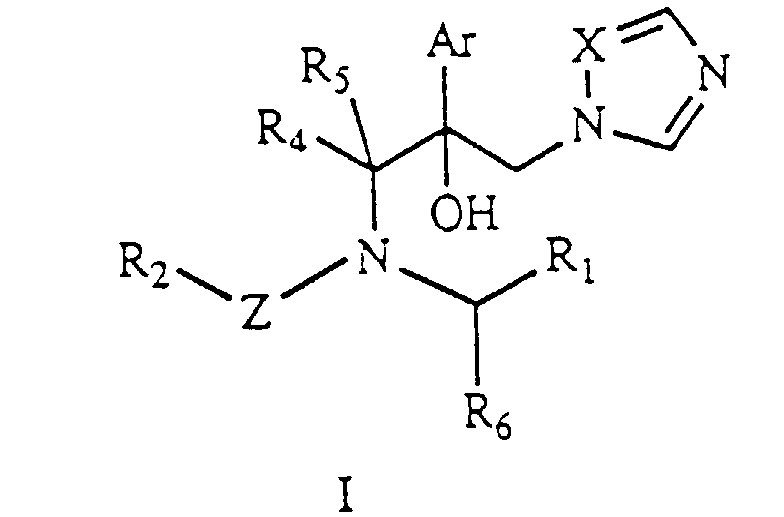 (b) die Oxidation einer Verbindung der Formel I, worin R1 für CH2OH steht, in den Aldehyd zur Erzielung eines Lactols der Formel I' gemäß Anspruch 1, worin B Hydroxy bedeutet und die gestrichelte Linie abwesend ist, und gegebenenfalls die Umwandlung dieser Hydroxygruppe in andere Gruppen durch chemische Standardreaktionen; oder(c) die Umsetzung einer Verbindung der Formel I, worin R1 für CO2H steht, mit einem geeigneten Dehydratationsmittel zur Erzielung eines Lactons der Formel I' gemäß Anspruch 1, worin B für 0 steht und die gestrichelte Linie eine kovalente Bindung bedeutet; oder(d) das Unterziehen einer Verbindung der Formel I, worin R1 für CH2OH steht, Standard-Mitsunobu-Bedingungen zur Erzielung einer Verbindung der Formel I' gemäß Anspruch 1, worin B Wasserstoff bedeutet und die gestrichelte Linie abwesend ist.
- Verfahren zur Herstellung einer homochiralen Verbindung der Formel I', wie in Anspruch 1 definiert, umfassend das Unterziehen einer Verbindung der Formel ArCOCH2W, worin W eine austretende Gruppe, z.B. Chlor, Brom, Mesyloxy oder p-Toluolsulfonyloxy,ist und Ar wie in Anspruch 1 definiert ist, einer Aldolkondensation mit dem Enolat eines Oxazolidinons der Formel Vworin D Phenyl, Benzyl, Isopropyl oder tert.-Butyl bedeutet, E Wasserstoff ist oder, wenn D für Phenyl steht, E auch Methyl sein kann und R4 wie in Anspruch 1 definiert ist, zur Erzielung einer Verbindung der Formel VI
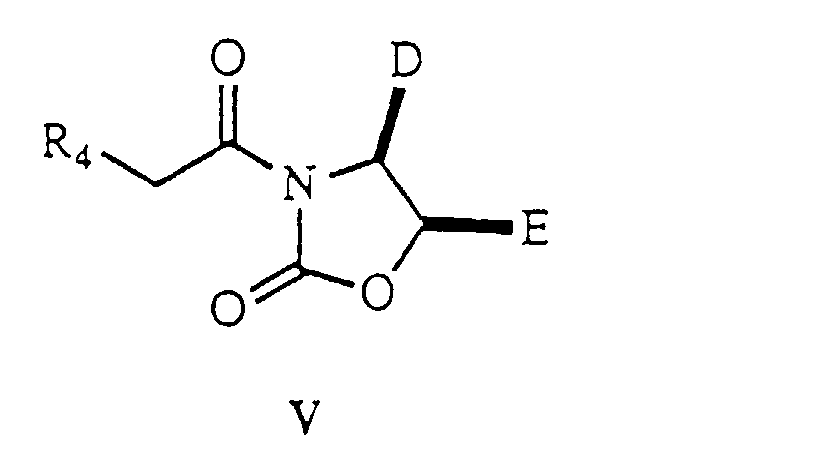 worin Ar, R4, D und E wie vorstehend definiert sind, und die anschließende Entfernung des chiralen Hilfsstoffs einer Verbindung der Formel VI in an sich bekannter Weise zur Erzielung einer Verbindung der Formel VII
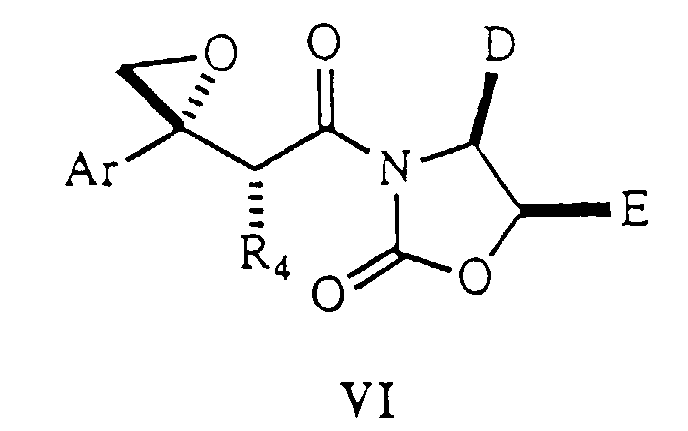 worin Ar und R4 wie vorstehend definiert sind, die nachfolgende Umsetzung von VII mit Triazol oder Imidazol in Gegenwart einer Base, um eine Verbindung der Formel VIII
 zu ergeben, worin Ar und R4 wie vorstehend definiert sind und X wie in Anspruch 1 definiert ist, die anschließende Behandlung von VIII mit einem Acylazid-bildenden Mittel zur Erzielung eines Acylazid -Zwischenprodukts der Formel
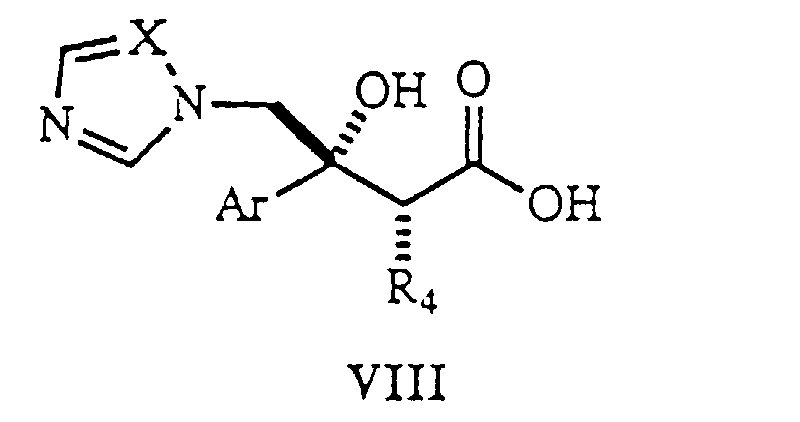 worin X, Ar und R4 wie vorstehend definiert sind, und das anschließende Erhitzen dieses Acylazids in Anwesenheit einer Base in einem Lösungsmittel und die nachfolgende Hydrolyse des entstandenen Zwischenprodukt-Oxazolidinons der Formel
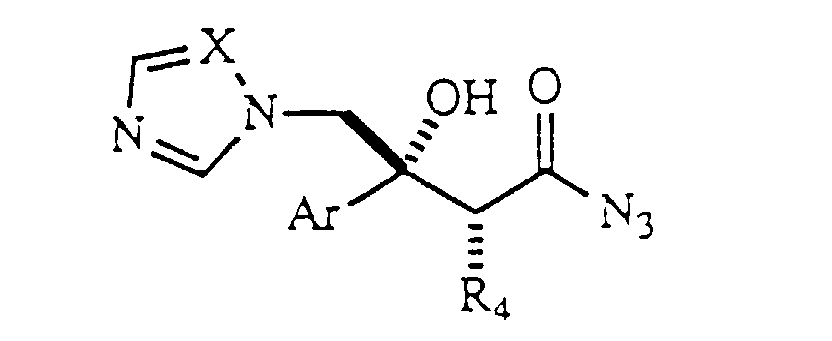 worin X, Ar und R4 wie vorstehend definiert sind, unter alkalischen Bedingungen zur Erzielung einer homochiralen Verbindung der Formel III
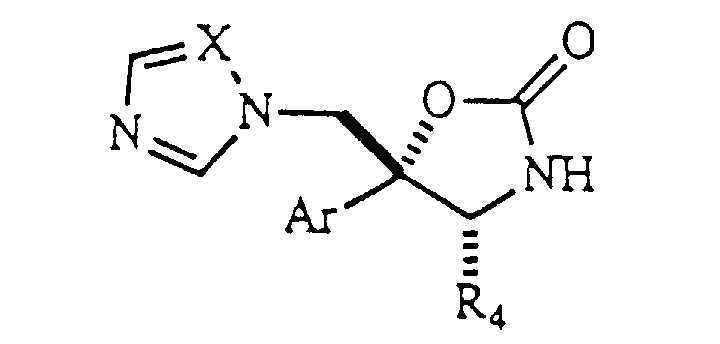 worin X, Ar und R4 wie vorstehend definiert sind, und die anschließende Behandlung von III mit einem Alkylierungsmittel der Formel WCHR1R6, worin R1 und R6 wie in Anspruch 14 bzw. Anspruch 1 definiert sind und W die vorstehende Bedeutung besitzt, zur Erzielung einer homochiralen Verbindung der Formel II
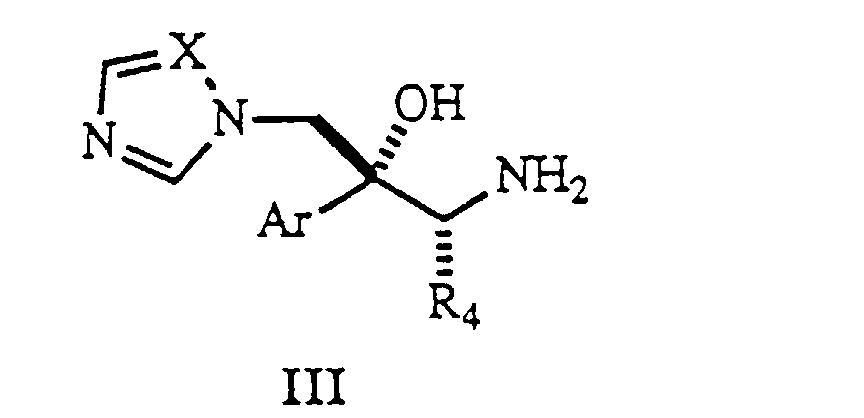 worin R1 für CO2R7 oder CH2OBzl steht, Bzl Benzyl bedeutet, R7 C1-4-Alkyl, Phenyl-C1-4-alkyl, Phenyl oder Phenyl, substituiert durch eine Gruppe R10, bedeutet und X, Ar, R4 und R6 wie vorstehend definiert sind und R10 wie in Anspruch 1 definiert ist; oder alternativ, wenn R6 = H, II auch erhalten werden kann durch Umsetzung von III mit einer Verbindung der Formel R1*CHO, worin R1* R1 oder eine hierin überführbare Gruppe bedeutet, zur Erzielung eines Oxazolidins der Formel IV
 worin X, Ar, R1* und R4 wie vorstehend definiert sind, die anschließende Umwandlung von R1* in eine Gruppe R1 und die letztendliche Reduktion von IV zur Erzielung einer Verbindung der Formel II, die letztendliche Reaktion von II mit einer Säure der Formel R2COOH oder einem reaktiven Derivat hiervon, z.B. dem Säurechlorid, oder mit einem Sulfonylchlorid der Formel R2SO2Cl unter experimentellen Standardbedingungen zur Erzielung einer homochiralen Verbindung der Formel I, worin R1 für CO2R7 oder CH2OBzl steht, und die nachfolgende Umwandlung dieser Gruppen R1 einer Verbindung der Formel I in eine Gruppe CO2H bzw. CH2OH durch chemische Standardreaktionen; und,
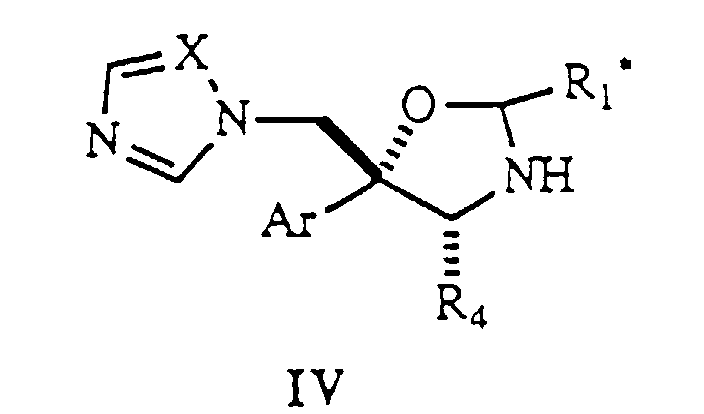 wenn in einer homochiralen Verbindung der Formel I' B für Hydroxy steht und die gestrichelte Linie abwesend ist, die Oxidation einer Verbindung der Formel I, worin R1 für CH2OH steht, zu dem Aldehyd unter Erzielung eines Lactols der Formel I', worin B für Hydroxy steht und die gestrichelte Linie abwesend ist, und gegebenenfalls die Überführung dieser Hydroxygruppe in andere Gruppen nach chemischen Standardreaktionen; oder,wenn in einer homochiralen Verbindung der Formel I' B für O steht und die gestrichelte Linie eine kovalente Bindung bedeutet, die Umsetzung einer Verbindung der Formel I, worin R1 für CO2H steht, mit einem geeigneten Dehydratationsmittel; oder,wenn in einer homochiralen Verbindung der Formel I' B für Wasserstoff steht und die gestrichelte Linie abwesend ist, das Unterwerfen einer Verbindung der Formel I, worin R1 für CH2OH steht, Standard-Mitsunobu-Bedingungen.
- Verfahren zur Herstellung einer homochiralen Verbindung der Formel IIIworin X, Ar und R4 wie vorstehend definiert sind, das das Unterwerfen einer Verbindung der Formel ArCOCH2W, worin W eine austretende Gruppe, z.B. Chlor, Brom, Mesyloxy oder p-Toluolsulfonyloxy, ist und Ar wie in Anspruch 1 definiert ist, einer Aldolkondensation mit dem Enolat eines Oxazolidinons der Formel V
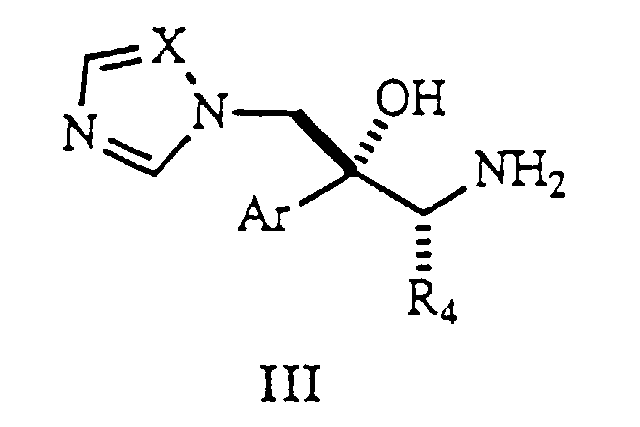 worin D Phenyl, Benzyl, Isopropyl oder tert.-Butyl bedeutet, E Wasserstoff ist oder, wenn D Phenyl bedeutet, E auch Methyl sein kann und R4 wie in Anspruch 1 definiert ist, zur Erzielung einer Verbindung der Formel VI
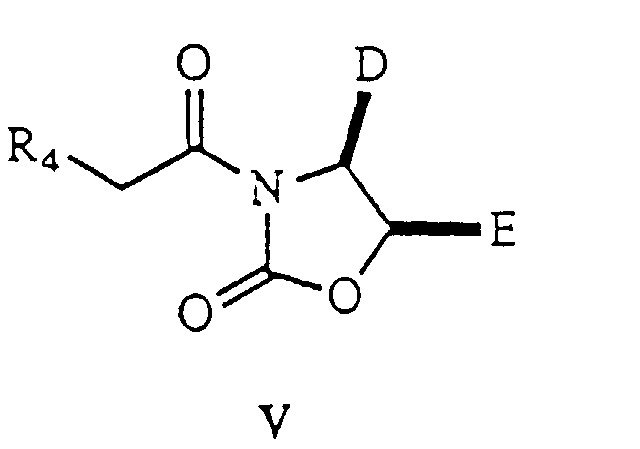 worin Ar, R4, D und E wie vorstehend definiert sind, und die anschließende Entfernung des chiralen Hilfsstoffs einer Verbindung der Formel VI in an sich bekannter Weise zur Erzielung einer Verbindung der Formel VII
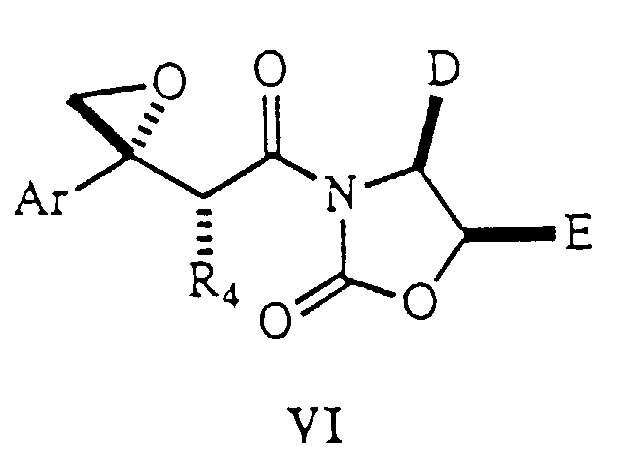 worin Ar und R4 wie vorstehend definiert sind, die anschließende Umsetzung von VII mit Triazol oder Imidazol in Gegenwart einer Base zur Erzielung einer Verbindung der Formel VIII
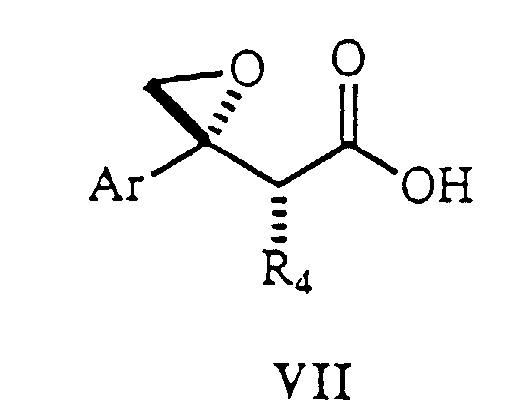 worin X, Ar und R4 wie vorstehend definiert sind, und die letztendliche Behandlung von VIII mit einem Acylazid-erzeugenden Mittel zur Erzielung eines Acylazid-Zwischenprodukts der Formel
 worin X, Ar und R4 wie vorstehend definiert sind, und das anschließende Erhitzen dieses Acylazids in Anwesenheit einer Base in einem Lösungsmittel und die nachfolgende Hydrolyse des resultierenden Zwischenprodukt-Oxazolidinons der Formel
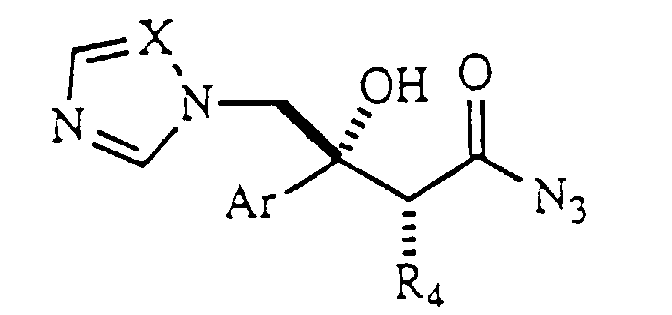 worin X, Ar und R4 wie vorstehend definiert sind, unter alkalischen Bedingungen umfaßt.
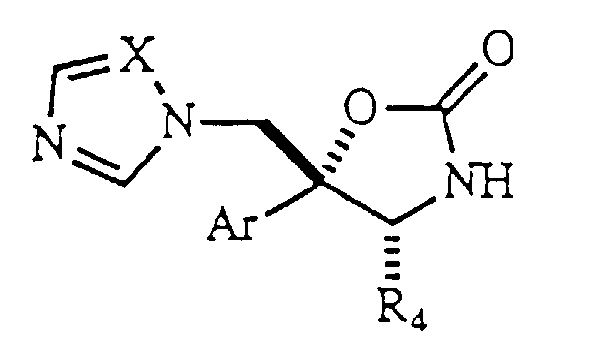
- Verfahren zur Herstellung einer homochiralen Verbindung der Formel IIIworin X, Ar und R4 wie in Anspruch 1 definiert sind, umfassend die Behandlung einer Verbindung der Formel VIII
 worin X, Ar und R4 wie vorstehend definiert sind, mit einem Acylazid-erzeugenden Mittel zur Erzielung eines Acylazid-Zwischenprodukts der Formel
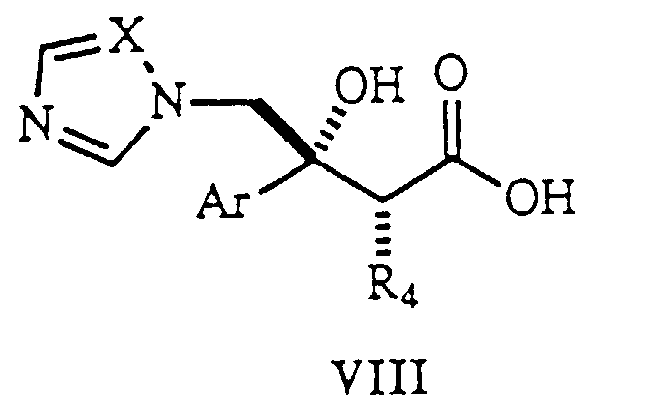 worin X, Ar und R4 wie vorstehend definiert sind, und das anschließende Erhitzen dieses Acylazids in Anwesenheit einer Base in einem Lösungsmittel und die darauffolgende Hydrolyse des resultierenden Zwischenprodukt-Oxazolodinons der Formel
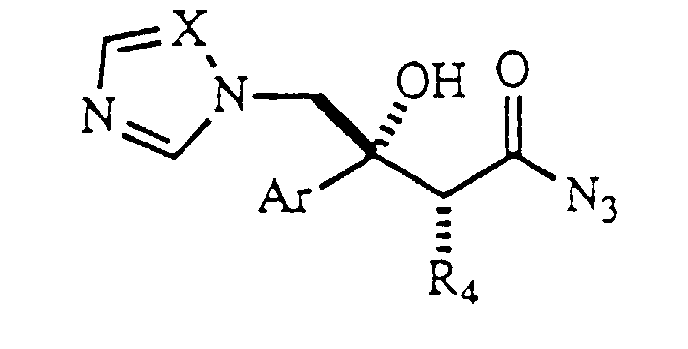 worin X, Ar und R4 wie vorstehend definiert sind, unter alkalischen Bedingungen.
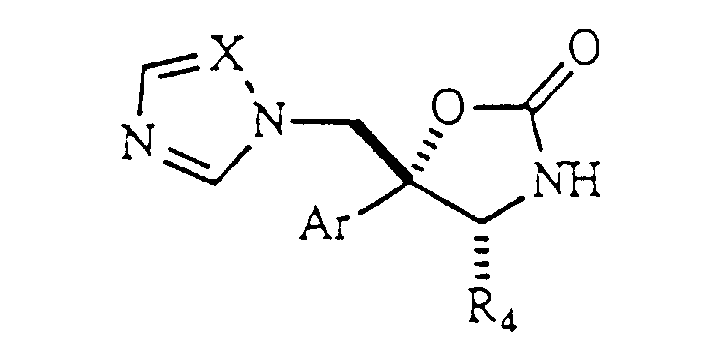
- Homochirale Verbindung der Formel VIworin Ar und R4 wie in Anspruch 1 definiert sind, D Phenyl, Benzyl, Isopropyl oder tert.-Butyl bedeutet und E Wasserstoff ist oder, wenn D Phenyl ist, E auch Methyl sein kann.
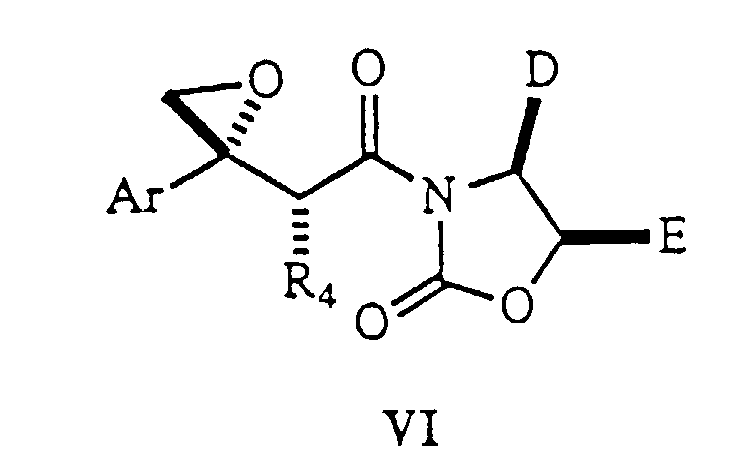
- Homochirale Verbindung der Formel VIIworin Ar und R4 wie in Anspruch 1 definiert sind.
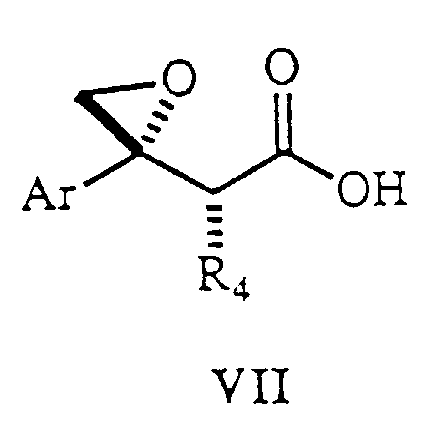
- Homochirale Verbindung der Formel VIIIworin X, Ar und R4 wie in Anspruch 1 definiert sind.

Applications Claiming Priority (2)
| Application Number | Priority Date | Filing Date | Title |
|---|---|---|---|
| ES9300537 | 1993-03-15 | ||
| ES09300537A ES2062941B1 (es) | 1993-03-15 | 1993-03-15 | Nuevos derivados de azol activos por via oral. |
Publications (2)
| Publication Number | Publication Date |
|---|---|
| EP0617031A1 EP0617031A1 (de) | 1994-09-28 |
| EP0617031B1 true EP0617031B1 (de) | 1998-09-16 |
Family
ID=8281134
Family Applications (1)
| Application Number | Title | Priority Date | Filing Date |
|---|---|---|---|
| EP94104007A Expired - Lifetime EP0617031B1 (de) | 1993-03-15 | 1994-03-15 | Oral aktive Azolderivate |
Country Status (8)
| Country | Link |
|---|---|
| US (3) | US5478826A (de) |
| EP (1) | EP0617031B1 (de) |
| JP (2) | JP3790276B2 (de) |
| AT (1) | ATE171175T1 (de) |
| CA (1) | CA2129455C (de) |
| DE (1) | DE69413281T2 (de) |
| DK (1) | DK0617031T3 (de) |
| ES (2) | ES2062941B1 (de) |
Families Citing this family (10)
| Publication number | Priority date | Publication date | Assignee | Title |
|---|---|---|---|---|
| ES2112774B1 (es) * | 1995-10-20 | 1999-05-16 | Uriach & Cia Sa J | Nuevos derivados azolicos con actividad antifungica. |
| WO1997005131A1 (en) * | 1995-08-02 | 1997-02-13 | J. Uriach & Cia. S.A. | New carboxamides with antifungal activity |
| US6696426B2 (en) | 2000-08-22 | 2004-02-24 | Pharmacia Corporation | Preservative free ophthalmic oxazolidinone antibiotic drug delivery systems |
| PE20020300A1 (es) * | 2000-08-22 | 2002-05-10 | Pharmacia Corp | Composicion de solucion de un farmaco antibiotico a base de oxazolidinona con mejoramiento de la carga de farmaco |
| KR100898887B1 (ko) * | 2001-06-26 | 2009-05-21 | 바실리어 파마슈티카 아게 | 중간체 할로페닐 유도체 및 아졸 유도체 제조 방법에서이의 용도 |
| KR100572996B1 (ko) * | 2003-08-12 | 2006-04-25 | 한국화학연구원 | 불소화 비닐 에테르 측쇄기를 갖는 아졸계 살균제 화합물및 그의 제조방법 |
| US20080044326A1 (en) * | 2006-07-04 | 2008-02-21 | Esencia Co., Ltd. | Sterilizer for baby products |
| CN101768126B (zh) * | 2009-12-10 | 2012-05-02 | 中国人民解放军第二军医大学 | 一种三氮唑类抗真菌化合物及其盐类 |
| CN104292214B (zh) * | 2014-09-24 | 2017-04-05 | 南京华威医药科技开发有限公司 | 艾氟康唑及其中间体的合成方法 |
| CN105801500B (zh) * | 2014-12-31 | 2018-08-24 | 四川科伦药物研究院有限公司 | 拆分艾沙康唑中间化合物消旋体的方法 |
Family Cites Families (18)
| Publication number | Priority date | Publication date | Assignee | Title |
|---|---|---|---|---|
| EP0046633A1 (de) * | 1980-08-22 | 1982-03-03 | Imperial Chemical Industries Plc | Heterocyclische Derivate, ihre Verwendung als Pestizide und Verfahren zu ihrer Herstellung |
| CA1162540A (en) * | 1980-12-24 | 1984-02-21 | Ikutaro Saji | Imidazolylpropanol compounds and their acid addition salts, and production and use thereof |
| JPS5862163A (ja) * | 1981-10-09 | 1983-04-13 | Sumitomo Chem Co Ltd | イミダゾリルカルボン酸誘導体 |
| US4482558A (en) * | 1982-06-18 | 1984-11-13 | Pfizer Inc. | Antifungal amide and urea derivatives of (3-amino-2-aryl-2-hydroxyprop-1-yl)-1H-1,2,4-triazoles |
| ZA837220B (en) * | 1982-09-30 | 1984-08-29 | Pfizer | Triazole antifungal agents |
| DE3307218A1 (de) * | 1983-03-02 | 1984-09-06 | Bayer Ag, 5090 Leverkusen | Substituierte diazolylalkyl-carbinole, verfahren zu ihrer herstellung und ihre verwendung als antimykotische mittel |
| GB8306351D0 (en) * | 1983-03-08 | 1983-04-13 | Ici Plc | Azole fungicides |
| GB8332788D0 (en) * | 1983-12-08 | 1984-01-18 | Ici Plc | Antifungal triazole compound |
| US4758262A (en) * | 1985-02-08 | 1988-07-19 | E. I. Du Pont De Nemours And Company | Herbicidal propylene oxide derivatives |
| NO171272C (no) * | 1988-03-04 | 1993-02-17 | Sankyo Co | Analogifremgangsmaate til fremstilling av terapeutisk aktive 1,2,4-triazolforbindelser |
| ATE68486T1 (de) * | 1988-07-28 | 1991-11-15 | Uriach & Cia Sa J | 1-((2-fluorophenyl)(4-fluorophenyl)phenylmethyl - 1h-imidazol. |
| CA2031892C (en) * | 1989-12-25 | 2000-08-01 | Minoru Tokizawa | Triazole derivatives |
| TW211006B (de) * | 1990-08-24 | 1993-08-11 | Mochida Pharm Co Ltd | |
| ES2024332A6 (es) * | 1990-10-08 | 1992-02-16 | Uriach & Cia Sa J | Procedimiento para la obtencion de nuevas sulfonamidas. |
| GB9107055D0 (en) * | 1991-04-04 | 1991-05-22 | Pfizer Ltd | Triazole antifungal agents |
| KR920019763A (ko) * | 1991-04-26 | 1992-11-19 | 모리다 가즈라 | 아졸 화합물, 그의 제조방법 및 용도 |
| EP0548553A1 (de) * | 1991-11-25 | 1993-06-30 | Takeda Chemical Industries, Ltd. | Optisch aktive Azolverbindungen, ihre Herstellung und Anwendung |
| JP3471831B2 (ja) * | 1991-12-09 | 2003-12-02 | 富山化学工業株式会社 | 新規なトリアゾール誘導体およびその塩 |
-
1993
- 1993-03-15 ES ES09300537A patent/ES2062941B1/es not_active Expired - Fee Related
-
1994
- 1994-03-15 DE DE69413281T patent/DE69413281T2/de not_active Expired - Lifetime
- 1994-03-15 CA CA002129455A patent/CA2129455C/en not_active Expired - Fee Related
- 1994-03-15 AT AT94104007T patent/ATE171175T1/de active
- 1994-03-15 EP EP94104007A patent/EP0617031B1/de not_active Expired - Lifetime
- 1994-03-15 JP JP06993594A patent/JP3790276B2/ja not_active Expired - Fee Related
- 1994-03-15 ES ES94104007T patent/ES2124332T3/es not_active Expired - Lifetime
- 1994-03-15 DK DK94104007T patent/DK0617031T3/da active
- 1994-03-15 US US08/213,208 patent/US5478826A/en not_active Expired - Fee Related
-
1995
- 1995-10-13 US US08/542,680 patent/US5646294A/en not_active Expired - Lifetime
-
1997
- 1997-04-24 US US08/839,980 patent/US5760245A/en not_active Expired - Lifetime
-
2005
- 2005-12-19 JP JP2005364733A patent/JP4652223B2/ja not_active Expired - Lifetime
Also Published As
| Publication number | Publication date |
|---|---|
| DK0617031T3 (da) | 1999-06-14 |
| US5646294A (en) | 1997-07-08 |
| US5760245A (en) | 1998-06-02 |
| EP0617031A1 (de) | 1994-09-28 |
| JP3790276B2 (ja) | 2006-06-28 |
| JP2006124397A (ja) | 2006-05-18 |
| ATE171175T1 (de) | 1998-10-15 |
| ES2124332T3 (es) | 1999-02-01 |
| CA2129455A1 (en) | 1994-09-16 |
| ES2062941A1 (es) | 1994-12-16 |
| US5478826A (en) | 1995-12-26 |
| DE69413281D1 (de) | 1998-10-22 |
| ES2062941B1 (es) | 1995-10-01 |
| CA2129455C (en) | 2005-01-25 |
| JP4652223B2 (ja) | 2011-03-16 |
| DE69413281T2 (de) | 1999-05-06 |
| JPH072788A (ja) | 1995-01-06 |
Similar Documents
| Publication | Publication Date | Title |
|---|---|---|
| SU1416058A3 (ru) | Способ получени азоловых соединений или их кислотно-аддитивных солей,их простых или сложных эфиров | |
| CA1192203A (en) | Microbicidal arylphenyl ether derivatives, production thereof and use thereof | |
| JP2997947B2 (ja) | トリアゾール化合物およびその用途 | |
| JPS59222434A (ja) | 1―トリアゾリルエチルエーテル誘導体の製造方法 | |
| EP0548553A1 (de) | Optisch aktive Azolverbindungen, ihre Herstellung und Anwendung | |
| NO171272B (no) | Analogifremgangsmaate til fremstilling av terapeutisk aktive 1,2,4-triazolforbindelser | |
| DE69409473T2 (de) | Azolverbindungen, ihre Herstellung und Verwendung als antimykotische Mittel | |
| JPH10507205A (ja) | 抗真菌活性を有する新規カルボンアミド | |
| US5489606A (en) | Anti-fungal triazole derivatives, their uses | |
| US5646294A (en) | Orally active azole derivatives | |
| EP0455909A2 (de) | 5-[1-(Imidazol)methyl]-3,3-disubstituierte-2(3H)furanon-Derivate | |
| Bartroli et al. | Synthesis and antifungal activity of new azole derivatives containing an N-acylmorpholine ring | |
| CA2217516C (en) | Triazole antifungal agent | |
| CZ281840B6 (cs) | Deriváty cyklohexanu a tetrahydropyranu, způsob jejich výroby a farmaceutický prostředek, který je obsahuje | |
| KR19980701721A (ko) | 야졸 화합물, 그의 생성법 및 용도 | |
| US5134152A (en) | Oxetane derivatives and their use as anti-fungal or fungicidal agents | |
| RU2126004C1 (ru) | Производные имидазола или их фармацевтически приемлемые соли | |
| KR100312469B1 (ko) | 경구활성의아졸유도체 | |
| KR100418128B1 (ko) | 인간및수의학적용도의항진균활성을갖는아졸화합물 | |
| JPH08325243A (ja) | 新規なトリアゾール誘導体、その製造方法及びこれを有効成分とする抗真菌剤 | |
| EP0612734A1 (de) | Oralaktive fungizide Mittel | |
| JP2843920B2 (ja) | イミダゾールリポキシゲナーゼ阻害剤 | |
| EP0506437A1 (de) | Imidazole | |
| JPH04368383A (ja) | 4−置換オキセタン誘導体 | |
| JPH06279424A (ja) | オキシラン誘導体 |
Legal Events
| Date | Code | Title | Description |
|---|---|---|---|
| PUAI | Public reference made under article 153(3) epc to a published international application that has entered the european phase |
Free format text: ORIGINAL CODE: 0009012 |
|
| AK | Designated contracting states |
Kind code of ref document: A1 Designated state(s): AT BE CH DE DK ES FR GB GR IE IT LI LU MC NL PT SE |
|
| 17P | Request for examination filed |
Effective date: 19950327 |
|
| 17Q | First examination report despatched |
Effective date: 19960328 |
|
| GRAG | Despatch of communication of intention to grant |
Free format text: ORIGINAL CODE: EPIDOS AGRA |
|
| GRAG | Despatch of communication of intention to grant |
Free format text: ORIGINAL CODE: EPIDOS AGRA |
|
| GRAH | Despatch of communication of intention to grant a patent |
Free format text: ORIGINAL CODE: EPIDOS IGRA |
|
| GRAH | Despatch of communication of intention to grant a patent |
Free format text: ORIGINAL CODE: EPIDOS IGRA |
|
| GRAA | (expected) grant |
Free format text: ORIGINAL CODE: 0009210 |
|
| AK | Designated contracting states |
Kind code of ref document: B1 Designated state(s): AT BE CH DE DK ES FR GB GR IE IT LI LU MC NL PT SE |
|
| REF | Corresponds to: |
Ref document number: 171175 Country of ref document: AT Date of ref document: 19981015 Kind code of ref document: T |
|
| REG | Reference to a national code |
Ref country code: CH Ref legal event code: EP |
|
| REF | Corresponds to: |
Ref document number: 69413281 Country of ref document: DE Date of ref document: 19981022 |
|
| REG | Reference to a national code |
Ref country code: IE Ref legal event code: FG4D |
|
| REG | Reference to a national code |
Ref country code: PT Ref legal event code: SC4A Free format text: AVAILABILITY OF NATIONAL TRANSLATION Effective date: 19980922 Ref country code: CH Ref legal event code: NV Representative=s name: SCHMAUDER & PARTNER AG PATENTANWALTSBUERO |
|
| ET | Fr: translation filed | ||
| REG | Reference to a national code |
Ref country code: ES Ref legal event code: FG2A Ref document number: 2124332 Country of ref document: ES Kind code of ref document: T3 |
|
| REG | Reference to a national code |
Ref country code: DK Ref legal event code: T3 |
|
| PLBE | No opposition filed within time limit |
Free format text: ORIGINAL CODE: 0009261 |
|
| STAA | Information on the status of an ep patent application or granted ep patent |
Free format text: STATUS: NO OPPOSITION FILED WITHIN TIME LIMIT |
|
| 26N | No opposition filed | ||
| REG | Reference to a national code |
Ref country code: GB Ref legal event code: IF02 |
|
| REG | Reference to a national code |
Ref country code: PT Ref legal event code: TE4A Owner name: J. URIACH & CIA, S.A., ES Effective date: 20070712 Ref country code: PT Ref legal event code: PC4A Owner name: PALAU PHARMA S.A., ES Effective date: 20070712 |
|
| REG | Reference to a national code |
Ref country code: CH Ref legal event code: PUE Owner name: PALAU PHARMA, S.A. Free format text: J. URIACH & CIA. S.A.#DEGA BAHI, 59-67#E-08026 BARCELONA (ES) -TRANSFER TO- PALAU PHARMA, S.A.#AV. CAMI REIAL 51-57#08184 PALAU-SOLITA I PLEGAMANS (ES) |
|
| REG | Reference to a national code |
Ref country code: GB Ref legal event code: 732E |
|
| NLS | Nl: assignments of ep-patents |
Owner name: PALAU PHARMA, S.A. Effective date: 20070801 |
|
| REG | Reference to a national code |
Ref country code: FR Ref legal event code: TP |
|
| BECA | Be: change of holder's address |
Owner name: S.A. *PALAU PHARMAAV. CAMI REIAL 51-57, E-08184 PA Effective date: 20070614 |
|
| REG | Reference to a national code |
Ref country code: CH Ref legal event code: PCAR Free format text: SCHMAUDER & PARTNER AG PATENT- UND MARKENANWAELTE VSP;ZWAENGIWEG 7;8038 ZUERICH (CH) |
|
| PGFP | Annual fee paid to national office [announced via postgrant information from national office to epo] |
Ref country code: MC Payment date: 20110224 Year of fee payment: 18 Ref country code: DK Payment date: 20110221 Year of fee payment: 18 Ref country code: IE Payment date: 20110224 Year of fee payment: 18 |
|
| PGFP | Annual fee paid to national office [announced via postgrant information from national office to epo] |
Ref country code: SE Payment date: 20110307 Year of fee payment: 18 Ref country code: PT Payment date: 20110128 Year of fee payment: 18 Ref country code: CH Payment date: 20110125 Year of fee payment: 18 Ref country code: AT Payment date: 20110221 Year of fee payment: 18 Ref country code: LU Payment date: 20110323 Year of fee payment: 18 Ref country code: FR Payment date: 20110304 Year of fee payment: 18 Ref country code: NL Payment date: 20110316 Year of fee payment: 18 Ref country code: IT Payment date: 20110319 Year of fee payment: 18 |
|
| PGFP | Annual fee paid to national office [announced via postgrant information from national office to epo] |
Ref country code: GR Payment date: 20110224 Year of fee payment: 18 |
|
| PGFP | Annual fee paid to national office [announced via postgrant information from national office to epo] |
Ref country code: ES Payment date: 20110325 Year of fee payment: 18 Ref country code: DE Payment date: 20110331 Year of fee payment: 18 Ref country code: GB Payment date: 20110221 Year of fee payment: 18 |
|
| PGFP | Annual fee paid to national office [announced via postgrant information from national office to epo] |
Ref country code: BE Payment date: 20110414 Year of fee payment: 18 |
|
| REG | Reference to a national code |
Ref country code: PT Ref legal event code: MM4A Free format text: LAPSE DUE TO NON-PAYMENT OF FEES Effective date: 20120917 |
|
| BERE | Be: lapsed |
Owner name: S.A. *PALAU PHARMA Effective date: 20120331 |
|
| REG | Reference to a national code |
Ref country code: NL Ref legal event code: V1 Effective date: 20121001 |
|
| REG | Reference to a national code |
Ref country code: SE Ref legal event code: EUG |
|
| PG25 | Lapsed in a contracting state [announced via postgrant information from national office to epo] |
Ref country code: MC Free format text: LAPSE BECAUSE OF NON-PAYMENT OF DUE FEES Effective date: 20120331 Ref country code: SE Free format text: LAPSE BECAUSE OF NON-PAYMENT OF DUE FEES Effective date: 20120316 |
|
| REG | Reference to a national code |
Ref country code: CH Ref legal event code: PL |
|
| REG | Reference to a national code |
Ref country code: DK Ref legal event code: EBP |
|
| GBPC | Gb: european patent ceased through non-payment of renewal fee |
Effective date: 20120315 |
|
| PG25 | Lapsed in a contracting state [announced via postgrant information from national office to epo] |
Ref country code: PT Free format text: LAPSE BECAUSE OF NON-PAYMENT OF DUE FEES Effective date: 20120917 |
|
| REG | Reference to a national code |
Ref country code: GR Ref legal event code: ML Ref document number: 980402401 Country of ref document: GR Effective date: 20121008 |
|
| REG | Reference to a national code |
Ref country code: AT Ref legal event code: MM01 Ref document number: 171175 Country of ref document: AT Kind code of ref document: T Effective date: 20120315 |
|
| REG | Reference to a national code |
Ref country code: FR Ref legal event code: ST Effective date: 20121130 |
|
| REG | Reference to a national code |
Ref country code: IE Ref legal event code: MM4A |
|
| PG25 | Lapsed in a contracting state [announced via postgrant information from national office to epo] |
Ref country code: AT Free format text: LAPSE BECAUSE OF NON-PAYMENT OF DUE FEES Effective date: 20120315 Ref country code: BE Free format text: LAPSE BECAUSE OF NON-PAYMENT OF DUE FEES Effective date: 20120331 Ref country code: IE Free format text: LAPSE BECAUSE OF NON-PAYMENT OF DUE FEES Effective date: 20120315 Ref country code: LI Free format text: LAPSE BECAUSE OF NON-PAYMENT OF DUE FEES Effective date: 20120331 Ref country code: GB Free format text: LAPSE BECAUSE OF NON-PAYMENT OF DUE FEES Effective date: 20120315 Ref country code: FR Free format text: LAPSE BECAUSE OF NON-PAYMENT OF DUE FEES Effective date: 20120402 Ref country code: CH Free format text: LAPSE BECAUSE OF NON-PAYMENT OF DUE FEES Effective date: 20120331 |
|
| REG | Reference to a national code |
Ref country code: DE Ref legal event code: R119 Ref document number: 69413281 Country of ref document: DE Effective date: 20121002 |
|
| PG25 | Lapsed in a contracting state [announced via postgrant information from national office to epo] |
Ref country code: IT Free format text: LAPSE BECAUSE OF NON-PAYMENT OF DUE FEES Effective date: 20120315 Ref country code: GR Free format text: LAPSE BECAUSE OF NON-PAYMENT OF DUE FEES Effective date: 20121008 |
|
| PG25 | Lapsed in a contracting state [announced via postgrant information from national office to epo] |
Ref country code: NL Free format text: LAPSE BECAUSE OF NON-PAYMENT OF DUE FEES Effective date: 20121001 |
|
| PG25 | Lapsed in a contracting state [announced via postgrant information from national office to epo] |
Ref country code: DK Free format text: LAPSE BECAUSE OF NON-PAYMENT OF DUE FEES Effective date: 20120331 |
|
| REG | Reference to a national code |
Ref country code: ES Ref legal event code: FD2A Effective date: 20130710 |
|
| PG25 | Lapsed in a contracting state [announced via postgrant information from national office to epo] |
Ref country code: ES Free format text: LAPSE BECAUSE OF NON-PAYMENT OF DUE FEES Effective date: 20120316 |
|
| PG25 | Lapsed in a contracting state [announced via postgrant information from national office to epo] |
Ref country code: LU Free format text: LAPSE BECAUSE OF NON-PAYMENT OF DUE FEES Effective date: 20120315 |
|
| PG25 | Lapsed in a contracting state [announced via postgrant information from national office to epo] |
Ref country code: DE Free format text: LAPSE BECAUSE OF NON-PAYMENT OF DUE FEES Effective date: 20121002 |