EP0616035B1 - Transgene Pilz-resistente Pflanzen - Google Patents
Transgene Pilz-resistente Pflanzen Download PDFInfo
- Publication number
- EP0616035B1 EP0616035B1 EP93116011A EP93116011A EP0616035B1 EP 0616035 B1 EP0616035 B1 EP 0616035B1 EP 93116011 A EP93116011 A EP 93116011A EP 93116011 A EP93116011 A EP 93116011A EP 0616035 B1 EP0616035 B1 EP 0616035B1
- Authority
- EP
- European Patent Office
- Prior art keywords
- plant
- fungus
- protein
- gene
- psi
- Prior art date
- Legal status (The legal status is an assumption and is not a legal conclusion. Google has not performed a legal analysis and makes no representation as to the accuracy of the status listed.)
- Expired - Lifetime
Links
Images
Classifications
-
- C—CHEMISTRY; METALLURGY
- C07—ORGANIC CHEMISTRY
- C07K—PEPTIDES
- C07K14/00—Peptides having more than 20 amino acids; Gastrins; Somatostatins; Melanotropins; Derivatives thereof
- C07K14/37—Peptides having more than 20 amino acids; Gastrins; Somatostatins; Melanotropins; Derivatives thereof from fungi
-
- C—CHEMISTRY; METALLURGY
- C07—ORGANIC CHEMISTRY
- C07K—PEPTIDES
- C07K14/00—Peptides having more than 20 amino acids; Gastrins; Somatostatins; Melanotropins; Derivatives thereof
- C07K14/415—Peptides having more than 20 amino acids; Gastrins; Somatostatins; Melanotropins; Derivatives thereof from plants
-
- C—CHEMISTRY; METALLURGY
- C12—BIOCHEMISTRY; BEER; SPIRITS; WINE; VINEGAR; MICROBIOLOGY; ENZYMOLOGY; MUTATION OR GENETIC ENGINEERING
- C12N—MICROORGANISMS OR ENZYMES; COMPOSITIONS THEREOF; PROPAGATING, PRESERVING, OR MAINTAINING MICROORGANISMS; MUTATION OR GENETIC ENGINEERING; CULTURE MEDIA
- C12N15/00—Mutation or genetic engineering; DNA or RNA concerning genetic engineering, vectors, e.g. plasmids, or their isolation, preparation or purification; Use of hosts therefor
- C12N15/09—Recombinant DNA-technology
- C12N15/63—Introduction of foreign genetic material using vectors; Vectors; Use of hosts therefor; Regulation of expression
- C12N15/79—Vectors or expression systems specially adapted for eukaryotic hosts
- C12N15/82—Vectors or expression systems specially adapted for eukaryotic hosts for plant cells, e.g. plant artificial chromosomes (PACs)
- C12N15/8241—Phenotypically and genetically modified plants via recombinant DNA technology
- C12N15/8261—Phenotypically and genetically modified plants via recombinant DNA technology with agronomic (input) traits, e.g. crop yield
- C12N15/8271—Phenotypically and genetically modified plants via recombinant DNA technology with agronomic (input) traits, e.g. crop yield for stress resistance, e.g. heavy metal resistance
- C12N15/8279—Phenotypically and genetically modified plants via recombinant DNA technology with agronomic (input) traits, e.g. crop yield for stress resistance, e.g. heavy metal resistance for biotic stress resistance, pathogen resistance, disease resistance
- C12N15/8282—Phenotypically and genetically modified plants via recombinant DNA technology with agronomic (input) traits, e.g. crop yield for stress resistance, e.g. heavy metal resistance for biotic stress resistance, pathogen resistance, disease resistance for fungal resistance
-
- C—CHEMISTRY; METALLURGY
- C12—BIOCHEMISTRY; BEER; SPIRITS; WINE; VINEGAR; MICROBIOLOGY; ENZYMOLOGY; MUTATION OR GENETIC ENGINEERING
- C12N—MICROORGANISMS OR ENZYMES; COMPOSITIONS THEREOF; PROPAGATING, PRESERVING, OR MAINTAINING MICROORGANISMS; MUTATION OR GENETIC ENGINEERING; CULTURE MEDIA
- C12N9/00—Enzymes; Proenzymes; Compositions thereof; Processes for preparing, activating, inhibiting, separating or purifying enzymes
- C12N9/14—Hydrolases (3)
- C12N9/24—Hydrolases (3) acting on glycosyl compounds (3.2)
- C12N9/2402—Hydrolases (3) acting on glycosyl compounds (3.2) hydrolysing O- and S- glycosyl compounds (3.2.1)
-
- C—CHEMISTRY; METALLURGY
- C12—BIOCHEMISTRY; BEER; SPIRITS; WINE; VINEGAR; MICROBIOLOGY; ENZYMOLOGY; MUTATION OR GENETIC ENGINEERING
- C12N—MICROORGANISMS OR ENZYMES; COMPOSITIONS THEREOF; PROPAGATING, PRESERVING, OR MAINTAINING MICROORGANISMS; MUTATION OR GENETIC ENGINEERING; CULTURE MEDIA
- C12N9/00—Enzymes; Proenzymes; Compositions thereof; Processes for preparing, activating, inhibiting, separating or purifying enzymes
- C12N9/14—Hydrolases (3)
- C12N9/24—Hydrolases (3) acting on glycosyl compounds (3.2)
- C12N9/2402—Hydrolases (3) acting on glycosyl compounds (3.2) hydrolysing O- and S- glycosyl compounds (3.2.1)
- C12N9/2405—Glucanases
- C12N9/2434—Glucanases acting on beta-1,4-glucosidic bonds
- C12N9/2442—Chitinase (3.2.1.14)
-
- C—CHEMISTRY; METALLURGY
- C12—BIOCHEMISTRY; BEER; SPIRITS; WINE; VINEGAR; MICROBIOLOGY; ENZYMOLOGY; MUTATION OR GENETIC ENGINEERING
- C12Y—ENZYMES
- C12Y302/00—Hydrolases acting on glycosyl compounds, i.e. glycosylases (3.2)
- C12Y302/01—Glycosidases, i.e. enzymes hydrolysing O- and S-glycosyl compounds (3.2.1)
- C12Y302/01014—Chitinase (3.2.1.14)
-
- Y—GENERAL TAGGING OF NEW TECHNOLOGICAL DEVELOPMENTS; GENERAL TAGGING OF CROSS-SECTIONAL TECHNOLOGIES SPANNING OVER SEVERAL SECTIONS OF THE IPC; TECHNICAL SUBJECTS COVERED BY FORMER USPC CROSS-REFERENCE ART COLLECTIONS [XRACs] AND DIGESTS
- Y10—TECHNICAL SUBJECTS COVERED BY FORMER USPC
- Y10S—TECHNICAL SUBJECTS COVERED BY FORMER USPC CROSS-REFERENCE ART COLLECTIONS [XRACs] AND DIGESTS
- Y10S47/00—Plant husbandry
- Y10S47/01—Methods of plant-breeding and including chromosome multiplication
Definitions
- the invention relates to a fungus-resistant plant and a Process for their production.
- the invention is based on the surprising finding that Incorporation of at least two different genes as claimed 1 defines that for fungal inhibitory proteins Encode the effect in the genome of a plant Resistance to fungi helps that go well beyond an additive Effect of the genes goes beyond itself.
- the genes code for gene products that maintain the vitality of fungi decrease.
- the genes can be fungal, bacterial and of vegetable, animal or viral origin his.
- the gene products have anti-fungal properties.
- the gene products are chitinase (ChiS), protein synthesis inhibitor (PSI) and antifungal protein (AFP).
- the transgenic fungus-resistant plant is a plant at which is preferably tobacco, potato, strawberry corn, Rapeseed or tomato plants.
- DNA transmission vectors with inserted are also described DNA sequences as detailed in this description are specified.
- a method of producing fungus-resistant is Plants the subject of the invention, wherein for transformation in the genome of a plant vectors are used which are more as a gene with fungal inhibitory activity.
- the synergistic effects were particularly beneficial transgenic fungus-resistant plants can be achieved on the Gene sequences transferred or transfected that were for Proteins from the attached sequence listing A to C encoded or corresponded to these.
- the PSI gene comes from barley and codes for a protein which inhibits the protein synthesis of fungi. After in vitro Tests even low concentrations of PSI are sufficient to test various Inhibit fungi such as Rhizoctonia solani.
- One can from the fermentation broth of Aspergillus giganteus Polypeptide can be isolated and sequenced, which via antifungal Activity.
- This polypeptide is useful as antifungal agent, e.g. as a spray and as a preservative for technical products and food and feed. It may continue to be effective with other pesticides Substances, fertilizers or growth regulators can be combined. Inhibitory activities against fungi could be found Others against various Aspergillus, Fusarium, Phytophthora and Trichophyton species are detected.
- ChiG chitinase
- GluG glucanase
- the inventors have now found, quite surprisingly, that ' the at least two-fold combined expression of PSI, AFP, ChiS, ChiG or GluG regarding the acquired fungal resistance transgenic plants leads to synergistic effects.
- the effects of the individual substances in the combination clearly exceeded. This includes resistance against the fungus Rhizoctonia solani, Sclerotinia infestation, Botrytis infestation etc.
- the invention further relates to the combined use the fungal inhibitory protein, preferably ChiS, PSI and AFP, against fungi.
- Combined use means here also that at least a first fungus-inhibiting Substance expressed by the plant and at least a second Substance that has an anti-fungal effect on the outside Plant is applied.
- the agents according to the invention also include those that the above mentioned proteins in at least two combinations.
- the agents according to the invention can contain other active ingredients. These other active ingredients can Pesticides, fertilizers and / or growth regulators that Agents according to the invention can also be used in different formulations such as concentrates, emulsions, Powders, formulations on carriers, mixtures with other active ingredients, etc.
- the combination is particularly preferred ChiS / PSI and AFP / PSI.
- These proteins can be special effective for inhibiting the growth of Rhizoctonia solani, in particular be used in tobacco plant crops.
- the invention also relates to the use of a DNA sequence in a method according to the invention, the at least encodes a polypeptide of sequences A to C, or a Fungus-resistant plant, the genome of which is at least two different Genes under the control of active promoters Contains fungal inhibitory activity as defined in claim 1 are.
- the invention further describes DNA sequences that hybridize with a DNA sequence that is for polypeptides encoded the amino acid sequences A to C, these DNA sequence natural synthetic or semi-synthetic Can be of origin and with the aforementioned DNA sequence through mutations, nucleotide substitutions, nucleotide deletions,
- Nucleotide insertions and inversions of nucleotide sequences are related can be and for a polypeptide with fungal inhibiting Effectiveness coded.
- a recombinant is also described DNA molecule that has at least one DNA sequence contains the above statements, this DNA molecule can be present as a cloning or expression vector.
- the invention further relates to those according to the invention Process obtained transgenic fungal resistant Plants, especially tobacco, potato, corn, pea, Rapeseed and tomato plants.
- the described DNA sequences are usually put together transferred with a promoter.
- Promoter sequences recognized and led by the herbal transcription apparatus thus to a constitutive expression of what is associated with them Gens in plants.
- the promoter can also be pathogen-inducible and / or wound-inducible (WUN1) and / or be tissue-specific and / or development-specific.
- the DNA coding for the amino acid sequences A to C was first cloned in a manner known per se and then transferred by conjugation to A. Tumefaciens LBA 4404 (A. Hoekema et al., Nature 303, 179-180). This was done according to the Van Haute et al. method described in EMBO J. 2 , 411-418 (1983).
- the DNA transfers into the agrobacterium were checked by isolating agrobacterial DNA according to the method described by Ebert et al. in proc. Natl. Acad. Sci. USA 84 5745-5749 (1987), method described.
- the restriction cleavage of the DNA, the transfer to Hybond-N membrane (Amersham) and the hybridization against a radioactively labeled DNA probe provided information about a successful DNA transfer into the agrobacterium.
- the transformed agrobacterium was used Transformed tobacco, rapeseed, strawberry, tomato and potato plants.
- MSC16 MS + 0.5 ⁇ g / ml BAP + 0.1 ⁇ g / ml NAA + 100 ⁇ g / ml kanamycin sulfate + 500 ⁇ g / ml Claforan) transferred.
- MSC15 MS + 2% sucrose, 500 ⁇ g / ml claforan + 100 ⁇ g / ml kanamycin sulfate). Root-shaped shoots were further analyzed.
- Monocotyledonous plants including maize, but also some dicolyte plants, were transformed into protoplasts using direct gene transfer. These protoplasts were then regenerated to intact plants (example: J. Potrykus in Biotechnology 8 (1990) 535).
- the transgenic plants obtained were used for test purposes infected with the fungus Rhizoctonia solani. For this purpose were mushroom cultures bred and mixed thoroughly in common soil. This Soil was then distributed in a bowl and with the planted test plants.
- the evaluation takes place 14 days after the start of the test series.
- Rhizoctonia solani Mushroom mycelium mixed with 100 ⁇ l potato dextrose solution and in Microtiter plates incubated at 25 ° C. This correlates Growth of the fungus with the increase in optical density 405 nanometers linear. The inhibitory effect of proteins can be due to a smaller increase in optical density be detected.
- W1 and W2 indicate the efficiencies of the individual proteins, which means the percentage deviation of the growth curve (in the presence of the protein) from the untreated control.
- OD (K) is the optical density of the untreated Control
- OD (P) the optical density of the protein treated culture.
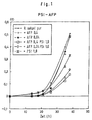
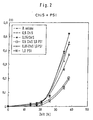
- the combination of ChiS and PSI protein, or from the combination of AFP and PSI protein against the fungus Rhizoctonia solani determined the following values (two each different ChiS and AFP concentrations at constant RIP concentration):
- Fig. 1 shows the results with the combination of Proteins, as well as with the individual substances were obtained. According to the figure, different ChiS concentrations (0.5 ⁇ g / ml or 0.05 ⁇ g / ml) combined with PSi protein (1.0 ⁇ g / ml).
- a 1.8 Kb ChiS gene was generated by using synthetic oligonucleotides according to the dideoxy sequencing method of Sanger et al. in proc. Natl. Acad. Sci. USA, 74 , (1977), 5463-5467.
- the 35S promoter 400 bp (from Töpfer et al. In Nucl. Acid. Res., 15 (1987) 5890)) derived from the cauliflower mosaic virus (CamV) was transcriptionally fused with the ChiS gene. 3 'from the ChiS gene, the 0.2 Kb termination signal of the 35S gene of the CamV was used, the functionality of which is known in dicotyledonous plants.
- the chimeric gene 35S-ChiS was cloned into the vector pLS034, transformed into tobacco and potato plants by means of the Agrobacterium tumefaciens transformation system, and kanamycin-resistant plants were regenerated.
- PolyA + - RNA was first isolated from mature barley seeds (Hordeum vulgare L. cv. Piggy) and stored in a cDNA library in ⁇ -gt-11 phages. The details of the procedure are R. Lea in Plant. Biol., 12 (1989), 673-682. Monospecific PSI antibodies were then used to identify cDNA clones.
- the PSI-positive ⁇ -gt-11 phages were then isolated, further cloned and according to the dideoxy sequencing method given above by Sanger et al. sequenced.
- the DNA cloned in E. Coli was then described in the above Way by conjugation to the Agrobacterium tumefaciens LBA4404 transferred.
- Both the transferred gene and the mRNA and gene product were able to in corresponding transgenic tobacco, potato, rapeseed, Strawberry and tomato plants can be detected.
- the construct was conjugated into the agrobacterial strain MP90RK (Koncz and Shell (see above)) or IHA101 (Hood et al. In J. Bacteriol. 168 (1986), 1291) ,
- Transgenic tobacco, potato, strawberry, rapeseed and tomato plants were then made using the method described above transformed. Transformed rung are due to the transferred resistance to the antibiotic kanamycin selected.
- DNA analysis Southern blotting
- RNA analysis Northern blotting
- protein analysis with specific antibodies Western blotting
- ChiG or GluG transgenic plants are obtained which are both southern, Northern and Western were positive.
- transgenic plants were obtained who are both Southern, Northern and Western positive were.
- a tobacco plant that expresses ChiS and PSI shows a much stronger resistance to Rhizoctonia infestation as the plants, either only ChiS or Expressed PSI, or which resulted from additive resilience would result.
- a synergistic inhibitory effect also results from the combined Expression of PSI and AFP transgenic tobacco against Rhizoctonia solani infestation. Even the two or more combinations different genes (ChiS, RIP, AFP, ChiG and GluG) in the most diverse transgenic plants led to synergistic Inhibitory effects against various fungi.
- index values have from 38 to 46, proves to be in accordance with the invention transgenic tobacco that this in the presence of the fungus Rhizoctonia solani grows as well as control plants (Index value 10-12), which cultivated on Rhizoctonia-free soil were.
- Seq IDNo . 1 to 3
- Sequence type Complete nucleotide sequence with corresponding protein, as far as it is encoded by an open reading grid, effective protein
- Sequence length 51 amino acids
- Strand form single strand Topology: linear Type of molecule: cDNA Original origin: fermentation broth from Aspergillus giganteus Name: Antifungal Peptide (AFP)
- AFP Antifungal Peptide
- Antifungal agent especially against Rhizoctonia solani, various Aspergillus, Fusarien and Trichophyton species.
- Seq IDNo . 8 Sequence type: nucleotide Strand shape: single strand (the activated strand is Double strand) Topology: linear Type of molecule: cDNA Immediate experimental origin: plasmid pLChiS from E. Coli strain A 5187 Original origin: Cosmid bank from Serratia Marcescens Name: Chis Protein (Chitinase) Properties: exo-chitinase
- Type of whey cooler cDNA Original origin: Barley seeds (Hordeum vulgare L.)
- Seq IDNo .: 11 and 12 Type of sequence nucleotide with the corresponding protein Sequence length: 1249 nucleotides
- Type of molecule cDNA Original origin: Barley seeds (Hordeum vulgare L.) Name: GluG (Glucanase) Characteristics: 48 bp long 5 'non-translating initial region Open reading grid of 1002 bp 199 pb long 3 'untranslated end, the underlined At-rich sequence at positions 1083 and 1210 are probably polyadenylation signals, the deduced amino acid sequence of the coded preprotein of 334 amino acids is given below the nucleotide sequence.
Landscapes
- Health & Medical Sciences (AREA)
- Chemical & Material Sciences (AREA)
- Life Sciences & Earth Sciences (AREA)
- Genetics & Genomics (AREA)
- Organic Chemistry (AREA)
- Engineering & Computer Science (AREA)
- Zoology (AREA)
- Wood Science & Technology (AREA)
- Bioinformatics & Cheminformatics (AREA)
- General Health & Medical Sciences (AREA)
- Molecular Biology (AREA)
- Biochemistry (AREA)
- General Engineering & Computer Science (AREA)
- Biomedical Technology (AREA)
- Medicinal Chemistry (AREA)
- Biotechnology (AREA)
- Microbiology (AREA)
- Biophysics (AREA)
- Proteomics, Peptides & Aminoacids (AREA)
- Gastroenterology & Hepatology (AREA)
- Physics & Mathematics (AREA)
- Botany (AREA)
- Cell Biology (AREA)
- Mycology (AREA)
- Plant Pathology (AREA)
- Breeding Of Plants And Reproduction By Means Of Culturing (AREA)
- Micro-Organisms Or Cultivation Processes Thereof (AREA)
- Medicines Containing Material From Animals Or Micro-Organisms (AREA)
- Agricultural Chemicals And Associated Chemicals (AREA)
- Mushroom Cultivation (AREA)
- Medicines That Contain Protein Lipid Enzymes And Other Medicines (AREA)
Description
ChiS, PSI;
PSI, AFP;
ChiS, GluG, PSI;
GluG, PSI, AFP; PSI, ChiG, AFP;
ChiS, GluG, PSI, AFP; ChiS, GluG, PSI, ChiG;
Chis, GluG, PSI, AFP, ChiG
Die Erfindung wird in den folgenden Beispielen näher erläutert.
- 0 =
- Ohne Symptome (gesund)
- 1 =
- leicht reduzierte Größe (gegenüber einer nicht-infizierten Kontrolle); kein bis sehr geringer sichtbarer Befall
- 2 =
- starke Wachstumsreduktion; schwere Befallssymptome
- 3 =
- tot
- Die Erwartungswerte waren:
- E1 = 29,9% und E2 = 44,5%
- Die gemessenen Werte waren:
- G1 = 60,4% und G2 = 64,1%
- Die Erwartungswerte waren:
- E1 = 39,9% und E2 = 41,9%
- Die gemessenen Werte waren:
- G1 = 57,7% und G2 = 65,4%
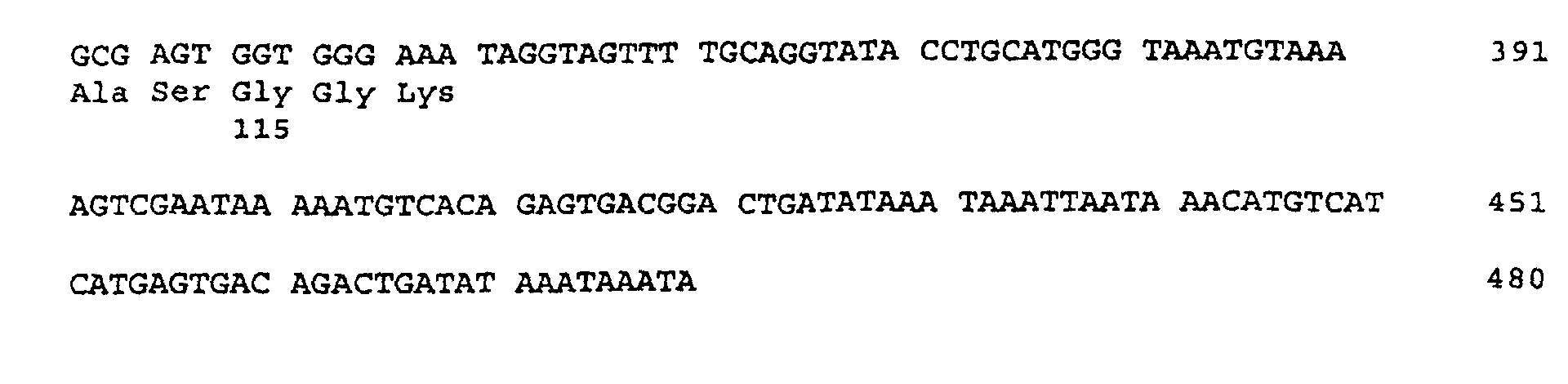
Art der Sequenz: Vollständige Nukleotidsequenz mit entsprechendem Protein, soweit es durch ein offenes Ableseraster codiert wird, wirksames Protein (3)
Sequenzlänge: 51 Aminosäuren (3)
Topologie: linear
Art des Moleküls: cDNA
Ursprüngliche Herkunft: Fermentationsbrühe von Aspergillus giganteus
Name: Antifungisches Peptid (AFP)
Merkmale (1) :
Offenes Ableseraster von 177 Nukleotiden, die N-terminale
Aminosäure des wirksamen Proteins ist mit * markiert.


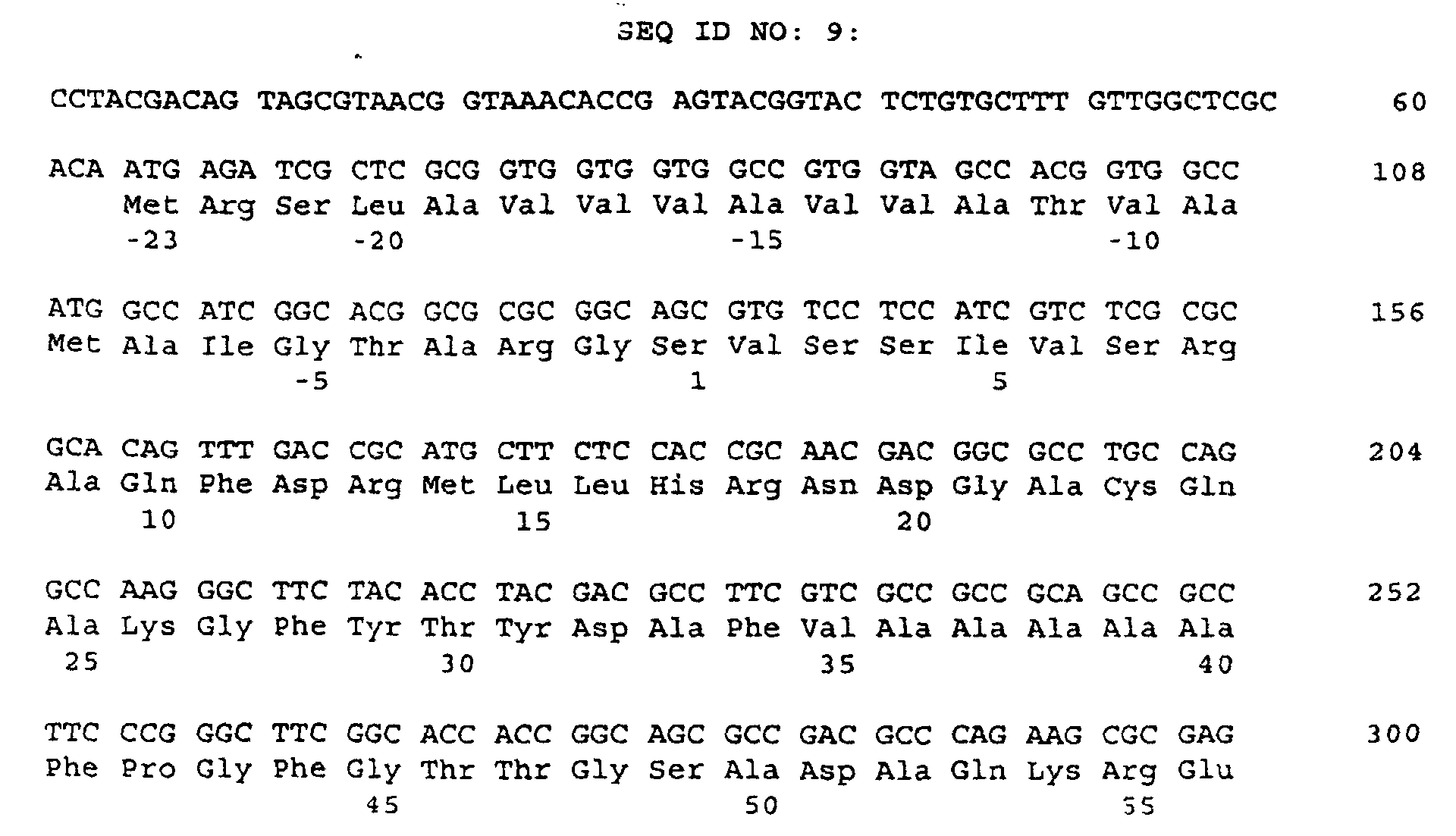
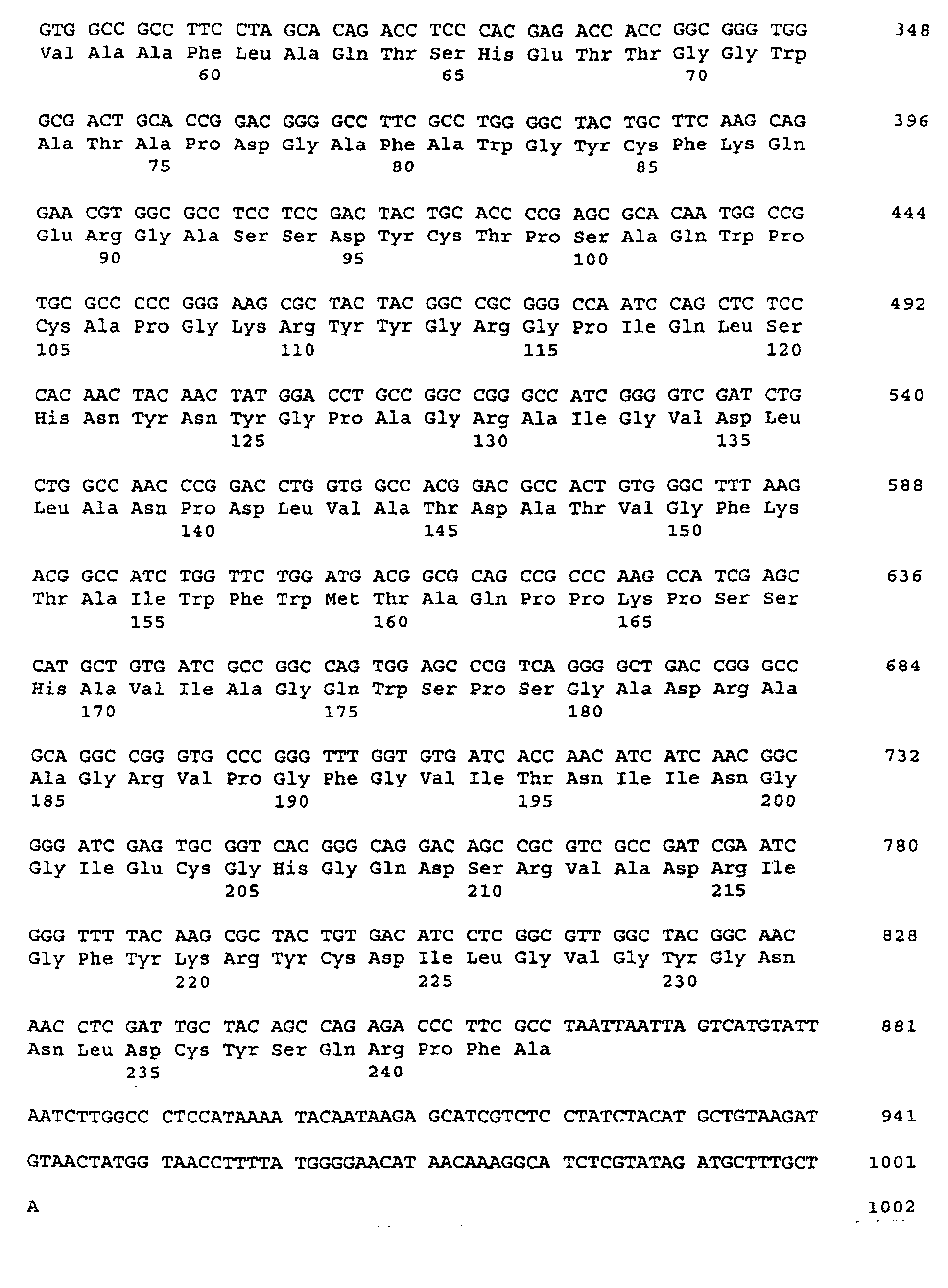
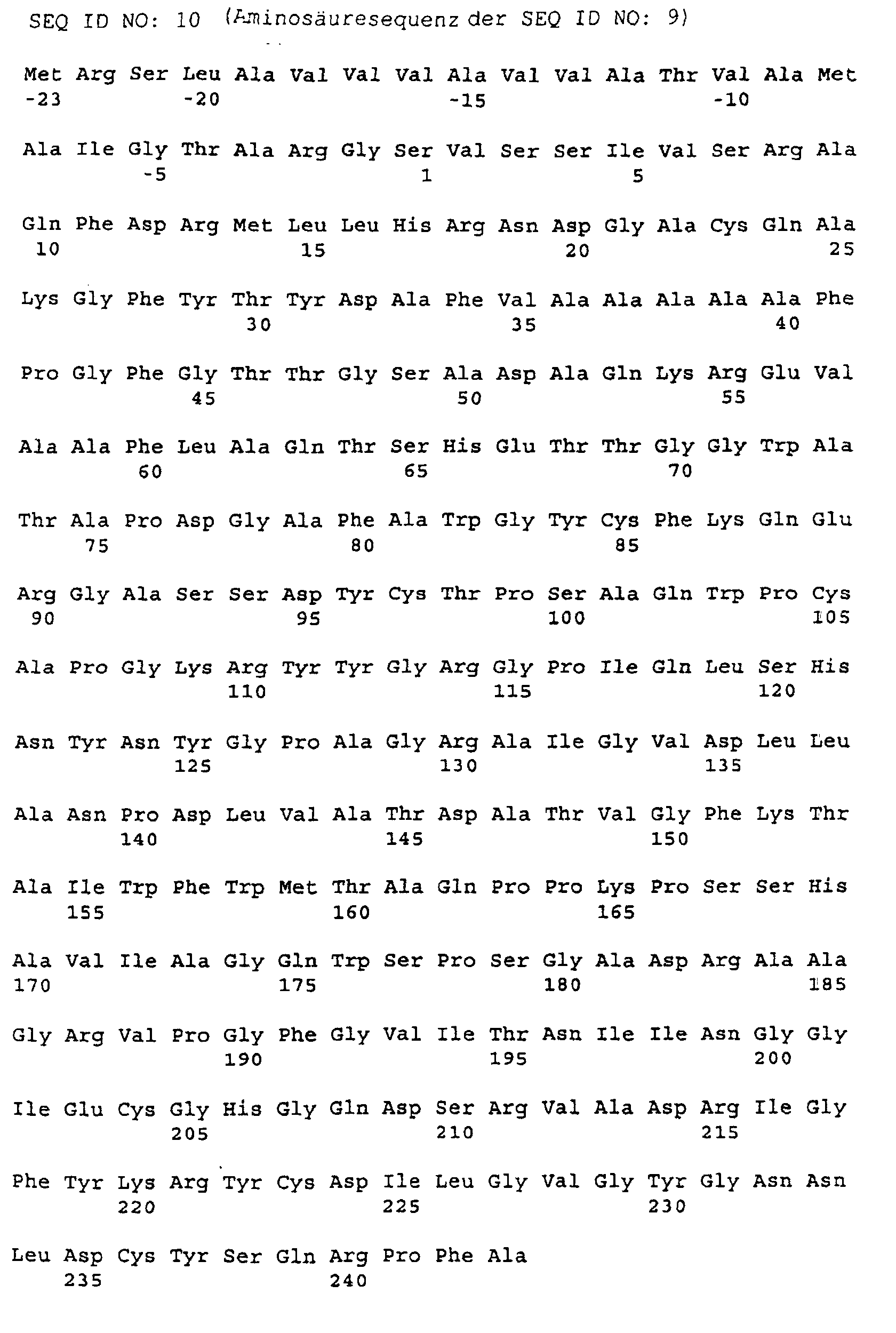
Art der Sequenz: Nukleotid mit entsprechendem Protein Sequenzlänge: 1078 Basenpaare (6 und 7 = unvollständiger
PSI-cDNA-Klon)
Strangform: Einzelstrang
Topologie: linear
Art des Moleküls: komplementär DNA
Urspüngliche Herkunft: Gerstesamen (Hordeum vulgare L.cv. Piggy)
Unmittelbare experimentelle Herkunft: cDNA-Genbank in 2-gt-11-Phagen
Name: Proteinsyntheseinhibitor
Merkmale:
42 bp-lange 5'-nicht-übersetzende Region
Offenes Ableseraster von 843 Basenpaaren (das Stopcodon ist mit. einem Sternchen markiert)
193 basenpaarlanges 3'-nicht-übersetztes Ende,
mögliche Polyadenylierungssignale sind unterstrichen Eigenschaften:
Antifungal wirksam, insbesondere gegen Sporen von Trichoderma reesii und fusarium sporotrichoides sowie gegen Rhizoctonia solani.



Art der Sequenz: Nukleotid
Strangform: Einzelstrang (der aktivierte Strang ist
Doppelstrang)
Topologie: linear
Art des Moleküls: cDNA
Unmittelbare experimentelle Herkunft: Plasmid pLChiS aus dem E.
Coli-Stamm A 5187
Ursprüngliche Herkunft: Cosmidbank aus Serratia Marcescens
Name: Chis-Protein (Chitinase)
Eigenschaften: Exo-Chitinase

Art der Sequenz: Nukleotid
Sequenzlänge: 1013 Nukleotide
Art des Molkeküls: cDNA
Ursprüngliche Herkunft: Gerstesamen (Hordeum vulgare L.)
Name: ChiG (Chitinase-G)
Merkmal:
63 pb-lange 5'-nicht übersetzende Anfangsregion, 798 pb offenes Ableseraster, 152 pb-langes 3'-nicht übersetztes Ende, Ablesestopcodons sind mit einem Sternchen markiert, die wahrscheinlichen Signalpeptidsequenzen sind unterstrichen, die abgeleitete Aminosäurensequenz eines 26 kD-Chitinase Präproteins mit 266 Aminosäuren ist unterhalb der Nukleotidsequenz angegeben, die unterstrichene AT-reiche Sequenz bei Position 905 ist wahrscheinlich ein Polyadenylierungssignal.
Antifungal wirksam, insbesondere gegen Trichoderma reesii und fusarium sporotrichoides sowie Rhizoctonia solani und Botrytis cinerea.
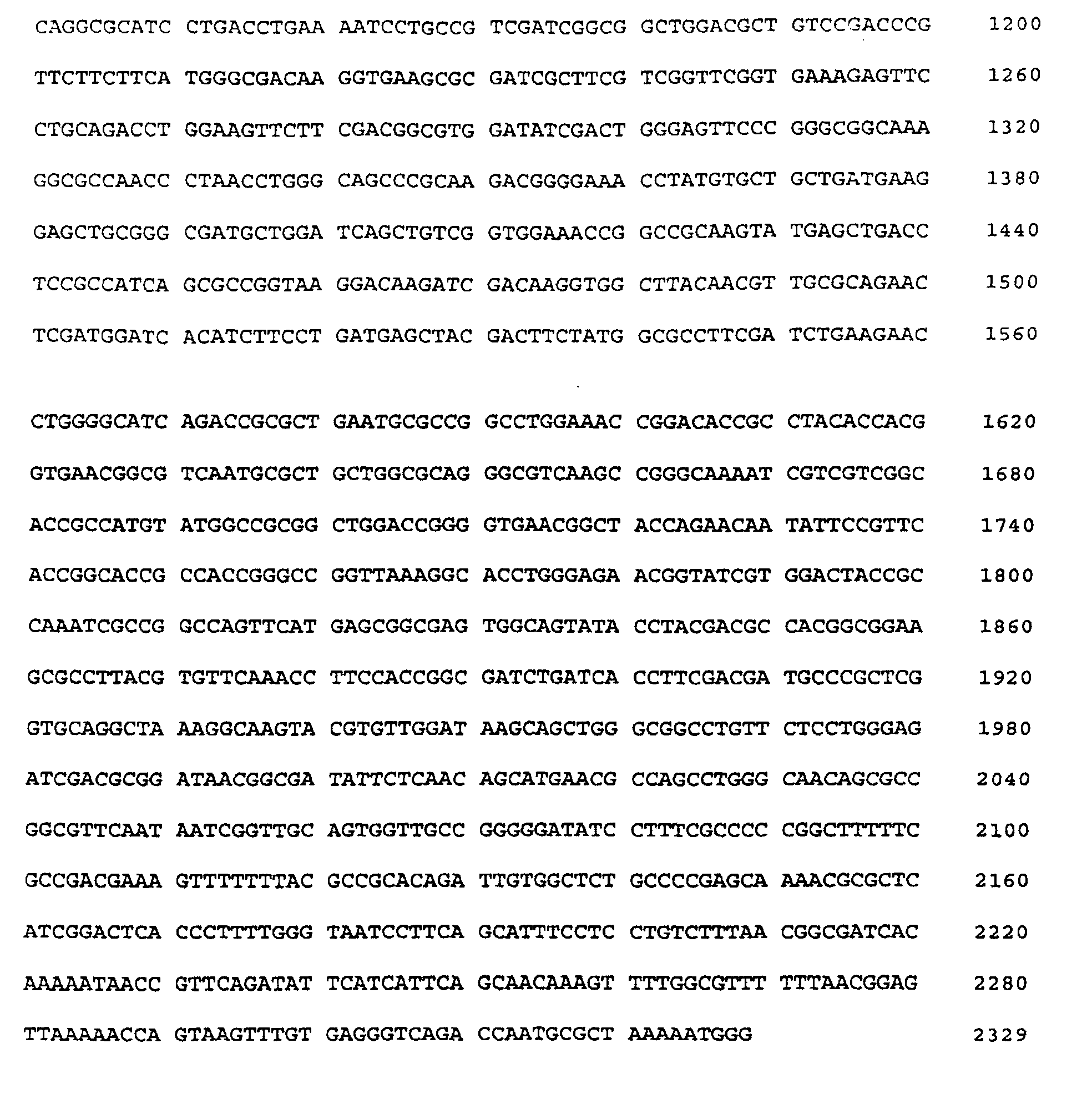
Art der Sequenz: Nukleotid mit entsprechendem Protein
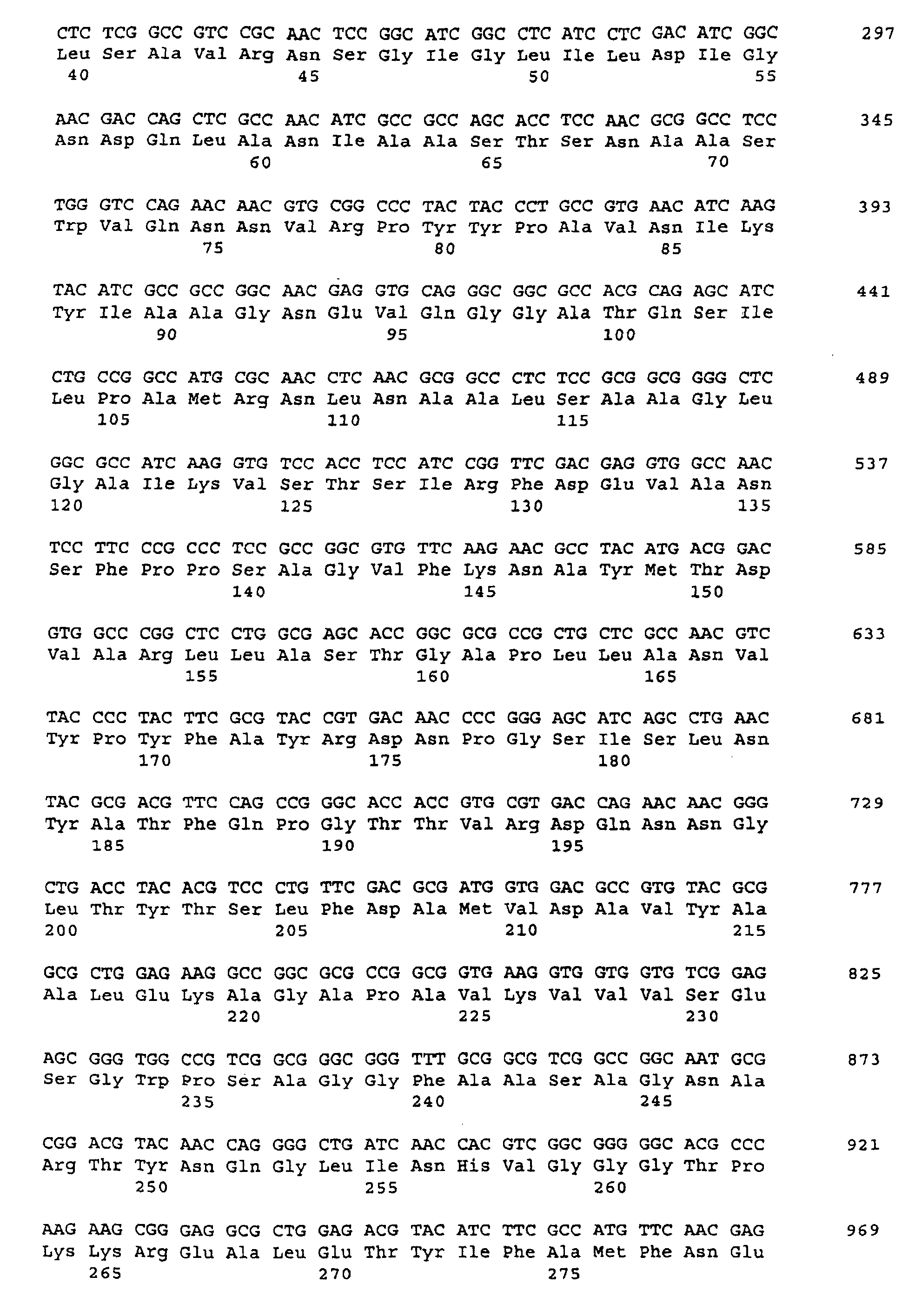
Sequenzlänge: 1249 Nukleotide
Art des Moleküls: cDNA
Ursprüngliche Herkunft: Gerstesamen (Hordeum vulgare L.)
Name: GluG (Glukanase)
Merkmale: 48 bp-lange 5'-nicht übersetzende Anfangsregion Offenes Ableseraster von 1002 bp
199 pb-langes 3'-nicht übersetztes Ende,
die unterstrichene At-reiche Sequenz bei den Position 1083 und 1210 sind wahrscheinlich Polyadenylierungssignale,
die abgeleitete Aminosäuresequenz des codierten Präproteins von 334 Aminosäuren wird unterhalb der Nukleotidsequenz angegeben.


Claims (5)
- Transgene Pilz-resistente Pflanze, dessen Genom mindestens zwei unterschiedliche Gen-Sequenzen, die für Proteine mit Pilz-inhibierender Wirkung kodieren, unter Kontrolle aktiver Promotoren, umfaßt, dadurch gekennzeichnet, daß die DNA-Sequenzen kodieren für:(a) mindestens ein PSI-Protein umfassend die Aminosäuresequenz gemäß Sequenz ID NO. 4, und(b) ein ChiS-Protein umfassend die Aminosäuresequenz des Genprodukts der Sequenz gemäß Sequenz ID NO. 8 oder ein AFP-Protein umfassend die Aminosäuresequenz gemäß Sequenz ID NO. 3.
- Pilz-resistente Pflanze gemäß Anspruch 1, wobei die Pflanze dadurch erhalten wurde, daß in das Genom einer Pflanze mindestens ein Gen, das für ein Protein mit Pilz-inhibierender Wirkung kodiert, transferiert und die Pilz-resistente Pflanze(a) durch Kreuzung der Pflanze mit einer gegebenenfalls transgenen, weiteren Pflanze, die mindestens ein anderes Gen, das für ein anderes Protein mit Pilz-inhibierender Wirkung kodiert, enthält und anschließende Selektion oder(b) durch Transformation der Pflanze mit mindestens einem anderen Gen, das für ein anderes Protein mit Pilz-inhibierender Wirkung kodiert, erhalten wird.
- Pflanze nach Anspruch 1 oder 2, dadurch gekennzeichnet, daß die Pflanze eine Tabak-, Kartoffel-, Erdbeer-, Mais-, Raps- oder Tomatenpflanze ist.
- Verfahren zur Erzeugung Pilz-resistenter Pflanzen nach einem der Ansprüche 1 bis 3, dadurch gekennzeichnet, daß in das Genom einer Pflanze mindestens ein Gen, das für ein Protein mit Pilz-inhibierender Wirkung wie in Anspruch 1 definiert kodiert, transferiert, und die Pilz-resistente Pflanze(a)' durch Kreuzung der Pflanze mit einer gegebenenfalls transgenen weiteren Pflanze, die mindestens ein anderes Gen, das für ein anderes Protein mit Pilz-inhibierender Wirkung wie in Anspruch 1 definiert kodiert, enthält und anschließende Selektion oder(b)' durch Transformation der Pflanze mit mindestens einem anderen Gen, das für ein anderes Protein mit Pilz-inhibierender Wirkung wie in Anspruch 1 definiert kodiert, erhalten wird.
- Verfahren zur Erzeugung einer Pflanze mit verbesserter Pilzresistenz, wobei das Verfahren die Transformation einer Pflanze mit mindestens zwei unterschiedlichen Gen-Sequenzen, die für Proteine mit Pilz-inhibierender Wirkung kodieren, unter Kontrolle aktiver Promotoren, umfaßt, mit der Maßgabe, daß die DNA-Sequenzen kodieren für:(a) mindestens ein PSI-Protein umfassend die Aminosäuresequenz gemäß Sequenz ID NO. 4, und(b) ein ChiS-Protein umfassend die Aminosäuresequenz des Genprodukts der Sequenz gemäß Sequenz ID NO. 8 oder ein AFP-Protein umfassend die Aminosäuresequenz gemäß Sequenz ID NO. 3.
Applications Claiming Priority (2)
| Application Number | Priority Date | Filing Date | Title |
|---|---|---|---|
| DE4234131 | 1992-10-09 | ||
| DE4234131A DE4234131C2 (de) | 1992-10-09 | 1992-10-09 | Transgener pathogen-resistenter Organismus |
Publications (3)
| Publication Number | Publication Date |
|---|---|
| EP0616035A2 EP0616035A2 (de) | 1994-09-21 |
| EP0616035A3 EP0616035A3 (de) | 1995-02-15 |
| EP0616035B1 true EP0616035B1 (de) | 2003-06-18 |
Family
ID=6470118
Family Applications (1)
| Application Number | Title | Priority Date | Filing Date |
|---|---|---|---|
| EP93116011A Expired - Lifetime EP0616035B1 (de) | 1992-10-09 | 1993-10-04 | Transgene Pilz-resistente Pflanzen |
Country Status (11)
| Country | Link |
|---|---|
| US (4) | US5689045A (de) |
| EP (1) | EP0616035B1 (de) |
| JP (1) | JPH06197651A (de) |
| AT (1) | ATE243258T1 (de) |
| AU (1) | AU671669B2 (de) |
| CA (1) | CA2108112A1 (de) |
| DE (2) | DE4234131C2 (de) |
| ES (1) | ES2201053T3 (de) |
| HU (1) | HU219268B (de) |
| MX (1) | MX9306300A (de) |
| ZA (1) | ZA937202B (de) |
Families Citing this family (29)
| Publication number | Priority date | Publication date | Assignee | Title |
|---|---|---|---|---|
| US5521153A (en) * | 1987-10-02 | 1996-05-28 | Ciba-Geigy Corporation | Synergistic antifungal protein and compositions containing same |
| US6222099B1 (en) | 1993-02-05 | 2001-04-24 | Regents Of The University Of Minnesota | Transgenic plants expressing maize acetyl COA carboxylase gene and method of altering oil content |
| US6069298A (en) * | 1993-02-05 | 2000-05-30 | Regents Of The University Of Minnesota | Methods and an acetyl CoA carboxylase gene for conferring herbicide tolerance and an alteration in oil content of plants |
| US6414222B1 (en) * | 1993-02-05 | 2002-07-02 | Regents Of The University Of Minnesota | Gene combinations for herbicide tolerance in corn |
| US5530187A (en) * | 1993-07-16 | 1996-06-25 | The Salk Institute For Biological Studies | Transgenic plants containing multiple disease resistance genes |
| DE4423022C1 (de) * | 1994-06-30 | 1995-05-24 | Lutz Prof Dr Heide | Transgene Pflanzen mit erhöhtem Gehalt an Sekundärstoffen |
| IL127123A0 (en) * | 1996-06-25 | 1999-09-22 | Gsf Forschungszentrum Umwelt | Ozone-induced gene expression in plants |
| JP4324656B2 (ja) | 1996-07-29 | 2009-09-02 | ケイヘン ナームロゼ フェンノートシャップ | 植物の防御応答を調節するポリヌクレオチドおよびそれの使用 |
| US6121436A (en) | 1996-12-13 | 2000-09-19 | Monsanto Company | Antifungal polypeptide and methods for controlling plant pathogenic fungi |
| US7087420B1 (en) | 1997-07-17 | 2006-08-08 | Cambia | Microbial β-glucuronidase genes, gene products and uses thereof |
| GB9827152D0 (en) * | 1998-07-03 | 1999-02-03 | Devgen Nv | Characterisation of gene function using double stranded rna inhibition |
| CN1125179C (zh) * | 1999-01-28 | 2003-10-22 | 中国农业科学院生物技术研究所 | 胞内或胞外协同表达两种抗真菌病基因培育抗病作物 |
| US6521435B1 (en) * | 1999-08-30 | 2003-02-18 | The United States Of America As Represented By The Secretary Of Agriculture | Nucleic acid sequences encoding cell wall-degrading enzymes and use to engineer resistance to Fusarium and other pathogens |
| CA2383642C (en) | 1999-10-14 | 2014-03-25 | Clontech Laboratories, Inc. | Anthozoa derived chromophores/fluorophores and methods for using the same |
| TWI265974B (en) * | 2001-11-20 | 2006-11-11 | Univ Hong Kong | Genetically modified plants with enhanced resistance to fungal diseases and a method of production thereof |
| EP1456223B1 (de) * | 2001-12-19 | 2009-08-12 | The University Of Chicago | Schnellreifende fluoreszierende proteine und verfahren zu deren anwendung |
| AU2003285844A1 (en) | 2002-11-12 | 2004-06-03 | Zakrytoe Aktsionernoe Obschestvo "Evrogen" | Fluorescent proteins and chromoproteins from non-aequorea hydrozoa species and methods for using same |
| EP1732944B1 (de) | 2004-04-07 | 2012-09-05 | The University of Chicago | Monomere, rotfluoreszierende proteine |
| MXPA06015054A (es) | 2004-07-02 | 2007-08-07 | Pioneer Hi Bred Int | Polipeptidos antifungales. |
| EP1807522B1 (de) * | 2004-10-21 | 2013-11-20 | Venganza Inc. | Verfahren und materialien für die resistenz von pflanzen gegen schädlinge und krankheitserreger |
| US8227572B2 (en) * | 2005-08-19 | 2012-07-24 | Commonwealth Scientific And Industrial Research Organisation | Arachnocampa luciferases |
| US7417131B2 (en) * | 2005-11-04 | 2008-08-26 | Evrogen Joint Stock Company | Modified green fluorescent proteins and methods for using same |
| US8563703B2 (en) | 2006-01-25 | 2013-10-22 | Evrogen IP Joint Stock Company | Fluorescent proteins and methods for using same |
| DE602007009498D1 (de) * | 2006-01-25 | 2010-11-11 | Evrogen Ip | Neue fluoreszenzproteine und verfahren zur verwendung davon |
| US8680235B2 (en) * | 2006-09-22 | 2014-03-25 | Stowers Institute For Medical Research | Branchiostoma derived fluorescent proteins |
| WO2009059305A2 (en) * | 2007-11-01 | 2009-05-07 | The University Of Chicago | Red fluorescent proteins with enhanced bacterial expression, increased brightness and reduced aggregation |
| US20100257634A1 (en) * | 2009-04-03 | 2010-10-07 | Venganza Inc. | Bioassay for gene silencing constructs |
| CN101613685B (zh) * | 2009-05-20 | 2011-04-13 | 广东省昆虫研究所 | 具有杀狄斯瓦螨活性的组合几丁质酶及其应用 |
| RU2730038C2 (ru) | 2018-06-28 | 2020-08-14 | Общество с ограниченной ответственностью "ПЛАНТА" | Ферменты биосинтеза люциферина и их применение |
Family Cites Families (10)
| Publication number | Priority date | Publication date | Assignee | Title |
|---|---|---|---|---|
| US4940840A (en) * | 1984-03-26 | 1990-07-10 | Dna Plant Technology Corporation | Novel chitinase-producing bacteria and plants |
| WO1989004371A1 (en) * | 1987-11-02 | 1989-05-18 | Louisiana State University Agricultural And Mechan | Plants genetically enhanced for disease resistance |
| DE3810286A1 (de) * | 1988-03-25 | 1989-10-12 | Max Planck Gesellschaft | Transgene pflanze mit modifizierter physiologie, morphologie und modifiziertem hormonmetabolismus, gewebekulturen dieser pflanze und verfahren zu ihrer herstellung |
| US4970168A (en) * | 1989-01-27 | 1990-11-13 | Monsanto Company | Virus-resistant plants |
| IL97020A (en) * | 1990-01-30 | 2000-12-06 | Mogen Int | Recombinant polynucleotides comprising a chitinase gene and a glucanase gene |
| JP3370090B2 (ja) * | 1990-06-15 | 2003-01-27 | ヘキスト・アクチェンゲゼルシャフト | 抗菌性ポリペプチドおよびその製法 |
| DE4040954C2 (de) * | 1990-12-20 | 2001-05-17 | Max Planck Gesellschaft | Verfahren zur Erzeugung von pathogen-resistenten Pflanzen |
| FR2674538B1 (fr) * | 1991-03-25 | 1994-11-18 | Sanofi Elf | Adn recombinant codant pour une nouvelle proteine a activite beta 1,3-glucanase bacteries contenant cet adn, cellules vegetales et plantes transformees. |
| DK61691D0 (da) * | 1991-04-08 | 1991-04-08 | Danisco | Genetiske konstruktioner |
| WO1994008009A1 (en) * | 1992-10-05 | 1994-04-14 | Mogen International N.V. | Antifungal chitin binding proteins and dna coding therefor |
-
1992
- 1992-10-09 DE DE4234131A patent/DE4234131C2/de not_active Expired - Fee Related
-
1993
- 1993-09-28 ZA ZA937202A patent/ZA937202B/xx unknown
- 1993-09-29 AU AU48720/93A patent/AU671669B2/en not_active Ceased
- 1993-10-04 DE DE59310345T patent/DE59310345D1/de not_active Expired - Fee Related
- 1993-10-04 AT AT93116011T patent/ATE243258T1/de not_active IP Right Cessation
- 1993-10-04 ES ES93116011T patent/ES2201053T3/es not_active Expired - Lifetime
- 1993-10-04 EP EP93116011A patent/EP0616035B1/de not_active Expired - Lifetime
- 1993-10-08 MX MX9306300A patent/MX9306300A/es unknown
- 1993-10-08 CA CA002108112A patent/CA2108112A1/en not_active Abandoned
- 1993-10-08 HU HU9302851A patent/HU219268B/hu not_active IP Right Cessation
- 1993-10-08 JP JP5253197A patent/JPH06197651A/ja active Pending
-
1995
- 1995-06-01 US US08/457,797 patent/US5689045A/en not_active Expired - Fee Related
-
1997
- 1997-03-06 US US08/812,025 patent/US5804184A/en not_active Ceased
-
1998
- 1998-08-24 US US09/138,873 patent/US6271438B1/en not_active Expired - Fee Related
- 1998-08-24 US US09/138,873 patent/US20010020300A1/en active Granted
Also Published As
| Publication number | Publication date |
|---|---|
| AU671669B2 (en) | 1996-09-05 |
| ES2201053T3 (es) | 2004-03-16 |
| HUT68236A (en) | 1995-06-28 |
| EP0616035A2 (de) | 1994-09-21 |
| US6271438B1 (en) | 2001-08-07 |
| EP0616035A3 (de) | 1995-02-15 |
| HU219268B (en) | 2001-03-28 |
| DE59310345D1 (de) | 2003-07-24 |
| US20010020300A1 (en) | 2001-09-06 |
| ZA937202B (en) | 1994-04-20 |
| MX9306300A (es) | 1994-04-29 |
| AU4872093A (en) | 1994-04-28 |
| DE4234131A1 (de) | 1994-04-21 |
| DE4234131C2 (de) | 1995-08-24 |
| US5689045A (en) | 1997-11-18 |
| HU9302851D0 (en) | 1994-01-28 |
| ATE243258T1 (de) | 2003-07-15 |
| CA2108112A1 (en) | 1994-04-10 |
| JPH06197651A (ja) | 1994-07-19 |
| US5804184A (en) | 1998-09-08 |
Similar Documents
| Publication | Publication Date | Title |
|---|---|---|
| DE4234131C2 (de) | Transgener pathogen-resistenter Organismus | |
| DE69333333T2 (de) | Auf fungus reagierendes chimaeres gen | |
| DE69033957T2 (de) | Herstellung von hybridem saatgut | |
| DE4004800C2 (de) | Im Habitus und Ertrag veränderte transgene Pflanzen | |
| DE69232005T2 (de) | Biozide proteine | |
| DE68922669T2 (de) | DNS-Konstruktionen und enthaltende Pflanzen. | |
| DE69510779T2 (de) | Nematizide proteine | |
| DE69834428T2 (de) | Promotor des h3c4 gens aus mais, verbunden mit erstem actin-intron aus reis; chimäres gen welches dieses beinhaltet und transformierte pflanzen | |
| DE3789358T2 (de) | Für den Fremdproteintransport zur pflanzlichen Zellwand verwendbare DNS. | |
| DE69731655T2 (de) | Gegen pilze gerichtete proteine, dafuer kodierende dna und wirtsorganismen, die diese beinhalten | |
| DE69434071T2 (de) | Antimikrobielle proteine | |
| EP0462065A2 (de) | Neue Signalsequenzen | |
| US5994625A (en) | Antifungal chitin binding proteins and DNA coding therefor | |
| DE69525529T2 (de) | Antimikrobielle proteine aus impatiens | |
| DE69333781T2 (de) | Biozide chitin bindende proteine | |
| DE69633568T2 (de) | Expressionskontrollesequenz zur allgemeinen und effektiven genexpression in pflanzen | |
| DE69032503T2 (de) | Genetische kontrolle der äthylen-biosynthese in pflanzen | |
| DE69232498T2 (de) | Biozide proteine | |
| DE69231940T2 (de) | Rekombinant DNS kodierend für eine Endochitinase | |
| DE102005026045A1 (de) | Nukleinsäure, die für ein autoaktiviertes Resistenzprotein zur Erzeugung einer Resistenz gegenüber Pathogenen bei Pflanzen codiert | |
| EP0492536B1 (de) | Verfahren zur Erzeugung von pathogen-resistenten Pflanzen | |
| DE10049267B4 (de) | Verfahren zur Erzeugung oder Erhöhung einer Resistenz in Organismen gegenüber biotischen Streßfaktoren | |
| DE4439748A1 (de) | Verfahren zur Veränderung des Blühverhaltens bei Pflanzen | |
| DE4117026A1 (de) | Verfahren zur erzeugung von pathogen-resistenten eukaryonten | |
| WO1997045547A2 (de) | Lokalisierter zelltod in pflanzen |
Legal Events
| Date | Code | Title | Description |
|---|---|---|---|
| PUAI | Public reference made under article 153(3) epc to a published international application that has entered the european phase |
Free format text: ORIGINAL CODE: 0009012 |
|
| AK | Designated contracting states |
Kind code of ref document: A2 Designated state(s): AT BE CH DE DK ES FR GB GR IE IT LI NL PT SE |
|
| PUAL | Search report despatched |
Free format text: ORIGINAL CODE: 0009013 |
|
| AK | Designated contracting states |
Kind code of ref document: A3 Designated state(s): AT BE CH DE DK ES FR GB GR IE IT LI NL PT SE |
|
| 17P | Request for examination filed |
Effective date: 19950724 |
|
| 17Q | First examination report despatched |
Effective date: 19990217 |
|
| RTI1 | Title (correction) |
Free format text: TRANSGENIC FUNGI RESISTANT PLANTS |
|
| GRAH | Despatch of communication of intention to grant a patent |
Free format text: ORIGINAL CODE: EPIDOS IGRA |
|
| GRAH | Despatch of communication of intention to grant a patent |
Free format text: ORIGINAL CODE: EPIDOS IGRA |
|
| GRAA | (expected) grant |
Free format text: ORIGINAL CODE: 0009210 |
|
| AK | Designated contracting states |
Designated state(s): AT BE CH DE DK ES FR GB GR IE IT LI NL PT SE |
|
| PG25 | Lapsed in a contracting state [announced via postgrant information from national office to epo] |
Ref country code: NL Free format text: LAPSE BECAUSE OF FAILURE TO SUBMIT A TRANSLATION OF THE DESCRIPTION OR TO PAY THE FEE WITHIN THE PRESCRIBED TIME-LIMIT Effective date: 20030618 Ref country code: IT Free format text: LAPSE BECAUSE OF FAILURE TO SUBMIT A TRANSLATION OF THE DESCRIPTION OR TO PAY THE FEE WITHIN THE PRESCRIBED TIME-LIMIT;WARNING: LAPSES OF ITALIAN PATENTS WITH EFFECTIVE DATE BEFORE 2007 MAY HAVE OCCURRED AT ANY TIME BEFORE 2007. THE CORRECT EFFECTIVE DATE MAY BE DIFFERENT FROM THE ONE RECORDED. Effective date: 20030618 Ref country code: IE Free format text: LAPSE BECAUSE OF FAILURE TO SUBMIT A TRANSLATION OF THE DESCRIPTION OR TO PAY THE FEE WITHIN THE PRESCRIBED TIME-LIMIT Effective date: 20030618 |
|
| REG | Reference to a national code |
Ref country code: GB Ref legal event code: FG4D Free format text: NOT ENGLISH |
|
| REG | Reference to a national code |
Ref country code: CH Ref legal event code: EP |
|
| REG | Reference to a national code |
Ref country code: IE Ref legal event code: FG4D Free format text: GERMAN |
|
| REF | Corresponds to: |
Ref document number: 59310345 Country of ref document: DE Date of ref document: 20030724 Kind code of ref document: P |
|
| GBT | Gb: translation of ep patent filed (gb section 77(6)(a)/1977) |
Effective date: 20030806 |
|
| PG25 | Lapsed in a contracting state [announced via postgrant information from national office to epo] |
Ref country code: SE Free format text: LAPSE BECAUSE OF FAILURE TO SUBMIT A TRANSLATION OF THE DESCRIPTION OR TO PAY THE FEE WITHIN THE PRESCRIBED TIME-LIMIT Effective date: 20030918 Ref country code: PT Free format text: LAPSE BECAUSE OF FAILURE TO SUBMIT A TRANSLATION OF THE DESCRIPTION OR TO PAY THE FEE WITHIN THE PRESCRIBED TIME-LIMIT Effective date: 20030918 Ref country code: GR Free format text: LAPSE BECAUSE OF FAILURE TO SUBMIT A TRANSLATION OF THE DESCRIPTION OR TO PAY THE FEE WITHIN THE PRESCRIBED TIME-LIMIT Effective date: 20030918 Ref country code: DK Free format text: LAPSE BECAUSE OF FAILURE TO SUBMIT A TRANSLATION OF THE DESCRIPTION OR TO PAY THE FEE WITHIN THE PRESCRIBED TIME-LIMIT Effective date: 20030918 |
|
| PG25 | Lapsed in a contracting state [announced via postgrant information from national office to epo] |
Ref country code: AT Free format text: LAPSE BECAUSE OF NON-PAYMENT OF DUE FEES Effective date: 20031004 |
|
| PG25 | Lapsed in a contracting state [announced via postgrant information from national office to epo] |
Ref country code: LI Free format text: LAPSE BECAUSE OF NON-PAYMENT OF DUE FEES Effective date: 20031031 Ref country code: CH Free format text: LAPSE BECAUSE OF NON-PAYMENT OF DUE FEES Effective date: 20031031 |
|
| NLV1 | Nl: lapsed or annulled due to failure to fulfill the requirements of art. 29p and 29m of the patents act | ||
| REG | Reference to a national code |
Ref country code: IE Ref legal event code: FD4D |
|
| REG | Reference to a national code |
Ref country code: ES Ref legal event code: FG2A Ref document number: 2201053 Country of ref document: ES Kind code of ref document: T3 |
|
| ET | Fr: translation filed | ||
| PLBE | No opposition filed within time limit |
Free format text: ORIGINAL CODE: 0009261 |
|
| STAA | Information on the status of an ep patent application or granted ep patent |
Free format text: STATUS: NO OPPOSITION FILED WITHIN TIME LIMIT |
|
| 26N | No opposition filed |
Effective date: 20040319 |
|
| REG | Reference to a national code |
Ref country code: CH Ref legal event code: PL |
|
| PGFP | Annual fee paid to national office [announced via postgrant information from national office to epo] |
Ref country code: GB Payment date: 20040831 Year of fee payment: 12 |
|
| PGFP | Annual fee paid to national office [announced via postgrant information from national office to epo] |
Ref country code: FR Payment date: 20040916 Year of fee payment: 12 |
|
| PGFP | Annual fee paid to national office [announced via postgrant information from national office to epo] |
Ref country code: BE Payment date: 20041022 Year of fee payment: 12 |
|
| PGFP | Annual fee paid to national office [announced via postgrant information from national office to epo] |
Ref country code: DE Payment date: 20041025 Year of fee payment: 12 |
|
| PGFP | Annual fee paid to national office [announced via postgrant information from national office to epo] |
Ref country code: ES Payment date: 20041026 Year of fee payment: 12 |
|
| PG25 | Lapsed in a contracting state [announced via postgrant information from national office to epo] |
Ref country code: GB Free format text: LAPSE BECAUSE OF NON-PAYMENT OF DUE FEES Effective date: 20051004 |
|
| PG25 | Lapsed in a contracting state [announced via postgrant information from national office to epo] |
Ref country code: ES Free format text: LAPSE BECAUSE OF NON-PAYMENT OF DUE FEES Effective date: 20051005 |
|
| PG25 | Lapsed in a contracting state [announced via postgrant information from national office to epo] |
Ref country code: BE Free format text: LAPSE BECAUSE OF NON-PAYMENT OF DUE FEES Effective date: 20051031 |
|
| PG25 | Lapsed in a contracting state [announced via postgrant information from national office to epo] |
Ref country code: DE Free format text: LAPSE BECAUSE OF NON-PAYMENT OF DUE FEES Effective date: 20060503 |
|
| GBPC | Gb: european patent ceased through non-payment of renewal fee |
Effective date: 20051004 |
|
| PG25 | Lapsed in a contracting state [announced via postgrant information from national office to epo] |
Ref country code: FR Free format text: LAPSE BECAUSE OF NON-PAYMENT OF DUE FEES Effective date: 20060630 |
|
| REG | Reference to a national code |
Ref country code: FR Ref legal event code: ST Effective date: 20060630 |
|
| REG | Reference to a national code |
Ref country code: ES Ref legal event code: FD2A Effective date: 20051005 |
|
| BERE | Be: lapsed |
Owner name: *MAX-PLANCK-GESELLSCHAFT ZUR FORDERUNG DER WISSENS Effective date: 20051031 |