EP0602984B1 - Electrochemical cell - Google Patents
Electrochemical cell Download PDFInfo
- Publication number
- EP0602984B1 EP0602984B1 EP93310190A EP93310190A EP0602984B1 EP 0602984 B1 EP0602984 B1 EP 0602984B1 EP 93310190 A EP93310190 A EP 93310190A EP 93310190 A EP93310190 A EP 93310190A EP 0602984 B1 EP0602984 B1 EP 0602984B1
- Authority
- EP
- European Patent Office
- Prior art keywords
- cathode
- electrolyte
- anode
- polymer
- effective amount
- Prior art date
- Legal status (The legal status is an assumption and is not a legal conclusion. Google has not performed a legal analysis and makes no representation as to the accuracy of the status listed.)
- Expired - Lifetime
Links
Images
Classifications
-
- H—ELECTRICITY
- H01—ELECTRIC ELEMENTS
- H01M—PROCESSES OR MEANS, e.g. BATTERIES, FOR THE DIRECT CONVERSION OF CHEMICAL ENERGY INTO ELECTRICAL ENERGY
- H01M10/00—Secondary cells; Manufacture thereof
- H01M10/05—Accumulators with non-aqueous electrolyte
- H01M10/052—Li-accumulators
-
- H—ELECTRICITY
- H01—ELECTRIC ELEMENTS
- H01M—PROCESSES OR MEANS, e.g. BATTERIES, FOR THE DIRECT CONVERSION OF CHEMICAL ENERGY INTO ELECTRICAL ENERGY
- H01M10/00—Secondary cells; Manufacture thereof
- H01M10/05—Accumulators with non-aqueous electrolyte
-
- H—ELECTRICITY
- H01—ELECTRIC ELEMENTS
- H01M—PROCESSES OR MEANS, e.g. BATTERIES, FOR THE DIRECT CONVERSION OF CHEMICAL ENERGY INTO ELECTRICAL ENERGY
- H01M10/00—Secondary cells; Manufacture thereof
- H01M10/05—Accumulators with non-aqueous electrolyte
- H01M10/056—Accumulators with non-aqueous electrolyte characterised by the materials used as electrolytes, e.g. mixed inorganic/organic electrolytes
- H01M10/0564—Accumulators with non-aqueous electrolyte characterised by the materials used as electrolytes, e.g. mixed inorganic/organic electrolytes the electrolyte being constituted of organic materials only
- H01M10/0565—Polymeric materials, e.g. gel-type or solid-type
-
- H—ELECTRICITY
- H01—ELECTRIC ELEMENTS
- H01M—PROCESSES OR MEANS, e.g. BATTERIES, FOR THE DIRECT CONVERSION OF CHEMICAL ENERGY INTO ELECTRICAL ENERGY
- H01M4/00—Electrodes
- H01M4/02—Electrodes composed of, or comprising, active material
- H01M4/36—Selection of substances as active materials, active masses, active liquids
- H01M4/60—Selection of substances as active materials, active masses, active liquids of organic compounds
-
- H—ELECTRICITY
- H01—ELECTRIC ELEMENTS
- H01M—PROCESSES OR MEANS, e.g. BATTERIES, FOR THE DIRECT CONVERSION OF CHEMICAL ENERGY INTO ELECTRICAL ENERGY
- H01M6/00—Primary cells; Manufacture thereof
- H01M6/14—Cells with non-aqueous electrolyte
- H01M6/16—Cells with non-aqueous electrolyte with organic electrolyte
- H01M6/162—Cells with non-aqueous electrolyte with organic electrolyte characterised by the electrolyte
- H01M6/164—Cells with non-aqueous electrolyte with organic electrolyte characterised by the electrolyte by the solvent
-
- H—ELECTRICITY
- H01—ELECTRIC ELEMENTS
- H01M—PROCESSES OR MEANS, e.g. BATTERIES, FOR THE DIRECT CONVERSION OF CHEMICAL ENERGY INTO ELECTRICAL ENERGY
- H01M6/00—Primary cells; Manufacture thereof
- H01M6/14—Cells with non-aqueous electrolyte
- H01M6/16—Cells with non-aqueous electrolyte with organic electrolyte
- H01M6/162—Cells with non-aqueous electrolyte with organic electrolyte characterised by the electrolyte
- H01M6/168—Cells with non-aqueous electrolyte with organic electrolyte characterised by the electrolyte by additives
-
- Y—GENERAL TAGGING OF NEW TECHNOLOGICAL DEVELOPMENTS; GENERAL TAGGING OF CROSS-SECTIONAL TECHNOLOGIES SPANNING OVER SEVERAL SECTIONS OF THE IPC; TECHNICAL SUBJECTS COVERED BY FORMER USPC CROSS-REFERENCE ART COLLECTIONS [XRACs] AND DIGESTS
- Y02—TECHNOLOGIES OR APPLICATIONS FOR MITIGATION OR ADAPTATION AGAINST CLIMATE CHANGE
- Y02E—REDUCTION OF GREENHOUSE GAS [GHG] EMISSIONS, RELATED TO ENERGY GENERATION, TRANSMISSION OR DISTRIBUTION
- Y02E60/00—Enabling technologies; Technologies with a potential or indirect contribution to GHG emissions mitigation
- Y02E60/10—Energy storage using batteries
-
- Y—GENERAL TAGGING OF NEW TECHNOLOGICAL DEVELOPMENTS; GENERAL TAGGING OF CROSS-SECTIONAL TECHNOLOGIES SPANNING OVER SEVERAL SECTIONS OF THE IPC; TECHNICAL SUBJECTS COVERED BY FORMER USPC CROSS-REFERENCE ART COLLECTIONS [XRACs] AND DIGESTS
- Y02—TECHNOLOGIES OR APPLICATIONS FOR MITIGATION OR ADAPTATION AGAINST CLIMATE CHANGE
- Y02T—CLIMATE CHANGE MITIGATION TECHNOLOGIES RELATED TO TRANSPORTATION
- Y02T10/00—Road transport of goods or passengers
- Y02T10/60—Other road transportation technologies with climate change mitigation effect
- Y02T10/70—Energy storage systems for electromobility, e.g. batteries
Definitions
- This invention relates to thin film solid state electrochemical cells. More particularly, this invention relates to a novel positive electrode material having the formula (CS x ) n wherein x is from 1.7 to 2.3 and n is unspecified but at least greater than or equal to 2.
- Batteries are used in almost all consumer electronic products from flash lights to lap top computers. Over the years, considerable interest has been shown in developing high energy-density rechargeable batteries for many applications including electric vehicles.
- thin film solid state batteries using the organo-sulfur cathode materials of this invention are particularly well suited for use in many consumer applications because of their high energy to weight ratio.
- the first materials include transition metal chalcogenides, such as titanium disulfide with alkali metals as the anode.
- transition metal chalcogenides such as titanium disulfide with alkali metals as the anode.
- U.S. Patent No. 4,049,879 lists transition metal phosphorous chalcogenides.
- Other U.S. patents, such as U.S. Patent Nos.4,143,214, 4,152,491 and 4,664,991 describes cells wherein the cathode is a carbon/sulfur based material, generally of the C x S formula where x is typically 10 or larger.
- U.S. Patent No. 4,143,294 to Chang, et al. describes cells having cathodes containing C x S, wherein x is a numerical value from about 4 to about 50.
- U.S. Patent No. 4,152,491 to Chang, et al. relates to electric current producing cells where the cathode-active materials include one or more polymer compounds having a plurality of carbon monosulfide units.
- the carbon monosulfide unit is generally described as (CS) x , wherein x is an integer of at least 5, and may be at least 50, and is preferably at least 100.
- CS carbon monosulfide unit
- U.S. Patent No. 4,664,991 to Perichaud, et al. describes a substance containing a one-dimensional electric conducting polymer and at least one polysulfurated chain forming a complex with the polymer.
- Perichaud, et al. use a material which has two components.
- One is the conducting polymer, which is selected from a group consisting of polyacetylenes, polyparaphenylenes, polythiophenes, polypyrroles, polyanilines and their substituted derivatives.
- the other is a polysulfurated chain which is in a charge transfer relation to the conducting polymer.
- the polysulfurated chain is formed by high temperature heating of sulfur to produce a chain of the composition ... S-S-S-S ... of indeterminate length.
- the cell of Perichaud, et al. exhibits a fairly low voltage of only 2.0 V against lithium.
- R is one or more different aliphatic or aromatic organic moieties having one to twenty carbon atoms.
- One or more oxygen, sulfur, nitrogen or fluorine atoms associated with the chain when R is an aliphatic chain can also be included.
- the aliphatic chain may be linear or branched, saturated or unsaturated.
- the aliphatic chain or the aromatic rings may have substituted groups.
- the preferred form of the cathode material is a simple dimer or (RS) 2 .
- R is a straight or a branched aliphatic chain
- moieties as alkyl, alkenyl, alkynyl, alkoxyalkyl, alkythioalkyl, or aminoalkyl group and their fluorine derivatives may be included.
- the organic moiety comprises an aromatic group
- the group may comprise an aryl, aralkyl or alkylaryl, including fluorine substituted derivatives, and the ring may also contain one or more nitrogen, sulfur, or oxygen heteroatoms in the ring as well.
- the main cathode reaction during discharge and recharge of the battery is the breaking and reforming of S-S bonds.
- the breaking of an S-S bond is associated with the formation of an S - -M + ionic complex.
- the organo-sulfur materials investigated by De Jonghe, et al. undergo polymerization and de-polymerization upon the formation and breaking of the S-S bonds.
- the de-polymerization which occurs during the discharging of the cell results in lower weight monomeric species which can dissolve into the electrolyte, severly reducing the utility of the organo-sulfur material as cathode-active material.
- organo-sulfur materials developed by De Jonghe, et al. are conjugated structures where the oxidation and reduction are independent of S-S bond formation and breaking and maintains a fast kinetic rate at ambient temperatures and below.
- the present invention consists in a composite cathode containing as cathode-active material one or more conjugated carbon-sulfur compounds having the formula: (CS x ) n wherein x is from 1.7 to 2.3 and n is greater or equal to 2, preferably greater than 20.
- a cathode has an electrochemical activity of oxidation and reduction which does not involve forming and breaking sulfur-sulfur bonds in the polymer backbone.
- the cathode of the invention can be used to make thin film solid state batteries, and in particular rechargeable batteries, which are inexpensive, yet avoid the limitations existing in the prior art, while offering performance characteristics much higher than those of known materials having an actual specific energy in excess of 900 Wh/kg.
- the composite cathodes of this invention have as the active cathode material poly(carbon disulfide) (PCS) polymers which do not undergo polymerisation and depolymerisation upon oxidation and reduction.
- PCS poly(carbon disulfide)
- the invention also provides an electric current-producing cell, comprising:
- the anode material may be an elemental alkali metal or an alloy including the mixture of an elemental alkali metal and ore or more alloys made from an element selected from the Periodic Table Group IA and IIA metals. Lithium and sodium are useful materials for the anode of the battery of the invention.
- the anode may also be intercalated carbon such as LiC x where x is equal to 6 or greater.
- Two gel polymer electrolyte systems have been successfully used in the fabrication of the cell of the invention.
- One system is based on a sulfonated polyimide with propylene carbonate (PC) and ethylene carbonate (EC) as the plasticizer components; and the other a high conductivity gel polymer electrolyte based on polyacylonitrile (PAN) with EC and PC added.
- PC propylene carbonate
- EC ethylene carbonate
- a method of making the solid state battery of the invention is also provided.
- the method of making the cells of the present invention is particularly preferred for use in applications requiring long cycle life and high energy storage capacity.
- solid state batteries are provided having a longer cycle life, higher specific energy and higher current than has been previously achieved with organo-sulfur cathode materials.
- these batteries also have long shelf life and a low rate of self-discharge.
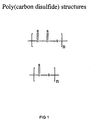
- Figure 1 shows schematically possible structures of poly(carbon disulfide).
- the polymer, as synthesized, is most likely a co-polymer of the structures shown in Figure 1.
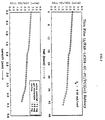
- Figure 2 shows the galvanostatic discharge profile of a thin film Li/PAN-LiClO 4 -EC-PC/PCS battery as a function of time (a) and capacity (b) at a current density of 0.10 mA/ cm 2 .
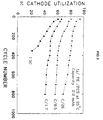
- Figure 3 shows the cathode utilization achieved upon cycling at different densities.
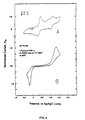
- Figure 4 shows cyclic voltammograms of PCS and ((C 2 H 5 ) 2 NCSS) 2 in an electrolyte consisting of dimethylsulfoxide with 0.1 molar concentration of tetraethylammonium perchlorate.
- the novel cell of the invention contains a specified anode, and a cathode which is preferably a composite of a non-aqueous organic electrolyte, PCS and conductive carbon.
- the anode employed in the cell of the invention includes one or more metals selected from the group consisting of the Periodic Table Group IA and Group IIA metals.
- the anode may comprise any metal capable of functioning as a negative electrode in combination with the novel PCS cathode material of the invention.
- the anode includes one or more alkali metals.
- the anode may also comprise one or more alkali metals in combination with one or more alkali earth metals, or in combination with one or more suitable metals.
- the anode comprises a thin lithium foil of a thickness from about 25 ⁇ m to 250 ⁇ m.
- Poly(carbon disulfide) was prepared by reacting carbon disulfide with sodium metal in an appropriate solvent.
- PCS polymer is reduced.
- the reduction of PCS is accompanied by the insertion of Li + ions into the cathode from the electrolyte to maintain charge neutrality.
- the main design concerns are the kinetics and chemical and electrochemical reversibility of the reduction/oxidation, the density of available sulfur atoms, and the miscibility with the polymer electrolyte.
- PCS as the cathode active material
- An advantage of using PCS as the cathode active material is the high density of sulfur atoms which results in a high density of charge-transfer electrons during oxidation-reduction. This is accompanied by a high density of Li + ions inserted for charge neutrality, resulting in a high capacity.
- the sulfur concentration is always greater than the carbon concentration.
- PCS as the cathode active material in solid state batteries is the absence of low molecular weight moieties produced during oxidation and reduction which may diffuse into the polymer electrolyte phase, particularly with gel electrolytes.
- PCS In contrast to the organo-sulfur materials developed by De Jonghe, et al. PCS does not undergo polymerization/de-polymerization upon charge and discharge, but maintains the integrity of the polymer backbone. The oxidation-reduction process involves instead the conjugated nature of the polymer. Although the detailed structure of PCS as synthesized has not yet been completely determined, it is assumed to be a co-polymer of the structures shown in Figure 1.
- Thin film rechargeable lithium cells having a PCS based cathode have been made in a planar configuration. Their discharge capabilities, rechargeability and quick charge retention capabilities have been measured. Typical discharge characteristic curves for a Li/PCS cell with a gel electrolyte at 0.10 mA/cm 2 are shown in Figure 2.
- Fig. 3 illustrates the percentage of cathode utilization against the cycle number.
- the capacity calculations and cathode utilization numbers were calculated in a cycle interval of 25, until a capacity decline of 20% was observed. More than 800 cycles were achieved at low to moderate C-rates. This is in contrast to 200 cycles or less for organo-sulfur materials which are based on the mechanism of polymerization and de-polymerization [ J. Electrochem. Soc., Vol. 138, pp. 1891-1895 (1991)].
- the charging efficiency of an electrical cell is defined as the ratio between charge output and charge input to the cell during one complete cycle.
- the charging efficiency is close to unity until the 200th cycle.
- the battery cycling was disrupted to measure the cell impedance.
- a low cell impedance was observed which ruled out limitations under cathode/electrolyte interface. More importantly, a large life cycle was anticipated.
- the declining cathode capacity after 500 cycles was attributed to the possible formation of soft dendrites at the lithium anode-polymer electrolyte interface; therefore, these cells have been classified as anode performance limited battery systems.
- the cyclic voltammograms shown in Figure 4 illustrate the fundamental difference between PCS and organo-sulfur materials whose electrochemical activity is based on breaking and reforming of S-S bonds.
- PCS the oxidation and reduction peaks are closely aligned on the voltage axis, indicative of fast, reversible electrochemical kinetics expected from the oxidation and reduction of a conjugated system.
- NCSS NCSS
- PCS is a conjugated polymeric structure fundamentally different in its structure and electrochemical function compared with the materials developed by DeJonghe et al. This fundamental difference structurally and electronically is the cause for the substantially higher capacity and very much longer cycle life.
- the polymer electrolyte used in the cell of the present invention is any polymer electrolyte which is chemically inert with respect to the anode and the cathode, and which permits the migration of ions between the anode and cathode.
- Different polymer electrolyte systems which have application to both lithium and sodium based rechargeable batteries can be employed in the fabrication of the cell of the invention, such as solid polymer electrolytes; single-ion conducting polymer electrolytes and high conductivity gel polymer electrolytes. Liquid organic electrolytes are also useful electrolytes for the invention.
- Single ion conducting polymer electrolytes have been synthesized with highly delocalized anionic moieties covalently attached to the polymer backbone to achieve high specific lithium ion conductivity, as described in U.S. Patent No. 4,882,243 (1989).
- the advantages of polymer electrolytes with exclusive cation conduction are found in reduced cell polarization deriving from anion mobility, reduced volume changes in the cathode from intercalation of ion clusters and reduced salt-induced corrosion on the current collectors.
- Room temperature conductivities for single ion conducting polymer electrolytes described in U.S. Patent No. 4,882,243 are in the range of 10 -4 to 10 -5 S/cm range.
- Gel polymer electrolytes are also very effective polymer electrolyte systems. They include plasticizing agents in a polymer network. A substantial increase in lithium ion conductivity has been achieved by introducing ethylene carbonate (“EC”) and propylene carbonate (“PC”) plasticizer agents into polymers matrices.
- EC ethylene carbonate
- PC propylene carbonate
- plastizing agents include N-methyl acetamide, sulfonate, sulfolane, 1,2-dimethoxyethane, poly(ethylene glycol) 1,3-dioxolane and glymes.
- plasticizing agents themselves are useful solvents to form liquid polymer electrolytes which provide other effective electrolyte systems for the cell of the invention.
- mixtures of EC and PC with lithium salts, such as LiAsF 6 are useful liquid electrolytes.
- a 12 gram sample of sodium dispersion in xylene was added in small portions to an ice cooled mixture of 100 ml of CS 2 and 300 ml of methyl pyrolidinone and kept under nitrogen for 1 hour. After the addition was completed, the reaction mixture was stirred at room temperature for 2 days. The solvent was then removed under vacuum. The residue was dissolved in water and then acidified with 6N HCl. The hydrochloric acid aqueous layer was decanted and the residue was washed with water and then acetone. The residue was then dried under vacuum at 55°C overnight. After cooling, the black material was ground with acetone in a mortar and pestle assembly and filtered. The powder was repeatedly stirred with acetone until the solution became a light yellow color. The yield of the poly(carbon disulfide) was about 40 g.
- PCS prepared following the general procedure of Example 1 or 2, 50% polyacrylonitrile and 10% acetylene black was dissolved in dimethylsulfoxide to form a slurry.
- the slurry was ground into fine particles and was then cast as a film 25-100 ⁇ m on a 25 ⁇ m thick nickel foil. The entire unit was dried in a vacuum oven at 40°C - 80°C for 24 hours.
- a mixture of 40% by weight PCS, 45% by weight electrolyte and 15% acetylene black was dissolved in dimethylsulfoxide to form a slurry.
- the electrolyte could be polyethylene oxide, plus PC and EC and LiCF 3 SO 3 .
- the slurry was finally ground and then cast as a film onto a nickel foil. The entire unit was then dried in a vacuum oven at 40°C - 80°C for 24 hours.
- a rechargeable lithium battery of unipolar sandwich design was prepared by sandwiching a polymer electrolyte of about 25 ⁇ m thickness between a lithium foil of 125 ⁇ m thickness and a composite cathode of about 25-75 ⁇ m. To obtain laboratory prototype cells, the above components were sandwiched between two stainless steel circular disks having 0.5cm thickness. A typical material used for the anode was lithium metal.
- the PCS of the invention prepared in accordance with the procedure of Examples 1 or 2 was used for the cathode.
- the electrolyte employed in preparing the battery of the invention was a branched polysiloxane containing ethylene oxide side chains and a LiCF 3 SO 3 salt.
- a rechargeable lithium polymer electrolyte battery was prepared, having the composite cathode of the invention, a lithium foil anode, 9.8 mg of polymer gel electrolyte and 2.3 mg of ultrafine graphite powder.
- the composite anode contained 7.1 mg of PCS.
- the polymer gel electrolyte contained polyacrylonitrile, ethylene carbonate, propylene carbonate and LiClO 4 with a conductivity of 3 x10 -3 S/cm at 25°C.
- Figure 2 shows the first galvanostatic discharge profile of the cell of the invention at ambient temperature. At 0.10 mA/cm 2 current density, a practical capacity of 4.4 mAh has been achieved with a cut-off voltage at 1.5 volts. This translates into 87% of practical cathode utilization at a storage energy of 8,800 mWh.
- Another rechargeable lithium cell was prepared having a composite cathode containing 5.4 mg of polymer gel electrolyte, 12.0 mg of active cathode material and 1.9 mg of graphite powder. Assuming a mid cell potential of 2.5V, a storage energy of 12,600 mWh could be obtained.
- Rechargeable cells were prepared containing free-standing thin films of PCS-based composite cathodes.
- the cathodes contained 50% by weight of PCS, 40% by weight PAN, and 10% by weight acetylene black.
- Fig. 3 shows the practical cathode utilization achieved upon cycling at different current densities, assuming a 700 Ah/kg theoretical capacity. During the first few cycles, the percentage of utilization ranges from 60 to 86% at high to moderate C-rates. At low C-rates, only 8% loss in the cathode utilization was observed at the end of about 800 cycles. At low C-rates, the cycling efficiency of the cell is expected to be at least 2,500 cycles with a nominal capacity loss.
- a rechargeable lithium battery was prepared having a lithium foil of 125 ⁇ m thickness, a fiber reinforced 1 M LiClO 4 in propylene carbonate/dimethyl ethoxide electrolyte and a PCS-based composite cathode.
- the cathode contained 50% by weight PCS, 40% by weight PAN, and 10% by weight acetylene black.
- the battery prepared for this example exhibited about 500 cycles with a maximum cathode capacity loss of 10% compared to the first cycle.
- the cells were subjected to a twenty minute quick discharge/ charge cycle without any rest period by trial and error method to choose the appropriate voltage and current limits.
- the average material utilization during the first 200 cycles was 72% and about 60% between the 250th and 425th cycle.
- the cycle efficiency defined as the ratio between charge output (discharge) and charge input (charge) to the cell during one complete cycle is close to unity up to 200 cycles.
- Examples 8 and 9 demonstrate that at ambient temperature the lithium Li/PCS cells of the invention can be cycled extensively with a minimum loss of capacity.
- Poly(carbon disulfide) based lithium polymer electrolyte rechargeable systems with 2.5 volt mid-cell potential have thus been successfully developed with a high energy density and long cycle life capability.
- the battery system of the invention therefore, can be rated as an excellent rechargeable system with high energy density, long cycle life and an extremely long shelf-life.
Landscapes
- Chemical & Material Sciences (AREA)
- Chemical Kinetics & Catalysis (AREA)
- Electrochemistry (AREA)
- General Chemical & Material Sciences (AREA)
- Engineering & Computer Science (AREA)
- Manufacturing & Machinery (AREA)
- Physics & Mathematics (AREA)
- Condensed Matter Physics & Semiconductors (AREA)
- Dispersion Chemistry (AREA)
- General Physics & Mathematics (AREA)
- Inorganic Chemistry (AREA)
- Battery Electrode And Active Subsutance (AREA)
- Secondary Cells (AREA)
Applications Claiming Priority (4)
| Application Number | Priority Date | Filing Date | Title |
|---|---|---|---|
| US99194892A | 1992-12-17 | 1992-12-17 | |
| US991948 | 1993-11-03 | ||
| US145091 | 1993-11-03 | ||
| US08/145,091 US5441831A (en) | 1992-12-17 | 1993-11-03 | Cells having cathodes containing polycarbon disulfide materials |
Publications (3)
| Publication Number | Publication Date |
|---|---|
| EP0602984A2 EP0602984A2 (en) | 1994-06-22 |
| EP0602984A3 EP0602984A3 (en) | 1995-02-08 |
| EP0602984B1 true EP0602984B1 (en) | 1999-05-06 |
Family
ID=26842654
Family Applications (1)
| Application Number | Title | Priority Date | Filing Date |
|---|---|---|---|
| EP93310190A Expired - Lifetime EP0602984B1 (en) | 1992-12-17 | 1993-12-16 | Electrochemical cell |
Country Status (4)
| Country | Link |
|---|---|
| US (1) | US5441831A (enExample) |
| EP (1) | EP0602984B1 (enExample) |
| JP (1) | JPH0729599A (enExample) |
| DE (1) | DE69324780T2 (enExample) |
Families Citing this family (105)
| Publication number | Priority date | Publication date | Assignee | Title |
|---|---|---|---|---|
| US5460905A (en) * | 1993-06-16 | 1995-10-24 | Moltech Corporation | High capacity cathodes for secondary cells |
| US5686201A (en) * | 1994-11-23 | 1997-11-11 | Polyplus Battery Company, Inc. | Rechargeable positive electrodes |
| US6376123B1 (en) | 1994-11-23 | 2002-04-23 | Polyplus Battery Company | Rechargeable positive electrodes |
| US6017651A (en) * | 1994-11-23 | 2000-01-25 | Polyplus Battery Company, Inc. | Methods and reagents for enhancing the cycling efficiency of lithium polymer batteries |
| US5523179A (en) * | 1994-11-23 | 1996-06-04 | Polyplus Battery Company | Rechargeable positive electrode |
| US6030720A (en) * | 1994-11-23 | 2000-02-29 | Polyplus Battery Co., Inc. | Liquid electrolyte lithium-sulfur batteries |
| US6358643B1 (en) | 1994-11-23 | 2002-03-19 | Polyplus Battery Company | Liquid electrolyte lithium-sulfur batteries |
| US5814420A (en) * | 1994-11-23 | 1998-09-29 | Polyplus Battery Company, Inc. | Rechargeable positive electrodes |
| US5582623A (en) * | 1994-11-23 | 1996-12-10 | Polyplus Battery Company, Inc. | Methods of fabricating rechargeable positive electrodes |
| US5665492A (en) * | 1995-02-08 | 1997-09-09 | Matsushita Electric Industrial Co., Ltd. | Composite Electrode including organic disulfide compound, method of producing the same, and lithium secondary battery utilizing the same |
| EP0834201A4 (en) * | 1995-06-07 | 1999-11-10 | Moltech Corp | ELECTROACTIVE UPLOAD CAPACITIVE POLYACETYLENE-CO-POLYSULPHUR MATERIALS AND ELECTROLYTIC CELLS CONTAINING THEM |
| US5529860A (en) * | 1995-06-07 | 1996-06-25 | Moltech Corporation | Electroactive high storage capacity polyacetylene-co-polysulfur materials and electrolytic cells containing same |
| US5601947A (en) * | 1995-06-07 | 1997-02-11 | Moltech Corporation | Electroactive high storage capacity polycarbon-sulfide materials and electrolytic cells containing same |
| US6309778B1 (en) | 1996-02-16 | 2001-10-30 | Moltech Corporation | Electroactive high storage capacity polyacetylene-co-polysulfur materials and electrolytic cells containing same |
| JP2000511342A (ja) | 1996-05-22 | 2000-08-29 | モルテック コーポレイション | 複合カソード、新規複合カソードを含む化学電池、およびそれらを製造するプロセス |
| JP4083224B2 (ja) * | 1996-06-14 | 2008-04-30 | サイオン パワー コーポレイション | 2次電池セルの電解質に有用な組成物 |
| JP3617197B2 (ja) * | 1996-06-15 | 2005-02-02 | ソニー株式会社 | 難燃性ゲル電解質及びそれを用いた電池 |
| CA2186099A1 (en) * | 1996-09-20 | 1996-11-18 | David Stanley Wainwright | Aqueous rechargeable battery |
| US6110619A (en) | 1997-12-19 | 2000-08-29 | Moltech Corporation | Electrochemical cells with cationic polymers and electroactive sulfur compounds |
| US6201100B1 (en) | 1997-12-19 | 2001-03-13 | Moltech Corporation | Electroactive, energy-storing, highly crosslinked, polysulfide-containing organic polymers and methods for making same |
| US6210831B1 (en) | 1997-12-19 | 2001-04-03 | Moltech Corporation | Cathodes comprising electroactive sulfur materials and secondary batteries using same |
| US6703163B2 (en) | 1998-03-31 | 2004-03-09 | Celanese Ventures Gmbh | Lithium battery and electrode |
| EP1068647A1 (en) * | 1998-03-31 | 2001-01-17 | Celanese Ventures GmbH | Lithium battery and electrode |
| US7029794B2 (en) | 1998-03-31 | 2006-04-18 | Celanese Ventures Gmbh | Lithium battery and electrode |
| CA2326178A1 (en) * | 1998-03-31 | 1999-10-07 | Axiva Gmbh | Lithium battery and electrode |
| US6210832B1 (en) | 1998-09-01 | 2001-04-03 | Polyplus Battery Company, Inc. | Mixed ionic electronic conductor coatings for redox electrodes |
| US6200704B1 (en) | 1998-09-01 | 2001-03-13 | Polyplus Battery Company, Inc. | High capacity/high discharge rate rechargeable positive electrode |
| US6955866B2 (en) | 1998-09-03 | 2005-10-18 | Polyplus Battery Company | Coated lithium electrodes |
| US6537701B1 (en) | 1998-09-03 | 2003-03-25 | Polyplus Battery Company, Inc. | Coated lithium electrodes |
| US6194098B1 (en) | 1998-12-17 | 2001-02-27 | Moltech Corporation | Protective coating for separators for electrochemical cells |
| US6302928B1 (en) * | 1998-12-17 | 2001-10-16 | Moltech Corporation | Electrochemical cells with high volumetric density of electroactive sulfur-containing materials in cathode active layers |
| US6277514B1 (en) | 1998-12-17 | 2001-08-21 | Moltech Corporation | Protective coating for separators for electrochemical cells |
| US6190426B1 (en) | 1998-12-17 | 2001-02-20 | Moltech Corporation | Methods of preparing prismatic cells |
| KR100311947B1 (ko) | 1999-03-10 | 2001-11-02 | 박찬구 | 고용량 황화 탄화수소 화합물 및 이를 이용한 이차 전지 |
| US7771870B2 (en) * | 2006-03-22 | 2010-08-10 | Sion Power Corporation | Electrode protection in both aqueous and non-aqueous electrochemical cells, including rechargeable lithium batteries |
| US20110165471A9 (en) * | 1999-11-23 | 2011-07-07 | Sion Power Corporation | Protection of anodes for electrochemical cells |
| KR100779162B1 (ko) | 1999-11-23 | 2007-11-27 | 시온 파워 코퍼레이션 | 전기화학 전지를 위한 리튬 애노드 |
| US6733924B1 (en) | 1999-11-23 | 2004-05-11 | Moltech Corporation | Lithium anodes for electrochemical cells |
| US7066971B1 (en) | 1999-11-23 | 2006-06-27 | Sion Power Corporation | Methods of preparing electrochemical cells |
| US7247408B2 (en) | 1999-11-23 | 2007-07-24 | Sion Power Corporation | Lithium anodes for electrochemical cells |
| US7081142B1 (en) | 1999-11-23 | 2006-07-25 | Sion Power Corporation | Methods of preparing electrochemical cells |
| US6797428B1 (en) | 1999-11-23 | 2004-09-28 | Moltech Corporation | Lithium anodes for electrochemical cells |
| WO2001058805A1 (en) * | 2000-02-09 | 2001-08-16 | Hitachi Maxell, Ltd. | Poly(carbon sulfide), method for preparing the same and non-aqueous electrolyte cell using the same |
| JP4674883B2 (ja) * | 2000-02-09 | 2011-04-20 | 日立マクセル株式会社 | ポリ硫化カーボン、その製造方法およびそれを用いた非水電解質電池 |
| US6488721B1 (en) | 2000-06-09 | 2002-12-03 | Moltech Corporation | Methods of preparing electrochemical cells |
| EP1344265B1 (en) | 2000-12-21 | 2008-02-13 | Sion Power Corporation | Lithium anodes for electrochemical cells |
| US6632573B1 (en) | 2001-02-20 | 2003-10-14 | Polyplus Battery Company | Electrolytes with strong oxidizing additives for lithium/sulfur batteries |
| KR100402109B1 (ko) * | 2001-06-01 | 2003-10-17 | 임수근 | 신규한 나트륨/유황전지 |
| KR100385357B1 (ko) | 2001-06-01 | 2003-05-27 | 삼성에스디아이 주식회사 | 리튬-황 전지 |
| US7282298B2 (en) * | 2002-08-29 | 2007-10-16 | Matsushita Electric Industrial Co., Ltd. | Electrochemical device |
| JP4561953B2 (ja) * | 2003-06-11 | 2010-10-13 | ソニー株式会社 | 化合物およびその製造方法並びにそれを用いた二次電池用正極および二次電池 |
| US10629947B2 (en) | 2008-08-05 | 2020-04-21 | Sion Power Corporation | Electrochemical cell |
| JP5318420B2 (ja) * | 2005-01-19 | 2013-10-16 | アリゾナ・ボード・オブ・リージェンツ・フォー・アンド・オン・ビハーフ・オブ・アリゾナ・ステイト・ユニバーシティー | スルホン系電解質を有する電流発生装置 |
| CN101601150B (zh) | 2006-12-04 | 2015-02-18 | 赛昂能源有限公司 | 电解质的分离 |
| DE102007024394A1 (de) | 2007-05-25 | 2008-11-27 | Robert Bosch Gmbh | Elektrochemischer Energiespeicher |
| US20100239914A1 (en) * | 2009-03-19 | 2010-09-23 | Sion Power Corporation | Cathode for lithium battery |
| WO2009042958A1 (en) * | 2007-09-28 | 2009-04-02 | Arizona Board Of Regents For And On Behalf Of Arizona State University | Non-aqueous electrolyte solution for rechargeable lithium batteries |
| KR101576694B1 (ko) * | 2007-10-26 | 2015-12-10 | 시온 파워 코퍼레이션 | 배터리 전극용 프라이머 |
| JP5619622B2 (ja) | 2008-01-08 | 2014-11-05 | シオン・パワー・コーポレーション | 多孔性電極および関連方法 |
| KR20110052594A (ko) | 2008-08-05 | 2011-05-18 | 시온 파워 코퍼레이션 | 전기화학 셀에서 힘의 적용 |
| CN102576855B (zh) | 2009-08-24 | 2015-11-25 | 赛昂能源有限公司 | 用于电化学电池的剥离系统 |
| US20110070494A1 (en) | 2009-08-28 | 2011-03-24 | Sion Power Corporation | Electrochemical cells comprising porous structures comprising sulfur |
| WO2012174393A1 (en) | 2011-06-17 | 2012-12-20 | Sion Power Corporation | Plating technique for electrode |
| JP6118805B2 (ja) | 2011-10-13 | 2017-04-19 | シオン・パワー・コーポレーション | 電極構造およびその製造方法 |
| US9077041B2 (en) | 2012-02-14 | 2015-07-07 | Sion Power Corporation | Electrode structure for electrochemical cell |
| WO2013134655A1 (en) | 2012-03-09 | 2013-09-12 | Sion Power Corporation | Porous support structures, electrodes containing same, and associated methods |
| WO2014071160A1 (en) | 2012-11-02 | 2014-05-08 | Sion Power Corporation | Electrode active surface pretreatment |
| EP2936594B1 (en) | 2012-12-19 | 2017-02-22 | Basf Se | Electrode structure and method for making same |
| US9531009B2 (en) | 2013-01-08 | 2016-12-27 | Sion Power Corporation | Passivation of electrodes in electrochemical cells |
| WO2014110131A1 (en) | 2013-01-08 | 2014-07-17 | Sion Power Corporation | Conductivity control in electrochemical cells |
| KR20150125693A (ko) | 2013-03-05 | 2015-11-09 | 시온 파워 코퍼레이션 | 피브릴 셀룰로스 물질과 같은 피브릴 물질을 포함하는 전기화학 전지 |
| US12261284B2 (en) | 2013-03-15 | 2025-03-25 | Sion Power Corporation | Protective structures for electrodes |
| CN105051944B (zh) | 2013-03-15 | 2019-04-02 | 锡安能量公司 | 受保护电极结构和方法 |
| CN105122501B (zh) | 2013-03-15 | 2019-02-19 | 锡安能量公司 | 受保护电极结构 |
| JP6116715B2 (ja) | 2013-07-03 | 2017-04-19 | シオン・パワー・コーポレーション | 再充電式リチウム電池を含む電気化学電池における電極保護用のセラミック/ポリマーマトリックス |
| KR102059238B1 (ko) | 2013-08-08 | 2019-12-24 | 시온 파워 코퍼레이션 | 전기화학 전지에서의 자기-회복성 전극 보호 |
| JP6746062B2 (ja) | 2014-02-19 | 2020-08-26 | シオン・パワー・コーポレーション | 電解質抑制イオン伝導体を使用する電極保護 |
| US10490796B2 (en) | 2014-02-19 | 2019-11-26 | Sion Power Corporation | Electrode protection using electrolyte-inhibiting ion conductor |
| EP2911221B1 (en) | 2014-02-19 | 2025-04-23 | Sion Power Corporation | Electrode protection using a composite comprising an electrolyte-inhibiting ion conductor |
| WO2015166030A1 (en) | 2014-05-01 | 2015-11-05 | Basf Se | Electrode fabrication methods and associated articles |
| KR102563670B1 (ko) | 2014-09-09 | 2023-08-03 | 시온 파워 코퍼레이션 | 리튬 이온 전기화학 전지에서의 보호 층 및 관련된 전극 및 방법 |
| JP6800844B2 (ja) | 2014-10-23 | 2020-12-16 | シオン・パワー・コーポレーション | 電気化学セル用イオン伝導性複合物 |
| WO2016187510A1 (en) | 2015-05-20 | 2016-11-24 | Sion Power Corporation | Protective layers for electrodes |
| WO2017091341A1 (en) | 2015-11-24 | 2017-06-01 | Sion Power Corporation | Ionically conductive compounds and related uses |
| US10879527B2 (en) | 2016-05-20 | 2020-12-29 | Sion Power Corporation | Protective layers for electrodes and electrochemical cells |
| WO2017222967A2 (en) | 2016-06-21 | 2017-12-28 | Sion Power Corporation | Coatings for components of electrochemical cells |
| US11289700B2 (en) | 2016-06-28 | 2022-03-29 | The Research Foundation For The State University Of New York | KVOPO4 cathode for sodium ion batteries |
| EP3340346B1 (en) | 2016-12-23 | 2022-02-16 | Sion Power Corporation | Protected electrode structure for electrochemical cells |
| US11024923B2 (en) | 2017-03-09 | 2021-06-01 | Sion Power Corporation | Electrochemical cells comprising short-circuit resistant electronically insulating regions |
| US10720648B2 (en) | 2017-03-17 | 2020-07-21 | Sion Power Corporation | Electrode edge protection in electrochemical cells |
| KR20200000849A (ko) | 2017-05-24 | 2020-01-03 | 시온 파워 코퍼레이션 | 이온 전도성 화합물 및 관련 용도 |
| WO2018226921A1 (en) | 2017-06-09 | 2018-12-13 | Sion Power Corporation | In situ current collector |
| EP3973583A1 (en) | 2019-05-22 | 2022-03-30 | Sion Power Corporation | Electrically coupled electrodes, and associated articles and methods |
| US11710828B2 (en) | 2019-05-22 | 2023-07-25 | Sion Power Corporation | Electrochemical devices including porous layers |
| KR20220024803A (ko) | 2019-06-21 | 2022-03-03 | 시온 파워 코퍼레이션 | 전기화학 소자에 힘을 인가하기 위한 방법, 시스템 및 장치 |
| US11824228B2 (en) | 2019-11-19 | 2023-11-21 | Sion Power Corporation | Compression systems for batteries |
| US11978917B2 (en) | 2019-11-19 | 2024-05-07 | Sion Power Corporation | Batteries with components including carbon fiber, and associated systems and methods |
| US11791511B2 (en) | 2019-11-19 | 2023-10-17 | Sion Power Corporation | Thermally insulating compressible components for battery packs |
| US11984575B2 (en) | 2019-11-19 | 2024-05-14 | Sion Power Corporation | Battery alignment, and associated systems and methods |
| WO2021127159A2 (en) | 2019-12-20 | 2021-06-24 | Sion Power Corporation | Lithium metal electrodes |
| WO2021183858A1 (en) | 2020-03-13 | 2021-09-16 | Sion Power Corporation | Application of pressure to electrochemical devices including deformable solids, and related systems |
| JP7400580B2 (ja) * | 2020-03-25 | 2023-12-19 | Tdk株式会社 | 正極活物質層、それを用いた正極および二次電池 |
| US11705554B2 (en) | 2020-10-09 | 2023-07-18 | Sion Power Corporation | Electrochemical cells and/or components thereof comprising nitrogen-containing species, and methods of forming them |
| US12278357B2 (en) | 2021-07-23 | 2025-04-15 | Sion Power Corporation | Battery module with multiplexing and associated systems and methods |
| CN115763785A (zh) * | 2022-06-30 | 2023-03-07 | 滁州极鑫新能源科技有限公司 | 一种金属-聚硫化碳电池的生产方法 |
Family Cites Families (14)
| Publication number | Priority date | Publication date | Assignee | Title |
|---|---|---|---|---|
| US4184013A (en) * | 1976-07-24 | 1980-01-15 | Brown, Boveri & Cie Ag | Electrochemical storage cell |
| US4048392A (en) * | 1976-12-13 | 1977-09-13 | Honeywell Inc. | Crimp seal using polyphenylene sulfide plastic with an aluminum terminal pan |
| US4258109A (en) * | 1977-04-25 | 1981-03-24 | Duracell International Inc. | Solid state cells |
| US4143214A (en) * | 1978-06-26 | 1979-03-06 | Exxon Research & Engineering Co. | Cells having cathodes containing Cs S cathode-active materials |
| US4152491A (en) * | 1978-06-26 | 1979-05-01 | Exxon Research & Engineering Co. | Cells having cathodes containing carbon monosulfide polymer cathode-active materials |
| US4181779A (en) * | 1979-01-30 | 1980-01-01 | Bell Telephone Laboratories, Incorporated | Cell using halogen reactive material such as organo-metallic polymer |
| US4375427A (en) * | 1979-12-13 | 1983-03-01 | Allied Corporation | Thermoplastic conductive polymers |
| US4576697A (en) * | 1983-04-21 | 1986-03-18 | Combustion Engineering, Inc. | Synthesis of carbon-containing intercalatable layered transition metal chalocogenides |
| EP0157818B1 (fr) * | 1983-09-20 | 1989-02-08 | Societe Nationale Elf Aquitaine | Nouveaux derives de sulfures de polycarbone, leur preparation et leurs applications, notamment en electrochimie |
| US4556617A (en) * | 1984-06-26 | 1985-12-03 | Raychem Corporation | Anhydrous primary battery |
| FR2570882B1 (fr) * | 1984-09-21 | 1986-12-05 | Comp Generale Electricite | Matiere active positive a base d'un polymere conducteur electronique pour generateur electrochimique |
| US4833048A (en) * | 1988-03-31 | 1989-05-23 | The United States Of America As Represented By The United States Department Of Energy | Metal-sulfur type cell having improved positive electrode |
| US4917974A (en) * | 1989-04-14 | 1990-04-17 | The United States Of America As Represented By The Department Of Energy | Lithium/organosulfur redox cell having protective solid electrolyte barrier formed on anode and method of making same |
| US5324599A (en) * | 1991-01-29 | 1994-06-28 | Matsushita Electric Industrial Co., Ltd. | Reversible electrode material |
-
1993
- 1993-11-03 US US08/145,091 patent/US5441831A/en not_active Expired - Fee Related
- 1993-12-16 DE DE69324780T patent/DE69324780T2/de not_active Expired - Fee Related
- 1993-12-16 EP EP93310190A patent/EP0602984B1/en not_active Expired - Lifetime
- 1993-12-16 JP JP5343917A patent/JPH0729599A/ja active Pending
Also Published As
| Publication number | Publication date |
|---|---|
| DE69324780D1 (de) | 1999-06-10 |
| EP0602984A2 (en) | 1994-06-22 |
| US5441831A (en) | 1995-08-15 |
| EP0602984A3 (en) | 1995-02-08 |
| DE69324780T2 (de) | 1999-10-14 |
| JPH0729599A (ja) | 1995-01-31 |
Similar Documents
| Publication | Publication Date | Title |
|---|---|---|
| US5441831A (en) | Cells having cathodes containing polycarbon disulfide materials | |
| US6117590A (en) | Electroactive high storage capacity polyacetylene-co-polysulfur materials and electrolytic cells containing same | |
| US5690702A (en) | Method of making electroactive high storage capacity polycarbon-sulfide materials and electrolytic cells containing same | |
| US5571292A (en) | Method of producing a composite electrode | |
| US5529860A (en) | Electroactive high storage capacity polyacetylene-co-polysulfur materials and electrolytic cells containing same | |
| US5462566A (en) | High capacity cathodes for secondary cells | |
| US5753388A (en) | Process for prelithiation of carbon based anodes for lithium ion electrochemical cells | |
| KR100515751B1 (ko) | 재충전가능한 리튬 전기화학 전지 | |
| US6228532B1 (en) | Lithium secondary cell | |
| KR100560546B1 (ko) | 리튬 이차 전지용 음극 및 이를 포함하는 리튬 이차 전지 | |
| KR100283926B1 (ko) | 고용량 복합 전극 및 이를 이용한 이차 전지 | |
| CN1214074C (zh) | 电化学电源正极用单质硫/导电聚合物复合材料及方法 | |
| Doeff et al. | Thin film solid state sodium batteries for electric vehicles | |
| CA1284352C (en) | Negative electrodes for non-aqueous secondary batteries composed of conjugated polymer and alkali metal alloying or inserting material | |
| US5284722A (en) | Non-aqueous electrolyte secondary battery | |
| US5843592A (en) | Current collector for lithium ion electrochemical cell | |
| US6403255B1 (en) | Polyvinyl mercaptan redox material for cathodes in non-aqueous batteries | |
| US6309778B1 (en) | Electroactive high storage capacity polyacetylene-co-polysulfur materials and electrolytic cells containing same | |
| JPH0831449A (ja) | 二次電池用高容量電池 | |
| Van Schalkwijk | Lithium rechargeable batteries | |
| KR19990026388A (ko) | 주석-유기 디설파이드 복합 양극 및 이를 이용한이차 전지 | |
| KR19990038884A (ko) | 금속-유기 디설파이드 복합 전극 및 비수계 이차 전지 |
Legal Events
| Date | Code | Title | Description |
|---|---|---|---|
| PUAI | Public reference made under article 153(3) epc to a published international application that has entered the european phase |
Free format text: ORIGINAL CODE: 0009012 |
|
| AK | Designated contracting states |
Kind code of ref document: A2 Designated state(s): CH DE FR GB IT LI NL SE |
|
| RIN1 | Information on inventor provided before grant (corrected) |
Inventor name: LEE, HUNG SUI Inventor name: SKOTHEIM, TERJE A. Inventor name: OKAMOTO, YOSHI |
|
| PUAL | Search report despatched |
Free format text: ORIGINAL CODE: 0009013 |
|
| AK | Designated contracting states |
Kind code of ref document: A3 Designated state(s): CH DE FR GB IT LI NL SE |
|
| RHK1 | Main classification (correction) |
Ipc: H01M 4/60 |
|
| 17P | Request for examination filed |
Effective date: 19950502 |
|
| GRAG | Despatch of communication of intention to grant |
Free format text: ORIGINAL CODE: EPIDOS AGRA |
|
| 17Q | First examination report despatched |
Effective date: 19960319 |
|
| GRAG | Despatch of communication of intention to grant |
Free format text: ORIGINAL CODE: EPIDOS AGRA |
|
| GRAH | Despatch of communication of intention to grant a patent |
Free format text: ORIGINAL CODE: EPIDOS IGRA |
|
| GRAH | Despatch of communication of intention to grant a patent |
Free format text: ORIGINAL CODE: EPIDOS IGRA |
|
| GRAA | (expected) grant |
Free format text: ORIGINAL CODE: 0009210 |
|
| AK | Designated contracting states |
Kind code of ref document: B1 Designated state(s): CH DE FR GB IT LI NL SE |
|
| PG25 | Lapsed in a contracting state [announced via postgrant information from national office to epo] |
Ref country code: SE Free format text: THE PATENT HAS BEEN ANNULLED BY A DECISION OF A NATIONAL AUTHORITY Effective date: 19990506 Ref country code: NL Free format text: LAPSE BECAUSE OF FAILURE TO SUBMIT A TRANSLATION OF THE DESCRIPTION OR TO PAY THE FEE WITHIN THE PRESCRIBED TIME-LIMIT Effective date: 19990506 Ref country code: LI Free format text: LAPSE BECAUSE OF FAILURE TO SUBMIT A TRANSLATION OF THE DESCRIPTION OR TO PAY THE FEE WITHIN THE PRESCRIBED TIME-LIMIT Effective date: 19990506 Ref country code: IT Free format text: LAPSE BECAUSE OF FAILURE TO SUBMIT A TRANSLATION OF THE DESCRIPTION OR TO PAY THE FEE WITHIN THE PRE;WARNING: LAPSES OF ITALIAN PATENTS WITH EFFECTIVE DATE BEFORE 2007 MAY HAVE OCCURRED AT ANY TIME BEFORE 2007. THE CORRECT EFFECTIVE DATE MAY BE DIFFERENT FROM THE ONE RECORDED.SCRIBED TIME-LIMIT Effective date: 19990506 Ref country code: FR Free format text: LAPSE BECAUSE OF FAILURE TO SUBMIT A TRANSLATION OF THE DESCRIPTION OR TO PAY THE FEE WITHIN THE PRESCRIBED TIME-LIMIT Effective date: 19990506 Ref country code: CH Free format text: LAPSE BECAUSE OF FAILURE TO SUBMIT A TRANSLATION OF THE DESCRIPTION OR TO PAY THE FEE WITHIN THE PRESCRIBED TIME-LIMIT Effective date: 19990506 |
|
| REG | Reference to a national code |
Ref country code: CH Ref legal event code: EP |
|
| REF | Corresponds to: |
Ref document number: 69324780 Country of ref document: DE Date of ref document: 19990610 |
|
| RAP2 | Party data changed (patent owner data changed or rights of a patent transferred) |
Owner name: POLYTECHNIC UNIVERSITY Owner name: BROOKHAVEN SCIENCE ASSOCIATES |
|
| EN | Fr: translation not filed | ||
| REG | Reference to a national code |
Ref country code: CH Ref legal event code: PL |
|
| PLBE | No opposition filed within time limit |
Free format text: ORIGINAL CODE: 0009261 |
|
| STAA | Information on the status of an ep patent application or granted ep patent |
Free format text: STATUS: NO OPPOSITION FILED WITHIN TIME LIMIT |
|
| 26N | No opposition filed | ||
| PGFP | Annual fee paid to national office [announced via postgrant information from national office to epo] |
Ref country code: GB Payment date: 20001201 Year of fee payment: 8 |
|
| PGFP | Annual fee paid to national office [announced via postgrant information from national office to epo] |
Ref country code: DE Payment date: 20001211 Year of fee payment: 8 |
|
| PG25 | Lapsed in a contracting state [announced via postgrant information from national office to epo] |
Ref country code: GB Free format text: LAPSE BECAUSE OF NON-PAYMENT OF DUE FEES Effective date: 20011216 |
|
| REG | Reference to a national code |
Ref country code: GB Ref legal event code: IF02 |
|
| PG25 | Lapsed in a contracting state [announced via postgrant information from national office to epo] |
Ref country code: DE Free format text: LAPSE BECAUSE OF NON-PAYMENT OF DUE FEES Effective date: 20020702 |
|
| GBPC | Gb: european patent ceased through non-payment of renewal fee |
Effective date: 20011216 |