EP0595768B1 - Azofarbstoffe, Verfahren zu deren Herstellung und deren Verwendung - Google Patents
Azofarbstoffe, Verfahren zu deren Herstellung und deren Verwendung Download PDFInfo
- Publication number
- EP0595768B1 EP0595768B1 EP93810730A EP93810730A EP0595768B1 EP 0595768 B1 EP0595768 B1 EP 0595768B1 EP 93810730 A EP93810730 A EP 93810730A EP 93810730 A EP93810730 A EP 93810730A EP 0595768 B1 EP0595768 B1 EP 0595768B1
- Authority
- EP
- European Patent Office
- Prior art keywords
- alkyl
- formula
- alkoxy
- parts
- dyes
- Prior art date
- Legal status (The legal status is an assumption and is not a legal conclusion. Google has not performed a legal analysis and makes no representation as to the accuracy of the status listed.)
- Expired - Lifetime
Links
- 0 Nc(cc1)ccc1N=NC(C=C1)=CC=C*1S(O)(=O)=O Chemical compound Nc(cc1)ccc1N=NC(C=C1)=CC=C*1S(O)(=O)=O 0.000 description 1
Classifications
-
- C—CHEMISTRY; METALLURGY
- C09—DYES; PAINTS; POLISHES; NATURAL RESINS; ADHESIVES; COMPOSITIONS NOT OTHERWISE PROVIDED FOR; APPLICATIONS OF MATERIALS NOT OTHERWISE PROVIDED FOR
- C09B—ORGANIC DYES OR CLOSELY-RELATED COMPOUNDS FOR PRODUCING DYES, e.g. PIGMENTS; MORDANTS; LAKES
- C09B31/00—Disazo and polyazo dyes of the type A->B->C, A->B->C->D, or the like, prepared by diazotising and coupling
- C09B31/02—Disazo dyes
- C09B31/04—Disazo dyes from a coupling component "C" containing a directive amino group
- C09B31/043—Amino-benzenes
- C09B31/047—Amino-benzenes containing acid groups, e.g. —CO2H, —SO3H, —PO3H2, —OSO3H, —OPO2H2; Salts thereof
Definitions
- the present invention relates to new azo dyes, processes for their preparation and use of these dyes for dyeing and printing fiber materials, especially textile fiber materials.
- FR-A-2,382,484 discloses dyes which differ from the dyes of Distinguish formula (1) with respect to the missing substituent "-O-Y".
- FR-A-2,295,088 discloses dyes which differ from the dyes of Formula (1) for an additional sulfo group on the middle Phenylene component and a benzoylamino group at the terminal Differentiate phenyl component.
- DE-A-1,923,680 discloses dyes that differ from the dyes Distinguish formula (1) in that the middle phenylene component is a Sulfo group and the terminal phenyl component instead of the sulfo group is a hydroxy or has bound a methoxy group.
- GB-A-952,061 discloses dyes which differ from the dyes of Formula (1) for the alkanoylamino group on the terminal phenyl component and differentiate by the substituents on the middle phenylene component.
- Suitable C 1 -C 4 alkyl for R 5 is methyl, ethyl, propyl, isopropyl, butyl, sec-butyl, tert-butyl or isobutyl, in particular methyl.
- Suitable C 1 -C 4 alkoxy for R 5 are, for example, methoxy, ethoxy, propoxy, isopropoxy, butoxy or isobutoxy, in particular methoxy.
- the alkyl part C 1 -C 8 alkyl of the radical Y can be straight-chain or branched. Examples include methyl, ethyl, propyl, isopropyl, butyl, sec-butyl, tert-butyl, isobutyl, and straight-chain or branched pentyl, hexyl, heptyl or octyl.
- the alkyl part C 1 -C 8 -alkyl of the radical Y is preferably C 1 -C 4 -alkyl.
- the alkyl radicals mentioned above for Y are substituted by hydroxy or C 1 -C 4 alkoxy.
- the radical X as C 1 -C 8 alkyl and the alkyl part of the radical X as C 1 -C 8 alkoxy can be straight-chain or branched. Examples include methyl, ethyl, propyl, isopropyl, butyl, sec-butyl, tert-butyl, isobutyl, and straight-chain or branched pentyl, hexyl, heptyl or octyl.
- the radical X in the meaning of C 1 -C 8 alkyl is preferably C 1 -C 4 alkyl and in the meaning of C 1 -C 8 alkoxy is C 1 -C 4 alkoxy.
- alkyl radicals mentioned above for X and the alkyl part of the alkoxy radicals can be unsubstituted or substituted by hydroxy or C 1 -C 4 alkoxy.
- X as alkyl is unsubstituted C 1 -C 8 alkyl, preferably C 1 -C 4 alkyl and preferably methyl or ethyl.
- R 5 is preferably C 1 -C 4 alkyl.
- Very particularly preferred azo dyes of the formula (1) are those in which R 5 is C 1 -C 4 -alkyl and XC 1 -C 4 -alkyl.
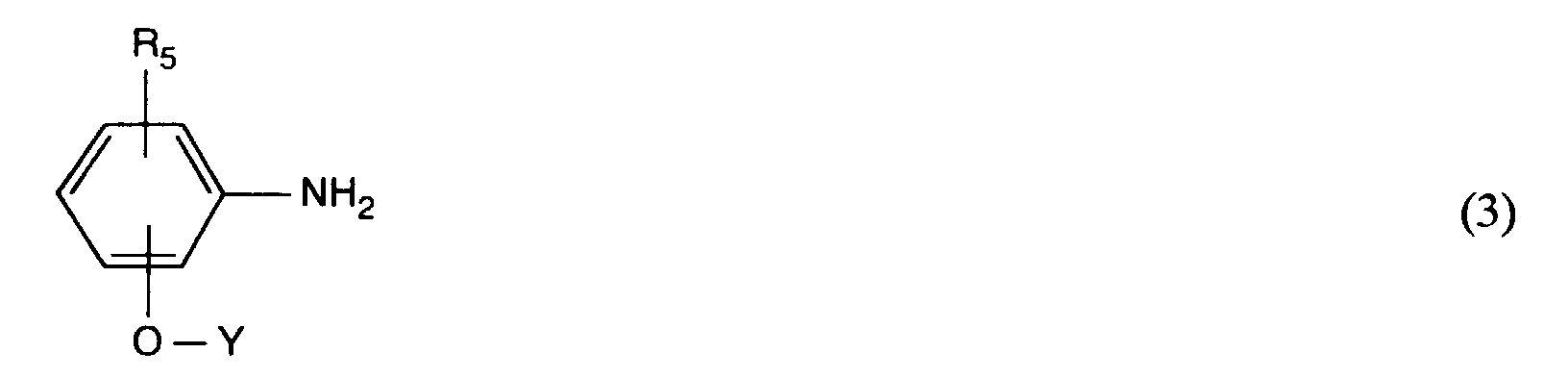
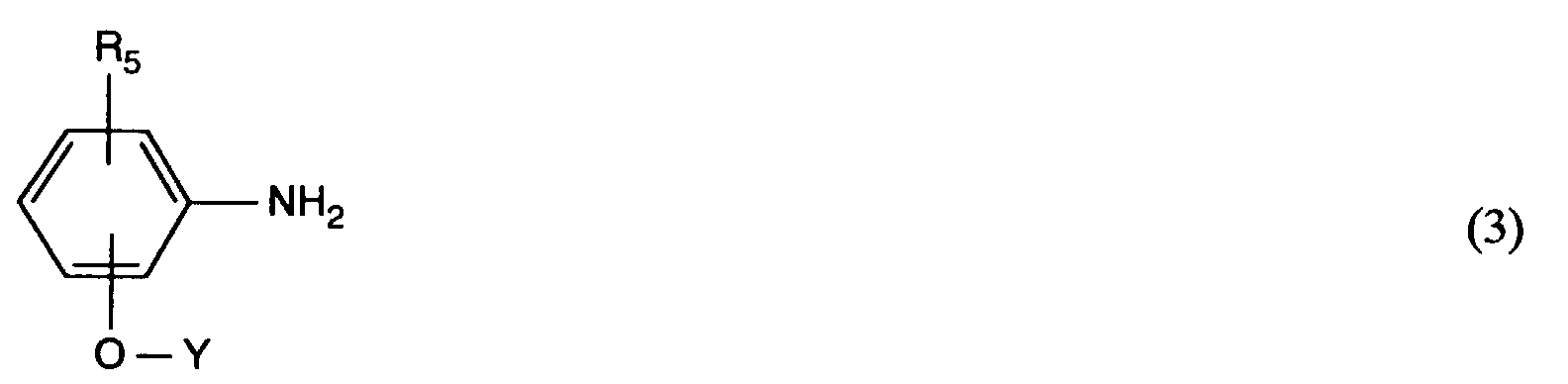
- the invention further relates to a process for the preparation of the azo dyes of the formula (1), which is characterized in that an amine of the formula diazotized, on a coupling component of the formula couples, the reaction product obtained with a the rest of the formula introducing compound and optionally a further conversion reaction, wherein R 5 , X and Y have the meanings given above under formula (1).
- the compound of formula (2) is diazotized in a manner known per se, e.g. with a nitrite, e.g. with an alkali metal nitrite such as sodium nitrite, in one mineral acid medium, e.g. in a hydrochloric acid medium, at temperatures of for example -5 to 40 ° C and preferably at 10 to 30 ° C.
- the coupling to the coupling component of the formula (3) is carried out in a manner known per se Way, at acidic, neutral to weakly alkaline pH values and temperatures of for example -5 to 30 ° C, preferably 5 to 15 ° C.
- Hal is halogen, such as chlorine, bromine or iodine, especially chlorine
- Acetic anhydride is particularly suitable for the introduction of compounds of the formula (4) in which X is methyl.
- Propionic anhydride is particularly suitable for the introduction of compounds of the formula (4) in which X is ethyl.
- the introduction of the rest of the above formula (4) can e.g. in dipolar aprotic solvents such as e.g. Dimethylformamide or dimethyl sulfoxide, or in Pyridine, or in particular in water, at a temperature of, for example, 40 up to 100 ° C and a pH of e.g. 5 to 8.
- dipolar aprotic solvents such as e.g. Dimethylformamide or dimethyl sulfoxide, or in Pyridine, or in particular in water, at a temperature of, for example, 40 up to 100 ° C and a pH of e.g. 5 to 8.
- azo dyes of the formula (1) which by hydroxy Contain substituted alkyl radical, can also of corresponding compounds can be assumed, which contain an acetate residue.
- corresponding compounds By hydrolysis of the Acetate residues, e.g. in a water / methanol mixture in the presence of ammonia, the corresponding compound containing a hydroxy group can be obtained.
- the azo dyes of the formula (1) are either in the form of their free acid or preferably as their salts.
- the salts include, for example, the alkali metal or ammonium salts or the salts of one organic amine into consideration.
- Examples are the sodium, lithium, potassium or ammonium salts or the salt called mono-, di- or triethanolamine.
- the azo dyes of the formula (1) according to the invention are suitable according to those known per se Methods for dyeing and printing, in particular those containing nitrogen or hydroxyl groups Fiber materials such as textile fiber materials made of cellulose, silk and especially wool and synthetic polyamides. Coloring or is preferred Printing on natural or synthetic polyamide fiber materials.
- the Azo dyes of the formula (1) according to the invention can be prepared in if necessary, previously prepared form can be used for dyeing or printing. Level dyeings in yellow to orange tones with good general fastness properties are obtained, especially good rub, wet, wet rub and light fastness.
- the Dyes according to the invention are readily water-soluble.
- the inventive Dyes can be combined very well with other dyes.
- the above Textile material can be in a wide variety of processing forms, e.g. as Fiber, yarn, woven or knitted fabric.
- parts represent parts by weight.
- the temperatures are Celsius degrees.
- the relationship between parts by weight and parts by volume is the same as the one between grams and cubic centimeters.
- a neutral, 70 to 80 ° C hot solution of 36.7 parts 4-Amino-azobenzene-4'-sulfonic acid in 500 parts of water is left in simultaneously with 27.5 Divide an aqueous 4 normal sodium nitrite solution into a mixture of 30 parts concentrated hydrochloric acid and 200 parts ice and keep the temperature of the Reaction mixture by adding ice at approx. 20 ° C. After the addition is complete Stirred for 2 hours and the excess nitrite is mixed with a little amidosulfonic acid destroyed.
- the diazotization mixture prepared in this way is slowly allowed to cool to a temperature of 0 to 5 ° C Solution of 17.5 parts of 2- (2-amino-4-methylphenoxy) ethanol in 200 parts of 2-normal Hydrochloric acid flow in and maintains the pH with aqueous sodium carbonate solution (20%) at a value of approx. 5.
- the dark, brown-red suspension is left for another hour stirred at a temperature of 10 to 15 ° C.
- the precipitate is suctioned off, in 500 Parts of water dissolved at a temperature of 80 ° C and with 30 parts of sodium chloride salted out. After washing with a little 5% aqueous sodium chloride solution and Ethanol gives 42.3 parts of a red powder.
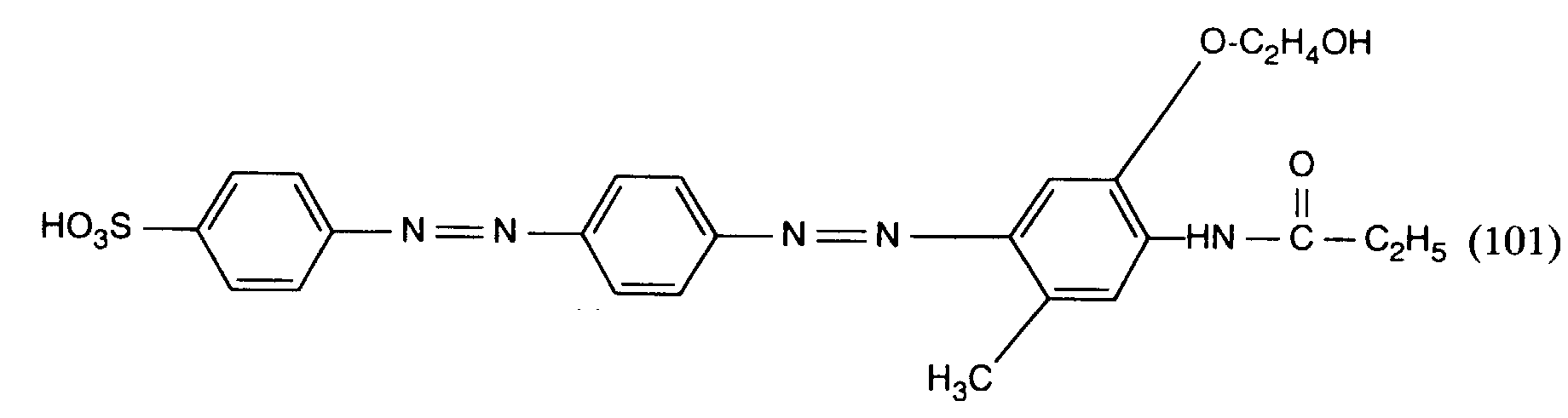
- the isopropanol solution is strongly concentrated, cooled to a temperature of 0 ° C and the resulting precipitate is filtered off. This gives 4.4 parts of an orange dye, which is in the form of the free acid of the compound of the formula corresponds.
- the dye of formula (101) obtained dyes natural and synthetic polyamide fiber material in orange shades.
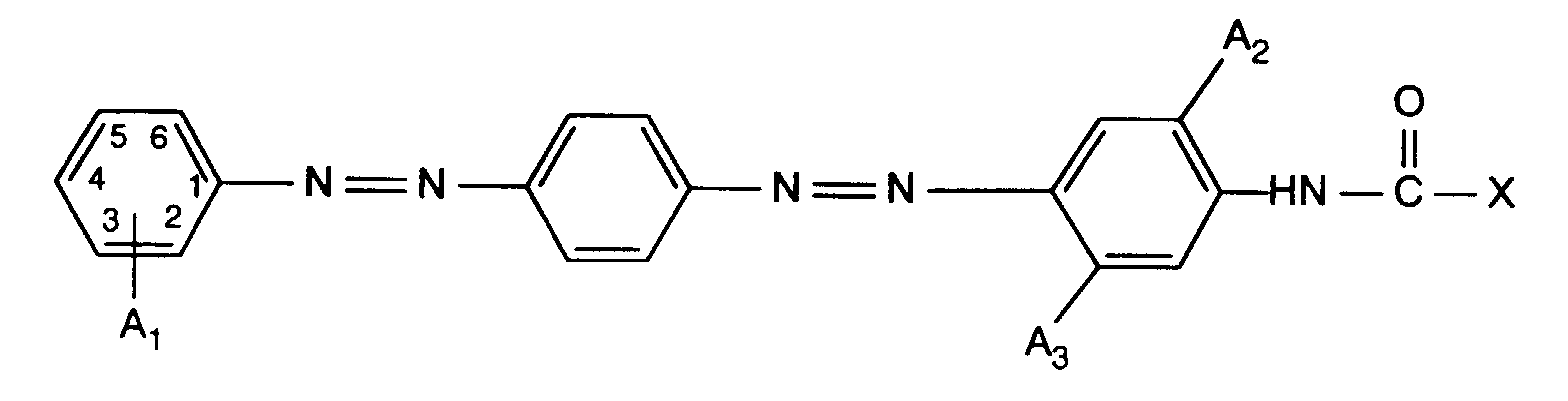
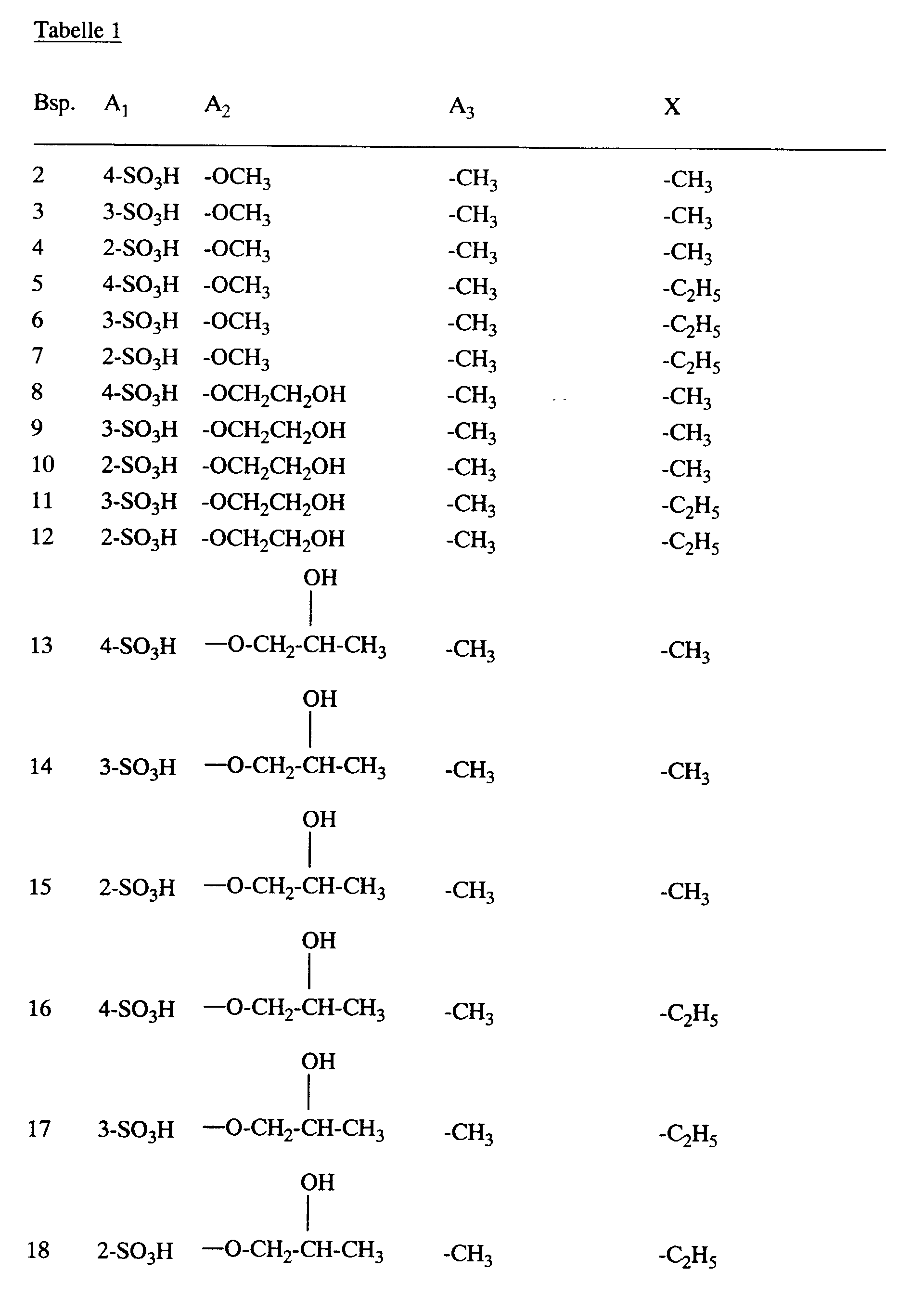
- the dyes of the formula given in the form of the free acid can are obtained, wherein A 1 , A 2 , A 3 and X have the meanings given in Table 1 below. Equimolar amounts of acetic anhydride are used to introduce the residue -CO-X, where X is methyl.
- the dyes listed in Table 1 dye natural and synthetic polyamide fiber material in yellow to orange shades.
- 10 parts of polyamide 6.6 fabric are dyed in 500 parts of an aqueous liquor containing 1 g / l Contains monosodium phosphate and is adjusted to pH 6 with disodium phosphate.
- the amount of the dye according to Example 1 is 1%, based on the fiber weight.
- the Dyeing time at a temperature of 98 ° is 30 to 90 minutes.
- the dyed polyamide 6.6 fabric is then removed and washed as usual and dried.
- the printed goods are dried in a drying cabinet at 70 to 80 ° and then 20 to 30 Steamed for minutes with saturated steam from 101 to 103 °.
- the goods then become 10 Rinsed cold for 15 minutes, at 50 to 60 ° with 2 g / l of a synthetic Washed detergent, rinsed cold again and then dried. You get one even pressure in orange shade.
Landscapes
- Chemical & Material Sciences (AREA)
- Organic Chemistry (AREA)
- Coloring (AREA)
Description





Claims (5)
- Azofarbstoffe der Formelworin
 R5 C1-C4-Alkyl, oder C1-C4-Alkyl,Y durch Hydroxy oder C1-C4-Alkoxy substituiertes C1-C8-Alkyl, undX gegebenenfalls durch Hydroxy oder C1-C4-Alkoxy substituiertes C1-C8-Alkyl oder C1-C8-Alkoxy, ist.
 - Azofarbstoffe gemäss Anspruch 1, dadurch gekennzeichnet, dass R5 C1-C4-Alkyl ist.
- Verfahren zur Herstellung von Azofarbstoffen gemäss Anspruch 1, dadurch gekennzeichnet, dass man ein Amin der Formeldiazotiert, auf eine Kupplungskomponente der Formel
 kuppelt, das erhaltene Reaktionsprodukt mit einer den Rest der Formel
 einführenden Verbindung umsetzt und gegebenenfalls eine weitere Umwandlungsreaktion anschliesst, wobei R5, X und Y die in Anspruch 1 angegebenen Bedeutungen haben.
- Verwendung der Azofarbstoffe gemäss den Ansprüchen 1 und 2 bzw. der gemäss Anspruch 3 erhaltenen Azofarbstoffe zum Färben oder Bedrucken von stickstoffhaltigen oder hydroxygruppenhaltigen Fasermaterialien.
- Verwendung gemäss Anspruch 4 zum Färben oder Bedrucken von natürlichen oder synthetischen Polyamidfasermaterialien.
Applications Claiming Priority (2)
| Application Number | Priority Date | Filing Date | Title |
|---|---|---|---|
| CH3333/92 | 1992-10-26 | ||
| CH333392 | 1992-10-26 |
Publications (2)
| Publication Number | Publication Date |
|---|---|
| EP0595768A1 EP0595768A1 (de) | 1994-05-04 |
| EP0595768B1 true EP0595768B1 (de) | 1998-01-21 |
Family
ID=4253709
Family Applications (1)
| Application Number | Title | Priority Date | Filing Date |
|---|---|---|---|
| EP93810730A Expired - Lifetime EP0595768B1 (de) | 1992-10-26 | 1993-10-18 | Azofarbstoffe, Verfahren zu deren Herstellung und deren Verwendung |
Country Status (5)
| Country | Link |
|---|---|
| US (1) | US5527889A (de) |
| EP (1) | EP0595768B1 (de) |
| JP (1) | JPH06212083A (de) |
| DE (1) | DE59308033D1 (de) |
| ES (1) | ES2112975T3 (de) |
Families Citing this family (6)
| Publication number | Priority date | Publication date | Assignee | Title |
|---|---|---|---|---|
| DE59408909D1 (de) * | 1993-10-13 | 1999-12-16 | Ciba Sc Holding Ag | Neue Fluoreszenzfarbstoffe |
| EP0754733A1 (de) * | 1995-07-21 | 1997-01-22 | Ciba SC Holding AG | Azofarbstoffe, Verfahren zu deren Herstellung und deren Verwendung |
| TW415960B (en) * | 1995-07-21 | 2000-12-21 | Ciba Sc Holding Ag | Azo dyes, processes for their preparation and their use |
| DE59701206D1 (de) * | 1996-07-12 | 2000-04-13 | Ciba Sc Holding Ag | Verfahren zum Trichromie-Färben oder -Bedrucken |
| US5948125A (en) * | 1997-05-20 | 1999-09-07 | Ciba Specialty Chemicals Corporation | Method of treating dyed, natural or synthetic polyamide fibre materials |
| EP1013719A1 (de) * | 1998-12-22 | 2000-06-28 | Ciba SC Holding AG | Verfahren zum Trichromie-Färben oder Bedrucken |
Family Cites Families (12)
| Publication number | Priority date | Publication date | Assignee | Title |
|---|---|---|---|---|
| DE1267769B (de) * | 1959-03-13 | 1968-05-09 | Du Pont | Verfahren zur Herstellung von wasserloeslichen Dis- und Tetrakis-azofarbstoffen |
| DE1923680C3 (de) * | 1969-05-09 | 1978-04-20 | Bayer Ag, 5090 Leverkusen | Disazofarbstoffe und ihre Verwendung zum Färben und Bedrucken von natürlichen und synthetischen Fasermaterialien |
| NL7514577A (nl) * | 1974-12-20 | 1976-06-22 | Hoechst Ag | In water oplosbare disazokleurstoffen, bereiding en toepassing. |
| US4194883A (en) * | 1974-12-20 | 1980-03-25 | Hoechst Aktiengesellschaft | Water-soluble disazo dyestuffs and process for coloring synthetic polyamide fibres with them |
| DE2708779C2 (de) * | 1977-03-01 | 1985-09-05 | Bayer Ag, 5090 Leverkusen | Disazofarbstoffe, Verfahren zu ihrer Herstellung und ihre Verwendung |
| US4466920A (en) * | 1977-03-14 | 1984-08-21 | Sandoz Ltd. | Disazo compounds having a further unsubstituted or substituted sulfophenyl diazo component radical and a 4-alkoxy- or arylsulfonyloxy benzene coupling component radical having an acylamina substituent |
| DE2718620C2 (de) * | 1977-04-27 | 1982-10-21 | Basf Ag, 6700 Ludwigshafen | Sulfonsäuregruppenhaltige Disazofarbstoffe und deren Verwendung |
| CH643580A5 (de) * | 1979-08-10 | 1984-06-15 | Sandoz Ag | Anionische disazoverbindungen, deren herstellung und verwendung als farbstoffe. |
| US4340385A (en) * | 1981-02-23 | 1982-07-20 | Sandoz, Inc. | Stable, concentrated, aqueous compositions containing para-sulfophenyl-azo-substituted 1,4-phenylene-azo-para-2-hydroxypropoxyphenyl dyes |
| US4749784A (en) * | 1985-03-11 | 1988-06-07 | Crompton & Knowles Corporation | Alkanol substituted disazo orange dye for nylon |
| EP0425434B1 (de) * | 1989-10-23 | 1995-11-15 | Ciba-Geigy Ag | Farbstoffmischungen und deren Verwendung |
| EP0586339B1 (de) * | 1992-08-27 | 1999-09-22 | Ciba SC Holding AG | Azofarbstoffe, Verfahren zu deren Herstellung und deren Verwendung |
-
1993
- 1993-10-18 DE DE59308033T patent/DE59308033D1/de not_active Expired - Fee Related
- 1993-10-18 ES ES93810730T patent/ES2112975T3/es not_active Expired - Lifetime
- 1993-10-18 EP EP93810730A patent/EP0595768B1/de not_active Expired - Lifetime
- 1993-10-25 JP JP5266422A patent/JPH06212083A/ja active Pending
-
1995
- 1995-04-17 US US08/425,663 patent/US5527889A/en not_active Expired - Fee Related
Also Published As
| Publication number | Publication date |
|---|---|
| EP0595768A1 (de) | 1994-05-04 |
| JPH06212083A (ja) | 1994-08-02 |
| ES2112975T3 (es) | 1998-04-16 |
| DE59308033D1 (de) | 1998-02-26 |
| US5527889A (en) | 1996-06-18 |
Similar Documents
| Publication | Publication Date | Title |
|---|---|---|
| DE1644203C3 (de) | ||
| EP0719837B1 (de) | Azofarbstoffe, Verfahren zu deren Herstellung und deren Verwendung | |
| EP0714955B1 (de) | Azofarbstoffe, Verfahren zu deren Herstellung und deren Verwendung | |
| EP0595768B1 (de) | Azofarbstoffe, Verfahren zu deren Herstellung und deren Verwendung | |
| EP0586331B1 (de) | Verfahren zum Färben von synthetischen Polyamidfasermaterialien | |
| EP0718374B1 (de) | 1:2-Chromkomplexfarbstoffe enthaltende Farbstoffmischungen und 1:2 Chromkomplexfarbstoffe | |
| EP0754732B1 (de) | Azofarbstoffe, Verfahren zu deren Herstellung und deren Verwendung | |
| EP0514330B1 (de) | Azofarbstoffe | |
| DE1230152B (de) | Verfahren zur Herstellung von Azofarbstoffen | |
| EP0586339B1 (de) | Azofarbstoffe, Verfahren zu deren Herstellung und deren Verwendung | |
| DE1924570C3 (de) | Wasserlösliche Azofarbstoffe, Verfahren zu deren Herstellung und ihre Verwendung zum Färben und Bedrucken | |
| DE2854517A1 (de) | Azo reaktivfarbstoffverbindungen | |
| US4101547A (en) | 1,4-Diaminoanthraquinones | |
| DE1904112C3 (de) | Faserreaktive, schwermetallhaltige Formazanfarbstoffe, Verfahren zu ihrer Herstellung und deren Verwendung zum Färben oder Bedrucken von Textilmaterial | |
| DE1904113C3 (de) | Faserreaktive, schwermetallhaltige Formazanfarbstoffe, Verfahren zu deren Herstellung und deren Verwendung | |
| EP0457729B1 (de) | Azofarbstoffe, Verfahren zu deren Herstellung und deren Verwendung | |
| EP0439423B1 (de) | Azofarbstoffe, Verfahren zu deren Herstellung und deren Verwendung | |
| DE1904111C3 (de) | Faserreaktive schwermetallhaltige Formazanfarbstoffe, Verfahren zu ihrer Herstellung und deren Verwendung zum Färben oder Bedrucken von Textilmaterialien | |
| EP0739952B1 (de) | Azofarbstoffmischungen und deren Verwendung | |
| DE2106648A1 (en) | Soluble azo and anthraquinone dyes - from dyes contg vinylsulphone gps by addition of diethanolamine and sulphating | |
| DE3046451A1 (de) | "halo-triazinyl-verbindungen, deren herstellung und verwendung" | |
| EP0524147A2 (de) | Azofarbstoffe, Verfahren zu deren Herstellung und deren Verwendung | |
| EP0569329A1 (de) | Azofarbstoffe, Verfahren zu deren Herstellung und deren Verwendung | |
| CH637151A5 (de) | Neue azofarbstoffe und deren verwendung. | |
| EP0342159A1 (de) | Wasserlösliche Phthalocyaninverbindungen, Verfahren zu ihrer Herstellung und ihre Verwendung |
Legal Events
| Date | Code | Title | Description |
|---|---|---|---|
| PUAI | Public reference made under article 153(3) epc to a published international application that has entered the european phase |
Free format text: ORIGINAL CODE: 0009012 |
|
| AK | Designated contracting states |
Kind code of ref document: A1 Designated state(s): BE CH DE ES FR GB IT LI |
|
| 17P | Request for examination filed |
Effective date: 19941014 |
|
| 17Q | First examination report despatched |
Effective date: 19950201 |
|
| RAP1 | Party data changed (applicant data changed or rights of an application transferred) |
Owner name: CIBA SC HOLDING AG |
|
| RAP3 | Party data changed (applicant data changed or rights of an application transferred) |
Owner name: CIBA SPECIALTY CHEMICALS HOLDING INC. |
|
| GRAG | Despatch of communication of intention to grant |
Free format text: ORIGINAL CODE: EPIDOS AGRA |
|
| GRAG | Despatch of communication of intention to grant |
Free format text: ORIGINAL CODE: EPIDOS AGRA |
|
| GRAH | Despatch of communication of intention to grant a patent |
Free format text: ORIGINAL CODE: EPIDOS IGRA |
|
| GRAH | Despatch of communication of intention to grant a patent |
Free format text: ORIGINAL CODE: EPIDOS IGRA |
|
| GRAA | (expected) grant |
Free format text: ORIGINAL CODE: 0009210 |
|
| AK | Designated contracting states |
Kind code of ref document: B1 Designated state(s): BE CH DE ES FR GB IT LI |
|
| REG | Reference to a national code |
Ref country code: CH Ref legal event code: EP |
|
| ET | Fr: translation filed | ||
| REF | Corresponds to: |
Ref document number: 59308033 Country of ref document: DE Date of ref document: 19980226 |
|
| GBT | Gb: translation of ep patent filed (gb section 77(6)(a)/1977) |
Effective date: 19980302 |
|
| ITF | It: translation for a ep patent filed | ||
| REG | Reference to a national code |
Ref country code: ES Ref legal event code: FG2A Ref document number: 2112975 Country of ref document: ES Kind code of ref document: T3 |
|
| PLBE | No opposition filed within time limit |
Free format text: ORIGINAL CODE: 0009261 |
|
| STAA | Information on the status of an ep patent application or granted ep patent |
Free format text: STATUS: NO OPPOSITION FILED WITHIN TIME LIMIT |
|
| 26N | No opposition filed | ||
| PGFP | Annual fee paid to national office [announced via postgrant information from national office to epo] |
Ref country code: FR Payment date: 19990830 Year of fee payment: 7 Ref country code: CH Payment date: 19990830 Year of fee payment: 7 |
|
| PGFP | Annual fee paid to national office [announced via postgrant information from national office to epo] |
Ref country code: DE Payment date: 19990910 Year of fee payment: 7 |
|
| PGFP | Annual fee paid to national office [announced via postgrant information from national office to epo] |
Ref country code: GB Payment date: 19990922 Year of fee payment: 7 |
|
| PGFP | Annual fee paid to national office [announced via postgrant information from national office to epo] |
Ref country code: ES Payment date: 19991019 Year of fee payment: 7 |
|
| PGFP | Annual fee paid to national office [announced via postgrant information from national office to epo] |
Ref country code: BE Payment date: 19991221 Year of fee payment: 7 |
|
| PG25 | Lapsed in a contracting state [announced via postgrant information from national office to epo] |
Ref country code: GB Free format text: LAPSE BECAUSE OF NON-PAYMENT OF DUE FEES Effective date: 20001018 |
|
| PG25 | Lapsed in a contracting state [announced via postgrant information from national office to epo] |
Ref country code: ES Free format text: LAPSE BECAUSE OF NON-PAYMENT OF DUE FEES Effective date: 20001019 |
|
| PG25 | Lapsed in a contracting state [announced via postgrant information from national office to epo] |
Ref country code: LI Free format text: LAPSE BECAUSE OF NON-PAYMENT OF DUE FEES Effective date: 20001031 Ref country code: CH Free format text: LAPSE BECAUSE OF NON-PAYMENT OF DUE FEES Effective date: 20001031 Ref country code: BE Free format text: LAPSE BECAUSE OF NON-PAYMENT OF DUE FEES Effective date: 20001031 |
|
| BERE | Be: lapsed |
Owner name: CIBA SPECIALTY CHEMICALS HOLDING INC. Effective date: 20001031 |
|
| GBPC | Gb: european patent ceased through non-payment of renewal fee |
Effective date: 20001018 |
|
| REG | Reference to a national code |
Ref country code: CH Ref legal event code: PL |
|
| PG25 | Lapsed in a contracting state [announced via postgrant information from national office to epo] |
Ref country code: FR Free format text: LAPSE BECAUSE OF NON-PAYMENT OF DUE FEES Effective date: 20010629 |
|
| PG25 | Lapsed in a contracting state [announced via postgrant information from national office to epo] |
Ref country code: DE Free format text: LAPSE BECAUSE OF NON-PAYMENT OF DUE FEES Effective date: 20010703 |
|
| REG | Reference to a national code |
Ref country code: FR Ref legal event code: ST |
|
| REG | Reference to a national code |
Ref country code: ES Ref legal event code: FD2A Effective date: 20011113 |
|
| PG25 | Lapsed in a contracting state [announced via postgrant information from national office to epo] |
Ref country code: IT Free format text: LAPSE BECAUSE OF NON-PAYMENT OF DUE FEES;WARNING: LAPSES OF ITALIAN PATENTS WITH EFFECTIVE DATE BEFORE 2007 MAY HAVE OCCURRED AT ANY TIME BEFORE 2007. THE CORRECT EFFECTIVE DATE MAY BE DIFFERENT FROM THE ONE RECORDED. Effective date: 20051018 |