EP0439423B1 - Azofarbstoffe, Verfahren zu deren Herstellung und deren Verwendung - Google Patents
Azofarbstoffe, Verfahren zu deren Herstellung und deren Verwendung Download PDFInfo
- Publication number
- EP0439423B1 EP0439423B1 EP91810025A EP91810025A EP0439423B1 EP 0439423 B1 EP0439423 B1 EP 0439423B1 EP 91810025 A EP91810025 A EP 91810025A EP 91810025 A EP91810025 A EP 91810025A EP 0439423 B1 EP0439423 B1 EP 0439423B1
- Authority
- EP
- European Patent Office
- Prior art keywords
- formula
- hydrogen
- dyeing
- substituted
- dye
- Prior art date
- Legal status (The legal status is an assumption and is not a legal conclusion. Google has not performed a legal analysis and makes no representation as to the accuracy of the status listed.)
- Expired - Lifetime
Links
- 0 Nc(cc1)ccc1N=NC(C=C1)=CC=C*1S(O)(=O)=O Chemical compound Nc(cc1)ccc1N=NC(C=C1)=CC=C*1S(O)(=O)=O 0.000 description 5
- URLKBWYHVLBVBO-UHFFFAOYSA-N Cc1ccc(C)cc1 Chemical compound Cc1ccc(C)cc1 URLKBWYHVLBVBO-UHFFFAOYSA-N 0.000 description 1
- YXFVVABEGXRONW-UHFFFAOYSA-N Cc1ccccc1 Chemical compound Cc1ccccc1 YXFVVABEGXRONW-UHFFFAOYSA-N 0.000 description 1
Classifications
-
- C—CHEMISTRY; METALLURGY
- C09—DYES; PAINTS; POLISHES; NATURAL RESINS; ADHESIVES; COMPOSITIONS NOT OTHERWISE PROVIDED FOR; APPLICATIONS OF MATERIALS NOT OTHERWISE PROVIDED FOR
- C09B—ORGANIC DYES OR CLOSELY-RELATED COMPOUNDS FOR PRODUCING DYES, e.g. PIGMENTS; MORDANTS; LAKES
- C09B29/00—Monoazo dyes prepared by diazotising and coupling
- C09B29/34—Monoazo dyes prepared by diazotising and coupling from other coupling components
- C09B29/36—Monoazo dyes prepared by diazotising and coupling from other coupling components from heterocyclic compounds
-
- C—CHEMISTRY; METALLURGY
- C09—DYES; PAINTS; POLISHES; NATURAL RESINS; ADHESIVES; COMPOSITIONS NOT OTHERWISE PROVIDED FOR; APPLICATIONS OF MATERIALS NOT OTHERWISE PROVIDED FOR
- C09B—ORGANIC DYES OR CLOSELY-RELATED COMPOUNDS FOR PRODUCING DYES, e.g. PIGMENTS; MORDANTS; LAKES
- C09B31/00—Disazo and polyazo dyes of the type A->B->C, A->B->C->D, or the like, prepared by diazotising and coupling
- C09B31/02—Disazo dyes
- C09B31/10—Disazo dyes from a coupling component "C" containing reactive methylene groups
-
- C—CHEMISTRY; METALLURGY
- C09—DYES; PAINTS; POLISHES; NATURAL RESINS; ADHESIVES; COMPOSITIONS NOT OTHERWISE PROVIDED FOR; APPLICATIONS OF MATERIALS NOT OTHERWISE PROVIDED FOR
- C09B—ORGANIC DYES OR CLOSELY-RELATED COMPOUNDS FOR PRODUCING DYES, e.g. PIGMENTS; MORDANTS; LAKES
- C09B43/00—Preparation of azo dyes from other azo compounds
-
- D—TEXTILES; PAPER
- D06—TREATMENT OF TEXTILES OR THE LIKE; LAUNDERING; FLEXIBLE MATERIALS NOT OTHERWISE PROVIDED FOR
- D06P—DYEING OR PRINTING TEXTILES; DYEING LEATHER, FURS OR SOLID MACROMOLECULAR SUBSTANCES IN ANY FORM
- D06P3/00—Special processes of dyeing or printing textiles, or dyeing leather, furs, or solid macromolecular substances in any form, classified according to the material treated
- D06P3/02—Material containing basic nitrogen
- D06P3/04—Material containing basic nitrogen containing amide groups
- D06P3/24—Polyamides; Polyurethanes
- D06P3/241—Polyamides; Polyurethanes using acid dyes
Definitions
- the present invention relates to new azo dyes, processes for their preparation and use of these dyes for dyeing and printing fiber materials, in particular textile fiber materials.
- a dye of the formula is already known from FR-A-20 30 380, Example 1
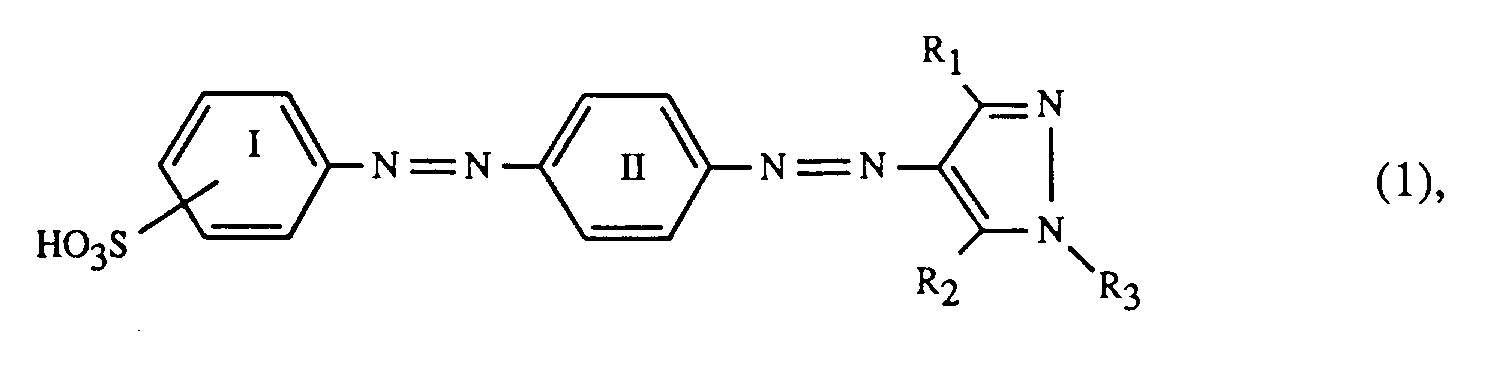
- the present invention relates to azo dyes of the formula wherein R1 is hydrogen or C1-C4-alkyl, R2 C2-C4-alkyl, R3 is hydrogen, C1-C4-alkyl or optionally substituted C5-C7-cycloalkyl or phenyl and the benzene rings I and II are optionally substituted.
- the azo dyes of the formula (1) are generally as a mixture of isomers of the compounds of the formulas in front.
- the term azo dyes of the formula (1) here and below also mean the above-mentioned isomer mixtures.
- R1 and R3 in formula (1) independently of one another methyl, ethyl, propyl, isopropyl, butyl, isobutyl, sec-butyl or tert-butyl.
- C2-C4 alkyl for R2 in formula (1) is ethyl, propyl, isopropyl, butyl, isobutyl, sec-butyl or tert-butyl.
- C5-C7-cycloalkyl for R3 in formula (1) e.g. unsubstituted cyclohexyl or by C1-C4-alkyl, e.g. Methyl or ethyl, substituted cyclohexyl.
- phenyl for R3 in formula (1) e.g. unsubstituted phenyl or by C1-C4 alkyl, e.g. Methyl or ethyl, C1-C4 alkoxy, e.g. Methoxy or ethoxy, C2-C4 alkanoylamino, e.g. Acetylamino or propionylamino, hydroxy, sulfo, cyan or halogen, e.g. Fluorine, chlorine or bromine, substituted phenyl into consideration.
- C1-C4 alkyl e.g. Methyl or ethyl
- C1-C4 alkoxy e.g. Methoxy or ethoxy
- C2-C4 alkanoylamino e.g. Acetylamino or propionylamino
- hydroxy, sulfo, cyan or halogen e.g. Fluorine, chlorine or bromine
- the substituents of the benzene rings I and II are, for example, independently of one another C1-C4 alkyl, e.g. Methyl or ethyl, C1-C4 alkoxy, e.g. Methoxy or ethoxy, C2-C4 alkanoylamino, e.g. Acetylamino or propionylamino, hydroxy, sulfo, cyano, nitro, sulfonamido or halogen, e.g. Fluorine, chlorine or bromine.
- C1-C4 alkyl e.g. Methyl or ethyl
- C1-C4 alkoxy e.g. Methoxy or ethoxy
- C2-C4 alkanoylamino e.g. Acetylamino or propionylamino
- hydroxy, sulfo, cyano, nitro, sulfonamido or halogen
- Preferred substituents of the benzene rings I and II are C1-C4-alkyl, C1-C4-alkoxy, C2-C4-alkanoylamino and halogen, in particular methyl, methoxy and chlorine, preferably methoxy.
- azo dyes of the formula (1) in which R1 is C1-C4-alkyl, in particular methyl or ethyl.
- azo dyes of the formula (1) in which R2 is ethyl.
- azo dyes of the formula (1) are preferred, in which R3 is hydrogen.
- azo dyes of the formula (1) in which the sulfo group is bonded to the benzo ring I in the meta or para position to the azo group.
- Azo dyes of the formula (I) are particularly preferred in which R1 is methyl or ethyl and R2 is ethyl, in particular in which R1 is methyl or ethyl and R2 is ethyl and the sulfo group is bonded to the benzene ring I in the meta or para position to the azo group.
- Azo dyes of the formula are particularly important wherein R1 is methyl or ethyl and R 'is hydrogen or methoxy and the sulfo group is bonded to the benz ring in the designated 3- or 4-position.
- the azo dyes of the formulas are of particular interest especially the dyes of formulas (5) and (6).
- the invention further relates to a process for the preparation of the azo dyes of the formula (I), which is characterized in that an amine of the formula diazotized and on a coupling component of the formula couples and the reaction product of the formula with a hydrazine of the formula H2N-NH-R3 (10) implements, wherein R1, R2 and R3 have the meanings given in formula (1) and the benzene rings I and II are optionally substituted.
- the diazotization of the amine of the formula (7) is usually carried out by the action of nitrous acid in aqueous mineral acid solution at low temperature, the coupling to the coupling component of the formula (8) at acidic, neutral to weakly alkaline pH values, especially at a pH from 2 to 6.
- the reaction of the compound of formula (9) with a hydrazine of formula (10) is carried out in water, an organic solvent, such as e.g. Methanol, ethanol, pyridine or glacial acetic acid or a mixture of water and an organic solvent such as e.g. Water / glacial acetic acid, at a temperature of 40 to 100 ° C, especially at a temperature of 40 to 60 ° C.
- an organic solvent such as e.g. Methanol, ethanol, pyridine or glacial acetic acid or a mixture of water and an organic solvent such as e.g. Water / glacial acetic acid
- the amines of the formula (7), the coupling components of the formula (8) and the hydrazines of the formula (10) are known per se or can be prepared analogously to known compounds.
- Examples of amines of the formula (7) are 4-amino-azobenzene-2'-, -3'- or -4'-sulfonic acid.
- Examples of coupling components of the formula (8) are 2,4-hexanedione, 3,5-heptanedione, 2,4-heptanedione, 3,5-octanedione and 4,6-octanedione.
- Examples of compounds of the formula (10) are hydrazine, methyl, ethyl, propyl, isopropyl, butyl, isobutyl, sec-butyl, tert-butyl or cyclohexyl hydrazine.
- Coupling components of the formula (8) in which R 1 is methyl or ethyl and R 2 is ethyl are particularly preferred for the process according to the invention.
- An amine of the formula (7) in which the sulfo group is bonded to the benzo ring I in the meta or para position to the azo group is preferably diazotized, and this is coupled to a coupling component of the formula (8) in which R 1 is methyl or ethyl and R 2 is ethyl is.
- a very particularly preferred embodiment of the process according to the invention for the preparation of the azo dyes of the formula (1) is characterized in that an amine of the formula (7) in which the sulfo group is bonded to the benzo ring I in the meta or para position to the azo group, diazotized and coupled to a coupling component of formula (8), wherein R1 is methyl or ethyl and R2 is ethyl, and the reaction product with a compound of formula (10), wherein R3 is hydrogen.
- a very particularly important embodiment of the process according to the invention for the preparation of the azo dyes of the formula (1) is characterized in that an amine of the formula wherein R 'is hydrogen or methoxy and the sulfo group is bonded to the benz ring in the 3- or 4-position, diazotized and on a coupling component of the formula wherein R1 is methyl or ethyl, couples and the reaction product with a compound of the formula H2N-NH2 (13) implements.
- the invention further relates to a process for trichromatic dyeing or printing of natural and synthetic polyamide materials with a dye mixture which contains at least one yellow or orange-dyeing dye of the formula (1) together with at least one red-dyeing dye and at least one blue-dyeing dye, where the preferences given above apply to the dye of the formula (1); in particular, a dye of the formula (3) is used as the yellow or orange dye.
- At least one dye of the formula (1) is preferably used together with at least one of the red-coloring dyes of the formulas (14), (15) and (16): wherein R4 optionally substituted C1-C8-alkyl, halogen, optionally substituted in the phenyl ring by C1-C4-alkyl substituted phenylsulfonyl or phenoxysulfonyl, cyclohexyloxycarbonylamino, C2-C4-alkanoylamino, optionally in the phenyl ring by halogen substituted benzoylamino, 1-azacycloheptane-N-sulfonyl or is wherein R4 optionally substituted C1-C8-alkyl, halogen, optionally substituted in the phenyl ring by C1-C4-alkyl substituted phenylsulfonyl or phenoxysulfonyl, cyclohexyloxycarbonylamino
- R7 is C1-C8-alkyl or optionally substituted by C1-C4-alkyl, phenyl or cyclohexyl and R8 is hydrogen or C1-C8-alkyl
- R5 is hydrogen, halogen, C1-C8-alkyl or C2-C4-alkanoylamino
- R6 is hydrogen or halogen is wherein D is optionally substituted phenyl, thiophenyl or benzthiazolyl
- R9 C1-C8-alkyl R10 optionally substituted C1-C8-alkyl and R11 is hydrogen or C1-C4-alkyl
- R12 is C1-C4-alkyl, together with at least one blue-coloring dye of the formula wherein one Y is hydrogen or methyl and the other Y is C2 ⁇ 4-alkanoylamino or C2-C4-hydroxyalkylsulphamoyl and Z4 is hydrogen or methyl, the preferences given above applying
- R5, R7 and R8 in the formula (14) and for R9 and R10 in formula (15) independently of one another z.
- R4, R5, R7, R8, R9 and R10 are C1-C4-alkyl.
- the radical R4 in formula (14) as C1-C8 alkyl can be substituted, e.g. by halogen, e.g. Chlorine or bromine and especially fluorine.
- halogen e.g. Chlorine or bromine and especially fluorine.
- the trifluoromethyl radical may be mentioned as an example.
- the radical R10 in formula (15) as C1-C8-alkyl can be substituted e.g. by sulfo, sulfato or phenyl. Examples include benzyl, ⁇ -sulfoethyl, ⁇ -sulfopropyl and ⁇ -sulfatoethyl.
- Halogen for R4, R5 and R6 in formula (14) independently of one another are, for example Fluorine, bromine or especially chlorine.
- radical R4 in formula (14) as benzoylamino in the phenyl ring can be replaced by halogen, e.g. Fluorine, bromine or especially chlorine, may be substituted.
- the radical R7 as phenyl or cyclohexyl and the radical R4 as phenylsulfonyl or phenoxysulfonyl can by C1-C4-alkyl, such as.
- methyl, ethyl, propyl, isopropyl, butyl, sec-butyl, tert-butyl or isobutyl, especially methyl, may be substituted.
- C1-C4 alkyl for R11 in formula (15) and for R12 in formula (16) independently z.
- B methyl, ethyl, propyl, isopropyl, butyl, sec-butyl, tert-butyl or isobutyl, especially methyl, into consideration.
- C2-C4-alkanoylamino come for R4 and R5 in formula (14) and for Y in formula (17) independently of one another e.g. Acetylamino, propionylamino or butyrylamino.
- the radical D in formula (15) can be, for example, halogen, such as fluorine, chlorine or bromine, C1-C4-alkyl, such as methyl, ethyl, propyl, isopropyl, butyl, sec-butyl, tert-butyl or isobutyl, C1-C4-alkoxy such as methoxy, ethoxy, propoxy or butoxy, C1-C4-alkoxycarbonyl such as methoxycarbonyl or ethoxycarbonyl, sulfo or C1-C--alkylaminosulfonyl optionally substituted in the alkyl part by sulfo such as methylaminosulfonyl, ethylaminosulfonyl or ⁇ - Sulfoethylaminosulfonyl, be substituted.
- halogen such as fluorine, chlorine or bromine
- C1-C4-alkyl such as methyl
- C2 ⁇ 4-hydroxylalkylsulphamoyl for Y in formula (17) is, for example, the ⁇ -hydroxyethylsulphamoyl, ⁇ -hydroxypropylsulphamoyl, ⁇ -hydroxypropylsulphamoyl or the ⁇ -hydroxybutylsulphamoyl.
- At least one of the red-coloring dyes of the formulas (14), (15) and (16) is preferably used for the process according to the invention for trichromatic dyeing or printing, wherein in the dye of the formula (14) R4 trifluoromethyl, chlorine, acetylamino, -SO2N (n-C4H9) 2, phenoxysulfonyl, phenylsulfonyl, 1-azacycloheptane-N-sulfonyl, cyclohexyloxycarbonylamino, benzoylamino optionally substituted by chlorine in the phenyl ring or phenylaminosulfonyl optionally substituted by methyl in the phenyl ring, cyclohexylaminosulfonyl C2-N- (C1) or N- (C1-C2-alkyl) cyclohexylaminosulfonyl, R5 is hydrogen, methyl, chlorine or acetylamino and R6
- mixtures of blue-coloring dyes are used for the process according to the invention, preference is given to mixing the blue-coloring dyes of the formulas (21) or (22) with a dye of the formula (23), (24) or (25).
- the mixture of the blue-coloring dyes of the formulas is very particularly preferred wherein Y2 is a C2 ⁇ 4-hydroxyalkylsulphamoylrest, and wherein the rest -NH-CO-CH2CH3 is bound in the 3- or 4-position.
- At least one dye of the formula (1) together with at least one of the red-coloring dyes of the formulas (18), (19) and (20), in particular (18) and (19), and at least one of the blue-coloring dyes of the formulas (21), (22), (23), (24) and (25), where the preferences given above apply to the dye of the formula (1); in particular, a dye of the formula (3) is used as the yellow or orange dye.
- a very particularly important embodiment of the process according to the invention for trichromatic dyeing or printing is characterized in that at least one dye of the formula (1) is used together with a red-coloring dye of the formula (19) and a blue-coloring dye of the formula (21), the preferences given above apply to the dye of the formula (1); in particular, a dye of the formula (3) is used as the yellow or orange dye.
- dye mixtures are used in the process according to the invention, these can be prepared by mixing the individual dyes. This mixing process takes place, for example, in suitable mills, e.g. Ball and pin mills, as well as in kneaders or mixers.
- the dye mixtures of the dyes can be prepared by spray drying the aqueous dye mixtures.
- the dyes of the formula (1) according to the invention and the dyes used in the process according to the invention for trichromatic dyeing or printing are either in the form of their free sulfonic acid or preferably as their salts.
- suitable salts are the alkali, alkaline earth or ammonium salts or the salts of an organic amine.
- suitable salts include the sodium, lithium, potassium or ammonium salts or the salt of mono-, di- or triethanolamine.
- the dyes of the formula (1) according to the invention and the dyes used in the process according to the invention generally contain further additives such as e.g. Cooking salt or dextrin.
- the process according to the invention for trichromatic dyeing or printing can be applied to the customary dyeing or printing processes.
- the dyeing liquors or printing pastes can contain other additives, for example wetting agents, anti-foaming agents, leveling agents or agents which influence the property of the textile material, such as e.g. Plasticizers, flame retardants or dirt, water and oil repellents, water softeners and natural or synthetic thickeners such as Alginates and cellulose ethers.
- the dyes of the formula (1) according to the invention and the process according to the invention for trichromatic dyeing or printing are particularly suitable for dyeing from short liquors, such as suitable for continuous dyeing processes or discontinuous and continuous foam coloring processes.
- the dyes of the formula (1) according to the invention and the dyes used in the process according to the invention are distinguished in trichromatic dyeing or printing by uniform color build-up, good absorption behavior, good constancy of shades even in different concentrations, good fastness properties and in particular by very good combinability.
- the dyes of the formula (1) according to the invention and the process according to the invention for trichromatic dyeing or printing are suitable for dyeing or printing both natural polyamide materials such as wool, in particular synthetic polyamide materials such as polyamide 6 or polyamide 6.6, and are suitable for dyeing or printing wool and synthetic polyamide blends or yarns.
- the textile material mentioned can be in a wide variety of processing forms, such as as fiber, yarn, woven or knitted fabric and in particular in the form of carpets.
- the azo dyes of the formula (1) according to the invention give level dyeings with good general fastness properties, in particular good fastness to rubbing, wet, wet rubbing and light. Furthermore, the dyes according to the invention are readily water-soluble and hard water-resistant.
- parts represent parts by weight.
- the temperatures are degrees Celsius.
- the relationship between parts by weight and parts by volume is the same as that between grams and cubic centimeters.
- Example 1 A neutral, 70 to 80 ° hot solution of 28 parts of 4-amino-azobenzene-4'-sulfonic acid in 500 parts of water is simultaneously mixed with 26 parts of an aqueous sodium nitrite solution (4N) in the mixture of 28 parts of concentrated hydrochloric acid Run in 200 parts of water and keep the temperature of the reaction mixture at 20 to 25 ° by adding ice. After the addition is complete, stirring is continued for 2 hours and the excess nitrite is destroyed with a little amidosulfonic acid. The diazotization mixture thus prepared is slowly allowed to flow into a 0 to 5 ° cold solution of 14 parts of 2,4-hexanedione and 180 parts of sodium acetate in 500 parts of water. After stirring for several hours at 0 to 5 °, the reaction is warmed to 30 ° and the pH is adjusted to 5.5 with sodium acetate. The precipitate is then filtered off and dried at 60 °. 30 parts of an orange powder are obtained.
- 4N aqueous sodium nitrite
- Examples 2 to 113 The procedure is as described in Example 1, but instead of 28 parts of 4-amino-azobenzene-4'-sulfonic acid, an equimolar amount of a compound of the formula is used wherein the sulfo group in the position indicated in Table 1 in column 2 is bonded to the benzine ring I and the benzene rings I and II contain no further substituents, and instead of 14 parts of 2,4-hexanedione an equimolar amount of a compound of the formula wherein R1 and R2 have the meanings given in Table 1 in columns 3 and 4, and instead of 1.5 parts of hydrazine hydrate, an equimolar amount of a compound of the formula H2N-NH-R3 (10), wherein R3 has the meanings given in Table 1 in column 5, analog dyes are obtained which dye synthetic and natural polyamide materials in yellow shades.
- Examples 114 to 117 If the procedure is as given in Example 1, but instead of 28 parts of 4-amino-azobenzene-4'-sulfonic acid, an equimolar amount of one of the azo compounds given in Table 2 in column 2 is obtained, the result is Columns 3 in the form of free acids, which dye synthetic and natural polyamide materials in yellow shades.
- Example 118 If the procedure described in Example 114 is followed, but instead of 14 parts of 2,4-hexanedione, an equimolar amount of 3,5-heptanedione is used, the dye of the formula is obtained that colors synthetic and natural polyamide materials in yellow shades.
- Dyeing example 1 10 parts of polyamide-6.6 fiber material (Helancatrikot) are dyed in 500 parts of an aqueous liquor which contains 2 g / l of ammonium acetate and is adjusted to pH 5 with acetic acid.
- the dyes are 0.05% of the red dye in the form of the free acid of the formula corresponds to 0.18% of the yellow dye in the form of the free acid of the formula (101) and 0.17% of the blue dye in the form of the free acid of the formula corresponds, used, the quantities refer to the fiber weight.
- the dyeing time at a temperature of 98 ° is 30 to 90 minutes.
- the dyed polyamide fiber material is then removed and, as usual, rinsed and dried. The result is a piece of fabric dyed in a brown shade that doesn't matter at all and has no material-related streakiness.
- Dyeing example 2 10 parts of polyamide 6.6 yarn are dyed in 400 parts of an aqueous liquor which contains 1.5 g / l of ammonium acetate and is adjusted to pH 5.5 with acetic acid. 0.1% of the dye of the formula (102), 0.13% of the dye of the formula (101) and 0.12% of the dye of the formula (103) are used as dyes, the quantitative data relating to the fiber weight.
- the dyebath is heated to 98 ° C. in the course of 30 minutes and kept at 96 ° to 98 ° for 60 minutes. The dyed yarn is then removed and rinsed and dried as usual. A yarn dyed in a brown shade is obtained.
- Dyeing example 3 10 parts of polyamide 6.6 carpet yarn are dyed in 400 parts of an aqueous liquor which contains 1.5 g / l of ammonium acetate and is adjusted to pH 5.5 with acetic acid. 0.15% of the red dye of the formula 0.625% of the yellow dye of the formula (101) and 0.52% of the blue dye of the formula (103) are used, the quantitative data relating to the fiber weight. The dyebath is heated to 98 ° within 30 minutes and held at 96 ° to 98 ° for 60 minutes. The dyed yarn is then removed and rinsed and dried as usual. A yarn dyed in a brown shade is obtained.
- Staining example 4 If you proceed as indicated in staining example 3, but instead of Dyes of the formulas (104), (101) and (103) 0.32% of the dye of the formula (102), 0.46% of the dye of formula (101) and 0.61% of the dye of the formula (103) used, you also get a yarn dyed in a brown shade.
- Dyeing example 5 (carpet press ) A velor carpet made of polyamide 6 with a pile weight of 400 g / m2 is used for the base dyeing with an aqueous padding liquor of the following composition 0.1 g / l of dye of the formula (101), 0.1 g / l of dye of the formula (103), 2 g / l thickener based on natural polysaccharides, 0.5 g / l wetting agent based on a sulfated alkyl aryl polyglycolate, and 0.5 g / l defoamer based on high-boiling alcohols, which is adjusted to pH 4.5 with acetic acid, padded and squeezed to 80% of the liquor intake.
- a pattern with the following aqueous printing paste is applied to the carpet pretreated in this way using a printing template: 1 g / l of dye of the formula (101), 20 g / l of dye of the formula (102), 10 g / l of dye of the formula (103), 15 g / l thickener based on natural polysaccharides, 2 g / l wetting agent based on a sulfated alkyl aryl polyglycolate, 1 g / l defoamer based on high-boiling alcohols.
- the printing paste is adjusted to pH 4.5 with acetic acid.
- the printed material is then treated with saturated steam at 101 ° for 5 minutes to fix the dyes, rinsed, neutralized, rinsed again and dried.
- Coloring example 6 (carpet continuous dyeing) 2.7 parts of the yellow dye of the formula (101), 1.2 parts of the red dye of the formula (102) and 1.3 parts of the blue dye of the formula (103) are dissolved in 100 parts of water by briefly boiling. This solution then becomes a solution containing 3 parts of a thickening agent based on locust bean more, 5.0 parts of a coacervate-forming padding aid based on a condensation product of a higher molecular fatty acid with an oxyalkylamine, 2.0 parts krist. Monosodium phosphate and 1.0 part krist. Disodium phosphate in 500 parts of cold water added. Then make up to 1000 parts with cold water.
- EXAMPLE 7 The procedure is as described in Example 6 and, using the same procedure, 1.2 parts of the yellow dye from Example 2 or 1.2 parts of the yellow dye from Example are used instead of 1.2 parts of the yellow dye of the formula (101) 114, so you get a carpet colored in a brown shade.
Landscapes
- Chemical & Material Sciences (AREA)
- Organic Chemistry (AREA)
- Engineering & Computer Science (AREA)
- Textile Engineering (AREA)
- Coloring (AREA)
- Pharmaceuticals Containing Other Organic And Inorganic Compounds (AREA)
Description
- Die vorliegende Erfindung betrifft neue Azofarbstoffe, Verfahren zu deren Herstellung und Verwendung dieser Farbstoffe zum Färben und Bedrucken von Fasermaterialien, insbesondere textilen Fasermaterialien.
- Aus der FR-A-20 30 380, Beispiel 1 kennt man bereits einen Farbstoff der Formel

- Gegenstand der vorliegenden Erfindung sind Azofarbstoffe der Formel

worin R₁ Wasserstoff oder C₁-C₄-Alkyl, R₂ C₂-C₄-Alkyl, R₃ Wasserstoff, C₁-C₄-Alkyl oder gegebenenfalls substituiertes C₅-C₇-Cycloalkyl oder Phenyl sind und die Benzringe I und II gegebenenfalls substituiert sind. - Die Azofarbstoffe der Formel (1), worin R₁ und R₂ voneinander verschiedene Bedeutungen haben und zusätzlich R₃ nicht Wasserstoff bedeutet, liegen in der Regel als Isomerengemisch der Verbindungen der Fomeln

vor. Unter der Bezeichnung Azofarbstoffe der Formel (1) werden hier und im folgenden auch die oben angegebenen Isomerengemische verstanden. - Als C₁-C₄-Alkyl kommt für R₁ und R₃ in Formel (1) unabhängig voneinander Methyl, Aethyl, Propyl, Isopropyl, Butyl, Isobutyl, sek.-Butyl oder tert.-Butyl in Betracht.
- Als C₂-C₄-Alkyl kommt für R₂ in Formel (1) Aethyl, Propyl, Isopropyl, Butyl, Isobutyl, sek.-Butyl oder tert.-Butyl in Betracht.
- Als C₅-C₇-Cycloalkyl kommt für R₃ in Formel (1) z.B. unsubstituiertes Cyclohexyl oder durch C₁-C₄-Alkyl, wie z.B. Methyl oder Aethyl, substituiertes Cyclohexyl in Betracht.
- Als Phenyl kommt für R₃ in Formel (1) z.B. unsubstituiertes Phenyl oder durch C₁-C₄-Alkyl, wie z.B. Methyl oder Aethyl, C₁-C₄-Alkoxy, wie z.B. Methoxy oder Aethoxy, C₂-C₄-Alkanoylamino, wie z.B. Acetylamino oder Propionylamino, Hydroxy, Sulfo, Cyan oder Halogen, wie z.B. Fluor, Chlor oder Brom, substituiertes Phenyl in Betracht.
- Als Substituenten der Benzringe I und II kommen unabhängig voneinander z.B. C₁-C₄-Alkyl, wie z.B. Methyl oder Aethyl, C₁-C₄-Alkoxy, wie z.B. Methoxy oder Aethoxy, C₂-C₄-Alkanoylamino, wie z.B. Acetylamino oder Propionylamino, Hydroxy, Sulfo, Cyan, Nitro, Sulfonamido oder Halogen, wie z.B. Fluor, Chlor oder Brom, in Betracht. Bevorzugte Substituenten der Benzringe I und II sind C₁-C₄-Alkyl, C₁-C₄-Alkoxy, C₂-C₄-Alkanoylamino und Halogen, insbesondere Methyl, Methoxy und Chlor, vorzugsweise Methoxy.
- Bevorzugt sind Azofarbstoffe der Formel (1), worin der Benzring I nur durch eine Sulfogruppe substituiert ist.
- Ebenfalls bevorzugt sind Azofarbstoffe der Formel (1), worin R₁ C₁-C₄-Alkyl, insbesondere Methyl oder Aethyl, ist.
- Weiterhin bevorzugt sind Azofarbstoffe der Formel (1), worin R₂ Aethyl ist.
- Ferner sind Azofarbstoffe der Formel (1) bevorzugt, worin R₃ Wasserstoff ist.
- Bevorzugt sind ebenfalls Azofarbstoffe der Formel (1), worin die Sulfogruppe an den Benzring I in meta- oder para-Stellung zur Azogruppe gebunden ist.
- Besonders bevorzugt sind Azofarbstoffe der Formel (I), worin R₁ Methyl oder Aethyl und R₂ Aethyl ist, insbesondere worin R₁ Methyl oder Aethyl und R₂ Aethyl ist und die Sulfogruppe an den Benzring I in meta- oder para-Stellung zur Azogruppe gebunden ist.
- Ganz besonders bevorzugt sind Azofarbstoffe der Formel (1), worin R₁ Methyl oder Aethyl, R₂ Aethyl und R₃ Wasserstoff ist, insbesondere worin R₁ Methyl oder Aethyl, R₂ Aethyl und R₃ Wasserstoff ist und die Sulfogruppe an den Benzring I in meta- oder para-Stellung zur Azogruppe gebunden ist.
- Ganz besonders wichtig sind Azofarbstoffe der Formel

worin R₁ Methyl oder Aethyl und R' Wasserstoff oder Methoxy bedeutet und die Sulfogruppe in der bezeichneten 3- oder 4-Position an den Benzring gebunden ist. - Von besonderem Interesse sind die Azofarbstoffe der Formeln


insbesondere die Farbstoffe der Formeln (5) und (6). - Gegenstand der Erfindung ist ferner ein Verfahren zur Herstellung der Azofarbstoffe der Formel (I), welches dadurch gekennzeichnet ist, dass man ein Amin der Formel

diazotiert und auf eine Kupplungskomponente der Formel
kuppelt und das Reaktionsprodukt der Formel
mit einem Hydrazin der Formel
H₂N-NH-R₃ (10)
umsetzt, wobei R₁, R₂ und R₃ die in unter Formel (1) angegebenen Bedeutungen haben und die Benzringe I und II gegebenenfalls substituiert sind. - Die Diazotierung des Amins der Formel (7) erfolgt in der Regel durch Einwirken salpetriger Säure in wässrig-mineralsaurer Lösung bei tiefer Temperatur, die Kupplung auf die Kupplungskomponente der Formel (8) bei sauren, neutralen bis schwach alkalischen pH-Werten, insbesondere bei einem pH-Wert von 2 bis 6.
- Die Umsetzung der Verbindung der Formel (9) mit einem Hydrazin der Formel (10) erfolgt in Wasser, einem organischen Lösungsmittel, wie z.B. Methanol, Aethanol, Pyridin oder Eisessig oder einer Mischung von Wasser und einem organischen Lösungsmittel, wie z.B. Wasser/Eisessig, bei einer Temperatur von 40 bis 100°C, insbesondere bei einer Temperatur von 40 bis 60°C.
- Die Amine der Formel (7), die Kupplungskomponenten der Formel (8) und die Hydrazine der Formel (10) sind an sich bekannt oder können in Analogie zu bekannten Verbindungen hergestellt werden.
- Als Beispiele für Amine der Formel (7) seien 4-Amino-azobenzol-2'-, -3'- oder -4'-sulfonsäure genannt.
- Als Beispiele für Kupplungskomponenten der Formel (8) seien 2,4-Hexandion, 3,5-Heptandion, 2,4-Heptandion, 3,5-Oktandion und 4,6-Oktandion genannt.
- Als Beispiele für Verbindungen der Formel (10) seien Hydrazin, Methyl-, Aethyl-, Propyl-, Isopropyl-, Butyl-, Isobutyl-, sek.-Butyl-, tert.-Butyl- oder Cyclohexylhydrazin genannt.
- Bevorzugte Ausführungsformen des erfindungsgsmässen Verfahrens sind dadurch gekennzeichnet, dass man
- ein Amin der Formel (7) verwendet, worin der Benzring I nur durch eine Sulfogruppe substituiert ist;
- ein Amin der Formel (7) verwendet, worin die Sulfogruppe an den Benzring I in meta- oder para-Stellung zur Azogruppe gebunden ist;
- eine Kupplungskomponente der Formel (8) verwendet, worin R₁ Methyl oder Aethyl ist;
- eine Kupplungskomponente der Formel (8) verwendet, worin R₂ Aethyl ist;
- eine Verbindung der Formel (10) verwendet, worin R₃ Wasserstoff ist.
- Besonders bevorzugt für das erfindungsgemässe Verfahren sind Kupplungskomponenten der Formel (8), worin R₁ Methyl oder Aethyl und R₂ Aethyl ist. Vorzugsweise diazotiert man ein Amin der Formel (7), worin die Sulfogruppe an den Benzring I in meta- oder para-Stellung zur Azogruppe gebunden ist, und kuppelt dieses auf eine Kupplungskomponente der Formel (8), worin R₁ Methyl oder Aethyl und R₂ Aethyl ist.
- Eine ganz besonders bevorzugte Ausführungsform des erfindungsgemässen Verfahrens zur Herstellung der Azofarbstoffe der Formel (1) ist dadurch gekennzeichnet, dass man ein Amin der Formel (7), worin die Sulfogruppe an den Benzring I in meta- oder para-Stellung zur Azogruppe gebunden ist, diazotiert und auf eine Kupplungskomponente der Formel (8), worin R₁ Methyl oder Aethyl und R₂ Aethyl ist, kuppelt und das Reaktionsprodukt mit einer Verbindung der Formel (10), worin R₃ Wasserstoff ist, umsetzt.
- Eine ganz besonders wichtige Ausführungsform des erfindungsgemässen Verfahrens zur Herstellung der Azofarbstoffe der Formel (1) ist dadurch gekennzeichnet, dass man ein Amin der Formel

worin R' Wasserstoff oder Methoxy bedeutet und die Sulfogruppe in 3- oder 4-Position an den Benzring gebunden ist, diazotiert und auf eine Kupplungskomponente der Formel
worin R₁ Methyl oder Aethyl ist, kuppelt und das Reaktionsprodukt mit einer Verbindung der Formel
H₂N-NH₂ (13)
umsetzt. - Gegenstand der Erfindung ist ferner ein Verfahren zum Trichromie-Färben oder -Bedrucken von natürlichen und synthetischen Polyamidmaterialien mit einer Farbstoffmischung, die mindestens einen gelb- oder orangefärbenden Farbstoff der Formel (1) zusammen mit mindestens einem rotfärbenden Farbstoff und mindestens einem blaufärbenden Farbstoff enthält, wobei für den Farbstoff der Formel (1) die zuvor angegebenen Bevorzugungen gelten; insbesondere verwendet man als gelb- oder orangefärbenden Farbstoff einen Farbstoff der Formel (3).
- Bevorzugt verwendet man in dem erfindungsgemässen Verfahren zum Trichromie-Färben oder -Bedrücken mindestens einen Farbstoff der Formel (1) zusammen mit mindestens einem der rotfärbenden Farbstoffe der Formeln (14), (15) und (16):

worin R₄ gegebenenfalls substituiertes C₁-C₈-Alkyl, Halogen, gegebenenfalls im Phenylring durch C₁-C₄-Alkyl substituiertes Phenylsulfonyl oder Phenoxysulfonyl, Cyclohexyloxycarbonylamino, C₂-C₄-Alkanoylamino, gegebenenfalls im Phenylring durch Halogen substituiertes Benzoylamino, 1-Azacycloheptan-N-sulfonyl oder
ist, wobei - R₇ C₁-C₈-Alkyl oder gegebenenfalls durch C₁-C₄-Alkyl substituiertes Phenyl oder Cyclohexyl und R₈ Wasserstoff oder C₁-C₈-Alkyl ist, R₅ Wasserstoff, Halogen, C₁-C₈-Alkyl oder C₂-C₄-Alkanoylamino und R₆ Wasserstoff oder Halogen ist,

worin D gegebenenfalls substituiertes Phenyl, Thiophenyl oder Benzthiazolyl, R₉ C₁-C₈-Alkyl, R₁₀ gegebenenfalls substituiertes C₁-C₈-Alkyl und R₁₁ Wasserstoff oder C₁-C₄-Alkyl ist, und
worin R₁₂ C₁-C₄-Alkyl ist, zusammen mit mindestens einem blaufärbenden Farbstoff der Formel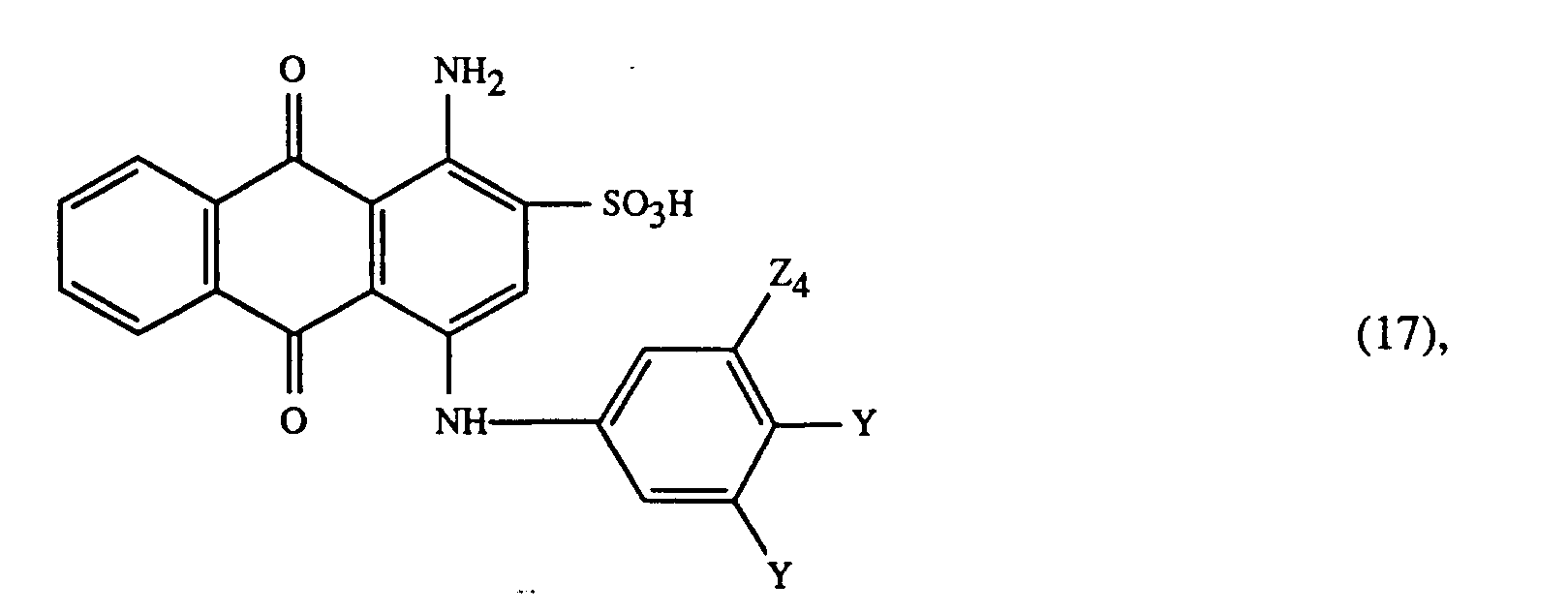
worin ein Y Wasserstoff oder Methyl und das andere Y C₂₋₄-Alkanoylamino oder C₂-C₄-Hydroxyalkylsulphamoyl bedeutet und Z₄ Wasserstoff oder Methyl ist, wobei für den Farbstoff der Formel (1) die zuvor angegebenen Bevorzugungen gelten; insbesondere verwendet man als gelb- oder orangefärbenden Farbstoff einen Farbstoff der Formel (3). - Die in dem erfindungsgemässen Verfahren zum Trichromie-Färben oder -Bedrucken verwendeten Farbstoffe der Formeln (14), (15), (16) und (17) sind an sich bekannt oder können in Analogie zu bekannten Farbstoffen hergestellt werden.
- Als C₁-C₈-Alkyl kommen für R₄, R₅, R₇ und R₈ in der Formel (14) und für R₉ und R₁₀ in Formel (15) unabhängig voneinander z. B. Methyl, Äthyl, Propyl, Isopropyl, Butyl, sek.-Butyl, tert.-Butyl, Isobutyl, Pentyl, Hexyl, Heptyl und Octyl in Betracht. Vorzugsweise sind R₄, R₅, R₇, R₈, R₉ und R₁₀ C₁-C₄-Alkyl.
- Der Rest R₄ in Formel (14) als C₁-C₈-Alkyl kann substituiert sein z.B. durch Halogen, wie z.B. Chlor oder Brom und insbesondere Fluor. Als Beispiel sei der Trifluormethylrest genannt.
- Der Rest R₁₀ in Formel (15) als C₁-C₈-Alkyl kann substituiert sein z.B. durch Sulfo, Sulfato oder Phenyl. Als Beispiele seien Benzyl, β-Sulfoäthyl, γ-Sulfopropyl und β-Sulfatoäthyl genannt.
- Als Halogen kommen für R₄, R₅ und R₆ in Formel (14) unabhängig voneinander z.B. Fluor, Brom oder insbesondere Chlor in Betracht.
- Der Rest R₄ in Formel (14) als Benzoylamino kann im Phenylring durch Halogen, wie z.B. Fluor, Brom oder insbesondere Chlor, substituiert sein.
- Der Rest R₇ als Phenyl oder Cyclohexyl sowie der Rest R₄ als Phenylsulfonyl oder Phenoxysulfonyl kann durch C₁-C₄-Alkyl, wie z. B. Methyl, Äthyl, Propyl, Isopropyl, Butyl, sek.-Butyl, tert.-Butyl oder Isobutyl, insbesondere Methyl, substituiert sein.
- Als C₁-C₄-Alkyl kommen für R₁₁ in Formel (15) und für R₁₂ in Formel (16) unabhängig voneinander z. B. Methyl, Äthyl, Propyl, Isopropyl, Butyl, sek.-Butyl, tert.-Butyl oder Isobutyl, insbesondere Methyl, in Betracht.
- Als C₂-C₄-Alkanoylamino kommen für R₄ und R₅ in Formel (14) und für Y in Formel (17) unabhängig voneinander z.B. Acetylamino, Propionylamino oder Butyrylamino in Betracht.
- Der Rest D in Formel (15) kann z.B. durch Halogen, wie Fluor, Chlor oder Brom, C₁-C₄-Alkyl, wie Methyl, Äthyl, Propyl, Isopropyl, Butyl, sek.-Butyl, tert.-Butyl oder Isobutyl, C₁-C₄-Alkoxy, wie z.B. Methoxy, Äthoxy, Propoxy oder Butoxy, C₁-C₄-Alkoxycarbonyl, wie z.B. Methoxycarbonyl oder Aethoxycarbonyl, Sulfo oder gegebenenfalls im Alkylteil durch Sulfo substituiertes C₁-C₄-Alkylaminosulfonyl, wie z.B. Methylaminosulfonyl, Aethylaminosulfonyl oder β-Sulfoäthylaminosulfonyl, substituiert sein.
- Als C₂₋₄-Hydroxylalkylsulphamoylrest kommt für Y in Formel (17) beispielsweise der β-Hydroxyäthylsulphamoyl-, β-Hydroxypropylsulphamoyl-, γ-Hydroxypropylsulphamoyl- oder der β-Hydroxybutylsulphamoylrest in Betracht.
- Bevorzugt verwendet man für das erfindungsgemässe Verfahren zum Trichromie-Färben oder -Bedrücken mindestens einen der rotfärbenden Farbstoffe der Formeln (14), (15) und (16), wobei im Farbstoff der Formel (14) R₄ Trifluoromethyl, Chlor, Acetylamino, -SO₂N(n-C₄H₉)₂, Phenoxysulfonyl, Phenylsulfonyl, 1-Azacycloheptan-N-sulfonyl, Cyclohexyloxycarbonylamino, gegebenenfalls im Phenylring durch Chlor substituiertes Benzoylamino oder gegebenenfalls im Phenylring durch Methyl substituiertes Phenylaminosulfonyl, Cyclohexylaminosulfonyl, N-(C₁-C₂-Alkyl)phenyl- oder N-(C₁-C₂-Alkyl)cyclohexyl-aminosulfonyl, R₅ Wasserstoff, Methyl, Chlor oder Acetylamino und R₆ Wasserstoff oder Chlor ist, und im Farbstoff der Formel (15) D durch Chlor, Sulfo, Methylaminosulfonyl, Aethylaminosulfonyl oder β-Sulfoäthylaminosulfonyl substituiertes Phenyl, durch Methyl, Methoxy- oder Aethoxycarbonyl substituiertes Thiophenyl oder gegebenenfalls durch Methyl, Methoxy oder Sulfo substituiertes Benzthiophenyl ist, R₉ Aethyl, R₁₀ Aethyl, β-Sulfatoäthyl,

oder Benzyl und R₁₁ Wasserstoff oder Methyl ist, und im Farbstoff der Formel (16) R₁₂ Methyl ist. - Besonders bevorzugt verwendet man mindestens einen der rotfärbenden Farbstoffe der Formeln

- Ebenfalls besonders bevorzugt verwendet man für das erfindungsgemässe Verfahren mindestens einen der blaufärbenden Farbstoffe der Formeln


- Verwendet man für das erfindungsgemässe Verfahren Mischungen blaufärbender Farbstoffe, so ist die Mischung der blaufärbenden Farbstoffe der Formeln (21) oder (22) mit einem Farbstoff der Formel (23), (24) oder (25) bevorzugt. Ganz besonders bevorzugt ist die Mischung der blaufärbenden Farbstoffe der Formeln

worin Y₂ ein C₂₋₄-Hydroxyalkylsulphamoylrest ist, und
worin der Rest -NH-CO-CH₂CH₃ in 3- oder 4-Stellung gebunden ist. - Ganz besonders bevorzugt verwendet man für das erfindungsgemässe Verfahren zum Trichromie-Färben oder -Bedrucken mindestens einen Farbstoff der Formel (1) zusammen mit mindestens einem der rotfärbenden Farbstoffe der Formeln (18), (19) und (20), insbesondere (18) und (19), und mindestens einem der blaufärbenden Farbstoffe der Formeln (21), (22), (23), (24) und (25), wobei für den Farbstoff der Formel (1) die zuvor angegebenen Bevorzugungen gelten; insbesondere verwendet man als gelb- oder orangefarbenden Farbstoff einen Farbstoff der Formel (3).
- Eine ganz besonders wichtige Ausführungsform des erfindungsgemässen Verfahrens zum Trichromie-Färben oder -Bedrucken ist dadurch gekannzeichnet, dass man mindestens einen Farbstoff der Formel (1) zusammen mit einem rotfärbenden Farbstoff der Formel (19) und einem blaufärbenden Farbstoff der Formel (21) verwendet, wobei für den Farbstoff der Formel (1) die zuvor angegebenen Bevorzugungen gelten; insbesondere verwendet man als gelb- oder orangefärbenden Farbstoff einen Farbstoff der Formel (3).
- Werden in dem erfindungsgemässen Verfahren Farbstoffmischungen verwendet, so können diese durch Mischung der Einzelfarbstoffe hergestellt werden. Dieser Mischprozess erfolgt beispielsweise in geeigneten Mühlen, z.B. Kugel- und Stiftmühlen, sowie in Knetern oder Mixern.
- Ferner können die Farbstoffmischungen der Farbstoffe durch Zerstäubungstrocknen der wässrigen Farbstoffmischungen hergestellt werden.
- Die erfindungsgemässen Farbstoffe der Formel (1) sowie die in dem erfindungsgemässen Verfahren zum Trichromie-Färben oder -Bedrücken verwendeten Farbstoffe liegen entweder in der Form ihrer freien Sulfonsäure oder vorzugsweise als deren Salze vor.
- Als Salze kommen beispielsweise die Alkali-, Erdalkali- oder Ammoniumsalze oder die Salze eines organischen Amins in Betracht. Als Beispiele seien die Natrium-, Lithium-, Kalium- oder Ammoniumsalze oder das Salz des Mono-, Di- oder Triäthanolamins genannt.
- Die erfindungsgemässen Farbstoffe der Formel (1) sowie die in dem erfindungsgemässen Verfahren verwendeten Farbstoffe enthalten in der Regel weitere Zusätze wie z.B. Kochsalz oder Dextrin.
- Das erfindungsgemässe Verfahren zum Trichromie-Färben oder -Bedrücken kann auf die üblichen Färbe- bzw. Druckverfahren angewendet werden.- Die Färbeflotten oder Druckpasten können ausser Wasser und den Farbstoffen weitere Zusätze, beispielsweise Netzmittel, Antischaummittel, Egalisiermittel oder die Eigenschaft des Textilmaterials beeinflussende Mittel wie z.B. Weichmachungsmittel, Zusätze zum Flammfestausrüsten oder schmutz-, wasser- und öl-abweisende Mittel sowie wasserenthärtende Mittel und natürliche oder synthetische Verdicker, wie z.B. Alginate und Celluloseäther, enthalten.
- Die erfindungsgemässen Farbstoffe der Formel (1) sowie das erfindungsgemässe Verfahren zum Trichromie-Färben oder -Bedrücken sind besonders zum Färben aus Kurzflotten, wie z.B. bei Kontinuefärbeverfahren oder diskontinuierlichen und kontinuierlichen Schaumfärbeverfahren, geeignet.
- Die erfindungsgemässen Farbstoffe der Formel (1) sowie die in dem erfindungsgemässen Verfahren verwendeten Farbstoffe zeichnen sich beim Trichromie-Färben oder -Bedrucken durch gleichmässigen Farbaufbau, gutes Aufziehverhalten, guten Nuancenkonstanz auch in verschiedenen Konzentrationen, gute Echtheiten sowie insbesondere durch sehr gute Kombinierbarkeit aus.
- Die erfindungsgemässen Farbstoffe der Formel (1) sowie das erfindungsgemässe Verfahren zum Trichromie-Färben oder -Bedrücken eignen sich zum Färben oder Bedrucken sowohl von natürlichen Polyamidmaterialien wie z.B. Wolle, wie insbesondere von synthetischen Polyamidmaterialien, wie z.B. Polyamid 6 oder Polyamid 6.6, und sind geeignet zum Färben oder Bedrücken von Woll- und synthetischem Polyamid-Mischgeweben oder -Garnen.
- Das genannte Textilmaterial kann dabei in den verschiedensten Verarbeitungsformen vorliegen, wie z.B. als Faser, Garn, Gewebe oder Gewirke und insbesondere in Form von Teppichen.
- Die erfindungsgemässen Azofarbstoffe der Formel (1) ergeben egale Färbungen mit guten Allgemeinechtheiten, insbesondere guter Reib-, Nass-, Nassreib- und Lichtechtheit. Ferner sind die erfindungsgemässen Farbstoffe gut wasserlöslich und hartwasserbeständig.
- In den folgenden Beispielen stehen Teile für Gewichtsteile. Die Temperaturen sind Celsiusgrade. Die Beziehung zwischen Gewichtsteilen und Volumenteilen ist dieselbe wie diejenige zwischen Gramm und Kubikzentimeter.
- Beispiel 1: Eine neutrale, 70 bis 80° heisse Lösung von 28 Teilen 4-Amino-azobenzol-4'-sulfonsäure in 500 Teilen Wasser lässt man gleichzeitig mit 26 Teilen einer wässrigen Natriumnitritlösung (4N) in die Mischung von 28 Teilen konzentrierter Salzsäure in 200 Teilen Wasser einlaufen und hält die Temperatur der Reaktionsmischung durch Zugabe von Eis bei 20 bis 25°. Nach beendeter Zugabe wird noch 2 Stunden nachgeruhrt und der Nitritüberschuss mit wenig Amidosulfonsäure zerstört. Das so bereitete Diazotierungsgemisch lässt man langsam in eine 0 bis 5° kalte Lösung von 14 Teilen 2,4-Hexandion und 180 Teilen Natriumacetat in 500 Teilen Wasser einfliessen. Nach mehrstündigem Rühren bei 0 bis 5° wird zur Vervollständigung der Reaktion auf 30° erwärmt und mit Natriumacetat der pH auf einen Wert von 5,5 gestellt. Anschliessend wird der Niederschlag abgesaugt und bei 60° getrocknet Man erhält 30 Teile eines orangefarbenen Pulvers.
- 8 Teile des nach obigen Angaben hergestellten Reaktionsproduktes werden in 50 Teilen Eisessig und 20 Teilen Wasser bei Raumtemperatur suspendiert. Unter Rühren werden auf einmal 1,5 Teile Hydrazinhydrat zugefügt. Das Reaktionsgemisch wird langsam auf 100° erhitzt und so lange gerührt, bis dünnschichtchromatographisch kein Edukt mehr nachweisbar ist. Nach Abkühlung auf Raumtemperatur wird der Farbstoff durch Zusatz von Salzsäure (2N) ausgefällt. Nach Filtration, Nachwaschen mit wenig Wasser und Trocknung bei einer Temperatur von 80° erhält man 7 Teile eines Farbstoffs, der in Form der freien Säure der Verbindung der Formel

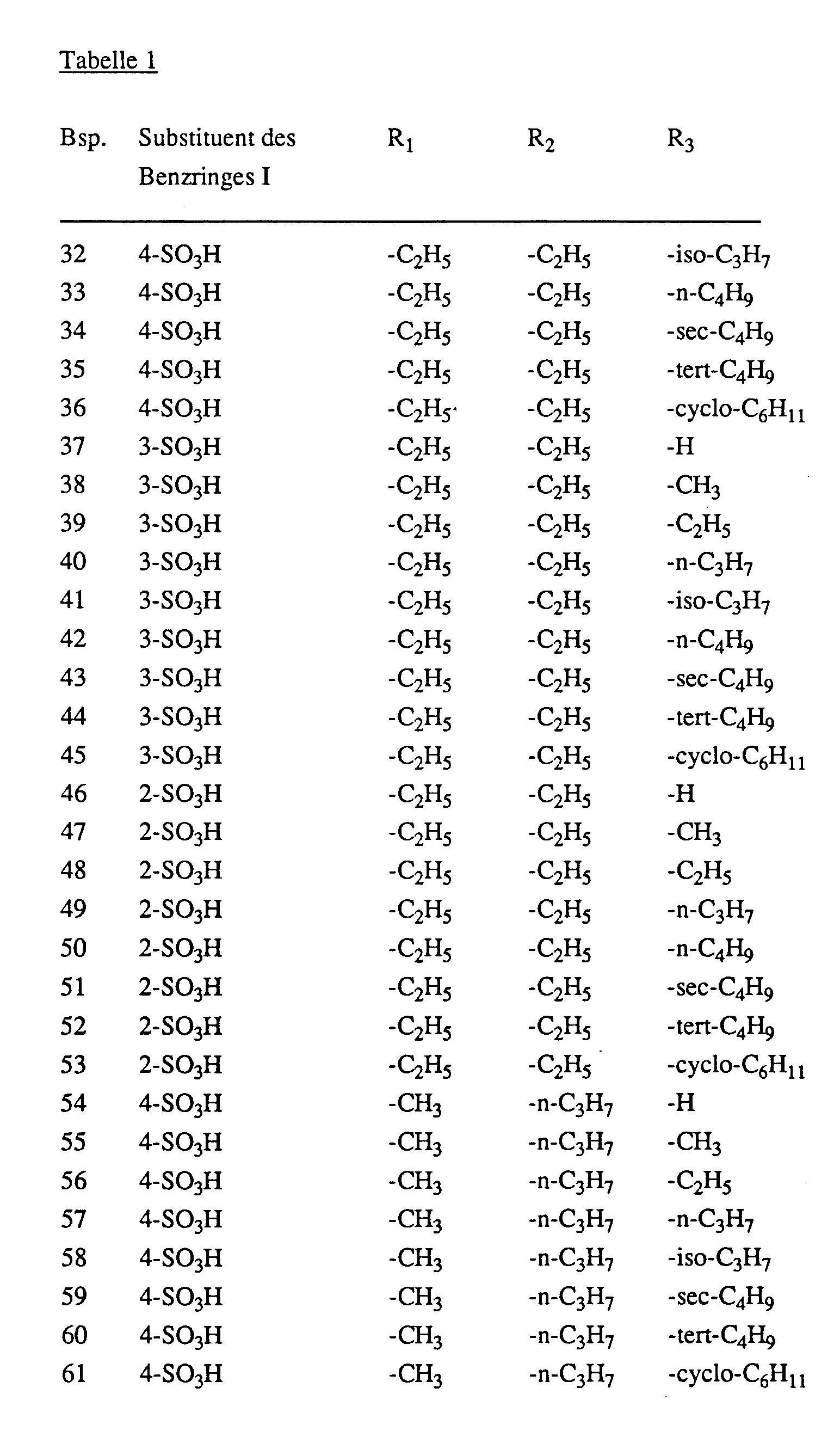
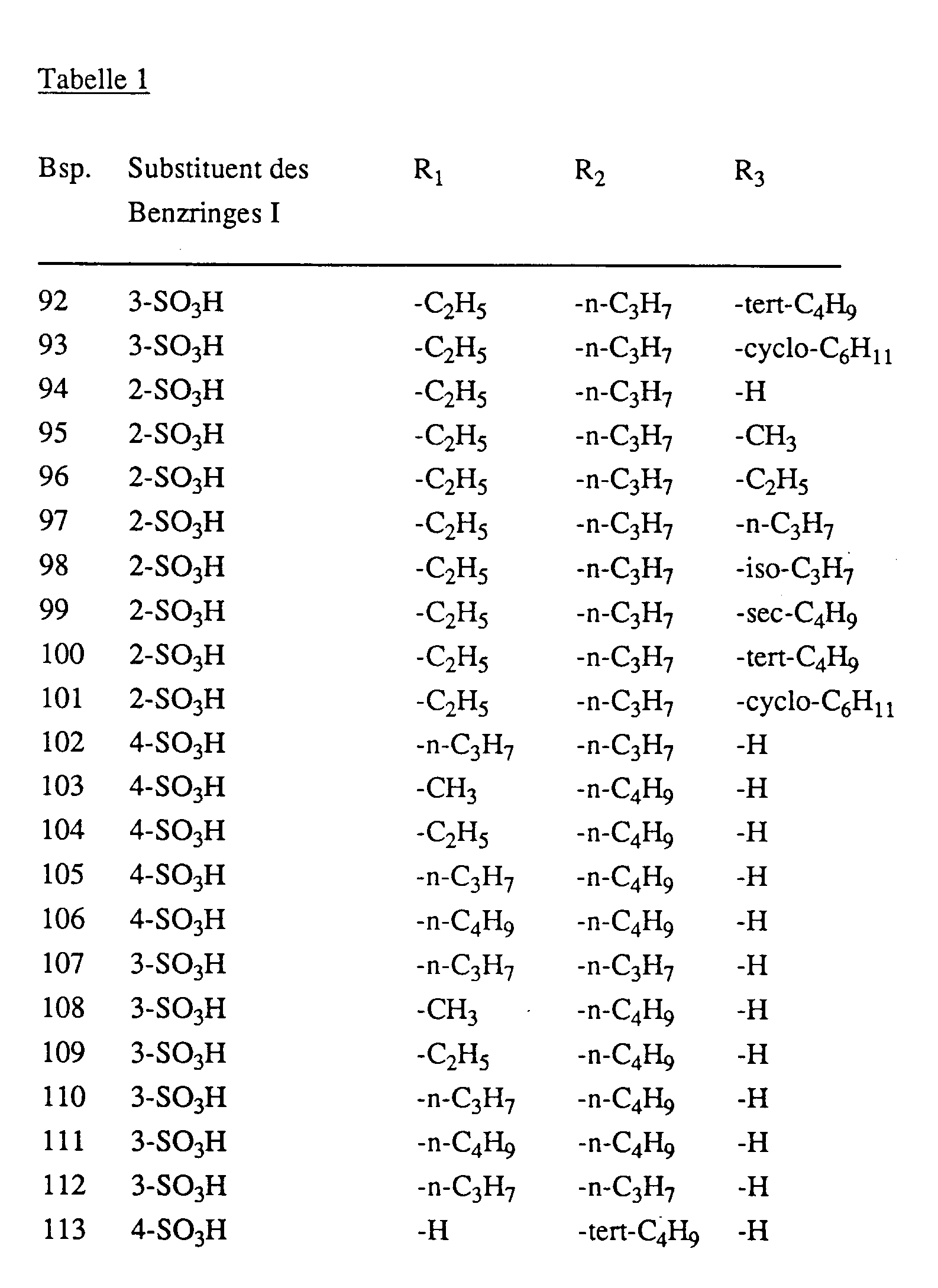
entspricht. - Beispiele 2 bis 113: Verfährt man wie in Beispiel 1 angegeben, verwendet jedoch anstelle von 28 Teilen 4-Amino-azobenzol-4'-sulfonsäure eine äquimolare Menge einer Verbindung der Formel

worin die Sulfogruppe in der in Tabelle 1 in Spalte 2 angegebenen Position an den Benzring I gebunden ist und die Benzringe I und II keine weiteren Substituenten enthalten, und anstelle von 14 Teilen 2,4-Hexandion eine äquimolare Menge einer Verbindung der Formel
worin R₁ und R₂ die in Tabelle 1 in den Spalten 3 und 4 angegebenen Bedeutungen haben, sowie anstelle von 1,5 Teilen Hydrazinhydrat eine äquimolare Menge einer Verbindung der Formel
H₂N-NH-R₃ (10),
worin R₃ die in Tabelle 1 in Spalte 5 angegebenen Bedeutungen hat, so erhält man analoge Farbstoffe, die synthetische und natürliche Polyamidmaterialien in gelben Farbtönen färben. Verwendet man in den Beispielen der folgenden Tabelle 1 eine Verbindung der Formel (8), worin R₁ und R₂ voneinander verschiedene Bedeutungen haben, zusammen mit einer Verbindung der Formel (10), worin R₃ nicht Wasserstoff bedeutet, so erhält man Isomerengemische der Verbindungen der Formeln
worin R₁, R₂ und R₃ die in Tabelle 1 in den Spalten 3 bis 5 angegebenen Bedeutungen haben und die Sulfogruppe in der in Tabelle 1 in Spalte 2 angegebenen Position an den Benzring I gebunden ist und die Benzringe I und II keine weiteren Substituenten enthalten, die synthetische und natürliche Polyamidmaterialien in gelben Farbtönen färben.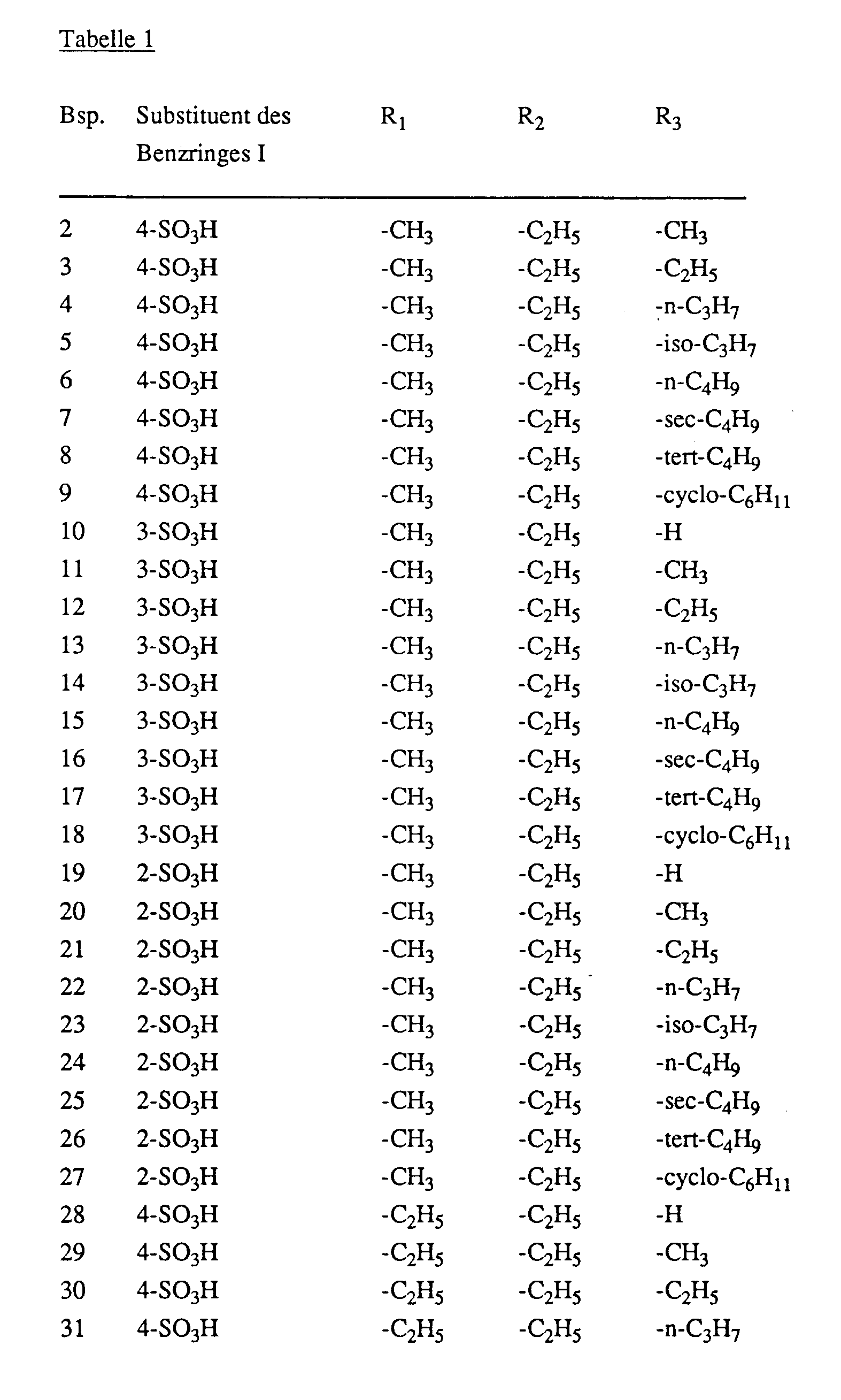

- Beispiele 114 bis bis 117: Verfährt man wie in Beispiel 1 angegeben, verwendet jedoch anstelle von 28 Teilen 4-amino-azobenzol-4'-sulfonsäure eine äquimolare Menge einer der in der folgenden Tabelle 2 in Spalte 2 angegebenen Azoverbindung, so erhält man die in Spalte 3 in Form der freien Säuren angegebenen Farbstoffe, die synthetische und natürliche Polyamidmaterialien in gelben Farbtönen färben.

- Beispiel 118: Verfährt man wie in Beispiel 114 angegeben, verwendet jedoch anstelle von 14 Teilen 2,4-Hexandion eine äquimolare Menge 3,5-Heptandion, so erhält man den Farbstoff der Formel
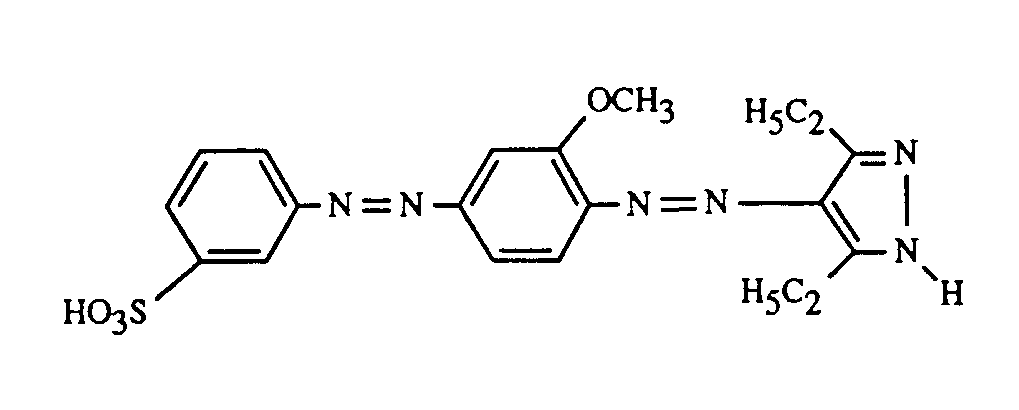
der synthetische und natürliche Polyamidmaterialien in gelben Farbtönen färbt. - Färbebeispiel 1: Man färbt 10 Teile Polyamid-6.6 Fasermaterial (Helancatrikot) in 500 Teilen einer wässrigen Flotte, die 2 g/l Ammonacetat enthält und mit Essigsäure auf pH 5 gestellt wird. Als Farbstoffe werden 0,05 % des roten Farbstoffs der in Form der freien Säure der Formel

entspricht, 0,18 % des gelben Farbstoffs der in Form der freien Säure der Formel (101) entspricht und 0,17 % des blauen Farbstoffs der in Form der freien Säure der Formel
entspricht, verwendet, wobei sich die Mengenangaben auf das Fasergewicht beziehen. - Die Färbedauer bei einer Temperatur von 98° beträgt 30 bis 90 Minuten. Das gefärbte Polyamidfasermaterial wird anschliessend herausgenommen und wie üblich gespült und getrocknet. Man erhält ein in einem braunen Farbton völlig egal gefärbtes Gewebestück, das keinerlei materialbedingte Streifigkeit aufweist.
- Färbebeispiel 2: Man färbt 10 Teile Polyamid 6.6-Garn in 400 Teilen einer wässrigen Flotte, die 1,5 g/l Ammonacetat enthält und mit Essigsäure auf pH 5,5 gestellt wird. Als Farbstoffe werden 0,1 % des Farbstoffs der Formel (102), 0,13 % des Farbstoffs der Formel (101) und 0,12 % des Farbstoffs der Formel (103) verwendet, wobei sich die Mengenangaben auf das Fasergewicht beziehen. Das Färbebad wird innerhalb von 30 Minuten auf 98°C erhitzt und 60 Minuten bei 96° bis 98° gehalten. Das gefärbte Garn wird anschliessend herausgenommen und wie üblich gespült und getrocknet. Man erhält ein in einem braunen Farbton gefärbtes Garn.
- Färbebeispiel 3: Man färbt 10 Teile Polyamid 6.6-Teppichgarn in 400 Teilen einer wässrigen Flotte, die 1,5 g/l Ammonacetat enthält und mit Essigsäure auf pH 5,5 gestellt wird. Als Farbstoffe werden 0,15 % des roten Farbstoffs der Formel

0,625 % des gelben Farbstoffs der Formel (101) und 0,52 % des blauen Farbstoffs der Formel (103) verwendet, wobei sich die Mengenangaben auf das Fasergewicht beziehen. Das Färbebad wird innerhalb von 30 Minuten auf 98° erhitzt und 60 Minuten bei 96° bis 98° gehalten. Das gefärbte Garn wird anschliessend herausgenommen und wie üblich gespült und getrocknet. Man erhält ein in einem braunen Farbton gefärbtes Garn. - Färbebeispiel 4: Wenn man wie in Färbebeispiel 3 angegeben vorgeht, jedoch anstelle der
Farbstoffe der Formeln (104), (101) und (103)
0,32 % des Farbstoffs der Formel (102),
0,46 % des Farbstoffs der Formel (101) und
0,61 % des Farbstoffs der Formel (103)
verwendet, so erhält man ebenfalls ein in einem braunen Farbton gefärbtes Garn. - Färbebeispiel 5: (Teppichdrück) Ein Velours-Teppich aus Polyamid-6 mit einem Florgewicht von 400 g/m² wird für die Fondfärbung mit einer wässrigen Klotzflotte der nachstehenden Zusammensetzung
0,1 g/l Farbstoff der Formel (101),
0,1 g/l Farbstoff der Formel (103),
2 g/l Verdicker auf der Basis natürlicher Polysaccharide,
0,5 g/l Netzmittel auf der Basis eines sulfatierten Alkyl-Aryl-Polyglycolates, und
0,5 g/l Entschäumer auf der Basis hochsiedender Alkohole,
die mit Essigsäure auf den pH-Wert 4,5 eingestellt ist, foulardiert und auf 80 % der Flottenaufnahme abgequetscht. Auf den so vorbehandelten Teppich wird über eine Druckschablone ein Muster mit der nachstehenden wässrigen Druckpaste aufgebracht:
1 g/l Farbstoff der Formel (101),
20 g/l Farbstoff der Formel (102),
10 g/l Farbstoff der Formel (103),
15 g/l Verdicker auf der Basis natürlicher Polysaccharide,
2 g/l Netzmittel auf der Basis eines sulfatierten Alkyl-Aryl-Polyglycolates,
1 g/l Entschäumer auf der Basis hochsiedender Alkohole.
Die Druckpaste ist mit Essigsäure auf pH-Wert 4,5 gestellt. - Das bedrückte Material wird anschliessend während 5 Minuten mit Sattdampf von 101° behandelt zur Fixierung der Farbstoffe, gespült, neutralisiert, erneut gespült und getrocknet.
- Man erhält einen Verlours-Teppich mit bordeaux-farbigem Muster auf blassolivem Untergrund mit sehr scharfen Konturen, welcher eine gute Penetration und keinerlei "Frosting" aufweist.
- Färbebeispiel 6: (Teppich-Kontinue-Färbung)
2,7 Teile des gelben Farbstoffes der Formel (101), 1,2 Teile des roten Farbstoffes der Formel (102) und 1,3 Teile des blauen Farbstoffes der Formel (103) werden in 100 Teilen Wasser durch kurzes Kochen gelöst. Diese Lösung wird hierauf zu einer Lösung, enthaltend 3 Teile eines Verdickungsmittels auf der Basis von Johannisbrotkernmehr, 5,0 Teile eines koazervatbildenden Klotzhilfsmittels auf der Basis eines Kondensationsproduktes einer höher molekularen Fettsäure mit einem Oxyalkylamin, 2,0 Teilen krist. Mononatriumphosphat und 1,0 Teile krist. Dinatriumphosphat in 500 Teilen kaltem Wasser zugegeben. Anschliessend wird mit kaltem Wasser auf 1000 Teile aufgefüllt. Von dieser, einen pH-Wert von 5,5 bis 6,5 aufweisenden Flotte werden 300 %, bezogen auf das Teppichgewicht, auf einen Polyamid-6.6-Nadelflor-Rohteppich aufgetragen, bei einer Teppichgeschwindigkeit von 8 Meter pro Minute. Der getränkte Teppich gelangt in einen Schleifendämpfer, wo er während 10 Minuten mit Sattdampf von 98 bis 100° behandelt wird. - Nach dem Waschen in einer Breitwaschmaschine erhält man einen in einem neutral braunen Farbton gefärbten Teppich.
- Beispiel 7: Verfährt man wie in Beispiel 6 angegeben und verwendet bei sonst gleicher Verfahrensweise anstelle von 1,2 Teilen des gelben Farbstoffs der Formel (101) 1,2 Teile des gelben Farbstoffes aus Beispiel 2 oder 1,2 Teile des gelben Farbstoffes aus Beispiel 114, so erhält man einen in einem braunen Farbton gefärbten Teppich.
Claims (12)
- Azofarbstoffe der Formel

- Azofarbstoffe gemäss Anspruch 1, dadurch gekennzeichnet, dass R₁ Methyl oder Aethyl ist.
- Azofarbstoffe gemäss einem der Ansprüche 1 und 2, dadurch gekennzeichnet, dass R₂ Aethyl ist.
- Azofarbstoffe gemäss einem der Ansprüche 1 bis 3, dadurch gekennzeichnet, dass R₃ Wasserstoff ist.
- Azofarbstoffe gemäss einem der Ansprüche 1 bis 4, dadurch gekennzeichnet, dass die Sulfogruppe an den Benzring I in meta- oder para-Stellung zur Azogruppe gebunden ist.
- Azofarbstoffe gemäss Anspruch 1, der Formel

- Verfahren zur Herstellung von Azofarbstoffen gemäss Anspruch 1, dadurch gekennzeichnet, dass man ein Amin der Formel


H₂N-NH-R₃ (10)
umsetzt, wobei R₁, R₂ und R₃ die in Anspruch 1 angegebenen Bedeutungen haben und die Benzringe I und II gegebenenfalls substituiert sind. - Verfahren zum Trichromie-Färben oder -Bedrücken von natürlichen und synthetischen Polyamidmaterialien mit Farbstoffmischungen, dadurch gekennzeichnet, dass man mindestens einen gelb- oder orangefärbenden Farbstoff der Formel
- Verfahren gemäss Anspruch 8 zum Trichromie-Färben oder -Bedrucken, dadurch gekennzeichnet, dass man mindestens einen der rotfärbenden Farbstoffe der Formeln (14), (15) und (16):


- Verfahren gemäss einem der Ansprüche 8 und 9 zum Trichromie-Färben oder -Bedrucken, dadurch gekennzeichnet, dass man mindestens einen der rotfärbenden Farbstoffe der Formeln

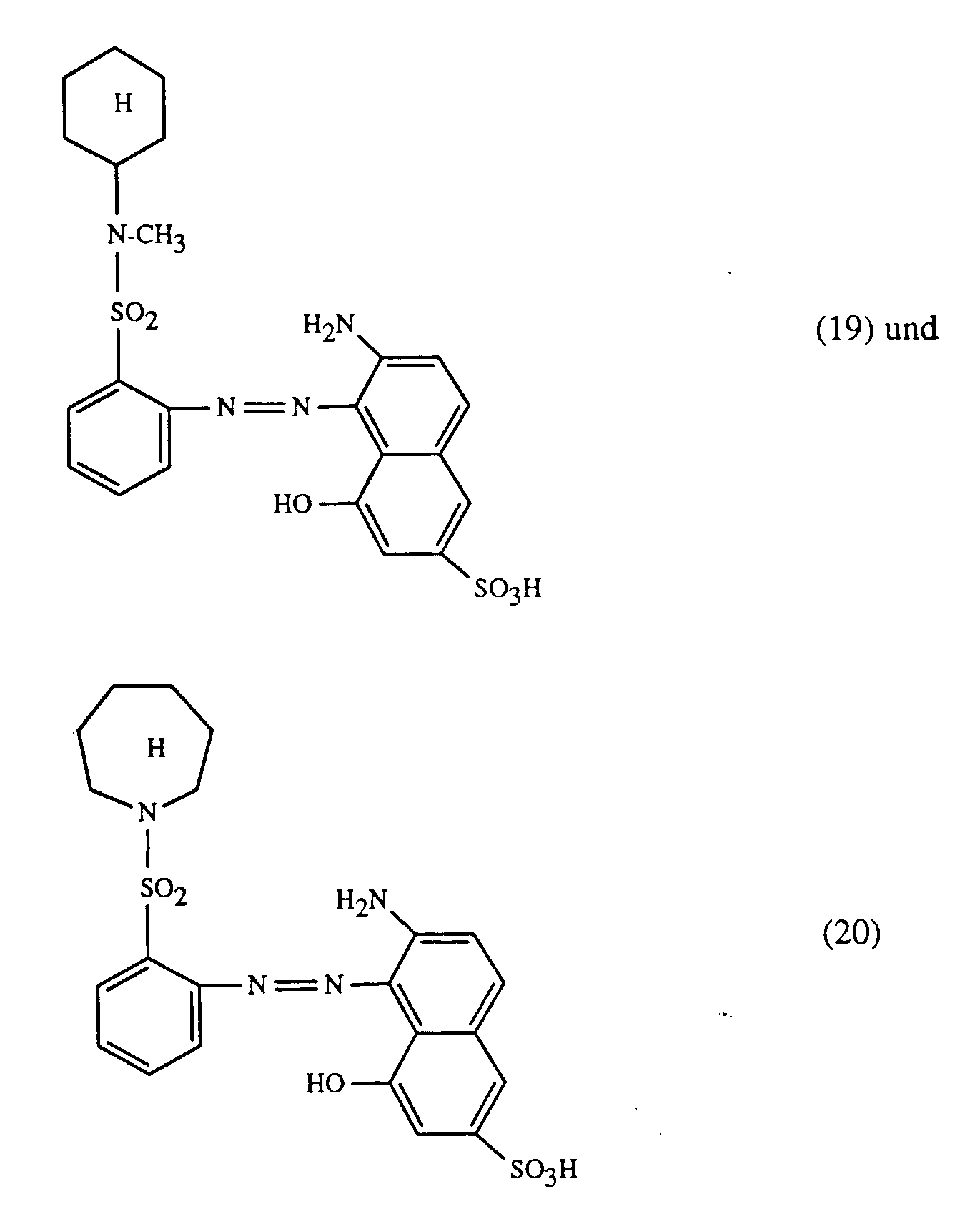


- Verwendung der Azofarbstoffe gemäss den Ansprüchen 1 bis 6 bzw. der gemäss Anspruch 7 erhaltenen Azofarbstoffe zum Färben oder Bedrucken von natürlichen und synthetischen Polyamidmaterialien.
- Das nach dem Verfahren gemäss Anspruch 8 gefärbte oder bedruckte Polyamidmaterial, insbesondere Polyamid-Teppiche.
Applications Claiming Priority (2)
| Application Number | Priority Date | Filing Date | Title |
|---|---|---|---|
| CH227/90 | 1990-01-24 | ||
| CH22790 | 1990-01-24 |
Publications (3)
| Publication Number | Publication Date |
|---|---|
| EP0439423A2 EP0439423A2 (de) | 1991-07-31 |
| EP0439423A3 EP0439423A3 (en) | 1991-12-18 |
| EP0439423B1 true EP0439423B1 (de) | 1995-05-31 |
Family
ID=4182183
Family Applications (1)
| Application Number | Title | Priority Date | Filing Date |
|---|---|---|---|
| EP91810025A Expired - Lifetime EP0439423B1 (de) | 1990-01-24 | 1991-01-15 | Azofarbstoffe, Verfahren zu deren Herstellung und deren Verwendung |
Country Status (6)
| Country | Link |
|---|---|
| US (1) | US5196520A (de) |
| EP (1) | EP0439423B1 (de) |
| JP (1) | JPH04213369A (de) |
| KR (1) | KR910014468A (de) |
| DE (1) | DE59105605D1 (de) |
| ES (1) | ES2073148T3 (de) |
Families Citing this family (2)
| Publication number | Priority date | Publication date | Assignee | Title |
|---|---|---|---|---|
| ES2116328T3 (es) * | 1991-07-19 | 1998-07-16 | Ciba Geigy Ag | Colorantes azoicos, procedimiento de obtencion y utilizacion de los mismos. |
| ES2100327T3 (es) * | 1991-07-19 | 1997-06-16 | Ciba Geigy Ag | Mezclas de colorantes y su utilizacion. |
Family Cites Families (3)
| Publication number | Priority date | Publication date | Assignee | Title |
|---|---|---|---|---|
| DE1906382A1 (de) * | 1969-02-08 | 1971-05-06 | Basf Ag | Sulfonsaeuregruppenhaltige Disazofarbstoffe der Pyrazolonreilie |
| BE795634A (fr) * | 1972-02-26 | 1973-08-20 | Basf Ag | Colorants dis-azoiques hydrosolubles de la serie du pyrazole |
| DE2826761A1 (de) * | 1978-06-19 | 1980-01-03 | Hoechst Ag | Verfahren zum faerben oder bedrucken von hydrophoben, synthetischen organischen fasermaterialien |
-
1991
- 1991-01-15 EP EP91810025A patent/EP0439423B1/de not_active Expired - Lifetime
- 1991-01-15 DE DE59105605T patent/DE59105605D1/de not_active Expired - Fee Related
- 1991-01-15 ES ES91810025T patent/ES2073148T3/es not_active Expired - Lifetime
- 1991-01-18 US US07/645,374 patent/US5196520A/en not_active Expired - Fee Related
- 1991-01-22 KR KR1019910001000A patent/KR910014468A/ko not_active Withdrawn
- 1991-01-24 JP JP3006667A patent/JPH04213369A/ja active Pending
Also Published As
| Publication number | Publication date |
|---|---|
| ES2073148T3 (es) | 1995-08-01 |
| JPH04213369A (ja) | 1992-08-04 |
| DE59105605D1 (de) | 1995-07-06 |
| EP0439423A3 (en) | 1991-12-18 |
| US5196520A (en) | 1993-03-23 |
| EP0439423A2 (de) | 1991-07-31 |
| KR910014468A (ko) | 1991-08-31 |
Similar Documents
| Publication | Publication Date | Title |
|---|---|---|
| EP0387201B1 (de) | Farbstoffmischung und deren Verwendung | |
| EP0775776A2 (de) | Verfahren zum Di- oder Trichromie-Färben oder -Bedrucken | |
| EP0719837B1 (de) | Azofarbstoffe, Verfahren zu deren Herstellung und deren Verwendung | |
| EP0425434B1 (de) | Farbstoffmischungen und deren Verwendung | |
| EP0042357B1 (de) | Azofarbstoffe, deren Herstellung und Verwendung | |
| WO2013056838A1 (de) | Trisazo-säurefarbstoffe | |
| EP0714955B1 (de) | Azofarbstoffe, Verfahren zu deren Herstellung und deren Verwendung | |
| EP0586331B1 (de) | Verfahren zum Färben von synthetischen Polyamidfasermaterialien | |
| EP0549529B1 (de) | Verfahren zum Färben oder Bedrucken von hydroxylgruppenhaltigen Fasermaterialien | |
| EP0718374B1 (de) | 1:2-Chromkomplexfarbstoffe enthaltende Farbstoffmischungen und 1:2 Chromkomplexfarbstoffe | |
| EP0658605B1 (de) | Verfahren zum Trichromie-Färben oder -Bedrucken | |
| EP0657508A1 (de) | Reaktivfarbstoffe, Verfahren zu deren Herstellung und deren Verwendung | |
| EP0524148B1 (de) | Farbstoffmischungen und deren Verwendung | |
| EP0823505B1 (de) | Verfahren zum Trichromie-Färben oder -Bedrucken | |
| EP0439423B1 (de) | Azofarbstoffe, Verfahren zu deren Herstellung und deren Verwendung | |
| EP0514330B1 (de) | Azofarbstoffe | |
| EP0524147B1 (de) | Azofarbstoffe, Verfahren zu deren Herstellung und deren Verwendung | |
| EP0548014A1 (de) | Farbstoffmischungen und deren Verwendung | |
| EP0595768B1 (de) | Azofarbstoffe, Verfahren zu deren Herstellung und deren Verwendung | |
| DE2154942A1 (de) | Neue monoazo-reaktivfarbstoffe, ihre verwendung und verfahren zu ihrer herstellung | |
| EP0425435A1 (de) | Verfahren zum Trichromie-Färben oder -Bedrucken | |
| EP0601971B1 (de) | Verfahren zum Trichromie-Färben oder -Bedrucken | |
| EP0457729B1 (de) | Azofarbstoffe, Verfahren zu deren Herstellung und deren Verwendung | |
| EP0586339B1 (de) | Azofarbstoffe, Verfahren zu deren Herstellung und deren Verwendung | |
| EP0739952B1 (de) | Azofarbstoffmischungen und deren Verwendung |
Legal Events
| Date | Code | Title | Description |
|---|---|---|---|
| PUAI | Public reference made under article 153(3) epc to a published international application that has entered the european phase |
Free format text: ORIGINAL CODE: 0009012 |
|
| 17P | Request for examination filed |
Effective date: 19910117 |
|
| AK | Designated contracting states |
Kind code of ref document: A2 Designated state(s): BE CH DE ES FR GB IT LI NL |
|
| PUAL | Search report despatched |
Free format text: ORIGINAL CODE: 0009013 |
|
| AK | Designated contracting states |
Kind code of ref document: A3 Designated state(s): BE CH DE ES FR GB IT LI NL |
|
| 17Q | First examination report despatched |
Effective date: 19940803 |
|
| GRAA | (expected) grant |
Free format text: ORIGINAL CODE: 0009210 |
|
| AK | Designated contracting states |
Kind code of ref document: B1 Designated state(s): BE CH DE ES FR GB IT LI NL |
|
| ET | Fr: translation filed | ||
| REF | Corresponds to: |
Ref document number: 59105605 Country of ref document: DE Date of ref document: 19950706 |
|
| REG | Reference to a national code |
Ref country code: ES Ref legal event code: FG2A Ref document number: 2073148 Country of ref document: ES Kind code of ref document: T3 |
|
| GBT | Gb: translation of ep patent filed (gb section 77(6)(a)/1977) |
Effective date: 19950718 |
|
| ITF | It: translation for a ep patent filed | ||
| PGFP | Annual fee paid to national office [announced via postgrant information from national office to epo] |
Ref country code: ES Payment date: 19960125 Year of fee payment: 6 |
|
| PLBE | No opposition filed within time limit |
Free format text: ORIGINAL CODE: 0009261 |
|
| 26N | No opposition filed | ||
| REG | Reference to a national code |
Ref country code: CH Ref legal event code: PUE Owner name: CIBA-GEIGY AG TRANSFER- CIBA SC HOLDING AG |
|
| PGFP | Annual fee paid to national office [announced via postgrant information from national office to epo] |
Ref country code: FR Payment date: 19961125 Year of fee payment: 7 |
|
| PGFP | Annual fee paid to national office [announced via postgrant information from national office to epo] |
Ref country code: NL Payment date: 19961127 Year of fee payment: 7 |
|
| PGFP | Annual fee paid to national office [announced via postgrant information from national office to epo] |
Ref country code: DE Payment date: 19961205 Year of fee payment: 7 |
|
| PGFP | Annual fee paid to national office [announced via postgrant information from national office to epo] |
Ref country code: CH Payment date: 19961212 Year of fee payment: 7 |
|
| PGFP | Annual fee paid to national office [announced via postgrant information from national office to epo] |
Ref country code: GB Payment date: 19961223 Year of fee payment: 7 |
|
| BECN | Be: change of holder's name |
Effective date: 19961129 |
|
| PG25 | Lapsed in a contracting state [announced via postgrant information from national office to epo] |
Ref country code: ES Free format text: LAPSE BECAUSE OF NON-PAYMENT OF DUE FEES Effective date: 19970116 |
|
| NLS | Nl: assignments of ep-patents |
Owner name: CIBA SC HOLDING AG |
|
| REG | Reference to a national code |
Ref country code: FR Ref legal event code: TP |
|
| PGFP | Annual fee paid to national office [announced via postgrant information from national office to epo] |
Ref country code: BE Payment date: 19970318 Year of fee payment: 7 |
|
| REG | Reference to a national code |
Ref country code: CH Ref legal event code: PFA Free format text: CIBA SC HOLDING AG TRANSFER- CIBA SPECIALTY CHEMICALS HOLDING INC. |
|
| REG | Reference to a national code |
Ref country code: GB Ref legal event code: 732E |
|
| NLT1 | Nl: modifications of names registered in virtue of documents presented to the patent office pursuant to art. 16 a, paragraph 1 |
Owner name: CIBA SPECIALTY CHEMICALS HOLDING INC. |
|
| PG25 | Lapsed in a contracting state [announced via postgrant information from national office to epo] |
Ref country code: GB Free format text: LAPSE BECAUSE OF NON-PAYMENT OF DUE FEES Effective date: 19980115 |
|
| PG25 | Lapsed in a contracting state [announced via postgrant information from national office to epo] |
Ref country code: LI Free format text: LAPSE BECAUSE OF NON-PAYMENT OF DUE FEES Effective date: 19980131 Ref country code: FR Free format text: THE PATENT HAS BEEN ANNULLED BY A DECISION OF A NATIONAL AUTHORITY Effective date: 19980131 Ref country code: CH Free format text: LAPSE BECAUSE OF NON-PAYMENT OF DUE FEES Effective date: 19980131 Ref country code: BE Free format text: LAPSE BECAUSE OF NON-PAYMENT OF DUE FEES Effective date: 19980131 |
|
| REG | Reference to a national code |
Ref country code: FR Ref legal event code: CD |
|
| BERE | Be: lapsed |
Owner name: CIBA SPECIALTY CHEMICALS HOLDING INC. Effective date: 19980131 |
|
| PG25 | Lapsed in a contracting state [announced via postgrant information from national office to epo] |
Ref country code: NL Free format text: LAPSE BECAUSE OF NON-PAYMENT OF DUE FEES Effective date: 19980801 |
|
| GBPC | Gb: european patent ceased through non-payment of renewal fee |
Effective date: 19980115 |
|
| REG | Reference to a national code |
Ref country code: CH Ref legal event code: PL |
|
| NLV4 | Nl: lapsed or anulled due to non-payment of the annual fee |
Effective date: 19980801 |
|
| PG25 | Lapsed in a contracting state [announced via postgrant information from national office to epo] |
Ref country code: DE Free format text: LAPSE BECAUSE OF NON-PAYMENT OF DUE FEES Effective date: 19981001 |
|
| REG | Reference to a national code |
Ref country code: FR Ref legal event code: ST |
|
| REG | Reference to a national code |
Ref country code: ES Ref legal event code: FD2A Effective date: 19990503 |
|
| PG25 | Lapsed in a contracting state [announced via postgrant information from national office to epo] |
Ref country code: IT Free format text: LAPSE BECAUSE OF NON-PAYMENT OF DUE FEES;WARNING: LAPSES OF ITALIAN PATENTS WITH EFFECTIVE DATE BEFORE 2007 MAY HAVE OCCURRED AT ANY TIME BEFORE 2007. THE CORRECT EFFECTIVE DATE MAY BE DIFFERENT FROM THE ONE RECORDED. Effective date: 20050115 |