EP0425435A1 - Verfahren zum Trichromie-Färben oder -Bedrucken - Google Patents
Verfahren zum Trichromie-Färben oder -Bedrucken Download PDFInfo
- Publication number
- EP0425435A1 EP0425435A1 EP90810790A EP90810790A EP0425435A1 EP 0425435 A1 EP0425435 A1 EP 0425435A1 EP 90810790 A EP90810790 A EP 90810790A EP 90810790 A EP90810790 A EP 90810790A EP 0425435 A1 EP0425435 A1 EP 0425435A1
- Authority
- EP
- European Patent Office
- Prior art keywords
- alkyl
- formula
- dye
- substituted
- halogen
- Prior art date
- Legal status (The legal status is an assumption and is not a legal conclusion. Google has not performed a legal analysis and makes no representation as to the accuracy of the status listed.)
- Withdrawn
Links
- 238000000034 method Methods 0.000 title claims abstract description 40
- 238000004043 dyeing Methods 0.000 title claims abstract description 23
- 239000000975 dye Substances 0.000 claims abstract description 73
- 239000000203 mixture Substances 0.000 claims abstract description 31
- 239000001043 yellow dye Substances 0.000 claims abstract description 21
- 239000001044 red dye Substances 0.000 claims abstract description 19
- 239000004952 Polyamide Substances 0.000 claims abstract description 18
- 229920002647 polyamide Polymers 0.000 claims abstract description 18
- AJDUTMFFZHIJEM-UHFFFAOYSA-N n-(9,10-dioxoanthracen-1-yl)-4-[4-[[4-[4-[(9,10-dioxoanthracen-1-yl)carbamoyl]phenyl]phenyl]diazenyl]phenyl]benzamide Chemical compound O=C1C2=CC=CC=C2C(=O)C2=C1C=CC=C2NC(=O)C(C=C1)=CC=C1C(C=C1)=CC=C1N=NC(C=C1)=CC=C1C(C=C1)=CC=C1C(=O)NC1=CC=CC2=C1C(=O)C1=CC=CC=C1C2=O AJDUTMFFZHIJEM-UHFFFAOYSA-N 0.000 claims abstract description 16
- 239000000463 material Substances 0.000 claims abstract description 14
- 239000001045 blue dye Substances 0.000 claims abstract description 12
- 239000001048 orange dye Substances 0.000 claims abstract description 9
- 239000002657 fibrous material Substances 0.000 claims abstract description 6
- -1 arylcarbonyl radical Chemical class 0.000 claims description 107
- 125000004178 (C1-C4) alkyl group Chemical group 0.000 claims description 56
- 229910052736 halogen Inorganic materials 0.000 claims description 51
- 150000002367 halogens Chemical class 0.000 claims description 51
- 125000002496 methyl group Chemical group [H]C([H])([H])* 0.000 claims description 45
- 125000001997 phenyl group Chemical group [H]C1=C([H])C([H])=C(*)C([H])=C1[H] 0.000 claims description 41
- 229910052739 hydrogen Inorganic materials 0.000 claims description 40
- 239000001257 hydrogen Substances 0.000 claims description 40
- 125000000020 sulfo group Chemical group O=S(=O)([*])O[H] 0.000 claims description 34
- IOJUPLGTWVMSFF-UHFFFAOYSA-N benzothiazole Chemical class C1=CC=C2SC=NC2=C1 IOJUPLGTWVMSFF-UHFFFAOYSA-N 0.000 claims description 28
- 125000003236 benzoyl group Chemical group [H]C1=C([H])C([H])=C(C([H])=C1[H])C(*)=O 0.000 claims description 21
- ZAMOUSCENKQFHK-UHFFFAOYSA-N Chlorine atom Chemical compound [Cl] ZAMOUSCENKQFHK-UHFFFAOYSA-N 0.000 claims description 20
- 229910052801 chlorine Inorganic materials 0.000 claims description 20
- 239000000460 chlorine Substances 0.000 claims description 20
- 125000003170 phenylsulfonyl group Chemical group C1(=CC=CC=C1)S(=O)(=O)* 0.000 claims description 19
- UHOVQNZJYSORNB-UHFFFAOYSA-N Benzene Chemical compound C1=CC=CC=C1 UHOVQNZJYSORNB-UHFFFAOYSA-N 0.000 claims description 18
- UFHFLCQGNIYNRP-UHFFFAOYSA-N Hydrogen Chemical compound [H][H] UFHFLCQGNIYNRP-UHFFFAOYSA-N 0.000 claims description 18
- 125000001495 ethyl group Chemical group [H]C([H])([H])C([H])([H])* 0.000 claims description 18
- 125000004432 carbon atom Chemical group C* 0.000 claims description 17
- 150000002431 hydrogen Chemical class 0.000 claims description 16
- XLYOFNOQVPJJNP-UHFFFAOYSA-N water Substances O XLYOFNOQVPJJNP-UHFFFAOYSA-N 0.000 claims description 15
- 125000004209 (C1-C8) alkyl group Chemical group 0.000 claims description 14
- BCMCBBGGLRIHSE-UHFFFAOYSA-N 1,3-benzoxazole Chemical class C1=CC=C2OC=NC2=C1 BCMCBBGGLRIHSE-UHFFFAOYSA-N 0.000 claims description 14
- 150000003254 radicals Chemical class 0.000 claims description 14
- 125000004397 aminosulfonyl group Chemical group NS(=O)(=O)* 0.000 claims description 12
- 125000000229 (C1-C4)alkoxy group Chemical group 0.000 claims description 10
- 125000002023 trifluoromethyl group Chemical group FC(F)(F)* 0.000 claims description 10
- 125000000753 cycloalkyl group Chemical group 0.000 claims description 8
- 229910052757 nitrogen Inorganic materials 0.000 claims description 8
- 125000001424 substituent group Chemical group 0.000 claims description 8
- 125000004433 nitrogen atom Chemical group N* 0.000 claims description 7
- 150000005840 aryl radicals Chemical class 0.000 claims description 6
- 125000004104 aryloxy group Chemical group 0.000 claims description 6
- 125000004093 cyano group Chemical group *C#N 0.000 claims description 6
- 125000000113 cyclohexyl group Chemical group [H]C1([H])C([H])([H])C([H])([H])C([H])(*)C([H])([H])C1([H])[H] 0.000 claims description 6
- 125000004435 hydrogen atom Chemical group [H]* 0.000 claims description 6
- 125000000547 substituted alkyl group Chemical group 0.000 claims description 6
- 239000000654 additive Substances 0.000 claims description 5
- 125000002490 anilino group Chemical group [H]N(*)C1=C([H])C([H])=C([H])C([H])=C1[H] 0.000 claims description 5
- 125000003917 carbamoyl group Chemical group [H]N([H])C(*)=O 0.000 claims description 5
- 125000004663 dialkyl amino group Chemical group 0.000 claims description 5
- 150000002790 naphthalenes Chemical class 0.000 claims description 5
- 125000000449 nitro group Chemical group [O-][N+](*)=O 0.000 claims description 5
- 125000000217 alkyl group Chemical group 0.000 claims description 4
- 125000004122 cyclic group Chemical group 0.000 claims description 4
- 125000002347 octyl group Chemical group [H]C([*])([H])C([H])([H])C([H])([H])C([H])([H])C([H])([H])C([H])([H])C([H])([H])C([H])([H])[H] 0.000 claims description 4
- 125000004391 aryl sulfonyl group Chemical group 0.000 claims description 3
- 125000000664 diazo group Chemical group [N-]=[N+]=[*] 0.000 claims description 3
- 125000001624 naphthyl group Chemical group 0.000 claims description 3
- 239000004753 textile Substances 0.000 claims description 3
- NAWXUBYGYWOOIX-SFHVURJKSA-N (2s)-2-[[4-[2-(2,4-diaminoquinazolin-6-yl)ethyl]benzoyl]amino]-4-methylidenepentanedioic acid Chemical compound C1=CC2=NC(N)=NC(N)=C2C=C1CCC1=CC=C(C(=O)N[C@@H](CC(=C)C(O)=O)C(O)=O)C=C1 NAWXUBYGYWOOIX-SFHVURJKSA-N 0.000 claims description 2
- 125000000242 4-chlorobenzoyl group Chemical group ClC1=CC=C(C(=O)*)C=C1 0.000 claims description 2
- 125000005146 naphthylsulfonyl group Chemical group C1(=CC=CC2=CC=CC=C12)S(=O)(=O)* 0.000 claims description 2
- QTBSBXVTEAMEQO-UHFFFAOYSA-N Acetic acid Chemical compound CC(O)=O QTBSBXVTEAMEQO-UHFFFAOYSA-N 0.000 description 18
- 150000001875 compounds Chemical class 0.000 description 13
- WKBOTKDWSSQWDR-UHFFFAOYSA-N Bromine atom Chemical compound [Br] WKBOTKDWSSQWDR-UHFFFAOYSA-N 0.000 description 12
- GDTBXPJZTBHREO-UHFFFAOYSA-N bromine Substances BrBr GDTBXPJZTBHREO-UHFFFAOYSA-N 0.000 description 12
- 229910052794 bromium Inorganic materials 0.000 description 12
- 229910052731 fluorine Inorganic materials 0.000 description 12
- 239000011737 fluorine Substances 0.000 description 12
- PXGOKWXKJXAPGV-UHFFFAOYSA-N Fluorine Chemical compound FF PXGOKWXKJXAPGV-UHFFFAOYSA-N 0.000 description 11
- 125000000484 butyl group Chemical group [H]C([*])([H])C([H])([H])C([H])([H])C([H])([H])[H] 0.000 description 7
- 125000001436 propyl group Chemical group [H]C([*])([H])C([H])([H])C([H])([H])[H] 0.000 description 7
- XEKOWRVHYACXOJ-UHFFFAOYSA-N Ethyl acetate Chemical compound CCOC(C)=O XEKOWRVHYACXOJ-UHFFFAOYSA-N 0.000 description 6
- FAPWRFPIFSIZLT-UHFFFAOYSA-M Sodium chloride Chemical compound [Na+].[Cl-] FAPWRFPIFSIZLT-UHFFFAOYSA-M 0.000 description 6
- 239000002253 acid Substances 0.000 description 6
- 125000000959 isobutyl group Chemical group [H]C([H])([H])C([H])(C([H])([H])[H])C([H])([H])* 0.000 description 6
- 125000001449 isopropyl group Chemical group [H]C([H])([H])C([H])(*)C([H])([H])[H] 0.000 description 6
- 125000000999 tert-butyl group Chemical group [H]C([H])([H])C(*)(C([H])([H])[H])C([H])([H])[H] 0.000 description 6
- 238000004040 coloring Methods 0.000 description 5
- 150000003839 salts Chemical class 0.000 description 5
- 125000002914 sec-butyl group Chemical group [H]C([H])([H])C([H])([H])C([H])(*)C([H])([H])[H] 0.000 description 5
- WYURNTSHIVDZCO-UHFFFAOYSA-N Tetrahydrofuran Chemical compound C1CCOC1 WYURNTSHIVDZCO-UHFFFAOYSA-N 0.000 description 4
- 125000005236 alkanoylamino group Chemical group 0.000 description 4
- 125000001301 ethoxy group Chemical group [H]C([H])([H])C([H])([H])O* 0.000 description 4
- 239000004744 fabric Substances 0.000 description 4
- 239000000835 fiber Substances 0.000 description 4
- 125000002887 hydroxy group Chemical group [H]O* 0.000 description 4
- 125000000956 methoxy group Chemical group [H]C([H])([H])O* 0.000 description 4
- 238000003756 stirring Methods 0.000 description 4
- 239000002562 thickening agent Substances 0.000 description 4
- USFZMSVCRYTOJT-UHFFFAOYSA-N Ammonium acetate Chemical compound N.CC(O)=O USFZMSVCRYTOJT-UHFFFAOYSA-N 0.000 description 3
- 239000005695 Ammonium acetate Substances 0.000 description 3
- LFQSCWFLJHTTHZ-UHFFFAOYSA-N Ethanol Chemical compound CCO LFQSCWFLJHTTHZ-UHFFFAOYSA-N 0.000 description 3
- WSFSSNUMVMOOMR-UHFFFAOYSA-N Formaldehyde Chemical compound O=C WSFSSNUMVMOOMR-UHFFFAOYSA-N 0.000 description 3
- VMHLLURERBWHNL-UHFFFAOYSA-M Sodium acetate Chemical compound [Na+].CC([O-])=O VMHLLURERBWHNL-UHFFFAOYSA-M 0.000 description 3
- HEMHJVSKTPXQMS-UHFFFAOYSA-M Sodium hydroxide Chemical compound [OH-].[Na+] HEMHJVSKTPXQMS-UHFFFAOYSA-M 0.000 description 3
- 150000001412 amines Chemical class 0.000 description 3
- 235000019257 ammonium acetate Nutrition 0.000 description 3
- 229940043376 ammonium acetate Drugs 0.000 description 3
- 238000009835 boiling Methods 0.000 description 3
- 230000008878 coupling Effects 0.000 description 3
- 238000010168 coupling process Methods 0.000 description 3
- 238000005859 coupling reaction Methods 0.000 description 3
- 239000000843 powder Substances 0.000 description 3
- 239000011780 sodium chloride Substances 0.000 description 3
- GEHJYWRUCIMESM-UHFFFAOYSA-L sodium sulfite Chemical compound [Na+].[Na+].[O-]S([O-])=O GEHJYWRUCIMESM-UHFFFAOYSA-L 0.000 description 3
- 239000000080 wetting agent Substances 0.000 description 3
- 125000004400 (C1-C12) alkyl group Chemical group 0.000 description 2
- 0 *C(CC(*)(*)N(*)C1=CC2NC=O)C1=C[C@]2N=N* Chemical compound *C(CC(*)(*)N(*)C1=CC2NC=O)C1=C[C@]2N=N* 0.000 description 2
- VGCXGMAHQTYDJK-UHFFFAOYSA-N Chloroacetyl chloride Chemical compound ClCC(Cl)=O VGCXGMAHQTYDJK-UHFFFAOYSA-N 0.000 description 2
- VEXZGXHMUGYJMC-UHFFFAOYSA-N Hydrochloric acid Chemical compound Cl VEXZGXHMUGYJMC-UHFFFAOYSA-N 0.000 description 2
- 229920002292 Nylon 6 Polymers 0.000 description 2
- CDBYLPFSWZWCQE-UHFFFAOYSA-L Sodium Carbonate Chemical compound [Na+].[Na+].[O-]C([O-])=O CDBYLPFSWZWCQE-UHFFFAOYSA-L 0.000 description 2
- CIUQDSCDWFSTQR-UHFFFAOYSA-N [C]1=CC=CC=C1 Chemical compound [C]1=CC=CC=C1 CIUQDSCDWFSTQR-UHFFFAOYSA-N 0.000 description 2
- 125000000738 acetamido group Chemical group [H]C([H])([H])C(=O)N([H])[*] 0.000 description 2
- 125000002777 acetyl group Chemical group [H]C([H])([H])C(*)=O 0.000 description 2
- 125000002252 acyl group Chemical group 0.000 description 2
- 150000001298 alcohols Chemical class 0.000 description 2
- 125000003545 alkoxy group Chemical group 0.000 description 2
- 125000002877 alkyl aryl group Chemical group 0.000 description 2
- 150000003863 ammonium salts Chemical class 0.000 description 2
- 125000003118 aryl group Chemical group 0.000 description 2
- 239000000987 azo dye Substances 0.000 description 2
- 229910052799 carbon Inorganic materials 0.000 description 2
- 239000003795 chemical substances by application Substances 0.000 description 2
- 238000010014 continuous dyeing Methods 0.000 description 2
- 239000012043 crude product Substances 0.000 description 2
- 239000013530 defoamer Substances 0.000 description 2
- 150000004676 glycans Chemical class 0.000 description 2
- 238000010438 heat treatment Methods 0.000 description 2
- 125000004051 hexyl group Chemical group [H]C([H])([H])C([H])([H])C([H])([H])C([H])([H])C([H])([H])C([H])([H])* 0.000 description 2
- 238000002156 mixing Methods 0.000 description 2
- 230000007935 neutral effect Effects 0.000 description 2
- 239000012074 organic phase Substances 0.000 description 2
- 229920001282 polysaccharide Polymers 0.000 description 2
- 239000005017 polysaccharide Substances 0.000 description 2
- 125000001501 propionyl group Chemical group O=C([*])C([H])([H])C([H])([H])[H] 0.000 description 2
- 229920006395 saturated elastomer Polymers 0.000 description 2
- 239000001632 sodium acetate Substances 0.000 description 2
- 235000017281 sodium acetate Nutrition 0.000 description 2
- LPXPTNMVRIOKMN-UHFFFAOYSA-M sodium nitrite Chemical compound [Na+].[O-]N=O LPXPTNMVRIOKMN-UHFFFAOYSA-M 0.000 description 2
- 239000001488 sodium phosphate Substances 0.000 description 2
- 235000010265 sodium sulphite Nutrition 0.000 description 2
- YLQBMQCUIZJEEH-UHFFFAOYSA-N tetrahydrofuran Natural products C=1C=COC=1 YLQBMQCUIZJEEH-UHFFFAOYSA-N 0.000 description 2
- 238000005406 washing Methods 0.000 description 2
- 210000002268 wool Anatomy 0.000 description 2
- PNVPNXKRAUBJGW-UHFFFAOYSA-N (2-chloroacetyl) 2-chloroacetate Chemical compound ClCC(=O)OC(=O)CCl PNVPNXKRAUBJGW-UHFFFAOYSA-N 0.000 description 1
- 125000004769 (C1-C4) alkylsulfonyl group Chemical group 0.000 description 1
- RYHBNJHYFVUHQT-UHFFFAOYSA-N 1,4-Dioxane Chemical compound C1COCCO1 RYHBNJHYFVUHQT-UHFFFAOYSA-N 0.000 description 1
- ZLRFPQPVXRIBCQ-UHFFFAOYSA-N 2-$l^{1}-oxidanyl-2-methylpropane Chemical compound CC(C)(C)[O] ZLRFPQPVXRIBCQ-UHFFFAOYSA-N 0.000 description 1
- VLMRGLCBIFWPGL-UHFFFAOYSA-N 2-chloro-4-methylsulfonylaniline Chemical compound CS(=O)(=O)C1=CC=C(N)C(Cl)=C1 VLMRGLCBIFWPGL-UHFFFAOYSA-N 0.000 description 1
- INUNLMUAPJVRME-UHFFFAOYSA-N 3-chloropropanoyl chloride Chemical compound ClCCC(Cl)=O INUNLMUAPJVRME-UHFFFAOYSA-N 0.000 description 1
- CDIIZULDSLKBKV-UHFFFAOYSA-N 4-chlorobutanoyl chloride Chemical compound ClCCCC(Cl)=O CDIIZULDSLKBKV-UHFFFAOYSA-N 0.000 description 1
- LSNNMFCWUKXFEE-UHFFFAOYSA-M Bisulfite Chemical compound OS([O-])=O LSNNMFCWUKXFEE-UHFFFAOYSA-M 0.000 description 1
- 239000004375 Dextrin Substances 0.000 description 1
- 229920001353 Dextrin Polymers 0.000 description 1
- DGAQECJNVWCQMB-PUAWFVPOSA-M Ilexoside XXIX Chemical compound C[C@@H]1CC[C@@]2(CC[C@@]3(C(=CC[C@H]4[C@]3(CC[C@@H]5[C@@]4(CC[C@@H](C5(C)C)OS(=O)(=O)[O-])C)C)[C@@H]2[C@]1(C)O)C)C(=O)O[C@H]6[C@@H]([C@H]([C@@H]([C@H](O6)CO)O)O)O.[Na+] DGAQECJNVWCQMB-PUAWFVPOSA-M 0.000 description 1
- WHXSMMKQMYFTQS-UHFFFAOYSA-N Lithium Chemical compound [Li] WHXSMMKQMYFTQS-UHFFFAOYSA-N 0.000 description 1
- 229920000161 Locust bean gum Polymers 0.000 description 1
- 240000007817 Olea europaea Species 0.000 description 1
- ZLMJMSJWJFRBEC-UHFFFAOYSA-N Potassium Chemical compound [K] ZLMJMSJWJFRBEC-UHFFFAOYSA-N 0.000 description 1
- 229910006074 SO2NH2 Inorganic materials 0.000 description 1
- PMZURENOXWZQFD-UHFFFAOYSA-L Sodium Sulfate Chemical compound [Na+].[Na+].[O-]S([O-])(=O)=O PMZURENOXWZQFD-UHFFFAOYSA-L 0.000 description 1
- GSEJCLTVZPLZKY-UHFFFAOYSA-N Triethanolamine Chemical compound OCCN(CCO)CCO GSEJCLTVZPLZKY-UHFFFAOYSA-N 0.000 description 1
- 238000010521 absorption reaction Methods 0.000 description 1
- 230000002378 acidificating effect Effects 0.000 description 1
- 125000004442 acylamino group Chemical group 0.000 description 1
- 230000000996 additive effect Effects 0.000 description 1
- 235000010443 alginic acid Nutrition 0.000 description 1
- 229920000615 alginic acid Polymers 0.000 description 1
- 239000003513 alkali Substances 0.000 description 1
- 125000004453 alkoxycarbonyl group Chemical group 0.000 description 1
- 125000004466 alkoxycarbonylamino group Chemical group 0.000 description 1
- 150000008064 anhydrides Chemical class 0.000 description 1
- 229940040526 anhydrous sodium acetate Drugs 0.000 description 1
- 125000000129 anionic group Chemical group 0.000 description 1
- 239000001000 anthraquinone dye Substances 0.000 description 1
- 239000002518 antifoaming agent Substances 0.000 description 1
- 239000008346 aqueous phase Substances 0.000 description 1
- 239000002585 base Substances 0.000 description 1
- 125000004063 butyryl group Chemical group O=C([*])C([H])([H])C([H])([H])C([H])([H])[H] 0.000 description 1
- 125000003178 carboxy group Chemical group [H]OC(*)=O 0.000 description 1
- 229920003086 cellulose ether Polymers 0.000 description 1
- 238000006243 chemical reaction Methods 0.000 description 1
- 239000007859 condensation product Substances 0.000 description 1
- 238000010411 cooking Methods 0.000 description 1
- 238000001816 cooling Methods 0.000 description 1
- JEVCWSUVFOYBFI-UHFFFAOYSA-N cyanyl Chemical compound N#[C] JEVCWSUVFOYBFI-UHFFFAOYSA-N 0.000 description 1
- 235000019425 dextrin Nutrition 0.000 description 1
- 235000014113 dietary fatty acids Nutrition 0.000 description 1
- BNIILDVGGAEEIG-UHFFFAOYSA-L disodium hydrogen phosphate Chemical compound [Na+].[Na+].OP([O-])([O-])=O BNIILDVGGAEEIG-UHFFFAOYSA-L 0.000 description 1
- 229910000397 disodium phosphate Inorganic materials 0.000 description 1
- 235000019800 disodium phosphate Nutrition 0.000 description 1
- 239000000194 fatty acid Substances 0.000 description 1
- 229930195729 fatty acid Natural products 0.000 description 1
- 150000004665 fatty acids Chemical class 0.000 description 1
- 239000003063 flame retardant Substances 0.000 description 1
- 125000001153 fluoro group Chemical group F* 0.000 description 1
- 239000006260 foam Substances 0.000 description 1
- 125000003187 heptyl group Chemical group [H]C([*])([H])C([H])([H])C([H])([H])C([H])([H])C([H])([H])C([H])([H])C([H])([H])[H] 0.000 description 1
- 229910052744 lithium Inorganic materials 0.000 description 1
- 235000010420 locust bean gum Nutrition 0.000 description 1
- 239000000711 locust bean gum Substances 0.000 description 1
- 238000004519 manufacturing process Methods 0.000 description 1
- 229910000403 monosodium phosphate Inorganic materials 0.000 description 1
- 235000019799 monosodium phosphate Nutrition 0.000 description 1
- LNOPIUAQISRISI-UHFFFAOYSA-N n'-hydroxy-2-propan-2-ylsulfonylethanimidamide Chemical compound CC(C)S(=O)(=O)CC(N)=NO LNOPIUAQISRISI-UHFFFAOYSA-N 0.000 description 1
- 125000004108 n-butyl group Chemical group [H]C([H])([H])C([H])([H])C([H])([H])C([H])([H])* 0.000 description 1
- 125000004123 n-propyl group Chemical group [H]C([H])([H])C([H])([H])C([H])([H])* 0.000 description 1
- 239000003960 organic solvent Substances 0.000 description 1
- 230000035515 penetration Effects 0.000 description 1
- 125000001147 pentyl group Chemical group C(CCCC)* 0.000 description 1
- 239000004014 plasticizer Substances 0.000 description 1
- 229910052700 potassium Inorganic materials 0.000 description 1
- 239000011591 potassium Substances 0.000 description 1
- 239000000047 product Substances 0.000 description 1
- 239000011541 reaction mixture Substances 0.000 description 1
- 239000005871 repellent Substances 0.000 description 1
- 230000002940 repellent Effects 0.000 description 1
- 229910052708 sodium Inorganic materials 0.000 description 1
- 239000011734 sodium Substances 0.000 description 1
- 229910000029 sodium carbonate Inorganic materials 0.000 description 1
- AJPJDKMHJJGVTQ-UHFFFAOYSA-M sodium dihydrogen phosphate Chemical compound [Na+].OP(O)([O-])=O AJPJDKMHJJGVTQ-UHFFFAOYSA-M 0.000 description 1
- 235000010288 sodium nitrite Nutrition 0.000 description 1
- 229910052938 sodium sulfate Inorganic materials 0.000 description 1
- 235000011152 sodium sulphate Nutrition 0.000 description 1
- 239000002904 solvent Substances 0.000 description 1
- 238000001228 spectrum Methods 0.000 description 1
- 238000001694 spray drying Methods 0.000 description 1
- 125000003107 substituted aryl group Chemical group 0.000 description 1
- 125000004213 tert-butoxy group Chemical group [H]C([H])([H])C(O*)(C([H])([H])[H])C([H])([H])[H] 0.000 description 1
Classifications
-
- C—CHEMISTRY; METALLURGY
- C09—DYES; PAINTS; POLISHES; NATURAL RESINS; ADHESIVES; COMPOSITIONS NOT OTHERWISE PROVIDED FOR; APPLICATIONS OF MATERIALS NOT OTHERWISE PROVIDED FOR
- C09B—ORGANIC DYES OR CLOSELY-RELATED COMPOUNDS FOR PRODUCING DYES, e.g. PIGMENTS; MORDANTS; LAKES
- C09B67/00—Influencing the physical, e.g. the dyeing or printing properties of dyestuffs without chemical reactions, e.g. by treating with solvents grinding or grinding assistants, coating of pigments or dyes; Process features in the making of dyestuff preparations; Dyestuff preparations of a special physical nature, e.g. tablets, films
- C09B67/0033—Blends of pigments; Mixtured crystals; Solid solutions
- C09B67/0046—Mixtures of two or more azo dyes
-
- D—TEXTILES; PAPER
- D06—TREATMENT OF TEXTILES OR THE LIKE; LAUNDERING; FLEXIBLE MATERIALS NOT OTHERWISE PROVIDED FOR
- D06P—DYEING OR PRINTING TEXTILES; DYEING LEATHER, FURS OR SOLID MACROMOLECULAR SUBSTANCES IN ANY FORM
- D06P3/00—Special processes of dyeing or printing textiles, or dyeing leather, furs, or solid macromolecular substances in any form, classified according to the material treated
- D06P3/02—Material containing basic nitrogen
- D06P3/04—Material containing basic nitrogen containing amide groups
- D06P3/06—Material containing basic nitrogen containing amide groups using acid dyes
-
- D—TEXTILES; PAPER
- D06—TREATMENT OF TEXTILES OR THE LIKE; LAUNDERING; FLEXIBLE MATERIALS NOT OTHERWISE PROVIDED FOR
- D06P—DYEING OR PRINTING TEXTILES; DYEING LEATHER, FURS OR SOLID MACROMOLECULAR SUBSTANCES IN ANY FORM
- D06P3/00—Special processes of dyeing or printing textiles, or dyeing leather, furs, or solid macromolecular substances in any form, classified according to the material treated
- D06P3/02—Material containing basic nitrogen
- D06P3/04—Material containing basic nitrogen containing amide groups
- D06P3/24—Polyamides; Polyurethanes
- D06P3/241—Polyamides; Polyurethanes using acid dyes
-
- Y—GENERAL TAGGING OF NEW TECHNOLOGICAL DEVELOPMENTS; GENERAL TAGGING OF CROSS-SECTIONAL TECHNOLOGIES SPANNING OVER SEVERAL SECTIONS OF THE IPC; TECHNICAL SUBJECTS COVERED BY FORMER USPC CROSS-REFERENCE ART COLLECTIONS [XRACs] AND DIGESTS
- Y10—TECHNICAL SUBJECTS COVERED BY FORMER USPC
- Y10S—TECHNICAL SUBJECTS COVERED BY FORMER USPC CROSS-REFERENCE ART COLLECTIONS [XRACs] AND DIGESTS
- Y10S8/00—Bleaching and dyeing; fluid treatment and chemical modification of textiles and fibers
- Y10S8/916—Natural fiber dyeing
- Y10S8/917—Wool or silk
-
- Y—GENERAL TAGGING OF NEW TECHNOLOGICAL DEVELOPMENTS; GENERAL TAGGING OF CROSS-SECTIONAL TECHNOLOGIES SPANNING OVER SEVERAL SECTIONS OF THE IPC; TECHNICAL SUBJECTS COVERED BY FORMER USPC CROSS-REFERENCE ART COLLECTIONS [XRACs] AND DIGESTS
- Y10—TECHNICAL SUBJECTS COVERED BY FORMER USPC
- Y10S—TECHNICAL SUBJECTS COVERED BY FORMER USPC CROSS-REFERENCE ART COLLECTIONS [XRACs] AND DIGESTS
- Y10S8/00—Bleaching and dyeing; fluid treatment and chemical modification of textiles and fibers
- Y10S8/92—Synthetic fiber dyeing
- Y10S8/924—Polyamide fiber
Definitions
- the present invention relates to a process for trichromatic dyeing or printing of natural and synthetic polyamide materials with at least one blue-coloring, sulfo-containing anthraquinone dye, at least one red-dyeing, sulfo-containing azo dye and at least one yellow or orange-colored, sulfo-containing azo dye.
- the object underlying the present invention was to find a process for dyeing or printing natural and synthetic polyamide materials with dyes suitable for combination according to the trichromatic principle.
- the dyeings obtained in this way fulfill the tasks set.
- the dyeings obtained are distinguished by a uniform color structure with constant shade in different concentrations and good combinability.
- the present invention relates to a process for trichromatic dyeing or printing on natural and synthetic polyamide fiber materials, which is characterized in that at least one red dye of the formula wherein D is a diazo component of the benzene or naphthalene series, R1, R2, R3 and R4 independently of one another hydrogen or optionally substituted C1-C8-alkyl and n is 1, 2, 3, 4 or 5, together with at least one yellow or orange Dye of the formulas wherein B1, B2 and E1 are hydrogen, C1 ⁇ 4-alkyl or C1 ⁇ 4-alkoxy and X are straight-chain or branched C1 ⁇ 4-alkyl or straight-chain or branched C2 ⁇ 4-hydroxyalkyl, or wherein Z1, Z2 and Z3 independently represent hydrogen, halogen, C1 ⁇ 4-alkyl or C1 ⁇ 4-alkoxy, or mixtures of dyes of the formulas (2) and (3), or a yellow dye of the formula wherein W1 is hydrogen, C1 ⁇ 4-alky
- Trichromatic is to be understood as the additive color mixture of suitably selected yellow or orange, red and blue coloring dyes, with which any desired shade of the visible color spectrum can be adjusted by suitable choice of the proportions of the dyes.
- the radical D in formula (1) can contain the substituents customary for diazo components, for example alkyl groups having 1 to 8, preferably 1 to 4, carbon atoms, such as, for example, methyl, ethyl, propyl, isopropyl, butyl, isobutyl, sec-butyl, tert- Butyl, hexyl, octyl, where the alkyl groups can be substituted by sulfo or sulfato, alkoxy groups with 1 to 8 carbon atoms, in particular 1 to 4 carbon atoms, such as, for example, methoxy, ethoxy, propoxy, isopropoxy, butoxy, acylamino groups such as alkanoylamino groups with 2 to 8 carbon atoms and alkoxycarbonylamino groups with 2 to 8 carbon atoms, such as acetylamino, propionylamino, methoxycarbonylamino, ethoxycarbonylamino, alkan
- R1, R2, R3 and R4 in formula (1) e.g. considered:
- hydroxy, alkoxy with 1 to 4 carbon atoms e.g. Methoxy, ethoxy, propoxy, isopropoxy or butoxy, sulfo, sulfato, thiosul
- Suitable alkyl radicals for B1, B2, E1, X, Z1, Z2 and Z3 in formulas (2) and (3) independently of one another are straight-chain or branched alkyl radicals, such as methyl, ethyl, propyl, isopropyl, butyl, sec. -Butyl, isobutyl and tert-butyl.
- Suitable halogen for Z1, Z2 and Z3 in formula (3) fluorine or bromine and especially chlorine.
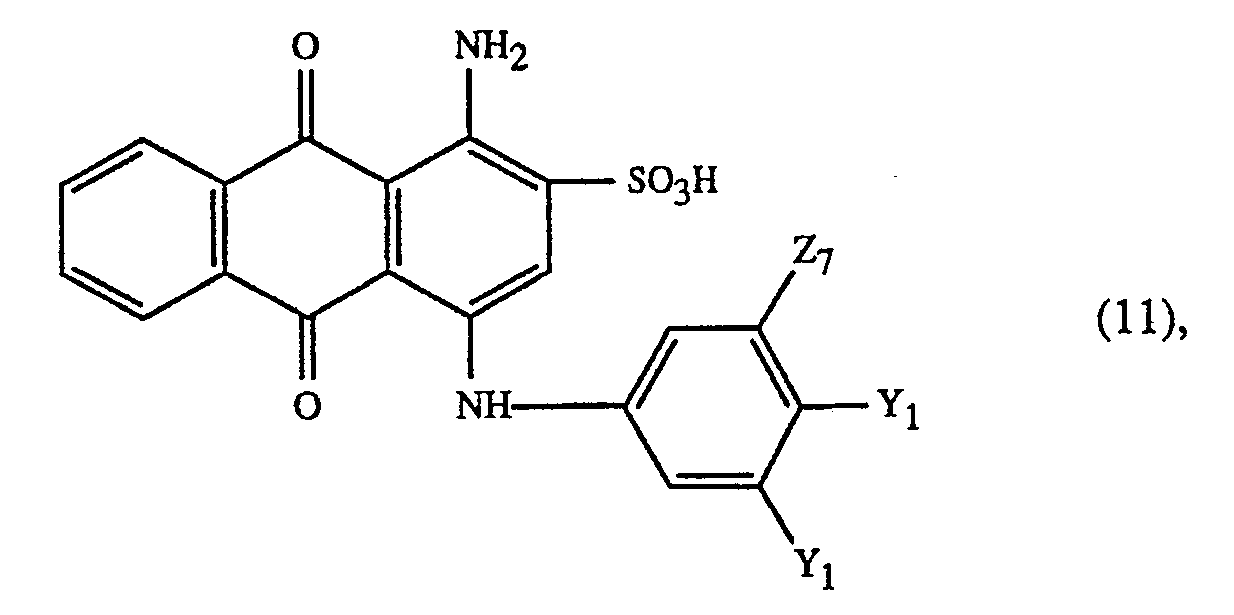
- C2 ⁇ 4-alkanoylamino for Y in formula (5) for example acetylamino, propionylamino or butyrylamino.
- alkoxy radicals for B1, B2, E1, Z1, Z2 and Z3 in formulas (2) and (3) came, for example, methoxy, ethoxy, propoxy, isopropoxy, butoxy, sec-butoxy, isobutoxy or tert-butoxy radical into consideration.
- the hydroxyalkyl radical for X in formula (2) is a straight-chain or branched one Hydroxyalkyl radical, such as the ⁇ -hydroxyethyl, ⁇ -hydroxypropyl, ⁇ -hydroxybutyl or the ⁇ -ethyl- ⁇ -hydroxyethyl radical.
- C2 ⁇ 4-hydroxylalkylsulphamoyl radical for Y in formula (5) is, for example, the ⁇ -hydroxyethylsulphamoyl, ⁇ -hydroxypropylsulphamoyl, ⁇ -hydroxypropylsulphamoyl or the ⁇ -hydroxybutylsulphamoyl radical.
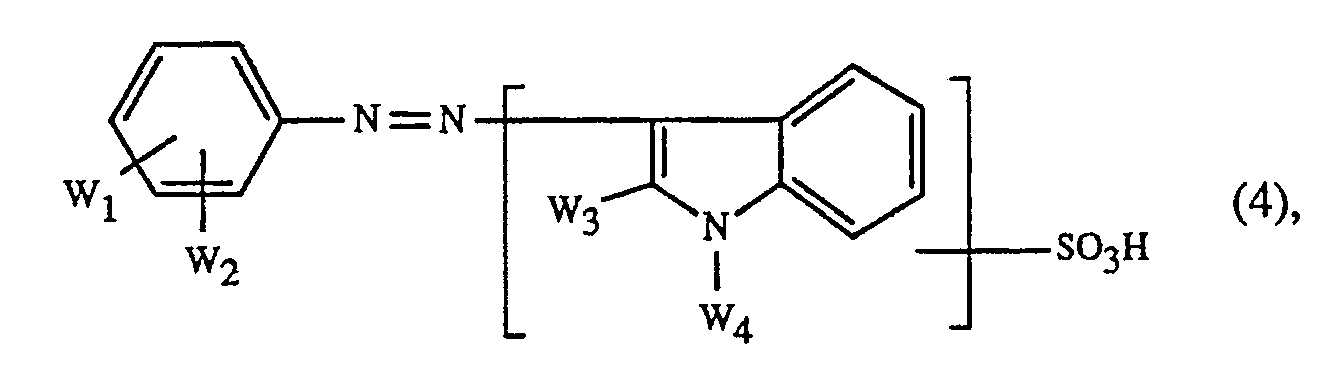
- W1 in formula (4) means C1 ⁇ 4-alkyl, it is methyl, ethyl, n-propyl, isopropyl, n-butyl, sec-butyl, isobutyl or tert-butyl.
- W1 in formula (4) means C1 ⁇ 4 alkoxy, it is methoxy, ethoxy, n-propoxy, isopropoxy, n-butoxy, sec-butoxy, isobutoxy or tert-butoxy.
- W1 in formula (4) means C2 ⁇ 4-alkanoylamino, it is for example acetylamino, propionylamino or butyrylamino.
- W1 in formula (4) denotes an optionally substituted arylsulfonyl, aryloxy or arylcarbonyl radical
- aryl preferably means a radical of the benzene or naphthalene series, which can be further substituted, for example by C1 ⁇ 4-alkyl groups, such as methyl and ethyl, C1 ⁇ 4-alkoxy groups, such as methoxy and ethoxy, halogen, such as fluorine, chlorine and bromine, alkanoylamino groups having 1 to 6 carbon atoms, acetylamino, and hydroxy.
- W1 and / or W2 is halogen, it is fluorine, chlorine or bromine.
- W2 in formula (4) represents an optionally substituted aryloxy or aryloxysulfonyl radical
- aryl means a radical of the benzene or naphthalene series which may be further substituted, for example by C1 ⁇ 4-alkyl groups such as methyl and ethyl, C1 ⁇ 4-alkoxy groups, such as methoxy and ethoxy, halogen such as fluorine, chlorine and bromine, alkanoylamino groups having 1 to 6 carbon atoms such as acetylamino, and hydroxy.
- W2, W3, W5 or W6 in formula (4) represent an optionally substituted alkyl radical, it is preferably, independently of one another, preferably a straight-chain or branched C1 ⁇ 12-alkyl, in particular C1 ⁇ 4-alkyl radical, which can be further substituted, for example by Halogen, such as fluorine, chlorine or bromine, hydroxy, cyano, C1 ⁇ 4 alkoxy, such as methoxy or ethoxy, and alkanoyl groups with 1 to 6 carbon atoms, such as the acetyl or propionyl group, and the benzoyl group.
- the alkyl radical W3 can also be substituted by sulfo.
- W2, W3, W5 and W6 as alkyl radical are: methyl, ethyl, propyl, isopropyl, butyl, sec-butyl, tert-butyl, isobutyl and trifluoromethyl.
- W3, W5 and W6 in formula (4) represent an optionally substituted aryl radical, this independently of one another preferably belongs to the benzene or naphthalene series; it can be further substituted, for example by C1 ⁇ 4-alkyl groups, such as methyl, C1 ⁇ 4-alkoxy groups such as methoxy and ethoxy, halogen such as fluorine, chlorine or bromine, trifluoromethyl, alkanoylamino groups having 1 to 6 carbon atoms such as acetylamino, hydroxy and carboxy.
- the aryl radical W3 can also be substituted by sulfo.
- W3, W5 and W6 as aryl radical is a phenyl radical which can be substituted by methyl, trifluoromethyl and chlorine.
- W4 in formula (4) is an alkyl radical, then preferably a straight-chain or branched C1 ⁇ 12 alkyl and in particular C18 alkyl radical is suitable.
- Examples include: methyl, ethyl, propyl, isopropyl, butyl, sec-butyl, tert-butyl, isobutyl, pentyl- (1), pentyl- (3), heptyl- (1), heptyl- (3) and octyl- (1).
- W5 and W6 are an optionally substituted cycloalkyl radical
- cycloalkyl groups with 5- to 7-membered rings, which may be further substituted are preferably suitable independently of one another. by C1 ⁇ 4 alkyl, such as methyl.
- the cyclohexyl group is particularly suitable.
- a preferred embodiment of the process according to the invention is characterized in that a red dye of the formula wherein D1 is phenyl or naphthyl, and each of these radicals can be substituted by C1-C8-alkyl, C1-C8-alkoxy, C2-C8-alkanoylamino, C2-C8-alkoxycarbonylamino, C2-C8-alkanoyl, C5-C7-cycloalkylcarbonyl, in the cycloalkyl ring by C1-C4-alkyl, halogen, sulfo or sulfato substituted C5-C7-cycloalkylcarbonyl, benzoyl, in the phenyl ring by C1-C4-alkyl, halogen, sulfo or sulfato-substituted benzoyl, benzthiazole, benzoxazole, by C1-C4-alkyl, halogen, s
- a particularly preferred embodiment of the process according to the invention is characterized in that a red dye of the formula wherein D2 is phenyl, which may be substituted by C1-C8-alkyl, C2-C8-alkanoyl, C2-C8-alkoxycarbonyl, C5-C7-cycloalkylcarbonyl, benzoyl, in the phenyl ring by C1-C4-alkyl, halogen, sulfo or sulfato substituted benzoyl, benzothiazole, benzoxazole, substituted by C1-C4-alkyl, halogen, sulfo or sulfato, benzthiazole or benzoxazole, halogen, phenylsulfonyl, in the phenyl ring by C1-C4-alkyl, halogen, sulfo or sulfato-substituted phenylsulfonyl, C1
- Red dyes of the formulas (1), (6) or (7) are particularly preferably used in the processes according to the invention, in which R1 is hydrogen or C1-C4-alkyl, in particular methyl, R2 and R3 independently of one another hydrogen or C1-C4-alkyl, especially methyl, R4 C1-C4-alkyl, especially ethyl, and n is the number 1 or 2.
- a very particularly preferred embodiment of the method according to the invention is characterized in that a red dye of the formula wherein R5 and R6 independently of one another are hydrogen or methyl, m is the number 1 or 2 and D has the meanings given under formula (1), in particular where D is given for D1 under formula (6) or for D2 under formula (7) Has meanings used.
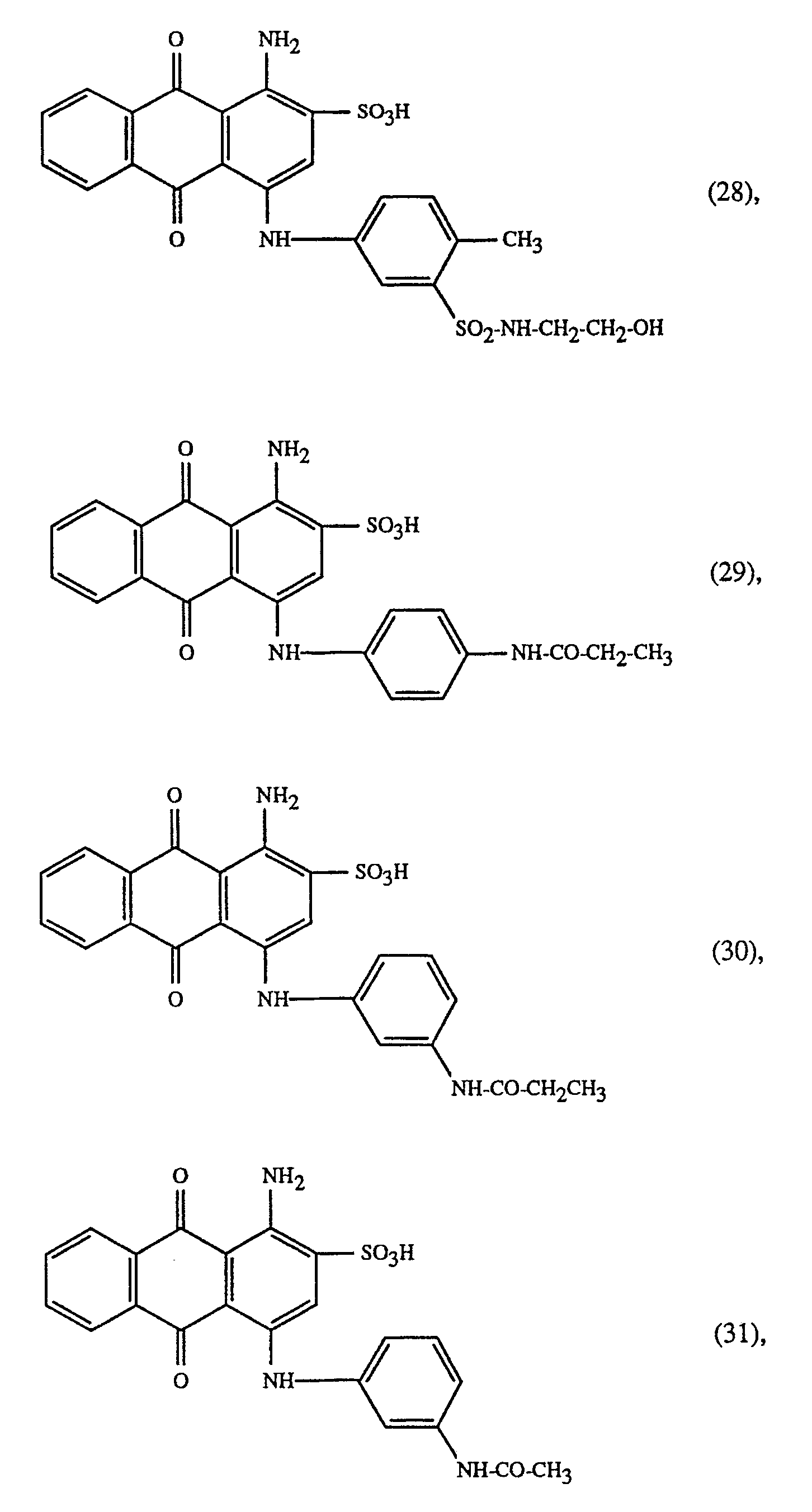
- Very particularly important embodiments of the process according to the invention are characterized in that a red dye of the formula along with the yellow dye of the formula or the orange dye of the formula or a mixture of the yellow dye of the formula (23) with the orange dye of the formula (24), or a mixture of the dyes of the formulas (23) and / or (24) with the dye of formula wherein the weight ratio of the dyes of the formulas (23) and (24) 60:40 to 40:60 and in particular 1: 1 and the weight ratio of the dyes of the formulas (23) or (24) and (25) 80:20 to 20: 80 and in particular 70:30, and the weight ratio of the dyes of the formulas (23), (24) and (25) 60:20:20, 20:60:20 to 20:20:60 and in particular 1: 1: 1 or the yellow dye of the formula and at least one of the blue dyes of the formulas or a mixture of a dye of the formulas (27) or (28) with a dye of the formulas (29), (30) or (31) is used.
- the dyes of the formulas (2), (3), (4) and (5) used in the processes according to the invention for trichromatic dyeing or printing are known, for example, from EP-A-181 292 and EP-A-127 579 and can be prepared in analogy to known processes.
- the dyes of formula (1) are prepared by using an amine of the formula D-NH2 (32) diazotized and on a coupling component of the formula couples, where D, R1, R2, R3, R4 and n have the meanings given under formula (1).
- the amines of the formula (32) are known per se and can be prepared analogously to known processes.
- the coupling components of the formula (33) are prepared, for example, by using a compound of the formula wherein R1, R2, R3 and R4 have the meanings given under formula (1), with a compound of formula X- (CH2) n - -Y (35), wherein X and Y each represent an anionic leaving group and n has the meanings given under formula (1), to a compound of the formula converts, wherein R1, R2, R3, R4 and n have the meanings given under formula (1) and X has the meaning given under formula (35), and the compound of formula (36) by replacing the radical X by a sulfo group to one Reacts compound of formula (33).
- X and Y in formula (35) independently of one another, e.g. Halogen, e.g. Fluorine, chlorine or bromine into consideration.
- X and Y are each chlorine.
- Examples of compounds of the formula (35) are chloroacetic acid chloride, 3-chloropropionic acid chloride, 4-chlorobutyric acid chloride and 5-valeric acid chloride.
- corresponding anhydrides such as e.g. Chloroacetic anhydride can be used.
- the reaction of the compound of formula (34) with the compound of formula (35) can be carried out in water or organic solvents, e.g. Tetrahydrofuran, dioxane or benzene, at temperatures from -10 to 80 ° C, especially at temperatures from 0 to 40 ° C.
- organic solvents e.g. Tetrahydrofuran, dioxane or benzene
- the introduction of the sulfo group to the compound of formula (36) takes place by replacing the radical X with a sulfo group, e.g. with Na2SO3, in a solvent, e.g. Water or a water / ethanol mixture, at temperatures from 60 to 100 ° C, in particular at temperatures from 85 to 100 ° C, at acidic, neutral to alkaline pH, in particular a pH of 5 to 9.
- a solvent e.g. Water or a water / ethanol mixture
- dye mixtures are used in the process according to the invention, so these can be prepared by mixing the individual dyes. This mixing process takes place, for example, in suitable mills, for example ball and pin mills, as well as in kneaders or mixers.
- the dye mixtures of the dyes can be prepared by spray drying the aqueous dye mixtures.
- the dyes used in the process according to the invention are either in the form of their free sulfonic acid or preferably as their salts.
- suitable salts are the alkali, alkaline earth or ammonium salts or the salts of an organic amine.
- suitable salts include the sodium, lithium, potassium or ammonium salts or the salt of triethanolamine.
- the dyes used in the process according to the invention generally contain further additives such as Cooking salt or dextrin.
- the process according to the invention for trichromatic dyeing or printing can be applied to the customary dyeing or printing processes.
- the dyeing liquors or printing pastes can contain other additives, for example wetting agents, anti-foaming agents, leveling agents or agents which influence the properties of the textile material, such as e.g. Plasticizers, flame retardants or dirt, water and oil repellents as well as water softeners and natural or synthetic thickeners such as Alginates and cellulose ethers.
- the process according to the invention is particularly suitable for dyeing from short liquors, such as suitable for continuous dyeing processes or discontinuous and continuous foam coloring processes.
- the dyes used in the process according to the invention are distinguished in trichromatic dyeing or printing by uniform color build-up, good absorption behavior, good constancy of shades even in different concentrations, good fastness properties, e.g. good formaldehyde resistance, as well as particularly good combinability.
- the inventive method is suitable for dyeing or printing both natural polyamide materials such as wool such as in particular synthetic polyamide materials such as polyamide 6 or polyamide 6.6 and it is suitable for dyeing or printing wool and synthetic polyamide blended fabrics or yarns.
- the textile material mentioned can be in a wide variety of processing forms, such as as fiber, yarn, woven or knitted fabric and in particular in the form of carpets.
- parts represent parts by weight.
- the temperatures are given in degrees Celsius.
- the relationship between parts by weight and parts by volume is the same as that between grams and cubic centimeters.
- the dyeing time at a temperature of 98 ° is 30 to 90 minutes.
- the dyed polyamide fiber material is then removed and rinsed and dried as usual. The result is a piece of fabric dyed in a brown shade that doesn't matter at all and has no material-related streakiness.
- 10 parts of polyamide 6.6 yarn are dyed in 400 parts of an aqueous liquor which contains 1.5 g / l of ammonium acetate and is adjusted to pH 5.5 with acetic acid. 0.1% of the dye is in the form of the free acid of the formula corresponds to, 0.13% of the dye of the formula (102) and 0.12% of the dye of the formula (103) are used, the quantitative data relating to the fiber weight.
- the dyebath is heated to 98 ° C. in the course of 30 minutes and held at 96 ° to 98 ° for 60 minutes.
- the dyed yarn is then removed and rinsed and dried as usual. A yarn dyed in a brown shade is obtained.
- 10 parts of polyamide 6.6 carpet yarn are dyed in 400 parts of an aqueous liquor which contains 1.5 g / l of ammonium acetate and is adjusted to pH 5.5 with acetic acid.
- the dyes used are 0.15% of the red dye of the formula (101), 0.625% of the yellow dye in the form of the free acid of the formula corresponds, and 0.52% of the blue dye of formula (103) is used, the amounts given refer to the fiber weight.
- the dyebath is heated to 98 ° within 30 minutes and held at 96 ° to 98 ° for 60 minutes.
- the dyed yarn is then removed and rinsed and dried as usual. A yarn dyed in a brown shade is obtained.
- a Verlours carpet made of polyamide-6 with a pile weight of 400 g / m2 is used for the base dyeing with an aqueous padding liquor of the following composition 0.1 g / l of dye of the formula (102), 0.1 g / l dye of the formula (103), 2 g / l thickener based on natural polysaccharides, 0.5 g / l wetting agent based on a sulfated alkyl aryl polyglycolate, and 0.5 g / l defoamer based on high-boiling alcohols, which is adjusted to pH 4.5 with acetic acid, padded and squeezed to 80% of the liquor intake.
- a pattern with the following aqueous printing paste is applied to the carpet pretreated in this way using a printing template: 1 g / l of dye of the formula (102), 20 g / l of dye of the formula (101), 10 g / l of dye of the formula (103), 15 g / l thickener based on natural polysaccharides, 2 g / l wetting agent based on a sulfated alkyl aryl polyglycolate, 1 g / l defoamer based on high-boiling alcohols.
- the printing paste is adjusted to pH 4.5 with acetic acid.
- the printed material is then treated with saturated steam at 101 ° for 5 minutes to fix the dyes, rinsed, neutralized, rinsed again and dried.
- Example 6 If the procedure described in Example 6 is followed and 1.2 parts of the red dye of the formula (101) are used instead of 1.2 parts of the red dye of the formula (104) using an otherwise identical procedure, a carpet colored in a brown shade is obtained .
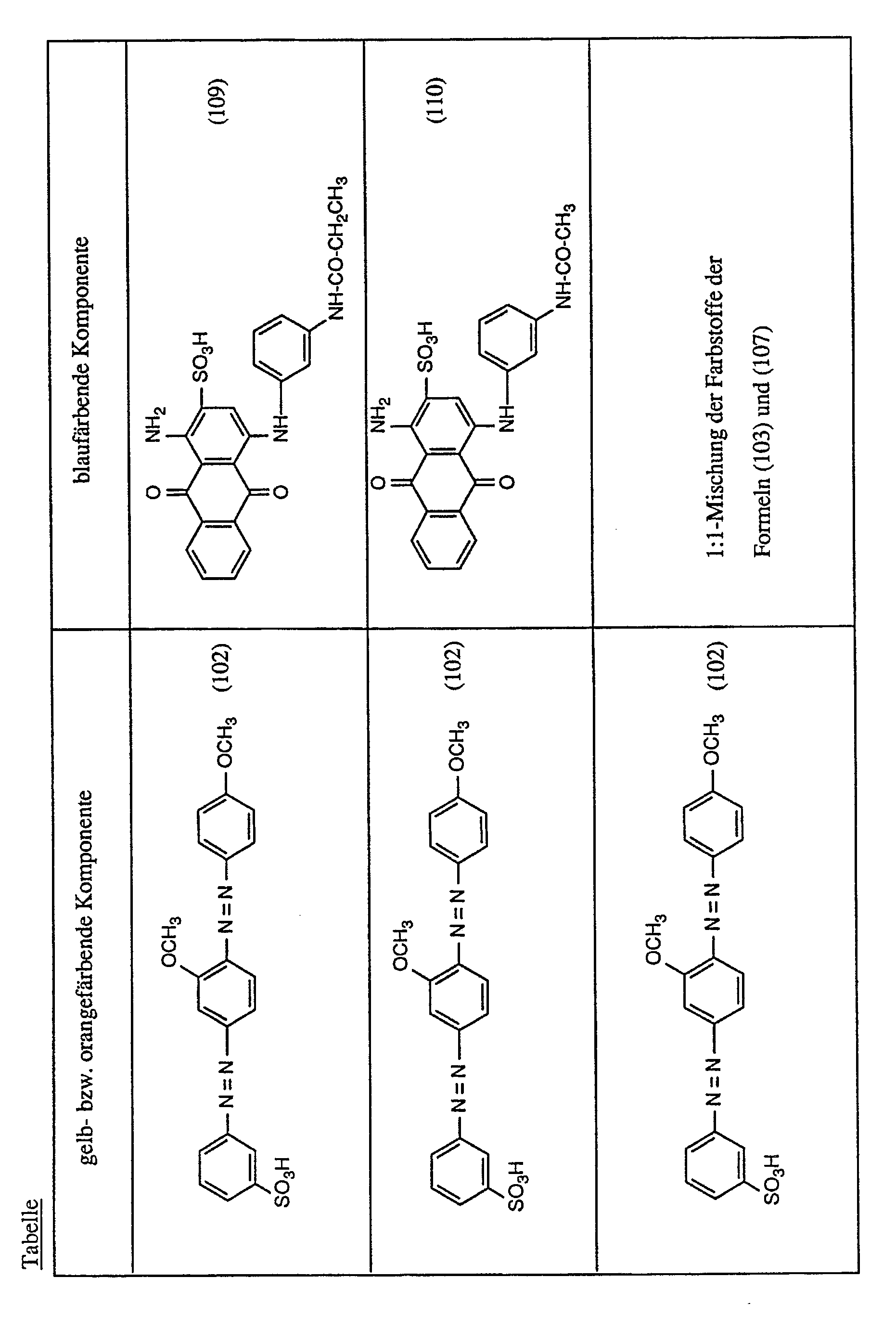
- Example 1 If the procedure described in Example 1 is followed and instead of the combination of the dyes of the formulas (101), (102) and (103) mentioned in Example 1, the combination of dyes indicated in the following table is used in amounts of the same color strength, this also gives pieces of fabric dyed in an even brown shade.
- the dye of the formula (106) is used as the red-coloring dye.
- the mixture is stirred at 0 to 3 ° for 30 minutes and then 15 parts of sodium acetate x 3H 2 O are added in 3 portions within 15 minutes. After stirring for a further 30 minutes at 0 to 3 °, a solution of 6 parts of sodium acetate, 3 parts of sodium carbonate and 30 parts of water is added over the course of 30 minutes, the reaction mixture not heating up to more than 20 °. 100 parts of a 15% strength aqueous sodium chloride solution are then added within 10 minutes, the dye obtained is filtered off and dried in vacuo at 50 °. 6 parts of a reddish powder are obtained, which corresponds to a compound of the formula (101). The dye obtained dyes natural and synthetic polyamide fiber material in red shades.
Landscapes
- Engineering & Computer Science (AREA)
- Textile Engineering (AREA)
- Chemical & Material Sciences (AREA)
- Chemical Kinetics & Catalysis (AREA)
- Organic Chemistry (AREA)
- Coloring (AREA)
Abstract
Verfahren zum Trichromie-Färben oder Bedrücken von natürlichen und synthetischen Polyamidfasermaterialien, welches dadurch gekennzeichnet ist, dass man mindestens einen roten Farbstoff der Formel <IMAGE> worin D, R1, R2, R3, R4 und n die in Anspruch 1 angegebenen Bedeutungen haben, zusammen mit mindestens einem gelben oder orangen Farbstoff der Formeln <IMAGE> worin B1, B2, E1 und X die in Anspruch 1 angegebenen Bedeutungen haben, oder <IMAGE> worin Z1, Z2 und Z3 die in Anspruch 1 angegebenen Bedeutungen haben, oder Mischungen von Farbstoffen der Formeln (2) und (3), oder einem gelben Farbstoff der Formel <IMAGE> worin W1, W2, W3 und W4 die in Anspruch 1 angegebenen Bedeutungen haben oder Mischungen von Farbstoffen der Formeln (2), (3) und (4) und mindestens einem blauen Farbstoff der Formel <IMAGE> worin ein Y und Z4 die in Anspruch 1 angegebenen Bedeutungen haben. Das erfindungsgemässe Verfahren eignet sich zum Färben von natürlichen oder synthetischen Polyamidmaterialien aus wässriger Flotte oder zum Drucken mit Druckpasten; und insbesondere zum Färben aus Kurzflotten.
Description
- Die vorliegende Erfindung betrifft ein Verfahren zum Trichromie-Färben oder -Bedrücken von natürlichen und synthetischen Polyamidmaterialien mit mindestens einem blaufärbenden, sulfogruppenhaltigen Anthrachinonfarbstoff, mindestens einem rotfärbenden, sulfogruppenhaltigen Azofarbstoff und mindestens einem gelb- oder orangefärbenden, sulfogruppenhaltigen Azofarbstoff.
- Die der vorliegenden Erfindung zugrundeliegende Aufgabe war es, ein Verfahren zum Färben oder Bedrücken von natürlichen und synthetischen Polyamidmaterialien mit zur Kombination nach dem Trichromie-Prinzip geeigneten Farbstoffen zu finden.
- Es wurde nun gefunden, dass man diese Aufgabe erfindungsgemäss durch das nachfolgend beschriebene Verfahren lösen kann. Die so erhaltenen Färbungen genügen den gestellten Aufgaben. Insbesondere zeichnen sich die erhaltenen Färbungen durch einen gleichmässigen Farbaufbau bei gleichzeitiger Nuancenkonstanz in verschiedenen Konzentrationen und eine gute Kombinierbarkeit aus.
- Gegenstand der vorliegenden Erfindung ist ein Verfahren zum Trichromie-Färben oder Bedrücken von natürlichen und synthetischen Polyamidfasermaterialien, welches dadurch gekennzeichnet ist, dass man mindestens einen roten Farbstoff der Formel




- Unter Trichromie ist die additive Farbmischung passend gewählter gelb- bzw. orange-, rot- und blaufärbender Farbstoffe zu verstehen, mit denen jede gewünschte Nuance des sichbaren Farbspektrums durch geeignete Wahl der Mengenverhältnisse der Farbstoffe eingestellt werden kann.
- Der Rest D in Formel (1) kann die bei Diazokomponenten üblichen Substituenten enthalten, z.B. Alkylgruppen mit 1 bis 8, vorzugsweise 1 bis 4 Kohlenstoffatomen, wie z.B. Methyl, Aethyl, Propyl, Isopropyl, Butyl, Isobutyl, sek.-Butyl, tert-Butyl, Hexyl, Octyl, wobei die Alkylgruppen durch Sulfo oder Sulfato substituiert sein können, Alkoxygruppen mit 1 bis 8 Kohlenstoffatomen, insbesondere 1 bis 4 Kohlenstoffatomen, wie z.B. Methoxy, Aethoxy, Propoxy, Isopropoxy, Butoxy, Acylaminogruppen wie Alkanoylaminogruppen mit 2 bis 8 Kohlenstoffatomen und Alkoxycarbonylaminogruppen mit 2 bis 8 Kohlenstoffatomen, wie z.B. Acetylamino, Propionylamino, Methoxycarbonylamino, Aethoxycarbonylamino, Alkanoylgruppen mit 2 bis 8, vorzugsweise 2 bis 4 Kohlenstoffatomen, wie z.B. Acetyl, Propionyl, Butyryl oder Isobutyryl, C₅-C₇-Cycloalkylcarbonyl, wie z.B. Cyclohexylcarbonyl, im Cycloalkylring durch C₁-C₄-Alkyl, wie z.B. Methyl, Aethyl, Propyl, Butyl, oder Halogen, wie z.B. Fluor, Chlor, Brom, Sulfo oder Sulfato, substituiertes C₅-C₇-Cycloalkylcarbonyl, Benzoyl, im Phenylring durch C₁-C₄-Alkyl, wie z.B. Methyl, Aethyl, Propyl, Butyl oder Halogen, wie z.B. Fluor, Chlor, Brom, Sulfo oder Sulfato, substituiertes Benzoyl, gegebenenfalls durch C₁-C₄-Alkyl, Halogen, Sulfo oder Sulfato substituiertes Benzthiazol oder Benzoxazol, Benzoylamino, Amino, Mono- oder Dialkylamino mit 1 bis 8 Kohlenstoffatomen im Alkylrest, Phenylamino, Alkoxycarbonyl mit 1 bis 8 Kohlenstoffatomen im Alkoxyrest, C₅-C₇-Cycloalkylaminosulfonyl, Nitro, Cyan, Trifluormethyl, Halogen, wie Fluor, Brom oder insbesondere Chlor, Sulfamoyl, am Stickstoffatom ein- oder zweifach durch C₁-C₄-Alkyl, C₅-C₇-Cycloalkyl oder Phenyl substituiertes Sulfamoyl, Carbamoyl, Ureido, Hydroxy, C₁-C₈-Alkylsulfonyl, C₁-C₈-Alkylaminosulfonyl, gegebenenfalls im Phenylring durch C₁-C₄-Alkyl, Halogen wie z.B. Fluor, Chlor, Brom, Sulfo oder Sulfato substituiertes Phenylsulfonyl, Carboxy, Sulfomethyl, Sulfo, Sulfato, Thiosulfato, Arylazogruppen wie z.B. die Phenylazo- und Naphthylazogruppe sowie Phenyl, Naphthyl, Phenoxy, Phenoxysulfonyl, Phenylaminosulfonyl, wobei die angegebenen Phenyl- oder Naphthylreste durch die oben angegebenen Substituenten weitersubstituiert sein können. Gegebenenfalls können je zwei benachbarte Substituenten der genannten Ringsysteme weitere ankondensierte Phenylringe oder Cyclohexylringe bilden.
- Als C₁-C₈-Alkyl kommt für R₁, R₂, R₃ und R₄ in Formel (1) z.B. in Betracht:
- Methyl, Aethyl, Propyl, Isopropyl, Butyl, Isobutyl, sek.-Butyl, tert.-Butyl, Pentyl, Hexyl, Heptyl oder Octyl, sowie die entsprechenden Reste, die z.B. durch Hydroxy, Alkoxy mit 1 bis 4 Kohlenstoffatomen, wie z.B. Methoxy, Aethoxy, Propoxy, Isopropoxy oder Butoxy, Sulfo, Sulfato, Thiosulfato, Cyan oder Halogen, wie z.B. Fluor, Chlor oder Brom, und Phenyl substituiert sind, wobei der Phenylrest durch die oben angegebenen Substituenten weitersubstituiert sein kann.
- Als Alkylreste kommen für B₁, B₂, E₁, X, Z₁, Z₂ und Z₃ in den Formeln (2) und (3) unabhängig voneinander geradkettige oder verzweigte Alkylreste in Betracht, wie beispielsweise Methyl, Aethyl, Propyl, Isopropyl, Butyl, sek.-Butyl, Isobutyl und tert.-Butyl.
- Als Halogen kommt für Z₁, Z₂ und Z₃ in Formel (3), Fluor oder Brom und insbesondere Chlor in Betracht.
- Als C₂₋₄-Alkanoylamino kommt für Y in Formel (5) beispielsweise Acetylamino-, Propionylamino- oder Butyrylaminorest in Betracht.
- Als Alkoxyreste kommten für B₁, B₂, E₁, Z₁, Z₂ und Z₃ in den Formeln (2) und (3) beispielsweise der Methoxy-, Aethoxy-, Propoxy-, Isopropoxy-, Butoxy-, sek.-Butoxy-, Isobutoxy- oder tert.-Butoxyrest in Betracht.
- Als Hydroxyalkylrest kommt für X in Formel (2) ein geradkettiger oder verzweigter Hydroxyalkylrest in Betracht, wie beispielsweise der β-Hydroxyäthyl-, β-Hydroxypropyl-, β-Hydroxybutyl- oder der α-Aethyl-β-hydroxyäthylrest.
- Als C₂₋₄-Hydroxylalkylsulphamoylrest kommt für Y in Formel (5) beispielsweise der β-Hydroxyäthylsulphamoyl-, β-Hydroxypropylsulphamoyl-, γ-Hydroxypropylsulphamoyl- oder der β-Hydroxybutylsulphamoylrest in Betracht.
- Bedeutet W₁ in Formel (4) C₁₋₄-Alkyl, so handelt es sich um Methyl, Aethyl, n-Propyl, Isopropyl, n-Butyl, sek.-Butyl, Isobutyl oder tert.-Butyl.
- Bedeutet W₁ in Formel (4) C₁₋₄-Alkoxy, so handelt es sich um Methoxy, Aethoxy, n-Propoxy, Isopropoxy, n-Butoxy, sek.-Butoxy, Isobutoxy oder tert-Butoxy.
- Bedeutet W₁ in Formel (4) C₂₋₄-Alkanoylamino, so handelt es sich beispielsweise um Acetylamino, Propionylamino oder Butyrylamino.
- Bedeutet W₁ in Formel (4) einen gegebenenfalls substituierten Arylsulfonyl-, Aryloxy- oder Arylcarbonylrest, so bedeutet Aryl vorzugsweise einen Rest der Benzol- oder Naphthalinreihe, der weitersubstituiert sein kann, beispielsweise durch C₁₋₄-Alkylgruppen, wie Methyl und Aethyl, C₁₋₄-Alkoxygruppen, wie Methoxy und Aethoxy, Halogen, wie Fluor, Chlor und Brom, Alkanoylaminogruppen mit 1 bis 6 Kohlenstoffatomen, wle Acetylamino, und Hydroxy.
- Bedeutet W₁ und/oder W₂ Halogen, so handelt es sich um Fluor, Chlor oder Brom.
- Bedeutet W₂ in Formel (4) einen gegebenfalls substituierten Aryloxy- oder Aryloxysulfonylrest, so bedeutet Aryl einen Rest der Benzol- oder Naphthalinreihe, der weitersubstituiert sein kann, beispielsweise durch C₁₋₄-Alkylgruppen, wie Methyl und Aethyl, C₁₋₄-Alkoxygruppen, wie Methoxy und Aethoxy, Halogen, wie Fluor, Chlor und Brom, Alkanoylaminogruppen mit 1 bis 6 Kohlenstoffatomen, wie Acetylamino, und Hydroxy.
- Bedeuten W₂, W₃, W₅ oder W₆ in Formel (4) einen gegebenenfalls substituierten Alkylrest, so handelt es sich unabhängig voneinander vorzugsweise um einen geradkettigen oder verzweigten C₁₋₁₂-Alkyl- insbesondere C₁₋₄-Alkylrest, der weitersubstituiert sein kann, z.B. durch Halogen, wie Fluor, Chlor oder Brom, Hydroxy, Cyano, C₁₋₄-Alkoxy, wie Methoxy oder Aethoxy, und Alkanoylgruppen mit 1 bis 6 Kohlenstoffatomen, wie die Acetyl- oder Propionylgruppe, und die Benzoylgruppe. Der Alkylrest W₃ kann auch durch Sulfo substituiert sein. Als Beispiele für W₂, W₃, W₅ und W₆ als Alkylrest seien genannt: Methyl, Aethyl, Propyl, Isopropyl, Butyl, sek.-Butyl, tert.-Butyl, Isobutyl und Trifluormethyl.
- Bedeuten W₃, W₅ und W₆ in Formel (4) einen gegebenenfalls substituierten Arylrest, so gehört dieser unabhängig voneinander vorzugsweise der Benzol- oder Naphthalinreihe an, er kann weitersubstituiert sein, beispielsweise durch C₁₋₄-Alkylgruppen, wie Methyl, C₁₋₄-Alkoxygruppen, wie Methoxy und Aethoxy, Halogen, wie Fluor, Chlor oder Brom, Trifluormethyl, Alkanoylaminogruppen mit 1 bis 6 Kohlenstoffatomen, wie Acetylamino, Hydroxy und Carboxy. Der Arylrest W₃ kann auch durch Sulfo substituiert sein. Insbesondere ist W₃, W₅ und W₆ als Arylrest ein Phenylrest, der durch Methyl, Trifluormethyl und Chlor substituiert sein kann.
- Bedeutet W₄ in Formel (4) einen Alkylrest, so kommt vorzugsweise ein geradkettiger oder verzweigter C₁₋₁₂-Alkyl- und insbesondere C₁₈-Alkylrest in Betracht. Als Beispiele seien genannt: Methyl, Aethyl, Propyl, Isopropyl, Butyl, sek.-Butyl, tert.-Butyl, Isobutyl, Pentyl-(1), Pentyl-(3), Heptyl-(1), Heptyl-(3) und Octyl-(1).
- Bedeuten W₅ und W₆ einen gegebenenfalls substituierten Cycloalkylrest, so kommen unabhängig voneinander vorzugsweise Cycloalkylgruppen mit 5- bis 7-gliedrigen Ringen in Betracht, die weitersubstituiert sein können, z.B. durch C₁₋₄-Alkyl, wie Methyl. Insbesondere kommt die Cyclohexylgruppe in Betracht.
- Eine bevorzugte Ausführungsform des erfindungsgemässen Verfahrens ist dadurch gekennzeichnet, dass man einen roten Farbstoff der Formel

- Eine besonders bevorzugte Ausführungsform des erfindungsgemässen Verfahrens ist dadurch gekennzeichnet, dass man einen roten Farbstoff der Formel

- Besonders bevorzugt werden in den erfindungsgemässen Verfahren rote Farbstoffe der Formeln (1), (6) oder (7) verwendet, worin R₁ Wasserstoff oder C₁-C₄-Alkyl, insbesondere Methyl, R₂ und R₃ unabhängig voneinander Wasserstoff oder C₁-C₄-Alkyl, insbesondere Methyl, R₄ C₁-C₄-Alkyl, insbesondere Aethyl, und n die Zahl 1 oder 2 ist.
- Weitere bevorzugte Ausführungsformen des erfindungsgemässen Verfahrens sind dadurch gekennzeichnet, dass man mindestens einen gelben oder orangen Farbstoff der Formel




- Eine ganz besonders bevorzugte Ausführungsform des erfindungsgemässen Verfahrens ist dadurch gekennzeichnet, dass man einen roten Farbstoff der Formel

- Ganz besonders wichtige Ausführungsformen des erfindungsgemässen Verfahrens sind dadurch gekennzeichnet, dass man einen roten Farbstoff der Formel


oder einer Mischung der Farbstoffe der Formeln (23) und/oder (24) mit dem Farbstoff der Formel


- Die in den erfindungsgemässen Verfahren zum Trichromie-Färben oder -Bedrucken verwendeten Farbstoffe der Formeln (2), (3), (4) und (5) sind z.B. aus der EP-A-181 292 bzw. EP-A-127 579 bekannt und können in Analogie zu bekannten Verfahren hergestellt werden. Die Farbstoffe der Formel (1) werden hergestellt, indem man ein Amin der Formel
D-NH₂ (32)
diazotiert und auf eine Kupplungskomponente der Formel
- Die Amine der Formel (32) sind an sich bekannt und können in Analogie zu bekannten Verfahren hergestellt werden.
- Die Kupplungskomponenten der Formel (33) werden z.B. hergestellt, indem man eine Verbindung der Formel

X-(CH₂)n--Y (35),
worin X und Y je eine anionische Abgangsgruppe bedeuten und n die unter Formel (1) angegebenen Bedeutungen hat, zu einer Verbindung der Formel
- Als X und Y in Formel (35) kommen unabhängig voneinander z.B. Halogen, wie z.B. Fluor, Chlor oder Brom in Betracht. Insbesondere sind X und Y jeweils Chlor. Als Beispiele für Verbindungen der Formel (35) seien Chloressigsäurechlorid, 3-Chlorpropionsäurechlorid, 4-Chlorbuttersäurechlorid und 5-Valeriansäurechlorid genannt. Anstelle der Verbindung der Formel (35) können auch entsprechende Anhydride, wie z.B. Chloressigsäureanhydrid, verwendet werden.
- Die Umsetzung der Verbindung der Formel (34) mit der Verbindung der Formel (35) kann in Wasser oder organischen Lösungsmitteln, wie z.B. Tetrahydrofuran, Dioxan oder Benzol, bei Temperaturen von -10 bis 80°C, insbesondere bei Temperaturen von 0 bis 40°C erfolgen.
- Die Einführung der Sulfogruppe zur Verbindung der Formel (36) erfolgt durch Austausch des Restes X durch eine Sulfogruppe, wie z.B. mit Na₂SO₃, in einem Lösungsmittel, wie z.B. Wasser oder einer Wasser/Aethanolmischung, bei Temperaturen von 60 bis 100°C, insbesondere bei Temperaturen von 85 bis 100°C, bei saurem, neutralem bis alkalischem pH-Wert, insbesondere einem pH-Wert von 5 bis 9.
- Werden in dem erfindungsgemässen Verfahren Farbstoffmischungen verwendet, so können diese durch Mischung der Einzelfarbstoffe hergestellt werden. Dieser Mischprozess erfolgt beispielsweise in geeigneten Mühlen, z.B. Kugel- und Stiftmühlen, sowie in Knetern oder Mixern.
- Ferner können die Farbstoffmischungen der Farbstoffe durch Zerstäubungstrocknen der wässrigen Farbstoffmischungen hergestellt werden.
- Die in dem erfindungsgemässen Verfahren verwendeten Farbstoffe liegen entweder in der Form ihrer freien Sulfonsäure oder vorzugsweise als deren Salze vor.
- Als Salze kommen beispielsweise die Alkali-, Erdalkali- oder Ammoniumsalze oder die Salze eines organischen Amins in Betracht. Als Beispiele seien die Natrium-, Lithium-, Kalium- oder Ammoniumsalze oder das Salz des Triäthanolamins genannt.
- Die in dem erfindungsgemässen Verfahren verwendeten Farbstoffe enthalten in der Regel weitere Zusätze wie z.B. Kochsalz oder Dextrin.
- Das erfindungsgemässe Verfahren zum Trichromie-Färben oder -Bedrücken kann auf die üblichen Färbe- bzw. Druckverfahren angewendet werden. Die Färbeflotten oder Druckpasten können ausser Wasser und den Farbstoffen weitere Zusätze, beispielsweise Netzmittel, Antischaummittel, Egalisiermittel oder die Eigenschaft des Textilmaterials beeinflussende Mittel wie z.B. Weichmachungsmittel, Zusätze zum Flammfestausrüsten oder schmutz-, wasser- und öl-abweisende Mittel sowie wasserenthärtende Mittel und natürliche oder synthetische Verdicker, wie z.B. Alginate und Celluloseäther, enthalten.
- Das erfindungsgemässe Verfahren ist besonders zum Färben aus Kurzflotten, wie z.B. bei Kontinuefärbeverfahren oder diskontinuierlichen und kontinuierlichen Schaumfärbeverfahren, geeignet.
- Die in dem erfindungsgemässen Verfahren verwendeten Farbstoffe zeichnen sich beim Trichromie-Färben oder -Bedrucken durch gleichmässigen Farbaufbau, gutes Aufziehverhalten, guten Nuancenkonstanz auch in verschiedenen Konzentrationen, gute Echtheiten, z.B. gute Formaldehydbeständigkeit, sowie insbesondere durch sehr gute Kombinierbarkeit aus.
- Das erfindungsgemässe Verfahren eignet sich zum Färben oder Bedrucken sowohl von natürlichen Polyamidmaterialien wie z.B. Wolle wie insbesondere von synthetischen Polyamidmaterialien wie z.B. Polyamid 6 oder Polyamid 6.6 und es ist geeignet zum Färben oder Bedrücken von Woll- und synthetischem Polyamid-Mischgeweben oder -Garnen.
- Das genannte Textilmaterial kann dabei in den verschiedensten Verarbeitungsformen vorliegen, wie z.B. als Faser, Garn, Gewebe oder Gewirke und insbesondere in Form von Teppichen.
- In den folgenden Beispielen stehen Teile für Gewichtsteile. Die Temperaturen sind in Celsiusgraden angegeben. Die Beziehung zwischen Gewichtsteilen und Volumenteilen ist dieselbe wie diejenige zwischen Gramm und Kubikzentimeter.
- Man färbt 10 Teile Polyamid-6.6 Fasermaterial (Helancatrikot) in 500 Teilen einer wässrigen Flotte, die 2 g/l Ammonacetat enthält und mit Essigsäure auf pH 5 gestellt wird. Als Farbstoffe werden 0,05 % des roten Farbstoffs der in Form der freien Säure der Formel


- Die Färbedauer bei einer Temperatur von 98° beträgt 30 bis 90 Minuten. Das gefärbte Polyamidfasermaterial wird anschliessend herausgenommen und wie üblich gespült und getrocknet. Man erhält ein in einem braunen Farbton völlig egal gefärbtes Gewebestück, das keinerlei materialbedingte Streifigkeit aufweist.
- Man färbt 10 Teile Polyamid 6.6-Garn in 400 Teilen einer wässrigen Flotte, die 1,5 g/l Ammonacetat enthält und mit Essigsäure auf pH 5,5 gestellt wird. Als Farbstoffe werden 0,1 % des Farbstoffs der in Form der freien Säure der Formel
- Man färbt 10 Teile Polyamid 6.6-Teppichgarn in 400 Teilen einer wässrigen Flotte, die 1,5 g/l Ammonacetat enthält und mit Essigsäure auf pH 5,5 gestellt wird. Als Farbstoffe werden 0,15 % des roten Farbstoffs der Formel (101), 0,625 % des gelben Farbstoffs der in Form der freien Säure der Formel

- Wenn man wie in Beispiel 3 angegeben vorgeht, jedoch anstelle der Farbstoffe der Formeln (101), (105) und (103)
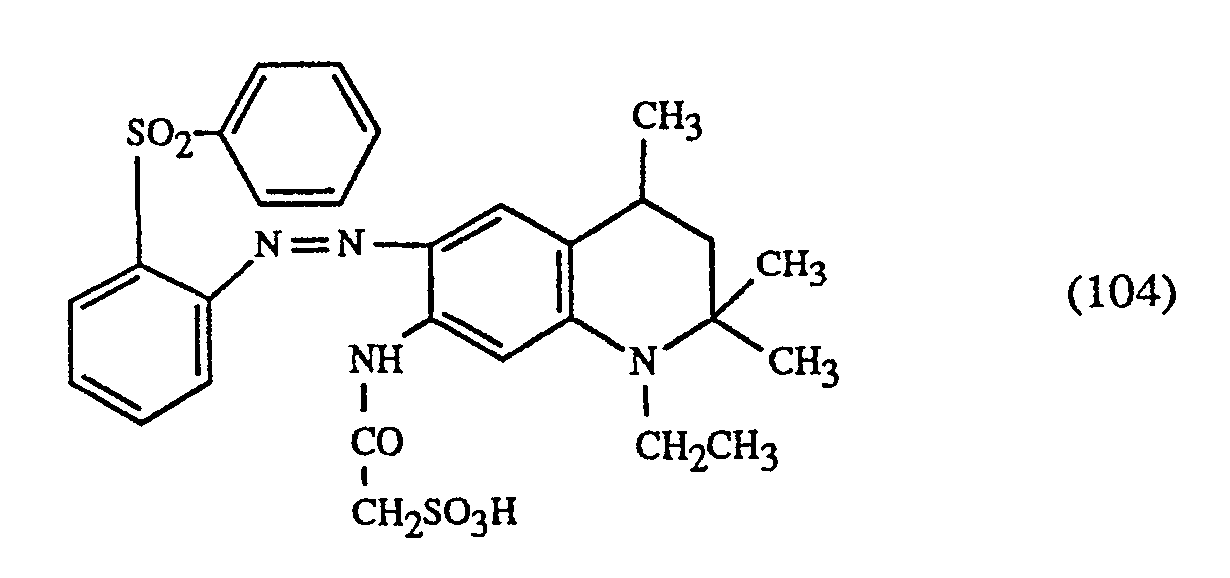
0,32 % des Farbstoffs der Formel (104),
0,46 % des Farbstoffs der Formel (105) und
0,61 % des Farbstoffs der Formel (103)
verwendet, so erhält man ebenfalls ein in einem braunen Farbton gefärbtes Garn. - Ein Verlours-Teppich aus Polyamid-6 mit einem Florgewicht von 400 g/m² wird für die Fondfärbung mit einer wässrigen Klotzflotte der nachstehenden Zusammensetzung
0,1 g/l Farbstoff der Formel (102),
0,1 g/l Farbstoff der Formel (103),
2 g/l Verdicker auf der Basis natürlicher Polysaccharide,
0,5 g/l Netzmittel auf der Basis eines sulfatierten Alkyl-Aryl-Polyglycolates, und
0,5 g/l Entschäumer auf der Basis hochsiedender Alkohole,
die mit Essigsäure auf den pH-Wert 4,5 eingestellt ist, foulardiert und auf 80 % der Flottenaufnahme abgequetscht. Auf den so vorbehandelten Teppich wird über eine Druckschablone ein Muster mit der nachstehenden wässrigen Druckpaste aufgebracht:
1 g/l Farbstoff der Formel (102),
20 g/l Farbstoff der Formel (101),
10 g/l Farbstoff der Formel (103),
15 g/l Verdicker auf der Basis natürlicher Polysaccharide,
2 g/l Netzmittel auf der Basis eines sulfatierten Alkyl-Aryl-Polyglycolates,
1 g/l Entschäumer auf der Basis hochsiedender Alkohole.
Die Druckpaste ist mit Essigsäure auf pH-Wert 4,5 gestellt. - Das bedruckte Material wird anschliessend während 5 Minuten mit Sattdampf von 101° behandelt zur Fixierung der Farbstoffe, gespült, neutralisiert, erneut gespült und getrocknet.
- Man erhält einen Verlours-Teppich mit bordeaux-farbigem Muster auf blassolivem Untergrund mit sehr scharfen Konturen, welcher eine gute Penetration und keinerlei "Frosting" aufweist.
- 2,7 Teile des gelben Farbstoffes der Formel (105), 1,2 Teile des roten Farbstoffes der Formel (104) und 1,3 Teile des blauen Farbstoffes der Formel (103) werden in 100 Teilen Wasser durch kurzes Kochen gelöst. Diese Lösung wird hierauf zu einer Lösung, enthaltend 3 Teile eines Verdickungsmittels auf der Basis von Johannisbrotkernmehl, 5,0 Teile eines koazervatbildenden Klotzhilfsmittels auf der Basis eines Kondensationsproduktes einer höher molekularen Fettsäure mit einem Oxyalkylamin, 2,0 Teilen krist. Mononatriumphosphat und 1,0 Teile krist. Dinatriumphosphat in 500 Teilen kaltem Wasser zugegeben. Anschliessend wird mit kaltem Wasser auf 1000 Teile aufgefrnllt. Von dieser, einen pH-Wert von 5,5 bis 6,5 aufweisenden Flotte werden 300 %, bezogen auf das Teppichgewicht, auf einen Polyamid-6.6-Nadelflor-Rohteppich aufgetragen, bei einer Teppichgeschwindigkeit von 8 Meter pro Minute. Der getränkte Teppich gelangt in einen Schleifendämpfer, wo er während 10 Minuten mit Sattdampf von 98 bis 100° behandelt wird.
- Nach dem Waschen in einer Breitwaschmaschine erhält man einen in einem neutral braunen Farbton gefärbten Teppich.
- Verfährt man wie in Beispiel 6 angegeben und verwendet bei sonst gleicher Verfahrensweise anstelle von 1,2 Teilen des roten Farbstoffs der Formel (104) 1,2 Teile des roten Farbstoffes der Formel (101), so erhält man einen in einem braunen Farbton gefärbten Teppich.
- Wenn man wie in den Beispielen 3 bis 7 angegeben verfährt, jedoch anstelle des rotfärbenden Farbstoffes der Formel (101) eine äquimolare Menge des Farbstoffes, der in Form der freien Säure der Formel

- Wenn man wie in Beispiel 1 angegeben verfährt und anstelle der in Beispiel 1 genannten Kombination der Farbstoffe der Formeln (101), (102) und (103) die in der folgenden Tabelle angegebene Kombination von Farbstoffen in Mengen gleicher Farbstärke verwendet, so erhält man ebenfalls in gleichmässig brauner Nuance gefärbte Gewebestücke.
- Als rotfärbender Farbstoff wird in der folgenden Tabelle der Farbstoff der Formel (106) verwendet.



- Bei Raumtemperatur werden 91,4 Teile 7-Amino-1-äthyl-1,2,3,4-tetrahyro-2,2,4-trimethylchinolin in 285 Teilen Tetrahydrofuran gelöst und unter Rühren 106,6 Teile wasserfreies Natriumacetat innerhalb von 2 Minuten eingetragen.
Innerhalb 30 Minuten werden danach 64,2 Teile Chloracetylchlorid unter Eiskühlung bei einer Innentemperatur von 20° zugetropft. Es wird 1 Stunde bei 20° gerührt und danach 250 Teile Wasser zugetropft. Man rührt 10 Minuten bei 20° nach, trennt danach die wässrige Phase ab und schüttelt die organische Phase einmal mit 100 Teilen 15%-iger wässriger Natriumchlorid-Lösung aus. Die organische Phase wird anschliessend über Natriumsulfat getrocknet und das Rohprodukt durch Einengen der Lösung am Rotationsverdampfer gewonnen. Man erhält 133,1 Teile eines grauen Pulvers der Formel
- Bei Raumtemperatur werden 133,1 Teile der Verbindung der Formel (1001) unter Rühren in 600 Teilen Wasser eingetragen. Anschliessend wird der pH-Wert durch Zugabe von 30%-iger wässriger Natronlauge auf 7 gestellt und 65 Teile Natriumsulfit eingetragen. Danach wird die Temperatur auf ca. 95° erhöht und 4 Stunden bei 93 bis 95° gerührt. Anschliessend lässt man auf 70° abkühlen und streut innerhalb 3 Minuten 105 Teile Natriumchlorid ein. Danach rührt man ohne zu heizen 1 Stunde nach, kühlt auf 15° ab und filtriert. Das abfiltrierte Rohprodukt wird 12 Stunden im Vakuum bei 60° getrocknet und anschliessend in 275 Teile absoluten Essigester eingerührt. Nach 15 Minuten Rühren wird das Produkt über eine Nutsche abgesaugt, mit 50 Teilen absolutem Essigester nachgewaschen und an der Luft getrocknet.
- Man erhält 186 Teile eines grauen Pulvers der Formel

- Bei ca. 10° werden 40 Teile Essigsäure (80 %) und 4 Teile Salzsäure (32 %) unter Rühren vorgelegt. Danach werden 2,1 Teile 4-Amino-3-chlor-phenylmethylsulfon eingetragen und die Temperatur auf 0° gesenkt. Danach wird innerhalb von 1 Minute eine Lösung aus 0,74 Teilen NaNO₂ in 3 Teilen Wasser zugegeben und bei 0 bis 3° diazotiert und 45 Minuten nachgerührt, wobei die Temperatur 0 bis 3° beträgt. Danach gibt man 1 Teil Sulfaminsäure zu, rührt kurz nach und gibt anschliessend 3,65 Teile der Kupplungskomponente der Formel (1002) innerhalb 1 Minute zu. Man rührt 30 Minuten bei 0 bis 3° nach und gibt daraufhin innerhalb 15 Minuten 15 Teile Natriumacetat x 3H₂O in 3 Portionen zu. Nach weiteren 30 Minuten Rühren bei 0 bis 3° wird innerhalb 30 Minuten eine Lösung aus 6 Teilen Natriumacetat, 3 Teilen Soda und 30 Teilen Wasser zugegeben, wobei sich die Reaktionsmischung nicht auf mehr als 20° erwärmt. Anschliessend gibt man innerhalb von 10 Minuten 100 Teile einer 15%-igen wässrigen Natriumchlorid-Lösung zu, filtriert den erhaltenen Farbstoff ab und trocknet im Vakuum bei 50°. Man erhält 6 Teile eines rötlichen Pulvers, das einer Verbindung der Formel (101) entspricht. Der erhaltene Farbstoff färbt natürliches und synthetisches Polyamidfasermaterial in roten Farbtönen.
Claims (12)
1. Verfahren zum Trichromie-Färben oder Bedrücken von natürlichen und synthetischen Polyamidfasermaterialien, dadurch gekennzeichnet, dass man mindestens einen roten Farbstoff der Formel

worin D eine Diazokomponente der Benzol- oder Naphthalinreihe, R₁, R₂, R₃ und R₄ unabhängig voneinander Wasserstoff oder gegebenenfalls substituiertes C₁-C₈-Alkyl und n die Zahl 1, 2, 3, 4 oder 5 ist, zusammen mit mindestens einem gelben oder orangen Farbstoff der Formeln

worin B₁, B₂ und E₁ Wasserstoff, C₁₋₄-Alkyl oder C₁₋₄-Alkoxy und X geradkettiges oder verzweigtes C₁₋₄-Alkyl oder geradkettiges oder verzweigtes C₂₋₄-Hydroxyalkyl bedeuten, oder

worin Z₁, Z₂ und Z₃ unabhängig voneinander Wasserstoff, Halogen, C₁₋₄-Alkyl oder C₁₋₄-Alkoxy bedeuten, oder Mischungen von Farbstoffen der Formeln (2) und (3), oder einem gelben Farbstoff der Formel

worin W₁ Wasserstoff, C₁₋₄-Alkyl, C₁₋₄-Alkoxy, Halogen, C₂₋₄-Alkanoylamino oder ein gegebenenfalls substituierter Arylsulfonyl-, Aryloxy- oder Arylcarbonylrest, W₂ Wasserstoff, Halogen, ein gegebenenfalls substituierter Alkyl, Aryloxy- oder Aryloxysulfonylrest oder ein Rest der Formel

W₃ ein gegebenenfalls substituierter Alkyl- oder Arylrest, W₄ Wasserstoff oder Alkyl und W₅ und W₆ unabhängig voneinander Wasserstoff oder ein gegebenenfalls substituierter Alkyl-, Cycloalkyl- oder Arylrest ist, oder Mischungen von Farbstoffen der Formeln (2), (3) und (4) und mindestens einem blauen Farbstoff der Formel

worin ein Y Wasserstoff oder Methyl und das andere Y C₂₋₄-Alkanoylamino oder C₂-C₄-Hydroxyalkylsulphamoyl bedeutet und Z₄ Wasserstoff oder Methyl ist, verwendet.
2. Verfahren gemäss Anspruch 1, dadurch gekennzeichnet, dass man als roten Farbstoff einen Farbstoff der Formel

worin D₁ Phenyl oder Naphthyl ist, wobei jeder Rest substituiert sein kann durch C₁-C₈-Alkyl, C₁-C₈-Alkoxy, C₂-C₈-Alkanoylamino, C₂-C₈-Alkoxycarbonylamino, C₂-C₈-Alkanoyl, C₅-C₇-Cycloalkylcarbonyl, im Cycloalkylring durch C₁-C₄-Alkyl, Halogen, Sulfo oder Sulfato substituiertes C₅-C₇-Cycloalkylcarbonyl, Benzoyl, im Phenylring durch C₁-C₄-Alkyl, Halogen, Sulfo oder Sulfato substituiertes Benzoyl, Benzthiazol, Benzoxazol, durch C₁-C₄-Alkyl, Halogen, Sulfo oder Sulfato substituiertes Benzthiazol oder Benzoxazol, Benzoylamino, Amino, Mono- oder Dialkylamino mit 1 bis 8 Kohlenstoffatomen im Alkylrest, Phenylamino, C₂-C₈-Alkoxycarbonyl, Nitro, Cyan, Trifluormethyl, Halogen, Sulfamoyl, am Stickstoffatom ein- oder zweifach durch C₁-C₄-Alkyl, C₅-C₇-Cycloalkyl oder Phenyl substituiertes Sulfamoyl, Carbamoyl, Ureido, Hydroxy, C₁-C₈-Alkylsulfonyl, Phenylsulfonyl, im Phenylring durch C₁-C₄-Alkyl, Halogen, Sulfo oder Sulfato substituiertes Phenylsulfonyl, Carboxy, Sulfomethyl, Sulfo, Sulfato, Thiosulfato und Phenylazo- und Naphthylazogruppen, und gegebenenfalls je 2 benachbarte Substituenten der genannten Ringsysteme weitere ankondensierte Phenylringe oder Cyclohexylringe bilden können und R₁, R₂, R₃, R₄ und n die unter Formel (1) angegebenen Bedeutungen haben, vorzugsweise worin jeder der für D₁ oben genannten Reste substituiert sein kann durch C₁-C₈-Alkyl, C₁-C₈-Alkoxy, C₂-C₈-Alkanoylamino, C₂-C₈-Alkoxycarbonylamino, C₂-C₈-Alkoxycarbonylamino, C₂-C₈-Alkanoyl, C₅-C₇-Cycloalkylcarbonyl, im Cycloalkylring durch C₁-C₄-Alkyl oder Halogen substituiertes C₅-C₇-Cycloalkylcarbonyl, Benzoyl, im Phenylring durch C₁-C₄-Alkyl oder Halogen substituiertes Benzoyl, Benzthiazol, Benzoxazol, Benzoylamino, Amino, Mono- oder Dialkylamino mit 1 bis 8 Kohlenstoffatomen im Alkylrest, Phenylamino, C₂-C₈-Alkoxycarbonyl, Nitro, Cyan, Trifluormethyl, Halogen, Sulfamoyl, am Stickstoffatom ein- oder zweifach durch C₁-C₄-Alkyl, C₅-C₇-Cycloalkyl oder Phenyl substituiertes Sulfamoyl, Carbamoyl, Ureido, Hydroxy, C₁-C₈-Alkylsulfonyl, Phenylsulfonyl, im Phenylring durch C₁-C₄-Alkyl und/oder Halogen substituiertes Phenylsulfonyl, Carboxy, Sulfomethyl, Sulfo, Sulfato, Thiosulfato und Phenylazo- und Naphthylazogruppen, und gegebenenfalls je 2 benachbarte Substituenten der genannten Ring systeme weitere ankondensierte Phenylringe oder Cyclohexylringe bilden können und R₁, R₂, R₃, R₄ und n die unter Formel (1) angegebenen Bedeutungen haben, verwendet.
3. Verfahren gemäss einem der Ansprüche 1 und 2, dadurch gekennzeichnet, dass man als roten Farbstoff einen Farbstoff der Formel

worin D₂ Phenyl ist, welches substituiert sein kann durch C₁-C₈-Alkyl, C₂-C₈-Alkanoyl, C₂-C₈-Alkoxycarbonyl, C₅-C₇-Cycloalkylcarbonyl, Benzoyl, im Phenylring durch C₁-C₄-Alkyl, Halogen, Sulfo oder Sulfato substituiertes Benzoyl, Benzthiazol, Benzoxazol, durch C₁-C₄-Alkyl, Halogen, Sulfo oder Sulfato substituiertes Benzthiazol oder Benzoxazol, Halogen, Phenylsulfonyl, im Phenylring durch C₁-C₄-Alkyl, Halogen, Sulfo oder Sulfato substituiertes Phenylsulfonyl, C₁-C₈-Alkylsulfonyl, am Stickstoffatom ein- oder zweifach durch C₁-C₄-Alkyl, C₅-C₇-Cycloalkyl oder Phenyl substituiertes Sulfamoyl und R₁, R₂, R₃, R₄ und n die unter Formel (1) angegebenen Bedeutungen haben, vorzugsweise worin der oben für D₂ genannte Rest substituiert sein kann durch C₁-C₈-Alkyl, C₂-C₈-Alkanoyl, C₂-C₈-Alkoxycarbonyl, C₅-C₇-Cycloalkylcarbonyl, C₁-C₄-Alkylsufonyl, Benzoyl, im Phenylring durch C₁-C₄-Alkyl oder Halogen substituiertes Benzoyl, Benzthiazol, Benzoxazol, Halogen, Phenylsulfonyl, im Phenylring durch C₁-C₄-Alkyl oder Halogen substituiertes Phenylsulfonyl, durch C₁-C₈-Alkyl, C₅-C₇-Cycloalkyl oder Phenyl substituiertes Sulfamoyl und R₁, R₂, R₃, R₄ und n die unter Formel (1) angegebenen Bedeutungen haben, verwendet.
4. Verfahren gemäss Anspruch 3, dadurch gekennzeichnet, dass man einen Farbstoff der Formel (7) verwendet, worin der für D₂ genannte Rest substituiert sein kann durch C₁-C₈-Alkyl, C₂-C₈-Alkanoyl, C₂-C₈-Alkoxycarbonyl, C₅-C₇-Cycloalkylcarbonyl, Benzoyl, im Phenylring durch C₁-C₄-Alkyl oder Halogen substituiertes Benzoyl, Benzthiazol, Benzoxazol, Halogen, Phenylsulfonyl, im Phenylring durch C₁-C₄-Alkyl oder Halogen substituiertes Phenylsulfonyl, C₁-C₈-Alkylsulfonyl, am Stickstoffatom ein- oder zweifach durch C₁-C₄-Alkyl, C₅-C₇-Cycloalkyl oder Phenyl substituiertes Sulfamoyl.
5. Verfahren gemäss einem der Ansprüche 1 bis 3, dadurch gekennzeichnet, dass man einen roten Farbstoff verwendet, worin R₁ Wasserstoff oder C₁-C₄-Alkyl, insbesondere Methyl, R₂ und R₃ unabhängig voneinander Wasserstoff oder C₁-C₄-Alkyl, insbesondere Methyl, R₄ C₁-C₄-Alkyl, insbesondere Aethyl, n die Zahl 1 oder 2 ist.
6. Verfahren gemäss einem der Ansprüche 1 bis 5, dadurch gekennzeichnet, dass man einen roten Farbstoff gemäss einem der Ansprüche 1 bis 5 als gelben oder orangen Farbstoff einen Farbstoff der Formel
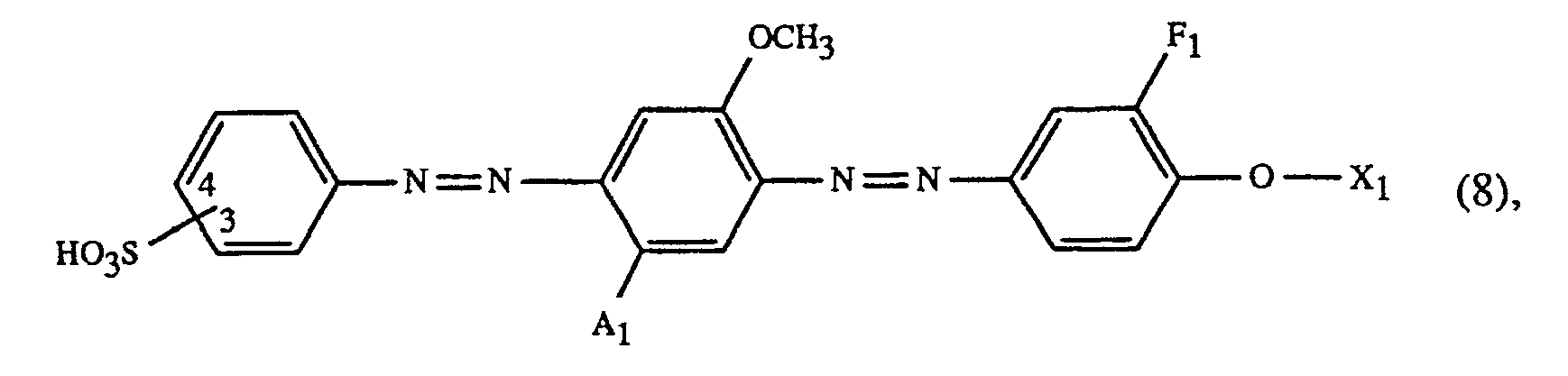
worin A₁ Wasserstoff oder Methyl, F₁ Wasserstoff oder Methyl und X₁ Methyl, Aethyl, β-Hydroxyäthyl, β-Hydroxypropyl, β-Hydroxybutyl oder α-Aethyl-β-hydroxyäthyl ist, und die Sulfogruppe in 3- oder 4-Stellung gebunden ist, oder eine Mischung aus mindestens einem Farbstoff der Formel (8) und einem gelben Farbstoff der Formel
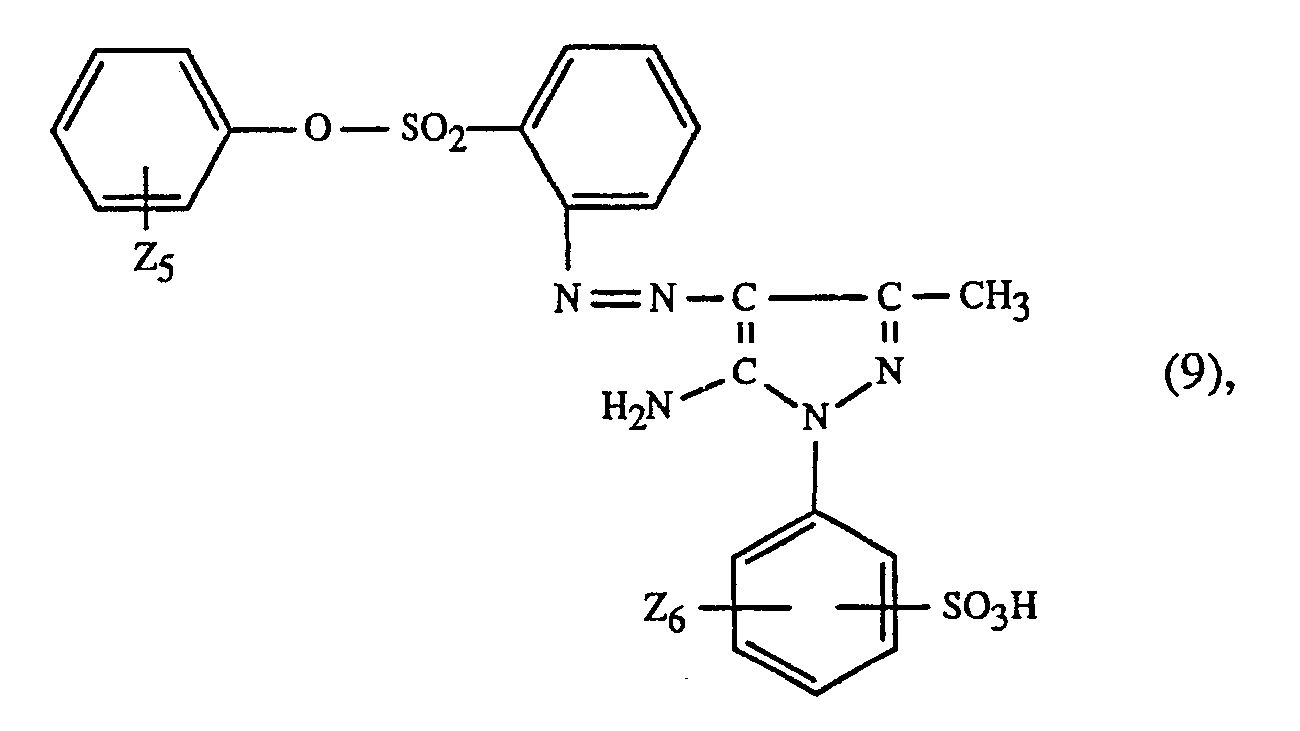
worin Z₅ und Z₆ unabhängig voneinander Wasserstoff, Methyl oder Chlor bedeuten, oder einen gelben Farbstoff der Formel

worin W₁ Wasserstoff, Methyl, Chlor, Methoxy, Aethoxy, o-Methylphenoxy, Phenoxy, Acetylamino, Phenylsulfonyl, p-Methylphenylsulfonyl, p-Chlorphenylsulfonyl, Naphthylsulfonyl, p-Methylbenzoyl oder p-Chlorbenzoyl, W₂ Wasserstoff, Chlor, Methyl, Trifluormethyl, o-Methylphenoxy, o-Chlorphenoxy, o-Chlorphenoxysulfonyl, -SO₂NH₂, N-C₁₋₂-Alkylaminosulfonyl, N,N-dimethylaminosulfonyl, N-Methyl-N-β-hydroxyäthylaminosulfonyl, N-Methyl-N-cyclohexylaminosulfonyl, N-Phenylaminosulfonyl, N-o-Methylphenylaminosulfonyl, N-o-Chlorphenylaminosulfonyl, N-m-Trifluormethylphenylaminosulfonyl, N-Aethyl-N-phenylaminosulfonyl, -CONH₂ oder -CON(CH₃)₂, W₃ Methyl oder Phenyl und W₄ Wasserstoff, Methyl, Aethyl oder Octyl ist, oder eine Mischung aus mindestens einem Farbstoff der Formel (8) und einem Farbstoff der Formel (10); zusammen mit mindestens einem blauen Farbstoff der Formel

worin ein Y₁ Wasserstoff oder Methyl und das andere Y₁ Acetylamino, Propionylamino oder C₂₋₄-Hydroxyalkylsulphamoyl und Z₇ Wasserstoff oder Methyl ist, oder eine Mischung der blauen Farbstoffe der Formeln

worin Y₂ ein C₂₋₄-Hydroxyalkylsulphamoylrest ist, und

worin der Rest -NH-CO-CH₂CH₃ in 3- oder 4-Stellung gebunden ist, verwendet.
7. Verfahren gemäss einem der Ansprüche 1 bis 6, dadurch gekennzeichnet, dass man als roten Farbstoff einen Farbstoff der Formel

worin R₅ und R₆ unabhängig voneinander Wasserstoff oder Methyl, m die Zahl 1 oder 2 ist und D die in Anspruch 1 angegebenen Bedeutungen hat, insbesondere worin D die für D₁ in Anspruch 2 oder die für D₂ in Anspruch 3 angegebene Bedeutungen hat, verwendet.
8. Verfahren gemäss einem der Ansprüche 1 bis 7, dadurch gekennzeichnet, dass man einen roten Farbstoff der Formel


zusammen mit dem gelben Farbstoff der Formel

oder dem orangen Farbstoff der Formel

oder einer Mischung des gelben Farbstoffes der Formel (23) mit dem orangen Farbstoff der Formel (24),
oder einer Mischung der Farbstoffe der Formeln (23) und/oder (24) mit dem Farbstoff der Formel 
wobei das Gewichtsverhältnis der Farbstoffe der Formeln (23) und (24) 60:40 bis 40:60 und insbesondere 1:1 und das Gewichtsverhältnis der Farbstoffe der Formeln (23) oder (24) und (25) 80:20 bis 20:80 und insbesondere 70:30 ist, und das Gewichtsverhältnis der Farbstoffe der Formeln (23), (24) und (25) 60:20:20,20:60:20 bis 20:20:60 und insbesondere 1:1:1 ist, oder dem gelben Farbstoff der Formel

und mindestens einem der blauen Farbstoffe der Formeln
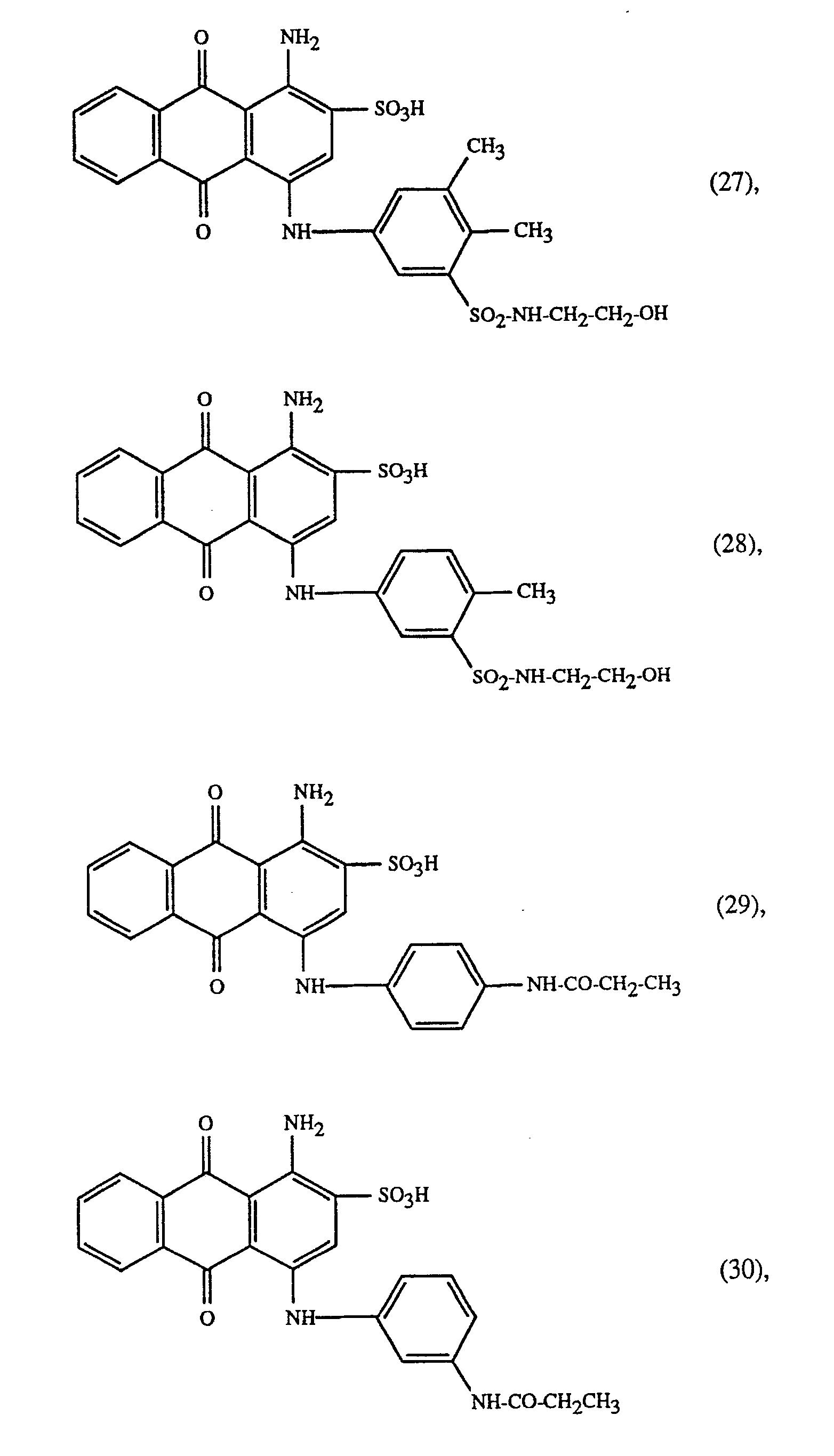

oder eine Mischung eines Farbstoffs der Formeln (27) oder (28) mit einem Farbstoff der Formeln (29), (30) oder (31) verwendet.
oder einer Mischung der Farbstoffe der Formeln (23) und/oder (24) mit dem Farbstoff der Formel
9. Verfahren zum Trichromie-Färben oder -Bedrücken von Materialien aus natürlichen und synthetischem Polyamid, dadurch gekennzeichnet, dass man diese Materialien mit einer Färbeflotte oder Druckpaste behandelt, welche die Farbstoffmischung gemäss Anspruch 1 sowie Wasser und gegebenenfalls weitere Zusätze enthält.
10. Wässrige Färbeflotte oder Druckpaste, dadurch gekennzeichnet, dass sie Wasser, die Farbstoffmischung gemäss Anspruch 1 sowie gegebenenfalls weitere Zusätze enthält.
11. Das nach dem Verfahren gemäss Anspruch 1 bzw. unter Verwendung der Färbeflotte oder Druckpaste gemäss Anspruch 10 gefärbte oder bedruckte Material, insbesondere das Textilmaterial.
12. Das gemäss Anspruch 11 gefärbte oder bedruckte Polyamidmaterial, insbesondere Polyamid-Teppiche.
Applications Claiming Priority (2)
| Application Number | Priority Date | Filing Date | Title |
|---|---|---|---|
| CH382789 | 1989-10-23 | ||
| CH3827/89 | 1989-10-23 |
Publications (1)
| Publication Number | Publication Date |
|---|---|
| EP0425435A1 true EP0425435A1 (de) | 1991-05-02 |
Family
ID=4264317
Family Applications (1)
| Application Number | Title | Priority Date | Filing Date |
|---|---|---|---|
| EP90810790A Withdrawn EP0425435A1 (de) | 1989-10-23 | 1990-10-16 | Verfahren zum Trichromie-Färben oder -Bedrucken |
Country Status (3)
| Country | Link |
|---|---|
| US (1) | US5045084A (de) |
| EP (1) | EP0425435A1 (de) |
| JP (1) | JPH03152279A (de) |
Cited By (1)
| Publication number | Priority date | Publication date | Assignee | Title |
|---|---|---|---|---|
| EP0694587A1 (de) * | 1994-06-25 | 1996-01-31 | Hoechst Mitsubishi Kasei Co., Ltd. | Monoazoindolfarbstoffe |
Families Citing this family (5)
| Publication number | Priority date | Publication date | Assignee | Title |
|---|---|---|---|---|
| JP3234004B2 (ja) * | 1991-12-13 | 2001-12-04 | ダイスタージャパン株式会社 | 分散染料混合物 |
| ES2130240T3 (es) * | 1992-02-28 | 1999-07-01 | Ciba Geigy Ag | Procedimiento para teñir cuero con mezclas de colorantes. |
| DE59306811D1 (de) * | 1992-04-01 | 1997-07-31 | Ciba Geigy Ag | Verfahren zum Färben von Leder mit Farbstoffmischungen |
| US5456726A (en) * | 1992-12-22 | 1995-10-10 | Sumitomo Chemical Company, Limited | Reactive dye composition and method for dyeing or printing cellulose fiber material using the same |
| US6837613B2 (en) * | 2001-04-10 | 2005-01-04 | Levtech, Inc. | Sterile fluid pumping or mixing system and related method |
Citations (5)
| Publication number | Priority date | Publication date | Assignee | Title |
|---|---|---|---|---|
| EP0083299A1 (de) * | 1981-12-29 | 1983-07-06 | Ciba-Geigy Ag | Verfahren zum Trichromie-Färben oder -Bedrucken |
| EP0092512A1 (de) * | 1982-04-08 | 1983-10-26 | Ciba-Geigy Ag | Verfahren zum Trichromie-Färben oder -Bedrucken |
| EP0127579A1 (de) * | 1983-05-25 | 1984-12-05 | Ciba-Geigy Ag | Verfahren zum Trichromie-Färben oder -Bedrucken |
| EP0181292A2 (de) * | 1984-11-08 | 1986-05-14 | Ciba-Geigy Ag | Verfahren zum Kontinuierlichen Trichromie-Färben von synthetischen Polyamidmaterialien |
| EP0388353A1 (de) * | 1989-03-06 | 1990-09-19 | Ciba-Geigy Ag | Azofarbstoffe, deren Herstellung und Verwendung |
Family Cites Families (6)
| Publication number | Priority date | Publication date | Assignee | Title |
|---|---|---|---|---|
| US3692769A (en) * | 1970-02-18 | 1972-09-19 | Max A Weaver | Azo compounds containing an arylsulfonyl phenyl diazo component |
| EP0083300B1 (de) * | 1981-12-29 | 1986-10-15 | Ciba-Geigy Ag | Farbstoffmischungen und deren Verwendung |
| US4579561A (en) * | 1984-01-31 | 1986-04-01 | Crompton And Knowles Corporation | Process for trichromatic dyeing polyamide fibers |
| US4652269A (en) * | 1984-11-08 | 1987-03-24 | Ciba-Geigy Corporation | Process for the continuous trichromatic dyeing of synthetic polyamide materials: including a blue anthraquinone reactive dye |
| US4840643A (en) * | 1988-03-16 | 1989-06-20 | Crompton & Knowles Corporation | Trichromatic combination of dyes for nylon |
| DE59004453D1 (de) * | 1989-03-10 | 1994-03-17 | Ciba Geigy | Farbstoffmischung und deren Verwendung. |
-
1990
- 1990-10-16 EP EP90810790A patent/EP0425435A1/de not_active Withdrawn
- 1990-10-18 US US07/599,588 patent/US5045084A/en not_active Expired - Fee Related
- 1990-10-23 JP JP2283573A patent/JPH03152279A/ja active Pending
Patent Citations (5)
| Publication number | Priority date | Publication date | Assignee | Title |
|---|---|---|---|---|
| EP0083299A1 (de) * | 1981-12-29 | 1983-07-06 | Ciba-Geigy Ag | Verfahren zum Trichromie-Färben oder -Bedrucken |
| EP0092512A1 (de) * | 1982-04-08 | 1983-10-26 | Ciba-Geigy Ag | Verfahren zum Trichromie-Färben oder -Bedrucken |
| EP0127579A1 (de) * | 1983-05-25 | 1984-12-05 | Ciba-Geigy Ag | Verfahren zum Trichromie-Färben oder -Bedrucken |
| EP0181292A2 (de) * | 1984-11-08 | 1986-05-14 | Ciba-Geigy Ag | Verfahren zum Kontinuierlichen Trichromie-Färben von synthetischen Polyamidmaterialien |
| EP0388353A1 (de) * | 1989-03-06 | 1990-09-19 | Ciba-Geigy Ag | Azofarbstoffe, deren Herstellung und Verwendung |
Cited By (1)
| Publication number | Priority date | Publication date | Assignee | Title |
|---|---|---|---|---|
| EP0694587A1 (de) * | 1994-06-25 | 1996-01-31 | Hoechst Mitsubishi Kasei Co., Ltd. | Monoazoindolfarbstoffe |
Also Published As
| Publication number | Publication date |
|---|---|
| US5045084A (en) | 1991-09-03 |
| JPH03152279A (ja) | 1991-06-28 |
Similar Documents
| Publication | Publication Date | Title |
|---|---|---|
| EP0387201B1 (de) | Farbstoffmischung und deren Verwendung | |
| EP1247842A1 (de) | Faserreaktive Anthrachinonfarbstoffe, deren Herstellung und deren Verwendung | |
| EP0425434B1 (de) | Farbstoffmischungen und deren Verwendung | |
| EP0181292A2 (de) | Verfahren zum Kontinuierlichen Trichromie-Färben von synthetischen Polyamidmaterialien | |
| EP0657508B1 (de) | Reaktivfarbstoffe, Verfahren zu deren Herstellung und deren Verwendung | |
| DE69418264T2 (de) | Rote Reaktivfarbstoffe, deren Mischungen sowie diese verwendende Färbemethode | |
| EP0425435A1 (de) | Verfahren zum Trichromie-Färben oder -Bedrucken | |
| EP0658605B1 (de) | Verfahren zum Trichromie-Färben oder -Bedrucken | |
| EP0718374B1 (de) | 1:2-Chromkomplexfarbstoffe enthaltende Farbstoffmischungen und 1:2 Chromkomplexfarbstoffe | |
| EP0352222B1 (de) | Faserreaktive Formazanfarbstoffe, Verfahren zu deren Herstellung und deren Verwendung | |
| EP0524148B1 (de) | Farbstoffmischungen und deren Verwendung | |
| EP0586331A2 (de) | Verfahren zum Färben von synthetischen Polyamidfasermaterialien | |
| EP0726297B1 (de) | Farbstoffmischungen und ihre Verwendung | |
| DE19646429A1 (de) | Mischungen von Monoazopyridonfarbstoffen | |
| EP0524147B1 (de) | Azofarbstoffe, Verfahren zu deren Herstellung und deren Verwendung | |
| EP0601971B1 (de) | Verfahren zum Trichromie-Färben oder -Bedrucken | |
| EP0439423B1 (de) | Azofarbstoffe, Verfahren zu deren Herstellung und deren Verwendung | |
| EP0651028A1 (de) | Verfahren zum Trichromie-Färben oder -Bedrucken | |
| EP0808940A2 (de) | Verfahren zum Trichromie-Färben oder-Bedrucken | |
| EP0625550B1 (de) | Farbstoffmischungen, 1:2-Kobaltkomplexformazanfarbstoffe und deren Verwendung | |
| EP0586339B1 (de) | Azofarbstoffe, Verfahren zu deren Herstellung und deren Verwendung | |
| EP0739952B1 (de) | Azofarbstoffmischungen und deren Verwendung | |
| EP1081196B1 (de) | Verfahren zum Färben oder Bedrucken von polyamidhaltigen Materialien | |
| EP0230909B1 (de) | Wasserlösliche Azoverbindungen, Verfahren zu ihrer Herstellung und ihre Verwendung als Farbstoffe | |
| EP0457729B1 (de) | Azofarbstoffe, Verfahren zu deren Herstellung und deren Verwendung |
Legal Events
| Date | Code | Title | Description |
|---|---|---|---|
| PUAI | Public reference made under article 153(3) epc to a published international application that has entered the european phase |
Free format text: ORIGINAL CODE: 0009012 |
|
| 17P | Request for examination filed |
Effective date: 19901019 |
|
| AK | Designated contracting states |
Kind code of ref document: A1 Designated state(s): BE CH DE DK ES FR GB IT LI |
|
| STAA | Information on the status of an ep patent application or granted ep patent |
Free format text: STATUS: THE APPLICATION IS DEEMED TO BE WITHDRAWN |
|
| 18D | Application deemed to be withdrawn |
Effective date: 19930501 |