EP0342159A1 - Wasserlösliche Phthalocyaninverbindungen, Verfahren zu ihrer Herstellung und ihre Verwendung - Google Patents
Wasserlösliche Phthalocyaninverbindungen, Verfahren zu ihrer Herstellung und ihre Verwendung Download PDFInfo
- Publication number
- EP0342159A1 EP0342159A1 EP89810338A EP89810338A EP0342159A1 EP 0342159 A1 EP0342159 A1 EP 0342159A1 EP 89810338 A EP89810338 A EP 89810338A EP 89810338 A EP89810338 A EP 89810338A EP 0342159 A1 EP0342159 A1 EP 0342159A1
- Authority
- EP
- European Patent Office
- Prior art keywords
- formula
- carbon atoms
- alkyl
- compounds
- preparation
- Prior art date
- Legal status (The legal status is an assumption and is not a legal conclusion. Google has not performed a legal analysis and makes no representation as to the accuracy of the status listed.)
- Granted
Links
- 238000000034 method Methods 0.000 title claims description 24
- IEQIEDJGQAUEQZ-UHFFFAOYSA-N phthalocyanine Chemical class N1C(N=C2C3=CC=CC=C3C(N=C3C4=CC=CC=C4C(=N4)N3)=N2)=C(C=CC=C2)C2=C1N=C1C2=CC=CC=C2C4=N1 IEQIEDJGQAUEQZ-UHFFFAOYSA-N 0.000 title claims description 12
- 238000002360 preparation method Methods 0.000 title claims description 12
- XLYOFNOQVPJJNP-UHFFFAOYSA-N water Substances O XLYOFNOQVPJJNP-UHFFFAOYSA-N 0.000 title description 10
- 150000001875 compounds Chemical class 0.000 claims abstract description 26
- 238000004043 dyeing Methods 0.000 claims abstract description 25
- 239000000835 fiber Substances 0.000 claims abstract description 17
- 229920000742 Cotton Polymers 0.000 claims abstract description 13
- 239000002657 fibrous material Substances 0.000 claims abstract description 12
- 229920000728 polyester Polymers 0.000 claims abstract description 12
- 239000000986 disperse dye Substances 0.000 claims abstract description 7
- 239000004744 fabric Substances 0.000 claims abstract description 7
- 239000000982 direct dye Substances 0.000 claims abstract description 4
- -1 heterocyclic radical Chemical class 0.000 claims description 34
- 239000000975 dye Substances 0.000 claims description 29
- 125000004432 carbon atom Chemical group C* 0.000 claims description 27
- 125000000217 alkyl group Chemical group 0.000 claims description 17
- 229910052739 hydrogen Inorganic materials 0.000 claims description 14
- 239000001257 hydrogen Substances 0.000 claims description 14
- 229910052757 nitrogen Inorganic materials 0.000 claims description 12
- 125000001997 phenyl group Chemical group [H]C1=C([H])C([H])=C(*)C([H])=C1[H] 0.000 claims description 12
- IJGRMHOSHXDMSA-UHFFFAOYSA-N Atomic nitrogen Chemical compound N#N IJGRMHOSHXDMSA-UHFFFAOYSA-N 0.000 claims description 10
- 125000003545 alkoxy group Chemical group 0.000 claims description 10
- 239000000203 mixture Substances 0.000 claims description 10
- 125000000020 sulfo group Chemical group O=S(=O)([*])O[H] 0.000 claims description 10
- XTHPWXDJESJLNJ-UHFFFAOYSA-N sulfurochloridic acid Chemical compound OS(Cl)(=O)=O XTHPWXDJESJLNJ-UHFFFAOYSA-N 0.000 claims description 9
- 125000004181 carboxyalkyl group Chemical group 0.000 claims description 8
- 125000000623 heterocyclic group Chemical group 0.000 claims description 8
- 229910052751 metal Inorganic materials 0.000 claims description 8
- 239000002184 metal Substances 0.000 claims description 8
- 125000002496 methyl group Chemical group [H]C([H])([H])* 0.000 claims description 8
- 125000005842 heteroatom Chemical group 0.000 claims description 7
- 125000004433 nitrogen atom Chemical group N* 0.000 claims description 7
- GAWIXWVDTYZWAW-UHFFFAOYSA-N C[CH]O Chemical group C[CH]O GAWIXWVDTYZWAW-UHFFFAOYSA-N 0.000 claims description 6
- XEEYBQQBJWHFJM-UHFFFAOYSA-N Iron Chemical compound [Fe] XEEYBQQBJWHFJM-UHFFFAOYSA-N 0.000 claims description 6
- PXHVJJICTQNCMI-UHFFFAOYSA-N Nickel Chemical compound [Ni] PXHVJJICTQNCMI-UHFFFAOYSA-N 0.000 claims description 6
- 150000001412 amines Chemical class 0.000 claims description 6
- 125000004435 hydrogen atom Chemical class [H]* 0.000 claims description 6
- NINIDFKCEFEMDL-UHFFFAOYSA-N Sulfur Chemical compound [S] NINIDFKCEFEMDL-UHFFFAOYSA-N 0.000 claims description 5
- 125000003178 carboxy group Chemical group [H]OC(*)=O 0.000 claims description 5
- 125000002768 hydroxyalkyl group Chemical group 0.000 claims description 5
- 125000004430 oxygen atom Chemical group O* 0.000 claims description 5
- 125000006239 protecting group Chemical group 0.000 claims description 5
- 229910052717 sulfur Inorganic materials 0.000 claims description 5
- 239000011593 sulfur Substances 0.000 claims description 5
- CIUQDSCDWFSTQR-UHFFFAOYSA-N [C]1=CC=CC=C1 Chemical class [C]1=CC=CC=C1 CIUQDSCDWFSTQR-UHFFFAOYSA-N 0.000 claims description 4
- 239000002253 acid Substances 0.000 claims description 4
- 125000003277 amino group Chemical group 0.000 claims description 4
- 239000012736 aqueous medium Substances 0.000 claims description 4
- 125000004429 atom Chemical group 0.000 claims description 4
- 230000008878 coupling Effects 0.000 claims description 4
- 238000010168 coupling process Methods 0.000 claims description 4
- 238000005859 coupling reaction Methods 0.000 claims description 4
- 125000002887 hydroxy group Chemical group [H]O* 0.000 claims description 4
- QJGQUHMNIGDVPM-UHFFFAOYSA-N nitrogen group Chemical group [N] QJGQUHMNIGDVPM-UHFFFAOYSA-N 0.000 claims description 4
- 238000007639 printing Methods 0.000 claims description 4
- RYGMFSIKBFXOCR-UHFFFAOYSA-N Copper Chemical group [Cu] RYGMFSIKBFXOCR-UHFFFAOYSA-N 0.000 claims description 3
- 125000002777 acetyl group Chemical group [H]C([H])([H])C(*)=O 0.000 claims description 3
- 239000010941 cobalt Substances 0.000 claims description 3
- 229910017052 cobalt Inorganic materials 0.000 claims description 3
- GUTLYIVDDKVIGB-UHFFFAOYSA-N cobalt atom Chemical compound [Co] GUTLYIVDDKVIGB-UHFFFAOYSA-N 0.000 claims description 3
- 229910052742 iron Inorganic materials 0.000 claims description 3
- 229910052759 nickel Inorganic materials 0.000 claims description 3
- 239000003086 colorant Substances 0.000 claims description 2
- 150000008049 diazo compounds Chemical class 0.000 claims description 2
- 125000001624 naphthyl group Chemical group 0.000 claims description 2
- 239000012209 synthetic fiber Substances 0.000 claims 1
- 229920002994 synthetic fiber Polymers 0.000 claims 1
- 239000000758 substrate Substances 0.000 abstract description 2
- FAPWRFPIFSIZLT-UHFFFAOYSA-M Sodium chloride Chemical compound [Na+].[Cl-] FAPWRFPIFSIZLT-UHFFFAOYSA-M 0.000 description 16
- LFQSCWFLJHTTHZ-UHFFFAOYSA-N Ethanol Chemical compound CCO LFQSCWFLJHTTHZ-UHFFFAOYSA-N 0.000 description 12
- 125000001424 substituent group Chemical group 0.000 description 10
- VHUUQVKOLVNVRT-UHFFFAOYSA-N Ammonium hydroxide Chemical compound [NH4+].[OH-] VHUUQVKOLVNVRT-UHFFFAOYSA-N 0.000 description 9
- 239000000908 ammonium hydroxide Substances 0.000 description 9
- JUJWROOIHBZHMG-UHFFFAOYSA-N Pyridine Chemical compound C1=CC=NC=C1 JUJWROOIHBZHMG-UHFFFAOYSA-N 0.000 description 8
- 239000011780 sodium chloride Substances 0.000 description 8
- 239000004753 textile Substances 0.000 description 8
- HEMHJVSKTPXQMS-UHFFFAOYSA-M Sodium hydroxide Chemical compound [OH-].[Na+] HEMHJVSKTPXQMS-UHFFFAOYSA-M 0.000 description 6
- RBTKNAXYKSUFRK-UHFFFAOYSA-N heliogen blue Chemical compound [Cu].[N-]1C2=C(C=CC=C3)C3=C1N=C([N-]1)C3=CC=CC=C3C1=NC([N-]1)=C(C=CC=C3)C3=C1N=C([N-]1)C3=CC=CC=C3C1=N2 RBTKNAXYKSUFRK-UHFFFAOYSA-N 0.000 description 5
- 150000002431 hydrogen Chemical class 0.000 description 5
- 239000010985 leather Substances 0.000 description 5
- QGZKDVFQNNGYKY-UHFFFAOYSA-N Ammonia Chemical compound N QGZKDVFQNNGYKY-UHFFFAOYSA-N 0.000 description 4
- VEXZGXHMUGYJMC-UHFFFAOYSA-N Hydrochloric acid Chemical compound Cl VEXZGXHMUGYJMC-UHFFFAOYSA-N 0.000 description 4
- 229960001506 brilliant green Drugs 0.000 description 4
- HXCILVUBKWANLN-UHFFFAOYSA-N brilliant green cation Chemical compound C1=CC(N(CC)CC)=CC=C1C(C=1C=CC=CC=1)=C1C=CC(=[N+](CC)CC)C=C1 HXCILVUBKWANLN-UHFFFAOYSA-N 0.000 description 4
- 238000006243 chemical reaction Methods 0.000 description 4
- 238000004040 coloring Methods 0.000 description 4
- 239000005457 ice water Substances 0.000 description 4
- UMJSCPRVCHMLSP-UHFFFAOYSA-N pyridine Natural products COC1=CC=CN=C1 UMJSCPRVCHMLSP-UHFFFAOYSA-N 0.000 description 4
- 239000011541 reaction mixture Substances 0.000 description 4
- 239000000725 suspension Substances 0.000 description 4
- WSFSSNUMVMOOMR-UHFFFAOYSA-N Formaldehyde Chemical compound O=C WSFSSNUMVMOOMR-UHFFFAOYSA-N 0.000 description 3
- UFHFLCQGNIYNRP-UHFFFAOYSA-N Hydrogen Chemical compound [H][H] UFHFLCQGNIYNRP-UHFFFAOYSA-N 0.000 description 3
- 239000000987 azo dye Substances 0.000 description 3
- 239000003795 chemical substances by application Substances 0.000 description 3
- 238000001035 drying Methods 0.000 description 3
- 125000001495 ethyl group Chemical group [H]C([H])([H])C([H])([H])* 0.000 description 3
- 239000000706 filtrate Substances 0.000 description 3
- RAXXELZNTBOGNW-UHFFFAOYSA-N imidazole Natural products C1=CNC=N1 RAXXELZNTBOGNW-UHFFFAOYSA-N 0.000 description 3
- 239000010446 mirabilite Substances 0.000 description 3
- 239000000123 paper Substances 0.000 description 3
- 150000003254 radicals Chemical class 0.000 description 3
- 150000003839 salts Chemical group 0.000 description 3
- RSIJVJUOQBWMIM-UHFFFAOYSA-L sodium sulfate decahydrate Chemical compound O.O.O.O.O.O.O.O.O.O.[Na+].[Na+].[O-]S([O-])(=O)=O RSIJVJUOQBWMIM-UHFFFAOYSA-L 0.000 description 3
- PVNIIMVLHYAWGP-UHFFFAOYSA-N Niacin Chemical compound OC(=O)C1=CC=CN=C1 PVNIIMVLHYAWGP-UHFFFAOYSA-N 0.000 description 2
- 239000004952 Polyamide Substances 0.000 description 2
- QAOWNCQODCNURD-UHFFFAOYSA-N Sulfuric acid Chemical compound OS(O)(=O)=O QAOWNCQODCNURD-UHFFFAOYSA-N 0.000 description 2
- 229910021529 ammonia Inorganic materials 0.000 description 2
- 239000002585 base Substances 0.000 description 2
- 125000002091 cationic group Chemical group 0.000 description 2
- 229920002678 cellulose Polymers 0.000 description 2
- 239000001913 cellulose Substances 0.000 description 2
- 239000007859 condensation product Substances 0.000 description 2
- 238000004519 manufacturing process Methods 0.000 description 2
- 239000000463 material Substances 0.000 description 2
- BDAGIHXWWSANSR-UHFFFAOYSA-N methanoic acid Natural products OC=O BDAGIHXWWSANSR-UHFFFAOYSA-N 0.000 description 2
- 125000004108 n-butyl group Chemical group [H]C([H])([H])C([H])([H])C([H])([H])C([H])([H])* 0.000 description 2
- 229920002647 polyamide Polymers 0.000 description 2
- 125000002924 primary amino group Chemical group [H]N([H])* 0.000 description 2
- JEXVQSWXXUJEMA-UHFFFAOYSA-N pyrazol-3-one Chemical compound O=C1C=CN=N1 JEXVQSWXXUJEMA-UHFFFAOYSA-N 0.000 description 2
- LPXPTNMVRIOKMN-UHFFFAOYSA-M sodium nitrite Chemical compound [Na+].[O-]N=O LPXPTNMVRIOKMN-UHFFFAOYSA-M 0.000 description 2
- 159000000000 sodium salts Chemical class 0.000 description 2
- 125000000542 sulfonic acid group Chemical group 0.000 description 2
- FYSNRJHAOHDILO-UHFFFAOYSA-N thionyl chloride Chemical compound ClS(Cl)=O FYSNRJHAOHDILO-UHFFFAOYSA-N 0.000 description 2
- 210000002268 wool Anatomy 0.000 description 2
- 125000006273 (C1-C3) alkyl group Chemical group 0.000 description 1
- 125000006274 (C1-C3)alkoxy group Chemical group 0.000 description 1
- 125000006527 (C1-C5) alkyl group Chemical group 0.000 description 1
- KEQGZUUPPQEDPF-UHFFFAOYSA-N 1,3-dichloro-5,5-dimethylimidazolidine-2,4-dione Chemical compound CC1(C)N(Cl)C(=O)N(Cl)C1=O KEQGZUUPPQEDPF-UHFFFAOYSA-N 0.000 description 1
- SNQGOOIWXLIOLV-UHFFFAOYSA-N 2-[4-(2,2-dicyanoethenyl)-n-ethyl-3-methylanilino]ethyl 5-[3-[4-(2,2-dicyanoethenyl)-n-ethyl-3-methylanilino]propanoyloxy]pentanoate Chemical compound C=1C=C(C=C(C#N)C#N)C(C)=CC=1N(CC)CCOC(=O)CCCCOC(=O)CCN(CC)C1=CC=C(C=C(C#N)C#N)C(C)=C1 SNQGOOIWXLIOLV-UHFFFAOYSA-N 0.000 description 1
- 125000001622 2-naphthyl group Chemical group [H]C1=C([H])C([H])=C2C([H])=C(*)C([H])=C([H])C2=C1[H] 0.000 description 1
- TXRRJWPBZVKVRC-UHFFFAOYSA-N 3-[(2-acetamido-4-aminophenyl)diazenyl]benzenesulfonic acid Chemical compound CC(=O)NC1=CC(N)=CC=C1N=NC1=CC=CC(S(O)(=O)=O)=C1 TXRRJWPBZVKVRC-UHFFFAOYSA-N 0.000 description 1
- WBCXRDHKXHADQF-UHFFFAOYSA-N 4,11-diamino-2-(3-methoxypropyl)naphtho[2,3-f]isoindole-1,3,5,10-tetrone Chemical compound O=C1C2=CC=CC=C2C(=O)C2=C1C(N)=C(C(N(CCCOC)C1=O)=O)C1=C2N WBCXRDHKXHADQF-UHFFFAOYSA-N 0.000 description 1
- OSWFIVFLDKOXQC-UHFFFAOYSA-N 4-(3-methoxyphenyl)aniline Chemical compound COC1=CC=CC(C=2C=CC(N)=CC=2)=C1 OSWFIVFLDKOXQC-UHFFFAOYSA-N 0.000 description 1
- BVKZGUZCCUSVTD-UHFFFAOYSA-M Bicarbonate Chemical class OC([O-])=O BVKZGUZCCUSVTD-UHFFFAOYSA-M 0.000 description 1
- JUWJAIGQCIVWKG-UHFFFAOYSA-N CC(C)(C)C(C)(C)N=O Chemical compound CC(C)(C)C(C)(C)N=O JUWJAIGQCIVWKG-UHFFFAOYSA-N 0.000 description 1
- TZJUSWRVBVJSGV-UHFFFAOYSA-N CC(NNC(C)=C)=C Chemical compound CC(NNC(C)=C)=C TZJUSWRVBVJSGV-UHFFFAOYSA-N 0.000 description 1
- SPQJOYPGNBXGTN-UHFFFAOYSA-N CCC(C(C)(C)C)N=O Chemical compound CCC(C(C)(C)C)N=O SPQJOYPGNBXGTN-UHFFFAOYSA-N 0.000 description 1
- IVEOCYLKEXGIPE-UHFFFAOYSA-N CCN1C(O)=CC(C)=C(C(N)=O)C1=O Chemical compound CCN1C(O)=CC(C)=C(C(N)=O)C1=O IVEOCYLKEXGIPE-UHFFFAOYSA-N 0.000 description 1
- 244000025254 Cannabis sativa Species 0.000 description 1
- 235000012766 Cannabis sativa ssp. sativa var. sativa Nutrition 0.000 description 1
- 235000012765 Cannabis sativa ssp. sativa var. spontanea Nutrition 0.000 description 1
- 229920003043 Cellulose fiber Polymers 0.000 description 1
- ZAMOUSCENKQFHK-UHFFFAOYSA-N Chlorine atom Chemical compound [Cl] ZAMOUSCENKQFHK-UHFFFAOYSA-N 0.000 description 1
- RPNUMPOLZDHAAY-UHFFFAOYSA-N Diethylenetriamine Chemical compound NCCNCCN RPNUMPOLZDHAAY-UHFFFAOYSA-N 0.000 description 1
- BRLQWZUYTZBJKN-UHFFFAOYSA-N Epichlorohydrin Chemical compound ClCC1CO1 BRLQWZUYTZBJKN-UHFFFAOYSA-N 0.000 description 1
- 229920000297 Rayon Polymers 0.000 description 1
- 229910006074 SO2NH2 Inorganic materials 0.000 description 1
- 229910006069 SO3H Inorganic materials 0.000 description 1
- 238000005903 acid hydrolysis reaction Methods 0.000 description 1
- 150000007513 acids Chemical class 0.000 description 1
- 229910052783 alkali metal Inorganic materials 0.000 description 1
- 150000008044 alkali metal hydroxides Chemical class 0.000 description 1
- 238000005904 alkaline hydrolysis reaction Methods 0.000 description 1
- 150000003863 ammonium salts Chemical class 0.000 description 1
- BFNBIHQBYMNNAN-UHFFFAOYSA-N ammonium sulfate Chemical compound N.N.OS(O)(=O)=O BFNBIHQBYMNNAN-UHFFFAOYSA-N 0.000 description 1
- 229910052921 ammonium sulfate Inorganic materials 0.000 description 1
- 235000011130 ammonium sulphate Nutrition 0.000 description 1
- 125000000129 anionic group Chemical group 0.000 description 1
- 235000009120 camo Nutrition 0.000 description 1
- 150000004649 carbonic acid derivatives Chemical class 0.000 description 1
- 125000002057 carboxymethyl group Chemical group [H]OC(=O)C([H])([H])[*] 0.000 description 1
- 235000005607 chanvre indien Nutrition 0.000 description 1
- 239000000460 chlorine Substances 0.000 description 1
- 229910052801 chlorine Inorganic materials 0.000 description 1
- 239000012954 diazonium Substances 0.000 description 1
- 150000001989 diazonium salts Chemical class 0.000 description 1
- QGBSISYHAICWAH-UHFFFAOYSA-N dicyandiamide Chemical compound NC(N)=NC#N QGBSISYHAICWAH-UHFFFAOYSA-N 0.000 description 1
- 238000009967 direct dyeing Methods 0.000 description 1
- 239000002270 dispersing agent Substances 0.000 description 1
- 235000019253 formic acid Nutrition 0.000 description 1
- 229910052736 halogen Inorganic materials 0.000 description 1
- 150000002367 halogens Chemical class 0.000 description 1
- 239000011487 hemp Substances 0.000 description 1
- 239000000976 ink Substances 0.000 description 1
- 238000007641 inkjet printing Methods 0.000 description 1
- 229910052500 inorganic mineral Inorganic materials 0.000 description 1
- 125000000959 isobutyl group Chemical group [H]C([H])([H])C([H])(C([H])([H])[H])C([H])([H])* 0.000 description 1
- 125000005921 isopentoxy group Chemical group 0.000 description 1
- 125000001972 isopentyl group Chemical group [H]C([H])([H])C([H])(C([H])([H])[H])C([H])([H])C([H])([H])* 0.000 description 1
- 125000001449 isopropyl group Chemical group [H]C([H])([H])C([H])(*)C([H])([H])[H] 0.000 description 1
- 229910052744 lithium Inorganic materials 0.000 description 1
- NYGZLYXAPMMJTE-UHFFFAOYSA-M metanil yellow Chemical group [Na+].[O-]S(=O)(=O)C1=CC=CC(N=NC=2C=CC(NC=3C=CC=CC=3)=CC=2)=C1 NYGZLYXAPMMJTE-UHFFFAOYSA-M 0.000 description 1
- 125000000956 methoxy group Chemical group [H]C([H])([H])O* 0.000 description 1
- 239000011707 mineral Substances 0.000 description 1
- PEMGGJDINLGTON-UHFFFAOYSA-N n-(3-aminophenyl)acetamide Chemical compound CC(=O)NC1=CC=CC(N)=C1 PEMGGJDINLGTON-UHFFFAOYSA-N 0.000 description 1
- 125000004123 n-propyl group Chemical group [H]C([H])([H])C([H])([H])C([H])([H])* 0.000 description 1
- PSZYNBSKGUBXEH-UHFFFAOYSA-N naphthalene-1-sulfonic acid Chemical compound C1=CC=C2C(S(=O)(=O)O)=CC=CC2=C1 PSZYNBSKGUBXEH-UHFFFAOYSA-N 0.000 description 1
- UFWIBTONFRDIAS-UHFFFAOYSA-N naphthalene-acid Natural products C1=CC=CC2=CC=CC=C21 UFWIBTONFRDIAS-UHFFFAOYSA-N 0.000 description 1
- 235000001968 nicotinic acid Nutrition 0.000 description 1
- 229960003512 nicotinic acid Drugs 0.000 description 1
- 239000011664 nicotinic acid Substances 0.000 description 1
- 125000001147 pentyl group Chemical group C(CCCC)* 0.000 description 1
- 229910052700 potassium Inorganic materials 0.000 description 1
- 125000001436 propyl group Chemical group [H]C([*])([H])C([H])([H])C([H])([H])[H] 0.000 description 1
- 239000002964 rayon Substances 0.000 description 1
- 125000002914 sec-butyl group Chemical group [H]C([H])([H])C([H])([H])C([H])(*)C([H])([H])[H] 0.000 description 1
- 125000000467 secondary amino group Chemical group [H]N([*:1])[*:2] 0.000 description 1
- 229910052708 sodium Inorganic materials 0.000 description 1
- 239000011734 sodium Substances 0.000 description 1
- 235000010288 sodium nitrite Nutrition 0.000 description 1
- 238000010186 staining Methods 0.000 description 1
- 239000007858 starting material Substances 0.000 description 1
- 238000003756 stirring Methods 0.000 description 1
- 239000000126 substance Substances 0.000 description 1
- 210000004243 sweat Anatomy 0.000 description 1
- 239000000979 synthetic dye Substances 0.000 description 1
- 125000000999 tert-butyl group Chemical group [H]C([H])([H])C(*)(C([H])([H])[H])C([H])([H])[H] 0.000 description 1
- 125000005505 thiomorpholino group Chemical group 0.000 description 1
- 229910052720 vanadium Inorganic materials 0.000 description 1
Classifications
-
- C—CHEMISTRY; METALLURGY
- C09—DYES; PAINTS; POLISHES; NATURAL RESINS; ADHESIVES; COMPOSITIONS NOT OTHERWISE PROVIDED FOR; APPLICATIONS OF MATERIALS NOT OTHERWISE PROVIDED FOR
- C09B—ORGANIC DYES OR CLOSELY-RELATED COMPOUNDS FOR PRODUCING DYES, e.g. PIGMENTS; MORDANTS; LAKES
- C09B56/00—Azo dyes containing other chromophoric systems
- C09B56/14—Phthalocyanine-azo dyes
Definitions
- the present invention relates to new water-soluble phthalocyanine compounds, processes for their preparation and their use for dyeing and printing fiber materials, in particular textile fiber materials.
- the present invention relates to new water-soluble phthalocyanine compounds of the formula wherein R1 and R2 are the same or different and each represent hydrogen, hydroxyalkyl having 2 or 3 carbon atoms, carboxyalkyl having 1 to 3 carbon atoms in the alkyl part or phenyl, or R1 and R2 together with the nitrogen atom represent a heterocyclic ring with optionally further heteroatoms, R3 is hydrogen or methyl, R4 is hydrogen, alkyl or alkoxy each having 1 to 5 carbon atoms, -NHCOR6, where R6 is alkyl or hydroxyalkyl each having 1 to 3 carbon atoms or optionally substituted phenyl, or sulfo, Me is a coordinatively bound metal atom, Pc a (a + b + c) -valent phthalocyanine residue, n is 1 to 3, A is a monosubstituted phenyl radical, a naphthyl or a heterocyclic radical, a
- the substituents R1 and R2 which are the same or different, have the meaning hydrogen, hydroxyalkyl having 2 to 5 carbon atoms, such as e.g. Hydroxyethyl, hydroxy-n-propyl, hydroxy-n-butyl and hydroxy-n-pentyl, and the corresponding branched hydroxyalkyl radicals; Carboxyalkyl having 1 to 5 carbon atoms in the alkyl part, e.g. Carboxymethyl, carboxyethyl, carboxy-n-propyl, carboxy-n-butyl or carboxy-n-pentyl, and the corresponding carboxyalkyl radicals, the alkyl part of which is branched; or phenyl.
- hydroxyalkyl having 2 to 5 carbon atoms such as e.g. Hydroxyethyl, hydroxy-n-propyl, hydroxy-n-butyl and hydroxy-n-pentyl, and the corresponding branched hydroxy
- Preferred substituents R1 and R2 are hydrogen; Hydroxyethyl or carboxyalkyl having 1 or 2 carbon atoms in the alkyl radical (-CH2COOH, -CH2CH2COOH) or phenyl, with a particularly preferred combination of one of the substituents R1 or R2 being hydrogen and the other one of the stated substituents.
- Form R1 and R2 together with the nitrogen atom to which they are attached, a heterocyclic ring, it is preferably saturated heterocyclic 5- or 6-rings, which may contain nitrogen, sulfur and / or oxygen atoms as further heteroatoms.
- heterocyclic radicals -NR1R2 are therefore pyrrolidino, piperidino, pipecolino, morpholino, thiomorpholino or piperazino, pyrrolidino, piperidino, morpholino and thiomorpholino being preferred.
- R3 is methyl or preferably hydrogen.
- C1-C5-alkyl for R4 in the compounds of formula (1) are, for example: methyl, ethyl, propyl, isopropyl, n-butyl, isobutyl, sec-butyl, tert-butyl, pentyl or isopentyl.
- C1-C5 alkoxy for R4 are, for example: methoxy, ethoxy, propoxy, isopropoxy, n-butoxy, isobutoxy, sec-butoxy, tert-butoxy, pentoxy or isopentoxy.
- the alkoxy radicals mentioned having 1 to 3 carbon atoms, in particular methoxy, are preferred.
- substituents such as -NHCOCH3, -NHCOCH2CH3, -NHCOCH2CH2CH3, -NHCOCH2OH, -NHCOCH2CH2OH, -NHCOCH2CH2CH2OH or wherein the phenyl ring can be optionally substituted, for example with methyl or halogen.
- Preferred substituents -NHCOR6 are -NHCOCH3, -NHCOCH2OH or -NHCOC6H5.
- the meaning sulfo in the substituent R4 includes both the free acid form (-SO3H) and the salt form, alkali metal salts (Li, Na, K) or ammonium salts being particularly suitable.
- the radical A is a monosubstituted phenyl radical with the substituents alkyl or alkoxy each having 1 to 5, preferably 1 to 3 carbon atoms, the individual substituents being those as indicated for R4; further substituents can be hydroxyl, carboxyl or sulfo.
- A can have one or more of the substituents mentioned for A as the phenyl radical, e.g. 1 to 4, preferably 1 or 2, contain.
- A is a heterocyclic radical, this can e.g. be a pyrazol-5-one or hydroxypyridonyl radical.
- A is a hydroxypyridonyl radical
- this has, for example, a structure of the formula wherein R7 is alkyl having 1 to 4 carbon atoms, for example methyl, ethyl, n-propyl, n-butyl and corresponding isomers and R8 -CN, -CONH2 or -CH2SO3H.
- a as a pyrazol-5-one residue corresponds, for example, to the formula wherein R10 represents -NH2, -COOH, ethyl and especially methyl and R11 optionally substituted by sulfo 1- or 2-naphthyl or preferably unsubstituted or by C1-C3-alkyl, C1-C3-alkoxy, chlorine, sulfo, methylsulfonyl, Acetylamino, hydroxy and / or carboxy substituted phenyl.
- Me is a coordinatively bonded metal atom, for example an iron, cobalt, nickel and in particular a copper atom.
- Pc is the short form for an (a + b + c) -valent phthalocyanine residue.
- the index a preferably has an (average) value of 1 to 1.2 and particularly preferably the value 1; the index b preferably has an (average) value of 0.5 to 1 and the index c preferably has an (average) value of 1 to 1.2.
- Preferred compounds of the formula (1) are those in which R1 and R2 are identical or different and are each hydrogen, hydroxyethyl or carboxyalkyl having 1 or 2 carbon atoms in the alkyl radical or phenyl, or R1 and R2 together with the nitrogen atom are a heterocyclic 5- or 6 -membered ring mean that as further heteroatoms May contain nitrogen, sulfur and / or oxygen atoms, R4 alkyl or alkoxy each having 1 to 3 carbon atoms, -NHCOCH3, -NHCOCH2OH, -NHCOC6H5 or sulfo and Me is a coordinatively bound iron, cobalt, nickel and in particular copper atom , and Pc, R3, a, b, c and n have the meanings given.
- Particularly preferred compounds of the formula (1) correspond to the formula wherein R1 and R2 are the same or different and are each hydrogen, hydroxyethyl or carboxyalkyl having 1 or 2 carbon atoms in the alkyl radical or phenyl, or R1 and R2 together with the nitrogen atom represent a heterocyclic 5- or 6-membered ring, which are further heteroatoms May contain nitrogen, sulfur and / or oxygen atoms, R4 alkyl or alkoxy each having 1 to 3 carbon atoms, -NHCOCH3, -NHCOCH2OH, -NHCOC6H5 or sulfo, R5 alkyl or alkoxy having 1 to 3 carbon atoms, as indicated for example for R4 are, hydroxyl, carboxyl or sulfo, and Pc, R3, a, b, c and n have the meanings given.
- the process for the preparation of the compounds of the formula (1) - and this is a further subject of the present invention - is characterized in that metal phthalocyanine sulfochlorides of the formula wherein Me is a coordinatively bound metal atom, x 2.5 to 4, y 0 to 1.5 and the sum of (x + y) 2.5 to 4, preferably 2.5 to 3, with compounds which are primary or secondary Have amino groups, the formulas and (8) HNR1R2, wherein R1, R2, R3, R4, A, Me, Pc and n have the meanings given under formula (1), reacted (condensed) in an aqueous medium at temperatures from 0 to 100 ° C. while maintaining a pH value of 5 to 10 and then optionally hydrolyzed with acid or alkaline.
- the process according to the invention is preferably carried out at 0 to 40 ° C. and a pH in the range from 5 to 8.
- Nitrogen-containing compounds such as e.g. Pyridine, nicotinic acid or imidazole are suitable.
- the compounds of the formulas (7) and (8) can be reacted simultaneously or in succession with the phthalocyanine sulfochlorides of the formula (6), as a rule first with the azo dyes of the formula (7) containing amino groups and then with the amines of the formula (8 ) is implemented. They are used in (b) or (c) molar amounts based on the compound of the formula (6), preferably also in 0.1 to 1-fold molar excess.
- the alkaline hydrolysis can be carried out with alkali metal hydroxides, carbonates or bicarbonates or ammonia or amines, and the acidic hydrolysis with mineral acids, in particular hydrochloric or sulfuric acid.
- An alternative production process for the preparation of the compounds of formula (1) is the phthalocyanine sulfochlorides of the formula and (8) HNR1R2, wherein x is 2.5 to 4, y is 0 to 1.5 and the sum of x + y is 2.5 to 4, preferably 2.5 to 3, simultaneously or in succession with amines of the formulas wherein R9 is a protective group, for example acetyl, and R1, R2, R3, R4, Me, Pc and n have the meanings given, in an aqueous medium at temperatures from 0 to 100 ° C while maintaining a pH of 5 to 10 , then splits off the protective group, diazotizes the resulting amino group and then couples the diazo compound to a coupling component A.
- the phthalocyanine sulfochlorides of the formula (6) used as starting compounds are known to the person skilled in the art or can be prepared by processes known per se (reaction of the metal phthalocyanine with chlorosulfonic acid and / or thionyl chloride at elevated temperature) (see, for example, K. Venkataraman, The Chemistry of Synthetic Dyes , Vol. V, p. 261 (1971), Academic Press, New York / London: FM Moser, AL Thomas, The phthalocyanines, Vol. II, pp. 20-22, CRC Press; 1983).
- the compounds of the formula (7) are also known, generally yellow azo dyes with a free primary or secondary amino group.
- the amino compounds of the formulas (8) and (9) are generally known and easily accessible.
- Another object of the present invention is the use of the phthalocyanine compounds of the formula (1), optionally also mixtures of these compounds, for dyeing or printing nitrogenous and in particular hydroxyl group-containing fiber materials.
- phthalocyanine compounds (phthalocyanine azo dyes) of the formula (1) according to the invention are therefore suitable for dyeing and printing nitrogen-containing or, in particular, cellulosic fiber materials, preferably textile fiber materials, made of silk, wool or synthetic polyamides, and preferably from cellulosic fibers such as rayon , Cotton or hemp.
- direct dyes C.I. direct dyes
- Textile fiber materials made from mixed fibers e.g. from wool / cotton, polyamide / cotton, polyacrylic / cotton or in particular polyester / cotton mixed fibers can be dyed by a single bath dyeing process and in the presence of dyes for the other types of fibers.
- the textile fiber materials can be in a wide variety of processing states, such as fiber, yarn, woven or knitted fabric.
- leather and paper can also be dyed with compounds (dyes) of the formula (1) according to the invention.
- Level dyeings are obtained in brilliant green shades with good general fastness properties, in particular good fastness to rubbing, wet, wet rubbing, sweat and light. If necessary, the wet fastness properties, in particular the wash fastness, of the direct dyeings obtained and prints can be significantly improved by post-treatment with so-called fixing agents.
- the dyes of the formula (1) according to the invention can be easily combined with other dyes, in particular disperse dyes.
- the dyes according to the invention have sufficient high-temperature stability and can thus be used under the dyeing conditions for polyester fibers, i.e. dye at temperatures in the range from about 100 to 150 ° C., preferably from 110 to 130 ° C., from an aqueous liquor and at a pH from 4 to 7.5, preferably 5 to 7.
- the provision of the dyestuffs of the formula (1) according to the invention can substantially simplify the dyeing of textile mixed fibers (mixed fabrics), for example those made from polyester and cellulose fibers.
- the usual dyeing of each type of fiber in a fiber blend in a separate operation using different dyeing conditions is no longer necessary.
- the compounds of formula (1) according to the invention are also suitable for the production of aqueous inks for ink-jet printing.
- Parts and percentages are by weight unless otherwise specified. Parts by weight and parts by volume are related in the same way as kilograms and liters. The temperatures are given in degrees Celsius.
- 14.6 parts of copper phthalocyanine sulfochloride (with an average number of 2.5 sulfochloride groups in the molecule) are mixed in 500 parts of water. 12 parts of the compound of the formula are added to this suspension and 1 part pyridine. The reaction mixture is stirred while maintaining the pH at 5.5 with 1N ammonium hydroxide solution for 4 hours at 20 to 25 ° C, then 2 hours at 30 to 35 ° C and finally 2 hours at 40 to 45 ° C. The pH is then adjusted to 8 with 1N ammonium hydroxide solution and the mixture is stirred at 40 to 45 ° C. for a further hour. About 70 parts of 1N ammonium hydroxide solution are used for this.
- the dye formed is then precipitated with 60 parts of sodium chloride, filtered off and washed with 10% aqueous sodium chloride solution.
- the filter residue is slurried with hot ethanol, filtered again and washed with hot ethanol until the filtrate is colorless.
- the dyes of the formulas can also be used in an analogous manner and produce.
- 14.6 parts of copper phthalocyanine sulfochloride (with an average number of 2.5 sulfochloride groups in the molecule) are mixed in 500 parts of water. 12 parts of the compound of the formula are added to this suspension and 1 part pyridine. The reaction mixture is stirred while maintaining the pH at 7-7.5 with 1N ammonium hydroxide solution for 4 hours at 0 to 5 ° C, then for 2 hours at 20 to 25 ° C and finally for 2 hours at 35 to 40 ° C. The pH is then adjusted to 8 with 1N ammonium hydroxide solution and the mixture is stirred at 40 to 45 ° C. for a further hour. About 70 parts of 1N ammonium hydroxide solution are used for this.
- the dye formed is then precipitated with 60 parts of sodium chloride, filtered off and washed with 10% aqueous sodium chloride solution.
- the filter residue is slurried with hot ethanol, filtered again and washed with hot ethanol until the filtrate is colorless.
- the dye formed is then precipitated with sodium chloride, filtered off and washed with aqueous sodium chloride solution.
- the filter residue is slurried with hot ethanol, filtered again and washed with hot ethanol until the filtrate is colorless.
- the suspension of the diazonium salt is then added dropwise at 0 to 4 ° C. to a solution of 6.6 parts of 6-hydroxy-3-carbamoyl-4-methyl1-ethylpyrid-2-one in 200 parts of ice water.
- the pH of the reaction mixture is kept at 9 to 9.5 by adding 30% sodium hydroxide solution.
- sodium chloride is added to the reaction solution, the salted-out dye is filtered off, washed with sodium chloride solution and dried.
- the dye of the formula is obtained which colors cellulose materials and leather in brilliant shades of green with good lightfastness.
- a fiber mixture of polyester and cotton 10 parts are placed in a dyebath at approx. 50 ° C, which contains 200 parts of water, a dye mixture consisting of 0.05 parts of C.I. Disperse Yellow 99, 0.5 parts C.I. Disperse Blue 60 and 0.2 part of the dye according to Example 3, 0.4 part of ammonium sulfate and 0.2 part of an anionic dispersing agent (e.g. formaldehyde condensation product of naphthalenesulfonic acid).
- the dyebath is adjusted to a pH of 5.5 with formic acid, 1 part of Glauber's salt is added and the mixture is then heated to about 130 ° C. within 45 minutes. It is dyed for a further 45 minutes at 130 ° C., then the dyebath is cooled to about 80 ° C. within 30 minutes and left at this temperature for a further 45 minutes.
- the stain is then rinsed thoroughly with cold water and dried.
- the procedure is as described in dyeing instructions 1 or 2, but after the dyeing process has been completed, the cold-rinsed dyeing is placed in a fresh bath at about 30 ° C. which contains 200 parts of water and 0.2-0.6 parts of a cationic aftertreatment agent (amine -Formaldehyde-dicyandiamide condensation product or preparation based on dicyandiamide and diethylenetriamine).
- a cationic aftertreatment agent amine -Formaldehyde-dicyandiamide condensation product or preparation based on dicyandiamide and diethylenetriamine.
- the procedure is as described in dyeing instructions 1 or 2, but after the dyeing process has been completed, the cold-rinsed dyeing is placed in a fresh bath at about 25 ° C. which contains 200 parts of water, 1 part of Glauber's salt and 0.6 part of a fiber-reactive cationic aftertreatment agent Contains base of N-methyldialkylamine and epichlorohydrin. The temperature is raised to 40 ° C. in the course of 15 minutes, 0.8 part of 30% strength sodium hydroxide solution is added and the dyeing is treated at 40 ° C. for a further 45 minutes. The dyeing is then rinsed hot and dried; it has improved wet fastness properties.
Landscapes
- Chemical & Material Sciences (AREA)
- Organic Chemistry (AREA)
- Coloring (AREA)
- Nitrogen Condensed Heterocyclic Rings (AREA)
Abstract
Description
- Die vorliegende Erfindung betrifft neue wasserlösliche Phthalocyaninverbindungen, Verfahren zu deren Herstellung sowie deren Verwendung zum Färben und Bedrucken von Fasermaterialien, insbesondere von textilen Fasermaterialien.
- Gegenstand der vorliegenden Erfindung sind neue wasserlösliche Phthalocyaninverbindungen der Formel

R₃ Wasserstoff oder Methyl,
R₄ Wasserstoff, Alkyl oder Alkoxy mit jeweils 1 bis 5 Kohlenstoffatomen,
-NHCOR6, worin R₆ Alkyl oder Hydroxyalkyl mit jeweils 1 bis 3 Kohlenstoffatomen oder gegebenenfalls substituiertes Phenyl ist, oder Sulfo,
Me ein koordinativ gebundenes Metallatom,
Pc ein (a+b+c)-wertiger Phthalocyaninrest,
n gleich 1 bis 3,
A ein monosubstituierter Phenylrest, ein Naphthyl- oder ein heterocyclischer Rest,
a gleich 1 bis 1,5,
b gleich 0,5 bis 1,5,
c gleich 1 bis 2
und die Summe aus (a+b+c) 2,5 bis 4 ist. - Die Substituenten R₁ und R₂, die gleich oder voneinander verschieden sind, haben die Bedeutung Wasserstoff, Hydroxyalkyl mit 2 bis 5 Kohlenstoffatomen, wie z.B. Hydroxyethyl, Hydroxy-n-propyl, Hydroxy-n-butyl und Hydroxy-n-pentyl, sowie die entsprechenden verzweigten Hydroxyalkylreste; Carboxyalkyl mit 1 bis 5 Kohlenstoffatomen im Alkylteil, wie z.B. Carboxymethyl, Carboxyäthyl, Carboxy-n-propyl, Carboxy-n-butyl oder Carboxy-n-pentyl, sowie die entsprechenden Carboxyalkylreste, deren Alkylteil verzweigt ist; oder Phenyl.
- Bevorzugt als Substituenten R₁ und R₂ sind Wasserstoff; Hydroxyäthyl oder Carboxyalkyl mit 1 oder 2 Kohlenstoffatomen im Alkylrest (-CH₂COOH, -CH₂CH₂COOH) oder Phenyl, wobei als besonders bevorzugte Kombination einer der Substituenten R₁ oder R₂ Wasserstoff und der andere einer der angegebenen Substituenten ist.
- Bilden R₁ und R₂ zusammen mit dem Stickstoffatom, an dem sie gebunden sind, einen heterocyclischen Ring, so handelt es sich vorzugsweise um gesättigte heterocyclische 5- oder 6-Ringe, die als weitere Heteroatome Stickstoff-, Schwefel- und/oder Sauerstoffatome enthalten können. Beispiele für heterocyclische Reste -NR₁R₂ sind also Pyrrolidino, Piperidino, Pipecolino, Morpholino, Thiomorpholino oder Piperazino, wobei Pyrrolidino, Piperidino, Morpholino und Thiomorpholino bevorzugt sind.
- R₃ ist Methyl oder vorzugsweise Wasserstoff.
- Als C₁-C₅-Alkyl kommen für R₄ in den Verbindungen der Formel (1) beispielsweise in Betracht: Methyl, Aethyl, Propyl, Isopropyl, n-Butyl, Isobutyl, sek.-Butyl, tert.-Butyl, Pentyl oder Isopentyl. Bevorzugt sind die genannten Alkylreste mit 1 bis 3 Kohlenstoffatomen, insbesondere Methyl.
- Als C₁-C₅-Alkoxy kommen für R₄ beispielsweise in Betracht: Methoxy, Aethoxy, Propoxy, Isopropoxy, n-Butoxy, Isobutoxy, sek.-Butoxy, tert.-Butoxy, Pentoxy oder Isopentoxy. Bevorzugt sind die genannten Alkoxyreste mit 1 bis 3 Kohlenstoffatomen, insbesondere Methoxy.
- Als-NHCOR₆ für R₄ in den Verbindungen der Formel (1) kommen beispielsweise Substituenten in Betracht wie -NHCOCH₃, -NHCOCH₂CH₃, -NHCOCH₂CH₂CH₃, -NHCOCH₂OH, -NHCOCH₂CH₂OH, -NHCOCH₂CH₂CH₂OH oder

- Die Bedeutung Sulfo im Substituent R₄ umfasst sowohl die freie Säureform (-SO₃H) als auch die Salzform, wobei insbesondere Alkalimetallsalze (Li, Na, K) oder Ammoniumsalze in Frage kommen.
- Der Rest A, gegebenenfalls auch die Kupplungskomponente, ist als monosubstituierter Phenylrest ein solcher mit den Substituenten Alkyl oder Alkoxy mit jeweils 1 bis 5, vorzugsweise 1 bis 3 Kohlenstoffatomen, wobei als Einzelsubstituenten solche in Frage kommen, wie sie für R₄ angegeben sind; weitere Substituenten können Hydroxyl, Carboxyl oder Sulfo sein.
- Als Naphthalinrest kann A einen oder mehrere der für A als Phenylrest genannten Substituenten, z.B. 1 bis 4, vorzugsweise 1 oder 2, enthalten.
- Handelt es sich bei A um einen heterocyclischen Rest, so kann dies z.B. ein Pyrazol-5-on- oder Hydroxypyridonylrest sein.
- Ist A ein Hydroxypyridonylrest, so weist dieser z.B. eine Struktur der Formel

- A als Pyrazol-5-on-Rest entspricht z.B. der Formel

- Als koordinativ gebundenes Metallatom ist Me in den Verbindungen der Formel (1) beispielsweise ein Eisen-, Kobalt-, Nickel- und insbesondere ein Kupferatom.
- Pc ist die Kurzform für einen (a+b+c)-wertigen Phthalocyaninrest.
- Der Index a weist vorzugsweise einen (Durchschnitts)-Wert 1 bis 1,2 und besonders bevorzugt den Wert 1 auf; der Index b hat bevorzugt einen (Durchschnitts)-Wert 0,5 bis 1 und der Index c weist vorzugswseise einen (Durchschnitts)-Wert 1 bis 1,2 auf.
- Bevorzugt sind solche Verindungen der Formel (1) worin R₁ und R₂ gleich oder voneinander verschieden sind und jeweils Wasserstoff, Hydroxyäthyl oder Carboxyalkyl mit 1 oder 2 Kohlenstoffatomen im Alkylrest oder Phenyl sind, oder R₁ und R₂ zusammen mit dem Stickstoffatom einen heterocyclischen 5- oder 6-gliedrigen Ring bedeuten, der als weitere Heteroatome Stickstoff-, Schwefel- und/oder Sauerstoffatome enthalten kann, R₄ Alkyl oder Alkoxy mit jeweils 1 bis 3 Kohlenstoffatomen, -NHCOCH₃, -NHCOCH₂OH, -NHCOC₆H₅ oder Sulfo und Me ein koordinativ gebundenes Eisen-, Kobalt-, Nickel- und insbesondere Kupferatom ist, und Pc, R₃, a, b, c und n die angegebenen Bedeutungen haben.
- Besonders bevorzugte Verbindungen der Formel (1) entsprechen der Formel

- Weiterhin bevorzugte Verbindungen der Formel (1) entsprechen den Formeln


- Das Verfahren zur Herstellung der Verbindungen der Formel (1) - und dies ist ein weiterer Gegenstand der vorliegenden Erfindung - ist dadurch gekennzeichnet, dass man Metallphthalocyaninsulfochloride der Formel


worin R₁, R₂, R₃, R₄, A, Me, Pc und n die unter Formel (1) angegebenen Bedeutungen haben,
in wässrigem Medium bei Temperaturen von 0 bis 100°C unter Einhaltung eines pH-Wertes von 5 bis 10 umsetzt (kondensiert) und anschliessend gegebenenfalls sauer oder alkalisch hydrolysiert. - Die Durchführung des erfindungsgemässen Verfahrens erfolgt bevorzugt bei 0 bis 40°C und einem pH-Wert im Bereich von 5 bis 8. Als Kondensationshilfsmittel sind stickstoffhaltige Verbindungen, wie z.B. Pyridin, Nicotinsäure oder Imidazol geeignet.
- Die Verbindungen der Formeln (7) und (8) können gleichzeitig oder nacheinander mit den Phthalocyaninsulfochloriden der Formel (6) umgesetzt werden, wobei in der Regel zuerst mit den Aminogruppen enthaltenden Azofarbstoffen der Formel (7) und dann mit den Aminen der Formel (8) umgesetzt wird. Sie werden in (b)- bzw. (c)-molaren Mengen bezogen auf die Verbindung der Formel (6), vorzugsweise auch in 0,1- bis 1-fachem molaren Ueberschuss eingesetzt.
- Die alkalische Hydrolyse kann mit Alkalimetallhydroxiden, -carbonaten oder -bicarbonaten oder Ammoniak oder Aminen, die saure Hydrolyse mit Mineralsäuren, insbesondere Salz- oder Schwefelsäure, durchgeführt werden.
- Ein alternatives Herstellungsverfahren zur Herstellung der Verbindungen der Formel (1) besteht darin, die Phthalocyaninsulfochloride der Formel
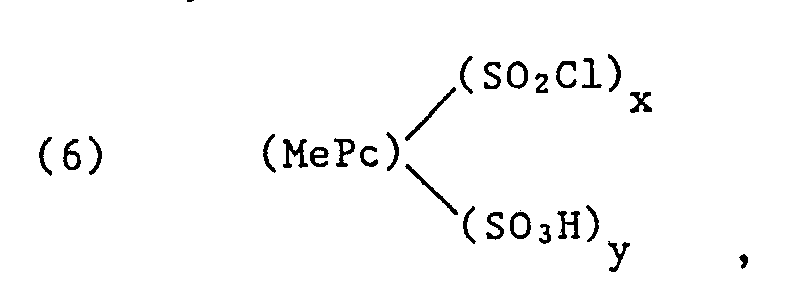
worin x 2,5 bis 4, y 0 bis 1,5 und die Summe aus x+y 2,5 bis 4, vorzugsweise 2,5 bis 3 ist,
gleichzeitig oder nacheinander mit Aminen der Formeln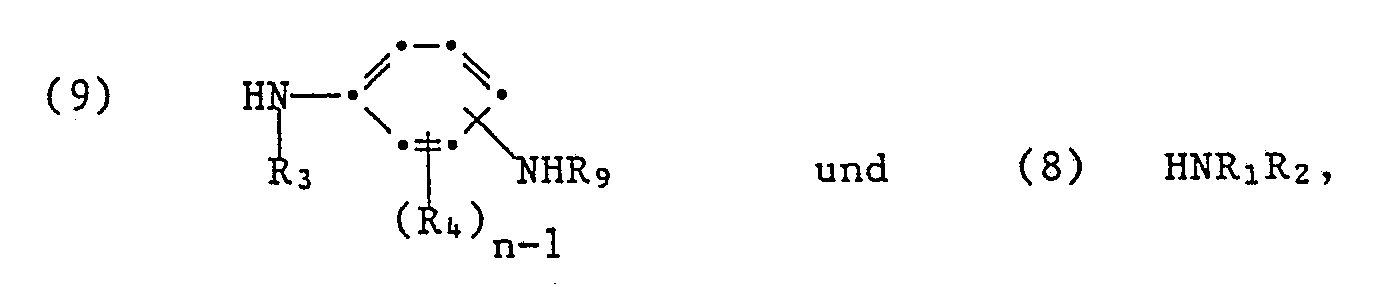
- Die als Ausgangsverbindungen verwendeten Phthalocyaninsulfochloride der Formel (6) sind dem Fachmann bekannt oder können nach an sich bekannten Verfahren (Umsetzung des Metall-Phthalocyanins mit Chlorsulfonsäure und/oder Thionylchlorid bei erhöhter Temperatur) hergestellt werden (s. z.B. K. Venkataraman, The Chemistry of Synthetic Dyes, Vol. V, S. 261 (1971), Academic Press, New York/London: F.M. Moser, A.L. Thomas, The phthalocyanines, Vol. II, S. 20-22, CRC Press; 1983).
- Bei den Verbindungen der Formel (7) handelt es sich ebenfalls um bekannte, in der Regel gelbe Azofarbstoffe mit freier primärer oder sekundärer Aminogruppe. Die Aminoverbindungen der Formeln (8) und (9) sind allgemein bekannt und leicht zugänglich.
- Ein weiterer Gegenstand der vorliegenden Erfindung ist die Verwendung der Phthalocyaninverbindungen der Formel (1), gegebenenfalls auch Mischungen dieser Verbindungen, zum Färben oder Bedrucken von stickstoffhaltigen und insbesondere hydroxylgruppenhaltigen Fasermaterialien.
- Die erfindungsgemässen Phthalocyaninverbindungen (Phthalocyanin-Azofarbstoffe) der Formel (1) eignen sich also zum Färben und Bedrucken von stickstoffhaltigen oder insbesondere von cellulosischen Fasermaterialien, vorzugsweise von textilen Fasermaterialien, aus Seide, Wolle oder synthetischen Polyamiden, sowie bevorzugt aus den cellulosischen Fasern, wie Rayon, Baumwolle oder Hanf.
- Bezüglich ihrer färberischen Eigenschaften können sie als direktziehende oder Direktfarbstoffe (C.I. direct dyes) bezeichnet werden.
- Ebenfalls können textile Fasermaterialien aus Mischfasern, wie z.B. aus Wolle/Baumwoll-, Polyamid/Baumwoll-, Polyacryl/Baumwoll- oder insbesondere Polyester/Baumwoll-Mischfasern durch Einbad-Färbeverfahren und in Gegenwart von Farbstoffen für die jeweils anderen Fasertypen gefärbt werden.
- Die textilen Fasermaterialien können in den verschiedensten Verarbeitungszuständen vorliegen, wie z.B. als Faser, Garn, Gewebe oder Gewirke.
- Neben den textilen Substraten können auch Leder und Papier mit erfindungsgemässen Verbindungen (Farbstoffen) der Formel (1) gefärbt werden.
- Man erhält egale Färbungen in brillant-grünen Farbtönen mit guten Allgemeinechtheiten, insbesondere guten Reib-, Nass-, Nasssreib-, Schweiss- und Lichtechtheiten. Sofern nötig, kann man die Nassechtheiten, insbesondere die Waschechtheit, der erhaltenen Direktfärbungen und drucke durch eine Nachbehandlung mit sogenannten Fixiermitteln noch wesentlich verbessern.
- Die erfindungsgemässen Farbstoffe der Formel (1) sind gut mit anderen Farbstoffen, insbesondere Dispersionsfarbstoffen kombinierbar. Die erfindungsgemässen Farbstoffe weisen eine ausreichende Hochtemperatur-Stabilität auf und lassen sich so unter den Färbededingungen für Polyesterfasern, d.h. bei Temperaturen im Bereich von etwa 100 bis 150°C, vorzugsweise von 110 bis 130°C, aus wässriger Flotte und bei einem pH-Wert von 4 bis 7,5, vorzugsweise 5 bis 7, färben.
- Damit ist es möglich, übliche Dispersionsfarbstoffe zusammen mit den erfindungsgemässen Farbstoffen der Formel (1) in einem einstufigen, einbadigen Verfahren zum Färben von Polyester/Baumwoll-Mischfasern (Mischgewebe) einzusetzen, wobei beide Faserarten gleichmässig und echt durch den jeweiligen Farbstoff angefärbt werden. Verwendet man einen Dispersionsfarbstoff mit gleicher Nuance wie der erfindungsgemässe Farbstoff sie aufweist, so ist es auch möglich Ton-in-Ton-Färbungen zu erhalten.
- Mit der Bereitstellung der erfindungsgemässen Farbstoffe der Formel (1) kann man das Färben von textilen Mischfasern (Mischgeweben), z.B. solchen aus Polyester- und Cellulosefasern, wesentlich vereinfachen. Die an sich übliche Färbung jeder Faserart einer Fasermischung in einem separaten Arbeitsgang unter Anwendung unterschiedlicher Färbebedingungen ist damit nicht mehr nötig.
- Die erfindungsgemässen Verbindungen der Formel (1) eignen sich auch zur Herstellung von wässrigen Tinten für den Tintenstrahldruck (ink-jet printing).
- Die folgenden Beispiele dienen zur Erläuterung der Erfindung. Teile und Prozente beziehen sich auf das Gewicht, sofern nicht anders angegeben. Gewichtsteile und Volumenteile stehen in gleicher Beziehung zueinander wie Kilogramm und Liter. Die Temperaturen sind in Celsiusgraden angegeben.
- 14,6 Teile Kupferphthalocyaninsulfochlorid (mit einer durchschnittlichen Anzahl von 2,5 Sulfochloridgruppen im Molekül) werden in 500 Teilen Wasser angerührt. Zu dieser Suspension gibt man 12 Teile der Verbindung der Formel

- Der gebildete Farbstoff wird dann mit 60 Teilen Kochsalz ausgefällt, abfiltriert und mit l0%iger wässriger Natriumchloridlösung gewaschen. Der Filterrückstand wird mit heissem Aethanol angeschlämmt, erneut filtriert und mit heissem Aethanol solange gewaschen, bis das Filtrat farblos ist.
- Nach dem Trocknen erhält man 30 Teile des Farbstoffes der Formel

- Der Farbstoff färbt Papier, cellulosische Textilfasermaterialien, insbesondere solche aus Baumwolle und Leder, in brillant-grünen Farbtönen.
- In analoger Weise kann man auch die Farbstoffe der Formeln

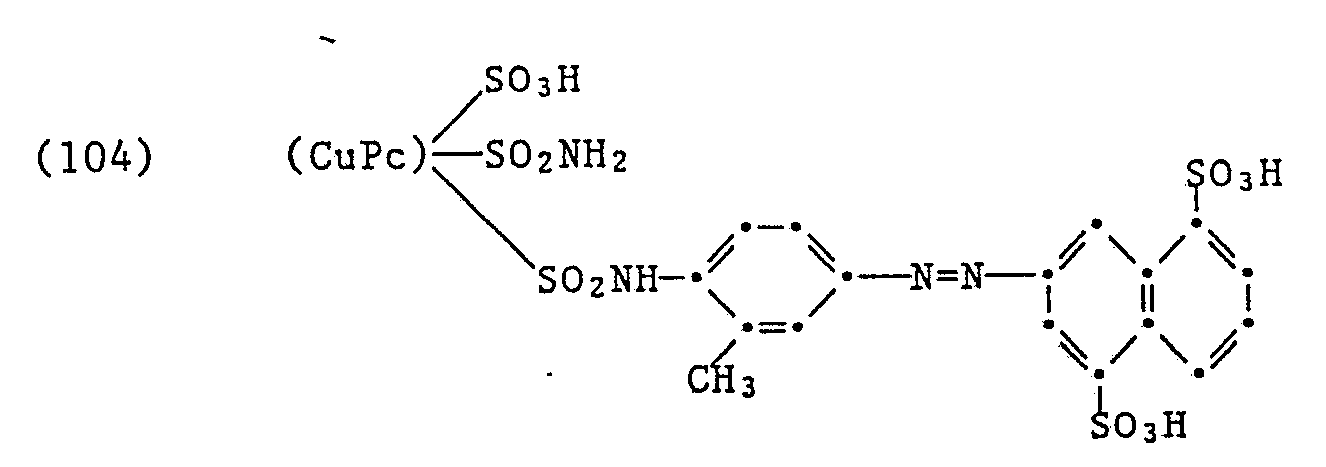
- 14,6 Teile Kupferphthalocyaninsulfochlorid (mit einer durchschnittlichen Anzahl von 2,5 Sulfochloridgruppen im Molekül) werden in 500 Teilen Wasser angerührt. Zu dieser Suspension gibt man 12 Teile der Verbindung der Formel

- Der gebildete Farbstoff wird dann mit 60 Teilen Kochsalz ausgefällt, abfiltriert und mit l0%iger wässriger Natriumchloridlösung gewaschen. Der Filterrückstand wird mit heissem Aethanol angeschlämmt, erneut filtriert und mit heissem Aethanol solange gewaschen, bis das Filtrat farblos ist.
- Nach dem Trocknen erhält man 30 Teile des salzhaltigen Farbstoffes der Formel

- Der Farbstoff färbt Papier, cellulosische Textilfasermaterialien, insbesondere solche aus Baumwolle und Leder, in brillant-grünen Farbtönen.
- 43,6 Teile eines Kupferphthalocyanin-sulfochlorids, das pro Molekül durchschnittlich ca. 1,7 Sulfochlorid-Gruppen und ca. 1,0 Sulfonsäure-Gruppen enthält, werden in 400 Teilen Eiswasser angeschlämmt. Zu dieser Suspension gibt man eine Lösung von 21 Teilen des Monoazofarb stoffes 3-Sulfo-2′-acetamido-4′-amino-azobenzol (Natriumsalz) in 350 Teilen Eiswasser und 1,0 Teilen Pyridin. Das Reaktionsgemisch wird unter Konstanthalten des pH-Wertes bei 7,5-8,0 mit 1N Ammoniumhydroxidlösung während 4 Stunden bei 0 bis 5°C, dann 2 Stunden bei 20 bis 25°C und schliesslich 2 Stunden bei 35 bis 40°C gerührt. Anschliessend wird der pH-Wert mit 1N-Ammoniumhydroxydlösung auf 8 gestellt und eine weitere Stunde bei 40 bis 45°C gerührt. Es werden dazu etwa 70 Teile 1N-Ammoniumhydroxydlösung verbraucht.
- Der gebildete Farbstoff wird dann mit Kochsalz ausgefällt, abfiltriert und mit wässriger Natriumchloridlösung gewaschen. Der Filterrückstand wird mit heissem Aethanol angeschlämmt, erneut filtriert und mit heissem Aethanol solange gewaschen, bis das Filtrat farblos ist.
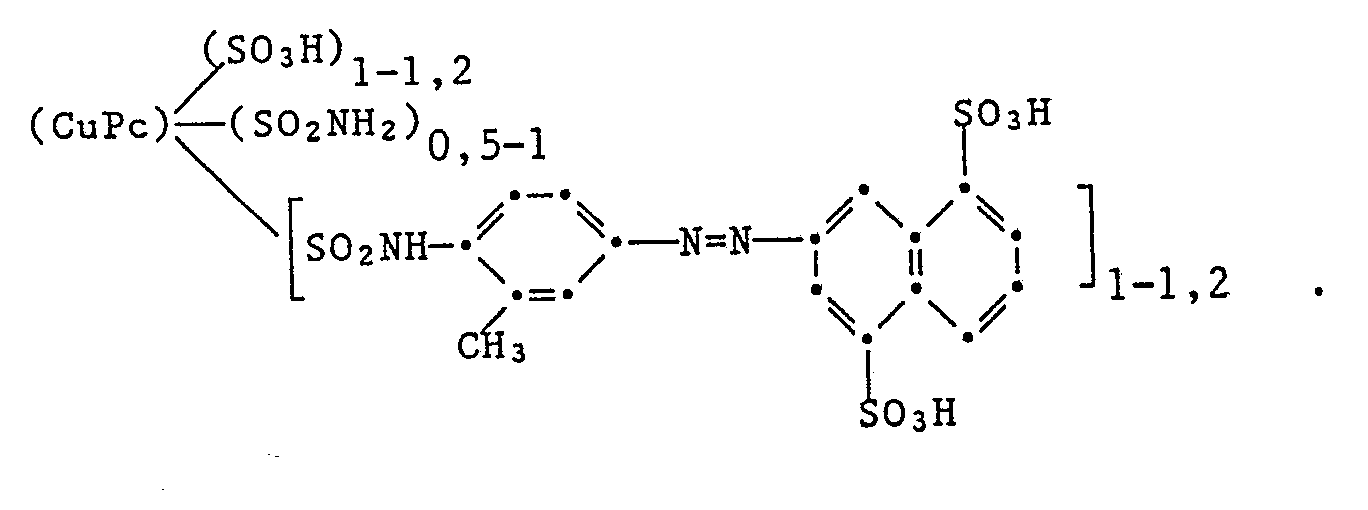
- Nach dem Trocknen erhält man 59 Teile des salzhaltigen Farbstoffes der Formel

- 23,1 Teile Kupferphthalocyanin-Base (Natriumsalz), die pro Molekül ca. 1,1 Sulfonsäure-Gruppen, ca. 0,7 -SO₂NH₂-Gruppen und ca. 1,1 Gruppen der Formel


- Analog wie in den Beispielen 1 bis 3 beschrieben lassen sich die folgenden Farbstoffe herstellen, die Cellulosematerialien und Leder jeweils in brillanten grünen Tönen mit guten Allgemeinechtheiten färben:

- 10 Teile Baumwollgewebe (gebleicht und mercerisiert) werden bei ca. 30°C in ein Färbebad eingebracht, welches 200 Teile Wasser und 0,35 Teile Farbstoff des Beispiels 2 enthält. Die Flotte wird innerhalb von 30 Minuten auf 95°C erhitzt und 15 Minuten bei dieser Temperatur belassen. Dann werden 4 Teile Glaubersalz zugesetzt und noch weitere 45 Minuten bei 95°C gefärbt. Danach wird das Färbebad innerhalb von 15 Minuten auf 80°C abgekühlt und noch weitere 15 Minuten bei dieser Temperatur belassen. Die Färbung wird dann gründlich mit kaltem Wasser gespült und getrocknet.
- 10 Teile einer Fasermischung aus Polyester und Baumwolle werden bei ca. 50°C in ein Färbebad eingebracht, welches 200 Teile Wasser, ein Farbstoffgemisch bestehend aus 0,05 Teilen C.I. Disperse Yellow 99, 0,5 Teilen C.I. Disperse Blue 60 und 0,2 Teilen des Farbstoffes gemäss Beispiel 3, 0,4 Teile Ammoniumsulfat sowie 0,2 Teile eines anionischen Dispersionsmittels (z.B. Formaldehyd-Kondensationsprodukt von Naphthalinsulfonsäure). Das Färbebad wird mit Ameisensäure auf einen pH-Wert von 5,5 eingestellt, 1 Teil Glaubersalz zugesetzt und dann innerhalb von 45 Minuten auf ca. 130°C aufgeheizt. Man färbt weitere 45 Minuten bei 130°C, kühlt dann das Färbebad innerhalb von 30 Minuten auf ca. 80°C ab und belässt es weitere 45 Minuten bei dieser Temperatur. Die Färbung wird dann gründlich mit kaltem Wasser gespült und getrocknet.
- Man verfährt wie in den Färbevorschriften 1 oder 2 beschrieben, gibt jedoch nach Abschluss des Färbevorgangs die kalt gespülte Färbung in ein frisches ca. 30°C warmes Bad, welches 200 Teile Wasser und 0,2-0,6 Teile eines kationischen Nachbehandlungsmittels (Amin-Formaldehyd-Dicyandiamid-Kondensationsprodukt oder Zubereitung auf der Basis von Dicyandiamid und Diäthylentriamin) enthält. Die Färbung wird 30 Minuten bei 30°C nachbehandelt und anschliessend ohne weiteren Spülprozess getrocknet; man erhält eine Färbung mit verbesserten Nassechtheiten.
- Man verfährt wie in den Färbevorschriften 1 oder 2 beschrieben, gibt jedoch nach Abschluss des Färbevorgangs die kalt gespülte Färbung in ein frisches ca. 25°C warmes Bad, welches 200 Teile Wasser, 1 Teil Glaubersalz und 0,6 Teile eines faserreaktiven kationischen Nachbehandlungsmittels auf Basis von N-Methyldialkylamin und Epichlorhydrin enthält. Die Temperatur wird innerhalb von 15 Minuten auf 40°C erhöht, 0,8 Teile 30%ige Natriumhydroxidlösung zugegeben und die Färbung weitere 45 Minuten bei 40°C behandelt. Die Färbung wird schliesslich heiss gespült und getrocknet; sie weist verbesserte Nassechtheiten auf.
Claims (13)

R₁ und R₂ zusammen mit dem Stickstoffatom einen heterocyclischen Ring mit gegebenenfalls weiteren Heteroatomen bedeuten,
R₃ Wasserstoff oder Methyl,
R₄ Wasserstoff, Alkyl oder Alkoxy mit jeweils 1 bis 5 Kohlenstoffatomen, -NHCOR₆, worin R₆ Alkyl oder Hydroxyalkyl mit jeweils 1 bis 3 Kohlenstoffatomen oder gegebenenfalls substituiertes Phenyl ist, oder Sulfo,
Me ein koordinativ gebundenes Metallatom,
Pc ein (a+b+c)-wertiger Phthalocyaninrest,
n gleich 1 bis 3,
A ein monosubstituierter Phenylrest, ein Naphthyl- oder ein heterocyclischer Rest,
a gleich 1 bis 1,5,
b gleich 1 bis 2 und
c gleich 1 bis 2 und
die Summe aus (a+b+c) 2,5 bis 4 ist,
dadurch gekennzeichnet, dass man ein Metallphthalocyaninsulfochlorid der Formel


worin R₁, R₂, R₃, R₄, A, Me, Pc und n die oben angegebenen Bedeutungen haben,
in wässrigem Medium bei Temperaturen von 0 bis 100°C unter Einhaltung eines pH-Wertes von 5 bis 10 umsetzt, und anschliessend gegebenenfalls mit einer Säure oder einer alkalischen Verbindung hydrolysiert.
R₁ und R₂ gleich oder voneinander verschieden sind und jeweils Wasserstoff, Hydroxyäthyl oder Carboxyalkyl mit 1 oder 2 Kohlenstoffatomen im Alkylrest oder Phenyl sind oder
R₁ und R₂ zusammen mit dem Stickstoffatom einen heterocyclischen 5- oder 6-gliedrigen Ring bedeuten, der als weitere Heteroatome Stickstoff-, Schwefel- und/oder Sauerstoffatome enthalten kann,
R₄ Alkyl oder Alkoxy mit jeweils 1 bis 3 Kohlenstoffatomen, -NHCOCH₃, -NHCOCH₂OH, -NHCOC₆H₅ oder Sulfo und
Me ein koordinativ gebundenes Eisen-, Kobalt-, Nickel- und insbesondere Kupferatom ist, und
Pc, R₃, a, b, c und n die in Anspruch 1 angegebenen Bedeutungen haben.

R₁ und R₂ zusammen mit dem Stickstoffatom einen heterocyclischen 5- oder 6-gliedrigen Ring bedeuten, der als weitere Heteroatome Stickstoff-, Schwefel- und/oder Sauerstoffatome enthalten kann,
R₄ Alkyl oder Alkoxy mit jeweils 1 bis 3 Kohlenstoffatomen, -NHCOCH₃, -NHCOCH₂OH, -NHCOC₆H₅ oder Sulfo,
R₅ Alkyl oder Alkoxy mit 1 bis 3 Kohlenstoffatomen, Hydroxyl, Carboxyl oder Sulfo und
Pc, R₃, a, b, c und n die angegebenen Bedeutungen haben.




worin R₉ eine Schutzgruppe, z.B. Acetyl, ist und R₁, R₂, R₃, R₄, Me, Pc und n die in Anspruch 1 angegebenen Bedeutungen haben, in wässrigem Medium bei Temperaturen von 0 bis 100°C unter Einhaltung eines pH-Wertes von 5 bis 10 umsetzt, anschliessend die Schutzgruppe abspaltet, die entstehende Aminogruppe diazotiert und die Diazoverbindung dann auf eine Kupplungskomponente A kuppelt.
Applications Claiming Priority (2)
| Application Number | Priority Date | Filing Date | Title |
|---|---|---|---|
| CH178688 | 1988-05-11 | ||
| CH1786/88 | 1988-11-05 |
Publications (2)
| Publication Number | Publication Date |
|---|---|
| EP0342159A1 true EP0342159A1 (de) | 1989-11-15 |
| EP0342159B1 EP0342159B1 (de) | 1993-09-01 |
Family
ID=4218568
Family Applications (1)
| Application Number | Title | Priority Date | Filing Date |
|---|---|---|---|
| EP89810338A Expired - Lifetime EP0342159B1 (de) | 1988-05-11 | 1989-05-01 | Wasserlösliche Phthalocyaninverbindungen, Verfahren zu ihrer Herstellung und ihre Verwendung |
Country Status (8)
| Country | Link |
|---|---|
| US (1) | US4992532A (de) |
| EP (1) | EP0342159B1 (de) |
| JP (1) | JPH0218462A (de) |
| KR (1) | KR900018120A (de) |
| BR (1) | BR8902191A (de) |
| DE (1) | DE58905415D1 (de) |
| ES (1) | ES2058591T3 (de) |
| MX (1) | MX15982A (de) |
Families Citing this family (2)
| Publication number | Priority date | Publication date | Assignee | Title |
|---|---|---|---|---|
| JP2725948B2 (ja) * | 1992-06-11 | 1998-03-11 | シーケーディ株式会社 | シールリング |
| FR2866805B1 (fr) * | 2004-02-27 | 2007-06-29 | Oreal | Composition comprenant un colorant mixte a base d'au moins un chromophore de type azo ou tri-(hetero)aryle methane, procede de coloration et colorants mixtes |
Citations (5)
| Publication number | Priority date | Publication date | Assignee | Title |
|---|---|---|---|---|
| DE945944C (de) * | 1952-07-31 | 1956-07-19 | Durand & Huguenin Ag | Verfahren zur Herstellung von wasserloeslichen und beizenziehenden Azophthalocyaninfarbstoffen |
| DE1176300B (de) * | 1961-09-28 | 1964-08-20 | Siegle & Co G M B H Farbenabri | Verfahren zur Herstellung von basischen Phthalocyaninfarbstoffen |
| GB1022751A (en) * | 1961-08-16 | 1966-03-16 | Durand & Huguenin Ag | Process for dyeing aluminium oxide layers |
| GB1220143A (en) * | 1967-05-17 | 1971-01-20 | Ugine Kuhlmann | Water-soluble azo dyestuffs derived from phthalocyanine |
| FR2384883A1 (fr) * | 1977-03-22 | 1978-10-20 | Hoechst Ag | Procede de formation de colorants azoiques sur des matieres fibreuses constituees par ou contenant de la cellulose |
Family Cites Families (5)
| Publication number | Priority date | Publication date | Assignee | Title |
|---|---|---|---|---|
| GB763343A (en) * | 1952-07-31 | 1956-12-12 | Durand & Huguenin Ag | New water-soluble mordant azophthalocyanine dyestuffs and process for making them |
| US3625936A (en) * | 1967-08-12 | 1971-12-07 | Hoechst Ag | Azophthalocyanine dyestuffs and process for preparing them |
| DE3009788A1 (de) * | 1980-03-14 | 1981-10-01 | Basf Ag, 6700 Ludwigshafen | Wasserloesliche nickelphtalocyaninazofarbstoffe |
| US4602084A (en) * | 1982-07-19 | 1986-07-22 | Ciba-Geigy Corporation | Monoazo dyes containing a 4-substituted-2-azo-1,1'-diphenylsulfone component |
| JPS6187759A (ja) * | 1984-09-06 | 1986-05-06 | Nippon Kayaku Co Ltd | 水溶性フタロシアニン化合物を用いる基材表面皮膜の着色法 |
-
1989
- 1989-05-01 ES ES89810338T patent/ES2058591T3/es not_active Expired - Lifetime
- 1989-05-01 DE DE89810338T patent/DE58905415D1/de not_active Expired - Fee Related
- 1989-05-01 EP EP89810338A patent/EP0342159B1/de not_active Expired - Lifetime
- 1989-05-03 US US07/346,688 patent/US4992532A/en not_active Expired - Fee Related
- 1989-05-10 BR BR898902191A patent/BR8902191A/pt not_active IP Right Cessation
- 1989-05-10 KR KR1019890006225A patent/KR900018120A/ko not_active Ceased
- 1989-05-10 MX MX1598289A patent/MX15982A/es unknown
- 1989-05-11 JP JP1116217A patent/JPH0218462A/ja active Pending
Patent Citations (5)
| Publication number | Priority date | Publication date | Assignee | Title |
|---|---|---|---|---|
| DE945944C (de) * | 1952-07-31 | 1956-07-19 | Durand & Huguenin Ag | Verfahren zur Herstellung von wasserloeslichen und beizenziehenden Azophthalocyaninfarbstoffen |
| GB1022751A (en) * | 1961-08-16 | 1966-03-16 | Durand & Huguenin Ag | Process for dyeing aluminium oxide layers |
| DE1176300B (de) * | 1961-09-28 | 1964-08-20 | Siegle & Co G M B H Farbenabri | Verfahren zur Herstellung von basischen Phthalocyaninfarbstoffen |
| GB1220143A (en) * | 1967-05-17 | 1971-01-20 | Ugine Kuhlmann | Water-soluble azo dyestuffs derived from phthalocyanine |
| FR2384883A1 (fr) * | 1977-03-22 | 1978-10-20 | Hoechst Ag | Procede de formation de colorants azoiques sur des matieres fibreuses constituees par ou contenant de la cellulose |
Also Published As
| Publication number | Publication date |
|---|---|
| BR8902191A (pt) | 1990-01-02 |
| EP0342159B1 (de) | 1993-09-01 |
| KR900018120A (ko) | 1990-12-20 |
| DE58905415D1 (de) | 1993-10-07 |
| US4992532A (en) | 1991-02-12 |
| JPH0218462A (ja) | 1990-01-22 |
| MX15982A (es) | 1993-09-01 |
| ES2058591T3 (es) | 1994-11-01 |
Similar Documents
| Publication | Publication Date | Title |
|---|---|---|
| EP0465420B1 (de) | Azofarbstoffe | |
| EP0202436A2 (de) | Verfahren zum Färben oder Bedrucken von Cellulosefasern oder Cellulosemischfasern | |
| DE1544446B2 (de) | Von Sulfon- und Carbonsäuregruppen freie wasserunlösliche Monoazofarbstoffe und Verfahren zu ihrer Herstellung | |
| EP0826743A2 (de) | Farbstoffmischungen, Verfahren zu deren Herstellung und deren Verwendung | |
| EP0014432B1 (de) | Wasserlösliche, faserreaktive Disazofarbstoffe, Verfahren zu deren Herstellung und ihre Verwendung zum Färben und Bedrucken von hydroxygruppen- und carbonamidgruppenhaltigen Fasermaterialien | |
| EP0718374B1 (de) | 1:2-Chromkomplexfarbstoffe enthaltende Farbstoffmischungen und 1:2 Chromkomplexfarbstoffe | |
| EP0258806B1 (de) | Wasserlösliche Disazoverbindungen, Verfahren zu ihrer Herstellung und ihre Verwendung als Farbstoffe | |
| EP0342159B1 (de) | Wasserlösliche Phthalocyaninverbindungen, Verfahren zu ihrer Herstellung und ihre Verwendung | |
| EP0342158B1 (de) | Wasserlösliche Phthalocyaninverbindungen, Verfahren zu ihrer Herstellung und ihre Verwendung | |
| DE69702963T2 (de) | Faserreaktive farbstoffe | |
| EP0265828B1 (de) | Wasserlösliche Disazoverbindungen, Verfahren zu ihrer Herstellung und ihre Verwendung als Farbstoffe | |
| EP0889098A2 (de) | Azofarbstoffe, Verfahren zu deren Herstellung und deren Verwendung | |
| EP0514330A1 (de) | Azofarbstoffe | |
| DE2934247A1 (de) | Verfahren zur veredlung von faserigen materialien | |
| DE1904112C3 (de) | Faserreaktive, schwermetallhaltige Formazanfarbstoffe, Verfahren zu ihrer Herstellung und deren Verwendung zum Färben oder Bedrucken von Textilmaterial | |
| CH628919A5 (de) | Verfahren zur herstellung von azofarbstoffen. | |
| EP0690103B1 (de) | Azofarbstoffe, Verfahren zu deren Herstellung und deren Verwendung | |
| EP1088858B1 (de) | Reaktivfarbstoffe, enthaltend einen Formazan- und einen Monoazofarbstoffrest, Verfahren zu deren Herstellung und deren Verwendung | |
| EP0230909B1 (de) | Wasserlösliche Azoverbindungen, Verfahren zu ihrer Herstellung und ihre Verwendung als Farbstoffe | |
| EP0457729B1 (de) | Azofarbstoffe, Verfahren zu deren Herstellung und deren Verwendung | |
| EP0726297A1 (de) | Farbstoffmischungen und ihre Verwendung | |
| DE3637337A1 (de) | Wasserloesliche azoverbindungen, verfahren zu ihrer herstellung und ihre verwendung als farbstoffe | |
| DE3400107C2 (de) | ||
| EP0099336B1 (de) | 1:2-Kobaltkomplexazofarbstoffe | |
| DE3332212C2 (de) |
Legal Events
| Date | Code | Title | Description |
|---|---|---|---|
| PUAI | Public reference made under article 153(3) epc to a published international application that has entered the european phase |
Free format text: ORIGINAL CODE: 0009012 |
|
| 17P | Request for examination filed |
Effective date: 19890503 |
|
| AK | Designated contracting states |
Kind code of ref document: A1 Designated state(s): BE CH DE ES FR GB IT LI |
|
| 17Q | First examination report despatched |
Effective date: 19920217 |
|
| GRAA | (expected) grant |
Free format text: ORIGINAL CODE: 0009210 |
|
| AK | Designated contracting states |
Kind code of ref document: B1 Designated state(s): BE CH DE ES FR GB IT LI |
|
| ET | Fr: translation filed | ||
| REF | Corresponds to: |
Ref document number: 58905415 Country of ref document: DE Date of ref document: 19931007 |
|
| GBT | Gb: translation of ep patent filed (gb section 77(6)(a)/1977) |
Effective date: 19931027 |
|
| ITF | It: translation for a ep patent filed | ||
| ITTA | It: last paid annual fee | ||
| PLBE | No opposition filed within time limit |
Free format text: ORIGINAL CODE: 0009261 |
|
| STAA | Information on the status of an ep patent application or granted ep patent |
Free format text: STATUS: NO OPPOSITION FILED WITHIN TIME LIMIT |
|
| 26N | No opposition filed | ||
| REG | Reference to a national code |
Ref country code: ES Ref legal event code: FG2A Ref document number: 2058591 Country of ref document: ES Kind code of ref document: T3 |
|
| REG | Reference to a national code |
Ref country code: CH Ref legal event code: PUE Owner name: CIBA-GEIGY AG TRANSFER- CIBA SC HOLDING AG |
|
| BECN | Be: change of holder's name |
Effective date: 19961129 |
|
| REG | Reference to a national code |
Ref country code: FR Ref legal event code: TP |
|
| PGFP | Annual fee paid to national office [announced via postgrant information from national office to epo] |
Ref country code: FR Payment date: 19970319 Year of fee payment: 9 |
|
| PGFP | Annual fee paid to national office [announced via postgrant information from national office to epo] |
Ref country code: DE Payment date: 19970411 Year of fee payment: 9 |
|
| PGFP | Annual fee paid to national office [announced via postgrant information from national office to epo] |
Ref country code: GB Payment date: 19970421 Year of fee payment: 9 |
|
| PGFP | Annual fee paid to national office [announced via postgrant information from national office to epo] |
Ref country code: CH Payment date: 19970423 Year of fee payment: 9 |
|
| PGFP | Annual fee paid to national office [announced via postgrant information from national office to epo] |
Ref country code: ES Payment date: 19970513 Year of fee payment: 9 |
|
| REG | Reference to a national code |
Ref country code: CH Ref legal event code: PFA Free format text: CIBA SC HOLDING AG TRANSFER- CIBA SPECIALTY CHEMICALS HOLDING INC. |
|
| REG | Reference to a national code |
Ref country code: GB Ref legal event code: 732E |
|
| PGFP | Annual fee paid to national office [announced via postgrant information from national office to epo] |
Ref country code: BE Payment date: 19970703 Year of fee payment: 9 |
|
| REG | Reference to a national code |
Ref country code: FR Ref legal event code: CD |
|
| PG25 | Lapsed in a contracting state [announced via postgrant information from national office to epo] |
Ref country code: GB Free format text: LAPSE BECAUSE OF NON-PAYMENT OF DUE FEES Effective date: 19980501 |
|
| PG25 | Lapsed in a contracting state [announced via postgrant information from national office to epo] |
Ref country code: ES Free format text: LAPSE BECAUSE OF NON-PAYMENT OF DUE FEES Effective date: 19980504 |
|
| PG25 | Lapsed in a contracting state [announced via postgrant information from national office to epo] |
Ref country code: LI Free format text: LAPSE BECAUSE OF NON-PAYMENT OF DUE FEES Effective date: 19980531 Ref country code: FR Free format text: LAPSE BECAUSE OF NON-PAYMENT OF DUE FEES Effective date: 19980531 Ref country code: CH Free format text: LAPSE BECAUSE OF NON-PAYMENT OF DUE FEES Effective date: 19980531 Ref country code: BE Free format text: LAPSE BECAUSE OF NON-PAYMENT OF DUE FEES Effective date: 19980531 |
|
| REG | Reference to a national code |
Ref country code: ES Ref legal event code: PC2A |
|
| BERE | Be: lapsed |
Owner name: CIBA SPECIALTY CHEMICALS HOLDING INC. Effective date: 19980531 |
|
| GBPC | Gb: european patent ceased through non-payment of renewal fee |
Effective date: 19980501 |
|
| REG | Reference to a national code |
Ref country code: CH Ref legal event code: PL |
|
| PG25 | Lapsed in a contracting state [announced via postgrant information from national office to epo] |
Ref country code: DE Free format text: LAPSE BECAUSE OF NON-PAYMENT OF DUE FEES Effective date: 19990302 |
|
| REG | Reference to a national code |
Ref country code: FR Ref legal event code: ST |
|
| REG | Reference to a national code |
Ref country code: ES Ref legal event code: FD2A Effective date: 20010503 |
|
| PG25 | Lapsed in a contracting state [announced via postgrant information from national office to epo] |
Ref country code: IT Free format text: LAPSE BECAUSE OF NON-PAYMENT OF DUE FEES;WARNING: LAPSES OF ITALIAN PATENTS WITH EFFECTIVE DATE BEFORE 2007 MAY HAVE OCCURRED AT ANY TIME BEFORE 2007. THE CORRECT EFFECTIVE DATE MAY BE DIFFERENT FROM THE ONE RECORDED. Effective date: 20050501 |