EP0586188A2 - Arbeitsprogrammierung während der Qualitätseinstellung - Google Patents
Arbeitsprogrammierung während der Qualitätseinstellung Download PDFInfo
- Publication number
- EP0586188A2 EP0586188A2 EP93306749A EP93306749A EP0586188A2 EP 0586188 A2 EP0586188 A2 EP 0586188A2 EP 93306749 A EP93306749 A EP 93306749A EP 93306749 A EP93306749 A EP 93306749A EP 0586188 A2 EP0586188 A2 EP 0586188A2
- Authority
- EP
- European Patent Office
- Prior art keywords
- image processing
- quality adjustment
- processing apparatus
- controller
- machine
- Prior art date
- Legal status (The legal status is an assumption and is not a legal conclusion. Google has not performed a legal analysis and makes no representation as to the accuracy of the status listed.)
- Granted
Links
Images




Classifications
-
- G—PHYSICS
- G03—PHOTOGRAPHY; CINEMATOGRAPHY; ANALOGOUS TECHNIQUES USING WAVES OTHER THAN OPTICAL WAVES; ELECTROGRAPHY; HOLOGRAPHY
- G03G—ELECTROGRAPHY; ELECTROPHOTOGRAPHY; MAGNETOGRAPHY
- G03G15/00—Apparatus for electrographic processes using a charge pattern
- G03G15/55—Self-diagnostics; Malfunction or lifetime display
-
- G—PHYSICS
- G03—PHOTOGRAPHY; CINEMATOGRAPHY; ANALOGOUS TECHNIQUES USING WAVES OTHER THAN OPTICAL WAVES; ELECTROGRAPHY; HOLOGRAPHY
- G03G—ELECTROGRAPHY; ELECTROPHOTOGRAPHY; MAGNETOGRAPHY
- G03G15/00—Apparatus for electrographic processes using a charge pattern
- G03G15/50—Machine control of apparatus for electrographic processes using a charge pattern, e.g. regulating differents parts of the machine, multimode copiers, microprocessor control
- G03G15/5016—User-machine interface; Display panels; Control console
- G03G15/502—User-machine interface; Display panels; Control console relating to the structure of the control menu, e.g. pop-up menus, help screens
Definitions
- the invention relates to programming an imaging machine and more particularly, to programming an imaging machine during a periodic copy quality adjustment.
- US-A-5,045,880 discloses a technique for pre-programming a reproduction machine for a plurality of complex jobs involving a variety of machine features and requirements using the operator console and touch sensitive screen display while the machine is in the print state or still in the process of completing a previous job.
- touching a Program Ahead file on the screen displays a simulation of a plurality of pre-programming slots or folders.
- a job can be pre-programmed into that slot or folder using file folders and subfolders that simulate a plurality of features and subfeatures of the machine.
- the features are automatically stored in the selected pre-programming slot on the touch sensitive screen and can be run upon the completion of the current job in progress or at a later time at the discretion of the operator.
- a difficulty with prior art systems is that often quality adjustments preclude the machine from other operations or uses. Although quality adjustments are necessary to maintain machine quality standards, an efficient machine should tolerate only brief and limited machine downtime during quality checks and modifications that exclude other operations such as pre-programming.
- the present invention is concerned with a technique for concurrently operating an image processing apparatus both in a quality adjustment mode wherein image processing components for forming images on a medium are periodically diagnosed and in an operator interaction mode wherein an operator interface including a touch screen with soft buttons connected to a controller is selectively engaged for machine programming.
- the invention includes the steps of monitoring the operation of the image processing components relative to image quality standards, initiating a quality adjustment of the image processing apparatus in response to said standards, and simultaneously interacting with the operator interface to input programming data to the controller.
- the invention thus provides a new and improved technique for concurrent operator interaction with a machine during periodic machine quality adjustments.
- the operator is able to selectively pre-program and schedule job runs at a machine operator console while the machine is in the process of an internal quality analysis.
- FIG. 1 shows one example of the overall construction of a color copying machine to which this invention is applied.
- a typical color copying machine to which this invention is applied is formed with the base machine 30, composed of a platen glass plate 31, which carries the original sheet thereon, an image input terminal (IIT) 32, an electrical control system container 33, the image output terminal (IOT) 34, a paper tray 35, and a user interface (U/I) 36 and also, as optional items, an editing pad 61, an automatic document feeder (ADF) 62, a sorter 63, and a film projector (F/P) 64 with its associated mirror 65.
- IIT image input terminal
- IOT image output terminal
- U/I user interface
- the IIT 32 is composed of an imaging unit 37, the wire 38 for driving the said unit, the driving pulley 39, and so forth, and IIT 32 reads a color original sheet for each of the primary colors B (Blue), G (Green), and R (Red) by means of a CCD line sensor and a color filter provided inside the imaging unit 37, converts the data so obtained into digital image signals and then outputs the signals to the IPS.
- IIT 32 reads a color original sheet for each of the primary colors B (Blue), G (Green), and R (Red) by means of a CCD line sensor and a color filter provided inside the imaging unit 37, converts the data so obtained into digital image signals and then outputs the signals to the IPS.
- the B, G, and R signals mentioned above are transformed into the primary colors of the toner, i.e. Y(Yellow), C(Cyan), M(Magenta), and K(Black), and then, with various data processing being applied to the data so obtained for the purpose of enhancing the reproduction fidelity and fineness, and so forth, the IPS converts the toner signals of the process color in harmonious gradation into binary toner signals and outputs them to the IOT 34.
- the IOT 34 which is provided with a scanner 40 and a photo-sensitive material belt 41, converts the image signals from the above-mentioned IPS into optical signals in the laser output part 40a and forms a latent image corresponding to the image on the original sheet on the photosensitive material belt 41 by way of the polygon mirror 40b, the lens 40c, and the reflexive mirror 40d.
- the photosensitive material belt 41 which is driven by the driving pulley 41a, has a cleaner 41b, a charging unit 41c, the individual developing devices 41d for Y, C, M, and K, and a transfer device 41e arranged around it.
- a transfer unit 42 which takes into it the sheet that comes transported to it from the paper tray 35 via the paper transport channel 35a and transfers the colors in the order of Y, C, M, and K, the transfer unit 42 being rotated four turns, for example, for full-color copying in four full colors.
- the sheet of paper on which the image is so transferred is then transported from the transfer unit 42 via the vacuum transport device 43 to the fixing device 45, where it is fixed, and is thereafter discharged from it.
- the paper transport channel 35a is so designed as to accept the paper fed alternatively from the SSI (Single Sheet Inserter) 35b.
- the U/I 36 is designed for use by the user for making the selections of the desired functions and for giving instructions regarding the conditions for the execution of the selected functions, and this system is provided with a color display unit 51 and a hardware control panel 52 installed by the side of the said display unit, and it is further combined with an infrared ray touch board 53, so that instructions can be given directly with the "soft buttons" on the screen.
- a color display unit 51 and a hardware control panel 52 installed by the side of the said display unit, and it is further combined with an infrared ray touch board 53, so that instructions can be given directly with the "soft buttons" on the screen.
- FIG. 2 there is illustrated in general block form, the control of the base machine 30 shown in Figure 1.
- the base machine is controlled by a plurality of printed wiring boards interconnected to a common channel or bus 98.
- a common channel or bus 98 For purposes of explanation, four printed wiring boards, boards 102, 104, 106 and 108 are illustrated, with printed wiring board 108 being the control for the user interface 36 and the remaining printed wiring boards providing control for predetermined systems and components of the base machine 30.
- the number of printed wiring boards and the manner of interconnection is merely a design choice and any other suitable control scheme for controlling the base machine is contemplated within the scope of this invention.
- one of the printed wiring boards, for example, board 102 could be the master control for the other printed wiring boards or that there could be any number of master slave relationships of the control boards or distributed control of the various functions of the base machine.
- the base machine 30 has control software resident on several printed circuit boards that communicate with each other using a common network, and that the base machine 30 has a user interface 36 that is controlled by software that is also part of the common network, illustrated by printed circuit board 108.
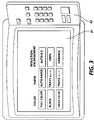
- Figure 3 is merely a simplified version of the color display unit 51, and hardware control panel 52 of the user interface 36 illustrating various soft control buttons such as full color, auto paper, and auto reduction/enlargement.
- the printed circuit board 108 controlling the user interface 36 is able to monitor all communications on the network 98 and display the communications on the screen 51.
- the service representative enters a hard key sequence that is recognized by the printed circuit board 108. This recognition of the key sequence by the printed circuit board 108 enables the control 108 to monitor the communications network 98 and display the communications appearing on the screen 51.
- the service representative merely enables a predetermined key sequence at the hardware control panel 52 to initiate a communications network monitor mode to monitor communications between selected elements such as the printed wiring boards 102,104, 106 and 108 on the network 98.
- the machine operator is able to set up or program the next job or a future machine job while the machine is currently in a copy quality adjustment mode.
- the operator can concurrently select features for a subsequent job run such as full color, black, or single color, or a particular size paper such as tray 1 containing 216 x 279mm (8.5 ⁇ 11") copy sheets or tray 2 containing 279x432mm (11'' ⁇ 17'') copy sheets, or select a particular reduce/enlargement mode.
- buttons can be displayed in the same frame or subsequent frames and can be selectively engaged by the operator during the copy quality adjust.
- suitable hard buttons shown on the panel 52 in accordance well known preprogramming techniques. For example, either hard or soft buttons can be used to select full size copies, 94% size copies, 77% size copies or any variable size copy as well as buttons to engage a recirculating document feeder to operate in a collate mode or non-collate mode.
- suitable buttons can enable the operator to select, in a given machine environment, finisher operations such as stapled, non-stapled, non-colated, and such features as duplex copying and offset stacking.
- the scope of the present invention is intended to cover not only setting the machine or configuring the machine for a next subsequent job to be initiated immediately after the completion of the copy quality adjustment, but also to cover the pre-programming of the machine to initiate a complete job run after the completion of a job run in process that has been interrupted by the copy quality adjust sequence.
- the machine can be pre-programmed for multiple jobs, while the machine is in a copy quality adjust mode.
- the operator can concurrently in a particular pre-program operation, predetermine documents within a document set to be selected for specific features and functions.
- predetermine documents within a document set can be selected for specific features and functions.
- a whole range of pre-programming and "exception" programming for predetermined selected documents in a particular set can be concurrently accomplished. This can be done by the use of soft and hard buttons with or without the use of a screen display at an operator console to set the machine up for subsequent job runs while the machine is currently in a copy quality adjust mode.
- a typical machine may be in one of several states throughout the operation of the machine, such as a cycle up or cycle down state, a ready state, an operating state, or a quality adjust state
- the scope of the present invention is intended to cover concurrent pre-programming of the machine during a copy quality adjust sequence regardless of the state of the machine.
- Block 300 illustrates a copier power on condition, but could indicate a cycle up mode.
- the decision block 302 illustrates the decision as to whether or not the copy is ready to make copies. If not, presumably additional cycle up or pre-operational analysis is required to insure that all operating components are ready for operation before initiation of a job.
- a copy quality adjustment is initiated. This could be a periodic time adjustment, or an automatically initiated copy quality adjustment depending upon machine conditions.
- Block 306 illustrates the pre-programming of job parameters enabled.
- the operator console either via hard buttons or soft buttons on a display screen are available for operator pre-programming.
- a suitable message on the display screen can be provided to inform the operator that the machine is in a condition to accept pre-programming operations.
- a suitable sequence of frames or windows of machine features can be displayed for operator selection.
- Block 308 is a decision as to whether or not the copy quality adjustment has been completed. If not, the machine cycles back to continue the copy quality adjustment. If completed, block 310 illustrates that the pre-programmed job may be started. It should be understood that the pre-programmed job could be automatically started upon the completion of the copy quality adjustment or, as indicated above, could be automatically started after the completion of a current job in process or could be one of several jobs in a job queue to be started as required.
- the system will automatically restart a copy quality adjustment that has been interrupted prematurely due to a machine fault or due to operator intervention.
- recovery procedures both automatic and manual, in the prior art, for recovery for various types of system malfunctions and shutdowns.
- the problem of correcting the malfunction and maintaining the integrity of the run in process can be a significant problem. For example, jammed copies often require removal before the machine can be restarted. Even minor events such as improperly closed covers or doors will activate interlock switches and inhibit operation.
- jammed copies often require removal before the machine can be restarted.
- Even minor events such as improperly closed covers or doors will activate interlock switches and inhibit operation.
- Also in a complex electronic control system there is a large number of software problems that can cause the control system to temporarily malfunction or crash, requiring the system or components of the system to be reset.
- block 322 illustrates the initiation of a copy quality adjustment.
- the copy quality adjustment could be initiated in any several ways such as a scheduled periodic copy quality adjustment, a copy quality adjustment in response to any of several events, or even an externally initiated copy quality adjustment.
- Block 324 illustrates the interruption of the copy quality adjustment.
- the interruption can be any hardware or software interruption caused by various malfunctions or software crashes of the machine or even by externally initiated actions such as the opening of a door or cover
- Block 326 illustrates that the interrupting condition has been cleared or eliminated in that no conditions exist to inhibit the continuation of the copy quality adjustment process. It should be understood that it is within the scope of the present invention that as long as the machine is capable of continuing with the copy quality analysis and adjustment process, the interrupting condition can be considered to be cleared. That is, the quality adjustment can continue even though other machine interrupting conditions exist that have no effect upon the copy quality adjustment procedure.
- the decision block 328 upon the sensing that the interrupting condition has been eliminated or cleared or has no effect upon the copy quality adjustment process, the decision is made whether or not a copy quality adjustment is required or still required. If the copy quality adjustment process has been completed at the time of the interruption or for any other reason is not required, the machine is then ready for printing or copying as illustrated at block 332. On the other hand, if the copy quality adjustment is required because it has been interrupted before completion, the machine continues to perform the copy quality adjustment as illustrated at block 330.
Landscapes
- Engineering & Computer Science (AREA)
- Physics & Mathematics (AREA)
- General Physics & Mathematics (AREA)
- Human Computer Interaction (AREA)
- Microelectronics & Electronic Packaging (AREA)
- Control Or Security For Electrophotography (AREA)
- Facsimiles In General (AREA)
- Accessory Devices And Overall Control Thereof (AREA)
Applications Claiming Priority (2)
| Application Number | Priority Date | Filing Date | Title |
|---|---|---|---|
| US07/939,765 US5343275A (en) | 1992-09-02 | 1992-09-02 | Job programming during machine quality adjust |
| US939765 | 1992-09-02 |
Publications (3)
| Publication Number | Publication Date |
|---|---|
| EP0586188A2 true EP0586188A2 (de) | 1994-03-09 |
| EP0586188A3 EP0586188A3 (de) | 1995-02-01 |
| EP0586188B1 EP0586188B1 (de) | 1997-09-10 |
Family
ID=25473696
Family Applications (1)
| Application Number | Title | Priority Date | Filing Date |
|---|---|---|---|
| EP93306749A Expired - Lifetime EP0586188B1 (de) | 1992-09-02 | 1993-08-25 | Arbeitsprogrammierung während der Qualitätseinstellung |
Country Status (4)
| Country | Link |
|---|---|
| US (1) | US5343275A (de) |
| EP (1) | EP0586188B1 (de) |
| JP (1) | JP2619200B2 (de) |
| DE (1) | DE69313765T2 (de) |
Cited By (3)
| Publication number | Priority date | Publication date | Assignee | Title |
|---|---|---|---|---|
| EP0678792A3 (de) * | 1994-04-19 | 1997-04-02 | Eastman Kodak Co | Bilderzeugungsgerät mit Mehrwegzugang zu einem Informationssystem. |
| EP1102471A3 (de) * | 1999-11-18 | 2002-03-20 | Xerox Corporation | Bildwiedergabevorrichtung und -Verfahren |
| EP1385089A2 (de) * | 2002-07-26 | 2004-01-28 | Ricoh Company, Ltd. | Bilderzeugungsgerät, Informationsverarbeitungsgerät, Programmausführungsverfahren und Programmproduzierungsverfahren |
Families Citing this family (5)
| Publication number | Priority date | Publication date | Assignee | Title |
|---|---|---|---|---|
| JP3467061B2 (ja) * | 1993-06-25 | 2003-11-17 | 株式会社リコー | 操作部及び画像形成装置 |
| US5481353A (en) * | 1994-10-31 | 1996-01-02 | Xerox Corporation | Apparatus for producing variable feature presentation sets |
| US6661978B2 (en) * | 2002-01-16 | 2003-12-09 | Xerox Corporation | Method and apparatus for automated job recovery |
| US20040021698A1 (en) * | 2002-08-05 | 2004-02-05 | Baldwin Amanda K. | Intuitive touchscreen interface for a multifunction device and method therefor |
| JP4925722B2 (ja) * | 2006-05-24 | 2012-05-09 | 京セラミタ株式会社 | 画像形成装置 |
Family Cites Families (10)
| Publication number | Priority date | Publication date | Assignee | Title |
|---|---|---|---|---|
| US4477178A (en) * | 1978-12-08 | 1984-10-16 | Canon Kabushiki Kaisha | Image forming apparatus |
| JPS57101858A (en) * | 1980-12-18 | 1982-06-24 | Ricoh Co Ltd | Copying device |
| USRE32611E (en) * | 1982-05-27 | 1988-02-23 | Eastman Kodak Company | Adjusting copier copy contrast and density during production runs |
| JPS59146082A (ja) * | 1983-02-09 | 1984-08-21 | Sharp Corp | 電子写真複写装置 |
| DE3423066A1 (de) * | 1983-06-24 | 1985-01-10 | Sharp K.K., Osaka | Elektrophotographisches kopiergeraet |
| US5045880A (en) * | 1988-10-03 | 1991-09-03 | Xerox Corporation | Pre-programming during job run |
| JPH0429272A (ja) * | 1990-05-25 | 1992-01-31 | Ricoh Co Ltd | 画像形成装置 |
| US5049931A (en) * | 1990-08-20 | 1991-09-17 | Xerox Corporation | Reproduction machine having a job run display screen with graphic symbol |
| US5138377A (en) * | 1991-05-23 | 1992-08-11 | Xerox Corporation | Internal expert system to aid in servicing |
| US5229815A (en) * | 1992-09-04 | 1993-07-20 | Xerox Corporation | Automatic machine quality adjust restart after premature interruption |
-
1992
- 1992-09-02 US US07/939,765 patent/US5343275A/en not_active Expired - Lifetime
-
1993
- 1993-06-25 JP JP5155887A patent/JP2619200B2/ja not_active Expired - Lifetime
- 1993-08-25 DE DE69313765T patent/DE69313765T2/de not_active Expired - Lifetime
- 1993-08-25 EP EP93306749A patent/EP0586188B1/de not_active Expired - Lifetime
Cited By (3)
| Publication number | Priority date | Publication date | Assignee | Title |
|---|---|---|---|---|
| EP0678792A3 (de) * | 1994-04-19 | 1997-04-02 | Eastman Kodak Co | Bilderzeugungsgerät mit Mehrwegzugang zu einem Informationssystem. |
| EP1102471A3 (de) * | 1999-11-18 | 2002-03-20 | Xerox Corporation | Bildwiedergabevorrichtung und -Verfahren |
| EP1385089A2 (de) * | 2002-07-26 | 2004-01-28 | Ricoh Company, Ltd. | Bilderzeugungsgerät, Informationsverarbeitungsgerät, Programmausführungsverfahren und Programmproduzierungsverfahren |
Also Published As
| Publication number | Publication date |
|---|---|
| EP0586188A3 (de) | 1995-02-01 |
| US5343275A (en) | 1994-08-30 |
| EP0586188B1 (de) | 1997-09-10 |
| JPH06102725A (ja) | 1994-04-15 |
| DE69313765T2 (de) | 1998-03-26 |
| JP2619200B2 (ja) | 1997-06-11 |
| DE69313765D1 (de) | 1997-10-16 |
Similar Documents
| Publication | Publication Date | Title |
|---|---|---|
| US8204398B2 (en) | Image forming apparatus with controller for automatically switching displays of operation procedure in rotation | |
| US5414494A (en) | Automatic call to selected remote operators in response to predetermined machine conditions | |
| US5511150A (en) | Copier/printer with improved productivity | |
| US8693017B2 (en) | Image forming apparatus, method of controlling the same, program, storage medium, printing system, and method suitable for the printing system | |
| JPH02145085A (ja) | フィルム画像読取装置 | |
| JPH04305659A (ja) | 電子複写印刷装置におけるジョブ回復方法とその装置 | |
| EP0586188B1 (de) | Arbeitsprogrammierung während der Qualitätseinstellung | |
| EP0631202B1 (de) | Bildqualitätsabstimmungsverfahren und Bilderzeugungsgerät | |
| US5229815A (en) | Automatic machine quality adjust restart after premature interruption | |
| JP2918784B2 (ja) | 画像処理装置及び方法 | |
| JPH04355775A (ja) | カラー画像形成装置及びカラー画像処理装置 | |
| NL1019420C2 (nl) | Conditioneel onderbreken van een afdrukopdracht. | |
| US5305058A (en) | Progressive levels of automatic machine quality adjust | |
| US4627710A (en) | Customized job default set-up | |
| US5313468A (en) | Self-diagnosing system for recording apparatus | |
| US6505025B2 (en) | Color image forming apparatus and process | |
| JP4110003B2 (ja) | 画像形成装置 | |
| JP3612802B2 (ja) | 画像処理装置 | |
| US5243380A (en) | Board fault isolation technique | |
| JP3524152B2 (ja) | 画像処理システム、その制御方法及び画像処理装置 | |
| JP6761451B2 (ja) | 印刷装置とその制御方法 | |
| JPH0795334A (ja) | 画像処理システム | |
| JP2522069B2 (ja) | 記録装置 | |
| JPH0547831B2 (de) | ||
| JPH02100438A (ja) | 記録装置のシリアル通信方式 |
Legal Events
| Date | Code | Title | Description |
|---|---|---|---|
| PUAI | Public reference made under article 153(3) epc to a published international application that has entered the european phase |
Free format text: ORIGINAL CODE: 0009012 |
|
| AK | Designated contracting states |
Kind code of ref document: A2 Designated state(s): DE FR GB |
|
| PUAL | Search report despatched |
Free format text: ORIGINAL CODE: 0009013 |
|
| AK | Designated contracting states |
Kind code of ref document: A3 Designated state(s): DE FR GB |
|
| 17P | Request for examination filed |
Effective date: 19950801 |
|
| 17Q | First examination report despatched |
Effective date: 19960905 |
|
| GRAG | Despatch of communication of intention to grant |
Free format text: ORIGINAL CODE: EPIDOS AGRA |
|
| GRAH | Despatch of communication of intention to grant a patent |
Free format text: ORIGINAL CODE: EPIDOS IGRA |
|
| GRAH | Despatch of communication of intention to grant a patent |
Free format text: ORIGINAL CODE: EPIDOS IGRA |
|
| GRAA | (expected) grant |
Free format text: ORIGINAL CODE: 0009210 |
|
| AK | Designated contracting states |
Kind code of ref document: B1 Designated state(s): DE FR GB |
|
| REF | Corresponds to: |
Ref document number: 69313765 Country of ref document: DE Date of ref document: 19971016 |
|
| ET | Fr: translation filed | ||
| PLBE | No opposition filed within time limit |
Free format text: ORIGINAL CODE: 0009261 |
|
| STAA | Information on the status of an ep patent application or granted ep patent |
Free format text: STATUS: NO OPPOSITION FILED WITHIN TIME LIMIT |
|
| 26N | No opposition filed | ||
| REG | Reference to a national code |
Ref country code: GB Ref legal event code: IF02 |
|
| PGFP | Annual fee paid to national office [announced via postgrant information from national office to epo] |
Ref country code: GB Payment date: 20120725 Year of fee payment: 20 |
|
| PGFP | Annual fee paid to national office [announced via postgrant information from national office to epo] |
Ref country code: DE Payment date: 20120723 Year of fee payment: 20 Ref country code: FR Payment date: 20120906 Year of fee payment: 20 |
|
| REG | Reference to a national code |
Ref country code: DE Ref legal event code: R071 Ref document number: 69313765 Country of ref document: DE |
|
| REG | Reference to a national code |
Ref country code: GB Ref legal event code: PE20 Expiry date: 20130824 |
|
| PG25 | Lapsed in a contracting state [announced via postgrant information from national office to epo] |
Ref country code: DE Free format text: LAPSE BECAUSE OF EXPIRATION OF PROTECTION Effective date: 20130827 |
|
| PG25 | Lapsed in a contracting state [announced via postgrant information from national office to epo] |
Ref country code: GB Free format text: LAPSE BECAUSE OF EXPIRATION OF PROTECTION Effective date: 20130824 |