EP0582976B1 - Typ-II-Restriktionsendonuklease SexAI - Google Patents
Typ-II-Restriktionsendonuklease SexAI Download PDFInfo
- Publication number
- EP0582976B1 EP0582976B1 EP93112617A EP93112617A EP0582976B1 EP 0582976 B1 EP0582976 B1 EP 0582976B1 EP 93112617 A EP93112617 A EP 93112617A EP 93112617 A EP93112617 A EP 93112617A EP 0582976 B1 EP0582976 B1 EP 0582976B1
- Authority
- EP
- European Patent Office
- Prior art keywords
- restriction endonuclease
- type
- mmol
- sexai
- streptomyces
- Prior art date
- Legal status (The legal status is an assumption and is not a legal conclusion. Google has not performed a legal analysis and makes no representation as to the accuracy of the status listed.)
- Expired - Lifetime
Links
Classifications
-
- C—CHEMISTRY; METALLURGY
- C12—BIOCHEMISTRY; BEER; SPIRITS; WINE; VINEGAR; MICROBIOLOGY; ENZYMOLOGY; MUTATION OR GENETIC ENGINEERING
- C12N—MICROORGANISMS OR ENZYMES; COMPOSITIONS THEREOF; PROPAGATING, PRESERVING, OR MAINTAINING MICROORGANISMS; MUTATION OR GENETIC ENGINEERING; CULTURE MEDIA
- C12N9/00—Enzymes; Proenzymes; Compositions thereof; Processes for preparing, activating, inhibiting, separating or purifying enzymes
- C12N9/14—Hydrolases (3)
- C12N9/16—Hydrolases (3) acting on ester bonds (3.1)
- C12N9/22—Ribonucleases [RNase]; Deoxyribonucleases [DNase]
Definitions
- the invention relates to the new type II restriction endonuclease SexAI, a process for their extraction and their use.
- Type II restriction endonucleases are endodeoxyribonucleases, which specific DNA sequences to recognize and are able to split. This involves phosphodiester bridges hydrolyzed in the target sequence, namely in one for each strand of polynucleotides. Type II restriction endonucleases are therefore valuable for the analysis of DNA molecules. Although it is already for numerous DNA sequences specific type II restriction endonucleases known, but there is still a need for Creation of further type II restriction endonucleases that are specific for DNA sequences and have so far been used by none of the known restriction endonucleases were recognized become. The invention is therefore based on the object a new restriction endonuclease is available make a one of no such enzyme to specifically recognize and split the recognized sequence can
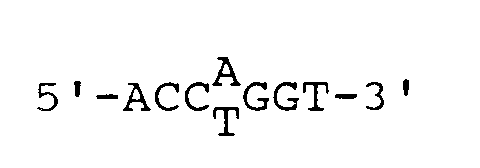
- this object is achieved by a type II restriction endonuclease with the recognition sequence and the cleavage site defined by the label
- the new restriction endonuclease according to the invention which is referred to below as SexAI, has an optimum temperature at 37 ° C.
- the enzyme has good activity between pH 8.2 and pH 9.5 in 10 mmol / l Tris / HCl buffer with 1.0 mmol / l 2-mercaptoethanol, 5 mmol / l MgCl 2 and 100 mmol / l NaCl.
- the optimum pH is at 9.2.
- the recognition sequence can be confirmed by complete digestion of the DNAs of the SV4O and Adeno 2 viruses, the phage lambda (dcm - ) and phiX174. These DNA molecules are treated with SexAI.
- Table 1 shows a comparison of the experimentally observed interface specificity with a computer-determined interface specificity for an enzyme which recognizes the following sequence: DNA Number of interfaces determined experimentally Number of interfaces determined by computer analysis Experimentally determined fragment lengths (base pairs) Fragment lengths (base pairs) determined by computer analysis Gap positions determined by computer analysis (with base pair) SV4O 1 1 5243 5243 176 PhiX174 1 1 5386 5386 3499 Lambda 5 5 22000 8700 22263 8745 22263 31008 32837 7700 4100 7659 4095 40496 44407 3900 1800 3911 1829 Ad2 9 9 14000 4000 13758 3917 3356 5658 6399 3400 3400 3369 3356 10316 11502 25260 3050 2400 3074 2389 28334 31703 34092 2300 1850 2302 1845 1200 750 1186 741
- the cleavage position within the recognition sequence of the enzyme can be found in an M13 derivative which is located at a distance of approximately 30-200 bases from the binding site of the universal sequencing primer (Messing, J. et al. (1981) Nucl. Acids Res. 9 , 309 - 321) carries this recognition sequence. Sequence reactions are first carried out on single-stranded DNA of the M13 derivative using the universal sequencing primer using the dideoxy chain termination method (Sanger, F., et al. (1977) Proc. Natl. Acad. Sci. USA 74 , 560-564, Messing, J et al. (1981) Nucl. Acids Res 9 , 309-321).
- the sequencing primer is radiolabelled with T4 polynucleotide kinase and [ ⁇ - 32 P] ATP at the 5 'end.
- T4 polynucleotide kinase and [ ⁇ - 32 P] ATP at the 5 'end.
- a partially double-stranded DNA is produced in a replenishment reaction with DNA polymerase I, (Klenow enzyme) and a deoxynucleotide triphosphate mixture from dATP, dCTP, dGTP and dTTP.
- This DNA is cleaved with the restriction endonuclease SexAI.
- Half of the gap preparation is additionally treated with T4 DNA polymerase in the presence of a mixture of all four deoxynucleotide triphosphates in order to obtain smooth DNA ends.
- the reaction products are analyzed by electrophoresis on sequencing gels (8 mol / l urea, 5% polyacrylamide) and subsequent autoradiography. The results are interpreted according to Brown, NL and Smith, M. (Methods in Enzymology 65 (1980) 391-401).
- the position of the cleavage site is determined by comparing the running distances of the radioactively labeled fragments with the sequence ladder.
- the samples additionally treated with T4 DNA polymerase show a 5bp longer running distance of the bands compared to the sample which was only cleaved with SexAI. This shows that SexAI produces a 5 '5-overhanging DNA end. SexAI is therefore split within the recognition sequence with the following specificity:
- the experimentally determined number of interfaces is identical to the number of interfaces obtained by computer analysis with the different DNAs for the sequence
- SexAI is preferably obtained by using microorganisms, preferably Streptomycetes, breeds and that Enzyme from the cells wins. Is particularly preferred the strain Streptomyces exfoliatus used.
- microorganism Streptomyces exfoliatus is in the German Collection of Microorganisms (DSM), Mascheroder Weg 1b, 33OO Braunschweig, FRG, deposited and has the deposit number DSM 7194.
- the usual biochemical purification methods can be used for the recovery, the presence of the enzyme in the fractions obtained in each case being able to be easily detected by cleaving its recognition sequence.
- Lambda (dcm - ) DNA for example, is suitable as a substrate.
- the DNA fragments obtained are electrophoretically separated in agarose gels in the buffer systems customary for fragment separation in the presence of ethidium bromide.
- Microorganisms grow aerobically in LB medium (10 g / l Bacto-Trypton, 5 g / l Bacto-Yeast extract and 10 g / l NaCl).
- the optimal growth conditions are at 26 ° C, pH 6.5 - 7.5.
- the doubling time is approximately 2.5 hours.
- the enzyme is isolated and purified by the usual chemical and mechanical methods, for example by high pressure dispersion, ultrasound or enzymatic digestion.
- the cells opened up via a French press.
- the further purification of the supernatant is preferably over Affinity chromatography, and adsorption chromatography carried out.
- Affinity chromatography is suitable, for example Heparin Sepharose CL-6B (Pharmacia) and Fractogel TSK AF Orange (Merck).
- a suitable adsorption exchanger is for example HA Ultrogel (IBF).
- the microorganism Streptomyces exfoliatus is found in 26 ° C bred for 10-12 hours and at the end of the logarithmic phase.
- the cell paste (30 g wet weight) is in 2.4 volumes of buffer A (40 mmol / l Tris-HCl, pH 8, O, O, 1 mmol / l EDTA, 7 mmol / l 2-mercaptoethanol), which contains protease inhibitors, resuspended.
- the cells are then disrupted by passing two times through a French press at 23,000 lb / inch 2 and the precipitate is separated off.
- NH 4 Cl is added to the supernatant (final concentration 0.3 mol / l).
- the nucleic acids are removed by a polymine precipitation.
- the centrifuged supernatant is then dialyzed against buffer B (40 mmol / l Tris-HCl, pH 8.0; 0.1 mmol / l EDTA; 7 mmol / l 2-mercaptoethanol; 10% (w / v) glycerol) and over fractionated a heparin-Sepharose column.
- buffer B 40 mmol / l Tris-HCl, pH 8.0; 0.1 mmol / l EDTA; 7 mmol / l 2-mercaptoethanol; 10% (w / v) glycerol
- the active fractions are equilibrated against buffer C (10 mmol / l potassium phosphate, pH 8.0; 0.1 mmol / l EDTA; 7 mmol / l 2-mercaptoethanol; 10% (w / v) glycerol) and on a HA Ultrogel column fractionated. A gradient of 10-250 mmol / l potassium phosphate in buffer C is used for elution. The active fractions are dialyzed against buffer B.
- the active fractions are pooled and against Storage buffer (20 mmol / l Tris-HCl, pH 8.0, 0.1 mmol / l 2-mercaptoethanol, 100 mmol / l NaCl, 0.1 mmol / l EDTA and 50% (v / v) glycerol) dialyzed.
- Storage buffer (20 mmol / l Tris-HCl, pH 8.0, 0.1 mmol / l 2-mercaptoethanol, 100 mmol / l NaCl, 0.1 mmol / l EDTA and 50% (v / v) glycerol) dialyzed.
- the solution is incubated for one hour at 37 ° C., cooled on ice and with 5 ⁇ l of a stopping reagent consisting of 7 mol / l urea, 2O% (w / v) sucrose, 6O mmol / l EDTA and O, O1% (w / v) bromophenol blue added.
- a separation is then carried out by electrophoresis in 0.5% agarose gels for 3-4 hours at 100 V. The bands obtained are identified by comparison with a DNA length standard.
Landscapes
- Life Sciences & Earth Sciences (AREA)
- Health & Medical Sciences (AREA)
- Chemical & Material Sciences (AREA)
- Wood Science & Technology (AREA)
- Molecular Biology (AREA)
- Engineering & Computer Science (AREA)
- Bioinformatics & Cheminformatics (AREA)
- Organic Chemistry (AREA)
- Zoology (AREA)
- Genetics & Genomics (AREA)
- Medicinal Chemistry (AREA)
- Microbiology (AREA)
- Biotechnology (AREA)
- Biochemistry (AREA)
- General Engineering & Computer Science (AREA)
- General Health & Medical Sciences (AREA)
- Biomedical Technology (AREA)
- Enzymes And Modification Thereof (AREA)
Description


| DNA | Anzahl der experimentell bestimmten Schnittstellen | Anzahl der durch Computeranalyse bestimmte Schnittstellen | Experimentell bestimmte Fragmentlängen (Basenpaare) | Durch Computeranalyse bestimmte Fragmentlängen (Basenpaare) | Spaltpositionen ermittelt durch Computeranalyse (bei Basenpaar) | ||||
| SV4O | 1 | 1 | 5243 | 5243 | 176 | ||||
| PhiX174 | 1 | 1 | 5386 | 5386 | 3499 | ||||
| Lambda | 5 | 5 | 22000 | 8700 | 22263 | 8745 | 22263 | 31008 | 32837 |
| 7700 | 4100 | 7659 | 4095 | 40496 | 44407 | ||||
| 3900 | 1800 | 3911 | 1829 | ||||||
| Ad2 | 9 | 9 | 14000 | 4000 | 13758 | 3917 | 3356 | 5658 | 6399 |
| 3400 | 3400 | 3369 | 3356 | 10316 | 11502 | 25260 | |||
| 3050 | 2400 | 3074 | 2389 | 28334 | 31703 | 34092 | |||
| 2300 | 1850 | 2302 | 1845 | ||||||
| 1200 | 750 | 1186 | 741 |

Claims (9)
- Typ II-Restriktionsendonuklease mit der Erkennungssequenz und der durch die Markierung charakterisierten Schnittstelleerhältlich aus Mikroorganismen der Gattung Streptomyces.

- Restriktionsendonuklease nach Anspruch 1 dadurch gekennzeichnet, daß sie aus dem Mikroorganismus Streptomyces exfoliatus DSM 7194 erhältlich ist.
- Restriktionsendonuklease nach den Anspruchen 1 oder 2, gekennzeichnet durch ein Temperatur-Optimum bei 37°C und ein pH-Optimum bei 9,2.
- Verfahren zur Gewinnung einer TypII-Restriktionsendonuklease mit der Erkennungssequenz und der durch die Markierung charakterisierten Spaltstelledadurch gekennzeichnet, daß man Streptomyceten züchtet und das Enzym aus den Zellen gewinnt.

- Verfahren nach Anspruch 4, dadurch gekennzeichnet, daß man den Stamm Streptomyces exfoliatus DSM 7194 züchtet.
- Verfahren nach den Anspruchen 4 und 5, dadurch gekennzeichnet, daß man die Zellen aufschließt und den Zellüberstand gewinnt.
- Verfahren nach Anspruch 6, dadurch gekennzeichnet, daß man zur Feinreinigung den Zellüberstand Affinitatschromatograpnien und einer Adsorptionschromatographie unterwirft.
- Verfahren nach Anspruch 7, dadurch gekennzeichnet, daß man zur Affinitätschromatographie trägerfixiertes Heparin verwendet.
- Verwendung einer TypII-Restriktionsendonuklease mit der Erkennunqssequenz und der durch die Markierung charakterisierten Schnittstelleerhältlich aus Mikroorganismen der Gattung Streptomyces zur Erkennung und Spaltung der komplementaren doppel-strangigen DNA-Sequenz


Applications Claiming Priority (2)
| Application Number | Priority Date | Filing Date | Title |
|---|---|---|---|
| DE4226657A DE4226657A1 (de) | 1992-08-12 | 1992-08-12 | TYP II-Restriktionsendonuklease SexAI |
| DE4226657 | 1992-08-12 |
Publications (3)
| Publication Number | Publication Date |
|---|---|
| EP0582976A2 EP0582976A2 (de) | 1994-02-16 |
| EP0582976A3 EP0582976A3 (de) | 1994-10-05 |
| EP0582976B1 true EP0582976B1 (de) | 2000-02-09 |
Family
ID=6465379
Family Applications (1)
| Application Number | Title | Priority Date | Filing Date |
|---|---|---|---|
| EP93112617A Expired - Lifetime EP0582976B1 (de) | 1992-08-12 | 1993-08-06 | Typ-II-Restriktionsendonuklease SexAI |
Country Status (3)
| Country | Link |
|---|---|
| US (1) | US5354669A (de) |
| EP (1) | EP0582976B1 (de) |
| DE (2) | DE4226657A1 (de) |
Families Citing this family (6)
| Publication number | Priority date | Publication date | Assignee | Title |
|---|---|---|---|---|
| US5391487A (en) * | 1993-08-13 | 1995-02-21 | Promega Corporation | Restriction endonuclease SgfI from Streptomyces griseoruber |
| KR100210482B1 (ko) * | 1997-04-10 | 1999-07-15 | 김종인 | 스트렙토마이세스엑스포리아투스(streptomycesexfoliatus)yj-118과이를이용한프라바스타틴나트륨의제조방법 |
| WO2001005949A1 (en) * | 1999-07-15 | 2001-01-25 | Unilever N.V. | Membrane separation process for purifying, concentrating and densifying enzyme solutions with polyols |
| US6420333B1 (en) | 2001-08-28 | 2002-07-16 | Unilever Home & Personal Care Usa Division Of Conopco, Inc. | Manufacture of capsules for incorporation into detergent and personal care compositions |
| KR100470078B1 (ko) * | 2003-06-12 | 2005-02-04 | 씨제이 주식회사 | 컴팩틴을 프라바스타틴으로 전환할 수 있는 스트렙토마이세스 종(Streptomyces sp.)CJPV 975652 및 그를 이용한 프라바스타틴의 제조방법 |
| DE102018212144A1 (de) * | 2018-07-20 | 2020-01-23 | Siemens Aktiengesellschaft | Anordnung aufweisend einen gewendelten Leiterstrang sowie Verfahren zur Herstellung einer derartigen Anordnung |
Family Cites Families (3)
| Publication number | Priority date | Publication date | Assignee | Title |
|---|---|---|---|---|
| JPH02255086A (ja) * | 1989-03-29 | 1990-10-15 | Nisshin Seito Kk | 新規制限酵素及びその製造法 |
| DE3924709A1 (de) * | 1989-07-26 | 1991-01-31 | Boehringer Mannheim Gmbh | Typ ii-restriktionsendonuklease dsav |
| DE4032213A1 (de) * | 1990-10-11 | 1992-04-16 | Boehringer Mannheim Gmbh | Typ ii-restriktionsendonuklease ssp4800i |
-
1992
- 1992-08-12 DE DE4226657A patent/DE4226657A1/de not_active Withdrawn
-
1993
- 1993-07-19 US US08/094,374 patent/US5354669A/en not_active Expired - Lifetime
- 1993-08-06 DE DE59309951T patent/DE59309951D1/de not_active Expired - Fee Related
- 1993-08-06 EP EP93112617A patent/EP0582976B1/de not_active Expired - Lifetime
Also Published As
| Publication number | Publication date |
|---|---|
| US5354669A (en) | 1994-10-11 |
| DE59309951D1 (de) | 2000-03-16 |
| EP0582976A3 (de) | 1994-10-05 |
| EP0582976A2 (de) | 1994-02-16 |
| DE4226657A1 (de) | 1994-02-17 |
Similar Documents
| Publication | Publication Date | Title |
|---|---|---|
| EP0582976B1 (de) | Typ-II-Restriktionsendonuklease SexAI | |
| DE69201136T2 (de) | Typ II Restriktionsendonuklease von Arthrobacter Species und Verfahren zu seiner Herstellung. | |
| EP0456086B1 (de) | TYP II-Restriktionsendonuklease SwaI | |
| EP0432454B1 (de) | Typ II-Restriktionsendonuklease SgrAI | |
| EP0480343B1 (de) | Typ II-Restriktionsendonuklease Ssp4800I | |
| DE3512435C2 (de) | ||
| DE3811277C2 (de) | ||
| EP0306847B1 (de) | Typ II-Restriktionsendonuklease Ksp632I | |
| WO1990006361A1 (de) | TYP II-RESTRIKTIONSENDONUKLEASE MamI | |
| DE3420298C2 (de) | ||
| DE3924709A1 (de) | Typ ii-restriktionsendonuklease dsav | |
| DE69201045T2 (de) | Restriktionsendonuklease vom Typ II, Apo I, aus Arthrobacter protophormiae und Verfahren zu ihrer Herstellung. | |
| DE3401617C2 (de) | ||
| EP0428061A1 (de) | Typ II-Restriktionsendonuklease McrI | |
| DE4007043A1 (de) | Typ ii-restriktionsendonuklease rlei | |
| DE3425957C2 (de) | ||
| DE3401620C2 (de) | ||
| DE3811279C2 (de) | ||
| DE69516060T2 (de) | Eine neue Restriktionsendonuklease | |
| DE3401619A1 (de) | Restriktionsendonuklease mae ii, ihre gewinnung und verwendung | |
| EP0336286A2 (de) | Typ II-Restriktionsendonuklease Ksp I | |
| DE3539521A1 (de) | Verfahren zur herstellung einer restriktionsendonuklease |
Legal Events
| Date | Code | Title | Description |
|---|---|---|---|
| PUAI | Public reference made under article 153(3) epc to a published international application that has entered the european phase |
Free format text: ORIGINAL CODE: 0009012 |
|
| 17P | Request for examination filed |
Effective date: 19930806 |
|
| AK | Designated contracting states |
Kind code of ref document: A2 Designated state(s): DE FR GB IT |
|
| PUAL | Search report despatched |
Free format text: ORIGINAL CODE: 0009013 |
|
| AK | Designated contracting states |
Kind code of ref document: A3 Designated state(s): DE FR GB IT |
|
| 17Q | First examination report despatched |
Effective date: 19980525 |
|
| RAP3 | Party data changed (applicant data changed or rights of an application transferred) |
Owner name: ROCHE DIAGNOSTICS GMBH |
|
| GRAG | Despatch of communication of intention to grant |
Free format text: ORIGINAL CODE: EPIDOS AGRA |
|
| GRAG | Despatch of communication of intention to grant |
Free format text: ORIGINAL CODE: EPIDOS AGRA |
|
| GRAH | Despatch of communication of intention to grant a patent |
Free format text: ORIGINAL CODE: EPIDOS IGRA |
|
| GRAH | Despatch of communication of intention to grant a patent |
Free format text: ORIGINAL CODE: EPIDOS IGRA |
|
| GRAA | (expected) grant |
Free format text: ORIGINAL CODE: 0009210 |
|
| AK | Designated contracting states |
Kind code of ref document: B1 Designated state(s): DE FR GB IT |
|
| PG25 | Lapsed in a contracting state [announced via postgrant information from national office to epo] |
Ref country code: IT Free format text: LAPSE BECAUSE OF FAILURE TO SUBMIT A TRANSLATION OF THE DESCRIPTION OR TO PAY THE FEE WITHIN THE PRESCRIBED TIME-LIMIT;WARNING: LAPSES OF ITALIAN PATENTS WITH EFFECTIVE DATE BEFORE 2007 MAY HAVE OCCURRED AT ANY TIME BEFORE 2007. THE CORRECT EFFECTIVE DATE MAY BE DIFFERENT FROM THE ONE RECORDED. Effective date: 20000209 Ref country code: GB Free format text: LAPSE BECAUSE OF FAILURE TO SUBMIT A TRANSLATION OF THE DESCRIPTION OR TO PAY THE FEE WITHIN THE PRESCRIBED TIME-LIMIT Effective date: 20000209 Ref country code: FR Free format text: LAPSE BECAUSE OF FAILURE TO SUBMIT A TRANSLATION OF THE DESCRIPTION OR TO PAY THE FEE WITHIN THE PRESCRIBED TIME-LIMIT Effective date: 20000209 |
|
| REF | Corresponds to: |
Ref document number: 59309951 Country of ref document: DE Date of ref document: 20000316 |
|
| EN | Fr: translation not filed | ||
| GBV | Gb: ep patent (uk) treated as always having been void in accordance with gb section 77(7)/1977 [no translation filed] |
Effective date: 20000209 |
|
| PLBE | No opposition filed within time limit |
Free format text: ORIGINAL CODE: 0009261 |
|
| 26N | No opposition filed | ||
| PGFP | Annual fee paid to national office [announced via postgrant information from national office to epo] |
Ref country code: DE Payment date: 20080829 Year of fee payment: 16 |
|
| PG25 | Lapsed in a contracting state [announced via postgrant information from national office to epo] |
Ref country code: DE Free format text: LAPSE BECAUSE OF NON-PAYMENT OF DUE FEES Effective date: 20100302 |