EP0575291A2 - Elektrisch leitende Kunststoffzusammensetzungen und deren Verwendung - Google Patents
Elektrisch leitende Kunststoffzusammensetzungen und deren Verwendung Download PDFInfo
- Publication number
- EP0575291A2 EP0575291A2 EP93810411A EP93810411A EP0575291A2 EP 0575291 A2 EP0575291 A2 EP 0575291A2 EP 93810411 A EP93810411 A EP 93810411A EP 93810411 A EP93810411 A EP 93810411A EP 0575291 A2 EP0575291 A2 EP 0575291A2
- Authority
- EP
- European Patent Office
- Prior art keywords
- composition according
- alkyl
- mol
- groups
- structural units
- Prior art date
- Legal status (The legal status is an assumption and is not a legal conclusion. Google has not performed a legal analysis and makes no representation as to the accuracy of the status listed.)
- Withdrawn
Links
- 0 C1CC*CC1 Chemical compound C1CC*CC1 0.000 description 2
Classifications
-
- C—CHEMISTRY; METALLURGY
- C08—ORGANIC MACROMOLECULAR COMPOUNDS; THEIR PREPARATION OR CHEMICAL WORKING-UP; COMPOSITIONS BASED THEREON
- C08L—COMPOSITIONS OF MACROMOLECULAR COMPOUNDS
- C08L41/00—Compositions of homopolymers or copolymers of compounds having one or more unsaturated aliphatic radicals, each having only one carbon-to-carbon double bond, and at least one being terminated by a bond to sulfur or by a heterocyclic ring containing sulfur; Compositions of derivatives of such polymers
-
- C—CHEMISTRY; METALLURGY
- C08—ORGANIC MACROMOLECULAR COMPOUNDS; THEIR PREPARATION OR CHEMICAL WORKING-UP; COMPOSITIONS BASED THEREON
- C08G—MACROMOLECULAR COMPOUNDS OBTAINED OTHERWISE THAN BY REACTIONS ONLY INVOLVING UNSATURATED CARBON-TO-CARBON BONDS
- C08G61/00—Macromolecular compounds obtained by reactions forming a carbon-to-carbon link in the main chain of the macromolecule
- C08G61/12—Macromolecular compounds containing atoms other than carbon in the main chain of the macromolecule
- C08G61/122—Macromolecular compounds containing atoms other than carbon in the main chain of the macromolecule derived from five- or six-membered heterocyclic compounds, other than imides
- C08G61/123—Macromolecular compounds containing atoms other than carbon in the main chain of the macromolecule derived from five- or six-membered heterocyclic compounds, other than imides derived from five-membered heterocyclic compounds
- C08G61/126—Macromolecular compounds containing atoms other than carbon in the main chain of the macromolecule derived from five- or six-membered heterocyclic compounds, other than imides derived from five-membered heterocyclic compounds with a five-membered ring containing one sulfur atom in the ring
-
- C—CHEMISTRY; METALLURGY
- C08—ORGANIC MACROMOLECULAR COMPOUNDS; THEIR PREPARATION OR CHEMICAL WORKING-UP; COMPOSITIONS BASED THEREON
- C08L—COMPOSITIONS OF MACROMOLECULAR COMPOUNDS
- C08L65/00—Compositions of macromolecular compounds obtained by reactions forming a carbon-to-carbon link in the main chain; Compositions of derivatives of such polymers
-
- H—ELECTRICITY
- H01—ELECTRIC ELEMENTS
- H01B—CABLES; CONDUCTORS; INSULATORS; SELECTION OF MATERIALS FOR THEIR CONDUCTIVE, INSULATING OR DIELECTRIC PROPERTIES
- H01B1/00—Conductors or conductive bodies characterised by the conductive materials; Selection of materials as conductors
- H01B1/06—Conductors or conductive bodies characterised by the conductive materials; Selection of materials as conductors mainly consisting of other non-metallic substances
- H01B1/12—Conductors or conductive bodies characterised by the conductive materials; Selection of materials as conductors mainly consisting of other non-metallic substances organic substances
- H01B1/124—Intrinsically conductive polymers
- H01B1/127—Intrinsically conductive polymers comprising five-membered aromatic rings in the main chain, e.g. polypyrroles, polythiophenes
-
- H—ELECTRICITY
- H01—ELECTRIC ELEMENTS
- H01G—CAPACITORS; CAPACITORS, RECTIFIERS, DETECTORS, SWITCHING DEVICES, LIGHT-SENSITIVE OR TEMPERATURE-SENSITIVE DEVICES OF THE ELECTROLYTIC TYPE
- H01G11/00—Hybrid capacitors, i.e. capacitors having different positive and negative electrodes; Electric double-layer [EDL] capacitors; Processes for the manufacture thereof or of parts thereof
- H01G11/22—Electrodes
- H01G11/30—Electrodes characterised by their material
- H01G11/48—Conductive polymers
-
- H—ELECTRICITY
- H01—ELECTRIC ELEMENTS
- H01G—CAPACITORS; CAPACITORS, RECTIFIERS, DETECTORS, SWITCHING DEVICES, LIGHT-SENSITIVE OR TEMPERATURE-SENSITIVE DEVICES OF THE ELECTROLYTIC TYPE
- H01G11/00—Hybrid capacitors, i.e. capacitors having different positive and negative electrodes; Electric double-layer [EDL] capacitors; Processes for the manufacture thereof or of parts thereof
- H01G11/54—Electrolytes
- H01G11/56—Solid electrolytes, e.g. gels; Additives therein
-
- C—CHEMISTRY; METALLURGY
- C08—ORGANIC MACROMOLECULAR COMPOUNDS; THEIR PREPARATION OR CHEMICAL WORKING-UP; COMPOSITIONS BASED THEREON
- C08G—MACROMOLECULAR COMPOUNDS OBTAINED OTHERWISE THAN BY REACTIONS ONLY INVOLVING UNSATURATED CARBON-TO-CARBON BONDS
- C08G2261/00—Macromolecular compounds obtained by reactions forming a carbon-to-carbon link in the main chain of the macromolecule
- C08G2261/10—Definition of the polymer structure
- C08G2261/14—Side-groups
- C08G2261/142—Side-chains containing oxygen
- C08G2261/1424—Side-chains containing oxygen containing ether groups, including alkoxy
-
- C—CHEMISTRY; METALLURGY
- C08—ORGANIC MACROMOLECULAR COMPOUNDS; THEIR PREPARATION OR CHEMICAL WORKING-UP; COMPOSITIONS BASED THEREON
- C08G—MACROMOLECULAR COMPOUNDS OBTAINED OTHERWISE THAN BY REACTIONS ONLY INVOLVING UNSATURATED CARBON-TO-CARBON BONDS
- C08G2261/00—Macromolecular compounds obtained by reactions forming a carbon-to-carbon link in the main chain of the macromolecule
- C08G2261/30—Monomer units or repeat units incorporating structural elements in the main chain
- C08G2261/32—Monomer units or repeat units incorporating structural elements in the main chain incorporating heteroaromatic structural elements in the main chain
- C08G2261/322—Monomer units or repeat units incorporating structural elements in the main chain incorporating heteroaromatic structural elements in the main chain non-condensed
- C08G2261/3223—Monomer units or repeat units incorporating structural elements in the main chain incorporating heteroaromatic structural elements in the main chain non-condensed containing one or more sulfur atoms as the only heteroatom, e.g. thiophene
-
- Y—GENERAL TAGGING OF NEW TECHNOLOGICAL DEVELOPMENTS; GENERAL TAGGING OF CROSS-SECTIONAL TECHNOLOGIES SPANNING OVER SEVERAL SECTIONS OF THE IPC; TECHNICAL SUBJECTS COVERED BY FORMER USPC CROSS-REFERENCE ART COLLECTIONS [XRACs] AND DIGESTS
- Y02—TECHNOLOGIES OR APPLICATIONS FOR MITIGATION OR ADAPTATION AGAINST CLIMATE CHANGE
- Y02E—REDUCTION OF GREENHOUSE GAS [GHG] EMISSIONS, RELATED TO ENERGY GENERATION, TRANSMISSION OR DISTRIBUTION
- Y02E60/00—Enabling technologies; Technologies with a potential or indirect contribution to GHG emissions mitigation
- Y02E60/13—Energy storage using capacitors
Definitions
- the invention relates to compositions of a) at least one oxidized polycationic polythiophene which is alkoxy-substituted in the 3,4-positions and b) at least one polyanion of a thermoplastic polymer with sulfated alcohol groups and / or with sulfonate alkylated alcohol groups in recurring structural units, processes for producing the compositions, the use of the compositions for producing electrically conductive moldings and the use of finely divided electrically conductive compositions as fillers for plastics.
- DE-A-3 804 520 describes electrically conductive polymers in the form of self-supporting films which consist of structural units of a 3-alkoxy-4-alkylthiophene which is doped with low molecular weight anions such as hexafluorophosphate or tosylate.
- the films are said to be chemically stable and thermally stable. They have good electrical conductivities, as can be expected when doping with low molecular weight anions.
- a major disadvantage is the brittleness of the films, which have no thermoplastic properties.
- DE-A-3 804 523 describes soluble, electrically conductive polymers which contain structural units of a thiophene which is substituted in the 3-position by a C 6 -C 30 alkoxy group and doped with low molecular weight anions such as, for example, hexafluorophosphate or tosylate is, and that is particularly suitable for coating purposes.
- EP-A-0 339 340 describes electrically conductive polymers in the form of antistatic coatings on plastics, which consist of structural units of a thiophene substituted in the 3,4-positions with alkylenedioxyl and which are doped with low molecular weight anions such as hexafluorophosphate or tosylate are. No information is given on the mechanical and thermoplastic properties of the deposits formed on electrodes.
- EP-A-0 440 957 describes electrically conductive polymers in the form of dispersions which are composed of structural units of hydroxyl- or alkoxy-substituted thiophenes and a polymeric polyanion such as, for example, polyacrylic acid or polystyrene sulfonic acid and which are used as antistatic coating agents.
- US Pat. No. 5,061,401 describes electrically conductive polymers in the form of films which are composed of optionally alkyl-substituted structural units of heteroaromatics, such as, for example, thiophene and polyanions of sulfated polymers. These compositions have good electrical conductivities and thermoplastic properties. For example, electrical conductivity can be increased by stretching. For the composition of example B5, the relatively low conductivity expected for unsubstituted thiophenes is measured.
- EP-A-0 446 172 describes molding compounds and fillers with these electrically conductive polymers.
- thermoplastic properties can also be achieved in compositions with oxidized polyanionic thiophenes if alkoxy-substituted thiophenes are used and the oxidative polymerization is carried out in the presence of sulfated or sulfonate-alkylated polymers.
- the electrical conductivity is surprisingly improved compared to similar compositions with polypyrroles and unsubstituted polythiophenes and even against alkoxy-substituted polythiophenes with low molecular weight anions and higher than expected.
- the compositions also have a significantly improved resistance to the influence of air, moisture and / or heat (oxidation resistance) and thus a remarkably increased service life without the electrical conductivity dropping significantly.
- the mechanical stability such as the tensile strength or breaking strength, and the thermoplastic deformability by stretching (elongation at break) are considerably improved; stretching can do so even at room temperature and not only in the range of the glass transition temperature, the elongation being 100% and more.
- the mechanical stability and the electrical conductivity can be improved by up to four to five times the basic conductivity.
- the compositions according to the invention even self-supporting, mechanically stable and translucent films down to a range of around 1 ⁇ m with high electrical conductivities can be produced, which are suitable for electro-optical applications.
- Another very important advantage is that the electrical conductivities can be specifically adjusted by the choice of the polyanion and a stretching and can be tailored to the desired applications.
- R 1 and R 2 preferably represent C 1 -C 12 alkyl, particularly preferably C 1 -C 8 alkyl, and very particularly preferably C 1 -C 4 alkyl.
- Some examples are methyl, ethyl and the isomers of Propyl, butyl, pentyl, hexyl, heptyl, octyl, nonyl, decyl, uncecyl, dodecyl, tetradecyl, hexadecyl and octadecyl.
- Preferred alkyl radicals are methyl, ethyl, n- and i-propyl, n-, i- and t-butyl, and furthermore n-pentyl and n-hexyl.
- R 1 and R 2 are preferably C 1 -C 17 alkoxymethyl and C 1 -C 16 alkoxyethyl, more preferably C 1 -C 12 alkoxymethyl and C 1 -C 12 alkoxyethyl, particularly preferably C 1 -C 8 - Alkoxymethyl and C 1 -C 7 alkoxyethyl, and very particularly preferably C 1 -C 4 alkoxymethyl and C 1 -C 4 alkoxyethyl.
- Some preferred examples are methoxymethyl, ethoxymethyl, n- or i-propyloxymethyl, n-, i- or t-butyloxymethyl, methoxyethyl, ethoxyethyl, n- or i-propyloxyethyl, n-, i- and t-butyloxyethyl.
- R 1 and R 2 are cycloalkyl, it is preferably C 5 - or C s -cycloalkyl, for example cyclopentyl and cyclohexyl.
- the substituents for cycloalkyl, phenyl and benzyl are preferably C 1 -C 4 alkyl, C 1 -C 4 alkoxy, F, CI and Br.
- alkyl and alkoxy are in particular methyl, ethyl, methoxy and ethoxy .
- substituted radicals are methylcyclopentyl, methylcyclohexyl, methoxycyclohexyl, methylphenyl, dimethylphenyl, ethylphenyl, methoxyphenyl, dimethoxyphenyl, chlorophenyl, methylbenzyl, dimethylbenzyl, ethylbenzyl, methoxybenzyl, dimethoxybenzyl and chlorobenzyl.
- R 1 and R 2 together represent alkylene. These are preferably C 1 -C 4 alkylene and particularly preferably C 1 - or C 2 alkylene. Examples of alkylene are methylene, ethylene, 1,2- or 1,3-propylene, butylene, pentylene and hexylene.
- R 1 and R 2 as alkylene are C 1 -C 6 alkyl, C 1 -C 6 alkoxy, cyclohexyl, phenyl and benzyl, for example methyl, ethyl, propyl, butyl, methoxy, ethoxy, cyclohexyl, phenyl and benzyl.
- R 1 and R 2 are linear or branched C 1 -C 6 alkyl, especially C 1 -C 4 alkyl, or R 1 and R 2 together are C 1 -C 4 alkylene, especially C 1 - or C 2 alkylene which is unsubstituted or substituted by 1 or 2 C 1 -C 6 alkyl groups or C 1 -C 6 alkoxy groups.
- R 1 and R 2 are C 1 or C 2 alkylene which is unsubstituted or substituted by C 1 -C 6 alkyl or C 1 -C 6 alkoxy.
- R 1 and R 2 represent a radical of the formula -CHR a -CHR b -, in which R a and R b independently of one another are H or C 1 -C 6 -alkyl, especially methyl or ethyl.
- the structural unit of the formula corresponds to a radical of the formula
- composition according to the invention preferably contains 0.1 to 0.9, particularly preferably 0.1 to 0.6, particularly preferably 0.15 to 0.4 structural units with sulfated alcohol groups per structural unit of the polythiophene
- the group - (C n H 2n ) - preferably represents linear or branched C 3 -C 8 alkylene with 3 to 5 C atoms in the carbon chain and particularly preferably linear C 3 -C 5 alkylene.
- Some examples are ethylene, Methylethylene, dimethylethylene, 1,3-propylene, methyl-1,3-propylene, dimethyl-1,3-propylene, trimethyl-1,3-propylene, 1,4-butylene, methyl-1,4-butylene, dimethyl 1,4-butylene, trimethyl-1,4-butylene, tetramethyl-1,4-butylene, 1,3-or 1,5-pentylene and 1,3-, 1,4-, 1,5- or 1, 6-hexylene.
- the group - (C n H 2n ) - is trimethylene and tetramethylene.
- thermoplastic polymer with salted sulfated alcohol groups used in the composition according to the invention and / or salted sulfonate alkylated alcohol groups preferably has a glass transition temperature of -100 to 350 ° C, particularly preferably -50 to 250 ° C, measured by the DSC method (differential scanning calorimetry).
- M ⁇ means an alkali metal or an ammonium cation, which are described in more detail below for the polymers.
- the tensile strength of this thermoplastic polymer is preferably at least 5 MPa, particularly preferably at least 10 MPa, measured in accordance with DIN 53 455. Depending on the type of polymer, the tensile strength can be up to 1000 MPa, preferably up to 500 MPa and particularly preferably up to 300 MPa.
- the degree of polymerization can e.g. 5 to 10,000, preferably 10 to 5000 and particularly preferably 10 to 1000.
- the alcohol groups in the thermoplastic polymer can be partially or completely sulfated and / or sulfonate alkylated.
- the ratio of free alcohol groups to sulfated alcohol groups and / or sulfonate alkylated alcohol groups in the thermoplastic polymer can be, for example, from 50: 1 to 1:50, preferably 10: 1 to 1:10.
- the thermoplastic polymer contains 5 to 100 mol%, more preferably 10 to 100 mol%, more preferably 20 to 100 mol%, particularly preferably 30 to 100 mol% and particularly preferably 30 to 90 mol% of structural units sulfated alcohol groups and / or sulfonate alkylated alcohol groups wherein the remaining structural units are corresponding hydroxyl-containing or hydroxyl-free structural elements.
- the sulfated and / or sulfonate alkylated alcohol groups can be used as secondary groups or as tertiary groups or in the polymer backbone; or in side groups of the polymer as primary groups -CH 2 -O-SO 3 ⁇ or -CH 2 -O- (C n H 2n ) SO 3 ⁇ , or as secondary groups or as tertiary groups be moderately bound.
- thermoplastic polymers can be based on different hydroxyl group-containing polymers or mixtures thereof, e.g. Polyesters, polyester amides, polyurethanes, polyamides, polycarbonates and polyimides from monomers containing hydroxyl groups; saponified polymers of vinyl esters or ethers; hydroxylated polydiolefins such as e.g.
- the sulfated and / or sulfonate-alkylated thermoplastic polymers are preferably polymers from the group of polyadducts of glycidyl compounds with an average of more than one epoxy group and one diol; Homopolymers and copolymers of hydroxyalkyl acrylates or methacrylates; Homo- and copolymers of vinyl alcohol; Homopolymers and copolymers of butadiene, isoprene and chloroprene, the double bonds of which are partially or completely hydroxylated; Homopolymers and copolymers of vinylphenols; polyimides from hydrogenated ketotetracarboxylic acids, especially benzophenonetetracarboxylic acids; Hydroxyalkyl polysiloxanes; and polyesters, polyamides, polyurethanes and polyimides from C 4 -C 12 alkenylene diols or diamines, the double bond of which is hydroxylated, are the basis.
- thermoplastic polymers are preferably either sulfated or sulfonate alkylated.
- the thermoplastic polymer can be, for example, an at least partially sulfated and / or sulfonate-alkylated polyadduct composed of a) a glycidyl compound with an average of more than one epoxy group and b) a diol, the groups in the polymer chain, in which the group -C n H 2n - has the meanings given above, including the preferences.
- the polyadducts are preferably based on glycidyl compounds with an average of two epoxy groups in the molecule.
- the glycidyl compounds can be reacted with aliphatic, cycloaliphatic or aromatic diols to give the preferred polyadducts, a secondary alcohol group being formed by addition to the glycidyl group and which can be sulfated and / or sulfonatedalkylated.
- the glycidyl compounds can also be reacted with primary, aliphatic, cycloaliphatic or aromatic monoamines (e.g. aniline, toluidine, C 1 -C 12 alkylamines, C 2 -C 12 hydroxyalkylamines), aliphatic, cycloaliphatic or aromatic dicarboxylic acids (eg maleic acid, adipic acid, trimethyladipic acid, sebacic acid, azelaic acid, succinic acid, dodecylsuccinic acid, phthalic acid, terephthalic acid, ⁇ 4 -tetrahydrophthalic acid, hexahydrophthalic acid, 4-methylhexahydrophthalic acid, 3,6-endomethylene-A 4 -tetrahydrophthalic acid, 4-methyl- 3,6-endomethylene-A 4 -tetrahydrophthalic acid) or aliphatic, cycloaliphatic, heterocyclic or aromatic bite-secondary amines
- R 'in the meaning of C 1 -C 20 alkyl can be linear or branched.
- R 'in the meaning of acyl can be, for example, C 1 -C 20 alkyl-CO-, C 5 -C s -cycloalkyl-CO-, C 1 -C 15 -alkyl-C 5 -C 8 -cycloalkyl-CO, C 5 -C 8 cycloalkyl-CH 2 -CO-, C 1 -C 14 -alkyl-C 5 -C 8 -cycloalkyl-CH 2 -CO, phenyl-CO, benzyl-CO, C 1 -C 14 -alkylphenyl- CO or benzyl CO.
- the hydrocarbon radical in the aminocarbonyl can be, for example, C 1 -C 20 alkyl, C 5 -C 8 cycloalkyl, C 1 -C 15 alkyl C 5 -C 8 cycloalkyl, C 5 -C 8 -Cycloalkyl-CH 2 -, C 1 -C 14 -alkyl-C 5 -C 8 -cycloalkyl-CH 2 -, phenyl, benzyl, C 1 -C 14 -alkylphenyl or -benzyl- act.
- R ' is preferably H, C 1 -C 6 acyl or C 1 -C 4 alkyl.
- It preferably contains 100 to 20, particularly preferably 100 to 30 mol% of structural units of the formula II and / or Ila, and 0 to 80, particularly preferably 0 to 70 mol% of structural units of the formula III. 90 to 60 mol% of structural units of the formula II and / or Ila and 10 to 40 mol% of structural units of the formula III are very particularly preferably present.
- R 3 and R 4 represent identical radicals.
- R 3 and R 4 as a radical with aliphatic diol groups, preferably contains 2 to 12, especially 2 to 8, carbon atoms.
- the hydroxyl groups can be bound to open-chain or cyclic aliphatic radicals.
- Suitable aliphatic radicals are, for example, linear or branched C 2 -C 12 alkylene, C 3 -C 8 cycloalkylene, C 1 -C 4 alkyl-C 5 -C 8 cycloalkylene, cyclohexylmethylene or cyclohexyldimethylene.
- Examples are ethylene, 1,2- or 1,3-propylene, 1,2-, 1,3- or 1,4-butylene, 1,2-, 1,3-, 1,4- or 1,5- Pentylene, 1,2-, 1,3-, 1,4-, 1,5 or 1,6-hexylene, heptylene, octylene, nonylene, decylene, undecylene, dodecylene, 1,3-cyclopentylene, 1,3- or 1,4-cyclohexylene, 2-methyl-1,4-cyclohexylene and cyclohexyl-1,4-dimethylene.
- the aromatic diol groups of the diols used for the polyadducts are especially phenolic groups.
- the diol residues with phenolic groups preferably contain 6-30, particularly preferably 6-20, carbon atoms.
- a preferred embodiment are compositions in which R 3 and R 4 independently of one another are a radical of the formula IV represent in which X is a direct bond, C 1 -C 4 alkylene, C 2 -C 12 alkylidene, C 5 -C 8 cycloalkylidene, -O-, -S-, -SO-, -SO 2 -, - CO-, -CO 2 -, -N (C 1 -C 4 alkyl) - or -Si (CH 3 ) 2 - means, R 5 and R 6 independently of one another H, halogen, C 1 -C 4 alkyl or C 1 -C 4 alkoxy, and x represents 1 or 2 and y represents 0 or 1.
- X preferably represents a direct bond, methylene, ethylene, C 2 -C 6 alkylidene, cyclohexylidene or cyclopentylidene, -O- or -S-.
- R 5 and R 6 are preferably H or methyl and y is preferably 1.
- R 3 and R 4 mean the rest
- thermoplastic polymer is an at least partially sulfated and / or sulfonate-alkylated polyvinyl alcohol or sulfated and / or sulfonate-alkylated polyvinyl alcohol copolymer with groups
- R preferably contains 2 to 12, particularly preferably 2 to 8, and particularly preferably 2 to 6 C atoms as alkylene.
- Examples are ethylene and the isomers of propylene, butylene, pentylene, hexylene, heptylene, octylene, nonylene, decylene, undecylene , Dodecylene, tetradecylene, hexadecylene and octadecylene, ethylene, 1,2- and 1,3-propylene, 1,2-, 1,3- and 1,4-butylene, 1,2-, 1,3-, 1,4- and 1,5-pentylene and 1,2-, 1,3-, 1,4-, 1,5- and 1,6-hexylene.
- R "in the meaning of poly (oxaalkylene) preferably contains 2 to 4 oxaalkylene units, and preferably 2 to 4, particularly preferably 2 or 3 carbon atoms in the alkylene radical.
- R 7 is preferably H. If R 7 is alkyl, it is preferably methyl or ethyl. If R 7 is -COOR 10 , R 10 is preferably C 1 -C 12 -, especially C 1 -C 6 -alkyl.
- R 8 is alkyl, it is preferably C 1 -C 4 alkyl, for example methyl, ethyl, n-propyl and n-butyl. R 8 preferably represents H, CI or C 1 -C 4 alkyl.
- R 10 is preferably C 1 -C 12 -, especially C 1 -C 6 -alkyl. If R 9 is alkyl, it preferably contains 1 to 6, especially 1 to 4 C. -Atoms. If R 9 represents the group -COOR 10 , R 10 preferably represents C 1 -C 12 -, especially C 1 -C 6 -alkyl, cyclopentyl or cyclohexyl. If R 9 represents the group -OCO-R 10 , R 10 represents preferably C 1 -C 12 -, especially C 1 -C 6 alkyl, phenyl or benzyl.
- R 7 is H
- R 8 is H, F, Cl, methyl or ethyl
- R 9 is H, OH, F, Cl, CN, C 1 -C 4 alkyl, C 1 -C 6 -Alkoxy, -COO-C 1 -C 6 -alkyl, -OOC-C 1 -C 6 -alkyl or phenyl.
- compositions are particularly preferred in which R 7 in formula VI is H, R 8 is H or methyl, and R 9 is H, OH, CN, methyl, OCH 3 or -COOCH 3 .
- thermoplastic polymer is a sulfated and / or sulfonate alkylated polymer of a partially hydroxylated polybutadiene, chloroprene or polyisoprene.
- compositions which contain 5 to 100 mol% of structural units of the formulas VII and / or VIIa are those compositions which contain 5 to 100 mol% of structural units of the formulas VII and / or VIIa
- R 11 and R 12 independently of one another are H, OH or CI and the group -C n H 2n - has the meaning given above, including the preferences.
- R 11 preferably represents H or CI and R 12 preferably represents H.
- thermoplastic polymer is a sulfated and / or sulfonate-alkylated polyimide with structural elements of the formula IX represents in which R 13 is unsubstituted or substituted by C 1 -C 6 alkyl or C 1 -C 6 alkoxy C 6 -C 12 arylene or C 5 -C 8 cycloalkylene or by the rest stands, r represents 0 or 1 and the group -C n H 2n - has the meaning given above, including the preferences.
- thermoplastic polymer is a sulfated and / or sulfonate alkylated polyamide with structural elements of the formula X. represents what
- R 14 is C 1 -C 12 alkyl
- r is 0 or 1
- the group -C n H 2n - has the meaning given above, including the preferences.
- compositions wherein R 3 and R 4 independently of one another are a radical of the formula IV represent in which X is a direct bond, C 1 -C 4 alkylene, C 2 -C 12 alkylidene, C 5 -C 8 cycloalkylidene, -O-, -S-, -SO-, -SO 2 -, - CO-, -CO 2 -, -N (C 1 -C 4 alkyl) - or -Si (CH3)
- 2- means, R 5 and R 6 independently of one another H, halogen, C 1 -C 4 alkyl or C 1 -C 4 alkoxy, and x is 1 or 2 and y is 0 or 1.
- X preferably represents a direct bond, methylene, ethylene, C 2 -C 6 alkylidene, cyclohexylidene or cyclopentylidene, -O- or -S-.
- R 5 and R 6 are preferably H or methyl and y is preferably 1.
- R 3 and R 4 mean the rest and particularly preferably the structural elements of the polythiophene correspond to residues of the formula If the composition contains more than one polyanion of a thermoplastic polymer with sulfated and / or sulfonate-alkylated alcohol groups, binary or ternary mixtures are preferred.
- polyanions of component b) in the composition according to the invention are derived from known polymeric salts or those which can be prepared by processes known per se. These are thermoplastic polymers with sulfated alcohol groups and / or with sulfonate alkylated alcohol groups in recurring structural units, where M ⁇ stands for an alkali metal or ammonium cation.
- the ammonium cation can be, for example, NH 4 ⁇ , a protonated, primary, secondary or tertiary amine, or quaternary ammonium or pyridinium.
- the primary ammonium can have 1 to 18 C atoms, especially 1 to 12 and in particular 1 to 6 C atoms, the secondary ammonium 2 to 24, particularly 2 to 12, in particular 2 to 8 C atoms, the tertiary ammonium 3 to 30 , especially 3 to 18 and in particular 3 to 12 C atoms, and the quaternary ammonium 4 to 36, especially 4 to 24 and in particular 4 to 18 C atoms.
- Preferred polymeric salts are those in which M ⁇ represents Li ⁇ , Na ⁇ or K ⁇ , or R 15 R 16 R 17 R 18 N ⁇ in which R 15 , R 16 , R 17 and R 18 independently of one another are H, unsubstituted or Hydroxyl-substituted C 1 -C 18 alkyl, phenyl, (C 1 -C 12 alkyl) phenyl, (C 1 -C 12 alkyl) benzyl, C 5 -C 7 cycloalkyl, (C 1 -C 12 - Represent alkyl) -C 5 -C 7 -cycloalkyl, or R 15 and R 16 together are tetramethylene, pentamethylene or 3-oxapentylene and R 17 and R 18 are have previously given meanings.
- a preferred embodiment is polymers in which at least one of the radicals R 15 to R 18 is not H. Polymers in which R 15 to R 17 are C 1 -C 6 alkyl and R 18 H are particularly
- R 15 to R 18 can be linear or branched in the meaning of alkyl and preferably contain 1 to 12, in particular 1 to 6, carbon atoms. Examples are methyl, ethyl, n- and i-propyl, n-, i- and t-butyl, pentyl, hexyl, heptyl, octyl, nonyl, decyl, undecyl, dodecyl, tetradecyl, hexadecyl and octadecyl.
- R 15 to R 18 in the meaning of hydroxyalkyl can be linear or branched and preferably contains 2 to 18, particularly 2 to 12 and in particular 2 to 6 carbon atoms. Some examples are 1-hydroxyeth-2-yl, 1- or hydroxy-prop-3-yl, 1-hydroxybut-4-yl, 1-hydroxyhex-6-yl.
- alkylphenyl and alkylbenzyl are methylphenyl, dimethylphenyl, ethylphenyl, n- or i-propylphenyl, n-, i- or t-butylphenyl, hexylphenyl, octylphenyl, decylphenyl, dodecylphenyl and correspondingly alkylated benzyl radicals.
- R 15 to R 18 in the meaning of cycloalkyl represent in particular cyclopentyl or cyclohexyl.
- R 15 to R 18 in the meaning of alkylcycloalkyl is preferably (C 1 -C 12 alkyl) cyclopentyl or cyclohexyl, for example methyl or ethylcyclopentyl or cyclohexyl.
- R 15 to R 18 are particularly preferably C 1 -C 6 -alkyl or R 15 to R 17 are C 1 -C 6 -alkyl and R 18 is H.
- polymeric salts to be used according to the invention are known or can be prepared by generally known processes, depending on the type of the polymers used and the process conditions, hydroxyl groups in the monomers used can be protected with customary protective groups. Polymers containing hydroxyl groups have been widely described or can be obtained by processes known per se.
- thermoplastic polymeric salts to be used according to the invention can be obtained in a known manner by using a thermoplastic polymer which contains alcohol groups in repeating structural units contains, with a sulfating reagent (for example Pyridin.SO 3 ) or a sulton of the formula in the presence of an inert solvent and an alkali metal base or an amine, and then isolating the polymeric salt.
- a sulfating reagent for example Pyridin.SO 3
- sulton of the formula in the presence of an inert solvent and an alkali metal base or an amine
- the reaction can be carried out stepwise first with a deficit of a sulfating reagent or a sulton and then with a sultone or sulfating reagent in order to obtain polymers with sulfate groups and sulfonate alkyl groups.
- Suitable inert solvents are, in particular, polar aprotic solvents, the choice of solvent being based primarily on the solubility of the hydroxyl-containing polymers.
- the solvents can be used alone or in a mixture of at least 2 solvents.
- ethers such as dibutyl ether, tetrahydrofuran, dioxane, methylene glycol, dimethylethylene glycol, dimethyldiethylene glycol, diethyldiethylene glycol, dimethyltriethylene glycol, halogenated hydrocarbons such as methylene chloride, chloroform, 1,2-dichloroethane, 1,1,1-trichloroethane, 1,1,2,2- Tetrachloroethane, carboxamides and lactams such as N, N-dimethylformamide, N, N-diethylformamide, N, N-dimethylacetamide, N, N-diethylacetamide, N-methyl-y-butyrolactam, N-methyl-s-caprolactam, N-methylpyrrolidone, N-acetylpyrrolidone, tetramethylurea, hexamethylphosphoric acid triamide, sulfoxides such as dimethyl sulfoxide, s,
- the reaction temperature is e.g. 40 to 200 ° C, preferably 60 to 150 ° C.
- the polymeric salt can be precipitated, filtered off, washed and dried with a non-solvent, advantageously water.
- Sulfonate alkylated phenoxy resins are described, for example, in BE-B-847 353.
- Sulfonate alkylated polyvinyl alcohols are described, for example, in EP-A-0 099 631 and in FR-B-1 584 814.
- Sulphated Polymers are described, for example, in US-A-5 061 401.
- the polymeric salts of sulfated and / or sulfonate-alkylated hydroxyl groups-containing polymers to be used according to the invention have thermoplastic properties. Their glass transition temperature is essentially unchanged compared to the starting polymers and they are characterized by their mechanical strength, e.g. due to its high tensile and bending strength and high flexibility. Surprisingly, they are particularly suitable as polyanions for electrically conductive polycations of alkoxy-substituted polyhthiophenes.
- composition can be obtained as a powder or a film depending on the reaction conditions.
- Process b) is advantageously used to produce a powdery material and process step a) is suitably used to produce a film-like material.
- Suitable oxidizing agents are, for example, peroxides and persulfates, especially H 2 0 2 , K 2 S 2 0 8 and (NH 4 ) 2 S 2 O 8 , as well as iron (III) compounds and copper (II) compounds, especially FeC1 3 and CuCI 2 .
- the electrolysis can be carried out potentiostatically or galvanostatically.
- Suitable anode materials are, for example, inert metals (titanium, nickel, platinum, steel) or ITO glass, or non-inert metals such as aluminum (see DE-A-3 906 563).
- the current density can be, for example, 0.05-50, preferably 0.05 to 20 and particularly preferably 0.05 to 10 mA / cm 2 .
- Brush electrodes are also a suitable anode material. It has proven to be very expedient to control the oxidation potential during the electrolysis by switching the anode with a reference electrode, since the electrical conductivity to be achieved can often be influenced favorably in the compositions according to the invention.
- the voltage of the reference electrode is advantageously in the range from 1.1 to 2 volts, preferably 1.3 to 1.6 volts.
- the concentration of polymeric salts can be 0.05 to 1 mol / l, preferably 0.05 to 0.5 mol / l, based on the reaction mixture.
- the concentration of thiophenes of the formula can be 0.01 to 10% by volume, in particular 0.1 to 5% by volume, based on the volume of the reaction mixture.
- Suitable organic solvents have been mentioned previously.
- Preferred solvents are alcohols, for example alkanols having 1 to 12 carbon atoms, which can be substituted by C 1 -C 4 alkoxy. Examples are methanol, ethanol, n- and i-propanol, n-, i- and t-butanol, pentanol, hexanol, heptanol, octanol, decanol, dodecanol, methoxyethanol, ethoxyethanol, diethylene glycol monomethyl or monoethyl ether, 1-methoxypropane-2 -or -3-ol.
- Other preferred solvents are carboxylic acid esters, such as propylene carbonate, which are used in particular in electrochemical polymerization.
- the formation of films or powdery deposits on the electrode can be determined by the electrolysis conditions and especially by the choice of solvent.
- the presence of polar protic solvents alone or in a mixture with polar solvents can promote the formation of powders.
- the electrochemical polymerization can also be carried out in water or aqueous-organic solution.
- buffers are, for example, alkylammonium phosphates with 1 to 3, in particular 2 or 3, alkyl radicals in the ammonium group, which can contain 1 to 6, in particular 1 to 4, carbon atoms. Examples are trimethyl, triethyl, Tri-n-propyl and tri-n-butylammonium phosphate.
- Suitable buffers are also cation exchangers in their protonated form.
- reaction mixture e.g. anionic plasticizers or anionic dyes.
- the compositions according to the invention can be detached from the anode, for example in the form of films, and cleaned by washing with solvents.
- the films can have a thickness of 0.1 ⁇ m to 0.3 cm, preferably 0.5 ⁇ m to 0.1 cm, more preferably 0.5 ⁇ m to 500 ⁇ m and particularly preferably 1 ⁇ m to 50 ⁇ m. The thickness essentially depends on the duration of the electrolysis.
- the oxidation with iron (III) compounds can be carried out, for example, at temperatures from -20 ° C. to 150 ° C., preferably 20 ° C. to 100 ° C.
- Suitable solvents have previously been mentioned in the preparation of the polymeric salts. If the iron (III) compounds, for example iron salts, are insoluble in organic solvents, water-soluble solvents are expediently used in a mixture with water. Suitable water-soluble solvents are in particular C 1 -C 12 -, preferably C 1 -C 4 -alkanols, which can be substituted by C 1 -C 4 -alkoxy. Examples of alkanols have been mentioned previously.
- Suitable iron (III) compounds are, for example, iron (III) complexes or complex salts or in particular iron (III) salts of inorganic and organic acids, such as, for example, HCl, HBr, HJ, H 2 SO 4 , HCl0 4 , HNO 3 , FS0 3 H, CF 3 SO 3 H, acetic acid and propionic acid.
- Iron (III) halides are preferred, especially iron (III) chloride.
- other oxidizing agents such as ammonium peroxodisulfate and Cu (II) salts can also be used.
- sodium or potassium salts of sulfated and / or sulfonate-alkylated thermoplastic polymers are advantageously used, which preferably contain 80 to 100 mol% of structural units with sulfated and / or sulfonate-alkylated hydroxyl groups.
- the chemical oxidation method is e.g. in Bull. Chem. Soc. Jpn. 62, pp. 234-238 (1989).
- the reaction proceeds quickly and the desired products precipitate out as black powders or plastic masses, which are filtered off and washed out with e.g. Water, NaOH or both agents can be cleaned.
- the compositions according to the invention formed can contain anions of the oxidizing agents. If ionic chloride is present, it can be removed by treating the powder with chlorosulfonic acid and then washing with water.
- the grain size of the powder particles is e.g. from 0.1 ⁇ m to 100 ⁇ m, preferably from 1 ⁇ m to 10 ⁇ m.
- compositions according to the invention are black free-flowing and electrically conductive powders or films, with glass transition temperatures up to about 200 ° C and more, which have thermoplastic properties and from which molded articles in any three-dimensional shape can be produced by known pressing processes, including transfer molding, with the application of pressure .
- the films can also be processed by stretching processes, for example deep drawing.
- the mechanical properties of films made from the compositions according to the invention can be further improved by stretching in the range of the glass transition temperatures.
- Another object of the invention is the use of the compositions according to the invention for the production of electrically conductive moldings, e.g. of rods, plates, housings and other molded parts that can be used to shield electromagnetic fields or as electrodes.
- the compositions according to the invention can be used in the form of powders as molding compounds.
- the molding compounds can be processed into sintered bodies at low temperatures, which can be porous.
- high pressure and higher temperatures e.g. below the decomposition temperatures up to the range of the glass transition temperatures, preferably 60 ° C to 150 ° C, the molding compounds are surprisingly flowable.
- compact moldings with smooth surfaces and good mechanical properties are obtained, e.g. Flexural strength, breaking strength, tensile strength, flexibility and toughness.
- the molded articles made from the compositions according to the invention have high electrical conductivities which are generally above 0.1 S / cm.
- the conductivity can be influenced by tempering shaped bodies or by the pressure and / or the temperature in molding processes or by stretching of films. The stretching can surprisingly be carried out even at temperatures in the range of the room temperature. When films are stretched between room temperature and glass transition temperature, the electrical conductivity is surprisingly increased significantly.
- These compositions according to the invention also have valuable mechanical properties.
- compositions according to the invention can e.g. used as electrical conductors, electrodes, cathodes for batteries, electromagnetic shielding materials, electrically conductive rods, sensors, antistatic packaging material, electrically conductive sealing material, charge carriers for capacitors, as electrochromic materials or IR absorbers.
- the powdered compositions can also be incorporated into polymers as electrically conductive fillers, e.g. in amounts of 0.1 to 90, preferably 5 to 80 wt .-%, based on the plastic.
- electrically conductive fillers e.g. in amounts of 0.1 to 90, preferably 5 to 80 wt .-%, based on the plastic.
- Suitable plastics e.g. from the field of thermosets, thermoplastics and structurally cross-linked polymers as well as incorporation methods and the use of e.g. Processing aids, other fillers, dyes and stabilizers are known to the person skilled in the art. Moldings made from these filled plastics can, depending on the amount of the electrically conductive filler, e.g. can be used as electrical conductors or as components for shielding electrical and magnetic fields.
- Another object of the invention is the use of the powdery composition according to the invention as a filler for natural and synthetic plastics.
- the amount of component b) can be 0.1 to 90% by weight, preferably 5 to 80% by weight, based on component a). Up to about 20% by weight, electrical conductivities are achieved, e.g. are suitable for antistatic equipment and the shielding of electrical fields. High electrical conductivities and e.g. Moldings which are suitable as electrical conductors are obtained with addition amounts of more than 20% by weight, preferably at least 30% by weight.
- composition according to the invention can contain further additives to improve the processing properties, the mechanical, electrical and thermal properties, the surface properties and light stability, for example finely divided fillers, reinforcing fillers, plasticizers, lubricants and mold release agents, adhesion promoters, antioxidants, heat and light stabilizers, pigments and dyes.
- finely divided fillers for example finely divided fillers, reinforcing fillers, plasticizers, lubricants and mold release agents, adhesion promoters, antioxidants, heat and light stabilizers, pigments and dyes.
- composition according to the invention can be produced by methods known in plastics technology, for example by mixing the finely divided electrically conductive filler with the plastic before, during or after production, by plasticizing the plastic and mixing with the filler by means of calendering, kneading, extruding or Injection molding for the production of granules or moldings. It is also possible to dry mix and then shape plastic powder with the filler, or to suspend the filler in a plastic solution, then remove the solvent and then process it.
- the finely divided filler is expediently added before shaping and before curing or crosslinking, for example by mixing the plastic components together with the filler, it being possible for this to be incorporated into a component beforehand.
- This composition according to the invention is a valuable molding compound for the production of antistatically equipped and electrically conductive moldings of all kinds, for example films, foils, tapes, fibers, plates, semi-finished products, moldings and housings for uses, as mentioned above.
- the usual methods for plastics processing can be used here, for example calendering, injection molding, injection molding, extruding, deep drawing, pressing and sintering.
- the finely divided, electrically conductive filler is thermoplastic, especially when processing under pressure and elevated temperature. Such processing methods are therefore preferred, since a higher electrical conductivity can generally be achieved with them.
- the compatibility with the base polymers can be influenced by the choice of the sulfated or sulfonate-alkylated polyanion. Polyanions with functional groups, e.g. Hydroxyl groups can lead to crosslinking with corresponding base polymers (e.g. epoxy resins). With good mechanical properties, the molded parts have high and permanent electrical conductivities, which are generally at least 0.01 S / cm. The conductivity can be increased by post-heating the molded parts.
- Another object of the invention is the use of this composition according to the invention for the production of electrically conductive molded parts.
- the conductivity is measured using the four-point method.
- the tensile strength is determined according to DIN 53455 and the glass transition temperature (Tg) according to the differential scanning calometry. Percentages are percentages by weight unless otherwise noted.
- the sulfated thermoplastic polymers are made by the methods described in US-A-5 061 401.
- a rotating anode is used to ensure homogeneous mixing of the electrolyte solution; the cathode is used in the form of a mesh to ensure the discharge of gaseous by-products.
- an Ag / AgCI reference electrode is connected to the anode.
- the deposited films are mechanically separated from the anode, extracted under reflux in acetonitrile for 1 h and dried at 50 ° C. in a high vacuum.
- the reaction conditions and the electrical conductivities at different current densities, electrode potentials (Ep ot W / CE), reference potentials (Ep ot W / Ref) and electrolysis times are summarized in Table 1:
- 0.05 mol / l of a sulfated phenoxy resin (25 mol% degree of sulfation) and 6.8 g (5 ml) of 3,4-propylidenedioxythiophene are dissolved in 200 ml of propylene carbonate and 2 ml of water and transferred to an electrolytic cell filled with inert gas. This is equipped with stainless steel electrodes.
- a charge of 3.6 C / cm 2 is passed through, a film 70 ⁇ m thick is deposited on the anode, cleaned according to Example 1 and dried.
- the conductivity of the film is 104 S / cm.
- a solution of 6 g (0.05 mol / l) of a sulfated phenoxy resin (25 mol% degree of sulfation) and 0.48 mol / l of 3,4-ethylenedioxythiophene (EDT) in 100 ml of propylene carbonate and 1 ml of water is poured into an inert gas filled electrolytic cell transferred. This is equipped with stainless steel electrodes. When passing a charge of 7.2 C / cm 2 , a film 110 ⁇ m thick is deposited on the anode, cleaned according to Example 1 and dried. The conductivity of the film is 200 S / cm.
- Example 3 The same conditions as in Example 3, but using y-butyrolactone as solvent.
- the conductivity of the film is 280 S / cm.
- Example 6 Potentiostatically controlled polymerization.
- the current density is 1.2 mA / cm 2 , the voltage between the working and counter electrodes is a maximum of 9 V.
- t 35 min, a film with a thickness of 36 ⁇ m is deposited, cleaned and dried according to Example 1.
- the conductivity of the film is 115 S / cm.
- Example 7 Potentiostatically controlled polymerization.
- EDT tri-n-butylammonium salt of a hydroxylated and then partially sulfated hydroxylated cis-polybutadiene (M w 300,000, prepared according to Example A7 of US Pat. No. 5,061,401) and 0.2 ml (0.05 75 vol .-%) EDT are dissolved in 30 ml of propylene carbonate at room temperature.
- the 57 ⁇ m thick film has a conductivity of 130 S / cm.
- Example 8 Potentiostatically controlled polymerization.
Landscapes
- Chemical & Material Sciences (AREA)
- Engineering & Computer Science (AREA)
- Chemical Kinetics & Catalysis (AREA)
- Power Engineering (AREA)
- Health & Medical Sciences (AREA)
- Medicinal Chemistry (AREA)
- Polymers & Plastics (AREA)
- Organic Chemistry (AREA)
- Electrochemistry (AREA)
- Microelectronics & Electronic Packaging (AREA)
- Materials Engineering (AREA)
- Spectroscopy & Molecular Physics (AREA)
- Physics & Mathematics (AREA)
- Compositions Of Macromolecular Compounds (AREA)
- Polyoxymethylene Polymers And Polymers With Carbon-To-Carbon Bonds (AREA)
- Macromolecular Compounds Obtained By Forming Nitrogen-Containing Linkages In General (AREA)
Abstract
- a) mindestens einem Polythiophen in oxidierter, polykationischer Form und wiederkehrenden Struktureinheiten der Formel I

worin R1 und R2 unabhängig voneinander für lineares oder verzweigtes C1-C18-Alkyl oder C2-C18-Alkoxyalkyl stehen ; oder C3-C8-Cycloalkyl, Phenyl oder Benzyl bedeuten, die unsubstituiert oder mit C1-C6-Alkyl, C1-C6-Alkoxy oder Halogen substituiert sind; oder R1 und R2 zusammen lineares C1-C6-Alkylen darstellen, das unsubstituiert oder mit C1-C6-Alkyl, C1-C6-Alkoxy, Halogen, C3-C8-Cycloalkyl, Phenyl, Benzyl, C1-C4-Alkylphenyl, C1-C4-Alkoxyphenyl, Halogenphenyl, C1-C4-Alkylbenzyl, C1-C4-Alkoxybenzyl oder Halogenbenzyl substituiert ist; und - b) mindestens einem Polyanion eines filmbildenden thermoplastischen Polymeren mit sulfatierten Alkoholgruppen
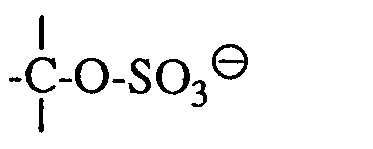
und/oder mit sulfonatalkylierten Alkoholgruppen
in wiederkehrenden Struktureinheiten, worin die Gruppe -(CnH2n)- für lineares oder verzweigtes C2-C12-Alkylen mit 2 bis 5 C-Atomen in der Kohlenstoffkette steht, das unsubstituiert oder mit C1-C4-Alkoxy substituiert ist. Die Zusammensetzungen sind intrinsisch elektrisch leitende thermoplastisch verformbare Massen.
Description
- Die Erfindung betrifft Zusammensetzungen aus a) mindestens einem oxidierten polykationischen in den 3,4-Stellungen alkoxysubstituierten Polythiophen und b) mindestens einem Polyanion eines thermoplastischen Polymeren mit sulfatierten Alkoholgruppen

und/oder mit sulfonatalkylierten Alkoholgruppen
in wiederkehrenden Struktureinheiten, Verfahren zur Herstellung der Zusammensetzungen, die Verwendung der Zusammensetzungen zur Herstellung elektrisch leitender Formkörper und die Verwendung feinteiliger elektrisch leitender Zusammensetzungen als Füllstoffe für Kunststoffe. - Es ist bekannt, dass man durch elektrochemische oder chemische Polymerisation von alkoxysubstituierten Thiophenen, in Gegenwart nicht-nukleophiler Anionen elektrisch leitende Salze von polykationischen Polyheteroaromaten erhält. Die mechanischen und oft auch elektrischen Eigenschaften solcher in der Regel auf Anoden als Film abgeschiedener Salze von Polythiophenen sind für viele Anwendungen ungenügend.
- In der DE-A-3 804 520 werden elektrisch leitende Polymere in Form freitragender Filme beschrieben, die aus Struktureinheiten eines 3-Alkoxy-4-alkylthiophens bestehen, das mit niedermolekularen Anionen wie zum Beispiel Hexafluorphosphat oder Tosylat dotiert ist. Die Filme werden als chemisch stabil und thermisch beständig bezeichnet. Sie weisen gute elektrische Leitfähigkeiten auf, wie es bei der Dotierung mit niedermolekularen Anionen zu erwarten ist. Ein wesentlicher Nachteil ist die Sprödigkeit der Filme, die keine thermoplastischen Eigenschaften besitzen.
- In der DE-A-3 804 523 werden lösliche elektrisch leitende Polymere beschrieben, die Struktureinheiten eines Thiophens enthalten, das in der 3-Stellung mit einer C6-C30-Alkoxygruppe substituiert ist und mit niedermolekularen Anionen wie zum Beispiel Hexafluorphosphat oder Tosylat dotiert ist, und das besonders für Beschichtungszwecke geeignet ist.
- In der EP-A-0 339 340 werden elektrisch leitende Polymere in Form von antistatischen Beschichtungen auf Kunststoffen beschrieben, die aus Struktureinheiten eines in den 3,4-Stellungen mit Alkylendioxyl substituierten Thiophens bestehen und die mit niedermolekularen Anionen wie zum Beispiel Hexafluorphosphat oder Tosylat dotiert sind. Über mechanische und thermoplastisch Eigenschaften der auf Elektroden gebildeten Abscheidungen werden keine Angaben gemacht.
- In der EP-A-0 440 957 werden elektrisch leitende Polymere in Form von Dispersionen beschrieben, die aus Struktureinheiten von hydroxyl- oderalkoxysubstituierten Thiophenen und einem polymeren Polyanion wie zum Beispiel Polyacrylsäure oder Polystyrolsulfonsäure aufgebaut sind und die als antistatische Beschichtungsmittel verwendet werden.
- In der US-A-5 061 401 werden elektrisch leitende Polymere in Form von Filmen beschrieben, die aus gegebenenfalls alkylsubstituierten Struktureinheiten von Heteroaromaten wie zum Beispiel Thiophen und Polyanionen von sulfatierten Polymeren aufgebaut sind. Diese Zusammensetzungen weisen gute elektrische Leitfähigkeiten und thermoplastische Eigenschaften auf. So kann zum Beispiel die elektrische Leitfähigkeit durch Verstrecken erhöhtwerden. Für die Zusammensetzung des Beispiels B5 wird die für unsubstituierte Thiophene erwartete relativ niedrige Leitfähigkeit gemessen. In der EP-A-0 446 172 werden Pressmassen und Füllstoffe mit diesen elektrisch leitenden Polymeren beschrieben.
- Es wurde nun gefunden, dass man auch bei Zusammensetzungen mit oxidierten polyanionischen Thiophenen überraschend hohe elektrische Leitfähigkeiten und ausgezeichnete thermoplastische Eigenschaften erzielen kann, wenn man alkoxysubstituierte Thiophene verwendet, und die oxidative Polymerisation in Gegenwart von sulfatierten oder sulfonatalkylierten Polymeren durchführt. Die elektrische Leitfähigkeit ist gegenüber gleichartigen Zusammensetzungen mit Polypyrrolen und unsubstituerten Polythiophenen und sogar gegenüber alkoxysubstituierten Polythiophenen mit niedermolkularen Anionen überraschend verbessert und höher als erwartet. Die Zusammensetzungen weisen auch eine wesentlich verbesserte Beständigkeit gegenüber dem Einfluss von Luft, Feuchtigkeit und/oder Wärme (Oxidationsbeständigkeit) und damit eine bemerkenswert erhöhte Gebrauchsdauer auf, ohne dass die elektrische Leitfähigkeit wesentlich abfällt. Ferner ist die mechanische Stabilität wie zum Beispiel die Reissfestigkeit oder die Bruchfestigkeit sowie die thermoplastische Verformbarkeit durch Verstrecken (Bruchdehnung) erheblich verbessert; das Verstrecken kann sogar bei Raumtemperatur und nicht nur im Bereich der Glasumwandlungstemperatur durchgeführt werden, wobei die Dehnung 100 % und mehr betragen kann. Mit dem Verstrecken kann die mechanische Stabilität und die elektrische Leitfähigkeit um etwa bis zum Vier- bis Fünffachen der Grundleitfähigkeit verbessert werden. Mit den erfindungsgemässen Zusammensetzungen können sogar freitragende mechanisch stabile und transluzente Filme bis zum Bereich um 1 µm mit hohen elektrischen Leitfähigkeiten hergestellt werden, die für elektrooptische Anwendungen in Frage kommen. Ein ganz wesentlicher Vorteil ist auch, dass man die elektrischen Leitfähigkeiten durch die Wahl des Polyanions und eine Verstreckung gezielt einstellen und auf gewünschte Anwendungen abstimmen kann.
- Ein Gegenstand der Erfindung ist eine Zusammensetzung aus
- a) mindestens einem Polythiophen in oxidierter, polykationischer Form und wiederkehrenden Struktureinheiten der Formel
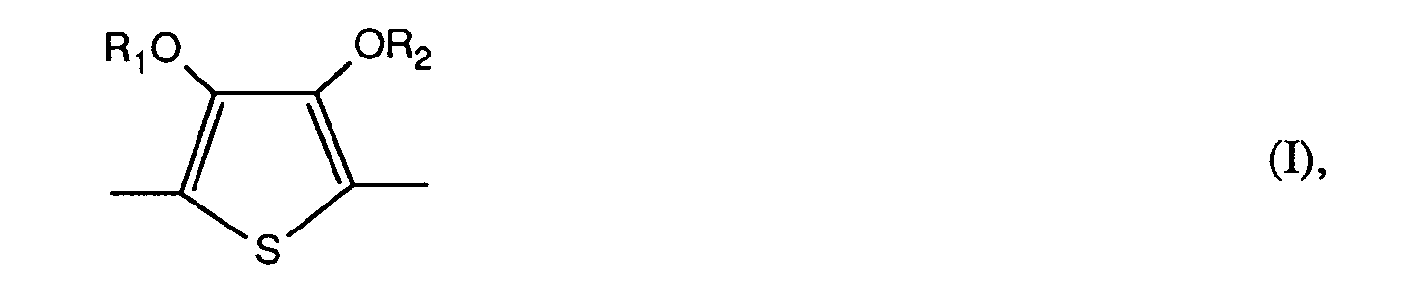
worin R1 und R2 unabhängig voneinander für lineares oder verzweigtes C1-C18-Alkyl oder C2-C18-Alkoxyalkyl stehen; oder C3-C8-Cycloalkyl, Phenyl oder Benzyl bedeuten, die unsubstituiert oder mit C1-C6-Alkyl, C1-C6-Alkoxy oder Halogen substituiert sind; oder R1 und R2 zusammen lineares C1-C6-Alkylen darstellen, das unsubstituiert oder mit C1-C6-Alkyl, C1-C6-Alkoxy, Halogen, C3-C8-Cycloalkyl, Phenyl, Benzyl, C1-C4-Alkylphenyl, C1-C4-Alkoxyphenyl, Halogenphenyl, C1-C4-Alkylbenzyl, C1-C4-Alkoxybenzyl oder Halogenbenzyl substituiert ist; und - b) mindestens einem Polyanion eines filmbildenden thermoplastischen Polymeren mit sulfatierten Alkoholgruppen

und/oder mit sulfonatalkylierten Alkoholgruppen
in wiederkehrenden Struktureinheiten, worin die Gruppe -(CnH2n)- für lineares oder verzweigtes C2-C12-Alkylen mit 2 bis 5 C-Atomen in der Kohlenstoffkette steht, das unsubstituiert oder mit C1-C4-Alkoxy substituiert ist. - R1 und R2 stellen als Alkyl bevorzugt C1-C12-Alkyl, besonders bevorzugt C1-C8-Alkyl, und ganz besonders bevorzugt C1-C4-Alkyl dar. Einige Beispiele sind Methyl, Ethyl und die Isomeren von Propyl, Butyl, Pentyl, Hexyl, Heptyl, Octyl, Nonyl, Decyl, Uncecyl, Dodecyl, Tetradecyl, Hexadecyl und Octadecyl. Bevorzugte Alkylreste sind Methyl, Ethyl, n- und i-Propyl, n-, i- und t-Butyl, und ferner n-Pentyl und n-Hexyl.
- R1 und R2 stellen als Alkoxyalkyl bevorzugt C1-C17-Alkoxymethyl und C1-C16-Alkoxyethyl, bevorzugter C1-C12-Alkoxymethyl und C1-C12-Alkoxyethyl, besonders bevorzugt C1-C8-Alkoxymethyl und C1-C7-Alkoxyethyl, und ganz besonders bevorzugt C1-C4-Alkoxymethyl und C1-C4-Alkoxyethyl. Einige bevorzugte Beispiele sind Methoxymethyl, Ethoxymethyl, n- oder i-Propyloxymethyl, n-,i- oder t-Butyloxymethyl, Methoxyethyl, Ethoxyethyl, n- oder i-Propyloxyethyl, n-,i- und t-Butyloxyethyl.
- Wenn R1 und R2 Cycloalkyl bedeuten, so handelt es sich bevorzugt um C5- oder Cs-Cycloalkyl, zum Beispiel Cyclopentyl und Cyclohexyl.
- Bei den Substituenten für Cycloalkyl, Phenyl und Benzyl handelt es sich bevorzugt um C1-C4-Alkyl, C1-C4-Alkoxy, F, CI und Br. Beispiele für Alkyl und Alkoxy sind besonders Methyl, Ethyl, Methoxy und Ethoxy. Einige Beispiele für solche substituierten Reste sind Methylcyclopentyl, Methylcyclohexyl, Methoxycyclohexyl, Methylphenyl, Dimethylphenyl, Ethylphenyl, Methoxyphenyl, Dimethoxyphenyl, Chlorphenyl, Methylbenzyl, Dimethylbenzyl, Ethylbenzyl, Methoxybenzyl, Dimethoxybenzyl und Chlorbenzyl.
- In einer bevorzugten Ausführungsform bedeuten R1 und R2 zusammen für Alkylen. Es handelt sich dabei bevorzugt um C1-C4-Alkylen und besonders bevorzugt C1- oder C2-Alkylen. Beispiele für Alkylen sind Methylen, Ethylen, 1,2- oder 1,3-Propylen, Butylen, Pentylen und Hexylen.
- Bevorzugte Substituenten für R1 und R2 als Alkylen sind C1-C6-Alkyl, C1-C6-Alkoxy, Cyclohexyl, Phenyl und Benzyl, zum Beispiel Methyl, Ethyl, Propyl, Butyl, Methoxy, Ethoxy, Cyclohexyl, Phenyl und Benzyl.
- In einer bevorzugten Untergruppe bedeuten R1 und R2 lineares oder verzweigtes C1-C6-Alkyl, besonders C1-C4-Alkyl, oder R1 und R2 zusammen C1-C4-Alkylen, besonders C1- oder C2-Alkylen, das unsubstituiert oder mit 1 oder 2 C1-C6-Alkylgruppen oder C1-C6-Alkoxygruppen substituiert ist.
- In einer bevorzugten Ausführungsform stellen R1 und R2 C1- oder C2-Alkylen dar, das unsubstituiert oder mit C1-C6-Alkyl oder C1-C6-Alkoxy substituiert ist.
- In einer besonders bevorzugten Ausführungsform stellen R1 und R2 einen Rest der Formel -CHRa-CHRb- dar, worin Ra und Rb unabhängig voneinander für H oder C1-C6-Alkyl, besonders Methyl oder Ethyl, stehen.
- In einer ganz besonders bevorzugten Ausführungsform entspricht die Struktureinheit der Formel einem Rest der Formel

- Die erfindungsgemässe Zusammensetzung enthält pro Struktureinheit des Polythiophens bevorzugt 0,1 bis 0,9, besonders bevorzugt 0,1 bis 0,6, insbesondere bevorzugt 0,15 bis 0,4 Struktureinheiten mit sulfatierten Alkoholgruppen

- und/oder sulfonatalkylierten Alkoholgruppen

- Die Gruppe -(CnH2n)- stellt bevorzugt lineares oder verzweigtes C3-C8-Alkylen mit 3 bis 5 C-Atomen in der Kohlenstoffkette und besonders bevorzugt lineares C3-C5-Alkylen dar. Einige Beispiele sind Ethylen, Methylethylen, Dimethylethylen, 1,3-Propylen, Methyl-1,3-propylen, Dimethyl-1,3-propylen, Trimethyl-1,3-propylen, 1,4-Butylen, Methyl-1,4-butylen, Dimethyl-1,4-butylen, Trimethyl-1,4-butylen, Tetramethyl-1,4-butylen, 1,3-oder 1,5-Pentylen und 1,3-, 1,4-, 1,5- oder 1,6-Hexylen. Insbesondere handelt es sich bei der Gruppe -(CnH2n)-um Trimethylen und Tetramethylen.
- Das in der erfindungsgemässen Zusammensetzung verwendete thermoplastische Polymer mit versalzten sulfatierten Alkoholgruppen

und/oder versalzten sulfonatalkylierten Alkoholgruppen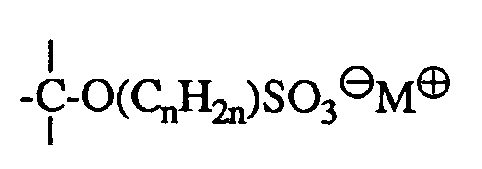
weist vorzugsweise eine Glasumwandlungstemperatur von -100 bis 350°C, besonders bevorzugt -50 bis 250°C auf, gemessen nach der DSC-Methode (Differential-Scannning-Calorimetry). M⊕ bedeutet ein Alkalimetall- oder ein Ammoniumkation, die nachfolgend für die Polymeren näher beschrieben werden. - Die Zugfestigkeit dieses thermoplastischen Polymeren beträgt bevorzugt mindestens 5 MPa, besonders bevorzugt mindestens 10 MPa, gemessen nach DIN 53 455. Die Zugfestigkeit kann je nach Art der Polymeren bis zu 1000 MPa, bevorzugt bis zu 500 MPa und insbesondere bevorzugt bis zu 300 MPa betragen. Der Polymerisationsgrad kann z.B. 5 bis 10000, bevorzugt 10 bis 5000 und insbesondere bevorzugt 10 bis 1000 betragen.
- Die Alkoholgruppen im thermoplastischen Polymer können teilweise oder vollständig sulfatiert und/oder sulfonatalkyliert sein. Das Verhältnis von freien Alkoholgruppen zu sulfatierten Alkoholgruppen

und/oder sulfonatalkylierten Alkoholgruppen
im thermoplastischen Polymer kann z.B. von 50:1 bis 1:50, bevorzugt 10:1 bis 1:10 betragen. - In einer bevorzugten Ausführungsform enthält das thermoplastische Polymer 5 bis 100 Mol-%, bevorzugter 10 bis 100 Mol-%, noch bevorzugter 20 bis 100 Mol-%, besonders bevorzugt 30 bis 100 Mol-% und insbesondere bevorzugt 30 bis 90 Mol-% Struktureinheiten sulfatierter Alkoholgruppen

und/oder sulfonatalkylierter Alkoholgruppen
wobei die restlichen Struktureinheiten entsprechende hydroxylgruppenhaltige oder hydroxylgruppenfreie Strukturelemente sind. - Die sulfatierten und/oder sulfonatalkylierten Alkoholgruppen können als sekundäre Gruppen

oder als tertiäre Gruppen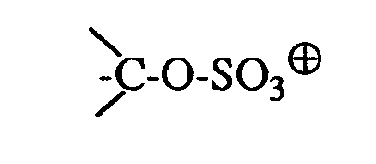
oder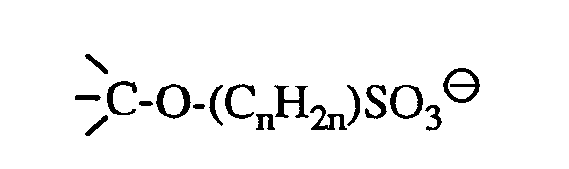
im Polymerrückgrat; oder in Seitengruppen des Polymeren als primäre Gruppen -CH2-O-SO3⊖ oder -CH2-O-(CnH2n)SO3⊖ endständig, oder als sekundäre Gruppen
oder als tertiäre Gruppen
mittelständig gebunden sein. - Den thermoplastischen Polymeren können unterschiedliche Hydroxylgruppen enthaltende Polymere oder Mischungen davon zu Grunde liegen, z.B. Polyester, Polyesteramide, Polyurethane, Polyamide, Polycarbonate und Polyimide aus Hydroxylgruppen enthaltenden Monomeren; verseifte Polymerisate von Vinylestern oder -ethern; hydroxylierte Polydiolefine wie z.B. Polybutadien, Polyisopren oder Chloropren sowie deren Copolymere mit olefinischen Monomeren; Polyacrylate oder Polymethacrylate mit Hydroxyalkylresten in der Estergruppe; Polysiloxane mit Hydroxyalkylgruppen; reduzierte Polyketone oder Copolymere davon; Polyether aus Glycidylverbindungen und Diolen; Polyvinylphenole oder Copolymere von Vinylphenolen und olefinischen Comonomeren; sowie Copolymerisate von Vinylalkohol, oder Hydroxylalkyl enthaltenden Acrylaten oder Methacrylaten, oder hydroxylierten Diolefinen mit ethylenisch ungesättigten Comonomeren wie z.B. Acrylnitril, Olefinen, Diolefinen, Vinylchlorid, Vinylidenchlorid, Vinylfluorid, Vinylidenfluorid, Styrol, a-Methylstyrol, Maleinsäureanhydrid, Maleinsäureimid, Vinylethern und Vinylestern.
- Den sulfatierten und/oder sulfonatalkylierten thermoplastischen Polymeren liegen bevorzugt Polymere aus der Gruppe Polyaddukte aus Glycidylverbindungen mit durchschnittlich mehr als einer Epoxidgruppe und einem Diol; Homo- und Copolymere von Hydroxyalkylacrylaten beziehungsweise -methacrylaten; Homo- und Copolymere von Vinylalkohol; Homo- und Copolymere von Butadien, Isopren und Chloropren, deren Doppelbindungen teilweise oder ganz hydroxyliert sind; Homo- und Copolymere von Vinylphenolen;Polyimide aus hydrierten Ketotetracarbonsäuren, besonders Benzophenontetracarbonsäuren; Hydroxyalkylpolysiloxane; und Polyester, Polyamide, Polyurethane und Polyimide aus C4-C12-Alkenylendiolen beziehungsweise -diaminen, deren Doppelbindung hydroxyliert sind, zu Grunde.
- Die thermoplastischen Polymere sind bevorzugt entweder sulfatiert oder sulfonatalkyliert.
- Bei dem thermoplastischen Polymer kann es sich z.B. um ein mindestens teilweise sulfatiertes und/oder sulfonatalkyliertes Polyaddukt aus a) einer Glycidylverbindung mit durchschnittlich mehr als einer Epoxidgruppe und b) einem Diol handeln, das Gruppen

in der Polymerkette enthält, worin die Gruppe -CnH2n- die zuvor angegebenen Bedeutungen hat, einschliesslich der Bevorzugungen. - Den Polyaddukten liegen bevorzugt Glycidylverbindungen mit durchschnittlich zwei Epoxidgruppen im Molekül zu Grunde.
- Als Glycidylverbindungen kommen vor allem solche mit zwei an ein Heteroatom (z.B. Schwefel, vorzugsweise Sauerstoff oder Stickstoff) gebundenen Glycidylgruppen, ß-Methylglycidylgruppen oder 2,3-Epoxycyclopentylgruppen in Frage; genannt seien insbesondere Bis-(2,3-epoxycyclopentyl)-ether; Diglycidylether von mehrwertigen aliphatischen Alkoholen wie 1,4-Butandiol oder von Polyalkylenglykolen wie Polypropylenglykol; Diglycidylethervon cycloaliphatischen Polyolen, wie 2,2-Bis-(4-hydroxycyclohexyl)-propan; Diglycidylethervon mehrwertigen Phenolen, wie Resorcin, Bis-(p-hydroxyphenyl)-methan, 2,2-Bis-(p-hydroxyphenyl)-propan (=Diomethan), 2,2-Bis-(4'-hydroxy-3',5'-dibromphenyl)-propan, 1,3-Di-(p-hydroxyphenyl)-ethan; Di-(ß-methylglycidyl)-ether der oben angeführten zweiwertigen Alkohole oder zweiwertigen Phenole; Diglycidylester von Dicarbonsäuren, wie Phthalsäure, Terephthalsäure, A4-Tetrahydrophthalsäure und Hexahydrophthalsäure; N,N-Diglycidylderivate von primären Aminen und Amiden und heterocyclischen, zwei N-Atome enthaltenden Stickstoffbasen, und N,N'-Diglycidylderivate von disekundären Diamiden und Diaminen, wie N,N-Diglycidylanilin, N,N-Diglycidyltoluidin, N,N-Diglycidyl-p-aminophenyl-methyl-ether, N,N'-Dimethyl-N,N'- diglycidyl-bis-(p-aminophenyl)-methan; N',N"-Diglycidyl-N-phenyl-isocyanurat; N,N'-Diglycidylethylenharnstoff; N,N'-Diglycidyl-5,5-dimethyl-hydantoin, N,N'-Diglycidyl-5-isopropyl-hydantoin, N,N-Methylen-bis-(N',N'- diglycidyl-5,5-dimethylhydantoin), 1,3-Bis-(N-glycidyl-5,5-dimethylhydantoin)-2-hydroxypropan; N,N'-Diglycidyl-5,5-dimethyl-6-isopropyl-5,6-dihydro-uracil.
- Die Glycidylverbindungen können mit aliphatischen, cycloaliphatischen oder aromatischen Diolen zu den bevorzugten Polyaddukten umgesetzt werden, wobei durch Addition an der Glycidylgruppe eine sekundäre Alkoholgruppe gebildet wird, die sulfatiert und/oder sulfonatalkyliert werden kann.
- Die Glycidylverbindungen können aber auch mit primären, aliphatischen, cycloaliphatischen oder aromatischen Monoaminen (z.B. Anilin, Toluidin, C1-C12-Alkylaminen, C2-C12-Hydroxyalkylaminen), aliphatischen, cycloaliphatischen oder aromatischen Dicarbonsäuren (z.B. Maleinsäure, Adipinsäure, Trimethyladipinsäure, Sebacinsäure, Azelainsäure, Bernsteinsäure, Dodecylbernsteinsäure, Phthalsäure, Terephthalsäure, Δ4-Tetrahydrophthalsäure, Hexahydrophthalsäure, 4-Methylhexahydrophthalsäure, 3,6-Endomethylen-A4-tetrahydrophthalsäure, 4-Methyl-3,6-endomethylen-A4-tetrahydrophthalsäure) oder aliphatischen, cycloaliphatischen, heterocyclischen oder aromatischen Bissekundäraminen oder Bissekundärcarbonsäureamiden (z.B. N,N'-Dimethylethylendiamin, N,N'-Dimethylpropylen-1,3-diamin, N,N'-Dimethylhexamethylendiamin, N,N'-Dicyclohexylhexamethylendiamin, N,N',N"-Trimethyldiethylentriamin, N,N'-Diethylpropylen-1,3-diamin, N-Methyl-3,5,5-trimethyl-3-(methylaminomethyl)-cyclohexylamin, N,N'-dimethylierte oder -diethylierte aromatische Diamine, z.B. m- oder p-Phenylendiamin, Bis-(4-aminophenyl)-methan oder -sulfon, 2,2-Bis-(4-aminophenyl)-propan, N,N-Dimethyl-m-xylylendiamin, sowie Ethylenharnstoff, 5,5-Dimethylhydantoin, 5-lsopropylhydantoin, N,N-Methylen-bis-5,5-dimethylhydantoin, 1,3-Bis-(5,5-dimethyl)-2-hydroxypropan, 5,5-Dimethyl-6-isopropyl-5,6-dihydrouracil), durch Polyaddition zu linearen Polyaddukten umgesetzt werden.
- Bevorzugt ist eine erfindungsgemässe Zusammensetzung, worin das Polyaddukt
- a) 100 bis 5 Mol-% gleiche oder verschiedene Struktureinheiten der Formel II und/oder IIa


und - b) 95 bis 0 Mol-% gleiche oder verschiedene Struktureinheiten der Formel III

enthält, bezogen auf die Strukturelemente des Polyaddukts, wobei R3 und R4 unabhängig voneinander den um zwei Hydroxylgruppen verminderten Rest eines Diols mit aliphatischen oder aromatischen Diolgruppen darstellen, und R' H, C1-C20-Alkyl, C1-C2-Acyl oder mit einem C1-C20-Kohlenwasserstoffrest N-substituiertes Aminocarbonyl bedeutet. - R' in der Bedeutung von C1-C20-Alkyl kann linear oder verzweigt sein. R' in der Bedeutung von Acyl kann z.B. C1-C20-Alkyl-CO-, C5-Cs-Cycloalkyl-CO-, C1-C15-Alkyl-C5-C8-cycloalkyl-CO, C5-C8-Cycloalkyl-CH2-CO-, C1-C14-Alkyl-C5-C8-cycloalkyl-CH2-CO, Phenyl-CO, Benzyl-CO, C1-C14-Alkylphenyl-CO- oder -benzyl-COsein. Bei dem Kohlenwasserstoffrest im Aminocarbonyl kann es sich z.B. um C1-C20-Alkyl-, C5-C8-Cycloalkyl-, C1-C15-Alkyl-C5-C8-cycloalkyl-, C5-C8-Cycloalkyl-CH2-, C1-C14-Alkyl-C5-C8-cycloalkyl-CH2-, Phenyl-, Benzyl-, C1-C14-Alkylphenyl- oder -benzyl- handeln. R' steht bevorzugt für H, C1-C6-Acyl oder C1-C4-Alkyl. Besonders bevorzugt steht R' für H.
- Bevorzugt sind 100 bis 20, besonders bevorzugt 100 bis 30 Mol% Struktureinheiten der Formel II und/oder Ila, und 0 bis 80, besonders bevorzugt 0 bis 70 Mol% Struktureinheiten der Formel III enthalten. Ganz besonders bevorzugt sind 90 bis 60 Mol% Struktureinheiten der Formel II und/oder Ila und 10 bis 40 Mol% Struktureinheiten der Formeln III enthalten.
- In einer bevorzugten Ausführungsform stellen R3 und R4 gleiche Reste dar. R3 und R4 in der Bedeutung als Rest mit aliphatischen Diolgruppen enthält bevorzugt 2 bis 12, besonders 2 bis 8 C-Atome. Die Hydroxylgruppen können an offenkettige oder cyclische aliphatische Reste gebunden sein. Als aliphatischer Rest kommt z.B. lineares oder verzweigtes C2-C12-Alkylen, C3-C8-Cycloalkylen, C1-C4-Alkyl-C5-C8-cycloalkylen, Cyclohexylmethylen oder Cyclohexyldimethylen in Frage. Beispiele sind Ethylen, 1,2- oder 1,3-Propylen, 1,2-, 1,3- oder 1,4-Butylen, 1,2-, 1,3-, 1,4- oder 1,5-Pentylen, 1,2-, 1,3-, 1,4-, 1,5 oder 1,6-Hexylen, Heptylen, Octylen, Nonylen, Decylen, Undecylen, Dodecylen, 1,3-Cyclopentylen, 1,3- oder 1,4-Cyclohexylen, 2-Methyl-1,4-cyclohexylen und Cyclohexyl-1,4-dimethylen.
- Die aromatischen Diolgruppen der für die Polyaddukte verwendeten Diole sind insbesondere phenolische Gruppen. Die Diolreste mit phenolischen Gruppen enthalten bevorzugt 6-30, besonders bevorzugt 6-20 C-Atome. Eine bevorzugte Ausführungsform sind Zusammensetzungen, worin R3 und R4 unabhängig voneinander einen Rest der Formel IV

- X stellt bevorzugt eine direkte Bindung, Methylen, Ethylen, C2-C6-Alkyliden, Cyclohexyliden oder Cyclopentyliden, -O- oder -S- dar. R5 und R6 stehen vorzugsweise für H oder Methyl und y steht bevorzugt für 1.
- Insbesondere bedeuten R3 und R4 den Rest

- Eine weitere bevorzugte Ausführungsform sind Zusammensetzungen, worin das thermoplastische Polymerein mindestens teilweise suifatierter und/oder sulfonatalkylierter Polyvinylalkohol oder sulfatiertes und/odersulfonatalkyliertes Polyvinylalkohol-Copolymer mit Gruppen

- ist. Sulfatierte und/oder sulfonatalkylierte Polyvinylalkohol-Copolymere sind bevorzugt in der Zusammensetzung enthalten.
- Bevorzugt sind solche Zusammensetzungen mit Polyvinylalkoholcopolymeren, worin das Copolymer
- a) 90 bis 5 Mol% Struktureinheiten der Formel V und/oder Va


- b) 95 bis 10 Mol% gleiche oder verschiedene Struktureinheiten der Formel VI

enthält, worin R7 für H, C1-C6-Alkyl, -COOR10 oder-COO⊖ steht, R8 H, F, Cl, CN oder C1-C6-Alkyl bedeutet, und Rg H, OH, -R"OH, F, Cl, CN, R10-O-, C1-C12-Alkyl, -COOe, -COOR10, -OCO-R10, Methylphenyl oder Phenyl darstellt, wobei R10 C1-C18-Alkyl, C5-C7-Cycloalkyl, (C1-C12-Alkyl)-C5-C7-cycloalkyl, Phenyl, (C1-C12-Alkyl)phenyl, Benzyl oder (C1-C12-Alkyl)benzyl darstellt und R" für lineares oder verzweigtes C2-C18-Alkylen, Poly(C2-C6-oxaalkylen) mit 2 bis 6 Oxaalkyleneinheiten steht, und die Gruppe -(CnH2n)- die zuvor angegebene Bedeutung hat.
- a) 90 bis 5 Mol% Struktureinheiten der Formel V und/oder Va
- Bevorzugt sind 60 bis 10, besonders 60 bis 20 Mol% Struktureinheiten der Formel IV, und 40 bis 90, besonders 40 bis 80 Mol% Strukturelemente der Formel V enthalten.
- R" enthält als Alkylen bevorzugt 2 bis 12, besonders bevorzugt 2 bis 8, und insbesondere bevorzugt 2 bis 6 C-Atome. Beispiele sind Ethylen und die Isomeren von Propylen, Butylen, Pentylen, Hexylen, Heptylen, Octylen, Nonylen, Decylen, Undecylen, Dodecylen, Tetradecylen, Hexadecylen und Octadecylen. Bevorzugt sind Ethylen, 1,2- und 1,3-Propylen, 1,2-, 1,3- und 1,4-Butylen, 1,2-, 1,3-, 1,4- und 1,5-Pentylen und 1,2-, 1,3-, 1,4-, 1,5- und 1,6-Hexylen.
- R" in der Bedeutung von Poly(oxaalkylen) enthält bevorzugt 2 bis 4 Oxaalkyleneinheiten, und bevorzugt 2 bis 4, besonders bevorzugt 2 oder 3 C-Atome im Alkylenrest.
- R7 steht bevorzugt für H. Bedeutet R7 Alkyl, so handelt es sich bevorzugt um Methyl oder Ethyl. Bedeutet R7 -COOR10, so stellt R10 bevorzugt C1-C12-, besonders C1-C6-Alkyl dar.
- Bedeutet R8 Alkyl, so handelt es sich bevorzugt um C1-C4-Alkyl, z.B. Methyl, Ethyl, n-Propyl und n-Butyl. R8 steht bevorzugt für H, CI oder C1-C4-Alkyl.
- Bedeutet Rg die Gruppe R10-O-, so stellt R10 bevorzugt C1-C12-, besonders C1-C6-Alkyl dar. Bedeutet R9 Alkyl, so enthält es bevorzugt 1 bis 6, besonders 1 bis 4 C-Atome. Bedeutet R9 die Gruppe -COOR10, so stellt R10 bevorzugt C1-C12-, besonders C1-C6-Alkyl, Cyclopentyl oder Cyclohexyl dar. Bedeutet R9 die Gruppe -OCO-R10, so stellt R10 bevorzugt C1-C12-, besonders C1-C6-Alkyl, Phenyl oder Benzyl dar.
- In einer bevorzugten Ausführungsform stehen R7 für H, R8 für H, F, Cl, Methyl oder Ethyl, und R9 für H, OH, F, Cl, CN, C1-C4-Alkyl, C1-C6-Alkoxy, -COO-C1-C6-Alkyl, -OOC-C1-C6-Alkyl oder Phenyl.
- Besonders bevorzugt sind Zusammensetzungen, worin in Formel VI R7 H bedeutet, R8 H oder Methyl darstellt, und R9 H, OH, CN, Methyl, OCH3 oder -COOCH3 bedeutet.
- Ganz besonders bevorzugt sind Zusammensetzungen, die 20 bis 60 Mol-% Struktureinheiten der Formel V, 50 bis 40 Mol-% Struktureinheiten der Formel -CH2-CH2- und 0 bis 40 Mol-% Struktureinheiten der Formel -CH2-CH(OH)- enthalten, wobei sich die Mol-% zu 100 Prozent addieren.
- Eine weitere bevorzugte Ausführungsform sind Zusammensetzungen, worin das thermoplastische Polymer ein sulfatiertes und/oder sulfonatalkyliertes Polymer eines teilhydroxylierten Polybutadiens, Chloroprens oder Polyisoprens ist.
- Eine bevorzugte Ausführungsform sind solche Zusammensetzungen, die 5 bis 100 Mol-% Struktureinheiten der Formeln VII und/oder Vlla
-


enthalten, worin R11 und R12 unabhängig voneinander für H, OH oder CI stehen und die Gruppe -CnH2n- die zuvor angegebene Bedeutung hat, einschliesslich der Bevorzugungen. - Bevorzugt sind in dieser Zusammensetzung 10 bis 100 Mol-%, besonders 20 bis 60 Mol-% Struktureinheiten der Formeln VII und/oder Vlla und 90 bis 0 Mol-%, besonders 80 bis 40 Mol-% Struktureinheiten der Formeln VIII und/oder Vllla enthalten. R11 steht bevorzugt für H oder CI und R12 steht bevorzugt für H.
- Eine weitere bevorzugte Ausführungsform sind Zusammensetzungen, worin das thermoplastische Polymere ein sulfatiertes und/oder sulfonatalkyliertes Polyimid mit Strukturelementen der Formel IX

darstellt, worin R13 für unsubstituiertes oder mit C1-C6-Alkyl oder C1-C6-Alkoxy substituiertes C6-C12-Arylen oder C5-C8-Cycloalkylen oder für den Rest
steht, r 0 oder 1 bedeutet und die Gruppe -CnH2n- die zuvor angegebene Bedeutung hat, einschliesslich der Bevorzugungen. - Eine andere bevorzugte Ausführungsform sind Zusammensetzungen, worin das thermoplastische Polymere ein sulfatiertes und/oder sulfonatalkyliertes Polyamid mit Strukturelementen der Formel X

- R13 für unsubstituiertes oder mit C1-C6-Alkyl oder C1-C6-Alkoxy substituiertes C6-C12-Arylen oder C5-C8-Cycloalkylen oder für den Rest

steht, R14 C1-C12Alkyl bedeutet, r für 0 oder 1 steht und die Gruppe -CnH2n- die zuvor angegebene Bedeutung hat, einschliesslich der Bevorzugungen. - Eine ganz besonders bevorzugte erfindungsgemässe Zusammensetzung ist jene, worin das filmbildende thermoplastische Polymer
- a) 100 bis 50 Mol-% gleiche oder verschiedene Struktureinheiten der Formel II und/oder Ila


und - b) 0 bis 50 Mol-% gleiche oder verschiedene Struktureinheiten der Formel III

enthält, bezogen auf die Struktureinheiten des Polyaddukts, wobei R3 und R4 unabhängig voneinander den um zwei Hydroxylgruppen verminderten Rest eines Diols mit aliphatischen oder aromatischen Diolgruppen darstellen, und R' H, C1-C20-Alkyl, C1-C20-Acyl oder mit einem C1-C20-Kohlenwasserstoffrest N-substituiertes Aminocarbonyl bedeutet. Insbesondere enthält das Polymer 60 bis 100, ganz besonders 60 bis 90 Mol-% Strukturelemente der Formeln II und/oder Ila und 40 bis 0, ganz besonders 40 bis 10 Mol- % Strukturelemente der Formel 111. R' bedeutet bevorzugt H. Diese Zusammensetzung enthält besonders bevorzugt ein Polythiophen in oxidierter, polykationischer Form und wiederkehrenden Struktureinheiten der Formel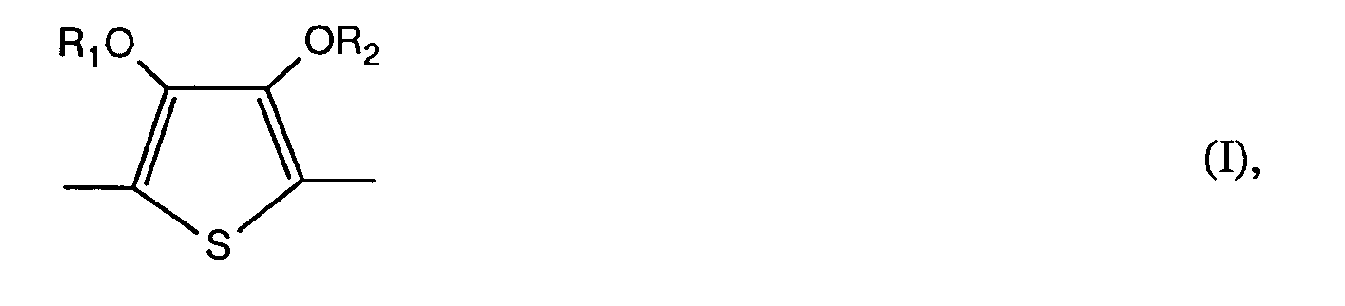
worin R1 und R2 unabhängig voneinander für lineares oder verzweigtes C1-C6-Alkyl oder R1 und R2 zusammen Methylen oder den Rest -CHRa-CHRb- darstellen, worin Ra und Rb unabhängig voneinander H, Methyl oder Ethyl und besonders bevorzugt H bedeuten. - Eine bevorzugte Ausführungsform sind diese Zusammensetzungen, worin R3 und R4 unabhängig voneinander einen Rest der Formel IV
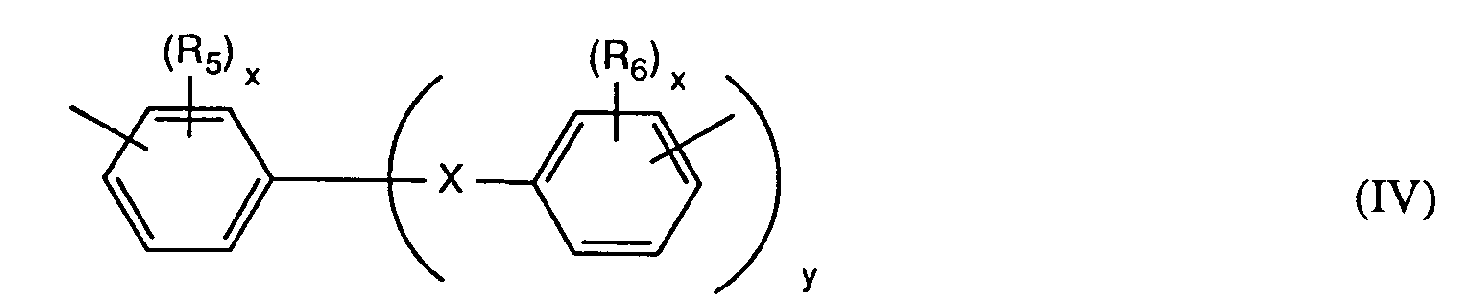
darstellen, worin X eine direkte Bindung, C1-C4-Alkylen, C2-C12-Alkyliden, C5-C8-Cycloalkyliden, -O-, -S-, -SO-, -SO2-, -CO-, -CO2-, -N(C1-C4-Alkyl)- oder-Si(CH3)2- bedeutet, R5 und R6 unabhängig voneinander H, Halogen, C1-C4-Alkyl oder C1-C4-Alkoxy sind, und x 1 oder 2 bedeutet und y für 0 oder 1 steht. - X stellt bevorzugt eine direkte Bindung, Methylen, Ethylen, C2-C6-Alkyliden, Cyclohexyliden oder Cyclopentyliden, -O- oder -S- dar. R5 und R6 stehen vorzugsweise für H oder Methyl und y steht bevorzugt für 1.
- Insbesondere bedeuten R3 und R4 den Rest

und besonders bevorzugt entsprechen die Strukturelemente des Polythiophens Resten der Formel
Enthält die Zusammensetzung mehr als ein Polyanion eines thermoplastischen Polymeren mit sulfatierten und/oder sulfonatalkylierten Alkoholgruppen, so sind binäre oder ternäre Mischungen bevorzugt. - Die Polyanionen der Komponente b) in der erfindungsgemässen Zusammensetzung leiten sich von bekannten oder nach an sich bekannten Verfahren herstellbaren polymeren Salzen ab. Es handelt sich um thermoplastische Polymere mit sulfatierten Alkoholgruppen

und/oder mit sulfonatalkylierten Alkhoholgruppen
in wiederkehrenden Struktureinheiten, wobei M⊕ für ein Alkalimetall- oder Ammoniumkation steht. - Das Ammoniumkation kann z.B. NH4⊕, ein protoniertes, primäres, sekundäres oder tertiäres Amin, oder quaternäres Ammonium oder Pyridinium sein. Das primäre Ammonium kann 1 bis 18 C-Atome, besonders 1 bis 12 und insbesondere 1 bis 6 C-Atome, das sekundäre Ammonium 2 bis 24, besonders 2 bis 12, insbesondere 2 bis 8 C-Atome, das tertiäre Ammonium 3 bis 30, besonders 3 bis 18 und insbesondere 3 bis 12 C-Atome, und das quaternäre Ammonium 4 bis 36, besonders 4 bis 24 und insbesondere 4 bis 18 C-Atome enthalten.
- Bevorzugte polymere Salze sind solche, worin M⊕ Li⊕, Na⊕ oder K⊕ darstellt, oder R15R16R17R18N⊕ ist, worin R15, R16, R17 und R18 unabgängig voneinander H, unsubstituiertes oder Hydroxyl-substituiertes C1-C18-Alkyl, Phenyl, (C1-C12-Alkyl)phenyl, (C1-C12-Alkyl)benzyl, C5-C7-Cycloalkyl, (C1-C12-Alkyl)-C5-C7-cycloalkyl darstellen, oder R15 und R16 zusammen Tetramethylen, Pentamethylen oder 3-Oxapentylen sind und R17 und R18 die zuvor angegebenen Bedeutungen haben. Eine bevorzugte Ausführungsform sind Polymere, worin mindestens einer der Reste R15 bis R18 nicht H bedeutet. Besonders bevorzugt sind Polymere, worin R15 bis R17 C1-C6-Alkyl und R18 H bedeuten.
- R15 bis R18 können in der Bedeutung von Alkyl linear oder verzweigt sein und bevorzugt 1 bis 12, besonders 1 bis 6 C-Atome enthalten. Beispiele sind Methyl, Ethyl, n- und i-Propyl, n-, i- und t-Butyl, Pentyl, Hexyl, Heptyl, Octyl, Nonyl, Decyl, Undecyl, Dodecyl, Tetradecyl, Hexadecyl und Octadecyl.
- R15 bis R18 in der Bedeutung von Hydroxyalkyl kann linear oder verzweigt sein und enthält bevorzugt 2 bis 18, besonders 2 bis 12 und insbesondere 2 bis 6 C-Atome. Einige Beispiele sind 1-Hydroxyeth-2-yl, 1- oderHydroxy-prop-3-yl, 1-Hydroxybut-4-yl, 1-Hydroxyhex-6-yl.
- Beispiele für Alkylphenyl und Alkylbenzyl sind Methylphenyl, Dimethylphenyl, Ethylphenyl, n- oder i-Propylphenyl, n-, i- oder t-Butylphenyl, Hexylphenyl, Octylphenyl, Decylphenyl, Dodecylphenyl und entsprechend alkylierte Benzylreste.
- R15 bis R18 in der Bedeutung von Cycloalkyl stellen besonders Cyclopentyl oder Cyclohexyl dar.
- R15 bis R18 in der Bedeutung von Alkylcycloalkyl ist bevorzugt (C1-C12-Alkyl)cyclopentyl oder-cyclohexyl, z.B. Methyl- oder Ethylcyclopentyl oder-cyclohexyl.
- Besonders bevorzugt stehen R15 bis R18 für C1-C6-Alkyl oder R15 bis R17 für C1-C6-Alkyl und R18 für H.
- Die erfindungsgemäss zu verwendenden polymeren Salze sind bekannt oder können nach allgemein bekannten Verfahren hergestellt werden, wobei je nach Art der verwendeten Polymeren und der Verfahrensbedingungen Hydroxylgruppen in den verwendeten Monomeren mit üblichen Schutzgruppen geschützt werden können. Hydroxylgruppenhaltige Polymere sind vielfach beschrieben oder können nach an sich bekannten Verfahren erhalten werden.
- Die erfindungsgemäss zu verwendenden thermoplastischen polymeren Salze sind in bekannter Weise erhältlich, indem man ein thermoplastisches Polymer, das in wiederkehrenden StruktureinheitenAlkoholgruppen

enthält, mit einem Sulfatierungsreagenz (zum Beispiel Pyridin.SO3) beziehungsweise einem Sulton der Formel
in Gegenwart eines inerten Lösungsmittels und einer Alkalimetallbase oder eines Amins umsetzt, und danach das polymere Salz isoliert. Die Umsetzung kann stufenweise zunächst mit einem Unterschuss eines Sulfatierungsreagenzes beziehungsweise einem Sulton und danach mit einem Sulton beziehungsweise Sulfatierungsreagenz vorgenommen werden, um Polymere mit Sulfatgruppen und Sulfonatalkylgruppen zu erhalten. - Geeignete inerte Lösungsmittel sind besonders polare aprotische Lösungsmittel, wobei sich die Wahl des Lösungsmittels hauptsächlich nach der Löslichkeit der Hydroxylgruppen enthaltenden Polymere richtet. Die Lösungsmittel können alleine oder in Mischung aus mindestens 2 Lösungsmitteln verwendetwerden. Beispiele sind: Ether wie Dibutylether, Tetrahydrofuran, Dioxan, Methylenglykol, Dimethylethylenglykol, Dimethyldiethylenglykol, Diethyldiethylenglykol, Dimethyltriethylenglykol, halogenierte Kohlenwasserstoffe wie Methylenchlorid, Chloroform, 1,2-Dichlorethan, 1,1,1-Trichlorethan, 1,1,2,2-Tetrachlorethan, Carbonsäureamide und Lactame wie N,N-Dimethylformamid, N,N-Diethylformamid, N,N-Dimethylacetamid, N,N-Diethylacetamid, N-Methyl-y-butyrolactam, N-Methyl-s-caprolactam , N-Methylpyrrolidon, N-Acetylpyrrolidon, Tetramethylharnstoff, Hexamethylphosphorsäuretriamid, Sulfoxide wie Dimethylsulfoxid, Sulfone wie Dimethylsulfon, Diethylsulfon, Trimethylensulfon, Tetramethylensulfon, N-Methylpyrrolidin, N-Methylpiperidin, N-Methylmorpholin, substituierte Benzole wie Benzonitril, Chlorbenzol, o-Dichlorbenzol, 1,2,4-Trichlorbenzol, Nitrobenzol.
- Die Reaktionstemperatur beträgt z.B. 40 bis 200°C, vorzugsweise 60 bis 150°C. Nach Beendigung der Reaktion kann das polymere Salz mit einem Nichtlösungsmittel, vorteilhaft Wasser, ausgefällt, abfiltiert, gewaschen und getrocknet werden.
- Sulfonatalkylierte Phenoxyharze sind zum Beispiel in der BE-B-847 353 beschrieben. Sulfonatalkylierte Polyvinylalkohole sind zum Beispiel in der EP-A-0 099 631 und in der FR-B-1 584 814 beschrieben. Sulfatierte Polymere sind zum Beispiel in der US-A-5 061 401 beschrieben.
- Die erfindungsgemäss zu verwendenden polymeren Salze von sulfatierten und/oder sulfonatalkylierten Hydroxylgruppen enthaltenden Polymeren haben thermoplastische Eigenschaften. Ihre Glasumwandlungstemperatur ist im Vergleich zu den Ausgangspolymeren im wesentlichen unverändert und sie zeichnen sich durch ihre mechanische Festigkeit aus, z.B. durch eine hohe Zug- und Biegefestigkeit und hohe Flexibilität. Sie eignen sich überraschend ganz besonders als Polyanionen für elektrisch leitende Polykationen von alkoxysubstituierten Polyhthiophenen.
- Die erfindungsgemässen Zusammensetzungen werden in an sich bekannter Weise hergestellt, indem man
- a) in einer organischen, wässrig-organischen oder wässrigen Lösung ein Thiophen der Formel in Gegenwart mindestens eines Salzes von einem filmbildenden thermoplastischen Polymeren mit sulfatierten AIkoholgruppen

und/oder mit sulfonatalkylierten Alkoholgruppen
in wiederkehrenden Struktureinheiten, worin die Gruppe -(CnH2n)- für lineares oder verzweigtes C2-C12-Alkylen mit 2 bis 5 C-Atomen in der Kohlenstoffkette steht, das unsubstituiert oder mit C1-C4-Alkoxy substituiert ist, elektrochemisch polymerisiert und danach die Zusammensetzung von der Anode entfernt oder - b) ein Thiophen der Formel in Gegenwart besagten Salzes und eines inerten Lösungsmittels mit einem Oxidationsmittel umsetzt.
- Die Zusammensetzung kann je nach den Reaktionsbedingungen als Pulver oder als Film erhalten werden. Das Verfahren b) wird vorteilhaft zur Herstellung eines pulverförmigen Materials und die Verfahrensstufe a) zweckmässig zur Herstellung eines filmförmigen Materials verwendet.
- Geeignete Oxidationsmittel sind z.B. Peroxide und Persulfate, besonders H202, K2S208 und (NH4)2S2O8, sowie Eisen(III)-Verbindungen und Kupfer(II)-Verbindungen, besonders FeC13 und CuCI2.
- Die Elektrolyse kann potentiostatisch oder galvanostatisch durchgeführt werden. Als Anodenmaterial eignen sich z.B. inerte Metalle (Titan, Nickel, Platin, Stahl) oder ITO-Glas, oder auch nicht inerte Metalle wie z.B. Aluminium (siehe DE-A-3 906 563). Die Stromdichte kann z.B. 0,05-50, bevorzugt 0,05 bis 20 und besonders bevorzugt 0,05 bis 10 mA/cm2 betragen. Ein geeignetes Anodenmaterial sind auch Bürstenelektroden. Es hat sich als sehr zweckmässig erwiesen, das Oxidationspotential während der Elektrolyse durch die Schaltung der Anode mit einer Referenzelektrode zu kontrollieren, da hiermit die zu erzielende elektrische Leitfähigkeit bei den erfindungsgemässen Zusammensetzungen oft günstig beeinflusst werden kann. Die Spannung der Referenzelektrode liegt hierbei vorteilhaft im Bereich von 1,1 bis 2 Volt, bevorzugt 1,3 bis 1,6 Volt.
- Die Konzentration an polymeren Salzen kann 0,05 bis 1 Mol/I, bevorzugt 0,05 bis 0,5 Mol/I betragen, bezogen auf die Reaktionsmischung. Die Konzentration an Thiophenen der Formel kann 0,01 bis 10 Vol.%, besonders 0,1 bis 5 Vol.% betragen, bezogen auf das Volumen der Reaktionsmischung.
- Geeignete organische Lösungsmittel sind zuvor erwähnt worden. Bevorzugte Lösungsmittel sind Alkohole, z.B. Alkanole mit 1 bis 12 C-Atomen, die mit C1-C4-Alkoxy substituiert sein können. Beispiele sind Methanol, Ethanol, n- und i-Propanol, n-, i- und t-Butanol, Pentanol, Hexanol, Heptanol, Octanol, Decanol, Dodecanol, Methoxyethanol, Ethoxyethanol, Diethylenglykolmonomethyl- oder -monoethylether, 1-Methoxypropan-2-oder -3-ol. Weitere bevorzugte Lösungsmittel sind Carbonsäureester wie zum Beispiel Propylencarbonat, die besonders bei der elektrochemischen Polymerisation verwendet werden.
- Die Bildung von Filmen oder von pulverförmigen Abscheidungen auf der Elektrode kann durch die Elektrolysebedingungen und besonders durch die Wahl des Lösungsmittels bestimmt werden. Die Gegenwart polarer protischer Lösungsmittel alleine oder in Mischung mit polaren Lösungsmitteln kann die Bildung von Pulvern fördern.
- Die elektrochemische Polymerisation kann bei ausreichender Löslichkeit der Reaktanden auch in Wasser oderwässrig-organischer Lösung durchgeführt werden. Die Mitverwendung von Puffern ist zweckmässig. Geeignete Puffer sind z.B. Alkylammoniumphosphate mit 1 bis 3, besonders 2 oder 3 Alkylresten in der Ammoniumgruppe, die 1 bis 6, besonders 1 bis 4 C-Atome enthalten können. Beispiele sind Trimethyl-, Triethyl-, Tri-n-propyl- und Tri-n-butylammoniumphosphat. Geeignete Puffer sind auch Kationenaustauscher in ihrer protonierten Form.
- Der Reaktionsmischung können auch weitere Substanzen zugegeben werden, die sich auf der Anode mitabscheiden, z.B. anionische Weichmacher oder anionische Farbstoffe.
- Nach beendeter Elektrolyse können die erfindungsgemässen Zusammensetzungen zum Beispiel in Form von Filmen von der Anode abgelöst und durch Auswaschen mit Lösungsmitteln gereinigt werden. Die Filme können eine Dicke von 0,1 µm bis 0,3 cm, bevorzugt 0,5 µm bis 0,1 cm, bevorzugter 0,5 µm bis 500 µm und besonders bevorzugt 1 µm bis 50 µm aufweisen. Die Dicke hängt im wesentlichen von der Elektrolysedauer ab.
- Die Oxidation mit Eisen(III)-Verbindungen kann z.B. bei Temperaturen von -20°C bis 150°C, bevorzugt 20°C bis 100°C durchgeführt werden. Geeignete Lösungsmittel sind zuvor bei der Herstellung der polymeren Salze erwähnt worden. Sofern die Eisen(III)-Verbindungen, z.B. Eisensalze, in organischen Lösungsmitteln unlöslich sind, werden zweckmässig wasserlösliche Lösungsmittel in Abmischung mit Wasser eingesetzt. Geeignete wasserlösliche Lösungsmittel sind insbesondere C1-C12-, bevorzugt C1-C4-Alkanole, die mit C1-C4-AI- koxy substituiert sein können. Beispiele für Alkanole sind zuvor erwähnt worden.
- Geeignete Eisen(III)-Verbindungen sind z.B. Eisen(III)-Komplexe oder -Komplexsalze oder besonders Eisen(III)-Salze von anorganischen und organischen Säuren, wie z.B. HCI, HBr, HJ, H2SO4, HCI04, HN03, FS03H, CF3SO3H, Essigsäure und Propionsäure. Bevorzugt sind Eisen(III)-Halogenide, besonders Eisen(III)-chlorid. Neben Fe(III)-Salzen können auch andere Oxidationsmittel, wie Ammoniumperoxodisulfat und Cu(II)-Salze verwendet werden.
- Bei der chemischen Oxidation werden vorteilhaft Natrium- oder Kaliumsalze sulfatierter und/oder sulfonatalkylierter thermoplastischer Polymere eingesetzt, die bevorzugt 80 bis 100 Mol-% Struktureinheiten mit sulfatierten und/oder sulfonatalkylierten Hydroxylgruppen enthalten.
- Die chemische Oxidationsmethode ist z.B. im Bull. Chem. Soc. Jpn. 62, S. 234-238 (1989) beschrieben. Die Reaktion verläuft schnell und die gewünschten Produkte fallen als schwarze Pulver oder plastische Massen aus, die abfiltriert werden und durch Auswaschen mit z.B. Wasser, NaOH oder beiden Mitteln gereinigt werden können. Bei der chemischen Oxidation können die gebildeten erfindungsgemässen Zusammensetzungen Anionen der Oxidationsmittel enthalten. Sofern ionisches Chlorid enthalten ist, kann es durch Behandeln der Pulver mit Chlorsulfonsäure und nachfolgendes Waschen mit Wasser entfernt werden.Die Korngrösse der Pulverteilchen beträgt z.B. von 0,1 µm bis 100 µm, bevorzugt von 1 µm bis 10 µm.
- Bei den erfindungsgemässen Zusammensetzungen handelt es sich um schwarze rieselfähige und elektrisch leitende Pulver oder Filme, mit Glasumwandlungstemperaturen bis zu etwa 200°C und mehr, die thermoplastische Eigenschaften aufweisen und aus denen nach bekannten Pressverfahren einschliesslich Spritzpressen unter Ausübung von Druck Formkörper in beliebigerdreidimensionalerGestalt hergestellt werden können. Die Filme können auch nach Streckverfahren, zum Beispiel Tiefziehen, verarbeitet werden. Die mechanischen Eigenschaften von Filmen aus den erfindungsgemässen Zusammensetzungen können durch Verstrecken im Bereich der Glasumwandlungstemperaturen noch verbessert werden. Ein weiterer Gegenstand der Erfindung ist die Verwendung der erfindungsgemässen Zusammensetzungen zur Herstellung von elektrisch leitenden Formkörpern, z.B. von Stäben, Platten, Gehäusen und anderen Formteilen, die zur Abschirmung elektromagnetischer Felder oder als Elektroden eingesetzt werden können.
- Die erfindungsgemässen Zusammensetzungen können in Form von Pulvern als Pressmassen verwendet werden. Die Pressmassen können bei niedrigen Temperaturen zu Sinterkörpern verarbeitet werden, die porös sein können. Bei Anwendung von hohem Druck und höheren Temperaturen, z.B. unterhalb der Zersetzungstemperaturen bis zum Bereich der Glasumwandlungstemperaturen, bevorzugt 60°C bis 150°C, sind die Pressmassen überraschend fliessfähig. Unter solchen Verarbeitungsbedingungen erhält man kompakte Formkörper mit glatten Oberflächen und guten mechanischen Eigenschaften, z.B. Biegefestigkeit, Bruchfestigkeit, Zugfestigkeit, Flexibilität und Zähigkeit.
- Die Formkörper aus den erfindungsgemässen Zusammensetzungen weisen hohe elektrische Leitfähigkeiten auf, die im allgemeinen über 0,1 S/cm liegen. Die Leitfähigkeit kann durch Tempern von Formkörpern oder durch den Druck und/oder die Temperatur bei Formgebungsverfahren oder durch Verstreckung von Filmen beeinflusst werden. Das Verstrecken kann überraschend sogar bei Temperaturen im Bereich der Raum- temperatur durchgeführt werden. Beim Verstrecken von Filmen im Bereich zwischen Raumtemperatur und Glasumwandlungstemperatur wird die elektrische Leitfähigkeit überraschend wesentlich erhöht. Diese erfindungsgemässen Zusammensetzungen weisen ferner wertvolle mechanische Eigenschaften auf.
- Die Formkörper und Filme aus erfindungsgemässen Zusammensetzungen können z.B. als elektrische Leiter, Elektroden, Kathoden für Batterien, elektromagnetische Abschirmungsmaterialien, elektrisch leitende Stäbe, Sensoren, antistatisches Verpackungsmaterial, elektrisch leitendes Versiegelungsmaterial, Ladungsträger für Kondensatoren, als elektrochrome Materialien oder IR-Absorber verwendet werden.
- Die pulverförmigen Zusammensetzungen können auch als elektrisch leitende Füllstoffe in Polymere eingearbeitet werden, z.B. in Mengen von 0,1 bis 90, vorzugsweise 5 bis 80 Gew.-%, bezogen auf den Kunststoff. Geeignete Kunststoffe, z.B. aus dem Bereich der Duroplaste, Thermoplaste und strukturell vernetzter Polymere sowie Einarbeitungsmethoden und die Verwendung von z.B. Verarbeitungshilfsmitteln, anderen Füllstoffen, Farbstoffen und Stabilisatoren sind dem Fachmann geläufig. Formkörper aus diesen gefüllten Kunststoffen können je nach Menge des elektrisch leitenden Füllstoffs z.B. als elektrische Leiter oder als Bauteile zur Abschirmung elektrischer und magnetischer Felderverwendet werden. Ein weiterer Gegenstand der Erfindung ist die Verwendung der erfindungsgemässen pulverförmigen Zusammensetzung als Füllstoff für natürliche und synthetische Kunststoffe.
- Ein anderer Gegenstand der Erfindung ist eine Zusammensetzung aus
- a) einem thermoplastischen, duroplastischen oder strukturell vernetzten Polymer, dem
- b) ein elektrisch leitender feinteiliger Füllstoff aus einer pulverförmigen erfindungsgemässen Zusammensetzung einverleibt ist.
- Die Menge der Komponente b) kann 0,1 bis 90 Gew.-%, bevorzugt 5 bis 80 Gew.-% betragen, bezogen auf die Komponente a). Bei einer Menge bis zu etwa 20 Gew.-% werden elektrische Leitfähigkeiten erzielt, die z.B. für eine antistatische Ausrüstung und die Abschirmung von elektrischen Feldern geeignet sind. Hohe elektrische Leitfähigkeiten und z.B. als elektrische Leitergeeignete Formkörperwerden bei Zusatzmengen von über 20 Gew.-%, bevorzugt mindestens 30 Gew.-% erhalten.
- Als Kunststoffe eignen sich z.B.:
- 1. Polymere von Mono- und Diolefinen, beispielsweise Polypropylen, Polyisobutylen, Polybuten-1, Polymethylpenten-1, Polyisopren oder Polybutadien sowie Polymerisate von Cycloolefinen wie z.B. von Cyclopenten oder Norbornen; ferner Polyethylen (das gegebenenfalls vernetzt sein kann), z.B. Polyethylen hoher Dichte (HDPE), Polyethylen niederer Dichte (LDPE), lineares Polyethylen niederer Dichte (LLDPE).
- 2. Mischungen der unter 1) genannten Polymeren, z.B. Mischungen von Polypropylen mit Polyisobutylen, Polypropylen mit Polyethylen (z.B. PP/HDPE, PP/LDPE) und Mischungen verschiedener Polyethylentypen (z.B. LDPE/HDPE).
- 3. Copolymere von Mono- und Diolefinen untereinander oder mit anderen Vinylmonomeren, wie z.B. Ethylen-Propylen-Copolymere, lineares Polyethylen niederer Dichte (LLDPE) und Mischungen desselben mit Polyethylen niederer Dichte (LDPE), Propyien-Buten-1-Copoiymere, Propylen-Isobutylen-Copolymere, Ethyien-Buten-1-Copoiymere, Ethylen-Hexen-Copolymere, Ethylen-Methylpenten-Copolymere, Ethylen-Hepten-Copolymere, Ethylen-Octen-Copolymere, Propylen-Butadien-Copolymere, Isobutylen-Isopren-Copolymere, Ethylen-Alkylacrylat-Copolymere, Ethylen-Alkylmethacrylat- Copolymere, Ethylen-Vinylacetat-Copolymere oder Ethylen-Acrylsäure-Copolymere und deren Salze (lonomere), sowie Terpolymere von Ethylen mit Propylen und einem Dien, wie Hexadien, Dicyclopentadien oder Ethylidennorbornen; ferner Mischungen solcher Copolymere untereinander und mit unter 1) genannten Polymeren, z.B. Polypropylen/Ethylen-Propylen-Copolymere, LDPE/Ethylen-Vinylacetat-Copolymere, LDPE/Ethylen-Acrylsäure-Copolymere, LLDPE/Ethylen-Vinylacetat-Copolymere und LLDPE/Ethylen-Acrylsäure-Copolymere. 3a. Kohlenwasserstoffharze (z.B. C5-C9) inklusive hydrierte Modifikationen davon (z.B. Klebrigmacherharze).
- 4. Polystyrol, Poly-(p-methylstyrol), Poly-(a-methylstyrol).
- 5. Copolymere von Styrol oder a-Methylstyrol mit Dienen oder Acrylderivaten, wie z.B. Styrol-Butadien, Styrol-Acrylnitril, Styrol-Alkylmethacrylat, Styrol-Butadien-Alkylacrylat, Styrol-Maleinsäureanhydrid, Styrol-Acrylnitril-Methylacrylat; Mischungen von hoher Schlagzähigkeit aus Styrol-Copolymeren und einem anderen Polymer, wie z.B. einem Polyacrylat, einem Dien-Polymeren oder einem Ethylen-Propylen-Dien-Terpolymeren; sowie Block-Copolymere des Styrols, wie z.B. Styrol-Butadien-Styrol, Styrol-Isopren-Styrol, Styrol-Ethylen/Butylen-Styrol oder Styrol-Ethylen/Propylen-Styrol.
- 6. Pfropfcopolymere von Styrol oder a-Methylstyrol, wie z.B. Styrol auf Polybutadien, Styrol auf Polybutadien-Styrol- oder Polybutadien-Acrylnitril-Copolymere, Styrol und Acrylnitril (bzw. Methacrylnitril) auf Polybutadien; Styrol, Acrylnitril und Methylmethacrylat auf Polybutadien; Styrol und Maleinsäureanhydrid auf Polybutadien; Styrol, Acrylnitril und Maleinsäureanhydrid oder Maleinsäureimid auf Polybutadien; Styrol und Maleinsäureimid auf Polybutadien, Styrol und Alkylacrylate bzw. Alkylmethacrylate auf Polybutadien, Styrol und Acrylnitril auf Ethylen-Propylen-Dien-Terpolymeren, Styrol und Acrylnitril auf Polyalkylacrylaten oder Polyalkylmethacrylaten, Styrol und Acrylnitril auf Acrylat-Butadien-Copolymeren, sowie deren Mischungen mit den unter 5) genannten Copolymeren, wie sie z.B. als sogenannte ABS-, MBS-, ASA-oder AES-Polymere bekannt sind.
- 7. Halogenhaltige Polymere, wie z.B. Polychloropren, Chlorkautschuk, chloriertes oder chlorsulfoniertes Polyethylen, Copolymere von Ethylen und chloriertem Ethylen, Epichlorhydrinhomo- und -copolymere, insbesondere Polymere aus halogenhaltigen Vinylverbindungen, wie z.B. Polyvinylchlorid, Polyvinylidenchlorid, Polyvinylfluorid, Polyvinylidenfluorid; sowie deren Copolymere, wie Vinylchlorid-Vinylidenchlorid, Vinylchlorid-Vinylacetat oder Vinylidenchlorid-Vinylacetat.
- 8. Polymere, die sich von a,ß-ungesättigten Säuren und deren Derivaten ableiten, wie Polyacrylate und Polymethacrylate, Polyacrylamide und Polyacrylnitrile.
- 9. Copolymere der unter 8) genannten Monomeren untereinander oder mit anderen ungesättigten Monomeren, wie z.B. Acrylnitril-Butadien-Copolymere, Acrylnitril-Alkylacrylat-Copolymere, Acrylnitril-Alkoxyalkylacrylat-Copolymere, Acrylnitril-Vinylhalogenid-Copolymere oderAcrylnitril-Alkylmethacrylat-Butadien-Terpolymere.
- 10. Polymere, die sich von ungesättigten Alkoholen und Aminen bzw. deren Acylderivaten oder Acetalen ableiten, wie Polyvinylalkohol, Polyvinylacetat, -stearat, -benzoat, -maleat, Polyvinylbutyral, Polyallylphthalat, Polyallylmelamin; sowie deren Copolymere mit in Punkt 1 genannten Olefinen.
- 11. Homo- und Copolymere von cyclischen Ethern, wie Polyalkylenglykole, Polyethylenoxyd, Polypropylenoxyd oder deren Copolymere mit Bisglycidylethern.
- 12. Polyacetale, wie Polyoxymethylen, sowie solche Polyoxymethylene, die Comonomere, wie z.B. Ethylenoxid, enthalten; Polyacetale, die mit thermoplastischen Polyurethanen, Acrylaten oder MBS modifiziert sind.
- 13. Polyphenylenoxide und -sulfide und deren Mischungen mit Styrolpolymeren oder Polyamiden.
- 14. Polyurethane, die sich von Polyethern, Polyestern und Polybutadienen mit endständigen Hydroxylgruppen einerseits und aliphatischen oder aromatischen Polyisocyanaten andererseits ableiten, sowie deren Vorprodukte.
- 15. Polyamide und Copolyamide, die sich von Diaminen und Dicarbonsäuren und/oder von Aminocarbonsäuren oder den entsprechenden Lactamen ableiten, wie Polyamid 4, Polyamid 6, Polyamid 6/6, 6/10, 6/9, 6/12, 4/6, Polyamid 11, Polyamid 12, aromatische Polyamide ausgehend von m-Xylylendiamin und Adipinsäure; Polyamide, hergestellt aus Hexamethylendiamin und Iso- und/oder Terephthalsäure und gegebenenfalls einem Elastomer als Modifikator, z.B. Poly-2,4,4-trimethylhexamethylenterephthalamid, Polym-phenylen-isophthalamid. Block-Copolymere der vorstehend genanntenPolyamide mit Polyolefinen, Olefin-Copolymeren, lonomeren oder chemisch gebundenen oder gepfropften Elastomeren; oder mit Polyethern, wie z.B. mit Polyethylenglykol, Polypropylenglykol oder Polytetramethylenglykol. Ferner mit EPDM oderABS modifizierte Polyamide oder Copolyamide; sowie während derverarbeitung kondensierte Polyamide ("RIM-Polyamid-systeme").
- 16. Polyharnstoffe, Polyimide, Polyamid-imide und Polybenzimidazole.
- 17. Polyester, die sich von Dicarbonsäuren und Dialkoholen und/odervon Hydroxycarbonsäuren oder den entsprechenden Lactonen ableiten, wie Polyethylenterephthalat, Polybutylenterephthalat, Poly-1,4-dimethylolcyclohexanterephthalat, Polyhydroxybenzoate, sowie Block-Polyether-ester, die sich von Polyethern mit Hydroxylendgruppen ableiten; ferner mit Polycarbonaten oder MBS modifizierte Polyester.
- 18. Polycarbonate und Polyestercarbonate.
- 19. Polysulfone, Polyethersulfone und Polyetherketone.
- 20. Vernetzte Polymere, die sich von Aldehyden einerseits und Phenolen, Harnstoff oder Melamin andererseits ableiten, wie Phenol-Formaldehyd-, Harnstoff-Formaldehyd- und Melamin-Formaldehydharze.
- 21. Trocknende und nicht-trocknende Alkydharze.
- 22. Ungesättigte Polyesterharze, die sich von Copolyestern gesättigter und ungesättigter Dicarbonsäuren mit mehrwertigen Alkoholen, sowie Vinylverbindungen als Vernetzungsmittel ableiten, wie auch deren halogenhaltige, schwerbrennbare Modifikationen.
- 23. Vernetzbare Acrylharze, die sich von substituierten Acrylsäureestern ableiten, wie z.B. von Epoxyacrylaten, Urethan-acrylaten oder Polyester-acrylaten.
- 24. Alkydharze, Polyesterharze und Acrylatharze, die mit Melaminharzen, Harnstoffharzen, Polyisocyanaten oder Epoxidharzen vernetzt sind.
- 25. Vernetzte Epoxidharze, die sich von Polyepoxiden ableiten, z.B. von Bis-glycidylethern oder von cycloaliphatischen Diepoxiden.
- 26. Natürliche Polymere, wie Cellulose, Naturkautschuk, Gelatine, sowie deren polymerhomolog chemisch abgewandelte Derivate, wie Celluloseacetate, -propionate und -butyrate, bzw. die Celluloseether, wie Methylcellulose; sowie Kolophoniumharze und Derivate.
- 27. Mischungen (Polyblends) der vorgenannten Polymere, wie z.B. PP/EPDM, Polyamid/EPDM oderABS, PVC/EVA, PVC/ABS, PVC/MBS, PC/ABS, PBTP/ABS, PC/ASA, PC/PBT, PVC/CPE, PVC/Acrylate, POM/thermoplastisches PUR, PC/thermoplastisches PUR, POM/Acrylat, POM/MBS, PPO/HIPS, PPO/PA 6.6 und Copolymere, PA/HDPE, PA/PP, PA/PPO.
- Der erfindungsgemässen Zusammensetzung können weitere Additive zur Verbesserung der Verarbeitungseigenschaften, der mechanischen, elektrischen und thermischen Eigenschaften, der Oberflächeneigenschaften und der Lichtstabilität einverleibt sein, zum Beispiel feinteilige Füllstoffe, Verstärkerfüllstoffe, Weichmacher, Gleit- und Entformungsmittel, Haftvermittler, Antioxidantien, Wärme- und Lichtstabilisatoren, Pigmente und Farbstoffe.
- Die Herstellung dieser erfindungsgemässen Zusammensetzung kann nach in der Kunststofftechnik bekannten Verfahren erfolgen, zum Beispiel durch Vermischen des feinteiligen elektrisch leitenden Füllstoffs mit dem Kunststoff vor, während oder nach der Herstellung, durch Plastifizieren des Kunststoffs und Vermischen mit dem Füllstoff mittels Kalandrieren, Kneten, Extrudieren oder Spritzgiesen zur Herstellung von Granulaten oder Formkörpern. Es ist auch möglich, Kunststoffpulver mit dem Füllstoff trocken zu vermischen und dann zu formen, oder den Füllstoff in einer Kunststofflösung zu suspendieren, dann das Lösungsmittel zu entfernen und anschliessend zu verarbeiten.
- Bei Duroplasten und strukturell vernetzten Polymeren wird der feinteilige Füllstoff zweckmässig vor der Formgebung und vor dem Härten bzw. Vernetzen zugesetzt, zum Beispiel durch gemeinsames Vermischen der Kunststoffkomponenten mit dem Füllstoff, wobei dieser zuvor einer Komponente einverleibt werden kann.
- Diese erfindungsgemässe Zusammensetzung ist eine wertvolle Formmasse zur Herstellung antistatisch ausgerüsteter und elektrisch leitender Formteile aller Art, zum Beispiel von Filmen, Folien, Bändern, Fasern, Platten, Halbzeug, Formkörpern und Gehäusen für Verwendungszwecke, wie sie zuvor erwähnt wurden. Hierbei können die für die Kunststoffverarbeitung üblichen Verfahren angewendet werden, zum Beispiel Kalandrieren, Spritzgiessen, Spritzpressen, Extrudieren, Tiefziehen, Press- und Sinterverfahren.
- Der feinteilige elektrisch leitende Füllstoff ist thermoplastisch verformbar, besonders bei einer Verarbeitung unter Druck und erhöhter Temperatur. Solche Verarbeitungsverfahren sind daher bevorzugt, da hiermit im allgemeinen eine höhere elektrische Leitfähigkeit erzielt werden kann. Die Verträglichkeit mit den Basispolymeren kann über die Wahl des sulfatierten beziehungsweise sulfonatalkylierten Polyanions beeinflusst werden. Polyanionen mit funktionellen Gruppen, z.B. Hydroxylgruppen, können zu Vernetzungen mit entsprechenden Basispolymeren (z.B. Epoxidharze) führen. Die Formteile weisen bei guten mechanischen Eigenschaften hohe und dauerhafte elektrische Leitfähigkeiten auf, die im allgemeinen mindestens 0,01 S/cm betragen. Die Leitfähigkeit kann durch Nachtempern der Formteile erhöht werden.
- Ein weiterer Gegenstand der Erfindung ist die Verwendung dieser erfindungsgemässen Zusammensetzung zur Herstellung von elektrisch leitenden Formteilen.
- Die nachfolgenden Beispiele erläutern die Erfindung näher. Die Leitfähigkeit wird nach der Vierpunktmethode gemessen. Die Zugfestigkeit wird nach DIN 53455 und die Glasumwandlungstemperatur (Tg) nach der Differential-Scanning-Calometrie. Prozentangaben sind Gewichtsprozente, wenn nicht anders vermerkt. Die sulfatierten thermoplastischen Polymere werden nach den in der US-A-5 061 401 beschriebenen Verfahren hergestellt.
- 2 g (3,6mmol) Tri-n-Butylammoniumsalz eines zu 30 Mol.-% teilsulfatierten Poly-(ß-hydroxyethers), hergestellt durch Polyaddition von Bisphenol-A-diglycidylether und Bisphenol-A, mit einem mittleren Molekulargewicht von 28000 Dalton und 0,2 ml (0,75 Vol-%) 3,4-Ethylendioxy-thiophen (EDT) werden in 30 ml Propylencarbonat bei Raumtemperatur gelöst und in eine mit Inertgas gefüllte Elektrolysezelle übergeführt. Diese ist mit Elektroden aus Edelstahl ausgestattet (Fläche 5 cm2). Um eine homogene Durchmischung der Elektrolytlösung zu gewährleisten wird eine rotierende Anode verwendet; die Kathode wird in Netzform eingesetzt um eine Abführung gasförmiger Nebenprodukte zu gewährleisten. Zur Kontrolle des Oxidationspotentials der Elektropolymerisation wird eine Ag/AgCI-Referenzelektrode zur Anode geschaltet. Die abgeschiedenen Filme werden mechanisch von der Anode abgetrennt, in Acetonitril 1 h unter Rückfluss extrahiert und bei 50°C im Hochvakuum getrocknet. Die Reaktionsbedingungen und die elektrischen Leitfähigkeiten bei verschiedenen Stromdichten, Elektrodenpotentialen (EpotW/CE), Referenzpotentialen (EpotW/Ref) und Elektrolysezeiten sind in Tabelle 1 zusammengefasst:
-

- 0,05 mol/I eines sulfatierten Phenoxyharzes (25 Mol-% Sulfatierungsgrad) und 6,8 g (5 ml) 3,4-Propylidendioxythiophen werden in 200 ml Propylencarbonat und 2 ml Wasser gelöst und in eine mit Inertgas gefüllte Elektrolysezelle übergeführt. Diese ist mit Elektroden aus Edelstahl ausgestattet. Beim Durchleiten einer Ladung von 3,6 C/cm2 wird ein Film von 70 µm Dicke an der Anode abgeschieden, gemäss Beispiel 1 gereinigt und getrocknet. Die Leitfähigkeit des Films beträgt 104 S/cm.
- Eine Lösung von 6 g (0,05 mol/I) eines sulfatierten Phenoxyharzes (25 Mol-% Sulfatierungsgrad) und 0,48 mol/I 3,4-Ethylendioxythiophen (EDT) in 100 ml Propylencarbonatund 1 ml Wasser wird in eine mit Inertgas gefüllte Elektrolysezelle übergeführt. Diese ist mit Elektroden aus Edelstahl ausgestattet. Beim Durchleiten einer Ladung von 7,2 C/cm2 wird ein Film von 110 µm Dicke an der Anode abgeschieden, gemäss Beispiel 1 gereinigt und getrocknet. Die Leitfähigkeit des Films beträgt 200 S/cm.
- Gleiche Bedingungen wie in Beispiel 3, jedoch unter Verwendung von y-butyrolacton als Lösungsmittel. Die Leitfähigkeit des Films beträgt 280 S/cm.
- Eine Lösung von 0,05 mol/I eines sulfatierten Phenoxyharzes bestehend aus 2,2-Bis(4-hydroxyphenyl)he- xaflouropropan-Struktureinheiten (23 Mol-% Sulfatierungsgrad) und 6 g 3,4-Ethylendioxythiophen (EDT) in 100 ml Propylencarbonat und 1 ml Wasser wird in eine mit Inertgas gefüllte Elektrolysezelle übergeführt. Diese ist mit Elektroden aus Edelstahl ausgestattet. Beim Durchleiten einer Ladung von 7,2 C/cm2 wird ein Film von 110 µm Dicke an der Anode abgeschieden, gemäss Beispiel 1 gereinigt und getrocknet. Die Leitfähigkeit des Films beträgt 350 S/cm.
- 0,35 g Tri-n-Butylammoniumsalz eines zu 81 Mol-% teilsulfatierten Poly(ß-hydroxyethers) aus Bisphenol-A-diglycidylether und Bisphenol-A mit einem mittleren Molekulargewicht von 28000 Dalton und 0,2 ml Ethylendioxy-thiophen (EDT) werden bei Raum-temperatur in 30 ml Propylencarbonat gelöst. Die Reaktionsmischung wird unter Inertgasatmosphäre in eine Elektrolysezelle gemäss Beispiel 1 gegeben. Man steuert die anodische Polymerisation des EDT's unter potentiostatischer Reaktionskontrolle, indem man ein Potential von 1.5 V gegen eine Ag/AgCI-Referenzelektrode zur rotierenden Anode anlegt. Die Stromdichte beträgt 1.2 mA/cm2, die Spannung zwischen Arbeits- und Gegenelektrode beträgt maximal 9 V. Nach t = 35 min wird ein Film von 36 µm Dicke abgeschieden, gemäss Beispiel 1 gereinigt und getrocknet. Die Leitfähigkeit des Films beträgt 115 S/cm.
- 0,5 g Tri-n-Butylammoniumsalz eines zu 33 Mol-% hydroxylierten und dann teilsulfatierten hydroxylierten cis-Polybutadiens (Mw 300 000, hergestellt nach Beispiel A7 der US-A-5 061 401) und 0,2 ml (0,75 Vol.-%) EDT werden bei Raumtemperatur in 30 ml Propylencarbonat gelöst. Gemäss Beispiel 2 wird dann unter folgenden Bedingungen ein Film hergestellt: EPot(W/Ref)= 1,5 V, Stromdichte 1,6 mA/cm2, EPot(W/CE)= 7 V, t = 50 min. Der 57 µm dicke Film besitzt eine Leitfähigkeit von 130 S/cm.
- 0,3 g Tri-n-Butylammoniumsalz eines zu 77 Mol-% teilsulfatierten Polyvinylalkohols und 0,2 ml (0,75 Vol.- %) EDT werden in 30 ml Propylencarbonat bei Raumtemperatur gelöst und wie in Beispiel 2 beschrieben elektrolysiert: Epot(W/Ref)=1,5 V, Stromdichte 2 mA/cm2, Epot(W/CE)= 8,5 V, t=40 min. Der 30 µm dicke Film besitzt eine Leitfähigkeit von 60 S/cm.
- Ein Lösung von 17,4 g Tri-n-Butylammoniumsalz eines zu 88 Mol-% teilsulfatierten Copolymeres aus p-Vinylphenol und Styrol(1:0,79, mittleres Molekulargewicht 3600) und 10 ml 3,4-Ethylendioxythiophen in 180 ml Propylencarbonat, 20 ml Methoxyethanol und 2 ml Wasser wird mit Argon gespült und dann in eine Elektrolysezelle transferriert. Bei einer Stromdichte von 2,0 mA/cm2 wird nach einer Stunde ein etwa 140 µm dicker Film auf der Anode abgeschieden. Der Film wird mechanisch entfernt, mit Ethanol gewaschen und dann bei 50°C im Vakuum getrocknet. Der schwarze Film weist eine Leitfähigkeit von 51,4 S/cm, eine Zugfestigkeit von 68 MPa, eine Bruchdehnung von 12% bei Raumtemperatur und 128% bei 100°C auf.
- Die mechanische Verstreckbarkeit einiger gemäss Beispiel 2 hergestellter Filme aus EDT und teilsulfatierten Poly(ß-hydroxyether) aus Bisphenol-A-diglycidylether und Bisphenol-A mit einem mittleren Molekulargewicht von 28 000 in Abhängigkeit vom Sulfatierungsgrades <p (=n/n+m) des Poly(ß-hydroxyethers) wird mit Hilfe eines Miniatur-Material-Testers (Polymer Laboratories) bestimmt. Der Elastizitätsmodulus der Filme variiert in Abhängigkeitdes Sulfatierungsgrades <p zwischen 0.3 und 0.9 GPa. Die Leitfähigkeiten der verstreckten Filme werden in Verstreckungsrichtung nach der 4-Punktmethode bestimmt. Die Ergebnisse sind in Tabelle 2 angegeben:
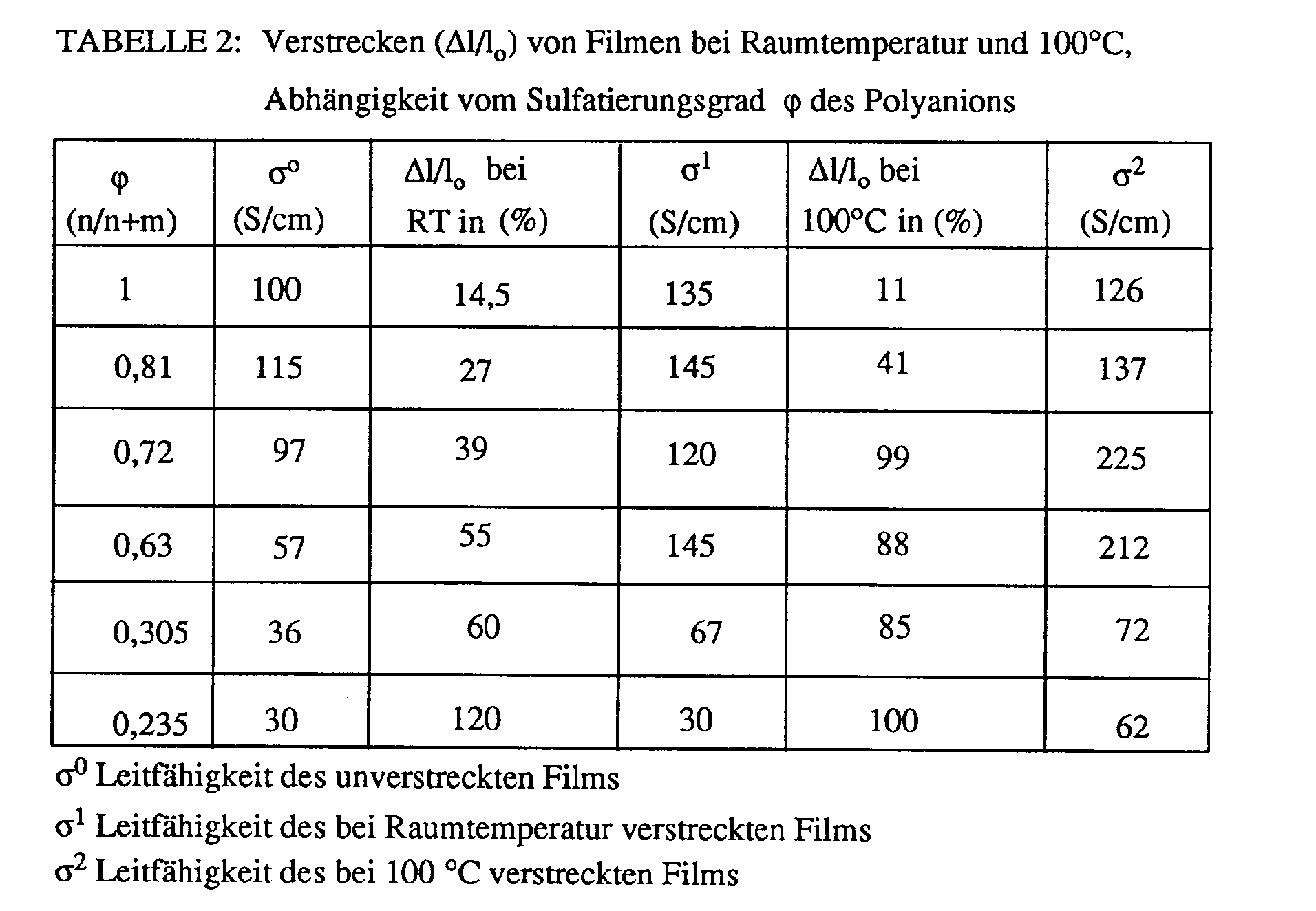
- 1 g (2,6 mmol) Natriumsalz eines zu 100 % sulfatierten Poly(ß-hydroxyethers) aus Bisphenol-A-diglycidylether und Bisphenol-A mit einem mittleren Molekulargewicht von 28 000 Dalton wird in 30 ml Lösungsmittel gelöst. Nach Zugabe von 1,14 g (8,07 mmol) EDT werden bei 100 °C (Beispiel H in Tabelle 3) 3,06 g FeC13 in 5 ml H20 zugetropft. Die Lösung verfärbt sich nach kurzer Zeit schwarz. Das ausgefallene Pulver wird abfiltriert, mehrfach in H20 gewaschen und im Vakuum getrocknet. Weitere Angaben finden sich in Tabelle 3. Die Leitfähigkeit wird an einer gepressten Pille nach der4-Punktmethode bestimmt. Die Zusammensetzungen der Beispiele A bis G in Tabelle 3 werden in analoger Weise erhalten.
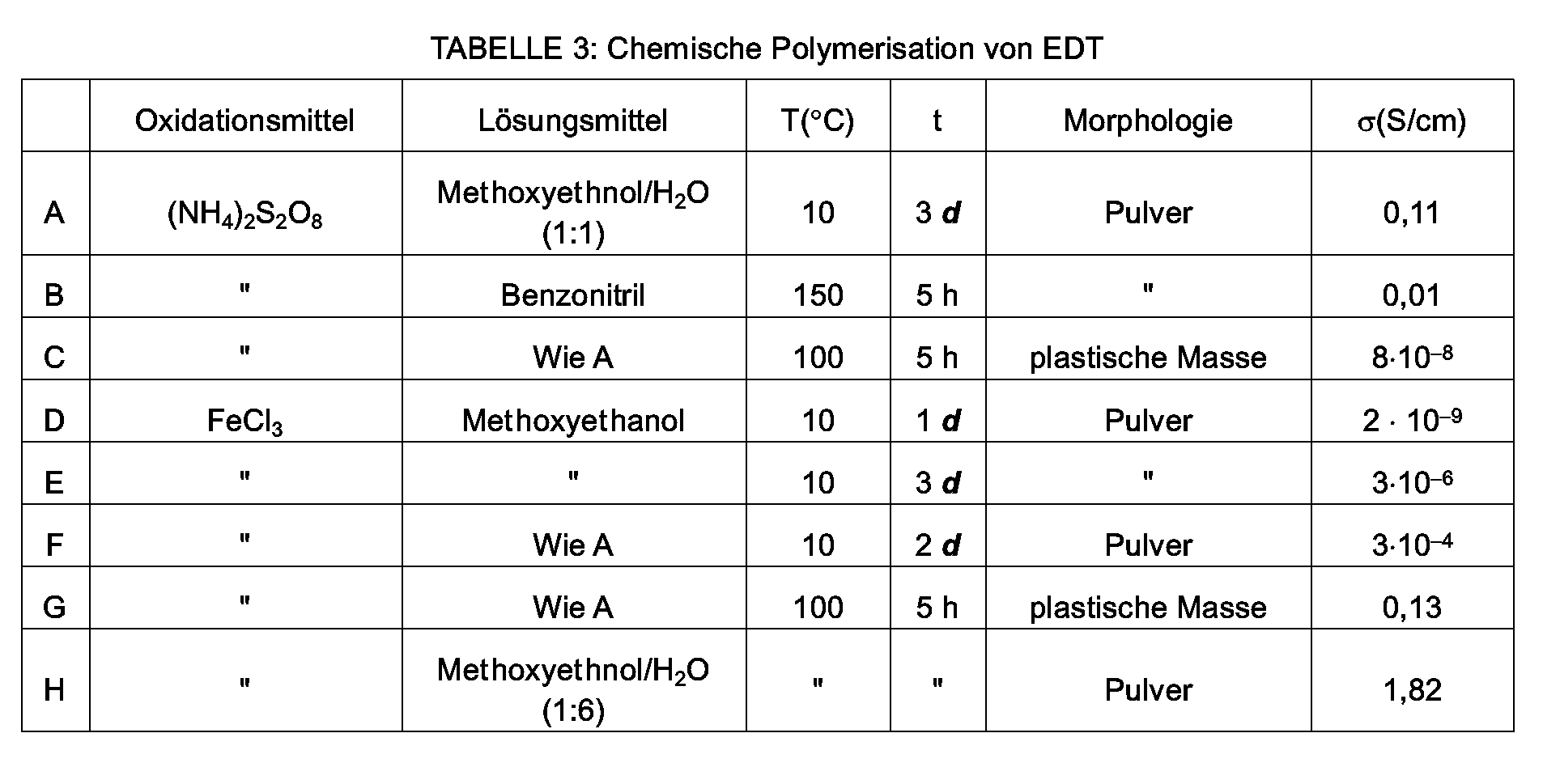
Claims (75)

worin R1 und R2 unabhängig voneinander für lineares oder verzweigtes C1-C18-Alkyl oder C2-C18-Alkoxyalkyl stehen; oder C3-C8-Cycloalkyl, Phenyl oder Benzyl bedeuten, die unsubstituiert oder mit C1-C6-Alkyl, C1-C6-Alkoxy oder Halogen substituiert sind; oder R1 und R2 zusammen lineares C1-C6-Alkylen darstellen, das unsubstituiert oder mit C1-C6-Alkyl, C1-C6-Alkoxy, Halogen, C3-C8-Cycloalkyl, Phenyl, Benzyl, C1-C4-Alkylphenyl, C1-C4-Alkoxyphenyl, Halogenphenyl, C1-C4-Alkylbenzyl, C1-C4-Alkoxy- benzyl oder Halogenbenzyl substituiert ist; und

und/oder mit sulfonatalkylierten Alkoholgruppen

in wiederkehrenden Struktureinheiten, worin die Gruppe -(CnH2n)- für lineares oder verzweigtes C2-C12-Alkylen mit 2 bis 5 C-Atomen in der Kohlenstoffkette steht, das unsubstituiert oder mit C1-C4-Alkoxy substituiert ist.

entspricht.

und/oder sulfonatalkylierten Alkoholgruppen

enthält.

und/oder versalzten sulfonatalkylierten Alkoholgruppen

eine Glasumwandlungstemperatur von -100 bis 350°C aufweist, gemessen nach der DSC-Methode, wobei M⊕ ein Alkalimetall- oder ein Ammoniumkation ist.

und/oder sulfonatalkylierten Alkoholgruppen

im thermoplastischen Polymer von 50:1 bis 1:50 beträgt.

und/oder sulfonatalkylierte Alkoholgruppen

enthält, wobei die restlichen Struktureinheiten entsprechende hydroxylgruppenhaltige oder hydroxylgruppenfreie Strukturelemente sind.

oder

oder als tertiäre Gruppen

im Polymerrückgrat; oder in Seitengruppen des Polymeren als primäre Gruppen -CH2-O-SO3⊖ oder-CH2-O-(CnH2n)SO3⊖ endständig, oder als sekundäre Gruppen

oder als tertiäre Gruppen

oder
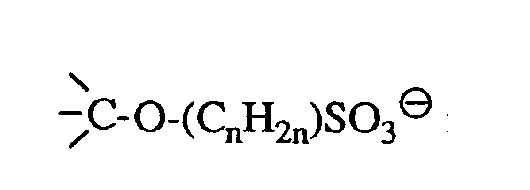
mittelständig gebunden sind.

und/oder

in der Polymerkette enthält, worin die Gruppe -CnH2n- die in Anspruch 1 angegebenen Bedeutungen hat.


und

enthält, bezogen auf das Polyaddukt, wobei R3 und R4 unabhängig voneinander den um zwei Hydroxylgruppen verminderten Rest eines Diols mit aliphatischen oder aromatischen Diolgruppen darstellen, und R' H, C1-C20-Alkyl, C1-C20-Acyl oder mit einem C1-C20-Kohlenwasserstoffrest N-substituiertesAminocarbonyl bedeutet.

darstellen, worin X eine direkten Bindung, C1-C4-Alkylen, C2-C12-Alkyliden, C5-C8-Cycloalkyliden, -O-, -S-, -SO-, -SO2-, -CO-, -CO2-, -N(C1-C4-Alkyl)- oder -Si(CH3)2- bedeutet, R5 und R6 unabhängig voneinander H, Halogen, C1-C4-Alkyl oder C1-C4-Alkoxy sind, und x 1 oder 2 bedeutet und y für 0 oder 1 steht.
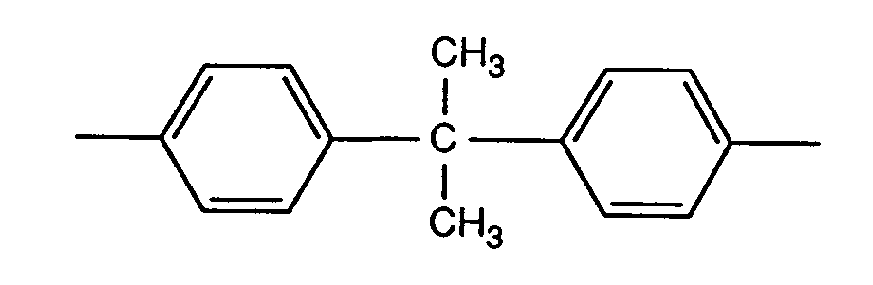
darstellen.

ist.


und

enthält, worin R7 für H, C1-C6-Alkyl, -COOR10 oder -COO⊖ steht, R8 H, F, Cl, CN oder C1-C6-Alkyl bedeutet, und Rg H, OH, R"OH, F, Cl, CN, R10-O-, C1-C12-Alkyl, COO⊖, -COOR10, -OCO-R10, Methylphenyl oder Phenyl darstellt, wobei R10 C1-C18-Alkyl, C5-C7-Cycloalkyl, (C1 -C12-Alkyl)-C5-C7-cycloalkyl, Phenyl, (C1-C12-Alkyl)phenyl, Benzyl oder (C1-C12-Alkyl)benzyl darstellt und R" für lineares oder verzweigtes C2-C18-Alkylen, Poly(C2-C6-oxaalkylen) mit 2 bis 6 Oxaalkyleneinheiten steht.
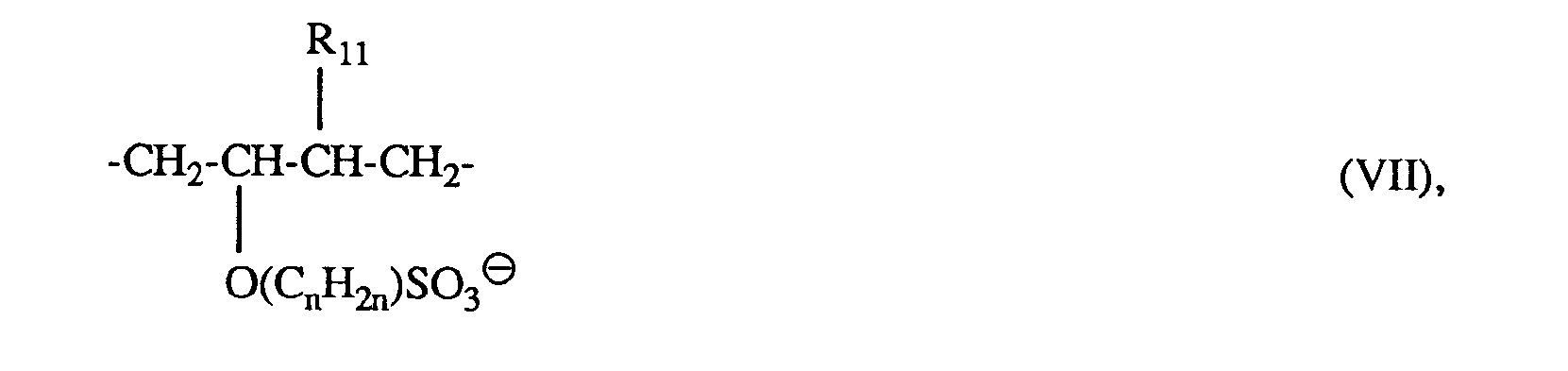
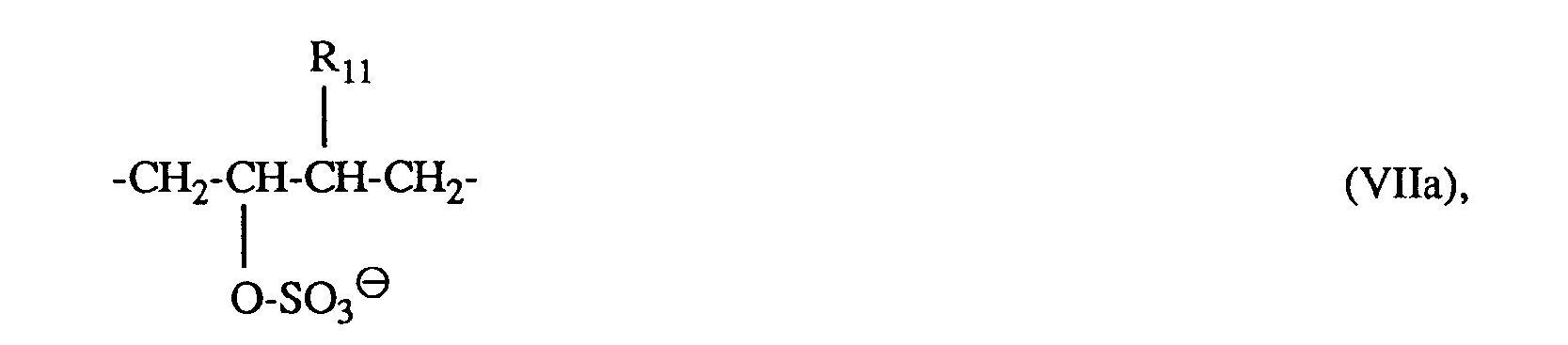
und 0 bis 95 Mol-% Struktureinheiten der Formeln VIII und/oder Vllla,

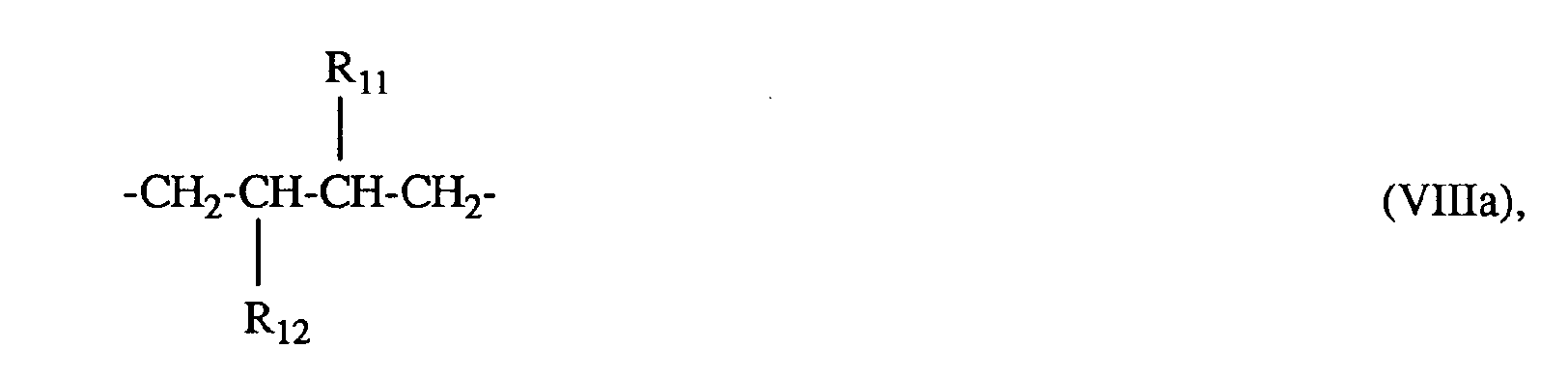
enthält, worin R11 und R12 unabhängig voneinander für H, OH oder CI stehen und die Gruppe -CnH2n- die in Anspruch 1 angegebene Bedeutung hat.


und

enthält, bezogen auf das Polyaddukt, wobei R3 und R4 unabhängig voneinander den um zwei Hydroxylgruppen verminderten Rest eines Diols mit aliphatischen oderaromatischen Diolgruppen darstellen, und R' H, C1-C20-Alkyl, C1-C20-Acyl oder miteinem C1-C20-Kohlenwasserstoffrest N-substituiertesAminocarbonyl bedeutet.

enthält, worin R1 und R2 unabhängig voneinander für lineares oder verzweigtes C1-C6-Alkyl oder R1 und R1zusammen Methylen oder den Rest-CHRa-CHRb-darstellen, worin Ra und Rb unabhängig voneinander H, Methyl oder Ethyl bedeuten.


bedeuten.

entsprechen.

und/oder mit sulfonatalkylierten Alkoholgruppen
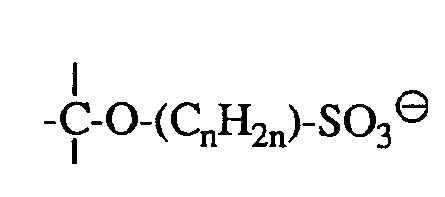
in wiederkehrenden Struktureinheiten, worin die Gruppe -(CnH2n)- für lineares oder verzweigtes C2-C12-Alkylen mit 2 bis 5 C-Atomen in der Kohlenstoffkette steht, das unsubstituiert oder mit C1-C4-Alkoxy substituiert ist, elektrochemisch polymerisiert und danach die Zusammensetzung von der Anode entfernt oder
Applications Claiming Priority (2)
| Application Number | Priority Date | Filing Date | Title |
|---|---|---|---|
| CH190692 | 1992-06-17 | ||
| CH1906/92 | 1992-06-17 |
Publications (2)
| Publication Number | Publication Date |
|---|---|
| EP0575291A2 true EP0575291A2 (de) | 1993-12-22 |
| EP0575291A3 EP0575291A3 (de) | 1994-01-26 |
Family
ID=4221364
Family Applications (1)
| Application Number | Title | Priority Date | Filing Date |
|---|---|---|---|
| EP19930810411 Withdrawn EP0575291A3 (de) | 1992-06-17 | 1993-06-08 | Elektrisch leitende Kunststoffzusammensetzungen und deren Verwendung |
Country Status (7)
| Country | Link |
|---|---|
| US (1) | US5482655A (de) |
| EP (1) | EP0575291A3 (de) |
| JP (1) | JPH0657104A (de) |
| KR (1) | KR940005746A (de) |
| CA (1) | CA2098475A1 (de) |
| MX (1) | MX9303617A (de) |
| TW (1) | TW247319B (de) |
Families Citing this family (37)
| Publication number | Priority date | Publication date | Assignee | Title |
|---|---|---|---|---|
| US5549851A (en) * | 1994-01-25 | 1996-08-27 | Shin-Etsu Chemical Co., Ltd. | Conductive polymer composition |
| DE19507413A1 (de) * | 1994-05-06 | 1995-11-09 | Bayer Ag | Leitfähige Beschichtungen |
| ATE287929T1 (de) * | 1994-05-06 | 2005-02-15 | Bayer Ag | Leitfähige beschichtungen hergestellt aus mischungen enthaltend polythiophen und lösemittel |
| EP1271669A3 (de) * | 1994-09-06 | 2005-01-26 | Koninklijke Philips Electronics N.V. | Elektrolumineszente Vorrichtung mit einer strukturierten transparenten Elektrodenschicht aus leitfähigem Polymer |
| DE4435124A1 (de) * | 1994-09-30 | 1996-04-04 | Siemens Ag | Elektrisches und/oder optisches Kabel mit einer Prägung auf dem Kabelmantel |
| DE19524132A1 (de) * | 1995-07-03 | 1997-01-09 | Bayer Ag | Kratzfeste leitfähige Beschichtungen |
| US6024895A (en) * | 1995-08-11 | 2000-02-15 | Mitsubishi Rayon Co., Ltd. | Cross-linkable, electrically conductive composition, electric conductor and process for forming the same |
| US5629050A (en) * | 1995-08-30 | 1997-05-13 | The Dow Chemical Company | Process for preparing coated articles |
| US6025462A (en) * | 1997-03-06 | 2000-02-15 | Eic Laboratories, Inc. | Reflective and conductive star polymers |
| DE19824186A1 (de) * | 1998-05-29 | 1999-12-02 | Bayer Ag | Elektrochrome Anordnung auf Basis von Poly-(3,4-ethylendioxy-thiophen)-Derivaten und Gel-Elektrolyt mit UV-Schutz |
| DE19841803A1 (de) * | 1998-09-12 | 2000-03-16 | Bayer Ag | Hilfsschichten für elektrolumineszierende Anordnungen |
| DE69919661T2 (de) * | 1998-11-17 | 2005-09-22 | Agfa-Gevaert | Verfahren zur Herstellung einer Schicht aus leitfähigen Polythiophen bei niedriger Temperatur |
| US6333145B1 (en) * | 1998-11-17 | 2001-12-25 | Agfa-Gevaert | Method for preparing a conductive polythiophene layer at low temperature |
| US6439711B1 (en) * | 2000-11-28 | 2002-08-27 | Xerox Corporation | Ballistic aerosol marking process employing marking material comprising polyester resin and poly (3,4-ethylenedioxythiophene) |
| AU2002352209A1 (en) * | 2001-12-04 | 2003-06-17 | Agfa-Gevaert | Composition containing a polymer or copolymer of a 3,4-dialkoxythiophene and non-aqueous solvent |
| EP1321483A1 (de) * | 2001-12-20 | 2003-06-25 | Agfa-Gevaert | 3,4-Alkylendioxythiophen-Verbindungen und ihre Polymere |
| EP1551847B1 (de) * | 2002-10-07 | 2006-07-05 | Agfa-Gevaert | 3,4-alkylendioxythiophen-verbindungen und ihre polymere |
| US7553908B1 (en) | 2003-01-30 | 2009-06-30 | Prc Desoto International, Inc. | Preformed compositions in shaped form comprising polymer blends |
| CN101705484A (zh) * | 2003-02-25 | 2010-05-12 | 坎梅陶尔股份有限公司 | 以富聚合物组合物涂布金属表面的方法 |
| CN1826382B (zh) * | 2003-04-30 | 2010-06-16 | Prc-迪索托国际公司 | 处于成型形式的预成形emi/rfi屏蔽组合物 |
| US20040231119A1 (en) * | 2003-05-21 | 2004-11-25 | Brenneman Keith R. | Method of electrolytic deposition of an intrinsically conductive polymer upon a non-conductive substrate |
| US6939663B2 (en) * | 2003-07-08 | 2005-09-06 | Kodak Polychrome Graphics Llc | Sulfated phenolic resins and printing plate precursors comprising sulfated phenolic resins |
| GB0323733D0 (en) * | 2003-10-10 | 2003-11-12 | Univ Heriot Watt | Conductive polymer |
| US20050245695A1 (en) * | 2004-04-30 | 2005-11-03 | Cosman Michael A | Polymer blend and compositions and methods for using the same |
| US20080171211A1 (en) * | 2004-08-03 | 2008-07-17 | Chemetall Gmbh | Method For Protecting A Metal Surface By Means Of A Corrosion-Inhibiting Coating |
| TW200619301A (en) * | 2004-09-22 | 2006-06-16 | Showa Denko Kk | The water-soluable composition of antistatic agent, the antistatic agent, the method of forming antistatic film, coated products and pattern by using the same the agent |
| ES2748506T3 (es) * | 2004-11-10 | 2020-03-17 | Chemetall Gmbh | Proceso para producir un recubrimiento de reparación en una superficie metálica recubierta |
| US8101014B2 (en) * | 2004-11-10 | 2012-01-24 | Chemetall Gmbh | Process for coating metallic surfaces with a multicomponent aqueous composition |
| US20060099332A1 (en) | 2004-11-10 | 2006-05-11 | Mats Eriksson | Process for producing a repair coating on a coated metallic surface |
| US20080138615A1 (en) * | 2005-04-04 | 2008-06-12 | Thomas Kolberg | Method for Coating Metallic Surfaces with an Aqueous Composition and Said Composition |
| JP5324217B2 (ja) * | 2005-06-27 | 2013-10-23 | イー・アイ・デュポン・ドウ・ヌムール・アンド・カンパニー | 導電性ポリマー組成物 |
| US8268195B2 (en) * | 2008-09-29 | 2012-09-18 | Air Products And Chemicals, Inc. | Electrically conductive films formed from dispersions comprising polythiophenes and ether containing polymers |
| US8357858B2 (en) * | 2008-11-12 | 2013-01-22 | Simon Fraser University | Electrically conductive, thermosetting elastomeric material and uses therefor |
| CA2791641A1 (en) * | 2010-01-13 | 2011-07-21 | University Of Connecticut | Thermally stable conducting polymers, methods of making, and methods of use thereof |
| KR101307893B1 (ko) * | 2011-04-25 | 2013-09-13 | 아주대학교산학협력단 | 폴리비닐계 공중합체, 상기를 포함하는 도판트, 및 상기 도판트를 포함하는 전도성 고분자 복합체 |
| TWI486430B (zh) | 2014-02-27 | 2015-06-01 | Ind Tech Res Inst | 透明電致變色聚合物與電致變色元件 |
| JP6864879B2 (ja) * | 2015-04-15 | 2021-04-28 | 国立大学法人山梨大学 | 導電性高分子複合体、導電性高分子複合体の製造方法、導電性高分子複合体組成物及び薄膜 |
Family Cites Families (9)
| Publication number | Priority date | Publication date | Assignee | Title |
|---|---|---|---|---|
| DE3804521A1 (de) * | 1988-02-13 | 1989-08-24 | Hoechst Ag | Elektrisch leitende beschichtungsmasse, verfahren zu ihrer herstellung und ihre verwendung |
| DE3804520A1 (de) * | 1988-02-13 | 1989-08-24 | Hoechst Ag | Elektrisch leitende polymere und ihre herstellung |
| DE3843412A1 (de) * | 1988-04-22 | 1990-06-28 | Bayer Ag | Neue polythiophene, verfahren zu ihrer herstellung und ihre verwendung |
| DE3813589A1 (de) * | 1988-04-22 | 1989-11-02 | Bayer Ag | Neue polythiophene, verfahren zu ihrer herstellung und ihre verwendung |
| DE3814730A1 (de) * | 1988-04-30 | 1989-11-09 | Bayer Ag | Feststoff-elektrolyte und diese enthaltende elektrolyt-kondensatoren |
| US5061401A (en) * | 1988-09-08 | 1991-10-29 | Ciba-Geigy Corporation | Electrically conductive composition of polyheteroaromatic compounds and polymeric sulfates |
| DE59010247D1 (de) * | 1990-02-08 | 1996-05-02 | Bayer Ag | Neue Polythiophen-Dispersionen, ihre Herstellung und ihre Verwendung |
| EP0446172A3 (en) * | 1990-03-08 | 1992-03-04 | Ciba-Geigy Ag | Electrical conductive press masses and polyheteroaromates and polymere sulfate fillers |
| US5185100A (en) * | 1990-03-29 | 1993-02-09 | Allied-Signal Inc | Conductive polymers formed from conjugated backbone polymers doped with non-oxidizing protonic acids |
-
1993
- 1993-05-22 TW TW082104050A patent/TW247319B/zh active
- 1993-06-08 EP EP19930810411 patent/EP0575291A3/de not_active Withdrawn
- 1993-06-11 US US08/075,658 patent/US5482655A/en not_active Expired - Fee Related
- 1993-06-15 CA CA002098475A patent/CA2098475A1/en not_active Abandoned
- 1993-06-16 MX MX9303617A patent/MX9303617A/es unknown
- 1993-06-16 KR KR1019930010962A patent/KR940005746A/ko not_active Withdrawn
- 1993-06-17 JP JP5145265A patent/JPH0657104A/ja active Pending
Also Published As
| Publication number | Publication date |
|---|---|
| JPH0657104A (ja) | 1994-03-01 |
| KR940005746A (ko) | 1994-03-22 |
| US5482655A (en) | 1996-01-09 |
| EP0575291A3 (de) | 1994-01-26 |
| MX9303617A (es) | 1993-12-01 |
| TW247319B (de) | 1995-05-11 |
| CA2098475A1 (en) | 1993-12-18 |
Similar Documents
| Publication | Publication Date | Title |
|---|---|---|
| US5482655A (en) | Electrically conductive thermoplastic polymer formulations and the use thereof | |
| EP0104726B1 (de) | Elektrisch leitfähige Polymerzusammensetzung | |
| US4567250A (en) | Preparation of finely divided electrically conductive pyrrole polymers | |
| EP0804497B1 (de) | Lösliche, elektroleitfähige polypyrrole und verfahren zur herstellung | |
| US4566955A (en) | Preparation of finely divided electrically conductive pyrrole polymers | |
| EP0358188B1 (de) | Elektrisch leitende Zusammensetzung mit Polyheteroaromaten und polymeren Sulfaten | |
| DE3223544A1 (de) | Copolymere von pyrrolen, verfahren zu ihrer herstellung sowie ihre verwendung | |
| JPH05255576A (ja) | 面状発熱体及びその製造法 | |
| DE69828573T2 (de) | Transparente leitfähige Polymere | |
| US5206297A (en) | Electrically conductive moulding compositions and fillers from polyheteroaromatic compounds and polymeric sulfates | |
| EP0566536A1 (de) | Elektrisch leitende Kunststoffzusammensetzungen und deren Verwendung | |
| EP0191726A2 (de) | Polypyrrol-Polyimidzusammensetzungen | |
| DE3851499T2 (de) | Elektrische leitfähige Polymerzusammensetzungen für die Herstellung dieser Zusammensetzungen verwendbare Verfahren und Polymere. | |
| EP0298746A2 (de) | Beschichtete anorganische Materialien | |
| EP0362142B1 (de) | Antistatische und elektrisch leitende Zusammensetzung | |
| EP0566533A1 (de) | Sulfatierte Polyvinylphenole, Zusammensetzung mit sulfatierten Polyvinylphenolen und deren Verwendung | |
| DE3938094A1 (de) | Verfahren zur herstellung von elektrisch leitfaehigen polymerisaten | |
| EP0554220A1 (de) | Charge-Transfer Komplexe mit Ferrocenen, deren Herstellung und deren Verwendung | |
| EP0303360A1 (de) | Elektroleitfähige Polymere | |
| JPH03174437A (ja) | 導電性ポリマー | |
| JP3163426B2 (ja) | ポリアリーレンチオエーテルの製造法 | |
| CA1337780C (en) | Antistatic and electrically conducting composition | |
| JP3474690B2 (ja) | 導電性ポリマーまたはその混合物の製造方法 | |
| EP0280183A1 (de) | Verfahren zur Herstellung von elektrisch leitfähigen elastischen Produkten | |
| EP0369251A2 (de) | Leitfähiges Hochpolymerverbundmaterial aus Polyalkyläthern und aromatischen polyheterocyclischen Polymeren, Verfahren zu ihrer Herstellung |
Legal Events
| Date | Code | Title | Description |
|---|---|---|---|
| PUAI | Public reference made under article 153(3) epc to a published international application that has entered the european phase |
Free format text: ORIGINAL CODE: 0009012 |
|
| PUAL | Search report despatched |
Free format text: ORIGINAL CODE: 0009013 |
|
| AK | Designated contracting states |
Kind code of ref document: A2 Designated state(s): AT BE CH DE DK ES FR GB IE IT LI NL PT SE |
|
| AK | Designated contracting states |
Kind code of ref document: A3 Designated state(s): AT BE CH DE DK ES FR GB IE IT LI NL PT SE |
|
| 17P | Request for examination filed |
Effective date: 19940708 |
|
| RAP1 | Party data changed (applicant data changed or rights of an application transferred) |
Owner name: JAPAT LTD |
|
| 17Q | First examination report despatched |
Effective date: 19960529 |
|
| STAA | Information on the status of an ep patent application or granted ep patent |
Free format text: STATUS: THE APPLICATION IS DEEMED TO BE WITHDRAWN |
|
| 18D | Application deemed to be withdrawn |
Effective date: 19970424 |