EP0574912B1 - Verfahren zur Gewinnung von Methylchlorsilanen aus hochsiedenden Rückständen der Methylchlorsilansynthese - Google Patents
Verfahren zur Gewinnung von Methylchlorsilanen aus hochsiedenden Rückständen der Methylchlorsilansynthese Download PDFInfo
- Publication number
- EP0574912B1 EP0574912B1 EP93109691A EP93109691A EP0574912B1 EP 0574912 B1 EP0574912 B1 EP 0574912B1 EP 93109691 A EP93109691 A EP 93109691A EP 93109691 A EP93109691 A EP 93109691A EP 0574912 B1 EP0574912 B1 EP 0574912B1
- Authority
- EP
- European Patent Office
- Prior art keywords
- methylchlorodisilanes
- methylchlorosilanes
- boiling
- cleavable
- cleavage
- Prior art date
- Legal status (The legal status is an assumption and is not a legal conclusion. Google has not performed a legal analysis and makes no representation as to the accuracy of the status listed.)
- Expired - Lifetime
Links
Images

Classifications
-
- C—CHEMISTRY; METALLURGY
- C07—ORGANIC CHEMISTRY
- C07F—ACYCLIC, CARBOCYCLIC OR HETEROCYCLIC COMPOUNDS CONTAINING ELEMENTS OTHER THAN CARBON, HYDROGEN, HALOGEN, OXYGEN, NITROGEN, SULFUR, SELENIUM OR TELLURIUM
- C07F7/00—Compounds containing elements of Groups 4 or 14 of the Periodic Table
- C07F7/02—Silicon compounds
- C07F7/08—Compounds having one or more C—Si linkages
- C07F7/12—Organo silicon halides
- C07F7/121—Preparation or treatment not provided for in C07F7/14, C07F7/16 or C07F7/20
- C07F7/126—Preparation or treatment not provided for in C07F7/14, C07F7/16 or C07F7/20 by reactions involving the formation of Si-Y linkages, where Y is not a carbon or halogen atom
-
- C—CHEMISTRY; METALLURGY
- C07—ORGANIC CHEMISTRY
- C07F—ACYCLIC, CARBOCYCLIC OR HETEROCYCLIC COMPOUNDS CONTAINING ELEMENTS OTHER THAN CARBON, HYDROGEN, HALOGEN, OXYGEN, NITROGEN, SULFUR, SELENIUM OR TELLURIUM
- C07F7/00—Compounds containing elements of Groups 4 or 14 of the Periodic Table
- C07F7/02—Silicon compounds
- C07F7/08—Compounds having one or more C—Si linkages
- C07F7/12—Organo silicon halides
- C07F7/121—Preparation or treatment not provided for in C07F7/14, C07F7/16 or C07F7/20
- C07F7/123—Preparation or treatment not provided for in C07F7/14, C07F7/16 or C07F7/20 by reactions involving the formation of Si-halogen linkages
-
- C—CHEMISTRY; METALLURGY
- C07—ORGANIC CHEMISTRY
- C07F—ACYCLIC, CARBOCYCLIC OR HETEROCYCLIC COMPOUNDS CONTAINING ELEMENTS OTHER THAN CARBON, HYDROGEN, HALOGEN, OXYGEN, NITROGEN, SULFUR, SELENIUM OR TELLURIUM
- C07F7/00—Compounds containing elements of Groups 4 or 14 of the Periodic Table
- C07F7/02—Silicon compounds
- C07F7/08—Compounds having one or more C—Si linkages
- C07F7/12—Organo silicon halides
- C07F7/121—Preparation or treatment not provided for in C07F7/14, C07F7/16 or C07F7/20
- C07F7/125—Preparation or treatment not provided for in C07F7/14, C07F7/16 or C07F7/20 by reactions involving both Si-C and Si-halogen linkages, the Si-C and Si-halogen linkages can be to the same or to different Si atoms, e.g. redistribution reactions
-
- C—CHEMISTRY; METALLURGY
- C07—ORGANIC CHEMISTRY
- C07F—ACYCLIC, CARBOCYCLIC OR HETEROCYCLIC COMPOUNDS CONTAINING ELEMENTS OTHER THAN CARBON, HYDROGEN, HALOGEN, OXYGEN, NITROGEN, SULFUR, SELENIUM OR TELLURIUM
- C07F7/00—Compounds containing elements of Groups 4 or 14 of the Periodic Table
- C07F7/02—Silicon compounds
- C07F7/08—Compounds having one or more C—Si linkages
- C07F7/12—Organo silicon halides
- C07F7/121—Preparation or treatment not provided for in C07F7/14, C07F7/16 or C07F7/20
- C07F7/128—Preparation or treatment not provided for in C07F7/14, C07F7/16 or C07F7/20 by reactions covered by more than one of the groups C07F7/122 - C07F7/127 and of which the starting material is unknown or insufficiently determined
Definitions
- the invention relates to a method for obtaining Methylchlorosilanes from high-boiling methylchlorodisilanes.
- the methylchlorodisilanes are by-products of Direct synthesis of methylchlorosilanes.
- the methylchlorosilanes are separated by distillation and cleaned. This results in a high boiler fraction, the 5th accounts for up to 10% of the raw product. It is economic and ecological reasons desirable to process these residues and gain valuable materials. This is achieved by isolating the distillable methylchlorodisilanes and be cleaved with hydrogen chloride to form methylchlorosilanes. As a rule, this cleavage is carried out with amine catalysts the liquid phase. The residue processing is u. a. in W. Noll, 2nd edition 1968, Verlag Chemie, Weinheim, Section 2.2.8. The chemical properties the disilanes and fundamentals of cleavage are described in R. Calas et al., J. Organomet. Chem., 225 (1982) 117 - 130.
- the high boiler fraction is usually worked up by means of batchwise distillation in order to obtain the fraction of the methylchlorodisilanes which can be split with hydrogen chloride.
- Boiling range Main components 70-140 ° C
- Fraction 1 Dimethyldichlorosilane Ethylmethyldichlorosilane Methylpropyldichlorosilane Ethyldimethylchlorosilane Methylchlorodisilanes Hydrocarbons 140-155 ° C
- Fraction 2 Pentamethylchlorodisilane Tetramethyldichlorodisilane Trimethyltrichlorodisilane Dimethyltetrachlorodisilane 155-160 ° C
- Fraction 3 Trimethyltrichlorodisilane Dimethyltetrachlorodisilane > 160 ° C
- Fraction 4 Oligomethylsilanes, also dimethyltetrachlorodisilane Carbosilanes Siloxa
- Cleavable with hydrogen chloride to monosilanes according to the equation are only methylchlorodisilanes which have at least two chlorine atoms on one silicon atom, ie not the symmetrical tetramethyldichlorodisilane or pentamethylchlorodisilane.
- the splitting creates the split silane, which mainly Dimethyldichlorosilane, methyltrichlorosilane and Contains methyldichlorosilane.
- the cleavable disilanes of fraction 3 are cleaved in reaction vessels that separate the cleavage product mixture enable, for example in a still with column attached.
- the split silane separated at the top of the column, non-cleavable Components of the added disilane mixture accumulate in the reaction mixture and force regular Ejection of the reactor contents.
- fractions of the processing of the high-boiling residues which contain no or too little fissile disilane, in particular fraction 4, as well as the residue to be discharged disilane cleavage which still contains cleavable disilanes, must be incinerated.
- US-A-2,709,176 describes a process for the cleavage of disilanes using HCl and tertiary amine catalysts.
- the silane mixture used for cleavage also contains by-products, which are more volatile than the fissile methylchlorodisilanes and higher than the cleavable methylchlorodisilanes boiling compounds.
- the present invention is based on the object Process for the recovery of methylchlorosilanes from high-boiling To provide residues of the methylchlorosilane synthesis, in which the cleavable methylchlorodisilanes are continuous can be split and a higher one Yield of fission silanes can be achieved.
- the invention relates to a method for obtaining Methylchlorosilanes from high boiling residues of Methylchlorosilane synthesis, being in the residues existing cleavable methylchlorodisilanes, which at least have two chlorine atoms on a silicon atom, with Hydrogen chloride in the presence of one in the reaction mixture remaining catalyst are split, the Cleavage of the methylchlorodisilanes in the presence of the lighter than the fissile methylchlorodisilanes volatile By-products of the high-boiling residues of Methylchlorosilane synthesis, which has a boiling point of have at least 70 ° C under normal conditions, expires and the more volatile by-products being continuous together with the methylchlorosilanes and the non-fissile Methylchlorodisilanes removed from the reaction mixture are characterized in that all are heavier than that cleavable methylchloro
- Methylchlorosilanes lighter than the fissile ones Methylchlorodisilane volatile by-products and non-cleavable Methylchlorodisilane does not interfere with the cleavage. Therefore is the usual separation of the high-boiling residues to obtain a fraction that is essentially only does not contain cleavable methylchlorodisilanes (fraction 3) required.
- the cleavage can be carried out continuously from the reaction mixture be operated as all heavier than the fissile Methylchlorodisilanes and the catalyst boiling compounds (Fraction 4) are separated before the cleavage.
- Catalysts remaining in the reaction mixture for the cleavage of methylchlorodisilanes with hydrogen chloride are less volatile homogeneous or heterogeneous catalysts known per se.
- Examples are transition metal complexes such as (Me 2 PhP) 2 PdCl 2 , (Ph 3 P) 2 NiCl 2 , and (Ph 3 P) 4 Pd (0) and the preferred organic nitrogen compounds such as N-methyl-2-pyrrolidone, polyvinylpyrrolidone , alkylated acid amides and tertiary amines.
- catalysts are tertiary amines which have at least one aryl radical optionally substituted with fluorine or chlorine atoms or C 1-6 alkyl radicals, preferably having up to 18 carbon atoms, such as the phenyl, naphthyl or p-tolyl radical, optionally present on the nitrogen atom
- aryl radicals which can be substituted with fluorine or chlorine atoms, preferably have up to 18 carbon atoms.
- Preferred examples are tributylamine and N, N-dimethylaniline.
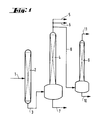
- the raw silane mixture is obtained from the reaction via line (1) transferred from silicon with methyl chloride in column (2).
- Column (2) the high-boiling residues (high boilers) on. This high boiler is fed via line (3) into the column (4) transferred.
- the high boiler contains due to the required high boiler freedom the top product of the column (2) a relative high proportion of the valuable target product of direct synthesis, the dimethyldichlorosilane.
- the high boiler is now in Column (4) is distilled off discontinuously. Fall in the process the above fractions 1 in lines 5, 6 and 7, 2 or 4 as waste streams, whereby not only dimethyldichlorosilane is lost, but also a significant one Proportion of fissile disilanes.
- Fraction 3 is on line (8) fed to the disilane cracking reactor (9) and there with Cleave hydrogen chloride with the addition of an amine catalyst.
- Non-fissile constituents in fraction 3 must come from the Reactor (9) are routed through line 10 regularly and are also a waste product.
- the split silane is separated off via the column of the reactor (9) and line (11) and fed back to the raw silane from direct synthesis.
Landscapes
- Chemical & Material Sciences (AREA)
- Organic Chemistry (AREA)
- Chemical Kinetics & Catalysis (AREA)
Description
| Siedebereich | Hauptkomponenten |
| 70 - 140°C Fraktion 1 | Dimethyldichlorsilan |
| Ethylmethyldichlorsilan | |
| Methylpropyldichlorsilan | |
| Ethyldimethylchlorsilan | |
| Methylchlordisilane | |
| Kohlenwasserstoffe | |
| 140 - 155°C Fraktion 2 | Pentamethylchlordisilan |
| Tetramethyldichlordisilan | |
| Trimethyltrichlordisilan | |
| Dimethyltetrachlordisilan | |
| 155 - 160°C Fraktion 3 | Trimethyltrichlordisilan |
| Dimethyltetrachlordisilan | |
| > 160°C Fraktion 4 | Oligomethylsilane, auch Dimethyltetrachlordisilan |
| Carbosilane | |
| Siloxane | |
| Metalle und Metallhalogenide |

- eine scharfe destillative Trennung, die großen Energie- und Investitionsaufwand erfordert, kann entfallen
- eine thermische Belastung mit langer Verweilzeit, wie bei der diskontinuierlichen Hochsiederdestillation, wird deutlich vermindert, Nebenreaktionen werden unterdrückt
- der mit dem Hochsieder zwangsläufig mitgehende Anteil des wertvollen Zielproduktes Dimethyldichlorsilan verbleibt im Spaltsilan und geht nicht verloren
- die in den Fraktionen 1, 2 und 4 enthaltenen Anteile spaltbarer Disilane werden vollständig gespalten und gehen nicht verloren
- Kolonne (18) und Spaltreaktor (16) können kontinuierlich betrieben werden, die Kapazitäten steigen entsprechend
- der Anfall nichtverwertbarer Abfälle wird wesentlich vermindert.
Claims (2)
- Verfahren zur Gewinnung von Methylchlorsilanen aus hochsiedenden Rückständen der Methylchlorsilansynthese, wobei in den Rückständen vorhandene spaltbare Methylchlordisilane, welche mindestens zwei Chloratome an einem Siliciumatom aufweisen, mit Chlorwasserstoff in Gegenwart eines im Reaktionsgemisch verbleibenden Katalysators gespalten werden, wobei die Spaltung der Methylchlordisilane in Gegenwart der leichter als die spaltbaren Methylchlordisilane flüchtigen Nebenprodukte der hochsiedenden Rückstände der Methylchlorsilansynthese, die einen Siedepunkt von mindestens 70°C bei Normalbedingungen aufweisen, abläuft und wobei die leichterflüchtigen Nebenprodukte kontinuierlich zusammen mit den Methylchlorsilanen und den nicht spaltbaren Methylchlordisilanen aus dem Reaktionsgemisch entfernt werden, dadurch gekennzeichnet, daß alle schwerer als die spaltbaren Methylchlordisilane siedenden Verbindungen vor der Spaltung abgetrennt werden und daß die Spaltung kontinuierlich erfolgt.
- Verfahren nach Anspruch 1, dadurch gekennzeichnet, daß als Kalysator ein tertiäres Amin eingesetzt wird.
Applications Claiming Priority (2)
| Application Number | Priority Date | Filing Date | Title |
|---|---|---|---|
| DE4220151 | 1992-06-19 | ||
| DE4220151A DE4220151A1 (de) | 1992-06-19 | 1992-06-19 | Verfahren zur Gewinnung von Methylchlorsilanen aus hochsiedenden Rückständen der Methylchlorsilansynthese |
Publications (2)
| Publication Number | Publication Date |
|---|---|
| EP0574912A1 EP0574912A1 (de) | 1993-12-22 |
| EP0574912B1 true EP0574912B1 (de) | 1999-01-07 |
Family
ID=6461417
Family Applications (1)
| Application Number | Title | Priority Date | Filing Date |
|---|---|---|---|
| EP93109691A Expired - Lifetime EP0574912B1 (de) | 1992-06-19 | 1993-06-17 | Verfahren zur Gewinnung von Methylchlorsilanen aus hochsiedenden Rückständen der Methylchlorsilansynthese |
Country Status (4)
| Country | Link |
|---|---|
| US (1) | US5288892A (de) |
| EP (1) | EP0574912B1 (de) |
| JP (1) | JPH0735386B2 (de) |
| DE (2) | DE4220151A1 (de) |
Cited By (5)
| Publication number | Priority date | Publication date | Assignee | Title |
|---|---|---|---|---|
| CN103396431A (zh) * | 2013-08-16 | 2013-11-20 | 唐山三友硅业有限责任公司 | 连续水解有机硅高沸物的方法 |
| WO2016011993A1 (de) | 2014-07-22 | 2016-01-28 | Norbert Auner | Verfahren zur spaltung von silicium-silicium-bindungen und/oder von silicium-chlor-bindungen in mono-, poly- und/oder oligosilanen |
| WO2019060479A1 (en) | 2017-09-20 | 2019-03-28 | Momentive Performance Materials Inc. | CLEAVAGE OF METHYLDISILANES IN METHYLMONOSILANES |
| WO2019060481A1 (en) | 2017-09-20 | 2019-03-28 | Momentive Performance Materials Inc. | CLEAVING DISILANE, CARBODISILANE AND OLIGOSILANE WITH CLEAVING COMPOUND AS CATALYST AND HYDROGENATION SOURCE |
| WO2019060480A1 (en) | 2017-09-20 | 2019-03-28 | Momentive Performance Materials Inc. | CLEANING OF METHYLILISILANES, CARBODISILANES AND METHYLOLIGOSILANES WITH SALTS OF ALKALI AND ALKALINE-EARTH METALS |
Families Citing this family (23)
| Publication number | Priority date | Publication date | Assignee | Title |
|---|---|---|---|---|
| DE4304256A1 (de) * | 1993-02-12 | 1994-08-18 | Solvay Deutschland | Katalysator zur Disproportionierung von Aryl- oder Alkylhalogendisilanen zu Aryl- oder Alkylhalogenmono- und Aryl- oder Alkylhalogenpolysilanen |
| US5292912A (en) * | 1993-07-19 | 1994-03-08 | Dow Corning Corporation | Catalytic conversion of direct process high-boiling component to chlorosilane monomers in the presence of hydrogen chloride |
| DE4431995A1 (de) * | 1994-09-08 | 1996-03-14 | Wacker Chemie Gmbh | Verfahren zur Herstellung von wasserstoffhaltigen Methylchlorsilanen |
| US5430168A (en) * | 1994-10-27 | 1995-07-04 | Dow Corning Corporation | Alumimum trichloride catalyzed hydrogenation of high-boiling residue from direct process |
| FR2732683B1 (fr) * | 1995-04-10 | 1997-06-20 | Rhone Poulenc Chimie | Procede de scission des sous-produits de la synthese directe des alkylchlorosilanes |
| US5606090A (en) * | 1996-06-13 | 1997-02-25 | Dow Corning Corporation | Conversion of high-boiling residue from direct process to monosilanes |
| US5627298A (en) * | 1996-06-13 | 1997-05-06 | Dow Corning Corporation | One step process for converting high-boiling residue from direct process to monosilanes |
| JP3362630B2 (ja) * | 1997-02-28 | 2003-01-07 | 信越化学工業株式会社 | 直接法メチルクロルシラン合成より副生する高沸点成分からのモノシラン類の製造方法 |
| DE19711693A1 (de) * | 1997-03-20 | 1998-09-24 | Wacker Chemie Gmbh | Verfahren zur Herstellung von Alkylchlorsilanen aus den Rückständen der Direktsynthese von Alkylchlorsilanen |
| US5876609A (en) * | 1997-03-28 | 1999-03-02 | General Electric Company | Process for treating methylchlorosilanes by-products |
| US5905183A (en) * | 1997-06-03 | 1999-05-18 | General Electric Company | Process for reducing the residual chloride concentration in copper containing solids |
| DE10126558C1 (de) * | 2001-05-31 | 2002-06-13 | Wacker Chemie Gmbh | Verfahren zur Herstellung von Silanen |
| DE10336545B3 (de) * | 2003-08-05 | 2005-04-14 | Ge Bayer Silicones Gmbh & Co. Kg | Verfahren zur Herstellung von Chlorsilanen |
| WO2008119505A1 (de) | 2007-03-30 | 2008-10-09 | Rev Renewable Energy Ventures Inc. | Katalytische hydrierung |
| CN101659672B (zh) * | 2008-08-29 | 2012-03-07 | 中国石油天然气股份有限公司 | 一种有机硅废渣浆的裂解处理方法 |
| CN102617629B (zh) * | 2012-02-14 | 2015-08-19 | 吉林化工学院化工分离技术开发中心 | 一种有机硅混合单体甲基氯硅烷的分离新工艺 |
| CN103833781B (zh) * | 2014-03-19 | 2017-05-10 | 山东东岳有机硅材料有限公司 | 一种苯基氯硅烷的制备方法 |
| CN112142975B (zh) * | 2020-09-16 | 2022-08-05 | 湖北兴瑞硅材料有限公司 | 一种有机硅副产高沸物综合利用的方法 |
| CN114437125A (zh) * | 2022-01-25 | 2022-05-06 | 杭州四马化工科技有限公司 | 一种线环体硅烷连续裂解工艺 |
| CN114949902A (zh) * | 2022-04-29 | 2022-08-30 | 内蒙古恒星化学有限公司 | 有机硅高沸物的分离回收系统及方法 |
| CN115779469A (zh) * | 2022-10-21 | 2023-03-14 | 北京国化新材料技术研究院有限公司 | 一种分段分离高沸物的精馏工艺及其应用 |
| CN116020554B (zh) * | 2022-12-30 | 2024-11-19 | 中国科学院过程工程研究所 | 一种有机硅高沸物裂解用有机胺催化剂及制备方法 |
| CN116440516B (zh) * | 2023-03-02 | 2025-01-24 | 江西蓝星星火有机硅有限公司 | 一种提高有机硅高沸点混合物裂解中HCl转化率的方法及装置 |
Family Cites Families (7)
| Publication number | Priority date | Publication date | Assignee | Title |
|---|---|---|---|---|
| BE526512A (de) * | 1953-02-20 | |||
| NL90972C (de) * | 1954-03-12 | |||
| NL127615C (de) * | 1965-06-14 | |||
| BE792713A (fr) * | 1971-12-15 | 1973-06-14 | Dow Corning | Procede catalytique de transformation de disilanes en silanes |
| US3878234A (en) * | 1973-07-30 | 1975-04-15 | Dow Corning | Preparation of hydrocarbon silanes from polysilanes |
| DE2950402A1 (de) * | 1979-12-14 | 1981-06-19 | Bayer Ag, 5090 Leverkusen | Verfahren zur umwandlung niedrigsiedender anteile aus der alkylchlorsilan-synthese |
| DE3410644A1 (de) * | 1984-03-23 | 1985-09-26 | Bayer Ag, 5090 Leverkusen | Verfahren zur herstellung von dimethyldichlorsilan |
-
1992
- 1992-06-19 DE DE4220151A patent/DE4220151A1/de not_active Withdrawn
-
1993
- 1993-04-19 US US08/048,597 patent/US5288892A/en not_active Expired - Fee Related
- 1993-06-15 JP JP5143385A patent/JPH0735386B2/ja not_active Expired - Lifetime
- 1993-06-17 EP EP93109691A patent/EP0574912B1/de not_active Expired - Lifetime
- 1993-06-17 DE DE59309269T patent/DE59309269D1/de not_active Expired - Fee Related
Cited By (7)
| Publication number | Priority date | Publication date | Assignee | Title |
|---|---|---|---|---|
| CN103396431A (zh) * | 2013-08-16 | 2013-11-20 | 唐山三友硅业有限责任公司 | 连续水解有机硅高沸物的方法 |
| CN103396431B (zh) * | 2013-08-16 | 2016-03-09 | 唐山三友硅业有限责任公司 | 连续水解有机硅高沸物的方法 |
| WO2016011993A1 (de) | 2014-07-22 | 2016-01-28 | Norbert Auner | Verfahren zur spaltung von silicium-silicium-bindungen und/oder von silicium-chlor-bindungen in mono-, poly- und/oder oligosilanen |
| DE102015009129A1 (de) | 2014-07-22 | 2016-01-28 | Norbert Auner | Verfahren zur Spaltung von Silicium-Silicium-Bindungen und/oder von Silicium-Chlor-Bindungen in Mono-, Poly- und/oder Oligosilanen |
| WO2019060479A1 (en) | 2017-09-20 | 2019-03-28 | Momentive Performance Materials Inc. | CLEAVAGE OF METHYLDISILANES IN METHYLMONOSILANES |
| WO2019060481A1 (en) | 2017-09-20 | 2019-03-28 | Momentive Performance Materials Inc. | CLEAVING DISILANE, CARBODISILANE AND OLIGOSILANE WITH CLEAVING COMPOUND AS CATALYST AND HYDROGENATION SOURCE |
| WO2019060480A1 (en) | 2017-09-20 | 2019-03-28 | Momentive Performance Materials Inc. | CLEANING OF METHYLILISILANES, CARBODISILANES AND METHYLOLIGOSILANES WITH SALTS OF ALKALI AND ALKALINE-EARTH METALS |
Also Published As
| Publication number | Publication date |
|---|---|
| JPH0735386B2 (ja) | 1995-04-19 |
| JPH0656853A (ja) | 1994-03-01 |
| DE4220151A1 (de) | 1993-12-23 |
| EP0574912A1 (de) | 1993-12-22 |
| US5288892A (en) | 1994-02-22 |
| DE59309269D1 (de) | 1999-02-18 |
Similar Documents
| Publication | Publication Date | Title |
|---|---|---|
| EP0574912A1 (de) | Verfahren zur Gewinnung von Methylchlorsilanen aus hochsiedenden Rückständen der Methylchlorsilansynthese | |
| EP0600266B1 (de) | Verfahren zur Herstellung von SiH-Gruppen aufweisenden Organopolysiloxanen | |
| EP0155626B1 (de) | Verfahren zur Herstellung von Dimethyldichlorsilan | |
| DE2642833C3 (de) | Oxysilan-Verbindungen, Verfahren zu ihrer Herstellung und ihre Verwendung | |
| DE69514983T2 (de) | Durch Aluminumtrichlorid katalysierte Hydrierung von hochsiedenden Rückständen der Direktsynthese | |
| EP1201671B1 (de) | Herstellung von Organosilanen | |
| DE69705162T2 (de) | Umsetzung von hochsiedenden Rückständen der Direktsynthese in Monosilane | |
| DE10039172C1 (de) | Verfahren zum Aufarbeiten von Rückständen der Direktsynthese von Organochlorsilanen | |
| EP1505070B1 (de) | Verfahren zur Herstellung von Chlorsilanen | |
| DE69725081T2 (de) | Hydrochlorierungsverfahren zur Umwandlung von hochsiedenden Rückständen der Direktsynthese | |
| DE1289842B (de) | Verfahren zur Spaltung von Disilanen | |
| DE60013971T2 (de) | Umsetzung von hochsiedenden Rückständen der Direktsynthese in Monosilane | |
| EP0869129B1 (de) | Verfahren zur Herstellung von Alkylchlorsilanen aus den Rückständen der Direktsynthese von Alkylchlorsilanen | |
| EP0806427B1 (de) | Verfahren zur Herstellung von vinylierten Silicium-organischen Verbindungen | |
| DE69916223T2 (de) | Redistribution von Silalkylene in ein Alkylreiche Silalkylen-enthaltende Rückstände | |
| EP0115772B1 (de) | Verfahren zur Spaltung von Organosiloxanen und deren Produkte und Anwendungen | |
| DE69717005T2 (de) | Umsetzung von hochsiedenden Rückständen der Direktsynthese in Monosilane | |
| DE19649027A1 (de) | Verfahren zur Herstellung von Organocarbonoyloxysilanen | |
| EP0082969A2 (de) | Verfahren zur Spaltung von Organosiloxanen | |
| DE69911881T2 (de) | Verfahren zur Umwandlung von polymeren Silicium enthaltenden Verbindungen in Monosilane | |
| DE2141881A1 (de) | Verfahren zur Herstellung von Chlor silanen aus Disiloxanen | |
| EP2245036B1 (de) | Verfahren zur herstellung von alkylchlorsilanen aus den rückständen der direktsynthese von alkylchlorsilanen | |
| EP1732936B1 (de) | Verfahren zum abtrennen von aluminiumchlorid aus organochlorsilanen | |
| DE1593341A1 (de) | Verfahren zur Trennung von Organochlorsilanen | |
| DE3436381A1 (de) | Verfahren zur herstellung von dimethyldichlorsilan |
Legal Events
| Date | Code | Title | Description |
|---|---|---|---|
| PUAI | Public reference made under article 153(3) epc to a published international application that has entered the european phase |
Free format text: ORIGINAL CODE: 0009012 |
|
| 17P | Request for examination filed |
Effective date: 19930617 |
|
| AK | Designated contracting states |
Kind code of ref document: A1 Designated state(s): DE ES FR GB |
|
| 17Q | First examination report despatched |
Effective date: 19960822 |
|
| GRAG | Despatch of communication of intention to grant |
Free format text: ORIGINAL CODE: EPIDOS AGRA |
|
| GRAG | Despatch of communication of intention to grant |
Free format text: ORIGINAL CODE: EPIDOS AGRA |
|
| GRAH | Despatch of communication of intention to grant a patent |
Free format text: ORIGINAL CODE: EPIDOS IGRA |
|
| GRAH | Despatch of communication of intention to grant a patent |
Free format text: ORIGINAL CODE: EPIDOS IGRA |
|
| GRAA | (expected) grant |
Free format text: ORIGINAL CODE: 0009210 |
|
| AK | Designated contracting states |
Kind code of ref document: B1 Designated state(s): DE ES FR GB |
|
| PG25 | Lapsed in a contracting state [announced via postgrant information from national office to epo] |
Ref country code: ES Free format text: THE PATENT HAS BEEN ANNULLED BY A DECISION OF A NATIONAL AUTHORITY Effective date: 19990107 |
|
| REF | Corresponds to: |
Ref document number: 59309269 Country of ref document: DE Date of ref document: 19990218 |
|
| GBT | Gb: translation of ep patent filed (gb section 77(6)(a)/1977) |
Effective date: 19990203 |
|
| ET | Fr: translation filed | ||
| PLBE | No opposition filed within time limit |
Free format text: ORIGINAL CODE: 0009261 |
|
| STAA | Information on the status of an ep patent application or granted ep patent |
Free format text: STATUS: NO OPPOSITION FILED WITHIN TIME LIMIT |
|
| 26N | No opposition filed | ||
| PGFP | Annual fee paid to national office [announced via postgrant information from national office to epo] |
Ref country code: FR Payment date: 20010531 Year of fee payment: 9 |
|
| PGFP | Annual fee paid to national office [announced via postgrant information from national office to epo] |
Ref country code: GB Payment date: 20010604 Year of fee payment: 9 Ref country code: DE Payment date: 20010604 Year of fee payment: 9 |
|
| REG | Reference to a national code |
Ref country code: GB Ref legal event code: IF02 |
|
| PG25 | Lapsed in a contracting state [announced via postgrant information from national office to epo] |
Ref country code: GB Free format text: LAPSE BECAUSE OF NON-PAYMENT OF DUE FEES Effective date: 20020617 |
|
| PG25 | Lapsed in a contracting state [announced via postgrant information from national office to epo] |
Ref country code: DE Free format text: LAPSE BECAUSE OF NON-PAYMENT OF DUE FEES Effective date: 20030101 |
|
| GBPC | Gb: european patent ceased through non-payment of renewal fee |
Effective date: 20020617 |
|
| PG25 | Lapsed in a contracting state [announced via postgrant information from national office to epo] |
Ref country code: FR Free format text: LAPSE BECAUSE OF NON-PAYMENT OF DUE FEES Effective date: 20030228 |
|
| REG | Reference to a national code |
Ref country code: FR Ref legal event code: ST |