EP0571084A2 - Adaptive contrast enhancement for scanned ultrasonic image - Google Patents
Adaptive contrast enhancement for scanned ultrasonic image Download PDFInfo
- Publication number
- EP0571084A2 EP0571084A2 EP93303051A EP93303051A EP0571084A2 EP 0571084 A2 EP0571084 A2 EP 0571084A2 EP 93303051 A EP93303051 A EP 93303051A EP 93303051 A EP93303051 A EP 93303051A EP 0571084 A2 EP0571084 A2 EP 0571084A2
- Authority
- EP
- European Patent Office
- Prior art keywords
- circuit
- areas
- image
- tissue
- clutter
- Prior art date
- Legal status (The legal status is an assumption and is not a legal conclusion. Google has not performed a legal analysis and makes no representation as to the accuracy of the status listed.)
- Withdrawn
Links
- 230000003044 adaptive effect Effects 0.000 title description 2
- 239000008280 blood Substances 0.000 claims abstract description 29
- 210000004369 blood Anatomy 0.000 claims abstract description 29
- 238000002604 ultrasonography Methods 0.000 claims abstract description 8
- 230000002708 enhancing effect Effects 0.000 claims abstract description 5
- 238000012886 linear function Methods 0.000 claims description 18
- 238000010606 normalization Methods 0.000 claims description 9
- 238000001914 filtration Methods 0.000 claims description 3
- 239000011159 matrix material Substances 0.000 claims description 2
- 238000000034 method Methods 0.000 abstract description 8
- 238000002592 echocardiography Methods 0.000 description 7
- 238000010586 diagram Methods 0.000 description 4
- 210000001367 artery Anatomy 0.000 description 3
- 230000004044 response Effects 0.000 description 3
- 230000001629 suppression Effects 0.000 description 3
- 230000005856 abnormality Effects 0.000 description 2
- 230000008901 benefit Effects 0.000 description 2
- 210000005242 cardiac chamber Anatomy 0.000 description 2
- 230000015556 catabolic process Effects 0.000 description 2
- 238000006731 degradation reaction Methods 0.000 description 2
- 230000001419 dependent effect Effects 0.000 description 2
- 230000000694 effects Effects 0.000 description 2
- 230000010354 integration Effects 0.000 description 2
- 238000013507 mapping Methods 0.000 description 2
- 239000007787 solid Substances 0.000 description 2
- 230000000747 cardiac effect Effects 0.000 description 1
- 238000006243 chemical reaction Methods 0.000 description 1
- 230000001934 delay Effects 0.000 description 1
- 238000009499 grossing Methods 0.000 description 1
- 238000003384 imaging method Methods 0.000 description 1
- 230000008569 process Effects 0.000 description 1
- 230000008354 tissue degradation Effects 0.000 description 1
- 230000007704 transition Effects 0.000 description 1
- 238000012285 ultrasound imaging Methods 0.000 description 1
Images

Classifications
-
- G—PHYSICS
- G01—MEASURING; TESTING
- G01S—RADIO DIRECTION-FINDING; RADIO NAVIGATION; DETERMINING DISTANCE OR VELOCITY BY USE OF RADIO WAVES; LOCATING OR PRESENCE-DETECTING BY USE OF THE REFLECTION OR RERADIATION OF RADIO WAVES; ANALOGOUS ARRANGEMENTS USING OTHER WAVES
- G01S7/00—Details of systems according to groups G01S13/00, G01S15/00, G01S17/00
- G01S7/52—Details of systems according to groups G01S13/00, G01S15/00, G01S17/00 of systems according to group G01S15/00
- G01S7/52017—Details of systems according to groups G01S13/00, G01S15/00, G01S17/00 of systems according to group G01S15/00 particularly adapted to short-range imaging
- G01S7/52023—Details of receivers
- G01S7/52025—Details of receivers for pulse systems
- G01S7/52026—Extracting wanted echo signals
Definitions
- This invention relates to ultrasonic imaging systems and more particularly to a method and apparatus for enhancing contrast in such a system by suppressing clutter in non-tissue areas of the image.
- Ultrasound images of various parts of the body may contain pools of blood in, for example, arteries or cardiac chambers, which blood pools are surrounded by tissue. Such images are frequently degraded by the presence of "clutter" which can be defined as extraneous image echoes displayed in blood pool areas. The presence of such clutter effectively lowers the contrast between blood and tissue, making it harder to find true physical tissue boundaries.
- this invention provides a method and apparatus for adaptively enhancing a scanned ultrasound image signal of a body portion having both areas of tissue and areas of blood pool. Clutter may appear in the blood pool areas.
- the image signal is processed to generate a mask signal having substantially a first value in areas of tissue and having substantially a second different value in areas of blood pool.
- the image signal is then modulated with the mask signal to substantially remove the clutter.
- the image is preferably formed of an XY matrix of pixels, and the modulating is preferably done on a pixel-by-pixel basis.
- the processing of the image to generate the mask involves passing the image signal through at least one low-pass filter stage, with the output from each low-pass filter stage being operated upon by a non-linear function.
- Each filter stage is preferably a two-dimensional filter stage, with a separate X filter stage and a separate Y filter stage being provided for the preferred embodiment.
- the non-linear processing for each stage preferably includes a normalization circuit followed by a table look up circuit.
- FIG. 1 is an illustration of an exemplary unprocessed image containing clutter in a blood pool area.
- FIG. 2 is an illustration of a suitable mask obtained in accordance with the teachings of this invention to modulate out the clutter in the image of FIG. 1.
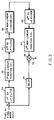
- FIG. 3 is a schematic block diagram of an N stage circuit for a preferred embodiment of the invention.
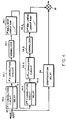
- FIG. 4 is a more detailed schematic block diagram of a two-stage circuit in accordance with the teachings of this invention.
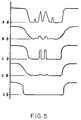
- FIG. 5 illustrates exemplary waveforms appearing at various points in the circuits of FIGS. 3 and 4.
- An ultrasound image is produced by generating a plurality of successive ultrasonic signals at different angles which are projected into the patient, recording the echoes received on each such signal and processing echoes to obtain a desired image.
- the image signal may then be scan converted to an X-Y pixel display format, polar coordinate display format or other display format suitable for presentation on a standard cathode ray tube monitor. While, for purposes of the following discussion, an X-Y display format is assumed, other display formats may be utilized with appropriate changes in circuitry.
- FIG. 1 An example of such image is shown in FIG. 1 for a body portion producing a speckle pattern in tissue areas 12 and 14 and having a blood pool area 16, for example an artery, in which there is a certain amount of clutter.
- the clutter is represented by the extraneous images 18 appearing in area 16. Since images of the tissue have a speckle pattern, and the clutter in blood pool area 16 can also provide a speckle appearance, it may be difficult in some situations to clearly distinguish between blood and tissue in border areas. However, since one objective of an ultrasonic scan may be to detect abnormalities in heart chambers or arteries, any loss of contrast at tissue boundaries may impede the ability of the physician to adequately detect such abnormalities. Therefore, it is desirable that an improved technique be provided for eliminating clutter 18 and for thus enhancing the contrast between blood pool area 16 and adjacent tissue areas 12 and 14.
- a straight thresholding to eliminate clutter causes sufficient degradation of tissue signal so as to be of little if any benefit in contrast enhancement. It is, therefore, preferable that a technique be provided for suppressing clutter 18 without also suppressing images in tissue areas 12 and 14.
- One way in which this might be accomplished is to generate a mask 20 (FIG. 2) which has no effect on the image in tissue areas 12 and 14, while causing full suppression in blood pool area 16.
- This mask which is adaptive to the image scanned, may then be mixed with the scanned image to achieve the desired selective suppression of clutter without also causing tissue degradation as with existing systems.
- the mask image is one in tissue areas to be saved and is zero in blood pool areas to be blocked.
- FIG. 3 is a generalized block diagram of a circuit adapted for generating the desired mask 20 and for mixing the mask with the image signal to achieve the desired clutter suppression.
- the circuit of FIG. 3 would be inserted in the system between the scan conversion circuitry and the display so that the inputs on line 30 are a pixel-by-pixel representation of the image to be displayed.
- the inputs on line 30 represent pixels starting in the upper left-hand corner of the image shown in FIG. 1 and proceeding for successive X positions in the right-hand direction.
- N bits which may be indicative of a particular gray scale value or color.
- the image will be substantially solid black for gray scale presentations or a solid selected other color for color images.
- Pixels on line 30 are applied both to a first two-dimensional low-pass filter 32 and to a compensating delay circuit 34.
- Filter 32 is the first element of the mask generating circuitry.
- Delay 34 is to compensate for processing delays in the mask generating circuity so that the mask value for a given pixel will arrive at a modulation mixer 36 at the same time as the image signal on line 30.
- Low-pass filter 32 is preferably a box car integrator or finite impulse response (FIR) filter, the output of which is an average of N successive inputs.
- FIR finite impulse response
- the effect of the integration or filtering is to somewhat blur boundaries.
- the signal on line 30 had an appearance such as that shown on line A of FIG. 5, which is a signal for a scan line such as line S in FIG. 1, with 0 being black and 1 being white.
- Successive pixels on a given line represent tissue which would have some speckle pattern which would have a certain gray level.
- Pixel P1 in FIG. 1 is an example of such a pixel.
- These pixels appear on the left and right on line A of FIG. 5.
- the dark blood pool shown in the center of this line has a substantially zero value, with clutter in the blood pool causing discrepancies in the blood pool level, some of which have a gray scale which is indistinguishable from that of the tissue.
- Line B of FIG. 5 illustrates an exemplary filter output for the signal on line A.
- the output from filter 32 is applied to a first non-linear function circuit 35, which preferably has a power law, sigmoid-shaped curve or other curve with a generally gentle slope between accept and reject values.
- non-linear circuit 35 would provide a soft threshold.
- the output from this first non-linear function circuit may have dropouts therein rather than the deeper, wider and more randomly-shaped depressions caused by clutter in the original image (line A).
- circuit 35 While the output from circuit 35 may be utilized as the mask signal, it is preferable that this signal be passed through a second two-d low-pass filter 37 and a second non-linear function circuit 38.
- Filter 37 averages out the dropouts, as shown for example on line D of FIG. 5, and non-linear function-circuit 38, which preferably has a sharper threshold than circuit 35, might then provide an output such as that shown on line E.
- the signal on line E might function as the desired mask signal.
- the mask signal on line E for the preferred embodiment is not strictly binary, but contains some intermediate levels to provide a smooth transition between masked and unmasked regions, so as to prevent an unnatural appearance of the final image. However, the mask is still sharp enough to provide significantly enhanced contrasts between these regions.
- FIG. 5 shows the mask being formed in two stages which, as will be discussed in conjunction with FIG. 4, is true for the preferred embodiment, it is possible that additional stages may be required in order to achieve a desired mask such as that shown on line E of FIG. 5 for certain applications. Therefore, FIG. 3 indicates the possibility of additional filter stages such as an Nth two-d low-pass filter stage 40 and a corresponding Nth non-linear function circuit 42. When a polar coordinate or other non-X-Y display format is utilized, two-dimensional convolution filters for such coordinate space would be employed as the filters 21, 35 and 40.
- the output from the Nth non-linear function circuit is connected as the other input to mixer or modulation circuit 36, delay 34 being sufficient such that, for a given pixel, the pixel image and the mask value for the pixel arrive simultaneously.
- the output from circuit 36 is connected over line 44 to either additional processing circuitry or to the image forming circuitry of the ultrasonic scanning system in which the circuit is utilized.
- FIG. 4 is a more detailed circuit diagram for a preferred embodiment of the invention, having two stages in the mask forming leg.
- each two-d low-pass filter consists of a Y convolution circuit or integrator 50.1,50.2 and an X convolution circuit or integrator 52.1,52.2.
- Each Y convolution circuit includes M delay lines, each of which is equal in length to the number of pixels in the X direction with the output from each delay line being fed to the input of the next succeeding delay line. This results in the outputs from the delay lines at any given time being the value from a given X pixel value at successive Y positions. These values are averaged with the incoming X pixel value to obtain the desired Y filter value for the pixel.
- Each X convolution circuit 52 includes an M bit delay, which M bits, along with the current input, are averaged in the circuit to obtain the desired X direction filtering.
- M for both filters is equal to six; however, the M values for the two filters need not be equal.
- each convolution circuit 52 is connected to a corresponding normalization circuit 54.1,54.2, which normalization circuit may be considered to be part of the non-linear function circuit in FIG. 3.
- Normalization circuits 54 operate in known ways to normalize the inputs thereto to values between zero and one.
- each normalization circuit 54 is applied as an input to a corresponding non-linear table lookup RAM 56.1,56.2.
- This is a standard circuit having an address position for each possible output from normalization circuit 54 and being addressed by the outputs from the normalization circuit.
- the value stored at each address is the desired non-linear function output corresponding to the address input from the normalization circuit.
- the non-linear function for circuit 56.1 would be a softer, less steeply sloped function, while the function for circuit 56.2 would be a steeper non-linear function.
- the output from circuit 56.2 is connected as one input to modulating mixer 36, the other input to this mixer being from compensation delay 34, which delay performs the function described for this delay in conjunction with FIG. 3.
- the processed mask value for each pixel is applied to mixer 36 at the same time the raw value for the pixel on line 30 is applied to the mixer from delay 34.
- the desired modulated output is thus obtained on line 44.
Landscapes
- Engineering & Computer Science (AREA)
- Computer Networks & Wireless Communication (AREA)
- Physics & Mathematics (AREA)
- General Physics & Mathematics (AREA)
- Radar, Positioning & Navigation (AREA)
- Remote Sensing (AREA)
- Ultra Sonic Daignosis Equipment (AREA)
- Image Processing (AREA)
Applications Claiming Priority (2)
| Application Number | Priority Date | Filing Date | Title |
|---|---|---|---|
| US07/885,582 US5224483A (en) | 1992-05-19 | 1992-05-19 | Adaptive contrast enhancement for scanned ultrasonic image |
| US885582 | 1992-05-19 |
Publications (2)
| Publication Number | Publication Date |
|---|---|
| EP0571084A2 true EP0571084A2 (en) | 1993-11-24 |
| EP0571084A3 EP0571084A3 (enExample) | 1994-04-06 |
Family
ID=25387248
Family Applications (1)
| Application Number | Title | Priority Date | Filing Date |
|---|---|---|---|
| EP93303051A Withdrawn EP0571084A2 (en) | 1992-05-19 | 1993-04-20 | Adaptive contrast enhancement for scanned ultrasonic image |
Country Status (3)
| Country | Link |
|---|---|
| US (1) | US5224483A (enExample) |
| EP (1) | EP0571084A2 (enExample) |
| JP (1) | JP3464013B2 (enExample) |
Cited By (2)
| Publication number | Priority date | Publication date | Assignee | Title |
|---|---|---|---|---|
| WO2000007035A1 (en) * | 1998-07-30 | 2000-02-10 | Boston Scientific Limited | Method and apparatus for spatial and temporal filtering of intravascular ultrasonic image data |
| WO2006117003A1 (en) | 2005-05-02 | 2006-11-09 | Univeyor A/S | System for unloading or loading of cargo |
Families Citing this family (18)
| Publication number | Priority date | Publication date | Assignee | Title |
|---|---|---|---|---|
| US5322067A (en) * | 1993-02-03 | 1994-06-21 | Hewlett-Packard Company | Method and apparatus for determining the volume of a body cavity in real time |
| US5363850A (en) * | 1994-01-26 | 1994-11-15 | Cardiovascular Imaging Systems, Inc. | Method for recognition and reduction of blood speckle in blood vessel imaging system |
| JP2949186B2 (ja) * | 1994-03-18 | 1999-09-13 | 富士通株式会社 | 画像処理方法及び画像処理装置 |
| US5487389A (en) * | 1994-12-29 | 1996-01-30 | Siemens Medical Systems, Inc. | Ultrasonic Doppler imager having an adaptive tissue rejection filter with enhanced tissue motion sensitivity |
| US5479926A (en) * | 1995-03-10 | 1996-01-02 | Acuson Corporation | Imaging system display processor |
| JP3580627B2 (ja) * | 1996-01-29 | 2004-10-27 | 株式会社東芝 | 超音波診断装置 |
| US5876343A (en) * | 1997-09-23 | 1999-03-02 | Scimed Life Systems, Inc. | Methods and apparatus for blood speckle detection in an intravascular ultrasound imaging system |
| JP4574768B2 (ja) * | 1998-11-16 | 2010-11-04 | 株式会社東芝 | 3次元超音波診断装置 |
| US6352509B1 (en) * | 1998-11-16 | 2002-03-05 | Kabushiki Kaisha Toshiba | Three-dimensional ultrasonic diagnosis apparatus |
| US6775400B1 (en) | 1999-10-29 | 2004-08-10 | Acuson Corporation | Medical diagnostic ultrasonic imaging method and apparatus for suppressing electronic noise |
| US6454715B2 (en) | 2000-04-11 | 2002-09-24 | Scimed Life Systems, Inc. | Methods and apparatus for blood speckle detection in an intravascular ultrasound imaging system |
| JP4913601B2 (ja) * | 2003-11-26 | 2012-04-11 | イマコー・インコーポレーテッド | 細いプローブを使用する経食道超音波 |
| JP4555207B2 (ja) | 2005-10-18 | 2010-09-29 | Necディスプレイソリューションズ株式会社 | 画質改善装置および画質改善方法 |
| US7726155B2 (en) * | 2006-07-07 | 2010-06-01 | Johns Manville | Cooling apparatus for fiberizing bushings |
| JP2009005888A (ja) * | 2007-06-28 | 2009-01-15 | Ge Medical Systems Global Technology Co Llc | 超音波撮像装置 |
| US20090177086A1 (en) * | 2008-01-09 | 2009-07-09 | Erik Normann Steen | Method and apparatus for selectively enhancing ultrasound image data |
| EP3179919B1 (en) * | 2014-08-14 | 2021-02-17 | Koninklijke Philips N.V. | Acoustic streaming for fluid pool detection and identification |
| JP7376031B2 (ja) | 2019-07-29 | 2023-11-08 | ユン、サム ヨル | 陰圧を維持する逆行性経皮的胆汁排液術用の胆汁排液機構 |
Family Cites Families (6)
| Publication number | Priority date | Publication date | Assignee | Title |
|---|---|---|---|---|
| US4213150A (en) * | 1978-04-21 | 1980-07-15 | Northrop Corporation | Real-time edge processing unit |
| US4646355A (en) * | 1985-03-15 | 1987-02-24 | Tektronix, Inc. | Method and apparatus for input picture enhancement by removal of undersired dots and voids |
| US4771470A (en) * | 1985-11-14 | 1988-09-13 | University Of Florida | Noise reduction method and apparatus for medical ultrasound |
| JPS6363436A (ja) * | 1986-09-02 | 1988-03-19 | 株式会社東芝 | 超音波診断装置 |
| DE69029211T2 (de) * | 1989-02-16 | 1997-03-27 | Fujitsu Ltd | Ultraschalldiagnosegerät zum Charakterisieren von Gewebe durch Analyse von Rückstreustrahlung |
| JPH0790026B2 (ja) * | 1989-08-25 | 1995-10-04 | 株式会社東芝 | 超音波診断装置 |
-
1992
- 1992-05-19 US US07/885,582 patent/US5224483A/en not_active Expired - Lifetime
-
1993
- 1993-04-20 EP EP93303051A patent/EP0571084A2/en not_active Withdrawn
- 1993-05-19 JP JP11733693A patent/JP3464013B2/ja not_active Expired - Fee Related
Cited By (3)
| Publication number | Priority date | Publication date | Assignee | Title |
|---|---|---|---|---|
| WO2000007035A1 (en) * | 1998-07-30 | 2000-02-10 | Boston Scientific Limited | Method and apparatus for spatial and temporal filtering of intravascular ultrasonic image data |
| US6181810B1 (en) | 1998-07-30 | 2001-01-30 | Scimed Life Systems, Inc. | Method and apparatus for spatial and temporal filtering of intravascular ultrasonic image data |
| WO2006117003A1 (en) | 2005-05-02 | 2006-11-09 | Univeyor A/S | System for unloading or loading of cargo |
Also Published As
| Publication number | Publication date |
|---|---|
| EP0571084A3 (enExample) | 1994-04-06 |
| JPH0663046A (ja) | 1994-03-08 |
| JP3464013B2 (ja) | 2003-11-05 |
| US5224483A (en) | 1993-07-06 |
Similar Documents
| Publication | Publication Date | Title |
|---|---|---|
| US5224483A (en) | Adaptive contrast enhancement for scanned ultrasonic image | |
| JPH0568147B2 (enExample) | ||
| US5892551A (en) | Circuit and method for reducing flicker | |
| CA2338724A1 (en) | Method and apparatus for spatial and temporal filtering of intravascular ultrasonic image data | |
| EP0849940A2 (en) | An apparatus for converting gray levels of an image, a method thereof, a program storage device thereof, and an infrared camera | |
| US6072892A (en) | Eye position detecting apparatus and method therefor | |
| US20090016635A1 (en) | Edge-enhancement device and edge-enhancement method | |
| AU767050B2 (en) | Contour correction device | |
| US5687258A (en) | Border treatment in image processing algorithms | |
| EP0505948B1 (en) | Ultrasonic diagnosing apparatus | |
| JP2921973B2 (ja) | 特定物体の画像抽出方法及び画像抽出装置 | |
| JPH09319869A (ja) | 画像エンハンサ | |
| EP0647062A1 (en) | Filter architecture, particularly for video applications | |
| EP1526741B1 (en) | Method and Apparatus for temporally recursive chrominance signal noise reduction | |
| JPH06319152A (ja) | 時空間画像フィルタ | |
| JP3165225B2 (ja) | 画像処理装置および画像処理方法 | |
| JP3014102B2 (ja) | 輪郭補正回路 | |
| TW436752B (en) | Method of processing a video signal for a matrix display using temporal type modulation for display | |
| US5588433A (en) | Ultrasonic diagnostic apparatus | |
| JP2000152268A (ja) | 映像信号処理装置 | |
| JPH08322838A (ja) | 超音波画像処理方法及び装置 | |
| JP2933626B2 (ja) | 内視鏡画像処理装置 | |
| JPS63209373A (ja) | 映像信号処理回路 | |
| CN118521506A (zh) | 一种图像处理的方法、装置及系统 | |
| JPH05277101A (ja) | 超音波診断装置 |
Legal Events
| Date | Code | Title | Description |
|---|---|---|---|
| PUAI | Public reference made under article 153(3) epc to a published international application that has entered the european phase |
Free format text: ORIGINAL CODE: 0009012 |
|
| AK | Designated contracting states |
Kind code of ref document: A2 Designated state(s): DE FR GB NL |
|
| PUAL | Search report despatched |
Free format text: ORIGINAL CODE: 0009013 |
|
| AK | Designated contracting states |
Kind code of ref document: A3 Designated state(s): DE FR GB NL |
|
| 17P | Request for examination filed |
Effective date: 19940509 |
|
| 17Q | First examination report despatched |
Effective date: 19980522 |
|
| STAA | Information on the status of an ep patent application or granted ep patent |
Free format text: STATUS: THE APPLICATION IS DEEMED TO BE WITHDRAWN |
|
| 18D | Application deemed to be withdrawn |
Effective date: 19981002 |