EP0568898B1 - Benzothiepin-, Benzothiopyran- und Benzothiophenderivate, deren Herstellung und Verwendung als Heilmittel - Google Patents
Benzothiepin-, Benzothiopyran- und Benzothiophenderivate, deren Herstellung und Verwendung als Heilmittel Download PDFInfo
- Publication number
- EP0568898B1 EP0568898B1 EP93106773A EP93106773A EP0568898B1 EP 0568898 B1 EP0568898 B1 EP 0568898B1 EP 93106773 A EP93106773 A EP 93106773A EP 93106773 A EP93106773 A EP 93106773A EP 0568898 B1 EP0568898 B1 EP 0568898B1
- Authority
- EP
- European Patent Office
- Prior art keywords
- dimethyl
- dioxo
- benzothiepin
- tetrahydro
- formula
- Prior art date
- Legal status (The legal status is an assumption and is not a legal conclusion. Google has not performed a legal analysis and makes no representation as to the accuracy of the status listed.)
- Expired - Lifetime
Links
- 0 CC(C)(**1)c2c1cc(*)c(*)c2 Chemical compound CC(C)(**1)c2c1cc(*)c(*)c2 0.000 description 4
Classifications
-
- C—CHEMISTRY; METALLURGY
- C07—ORGANIC CHEMISTRY
- C07D—HETEROCYCLIC COMPOUNDS
- C07D333/00—Heterocyclic compounds containing five-membered rings having one sulfur atom as the only ring hetero atom
- C07D333/50—Heterocyclic compounds containing five-membered rings having one sulfur atom as the only ring hetero atom condensed with carbocyclic rings or ring systems
- C07D333/52—Benzo[b]thiophenes; Hydrogenated benzo[b]thiophenes
- C07D333/54—Benzo[b]thiophenes; Hydrogenated benzo[b]thiophenes with only hydrogen atoms, hydrocarbon or substituted hydrocarbon radicals, directly attached to carbon atoms of the hetero ring
-
- A—HUMAN NECESSITIES
- A61—MEDICAL OR VETERINARY SCIENCE; HYGIENE
- A61P—SPECIFIC THERAPEUTIC ACTIVITY OF CHEMICAL COMPOUNDS OR MEDICINAL PREPARATIONS
- A61P17/00—Drugs for dermatological disorders
-
- A—HUMAN NECESSITIES
- A61—MEDICAL OR VETERINARY SCIENCE; HYGIENE
- A61P—SPECIFIC THERAPEUTIC ACTIVITY OF CHEMICAL COMPOUNDS OR MEDICINAL PREPARATIONS
- A61P37/00—Drugs for immunological or allergic disorders
- A61P37/02—Immunomodulators
- A61P37/06—Immunosuppressants, e.g. drugs for graft rejection
-
- C—CHEMISTRY; METALLURGY
- C07—ORGANIC CHEMISTRY
- C07D—HETEROCYCLIC COMPOUNDS
- C07D335/00—Heterocyclic compounds containing six-membered rings having one sulfur atom as the only ring hetero atom
- C07D335/04—Heterocyclic compounds containing six-membered rings having one sulfur atom as the only ring hetero atom condensed with carbocyclic rings or ring systems
- C07D335/06—Benzothiopyrans; Hydrogenated benzothiopyrans
-
- C—CHEMISTRY; METALLURGY
- C07—ORGANIC CHEMISTRY
- C07D—HETEROCYCLIC COMPOUNDS
- C07D337/00—Heterocyclic compounds containing rings of more than six members having one sulfur atom as the only ring hetero atom
- C07D337/02—Seven-membered rings
- C07D337/06—Seven-membered rings condensed with carbocyclic rings or ring systems
- C07D337/08—Seven-membered rings condensed with carbocyclic rings or ring systems condensed with one six-membered ring
Definitions
- the invention further relates to pharmaceutical preparations on the Basis of compounds of formula I or their salts and a Process for the preparation of compounds I.
- C 1-6 used here denotes groups with up to 6 coblene atoms; Groups with 1-4 coblene atoms, such as methyl, ethyl, isopropyl or 2-methylpropyl, are preferred.
- C 7-10 alkyl and C 7-10 alkoxy denotes alkyl and alkoxy groups with 7-10 carbon atoms, such as heptyl, octyl, nonyl and decyl.
- reaction of compound II with compounds III or IV and the reaction of compound V with compound VI can follow known methods of the Wittig or Horner reaction carried out will.
- the reaction of compounds with triphenylphosphonium groups can be carried out in the presence of an acid-binding agent, for example a strong base, such as butyllithium, sodium hydride or the sodium salt of dimethyl sulfoxide, but primarily in the presence of an ethylene oxide such as 1 which may be substituted by C 1-6 alkyl , 2-butylene oxide, optionally in a solvent, for example in an ether, such as diethyl ether or tetrahydrofuran, or in an aromatic hydrocarbon, such as benzene, in a temperature range between room temperature and the boiling point of the reaction mixture.
- an acid-binding agent for example a strong base, such as butyllithium, sodium hydride or the sodium salt of dimethyl sulfoxide, but primarily in the presence of an ethylene oxide such as 1 which may be substituted by C 1-6 alkyl , 2-butylene oxide, optionally in a solvent, for example in an ether, such as diethyl ether or
- Examples of anions Y - in the Wittig reagent are Cl - , Br - , HSO 4 - and tosylate.
- Implementation of compounds with dialkoxyphosphinyl groups can in the presence of a base and, preferably, in Presence of an inert organic solvent, e.g. in present of sodium hydride in benzene, toluene, dimethylformamide, tetrahydrofuran, Dioxane or 1,2-dimethoxyalkane, or even sodium alcoholate in one Alkanol, e.g. Sodium methylate in methanol, in a temperature between 0 ° and Boiling point of the reaction mixture lying temperature range be performed.
- an inert organic solvent e.g. in present of sodium hydride in benzene, toluene, dimethylformamide, tetrahydrofuran, Dioxane or 1,2-dimethoxyalkane, or even sodium alcoholate in one Alkanol, e.g. Sodium methylate in methanol, in a temperature between 0 ° and Boiling point of the reaction mixture lying temperature range be
- a carboxylic acid ester of the formula I thus obtained can in itself known way, e.g. by treatment with alkalis, in particular by Treat with aqueous alcoholic sodium or potassium hydroxide in one between room temperature and the boiling point of the reaction mixture lying temperature range are hydrolyzed.
- the carboxylic acid of the formula I thus obtained can be known per se Isolated as such or as a salt, e.g. as an alkali salt, in particular be isolated as Na or K salt.
- a compound of the formula I in which X is -S- can be oxidized by known methods to give a compound of the formula I in which X is -SO - or -SO 2 - .
- the oxidation can be carried out with oxidizing agents such as periodates, for example NaJO 4 or with organic peracids, such as m-chloroperbenzoic acid.
- oxidizing agents such as periodates, for example NaJO 4
- organic peracids such as m-chloroperbenzoic acid.
- the compounds of the formula I can be used as double bond isomers available. Most of them fall into the trans or alltrans form during manufacture on. Any cis isomers obtained can in themselves known manner, if desired, are separated.
- EP-A-0 2909 130 and US-A-4 980 369 describe compounds which are structurally similar to the compounds containing structural element (b) and which have an ethynylene radical instead of the alkenyl radical which connects the ring systems to one another.
- the compounds of formula I are inhibitors of the retinoic acid a receptor (RARa receptor). It has been found that the compounds of Formula I suppress retinoid-induced fetal malformations. The Compounds of the formula I can therefore be used to prevent teratogenic Effects used in the therapeutic application of Retinoids can occur.
- RARa receptor retinoic acid a receptor
- the compounds of formula I can also be used for treatment and Prevention of disease conditions used by a Overregulation of the RAR ⁇ receptor can be caused.
- autoimmune diseases or other diseases a strongly immunological component such as Psoriasis or others dermatological affections.
- the compounds of formula I and their salts can be in the form pharmaceutical preparations are used.
- the preparations for systemic use can e.g. be prepared by using a compound of formula I or a salt thereof as an effective ingredient of non-toxic, inert, per se Adds usual solid or liquid carriers in such preparations.
- the agents can be administered enterally, parenterally or topically.
- enteral application e.g. Tablets; Capsules, dragees, syrups, suspensions, solutions and suppositories.
- parenteral administration there are means in the form of infusion or Suitable injection solutions.
- the compounds can be used for enteral and parenteral administration of formula I in amounts of about 1-100 mg, preferably 5-30 mg / day, administered to adults.
- the active ingredients are appropriately in Form of ointments, tinctures, creams, solutions, lotions, sprays, Suspensions and the like are used. Ointments and are preferred Creams and solutions. These are intended for topical use Preparations can be made by using the process products as an active ingredient non-toxic, inert, for topical Treatment suitable solid or conventional in such preparations admixed with liquid carriers.
- 0.1-5% is appropriate, preferably 0.3-2% solutions, as well as approximately 0.1-5%, preferably approximately 0.3-2%, Suitable for ointments or creams.
- An antioxidant e.g. Tocopherol, N-methyl- ⁇ -tocopheramine and butylated hydroxyanisole or butylated hydroxytoluene can be added.
- the Z-connection can be made by irradiation with a high pressure mercury lamp are converted into a 1: 1 mixture of the E / Z isomers in THF that obtained by pure preparative HPLC further pure E-connection can be.
- Hard gelatin capsules can be made as follows: Components mg / capsule 1. spray-dried powder containing 75% of compound I. 20th 2. Sodium dioctyl sulfosuccinate 0.2 3. Sodium carboxymethyl cellulose 4.8 4. microcrystalline cellulose 86.0 5. Talk 8.0 6. Magnesium stearate 1.0 Total 120
- the spray dried powder that is based on the active ingredient, gelatin and microcrystalline cellulose based and an average grain size of the active ingredient of ⁇ 1 ⁇ (measured using autocorrelation spectroscopy), is mixed with an aqueous solution of sodium carboxymethyl cellulose and Sodium dioctyl sulfosuccinate moistened and kneaded.
- the resulting one Mass is granulated, dried and sieved, and the granules obtained mixed with microcrystalline cellulose, talc and magnesium stearate.
- the powder is filled into size 0 capsules.
- Tablets can be made as follows: Components mg / tablet 1. Compound I as a finely ground powder 20th 2. Milk sugar powder. 100 3. White cornstarch 60 4. Povidone K30 8th 5. White cornstarch 112 6. Talk 16 7. Magnesium stearate 4th Total 320
- the finely ground substance is mixed with milk sugar and part of the Mixed cornstarch.
- the mixture is mixed with an aqueous solution of Povidone K30 moistened and kneaded, and the resulting mass granulated, dried and sieved.
- the granules are mixed with the remaining corn starch, Talc and magnesium stearate mixed and more suitable for tablets Size pressed.
- Soft gelatin capsules can be made as follows: Components mg / capsule 1. Compound I 5 2. Triglyceride 450 Total 455
- a lotion can be made as follows: Components 1. Compound I, finely ground 1.0 g 2. Carbopol 934 0.6 g 3. Sodium hydroxide qs ad pH 6 4. ethanol, 94% 50.0 g 5. demineralized water ad 100.0 g
- the active ingredient is protected from light in the mixture of ethanol, 94% / water incorporated.
- Carbopol 934 will be complete Gelling stirred in and the pH adjusted with sodium hydroxide.
Landscapes
- Organic Chemistry (AREA)
- Chemical & Material Sciences (AREA)
- Health & Medical Sciences (AREA)
- Engineering & Computer Science (AREA)
- Bioinformatics & Cheminformatics (AREA)
- Immunology (AREA)
- Life Sciences & Earth Sciences (AREA)
- Public Health (AREA)
- Medicinal Chemistry (AREA)
- Nuclear Medicine, Radiotherapy & Molecular Imaging (AREA)
- Chemical Kinetics & Catalysis (AREA)
- Pharmacology & Pharmacy (AREA)
- Veterinary Medicine (AREA)
- Animal Behavior & Ethology (AREA)
- General Health & Medical Sciences (AREA)
- General Chemical & Material Sciences (AREA)
- Transplantation (AREA)
- Dermatology (AREA)
- Pharmaceuticals Containing Other Organic And Inorganic Compounds (AREA)
- Heterocyclic Compounds Containing Sulfur Atoms (AREA)
- Nitrogen And Oxygen Or Sulfur-Condensed Heterocyclic Ring Systems (AREA)
- Plural Heterocyclic Compounds (AREA)
- Heterocyclic Carbon Compounds Containing A Hetero Ring Having Oxygen Or Sulfur (AREA)
- Heterocyclic Carbon Compounds Containing A Hetero Ring Having Nitrogen And Oxygen As The Only Ring Hetero Atoms (AREA)
Description

- R1
- C7-10-Alkyl oder C7-10-Alkoxy;
- R2
- einen Rest der Formeln

- R3
- Carboxy oder C1-6-Alkoxycarbonyl; und n 1,2 oder 3 darstellt; und Salze von Carbonsäuren der Formel I.


- DMF
- Dimethylformamid
- DMSO
- Dimethylsulfoxid
- THF
- Tetrahydrofuran
- RT
- Raumtemperatur
- F.p.
- Schmelzpunkt
- i.V.
- im Vakuum
- EtOEt
- Diäthyläther
- tBuOH
- tert.-Butanol
- AcOEt
- Aethylacetat
| Bestandteile | mg/Kapsel |
| 1. sprühgetrocknetes Pulver enthaltend 75% Verbindung I | 20 |
| 2. Natriumdioctylsulfosuccinat | 0,2 |
| 3. Natriumcarboxymethylcellulose | 4,8 |
| 4. mikrokristalline Cellulose | 86,0 |
| 5. Talk | 8,0 |
| 6. Magnesiumstearat | 1.0 |
| Total | |
| Bestandteile | mg/Tablette |
| 1. Verbindung I als feingemahlenes Pulver | 20 |
| 2. Milchzucker pulv. | 100 |
| 3. Maisstärke weiss | 60 |
| 4. Povidone K30 | 8 |
| 5. Maisstärke weiss | 112 |
| 6. Talk | 16 |
| 7. Magnesiumstearat | 4 |
| Total | |
| Bestandteile | mg/Kapsel |
| 1. Verbindung I | 5 |
| 2. Triglycerid | 450 |
| Total | |
| Bestandteile | |
| 1. Verbindung I, feingemahlen | 1.0 g |
| 2. Carbopol 934 | 0,6 g |
| 3. Natriumhydroxid | q.s. ad pH 6 |
| 4. Aethanol, 94% | 50,0 g |
| 5. entmineralisiertes Wasser | ad 100,0 g |
Claims (13)
- Verbindungen der Formelin der X -S-, -SO- oder -SO2-;

- R1
- C7-10-Alkyl oder C7-10-Alkoxy;
- R2
- einen Rest der Formeln
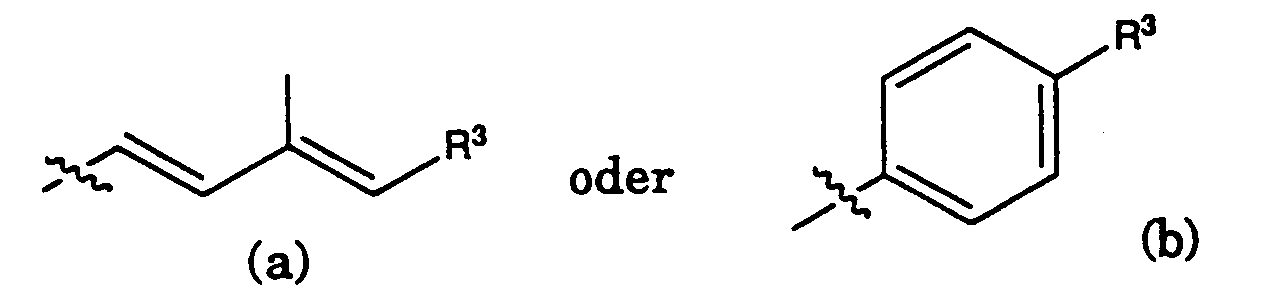
- R3
- Carboxy oder C1-6-Alkoxycarbonyl; und n 1,2 oder 3 darstellt; und Salze von Carbonsäuren der Formel I.
- Verbindungen gemäss Anspruch 1, in denen R1 Heptyl, Octyl, Heptyloxy oder Octyloxy ist.
- Verbindungen gemäss den Ansprüchen 1 oder 2, in denen X = SO2 ist.
- Verbindungen gemäss den Ansprüchen 1-3, in denen R3 Carboxyl ist.
- Verbindungen gemäss den Ansprüchen 1-4, in denen R2 ein Rest der Formel (a) ist.
- Die Verbindungen gemäß Anspruch 5,(all-E)-7-[7-Heptyloxy-3,4-dihydro-4,4-dimethyl-2H-1-benzothiopyran-6-yl]-3-methyl-octa-2,4,6-triensäureäthylester,(all-E)-7-[7-Heptyloxy-3,4-dihydro-4,4-dimethyl-2H-1-benzothiopyran-6-yl]-3-methyl-2,4,6-octatriensäure,(all-E)-7-[7-Heptyloxy-1-oxo-3,4-dihydro-4,4-dimethyl-2H-1-benzothiopyran-6-yl]-3-methyl-octa-2,4,6-triensäure,(all-E)-7-[7'-(Heptyloxy)-3',4'-dihydro-4',4'-dimethyl-2'H-1-benzothiopyran-6'-yl)-3-methyl-2,4,6-octatriensäure-1',1'-dioxid,(2E,4E,6E)-7-(8-Hexyloxy-5,5-dimethyl- 1,1-dioxo-2,3,4,5-tetrahydro-1-benzothiepin-7-yl)-3-methyl-octa-2,4,6-triensäureäthylester,(2E,4E,6E)-7-(8-Heptyloxy-5,5-dimethyl-1,1-dioxo-2,3,4,5-tetrahydro-1-benzothiepin-7-yl)-3-methyl-octa-2,4,6-triensäureäthylester,(2E,4E,6E)-7-(8-Hexyloxy-5,5-dimethyl-1,1-dioxo-2,3,4,5-tetrahydro-1-benzothiepin-7-yl)-3-methyl-octa-2,4,6-triensäure.
- Die Verbindungen gemäß Anspruch 5,(2E,4E,6E)-7-(8-Heptyloxy-5,5-dimethyl-1,1-dioxo-2,3,4,5-tetrahydro-1 benzothiepin-7-yl)-3-methyl-octa-2,4,6-triensäure,(2E,4E,6E)-7-(5,5-Dimethyl-1,1-dioxo-2,3,4,5-tetrahydro-8-octyl-1-benzothiepin-7-yl)-3-methyl-octa-2,4,6-triensäureäthylester,(2E,4E,6E)-7-(5,5-Dimethyl-1,1-dioxo-2,3,4,5-tetrahydro-8-octyl-1-benzothiepin-7-yl)-3-methyl-octa-2,4,6-triensäure.
- Verbindungen gemäss den Ansprüchen 1-4, in denen R2 ein Rest der Formel (b) ist.
- Die Verbindungen gemäß Anspruch 8,Aethyl p-[(E,Z)-2-[3',4'-Dihydro-4',4'-dimethyl-7'-(heptyloxy)-2'H-1-benzothiopyran-6'-yl]propenyl]benzoat-1',1'-dioxid,p-[(E)-2-[3',4'-Dihydro-4',4'-dimethyl-7'-(heptyloxy)-2'H-1-benzothiopyran-6'-yl]propenyl]benzoesäure-1',1'-dioxid,p-[(Z)-2-[3',4'-Dihydro-4',4'-dimethyl-7'-(heptyloxy)-2'H-1-benzothiopyran-6'-yl]propenyl]benzoesäure-1',1'-dioxid,Aethyl-(E)4-[2-(4,4-dimethyl-7-octyl-1,1-dioxo-3,4-dihydro-2H-1-benzothiopyran-6-yl)-propenyl]-benzoat,Aethyl-(Z)4-[2-(4,4-dimethyl-7-octyl-1,1-dioxo-3,4-dihydro-2H-1-benzothiopyran-6-yl)-propenyl]-benzoat,(E)-4-[2-(4,4-Dimethyl-7-octyl-1,1-dioxo-3,4-dihydro-2H-1-benzothiopyran-6-yl)-propenyl]-benzoesäure,(E)-4-[2-(8-Octyloxy-5,5-dimethyl-1,1-dioxo-2,3,4,5-tetrahydro-1-benzothiepin-7-yl)-propenyl]-benzoesäure-methylester,(E)-4-[2-(8-Hexyloxy-5,5-dimethyl-1,1-dioxo-2,3,4,5-tetrahydro-1-benzothiepin-7-yl)-propenyl]-benzoesäure-methylester,(E)-4-[2-(8-Heptyloxy-5,5-dimethyl-1,1-dioxo-2,3,4,5-tetrahydro-1-benzothiepin-7-yl)-propenyl]-benzoesäure-methylester,(E)-4-[2-(8-Heptyloxy-5,5-dimethyl-1,1-dioxo-2,3,4,5-tetrahydro-1-benzothiepin-7-yl)-propenyl]-benzoesäure,(E)-4-[2-(8-Hexyloxy-5,5-dimethyl-1,1-dioxo-2,3,4,5-tetrahydro-1-benzothiepin-7-yl)-propenyl]-benzoesäure,(E)-4-[2-(8-Octyloxy-5,5-dimethyl-1,1-dioxo-2,3,4,5-tetrahydro-1-benzothiepin-7-yl)-propenyl]-benzoesäure,(E)-4-[2-(5,5-Dimethyl-8-octyl-1,1-dioxo-2,3,4,5-tetrahydro-1-benzothiepin-7-yl)-propenyl]-benzoesäure-methylester,(E)-4-[2-(5,5-Dimethyl-8-octyl-1,1-dioxo-2,3,4,5-tetrahydro-1-benzothiepin-7-yl)-propenyl]-benzoesäure.
- Die Verbindungen gemäß Anspruch 8,(E)-4-[2-(6-Heptyloxy-3,3-dimethyl-1,1-dioxo-2,3-dihydro-benzo[b]-thiophen-5-yl)propenyl]-benzoesäuremethylester,(E)-4-[2-(6-Heptyloxy-3,3-dimethyl-1,1-dioxo-2,3-dihydro-benzo[b]-thiophen-5-yl)propenyl]-benzoesäure.
- Verwendung von Verbindungen der Formel I von Anspruch 1 oder Salzen einer Carbonsäure der Formel I bei der Herstellung von pharmazeutischen Präparaten zur Behandlung von Autoimmunerkrankungen oder Erkrankungen mit einer stark immunologischen Komponente, insbesondere Psoriasis.
- Pharmazeutische Präparate, enthaltend eine Verbindung der Formel I von Anspruch 1 oder Salzen einer Carbonsäure der Formel I und übliche pharmazeutische Trägerstoffe.
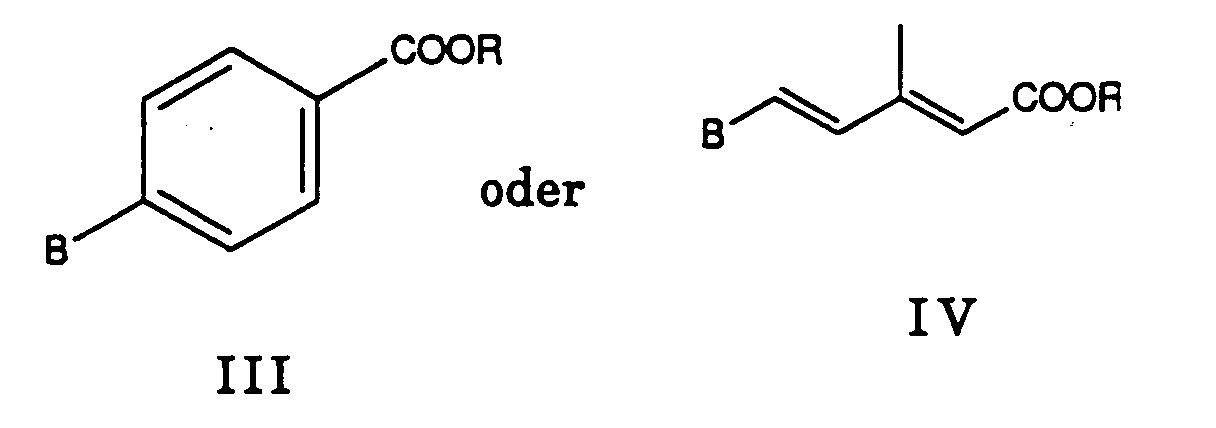
- Verfahren zur Herstellung von Verbindungen der Formel I von Anspruch 1, dadurch gekennzeichnet, dass mana) eine Verbindung der Formelmit einer Verbindung der Formeln
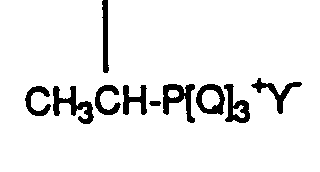
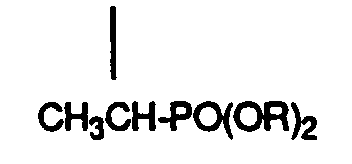
 umsetzt, wobei R C1-6-Alkyl ist und entweder A eine Triphenylphosphoniumäthylgruppe
 oder Dialkoxyphosphinyläthylgruppe
 und B Formyl ist; oder A Acetyl und B eine Triphenylmethylphosphoniumgruppe -CH2- P[Q] + / 3Y- oder eine Dialkoxyphosphinylmethylgruppe -CH2-PO(OR)2 ist; wobei Q Phenyl ist; oder dass man
 b) eine Verbindung der Formelmit einer Verbindung der Formel
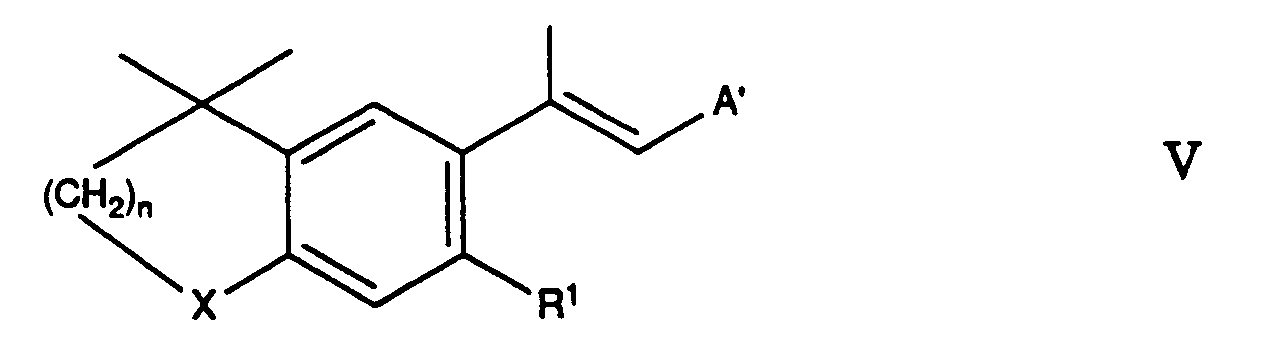 wobei entweder A' eine Triphenylmethylphosphoniumgruppe -CH2-P +[Q]3Y- oder eine Dialkoxyphosphinylmethylgruppe -CH2-PO(OR)2 und B' Formyl ist; oder A' Formyl und B' eine Triphenylmethylphosphoniumgruppe -CH2-P +[Q]3Y- oder eine Dialkoxyphosphinylmethylgruppe -CH2PO(OR2) ist, und wobei n, Q und R die oben angegebene Bedeutung haben,
zu einer Verbindung der Formel I, in der R3 -COOR ist, umsetzt und gewünschtenfalls die Estergruppe -COOR verseift und die erhaltene Carbonsäure als solche oder als Salz isoliert; und/oder eine erhaltene Verbindung der Formel I, in der X oder -S- ist, zu einer Verbindung der Formel I, in der X -SO- oder -SO2- ist, oxidiert.
Applications Claiming Priority (2)
| Application Number | Priority Date | Filing Date | Title |
|---|---|---|---|
| CH146592 | 1992-05-07 | ||
| CH1465/92 | 1992-05-07 |
Publications (2)
| Publication Number | Publication Date |
|---|---|
| EP0568898A1 EP0568898A1 (de) | 1993-11-10 |
| EP0568898B1 true EP0568898B1 (de) | 1998-04-01 |
Family
ID=4211112
Family Applications (1)
| Application Number | Title | Priority Date | Filing Date |
|---|---|---|---|
| EP93106773A Expired - Lifetime EP0568898B1 (de) | 1992-05-07 | 1993-04-27 | Benzothiepin-, Benzothiopyran- und Benzothiophenderivate, deren Herstellung und Verwendung als Heilmittel |
Country Status (13)
| Country | Link |
|---|---|
| US (2) | US5391766A (de) |
| EP (1) | EP0568898B1 (de) |
| JP (1) | JP2549239B2 (de) |
| CN (1) | CN1041417C (de) |
| AT (1) | ATE164580T1 (de) |
| AU (1) | AU666715B2 (de) |
| CA (1) | CA2093577C (de) |
| DE (1) | DE59308325D1 (de) |
| DK (1) | DK0568898T3 (de) |
| ES (1) | ES2115691T3 (de) |
| NZ (1) | NZ247523A (de) |
| PH (1) | PH30350A (de) |
| ZA (1) | ZA933083B (de) |
Families Citing this family (44)
| Publication number | Priority date | Publication date | Assignee | Title |
|---|---|---|---|---|
| US7655699B1 (en) | 1992-04-22 | 2010-02-02 | Eisai Inc. | Compounds having selective activity for retinoid X receptors, and means for modulation of processes mediated by retinoid X receptors |
| US5466861A (en) * | 1992-11-25 | 1995-11-14 | Sri International | Bridged bicyclic aromatic compounds and their use in modulating gene expression of retinoid receptors |
| US5475022A (en) * | 1993-10-18 | 1995-12-12 | Allergan, Inc. | Phenyl or heteroaryl and tetrahydronaphthyl substituted diene compounds having retinoid like biological activity |
| US5994391A (en) * | 1994-09-13 | 1999-11-30 | G.D. Searle And Company | Benzothiepines having activity as inhibitors of ileal bile acid transport and taurocholate uptake |
| US6262277B1 (en) | 1994-09-13 | 2001-07-17 | G.D. Searle And Company | Intermediates and processes for the preparation of benzothiepines having activity as inhibitors of ileal bile acid transport and taurocholate uptake |
| US6642268B2 (en) | 1994-09-13 | 2003-11-04 | G.D. Searle & Co. | Combination therapy employing ileal bile acid transport inhibiting benzothipines and HMG Co-A reductase inhibitors |
| US6268392B1 (en) | 1994-09-13 | 2001-07-31 | G. D. Searle & Co. | Combination therapy employing ileal bile acid transport inhibiting benzothiepines and HMG Co-A reductase inhibitors |
| US6107494A (en) * | 1994-09-13 | 2000-08-22 | G.D. Searle And Company | Substituted 5-aryl-benzothiepines having activity as inhibitors of ileal bile acid transport and taurocholate uptake |
| US5977125A (en) * | 1994-10-31 | 1999-11-02 | Eisai Co., Ltd. | Mono-or polyenic carboxylic acid derivatives |
| US5534261A (en) * | 1995-01-17 | 1996-07-09 | University Of Southern California | Retinoid-based compositions and method for preventing adhesion formation using the same |
| US7115728B1 (en) * | 1995-01-30 | 2006-10-03 | Ligand Pharmaceutical Incorporated | Human peroxisome proliferator activated receptor γ |
| US5807900A (en) * | 1995-03-31 | 1998-09-15 | Hoffmann-La Roche, Inc. | Method for identifying compounds having increased activity for the repair of skin photodamage |
| US5675033A (en) * | 1995-06-06 | 1997-10-07 | Allergan | 2,4-pentadienoic acid derivatives having retinoid-like biological activity |
| JP3964478B2 (ja) | 1995-06-30 | 2007-08-22 | エーザイ・アール・アンド・ディー・マネジメント株式会社 | ヘテロ環含有カルボン酸誘導体及びそれを含有する医薬 |
| BR9610875A (pt) | 1995-10-06 | 1999-07-13 | Ligand Pharm Inc | Modulares rxr seletivos - dimeros e processos para seu uso |
| FR2746098B1 (fr) * | 1996-03-14 | 1998-04-30 | Composes propynyl biaromatiques | |
| FR2752837B1 (fr) * | 1996-09-02 | 1999-11-12 | Cird Galderma | Nouveaux composes modulateurs des recepteurs hormonaux, les compositions les comprenant et leur utilisation en therapie |
| FR2753627B1 (fr) * | 1996-09-20 | 2003-02-21 | Galderma Rech Dermatologique | Utilisation des inhibiteurs de l'activite de l'acide retinoique pour favoriser la cicatrisation |
| FR2755011B1 (fr) * | 1996-10-31 | 1998-11-20 | Cird Galderma | Utilisation des inhibiteurs de l'activite de l'acide retinoique pour traiter les peaux sensibles et/ou les dommages aigus induits par les rayonnements u.v. |
| FR2756561B1 (fr) * | 1996-12-04 | 1999-01-08 | Cird Galderma | Composes heteroaryles, compositions pharmaceutiques et cosmetiques les contenant et utilisations |
| US7098025B1 (en) * | 1997-07-25 | 2006-08-29 | Ligand Pharmaceuticals Incorporated | Human peroxisome proliferator activated receptor gamma (pparγ) gene regulatory sequences and uses therefor |
| EP0908179A1 (de) * | 1997-08-23 | 1999-04-14 | Werner Bollag | Behandlung von zellvermittelten Immunkrankheiten |
| US8541469B2 (en) * | 1997-08-23 | 2013-09-24 | Glaxo Group Limited | Treatment of cell-mediated immune diseases |
| CN1511519A (zh) | 1997-11-12 | 2004-07-14 | - | 2型t辅助细胞介导的免疫病的治疗 |
| US6083973A (en) * | 1998-03-09 | 2000-07-04 | Syntex (U.S.A.) Inc. | Methods for inhibiting mucin secretion using RAR α selective antagonists |
| US6326397B1 (en) | 1998-11-10 | 2001-12-04 | Hoffman-La Roche Inc. | Retinoid antagonists and use thereof |
| PT1140190E (pt) | 1998-12-23 | 2003-02-28 | Searle Llc | Combinacoes de inibidores do transporte ileal dos acidos biliares e agentes sequestrantes dos acidos biliares usadas para problemas cardiovasculares |
| AU2157400A (en) | 1998-12-23 | 2000-07-31 | G.D. Searle & Co. | Combinations of cholesteryl ester transfer protein inhibitors and hmg coa reductase inhibitors for cardiovascular indications |
| EP1140186B1 (de) | 1998-12-23 | 2003-06-04 | G.D. Searle LLC. | Kombinationen von cholesteryl ester transfer protein inhibitoren und fibronsäure derivaten für kardiovaskuläre indikationen |
| DK1140184T3 (da) | 1998-12-23 | 2003-09-29 | Searle Llc | Kombinationer af cholesterylestertransferproteinhæmmere og nikotinsyrederivater til hjertekar indikationer |
| DK1140185T3 (da) | 1998-12-23 | 2003-09-29 | Searle Llc | Kombinationer af cholesterylestertransferhæmmere og galdesyre kompleksdannende forbindelser til hjertekar indikationer |
| EP1342475A1 (de) | 1998-12-23 | 2003-09-10 | G.D. Searle LLC. | Kombinationen von Ileumgallensäuretransportinhibitoren und Cholesterylestertransferproteininhibitoren für kardiovaskuläre Indikationen |
| MXPA01006472A (es) | 1998-12-23 | 2004-03-10 | Searle Llc | Combinaciones de inhibidores de transporte de acido biliar ileal y derivados de acido fibrico para indicaciones cardiovasculares. |
| PL353792A1 (en) | 1999-08-27 | 2003-12-01 | Ligand Pharmaceuticals Incorporatedligand Pharmaceuticals Incorporated | Androgen receptor modulator compounds and methods |
| US6566372B1 (en) * | 1999-08-27 | 2003-05-20 | Ligand Pharmaceuticals Incorporated | Bicyclic androgen and progesterone receptor modulator compounds and methods |
| US6667313B1 (en) | 1999-08-27 | 2003-12-23 | Ligand Pharmaceuticals Inc. | 8-substituted-6-triflouromethyl-9-pyrido [3,2-G] quinoline compounds as androgen receptor modulators |
| WO2001019770A2 (en) * | 1999-09-14 | 2001-03-22 | Ligand Pharmaceuticals Incorporated | Rxr modulators with improved pharmacologic profile |
| EP1286984A2 (de) | 2000-03-10 | 2003-03-05 | Pharmacia Corporation | Verfahren zur herstellung von tetrahydrobenzothiepinen |
| US6740663B2 (en) | 2001-11-02 | 2004-05-25 | G.D. Searle, Llc | Mono- and di-fluorinated benzothiepine compounds as inhibitors of apical sodium co-dependent bile acid transport (ASBT) and taurocholate uptake |
| AU2003207431A1 (en) | 2002-01-17 | 2003-09-02 | Pharmacia Corporation | Novel alkyl/aryl hydroxy or keto thiepines. |
| JP2004020220A (ja) * | 2002-06-12 | 2004-01-22 | Pioneer Electronic Corp | 通信システム及び方法、通信端末装置、通信センタ装置、並びにコンピュータプログラム |
| AU2003294757A1 (en) * | 2002-11-29 | 2004-06-23 | Axxima Pharmaceuticals Ag | Formulations useful against hepatitis c virus infections |
| EP1527774A1 (de) | 2003-11-03 | 2005-05-04 | Basilea Pharmaceutica AG | Neue Zubereitungsform für retinoidhaltige Weichgelatinekapseln |
| US7556150B2 (en) * | 2004-06-07 | 2009-07-07 | Duramed Pharmaceuticals, Inc. | Dispenser for progestin used for acute and maintenance treatment of DUB |
Family Cites Families (7)
| Publication number | Priority date | Publication date | Assignee | Title |
|---|---|---|---|---|
| CH651034A5 (de) * | 1982-05-12 | 1985-08-30 | Hoffmann La Roche | Chroman-, thiochroman- oder 1,2,3,4-tetrahydrochinolinderivate und ihre verwendung als arzneimittel-wirkstoffe. |
| WO1985000806A1 (en) * | 1983-08-08 | 1985-02-28 | Sri International | Benzonorbornenyl, benzopyranyl and benzothiopyranyl retinoic acid analogues |
| US4810804A (en) * | 1987-03-26 | 1989-03-07 | Allergan, Inc. | Acetylenes disubstituted with a phenyl group and a heterobicyclic group having retinoid-like activity |
| US4833254A (en) * | 1987-05-11 | 1989-05-23 | The Board Of Regents For The Oklahoma Agricultural And Mechanical Colleges Acting For And On Behalf Of Oklahoma State University | Heteroarotinoids as anticancer agents |
| GB8800397D0 (en) * | 1988-01-08 | 1988-02-10 | Sandoz Ltd | Improvements in/relating to organic compounds |
| AU626881B2 (en) * | 1988-07-14 | 1992-08-13 | F. Hoffmann-La Roche Ag | Benzofused heterocyclics used as pharmaceuticals |
| US4980369A (en) * | 1989-09-19 | 1990-12-25 | Allergan, Inc. | Acetylenes disubstituted with a phenyl group and a 2-substituted chromanyl or thiochromanyl group having retinoid-like activity |
-
1993
- 1993-04-07 CA CA002093577A patent/CA2093577C/en not_active Expired - Fee Related
- 1993-04-22 AU AU37108/93A patent/AU666715B2/en not_active Ceased
- 1993-04-27 DK DK93106773T patent/DK0568898T3/da active
- 1993-04-27 DE DE59308325T patent/DE59308325D1/de not_active Expired - Fee Related
- 1993-04-27 ES ES93106773T patent/ES2115691T3/es not_active Expired - Lifetime
- 1993-04-27 EP EP93106773A patent/EP0568898B1/de not_active Expired - Lifetime
- 1993-04-27 AT AT93106773T patent/ATE164580T1/de not_active IP Right Cessation
- 1993-04-30 ZA ZA933083A patent/ZA933083B/xx unknown
- 1993-04-30 NZ NZ247523A patent/NZ247523A/en unknown
- 1993-05-04 PH PH46140A patent/PH30350A/en unknown
- 1993-05-05 US US08/057,949 patent/US5391766A/en not_active Expired - Lifetime
- 1993-05-06 JP JP5105530A patent/JP2549239B2/ja not_active Expired - Fee Related
- 1993-05-07 CN CN93105352A patent/CN1041417C/zh not_active Expired - Fee Related
-
1994
- 1994-10-18 US US08/324,836 patent/US5512683A/en not_active Expired - Lifetime
Non-Patent Citations (1)
| Title |
|---|
| CANCER RESEARCH, Band 51, Nr. 18, 15 September 1991; J.M. LEHMANN et al., Seiten 4804-4809 * |
Also Published As
| Publication number | Publication date |
|---|---|
| DK0568898T3 (da) | 1999-01-18 |
| EP0568898A1 (de) | 1993-11-10 |
| JP2549239B2 (ja) | 1996-10-30 |
| CN1041417C (zh) | 1998-12-30 |
| CA2093577C (en) | 2006-01-03 |
| US5391766A (en) | 1995-02-21 |
| AU3710893A (en) | 1993-11-11 |
| PH30350A (en) | 1997-04-02 |
| JPH069616A (ja) | 1994-01-18 |
| AU666715B2 (en) | 1996-02-22 |
| CN1080922A (zh) | 1994-01-19 |
| ES2115691T3 (es) | 1998-07-01 |
| CA2093577A1 (en) | 1993-11-08 |
| ATE164580T1 (de) | 1998-04-15 |
| ZA933083B (en) | 1994-09-26 |
| US5512683A (en) | 1996-04-30 |
| DE59308325D1 (de) | 1998-05-07 |
| NZ247523A (en) | 1995-06-27 |
Similar Documents
| Publication | Publication Date | Title |
|---|---|---|
| EP0568898A1 (de) | Benzothiepin-, Benzothiopyran- und Benzothiophenderivate, deren Herstellung und Verwendung als Heilmittel | |
| EP0315071B1 (de) | Neue Benzocyclohepten-Derivate, deren Herstellung und Verwendung für Pharmazeutika | |
| EP0350846B1 (de) | Neue kondensierte heterocyclische Verbindungen und ihre Verwendung für Heilmittel | |
| EP0098591B1 (de) | Neue heterocyclische Verbindungen und diese enthaltende Rodentizide | |
| DE69928583T2 (de) | Tetrahydrochinolinderivate mit selektiver Aktivität für Retinoid X Rezeptoren | |
| DE60112741T2 (de) | Gamma-selektive retinoide | |
| DD215546A5 (de) | Verfahren zur herstellung bicyclischer thromboxansynthetase-inhibitoren | |
| FR2599027A1 (fr) | Derives de tetrahydronaphtalene et d'indane, utilisation pour la fabrication de preparations pharmaceutiques et procede d'obtention. | |
| DE3715809A1 (de) | Tetrahydronaphthalinderivate | |
| DE3316932A1 (de) | Heterocyclische verbindungen | |
| DE69604713T2 (de) | Retinoide | |
| US5451600A (en) | Substituted tetrahydrobenzopyrrolylfuranoic acid derivatives as phospholipase A2 inhibitors | |
| DE2907862C2 (de) | ||
| EP0085959A2 (de) | Aromatische Verbindungen | |
| DE2941869C2 (de) | ||
| DE2814321A1 (de) | Interphenylen-8-aza-9-dioxothia- 11,12-secoprostaglandine | |
| EP0591046B1 (de) | Chromen-Derivate mit einer Trien-Kette zur Verwendung bei der Behandlung der Osteoporose und der entzündlichen Erkrankungen | |
| DE3915450A1 (de) | Substituierte pyrrolverbindungen und deren anwendung in der pharmazie | |
| EP0087655B1 (de) | Verfahren zur Herstellung von Acemetacin | |
| FR2510113A1 (de) | ||
| JP2801589B2 (ja) | 新規レチノイド | |
| DE69720718T2 (de) | Als entzündungshemmende mittel nützliche dihydrobenzofurane und verwandte verbindungen | |
| DE3302814C2 (de) | ||
| DE2241027A1 (de) | Verfahren zur herstellung neuer heterocyclischer verbindungen | |
| EP0132566B1 (de) | Substituierte Benzophenone |
Legal Events
| Date | Code | Title | Description |
|---|---|---|---|
| PUAI | Public reference made under article 153(3) epc to a published international application that has entered the european phase |
Free format text: ORIGINAL CODE: 0009012 |
|
| 17P | Request for examination filed |
Effective date: 19930427 |
|
| AK | Designated contracting states |
Kind code of ref document: A1 Designated state(s): AT BE CH DE DK ES FR GB GR IE IT LI LU MC NL PT SE |
|
| 17Q | First examination report despatched |
Effective date: 19961107 |
|
| GRAG | Despatch of communication of intention to grant |
Free format text: ORIGINAL CODE: EPIDOS AGRA |
|
| GRAG | Despatch of communication of intention to grant |
Free format text: ORIGINAL CODE: EPIDOS AGRA |
|
| GRAH | Despatch of communication of intention to grant a patent |
Free format text: ORIGINAL CODE: EPIDOS IGRA |
|
| GRAH | Despatch of communication of intention to grant a patent |
Free format text: ORIGINAL CODE: EPIDOS IGRA |
|
| GRAA | (expected) grant |
Free format text: ORIGINAL CODE: 0009210 |
|
| AK | Designated contracting states |
Kind code of ref document: B1 Designated state(s): AT BE CH DE DK ES FR GB GR IE IT LI LU MC NL PT SE |
|
| REF | Corresponds to: |
Ref document number: 164580 Country of ref document: AT Date of ref document: 19980415 Kind code of ref document: T |
|
| REG | Reference to a national code |
Ref country code: CH Ref legal event code: EP |
|
| REF | Corresponds to: |
Ref document number: 59308325 Country of ref document: DE Date of ref document: 19980507 |
|
| ITF | It: translation for a ep patent filed | ||
| REG | Reference to a national code |
Ref country code: ES Ref legal event code: FG2A Ref document number: 2115691 Country of ref document: ES Kind code of ref document: T3 |
|
| GBT | Gb: translation of ep patent filed (gb section 77(6)(a)/1977) |
Effective date: 19980616 |
|
| ET | Fr: translation filed | ||
| REG | Reference to a national code |
Ref country code: IE Ref legal event code: FG4D Free format text: 79550 |
|
| REG | Reference to a national code |
Ref country code: PT Ref legal event code: SC4A Free format text: AVAILABILITY OF NATIONAL TRANSLATION Effective date: 19980414 |
|
| REG | Reference to a national code |
Ref country code: DK Ref legal event code: T3 |
|
| PLBE | No opposition filed within time limit |
Free format text: ORIGINAL CODE: 0009261 |
|
| 26N | No opposition filed | ||
| REG | Reference to a national code |
Ref country code: GB Ref legal event code: IF02 |
|
| PGFP | Annual fee paid to national office [announced via postgrant information from national office to epo] |
Ref country code: DK Payment date: 20050314 Year of fee payment: 13 |
|
| PGFP | Annual fee paid to national office [announced via postgrant information from national office to epo] |
Ref country code: MC Payment date: 20050404 Year of fee payment: 13 |
|
| PGFP | Annual fee paid to national office [announced via postgrant information from national office to epo] |
Ref country code: PT Payment date: 20050406 Year of fee payment: 13 |
|
| PGFP | Annual fee paid to national office [announced via postgrant information from national office to epo] |
Ref country code: IE Payment date: 20050414 Year of fee payment: 13 |
|
| PGFP | Annual fee paid to national office [announced via postgrant information from national office to epo] |
Ref country code: GR Payment date: 20050421 Year of fee payment: 13 |
|
| PGFP | Annual fee paid to national office [announced via postgrant information from national office to epo] |
Ref country code: BE Payment date: 20050428 Year of fee payment: 13 |
|
| PGFP | Annual fee paid to national office [announced via postgrant information from national office to epo] |
Ref country code: LU Payment date: 20050603 Year of fee payment: 13 |
|
| PG25 | Lapsed in a contracting state [announced via postgrant information from national office to epo] |
Ref country code: IE Free format text: LAPSE BECAUSE OF NON-PAYMENT OF DUE FEES Effective date: 20060427 |
|
| PG25 | Lapsed in a contracting state [announced via postgrant information from national office to epo] |
Ref country code: MC Free format text: LAPSE BECAUSE OF NON-PAYMENT OF DUE FEES Effective date: 20060430 Ref country code: LU Free format text: LAPSE BECAUSE OF NON-PAYMENT OF DUE FEES Effective date: 20060430 Ref country code: BE Free format text: LAPSE BECAUSE OF NON-PAYMENT OF DUE FEES Effective date: 20060430 |
|
| PG25 | Lapsed in a contracting state [announced via postgrant information from national office to epo] |
Ref country code: DK Free format text: LAPSE BECAUSE OF NON-PAYMENT OF DUE FEES Effective date: 20060501 |
|
| PG25 | Lapsed in a contracting state [announced via postgrant information from national office to epo] |
Ref country code: PT Free format text: LAPSE BECAUSE OF NON-PAYMENT OF DUE FEES Effective date: 20061027 |
|
| REG | Reference to a national code |
Ref country code: DK Ref legal event code: EBP |
|
| REG | Reference to a national code |
Ref country code: PT Ref legal event code: MM4A Free format text: LAPSE DUE TO NON-PAYMENT OF FEES Effective date: 20061027 |
|
| REG | Reference to a national code |
Ref country code: IE Ref legal event code: MM4A |
|
| BERE | Be: lapsed |
Owner name: F. *HOFFMANN-LA ROCHE A.G. Effective date: 20060430 |
|
| PGFP | Annual fee paid to national office [announced via postgrant information from national office to epo] |
Ref country code: GB Payment date: 20080317 Year of fee payment: 16 |
|
| PGFP | Annual fee paid to national office [announced via postgrant information from national office to epo] |
Ref country code: ES Payment date: 20080421 Year of fee payment: 16 Ref country code: DE Payment date: 20080430 Year of fee payment: 16 Ref country code: CH Payment date: 20080425 Year of fee payment: 16 |
|
| PGFP | Annual fee paid to national office [announced via postgrant information from national office to epo] |
Ref country code: AT Payment date: 20080318 Year of fee payment: 16 |
|
| PGFP | Annual fee paid to national office [announced via postgrant information from national office to epo] |
Ref country code: IT Payment date: 20080419 Year of fee payment: 16 |
|
| PG25 | Lapsed in a contracting state [announced via postgrant information from national office to epo] |
Ref country code: GR Free format text: LAPSE BECAUSE OF NON-PAYMENT OF DUE FEES Effective date: 20061102 |
|
| PGFP | Annual fee paid to national office [announced via postgrant information from national office to epo] |
Ref country code: SE Payment date: 20080404 Year of fee payment: 16 Ref country code: NL Payment date: 20080325 Year of fee payment: 16 |
|
| PGFP | Annual fee paid to national office [announced via postgrant information from national office to epo] |
Ref country code: FR Payment date: 20080403 Year of fee payment: 16 |
|
| REG | Reference to a national code |
Ref country code: CH Ref legal event code: PL |
|
| EUG | Se: european patent has lapsed | ||
| GBPC | Gb: european patent ceased through non-payment of renewal fee |
Effective date: 20090427 |
|
| NLV4 | Nl: lapsed or anulled due to non-payment of the annual fee |
Effective date: 20091101 |
|
| REG | Reference to a national code |
Ref country code: FR Ref legal event code: ST Effective date: 20091231 |
|
| PG25 | Lapsed in a contracting state [announced via postgrant information from national office to epo] |
Ref country code: LI Free format text: LAPSE BECAUSE OF NON-PAYMENT OF DUE FEES Effective date: 20090430 Ref country code: DE Free format text: LAPSE BECAUSE OF NON-PAYMENT OF DUE FEES Effective date: 20091103 Ref country code: CH Free format text: LAPSE BECAUSE OF NON-PAYMENT OF DUE FEES Effective date: 20090430 Ref country code: AT Free format text: LAPSE BECAUSE OF NON-PAYMENT OF DUE FEES Effective date: 20090427 |
|
| PG25 | Lapsed in a contracting state [announced via postgrant information from national office to epo] |
Ref country code: NL Free format text: LAPSE BECAUSE OF NON-PAYMENT OF DUE FEES Effective date: 20091101 |
|
| PG25 | Lapsed in a contracting state [announced via postgrant information from national office to epo] |
Ref country code: GB Free format text: LAPSE BECAUSE OF NON-PAYMENT OF DUE FEES Effective date: 20090427 Ref country code: FR Free format text: LAPSE BECAUSE OF NON-PAYMENT OF DUE FEES Effective date: 20091222 |
|
| REG | Reference to a national code |
Ref country code: ES Ref legal event code: FD2A Effective date: 20090428 |
|
| PG25 | Lapsed in a contracting state [announced via postgrant information from national office to epo] |
Ref country code: ES Free format text: LAPSE BECAUSE OF NON-PAYMENT OF DUE FEES Effective date: 20090428 |
|
| PG25 | Lapsed in a contracting state [announced via postgrant information from national office to epo] |
Ref country code: IT Free format text: LAPSE BECAUSE OF NON-PAYMENT OF DUE FEES Effective date: 20090427 |
|
| PG25 | Lapsed in a contracting state [announced via postgrant information from national office to epo] |
Ref country code: SE Free format text: LAPSE BECAUSE OF NON-PAYMENT OF DUE FEES Effective date: 20090428 |