EP0544165B1 - Phenylchinoxalin-Copolymere - Google Patents
Phenylchinoxalin-Copolymere Download PDFInfo
- Publication number
- EP0544165B1 EP0544165B1 EP92119492A EP92119492A EP0544165B1 EP 0544165 B1 EP0544165 B1 EP 0544165B1 EP 92119492 A EP92119492 A EP 92119492A EP 92119492 A EP92119492 A EP 92119492A EP 0544165 B1 EP0544165 B1 EP 0544165B1
- Authority
- EP
- European Patent Office
- Prior art keywords
- phenylquinoxaline
- copolymers
- copolymer
- structures
- group
- Prior art date
- Legal status (The legal status is an assumption and is not a legal conclusion. Google has not performed a legal analysis and makes no representation as to the accuracy of the status listed.)
- Expired - Lifetime
Links
- 229920001577 copolymer Polymers 0.000 title claims description 38
- QWNCDHYYJATYOG-UHFFFAOYSA-N 2-phenylquinoxaline Chemical compound C1=CC=CC=C1C1=CN=C(C=CC=C2)C2=N1 QWNCDHYYJATYOG-UHFFFAOYSA-N 0.000 claims description 13
- 125000003118 aryl group Chemical group 0.000 claims description 6
- 229910052739 hydrogen Inorganic materials 0.000 claims description 5
- 239000003989 dielectric material Substances 0.000 claims description 4
- 238000004519 manufacturing process Methods 0.000 claims description 4
- 125000000217 alkyl group Chemical group 0.000 claims description 2
- 125000004432 carbon atom Chemical group C* 0.000 claims description 2
- 239000001257 hydrogen Substances 0.000 claims description 2
- 125000004435 hydrogen atom Chemical class [H]* 0.000 claims description 2
- 125000003903 2-propenyl group Chemical group [H]C([*])([H])C([H])=C([H])[H] 0.000 claims 1
- 239000002904 solvent Substances 0.000 description 7
- 239000004642 Polyimide Substances 0.000 description 6
- 150000003949 imides Chemical class 0.000 description 6
- 229920001721 polyimide Polymers 0.000 description 6
- 229920000642 polymer Polymers 0.000 description 6
- 239000002243 precursor Substances 0.000 description 6
- SECXISVLQFMRJM-UHFFFAOYSA-N N-Methylpyrrolidone Chemical compound CN1CCCC1=O SECXISVLQFMRJM-UHFFFAOYSA-N 0.000 description 5
- 150000003254 radicals Chemical class 0.000 description 5
- 239000000758 substrate Substances 0.000 description 5
- ZPSJGADGUYYRKE-UHFFFAOYSA-N 2H-pyran-2-one Chemical compound O=C1C=CC=CO1 ZPSJGADGUYYRKE-UHFFFAOYSA-N 0.000 description 4
- YEJRWHAVMIAJKC-UHFFFAOYSA-N 4-Butyrolactone Chemical compound O=C1CCCO1 YEJRWHAVMIAJKC-UHFFFAOYSA-N 0.000 description 4
- 238000000034 method Methods 0.000 description 4
- 125000000896 monocarboxylic acid group Chemical group 0.000 description 4
- 231100000252 nontoxic Toxicity 0.000 description 4
- 230000003000 nontoxic effect Effects 0.000 description 4
- BCMCBBGGLRIHSE-UHFFFAOYSA-N 1,3-benzoxazole Chemical compound C1=CC=C2OC=NC2=C1 BCMCBBGGLRIHSE-UHFFFAOYSA-N 0.000 description 3
- WPFSJIPFTVNXIW-UHFFFAOYSA-N 1-[2-[2-(2-oxo-2-phenylacetyl)phenoxy]phenyl]-2-phenylethane-1,2-dione Chemical compound C=1C=CC=CC=1C(=O)C(=O)C1=CC=CC=C1OC1=CC=CC=C1C(=O)C(=O)C1=CC=CC=C1 WPFSJIPFTVNXIW-UHFFFAOYSA-N 0.000 description 3
- HYZJCKYKOHLVJF-UHFFFAOYSA-N 1H-benzimidazole Chemical compound C1=CC=C2NC=NC2=C1 HYZJCKYKOHLVJF-UHFFFAOYSA-N 0.000 description 3
- ZGDMDBHLKNQPSD-UHFFFAOYSA-N 2-amino-5-(4-amino-3-hydroxyphenyl)phenol Chemical group C1=C(O)C(N)=CC=C1C1=CC=C(N)C(O)=C1 ZGDMDBHLKNQPSD-UHFFFAOYSA-N 0.000 description 3
- ZMXDDKWLCZADIW-UHFFFAOYSA-N N,N-Dimethylformamide Chemical compound CN(C)C=O ZMXDDKWLCZADIW-UHFFFAOYSA-N 0.000 description 3
- 238000000137 annealing Methods 0.000 description 3
- 150000002460 imidazoles Chemical class 0.000 description 3
- 230000008569 process Effects 0.000 description 3
- 239000004065 semiconductor Substances 0.000 description 3
- NGNBDVOYPDDBFK-UHFFFAOYSA-N 2-[2,4-di(pentan-2-yl)phenoxy]acetyl chloride Chemical compound CCCC(C)C1=CC=C(OCC(Cl)=O)C(C(C)CCC)=C1 NGNBDVOYPDDBFK-UHFFFAOYSA-N 0.000 description 2
- HSTOKWSFWGCZMH-UHFFFAOYSA-N 3,3'-diaminobenzidine Chemical group C1=C(N)C(N)=CC=C1C1=CC=C(N)C(N)=C1 HSTOKWSFWGCZMH-UHFFFAOYSA-N 0.000 description 2
- HEMGYNNCNNODNX-UHFFFAOYSA-N 3,4-diaminobenzoic acid Chemical compound NC1=CC=C(C(O)=O)C=C1N HEMGYNNCNNODNX-UHFFFAOYSA-N 0.000 description 2
- 0 CC(*)(*)c1ccc(C)c(C)c1 Chemical compound CC(*)(*)c1ccc(C)c(C)c1 0.000 description 2
- IAZDPXIOMUYVGZ-UHFFFAOYSA-N Dimethylsulphoxide Chemical compound CS(C)=O IAZDPXIOMUYVGZ-UHFFFAOYSA-N 0.000 description 2
- OFOBLEOULBTSOW-UHFFFAOYSA-N Malonic acid Chemical compound OC(=O)CC(O)=O OFOBLEOULBTSOW-UHFFFAOYSA-N 0.000 description 2
- 229910052581 Si3N4 Inorganic materials 0.000 description 2
- VYPSYNLAJGMNEJ-UHFFFAOYSA-N Silicium dioxide Chemical compound O=[Si]=O VYPSYNLAJGMNEJ-UHFFFAOYSA-N 0.000 description 2
- XUIMIQQOPSSXEZ-UHFFFAOYSA-N Silicon Chemical compound [Si] XUIMIQQOPSSXEZ-UHFFFAOYSA-N 0.000 description 2
- 239000002253 acid Substances 0.000 description 2
- 230000008901 benefit Effects 0.000 description 2
- HFACYLZERDEVSX-UHFFFAOYSA-N benzidine Chemical group C1=CC(N)=CC=C1C1=CC=C(N)C=C1 HFACYLZERDEVSX-UHFFFAOYSA-N 0.000 description 2
- 230000015572 biosynthetic process Effects 0.000 description 2
- 238000009833 condensation Methods 0.000 description 2
- 230000005494 condensation Effects 0.000 description 2
- 238000010438 heat treatment Methods 0.000 description 2
- 229920006254 polymer film Polymers 0.000 description 2
- 238000007363 ring formation reaction Methods 0.000 description 2
- 229910052710 silicon Inorganic materials 0.000 description 2
- 239000010703 silicon Substances 0.000 description 2
- HQVNEWCFYHHQES-UHFFFAOYSA-N silicon nitride Chemical compound N12[Si]34N5[Si]62N3[Si]51N64 HQVNEWCFYHHQES-UHFFFAOYSA-N 0.000 description 2
- 229910052814 silicon oxide Inorganic materials 0.000 description 2
- 238000005496 tempering Methods 0.000 description 2
- FYSNRJHAOHDILO-UHFFFAOYSA-N thionyl chloride Chemical compound ClS(Cl)=O FYSNRJHAOHDILO-UHFFFAOYSA-N 0.000 description 2
- 235000012431 wafers Nutrition 0.000 description 2
- XLYOFNOQVPJJNP-UHFFFAOYSA-N water Substances O XLYOFNOQVPJJNP-UHFFFAOYSA-N 0.000 description 2
- 230000004580 weight loss Effects 0.000 description 2
- 125000000355 1,3-benzoxazolyl group Chemical group O1C(=NC2=C1C=CC=C2)* 0.000 description 1
- QTWJRLJHJPIABL-UHFFFAOYSA-N 2-methylphenol;3-methylphenol;4-methylphenol Chemical compound CC1=CC=C(O)C=C1.CC1=CC=CC(O)=C1.CC1=CC=CC=C1O QTWJRLJHJPIABL-UHFFFAOYSA-N 0.000 description 1
- XOFYHIQHLWORCL-UHFFFAOYSA-N 4,5-diaminophthalic acid Chemical compound NC1=CC(C(O)=O)=C(C(O)=O)C=C1N XOFYHIQHLWORCL-UHFFFAOYSA-N 0.000 description 1
- VQVIHDPBMFABCQ-UHFFFAOYSA-N 5-(1,3-dioxo-2-benzofuran-5-carbonyl)-2-benzofuran-1,3-dione Chemical compound C1=C2C(=O)OC(=O)C2=CC(C(C=2C=C3C(=O)OC(=O)C3=CC=2)=O)=C1 VQVIHDPBMFABCQ-UHFFFAOYSA-N 0.000 description 1
- LYLPPTALHMXNFG-UHFFFAOYSA-N CC(CN(C)C1)C1C(C)(C)C Chemical compound CC(CN(C)C1)C1C(C)(C)C LYLPPTALHMXNFG-UHFFFAOYSA-N 0.000 description 1
- FXHOOIRPVKKKFG-UHFFFAOYSA-N N,N-Dimethylacetamide Chemical compound CN(C)C(C)=O FXHOOIRPVKKKFG-UHFFFAOYSA-N 0.000 description 1
- 229910004298 SiO 2 Inorganic materials 0.000 description 1
- IZALUMVGBVKPJD-UHFFFAOYSA-N benzene-1,3-dicarbaldehyde Chemical compound O=CC1=CC=CC(C=O)=C1 IZALUMVGBVKPJD-UHFFFAOYSA-N 0.000 description 1
- 125000003785 benzimidazolyl group Chemical group N1=C(NC2=C1C=CC=C2)* 0.000 description 1
- UHOVQNZJYSORNB-UHFFFAOYSA-N c1ccccc1 Chemical compound c1ccccc1 UHOVQNZJYSORNB-UHFFFAOYSA-N 0.000 description 1
- 150000008280 chlorinated hydrocarbons Chemical class 0.000 description 1
- 238000000576 coating method Methods 0.000 description 1
- 150000001875 compounds Chemical class 0.000 description 1
- 229930003836 cresol Natural products 0.000 description 1
- XXTZHYXQVWRADW-UHFFFAOYSA-N diazomethanone Chemical compound [N]N=C=O XXTZHYXQVWRADW-UHFFFAOYSA-N 0.000 description 1
- 150000001991 dicarboxylic acids Chemical class 0.000 description 1
- 238000005516 engineering process Methods 0.000 description 1
- 230000007613 environmental effect Effects 0.000 description 1
- 150000002118 epoxides Chemical class 0.000 description 1
- PCHJSUWPFVWCPO-UHFFFAOYSA-N gold Chemical compound [Au] PCHJSUWPFVWCPO-UHFFFAOYSA-N 0.000 description 1
- 239000010931 gold Substances 0.000 description 1
- 229910052737 gold Inorganic materials 0.000 description 1
- 230000006872 improvement Effects 0.000 description 1
- 238000009413 insulation Methods 0.000 description 1
- 239000004922 lacquer Substances 0.000 description 1
- 238000005259 measurement Methods 0.000 description 1
- 238000004377 microelectronic Methods 0.000 description 1
- 239000000203 mixture Substances 0.000 description 1
- 239000003960 organic solvent Substances 0.000 description 1
- 150000002916 oxazoles Chemical class 0.000 description 1
- 239000003973 paint Substances 0.000 description 1
- ISWSIDIOOBJBQZ-UHFFFAOYSA-N phenol group Chemical group C1(=CC=CC=C1)O ISWSIDIOOBJBQZ-UHFFFAOYSA-N 0.000 description 1
- 239000002798 polar solvent Substances 0.000 description 1
- 230000001681 protective effect Effects 0.000 description 1
- 230000009467 reduction Effects 0.000 description 1
- 230000000717 retained effect Effects 0.000 description 1
- 230000003381 solubilizing effect Effects 0.000 description 1
- 238000001228 spectrum Methods 0.000 description 1
- 238000004528 spin coating Methods 0.000 description 1
- 238000003786 synthesis reaction Methods 0.000 description 1
- 150000000000 tetracarboxylic acids Chemical class 0.000 description 1
- 231100000331 toxic Toxicity 0.000 description 1
- 230000002588 toxic effect Effects 0.000 description 1
Classifications
-
- C—CHEMISTRY; METALLURGY
- C08—ORGANIC MACROMOLECULAR COMPOUNDS; THEIR PREPARATION OR CHEMICAL WORKING-UP; COMPOSITIONS BASED THEREON
- C08G—MACROMOLECULAR COMPOUNDS OBTAINED OTHERWISE THAN BY REACTIONS ONLY INVOLVING UNSATURATED CARBON-TO-CARBON BONDS
- C08G73/00—Macromolecular compounds obtained by reactions forming a linkage containing nitrogen with or without oxygen or carbon in the main chain of the macromolecule, not provided for in groups C08G12/00 - C08G71/00
- C08G73/06—Polycondensates having nitrogen-containing heterocyclic rings in the main chain of the macromolecule
- C08G73/0683—Polycondensates containing six-membered rings, condensed with other rings, with nitrogen atoms as the only ring hetero atoms
- C08G73/0694—Polycondensates containing six-membered rings, condensed with other rings, with nitrogen atoms as the only ring hetero atoms with only two nitrogen atoms in the ring, e.g. polyquinoxalines
-
- H—ELECTRICITY
- H01—ELECTRIC ELEMENTS
- H01B—CABLES; CONDUCTORS; INSULATORS; SELECTION OF MATERIALS FOR THEIR CONDUCTIVE, INSULATING OR DIELECTRIC PROPERTIES
- H01B3/00—Insulators or insulating bodies characterised by the insulating materials; Selection of materials for their insulating or dielectric properties
- H01B3/18—Insulators or insulating bodies characterised by the insulating materials; Selection of materials for their insulating or dielectric properties mainly consisting of organic substances
- H01B3/30—Insulators or insulating bodies characterised by the insulating materials; Selection of materials for their insulating or dielectric properties mainly consisting of organic substances plastics; resins; waxes
- H01B3/303—Macromolecular compounds obtained by reactions forming a linkage containing nitrogen with or without oxygen or carbon in the main chain of the macromolecule, not provided for in groups H01B3/38 or H01B3/302
Definitions
- polyphenylquinoxalines For use as dielectrics in multi-layer interconnections with high switching speeds, polyphenylquinoxalines have - compared to the conventional, highly heat-resistant protective and insulating layers based on polyimide (see: “35th Electronic Components Conference", Washington (USA), May 20-22 (1985) - conference report 1985, Pages 192 to 198) - better thermal and electrical properties (see: "First European Technical Symposium on Polyimides", adjoin, May 10-11 (1989) - Proceedings Vol. 1, pages B-2/1 to B-2 / 12). In order to be able to process the polymers into the thin layers required, they must be soluble in solvents that can be used in production lines without environmental problems. Another requirement is that the polymer layers must adhere well to the substrates used in microelectronics.
- polyphenylquinoxalines are only soluble in highly toxic phenolic solvents such as cresol or chlorinated hydrocarbons and show insufficient adhesion to typical semiconductor surfaces such as silicon oxide and silicon nitride.
- the object of the invention is to provide polymers which can be used to produce highly heat-resistant organic dielectrics with good thermal and electrical properties and can be processed in non-toxic solvents.
- the copolymers according to the invention have precursors of oxazoles (1), imides (1), imidazoles (2) and so-called pyrones (3), i.e. Imidazopyrrolonen, as co-component with polar partial structures. While largely maintaining the good thermal and electrical properties of polyphenylquinoxalines, these copolymers show good solubility in common non-toxic solvents, such as ⁇ -butyrolactone and N-methylpyrrolidone, and good adhesion to semiconductor substrates, such as silicon oxide and nitride. The processability in non-toxic solvents and the improved adhesion to semiconductor substrates is achieved through the introduction of the polar partial structures.
- copolymers according to the invention cyclize when heated to about 400 ° C and - with the formation of benzoxazole, imide, benzimidazole and pyrone partial structures - become insoluble in all organic solvents. After cyclization, the good thermal and electrical property spectrum of polyphenylquinoxaline is surprisingly retained. These copolymers are therefore outstandingly suitable for the production of highly heat-resistant dielectrics. Compared to polyimides, it is also advantageous that the reduction in the layer thickness is only 10 to 20% and is thus clearly below that of the polyimides with 30 to 50%.
- the copolymers according to the invention also have the advantage that the introduction of photoreactive groups, for example have photosensitive precursors prepared by adding unsaturated epoxides to OH, NH 2 or COOH groups.
- copolymers according to the invention leads to copolymers with benzoxazole, imide, benzimidazole or pyrone structures.
- copolymers have the following structure, for example:
- the radical R 'on the aromatic group which is adjacent to the CO-NH group must be a COOH group in the starting copolymer.
- the aromatic grouping in this case has only two radicals R ', which are H, F or Cl.
- Lacquer films can be produced from a solution of the copolymer, which release water during annealing at approx. 400 ° C, the o-hydroxy-amide groups cyclizing to give benzoxazole structures.
- Example 2 The procedure is the same as in Example 1, using 4,5-diaminophthalic acid instead of 3,4-diaminobenzoic acid and 4,4'-diaminobiphenyl instead of 3,3'-dihydroxy-4,4'-diaminobiphenyl.
- a copolymer with phenylquinoxaline units and o-carboxy-amide groups (-CO-NH-) is obtained via a tetracarboxylic acid or the corresponding acid chloride as an intermediate, which cyclize to imide structures on annealing at approx. 400 ° C.
- the copolymer can be processed into films.
- the polymer films are annealed at approx. 400 ° C, the o-amino-azomethine groups are cyclized to give benzimidazole structures.
- 3,3 ', 4,4'-tetraaminobiphenyl and benzophenonetetracarboxylic acid dianhydride are converted in a 6: 1 molar ratio to an oligomeric amidocarboxylic acid with terminal o-diamino functions.
- This amidocarboxylic acid is then condensed with oxydibenzil in a molar ratio of 6: 5 to form a copolymer which has both phenylquinoxaline units and o-amino-o'-carboxyamide groups (-CO-NH-).
- copolymers described above are in strongly polar solvents, such as dimethylformamide, dimethyl sulfoxide, Dimethylacetamide and N-methylpyrrolidone, very soluble.
- the substrates for example silicon wafers, were coated with solutions of the copolymers in N-methylpyrrolidone by spin coating.
- the paint films were dried at about 70 ° C for 1 h and then annealed at about 400 ° C for 1 h.
- the copolymers according to the invention are distinguished - in comparison to polyimides - by a significantly higher thermal resistance. Weight loss only occurs above a temperature of 500 ° C. The temperature behavior was determined thermogravimetrically, heating from room temperature to 700 ° C. at a heating rate of 10 ° C./min, and the weight loss being recorded in the process.
- copolymers according to the invention have very good insulation properties.
- the following electrical parameters were determined: Copolymer ⁇ tang ⁇ . 10 3 ⁇ ( ⁇ cm) example 1 3.03 1.3 1.3.10 18 Example 3 3.33 3.25 7.10 17 Example 4 3.08 2.0 1.6.10 18
- the dielectric properties were determined by a capacitance measurement at 25 ° C (humidity: 0%) a measuring frequency of 1 kHz.
- a polymer film was applied to a Cr / Ni-coated silicon wafer and a gold layer was deposited as a counter electrode; the film thickness was approx. 6 ⁇ m.
- copolymers according to the invention behave similarly to phenylquinoxaline polymers with regard to the thermal and dielectric characteristics. Due to the solubilizing OH, NH 2 and COOH groups, these copolymers also show good solubility in non-toxic solvents, such as ⁇ -butyrolactone and N-methylpyrrolidone. The polar groups in the copolymers also bring about an improvement in the adhesion properties on substrate surfaces, such as SiO 2 and Si 3 N 4 .
- the copolymers according to the invention also have the advantage that they are accessible to photostructuring. This can be done indirectly in two-layer technology with O 2 / RIE or directly with photosensitive pre-stages. Mixtures of the chemically bound, photoreactive group-containing copolymers with sensitizers and / or photoinitiators are used, with positive or negative structuring using light, preferably with a wavelength> 400 nm. For example, compounds based on diazoquinone or diazoketone can be used as sensitizers as they are used in common positive coatings.
Landscapes
- Chemical & Material Sciences (AREA)
- Chemical Kinetics & Catalysis (AREA)
- Physics & Mathematics (AREA)
- Spectroscopy & Molecular Physics (AREA)
- Health & Medical Sciences (AREA)
- Medicinal Chemistry (AREA)
- Polymers & Plastics (AREA)
- Organic Chemistry (AREA)
- Macromolecular Compounds Obtained By Forming Nitrogen-Containing Linkages In General (AREA)
- Polymers With Sulfur, Phosphorus Or Metals In The Main Chain (AREA)
- Silicon Polymers (AREA)
- Formation Of Insulating Films (AREA)
Description
- Für die Verwendung als Dielektrika bei Mehrlagenverschaltungen mit hoher Schaltgeschwindigkeit weisen Polyphenylchinoxaline - gegenüber den gängigen hochwärmebeständigen Schutz- und Isolierschichten auf Polyimidbasis (siehe dazu: "35th Electronic Components Conference", Washington (USA), May 20-22 (1985) - Konferenzbericht 1985, Seiten 192 bis 198) - bessere thermische und elektrische Eigenschaften auf (siehe dazu: "First European Technical Symposium on Polyimides", Montpellier, May 10-11 (1989) - Proceedings Vol. 1, Seiten B-2/1 bis B-2/12). Um die Polymeren zu den dabei erforderlichen dünnen Schichten verarbeiten zu können, müssen sie in solchen Lösungsmitteln löslich sein, die in Fertigungslinien ohne Umweltprobleme eingesetzt werden können. Ein weiteres Erfordernis besteht darin, daß die Polymerschichten auf den in der Mikroelektronik verwendeten Substraten gut haften müssen. Keine dieser beiden Anforderungen wird jedoch durch Polyphenylchinoxaline erfüllt. Diese Polymeren sind nämlich nur in stark toxischen phenolischen Lösungsmitteln, wie Kresol, oder chlorierten Kohlenwasserstoffen löslich und zeigen eine unzureichende Haftung auf typischen Halbleiteroberflächen, wie Siliciumoxid und Siliciumnitrid.
- Aufgabe der Erfindung ist es, Polymere bereitzustellen, die zur Herstellung hochwärmebeständiger organischer Dielektrika mit guten thermischen und elektrischen Eigenschaften dienen können und dabei in untoxischen Lösungsmitteln verarbeitet werden können.
- Dies wird erfindungsgemäß durch polare Partialstrukturen aufweisende Phenylchinoxalin-Copolymere der folgenden allgemeinen Formel erreicht:

wobei folgendes gilt:
X =-O- , -CO- , -S- , -SO2- , -(CF2)p- ,


und Z = Alkyl mit 1 bis 10 C-Atomen oder Aryl;
R' =H, F oder Cl;
wobei R" Wasserstoff (H) oder ein olefinisch ungesättigter Rest ist,
und wobei der an der aromatischen Gruppierung zur CO-Gruppe benachbarte Rest R' eine COOH-Gruppe sein kann,
und T = -O- , -CO- oder





- Die erfindungsgemäßen Copolymeren weisen - neben Phenylchinoxalin-Strukturen - Vorstufen von Oxazolen (1), Imiden (1), Imidazolen (2) und sogenannten Pyronen (3), d.h. Imidazopyrrolonen, als Cokomponente mit polaren Partialstrukturen auf. Diese Copolymeren zeigen, unter weitgehender Erhaltung der guten thermischen und elektrischen Eigenschaften von Polyphenylchinoxalinen, eine gute Löslichkeit in gängigen untoxischen Lösungsmitteln, wie γ-Butyrolacton und N-Methylpyrrolidon, sowie eine gute Haftung auf Halbleitersubstraten, wie Siliciumoxid und -nitrid. Die Verarbeitbarkeit in untoxischen Lösungsmitteln und die verbesserte Haftung auf Halbleitersubstraten wird durch die Einführung der polaren Partialstrukturen erreicht.
- Die Copolymeren nach der Erfindung cyclisieren beim Erhitzen auf ca. 400°C und werden - unter Ausbildung von Benzoxazol-, Imid-, Benzimidazol- und Pyron-Partialstrukturen - in allen organischen Lösungsmitteln unlöslich. Nach der Cyclisierung bleibt dabei überraschenderweise das gute thermische und elektrische Eigenschaftsspektrum von Polyphenylchinoxalin erhalten. Diese Copolymeren eignen sich deshalb in hervorragender Weise zur Herstellung hochwärmebeständiger Dielektrika. Im Vergleich zu Polyimiden ist ferner von Vorteil, daß die Reduzierung der Schichtdicke lediglich 10 bis 20 % beträgt und damit deutlich unter derjenigen der Polyimide mit 30 bis 50 % liegt.
- Die erfindungsgemäßen Copolymeren weisen ferner den Vorteil auf, daß sich durch Einführung photoreaktiver Gruppen, beispielsweise durch Addition ungesättigter Epoxide an OH-, NH2- oder COOH-Gruppen, photosensitive Vorstufen herstellen lassen. R" stellt dabei vorzugsweise einen der folgenden olefinisch ungesättigten Reste dar:
R" = -A-O-CH2-CH=CH2 ,


und s = 2 bis 16,
t = 1 bis 10. - Wie bereits ausgeführt, führt die Cyclisierung der erfindungsgemäßen Copolymeren zu Copolymeren mit Benzoxazol-, Imid-, Benzimidazol- oder Pyron-Strukturen. Diese Copolymeren weisen beispielsweise folgenden Aufbau auf:


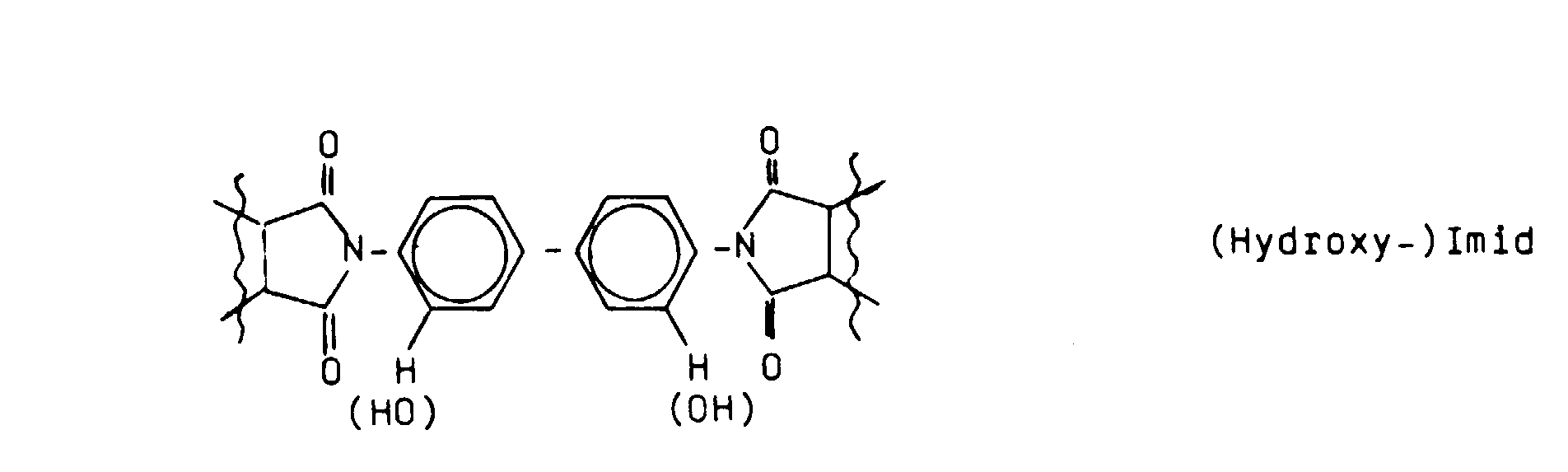


- Im Falle der Herstellung von Copolymeren mit Imid-Strukturen muß dabei - im Ausgangscopolymer - derjenige Rest R' an der aromatischen Gruppierung, der zur CO-NH-Gruppe benachbart ist, eine COOH-Gruppe sein. Dies bedeutet, daß die aromatische Gruppierung in diesem Fall lediglich zwei Reste R' aufweist, welche H, F oder Cl sind.
- Anhand von Ausführungsbeispielen soll die Erfindung noch näher erläutert werden.
- Durch Kondensation von Oxydibenzil (1 mol) mit 3,4-Diaminobenzoesäure (2 mol) wird eine Dicarbonsäure mit Phenylchinoxalineinheiten erhalten. Aus dieser Dicarbonsäure wird das entsprechende Säurechlorid hergestellt. Dazu kann Thionylchlorid dienen. Das Dicarbonsäurechlorid wird anschließend mit 3,3'-Dihydroxy-4,4'-diaminobiphenyl (1 mol) zu einem Copolymer umgesetzt, das sowohl Phenylchinoxalineinheiten als auch o-Hydroxy-amid-Gruppierungen (-CO-NH-) aufweist. Die Herstellung des Copolymers kann im übrigen auch mittels einer sogenannten chloridfreien Synthese erfolgen (siehe dazu EP-OS 0 391 196).
- Aus einer Lösung des Copolymers lassen sich Lackfilme herstellen, die beim Tempern bei ca. 400°C Wasser abspalten, wobei die o-Hydroxy-amid-Gruppierungen zu Benzoxazol-Strukturen cyclisieren.
- Es wird entsprechend Beispiel 1 vorgegangen, wobei anstelle von 3,4-Diaminobenzoesäure 4,5-Diaminophthalsäure und anstelle von 3,3'-Dihydroxy-4,4'-diaminobiphenyl 4,4'-Diaminobiphenyl verwendet wird. Über eine Tetracarbonsäure bzw. das entsprechende Säurechlorid als Zwischenstufe wird dabei ein Copolymer mit Phenylchinoxalineinheiten und o-Carboxy-amid-Gruppierungen (-CO-NH-) erhalten, die beim Tempern auf ca. 400°C zu Imid-Strukturen cyclisieren.
- Wird anstelle von 4,4'-Diaminobiphenyl 3,3'-Dihydroxy-4,4'-diaminobiphenyl eingesetzt, so wird in entsprechender Weise ein Copolymer mit Hydroxyimid-Strukturen erhalten.
- Durch Kondensation von Oxydibenzil und Isophthalaldehyd (Molverhältnis 1:1) mit der doppelten molaren Menge 3,3',4,4'-Tetraaminobiphenyl in einem geeigneten Lösungsmittel, wie N-Methylpyrrolidon, wird ein lösliches Copolymer erhalten, das sowohl Phenylchinoxalineinheiten als auch o-Amino-azomethinGruppierungen (-N=CH-) aufweist.
- Das Copolymer läßt sich zu Filmen verarbeiten. Beim Tempern der Polymerfilme bei ca. 400°C erfolgt eine Cyclisierung der o-Amino-azomethin-Gruppierungen zu Benzimidazol-Strukturen.
- 3,3',4,4'-Tetraaminobiphenyl und Benzophenontetracarbonsäuredianhydrid werden im Molverhältnis 6:1 zu einer oligomeren Amidocarbonsäure mit endständigen o-Diaminofunktionen umgesetzt. Diese Amidocarbonsäure wird anschließend mit Oxydibenzil im Molverhältnis 6:5 zu einem Copolymer kondensiert, das sowohl Phenylchinoxalineinheiten als auch o-Amino-o'-carboxyamid-Gruppierungen (-CO-NH-) aufweist.
- Aus dem Copolymer hergestellte Filme spalten beim Tempern bei ca. 400°C Wasser ab, wobei die o-Amino-o'-carboxy-amid-Gruppierungen zu Pyron-Strukturen cyclisieren.
- Sämtliche der vorstehend beschriebenen Copolymeren sind in stark polaren Lösungsmitteln, wie Dimethylformamid, Dimethylsulfoxid, Dimethylacetamid und N-Methylpyrrolidon, sehr gut löslich. Die Beschichtung der Substrate, beispielsweise Siliciumwafer, die mit Lösungen der Copolymeren in N-Methylpyrrolidon durchgeführt wurde, erfolgte durch Aufschleudern. Die Lackfilme wurden 1 h bei ca. 70°C getrocknet und anschließend 1 h bei ca. 400°C getempert.
- Im Gegensatz zu Phenylchinoxalin-Polymeren erfolgt bei den Copolymeren beim Tempern ein Schichtdickenverlust, da hier teilweise nicht-cyclisierte Prepolymereinheiten vorliegen, die erst durch den Temperprozeß (400°C/l h) in die hochwärmebeständigen Strukturen übergeführt werden. Der hierbei erfolgende Volumenschrumpf ist mit ca. 10 bis 20 % deutlich geringer als bei Polyimiden mit 30 bis 50 %.
- Die Copolymeren nach der Erfindung zeichnen sich - im Vergleich zu Polyimiden - durch eine deutlich höhere thermische Beständigkeit aus. Erst oberhalb einer Temperatur von 500°C tritt nämlich ein Gewichtsverlust auf. Das Temperaturverhalten wurde thermogravimetrisch ermittelt, wobei mit einer Heizrate von 10°C/min von Raumtemperatur auf 700°C aufgeheizt und dabei der Gewichtsverlust aufgezeichnet wurde.
- Die erfindungsgemäßen Copolymeren verfügen über sehr gute Isolationseigenschaften. Es wurden folgende elektrische Kennwerte ermittelt:
Copolymer ε tang δ . 103 ρ(Ω·cm) Beispiel 1 3,03 1,3 1,3.1018 Beispiel 3 3,33 3,25 7.1017 Beispiel 4 3,08 2,0 1,6.1018 - Die Bestimmung der dielektrischen Eigenschaften erfolgte durch eine Kapazitätsmessung bei 25°C (Luftfeuchtigkeit: 0 %) mit einer Meßfrequenz von 1 kHz. Dabei wurde ein Polymerfilm auf einen Cr/Ni-beschichteten Siliciumwafer aufgebracht und eine Goldschicht als Gegenelektrode aufgedampft; die Filmdicke betrug ca. 6 µm.
- Die Copolymeren nach der Erfindung verhalten sich bezüglich der thermischen und dielektrischen Kennwerte ähnlich wie Phenylchinoxalin-Polymere. Diese Copolymeren zeigen, aufgrund der solubilisierenden OH-, NH2- und COOH-Gruppen, zudem eine gute Löslichkeit in nicht-toxischen Lösungsmitteln, wie γ-Butyrolacton und N-Methylpyrrolidon. Die polaren Gruppen in den Copolymeren bewirken zugleich eine Verbesserung der Haftungseigenschaften auf Substratoberflächen, wie SiO2 und Si3N4.
- Die erfindungsgemäßen Copolymeren weisen ferner den Vorteil auf, daß sie einer Photostrukturierung zugänglich sind. Diese kann indirekt in Zweilagentechnik mit O2/RIE erfolgen oder direkt mit photosensitiv eingestellten Vorstufen. Dabei werden Mischungen aus den chemisch gebundene, photoreaktive Gruppen aufweisenden Copolymeren mit Sensibilisatoren und/oder Photoinitiatoren eingesetzt, wobei eine positive oder negative Strukturierung mittels Licht erfolgt, vorzugsweise mit einer Wellenlänge > 400 nm. Als Sensibilisatoren können beispielsweise Verbindungen auf Diazochinon- bzw. Diazoketonbasis eingesetzt werden, wie sie in gängigen Positivlacken Verwendung finden.
Claims (3)
- Phenylchinoxalin-Copolymere mit polaren Partialstrukturen der allgemeinen Formel

wobei folgendes gilt:
X =-O- , -CO- , -S- , -SO2- , -(CF2)p- ,


und Z = Alkyl mit 1 bis 10 C-Atomen oder Aryl;
R' =H, F oder Cl;
wobei R" Wasserstoff (H) oder ein olefinisch ungesättigter Rest ist,
und wobei der an der aromatischen Gruppierung zur CO-Gruppe benachbarte Rest R' eine COOH-Gruppe sein kann,
und T = -O- , -CO- oder


- Phenylchinoxalin-Copolymere nach Anspruch 1, dadurch gekennzeichnet, daß für R" folgendes gilt:
R" = -A-O-CH2-CH=CH2 ,


und s = 2 bis 16,
t = 1 bis 10. - Verwendung der Phenylchinoxalin-Copolymere nach Anspruch 1 oder 2 zur Herstellung hochwärmebeständiger Dielektrika.
Applications Claiming Priority (2)
| Application Number | Priority Date | Filing Date | Title |
|---|---|---|---|
| DE4138862 | 1991-11-26 | ||
| DE4138862 | 1991-11-26 |
Publications (2)
| Publication Number | Publication Date |
|---|---|
| EP0544165A1 EP0544165A1 (de) | 1993-06-02 |
| EP0544165B1 true EP0544165B1 (de) | 1996-06-05 |
Family
ID=6445621
Family Applications (1)
| Application Number | Title | Priority Date | Filing Date |
|---|---|---|---|
| EP92119492A Expired - Lifetime EP0544165B1 (de) | 1991-11-26 | 1992-11-13 | Phenylchinoxalin-Copolymere |
Country Status (4)
| Country | Link |
|---|---|
| US (1) | US5278277A (de) |
| EP (1) | EP0544165B1 (de) |
| JP (1) | JPH05295114A (de) |
| DE (1) | DE59206487D1 (de) |
Families Citing this family (1)
| Publication number | Priority date | Publication date | Assignee | Title |
|---|---|---|---|---|
| US7668415B2 (en) * | 2004-09-27 | 2010-02-23 | Qualcomm Mems Technologies, Inc. | Method and device for providing electronic circuitry on a backplate |
Family Cites Families (15)
| Publication number | Priority date | Publication date | Assignee | Title |
|---|---|---|---|---|
| US3852243A (en) * | 1969-07-31 | 1974-12-03 | Boeing Co | Polyphenylquinoxalines containing latent crosslinking groups |
| US3852244A (en) * | 1973-11-23 | 1974-12-03 | Gen Electric | Polyetherquinoxalines |
| FR2453873A1 (fr) * | 1979-01-19 | 1980-11-07 | Inst Francais Du Petrole | Resines de polyarylquinoxalines thermodurcissables utilisables notamment dans des vernis d'emaillage |
| US4375536A (en) * | 1981-11-12 | 1983-03-01 | The United States Of America As Represented By The Administrator Of The National Aeronautics And Space Administration | Polyphenylquinoxalines containing pendant phenylethynyl and ethynyl groups |
| US4595745A (en) * | 1983-06-27 | 1986-06-17 | Ube Industries, Ltd. | Organic solvent-soluble photosensitive polyamide resin |
| US4788271A (en) * | 1987-03-23 | 1988-11-29 | The United States Of America As Represented By The United States National Aeronautics And Space Administration | Polyphenylquinoxalines containing alkylenedioxy groups |
| US4914177A (en) * | 1987-07-13 | 1990-04-03 | American Telephone And Telegraph Company | Polyquinoxaline polymers, and articles comprising same |
| US4908426A (en) * | 1988-09-28 | 1990-03-13 | The United States Of America As Represented By The Administrator Of The National Aeronautics And Space Administration | Polyphenylquinoxalines via aromatic nucleophilic displacement |
| EP0391196A3 (de) * | 1989-04-06 | 1991-02-27 | Siemens Aktiengesellschaft | Herstellung von Hydroxypolyamiden |
| US5030704A (en) * | 1989-06-20 | 1991-07-09 | The University Of Akron | Self polymerizable phenylquinoxalines, their preparation and use in polyphenylquinoxaline homopolymers and copolymers |
| US5115078A (en) * | 1989-06-20 | 1992-05-19 | The University Of Akron | Self polymerizable phenylquinoxalines, their preparation and use in polyphenylquinoxaline homopolymers and copolymers |
| US5045608A (en) * | 1989-09-27 | 1991-09-03 | Ibm Corporation | Polyimide-poly(phenylquinoxaline) block copolymers |
| US5162495A (en) * | 1989-11-13 | 1992-11-10 | Exxon Research And Engineering Company | Synthesis of quinoline and substituted quinoline copolymers |
| US5175221A (en) * | 1990-02-21 | 1992-12-29 | Exxon Research And Engineering Company | Quaternary salts of polymers having repeating quinoxaline moieties |
| US5149773A (en) * | 1990-02-21 | 1992-09-22 | Exxon Research And Engineering Company | Polyquinoxaline and the method of preparation |
-
1992
- 1992-11-13 EP EP92119492A patent/EP0544165B1/de not_active Expired - Lifetime
- 1992-11-13 DE DE59206487T patent/DE59206487D1/de not_active Expired - Fee Related
- 1992-11-20 JP JP4335570A patent/JPH05295114A/ja active Pending
- 1992-11-25 US US07/982,191 patent/US5278277A/en not_active Expired - Fee Related
Also Published As
| Publication number | Publication date |
|---|---|
| DE59206487D1 (de) | 1996-07-11 |
| US5278277A (en) | 1994-01-11 |
| JPH05295114A (ja) | 1993-11-09 |
| EP0544165A1 (de) | 1993-06-02 |
Similar Documents
| Publication | Publication Date | Title |
|---|---|---|
| DE69913011T2 (de) | Funktionelle Gruppen für die Vernetzung von Polymeren | |
| DE69305318T2 (de) | Verfahren zur Herstellung eines Siliziumoxid-Filmes | |
| EP0513642B1 (de) | Verfahren zur Herstellung dünner Polyimidschutzschichten auf keramischen Supraleitern oder Hochtemperatursupraleitern | |
| EP1048680B1 (de) | Modifiziertes polyimidharz und diese enthaltende wärmehärtende harzzusammensetzung | |
| EP0291778B1 (de) | Verfahren zur Herstellung hochwärmebeständiger Dielektrika | |
| DE69822918T2 (de) | Elektronisches Teil und Verfahren zu seiner Herstellung | |
| DE60218475T2 (de) | Elektrischer gegenstand mit dielektrischer epoxyschicht, die mit aminophenylfluorenen gehärtet ist | |
| EP0157929A1 (de) | Verfahren zur Herstellung von Polyimid- und Polyisoindolochinazolindion-Vorstufen | |
| DE4017279C2 (de) | Polyimidharz-Masse und ihre Verwendung zur Herstellung von Schutzüberzügen | |
| KR101116753B1 (ko) | 고유전 폴리이미드-무기입자 복합체 및 이의 제조방법 | |
| DE68922360T2 (de) | Verfahren zur Herstellung von Metall-Polyimid-Verbundwerkstoffen. | |
| EP1375559B1 (de) | Dielektrikum mit Sperrwirkung gegen Kupferdiffusion | |
| EP0157930B1 (de) | Verfahren zur Herstellung von Polyimid- und Polyisoindolochinazolindion-Reliefstrukturen | |
| DE102008051918A1 (de) | Dielektrische Zusammensetzungen, die beschichteten Füllstoff enthalten, und damit verbundene Verfahren | |
| DE2927864C2 (de) | Verwendung von Polyamidsäuren bei der Herstellung von Halbleitern | |
| DE602005003146T2 (de) | Polymer- Zusamensetzungen für verbesserte Materialien | |
| DE68914375T2 (de) | Verfahren zur Herstellung eines aus Kupfer oder Silber/Polyimid zusammengesetzten Artikels. | |
| EP0006509A1 (de) | Verfahren zur Herstellung eines abdichtenden Überzugs auf elektronischen Schaltkreisen und Beschichtungsmaterial | |
| EP0544165A1 (de) | Phenylchinoxalin-Copolymere | |
| DE102020124520A1 (de) | Kondensator | |
| DE10147927C1 (de) | Poly-o-hyodroxyamide, Polybenzoxazole, elektronisches Bauteil sowie Verfahren zu ihrer Herstellung | |
| DE3382653T2 (de) | Chinoxalin-polymere mit biphenylen-endgruppen und ihre verwendung als isolierueberzuege in halbleiterelementen. | |
| DE3615039A1 (de) | Polyamidcarbonsaeuren, daraus hergestellte polyimide und verfahren zur herstellung von hochtemperaturbestaendigen schichten | |
| DE68922730T2 (de) | Hexafluoroisopropyliden enthaltende polyimidoligomere und -polymere. | |
| EP1375563B1 (de) | Isoliermaterial für Aluminium und Kupfermetallisierungen |
Legal Events
| Date | Code | Title | Description |
|---|---|---|---|
| PUAI | Public reference made under article 153(3) epc to a published international application that has entered the european phase |
Free format text: ORIGINAL CODE: 0009012 |
|
| AK | Designated contracting states |
Kind code of ref document: A1 Designated state(s): DE FR GB IT NL SE |
|
| 17P | Request for examination filed |
Effective date: 19931125 |
|
| 17Q | First examination report despatched |
Effective date: 19950718 |
|
| GRAH | Despatch of communication of intention to grant a patent |
Free format text: ORIGINAL CODE: EPIDOS IGRA |
|
| GRAA | (expected) grant |
Free format text: ORIGINAL CODE: 0009210 |
|
| AK | Designated contracting states |
Kind code of ref document: B1 Designated state(s): DE FR GB IT NL SE |
|
| REF | Corresponds to: |
Ref document number: 59206487 Country of ref document: DE Date of ref document: 19960711 |
|
| ET | Fr: translation filed | ||
| GBT | Gb: translation of ep patent filed (gb section 77(6)(a)/1977) |
Effective date: 19960722 |
|
| ITF | It: translation for a ep patent filed | ||
| PLBE | No opposition filed within time limit |
Free format text: ORIGINAL CODE: 0009261 |
|
| STAA | Information on the status of an ep patent application or granted ep patent |
Free format text: STATUS: NO OPPOSITION FILED WITHIN TIME LIMIT |
|
| 26N | No opposition filed | ||
| PGFP | Annual fee paid to national office [announced via postgrant information from national office to epo] |
Ref country code: FR Payment date: 20001010 Year of fee payment: 9 |
|
| PGFP | Annual fee paid to national office [announced via postgrant information from national office to epo] |
Ref country code: GB Payment date: 20001107 Year of fee payment: 9 |
|
| PGFP | Annual fee paid to national office [announced via postgrant information from national office to epo] |
Ref country code: SE Payment date: 20001129 Year of fee payment: 9 |
|
| PGFP | Annual fee paid to national office [announced via postgrant information from national office to epo] |
Ref country code: NL Payment date: 20001130 Year of fee payment: 9 |
|
| PGFP | Annual fee paid to national office [announced via postgrant information from national office to epo] |
Ref country code: DE Payment date: 20001219 Year of fee payment: 9 |
|
| PG25 | Lapsed in a contracting state [announced via postgrant information from national office to epo] |
Ref country code: GB Free format text: LAPSE BECAUSE OF NON-PAYMENT OF DUE FEES Effective date: 20011113 |
|
| PG25 | Lapsed in a contracting state [announced via postgrant information from national office to epo] |
Ref country code: SE Free format text: LAPSE BECAUSE OF NON-PAYMENT OF DUE FEES Effective date: 20011114 |
|
| REG | Reference to a national code |
Ref country code: GB Ref legal event code: IF02 |
|
| PG25 | Lapsed in a contracting state [announced via postgrant information from national office to epo] |
Ref country code: NL Free format text: LAPSE BECAUSE OF NON-PAYMENT OF DUE FEES Effective date: 20020601 |
|
| EUG | Se: european patent has lapsed |
Ref document number: 92119492.4 |
|
| PG25 | Lapsed in a contracting state [announced via postgrant information from national office to epo] |
Ref country code: DE Free format text: LAPSE BECAUSE OF NON-PAYMENT OF DUE FEES Effective date: 20020702 |
|
| PG25 | Lapsed in a contracting state [announced via postgrant information from national office to epo] |
Ref country code: FR Free format text: LAPSE BECAUSE OF NON-PAYMENT OF DUE FEES Effective date: 20020730 |
|
| NLV4 | Nl: lapsed or anulled due to non-payment of the annual fee |
Effective date: 20020601 |
|
| REG | Reference to a national code |
Ref country code: FR Ref legal event code: ST |
|
| REG | Reference to a national code |
Ref country code: FR Ref legal event code: ST |
|
| PG25 | Lapsed in a contracting state [announced via postgrant information from national office to epo] |
Ref country code: IT Free format text: LAPSE BECAUSE OF NON-PAYMENT OF DUE FEES;WARNING: LAPSES OF ITALIAN PATENTS WITH EFFECTIVE DATE BEFORE 2007 MAY HAVE OCCURRED AT ANY TIME BEFORE 2007. THE CORRECT EFFECTIVE DATE MAY BE DIFFERENT FROM THE ONE RECORDED. Effective date: 20051113 |