EP0543392A2 - Diamant-Halbleiteranordnung und Verfahren zu ihrer Herstellung - Google Patents
Diamant-Halbleiteranordnung und Verfahren zu ihrer Herstellung Download PDFInfo
- Publication number
- EP0543392A2 EP0543392A2 EP92119796A EP92119796A EP0543392A2 EP 0543392 A2 EP0543392 A2 EP 0543392A2 EP 92119796 A EP92119796 A EP 92119796A EP 92119796 A EP92119796 A EP 92119796A EP 0543392 A2 EP0543392 A2 EP 0543392A2
- Authority
- EP
- European Patent Office
- Prior art keywords
- diamond
- substrate
- crystal
- junction
- semiconductor device
- Prior art date
- Legal status (The legal status is an assumption and is not a legal conclusion. Google has not performed a legal analysis and makes no representation as to the accuracy of the status listed.)
- Ceased
Links
Images




Classifications
-
- H—ELECTRICITY
- H10—SEMICONDUCTOR DEVICES; ELECTRIC SOLID-STATE DEVICES NOT OTHERWISE PROVIDED FOR
- H10H—INORGANIC LIGHT-EMITTING SEMICONDUCTOR DEVICES HAVING POTENTIAL BARRIERS
- H10H20/00—Individual inorganic light-emitting semiconductor devices having potential barriers, e.g. light-emitting diodes [LED]
- H10H20/80—Constructional details
- H10H20/81—Bodies
- H10H20/822—Materials of the light-emitting regions
- H10H20/826—Materials of the light-emitting regions comprising only Group IV materials
- H10H20/8262—Materials of the light-emitting regions comprising only Group IV materials characterised by the dopants
-
- H—ELECTRICITY
- H10—SEMICONDUCTOR DEVICES; ELECTRIC SOLID-STATE DEVICES NOT OTHERWISE PROVIDED FOR
- H10D—INORGANIC ELECTRIC SEMICONDUCTOR DEVICES
- H10D62/00—Semiconductor bodies, or regions thereof, of devices having potential barriers
- H10D62/80—Semiconductor bodies, or regions thereof, of devices having potential barriers characterised by the materials
- H10D62/83—Semiconductor bodies, or regions thereof, of devices having potential barriers characterised by the materials being Group IV materials, e.g. B-doped Si or undoped Ge
- H10D62/834—Semiconductor bodies, or regions thereof, of devices having potential barriers characterised by the materials being Group IV materials, e.g. B-doped Si or undoped Ge further characterised by the dopants
-
- H—ELECTRICITY
- H10—SEMICONDUCTOR DEVICES; ELECTRIC SOLID-STATE DEVICES NOT OTHERWISE PROVIDED FOR
- H10H—INORGANIC LIGHT-EMITTING SEMICONDUCTOR DEVICES HAVING POTENTIAL BARRIERS
- H10H20/00—Individual inorganic light-emitting semiconductor devices having potential barriers, e.g. light-emitting diodes [LED]
- H10H20/01—Manufacture or treatment
- H10H20/011—Manufacture or treatment of bodies, e.g. forming semiconductor layers
- H10H20/014—Manufacture or treatment of bodies, e.g. forming semiconductor layers having light-emitting regions comprising only Group IV materials
-
- H—ELECTRICITY
- H10—SEMICONDUCTOR DEVICES; ELECTRIC SOLID-STATE DEVICES NOT OTHERWISE PROVIDED FOR
- H10H—INORGANIC LIGHT-EMITTING SEMICONDUCTOR DEVICES HAVING POTENTIAL BARRIERS
- H10H20/00—Individual inorganic light-emitting semiconductor devices having potential barriers, e.g. light-emitting diodes [LED]
- H10H20/052—Light-emitting semiconductor devices having Schottky type light-emitting regions; Light emitting semiconductor devices having Metal-Insulator-Semiconductor type light-emitting regions
-
- H10P14/24—
-
- H10P14/271—
-
- H10P14/274—
-
- H10P14/2905—
-
- H10P14/2921—
-
- H10P14/2922—
-
- H10P14/3406—
-
- H10P14/3442—
-
- H10P14/3444—
-
- H10P14/3446—
-
- H10P14/3456—
-
- H—ELECTRICITY
- H10—SEMICONDUCTOR DEVICES; ELECTRIC SOLID-STATE DEVICES NOT OTHERWISE PROVIDED FOR
- H10D—INORGANIC ELECTRIC SEMICONDUCTOR DEVICES
- H10D62/00—Semiconductor bodies, or regions thereof, of devices having potential barriers
- H10D62/80—Semiconductor bodies, or regions thereof, of devices having potential barriers characterised by the materials
- H10D62/83—Semiconductor bodies, or regions thereof, of devices having potential barriers characterised by the materials being Group IV materials, e.g. B-doped Si or undoped Ge
- H10D62/8303—Diamond
Definitions
- the known semiconductor devices using diamond could not provide satisfactory characteristics.
- the level of the operation current is undesirably limited when the devices have pn junctions which are basic constructions in semiconductor devices. This is mainly attributed to the fact that n-type semiconductors having low resistance level can hardly be obtained with diamond.
- an object of the present invention is to provide a pn junction diamond semiconductor which can operate with a large electric current and which exhibits superior pn junction characteristics, as well as high durability.
- Another object of the present invention is to provide an electroluminescence device having high insulation dielectric strength.
- Production of the p-type semiconductor employs introduction of boron into diamond. This can be done, for example, by using a material gas containing diborane (B2H6), boron trifluoride (BF3), or boron tribromide (BBr3). Alternatively, when a liquid organic compound such as acetone or alcohol is used as a carbon source, boric acid (H3BO3) is added into the liquid organic compound.
- B2H6 diborane
- BF3 boron trifluoride
- BBr3 boron tribromide
- the breakdown triggered by the underlying insulating layer is considered to be attributable to the aforesaid damage of the underlying insulating layers 12, 13 incurred during formation of the diamond luminescent layer 14 thereon.
- the diamond luminescent layer 14 is formed at high temperature of 800 to 900°C by microwave plasma CVD, employing plasma of a material gas containing hydrogen, methane and oxygen. Consequently, the insulating layers tend to be partly damaged or etched, with the result that the insulating nature is seriously impaired to trigger breakdown when a voltage is applied thereto. This problem would be overcome by increasing the thickness of the insulating layer, but such a measure is not recommenced because the increased thickness of the insulating layer reduces adhesion between the insulating layer and the underlying substrate 11.
- the breakdown occurring at the grain boundaries is considered to be attributable to presence of amorphous or graphite phase which exists in the grain boundary of the diamond luminescent layer.
- the diamond crystal possesses a very high dielectric strength, e.g., several MV/cm or higher, but amorphous carbon generally has a dielectric strength which is as small as 1/100 to 1/1000 that of diamond.
- graphite phase is electrically conductive. These non-diamond phases very often appear in grain boundaries, triggering breakdown of insulation under application of a voltage.
- the above-described abrading treatment is conducted preferably by employing diamond grains, but may be effected by supersonic treatment or by sand blasting.
- abrading of an Si single crystal substrate by a lateral grinding device employing diamond grains of 1 ⁇ m or smaller causes production of nuclei at a density of 107/cm2 or greater.
- the abrading with supersonic wave is preferably effected by immersing the substrate in a liquid in which grains of 1 to 50 mm are dispersed, and applying supersonic wave by. for example, a supersonic washing device for a period of 5 minutes to 4 hours, preferably from 10 minutes to 2 hours. With this method also, it is possible to obtain a nuclei density of 107/cm2 or greater.
- Luminescence takes place in a portion of the device near the Schottky electrode 3 when a forward voltage is applied by a D.C. power supply 5 between the Schottky electrode 3 and the ohmic electrode 4.
- the term "forward voltage” in this case means a voltage applied such that, when the diamond crystal layer 2 is a p-type semiconductor, the Schottky junction electrode receives a negative voltage while the ohmic junction electrode 4 receives a positive voltage.
- the forward voltage means such a voltage that the Schottky junction electrode is a positive electrode, while the ohmic junction electrode is a negative electrode.
- numeral 7 denotes an insulating layer preferably made of a material which has high transparency and breakdown voltage in visible wavelength region and which has a large dielectric constant.
- dielectric materials such as SiO2, Y2O3, HfO2, Si3N4, Al2O3, Ta2O5, PbTiO3, BaTa2O6 and SrTiO3.
- the insulating layer 7 is formed to have a thickness of 500 to 5000 A by a method such as vacuum evaporation, ion plating,sputtering, spraying and CVD.
- PMMA polymethyl methacrylate
- the masked surface of the substrate 1 was etched to a depth of approximately 1200 ⁇ by using an Ar ion beam etching apparatus.
- the etching was conducted for a period of 10 minutes at an acceleration voltage of 1 kV.
- an Al electrode as a Schottky electrode 3 and a Au electrode as an ohmic electrode 4 were formed with a thickness of approximately 1000 ⁇ on each diamond crystal 2 by a vacuum deposition method in such a manner that these electrodes 3 and 4 did not overlap each other.
- a quartz substrate 6 (diameter: 25 mm, thickness: 0.5 mm) was subjected to the same abrading, resist-pattern forming, and etching as those in Example 1.
- Fig. 6 shows an example of an apparatus for forming a diamond semiconductor.
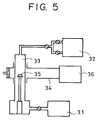
- the apparatus is a heat filament CVD apparatus, and includes a quartz reaction tube 61 disposed in an electric furnace 62, a tungsten filament 63 disposed in the reaction tube 61, a gas inlet tube 65, a flowmeter 66 for adjusting the gas flow rate, a first liquid vaporizer 67a for heating and gasifying a liquid organic compound containing lithium, a second liquid vaporizer 67b for heating and gasifying a liquid organic compound containing boron, a valve 68, a hydrogen gas cylinder 69, and an exhaust port 70 connected to a pressure adjusting valve and an exhaustion system (neither of which are shown).
- the apparatus is shown in the state where a substrate 64 is already set.
- the pressure adjusting valve was used to adjust the internal pressure within the reaction tube 61 to 50 Torr.
- the filament 63 was supplied with power from a power supply, not shown, and was red-heated to approximately 2100°C.
- the red-heated filament 63 caused decomposition of ethanol and hydrogen, thereby forming n-type diamond containing lithium on the substrate 64.
- the diode characteristics thus evaluated are indicated by solid lines in Fig. 7.
- the ratio in magnitude between forward current and backward current was at least 108.
- the leakage current in the backward direction was not more than 10 ⁇ 10 A, and the break-down voltage was not less than 250 V. Thus, very good diode characteristics were obtained.
- a single-crystal silicon substrate 84 of the same type as that used in Example 11 was placed inside the quartz reaction tube 81.
- the interior of the quartz reaction tube 81 was evacuated to 2 x 10 ⁇ 3 Torr by the exhaustion system. Thereafter, the first, second and third gas cylinders 88a, 88b and 88c as well as the flowmeters 86a, 86b and 86c were used to introduce, into the quartz reaction tube 81, hydrogen, methane, and diborane at flow rates of 200 ml/min, 0.75 ml/min and 40 ml/min, respectively.
- the pressure adjusting valve was used to adjust the internal pressure within the reaction tube 81 to 60 Torr.
- the microwave generator 82 was used to apply microwave to the quartz reaction tube 81 (output: 0.8 kW).
- plasma was generated, thereby forming p-type diamond containing boron on the substrate 84.
- a resist pattern was formed on a part of each diamond crystal 97 by a known photolithographic method, a SiO2 film with a thickness of 1000 ⁇ was formed through the resist by a known vacuum deposition method, and thereafter the resist was removed, thereby depositing SiO2 on a part of each diamond crystal 97.
Landscapes
- Led Devices (AREA)
- Crystals, And After-Treatments Of Crystals (AREA)
Applications Claiming Priority (4)
| Application Number | Priority Date | Filing Date | Title |
|---|---|---|---|
| JP3331591A JPH05139889A (ja) | 1991-11-21 | 1991-11-21 | ダイヤモンド結晶 |
| JP331591/91 | 1991-11-21 | ||
| JP33937191A JPH05152604A (ja) | 1991-11-29 | 1991-11-29 | ダイヤモンド半導体装置及びその製造方法 |
| JP339371/91 | 1991-11-29 |
Publications (2)
| Publication Number | Publication Date |
|---|---|
| EP0543392A2 true EP0543392A2 (de) | 1993-05-26 |
| EP0543392A3 EP0543392A3 (en) | 1993-10-20 |
Family
ID=26573899
Family Applications (1)
| Application Number | Title | Priority Date | Filing Date |
|---|---|---|---|
| EP19920119796 Ceased EP0543392A3 (en) | 1991-11-21 | 1992-11-20 | Diamond semiconductor device and method of producing the same |
Country Status (2)
| Country | Link |
|---|---|
| US (1) | US5541423A (de) |
| EP (1) | EP0543392A3 (de) |
Cited By (2)
| Publication number | Priority date | Publication date | Assignee | Title |
|---|---|---|---|---|
| EP0646968A1 (de) * | 1993-09-30 | 1995-04-05 | Sony Corporation | Verfahren zur Herstellung eines Diamanthalbleiters |
| FR2848335A1 (fr) * | 2002-12-06 | 2004-06-11 | Centre Nat Rech Scient | Procede d'elaboration de diamant de type n a haute conductivite electrique |
Families Citing this family (25)
| Publication number | Priority date | Publication date | Assignee | Title |
|---|---|---|---|---|
| US5463271A (en) * | 1993-07-09 | 1995-10-31 | Silicon Video Corp. | Structure for enhancing electron emission from carbon-containing cathode |
| US5961718A (en) * | 1995-10-16 | 1999-10-05 | National Science Council | Process for selectively depositing diamond films |
| US6356014B2 (en) | 1997-03-27 | 2002-03-12 | Candescent Technologies Corporation | Electron emitters coated with carbon containing layer |
| DE19718618C2 (de) * | 1997-05-02 | 1999-12-02 | Daimler Chrysler Ag | Komposit-Struktur mit einem mehrere mikroelektronische Bauteile und eine Diamantschicht aufweisenden Wachstums-Substrat sowie Verfahren zur Herstellung der Komposit-Struktur |
| US6858080B2 (en) * | 1998-05-15 | 2005-02-22 | Apollo Diamond, Inc. | Tunable CVD diamond structures |
| US6582513B1 (en) * | 1998-05-15 | 2003-06-24 | Apollo Diamond, Inc. | System and method for producing synthetic diamond |
| JP4421745B2 (ja) * | 2001-12-28 | 2010-02-24 | 東洋炭素株式会社 | 半導体ダイヤモンド合成用黒鉛材及び半導体ダイヤモンドの製造方法 |
| US7402835B2 (en) * | 2002-07-18 | 2008-07-22 | Chevron U.S.A. Inc. | Heteroatom-containing diamondoid transistors |
| US7501330B2 (en) * | 2002-12-05 | 2009-03-10 | Intel Corporation | Methods of forming a high conductivity diamond film and structures formed thereby |
| US7224532B2 (en) * | 2002-12-06 | 2007-05-29 | Chevron U.S.A. Inc. | Optical uses diamondoid-containing materials |
| JP2004214264A (ja) * | 2002-12-27 | 2004-07-29 | Sumitomo Electric Ind Ltd | 低抵抗n型半導体ダイヤモンドおよびその製造方法 |
| US20050019955A1 (en) * | 2003-07-23 | 2005-01-27 | Dahl Jeremy E. | Luminescent heterodiamondoids as biological labels |
| KR20060064564A (ko) * | 2003-09-16 | 2006-06-13 | 스미토모덴키고교가부시키가이샤 | 다이아몬드 전자 방출 소자 및 이를 이용한 전자선원 |
| US20050181210A1 (en) * | 2004-02-13 | 2005-08-18 | Doering Patrick J. | Diamond structure separation |
| US20060163584A1 (en) * | 2005-01-26 | 2006-07-27 | Robert Linares | Boron-doped diamond semiconductor |
| DE102005028216A1 (de) | 2005-06-17 | 2006-12-28 | Siemens Ag | Vorrichtung und Verfahren für die Computertomographie |
| CN100508144C (zh) * | 2005-06-20 | 2009-07-01 | 日本电信电话株式会社 | 金刚石半导体元件及其制造方法 |
| US7799600B2 (en) * | 2007-05-31 | 2010-09-21 | Chien-Min Sung | Doped diamond LED devices and associated methods |
| JP5539968B2 (ja) * | 2008-05-05 | 2014-07-02 | カーネギー インスチチューション オブ ワシントン | 超靭性の単結晶ホウ素ドープダイヤモンド |
| WO2010068419A2 (en) * | 2008-11-25 | 2010-06-17 | Carnegie Institution Of Washington | Production of single crystal cvd diamond rapid growth rate |
| WO2015023357A1 (en) * | 2013-08-12 | 2015-02-19 | The Government Of The United States Of America, As Represented By The Secretary Of The Navy | Chemically stable visible light photoemission electron source |
| CN108473311A (zh) * | 2015-08-07 | 2018-08-31 | 北卡罗莱纳州立大学 | Q-碳和q-bn的合成和处理,和由碳到金刚石的直接转化,bn及c-bn |
| US20170370019A1 (en) | 2016-06-28 | 2017-12-28 | North Carolina State University | Synthesis and processing of pure and nv nanodiamonds and other nanostructures for quantum computing and magnetic sensing applications |
| US11932929B2 (en) * | 2017-08-21 | 2024-03-19 | George Edward Parris | Method and materials for creating patterns of carbon and/or other elements on substrates or within liquid or frozen media by directed energy deposition of carbon and other elements |
| DE102021123907A1 (de) | 2021-09-15 | 2023-03-16 | Universität Siegen, Körperschaft des öffentlichen Rechts | LED und Herstellungsverfahren dafür |
Family Cites Families (14)
| Publication number | Priority date | Publication date | Assignee | Title |
|---|---|---|---|---|
| JPS59208821A (ja) * | 1983-05-13 | 1984-11-27 | Sumitomo Electric Ind Ltd | 気相合成によるダイヤモンド半導体およびその製造方法 |
| JPS59213126A (ja) * | 1983-05-19 | 1984-12-03 | Sumitomo Electric Ind Ltd | ダイヤモンド半導体素子の製造法 |
| JPS60246627A (ja) * | 1984-05-21 | 1985-12-06 | Sumitomo Electric Ind Ltd | ダイヤモンド半導体素子 |
| JP2650730B2 (ja) * | 1988-08-08 | 1997-09-03 | シャープ株式会社 | 炭化珪素半導体を用いたpn接合型発光ダイオード |
| US5051785A (en) * | 1989-06-22 | 1991-09-24 | Advanced Technology Materials, Inc. | N-type semiconducting diamond, and method of making the same |
| JPH0397275A (ja) * | 1989-09-09 | 1991-04-23 | Katsunobu Maeda | 炭化硅素の青色発光ダイオード素子 |
| EP0420188A1 (de) * | 1989-09-27 | 1991-04-03 | Sumitomo Electric Industries, Ltd. | Halbleitende Heteroübergangsstruktur |
| JP2775903B2 (ja) * | 1989-10-04 | 1998-07-16 | 住友電気工業株式会社 | ダイヤモンド半導体素子 |
| JP2509713B2 (ja) * | 1989-10-18 | 1996-06-26 | シャープ株式会社 | 炭化珪素半導体装置およびその製造方法 |
| JP3104229B2 (ja) * | 1989-11-28 | 2000-10-30 | ソニー株式会社 | ビデオカメラ用外部同期装置 |
| US5243199A (en) * | 1990-01-19 | 1993-09-07 | Sumitomo Electric Industries, Ltd. | High frequency device |
| JP2798462B2 (ja) * | 1990-01-26 | 1998-09-17 | 株式会社神戸製鋼所 | ダイヤモンド半導体発光素子 |
| JP2730271B2 (ja) * | 1990-03-07 | 1998-03-25 | 住友電気工業株式会社 | 半導体装置 |
| US5285078A (en) * | 1992-01-24 | 1994-02-08 | Nippon Steel Corporation | Light emitting element with employment of porous silicon and optical device utilizing light emitting element |
-
1992
- 1992-11-20 EP EP19920119796 patent/EP0543392A3/en not_active Ceased
-
1994
- 1994-07-20 US US08/278,104 patent/US5541423A/en not_active Expired - Lifetime
Cited By (5)
| Publication number | Priority date | Publication date | Assignee | Title |
|---|---|---|---|---|
| EP0646968A1 (de) * | 1993-09-30 | 1995-04-05 | Sony Corporation | Verfahren zur Herstellung eines Diamanthalbleiters |
| US5508208A (en) * | 1993-09-30 | 1996-04-16 | Sony Corporation | Method of manufacturing diamond semiconductor |
| FR2848335A1 (fr) * | 2002-12-06 | 2004-06-11 | Centre Nat Rech Scient | Procede d'elaboration de diamant de type n a haute conductivite electrique |
| WO2004053960A1 (fr) * | 2002-12-06 | 2004-06-24 | Centre National De La Recherche Scientifique - Cnrs | Procede d'elaboration de diamant de type n a haute conductivite electrique |
| US7368317B2 (en) | 2002-12-06 | 2008-05-06 | Centre National De La Recherche Scientifique-Cnrs | Method of producing an N-type diamond with high electrical conductivity |
Also Published As
| Publication number | Publication date |
|---|---|
| EP0543392A3 (en) | 1993-10-20 |
| US5541423A (en) | 1996-07-30 |
Similar Documents
| Publication | Publication Date | Title |
|---|---|---|
| EP0543392A2 (de) | Diamant-Halbleiteranordnung und Verfahren zu ihrer Herstellung | |
| US5632812A (en) | Diamond electronic device and process for producing the same | |
| Gildenblat et al. | The electrical properties and device applications of homoepitaxial and polycrystalline diamond films | |
| CA2054242C (en) | Light-emitting semiconductor device using gallium nitride group compound | |
| US5620557A (en) | Sapphireless group III nitride semiconductor and method for making same | |
| US5747118A (en) | Plasma enhanced chemical transport process for forming diamond films | |
| Khan et al. | Electrical properties and ion implantation of epitaxial GaN, grown by low pressure metalorganic chemical vapor deposition | |
| EP0377320A2 (de) | Durch elektrisches Feld lichtemittierende Vorrichtung | |
| US5897924A (en) | Process for depositing adherent diamond thin films | |
| JP3428984B2 (ja) | 安定化層及びその製法 | |
| US5034784A (en) | Diamond electric device on silicon | |
| EP0390209A2 (de) | Lichtemittierende Diamantanordnung | |
| US7063742B1 (en) | N-type semiconductor diamond and its fabrication method | |
| JPH05152604A (ja) | ダイヤモンド半導体装置及びその製造方法 | |
| Sugino et al. | Electron emission characteristics of metal/diamond field emitters | |
| US5612548A (en) | Diamond light-emitting element | |
| Futagi et al. | Highly conductive and wide optical band gap n‐type μc‐SiC prepared by electron cyclotron resonance plasma‐enhanced chemical vapor deposition | |
| EP0244874A2 (de) | Lumineszentes Material, Verfahren zu seiner Herstellung und lumineszentes Halbleiterelement | |
| Sekiguchi et al. | Characterization of a diamond pn junction using electron-beam-induced current and cathodoluminescence | |
| Lau et al. | a-SiC: H thin film visible light-emitting diodes with highly conductive wide band gap a-SiC: H as the carrier injection layers | |
| EP0822268B1 (de) | Verfahren zur Erzeugung einer haftenden Diamantbeschichtung | |
| Mino et al. | Plasma‐assisted metalorganic chemical vapor deposition of ZnSe films | |
| JPH0769792A (ja) | ダイヤモンド結晶のエピタキシャル成長法及び選択エピタキシャル成長法 | |
| Futagi et al. | An amorphous SiC thin film visible light-emitting diode with a μc-SiC: H electron injector | |
| JPH08264829A (ja) | 化合物半導体構造およびその製造方法 |
Legal Events
| Date | Code | Title | Description |
|---|---|---|---|
| PUAI | Public reference made under article 153(3) epc to a published international application that has entered the european phase |
Free format text: ORIGINAL CODE: 0009012 |
|
| AK | Designated contracting states |
Kind code of ref document: A2 Designated state(s): DE FR GB |
|
| PUAL | Search report despatched |
Free format text: ORIGINAL CODE: 0009013 |
|
| AK | Designated contracting states |
Kind code of ref document: A3 Designated state(s): DE FR GB |
|
| 17P | Request for examination filed |
Effective date: 19940302 |
|
| 17Q | First examination report despatched |
Effective date: 19960228 |
|
| STAA | Information on the status of an ep patent application or granted ep patent |
Free format text: STATUS: THE APPLICATION HAS BEEN REFUSED |
|
| 18R | Application refused |
Effective date: 20021112 |