EP0534344B1 - Substituierte 3-Amino-2,3,4,5-Tetrahydro-1-Aryloxy-3-Benzazepine, Verfahren zu ihrer Herstellung und ihre Verwendung als Modulatoren der Neurotransmitterfunktion - Google Patents
Substituierte 3-Amino-2,3,4,5-Tetrahydro-1-Aryloxy-3-Benzazepine, Verfahren zu ihrer Herstellung und ihre Verwendung als Modulatoren der Neurotransmitterfunktion Download PDFInfo
- Publication number
- EP0534344B1 EP0534344B1 EP92116111A EP92116111A EP0534344B1 EP 0534344 B1 EP0534344 B1 EP 0534344B1 EP 92116111 A EP92116111 A EP 92116111A EP 92116111 A EP92116111 A EP 92116111A EP 0534344 B1 EP0534344 B1 EP 0534344B1
- Authority
- EP
- European Patent Office
- Prior art keywords
- hydrogen
- formula
- compound
- alkyl
- alkylcarbonyl
- Prior art date
- Legal status (The legal status is an assumption and is not a legal conclusion. Google has not performed a legal analysis and makes no representation as to the accuracy of the status listed.)
- Expired - Lifetime
Links
- 0 C1C2C1CCC*2 Chemical compound C1C2C1CCC*2 0.000 description 4
Classifications
-
- C—CHEMISTRY; METALLURGY
- C07—ORGANIC CHEMISTRY
- C07D—HETEROCYCLIC COMPOUNDS
- C07D223/00—Heterocyclic compounds containing seven-membered rings having one nitrogen atom as the only ring hetero atom
- C07D223/14—Heterocyclic compounds containing seven-membered rings having one nitrogen atom as the only ring hetero atom condensed with carbocyclic rings or ring systems
- C07D223/16—Benzazepines; Hydrogenated benzazepines
-
- A—HUMAN NECESSITIES
- A61—MEDICAL OR VETERINARY SCIENCE; HYGIENE
- A61P—SPECIFIC THERAPEUTIC ACTIVITY OF CHEMICAL COMPOUNDS OR MEDICINAL PREPARATIONS
- A61P25/00—Drugs for disorders of the nervous system
- A61P25/18—Antipsychotics, i.e. neuroleptics; Drugs for mania or schizophrenia
-
- A—HUMAN NECESSITIES
- A61—MEDICAL OR VETERINARY SCIENCE; HYGIENE
- A61P—SPECIFIC THERAPEUTIC ACTIVITY OF CHEMICAL COMPOUNDS OR MEDICINAL PREPARATIONS
- A61P25/00—Drugs for disorders of the nervous system
- A61P25/24—Antidepressants
-
- A—HUMAN NECESSITIES
- A61—MEDICAL OR VETERINARY SCIENCE; HYGIENE
- A61P—SPECIFIC THERAPEUTIC ACTIVITY OF CHEMICAL COMPOUNDS OR MEDICINAL PREPARATIONS
- A61P25/00—Drugs for disorders of the nervous system
- A61P25/26—Psychostimulants, e.g. nicotine, cocaine
Definitions
- the present invention relates to compounds of the formula I, where n is 1 or 2; m is 1 or 2; each X is independently hydrogen or C1-C6-alkoxy; Y is hydrogen, halogen or trifluoromethyl; R1 is hydrogen, C1-C6-alkyl, imidazolyl-C1-C6-alkyl, thienyl-C1-C6-alkyl, pyridinyl-C1-C6-alkyl, pyrrolyl-C1-C6-alkyl, pyridinyl, C1-C6-alkylcarbonyl, imidazolyl-C1-C6-alkylcarbonyl, thienyl-C1-C6-alkylcarbonyl, pyridinyl-C1-C6-alkylcarbonyl, pyrrolyl-C1-C6-alkylcarbonyl, trifluoromethylcarbonyl, or phenyl-C1-
- EP-A-0 096 838 relates to 1-aryloxy-2,3,4,5- tetrahydro-3-benzazepines, which have antidepressant, antihypertensive and/or analgesic activities.
- C1-C6-alkyl shall mean a straight or branched alkyl group having from 1 to 6 carbon atoms.
- Examples of said C1-C6-alkyl include methyl, ethyl, n-propyl, iso-propyl, n-butyl, iso-butyl, sec-butyl, t-butyl and straight- and branched-chain pentyl and hexyl.
- halogen shall mean fluorine, chlorine, bromine or iodine.
- the compounds of this invention are prepared by utilizing one or more of the synthetic steps described below.
- a compound of Formula II where R3 is is reduced in a routine manner known to the art (for instance, with the aid of sodium borohydride) to afford a compound of Formula III.
- Compound III is detosylated or demesylated in a routine manner known to the art (for instance, with the aid of sodium metal in liquid ammonia or sodium bis(2-methoxyethoxy)aluminum hydride in toluene) to afford a compound of Formula IV.
- STEPS A and B the reader is referred to Effland et al., United States Patent 4,794,181.
- Compound IV is allowed to react with a fluoro, chloro or bromo compound of the formula where Hal is fluorine, chlorine or bromine in a routine manner known to the art, for instance with the aid of NaH in a suitable medium such as dimethylformamide or benzene, to afford a compound of Formula V (Williamson ether synthesis).
- Compound V is subjected to a nitrosation reaction conducted in a routine manner known to the art, for instance with the aid of sodium nitrite and hydrochloric acid, to afford a compound of Formula VI.
- Compound VI is reduced with the aid of zinc dust and a suitable acid such as acetic acid in a routine manner known to the art to afford a compound of Formula VII.
- Compound VII is allowed to react with a C1-C6-alkyl halide of the formula R4-Hal where R4 is C1-C6-alkyl and Hal is chlorine or bromine, or with a di-C1-C6-alkyl sulfate of the formula (R4)2SO4 in a routine manner known to the art to afford a compound of Formula VIII.
- Compound VII is allowed to react with a C1-C6-alkyl chloroformate of the formula Cl-CO-OR5 where R5 is C1-C6-alkyl to afford a compound of Formula IX.
- This reaction is typically conducted in a suitable solvent such as dichloromethane in the presence of a suitable base such as sodium bicarbonate or triethylamine at a temperature of about 20-60°C.
- a compound of formula VIII in which the group R4 is methyl is desired, the following method may be employed as an alternative to STEP F.
- a compound of formula IXa obtained from STEP G is allowed to react with LiAlH4 in a suitable medium such as tetrahydrofuran at a temperature of about 25-100°C to afford a compound of formula VIIIa.
- Compound VII is allowed to react with an acid compound of formula X (in which the amino group is protected) where the group -R6- represents a C1-C6-alkylene group and R7 is hydrogen or C1-C6-alkyl in the presence of dicyclohexylcarbodiimide to afford a corresponding ester of formula XI and thereafter the latter is hydrolyzed in a routine manner known to the art or catalytically reduced with hydrogen to afford a compound of formula XII.
- the same purpose can be accomplished where the benzyloxy moiety in formula X is tertiarybutyloxy.
- Compount VII is allowed to react with an acid compound of formula XIII where R8 is C1-C6-alkyl and R9 is also C1-C6-alkyl in the presence of dicyclohexylcarbodiimide in a routine manner known to the art to afford a compound of formula XIV.
- a compound of Formula XV obtained from one of the foregoing STEPS is allowed to react with a halide compound of the formula R10-Hal where R10 is C1-C6-alkyl, phenyl-C1-C6-alkyl, wherein the phenyl group may be substituted as indicated above, or heteroaryl-C1-C6-alkyl, wherein the term heteroaryl means imidazolyl, thienyl, pyridinyl or pyrrolyl, or with a di-C1-C6-alkyl sulfate compound of the formula (R10)2SO4 in substantially the same manner as in STEP F to afford a compound of Formula XVI.
- a halide compound of the formula R10-Hal where R10 is C1-C6-alkyl, phenyl-C1-C6-alkyl, wherein the phenyl group may be substituted as indicated above, or heteroaryl-C1-C6-alky
- Compound XV is allowed to react with an acid halide of the formula R11-CO-Hal where R11 is C1-C6-alkyl, phenyl or phenyl-C1-C6-alkyl, wherein the phenyl may be substituted as indicated above, heteroaryl-C1-C6-alkyl, wherein the term heteroaryl means imidazolyl, thienyl, pyridinyl or pyrrolyl, or trifluoromethyl in a routine manner known to the art to afford a compound of formula XVII.
- Compound XV is allowed to react with a fluoro or chloropyridine of formula XVIII where Hal' is fluorine or chlorine to afford a compound of formula XIX.
- This reaction is typically conducted in a suitable ethereal solvent such as bis(2-methoxyethyl)ether or dioxane, or a polar aprotic solvent such as dimethylformamide.
- the compounds of Formula I of the present invention are useful as modulators of neurotransmitter function such as serotonergic and adrenergic, and as such are useful as antidepressants and for the treatment of personality disorders such as obsessive compulsive disorders. This utility is manifested in the 3H-Serotonin Uptake in Rat Whole Brain Test described below.
- This assay is used as a biochemical screen for potential antidepressants which block serotonin (5HT) uptake.
- [3H]-5HT transport has been characterized in CNS tissue (6,7) and found to be saturable, sodium-and temperature-dependent, inhibited by ouabain, metabolic inhibitors, tryptamine analogs (8) and tricyclic antidepressants (tertiary amines >> secondary amines)(9).
- the latter findings differentiate 5HT uptake from catecholamine uptake.
- [3H]-5HT uptake can also be used as a marker for serotonin nerve terminals.
- Either whole brain minus cerebella or hypothalamus is weighed and homogenized in 9 volumes of ice-cold 0.32 M sucrose using a Potter-Elvejhem homogenizer. Homogenization should be done with 4-5 up and down strokes at medium speeds to minimize synaptosome lysis. The homogenate is centrifuged at 1000 g for 10 min. at 0-4°C. The supernatant (S1) is decanted and is used for uptake experiments. D. Assay - 800 »l KHBB + [3H]-5HT 20 »l Vehicle or appropriate drug concentration 200 »l Tissue suspension Tubes are incubated at 37°C under a 95% O2/5% CO2 atmosphere for 5 minutes.
- Effective quantities of the compounds of the invention may be administered to a patient by any of the various methods, for example, orally as in capsule or tablets, parenterally in the form of sterile solutions or suspensions, and in some cases intravenously in the form of sterile solutions.
- the free base final products while effective themselves, may be formulated and administered in the form of their pharmaceutically acceptable acid addition salts for purposes of stability, convenience of crystallization, increased solubility and the like.
- Acids useful for preparing the pharmaceutically acceptable acid addition salts of the invention include inorganic acids such as hydrochloric, hydrobromic, sulfuric, nitric, phosphoric and perchloric acids, as well as organic acids such as tartaric, citric, acetic, succinic, maleic, fumaric and oxalic acids.
- inorganic acids such as hydrochloric, hydrobromic, sulfuric, nitric, phosphoric and perchloric acids
- organic acids such as tartaric, citric, acetic, succinic, maleic, fumaric and oxalic acids.
- the active compounds of the present invention may be orally administered, for example, with an inert diluent or with an edible carrier, or they may be enclosed in gelatin capsules, or they may be compressed into tablets.
- the active compounds of the invention may be incorporated with excipients and used in the form of tablets, troches, capsules, elixirs, suspensions, syrups, wafers, chewing gum and the like. These preparations should contain at least 0.5% of active compounds, but may be varied depending upon the particular form and may conveniently be between 4% to about 70% of the weight of the unit. The amount of active compound in such compositions is such that a suitable dosage will be obtained.
- Preferred compositions and preparations according to the present invention are prepared so that an oral dosage unit form contains between 1.0 - 300 milligrams of active compound.
- the tablets, pills, capsules, troches and the like may also contain the following ingredients: a binder such as micro-crystalline cellulose, gum tragacanth or gelatin; an excipient such as starch or lactose, a disintegrating agent such as alginic acid, Primogel, cornstarch and the like; a lubricant such as magnesium stearate or Sterotex; a glidant such as colloidal silicon dioxide; and a sweeting agent such as sucrose or saccharin may be added or a flavoring agent such as peppermint, methyl salicylate, or orange flavoring.
- a binder such as micro-crystalline cellulose, gum tragacanth or gelatin
- an excipient such as starch or lactose, a disintegrating agent such as alginic acid, Primogel, cornstarch and the like
- a lubricant such as magnesium stearate or Sterotex
- a glidant such as colloidal silicon dioxide
- a sweeting agent such
- dosage unit forms may contain other various materials which modify the physical form of the dosage unit, for example, as coatings.
- tablets or pills may be coated with sugar, shellac, or other enteric coating agents.
- a syrup may contain, in addition to the active compounds, sucrose as a sweetening agent and certain preservatives, dyes, coloring and flavors. Materials used in preparing these various compositions should be pharmaceutically pure and non-toxic in the amounts used.
- the active compounds of the invention may be incorporated into a solution or suspension. These preparations should contain at least 0.1% of active compound, but may be varied between 0.5 and about 30% of the weight thereof. The amount of active compound in such compositions is such that a suitable dosage will be obtained. Preferred compositions and preparations according to the present inventions are prepared so that a parenteral dosage unit contains between 0.5 to 100 milligrams of active compound.
- the solutions or suspensions may also include the following components: a sterile diluent such as water for injection, saline solution, fixed oils, polyethylene glycols, glycerine, propylene glycol or other synthetic solvents; antibacterial agents such as benzyl alcohol or methyl parabens; antioxidants such as ascorbic acid or sodium bisulfite; chelating agents such as ethylenediaminetetraacetic acid; buffers such as acetates, citrates or phosphates and agents for the adjustment of tonicity such as sodium chloride or dextrose.
- a sterile diluent such as water for injection, saline solution, fixed oils, polyethylene glycols, glycerine, propylene glycol or other synthetic solvents
- antibacterial agents such as benzyl alcohol or methyl parabens
- antioxidants such as ascorbic acid or sodium bisulfite
- chelating agents such as ethylenediaminetetraacetic acid
- Examples of the compounds of this invention include: 3-amino-2,3,4,5-tetrahydro-1-(4-trifluoromethylphenoxy)-3-benzazepine; 3-amino-7,8-dimethoxy-1-phenoxy-2,3,4,5-tetrahydro-3-benzazepine; 3,5-dichloro-N-(7,8-dimethoxy-1-phenoxy-2,3,4,5-tetrahydro-1H-3-benzazepin-3-yl)benzamide; N-[2,3,4,5-Tetrahydro-1-(4-trifluoromethylphenoxy)-3-benzazepin-3-yl]carbamic acid ethyl ester; N-Methyl-N-[2,3,4,5-tetrahydro-1-(4-trifluoromethylphenoxy)-3-benzazepin-3-yl]carbamic acid ethyl ester; 3-Propylamino-2,3,4,5-tetrahydro-1-(4-trifluor
- Zinc dust (12 g) was added to a solution of 3-nitroso-2,3,4,5-tetrahydro-1-(4-trifluoromethylphenoxy)-3-benzazepine (9 g) in 150 ml of 2:1 acetic acid/water mixture. After stirring at ambient temperature for three hours, the reaction mixture was filtered, stirred with ice and basified with ammonium hydroxide. The oil which had separated was extracted with dichloromethane. The dried (anhydrous magnesium sulfate) organic extract was filtered and concentrated. The residue was eluted through silica with 3% methanol in dichloromethane via high performance liquid chromatography to yield 6.3 g of white solid, mp 98-100°.
- Zinc dust (9 g) was added to a solution of 7,8-dimethoxy-3-nitroso-1-phenoxy-2,3,4,5-tetrahydro-3-benzazepine (10 g) in 150 ml of 2:1 acetic acid/water. After stirring at ambient temperate for three hours, the reaction mixture was filtered, stirred with ice and basified with ammonium hydroxide. The oil which had separated was extracted with dichloromethane. The organic extract was washed with water and saturated sodium chloride solution, and thereafter dried (anhydrous magnesium sulfate), filtered and concentrated to 10 g brown oil.
Landscapes
- Health & Medical Sciences (AREA)
- Organic Chemistry (AREA)
- Chemical & Material Sciences (AREA)
- Engineering & Computer Science (AREA)
- Bioinformatics & Cheminformatics (AREA)
- Neurosurgery (AREA)
- Life Sciences & Earth Sciences (AREA)
- Biomedical Technology (AREA)
- Chemical Kinetics & Catalysis (AREA)
- General Chemical & Material Sciences (AREA)
- Medicinal Chemistry (AREA)
- Nuclear Medicine, Radiotherapy & Molecular Imaging (AREA)
- Psychiatry (AREA)
- Pharmacology & Pharmacy (AREA)
- Neurology (AREA)
- Animal Behavior & Ethology (AREA)
- General Health & Medical Sciences (AREA)
- Public Health (AREA)
- Veterinary Medicine (AREA)
- Pain & Pain Management (AREA)
- Pharmaceuticals Containing Other Organic And Inorganic Compounds (AREA)
- Plural Heterocyclic Compounds (AREA)
- Nitrogen Condensed Heterocyclic Rings (AREA)
- Other In-Based Heterocyclic Compounds (AREA)
Claims (9)
- Verfahren zur Herstellung einer Verbindung der Formel I:

n für 1 oder 2 steht;
m für 1 oder 2 steht;
jedes X unabhängig voneinander Wasserstoff oder C₁-C₆-Alkoxy bedeutet;
Y für Wasserstoff, Halogen oder Trifluormethyl steht;
R₁ für Wasserstoff, C₁-C₆-Alkyl, Imidazolyl-C₁-C₆-alkyl, Thienyl-C₁-C₆-alkyl, Pyridinyl-C₁-C₆-alkyl, Pyrrolyl-C₁-C₆-alkyl, Pyridinyl, C₁-C₆-Alkylcarbonyl, Imidazolyl-C₁-C₆-alkylcarbonyl, Thienyl-C₁-C₆-alkylcarbonyl, Pyridinyl-C₁-C₆-alkylcarbonyl, Pyrrolyl-C₁-C₆-alkylcarbonyl, Trifluormethylcarbonyl oder Phenyl-C₁-C₆-alkyl, Phenylcarbonyl oder Phenyl-C₁-C₆-alkylcarbonyl steht, wobei das Phenyl mit 0, 1 oder 2 Substituenten substituiert ist, bei denen es sich unabhängig voneinander um C₁-C₆-Alkyl, C₁-C₆-Alkoxy, Halogen oder Trifluormethyl handelt,
R₂ für Wasserstoff, C₁-C₆-Alkyl, C₁-C₆-Alkoxycarbonyl, Amino-C₁-C₆-alkylcarbonyl, C₁-C₆-alkylamino-C₁-C₆-alkylcarbonyl oder Di-C₁-C₆-Alkylamino-C₁-C₆-alkylcarbonyl steht;
oder eines pharmazeutisch verträglichen Säureadditionssalzes davon, das folgende Schritte umfaßt:a) Reduzieren einer Verbindung der Formel VI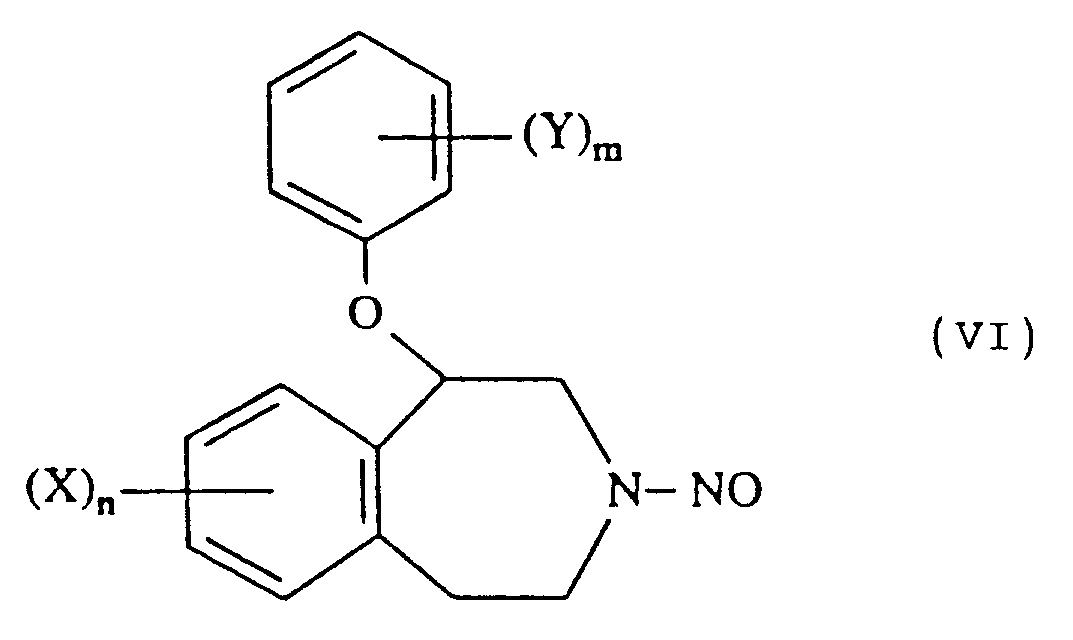 b) wahlweise Umsetzen einer Verbindung der Formel I, in welcher R₁ und R₂ beide für Wasserstoff stehen, mit einem C₁-C₆-Alkylhalogenid der Formel R₄Hal, in welcher Hal Chlor oder Brom ist, oder mit einem Di-C₁-C₆-alkylsulfat der Formel (R₄)₂SO₄, in welcher R₄ für C₁-C₆-Alkyl steht, zur Bildung einer Verbindung der Formel I, in welcher R₁ Wasserstoff und R₂ C₁-C₆-Alkyl ist,c) wahlweise Umsetzen einer Verbindung der Formel I, in welcher R₁ und R₂ beide Wasserstoff sind, mit einem C₁-C₆-Alkylchloroformat der Formel Cl-COOR₅, in welcher R₅ C₁-C₆-Alkyl ist, zur Bildung einer Verbindung der Formel I, in welcher R₁ Wasserstoff und R₂ C₁-C₆-Alkyloxycarbonyl ist,d) wahlweise Umsetzen einer Verbindung der Formel I, in welcher R₁ Wasserstoff und R₂ Ethoxycarbonyl ist, mit LiAlH₄ zur Bildung einer Verbindung der Formel I, in welcher R₁ für Wasserstoff und R₂ für Methyl steht,e) wahlweise Umsetzen einer Verbindung der Formel I, in welcher R₁ und R₂ beide für Wasserstoff stehen, mit einer Verbindung der Formel X
 f) wahlweise Umsetzen einer Verbindung der Formel I, in welcher R₁ und R₂ beide für Wasserstoff stehen, mit einer Verbindung der Formel XIII
 g) wahlweise Umsetzen einer Verbindung der Formel I, in welcher R₁ für Wasserstoff steht und R₂ wie vorstehend angegeben definiert ist, aber nicht Wasserstoff ist, mit einer Verbindung der Formel R₁₀Hal oder der Formel (R₁₀)₂SO₄, in welcher R₁₀ für C₁-C₆-Alkyl, Phenyl-C₁-C₆-alkyl, wobei die Phenylgruppe wie vorstehend beschrieben substituiert sein kann, oder Heteroaryl-C₁-C₆-alkyl, wobei dem Begriff Heteroaryl die weiter oben zugeteilte Bedeutung zukommt, steht, zur Bildung einer Verbindung der Formel I, in welcher R₁ C₁-C₆-Alkyl, wahlweise substituiertes Phenyl-C₁-C₆-alkyl oder Heteroaryl-C₁-C₆-alkyl ist und R₂ wie vorstehend angegeben definiert ist, aber nicht Wasserstoff ist.h) wahlweise Umsetzen einer Verbindung der Formel I, in welcher R₁ für Wasserstoff steht und R₂ wie vorstehend angegeben 1 definiert ist, aber nicht Wasserstoff ist, mit einem Säurehalogenid der Formel R₁₁COHal, in welcher R₁₁ C₁-C₆Alkyl, Phenyl oder Phenyl-C₁-C₆-alkyl ist, wobei das Phenyl wie vorstehend beschrieben substituiert sein kann, Heteroaryl-C₁-C₆-alkyl, wobei der Begriff Heteroaryl wie vorstehens angegeben definiert ist oder für Trifluormethyl steht, zur Bildung einer Verbindung der Formel I, in welcher R₁ C₁-C₆-Alkylcarbonyl, wahlweise substituiertes Phenylcarbonyl oder Phenyl-C₁-C₆-alkylcarbonyl, Heteroaryl-C₁-C₆-carbonyl oder Trifluormethylcarbonyl bedeutet, und R₂ wie weiter oben beschrieben definiert ist, aber nicht Wasserstoff ist.i) wahlweise Umsetzen einer Verbindung der Formel I, in welcher R₁ für Wasserstoff steht und R₂ wie vorstehend beschrieben definiert ist, aber nicht Wasserstoff ist , mit Methyltrifluoracetat zur Bildung einer Verbindung der Formel I, in welcher R₁ für Trifluormethylcarbonyl steht und R₂ wie vorstehens angegeben definiert ist, aber nicht Wasserstoff ist,j) wahlweise Umsetzen einer Verbindung der Formel I, in welcher R₁ für Wasserstoff steht und R₂ wie vorstehend beschrieben definiert ist, aber nicht Wasserstoff ist, mit Fluor- oder Chlorpyridin zur Bildung einer Verbindung der Formel I, in welcher R₁ für Pyridinyl steht und R₂ wie weiter oben angegeben definiert ist, aber nicht Wasserstoff ist.
 - Verfahren gemäß Anspruch 1, wobei R₁ Wasserstoff, C₁-C₆-Alkyl, Trifluormethylcarbonyl oder Phenylcarbonyl ist, wobei das Phenyl wie in Anspruch 1 angegeben substituiert sein kann und R₂ für Wasserstoff, C₁-C₆-Alkyl oder C₁-C₆-Alkoxycarbonyl steht.
- Verfahren gemäß Anspruch 2, wobei Y für Wasserstoff oder Trifluormethyl und n für 1 steht.
- Verfahren gemäß Anspruch 3, wobei R₁ und R₂ beide für Wasserstoff stehen.
- Verfahren gemäß Anspruch 1, bei dem 3-Amino-7,8-dimethoxy-1-phenoxy-2,3,4,5-tetrahydro-3-benzazepin oder ein pharmazeutisch verträgliches Säureadditionssalz davon hergestellt wird.
- Verfahren gemäß Anspruch 1, bei dem 3-Amino-2,3,4,5-tetrahydro-1-(4-trifluormethylphenoxy)-3-benzazepin oder ein pharmazeutisch verträgliches Säureadditionssalz davon hergestellt wird.
- Verwendung einer Verbindung gemäß Anspruch 1 zur Herstellung eines Medikaments mit Wirksamkeit zur Behandlung von Depressionen und Persönlichkeitsstörungen.
Applications Claiming Priority (2)
| Application Number | Priority Date | Filing Date | Title |
|---|---|---|---|
| US07/763,711 US5202319A (en) | 1991-09-23 | 1991-09-23 | Substituted 3-amino-2,3,4,5-tetrahydro-1-aryloxy-3-benzazepines |
| US763711 | 1991-09-23 |
Publications (2)
| Publication Number | Publication Date |
|---|---|
| EP0534344A1 EP0534344A1 (de) | 1993-03-31 |
| EP0534344B1 true EP0534344B1 (de) | 1995-02-15 |
Family
ID=25068602
Family Applications (1)
| Application Number | Title | Priority Date | Filing Date |
|---|---|---|---|
| EP92116111A Expired - Lifetime EP0534344B1 (de) | 1991-09-23 | 1992-09-21 | Substituierte 3-Amino-2,3,4,5-Tetrahydro-1-Aryloxy-3-Benzazepine, Verfahren zu ihrer Herstellung und ihre Verwendung als Modulatoren der Neurotransmitterfunktion |
Country Status (8)
| Country | Link |
|---|---|
| US (1) | US5202319A (de) |
| EP (1) | EP0534344B1 (de) |
| JP (1) | JP2665434B2 (de) |
| AT (1) | ATE118484T1 (de) |
| DE (1) | DE69201424T2 (de) |
| DK (1) | DK0534344T3 (de) |
| ES (1) | ES2068662T3 (de) |
| GR (1) | GR3015494T3 (de) |
Families Citing this family (3)
| Publication number | Priority date | Publication date | Assignee | Title |
|---|---|---|---|---|
| KR100710547B1 (ko) * | 2002-01-02 | 2007-04-24 | 에스케이 주식회사 | (s)-3-아미노-2,3,4,5-테트라히드로-2-옥소-1H-벤자제핀-1-아세트산 및 이의 에스테르 화합물의 제조방법 |
| KR100710548B1 (ko) * | 2002-12-26 | 2007-04-24 | 에스케이 주식회사 | (s)-3-아미노-2,3,4,5-테트라히드로-2-옥소-1H-1-벤자제핀-1-아세트산 및 이의 에스테르 화합물의 제조방법 |
| NZ580802A (en) | 2007-05-10 | 2012-09-28 | Albany Molecular Res Inc | Aryloxy-and heteroaryloxy-substituted tetrahydrobenzazepines and use thereof to block reuptake of norepinephrine, dopamine, and serotonin |
Family Cites Families (4)
| Publication number | Priority date | Publication date | Assignee | Title |
|---|---|---|---|---|
| US4314081A (en) * | 1974-01-10 | 1982-02-02 | Eli Lilly And Company | Arloxyphenylpropylamines |
| US4794181A (en) * | 1982-06-14 | 1988-12-27 | Hoechst-Roussel Pharmaceuticals, Inc. | 1-aryloxy-2,3,4,5-tetrahydro-3-benzazepines |
| US4988690A (en) * | 1982-06-14 | 1991-01-29 | Hoechst-Roussel Pharmaceuticals Inc. | 1-aryloxy-2,3,4,5-tetrahydro-3-benzazepines and anti-depressant use thereof |
| DE69016531T2 (de) * | 1989-08-02 | 1995-07-06 | Hoechst Roussel Pharma | 2,3-Dihydro-1-(pyridinylamino)-indole, Verfahren zu ihrer Herstellung und ihre Anwendung als Arzneimittel. |
-
1991
- 1991-09-23 US US07/763,711 patent/US5202319A/en not_active Expired - Fee Related
-
1992
- 1992-09-21 DE DE69201424T patent/DE69201424T2/de not_active Expired - Fee Related
- 1992-09-21 ES ES92116111T patent/ES2068662T3/es not_active Expired - Lifetime
- 1992-09-21 AT AT92116111T patent/ATE118484T1/de not_active IP Right Cessation
- 1992-09-21 DK DK92116111.3T patent/DK0534344T3/da active
- 1992-09-21 EP EP92116111A patent/EP0534344B1/de not_active Expired - Lifetime
- 1992-09-22 JP JP4251777A patent/JP2665434B2/ja not_active Expired - Fee Related
-
1995
- 1995-03-20 GR GR950400625T patent/GR3015494T3/el unknown
Also Published As
| Publication number | Publication date |
|---|---|
| JPH05301859A (ja) | 1993-11-16 |
| DE69201424T2 (de) | 1995-07-13 |
| US5202319A (en) | 1993-04-13 |
| DE69201424D1 (de) | 1995-03-23 |
| EP0534344A1 (de) | 1993-03-31 |
| ES2068662T3 (es) | 1995-04-16 |
| JP2665434B2 (ja) | 1997-10-22 |
| GR3015494T3 (en) | 1995-06-30 |
| ATE118484T1 (de) | 1995-03-15 |
| DK0534344T3 (da) | 1995-07-17 |
Similar Documents
| Publication | Publication Date | Title |
|---|---|---|
| EP0352613B1 (de) | Substituierte Aminomethyltetraline sowie ihre heterocyclischen Analoga | |
| CA2243234C (en) | 5h-thiazolo[3,2-a]pyrimidine derivatives | |
| EP0096838B1 (de) | 1-Aryloxy-2,3,4,5-tetrahydro-3-benzazepine, Verfahren zur Herstellung derselben und ihre Verwendung als Heilmittel | |
| KR100523366B1 (ko) | 티에닐아졸일알콕시에탄아민, 이의 제조방법 및 이의 용도 | |
| EP0370498A2 (de) | Trans-4-amino(alkyl)-1-pyridylcarbamoylcyclohexan-Verbindungen und ihre pharmazeutische Anwendung | |
| US20090209608A1 (en) | Deuterium-enriched asenapine | |
| PL166565B1 (pl) | Sposób wytwarzania nowych pochodnych amin aromatycznych PL PL | |
| IE921891A1 (en) | Tetrahydropyrrolo[1,2-a]pyrazine-4-spiro-3'-pyrrolidine¹derivatives, processes for the preparation thereof and¹pharmaceutical compositions containing the same | |
| EP0677042B1 (de) | Indol-piperazin-derivate als selektive liganden der 5ht1d und 5ht1b receptoren verwendbar als arzneimittel | |
| EP0509402A1 (de) | Substituierte 3-(Pyridinylamino)-indole und Benzo(b)thiophene, ein Verfahren zu ihrer Herstellung und ihre Verwendung als Arzneimittel | |
| EP0594000A1 (de) | Substituierte (Pyridinylamino)-benzisoxazole und -benzisothiazole, ein Verfahren zu ihrer Herstellung und ihre Verwendung als Arzneimittel | |
| EP0509400A1 (de) | 1-(Pyrido(3,4-b)-1,4-oxazinyl-4-yl)-1H-Indole, Zwischenprodukte und ein Verfahren zu ihrer Herstellung und ihre Verwendung als Arzneimittel | |
| FR2747678A1 (fr) | Composes derives d'imidazobenzoxazine, leurs procedes de preparation et leurs utilisations en therapeutique | |
| JP2546770B2 (ja) | 精神弛緩剤のパーヒドロ−1H−ピリド〔1,2−a〕ピラジン | |
| EP0534344B1 (de) | Substituierte 3-Amino-2,3,4,5-Tetrahydro-1-Aryloxy-3-Benzazepine, Verfahren zu ihrer Herstellung und ihre Verwendung als Modulatoren der Neurotransmitterfunktion | |
| US5498628A (en) | Naphthamide derivatives | |
| JPH0570457A (ja) | 置換イミダゾール−2−オンの誘導体及びその製造方法 | |
| EP0361888A2 (de) | Apovincaminsäure-Derivate | |
| GB2120662A (en) | New azepinoindoles, their production and pharmaceutical compositions containing them | |
| NZ286340A (en) | Amides of 2-(4-indolyl piperazia-1-yl)-1-ph-enyl (and bemzyl)ethyl amine derivatives with various (cyclo) alkane carboxylic acids; pharmaceutical compositions | |
| EP0614888A1 (de) | Tetrahydrocyclopent[b]indole-methanamine und verwandte Verbindungen, und Verfahren zu ihrer Herstellung und ihre Verwendung als Arzneimittel | |
| FI76075B (fi) | Foerfarande foer framstaellning av farmaceutiskt vaerdefulla bensazepinderivat. | |
| DE3780649T2 (de) | Kondensierte benzazepine. | |
| EP0718299B1 (de) | Trizyklische Oximether, Verfahren zu ihrer Herstellung und diese enthaltende pharmazeutische Zusammensetzungen | |
| EP0338793B1 (de) | Antihypertensive Sulfonanilide |
Legal Events
| Date | Code | Title | Description |
|---|---|---|---|
| PUAI | Public reference made under article 153(3) epc to a published international application that has entered the european phase |
Free format text: ORIGINAL CODE: 0009012 |
|
| AK | Designated contracting states |
Kind code of ref document: A1 Designated state(s): AT BE CH DE DK ES FR GB GR IT LI LU NL PT SE |
|
| 17P | Request for examination filed |
Effective date: 19930604 |
|
| 17Q | First examination report despatched |
Effective date: 19930818 |
|
| GRAA | (expected) grant |
Free format text: ORIGINAL CODE: 0009210 |
|
| AK | Designated contracting states |
Kind code of ref document: B1 Designated state(s): AT BE CH DE DK ES FR GB GR IT LI LU NL PT SE |
|
| REF | Corresponds to: |
Ref document number: 118484 Country of ref document: AT Date of ref document: 19950315 Kind code of ref document: T |
|
| REF | Corresponds to: |
Ref document number: 69201424 Country of ref document: DE Date of ref document: 19950323 |
|
| ET | Fr: translation filed | ||
| REG | Reference to a national code |
Ref country code: ES Ref legal event code: FG2A Ref document number: 2068662 Country of ref document: ES Kind code of ref document: T3 |
|
| ITF | It: translation for a ep patent filed | ||
| REG | Reference to a national code |
Ref country code: GR Ref legal event code: FG4A Free format text: 3015494 |
|
| REG | Reference to a national code |
Ref country code: DK Ref legal event code: T3 |
|
| PLBE | No opposition filed within time limit |
Free format text: ORIGINAL CODE: 0009261 |
|
| 26N | No opposition filed | ||
| REG | Reference to a national code |
Ref country code: GB Ref legal event code: IF02 |
|
| PGFP | Annual fee paid to national office [announced via postgrant information from national office to epo] |
Ref country code: AT Payment date: 20030902 Year of fee payment: 12 |
|
| PGFP | Annual fee paid to national office [announced via postgrant information from national office to epo] |
Ref country code: NL Payment date: 20030909 Year of fee payment: 12 |
|
| PGFP | Annual fee paid to national office [announced via postgrant information from national office to epo] |
Ref country code: GB Payment date: 20030917 Year of fee payment: 12 |
|
| PGFP | Annual fee paid to national office [announced via postgrant information from national office to epo] |
Ref country code: FR Payment date: 20030918 Year of fee payment: 12 |
|
| PGFP | Annual fee paid to national office [announced via postgrant information from national office to epo] |
Ref country code: SE Payment date: 20030919 Year of fee payment: 12 |
|
| PGFP | Annual fee paid to national office [announced via postgrant information from national office to epo] |
Ref country code: DK Payment date: 20030922 Year of fee payment: 12 |
|
| PGFP | Annual fee paid to national office [announced via postgrant information from national office to epo] |
Ref country code: PT Payment date: 20030923 Year of fee payment: 12 Ref country code: CH Payment date: 20030923 Year of fee payment: 12 |
|
| PGFP | Annual fee paid to national office [announced via postgrant information from national office to epo] |
Ref country code: LU Payment date: 20030929 Year of fee payment: 12 |
|
| PGFP | Annual fee paid to national office [announced via postgrant information from national office to epo] |
Ref country code: GR Payment date: 20030930 Year of fee payment: 12 |
|
| PGFP | Annual fee paid to national office [announced via postgrant information from national office to epo] |
Ref country code: ES Payment date: 20031008 Year of fee payment: 12 |
|
| PGFP | Annual fee paid to national office [announced via postgrant information from national office to epo] |
Ref country code: BE Payment date: 20031016 Year of fee payment: 12 |
|
| PGFP | Annual fee paid to national office [announced via postgrant information from national office to epo] |
Ref country code: DE Payment date: 20031031 Year of fee payment: 12 |
|
| PG25 | Lapsed in a contracting state [announced via postgrant information from national office to epo] |
Ref country code: LU Free format text: LAPSE BECAUSE OF NON-PAYMENT OF DUE FEES Effective date: 20040921 Ref country code: GB Free format text: LAPSE BECAUSE OF NON-PAYMENT OF DUE FEES Effective date: 20040921 Ref country code: AT Free format text: LAPSE BECAUSE OF NON-PAYMENT OF DUE FEES Effective date: 20040921 |
|
| PG25 | Lapsed in a contracting state [announced via postgrant information from national office to epo] |
Ref country code: SE Free format text: LAPSE BECAUSE OF NON-PAYMENT OF DUE FEES Effective date: 20040922 Ref country code: ES Free format text: LAPSE BECAUSE OF NON-PAYMENT OF DUE FEES Effective date: 20040922 |
|
| PG25 | Lapsed in a contracting state [announced via postgrant information from national office to epo] |
Ref country code: LI Free format text: LAPSE BECAUSE OF NON-PAYMENT OF DUE FEES Effective date: 20040930 Ref country code: DK Free format text: LAPSE BECAUSE OF NON-PAYMENT OF DUE FEES Effective date: 20040930 Ref country code: CH Free format text: LAPSE BECAUSE OF NON-PAYMENT OF DUE FEES Effective date: 20040930 Ref country code: BE Free format text: LAPSE BECAUSE OF NON-PAYMENT OF DUE FEES Effective date: 20040930 |
|
| PG25 | Lapsed in a contracting state [announced via postgrant information from national office to epo] |
Ref country code: PT Free format text: LAPSE BECAUSE OF NON-PAYMENT OF DUE FEES Effective date: 20050321 |
|
| BERE | Be: lapsed |
Owner name: *HOECHST-ROUSSEL PHARMACEUTICALS INC. Effective date: 20040930 |
|
| PG25 | Lapsed in a contracting state [announced via postgrant information from national office to epo] |
Ref country code: NL Free format text: LAPSE BECAUSE OF NON-PAYMENT OF DUE FEES Effective date: 20050401 Ref country code: DE Free format text: LAPSE BECAUSE OF NON-PAYMENT OF DUE FEES Effective date: 20050401 |
|
| PG25 | Lapsed in a contracting state [announced via postgrant information from national office to epo] |
Ref country code: GR Free format text: LAPSE BECAUSE OF NON-PAYMENT OF DUE FEES Effective date: 20050405 |
|
| EUG | Se: european patent has lapsed | ||
| GBPC | Gb: european patent ceased through non-payment of renewal fee |
Effective date: 20040921 |
|
| REG | Reference to a national code |
Ref country code: CH Ref legal event code: PL |
|
| PG25 | Lapsed in a contracting state [announced via postgrant information from national office to epo] |
Ref country code: FR Free format text: LAPSE BECAUSE OF NON-PAYMENT OF DUE FEES Effective date: 20050531 |
|
| REG | Reference to a national code |
Ref country code: PT Ref legal event code: MM4A Free format text: LAPSE DUE TO NON-PAYMENT OF FEES Effective date: 20050321 |
|
| NLV4 | Nl: lapsed or anulled due to non-payment of the annual fee |
Effective date: 20050401 |
|
| REG | Reference to a national code |
Ref country code: DK Ref legal event code: EBP |
|
| REG | Reference to a national code |
Ref country code: FR Ref legal event code: ST |
|
| PG25 | Lapsed in a contracting state [announced via postgrant information from national office to epo] |
Ref country code: IT Free format text: LAPSE BECAUSE OF NON-PAYMENT OF DUE FEES;WARNING: LAPSES OF ITALIAN PATENTS WITH EFFECTIVE DATE BEFORE 2007 MAY HAVE OCCURRED AT ANY TIME BEFORE 2007. THE CORRECT EFFECTIVE DATE MAY BE DIFFERENT FROM THE ONE RECORDED. Effective date: 20050921 |
|
| REG | Reference to a national code |
Ref country code: ES Ref legal event code: FD2A Effective date: 20040922 |
|
| BERE | Be: lapsed |
Owner name: *HOECHST-ROUSSEL PHARMACEUTICALS INC. Effective date: 20040930 |