EP0531716B1 - Deacetylasegene zur Erzeugung von Phosphinothricin oder Phosphinothricyl-Alanyl-Alanin, Verfahren zu ihrer Isolierung und ihre Verwendung - Google Patents
Deacetylasegene zur Erzeugung von Phosphinothricin oder Phosphinothricyl-Alanyl-Alanin, Verfahren zu ihrer Isolierung und ihre Verwendung Download PDFInfo
- Publication number
- EP0531716B1 EP0531716B1 EP92113465A EP92113465A EP0531716B1 EP 0531716 B1 EP0531716 B1 EP 0531716B1 EP 92113465 A EP92113465 A EP 92113465A EP 92113465 A EP92113465 A EP 92113465A EP 0531716 B1 EP0531716 B1 EP 0531716B1
- Authority
- EP
- European Patent Office
- Prior art keywords
- acetyl
- gene
- ptc
- ptt
- deacetylase
- Prior art date
- Legal status (The legal status is an assumption and is not a legal conclusion. Google has not performed a legal analysis and makes no representation as to the accuracy of the status listed.)
- Expired - Lifetime
Links
Images


Classifications
-
- C—CHEMISTRY; METALLURGY
- C12—BIOCHEMISTRY; BEER; SPIRITS; WINE; VINEGAR; MICROBIOLOGY; ENZYMOLOGY; MUTATION OR GENETIC ENGINEERING
- C12N—MICROORGANISMS OR ENZYMES; COMPOSITIONS THEREOF; PROPAGATING, PRESERVING, OR MAINTAINING MICROORGANISMS; MUTATION OR GENETIC ENGINEERING; CULTURE MEDIA
- C12N15/00—Mutation or genetic engineering; DNA or RNA concerning genetic engineering, vectors, e.g. plasmids, or their isolation, preparation or purification; Use of hosts therefor
- C12N15/09—Recombinant DNA-technology
- C12N15/63—Introduction of foreign genetic material using vectors; Vectors; Use of hosts therefor; Regulation of expression
- C12N15/79—Vectors or expression systems specially adapted for eukaryotic hosts
- C12N15/82—Vectors or expression systems specially adapted for eukaryotic hosts for plant cells, e.g. plant artificial chromosomes (PACs)
- C12N15/8201—Methods for introducing genetic material into plant cells, e.g. DNA, RNA, stable or transient incorporation, tissue culture methods adapted for transformation
- C12N15/8209—Selection, visualisation of transformants, reporter constructs, e.g. antibiotic resistance markers
-
- C—CHEMISTRY; METALLURGY
- C12—BIOCHEMISTRY; BEER; SPIRITS; WINE; VINEGAR; MICROBIOLOGY; ENZYMOLOGY; MUTATION OR GENETIC ENGINEERING
- C12N—MICROORGANISMS OR ENZYMES; COMPOSITIONS THEREOF; PROPAGATING, PRESERVING, OR MAINTAINING MICROORGANISMS; MUTATION OR GENETIC ENGINEERING; CULTURE MEDIA
- C12N15/00—Mutation or genetic engineering; DNA or RNA concerning genetic engineering, vectors, e.g. plasmids, or their isolation, preparation or purification; Use of hosts therefor
- C12N15/09—Recombinant DNA-technology
- C12N15/63—Introduction of foreign genetic material using vectors; Vectors; Use of hosts therefor; Regulation of expression
- C12N15/79—Vectors or expression systems specially adapted for eukaryotic hosts
- C12N15/82—Vectors or expression systems specially adapted for eukaryotic hosts for plant cells, e.g. plant artificial chromosomes (PACs)
- C12N15/8241—Phenotypically and genetically modified plants via recombinant DNA technology
- C12N15/8261—Phenotypically and genetically modified plants via recombinant DNA technology with agronomic (input) traits, e.g. crop yield
-
- C—CHEMISTRY; METALLURGY
- C12—BIOCHEMISTRY; BEER; SPIRITS; WINE; VINEGAR; MICROBIOLOGY; ENZYMOLOGY; MUTATION OR GENETIC ENGINEERING
- C12N—MICROORGANISMS OR ENZYMES; COMPOSITIONS THEREOF; PROPAGATING, PRESERVING, OR MAINTAINING MICROORGANISMS; MUTATION OR GENETIC ENGINEERING; CULTURE MEDIA
- C12N9/00—Enzymes; Proenzymes; Compositions thereof; Processes for preparing, activating, inhibiting, separating or purifying enzymes
- C12N9/14—Hydrolases (3)
-
- Y—GENERAL TAGGING OF NEW TECHNOLOGICAL DEVELOPMENTS; GENERAL TAGGING OF CROSS-SECTIONAL TECHNOLOGIES SPANNING OVER SEVERAL SECTIONS OF THE IPC; TECHNICAL SUBJECTS COVERED BY FORMER USPC CROSS-REFERENCE ART COLLECTIONS [XRACs] AND DIGESTS
- Y02—TECHNOLOGIES OR APPLICATIONS FOR MITIGATION OR ADAPTATION AGAINST CLIMATE CHANGE
- Y02A—TECHNOLOGIES FOR ADAPTATION TO CLIMATE CHANGE
- Y02A40/00—Adaptation technologies in agriculture, forestry, livestock or agroalimentary production
- Y02A40/10—Adaptation technologies in agriculture, forestry, livestock or agroalimentary production in agriculture
- Y02A40/146—Genetically Modified [GMO] plants, e.g. transgenic plants
Definitions
- the invention relates to the use of deacetylase genes, in particular for the use of transgenic plants tissue-specific promoters. In these plants the development can certain parts of plants can be specifically prevented.
- Phosphinothricin is a Glutamine synthetase (GS) inhibitor.
- PTC is a "building block" of the antibiotic Phosphinothricyl alanyl alanine.
- This tripeptide is active against Gram-positive and Gram-negative bacteria and also against the fungus Botrytis cinerea. PTT will produced by the strain Streptomyces viridochromogenes Tü494, which in the German collection for microorganisms under the numbers DSM 40736 and DSM 4112 is deposited and available.
- the present invention now describes deacetylase genes (dea) whose Expression products intracellularly N-acetyl-phosphinothricin (N-Ac-PTC) or Deacetylate N-Ac-PTT and thus make it antibiotically active again.
- N-acetylphosphinothricin tripeptide deacetylase gene can be isolated from S. viridochromogenes Tü494.
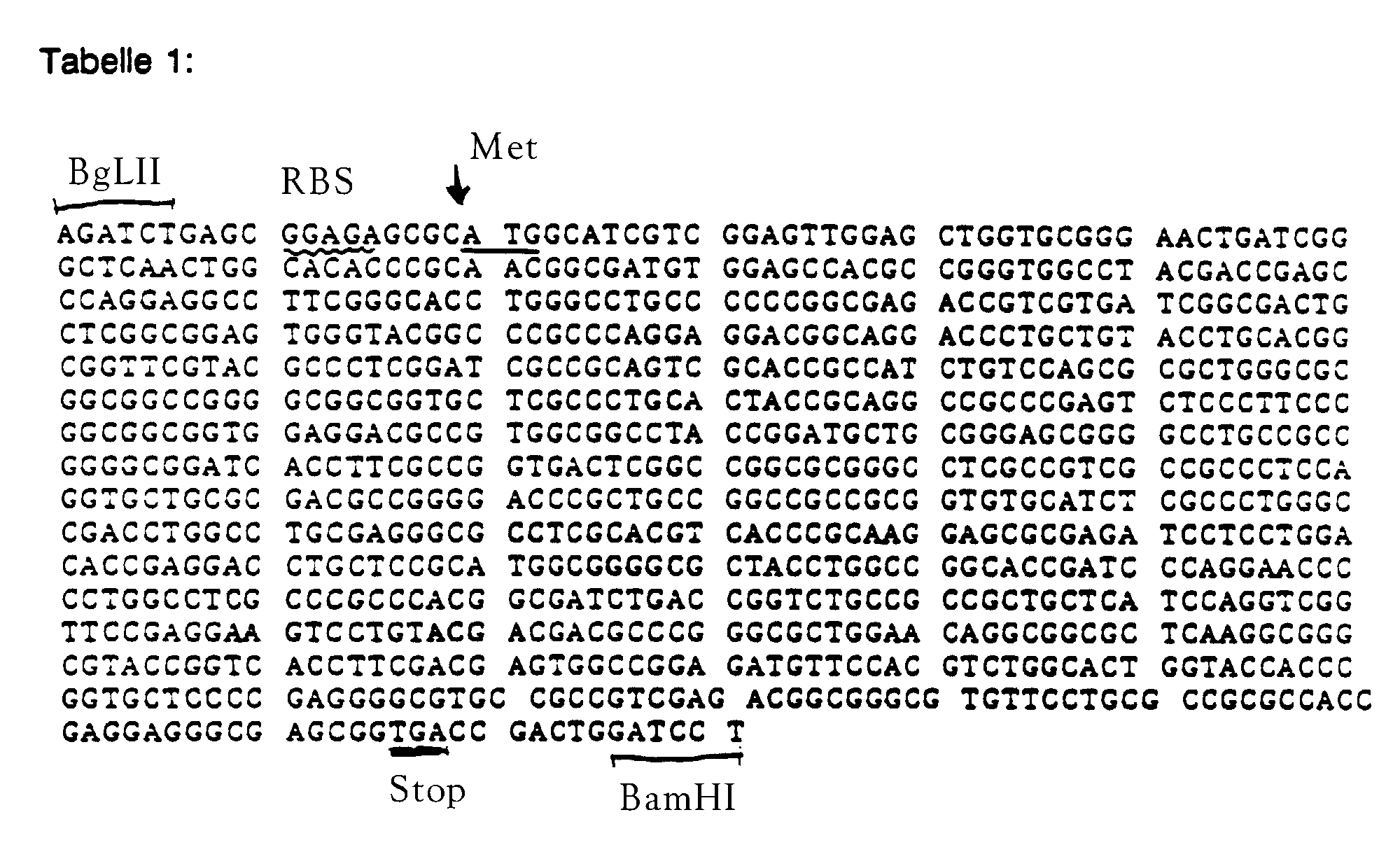
- the dea gene is located downstream of the pat gene on the already known 4.0 kb BamHI fragment (EP-A-0 257 542). This gene lies on a BglII-BamHI fragment and is precisely determined by the sequence (FIG. 1 and Tab. 1).
- the protein sequence is defined by the DNA sequence.
- An ATG codon which is recognized in bacteria and in plants, serves as the translation start codon; the Shine-Dalgarno sequence is underlined. This gene encodes the final step in PTT biosynthesis, the deacetylation of inactive N-acetylphosphinothricin tripeptide to the active PTT.
- the phosphinothricin-N-acetyltransferase encoded by the pat gene serves in the PTT biosynthesis is actually used for acetylation of desmethyl PTC and can their non-specificity can be used to detoxify PTC.
- By Overexpression of the dea gene (with the help of suitable promoters or through Cloning to high-copy vectors) can be an insufficiently specific N-acetyl PTT deacetylase now for the activation of N-acetyl-phosphinothricin be used.
- Another dea gene can be obtained from E. coli. It was found that in E. coli - in contrast to other bacteria (e.g. rhizobia and Streptomycetes) - after cloning the pat gene into suitable expression vectors (Strauch et al., Gene, 63, 65-74, 1988; Wohlleben et al., Gene, 70, 25-37, 1988) im So - called PAT assay (doctoral thesis Inge Broer, Faculty of Biology of the Bielefeld University, Expression of the phosphinthricin-N-acetyltransferase gene from Streptomyces viridochromogenes in Nicotiana tabacum, pp. 42-43, 1989) none Activity can be demonstrated.
- the pat gene is low in E. coli unable to confer PTT resistance because of endogenous deacetylase abolishes the action of phosphinothricin-N-acetyltransferase.
- this deacetylase activity by effectively inhibiting GS activity Addition of N-acetyl-phosphinothricin can be detected directly.
- N-Ac-PTC will implemented by the deacetylase to PTC, which then the GS in a known manner inhibits what occurs in the ⁇ -glutamyl transferase assay (Bender et al., J. Bacteriol. 129, 1001-1009, 1977). This is due to endogenous deacetylase activity from E. coli.
- pat and dea genes can be used together with Tissue-specific promoters can be used to develop certain To specifically prevent plant tissue.
- a special application is e.g. B. the Manufacture of male sterile plants.
- RNAse gene with a tapetum-specific Promoter (Mariani et al .; Nature 347, 737-741, 1990) fused.
- the exclusive Expression of the gene in the tapetum cells ensures the selective destruction of the Tissue and thus prevents the formation of ripe pollen.
- a plant that this Gene should only be able to form seeds after cross-fertilization.
- a The main disadvantage of this system is the fact that descendants of this Plant are also male sterile and therefore in the field where they are on Self-fertilization are dependent, can not form seeds. This only works then when the male partner of the cross carries a gene that has the effect the RNAse can cancel in the offspring. This is said according to the above mentioned patent application made by the barstar gene. The fact is that only genetically modified, i.e. transgenic partners in the intersection can be used.
- N-acetyl-phosphinothricin if you need high activity. All can be used as tissue-specific promoters described promoters find use, the selective expression in certain tissues (e.g. Koltunow et al., The Plant Cell., Vol. 2, 1201-1224, 1990). Of course, all newly isolated promoters are included similar properties. In addition to tissue-specific promoters promoters are also used which have a different type of regulation (e.g. due to time, stress, environmental) and the occurs tissue-specifically.
- DNA fragments with promoter activity are pre-cloned dea genes, so shows the selective failure of tissue parts after application of N-acetyl-phosphinothricin or N-acetyl-phosphinothricin tripeptide the specificity of the promoter.
- the invention relates to positive selection systems. Either in Combination with the pat gene and PTT (or PTC) together with a dea gene or with N-acetyl-phosphinothricin (or N-acetyl-phosphinothricin tripeptide) and An dea gene alone can be used to select the cells in which the dea gene has been deactivated. This enables successful cloning (insertion inactivation) but also select rare events (e.g. transposition) directly. Further Aspects of the invention are set out in the examples.
- Example 1 Fusion of the deacetylase coding region with eukaryotic Transcription signals
- the plasmid pPRI (see EP-0 257 542) was isolated from an E. coli strain and cleaved with BamHI and BgIII. The digested DNA was in an agarose gel separated and a 0.9 kb fragment isolated from the gel.
- the vector pROKI (Baulcombe et al., Nature 321, 446-449, 1986) was also treated with BamHI restricted. The two approaches were combined and ligated. The ligation mix was developed according to E. coli S17.1 (Simon et al., Bio / Technology 1,784-791, 1983) transformed. Colonies were grown on media containing kanamycin Transfer nitrocellulose filter and lysed after 12h incubation at 37 ° C.
- the 0.9 kb isolated from the agarose gel Fragment was made single-stranded by incubation at 100 ° C. Subsequently the missing strand was labeled with Klenow polymerase and digoxigenin Synthesized nucleotides. The marked strand was used as a sample Hybridization with the bacterial DNA bound to the filter is used. Hybridizing clones could be detected using an antibody reaction.
- the plasmid with the orientation I was designated as pIB17.1, with orientation II as pIB17.2 (see FIG. 2).
- Example 2 Detection of the deacetylation of N-acetyl-PTC and N-acetyl-PTT by the deacetylase gene
- the plasmids pIB17.1 and pIB17.2 were therefore by means of a 2-factor crossing in the Rhizobium meliloti strain transferred in 2011.
- R. meliloti Wild-type strains with radiolabelled N-acetyl-PTC could be shown that this strain does not deacetylate N-acetyl-PTC.
- R. meliloti is very sensitive to PTC and PTT. Therefore leaves the deacetylation also affects the inhibition of R. meliloti Detect glutamine synthetases by the released PTC.
- Example 3 Transfer of the modified deacetylase gene in Nicotiana tabacum
- the deacetylase gene modified in Example 1 was determined using a 2-factor Crossing transferred to A. tumefaciens LBA4404. With the so created Strains LBA4404 / 17.1 and LBA4404 / 17.2 were Nicotiana tabacum Leaf discs incubated and after 3 days on a kanamycin-containing Shoot induction medium implemented. Regenerating kanamycin-resistant rung can by Southern hybridization to the presence of the deacetylase gene be tested. After treatment with N-acetyl-PTC or N-acetyl-PTT then the plants are killed by the released PTC or PTT.
- Example 4 Construction of a vector for the transient expression of the modified Deacetylase gene in E. coli and tobacco protoplasts
- the modified deacetylase gene from pIB17.1 and pIB17.2 was by EcoRI / HindIII digestion cut out of the plasmids. The restricted DNA was separated in an agarose gel and a 0.9 kb fragment was isolated in each case. Of the Vector pSVB28 (Arnold and Pühler, Gene 70, 171-179, 1988) was also used Digested EcoRI / HindIII. The two approaches were combined and ligated. After Transformation into the ⁇ -galactosidase negative E. coli strain JM83 all showed Vector bearing clones a blue color, while clones using a vector Wear insertion of the deacetylase gene, remained white.
- the DNA was cloned and digested with EcoRI / HindIII. Based on the The clones with the modified deacetylase gene had a restriction pattern detect.
- the constructed vectors are called pIB27.1 and pIB27.2 (see Fig. 2). They are present in E. coli with a large number of copies.
- Example 5 Transient expression of the modified deacetylase gene in Tobacco protoplasts
- the plasmid DNA was isolated from the E. coli strains constructed in Example 4. Young tobacco leaves were incubated with digestive enzymes for 20 hours. The one from the Protoplasts covered with leaf skeletons were cleaned and placed in a transfer buffer incubated with polyethylene glycol (PEG) and the isolated DNA. Then were the protoplasts are washed and in a culture liquid (K3 medium) added. After 3 days of incubation under dim lighting, the regenerating protoplasts and the crude extracts with radioactive labeled N-acetyl-PTC and N-acetyl-PTT incubated. The deacetylated PTC or PTT can be detected using thin layer chromatography.
- PEG polyethylene glycol
- Example 6 Method for producing male sterile crop plants under Use of the deacetylase gene from S. viridochromogenes under the control of a wallpaper-specific promoter.
- the deacetylase gene from Streptomyces viridochromogenes is linked to a wallpaper-specific promoter from Nicotiana tabacum fused and over Agrobacterial mediated leaf disc transformation introduced into tobacco cells.
- the plants regenerating from these cells become any Sprayed with N-acetyl-PTC or N-acetyl-PTT before flowering. It can are shown that N-acetyl-PTC is stable in the plant cell and in all cells is transported. Neither substance has any noticeable negative consequences for the wild type plant. As soon as the first tapetum cells form, they begin with expression of the deacetylase gene.
- N-acetyl PTC stored in the cell or N-acetyl-PTT is deacetylated by the enzyme and thus effective Form transferred. It inhibits the cells' glutamine synthetase and leads to one rapid death. Ripe pollen can no longer arise. In addition, too the formation of deacetylase is interrupted. Surrounding cells shouldn't be affected. If the plant is not using N-acetyl-PTC or N-acetyl-PTT treated, it is fully fertile. This eliminates the need to lift the cms Gene of the male partner of the cross. At the same time there is a precisely defined one Mutation before that has no effect on the viability and usability of the Plant remains.
- the deacetylase gene is thus without a promoter at the right or left end a disarmed T-DNA clones that one at the insertion site of the T-DNA Read the promoter located in the plant genome into the gene and close it its expression can lead.
- Transgenic plants are over Clone propagation cloned.
- a clone is created with N-acetyl-PTC or N-acetyl-PTT treated and examined for any dying tissue.
- reverser PCR can target the gene from a non-N-acetyl-PTC or N-acetyl-PTT treated clone are multiplied and isolated (Kahl and Weising, gene transfer in Plants, biology in our time, No. 6, p. 181, 1988).
- N-acetyl-PPT and PPT could be identified by comparing the R 1 values of the radioactive spots with the corresponding reference substances. It turned out that N-Acetyl-PPT is almost completely metabolized to PPT in the soil within 14 days. In contrast, in a control experiment with sterile soil samples (soil 4 hours at 200 ° C), the substance was found to be completely stable.
- Example 9 Isolation and identification of soil microorganisms with a N-acetyl-PPT-specific deacetylase activity
- All media contained 5 mM N-acetyl-PPT.
- the agar plates and the liquid cultures were incubated for 3-5 days at 28 ° C.
- the experiment also shows that the deacetylase found accepts the L-enantiomer of the acetylated PPT as a substrate.
- the culture CB 10 was plated on LB agar (10 g / l tryptone, 5 g / l yeast extract, 10 g / l NaCl, 15 g / l agar) and for Incubated for 2 days at 28 ° C. 10 single colonies were isolated from the plate, inoculated in chitin liquid medium and the cultures tested for N-acetyl-PPT-deacetylase activity as described above. The deacetylase positive isolates were replated to check the culture uniformity. The strain with the highest deacetylase activity was identified as Xanthomonas maltophilia (DSM Accession No. DSM 7192).
- the enrichment cultures of the soil samples in the various liquid media were tested for deacetylation of N-acetyl-PPT as described above. Only the chitin medium cultures were found to be deacetylase positive. After plating on chitin agar, a total of 40 individual colonies were isolated from these cultures, grown in chitin liquid medium and then examined for deacetylase activity. Six positive isolates were found (BoK1, BoK5, BoK9, BCÜ 1, BCÜ2, BCÜ3), from which the active pure cultures could be obtained by spreading again on agar plates and further cultivating individual colonies (see above). The strain with the highest deacetylase activity was identified as Microbacterium imperiale (DSM deposit no. DSM 7191).
- Example 10 N-Acetyl-PPT-Deacetylase Enzyme Tests Using the Isolated Microorganisms
- the suspensions were mixed with 1 volume of 100 mM N-acetyl-PPT and incubated in 50 ml Erlenmeyer flasks for 24 hours at 28 ° C. and 220 rpm. After the cells had been separated off by centrifugation at 5000 rpm for 10 min, the PPT content in the supernatants was determined in the amino acid analyzer (see Example 9).
- Actinoplanes liguriae IFO No. 13997
- Actinoplanes sp. Central Research Collection No. A 1015
- N-acetyl-PPT-specific deacetylase activities were also found in fermentation experiments in the presence of N-acetyl-PPT and by biotransformation with 14 [C] -LN-acetyl-PPT as substrate.
Landscapes
- Health & Medical Sciences (AREA)
- Genetics & Genomics (AREA)
- Life Sciences & Earth Sciences (AREA)
- Engineering & Computer Science (AREA)
- Chemical & Material Sciences (AREA)
- Bioinformatics & Cheminformatics (AREA)
- Biomedical Technology (AREA)
- Organic Chemistry (AREA)
- Biotechnology (AREA)
- Wood Science & Technology (AREA)
- Zoology (AREA)
- General Engineering & Computer Science (AREA)
- Molecular Biology (AREA)
- General Health & Medical Sciences (AREA)
- Biochemistry (AREA)
- Microbiology (AREA)
- Plant Pathology (AREA)
- Cell Biology (AREA)
- Biophysics (AREA)
- Physics & Mathematics (AREA)
- Medicinal Chemistry (AREA)
- Enzymes And Modification Thereof (AREA)
- Preparation Of Compounds By Using Micro-Organisms (AREA)
- Micro-Organisms Or Cultivation Processes Thereof (AREA)
- Breeding Of Plants And Reproduction By Means Of Culturing (AREA)
- Measuring Or Testing Involving Enzymes Or Micro-Organisms (AREA)
- Inorganic Compounds Of Heavy Metals (AREA)
Description
N-Acetyl-PPT im Boden innerhalb von 14 Tagen fast vollständig zu PPT metabolisiert wird. In einem Kontrollversuch mit sterilen Bodenproben (Boden 4 Stunden bei 200°C) erwies sich die Substanz dagegen als vollständig stabil.
- Lösung A:
- 50 g/l K2HPO4
- Lösung B:
- 2,5 g/l MgSO4
0,5 g/l NaCl
25 ml/l Spurenelemente
Die Deacetylase-Aktivität der Zellen dieser Kultur wurde anschließend noch durch Biotransformation mit 14[C]-L-N-Acetyl-PPT als Substrat überprüft. Dazu wurden 1,5 ml der Kultur wie oben abzentrifugiert, das Zellpellet 1 x in 10 mM NaCl, 10 mM NaPhosphat-Puffer, pH = 7,0 gewaschen und in 100 µl des gleichen Puffers resuspeniert. 10 µl dieser Suspension wurden mit 10 µl einer 0,25 mM Lösung von 14[C]-L-N-Acetyl-PT versetzt und für 15 Stunden bei 28°C inkubiert. Dann wurden die Bakterien abzentrifugiert und 7 µl des Überstandes durch Dünnschichtchromatographie und Autoradiographie wie in Beispiel 1 beschrieben analysiert. Es konnte eine nahezu quantitative Umsetzung von N-Acetyl-PPT in PPT festgestellt werden. Der Versuch zeigt außerdem, daß die gefundene Deacetylase das L-Enantiomer des acetylierten PPT als Substrat akzeptiert.
Zur weiteren Reinigung der Stämme mit der gewünschten Deacetylase-Aktivität wurde die Kultur CB 10 auf LB-Agar (10 g/l Trypton, 5 g/l Hefe-Extrakt, 10 g/l NaCl, 15 g/l Agar) ausplattiert und für 2 Tage bei 28°C bebrütet. Von der Platte wurden 10 Einzelkoloniern isoliert, in Chitin-Flüssigmedium überimpft und die Kulturen wie oben beschrieben auf N-Acetyl-PPT-Deacetylase-Aktivität getestet. Die Deacetylase-positiven Isolate wurden erneut ausplattiert, um die Einheitlichkeit der Kultur zu überprüfen. Der Stamm mit der höchsten Deacetylase-Aktivität wurde als Xanthomonas maltophilia identifiziert (DSM Hinterlegungs-Nr. DSM 7192).
| N-Acetyl-PPT-Deacetylase-Tests mit Bodenmikroorganismen | |||
| Stamm: | Medium: | Konzentration an PPT im Überstand | |
| [mM]: | [%]: | ||
| BoK1 | LB | 0,7 | 2,7 |
| BoK1 | Chitin | 13,9 | 55,5 |
| BoK5 | LB | 6,0 | 23,9 |
| BoK5 | Chitin | 14,3 | 57,2 |
- Medium A:
- 0,2 % Hefe-Extrakt
0,2 % Fleischextrakt
0,4 % Polypepton (aus Sojamehl)
1 % Glucose - Medium B:
- 20 g/l Haferflocken
1 ml/l Spurenelemente
| N-Acetyl-PPT-Deacetylase-Tests mit Actinomyceten | |||
| Stamm: | Medium: | Konzentration an PPT im Überstand | |
| [mM]: | [%]: | ||
| Actinoplanes liguriae (IFO Nr. 13997) | A | 3,3 | 13,2 |
| Actinoplanes liguriae (IFO Nr. 13997) | B | 7,6 | 30,4 |
| Actinoplanes sp. (Nr. A 1015) | A | 11,0 | 44,0 |
| Actinoplanes sp. (Nr. A 1015) | B | 2,7 | 10,8 |
- Aus der Kultur CB 10:
- Clavibacter michiganense insidiosum
Agrobacterium tumefaciens
Agrobacterium oxydans
Bacillus amyloliquefaciens
Bacillus macerans - Aus der Kultur BoK1:
- Alcaligenes faecalis
Escherichia coli - Aus der Kultur BoK5:
- Staphylococcus hominis
- Aus der Kultur BCÜ1:
- Micrococcus luteus A
Acinetobacter johnsonii
Microbacterium laeraniformans - Aus der Kultur BCÜ2:
- Acinetobacter calcoaceticus
Claims (8)
- Verfahren zur Herstellung transgener Pflanzen mit selektiv zerstörbaren Pflanzenteilen, dadurch gekennzeichnet, daß man in die Pflanze ein Deacetylasegen unter Kontrolle eines gewebespezifischen Promoters bringt und die betreffenden Gewebeteile durch geeignete rechtzeitige Behandlung mit N-Acetyl-PTC oder N-Acetyl-PTT zum Absterben bringt.
- Verfahren zur Herstellung transgener Pflanzen mit selektiv zerstörbaren Pflanzenteilen, dadurch gekennzeichnet, daß die Pflanze eine PTC-Resistenz besitzt und zusätzlich ein Deacetylasegen unter Kontrolle eines gewebespezifischen Promoters erhält und die betreffenden Gewebeteile durch geeignete rechtzeitige Behandlung mit PTC oder PTT zum Absterben bringt.
- Verfahren nach Anspruch 1 oder 2, dadurch gekennzeichnet, daß das Deacetylasegen aus E.coli stammt und die Pflanze mit N-Acetyl-PTC bzw. PTC behandelt wird.
- Verfahren nach Anspruch 1 oder 2, dadurch gekennzeichnet, daß das Deacetylasegen aus Streptomyces stammt und die Pflanze mit N-Acetyl-PTT bzw. PTT behandelt wird.
- Verfahren nach einem oder mehreren der Ansprüche 1 - 4, dadurch gekennzeichnet, daß männlich sterile Pflanzen erzeugt werden.
- Verfahren nach einem oder mehreren der Ansprüche 1 - 5, dadurch gekennzeichnet, daß das Deacetylasegen unter der Kontrolle des Tapetum-Promoters steht.
- Verwendung eines Deacetylasegens zum gezielten Außer-Funktion-Setzen spezifischer Pflanzenteile, in dem das Deacetylasegen unter der Kontrolle eines gewebespezifischen Promoters exprimiert wird und die betreffenden Gewebeteile durch geeignete und rechtzeitige Behandlung mit N-Acetyl-PTC oder N-Acetyl-PTT selektiv abgetötet werden.
- Verwendung eines Deacetylasegens zum gezielten Außer-Funktion-Setzen spezifischer Pflanzenteile, in dem das Deacetylasegen unter der Kontrolle eines gewebespezifischen Promoters exprimiert wird und die betreffenden Gewebeteile durch geeignete und rechtzeitige Behandlung mit PTC oder PTT selektiv abgetötet werden.
Priority Applications (1)
| Application Number | Priority Date | Filing Date | Title |
|---|---|---|---|
| EP98101772A EP0869182B1 (de) | 1991-08-09 | 1992-08-07 | Pflanzen, die für ein Deacetylasegen transgen sind |
Applications Claiming Priority (2)
| Application Number | Priority Date | Filing Date | Title |
|---|---|---|---|
| DE4126414 | 1991-08-09 | ||
| DE4126414A DE4126414A1 (de) | 1991-08-09 | 1991-08-09 | Deacetylasegene zur erzeugung von phosphinothricin oder phosphinothricyl-alanyl-alanin, verfahren zu ihrer isolierung und ihre verwendung |
Related Child Applications (1)
| Application Number | Title | Priority Date | Filing Date |
|---|---|---|---|
| EP98101772A Division EP0869182B1 (de) | 1991-08-09 | 1992-08-07 | Pflanzen, die für ein Deacetylasegen transgen sind |
Publications (3)
| Publication Number | Publication Date |
|---|---|
| EP0531716A2 EP0531716A2 (de) | 1993-03-17 |
| EP0531716A3 EP0531716A3 (en) | 1994-05-11 |
| EP0531716B1 true EP0531716B1 (de) | 1998-12-23 |
Family
ID=6438019
Family Applications (2)
| Application Number | Title | Priority Date | Filing Date |
|---|---|---|---|
| EP92113465A Expired - Lifetime EP0531716B1 (de) | 1991-08-09 | 1992-08-07 | Deacetylasegene zur Erzeugung von Phosphinothricin oder Phosphinothricyl-Alanyl-Alanin, Verfahren zu ihrer Isolierung und ihre Verwendung |
| EP98101772A Expired - Lifetime EP0869182B1 (de) | 1991-08-09 | 1992-08-07 | Pflanzen, die für ein Deacetylasegen transgen sind |
Family Applications After (1)
| Application Number | Title | Priority Date | Filing Date |
|---|---|---|---|
| EP98101772A Expired - Lifetime EP0869182B1 (de) | 1991-08-09 | 1992-08-07 | Pflanzen, die für ein Deacetylasegen transgen sind |
Country Status (14)
| Country | Link |
|---|---|
| US (4) | US5767370A (de) |
| EP (2) | EP0531716B1 (de) |
| JP (1) | JPH05199875A (de) |
| AT (2) | ATE368119T1 (de) |
| AU (1) | AU653845B2 (de) |
| CA (1) | CA2075560A1 (de) |
| DE (3) | DE4126414A1 (de) |
| DK (2) | DK0869182T3 (de) |
| ES (2) | ES2128331T3 (de) |
| GR (1) | GR3029769T3 (de) |
| HU (1) | HU216645B (de) |
| MX (1) | MX9204610A (de) |
| SG (1) | SG46682A1 (de) |
| ZA (1) | ZA925935B (de) |
Families Citing this family (16)
| Publication number | Priority date | Publication date | Assignee | Title |
|---|---|---|---|---|
| EP0628635A1 (de) * | 1993-06-08 | 1994-12-14 | Nunhems Zaden Bv | Verfahren zur Herstellung männlicher steriler Pflanzen |
| WO1994029465A1 (en) * | 1993-06-08 | 1994-12-22 | Nunhems Zaden B.V. | Process for generating male sterile plants |
| DE19639463A1 (de) | 1996-09-26 | 1998-04-02 | Hoechst Schering Agrevo Gmbh | Verfahren zur Herstellung weiblich steriler Pflanzen |
| US6555733B2 (en) | 1996-12-16 | 2003-04-29 | Hoechst Schering Agrevo Gmbh | Genes coding for amino acid deacetylases with specificity for N-acetyl-L-phosphinothricin, their isolation and use |
| DE19652284A1 (de) | 1996-12-16 | 1998-06-18 | Hoechst Schering Agrevo Gmbh | Neue Gene codierend für Aminosäure-Deacetylasen mit Spezifität für N-Acetyl-L-Phosphinothricin, ihre Isolierung und Verwendung |
| BR9808824A (pt) * | 1997-03-03 | 2000-07-04 | Novartis Ag | Método de produção de semente hìbrida usando esterilidade fêmea condicional |
| US6815577B1 (en) | 1997-03-03 | 2004-11-09 | Syngenta Participations Ag | Method of hybrid seed production using conditional female sterility |
| AU6882298A (en) * | 1997-04-03 | 1998-10-22 | Dekalb Genetics Corporation | Glyphosate resistant maize lines |
| US7001733B1 (en) | 1998-05-12 | 2006-02-21 | Rigel Pharmaceuticals, Inc. | Methods and compositions for screening for modulations of IgE synthesis, secretion and switch rearrangement |
| EP0987330A1 (de) * | 1998-09-01 | 2000-03-22 | Hoechst Schering AgrEvo GmbH | Änderung der Entwicklung und Differenzierung von Pflanzen durch gewebespezifisches Deac-Gen Expressionssystem |
| EP0987331A1 (de) * | 1998-09-01 | 2000-03-22 | Hoechst Schering AgrEvo GmbH | Pathogenizitätskontrolle von Pflanzen durch pathogeninduzierbare Expression von Deac-Gen |
| US6384304B1 (en) | 1999-10-15 | 2002-05-07 | Plant Genetic Systems N.V. | Conditional sterility in wheat |
| CA2440745A1 (en) * | 2001-03-12 | 2002-09-19 | Bayer Bioscience N.V. | Novel genes for conditional cell ablation |
| US20070199095A1 (en) | 2005-10-13 | 2007-08-23 | Edwards Allen | Methods for producing hybrid seed |
| PE20141518A1 (es) | 2011-07-01 | 2014-11-17 | Monsanto Technology Llc | Metodos y composiciones para la regulacion selectiva de la expresion de proteinas |
| CN112111506B (zh) * | 2020-09-23 | 2022-03-25 | 江南大学 | 一种RBS优化提高γ-谷氨酰胺转肽酶表达量的方法 |
Family Cites Families (4)
| Publication number | Priority date | Publication date | Assignee | Title |
|---|---|---|---|---|
| ES2038631T3 (es) * | 1986-08-23 | 1993-08-01 | Hoechst Aktiengesellschaft | Procedimiento para la obtencion de un gen de resistencia frente a fosfinotricina (ptc). |
| NZ227835A (en) * | 1988-02-03 | 1992-09-25 | Paladin Hybrids Inc | Antisense gene systems of pollination control for hybrid seed production |
| WO1990008828A2 (en) * | 1989-02-02 | 1990-08-09 | Paladin Hybrids Inc. | Molecular methods of hybrid seed production |
| US5212296A (en) * | 1989-09-11 | 1993-05-18 | E. I. Du Pont De Nemours And Company | Expression of herbicide metabolizing cytochromes |
-
1991
- 1991-08-09 DE DE4126414A patent/DE4126414A1/de not_active Withdrawn
-
1992
- 1992-08-07 AT AT98101772T patent/ATE368119T1/de not_active IP Right Cessation
- 1992-08-07 CA CA002075560A patent/CA2075560A1/en not_active Abandoned
- 1992-08-07 SG SG1996008249A patent/SG46682A1/en unknown
- 1992-08-07 EP EP92113465A patent/EP0531716B1/de not_active Expired - Lifetime
- 1992-08-07 ES ES92113465T patent/ES2128331T3/es not_active Expired - Lifetime
- 1992-08-07 DK DK98101772T patent/DK0869182T3/da active
- 1992-08-07 DE DE59209598T patent/DE59209598D1/de not_active Expired - Fee Related
- 1992-08-07 ES ES98101772T patent/ES2290974T3/es not_active Expired - Lifetime
- 1992-08-07 AT AT92113465T patent/ATE174964T1/de not_active IP Right Cessation
- 1992-08-07 ZA ZA925935A patent/ZA925935B/xx unknown
- 1992-08-07 DE DE59210006T patent/DE59210006D1/de not_active Expired - Fee Related
- 1992-08-07 EP EP98101772A patent/EP0869182B1/de not_active Expired - Lifetime
- 1992-08-07 MX MX9204610A patent/MX9204610A/es active IP Right Grant
- 1992-08-07 DK DK92113465T patent/DK0531716T3/da active
- 1992-08-07 HU HU9202582A patent/HU216645B/hu unknown
- 1992-08-07 AU AU20890/92A patent/AU653845B2/en not_active Ceased
- 1992-08-10 JP JP4234194A patent/JPH05199875A/ja active Pending
-
1995
- 1995-06-02 US US08/459,254 patent/US5767370A/en not_active Expired - Lifetime
- 1995-06-02 US US08/458,912 patent/US5650310A/en not_active Expired - Lifetime
- 1995-06-02 US US08/459,255 patent/US5767371A/en not_active Expired - Lifetime
- 1995-06-05 US US08/461,179 patent/US5668297A/en not_active Expired - Lifetime
-
1999
- 1999-03-23 GR GR990400856T patent/GR3029769T3/el unknown
Also Published As
| Publication number | Publication date |
|---|---|
| HU216645B (hu) | 1999-07-28 |
| DE59209598D1 (de) | 1999-02-04 |
| AU2089092A (en) | 1993-02-11 |
| ZA925935B (en) | 1993-04-28 |
| EP0531716A3 (en) | 1994-05-11 |
| US5767370A (en) | 1998-06-16 |
| ATE174964T1 (de) | 1999-01-15 |
| US5650310A (en) | 1997-07-22 |
| EP0869182B1 (de) | 2007-07-25 |
| HU9202582D0 (en) | 1992-10-28 |
| ES2128331T3 (es) | 1999-05-16 |
| DK0531716T3 (da) | 1999-08-23 |
| ATE368119T1 (de) | 2007-08-15 |
| SG46682A1 (en) | 1998-02-20 |
| MX9204610A (es) | 1993-02-01 |
| US5668297A (en) | 1997-09-16 |
| DE4126414A1 (de) | 1993-02-11 |
| HUT62656A (en) | 1993-05-28 |
| ES2290974T3 (es) | 2008-02-16 |
| CA2075560A1 (en) | 1993-02-10 |
| AU653845B2 (en) | 1994-10-13 |
| JPH05199875A (ja) | 1993-08-10 |
| DE59210006D1 (de) | 2007-09-06 |
| US5767371A (en) | 1998-06-16 |
| GR3029769T3 (en) | 1999-06-30 |
| DK0869182T3 (da) | 2007-11-26 |
| EP0869182A1 (de) | 1998-10-07 |
| EP0531716A2 (de) | 1993-03-17 |
Similar Documents
| Publication | Publication Date | Title |
|---|---|---|
| DE68929331T2 (de) | Systeme zur Bestäubungskontrolle mittels Antisens-Gensystemen zur Herstellung von hydribem Saatgut | |
| DE69024979T2 (de) | Expression von unkrautvertilgungsmittel p450 metabolisierenden cytochromen | |
| EP0942965B1 (de) | Neues gen für eine aminosäure-deacetylase mit spezifität für n-acetyl-l-phosphinothricin, ihre isolierung und verwendung | |
| DE69333333T2 (de) | Auf fungus reagierendes chimaeres gen | |
| DE69132124T2 (de) | Verfahren zur transformation monokotyler pflanzen | |
| DE69333880T2 (de) | Erhaltung von männlichen sterilen pflanzen | |
| DE69034190T2 (de) | Molekulare verfahren zur vermehrung von hybriden saaten | |
| DE3587718T2 (de) | Herbizide Resistenz in Pflanzen. | |
| DE69434972T2 (de) | Verfahren zur transformation von pflanzen und ein vektor dafür | |
| DE69333801T2 (de) | Verfahren zur Herstellung von hybridem Saatgut | |
| DE3789359T2 (de) | Modifizierung von Baumwollpflanzen und Zellinien durch Gentechnologie. | |
| EP0869182A1 (de) | Deacetylasegene zur Erzeugung von Phosphinothricin oder Phosphinothricyl-Alanyl-Alanin, Verfahren zu ihrer Isolierung und ihre Verwendung | |
| DE69401436T2 (de) | Verfahren zum bekämpfen von insekten | |
| DE69130532T2 (de) | Binäres cryptocytotoxisches verfahren zur herstellung von hybrid-saatgut | |
| EP0257542B1 (de) | Resistenzgen gegen Phosphinothricin und seine Verwendung | |
| DE69636225T2 (de) | Stimulierung der homologen rekombination in pflanzlichen organismen mittels rekombinations fördernder enzyme | |
| DE69835672T2 (de) | Methoden zur pflanzentransformation | |
| EP0298918A2 (de) | Induzierbare Virusresistenz bei Pflanzen | |
| DE69924005T2 (de) | Transgene pflanzen mit konditional lethalem gen | |
| DE19639463A1 (de) | Verfahren zur Herstellung weiblich steriler Pflanzen | |
| EP0317511A2 (de) | Insektizide Baumwollpflanzenzellen | |
| Charles et al. | ndvF, a novel locus located on megaplasmid pRmeSU47b (pEXO) of Rhizobium meliloti, is required for normal nodule development | |
| DE69033698T2 (de) | Gegen Glutaminsynthetaseinhibitoren resistente Sojabohnenpflanzen | |
| DE19600357C1 (de) | DNA-Sequenz kodierend einen Phosphoenolpyruvat-Phosphat-Translokator, Plasmide, Bakterien, Hefen und Pflanzen enthaltend diesen Transporter | |
| WO1997045547A2 (de) | Lokalisierter zelltod in pflanzen |
Legal Events
| Date | Code | Title | Description |
|---|---|---|---|
| PUAI | Public reference made under article 153(3) epc to a published international application that has entered the european phase |
Free format text: ORIGINAL CODE: 0009012 |
|
| AK | Designated contracting states |
Kind code of ref document: A2 Designated state(s): AT BE CH DE DK ES FR GB GR IT LI NL SE |
|
| PUAL | Search report despatched |
Free format text: ORIGINAL CODE: 0009013 |
|
| AK | Designated contracting states |
Kind code of ref document: A3 Designated state(s): AT BE CH DE DK ES FR GB GR IT LI NL SE |
|
| RAP1 | Party data changed (applicant data changed or rights of an application transferred) |
Owner name: HOECHST SCHERING AGREVO GMBH |
|
| 17P | Request for examination filed |
Effective date: 19941111 |
|
| 17Q | First examination report despatched |
Effective date: 19960131 |
|
| GRAG | Despatch of communication of intention to grant |
Free format text: ORIGINAL CODE: EPIDOS AGRA |
|
| GRAG | Despatch of communication of intention to grant |
Free format text: ORIGINAL CODE: EPIDOS AGRA |
|
| GRAH | Despatch of communication of intention to grant a patent |
Free format text: ORIGINAL CODE: EPIDOS IGRA |
|
| RAP1 | Party data changed (applicant data changed or rights of an application transferred) |
Owner name: HOECHST SCHERING AGREVO GMBH |
|
| GRAH | Despatch of communication of intention to grant a patent |
Free format text: ORIGINAL CODE: EPIDOS IGRA |
|
| GRAA | (expected) grant |
Free format text: ORIGINAL CODE: 0009210 |
|
| AK | Designated contracting states |
Kind code of ref document: B1 Designated state(s): AT BE CH DE DK ES FR GB GR IT LI NL SE |
|
| REF | Corresponds to: |
Ref document number: 174964 Country of ref document: AT Date of ref document: 19990115 Kind code of ref document: T |
|
| REG | Reference to a national code |
Ref country code: CH Ref legal event code: EP |
|
| REF | Corresponds to: |
Ref document number: 59209598 Country of ref document: DE Date of ref document: 19990204 |
|
| ITF | It: translation for a ep patent filed | ||
| GBT | Gb: translation of ep patent filed (gb section 77(6)(a)/1977) |
Effective date: 19990223 |
|
| ET | Fr: translation filed | ||
| REG | Reference to a national code |
Ref country code: ES Ref legal event code: FG2A Ref document number: 2128331 Country of ref document: ES Kind code of ref document: T3 |
|
| REG | Reference to a national code |
Ref country code: DK Ref legal event code: T3 |
|
| PLBQ | Unpublished change to opponent data |
Free format text: ORIGINAL CODE: EPIDOS OPPO |
|
| PLBI | Opposition filed |
Free format text: ORIGINAL CODE: 0009260 |
|
| PLBF | Reply of patent proprietor to notice(s) of opposition |
Free format text: ORIGINAL CODE: EPIDOS OBSO |
|
| 26 | Opposition filed |
Opponent name: NOVARTIS AG Effective date: 19990922 |
|
| NLR1 | Nl: opposition has been filed with the epo |
Opponent name: NOVARTIS AG |
|
| PLBF | Reply of patent proprietor to notice(s) of opposition |
Free format text: ORIGINAL CODE: EPIDOS OBSO |
|
| RAP2 | Party data changed (patent owner data changed or rights of a patent transferred) |
Owner name: AVENTIS CROPSCIENCE GMBH |
|
| PLBF | Reply of patent proprietor to notice(s) of opposition |
Free format text: ORIGINAL CODE: EPIDOS OBSO |
|
| NLT2 | Nl: modifications (of names), taken from the european patent patent bulletin |
Owner name: AVENTIS CROPSCIENCE GMBH |
|
| RAP2 | Party data changed (patent owner data changed or rights of a patent transferred) |
Owner name: AVENTIS CROPSCIENCE GMBH |
|
| NLT2 | Nl: modifications (of names), taken from the european patent patent bulletin |
Owner name: AVENTIS CROPSCIENCE GMBH |
|
| PLBO | Opposition rejected |
Free format text: ORIGINAL CODE: EPIDOS REJO |
|
| PLAB | Opposition data, opponent's data or that of the opponent's representative modified |
Free format text: ORIGINAL CODE: 0009299OPPO |
|
| PLBQ | Unpublished change to opponent data |
Free format text: ORIGINAL CODE: EPIDOS OPPO |
|
| PLAB | Opposition data, opponent's data or that of the opponent's representative modified |
Free format text: ORIGINAL CODE: 0009299OPPO |
|
| R26 | Opposition filed (corrected) |
Opponent name: SYNGENTA PARTICIPATIONS AG Effective date: 19990922 |
|
| R26 | Opposition filed (corrected) |
Opponent name: SYNGENTA PARTICIPATIONS AG Effective date: 19990922 |
|
| PLBN | Opposition rejected |
Free format text: ORIGINAL CODE: 0009273 |
|
| NLR1 | Nl: opposition has been filed with the epo |
Opponent name: SYNGENTA PARTICIPATIONS AG |
|
| NLR1 | Nl: opposition has been filed with the epo |
Opponent name: SYNGENTA PARTICIPATIONS AG |
|
| 27O | Opposition rejected |
Effective date: 20010319 |
|
| NLR2 | Nl: decision of opposition | ||
| REG | Reference to a national code |
Ref country code: GB Ref legal event code: IF02 |
|
| PGFP | Annual fee paid to national office [announced via postgrant information from national office to epo] |
Ref country code: DE Payment date: 20070612 Year of fee payment: 16 |
|
| PGFP | Annual fee paid to national office [announced via postgrant information from national office to epo] |
Ref country code: DK Payment date: 20070815 Year of fee payment: 16 |
|
| PGFP | Annual fee paid to national office [announced via postgrant information from national office to epo] |
Ref country code: ES Payment date: 20070926 Year of fee payment: 16 |
|
| PGFP | Annual fee paid to national office [announced via postgrant information from national office to epo] |
Ref country code: AT Payment date: 20070813 Year of fee payment: 16 Ref country code: CH Payment date: 20070727 Year of fee payment: 16 |
|
| REG | Reference to a national code |
Ref country code: GB Ref legal event code: 732E |
|
| REG | Reference to a national code |
Ref country code: CH Ref legal event code: PUE Owner name: BAYER CROPSCIENCE AG Free format text: HOECHST SCHERING AGREVO GMBH#MIRAUSTRASSE 54#13509 BERLIN (DE) -TRANSFER TO- BAYER CROPSCIENCE AG#ALFRED-NOBEL-STRASSE 50#40789 MONHEIM (DE) Ref country code: CH Ref legal event code: NV Representative=s name: PATENTANWAELTE SCHAAD, BALASS, MENZL & PARTNER AG |
|
| PGFP | Annual fee paid to national office [announced via postgrant information from national office to epo] |
Ref country code: GB Payment date: 20070801 Year of fee payment: 16 |
|
| PGFP | Annual fee paid to national office [announced via postgrant information from national office to epo] |
Ref country code: IT Payment date: 20070828 Year of fee payment: 16 Ref country code: NL Payment date: 20070805 Year of fee payment: 16 Ref country code: SE Payment date: 20070807 Year of fee payment: 16 |
|
| NLS | Nl: assignments of ep-patents |
Owner name: BAYER CROPSCIENCE AG Effective date: 20071213 |
|
| NLT1 | Nl: modifications of names registered in virtue of documents presented to the patent office pursuant to art. 16 a, paragraph 1 |
Owner name: BAYER CROPSCIENCE GMBH Owner name: AVENTIS CROPSCIENCE GMBH |
|
| PGFP | Annual fee paid to national office [announced via postgrant information from national office to epo] |
Ref country code: BE Payment date: 20071018 Year of fee payment: 16 |
|
| PGFP | Annual fee paid to national office [announced via postgrant information from national office to epo] |
Ref country code: FR Payment date: 20070808 Year of fee payment: 16 |
|
| PGFP | Annual fee paid to national office [announced via postgrant information from national office to epo] |
Ref country code: GR Payment date: 20070717 Year of fee payment: 16 |
|
| BECA | Be: change of holder's address |
Owner name: *BAYER CROPSCIENCE A.G.ALFRED-NOBEL-STRASSE 50, D- Effective date: 20080520 |
|
| BECH | Be: change of holder |
Owner name: *BAYER CROPSCIENCE A.G. Effective date: 20080520 |
|
| BECN | Be: change of holder's name |
Owner name: *BAYER CROPSCIENCE A.G. Effective date: 20080520 |
|
| REG | Reference to a national code |
Ref country code: FR Ref legal event code: TP |
|
| REG | Reference to a national code |
Ref country code: DK Ref legal event code: EBP |
|
| REG | Reference to a national code |
Ref country code: CH Ref legal event code: PL |
|
| EUG | Se: european patent has lapsed | ||
| GBPC | Gb: european patent ceased through non-payment of renewal fee |
Effective date: 20080807 |
|
| PG25 | Lapsed in a contracting state [announced via postgrant information from national office to epo] |
Ref country code: AT Free format text: LAPSE BECAUSE OF NON-PAYMENT OF DUE FEES Effective date: 20080807 |
|
| NLV4 | Nl: lapsed or anulled due to non-payment of the annual fee |
Effective date: 20090301 |
|
| PG25 | Lapsed in a contracting state [announced via postgrant information from national office to epo] |
Ref country code: NL Free format text: LAPSE BECAUSE OF NON-PAYMENT OF DUE FEES Effective date: 20090301 |
|
| REG | Reference to a national code |
Ref country code: FR Ref legal event code: ST Effective date: 20090430 |
|
| PG25 | Lapsed in a contracting state [announced via postgrant information from national office to epo] |
Ref country code: GR Free format text: LAPSE BECAUSE OF NON-PAYMENT OF DUE FEES Effective date: 20090304 Ref country code: CH Free format text: LAPSE BECAUSE OF NON-PAYMENT OF DUE FEES Effective date: 20080831 Ref country code: LI Free format text: LAPSE BECAUSE OF NON-PAYMENT OF DUE FEES Effective date: 20080831 |
|
| PG25 | Lapsed in a contracting state [announced via postgrant information from national office to epo] |
Ref country code: BE Free format text: LAPSE BECAUSE OF NON-PAYMENT OF DUE FEES Effective date: 20080831 Ref country code: DK Free format text: LAPSE BECAUSE OF NON-PAYMENT OF DUE FEES Effective date: 20080831 |
|
| PG25 | Lapsed in a contracting state [announced via postgrant information from national office to epo] |
Ref country code: DE Free format text: LAPSE BECAUSE OF NON-PAYMENT OF DUE FEES Effective date: 20090303 Ref country code: FR Free format text: LAPSE BECAUSE OF NON-PAYMENT OF DUE FEES Effective date: 20080901 Ref country code: IT Free format text: LAPSE BECAUSE OF NON-PAYMENT OF DUE FEES Effective date: 20080807 |
|
| REG | Reference to a national code |
Ref country code: ES Ref legal event code: FD2A Effective date: 20080808 |
|
| PG25 | Lapsed in a contracting state [announced via postgrant information from national office to epo] |
Ref country code: GB Free format text: LAPSE BECAUSE OF NON-PAYMENT OF DUE FEES Effective date: 20080807 |
|
| PG25 | Lapsed in a contracting state [announced via postgrant information from national office to epo] |
Ref country code: ES Free format text: LAPSE BECAUSE OF NON-PAYMENT OF DUE FEES Effective date: 20080808 |
|
| PG25 | Lapsed in a contracting state [announced via postgrant information from national office to epo] |
Ref country code: SE Free format text: LAPSE BECAUSE OF NON-PAYMENT OF DUE FEES Effective date: 20080808 |