EP0529300B1 - Neues rekombinantes Human-IFN-beta, Verfahren zu dessen Herstellung und dieses enthaltende pharmazeutische Zubereitungen - Google Patents
Neues rekombinantes Human-IFN-beta, Verfahren zu dessen Herstellung und dieses enthaltende pharmazeutische Zubereitungen Download PDFInfo
- Publication number
- EP0529300B1 EP0529300B1 EP92112427A EP92112427A EP0529300B1 EP 0529300 B1 EP0529300 B1 EP 0529300B1 EP 92112427 A EP92112427 A EP 92112427A EP 92112427 A EP92112427 A EP 92112427A EP 0529300 B1 EP0529300 B1 EP 0529300B1
- Authority
- EP
- European Patent Office
- Prior art keywords
- beta
- ifn
- proportion
- recombinant
- chromatography
- Prior art date
- Legal status (The legal status is an assumption and is not a legal conclusion. Google has not performed a legal analysis and makes no representation as to the accuracy of the status listed.)
- Expired - Lifetime
Links
Classifications
-
- C—CHEMISTRY; METALLURGY
- C07—ORGANIC CHEMISTRY
- C07K—PEPTIDES
- C07K14/00—Peptides having more than 20 amino acids; Gastrins; Somatostatins; Melanotropins; Derivatives thereof
- C07K14/435—Peptides having more than 20 amino acids; Gastrins; Somatostatins; Melanotropins; Derivatives thereof from animals; from humans
- C07K14/52—Cytokines; Lymphokines; Interferons
- C07K14/555—Interferons [IFN]
- C07K14/565—IFN-beta
-
- A—HUMAN NECESSITIES
- A61—MEDICAL OR VETERINARY SCIENCE; HYGIENE
- A61K—PREPARATIONS FOR MEDICAL, DENTAL OR TOILETRY PURPOSES
- A61K38/00—Medicinal preparations containing peptides
Definitions
- the invention relates to a new recombinant fibroblast interferon, Process for its preparation and pharmaceutical preparations containing this recombinant human interferon-beta (IFN-beta).
- IFN-beta human interferon-beta
- Naturally occurring interferons are species-specific proteins, mostly Glycoproteins from different cells after induction with viruses, double-stranded RNA, other polynucleotides, antigens and Mitogens are produced.
- the interferons have numerous biological ones Activities. The main ones are the antiviral, antiproliferative, immunomodulating and anti-cellular effects. With human interferons a distinction is made between three types: leukocytes, lymphocytes, Fibroblasts and within the immune system are produced. They are called alpha, beta and gamma interferons.
- Natural human IFN-beta is induced by human fibroblast cell cultures produced and isolated from the cell culture supernatant and cleaned. Proteins or polypeptides with human IFN-beta activity can also using recombinant DNA technology in microorganisms or eukaryotic cell systems, such as e.g. B. mammalian cell cultures, be produced, cf. William E. Stewart II, The Interferon System, 2nd edition, Springer-Verlag Vienna, New York (1981); EP-A 41 313; W. Reiser and H. Hauser, Pharm. Research / Drug. Res. 37 (1), Mr. 4 (1987), Page 482; Mc Cormic et al., Molecular and Cellular Biology, Vol. 4, No. 1, Page 166 (1984); EP-A-0 388 799; Chernajovsky et al., DNA, Vol. 3, No.4, page 297 (1984).
- Fibroblast interferon has many immunological properties, which are comparable to those of the IFN-alpha. However IFN-beta tolerated much better and obviously also has one lower haematological toxicity than IFN-alpha in the previously examined Cases of renal cell carcinoma and lymphoid tumors. In in In vitro studies IFN-beta inhibits the HIV virus and shows one synergistic antiretroviral activity with azidothymidine.
- interferons especially recombinant ones
- instability In particular the high-purity interferon preparations for clinical use show both in liquid and in lyophilized state a rapid loss of activity.
- interferons which are produced in bacteria using recombinant DNA technology
- Another disadvantage is that it is produced in this way Interferons are almost insoluble in aqueous solutions.
- a new recombinant IFN-beta with the features of claim 1, method for its manufacture and stable pharmaceutical preparations of IFN-beta in liquid or lyophilized or solid form put the high purity recombinant IFN-beta in high doses without any pharmacologically disadvantageous additives.
- the IFN-beta according to the invention has a higher antitumor activity, in particular in Kaposi's sarcoma, as the previously tested IFN-beta preparations of natural or recombinant IFN-beta.
- the new IFN-beta is made using recombinant DNA technology produced in CHO cell cultures and by a process that from a combination of phase distribution, affinity, metal chelate and Size exclusion chromatography is made.
- transfected cells of the CHO line (chinese hamster ovary) with the laboratory designation BIC 8622 (construction of the animal cell line, cf. European Patent Application No. 0 287 075) are used in conventional cell culture medium (Modified Eagles Medium (MEM ) with Earles salts), supplemented with 0 to 5% fetal calf serum (FCS), brought to confluence in stationary culture.
- MEM Modified Eagles Medium
- FCS fetal calf serum
- the cells secrete constitutively between 1 x 10 8 and 2 x 10 9 international units (IU) per day and per liter of culture supernatant.
- the IFN-beta continues via liquid / liquid phase extraction enriched, with aqueous two-phase systems based Polyalkylene glycol / dextran or polyalkylene glycol / salt are used.
- polyethylene glycols and / or polypropylene glycols can be used be used.
- Polyethylene glycols can be used as polyethylene glycols with a MW of 1,000 to 6,000, preferably 1,200 to 3,000, most preferably 1,500 to 2,000 are used.
- the concentration is in the range from 1 to 30% by weight, preferably 2 to 15% by weight, most preferably 3 to 9% by weight.
- Polypropylene glycols with a MW of 1,500 to 4,000 can be used. The concentrations used correspond to those for the polyethylene glycols.
- Dextrans with a molecular weight of 15,000 to 5,000,000, preferably 100,000 to 1,000,000, most preferred 350,000 to 550,000 can be used.
- the concentration is in Range from 1 to 10% by weight, preferably 2 to 6% by weight and most preferably in the range from 4 to 6% by weight.
- NaCl, LiCl, NaJ, KJ, Na 2 SO 4 , Na 2 HPO 4 , K 2 HPO 4 , K 2 SO 4 , NaH 2 PO 4 , KCl, NH 4 Cl, (NH 4 ) 2 SO 4 , Na citrate and Na oxalate can be used alone or in a mixture.
- concentration of the salt is in the range of 2 to 30% by weight, preferably 3 to 20% by weight and most preferably in the range of 4 to 16% by weight.
- the cell culture medium containing IFN-beta is combined with the components of the aqueous phase systems described intensively for 5 to 24 hours, preferably 8 to 16 hours, most preferably 10 to 12 hours at 4 to 25 ° C, preferably 10 to 20 ° C, most preferably 13 to 18 ° C and after separation and separation in the polyalkylene glycol-containing Enriched upper phase.
- the separation of the aqueous phases takes place by gravitation or by Separation.
- the polyalkylene glycol-containing upper phase contains recombinant IFN-beta in a concentration of 1 x 10 8 to 1 x 10 10 IU / liter.
- the specific activity is 5 x 10 5 to 3 x 10 7 IU / mg protein.
- the yields are almost 100%.
- Blau-Dextran-Sepharose ® or other suitable matrices immobilized with Cibacron ® Blau, such as Matrex Gel Blue A from Amicon or Fraktogel TSK AF-Blue from Merck or Blue-Sepharose ® 6FF from Pharmacia, are used.
- the upper phase originating from the phase system is adjusted to a NaCl Concentration between 0.5 and 1.0 mol / l brought and with a flow rate applied to the affinity column from 1 to 5 cm / min.
- PBS pH 7, or PBS
- containing 1 to 30 wt .-% ethylene glycol and / or 1 to 15% propylene glycol is then containing with PBS 10 to 70% by weight of ethylene glycol and / or 20 to 50% by weight of propylene glycol, eluted.
- the recombinant IFN-beta has a concentration of 6 ⁇ 10 6 to 9 ⁇ 10 7 IU / ml eluate and a specific activity of 50 ⁇ 10 6 to 140 ⁇ 10 6 IU / mg protein.
- the yields are between 70 and 90%.
- Various matrices with chemically identical or different ligands are suitable for metal chelate chromatography.
- the metal ions suitable for the coordinative binding of recombinant IFN-beta can be Cu 2+ , Zn 2+ , Co 2+ or Ni 2+ ions.
- Desorption can be carried out using competitive substances such as imidazole, histidine, glycine or NH 4 Cl, chelating agents such as EDTA, IDA (iminodiacetic acid), TED (tris-carboxymethylethylene diamine) or by lowering the pH to pH 2 to pH 4.
- Suitable separation media are coupled to Immobilized Iminodiacetic Acid Agarose or on Fraktogel TSK HW-65F from Pierce or Chelating Sepharose ® FF from Pharmacia or Cellufine Chelate from the company Amicon.
- the chromatography medium is placed in a suitable chromatography column filled and loaded with the appropriate metal cation by a solution of this metal ion is pumped over the column.
- a suitable buffer e.g. B. PBS containing 0.1 to 1.0 mol / l NaCl
- the eluate is affinity chromatography with a flow rate applied from 0.75 to 1.5 cm / min.
- the column is then eluted with a gradient of 0 to 100 mmol / l imidazole in PBS.
- a pH gradient from pH 7 to pH 2 can also be produced by mixing buffer A (PBS; pH 7) and buffer B (0.2 mol / l glycine / HCl; pH 2), can be used for elution.
- buffer A PBS; pH 7
- buffer B 0.2 mol / l glycine / HCl; pH 2
- the isocratic elution PBS / glycine / HCl buffers with falling pH values are also possible.
- the recombinant IFN-beta has a concentration of 50 ⁇ 10 6 to 300 ⁇ 10 6 IU / ml eluate and a specific activity of 150 ⁇ 10 6 IU / mg to 220 ⁇ 10 6 protein.
- the yields are between 60 and 90%.
- Various separation media are suitable for size exclusion chromatography, which have a fractionation range between approximately 1,000 and approximately 600,000 Daltons.
- Sephadex® G150, G150 superfine, Sephacryl R S-200 High Resolution, Superose R 12 prep grade from Pharmacia or TSK-SW 3000 from Toyo Soda can be used.
- the chromatography medium is placed in a suitable chromatography column filled and equilibrated with a suitable buffer after weaning.
- PBS with 0 to 0.5 mol / l NaCl are used as a buffer.
- the chromatography is carried out with running buffer PBS containing 0 to 0.5 mol / l NaCl.
- the recombinant IFN-beta has a concentration of 15 ⁇ 10 6 to 50 ⁇ 10 6 IU / ml eluate and a specific activity of 200 ⁇ 10 6 to 300 ⁇ 10 6 IU / mg protein.
- the yields are between 60 and 80%.
- the material obtained can then be processed directly or be stored at - 20 ° C.
- All cleaning steps are carried out at a temperature of 4 to 15 ° C carried out.
- the recombinant IFN-beta according to the invention a proportion of blantennär oligosaccharide structures of at least 70% and preferably 75%.
- a another essential component of the recombinant according to the invention IFN-beta is a part of triantennary structures, possibly with at least one repeat, the 1-> 4 and 1-> 6 are linked, the Share in triantennary structures at least 20% and is preferably 25%.
- the recombinant according to the invention IFN-beta also contains 0 to 5%, preferably 0.5 to 3% tetraantennary oligosaccharide structures.
- the recombinant IFN-beta according to the invention shows in its entirety Oligosaccharide content a sialic acid content of at least 90% on.
- the sialic acid content consists of 90 to 100% N-acetylneuraminic acid and 0 to 10% N-glycolylneuraminic acid together.
- the recombinant IFN-beta according to the invention also contains fucose.
- the fucose content is obviously not essential for stability is 85%, preferably 90% and most preferably> 95%.
- the specific sugar residues correspond to those shown in the subclaims Structural formulas.
- IFN-beta recombinant according to the invention would thus be one high antennae with a high degree of sialylation.
- the invention further relates to pharmaceutical preparations which are recombinant IFN-beta with the features described above in Contain connection with known and usual carriers and auxiliaries.
- the preparations according to the invention also include high dosage formulations, ie formulations which contain between about 18 ⁇ 10 6 and about 50 ⁇ 10 6 IU, preferably about 20 ⁇ 10 6 to about 40 ⁇ 10 6 IU and particularly preferably about 25 per preparation x 10 6 to 30 x 10 6 IU IFN-beta included.
- an aqueous-based buffer can be used, where the pH value of the solvent is physiologically acceptable, preferably in the neutral range, i.e. H. in a range from about 4 to is about 8.
- fillers preferably a serum protein such as HSA, are used (human serum albumin) or other known fillers such as PVP.
- the pharmaceutical preparations according to the invention can be used for treatment of tumors, viral diseases, immunopathies or inflammation including rheumatic diseases, allergies, psoriasis, Crohn's disease and degenerative diseases of the nervous system, e.g. B. Multiple sclerosis.
- the required amount of the recombinant IFN-beta to be used (hereinafter referred to as the active ingredient) in the drug for the desired therapeutic effect depends on the respective mode of administration and the subject to be treated, as well as the particular disease.
- a suitable dose of the active ingredient for administration to humans is between about 0.1 x 10 6 and 100 x 10 6 IU.
- the most preferred dose for local therapy is about 0.1 x 10 6 to about 6 x 10 6 IU, with systematic therapy about 1 x 10 6 to 30 x 10 6 IU per day, possibly several times a day.
- the active ingredient be administered in the form of a pharmaceutical formulation containing the active ingredient in a pharmaceutically acceptable carrier.
- the active ingredient in such a formulation is usually 1 ⁇ 10 6 to 50 ⁇ 10 6 IU / ml active ingredient solution.
- the active ingredient is approximately 0.1 x 10 6 to 10 x 10 6 IU / g preparation.
- the pharmaceutical preparations according to the invention contain the active ingredient in conjunction with a pharmaceutically acceptable Carrier and optionally other therapeutically active Components.
- the carrier must be acceptable in the sense that it is compatible with the other components of the formulation and none has an adverse effect on the recipient of the formulation.
- the formulations are suitably in the form of an ophthalmic, subcutaneous, intracutaneous, intramuscular, intravenous, intratecal, intra-articular, intratumoral / peritumoral, intralesional / perilesional or topical dosage form.
- the formulations of the invention can by any of the on the Processes known in the field of pharmaceutical technology will. Essentially, all of the methods include the matching step the active ingredient with the carrier, if appropriate with one or more additional components. Generally will the formulations by uniformly and intimately mixing the active Ingredients with a liquid carrier or a finely divided solid support or both and then, if necessary, shapes of the product in the desired preparation form.
- the formulations according to the invention can be in the form of discrete Units are present, each form a certain amount of the active Contains component. They can also be in the form of a powder or in In the form of granules or in the form of a solution or in the form of a suspension in an aqueous or non-aqueous liquid or in the form an oil-in-water emulsion or water-in-oil emulsion. Of the active ingredient can also be in the form of a bolus, an electuary or a paste.
- the formulations of the invention for parenteral administration usually contain a sterile aqueous Preparation of the active ingredient, preferably with the blood of the Recipient is isotonic.
- the formulations according to the invention for the Parenteral administration can also be in the form of a powder in one sterile vials, e.g. B. as a lyophilisate, the active Ingredient immediately before use by dissolving with Aqua inj. for the Administration is prepared.
- Preparations according to the invention for intra-articular administration are suitable, in the form of a sterile aqueous preparation of the active ingredient, the active ingredient optionally is in microcrystalline form, e.g. B. in the form of an aqueous microcrystalline Suspension.
- the formulations according to the invention can also be in the form of a liposomal preparation or in the form of a biodegradable polymer system for administration of the active ingredient.
- Formulations of the invention suitable for topical administration contain liquid or semi-liquid preparations, such as. B. liniment, Lotions, dressings, oil-in-water or water-in-oil emulsions, such as B. creams, ointments or pastes, or solutions or suspensions, such as B. drops.
- the active ingredient for ophthalmic administration in the form of aqueous eye drops, for example in the form of a 0.1 to 1.0% solution.
- inventive Formulations one or more other common and known components, such as. B. diluents, buffer substances, Binders, surfactants, thickeners, lubricants, Preservatives, antioxidants, emulsifiers and the like contain.
- the process according to the invention for producing the pure recombinant IFN-beta provides IFN-beta in a very reproducible manner with a carbohydrate composition which fulfills the aforementioned features.
- the range of fluctuation is very small.
- the process also leads to a high-purity IFN-beta which, due to its high volume activity of 12 to 50 x 10 6 IU / ml in the end product, fulfills the requirements for a high dosage formulation.
- IFN-beta shows in contrast to IFN-beta lower purity and lower volume activity a significant increased inherent stability.
- This high stability is without additives and stabilizers as required by the prior art, reached in buffered physiological saline at neutral pH.
- the recombinant IFN-beta used in the preparations according to the invention has a specific activity of at least 2 ⁇ 10 8 IU / mg.
- the purity of the IFN-beta used is at least> 98%, preferably> 99%.
- the specific activity is determined by taking the antiviral Activity compared to an NIH reference standard.
- the protein concentration is determined using the standard Lowry method.
- the cells are gradually transferred from larger ampoules into larger production vessels and grown to a scale suitable for recombinant IFN-beta production.
- Roux bottles, double tubs, tub stacks and battery tub stacks are used to build the production pyramid.
- the harvest phase takes place in the battery tray stack.
- the medium consists of MEM alpha minus, L-glutamine (2 mM) and gentamycin (50 ⁇ g / l). To achieve higher yields, 1% to 5% fetal calf serum can be added.
- the recombinant IFN-beta is secreted into the growth medium.
- the harvest, 80 l conditioned medium with 1 x 10 5 to 1 x 10 6 IU / l recombinant IFN-beta takes place every 24 hours.
- the recombinant IFN-beta has a specific activity of 1.0 x 10 6 IU / mg protein at this stage.
- the recombinant IFN-beta has a specific activity of 3 x 10 6 IU / mg protein at this stage.
- the subsequent chromatographic purification stages can be due to the high inherent stability of the recombinant IFN-beta at 15 ° C be performed.
- the chromatographic purification process begins with affinity chromatography to Blue Sepharose FF (Pharmacia). For this, 0.5 l Blue Sepharose FF in a chromatography acid with a diameter of 10 cm and equilibrated with 1.5 l PBS. The Geibet height is approx. 6 cm. The upper phase, 20 l, is with PBS containing 1 mol / l NaCl, diluted 1: 1 and at a flow rate of 3 cm / min over the column pumped. IFN-beta binds 95% under these conditions.
- the affinity chromatography eluate is diluted 1: 2 with PBS and pumped over the column at a flow rate of 1.5 cm / min.
- IFN-beta binds to about 100% under these conditions. This is followed by washing with 1.0 l PBS containing 1 mol / l NaCl and then eluting with a gradient of 0.5 l PBS containing 1 mol / l NaCl and 0.5 l PBS containing 1 mol / l NaCl and 0.1 mol / l imidazole. Approx. 15 to 20% of the interferon activity is obtained in the wash and approx. 70% of the interferon activity in the elution.
- the recombinant IFN-beta has a specific activity of 195 x 10 6 IU / mg protein at this stage.
- the recombinant IFN-beta has a specific activity of 220 x 10 6 IU / mg and a protein purity, determined by SDS-PAGE electrophoresis and silver staining, of> 99%.
- the eluate of size exclusion chromatography is based on identity (Primary sequence, carbohydrate structures) and efficacy (biological Assay, ELISA) tested and then formulated.
- the eluate of size exclusion chromatography is adjusted to the desired volume activity of e.g. B. 30 x 10 6 IU / ml and mixed with 10 mg / ml human serum albumin as a filler.
- This solution is sterile filtered through a 0.22 ⁇ m filter. From this formulation, 1 ml aliquots are filled into DIN R2 bottles and deep-frozen at - 50 ° C and then lyophilized. The sealed freeze-dried vials are stored at 15 ° C.
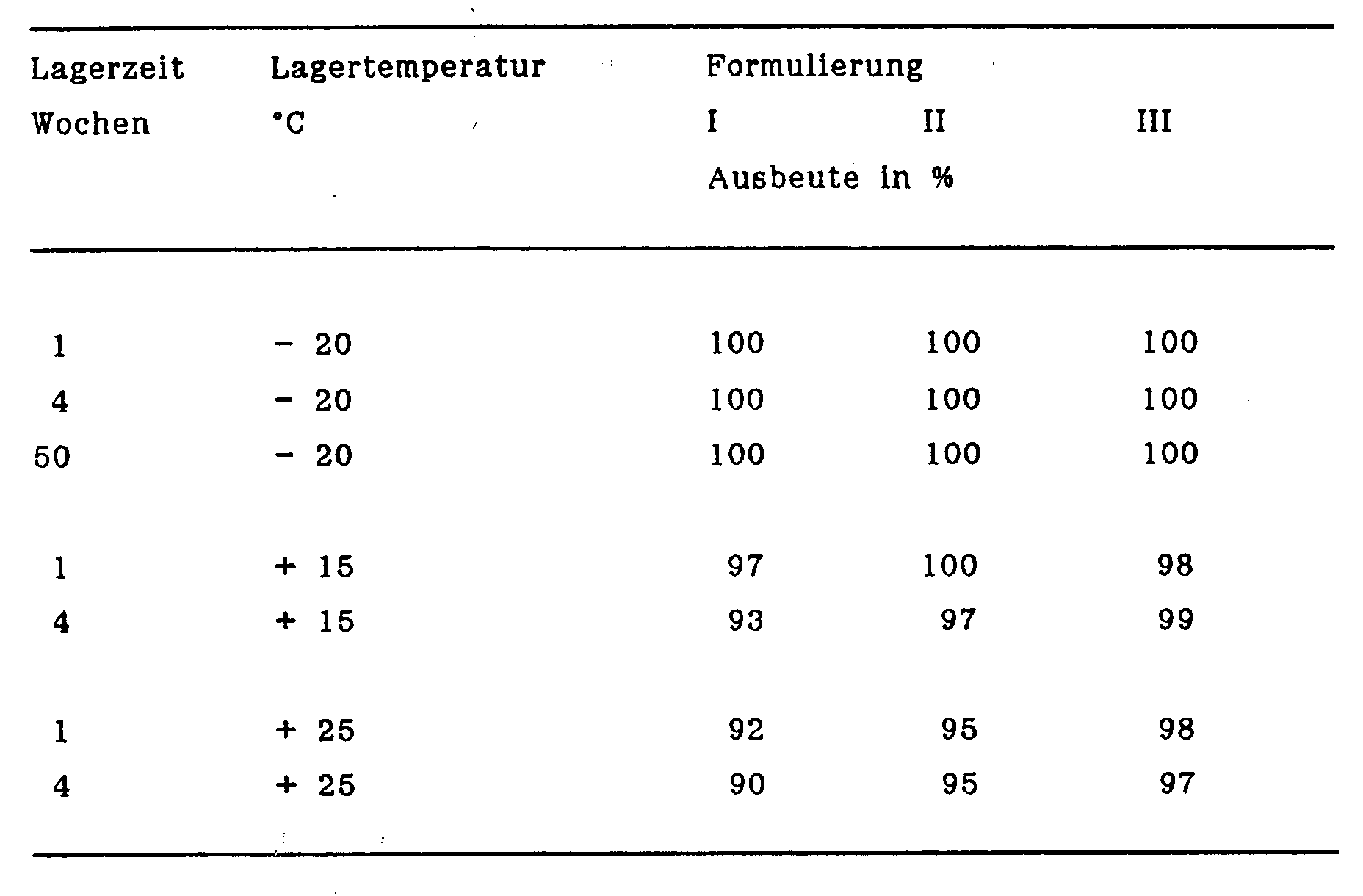
- Example 3 shows the stability of preparations with recombinant IFN-beta from CHO cells with a purity of> 99% in liquid formulation in different compositions without stabilizing additives.
- Dissolved recombinant IFN-beta with 10 8 IU / ml and a protein content of 0.4 mg / ml is dialyzed against the described formulation buffer and then diluted with the appropriate buffer to the required volume activity.
- Table 1 shows that the high stability of the preparations according to the invention does not depend on the composition of the buffer.
- Example 4 shows the stability of preparations with recombinant IFN-beta from CHO cells with a purity of> 99% in lyophilized Form of different composition with human serum albumin as Filler. No stabilizing additives were used.
- Dissolved recombinant IFN-beta with an activity of 1.5 x 10 8 IU / ml and a protein content of 0.6 mg / ml is dialyzed against the specified formulation buffer without HSA and then diluted with the appropriate buffer with HSA to the required volume activity.
- a suitable number of vials are made from each formulation so that a new bottle is available for each stability test. After the end of the exercise experiment, the content of a bottle is poured into 1 ml Aqua inj. dissolved and the remaining active ingredient content determined using a bioassay.
- Table 2 show that the formulations according to the invention with recombinant IFN-beta a stable final formulation in physiological buffer at neutral pH without additional additives Enable stabilization.
- the serum albumin used as an additive is used as a filler for the lyophilized protein, because the protein content of the pure IFN-beta is only 10 to 200 ⁇ g.
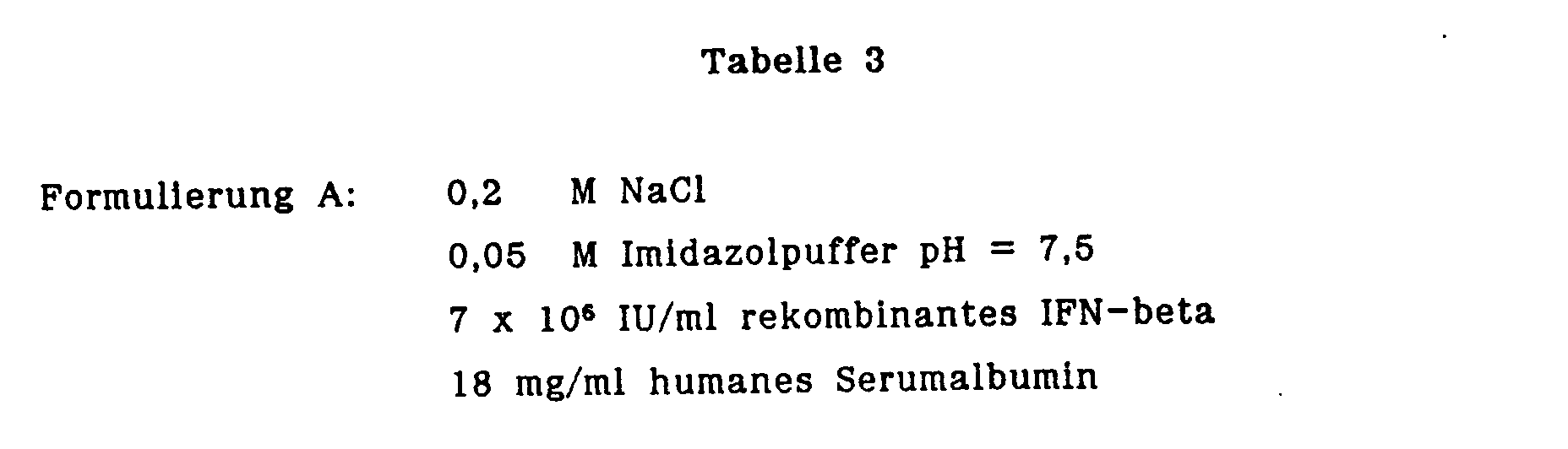
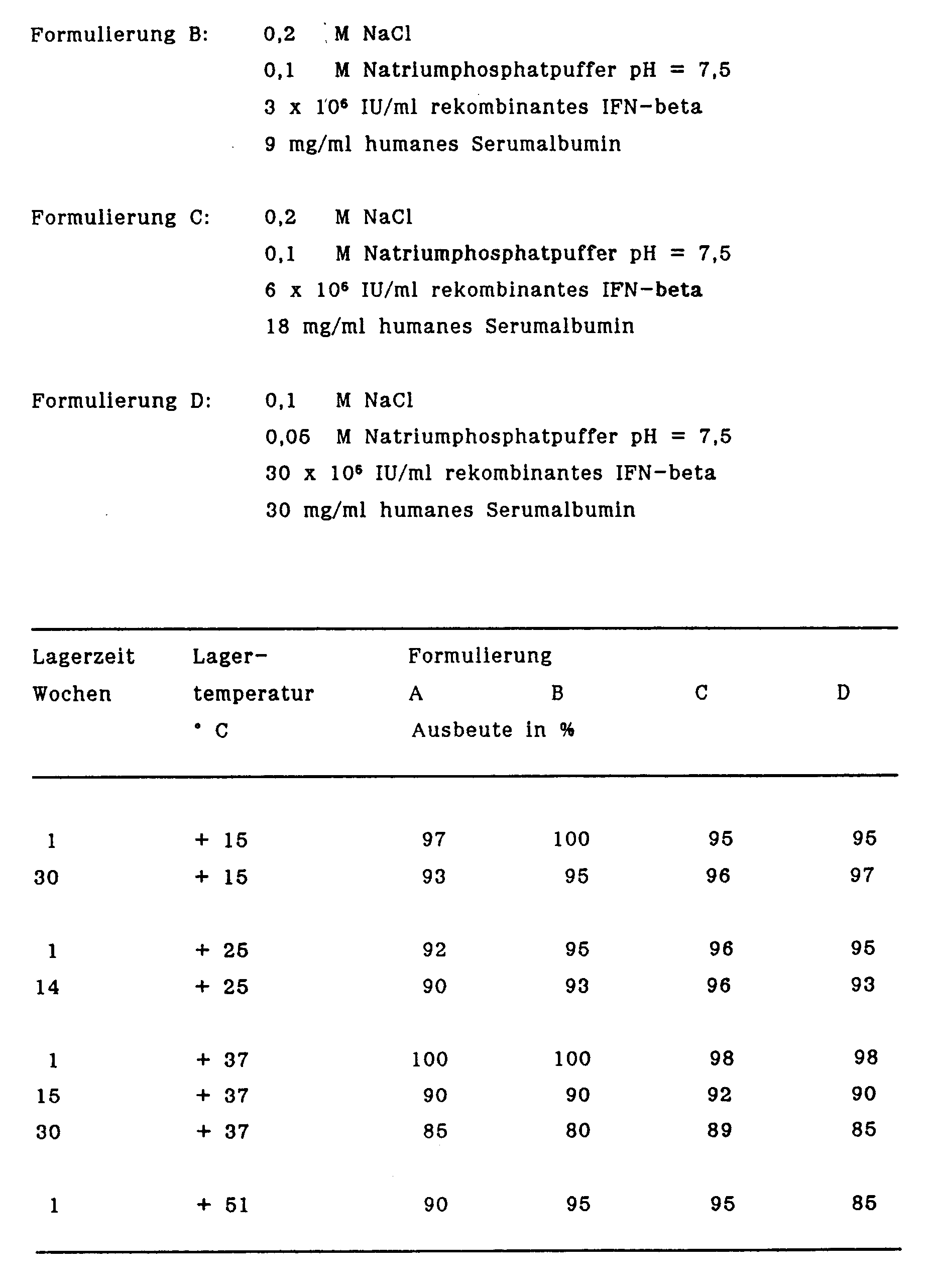
- This example shows the stability of preparations with recombinant IFN-beta from CHO cells with a purity of> 99% in lyophilized Form of different composition and with human serum albumin as filler after reconstitution in 1 ml aqua inj ..
- Dissolved recombinant IFN-beta with an activity of 1.5 x 10 8 IU / ml and a protein content of 0.6 mg / ml is dialyzed against the specified formulation buffer without HSA and then diluted with the appropriate buffer with HSA to the required volume activity.
- the high stability of the preparations according to the invention is like that Table 3 shows not affected by the composition of the buffer. This shows that the preparations according to the invention after lyophilization and reconstitution are very stable. The advantage of this stable formulation of the active ingredient is particularly evident in infusions over a longer period at room temperature.
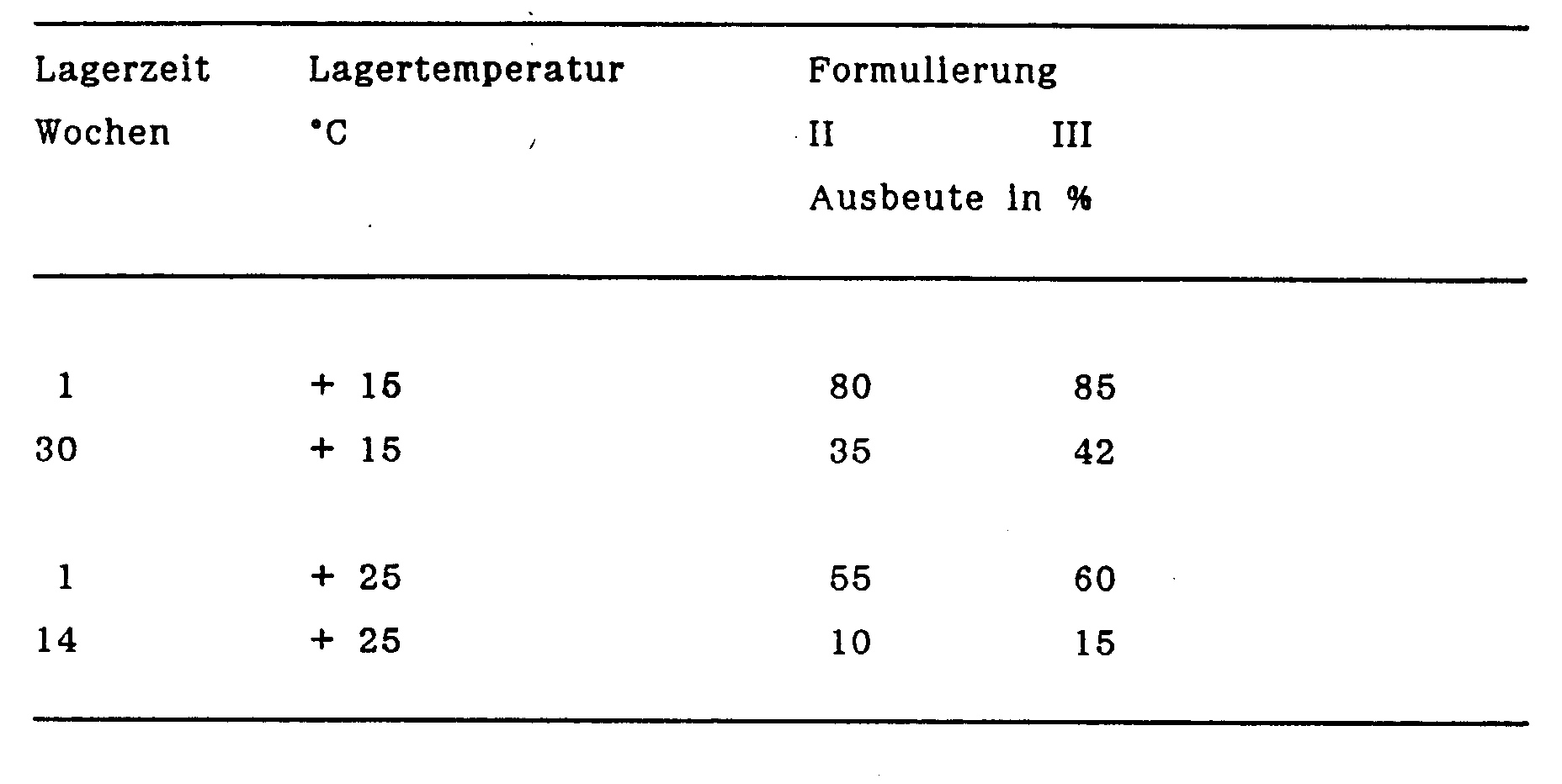
- This example shows the reduced stability of preparations with recombinant IFN-beta from CHO cells with a purity of> 99% after treatment with sialidase.
- This enzyme defines Cleave terminal sialic acids enzymatically.
- Example 6 shows the relationship between the degree of serialization and stability of recombinant IFN-beta.
- the significantly lower sialic acid content of approx. 60 to 70% leads to an increased instability of the IFN-beta.
- Sialic acid content goes hand in hand with a reduction in solubility and the IFN-beta tends to cloud and precipitate.
- composition of the carbohydrate portion of IFN-beta, produced in FS4 cells in cell culture, and the invention recombinant IFN-beta, produced in CHO cell cultures examined. Unless otherwise specified, the procedures are for determination of carbohydrate content in The Journal of Biological Chemistry, Vol. 262, No. 30, October 25, 1987, page 25.
- the primary structures of the recombinant IFN-beta from CHO cells and the IFN-beta from FS4 cells are identical.
- the recombinant IFN-beta produced as described above is surprisingly clinically much more effective than natural IFN-beta, like the following examples show.
Landscapes
- Chemical & Material Sciences (AREA)
- Health & Medical Sciences (AREA)
- Life Sciences & Earth Sciences (AREA)
- Organic Chemistry (AREA)
- General Health & Medical Sciences (AREA)
- Gastroenterology & Hepatology (AREA)
- Biochemistry (AREA)
- Biophysics (AREA)
- Zoology (AREA)
- Genetics & Genomics (AREA)
- Medicinal Chemistry (AREA)
- Molecular Biology (AREA)
- Proteomics, Peptides & Aminoacids (AREA)
- Toxicology (AREA)
- Medicines That Contain Protein Lipid Enzymes And Other Medicines (AREA)
- Preparation Of Compounds By Using Micro-Organisms (AREA)
- Micro-Organisms Or Cultivation Processes Thereof (AREA)
Description




- Patient:
- männlich, 43 Jahre, homosexuell
- Erkrankung:
- AIDS, Klassifikation: CDC IV/WR 5 Kaposi-Sarkome am gesamten Integument mit Beteiligung der Mundschleimhaut
- Therapie:
- 3 x 10⁶ IU erfindungsgemäßes rekombinantes IFN-beta, wie o. a., subcutan 3 x/Woche über 9 Wochen plus Zidovudine 500 mg/d
- Ergebnis:
- Verringerung der Kaposi-Sarkome in Größe und Anzahl
- Therapie:
- 3 x 10⁶ IU hochgereinigtes natürliches IFN-beta subcutan 3 x/Woche über 6 Wochen plus Zidovudine 500 mg/d
- Ergebnis:
- Auftreten neuer Kaposi-Sarkome
- Therapie:
- 3 x 10⁶ IU erfindungsgemäßes rekombinantes IFN-beta, wie o. a., subcutan 3 x/Woche kontinuierlich plus Zidovudine 500 mg/d über ca. 6 Wochen
- Ergebnis:
- Verringerung der Kaposi-Sarkome in Größe und Anzahl
- Patient:
- männlich, 47 Jahre, homosexuell
- Erkrankung:
- AIDS, Klassifikation: CDC IV/WR 5 Kaposi-Sarkome am gesamten Integument
- Therapie:
- 3 x 10⁶ IU erfindungsgemäßes rekombinantes IFN-beta, wie o. a., subcutan 3 x/Woche über 5 Wochen plus Zidovudine 1000 mg/d
- Ergebnis:
- Verringerung der Kaposi-Sarkome in Größe und Anzahl
- Therapie:
- 3 x 10⁶ IU hochgereinigtes natürliches IFN-beta subcutan 3 x/Woche über 6 Wochen plus Zidovudine 500 mg/d
- Ergebnis:
- Vergrößerung der Kaposi-Sarkome
- Therapie:
- 3 x 10⁶ IU erfindungsgemäßes rekombinantes IFN-beta, wie o. a., subcutan 3 x/Woche kontinuierlich plus Zidovudine 500 mg/d über ca. 6 Wochen
- Ergebnis:
- Verringerung der Kaposi-Sarkome in Größe und Anzahl
Claims (26)
- Rekombinantes Human IFN-beta aus CHO-Zellkulturen, gekennzeichnet dadurch,
daß es einen Anteil an biantennären Oligosaccharid-Strukturen von mindestens 70 %, einen Anteil von triantennären Oligosaccharid-Strukturen von mindestens 20 %, und einen Anteil von tetraantennären Oligosaccharid-Strukturen von 0 bis 5 % sowie einen Sialinsäuregehalt von mindestens 90 % aufweist. - Rekombinantes Human-IFN-beta nach Anspruch 1, dadurch gekennzeichnet, daß der Anteil an blantennären Oligosaccharid-Strukturen mindestens 75 % beträgt.
- Rekombinantes Human-IFN-beta nach Anspruch 1 oder 2, dadurch gekennzeichnet, daß der Anteil an triantennären Oligosaccharid-Strukturen mindestens 25 % beträgt.
- Rekombinantes Human-IFN-beta nach einem der Ansprüche 1 bis 3, dadurch gekennzeichnet, daß die triantennären Strukturen gegebenenfalls mindestens ein N-Acetyllactosamin-Repeat aufweisen.
- Rekombinantes Human-IFN-beta nach Anspruch 1 bis 4, dadurch gekennzeichnet, daß die triantennäre Struktur 1->4 und/oder 1->6 verknüpft ist.
- Rekombinantes Human-IFN-beta nach einem der Ansprüche 1 bis 5, dadurch gekennzeichnet, daß der Anteil an tetraantennären Oligosaccharid-Strukturen 0,5 bis 3 % beträgt.
- Rekombinantes Human-IFN-beta nach einem der Ansprüche 1 bis 6, dadurch gekennzeichnet, daß sich der Sialinsäureanteil aus N-Acetylneuraminsäure und N-Glykolylneuraminsäure zusammensetzt.
- Rekombinantes Human-IFN-beta nach Anspruch 7, dadurch gekennzeichnet, daß der Anteil an N-Acetylneuraminsäure 90 bis 100 % und der Anteil an N-Glykolylneuraminsäure 0 bis 10 % beträgt.
- Rekombinantes Human-IFN-beta nach einem der Ansprüche 1 bis 8, dadurch gekennzeichnet, daß das rekombinante IFN-beta weiterhin einen Fucosegehalt von mindestens 85 %, bevorzugt 90 % und am meisten bevorzugt > 95 % aufweist.
- Rekombinantes Human-IFN-beta nach einem der Ansprüche 1 bis 9, dadurch gekennzeichnet, daß mindestens eine Oligosaccharid-Struktur einer der folgenden Formeln entspricht:

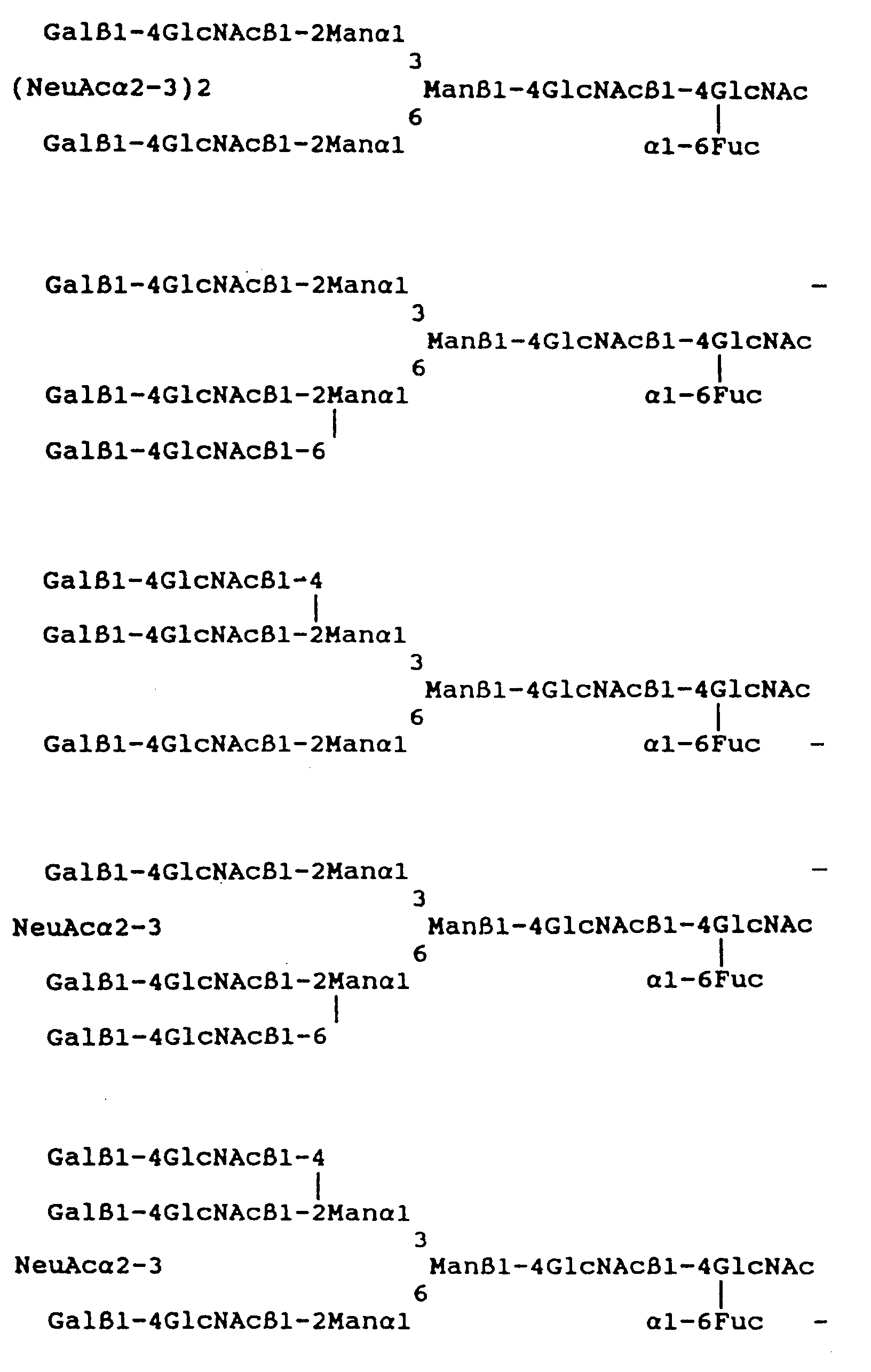
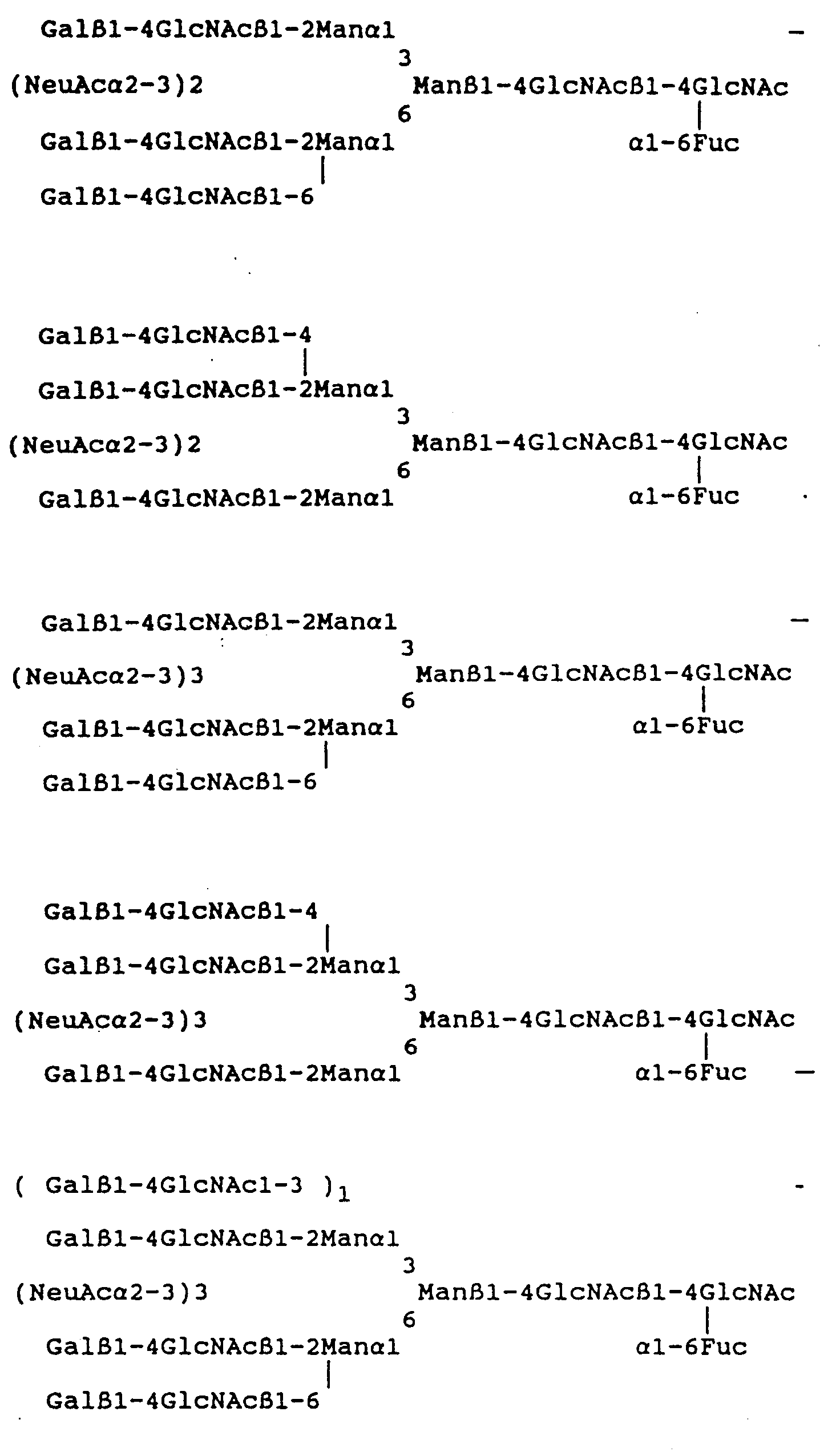 wobei NeuAc auch für N-Glykolylneuraminsäure steht.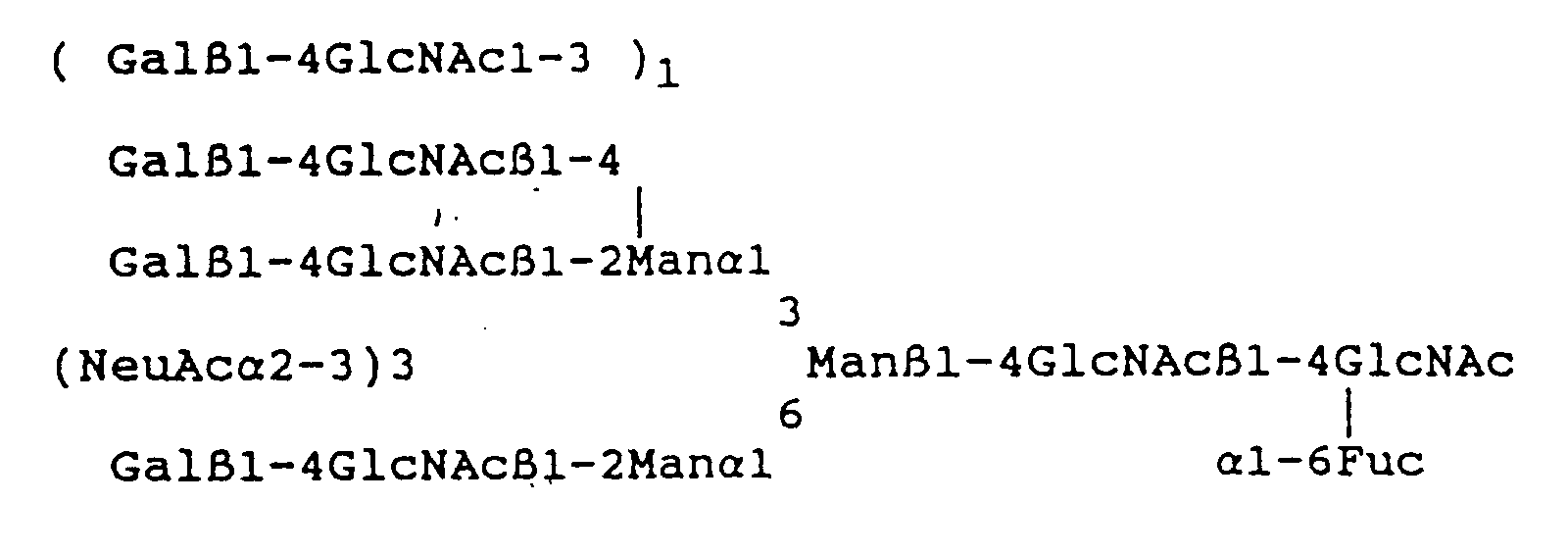
- Rekombinantes Human-IFN-beta nach einem der Ansprüche 1 bis 10, dadurch gekennzeichnet, daß es eine spezifische Aktivität von mindestens 200 x 106 IU/mg aufweist.
- Verfahren zur Herstellung von rekombinantem Human-IFN-beta nach einem der Ansprüche 1 bis 11, dadurch gekennzeichnet, daß eine wäßrige Lösung von Human-IFN-beta in unreinem Zustand durch eine flüssig/flüssig Phasenextraktion angereichert wird, dann einer Farbstoff-Affinitätschromatographie unterzogen wird, anschließend eine Metallchelatchromatographie durchgeführt wird, der eine Size-Exclusion-Chromatographie folgt, wobei die jeweiligen Chromatographieschritte in diese Reihenfolge durchgeführt werden.
- Verfahren nach Anspruch 12, dadurch gekennzeichnet, daß die flüssig/flüssig Phasenextraktion mit einem wäßrigen Zweiphasensystem auf Basis Polyalkylenglykol/Dextran oder Polyalkylenglykol/Salz durchgeführt wird.
- Verfahren nach Anspruch 13, dadurch gekennzeichnet, daß als Polyalkylenglykol Polyethylenglykol mit einem Molekulargewicht von 1.000 bis 6.000 oder Polypropylenglykol mit einem Molekulargewicht von 1.500 bis 4.000 verwendet wird.
- Verfahren nach Anspruch 13, dadurch gekennzeichnet, daß als Salz NaCl, LiCl, NaJ, KJ, Na2SO4, Na2HPO4, K2HPO4, K2SO4, NaH2PO4, KCl, NH4Cl, (NH4)2SO4, Na-Citrat oder Na-Oxalat verwendet wird.
- Verfahren nach Anspruch 13, dadurch gekennzeichnet, daß der Farbstoff in der Affinitätschromatographie Cibacron Blau F 3 GA ist.
- Verfahren nach Anspruch 12, dadurch gekennzeichnet, daß in der Metallchelatchromatographie Cu2+, Zn2+, Co2+ oder Ni2+ Ionen verwendet werden.
- Verfahren nach Anspruch 12, dadurch gekennzeichnet, daß für die Size-Exclusion-Chromatographie Trennmedien verwendet werden, die einen Trennbereich von 1.000 Dalton bis 600.000 Dalton, vorzugsweise Sephadex ® G150, Sephadex R G150 superfine, Sephacryl ® S-200 High Resolution, Superose 12 prep grade oder TSK-SW 3000 verwendet werden.
- Verfahren nach einem der Ansprüche 13 und 16, dadurch gekennzeichnet, daß die Elution in der Affinitätschromatographie mit PBS, enthaltend 10 bis 70 Gew.-% Ethylenglykol und/oder 20 bis 50 Gew.-% Propylenglykol, erfolgt.
- Verfahren nach einem der Ansprüche 13 und 17, dadurch gekennzeichnet, daß die Elution in der Metallchelatchromatographie mit kompetetiven Substanzen wie Imidazol, Histidin, Glycin oder NH4Cl oder einem pH-Gradienten von etwa pH 7 bis etwa pH 2 oder durch isokratische Elution mit fallenden pH-Werten erfolgt.
- Verfahren nach einem der Ansprüche 13 und 18, dadurch gekennzeichnet, daß die Elution in der Size-Exclusion-Chromatographie mit PBS, enthaltend 0 bis 0,5 mol/l NaCl erfolgt.
- Pharmazeutische Zubereitung enthaltend rekombinantes Human-IFN-beta nach einem der Ansprüche 1 bis 13 in Verbindung mit üblichen Träger- und Hilfsstoffen.
- Pharmazeutische Zubereitung nach Anspruch 22, dadurch gekennzeichnet, daß sie mindestens 25 x 106 IU/ml IFN-beta enthält.
- Pharmazeutische Formulierung nach Anspruch 22 oder 23, dadurch gekennzeichnet, daß sie in einer für die topische oder parenterale Verabreichung geeigneten Form vorliegt.
- Pharmazeutische Formulierung nach Anspruch 23, dadurch gekennzeichnet, daß sie in Form eines Gels, einer Emulsion oder einer Salbe vorliegt.
- Pharmazeutische Zubereitung nach Anspruch 23, dadurch gekennzeichnet, daß sie in Form eines Lyophilisates, einer Lösung oder einer Infusion vorliegt.
Applications Claiming Priority (2)
| Application Number | Priority Date | Filing Date | Title |
|---|---|---|---|
| DE4128319 | 1991-08-27 | ||
| DE4128319A DE4128319A1 (de) | 1991-08-27 | 1991-08-27 | Neues rekombinantes human-ifn-beta, verfahren zu dessen herstellung und dieses enthaltende pharmazeutische zubereitungen |
Publications (2)
| Publication Number | Publication Date |
|---|---|
| EP0529300A1 EP0529300A1 (de) | 1993-03-03 |
| EP0529300B1 true EP0529300B1 (de) | 1998-10-14 |
Family
ID=6439169
Family Applications (1)
| Application Number | Title | Priority Date | Filing Date |
|---|---|---|---|
| EP92112427A Expired - Lifetime EP0529300B1 (de) | 1991-08-27 | 1992-07-21 | Neues rekombinantes Human-IFN-beta, Verfahren zu dessen Herstellung und dieses enthaltende pharmazeutische Zubereitungen |
Country Status (5)
| Country | Link |
|---|---|
| EP (1) | EP0529300B1 (de) |
| AT (1) | ATE172206T1 (de) |
| DE (2) | DE4128319A1 (de) |
| DK (1) | DK0529300T3 (de) |
| ES (1) | ES2121804T3 (de) |
Cited By (4)
| Publication number | Priority date | Publication date | Assignee | Title |
|---|---|---|---|---|
| US7144574B2 (en) | 1999-08-27 | 2006-12-05 | Maxygen Aps | Interferon β variants and conjugates |
| US7238344B2 (en) | 1999-08-27 | 2007-07-03 | Maxygen, Inc. | Interferon-β variants and conjugates |
| EP1697411A4 (de) * | 2003-12-04 | 2008-08-27 | Cj Cheiljedang Corp | Verfahren zur aufreinigung von interferon-beta |
| US7431921B2 (en) | 1999-08-27 | 2008-10-07 | Maxygen Aps | Interferon beta-like molecules |
Families Citing this family (16)
| Publication number | Priority date | Publication date | Assignee | Title |
|---|---|---|---|---|
| US6270989B1 (en) * | 1991-11-05 | 2001-08-07 | Transkaryotic Therapies, Inc. | Protein production and delivery |
| US5968502A (en) | 1991-11-05 | 1999-10-19 | Transkaryotic Therapies, Inc. | Protein production and protein delivery |
| GB9506051D0 (en) * | 1995-03-24 | 1995-05-10 | Univ Singapore | Gene expression |
| AU7130696A (en) * | 1995-09-19 | 1997-04-09 | Schering Aktiengesellschaft | Combination of beta-interferon for the treatment of prostate cancer |
| DE19544167A1 (de) * | 1995-11-17 | 1997-05-22 | Schering Ag | Verwendung von Interferon-ß zur Behandlung von Bronchialkarzinom bei Bestrahlungstherapie |
| WO1997048808A1 (en) * | 1996-06-19 | 1997-12-24 | Chiron Corporation | Bacterial production of interferon-beta using low levels of sodium and potassium ions |
| DK1017413T4 (da) * | 1997-09-23 | 2008-03-25 | Rentschler Biotech Gmbh | Flydende formulering af interferon-beta |
| FR2791894B1 (fr) * | 1999-04-09 | 2001-07-13 | Inst Nat Sante Rech Med | Utilisation d'interferon beta dans le traitement de la tumeur d'ewing |
| EP1366075B1 (de) | 2001-02-27 | 2009-05-27 | Maxygen Aps | Neue interferon-beta-ähnliche moleküle |
| DK1575531T3 (da) * | 2002-09-27 | 2011-11-21 | Biogen Idec Inc | Terapier for kronisk inflammatorisk demyeliniserende polyneuropati under anvendelse af interferon-beta |
| ES2335017T3 (es) * | 2003-09-09 | 2010-03-18 | Novartis Vaccines And Diagnostics, Inc. | Separacion cromatografica de polipeptidos terapeuticos. |
| BRPI0507169A (pt) | 2004-02-02 | 2007-06-26 | Ambrx Inc | polipeptìdeos do hormÈnio de crescimento humano modificados e seu usos |
| KR100781666B1 (ko) * | 2004-11-02 | 2007-12-03 | 신영기 | 인간 인터페론-베타 변이체 |
| US20080219952A1 (en) | 2005-08-26 | 2008-09-11 | Ares Trading S.A. | Process For the Preparation of Glycosylated Interferon Beta |
| CN101675071B (zh) | 2007-05-02 | 2014-06-18 | Ambrx公司 | 经修饰干扰素β多肽和其用途 |
| DE102009032179A1 (de) | 2009-07-07 | 2011-01-13 | Biogenerix Ag | Verfahren zur Reinigung von Interferon beta |
Family Cites Families (4)
| Publication number | Priority date | Publication date | Assignee | Title |
|---|---|---|---|---|
| WO1982002715A1 (fr) * | 1981-02-04 | 1982-08-19 | Sugano Haruo | Gene d'interferon (beta)humain |
| JPS58110600A (ja) * | 1981-12-25 | 1983-07-01 | Kyowa Hakko Kogyo Co Ltd | ヒトβ型インタ−フエロン遺伝子を含む組みかえ体プラスミド |
| US4450103A (en) * | 1982-03-01 | 1984-05-22 | Cetus Corporation | Process for recovering human IFN-β from a transformed microorganism |
| IL89662A (en) * | 1989-03-19 | 1997-11-20 | Interpharm Lab Ltd Kiryat Weiz | Pharmaceutical compositions comprising interferon-beta |
-
1991
- 1991-08-27 DE DE4128319A patent/DE4128319A1/de not_active Withdrawn
-
1992
- 1992-07-21 DE DE59209525T patent/DE59209525D1/de not_active Expired - Lifetime
- 1992-07-21 DK DK92112427T patent/DK0529300T3/da active
- 1992-07-21 AT AT92112427T patent/ATE172206T1/de active
- 1992-07-21 EP EP92112427A patent/EP0529300B1/de not_active Expired - Lifetime
- 1992-07-21 ES ES92112427T patent/ES2121804T3/es not_active Expired - Lifetime
Non-Patent Citations (4)
| Title |
|---|
| DNA, Vol. 3, No. 4 ( 1984 ), Seiten 297-308 * |
| Eur. J. Biochem. 181 ( 1989 ), Seiten 545-553 * |
| J. Biol. Chem., Vol. 263, No. 33 ( 1988 ), Seiten 17508-17515 * |
| Journal of Biol. Chem., Vol. 262, No. 30 ( 1987 ), Seiten 14600 - 14605 * |
Cited By (6)
| Publication number | Priority date | Publication date | Assignee | Title |
|---|---|---|---|---|
| US7144574B2 (en) | 1999-08-27 | 2006-12-05 | Maxygen Aps | Interferon β variants and conjugates |
| US7238344B2 (en) | 1999-08-27 | 2007-07-03 | Maxygen, Inc. | Interferon-β variants and conjugates |
| US7338788B2 (en) | 1999-08-27 | 2008-03-04 | Maxygen Aps | Interferon-β variants and conjugates |
| US7431921B2 (en) | 1999-08-27 | 2008-10-07 | Maxygen Aps | Interferon beta-like molecules |
| EP1697411A4 (de) * | 2003-12-04 | 2008-08-27 | Cj Cheiljedang Corp | Verfahren zur aufreinigung von interferon-beta |
| US7780960B2 (en) | 2003-12-04 | 2010-08-24 | Cj Cheiljedang Corporation | Process for purifying interferon beta |
Also Published As
| Publication number | Publication date |
|---|---|
| EP0529300A1 (de) | 1993-03-03 |
| ES2121804T3 (es) | 1998-12-16 |
| DE59209525D1 (de) | 1998-11-19 |
| DE4128319A1 (de) | 1993-03-04 |
| ATE172206T1 (de) | 1998-10-15 |
| DK0529300T3 (da) | 1999-06-23 |
Similar Documents
| Publication | Publication Date | Title |
|---|---|---|
| DE4128319A1 (de) | Neues rekombinantes human-ifn-beta, verfahren zu dessen herstellung und dieses enthaltende pharmazeutische zubereitungen | |
| EP1988913B1 (de) | G-csf-flüssigformulierung | |
| DE60109625T3 (de) | Flüssige arzneizubereitung enthaltend ein erythropoietin derivat | |
| EP0281299B1 (de) | Haltbare Interferonkomplexe | |
| DE69839251T2 (de) | Alpha interferon-polymer konjugate mit erhöhter biologischer wirksamkeit sowie verfahren zu deren herstellung | |
| DE69432179T3 (de) | Eine formulierung des gerinnungsfaktors viii | |
| DE3520228C2 (de) | Wasserlösliche bioaktive Trockenfeststoffzusammensetzung, Verfahren zu ihrer Herstellung und sie enthaltende pharmazeutische Präparate | |
| EP0508194B1 (de) | Stabilisierte Faktor VIII-Präparationen | |
| DE69603894T2 (de) | Interferon-Lösung | |
| DE60011087T2 (de) | Konjugate zwischen erythropoietin und polyethylenglycol | |
| DE3587479T2 (de) | Vehikel zur Verabreichung von Interferon. | |
| EP2289539B1 (de) | Zinkfreie und zinkarme Insulinzubereitungen mit verbesserter Stabilität | |
| DE69806055T2 (de) | Verbesserte interferon-polymer konjugate | |
| DE69430251T2 (de) | Verbesserte interferon-polymerkonjugate | |
| DE69720320T2 (de) | Interferon-Konjugate | |
| DE68916385T2 (de) | Stabilisierte Formulierungen mit hydrohoben Proteinen. | |
| EP1224940B1 (de) | Flüssige Interferon-Beta Formulierungen | |
| DE3782828T2 (de) | Interleukin-2-zusammensetzungen. | |
| DE10031839A1 (de) | Erythropoietinkonjugate | |
| DE69029765T2 (de) | Stabilisierung von hochgereinigten Proteinen | |
| DE69712036T2 (de) | Neue verabreichung von thrombopoietin | |
| US4871538A (en) | Insoluble copper-alpha interferon complex | |
| DE3515336C2 (de) | Verfahren zur Herstellung und Reinigung von â-Interferon | |
| EP0420049B1 (de) | Stabilisierte Leukocyten-Interferone | |
| DE69836315T2 (de) | Verwendung von TCF-II zur Behandlung von durch Krebs verursachtem Gewichtsverlust, Anaemie und TNF-Erhöhung |
Legal Events
| Date | Code | Title | Description |
|---|---|---|---|
| PUAI | Public reference made under article 153(3) epc to a published international application that has entered the european phase |
Free format text: ORIGINAL CODE: 0009012 |
|
| AK | Designated contracting states |
Kind code of ref document: A1 Designated state(s): AT BE CH DE DK ES FR GB GR IT LI LU MC NL PT SE |
|
| 17P | Request for examination filed |
Effective date: 19930401 |
|
| RAP1 | Party data changed (applicant data changed or rights of an application transferred) |
Owner name: DR. RENTSCHLER BIOTECHNOLOGIE GMBH |
|
| 17Q | First examination report despatched |
Effective date: 19950913 |
|
| GRAG | Despatch of communication of intention to grant |
Free format text: ORIGINAL CODE: EPIDOS AGRA |
|
| GRAG | Despatch of communication of intention to grant |
Free format text: ORIGINAL CODE: EPIDOS AGRA |
|
| GRAG | Despatch of communication of intention to grant |
Free format text: ORIGINAL CODE: EPIDOS AGRA |
|
| GRAH | Despatch of communication of intention to grant a patent |
Free format text: ORIGINAL CODE: EPIDOS IGRA |
|
| GRAH | Despatch of communication of intention to grant a patent |
Free format text: ORIGINAL CODE: EPIDOS IGRA |
|
| GRAA | (expected) grant |
Free format text: ORIGINAL CODE: 0009210 |
|
| AK | Designated contracting states |
Kind code of ref document: B1 Designated state(s): AT BE CH DE DK ES FR GB GR IT LI LU MC NL PT SE |
|
| REF | Corresponds to: |
Ref document number: 172206 Country of ref document: AT Date of ref document: 19981015 Kind code of ref document: T |
|
| REG | Reference to a national code |
Ref country code: CH Ref legal event code: EP Ref country code: CH Ref legal event code: NV Representative=s name: DR. CONRAD A. RIEDERER PATENTANWALT |
|
| PLBQ | Unpublished change to opponent data |
Free format text: ORIGINAL CODE: EPIDOS OPPO |
|
| PLBI | Opposition filed |
Free format text: ORIGINAL CODE: 0009260 |
|
| GBT | Gb: translation of ep patent filed (gb section 77(6)(a)/1977) |
Effective date: 19981014 |
|
| REF | Corresponds to: |
Ref document number: 59209525 Country of ref document: DE Date of ref document: 19981119 |
|
| 26 | Opposition filed |
Opponent name: BIOGEN INC. Effective date: 19981014 |
|
| REG | Reference to a national code |
Ref country code: ES Ref legal event code: FG2A Ref document number: 2121804 Country of ref document: ES Kind code of ref document: T3 |
|
| REG | Reference to a national code |
Ref country code: PT Ref legal event code: SC4A Free format text: AVAILABILITY OF NATIONAL TRANSLATION Effective date: 19981028 |
|
| NLR1 | Nl: opposition has been filed with the epo |
Opponent name: BIOGEN INC. |
|
| ET | Fr: translation filed | ||
| REG | Reference to a national code |
Ref country code: DK Ref legal event code: T3 |
|
| PLBF | Reply of patent proprietor to notice(s) of opposition |
Free format text: ORIGINAL CODE: EPIDOS OBSO |
|
| PLBF | Reply of patent proprietor to notice(s) of opposition |
Free format text: ORIGINAL CODE: EPIDOS OBSO |
|
| RAP2 | Party data changed (patent owner data changed or rights of a patent transferred) |
Owner name: DR. RENTSCHLER BIOTECHNOLOGIE GMBH & CO. KG. |
|
| RAP4 | Party data changed (patent owner data changed or rights of a patent transferred) |
Owner name: RENTSCHLER BIOTECHNOLOGIE GMBH & CO. KG. |
|
| NLT2 | Nl: modifications (of names), taken from the european patent patent bulletin |
Owner name: DR. RENTSCHLER BIOTECHNOLOGIE GMBH & CO. KG. |
|
| PLBF | Reply of patent proprietor to notice(s) of opposition |
Free format text: ORIGINAL CODE: EPIDOS OBSO |
|
| REG | Reference to a national code |
Ref country code: GB Ref legal event code: IF02 |
|
| NLT1 | Nl: modifications of names registered in virtue of documents presented to the patent office pursuant to art. 16 a, paragraph 1 |
Owner name: DR. RENTSCHLER BIOTECHNOLOGIE GMBH & CO. KG. |
|
| PLBO | Opposition rejected |
Free format text: ORIGINAL CODE: EPIDOS REJO |
|
| REG | Reference to a national code |
Ref country code: FR Ref legal event code: CD Ref country code: FR Ref legal event code: CJ |
|
| APAC | Appeal dossier modified |
Free format text: ORIGINAL CODE: EPIDOS NOAPO |
|
| APAC | Appeal dossier modified |
Free format text: ORIGINAL CODE: EPIDOS NOAPO |
|
| APAC | Appeal dossier modified |
Free format text: ORIGINAL CODE: EPIDOS NOAPO |
|
| APAC | Appeal dossier modified |
Free format text: ORIGINAL CODE: EPIDOS NOAPO |
|
| PLBN | Opposition rejected |
Free format text: ORIGINAL CODE: 0009273 |
|
| STAA | Information on the status of an ep patent application or granted ep patent |
Free format text: STATUS: OPPOSITION REJECTED |
|
| 27O | Opposition rejected |
Effective date: 20030415 |
|
| NLR2 | Nl: decision of opposition |
Effective date: 20030415 |
|
| APBQ | Date of receipt of statement of grounds of appeal recorded |
Free format text: ORIGINAL CODE: EPIDOSNNOA3O |
|
| APAY | Date of receipt of notice of appeal deleted |
Free format text: ORIGINAL CODE: EPIDOSDNOA2O |
|
| APBA | Date of receipt of statement of grounds of appeal deleted |
Free format text: ORIGINAL CODE: EPIDOSDNOA3O |
|
| APAA | Appeal reference recorded |
Free format text: ORIGINAL CODE: EPIDOS REFN |
|
| APAH | Appeal reference modified |
Free format text: ORIGINAL CODE: EPIDOSCREFNO |
|
| REG | Reference to a national code |
Ref country code: CH Ref legal event code: NV Representative=s name: RIEDERER HASLER & PARTNER PATENTANWAELTE AG |
|
| PGFP | Annual fee paid to national office [announced via postgrant information from national office to epo] |
Ref country code: PT Payment date: 20110630 Year of fee payment: 20 |
|
| PGFP | Annual fee paid to national office [announced via postgrant information from national office to epo] |
Ref country code: LU Payment date: 20110725 Year of fee payment: 20 |
|
| PGFP | Annual fee paid to national office [announced via postgrant information from national office to epo] |
Ref country code: DK Payment date: 20110720 Year of fee payment: 20 Ref country code: FR Payment date: 20110729 Year of fee payment: 20 Ref country code: CH Payment date: 20110725 Year of fee payment: 20 Ref country code: MC Payment date: 20110714 Year of fee payment: 20 |
|
| PGFP | Annual fee paid to national office [announced via postgrant information from national office to epo] |
Ref country code: GR Payment date: 20110727 Year of fee payment: 20 Ref country code: ES Payment date: 20110726 Year of fee payment: 20 Ref country code: GB Payment date: 20110721 Year of fee payment: 20 Ref country code: DE Payment date: 20110722 Year of fee payment: 20 Ref country code: SE Payment date: 20110722 Year of fee payment: 20 Ref country code: AT Payment date: 20110714 Year of fee payment: 20 |
|
| PGFP | Annual fee paid to national office [announced via postgrant information from national office to epo] |
Ref country code: NL Payment date: 20110726 Year of fee payment: 20 Ref country code: IT Payment date: 20110726 Year of fee payment: 20 Ref country code: BE Payment date: 20110713 Year of fee payment: 20 |
|
| REG | Reference to a national code |
Ref country code: DE Ref legal event code: R071 Ref document number: 59209525 Country of ref document: DE |
|
| REG | Reference to a national code |
Ref country code: DK Ref legal event code: EUP |
|
| REG | Reference to a national code |
Ref country code: DE Ref legal event code: R071 Ref document number: 59209525 Country of ref document: DE |
|
| REG | Reference to a national code |
Ref country code: NL Ref legal event code: V4 Effective date: 20120721 |
|
| BE20 | Be: patent expired |
Owner name: *RENTSCHLER BIOTECHNOLOGIE G.M.B.H. Effective date: 20120721 |
|
| REG | Reference to a national code |
Ref country code: CH Ref legal event code: PL Ref country code: PT Ref legal event code: MM4A Free format text: MAXIMUM VALIDITY LIMIT REACHED Effective date: 20120721 |
|
| REG | Reference to a national code |
Ref country code: GB Ref legal event code: PE20 Expiry date: 20120720 |
|
| REG | Reference to a national code |
Ref country code: SE Ref legal event code: EUG |
|
| REG | Reference to a national code |
Ref country code: AT Ref legal event code: MK07 Ref document number: 172206 Country of ref document: AT Kind code of ref document: T Effective date: 20120721 |
|
| REG | Reference to a national code |
Ref country code: GR Ref legal event code: MA Ref document number: 990400010 Country of ref document: GR Effective date: 20120722 |
|
| PG25 | Lapsed in a contracting state [announced via postgrant information from national office to epo] |
Ref country code: GB Free format text: LAPSE BECAUSE OF EXPIRATION OF PROTECTION Effective date: 20120720 Ref country code: DE Free format text: LAPSE BECAUSE OF EXPIRATION OF PROTECTION Effective date: 20120724 |
|
| REG | Reference to a national code |
Ref country code: ES Ref legal event code: FD2A Effective date: 20121122 |
|
| PG25 | Lapsed in a contracting state [announced via postgrant information from national office to epo] |
Ref country code: PT Free format text: LAPSE BECAUSE OF EXPIRATION OF PROTECTION Effective date: 20120731 |
|
| PG25 | Lapsed in a contracting state [announced via postgrant information from national office to epo] |
Ref country code: ES Free format text: LAPSE BECAUSE OF EXPIRATION OF PROTECTION Effective date: 20120722 |