EP0525478A2 - Flüssigkristallanzeigezelle - Google Patents
Flüssigkristallanzeigezelle Download PDFInfo
- Publication number
- EP0525478A2 EP0525478A2 EP92111775A EP92111775A EP0525478A2 EP 0525478 A2 EP0525478 A2 EP 0525478A2 EP 92111775 A EP92111775 A EP 92111775A EP 92111775 A EP92111775 A EP 92111775A EP 0525478 A2 EP0525478 A2 EP 0525478A2
- Authority
- EP
- European Patent Office
- Prior art keywords
- liquid crystal
- orientation
- crystal display
- plates
- display cell
- Prior art date
- Legal status (The legal status is an assumption and is not a legal conclusion. Google has not performed a legal analysis and makes no representation as to the accuracy of the status listed.)
- Granted
Links
Images

Classifications
-
- G—PHYSICS
- G02—OPTICS
- G02F—OPTICAL DEVICES OR ARRANGEMENTS FOR THE CONTROL OF LIGHT BY MODIFICATION OF THE OPTICAL PROPERTIES OF THE MEDIA OF THE ELEMENTS INVOLVED THEREIN; NON-LINEAR OPTICS; FREQUENCY-CHANGING OF LIGHT; OPTICAL LOGIC ELEMENTS; OPTICAL ANALOGUE/DIGITAL CONVERTERS
- G02F1/00—Devices or arrangements for the control of the intensity, colour, phase, polarisation or direction of light arriving from an independent light source, e.g. switching, gating or modulating; Non-linear optics
- G02F1/01—Devices or arrangements for the control of the intensity, colour, phase, polarisation or direction of light arriving from an independent light source, e.g. switching, gating or modulating; Non-linear optics for the control of the intensity, phase, polarisation or colour
- G02F1/13—Devices or arrangements for the control of the intensity, colour, phase, polarisation or direction of light arriving from an independent light source, e.g. switching, gating or modulating; Non-linear optics for the control of the intensity, phase, polarisation or colour based on liquid crystals, e.g. single liquid crystal display cells
- G02F1/133—Constructional arrangements; Operation of liquid crystal cells; Circuit arrangements
- G02F1/1333—Constructional arrangements; Manufacturing methods
- G02F1/1337—Surface-induced orientation of the liquid crystal molecules, e.g. by alignment layers
- G02F1/13378—Surface-induced orientation of the liquid crystal molecules, e.g. by alignment layers by treatment of the surface, e.g. embossing, rubbing or light irradiation
- G02F1/133788—Surface-induced orientation of the liquid crystal molecules, e.g. by alignment layers by treatment of the surface, e.g. embossing, rubbing or light irradiation by light irradiation, e.g. linearly polarised light photo-polymerisation
-
- G—PHYSICS
- G02—OPTICS
- G02F—OPTICAL DEVICES OR ARRANGEMENTS FOR THE CONTROL OF LIGHT BY MODIFICATION OF THE OPTICAL PROPERTIES OF THE MEDIA OF THE ELEMENTS INVOLVED THEREIN; NON-LINEAR OPTICS; FREQUENCY-CHANGING OF LIGHT; OPTICAL LOGIC ELEMENTS; OPTICAL ANALOGUE/DIGITAL CONVERTERS
- G02F1/00—Devices or arrangements for the control of the intensity, colour, phase, polarisation or direction of light arriving from an independent light source, e.g. switching, gating or modulating; Non-linear optics
- G02F1/01—Devices or arrangements for the control of the intensity, colour, phase, polarisation or direction of light arriving from an independent light source, e.g. switching, gating or modulating; Non-linear optics for the control of the intensity, phase, polarisation or colour
- G02F1/13—Devices or arrangements for the control of the intensity, colour, phase, polarisation or direction of light arriving from an independent light source, e.g. switching, gating or modulating; Non-linear optics for the control of the intensity, phase, polarisation or colour based on liquid crystals, e.g. single liquid crystal display cells
- G02F1/133—Constructional arrangements; Operation of liquid crystal cells; Circuit arrangements
- G02F1/1333—Constructional arrangements; Manufacturing methods
- G02F1/1337—Surface-induced orientation of the liquid crystal molecules, e.g. by alignment layers
- G02F1/133711—Surface-induced orientation of the liquid crystal molecules, e.g. by alignment layers by organic films, e.g. polymeric films
-
- G—PHYSICS
- G02—OPTICS
- G02F—OPTICAL DEVICES OR ARRANGEMENTS FOR THE CONTROL OF LIGHT BY MODIFICATION OF THE OPTICAL PROPERTIES OF THE MEDIA OF THE ELEMENTS INVOLVED THEREIN; NON-LINEAR OPTICS; FREQUENCY-CHANGING OF LIGHT; OPTICAL LOGIC ELEMENTS; OPTICAL ANALOGUE/DIGITAL CONVERTERS
- G02F1/00—Devices or arrangements for the control of the intensity, colour, phase, polarisation or direction of light arriving from an independent light source, e.g. switching, gating or modulating; Non-linear optics
- G02F1/01—Devices or arrangements for the control of the intensity, colour, phase, polarisation or direction of light arriving from an independent light source, e.g. switching, gating or modulating; Non-linear optics for the control of the intensity, phase, polarisation or colour
- G02F1/13—Devices or arrangements for the control of the intensity, colour, phase, polarisation or direction of light arriving from an independent light source, e.g. switching, gating or modulating; Non-linear optics for the control of the intensity, phase, polarisation or colour based on liquid crystals, e.g. single liquid crystal display cells
- G02F1/133—Constructional arrangements; Operation of liquid crystal cells; Circuit arrangements
- G02F1/1333—Constructional arrangements; Manufacturing methods
- G02F1/1337—Surface-induced orientation of the liquid crystal molecules, e.g. by alignment layers
- G02F1/133753—Surface-induced orientation of the liquid crystal molecules, e.g. by alignment layers with different alignment orientations or pretilt angles on a same surface, e.g. for grey scale or improved viewing angle
-
- G—PHYSICS
- G02—OPTICS
- G02F—OPTICAL DEVICES OR ARRANGEMENTS FOR THE CONTROL OF LIGHT BY MODIFICATION OF THE OPTICAL PROPERTIES OF THE MEDIA OF THE ELEMENTS INVOLVED THEREIN; NON-LINEAR OPTICS; FREQUENCY-CHANGING OF LIGHT; OPTICAL LOGIC ELEMENTS; OPTICAL ANALOGUE/DIGITAL CONVERTERS
- G02F1/00—Devices or arrangements for the control of the intensity, colour, phase, polarisation or direction of light arriving from an independent light source, e.g. switching, gating or modulating; Non-linear optics
- G02F1/01—Devices or arrangements for the control of the intensity, colour, phase, polarisation or direction of light arriving from an independent light source, e.g. switching, gating or modulating; Non-linear optics for the control of the intensity, phase, polarisation or colour
- G02F1/13—Devices or arrangements for the control of the intensity, colour, phase, polarisation or direction of light arriving from an independent light source, e.g. switching, gating or modulating; Non-linear optics for the control of the intensity, phase, polarisation or colour based on liquid crystals, e.g. single liquid crystal display cells
- G02F1/133—Constructional arrangements; Operation of liquid crystal cells; Circuit arrangements
- G02F1/1333—Constructional arrangements; Manufacturing methods
- G02F1/1337—Surface-induced orientation of the liquid crystal molecules, e.g. by alignment layers
- G02F1/133753—Surface-induced orientation of the liquid crystal molecules, e.g. by alignment layers with different alignment orientations or pretilt angles on a same surface, e.g. for grey scale or improved viewing angle
- G02F1/133757—Surface-induced orientation of the liquid crystal molecules, e.g. by alignment layers with different alignment orientations or pretilt angles on a same surface, e.g. for grey scale or improved viewing angle with different alignment orientations
-
- G—PHYSICS
- G02—OPTICS
- G02F—OPTICAL DEVICES OR ARRANGEMENTS FOR THE CONTROL OF LIGHT BY MODIFICATION OF THE OPTICAL PROPERTIES OF THE MEDIA OF THE ELEMENTS INVOLVED THEREIN; NON-LINEAR OPTICS; FREQUENCY-CHANGING OF LIGHT; OPTICAL LOGIC ELEMENTS; OPTICAL ANALOGUE/DIGITAL CONVERTERS
- G02F1/00—Devices or arrangements for the control of the intensity, colour, phase, polarisation or direction of light arriving from an independent light source, e.g. switching, gating or modulating; Non-linear optics
- G02F1/01—Devices or arrangements for the control of the intensity, colour, phase, polarisation or direction of light arriving from an independent light source, e.g. switching, gating or modulating; Non-linear optics for the control of the intensity, phase, polarisation or colour
- G02F1/13—Devices or arrangements for the control of the intensity, colour, phase, polarisation or direction of light arriving from an independent light source, e.g. switching, gating or modulating; Non-linear optics for the control of the intensity, phase, polarisation or colour based on liquid crystals, e.g. single liquid crystal display cells
- G02F1/133—Constructional arrangements; Operation of liquid crystal cells; Circuit arrangements
- G02F1/1333—Constructional arrangements; Manufacturing methods
- G02F1/1337—Surface-induced orientation of the liquid crystal molecules, e.g. by alignment layers
- G02F1/133765—Surface-induced orientation of the liquid crystal molecules, e.g. by alignment layers without a surface treatment
-
- G—PHYSICS
- G02—OPTICS
- G02F—OPTICAL DEVICES OR ARRANGEMENTS FOR THE CONTROL OF LIGHT BY MODIFICATION OF THE OPTICAL PROPERTIES OF THE MEDIA OF THE ELEMENTS INVOLVED THEREIN; NON-LINEAR OPTICS; FREQUENCY-CHANGING OF LIGHT; OPTICAL LOGIC ELEMENTS; OPTICAL ANALOGUE/DIGITAL CONVERTERS
- G02F1/00—Devices or arrangements for the control of the intensity, colour, phase, polarisation or direction of light arriving from an independent light source, e.g. switching, gating or modulating; Non-linear optics
- G02F1/01—Devices or arrangements for the control of the intensity, colour, phase, polarisation or direction of light arriving from an independent light source, e.g. switching, gating or modulating; Non-linear optics for the control of the intensity, phase, polarisation or colour
- G02F1/13—Devices or arrangements for the control of the intensity, colour, phase, polarisation or direction of light arriving from an independent light source, e.g. switching, gating or modulating; Non-linear optics for the control of the intensity, phase, polarisation or colour based on liquid crystals, e.g. single liquid crystal display cells
- G02F1/137—Devices or arrangements for the control of the intensity, colour, phase, polarisation or direction of light arriving from an independent light source, e.g. switching, gating or modulating; Non-linear optics for the control of the intensity, phase, polarisation or colour based on liquid crystals, e.g. single liquid crystal display cells characterised by the electro-optical or magneto-optical effect, e.g. field-induced phase transition, orientation effect, guest-host interaction or dynamic scattering
- G02F1/139—Devices or arrangements for the control of the intensity, colour, phase, polarisation or direction of light arriving from an independent light source, e.g. switching, gating or modulating; Non-linear optics for the control of the intensity, phase, polarisation or colour based on liquid crystals, e.g. single liquid crystal display cells characterised by the electro-optical or magneto-optical effect, e.g. field-induced phase transition, orientation effect, guest-host interaction or dynamic scattering based on orientation effects in which the liquid crystal remains transparent
- G02F1/1396—Devices or arrangements for the control of the intensity, colour, phase, polarisation or direction of light arriving from an independent light source, e.g. switching, gating or modulating; Non-linear optics for the control of the intensity, phase, polarisation or colour based on liquid crystals, e.g. single liquid crystal display cells characterised by the electro-optical or magneto-optical effect, e.g. field-induced phase transition, orientation effect, guest-host interaction or dynamic scattering based on orientation effects in which the liquid crystal remains transparent the liquid crystal being selectively controlled between a twisted state and a non-twisted state, e.g. TN-LC cell
Definitions
- the invention relates to liquid crystal display cells which consist of an oriented liquid crystal between two plates (substrates) provided with transparent electrode layers and orientation layers.
- liquid crystal display cells which are based on an electrical field effect
- the glass or plastic plates which delimit the liquid crystal are provided on the surfaces facing the liquid crystal with coatings which orient the immediately adjacent liquid crystal molecules along a preferred direction.
- TN twisted nematic
- STN Super Twisted Nematic
- the wall orientation of the liquid crystal molecules in display cells has been generated either by oblique vapor deposition of the substrate surface with SiO x , or today practically exclusively by mechanical treatment (rubbing) of a polymer layer that was previously applied to the substrate surface (s).
- This rubbing method does not allow selective areas of the substrate surface to be given a preferred orientation.
- orientation patterns such as a wall orientation that differs from pixel (pixel) to pixel.
- the almost exclusively applied rubbing of a polymer layer frequently affects the yields in the production of actively addressed rotary cells in that the electrostatic charging of the substrate that occurs during rubbing leads to electrical breakdowns in the thin-film transistors on the substrate surface.
- the invention is based on the object of specifying a new and improved possibility of surface orientation of liquid crystals which avoids the disadvantages of the known methods and, above all, includes the possibility of producing orientation patterns.
- photopolymer a polymer whose polymerization has been triggered or caused by exposure to light is referred to as a photopolymer.
- a photopolymer For the rest, reference is also made to the Swiss patent application No. 2244/91 with the title "Oriented photopolymers and processes for their production”.
- the preferred directions on the two plates are preferably different.
- a nematic liquid crystal is particularly preferably oriented planar in a preferred direction by the orientation layers, the angle 0 between the nematic director and the substrate surface being 0 6 e ⁇ 85 °.
- the two plates have different orientation patterns, which differ in different preferred orientations, which leads to different twist angles.
- oriented photopolymer layers i.e. Photopolymers that are polymerized by irradiation of linearly polarized light, orient liquid crystals that come into contact with them in a preferred direction. This does not only apply to the preferred direction parallel to the plates.
- the oriented photopolymers can also induce a tilt angle in the direction perpendicular to the plates.
- orientation layers made of photopolymers also enables the generation of orientation patterns by irradiating photographic masks with linearly polarized light in a desired direction of oscillation and imaging them on the coated substrate.
- interferometric imaging techniques can also be used (polarized holograms).
- the liquid crystal cell shown schematically in FIG. 1, as usual, consists of two transpa pension plates 1, 2 and an intermediate liquid crystal layer 7.
- the two plates made of glass or plastic are provided with control electrodes 3, 4 and with overlying orientation layers 5, 6.
- the orientation layers consist of oriented photopolymer.
- a glass plate 1 is provided with a transparent, conductive electrode layer 2 and with a layer 3 made of a photopolymerizable organic material.
- the layer is irradiated with linearly polarized light by means of a lens 4 and a mask 5 in front. This comes from a polarizer 6, which is illuminated with unpolarized UV light 7.
- the mask 5 is shown in FIG. 3 as a mask set, which consists of two complementary masks 8, 9 or in other words a positive mask 8 (FIG. 3a) and a negative mask 9 (FIG. 3b).
- the two masks show a checkered pattern, i.e. they alternately cover the same size squares 10 of the entire cell area and leave the other square areas 11 free.
- Irradiation through the positive mask 8 with linearly polarized light in the direction of polarization indicated by the arrow 12 causes the oriented polymerization of the areas of the polymerizable layer 2 arranged behind it which are left free from the mask.
- the mask 8 is replaced by the negative mask 9 and the polymerizable layer 3 is irradiated with light, the direction of polarization of which is rotated by 90 according to the arrow 12.
- the now free surfaces of the layer polymerize with a correspondingly rotated orientation.
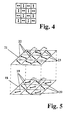
- This two-stage irradiation with different masks and different linearly polarized light creates an orientation pattern in the photopolymer layer, as shown in FIG. 4.
- the adjoining square areas each have a staggered preferred orientation of the polymer molecules.
- the liquid crystal molecules orient themselves in accordance with the changing orientations of the photopolymer layer.
- FIG. 5 An example of such a display, in which pixels with a first helix angle ⁇ 1 with pixels with a second helix angle ⁇ 2 of the liquid crystal in between are arranged in a grid pattern, is shown in FIG. 5.
- the two plates are shown with the preferred orientations.
- the lower plate 14 has a preferred orientation ⁇ 11 in a first set 15 of the surface areas arranged in a grid, in the second set 16 the preferred orientation ⁇ 12 , where a is the angle of the preferred orientation with respect to a substrate edge.
- the upper plate 17 accordingly has a first set 18 of surface areas with preferred orientation u 21 and a second set 19 of surface areas with preferred orientation a 22 .
- cholesteric additives which cause a suitable natural twisting in a manner known per se, stable helix configurations with a uniform direction of rotation and 70 ° ⁇
- a glass plate was coated with a 2% solution of polyvinyl cinnamate (mol. Wt. - 15000) in methyl cellosolve acetate in a spin coating process at 3000 rpm for about 30 s.
- the thickness of the layer produced in this way was approximately 0.1 ⁇ .
- the layer was then approx. 20 min. air-dried and then heated to approx. 80 ° -90 ° C for approx. 20 s.
- the layer was exposed to the linearly polarized light of an HgHP lamp with a wavelength of approximately 365 nm for approximately 100 s, first through the positive mask 8 and then with um 90 rotated direction of polarization through the complementary or negative mask 9.
- the irradiation energy was in each case approximately 15 mW / cm 2 .
- a cell which was filled with a nematic liquid crystal, was built from the plates prepared in this way in a manner known per se. Depending on whether one or both plates have an orientation pattern, it may be necessary to make precise adjustments. It was found that the liquid crystal layer was planarly oriented in two preferred directions, and in such a way that the nematic director of the liquid crystal layer was oriented in accordance with the changing orientation in the photopolymer layers.
- Example 2 In a procedure similar to that in Example 1, a layer of a solution of a polyvinyl ester of paramethoxycinnamic acid (molecular weight approx. 15000-50000) in chlorobenzene and dichlorethylene was exposed 1: 1 for approx. 10 s to an irradiation power of approx. 0.5 J / cm 2 . The resulting layer also induces a parallel orientation in an adjacent liquid crystal.
- a glass plate was immersed in a 1% solution of coated in water.
- a liquid crystal cell constructed with plates coated in this way was filled with a nematic liquid crystal and, for better orientation of the liquid crystal, heated to 100 ° C. for about 5 minutes so that the liquid crystal reached its isotropic state, and then cooled. The liquid crystal was then planar.
- a glass plate was covered with a 3% solution of evaporated in chloroform.
- the resulting layer approx. 1000-2000 ⁇ thick, was irradiated with light of the wavelength ⁇ 400-550 with an output of approx. 45 mW / cm 2 for approx. 3 min.
- Example 3 With plates coated in this way, a liquid crystal cell was built as in Example 3, in which the liquid crystal was likewise planar.
- Example 1 was repeated, but instead of linearly polarized light, unpolarized light was used in the second exposure step. After assembly of the liquid crystal cell, it was found that the areas photopolymerized with linearly polarized light oriented the liquid crystal layer planar in a preferred direction, whereas the liquid crystal in the areas irradiated with unpolarized light Areas has no preferred direction.
Landscapes
- Physics & Mathematics (AREA)
- Nonlinear Science (AREA)
- Spectroscopy & Molecular Physics (AREA)
- Mathematical Physics (AREA)
- Chemical & Material Sciences (AREA)
- Crystallography & Structural Chemistry (AREA)
- General Physics & Mathematics (AREA)
- Optics & Photonics (AREA)
- Liquid Crystal (AREA)
Abstract
Description
- Die Erfindung betrifft Flüssigkristallanzeigezellen die aus einem orientierten Flüssigkristall zwischen zwei mit transparenten Elektrodenschichten und Orientierungsschichten versehenen Platten (Substraten) bestehen.
- In Flüssigkristallanzeigezellen, die auf einem elektrischen Feldeffekt beruhen, sind die den Flüssigkristall begrenzenden Glas- oder Kunstoffplatten auf den dem Flüssigkristall zugewandten Oberflächen mit Beschichtungen versehen, welche die unmittelbar angrenzenden Flüssigkristallmoleküle entlang einer Vorzugsrichtung orientieren. Dies gilt für Flüssigkristallanzeigen, die auf dem sog. Drehzellen (twisted nematic, TN)-Effekt, und solche, die auf höherer Verdrillung beruhen, z.B. sog. Super Twisted Nematic (STN)-Zellen, sowie schliesslich auch für ferroelektrische Flüssigkristallzellen.
- Bisher wurde die Wandorientierung der Flüssigkristallmoleküle in Anzeigezellen entweder durch Schrägbedampfen der Substratoberfläche mit SiOx, oder aber heute praktisch ausschliesslich durch mechanische Behandlung (Reiben) einer Polymerschicht erzeugt, die zuvor auf die Substratoberfläche(n) aufgebracht wurde. Diese Reibmethode erlaubt es nicht, selektive Gebiete der Substratoberfläche mit einer Vorzugsorientierung zu versehen. Insbesondere ist es mit bisherigen Methoden nicht möglich, Orientierungsmuster herzustellen, wie z.B. eine von Bildpunkt (Pixel) zu Bildpunkt verschiedene Wandorientierung. Ausserdem beeinträchtigt das heute beinahe ausschliesslich angewendete Reiben einer Polymerschicht häufig die Ausbeuten bei der Herstellung von aktiv adressierten Drehzellen dadurch, dass die beim Reiben entstehende elektrostatische Aufladung des Substrates zu elektrischen Durchbrüchen in den Dünnfilmtransistoren auf der Substratoberfläche führt.
- Der Erfindung liegt die Aufgabe zugrunde, eine neue und verbesserte Möglichkeit der Oberflächenorientierung von Flüssigkristallen anzugeben, die die Nachteile der bekannten Methoden vermeidet und vor allem die Möglichkeit der Herstellung von Orientierungsmustern beinhaltet.
- Erfindungsgemäss wird dies dadurch erreicht, dass bei einer Flüssigkristallzelle der eingangs erwähnten Art auf die mit den Elektroden versehenen Innenseiten der Platten orientierte Photopolymerschichten aufgebracht sind, welche die angrenzenden Flüssigkristallmoleküle in eine Vorzugsrichtung ausrichten.
- Für den Zweck der vorliegenden Beschreibung wird ein Polymer, dessen Polymerisation durch Lichteinwirkung ausgelöst oder bewirkt wurde als Photopolymer bezeichnet. Im übrigen wird auch Bezug genommen auf das schweizerische Patentgesuch Nr. 2244/91 mit dem Titel "Orientierte Photopolymere und Verfahren zu deren Herstellung".
- Vorzugsweise sind die Vorzugsrichtungen an den beiden Platten verschieden.
- Besonders bevorzugt wird ein nematischer Flüssigkristall durch die Orientierungsschichten planar in eine Vorzugsrichtung orientiert, wobei der Winkel 0 zwischen dem nematischen Direktor und der Substratoberfläche 0 6 e < 85 ° ist.
- Gemäss einer bevorzugten Ausführungsform der Erfindung ist ein Muster aus Bereichen mit unterschiedlichen Vorzugsorientierungen oder ein Muster aus Bereichen mit Vorzugsorientierung und unorientierten Bereichen vorhanden.
- Gemäss einer weiteren bevorzugten Ausführungsform weisen die beiden Platten unterschiedliche Orientierungsmuster auf, die sich durch unterschiedliche Vorzugsorientierungen unterscheiden, was zu unterschiedlichen Verdrillungswinkeln führt.
- Es wurde überraschend gefunden, dass orientierte Photopolymerschichten, d.h. Photopolymere die durch Einstrahlen von linear polarisiertem Licht polymerisiert sind, Flüssigkristalle, die mit ihnen in Kontakt kommen, in eine Vorzugsrichtung orientieren. Dies gilt nicht nur für die Vorzugsrichtung parallel zu den Platten. Durch die orientierten Photopolymere kann auch ein Kippwinkel in Richtung senkrecht zu den Platten induziert.
- Dadurch wird die Herstellung von Oberflächenorientierungsschichten in Flüssigkristallanzeigezellen ohne SiOx- Bedampfung und ohne geriebene Polymere erstmals möglich.
- Die Verwendung von Orientierungsschichten aus Photopolymeren erlaubt erstmals auch die Erzeugung von Orientierungsmustern, indem photographische Masken mit linear polarisiertem Licht einer gewünschten Schwingungsrichtung bestrahlt und auf das beschichtete Substrat abgebildet werden. Als Alternative können auch interferometrische Abbildungstechniken angewandt werden (polarisierte Hologramme).
- Im folgenden werden anhand der beiliegenden Zeichnung und der Beispiele Ausführungsformen der Erfindung näher erläutert. Es zeigen
- Fig. 1 eine Flüssigkristallanzeigezelle nach der Erfindung
- Fig. 2 eine Vorrichtung zur Herstellung einer Orientierungsschicht
- Fig. 3 einen Maskensatz zur Verwendung in der Vorrichtung nach Fig. 1
- Fig. 4-5 verschiedene Orientierungsmuster als Ergebnis der Belichtung mit dem Maskensatz gemäss Fig. 3.
- Die in Fig. 1 schematisch im Schnitt gezeigte Flüssigkristallzelle besteht wie üblich aus zwei transparenten Platten 1, 2 und einer dazwischenliegenden Flüssigkristallschicht 7. Die beiden Platten aus Glas oder Kunststoff sind mit Ansteuerelektroden 3,4 und mit darüberliegenden Orientierungsschichten 5, 6 versehen. Im Unterschied zu vorbekannten Flüssigkristallzellen bestehen die Orientierungsschichten aus orientiertem Photopolymer.
- In der in Fig. 2 gezeigten einfachen Vorrichtung zur Herstellung der orientierten Photopolymerschichten ist eine Glasplatte 1 mit einer transparenten, leitenden Elektrodenschicht 2 und mit einer Schicht 3 aus einem photopolymerisierbaren organischen Material versehen. Die Schicht wird mittels einer Linse 4 und einer vorgesetzten Maske 5 mit linear polarisiertem Licht bestrahlt. Dieses kommt von einem Polarisator 6, der mit unpolarisiertem UV-Licht 7 beleuchtet wird.
- Die Maske 5 ist in Fig. 3 als Maskensatz gezeigt, der aus zwei komplementären Masken 8, 9 oder mit anderen Worten aus einer positiven Maske 8 (Fig. 3a) und einer negativen Maske 9 (Fig. 3b) besteht. Die beiden Masken zeigen ein schachbrettartiges Muster, d.h. sie decken abwechselnd gleich grosse Quadrate 10 der gesamten Zellenfläche ab und lassen die jeweils anderen quadratischen Flächen 11 frei.
- Bestrahlung durch die positive Maske 8 mit linear polarisiertem Licht mit der durch den Pfeil 12 angegebenen Polarisationsrichtung bewirkt die orientierte Polymerisation der von der Maske frei gelassenen Flächen der dahinter angeordneten polymerisierbaren Schicht 2. Nach diesem ersten Schritt wird die Maske 8 durch die negative Maske 9 ersetzt und die polymerisierbare Schicht 3 mit Licht bestrahlt, dessen Polarisationsrichtung gemäss dem Pfeil 12 um 90 gedreht ist. Die nunmehr freien Flächen der Schicht polymerisieren mit entsprechend gedrehter Orientierung.
- Wenn im ersten Schritt vollständige Polymerisation erreicht wurde, ist für den zweiten Schritt keine Maske mehr erforderlich, weil die im ersten Schritt induzierte Orientierung erhalten bleibt.
- Durch diese zweistufige Bestrahlung mit verschiedenen Masken und unterschiedlich linear polarisiertem Licht entsteht ein Orientierungsmuster in der Photopolymerschicht, wie es in Fig. 4 gezeigt ist. Die jeweils aneinandergrenzenden quadratischen Bereiche weisen gegeneinander versetzte Vorzugsorientierung der Polymermoleküle auf. In einer Flüssigkristallzelle, die mit derart beschichteten Platten aufgebaut ist, orientieren sich die Flüssigkristallmoleküle entsprechend den wechselnden Orientierungen der Photopolymerschicht.
- Anstelle der von Bereich zu Bereich um 90 versetzten Orientierung sind auch andere Winkelkombinationen möglich. Vor allem ist es möglich, die Orientierungsrichtungen voneinander in der Zelle gegenüberliegenden Bereichen so vorzusehen, dass die Verdrillungswinkel bzw. die Ganghöhen der dazwischenliegenden Volumenbereiche des Flüssigkristalls von Bereich zu Bereich variieren. Durch geeignete chirale Dotierung des nematischen Flüssigkristalls lassen sich so in einer einzigen Anzeige TN-Bereiche und STN-Bereiche nebeneinander verwirklichen. Dies kann von Bedeutung sein, wenn in einer Anzeige sowohl grossflächige Informationen als auch komplexe, d.h. Multiplexansteuerung erfordernde Informationen dargestellt werden sollen. Auch lassen sich verschieden stark verdrillte STN-Zellen in ein und derselben Anzeige realisieren.
- Ein Beispiel einer solchen Anzeige, bei der Bildpunkte mit einem ersten Helixwinkel φ1mit Bildpunkten mit einem zweiten Helixwinkel φ2 des jeweils dazwischenliegenden Flüssigkristalls rasterförmig angeordnet sind, ist in Fig. 5 gezeigt. Dargestellt sind die beiden Platten mit den Vorzugsorientierungen.
- Die untere Platte 14 hat in einerersten Menge 15 der rasterförmig angeordneten Flächenbereiche eine Vorzugsorientierung α11, in der zweiten Menge 16 die Vorzugsorientierung α12, wobei a der Winkel der Vorzugsorientieurng gegenüber einer Substratkante ist.
- Die obere Platte 17 hat entsprechend eine erste Menge 18 von Flächenbereichen mit Vorzugsorientierung u21 und eine zweite Menge 19 von Flächenbereichen mit Vorzugsorientierung a22. Durch geeignete Justierung der Platten in einer Flüssigkristallzelle ergeben sich für den dazwischenliegenden Flüssigkristall die Helixwinkel φ1 = α11 - a12 bzw. φ2 = α21- α22. Durch Dotierung mit cholesterischen Zusätzen, die in an sich bekannter Weise eine geeignete natürliche Verdrillung bewirken, können stabile Helixkonfigurationen mit einheitlichem Drehsinn und 70 ° ≦|φ1 - φ2 ≦ 220 erreicht werden.
- Im folgenden werden einige zur Erläuterung der Erfindung durchgeführte Beispiele beschrieben.
- Eine Glasplatte wurde mit einer 2%igen Lösung von Polyvinylcinnamat (Mol. Gew. - 15000) in Methylcellosolveacetat in einem Spin-Coating Verfahren mit 3000 Upm ca. 30 s beschichtet. Die Dicke der so hergestellten Schichtbetrug ca. 0.1u. Danach wurde die Schicht ca. 20 min. an der Luft getrocknet und anschliessend während ca. 20 s auf ca. 80 ° -90 ° C erhitzt. Nach dieser Vorbehandlung wurde die Schicht während ca. 100 s der Bestrahlung mit dem linear polarisierten Licht einer HgHP-Lampe mit einer Wellenlänge von ca. 365 nm ausgesetzt, und zwar zuerst durch die positive Maske 8 und danach mit um 90 gedrehter Polarisationsrichtung durch die komplementäre oder negative Maske 9. Die Bestrahlungsenergie betrug jeweils ca. 15 mW/cm2.
- Aus den so vorbereiteten Platten wurde in an sich bekannter Weise eine Zelle gebaut, die mit einem nematischen Flüssigkristall gefüllt wurde. Je nachdem ob eine oder beide Platten ein Orientierungsmuster aufweisen, muss gegebenenfalls auf genaue Justierung geachtet werden. Es wurde festgestellt, dass die Flüssigkristallschicht in zwei Vorzugsrichtungen planar orientiert war und zwar so, dass der nematische Direktor der Flüssigkristallschicht entsprechend der wechselnden Orientierung in den Photopolymerschichten ausgerichtet war.
- In einem ähnlichen Vorgehen wie in Beispiel 1 wurde eine Schicht aus einer Lösung eines Polyvinylesters der Paramethoxyzimtsäure (Molekulargewicht ca. 15000-50000) in Chlorobenzol und Dichloräthylen 1:1 während ca. 10 s einer Bestrahlungsleistung von ca. 0.5 J/cm2 ausgesetzt. Die entstehende Schicht induziert ebenfalls eine parallele Orientierung in einem angrenzenden Flüssigkristall.
- Eine Glasplatte wurde in einem Tauchverfahren mit einer 1 %igen Lösung von

in Wasser beschichtet. Die so entstandene Schicht hat eine Dicke von ca. 0,07µ und wurde mit linear polarisiertem Licht mit einer Wellenlänge = = 400-500 nm und einer Bestrahlungsleistung von ca. 47 mW/cm2 während ca. 8 min. bestrahlt. - Eine mit derart beschichteten Platten aufgebaute Flüssigkristallzelle wurde mit einem nematischen Flüssigkristall gefüllt und zwecks besserer Orientierung des Flüssigkristalls etwa 5 min auf 100°C erhitzt, damit der Flüssigkristall seinen isotropen Zustand erreicht, und danach abgekühlt. Der Flüssigkristall war danach planar orientiert.
- Eine Glasplatte wurde mit einer 3%igen Lösung von

in Chloroform bedampft. Die so entstandene, ca. 1000-2000 Ä dicke Schicht wurde mit Licht der Wellenlänge λ≈ 400-550 mit einer Leistung von ca. 45 mW/cm2 während ca. 3 min bestrahlt. - Mit derart beschichteten Platten wurde wie im Beispiel 3 eine Flüssigkristallzelle gebaut in der der Flüssigkristall ebenfalls planar orientiert war.
- Beispiel 1 wurde wiederholt, jedoch an Stelle von linear polarisiertem Licht wurde im zweiten Belichtungsschritt unpolarisiertes Licht verwendet. Nach dem Zusammenbau der Flüssigkristallzelle wurde festgestellt, dass die mit linear polarisiertem Licht photopolymerisierten Gebiete die Flüssigkristallschicht in eine Vorzugsrichtung planar orientierten, wogegen der Flüssigkristall in den mit unpolarisiertem Licht bestrahlten Gebieten keine Vorzugsrichtung aufweist.
Claims (6)
Applications Claiming Priority (4)
| Application Number | Priority Date | Filing Date | Title |
|---|---|---|---|
| CH2246/91 | 1991-07-26 | ||
| CH224691 | 1991-07-26 | ||
| CH10092 | 1992-01-14 | ||
| CH100/92 | 1992-01-14 |
Publications (3)
| Publication Number | Publication Date |
|---|---|
| EP0525478A2 true EP0525478A2 (de) | 1993-02-03 |
| EP0525478A3 EP0525478A3 (en) | 1993-08-04 |
| EP0525478B1 EP0525478B1 (de) | 1997-06-11 |
Family
ID=25683519
Family Applications (1)
| Application Number | Title | Priority Date | Filing Date |
|---|---|---|---|
| EP92111775A Expired - Lifetime EP0525478B1 (de) | 1991-07-26 | 1992-07-10 | Flüssigkristallanzeigezelle |
Country Status (5)
| Country | Link |
|---|---|
| US (1) | US5838407A (de) |
| EP (1) | EP0525478B1 (de) |
| JP (1) | JP2608661B2 (de) |
| DE (1) | DE59208605D1 (de) |
| SG (1) | SG50586A1 (de) |
Cited By (45)
| Publication number | Priority date | Publication date | Assignee | Title |
|---|---|---|---|---|
| EP0611981A1 (de) * | 1993-02-17 | 1994-08-24 | F. Hoffmann-La Roche Ag | Optisches Bauelement |
| WO1995018989A3 (en) * | 1994-01-10 | 1995-09-21 | Honeywell Inc | Method of fabricating multi-domain, liquid crystal displays |
| WO1995034843A1 (de) * | 1994-06-13 | 1995-12-21 | Merck Patent Gmbh | Elektrooptisches system |
| EP0689084A1 (de) * | 1994-06-24 | 1995-12-27 | F. Hoffmann-La Roche AG | Optisches Bauelement |
| EP0708354A1 (de) * | 1994-10-14 | 1996-04-24 | International Business Machines Corporation | Flussigkristallanzeigevorrichtung und Herstellungsverfahren |
| EP0684500A3 (de) * | 1994-05-27 | 1996-07-24 | Sharp Kk | Flüssigkristall-Anzeigevorrichtung und Verfahren und Gerät zu ihrer Herstellung. |
| US5578351A (en) * | 1995-01-20 | 1996-11-26 | Geo-Centers, Inc. | Liquid crystal composition and alignment layer |
| EP0753785A1 (de) * | 1995-07-11 | 1997-01-15 | F. Hoffmann-La Roche Ag | Übertragung von Polarisationsmustern auf polarisationsempfindliche Photoschichten |
| FR2741353A1 (fr) * | 1995-11-20 | 1997-05-23 | Lg Electronics Inc | Substance photosensible pour l'orientation d'un dispositif a cristaux liquides et dispositif a cristaux liquides obtenu a partir de celle-ci |
| EP0742471A3 (de) * | 1995-05-10 | 1997-10-22 | Stanley Electric Co Ltd | Anordnung zur gekippten Ausrichtung von Flüssigkristallen ohne Reiben |
| GB2318190A (en) * | 1996-10-02 | 1998-04-15 | Lg Electronics Inc | Method for fabricating an LCD with a photo-oriented alignment layer |
| US5855968A (en) * | 1993-07-30 | 1999-01-05 | Sharp Kabushiki Kaisha | Liquid crystal display device and method for producing the same |
| US5912717A (en) * | 1996-02-05 | 1999-06-15 | Stanley Electric Co., Ltd. | Homeotropic liquid crystal display and its manufacture |
| US6013335A (en) * | 1993-07-30 | 2000-01-11 | Sharp Kabushiki Kaisha | Liquid crystal display apparatus and method for processing the same |
| US6124970A (en) * | 1997-10-20 | 2000-09-26 | Latents Image Technology Ltd. | Polymer materials with latent images visible in polarized light and methods for their production |
| US6160597A (en) * | 1993-02-17 | 2000-12-12 | Rolic Ag | Optical component and method of manufacture |
| US6191836B1 (en) | 1996-11-07 | 2001-02-20 | Lg Philips Lcd, Co., Ltd. | Method for fabricating a liquid crystal cell |
| US6226066B1 (en) | 1996-01-09 | 2001-05-01 | Lg. Philips Lcd Co., Ltd. | Method for controlling pretilt angle direction in a liquid crystal cell |
| US6271906B1 (en) | 1991-12-05 | 2001-08-07 | Rolic Ag | Liquid crystal cells for integrated optical components and a method of manufacturing them |
| US6292296B1 (en) | 1997-05-28 | 2001-09-18 | Lg. Philips Lcd Co., Ltd. | Large scale polarizer and polarizer system employing it |
| US6383579B1 (en) | 1999-04-21 | 2002-05-07 | Lg. Philips Lcd Co., Ltd. | Liquid crystal display device |
| US6399165B1 (en) | 1997-11-21 | 2002-06-04 | Lg. Philips Lcd Co., Ltd. | Liquid crystal display device |
| US6479218B1 (en) | 1999-10-14 | 2002-11-12 | Lg Philips Lcd Co., Ltd | Method for manufacturing multi-domain liquid crystal cell |
| SG94794A1 (en) * | 1993-02-17 | 2003-03-18 | Rolic Ag | Optical component |
| US6627269B2 (en) | 2000-12-05 | 2003-09-30 | Lg.Philips Lcd Co., Ltd. | Photo-alignment material and liquid crystal display device |
| US6764724B1 (en) | 1999-03-25 | 2004-07-20 | Lg.Philips Lcd Co., Ltd. | Alignment layer for a liquid crystal display device |
| US6770335B2 (en) | 2000-10-28 | 2004-08-03 | Lg.Philips Lcd Co., Ltd. | Photoalignment materials and liquid crystal display device and method for fabricating the same with said materials |
| US6793987B2 (en) | 2000-10-28 | 2004-09-21 | Lg.Philips Lcd Co., Ltd. | Photoalignment materials and liquid crystal display fabricated with such photoalignment materials |
| DE19744267B4 (de) * | 1996-10-07 | 2005-07-28 | Lg. Philips Lcd Co., Ltd. | Verfahren zum Steuern des Kippwinkels in einer Flüssigkristallzelle |
| US7060332B2 (en) | 2001-04-25 | 2006-06-13 | Lg.Philips Lcd Co., Ltd. | Liquid crystal display with alignment film of polyphenylenphthalamide-based material and method for fabricating the same |
| DE19703682B4 (de) * | 1996-02-01 | 2006-08-10 | Lg. Philips Lcd Co., Ltd. | UV-Licht-Bestrahlvorrichtung für Photoausrichtungsverfahren und Bestrahlverfahren unter Verwendung derselben |
| CN100410776C (zh) * | 2004-06-30 | 2008-08-13 | 乐金显示有限公司 | 液晶显示装置及其制造方法 |
| WO2008130559A2 (en) | 2007-04-16 | 2008-10-30 | North Carolina State University | Methods of fabricating switchable liquid crystal polarization gratings on reflective substrates and related devices |
| EP1767523A4 (de) * | 2004-06-30 | 2009-08-26 | Dainippon Ink & Chemicals | Azoverbindung, zusammensetzung für eine optische ausrichtungsschicht damit und herstellungsverfahren für eine optische ausrichtungsschicht |
| EP2302424A1 (de) | 1997-05-09 | 2011-03-30 | Rolic AG | Optisches Element mit strukturiertem Retarder |
| EP2309292A3 (de) * | 2001-11-08 | 2011-11-23 | Dai Nippon Printing Co., Ltd. | Flüssigkristallanzeigevorrichtung |
| US8305523B2 (en) | 2007-04-16 | 2012-11-06 | North Carolina State University | Multi-layer achromatic liquid crystal polarization gratings and related fabrication methods |
| US8339566B2 (en) | 2007-04-16 | 2012-12-25 | North Carolina State University | Low-twist chiral liquid crystal polarization gratings and related fabrication methods |
| US8659738B2 (en) | 2001-11-08 | 2014-02-25 | Dai Nippon Printing Co., Ltd. | Phase difference layer laminated body for three dimensional liquid crystal display device and manufacturing method thereof |
| CN104635373A (zh) * | 2015-02-13 | 2015-05-20 | 上海天马微电子有限公司 | 液晶显示面板及液晶显示装置 |
| CN104884982A (zh) * | 2012-12-31 | 2015-09-02 | Lg化学株式会社 | 光学元件 |
| US9298041B2 (en) | 2007-04-16 | 2016-03-29 | North Carolina State University | Multi-twist retarders for broadband polarization transformation and related fabrication methods |
| US10207474B2 (en) | 2015-01-28 | 2019-02-19 | Zeon Corporation | Multilayer film, optically anisotropic layered body, circularly polarizing plate, organic electroluminescence display device, and manufacturing method |
| CN110192145A (zh) * | 2016-11-18 | 2019-08-30 | 奇跃公司 | 具有纳米级图案的液晶衍射设备及其制造方法 |
| US11586065B2 (en) | 2016-11-18 | 2023-02-21 | Magic Leap, Inc. | Spatially variable liquid crystal diffraction gratings |
Families Citing this family (63)
| Publication number | Priority date | Publication date | Assignee | Title |
|---|---|---|---|---|
| JP2693368B2 (ja) * | 1993-06-29 | 1997-12-24 | スタンレー電気株式会社 | 液晶表示素子とその製造方法 |
| JP2768262B2 (ja) * | 1994-02-24 | 1998-06-25 | 日本電気株式会社 | 透過型液晶表示装置 |
| TW515926B (en) | 1996-07-10 | 2003-01-01 | Matsushita Electric Industrial Co Ltd | Liquid crystal alignment film and method for producing the same, and liquid crystal display apparatus using the same and method for producing the same |
| KR100247137B1 (ko) * | 1996-07-29 | 2000-03-15 | 구본준 | 멀티도메인 액정셀의 제조방법 |
| WO1999047967A1 (en) * | 1998-03-19 | 1999-09-23 | Matsushita Electric Industrial Co., Ltd. | Resin-liquid crystal formed body, liquid crystal device, liquid crystal display comprising the same, and methods of manufacturing the same |
| JP3620312B2 (ja) | 1998-10-30 | 2005-02-16 | 株式会社日立製作所 | 液晶表示装置 |
| US20040120040A1 (en) * | 1998-11-13 | 2004-06-24 | Rolic Ag | Optical component |
| US6610462B1 (en) | 1999-08-13 | 2003-08-26 | Rolic Ag | Liquid crystal alignment using photo-crosslinkable low molecular weight materials |
| US6239853B1 (en) * | 1999-10-01 | 2001-05-29 | Rockwell Science Center, Llc | Staggered waveplate LCD privacy screen |
| CN1220754C (zh) | 1999-10-19 | 2005-09-28 | 罗利克有限公司 | 拓扑结构化的聚合物涂层 |
| WO2002003128A2 (en) * | 2000-07-05 | 2002-01-10 | Rolic Ag | Nematic liquid crystal electrooptical element and device |
| EP1170624A1 (de) * | 2000-07-05 | 2002-01-09 | Rolic AG | Elektrooptisches Element und Vorrichtung, welche nematische Flüssigkristalle verwenden |
| US6630289B1 (en) * | 2000-08-22 | 2003-10-07 | The Hong Kong University Of Science And Technology | Photo-patterned light polarizing films |
| KR100673265B1 (ko) | 2000-10-04 | 2007-01-22 | 엘지.필립스 엘시디 주식회사 | 액정표시장치 |
| EP1203980A1 (de) * | 2000-11-03 | 2002-05-08 | Rolic AG | Schaltbarer Farbfilter |
| US6822713B1 (en) * | 2000-11-27 | 2004-11-23 | Kent State University | Optical compensation film for liquid crystal display |
| US6573963B2 (en) | 2001-02-22 | 2003-06-03 | 3M Innovativeproperties Company | Cholesteric liquid crystal optical bodies and methods of manufacture |
| US6917399B2 (en) * | 2001-02-22 | 2005-07-12 | 3M Innovative Properties Company | Optical bodies containing cholesteric liquid crystal material and methods of manufacture |
| KR100783358B1 (ko) * | 2001-04-27 | 2007-12-07 | 엘지.필립스 엘시디 주식회사 | 입체영상 표시장치 및 제조방법 |
| US6876427B2 (en) | 2001-09-21 | 2005-04-05 | 3M Innovative Properties Company | Cholesteric liquid crystal optical bodies and methods of manufacture and use |
| US20030090012A1 (en) * | 2001-09-27 | 2003-05-15 | Allen Richard Charles | Methods of making polarization rotators and articles containing the polarization rotators |
| US6985291B2 (en) * | 2001-10-01 | 2006-01-10 | 3M Innovative Properties Company | Non-inverting transflective assembly |
| JP2004053784A (ja) | 2002-07-18 | 2004-02-19 | Sharp Corp | 液晶表示装置およびその製造方法 |
| JP2006505015A (ja) * | 2002-11-01 | 2006-02-09 | コピン・コーポレーシヨン | マルチドメイン垂直配向液晶ディスプレー |
| US7068344B2 (en) * | 2003-02-24 | 2006-06-27 | 3M Innovative Properties Company | Cholesteric liquid crystal optical bodies and methods of manufacture and use |
| US6913708B2 (en) * | 2003-02-24 | 2005-07-05 | 3M Innovative Properties Company | Cholesteric liquid crystal drying process and solvent |
| US7029729B2 (en) * | 2003-02-24 | 2006-04-18 | 3M Innovative Properties Company | Cholesteric liquid crystal additives |
| EP1462485A1 (de) * | 2003-03-26 | 2004-09-29 | Rolic AG | Polymerisierbare dichroitische Azofarbstoffe |
| US7160586B2 (en) | 2003-08-29 | 2007-01-09 | 3M Innovative Properties Company | Cholesteric liquid crystal copolymers and additives |
| US7196758B2 (en) * | 2003-12-30 | 2007-03-27 | 3M Innovative Properties Company | Method of alignment of liquid crystals comprising exposing an alignment material to an interference pattern |
| WO2005114313A1 (en) * | 2004-05-21 | 2005-12-01 | Kopin Corporation | Full symmetrical wide-viewing angle display |
| US20050266175A1 (en) * | 2004-05-27 | 2005-12-01 | Yong Hsu | Retardation coating |
| US7510741B2 (en) * | 2004-06-01 | 2009-03-31 | 3M Innovative Properties Company | Method of making multilayer cholesteric liquid crystal optical bodies |
| EP1764405A1 (de) * | 2005-09-20 | 2007-03-21 | Rolic AG | Funktionalisierte photoreaktive Verbindungen |
| US7652736B2 (en) * | 2005-10-25 | 2010-01-26 | 3M Innovative Properties Company | Infrared light reflecting film |
| US7439000B2 (en) * | 2005-10-25 | 2008-10-21 | 3M Innovative Properties Company | High clarity cholesteric liquid crystal films |
| JP4935982B2 (ja) * | 2005-11-10 | 2012-05-23 | Dic株式会社 | 光配向膜用組成物、光学異方体及びその製造方法 |
| TWI406061B (zh) | 2005-11-10 | 2013-08-21 | Dainippon Ink & Chemicals | 光配向膜用組成物、光學異向體及其製法 |
| JP5070977B2 (ja) * | 2007-07-31 | 2012-11-14 | 大日本印刷株式会社 | 液晶表示素子 |
| KR101527402B1 (ko) | 2007-12-21 | 2015-06-09 | 롤릭 리미티드 | 광정렬 조성물 |
| EP2222740B1 (de) * | 2007-12-21 | 2017-10-11 | Rolic AG | Funktionalisierte lichtreaktive verbindungen |
| DE102008020770B3 (de) * | 2008-04-21 | 2009-10-29 | Bundesdruckerei Gmbh | Sicherheitselement mit einem elektrisch stimulierbaren polarisationsabhängigen Volumenhologramm und Verfahren zu dessen Herstellung |
| JP5906571B2 (ja) | 2010-04-06 | 2016-04-20 | ソニー株式会社 | 液晶表示装置、液晶表示装置の製造方法 |
| US20110262844A1 (en) * | 2010-04-21 | 2011-10-27 | Beam Engineering For Advanced Measurement Co. | Fabrication of high efficiency, high quality, large area diffractive waveplates and arrays |
| KR101867348B1 (ko) | 2011-05-31 | 2018-06-15 | 디아이씨 가부시끼가이샤 | 계피산 유도체 및 그 중합체, 및 그 경화물로 이루어지는 액정 배향층 |
| WO2013002224A1 (ja) | 2011-06-30 | 2013-01-03 | Dic株式会社 | 桂皮酸誘導体及びその重合体、ならびにその硬化物からなる液晶配向層 |
| CN103732638B (zh) | 2011-06-30 | 2016-01-20 | Dic株式会社 | 共聚物及包含该共聚物的固化物的液晶取向层 |
| JP6160073B2 (ja) | 2011-12-26 | 2017-07-12 | 旭硝子株式会社 | 液晶配向膜の製造方法、光学素子の製造方法および光記録媒体処理装置の製造方法 |
| JP6003192B2 (ja) | 2012-04-27 | 2016-10-05 | ソニー株式会社 | 液晶表示装置 |
| JP2014081559A (ja) | 2012-10-18 | 2014-05-08 | Sony Corp | 液晶表示装置 |
| JP2014095783A (ja) | 2012-11-08 | 2014-05-22 | Sony Corp | 液晶表示装置 |
| JP6194657B2 (ja) | 2013-06-28 | 2017-09-13 | ソニー株式会社 | 液晶表示装置 |
| WO2015080221A1 (ja) | 2013-11-29 | 2015-06-04 | Dic株式会社 | 化合物、重合体、液晶配向膜、液晶表示素子、及び光学異方体 |
| KR102284231B1 (ko) | 2014-02-19 | 2021-08-04 | 롤리크 아게 | 액정 정렬 조성물, 액정 정렬 필름 및 액정 디스플레이 소자 |
| US10126602B2 (en) | 2014-03-20 | 2018-11-13 | Samsung Display Co., Ltd. | Curved display device and fabricating method thereof |
| EP3145997B1 (de) | 2014-05-21 | 2023-07-12 | ROLIC Technologies AG | Polymerisierbare dichroitische farbstoffe |
| WO2016152330A1 (ja) | 2015-03-20 | 2016-09-29 | ソニー株式会社 | 液晶表示装置 |
| US9902906B2 (en) | 2015-04-21 | 2018-02-27 | The United States Of America As Represented By The Secretary Of The Air Force | Voxelated liquid crystal elastomers |
| US11209700B2 (en) | 2016-01-21 | 2021-12-28 | Sharp Kabushiki Kaisha | Method for manufacturing liquid crystal panel, method for manufacturing retardation plate, and wire grid polarizing plate |
| CN205487282U (zh) | 2016-04-06 | 2016-08-17 | 北京京东方光电科技有限公司 | 显示模组、显示装置 |
| US11561440B2 (en) | 2017-03-03 | 2023-01-24 | Rolic Technologies AG | Photoalignment composition for the stabilization of the pre-tilt angle in liquid crystal layers |
| KR20250124208A (ko) | 2022-12-16 | 2025-08-19 | 롤릭 테크놀로지스 아게 | 액정 배향막 형성용 조성물 |
| WO2025181073A1 (en) | 2024-03-01 | 2025-09-04 | Rolic Technologies AG | Photoalignable polymeric material for forming a liquid crystal alignment film |
Family Cites Families (26)
| Publication number | Priority date | Publication date | Assignee | Title |
|---|---|---|---|---|
| JPS545754A (en) * | 1977-06-15 | 1979-01-17 | Toshiba Corp | Twist nematic type liquid crystal display device |
| DE2912467A1 (de) * | 1979-03-29 | 1980-10-09 | Siemens Ag | Fluessigkristallanzeige |
| JPS5952802B2 (ja) * | 1980-04-01 | 1984-12-21 | 大日本印刷株式会社 | 液晶表示用配向基板およびその製造法 |
| DE3234074A1 (de) * | 1982-09-14 | 1984-03-15 | Siemens AG, 1000 Berlin und 8000 München | Fluessigkristallzelle und ihre verwendung |
| JPS6060624A (ja) * | 1983-09-13 | 1985-04-08 | Matsushita Electric Ind Co Ltd | 液晶表示パネルおよびその製造方法 |
| JPS6111725A (ja) * | 1984-06-26 | 1986-01-20 | Fujitsu Ltd | 液晶表示装置およびその製造方法 |
| JPS6151124A (ja) * | 1984-08-20 | 1986-03-13 | Matsushita Electric Ind Co Ltd | 液晶表示装置 |
| JPS61121035A (ja) * | 1984-11-16 | 1986-06-09 | Seiko Epson Corp | 液晶光学装置 |
| JPS6291920A (ja) * | 1985-10-18 | 1987-04-27 | Victor Co Of Japan Ltd | 液晶表示セル |
| GB8608276D0 (en) * | 1986-04-04 | 1986-05-08 | British Telecomm | Optical devices |
| ATE88026T1 (de) * | 1986-09-11 | 1993-04-15 | Siemens Ag | Verfahren zur herstellung waermebestaendiger strukturierter schichten. |
| JP2692693B2 (ja) * | 1986-10-22 | 1997-12-17 | 富士通株式会社 | 液晶表示パネル |
| US4952030A (en) * | 1987-09-04 | 1990-08-28 | Asahi Glass Company, Ltd. | Liquid crystal display device with a 50°-80° twist angle |
| JPH01210932A (ja) * | 1988-02-18 | 1989-08-24 | Nec Corp | 液晶表示装置の配向処理方法 |
| JP2696108B2 (ja) * | 1988-06-01 | 1998-01-14 | セイコーインスツルメンツ株式会社 | 液晶素子及びその製造方法 |
| JPH0255330A (ja) * | 1988-08-22 | 1990-02-23 | Matsushita Electric Ind Co Ltd | 液晶用配向膜の製法 |
| JP2569406B2 (ja) * | 1989-01-25 | 1997-01-08 | 工業技術院長 | レーザーを用いた液晶配向膜の作製方法 |
| JPH02211425A (ja) * | 1989-02-13 | 1990-08-22 | Seiko Epson Corp | 液晶配向膜及びその形成方法 |
| US4974941A (en) * | 1989-03-08 | 1990-12-04 | Hercules Incorporated | Process of aligning and realigning liquid crystal media |
| JPH03111818A (ja) * | 1989-09-27 | 1991-05-13 | Hitachi Ltd | 光学素子およびその製法 |
| US5073294A (en) * | 1990-03-07 | 1991-12-17 | Hercules Incorporated | Process of preparing compositions having multiple oriented mesogens |
| JPH07101264B2 (ja) * | 1990-04-25 | 1995-11-01 | 工業技術院長 | 液晶材料の配向方法 |
| DE69121658T2 (de) * | 1990-09-17 | 1997-01-23 | Matsushita Electric Ind Co Ltd | Flüssigkristallorientierungsschicht und ihr Herstellungsverfahren |
| JP2502802B2 (ja) * | 1990-10-15 | 1996-05-29 | インターナシヨナル・ビジネス・マシーンズ・コーポレーシヨン | 液晶表示装置 |
| DE69221102T2 (de) * | 1991-12-20 | 1998-01-08 | Fujitsu Ltd | Flüssigkristall-Anzeigevorrichtung mit verschiedenen aufgeteilten Orientierungsbereichen |
| US5246748A (en) * | 1991-12-23 | 1993-09-21 | Hoechst Celanese Corp. | Thin film optical medium of a multiple amphiphilic bilayer composite |
-
1992
- 1992-07-10 EP EP92111775A patent/EP0525478B1/de not_active Expired - Lifetime
- 1992-07-10 DE DE59208605T patent/DE59208605D1/de not_active Expired - Lifetime
- 1992-07-10 SG SG1996005599A patent/SG50586A1/en unknown
- 1992-07-24 JP JP4198709A patent/JP2608661B2/ja not_active Expired - Lifetime
-
1996
- 1996-02-16 US US08/601,310 patent/US5838407A/en not_active Expired - Lifetime
Cited By (91)
| Publication number | Priority date | Publication date | Assignee | Title |
|---|---|---|---|---|
| US6271906B1 (en) | 1991-12-05 | 2001-08-07 | Rolic Ag | Liquid crystal cells for integrated optical components and a method of manufacturing them |
| SG94794A1 (en) * | 1993-02-17 | 2003-03-18 | Rolic Ag | Optical component |
| US6160597A (en) * | 1993-02-17 | 2000-12-12 | Rolic Ag | Optical component and method of manufacture |
| EP0611981A1 (de) * | 1993-02-17 | 1994-08-24 | F. Hoffmann-La Roche Ag | Optisches Bauelement |
| US5602661A (en) * | 1993-02-17 | 1997-02-11 | Hoffmann-La Roche Inc. | Optical component |
| US6369869B2 (en) | 1993-02-17 | 2002-04-09 | Rolic A.G. | Optical component and method of manufacture |
| US6717644B2 (en) | 1993-02-17 | 2004-04-06 | Rolic Ag | Optical component and method of manufacture |
| US6013335A (en) * | 1993-07-30 | 2000-01-11 | Sharp Kabushiki Kaisha | Liquid crystal display apparatus and method for processing the same |
| US5855968A (en) * | 1993-07-30 | 1999-01-05 | Sharp Kabushiki Kaisha | Liquid crystal display device and method for producing the same |
| US5657105A (en) * | 1994-01-10 | 1997-08-12 | Honeywell Inc. | Multi-domain liquid crystal displays |
| WO1995018989A3 (en) * | 1994-01-10 | 1995-09-21 | Honeywell Inc | Method of fabricating multi-domain, liquid crystal displays |
| US5604615A (en) * | 1994-05-27 | 1997-02-18 | Sharp Kabushiki Kaisha | Liquid crystal display device and methods for producing same with alignment layer having new bond formation or bond cleavage reaction of molecular chains by light irradiation |
| EP0684500A3 (de) * | 1994-05-27 | 1996-07-24 | Sharp Kk | Flüssigkristall-Anzeigevorrichtung und Verfahren und Gerät zu ihrer Herstellung. |
| WO1995034843A1 (de) * | 1994-06-13 | 1995-12-21 | Merck Patent Gmbh | Elektrooptisches system |
| EP0689084A1 (de) * | 1994-06-24 | 1995-12-27 | F. Hoffmann-La Roche AG | Optisches Bauelement |
| EP0708354A1 (de) * | 1994-10-14 | 1996-04-24 | International Business Machines Corporation | Flussigkristallanzeigevorrichtung und Herstellungsverfahren |
| US5764326A (en) * | 1994-10-14 | 1998-06-09 | International Business Machines Corporation | Multiple direction rotatable liquid crystal display device and a method for its manufacture |
| US5578351A (en) * | 1995-01-20 | 1996-11-26 | Geo-Centers, Inc. | Liquid crystal composition and alignment layer |
| EP0742471A3 (de) * | 1995-05-10 | 1997-10-22 | Stanley Electric Co Ltd | Anordnung zur gekippten Ausrichtung von Flüssigkristallen ohne Reiben |
| US6496239B2 (en) | 1995-07-11 | 2002-12-17 | Rolic Ag | Optical component for producing linearly polarized light |
| EP0753785A1 (de) * | 1995-07-11 | 1997-01-15 | F. Hoffmann-La Roche Ag | Übertragung von Polarisationsmustern auf polarisationsempfindliche Photoschichten |
| FR2741353A1 (fr) * | 1995-11-20 | 1997-05-23 | Lg Electronics Inc | Substance photosensible pour l'orientation d'un dispositif a cristaux liquides et dispositif a cristaux liquides obtenu a partir de celle-ci |
| US5824377A (en) * | 1995-11-20 | 1998-10-20 | Lg Electronics Inc. | Photosensitive material for orientation of liquid crystal device and liquid crystal device thereof |
| US5998563A (en) * | 1995-11-20 | 1999-12-07 | Lg Electronics Inc. | Photosensitive material for orientation of liquid crystal device and liquid crystal device thereof |
| US6633355B2 (en) | 1996-01-09 | 2003-10-14 | Lg. Philips Lcd Co., Ltd. | Method for controlling pretilt angle direction in a liquid crystal cell |
| US6879363B2 (en) | 1996-01-09 | 2005-04-12 | Lg.Philips Lcd Co., Ltd. | Method for controlling pretilt angle direction in a liquid crystal cell |
| US7145618B2 (en) | 1996-01-09 | 2006-12-05 | Lg.Philips Lcd Co., Ltd | Method for controlling pretilt angle direction in a liquid crystal cell |
| US6226066B1 (en) | 1996-01-09 | 2001-05-01 | Lg. Philips Lcd Co., Ltd. | Method for controlling pretilt angle direction in a liquid crystal cell |
| US6433850B2 (en) | 1996-01-09 | 2002-08-13 | Lg. Phillips Lcd Co., Ltd. | Pretilt angle direction in a liquid crystal cell |
| DE19703682B4 (de) * | 1996-02-01 | 2006-08-10 | Lg. Philips Lcd Co., Ltd. | UV-Licht-Bestrahlvorrichtung für Photoausrichtungsverfahren und Bestrahlverfahren unter Verwendung derselben |
| DE19703682B9 (de) * | 1996-02-01 | 2006-11-23 | Lg. Philips Lcd Co., Ltd. | UV-Licht-Bestrahlvorrichtung für Photoausrichtungsverfahren und Bestrahlverfahren unter Verwendung derselben |
| US5912717A (en) * | 1996-02-05 | 1999-06-15 | Stanley Electric Co., Ltd. | Homeotropic liquid crystal display and its manufacture |
| GB2318190B (en) * | 1996-10-02 | 1998-08-26 | Lg Electronics Inc | A method of fabricating a liquid crystal display device |
| GB2318190A (en) * | 1996-10-02 | 1998-04-15 | Lg Electronics Inc | Method for fabricating an LCD with a photo-oriented alignment layer |
| US5953584A (en) * | 1996-10-02 | 1999-09-14 | Lg Electronics Inc. | Method of fabricating liquid crystal display device having alignment direction determined |
| DE19744267B4 (de) * | 1996-10-07 | 2005-07-28 | Lg. Philips Lcd Co., Ltd. | Verfahren zum Steuern des Kippwinkels in einer Flüssigkristallzelle |
| US6417905B1 (en) | 1996-11-07 | 2002-07-09 | Lg. Philips Lcd Co., Ltd. | Method for fabricating a liquid crystal cell |
| US6462797B1 (en) | 1996-11-07 | 2002-10-08 | Lg. Philips Lcd Co., Ltd. | Method for fabricating a liquid crystal cell |
| US6191836B1 (en) | 1996-11-07 | 2001-02-20 | Lg Philips Lcd, Co., Ltd. | Method for fabricating a liquid crystal cell |
| US6721025B2 (en) | 1996-11-07 | 2004-04-13 | Lg.Philips Lcd Co., Ltd | Method for fabricating a liquid crystal cell |
| EP2302425A1 (de) | 1997-05-09 | 2011-03-30 | Rolic AG | Optisches Bauelement |
| EP2302424A1 (de) | 1997-05-09 | 2011-03-30 | Rolic AG | Optisches Element mit strukturiertem Retarder |
| US6292296B1 (en) | 1997-05-28 | 2001-09-18 | Lg. Philips Lcd Co., Ltd. | Large scale polarizer and polarizer system employing it |
| US6639720B2 (en) | 1997-05-28 | 2003-10-28 | Lg.Philips Lcd Co., Ltd. | Large scale polarizer and polarizer system employing it |
| US7911696B1 (en) | 1997-05-28 | 2011-03-22 | Lg Display Co., Ltd. | Large scale polarizer and polarizer system employing it |
| US7016113B2 (en) | 1997-05-28 | 2006-03-21 | Lg.Philips Lcd Co., Ltd. | Large scale polarizer and polarizer system employing it |
| US7016112B2 (en) | 1997-05-28 | 2006-03-21 | Lg.Philips Lcd Co., Ltd. | Large scale polarizer and polarizer system employing it |
| US6124970A (en) * | 1997-10-20 | 2000-09-26 | Latents Image Technology Ltd. | Polymer materials with latent images visible in polarized light and methods for their production |
| US6572939B2 (en) | 1997-11-21 | 2003-06-03 | Lg.Philips Lcd Co., Ltd. | Liquid crystal display device |
| US6399165B1 (en) | 1997-11-21 | 2002-06-04 | Lg. Philips Lcd Co., Ltd. | Liquid crystal display device |
| US6764724B1 (en) | 1999-03-25 | 2004-07-20 | Lg.Philips Lcd Co., Ltd. | Alignment layer for a liquid crystal display device |
| US7014892B2 (en) | 1999-03-25 | 2006-03-21 | Lg.Philips Lcd Co., Ltd. | Alignment layer for a liquid crystal display device |
| US7901605B2 (en) | 1999-03-25 | 2011-03-08 | Lg Display Co., Ltd. | Method of forming an alignment layer for liquid crystal display device |
| US7608211B2 (en) | 1999-03-25 | 2009-10-27 | Lg Display Co., Ltd. | Method of making a liquid crystal display device |
| US6383579B1 (en) | 1999-04-21 | 2002-05-07 | Lg. Philips Lcd Co., Ltd. | Liquid crystal display device |
| US6582784B2 (en) | 1999-04-21 | 2003-06-24 | Lg.Philips Lcd Co., Ltd. | Liquid crystal display |
| US6787292B2 (en) | 1999-10-14 | 2004-09-07 | Lg.Philips Lcd Co., Ltd. | Method for manufacturing multi-domain liquid crystal cell |
| US6479218B1 (en) | 1999-10-14 | 2002-11-12 | Lg Philips Lcd Co., Ltd | Method for manufacturing multi-domain liquid crystal cell |
| US6770335B2 (en) | 2000-10-28 | 2004-08-03 | Lg.Philips Lcd Co., Ltd. | Photoalignment materials and liquid crystal display device and method for fabricating the same with said materials |
| US7083833B2 (en) | 2000-10-28 | 2006-08-01 | Lg.Philips Lcd Co., Ltd. | Photoalignment materials and liquid crystal display fabricated with such photoalignment materials |
| US6793987B2 (en) | 2000-10-28 | 2004-09-21 | Lg.Philips Lcd Co., Ltd. | Photoalignment materials and liquid crystal display fabricated with such photoalignment materials |
| US6627269B2 (en) | 2000-12-05 | 2003-09-30 | Lg.Philips Lcd Co., Ltd. | Photo-alignment material and liquid crystal display device |
| US7220467B2 (en) | 2000-12-05 | 2007-05-22 | Lg.Phillips Lcd Co., Ltd. | Photo-alignment material and liquid crystal display device and its manufacturing method using the same |
| US8491973B2 (en) | 2000-12-05 | 2013-07-23 | Lg Display Co., Ltd. | Photo-alignment material and liquid crystal display device and its manufacturing method using the same |
| US6797096B2 (en) | 2000-12-05 | 2004-09-28 | Lg.Philips Lcd Co., Ltd. | Photo-alignment material and liquid crystal display device and its manufacturing method using the same |
| US7060332B2 (en) | 2001-04-25 | 2006-06-13 | Lg.Philips Lcd Co., Ltd. | Liquid crystal display with alignment film of polyphenylenphthalamide-based material and method for fabricating the same |
| EP2309292A3 (de) * | 2001-11-08 | 2011-11-23 | Dai Nippon Printing Co., Ltd. | Flüssigkristallanzeigevorrichtung |
| US8659711B2 (en) | 2001-11-08 | 2014-02-25 | Dai Nippon Printing Co., Ltd. | Phase difference layer laminated body for three dimensional liquid crystal display device and manufacturing method thereof |
| US8659738B2 (en) | 2001-11-08 | 2014-02-25 | Dai Nippon Printing Co., Ltd. | Phase difference layer laminated body for three dimensional liquid crystal display device and manufacturing method thereof |
| EP1767523A4 (de) * | 2004-06-30 | 2009-08-26 | Dainippon Ink & Chemicals | Azoverbindung, zusammensetzung für eine optische ausrichtungsschicht damit und herstellungsverfahren für eine optische ausrichtungsschicht |
| US7892711B2 (en) | 2004-06-30 | 2011-02-22 | Dic Corporation | Azo compound, composition for photo-alignment film using the same, and method for producing photo-alignment film |
| CN100410776C (zh) * | 2004-06-30 | 2008-08-13 | 乐金显示有限公司 | 液晶显示装置及其制造方法 |
| WO2008130559A2 (en) | 2007-04-16 | 2008-10-30 | North Carolina State University | Methods of fabricating switchable liquid crystal polarization gratings on reflective substrates and related devices |
| US8358400B2 (en) | 2007-04-16 | 2013-01-22 | North Carolina State University | Methods of fabricating liquid crystal polarization gratings on substrates and related devices |
| CN101681064B (zh) * | 2007-04-16 | 2013-05-01 | 北卡罗莱纳州立大学 | 在衬底上制造液晶偏振光栅的方法和相关装置 |
| US8305523B2 (en) | 2007-04-16 | 2012-11-06 | North Carolina State University | Multi-layer achromatic liquid crystal polarization gratings and related fabrication methods |
| US8520170B2 (en) | 2007-04-16 | 2013-08-27 | North Carolina State University | Low-twist chiral optical layers and related fabrication methods |
| US8610853B2 (en) | 2007-04-16 | 2013-12-17 | North Carolina State University | Methods of fabricating optical elements on substrates and related devices |
| CN101681064A (zh) * | 2007-04-16 | 2010-03-24 | 北卡罗莱纳州立大学 | 在反射衬底上制造可转换的液晶偏振光栅的方法和相关装置 |
| WO2008130559A3 (en) * | 2007-04-16 | 2008-12-18 | Univ North Carolina State | Methods of fabricating switchable liquid crystal polarization gratings on reflective substrates and related devices |
| US8339566B2 (en) | 2007-04-16 | 2012-12-25 | North Carolina State University | Low-twist chiral liquid crystal polarization gratings and related fabrication methods |
| US9298041B2 (en) | 2007-04-16 | 2016-03-29 | North Carolina State University | Multi-twist retarders for broadband polarization transformation and related fabrication methods |
| CN104884982A (zh) * | 2012-12-31 | 2015-09-02 | Lg化学株式会社 | 光学元件 |
| US10207474B2 (en) | 2015-01-28 | 2019-02-19 | Zeon Corporation | Multilayer film, optically anisotropic layered body, circularly polarizing plate, organic electroluminescence display device, and manufacturing method |
| CN104635373A (zh) * | 2015-02-13 | 2015-05-20 | 上海天马微电子有限公司 | 液晶显示面板及液晶显示装置 |
| CN104635373B (zh) * | 2015-02-13 | 2018-03-16 | 上海天马微电子有限公司 | 液晶显示面板及液晶显示装置 |
| US9804439B2 (en) | 2015-02-13 | 2017-10-31 | shanghai Tianma Micro-Electronics Co., LTD | Display panel and a display device |
| CN110192145A (zh) * | 2016-11-18 | 2019-08-30 | 奇跃公司 | 具有纳米级图案的液晶衍射设备及其制造方法 |
| CN110192145B (zh) * | 2016-11-18 | 2022-06-10 | 奇跃公司 | 具有纳米级图案的液晶衍射设备及其制造方法 |
| US11586065B2 (en) | 2016-11-18 | 2023-02-21 | Magic Leap, Inc. | Spatially variable liquid crystal diffraction gratings |
| US11693282B2 (en) | 2016-11-18 | 2023-07-04 | Magic Leap, Inc. | Liquid crystal diffractive devices with nano-scale pattern and methods of manufacturing the same |
Also Published As
| Publication number | Publication date |
|---|---|
| JPH05232473A (ja) | 1993-09-10 |
| JP2608661B2 (ja) | 1997-05-07 |
| DE59208605D1 (de) | 1997-07-17 |
| EP0525478B1 (de) | 1997-06-11 |
| HK1007198A1 (en) | 1999-04-01 |
| EP0525478A3 (en) | 1993-08-04 |
| US5838407A (en) | 1998-11-17 |
| SG50586A1 (en) | 2000-05-23 |
Similar Documents
| Publication | Publication Date | Title |
|---|---|---|
| EP0525478B1 (de) | Flüssigkristallanzeigezelle | |
| EP0753785B1 (de) | Übertragung von Polarisationsmustern auf polarisationsempfindliche Photoschichten | |
| DE19732683B4 (de) | Herstellungsverfahren für eine Mehrbereichs-Flüssigkristallzelle | |
| EP0689084B1 (de) | Optisches Bauelement aus Schichten vernetzter flüssigkristalliner Monomere und Verfahren zu seiner Herstellung | |
| DE4429916C2 (de) | Verfahren zum Herstellen einer Orientierungsschicht aus Photopolymeren in einer Flüssigkristallanzeige | |
| DE19749355B4 (de) | Herstellungsverfahren für eine Flüssigkristallzelle | |
| DE19637952B4 (de) | Verfahren zum Herstellen einer Flüssigkristallzelle unter Verwendung von Licht | |
| DE69420213T2 (de) | Biegsame Karte mit einer Einrichtung zur Gültigkeitskontrolle | |
| DE69232747T2 (de) | Verfahren zum vertikalen Ausrichten von Flüssigkristallen | |
| DE69600629T2 (de) | Ausrichtungsverfahren für flüssigkristallvorrichtungen | |
| EP0756193B1 (de) | Verfahren zur Erzeugung von Kippwinkeln in photoorientierten Polymernetzwerkschichten | |
| DE19654638B9 (de) | Flüssigkristallzelle und Herstellungsverfahren dafür | |
| DE19703682B9 (de) | UV-Licht-Bestrahlvorrichtung für Photoausrichtungsverfahren und Bestrahlverfahren unter Verwendung derselben | |
| DE69220471T2 (de) | Anzeigevorrichtung mit Flüssigkristallmaterial | |
| DE69427202T2 (de) | Flüssigkristall Anzeigevorrichtung, Verfahren zu ihrer Herstellung, und ein Substrat | |
| DE19637924B4 (de) | Verfahren zum Herstellen einer Flüssigkristallzelle mit bogenförmig ausgerichteten Flüssigkristallmolekülen unter Verwendung von Licht | |
| DE3020645C2 (de) | Flüssigkristallanzeige und Verfahren zu ihrer Herstellung | |
| EP0611981A1 (de) | Optisches Bauelement | |
| DE69533782T2 (de) | Flüssigkristall-Anzeigevorrichtung und Verfahren und Gerät zu ihrer Herstellung | |
| DE2948809A1 (en) | The orientation of ordered liquids and their use in devices | |
| DE19637951A1 (de) | Verfahren zum Einstellen der Orientierung für eine Flüssigkristallzelle | |
| EP0525477A1 (de) | Orientierte Photopolymere und Verfahren zu ihrer Herstellung | |
| DE4420585A1 (de) | Elektrooptisches System | |
| DE19826008A1 (de) | Herstellungsverfahren für ein Mehrbereichs-Flüssigkristallanzeigepaneel | |
| DE4343028C2 (de) | Ferroelektrisches LCD und Verfahren zu dessen Herstellung |
Legal Events
| Date | Code | Title | Description |
|---|---|---|---|
| PUAI | Public reference made under article 153(3) epc to a published international application that has entered the european phase |
Free format text: ORIGINAL CODE: 0009012 |
|
| 17P | Request for examination filed |
Effective date: 19920710 |
|
| AK | Designated contracting states |
Kind code of ref document: A2 Designated state(s): CH DE FR GB IT LI NL |
|
| PUAL | Search report despatched |
Free format text: ORIGINAL CODE: 0009013 |
|
| AK | Designated contracting states |
Kind code of ref document: A3 Designated state(s): CH DE FR GB IT LI NL |
|
| 17Q | First examination report despatched |
Effective date: 19950306 |
|
| GRAG | Despatch of communication of intention to grant |
Free format text: ORIGINAL CODE: EPIDOS AGRA |
|
| GRAH | Despatch of communication of intention to grant a patent |
Free format text: ORIGINAL CODE: EPIDOS IGRA |
|
| GRAH | Despatch of communication of intention to grant a patent |
Free format text: ORIGINAL CODE: EPIDOS IGRA |
|
| GRAA | (expected) grant |
Free format text: ORIGINAL CODE: 0009210 |
|
| AK | Designated contracting states |
Kind code of ref document: B1 Designated state(s): CH DE FR GB IT LI NL |
|
| REG | Reference to a national code |
Ref country code: CH Ref legal event code: EP |
|
| REF | Corresponds to: |
Ref document number: 59208605 Country of ref document: DE Date of ref document: 19970717 |
|
| RAP2 | Party data changed (patent owner data changed or rights of a patent transferred) |
Owner name: ROLIC AG |
|
| ITF | It: translation for a ep patent filed | ||
| ET | Fr: translation filed | ||
| REG | Reference to a national code |
Ref country code: CH Ref legal event code: NV Representative=s name: PATENTANWALTSBUERO EDER AG Ref country code: CH Ref legal event code: PFA Free format text: ROLIC AG,GRENZACHERSTRASSE 124,4058 BASEL (CH) TRANSFER- ROLIC AG,INNERE GUETERSTRASSE 2,6301 ZUG (CH) |
|
| NLT2 | Nl: modifications (of names), taken from the european patent patent bulletin |
Owner name: ROLIC AG |
|
| GBT | Gb: translation of ep patent filed (gb section 77(6)(a)/1977) |
Effective date: 19970924 |
|
| NLXE | Nl: other communications concerning ep-patents (part 3 heading xe) |
Free format text: PAT. BUL. 11/97 PAGE 1645: SHOULD BE MODIFIED INTO: ROLIC AG |
|
| PLBE | No opposition filed within time limit |
Free format text: ORIGINAL CODE: 0009261 |
|
| STAA | Information on the status of an ep patent application or granted ep patent |
Free format text: STATUS: NO OPPOSITION FILED WITHIN TIME LIMIT |
|
| 26N | No opposition filed | ||
| REG | Reference to a national code |
Ref country code: CH Ref legal event code: PFA Free format text: ROLIC AG,INNERE GUETERSTRASSE 2,6301 ZUG (CH) TRANSFER- ROLIC AG,CHAMERSTRASSE 50,6301 ZUG (CH) |
|
| REG | Reference to a national code |
Ref country code: GB Ref legal event code: IF02 |
|
| REG | Reference to a national code |
Ref country code: CH Ref legal event code: NV Representative=s name: ROLIC TECHNOLOGIES LTD. |
|
| PGFP | Annual fee paid to national office [announced via postgrant information from national office to epo] |
Ref country code: CH Payment date: 20080715 Year of fee payment: 17 |
|
| PGFP | Annual fee paid to national office [announced via postgrant information from national office to epo] |
Ref country code: NL Payment date: 20080716 Year of fee payment: 17 Ref country code: IT Payment date: 20080725 Year of fee payment: 17 |
|
| REG | Reference to a national code |
Ref country code: CH Ref legal event code: PL |
|
| NLV4 | Nl: lapsed or anulled due to non-payment of the annual fee |
Effective date: 20100201 |
|
| PG25 | Lapsed in a contracting state [announced via postgrant information from national office to epo] |
Ref country code: LI Free format text: LAPSE BECAUSE OF NON-PAYMENT OF DUE FEES Effective date: 20090731 Ref country code: CH Free format text: LAPSE BECAUSE OF NON-PAYMENT OF DUE FEES Effective date: 20090731 |
|
| PG25 | Lapsed in a contracting state [announced via postgrant information from national office to epo] |
Ref country code: IT Free format text: LAPSE BECAUSE OF NON-PAYMENT OF DUE FEES Effective date: 20090710 |
|
| PGFP | Annual fee paid to national office [announced via postgrant information from national office to epo] |
Ref country code: FR Payment date: 20110729 Year of fee payment: 20 |
|
| PGFP | Annual fee paid to national office [announced via postgrant information from national office to epo] |
Ref country code: GB Payment date: 20110721 Year of fee payment: 20 Ref country code: DE Payment date: 20110722 Year of fee payment: 20 |
|
| REG | Reference to a national code |
Ref country code: DE Ref legal event code: R071 Ref document number: 59208605 Country of ref document: DE |
|
| REG | Reference to a national code |
Ref country code: DE Ref legal event code: R071 Ref document number: 59208605 Country of ref document: DE |
|
| REG | Reference to a national code |
Ref country code: GB Ref legal event code: PE20 Expiry date: 20120709 |
|
| PG25 | Lapsed in a contracting state [announced via postgrant information from national office to epo] |
Ref country code: NL Free format text: LAPSE BECAUSE OF NON-PAYMENT OF DUE FEES Effective date: 20100201 |
|
| PG25 | Lapsed in a contracting state [announced via postgrant information from national office to epo] |
Ref country code: GB Free format text: LAPSE BECAUSE OF EXPIRATION OF PROTECTION Effective date: 20120709 Ref country code: DE Free format text: LAPSE BECAUSE OF EXPIRATION OF PROTECTION Effective date: 20120711 |