EP0514940B1 - Method of crystallizing alpha-L-aspartyl-L-phenylalanine methyl ester - Google Patents
Method of crystallizing alpha-L-aspartyl-L-phenylalanine methyl ester Download PDFInfo
- Publication number
- EP0514940B1 EP0514940B1 EP92108708A EP92108708A EP0514940B1 EP 0514940 B1 EP0514940 B1 EP 0514940B1 EP 92108708 A EP92108708 A EP 92108708A EP 92108708 A EP92108708 A EP 92108708A EP 0514940 B1 EP0514940 B1 EP 0514940B1
- Authority
- EP
- European Patent Office
- Prior art keywords
- solution
- crystallizer
- solvent
- apm
- less
- Prior art date
- Legal status (The legal status is an assumption and is not a legal conclusion. Google has not performed a legal analysis and makes no representation as to the accuracy of the status listed.)
- Expired - Lifetime
Links
- 238000000034 method Methods 0.000 title claims description 36
- IAOZJIPTCAWIRG-QWRGUYRKSA-N aspartame Chemical compound OC(=O)C[C@H](N)C(=O)N[C@H](C(=O)OC)CC1=CC=CC=C1 IAOZJIPTCAWIRG-QWRGUYRKSA-N 0.000 title claims description 5
- OKKJLVBELUTLKV-UHFFFAOYSA-N Methanol Chemical compound OC OKKJLVBELUTLKV-UHFFFAOYSA-N 0.000 claims description 24
- 239000002002 slurry Substances 0.000 claims description 20
- 230000008016 vaporization Effects 0.000 claims description 19
- 239000002904 solvent Substances 0.000 claims description 15
- LFQSCWFLJHTTHZ-UHFFFAOYSA-N Ethanol Chemical compound CCO LFQSCWFLJHTTHZ-UHFFFAOYSA-N 0.000 claims description 13
- 238000001816 cooling Methods 0.000 claims description 13
- XLYOFNOQVPJJNP-UHFFFAOYSA-N water Substances O XLYOFNOQVPJJNP-UHFFFAOYSA-N 0.000 claims description 11
- 238000009834 vaporization Methods 0.000 claims description 8
- 239000012046 mixed solvent Substances 0.000 claims description 6
- 239000003125 aqueous solvent Substances 0.000 claims description 3
- 238000007599 discharging Methods 0.000 claims description 3
- 238000010438 heat treatment Methods 0.000 claims description 3
- 238000001704 evaporation Methods 0.000 claims 1
- 239000000243 solution Substances 0.000 description 30
- 239000013078 crystal Substances 0.000 description 22
- 239000007788 liquid Substances 0.000 description 14
- 235000012970 cakes Nutrition 0.000 description 10
- 238000002425 crystallisation Methods 0.000 description 9
- 230000008025 crystallization Effects 0.000 description 9
- 238000001914 filtration Methods 0.000 description 8
- 238000012546 transfer Methods 0.000 description 8
- 239000000706 filtrate Substances 0.000 description 6
- VEXZGXHMUGYJMC-UHFFFAOYSA-N Hydrochloric acid Chemical compound Cl VEXZGXHMUGYJMC-UHFFFAOYSA-N 0.000 description 4
- 230000005587 bubbling Effects 0.000 description 4
- 238000005187 foaming Methods 0.000 description 4
- 239000007864 aqueous solution Substances 0.000 description 3
- 238000003756 stirring Methods 0.000 description 3
- 229930006000 Sucrose Natural products 0.000 description 2
- CZMRCDWAGMRECN-UGDNZRGBSA-N Sucrose Chemical compound O[C@H]1[C@H](O)[C@@H](CO)O[C@@]1(CO)O[C@@H]1[C@H](O)[C@@H](O)[C@H](O)[C@@H](CO)O1 CZMRCDWAGMRECN-UGDNZRGBSA-N 0.000 description 2
- 230000003247 decreasing effect Effects 0.000 description 2
- 235000021463 dry cake Nutrition 0.000 description 2
- 235000003599 food sweetener Nutrition 0.000 description 2
- VSDUZFOSJDMAFZ-VIFPVBQESA-N methyl L-phenylalaninate Chemical class COC(=O)[C@@H](N)CC1=CC=CC=C1 VSDUZFOSJDMAFZ-VIFPVBQESA-N 0.000 description 2
- 238000012986 modification Methods 0.000 description 2
- 230000004048 modification Effects 0.000 description 2
- 239000000047 product Substances 0.000 description 2
- 239000012047 saturated solution Substances 0.000 description 2
- 239000007790 solid phase Substances 0.000 description 2
- 229960004793 sucrose Drugs 0.000 description 2
- 239000003765 sweetening agent Substances 0.000 description 2
- GWKOSRIHVSBBIA-REOHCLBHSA-N (3s)-3-aminooxolane-2,5-dione Chemical class N[C@H]1CC(=O)OC1=O GWKOSRIHVSBBIA-REOHCLBHSA-N 0.000 description 1
- 125000004169 (C1-C6) alkyl group Chemical group 0.000 description 1
- YZQCXOFQZKCETR-UWVGGRQHSA-N Asp-Phe Chemical compound OC(=O)C[C@H](N)C(=O)N[C@H](C(O)=O)CC1=CC=CC=C1 YZQCXOFQZKCETR-UWVGGRQHSA-N 0.000 description 1
- 102000004190 Enzymes Human genes 0.000 description 1
- 108090000790 Enzymes Proteins 0.000 description 1
- 241000220317 Rosa Species 0.000 description 1
- 239000002253 acid Substances 0.000 description 1
- 235000003704 aspartic acid Nutrition 0.000 description 1
- 150000001509 aspartic acid derivatives Chemical class 0.000 description 1
- OQFSQFPPLPISGP-UHFFFAOYSA-N beta-carboxyaspartic acid Natural products OC(=O)C(N)C(C(O)=O)C(O)=O OQFSQFPPLPISGP-UHFFFAOYSA-N 0.000 description 1
- 230000015572 biosynthetic process Effects 0.000 description 1
- 238000006243 chemical reaction Methods 0.000 description 1
- 230000000052 comparative effect Effects 0.000 description 1
- 239000012141 concentrate Substances 0.000 description 1
- 238000007796 conventional method Methods 0.000 description 1
- 238000000354 decomposition reaction Methods 0.000 description 1
- 230000008021 deposition Effects 0.000 description 1
- 238000010586 diagram Methods 0.000 description 1
- 235000005911 diet Nutrition 0.000 description 1
- 230000037213 diet Effects 0.000 description 1
- 230000000694 effects Effects 0.000 description 1
- 150000002148 esters Chemical group 0.000 description 1
- 238000002474 experimental method Methods 0.000 description 1
- 230000008014 freezing Effects 0.000 description 1
- 238000007710 freezing Methods 0.000 description 1
- 239000012535 impurity Substances 0.000 description 1
- 238000010907 mechanical stirring Methods 0.000 description 1
- -1 methanol or ethanol Chemical compound 0.000 description 1
- 239000003960 organic solvent Substances 0.000 description 1
- 239000002244 precipitate Substances 0.000 description 1
- 238000001556 precipitation Methods 0.000 description 1
- 238000000926 separation method Methods 0.000 description 1
- 239000000126 substance Substances 0.000 description 1
- 239000005720 sucrose Substances 0.000 description 1
- 238000012360 testing method Methods 0.000 description 1
Images
Classifications
-
- C—CHEMISTRY; METALLURGY
- C07—ORGANIC CHEMISTRY
- C07K—PEPTIDES
- C07K5/00—Peptides containing up to four amino acids in a fully defined sequence; Derivatives thereof
- C07K5/04—Peptides containing up to four amino acids in a fully defined sequence; Derivatives thereof containing only normal peptide links
- C07K5/06—Dipeptides
- C07K5/06104—Dipeptides with the first amino acid being acidic
- C07K5/06113—Asp- or Asn-amino acid
- C07K5/06121—Asp- or Asn-amino acid the second amino acid being aromatic or cycloaliphatic
- C07K5/0613—Aspartame
Definitions
- the present invention relates to a method of preparing ⁇ -L-aspartyl-L-phenylalanine methyl ester (hereinafter referred to as " ⁇ -APM") which is useful as a sweetener and relates to an improved method of crystallizing ⁇ -APM from a solution of ⁇ -APM.
- ⁇ -APM ⁇ -L-aspartyl-L-phenylalanine methyl ester
- ⁇ -APM of the present invention is a dipeptide sweetener having a sweetness about 200 times that of sucrose (cane sugar). Because of its good sweetening properties and the low calory content, it is widely used as a diet sweetener, and the worldwide demand for it is estimated to be over 10,000 tons by 1995.
- ⁇ -APM is produced industrially by several methods.
- One method of obtaining ⁇ -APM is to react a N-substituted aspartic acid anhydride and a phenylalanine methyl ester in an organic solvent followed by removal of the N-substituent from the product by a conventional method (U.S. Patent 3,786,039).
- the thus formed ⁇ -APM containing impurities is brought into contact with a hydrohalogenic acid to obtain ⁇ -APM hydrohalide which is neutralized to obtain ⁇ -APM.
- a second method of obtaining ⁇ -APM is to methyl-esterify ⁇ -L-aspartyl-L-phenylalanine in a mixed solvent comprising water, methanol and hydrochloric acid to obtain ⁇ -APM hydrochloride, and then neutralize the hydrochloride to obtain ⁇ -APM (Japanese Patent Application Laid-Open No. 53-82752).
- a third method of obtaining ⁇ -APM is to condense an N-substituted aspartic acid and a phenylalanine methyl ester in the presence of an enzyme and thereafter remove the N-substituent from the product (Japanese Patent Application Laid-Open No. 55-135595).
- ⁇ -APM is finally crystallized by cooling from an aqueous solution having a relatively high temperature, then the resulting ⁇ -APM crystals are separated and dewatered in a solid-liquid separator, such as a centrifugal separator, and thereafter the thus separated crystals are dried.
- the cooling crystallization is generally carried out in a stirring crystallizer having a heat transfer surface for cooling or in a crystallizer equipped with an external heat exchanger and an external circulation system, such as pumps.
- one object of the present invention is to provide a process which overcomes the problem of crystal formation on the cooling surface of an ⁇ -APM crystallization system (crystallizer).
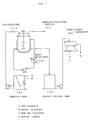
- Figure 1 shows a diagram of a crystallizer equipment, which can be used in the present invention and was used in Example 1.
- a crystallization operation is generally carried out such that, per unit time, a vaporizing amount of the solvent (water) per vaporizing area of the concentrated solution (or slurry) is about 1,000 kg/ m2 ⁇ h for the crystallization of ordinary substances other than ⁇ -APM.
- a vaporizing amount of the solvent (water) per vaporizing area of the concentrated solution (or slurry) is about 1,000 kg/ m2 ⁇ h for the crystallization of ordinary substances other than ⁇ -APM.
- ⁇ -APM it has been discovered that a substantial bubbling of the slurry with vaporization occurs under conventional vaporization conditions. This bubbling is especially pronounced when the starting solution is fed to the crystallizer so that the depth of the solution in the crystallizer is kept constant. It is difficult to continue the operation of the equipment under these conditions.
- Crystallizers are available without heat transfer surfaces for cooling. It is preferable to equip such crystallizers with a heat transfer means such as coils, jackets and so on, or with an external heat exchanger whereby the solution can be heated by circulating a part of the ⁇ -APM solution through the heat transfer means. Heating the ⁇ -APM solution is preferable when the temperature of the solution becomes too low. When the temperature of the solution becomes too low, the vaporization rate is lowered, thereby decreasing the efficiency of the present process. Although the temperature of operation during the present process depends on the operation pressure, it is preferable to keep the temperature of the solution at 20°C or lower (the lower limit is the freezing point of the solvent) to obtain maximum stability of the process and high yield of ⁇ -APM.
- a heat transfer means such as coils, jackets and so on, or with an external heat exchanger whereby the solution can be heated by circulating a part of the ⁇ -APM solution through the heat transfer means. Heating the ⁇ -APM solution is preferable when the temperature of the solution becomes
- the bubbling is remarkable as mentioned above, especially when using water as a solvent, it is necessary to control the vaporizing rate to 40 kg/m2 ⁇ h or less, preferably 20 kg/m2 ⁇ h or less, or to use an aqueous mixed solvent containing a lower alcohol, preferably a C1 ⁇ 6 alkyl alcohol.
- Methanol and ethanol are preferably used as the lower alcohol. Methanol is the most preferred lower alcohol since ⁇ -APM can undergo ester exchange reactions under some conditions reducing the overall yield of the process.
- the solid-liquid separability of the crystals deteriorates if the alcohol concentration is too high. Therefore, the alcohol concentration is preferably in the range of from 10 - 60% by volume of the solvent.
- the concentration of ⁇ -APM in the starting solution is preferably a saturated solution in the solvent used at 30°C or higher, e.g. the solubility of ⁇ -APM at 30°C is 1-3 g/dl, since a dilute solution requires greater concentration to effect precipitation.
- the solubility of ⁇ -APM increases at higher temperatures, however, decomposition of ⁇ -APM simultaneously occurs, so, the maximum concentration of the starting solution should be the concentration of a saturated solution at 80°C, for example.
- a preferred range of the concentration of ⁇ -APM in the starting solution is 2-15 %, more preferably 3-10 %.
- the present method of crystallizing ⁇ -APM overcomes deposition problems during crystallization.
- the use of water or an aqueous solvent containing a lower alcohol in the present process substantially improves the solid-liquid separability of ⁇ -APM crystals and also noticeably improves the yield of crystals.
- the present method has practical utility due to its simplicity and the use of conventional equipment.
- the value C' obtained by dividing the total amount (g) of the crystals in the slurry by the total amount (cm3) of the liquid in the slurry, was used in the following equation, where filtration area A is 93 (cm3) and the viscosity » of the filtrate is 0.0135 (g/cm.s).
- the specific cake resistance ⁇ (m/kg) thus calculated is a measure of the filterability of the sample. Samples having a lower value ⁇ are more easily filtered.
- ⁇ 20.K.A2.PT/».C' (m/kg)
- ⁇ is the specific cake resistance (m/kg) of the filtered cake
- » is the viscosity of the filtrate (g/cm.s)
- A is the filtration area (cm2)
- a pilot plant system having the configuration shown in Fig. 1 was used.
- An aqueous ⁇ -APM solution having an ⁇ -APM concentration of 4.5 wt% and a liquid temperature of 65°C was fed into the 200-liter jacketed crystallizer (1), the inner pressure in the crystallizer was kept at from 8 to 10 Torr by an external pressure-reducing device (2), and the liquid temperature in the crystallizer was kept at 10°C by the latent heat of vaporization without cooling or heating.
- the vaporizing rate of the water solvent was 40 kg/m2 ⁇ h, and the slurry was discharged simultaneously so that the solution level in the tank was 50 %.
- the circulating speed of the solution was from 3 to 4 m3/h.
- the operation was continued for 24 hours, whereupon no rapid foaming occurred during the operation and the slurry had good fluidity.
- the specific resistivity value of the slurry obtained was 7 x 10¹⁰ (m/kg). After being filtrated with a small centrifuge followed by dewatering for 15 minutes, the crystals had a moisture content of 65 %.
- Example 2 The same experiment as that in Example 1 was repeated, except that the vaporizing rate of the water solvent was varied to 20 kg/m2 ⁇ h. The operation was continued for 24 hours, whereupon no rapid bubbling or foaming occurred during the operation and the slurry had good fluidity.
- the specific cake resistance value of the slurry obtained was 5.0 x 10¹⁰ m/kg. After dewatering for 15 minutes, the crystals had a moisture content of 62.1%.
- Example 2 The same operation as Example 1 was carried out except that a vaporizing rate of 100 kg/m2 ⁇ h was used. Just after the start of the operation the surface of the solution rose about one meter and it became difficult to continue the operation. The operation was stopped after 5 hours.
- Example 2 The same apparatus as used in Example 1 was used. An aqueous 30% methanol solution of ⁇ -APM having an ⁇ -APM concentration of 4.3 wt% and a liquid temperature of 50°C was fed into the crystallizer (1) at a feed speed of 188 liter/h (average),the inner pressure in the crystallizer was kept at about 4 MPa (30 Torr) using the external pressure-reducing device (2), and the liquid temperature in the crystallizer was kept at 20°C.
- the vaporizing rate of the solvent was 53 kg/m2 ⁇ h, and the slurry was discharged at a rate of 176 liter/h (average) to keep the slurry level constant.
- the operation was continued for 24 hours, whereupon no rapid foaming occurred during the operation and the slurry had good fluidity.
- the specific cake resistance value of the slurry obtained was 8.6 x 10⁹ m/kg. After dewatering for 15 minutes with a centrifuge, the crystals had a moisture content (loss on dry) of 44 %.
- Example 2 The same apparatus as used in Example 1 was used.
- An aqueous 30% methanol solution of ⁇ -APM having an ⁇ -APM concentration of 3.7 wt% and a liquid temperature of 20°C was fed into the crystallizer (1) at a feed speed of 237 liter/h (average), and the inner pressure in the crystallizer was kept at about 4 kPa (30 Torr) using the external pressure-reducing device (2).
- a part of the ⁇ -APM solution was removed from the crystallizer and heated with an external heat exchanger (3), to keep the liquid temperature in the crystallier at 20°C.
- the concentration ratio was controlled to 0.8.
- the vaporizing rate of the solvent was 160 kg/m2 ⁇ h, and the circulating speed of the solution was 0.4 m3/h.
- the operation was continued for 24 hours, whereupon no rapid foaming occurred during the operation and the slurry had good fluidity.
- the specific cake resistance value of the slurry obtained was 2.8 x 10⁹ m/kg. After dewatering for 15 minutes with a centrifuge, the crystals had a moisture content (loss on dry) of 37.5%.
Landscapes
- Chemical & Material Sciences (AREA)
- Organic Chemistry (AREA)
- Genetics & Genomics (AREA)
- Biochemistry (AREA)
- Biophysics (AREA)
- General Health & Medical Sciences (AREA)
- Health & Medical Sciences (AREA)
- Medicinal Chemistry (AREA)
- Molecular Biology (AREA)
- Proteomics, Peptides & Aminoacids (AREA)
- Life Sciences & Earth Sciences (AREA)
- Peptides Or Proteins (AREA)
- Organic Low-Molecular-Weight Compounds And Preparation Thereof (AREA)
- Seasonings (AREA)
Applications Claiming Priority (4)
| Application Number | Priority Date | Filing Date | Title |
|---|---|---|---|
| JP22133691 | 1991-05-23 | ||
| JP221336/91 | 1991-05-23 | ||
| JP4102917A JPH05125095A (ja) | 1991-05-23 | 1992-04-22 | α−L−アスパルチル−L−フエニルアラニンメチルエステルの晶析方法 |
| JP102917/92 | 1992-04-22 |
Publications (2)
| Publication Number | Publication Date |
|---|---|
| EP0514940A1 EP0514940A1 (en) | 1992-11-25 |
| EP0514940B1 true EP0514940B1 (en) | 1995-03-01 |
Family
ID=26443603
Family Applications (1)
| Application Number | Title | Priority Date | Filing Date |
|---|---|---|---|
| EP92108708A Expired - Lifetime EP0514940B1 (en) | 1991-05-23 | 1992-05-22 | Method of crystallizing alpha-L-aspartyl-L-phenylalanine methyl ester |
Country Status (4)
| Country | Link |
|---|---|
| EP (1) | EP0514940B1 (enExample) |
| JP (1) | JPH05125095A (enExample) |
| CA (1) | CA2069259C (enExample) |
| DE (1) | DE69201516T2 (enExample) |
Families Citing this family (2)
| Publication number | Priority date | Publication date | Assignee | Title |
|---|---|---|---|---|
| JPH05194587A (ja) * | 1992-01-14 | 1993-08-03 | Ajinomoto Co Inc | α−L−アスパルチル−L−フェニルアラニンメチルエステルの精製法 |
| AU4449100A (en) * | 1999-03-03 | 2000-09-21 | Nutrasweet Company, The | Novel crystallization products of neotame and methods for producing same |
Citations (2)
| Publication number | Priority date | Publication date | Assignee | Title |
|---|---|---|---|---|
| EP0119837A1 (en) * | 1983-03-18 | 1984-09-26 | Ajinomoto Co., Inc. | Dipeptide crystals, a process for their production, tablets containing the dipeptide crystals and a process for the production thereof |
| JPH03204895A (ja) * | 1989-10-20 | 1991-09-06 | Ajinomoto Co Inc | アスパルテーム顆粒 |
-
1992
- 1992-04-22 JP JP4102917A patent/JPH05125095A/ja active Pending
- 1992-05-22 EP EP92108708A patent/EP0514940B1/en not_active Expired - Lifetime
- 1992-05-22 CA CA002069259A patent/CA2069259C/en not_active Expired - Fee Related
- 1992-05-22 DE DE69201516T patent/DE69201516T2/de not_active Expired - Fee Related
Patent Citations (2)
| Publication number | Priority date | Publication date | Assignee | Title |
|---|---|---|---|---|
| EP0119837A1 (en) * | 1983-03-18 | 1984-09-26 | Ajinomoto Co., Inc. | Dipeptide crystals, a process for their production, tablets containing the dipeptide crystals and a process for the production thereof |
| JPH03204895A (ja) * | 1989-10-20 | 1991-09-06 | Ajinomoto Co Inc | アスパルテーム顆粒 |
Also Published As
| Publication number | Publication date |
|---|---|
| EP0514940A1 (en) | 1992-11-25 |
| CA2069259A1 (en) | 1992-11-24 |
| DE69201516D1 (de) | 1995-04-06 |
| DE69201516T2 (de) | 1995-10-05 |
| CA2069259C (en) | 2002-07-16 |
| JPH05125095A (ja) | 1993-05-21 |
Similar Documents
| Publication | Publication Date | Title |
|---|---|---|
| US20040030124A1 (en) | Process for recovering chlorosucrose compounds | |
| EP0091787B2 (en) | Process for crystallizing alpha-L-aspartyl-L-phenylalanine-methyl ester | |
| EP0293680B1 (en) | A method for the crystallization of fructose | |
| EP0751146A1 (en) | Crystallization of alpha-L-aspartyl-l-phenylalanine methyl ester from aqueous solution | |
| US5391810A (en) | Method of crystallizing α-L-aspartyl-L-phenylalanine methyl ester | |
| EP0514940A1 (en) | Method of crystallizing alpha-L-aspartyl-L-phenylalanine methyl ester | |
| EP0399605B1 (en) | Method for crystallizing alpha-L-aspartyl-L-phenylalanine methyl ester | |
| CA2069256C (en) | Method of preparing .alpha.-l-aspartyl-l-phenylalanine methyl ester | |
| KR920006562B1 (ko) | 쉽게 용해할 수 있는 결정성 α-L-아스파르틸-L-페닐알라닌 메틸 에스테르의 제조방법 | |
| US6335461B1 (en) | Process for purification of aspartame derivative | |
| CA2069257C (en) | Method of preparing .alpha.-l-aspartyl-l-phenylalanine methyl ester | |
| EP0510552B1 (en) | Preparation process of alpha-aspartyl-L-phenylalanine methyl ester | |
| US5425787A (en) | Method for crystallization of α-L-aspartyl-L-phenylalanine methyl ester | |
| US5347035A (en) | Method for crystallizing α-L-aspartyl-L-phenylalanine methyl ester | |
| EP0733641A1 (en) | Method for crystallizing alpha-l-aspartyl-l-phenylalanine methyl ester | |
| JP2817255B2 (ja) | α―L―アスパルチル―L―フェニルアラニンメチルエステルの晶析法 | |
| JP2970109B2 (ja) | α−L−アスパルチル−L−フェニルアラニンメチルエステル溶液の濃縮方法 | |
| EP0523813B1 (en) | Method for crystallizing alpha-L-aspartyl-L-phenylalanine methyl ester | |
| US5312977A (en) | Method for purifying L-phenylalanine | |
| US5659066A (en) | Method for crystallizing α-L-aspartyl-L-phenylalanine methyl ester | |
| JP3270558B2 (ja) | L−フェニルアラニンの精製方法および製造方法 | |
| JPH09249692A (ja) | α−L−アスパルチル−L−フェニルアラニンメチルエステルの晶析方法 | |
| JPH05202094A (ja) | α−L−アスパルチル−L−フェニルアラニンメチルエステル又はその塩酸塩の製造法 | |
| JPH0525197A (ja) | α−L−アスパルチル−L−フエニルアラニンメチルエステルの製造法 |
Legal Events
| Date | Code | Title | Description |
|---|---|---|---|
| PUAI | Public reference made under article 153(3) epc to a published international application that has entered the european phase |
Free format text: ORIGINAL CODE: 0009012 |
|
| AK | Designated contracting states |
Kind code of ref document: A1 Designated state(s): BE CH DE FR GB IT LI NL |
|
| 17P | Request for examination filed |
Effective date: 19930427 |
|
| 17Q | First examination report despatched |
Effective date: 19931005 |
|
| GRAA | (expected) grant |
Free format text: ORIGINAL CODE: 0009210 |
|
| ITF | It: translation for a ep patent filed | ||
| AK | Designated contracting states |
Kind code of ref document: B1 Designated state(s): BE CH DE FR GB IT LI NL |
|
| REF | Corresponds to: |
Ref document number: 69201516 Country of ref document: DE Date of ref document: 19950406 |
|
| ET | Fr: translation filed | ||
| PLBE | No opposition filed within time limit |
Free format text: ORIGINAL CODE: 0009261 |
|
| STAA | Information on the status of an ep patent application or granted ep patent |
Free format text: STATUS: NO OPPOSITION FILED WITHIN TIME LIMIT |
|
| 26N | No opposition filed | ||
| REG | Reference to a national code |
Ref country code: GB Ref legal event code: IF02 |
|
| PGFP | Annual fee paid to national office [announced via postgrant information from national office to epo] |
Ref country code: NL Payment date: 20070515 Year of fee payment: 16 |
|
| PGFP | Annual fee paid to national office [announced via postgrant information from national office to epo] |
Ref country code: CH Payment date: 20070516 Year of fee payment: 16 |
|
| PGFP | Annual fee paid to national office [announced via postgrant information from national office to epo] |
Ref country code: DE Payment date: 20070517 Year of fee payment: 16 |
|
| PGFP | Annual fee paid to national office [announced via postgrant information from national office to epo] |
Ref country code: GB Payment date: 20070516 Year of fee payment: 16 |
|
| PGFP | Annual fee paid to national office [announced via postgrant information from national office to epo] |
Ref country code: IT Payment date: 20070528 Year of fee payment: 16 |
|
| PGFP | Annual fee paid to national office [announced via postgrant information from national office to epo] |
Ref country code: BE Payment date: 20070711 Year of fee payment: 16 |
|
| BERE | Be: lapsed |
Owner name: *AJINOMOTO CO. INC. Effective date: 20080531 |
|
| REG | Reference to a national code |
Ref country code: CH Ref legal event code: PL |
|
| GBPC | Gb: european patent ceased through non-payment of renewal fee |
Effective date: 20080522 |
|
| PG25 | Lapsed in a contracting state [announced via postgrant information from national office to epo] |
Ref country code: CH Free format text: LAPSE BECAUSE OF NON-PAYMENT OF DUE FEES Effective date: 20080531 Ref country code: LI Free format text: LAPSE BECAUSE OF NON-PAYMENT OF DUE FEES Effective date: 20080531 Ref country code: NL Free format text: LAPSE BECAUSE OF NON-PAYMENT OF DUE FEES Effective date: 20081201 |
|
| PG25 | Lapsed in a contracting state [announced via postgrant information from national office to epo] |
Ref country code: BE Free format text: LAPSE BECAUSE OF NON-PAYMENT OF DUE FEES Effective date: 20080531 |
|
| PG25 | Lapsed in a contracting state [announced via postgrant information from national office to epo] |
Ref country code: DE Free format text: LAPSE BECAUSE OF NON-PAYMENT OF DUE FEES Effective date: 20081202 |
|
| PG25 | Lapsed in a contracting state [announced via postgrant information from national office to epo] |
Ref country code: GB Free format text: LAPSE BECAUSE OF NON-PAYMENT OF DUE FEES Effective date: 20080522 |
|
| PG25 | Lapsed in a contracting state [announced via postgrant information from national office to epo] |
Ref country code: IT Free format text: LAPSE BECAUSE OF NON-PAYMENT OF DUE FEES Effective date: 20080522 |
|
| PGFP | Annual fee paid to national office [announced via postgrant information from national office to epo] |
Ref country code: FR Payment date: 20110523 Year of fee payment: 20 |