EP0508542A2 - Verfahren zur Behandlung von Erz mit rückgewinnbaren Metallwertstoffen einschliesslich arsenhaltiger Komponenten - Google Patents
Verfahren zur Behandlung von Erz mit rückgewinnbaren Metallwertstoffen einschliesslich arsenhaltiger Komponenten Download PDFInfo
- Publication number
- EP0508542A2 EP0508542A2 EP92200989A EP92200989A EP0508542A2 EP 0508542 A2 EP0508542 A2 EP 0508542A2 EP 92200989 A EP92200989 A EP 92200989A EP 92200989 A EP92200989 A EP 92200989A EP 0508542 A2 EP0508542 A2 EP 0508542A2
- Authority
- EP
- European Patent Office
- Prior art keywords
- ore
- roasting
- arsenic
- oxygen
- gas
- Prior art date
- Legal status (The legal status is an assumption and is not a legal conclusion. Google has not performed a legal analysis and makes no representation as to the accuracy of the status listed.)
- Granted
Links
Images





Classifications
-
- C—CHEMISTRY; METALLURGY
- C22—METALLURGY; FERROUS OR NON-FERROUS ALLOYS; TREATMENT OF ALLOYS OR NON-FERROUS METALS
- C22B—PRODUCTION AND REFINING OF METALS; PRETREATMENT OF RAW MATERIALS
- C22B1/00—Preliminary treatment of ores or scrap
- C22B1/02—Roasting processes
-
- C—CHEMISTRY; METALLURGY
- C22—METALLURGY; FERROUS OR NON-FERROUS ALLOYS; TREATMENT OF ALLOYS OR NON-FERROUS METALS
- C22B—PRODUCTION AND REFINING OF METALS; PRETREATMENT OF RAW MATERIALS
- C22B1/00—Preliminary treatment of ores or scrap
- C22B1/02—Roasting processes
- C22B1/10—Roasting processes in fluidised form
Definitions
- This invention relates to recovering precious metal and/or metal values from ores including refractory ores, ore concentrates, or ore tailing which include arsenic-, carbon-and/or sulfur-containing components and ores which are refractory to the recovery of precious metal values.
- precious metals such as gold
- ores in different forms.
- precious metal ores also frequently contain other materials which interfere with the recovery of these precious metal values, rendering these ores refractory to precious metal recovery.
- the precious metal content may be at a relatively low level. This low level content compounds the effect of the refractory nature of these ores.
- U.S. Patent No. 360,904 to Elizabeth B. Parnell relates to roasting gold or silver bearing ores using a double roasting schedule with the first roasting at 1100 to 1300 degrees Fahrenheit and the second roasting to 1200°F to 1600°F (the time occupied in the second roasting can be reduced by supplying oxygen along with the air).
- U.S. Patent No. 921,645 to J.E. Greenwalt discloses the roasting of ore by heating the ore on a porous granular bed through which air is forced from below.
- U.S. Patent No. 1,075,011 to N.C. Christensen, Jr. discloses a process for treating ore by means of a roasting oven which, by regulation of the fuel supply, may be either oxidizing, reducing, or neutral.
- U.S. Patent No. 2,056,564 to Bernart M. Carter discloses suspension roasting of finely divided sulfide ores. Roasting is in air or oxygen in which the temperature of the mixture entering the roasting chamber is controlled and to a corresponding degree the temperatures within the roasting chamber are thus controlled in an effort to prevent the formation of accretions on the walls of the apparatus.
- U.S. Patent No. 2,209,331 to Ture Robert Haglund discloses a process for the production of sulfur from the roasting of sulfide material in oxygen or air enriched with oxygen so that as soon as the free oxygen has been consumed in the formation of SO2, the iron sulfide reacts with the sulfur dioxide forming free sulfur and iron oxides.
- U.S. Patent No. 2,536,952 to Kenneth D. McCean relates to roasting mineral sulfides in gaseous suspension.
- U.S. Patent No. 2,596,580 to James B. McKay et al. and U.S. Patent No. 2,650,169 to Donald T. Tarr, Jr. et al. relates to roasting gold-bearing ores which contain commercially significant amounts of gold in association with the mineral arsenopyrite.
- the patent describes the importance of closely regulating the availability of oxygen in order to provide enough oxygen so that volatile compounds of arsenic are formed while the formation of nonvolatile arsenic compounds is minimized.
- U.S. Patent No. 2,867,529 to Frank A. Forward relates to treatment of refractory ores and concentrates which contain at least one precious metal, sulfur and at least one arsenic, antimony or lead compound by roasting in a non-oxidizing atmosphere at a temperature above 900 degrees Fahrenheit, but less than the fusion temperature of the material being roasted.
- U.S. Patent No. 2,927,017 to Orrin F. Marvin relates to a method for refining metals, including precious metals, from complex ores which contain two or more metal values in chemical union or in such physical union as to prevent normal mechanical separation of the values.
- the method uses multiple roasting steps.
- U.S. Patent No. 2,993,778 to Adolf Johannsen et al. relates to roasting a sulfur mineral with its objects being-the production of sulfur dioxide, increasing the completeness of roasting and the production of metal oxides.
- U.S. Patent No. 3,172,755 to Angel Vian-Ortuno et al. relates to a process for treating pyrite ores bearing arsenic by subjecting the arsenic-containing pyrite ore to partial oxidation so as to oxidize only the labile sulfur of the arsenic-containing pyrite and subsequently heating the pyrite ore in a non-oxidizing gas to separate the arsenic from the ore and to form a residual ore free of arsenic.
- U.S. Patent No. 4,731,114 Gopalan Ramadorai et al. relates to a process for the recovery of precious metals from low-grade carbonaceous sulfide ores using partial roasting of the ores following by aqueous oxidation in an autoclave.
- U.S. Patent No. 4,919,715 relates to the use of pure oxygen in roasting of refractory gold-bearing ores at temperatures between about 1000°F (537.8°C) and about 1200°F (648.9°C).
- This patent fails to address the problem of arsenic volatilization, is silent on the arsenic content in the ore, and does not address in that context the optimizing of gold recovery from refractory sulfidic, carbonaceous ores or separation of cyanide consuming components before recovery of gold from the ore.
- the disclosed method requires two fluid beds and stage-wise roasting in these beds and the use of substantially pure oxygen (substantially pure oxygen being defined as at least about 80% by weight.)
- European Patent Specification 0 128 887 discloses roasting sulfide concentrates having an average particle size below 1 mm and containing copper and noble metals as valuable metals as well as arsenic as an impurity. Volatization of arsenic is in a circulating fluidized bed under an oxygen partial pressure of 10 ⁇ 14 to 10 ⁇ 16bars and at low temperatures, i.e. temperatures which exceed the breakdown and decomposition temperatures of arsenic compounds. A major part of the solids is removed under the same conditions in a hot cyclone from the suspension discharged from the fluidized bed reactor and is recycled to the fluidized bed reactor. Additional solids are removed from the gas in a second cyclone.
- the exhaust gas is discharged through a chimney.
- the calcine from the circulating fluidized bed and eventually solids collected in the second cyclone are fed to a classical fluidized bed, in which the sulfur containing materials which are present are roasted at an increased oxygen potential.
- a classical fluidized bed in which the sulfur containing materials which are present are roasted at an increased oxygen potential.
- arsenic oxides may be removed together with the residual solids. That exhaust gas may also contain volatilized sulfur.
- German Patent Specification 15 83 184 discloses the removal of arsenic from iron ores and calcined pyrites in a process in which the ores are mixed with calcium oxide or calcium carbonate in an amount of 0.5% to 5% as Ca relative to the weight of the ore and are heated in an oxidizing atmosphere to 800°C to 1000°C so that the arsenic is concentrated in a fine-grained fraction. This fraction is separated from the coarser fraction and is leached with acids to remove arsenic.
- oxides, hydroxides and various salts of alkali metals and alkaline earth metals are described in the description of the state of the art in the roasting of pyrites.
- corresponding water-soluble arsenates may be formed from the arsenic contained in the ore.
- the effect of these additives in the roasting stage is constrained by the formation of the corresponding sulfates.
- the sulfates are almost entirely inactive in a reaction for partitioning arsenic.
- arsenates When the above substances are added to calcined pyrites in an oxidizing atmosphere at 500°C to 900°C, arsenates will be formed, which may be leached with salt solutions or acid solution. These arsenates should not be dumped in open air dumps. Moreover, the leaching results in an arsenic-containing solution, which is nearly impossible to dispose environmentally in an acceptable manner.
- any arsenic which is present is an undesired accompanying element and must be removed from the calcine and from the roaster gas. This is typically accomplished by a so-called dearsenication roasting.
- the arsenic content of the material is volatilized in a roasting zone having a low oxygen content and enters the gaseous effluent as arsenic vapor or arsenic oxide vapor and arsenic sulfide vapor.
- the above mentioned U.S. Patent art deals with such roasting.
- arsenic and arsenic sulfides are oxidized to form arsenic oxide vapors under a relatively high oxygen partial pressure.
- the dustlike solids contained in the roaster gas are removed at a temperature exceeding the sublimation temperature of the arsenic oxides, which are subsequently separated at lower gas temperatures, or the solids and the arsenic oxides are jointly removed at lower gas temperatures.
- the first case contaminated arsenic oxides will be formed.
- the arsenic which has been removed will be recycled in the process scheme. Recycling is together with the other solids which have been separated, particularly if the solids contain valuable metals and for that reason alone must be recirculated, or the removed solids may be dumped only after taking special precautionary measures because of the arsenic content.
- part of the arsenic oxide may undesirably and unpredictably react with metal oxides to from metal arsenates, e.g., with Fe2O3 to form FeASO4.
- the metal arsenates deposit on e.g. the ore particle surfaces and clog the pores of the particle.
- German Patent Specification 1,132,942 disclosed a process of roasting iron-containing sulfide ores, particularly pyrites in which the ores are roasted in a single stage fluidized bed roaster with oxygen-containing gases at 800°C to 900°C under an oxygen partial pressure not in excess of 2.9 x10 ⁇ 8 atm so that the iron content is reacted to form Fe3O4, some sulfur is sublimated and arsenic, arsenic sulfides and arsenic oxides are vaporized.
- Solids entrained by the roaster exhaust gas are subsequently removed at temperatures exceeding the condensation temperatures of sulfur and arsenic and the roaster gas is after-burned with a supply of air or oxygen so that the oxygen partial pressure is sufficiently increased to ensure a complete combustion of the sulfur in the purified roaster gas.
- the arsenic oxides produced by the after burning and removed from the gas stream will be contaminated by residual dust.
- German Patent Specification 1,458,744 discloses the roasting of iron sulfides by a process in which the ores are roasted in a single stage fluidized bed roaster with oxygen-containing gases at 700°C to 1100°C and under an oxygen partial pressure of about 10 ⁇ 2 to 10 ⁇ 15 atm, whereby Fe2O3 is partly formed, the arsenic which is present is substantially volatilized as As2O3 and the sulfur is volatilized as elementary sulfur.
- the oxygen partial pressure in the roaster gas is increased by a supply of air and the elementary sulfur and the arsenic compounds are oxidized. In that process too the volatile arsenic oxides are contaminated by residual dust as they are removed from the gas stream.
- arsenic-containing material particularly non-ferrous metal ores
- the arsenic may be volatilized in a first stage at temperatures of 627°C to 927°C and under oxygen partial pressures of about 10 ⁇ 16 bars.
- the solids are roasted under oxidizing conditions in a second stage.
- the gas from the second stage is fed in part to a gas purifier and in part to the first stage.
- Sulfur and oxygen are added to the exhaust gas from the second stage and the arsenic contained therein is completely reacted to form arsenic sulfides, which are partly present as fine dust and partly as vapor.
- None of these patents teaches or suggests roasting ores or refractory ores, ore concentrates or ore tailings of the type described herein for recovery of metals such as precious metals in an oxygen-enriched gaseous environment under conditions as described herein in order to minimize and/or eliminate arsenic volatilization, facilitate arsenic conversion to an insoluble, environmentally acceptable form immobilized in a waste product while reducing the effects of carbon- and sulfur-containing components on metal recovery such as precious metal recovery.
- none of the references deals with the conversion of arsenic to arsenates to environmentally very stable compounds during e.g. a single stage circulating fluid bed roasting of ores. In fact, the opposite is true.
- the present invention achieves excellent results in a simpler more efficient manner with outstanding metal, e.g. gold recovery with facile arsenic elimination as an environmental problem, while minimizing leaching cyanide consumption and conserving heat given-off in the roasting process.
- precious metal and metal values may be recoverable from ore, ore concentrates or tailings which have arsenic- carbon- and sulfur-containing components by
- the above objective is accomplished by a process of roasting ores containing metal values or refractory gold ores or gold ore concentrates or tailings whereby the roasting is carried out:
- An SO2-containing exhaust gas obtained in such reaction is thereafter purified, and may be sent to an acid plant producing sulfuric acid wherein surplus oxygen employed in such acid plant to obtain sulfuric acid is recirculated to an appropriate place in the process, e.g. circulating fluid bed or calcine coolers or ore heaters to utilize more efficiently in such combination oxygen employed in this process.
- the oxygen content of the gas defined in b) amounts to 20% to 50% by volume amounts as high as 65% by volume may be employed.
- this invention relates to a process of removing arsenic vapor and arsenic-compound vapor from dust-containing hot gases such as during ore roasting, wherein solids are separated from the gas at a temperature above the condensation temperature of the arsenic and arsenic compounds.
- These arsenic components are subsequently oxidized with a supply of oxygen-containing gases and immobilized for disposal in an environmentally acceptable manner meeting with ample margins of safety the accptable environment disposal requirements.
- this invention is to provide an economic process by which the metallic arsenic and the arsenic compounds found with mineral values upon roasting and contained in the gases are converted to a form that these values may be dumped in an environmentally acceptable manner.
- the arsenic compound vapors contained in the gas to be treated may consist of arsenic oxides and arsenic sulfides. The percentages are in percent in volume with reference to gases.
- SO2-containing gases are produced, e.g., by the roasting of sulfur-containing materials, such as sulfidic non-ferrous metal ores.
- SO2-free gases are produced, e.g., by the thermal processing of arsenic-containing intermediate products and waste materials, such as sludges, dusts and solutions as it is known in the metallurgical industry.
- the solids are suitably removed from the gas in cyclones and/or ceramic filters, such as candle filters and/or hot electrostatic precipitators.
- additives in ii) may consist of waste products, such as red mud formed by processes employed in the alumina production industry, filter salts and waste gypsum.
- Particularly suitable additives are sulfates, e.g. iron sulfates.
- the particle size of the additives should be as small as possible because small particles will reduce the reaction time and the amount of reactant which is required.
- stable arsenates designates those arsenates which have only a low solubility in rainwater. The additives are added in amounts which are sufficient for the formation of the arsenates. Mixtures of additive used.
- Water required for the water vapor content in the gas phase may be introduced into the gas to be treated by a corresponding supply of steam, as moisture or even as water of crystallization in the ore or additives.
- the arsenates are preferably formed at a temperature of 500°C to 600°C.
- the maximum oxygen content of the exhaust gas is not critical and may be, e.g., 50% of volume. If the exhaust gas contains SO2, it may be processed in a suitable plant for the production of sulfuric acid.
- the treatment may be effected in a circulating fluidized bed, an ebullating fluidized bed, a classical fluidized bed, a rotary kiln or a multiple-hearth furnace; a circulating fluidized bed is preferred.
- the solubility of the stable arsenates is so low that these may be dumped without special precautionary measures.
- At least 80% of the additives employed have a particle size of about 10 to about 200 ⁇ m. With that particle size a substantially complete and fast formation of arsenates will be effected.
- the water vapor content of the exhaust gas is adjusted to 0.5% to 10%. This content will result in a formation of stable arsenates having a particularly low solubility, e.g. such as scorodites or scorodite like compounds.
- gases in which the dust has no content or only a low content of metal are treated to remove only that amount of solids which exceeds the amount of solids required to form arsenates.
- a typical example for such aspect of the invention is in the roasting of pyrites or calcined pyrites or in the processing of gases in which the dust content consists of iron compounds. It is possible to utilize at least a part of the additives for the reaction with a containing arsenic values and thus these additives need not be separately obtained and added.
- the solids suspended in the gas are substantially removed therefrom if the dust in the gas has a valuable metal, e.g. gold.
- the valuable metal will substantially be introduced into the calcine and can be recovered therefrom. It will then be necessary to add the required additives in the necessary amount to immobilize the arsenic.
- Refractory ores which include carbon-and sulfur-containing components, such as organic and inorganic carbonaceous materials and sulfidic minerals, respectively, pose an especially severe problem in the economical, commercial recovery of precious metals, such as gold, because the efficiency and completion of recovery is dependent on the content of those carbon- and sulfur-containing components.
- the recovery yield of precious metal values in refractory ores can be significantly increased by oxidizing carbon- and sulfur-containing components.
- the efficient oxidation of carbon is especially important because residual carbon in the roasted ore, or calcine, reduces precious metal recovery during leaching by "preg robbing" because it takes up or "robs" leachant solubilized gold.
- refractory ores which further include arsenic-containing components pose an even more complex problem.
- This arsenic content while amenable to oxidation as discussed above, poses a problem in that the arsenic component or an intermediate product of roasting may volatilize at roasting temperatures, thereby requiring supplemental precautionary processing measures or the oxidized end product in the calcine solubilizes to a presently unacceptable level during leaching and/or after the exhausted calcine, i.e. tailings have been discarded and stored in a heap.
- arsenic is immobilized in the calcine upon roasting but further roaster gas treatment such as in the fluidized bed(s) be practiced to immobilize arsenic in the event a gas phase treatment of the volatilized arsenic compounds is desired.
- fluorine while present in very small amounts in the form of HF is also converted to an unknown insoluble form in the calcine such that only a small percentage must further be treated thereby reducing fluorine levels.
- fluorine while present in very small amounts in the form of HF is also converted to an unknown insoluble form in the calcine such that only a small percentage must further be treated thereby reducing fluorine levels.
- the reduced HF and arsenic immobiliztion levels achieved by the present process are far below the present day required limits.
- the process for the recovery of precious metals from refractory ores or their concentrates or tailings which include arsenic-, carbon- and sulfur-containing components according to the present invention includes roasting that ore in an oxygen-enriched gaseous atmosphere such as oxygen augmented air having an initial oxygen content of less than about 65 percent by volume and recovering the thus-roasted ore, whereby the ore is amenable to recovery of the precious metal values in it.
- an oxygen-enriched gaseous atmosphere such as oxygen augmented air having an initial oxygen content of less than about 65 percent by volume
- free oxides in item c) above indicates that said substances are not present as compounds with arsenic or sulfur but in a form free of these. If calcium and magnesium as carbonates are available in a free form in the ore in a sufficient amount, it will be unnecessary to add said substances.
- iron compounds are present, even in a large excess, an addition will always be required, i.e. if below a ratio of 3.5 to 4.0 moles iron to a mole of arsenic, because a major part of the iron will always be included in compounds with arsenic or sulfur. Hence, iron must be present of at least 3:5 moles of iron for each mole of arsenic.
- the additives may consist of waste products, such as red mud from the alumina industry, filter salts and waste gypsum. Sulfates are particularly suitable. As seen from the data herein, iron compounds are preferred.
- the use of an additive is preferable because the additive, in particle form will then be present close to the ore particles and will be able to combine immediately with arsenic which may have been vaporized from the ore particles at the higher temperatures discussed herein.
- stable arsenates designates those arsenates which have only a low solubility in rainwater when stored in a waste dump of an exhausted calcine.
- Proper roasting is also related to the iron content in the ore, e.g., as pyrites in the ore, the partition of arsenic between oxidation and reaction with an iron, or other compound in the ore, or an added additive and the role of iron in added form (if addition is necessary to the ore) the conversion of arsenic to scorodite or scorodite compounds during roasting and like effects.
- the process of the present invention is preferably suitable for use on candidate precious metal ores having arsenic-, sulfur- and carbon-containing components.
- iron is in the form of the sulfides in such ores, i.e. pyrites.
- Water required for the water vapor may be fed to the reactor by a suitable addition of steam, as moisture or water in the ore, of crystallization in the additives or as a water of crystallization in a component in the ore.
- the exhaust gas may be processed for a production of sulfuric acid or may be scrubbed to remove the SO2 or the SO2 content may be liquified.
- the ore is roasted in the form of fluidized solids, and more preferably, the ore circulates as fluidized solids in a circulating fluidized bed or in an ebullating fluidized bed (which has a circulation feature to it).
- the precious metal content can be recovered from the thus-roasted ore or ore concentrate or tailings by separation of cyanide consuming components by solubilization of these and then leaching through cyanidation, carbon-in-leach cyanidation or carbon-in-pulp cyanidation.
- the advantage afforded by the process in accordance with this invention resides in that the calcine which is produced has a very good leachability, with e.g. cyanide, resulting in a high yield of gold and in a low consumption of cyanide.
- the arsenic is bound in the form of stable arsenates, which do not disturb the leaching and which have an extremely low solubility in rainwater such that these calcines may be dumped without a need for special precautionary measures or further treatment(s).
- the ores or concentrates may contain up to about 1 arsenic and even up to 2% and more.
- a stationary fluidized bed having a defined upper surface mayy also be used.
- an ebullating fluid bed, a rotary kiln or a multiple-hearth furnace may be employed, provided the proper reactions may be obtained.
- the temperature at which an undesirable molten phase is formed depends on the composition of the ore in molten phase in or on the ore particle even a partial molten phase, e.g. partial sintering is undesirable as metal recovery by leaching is undesirably affected.
- the percentages for the gases are stated in percent by volume.
- the gas which is fed is adjusted to have a higher oxygen content.
- the reaction temperature is achieved by a feeding of hot gases and/or by an addition of fuel. If fuel is added, oxygen in the amount required for the combustion of fuel must be added. If a reaction temperature is low, the required heat is introduced by feeding of suitable hot gases and/or by a sufficient preheating of the charged materials.
- Roasting with two stage oxygen injection may be carried out particularly conveniently.
- the roasting in the lower portion of the circulating fluid bed reactor is carried out as the first stage.
- a fluidizing gas contains an oxygen-containing atmosphere having an oxygen content below about 1%.
- the second oxygen injection during this roasting stage is carried out in the upper portion of the reactor with a supply of secondary gas and optionally even with a supply of tertiary gas having yet more oxygen injected in that phase at a corresponding higher oxygen content.
- the candidate ores may have the following levels of arsenic, carbon and sulfur components on a percent by weight basis: Arsenic up to 1.0% or higher Carbon 2.5% Maximum Sulfur 5.0% Maximum (All percentages are on a weight-to-weight basis unless otherwise stated.)
- the ore is primarily pyritic-carbonaceous-siliceous.
- Candidate ores may be found in the region around Carlin, Nevada. Other types of ores which may be used have been identified as siliceous-argillaceous-carbonate-pyritic, pyritic-siliceous, and carbonaceous-siliceous. Small amounts of dolomite, calcite and other carbonate materials may be present in the ore.
- a typical chemical analysis of the ore shows an average composition as follows: Arsenic 0.2 Percent Sulfur (Total) 4.0 Percent Carbon (Total) 1.0 Percent Iron 3.5 Percent Zinc 0.08 Percent Strontium 0.03 Percent Gold 0.15 Ounces per ton
- gold recovery by using the process of the present invention yields from about 75 percent to about 90 percent (and even higher) gold recovery.
- the roasting treatment according to items a) to d) described above is preceded by a first roasting stage, in which the roasting is effected at temperatures which are between 450° and 900°C, preferably below 575°C, and below the temperature at which a molten phase is formed of an ore material and in an oxygen-containing atmosphere having an oxygen content below 1%.
- a roasting stage in which the roasting is effected at temperatures which are between 450° and 900°C, preferably below 575°C, and below the temperature at which a molten phase is formed of an ore material and in an oxygen-containing atmosphere having an oxygen content below 1%.
- Such roasting assures vaporization and an immediate reaction of the arsenic with the additive.
- a roasting with two stage oxygen injection may be necessary if the ores contain more than about 1% arsenic but may also be adopted if the ores have a lower arsenic content and are particularly refractory.
- the water vapor content of the gas defined in d) ranges from about 0.5% to 10% by weight.
- Arsenates having a particularly low solubility such as scorodites will be formed if the water vapor content is in that range.
- the roasting is effected at temperatures of 550°C to 750°C.
- the heat consumption may be low, the arsenic will effectively be bound and immobilized and the calcine will have a good leachability.
- the substances defined in c) are present in at least about 1.5 to about 3 to 4 times the stoichiometric quantity depending on the particular compound and ore used. This will result in an effective binding of the arsenic in conjunction with a relatively small amount of solids.
- the amount of the substance added is, of course, determined by the solubility of arsenic in the exhausted calcine.
- the substances defined in c) are added in a particle size below 1 mm. That particle size will result in an effective contact and binding of arsenic present in the ore material.
- 80% of the substances defined in c) are added in a particle size of 10 to 50 ⁇ m. Arsenic will be bound very effectively using that particle size.
- the ore is comminuted, or ground, before roasting to a range of particle sizes, i.e., from about 50% to about 90% passing through about 200 mesh (-200M) sieve (U.S. or Tyler size), and of a set moisture content, i.e., from about 0% to about 5% (and preferably less than about 1% if clays having water of crystallization are present).
- a range of particle sizes i.e., from about 50% to about 90% passing through about 200 mesh (-200M) sieve (U.S. or Tyler size)
- a set moisture content i.e., from about 0% to about 5% (and preferably less than about 1% if clays having water of crystallization are present).
- the ground ore is roasted in an oxygen-enriched gaseous atmosphere wherein the carbon and sulfur content is substantially completely oxidized from an initial roaster feed to a final calcine content as follows: COMPONENT ROASTER FEED FINAL CALCINE CONTENT From About To About From About To About Arsenic 0.1% 1.0% 0.1% 1.0% Carbon (total) 0.5% 2.5% 0.02% 0.1% Sulfur (total) 0.5% 5.0% 0.05% 0.1%
- Sulfur (total) 0.5%
- 0.05% Ninety-eight percent or greater of the sulfur content and 90 percent or greater of the carbon content are respectively oxidized during roasting. For extraction of gold from these refractory ores, an important consideration is the completeness of the oxid
- Final carbon values at 0.05% to 0.1% provide good results.
- the final carbon level is important since it can negatively affect gold recovery by "preg robbing" during the leaching operation.
- arsenic content is beneficially retained in the solid phase ore/calcine rather than being volatilized (with a consequent need for supplemental precautionary measures.)
- greater than about 95% of the arsenic is fixed in the calcine by the presence of a e.g. proper amount of iron. If desired, additional iron may be added to facilitate this conversion to an insoluble form.
- ferricarsenate compounds formed during roasting render the arsenic in a fixed form in the calcine. Further, the ferricarsenate compound is insoluble in the subsequent leaching and from the tailings in dump storage after the gold values are extracted.
- arsenic values not volatilized by the process of the present invention by retaining them in the calcine in a nonvolatile form, but also these arsenic values can be retained in a form which is insoluble to the leaching and insoluble over long period while in a dump.
- a triple benefit results - reduced arsenic volatilization, long-term arsenic immobilization, and no impairment of gold recovery.
- reaction temperature of the oxygen-enriched gaseous atmosphere during roasting is controlled preferably such that it is from about 475°C to about 600°C.
- reaction temperatures in the reactor apparatus must be sufficiently high to optimize the oxidation reaction, particularly the oxidation of carbon- and sulfur-containing components and formation of e.g. ferricarsenate compounds. It has been found that a reaction temperature in the reaction apparatus for the oxygen-enriched gaseous atmosphere of from about 475°C to about 600°C is desirable, while a preferred temperature range is from about 500°C to about 575°C.
- the gaseous atmosphere in which, e.g. the gold ore is roasted is an oxygen-enriched gaseous atmosphere, such as oxygen-enriched air, having a total initial oxygen content, after enrichment, of less than about 65 percent (by volume), and desirably from about 25 percent (by volume) to about 60 percent (by volume); industrially a range of oxygen of 35% to 55% by volume is indicated for the process.
- oxygen-enriched gaseous atmosphere such as oxygen-enriched air
- the ground ore is roasted as fluidized solids in the oxygen-enriched gaseous environment.
- the fluidized ore in the gaseous roasting atmosphere forms a two phase suspension in which ore is a discontinuous phase composed of discrete solid particles and the gaseous atmosphere is the continuous phase.
- the ore concentrates will have sufficient oxidizable content that there will be an autothermal oxidation reaction during roasting.
- additional oxidizable content is provided by adding a comburant so that there will be a thermal reaction during roasting.
- a low ignition point fuel is added, e.g. coal or butane/propane.
- the ignition point should be that of propane or below.
- Fluidizing the ore facilitates the transfer of reactants and heat produced by the oxidation reaction, i.e., from the ore to the gaseous atmosphere and vice versa . It also increases both reaction velocity and reaction uniformity. Further, as a result of these factors and the law of mass reaction, reaction of e.g. the iron and arsenic values to ferricarsenate compounds and, therefore, arsenic volatilization can be controlled.
- the reaction pathway for iron and arsenic values appears to be the oxidation of iron and arsenic values to form ferricarsenates. Because of the great complexity of reactions in any ore during roasting such pathway as arsenic to ferricarsenate is merely surmised but the important point is e.g. the scorodite formation. For the other substances disclosed herein, similar end results are obtained. However, the ferricarsenates are the desirable end products such as in the scorodite form.
- oxidation reaction of the carbon- and sulfur-containing components is generally exothermic, it may be necessary to raise initially the temperature of the ore and the temperature of the gaseous reaction atmosphere in order to initiate the oxidation. This may be accomplished by initially adding a comburant, such as a carbonaceous comburant like coal, or butane typically coal; or other low combustion, i.e. flash point fuel. Moreover, if the stoichiometry of the ore is such that supplemental heat input is needed, the below-described fluid beds lend themselves well to such supplementation without any disadvantages.
- a comburant such as a carbonaceous comburant like coal, or butane typically coal
- other low combustion i.e. flash point fuel
- an ebullating bed may be used with the overflow from the ebullating bed being constantly circulated.
- the reaction velocity may be lower in an ebullating fluid bed.
- Efficiency and control over the oxidation and reaction conditions are improved by circulating the ore as fluidized solids.
- An advantage of a circulating fluid bed or an ebullating fluid bed is the precise control of the bed temperature; and although an employed temperature is ore specific within the above ranges, the control is maintained within ⁇ 15°C in a broader aspect; with ⁇ 10°C being more typical and ⁇ 5°C being preferred.
- Such temperature range permits even greater control over oxidation of the arsenic-, carbon- and sulfur-containing components and over reaction of the iron- and arsenic-containing components with each other while minimizing arsenic volatilization.
- the roasting is performed in a circulating fluidized bed.
- the fluidized bed system consists of a fluidized bed reactor, a recycling cyclone and a recycling line. That fluidized bed differs from a classical fluidized bed, in which a dense phase is separated by a distinct density step from the overlying gas space and exhibits states of distribution having no defined boundary layer. There is no density step between the dense phase and an overlying dust space but the solids concentration in the reactor decreases continuously from bottom to top. A gas-solid suspension is discharged from the top of the reactor.
- the Froude and Archimedes numbers the following ranges are obtained: wherein and
- the suspension discharged from the fluidized bed reactor is fed to the recycling cyclone(s) of the circulating fluidized bed and substantially all solids are removed from the suspension in said cyclone(s).
- the solids which have been removed are returned to the fluidized bed reactor in such a manner that the solids circulated in the circulating fluidized bed systems amount to at least four times the weight of solids contained in the fluidized bed reactor.
- Circulating fluidized bed technology is further discussed in e.g. G. Folland et al ., "Lurgi's Circulating Fluid Bed Applied to Gold Roasting", E & MJ , 28-30 (October 1989) and Paul Broedermann, "Calcining of Fine-Grained Materials in the Circulating Fluid Bed", Lurgi Express Information Bulletin - C 1384/3.81 , the disclosures of which are incorporated herein by reference.
- the residence time of the ore in the oxygen-enriched gaseous atmosphere should be from about 8 to 10 minutes preferably from about 10 minutes to about 12 or more, but constrained by practical design considerations such as vessel size; pump size etc. It should be understood that residence time is a function of ore mineralogy. Control of residence time at temperature also controls silicate melting which is to be avoided since the porosity created by sulfidic sulfur oxidation is then vitiated. High porosity and low sintering is desirable for the subsequent leaching of gold.
- the precious metal values are recovered from the thus-roasted ore, or calcine, by leaching, such as by cyanidation, carbon-in-leach cyanidation or carbon-in-pulp cyanidation.
- leaching such as by cyanidation, carbon-in-leach cyanidation or carbon-in-pulp cyanidation.
- the thus-roasted gold ore may be subjected to an oxygen or chlorine treatment after roasting and prior to leaching.
- This treatment may be in the form of bubbling gaseous oxygen or chlorine through a suspension or a slurry of the thus-roasted ore either in a bath at ambient pressure or in a closed vessel at ambient or elevated pressure prior to leaching the ore.
- the precious metal recovery provided by the present invention from refractory ores which include arsenic-, carbon-and sulfur-containing components is much improved, reaching levels of 75-90% and in some cases higher, such as 92%. It must be understood that the mineralogy of the ore will influence the results. Conventionally pyritic sulfides, sulfides and carbon affect recovery and higher or lower arsenic content makes it more or less expensive to treat the ore to meet today's environmental demands.
- heat recovery i.e. as a cost advantage
- heat may be recovered not only from the off-gases from the one stage roasting such as derived from a circulating fluid bed or an ebullating fluid bed, but also by cooling a calcine with air or air enriched with oxygen e.g. of up to 65% oxygen by volume.
- air cooling is taught in U.S. Patent 4,919,715 to supposedly reduce the recovery of gold, apparently by as much as 2%, but we have found it not to be detrimental, if anything, such heat recuperation seems to have improved the yields.
- FIG. 2 a schematic representation of appropriately labeled circulating fluidized bed (CFB) has been shown.
- the air input at the bottom of the bed with the recirculating material from the hot cyclone (or a plurality of cyclones in parallel, e.g. two) keep the bed in a high degree of turbulence assuring excellent i.e. almost instantaneous temperature uniformity and reaction conditions.
- the complete residence time in such bed may be based on a number of passes of the bed contents through the bed, but it is best to express it as overall nominal residence time for the bed contents.
- a residence time is a summation time of the circulating particles in such bed. It is believed that the post-finishing of the calcine during cooling has the above-mentioned advantageous effect for any particle which may have escaped the necessary residence time in the circulating fluid bed, yet at no overall reduction of residence efficiency and gold recovery.
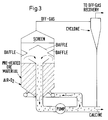
- Figure 3 shows an ebullating fluid bed which is an embodiment of a fluid bed suitable as another approach in the disclosed process.
- the appropriately labeled illustration provides for another circulation approach when roasting an ore material.
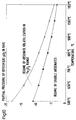
- Figures 4 to 6 will be further explained in conjunction with the Examples.
- Figures 4 and 6 illustrate the "knee-in-the-curve" found for the roasting conditions existing as a function of roasting temperature, oxygen content in roasting gas i.e. air, and as a function of gold extraction.
- a circulating fluid bed (CFB) reactor 100 is fed from an ore preheat stage identified with stream 200 corresponding to the same stream number in Table 7 further disclosed herein.
- a start-up gas stream such as butane/propane has been shown entering the CFB reactor 100 at the bottom thereof.
- a combined stream of oxygen unexhausted off-gas and fresh oxygen via preheater 102 is introduced into the CFB reactor 100.
- the combined stream is identified as 201.
- a preheated, oxygen supplemented air stream 208 is introduced in the CFB reactor 100 and is coming from the post-finishing calcine treatment which will be discussed below.
- a single cyclone 103 has been shown in Figure 7, but more than one may be operated in parallel or in series to assure greater particulate removal from the off-gas.
- Cyclone 103 bottoms i.e. underflow collections are partially reintroduced into the CFB reactor 100 via seal pot 104.
- a slip stream 105 of calcined product is also taken from seal pot 104 and introduced into a four stage pre-heaters (recuperators) 107 to 110 which are in a heat recovery unit 106. Air augmented with oxygen is brought up to about 450°C in heat recovery unit 106.
- the unit 106 consists of four pre-heaters in the form of fluidized beds 107, 108, 109 and 110, respectively.
- these pre-heaters 107, 108, 109 and 110 have been identified by separate numbers.
- the CFB reactor 100 is operated at 550°C.
- the resulting calcine (of retention time of 10 minutes in reactor 100) is introduced in the first pre-heater 107.
- the calcine is at a temperature of about 525°C and has a residence time of about 15 minutes in preheater 107; in the second pre-heater 108, the calcine temperature is about 475°C and residence time is about 10 minutes; in the third pre-heater 109 the calcine temperature is at about 420°C and the residence time is about 8 minutes; in the fourth pre-heater 110 the calcine temperature is about 350°C and the residence time is about eight minutes. Air and oxygen enter these preheaters in parallel, fluidize in each the calcine, and is mixed and cleaned in cyclone 112. After separation of particulates in cyclone 112, air and oxygen is introduced as stream 208 into the CFB reactor 100.
- a second pre-heater unit (not shown) of the same type may be operated in parallel to the first pre-heater unit 106.
- the seal pot 104 or a second seal pot (not shown) may feed the second pre-heater unit.
- Table 7 these are referred to two parallel identical pre-heater units such as 106, two parallel cyclones such as 112, and two parallel seal pots such as 104.
- Heated air and oxygen from all four pre-heaters is used and is at about 450°C as shown in Table 7.
- ambient air is introduced via pump 113 into heating coils 114 immersed in the fluidized calcine in pre-heaters 109 and 110.
- This air is used to pre-heat in a CFB type vessel (not shown) the ore introduced as stream 200 in the CFB reactor 100.
- Hot air exits heating coils 114 at 200°C.
- the balance of the energy requirement for roasting is made up by the addition of butane or pulverized coal to the CFB reactor 100.
- Calcine in stream 209 is quenched in water in tank 115 to a 15% solids content and further worked-up as previously described for removal of a cyanicide materials, neutralization and subsequent leaching.
- Off-gases i.e. cyclone 103 overflows are introduced into a waste heat boiler 116 where the off-gas temperature is reduced to about 375°C, dust from the waste heat boiler 116 is introduced into the pre-heater unit in an appropriate place, e.g. pre-heater 108 and combined with calcine.
- the off gases are introduced into an electrostatic precipitator 117, e.g. a five field, hot electrostatic precipitator, to remove substantially all residual dust in the off-gas.
- a number of precipitators 117 may be used.
- the exit temperature of the off-gas from the electrostatic precipitator 117 is at about 350°C and the off-gas comprises about 36% by volume of oxygen.
- the ore used in these runs came from a random sampling of arsenic-, sulfidic-, organic carbon-containing, gold-bearing ores from the region around Carlin, Nevada. This ore, for the series of runs showed an average gold content of about 0.16 ounces of gold per ton of ore and up to 0.20 oz. of gold per ton, an average content of 0.08 percent arsenic, 2.49 percent sulfide sulfur (2.81 percent total sulfur) and 0.79 percent organic carbon (0.84 percent total carbon.) The ore was classified as pyritic-carbonaceous-siliceous ore and had the following mineralogical and chemical analyses:
- a chemical analysis of the ore shows an average composition as follows: Arsenic 824 parts per million Carbon (Total) 0.84 Percent Sulfur (Total) 2.81 Percent Gold 0.164 ounces per ton Iron 4.0 Percent Zinc 400 parts per million Strontium 0.02 Percent
- the ore was ground in a small ball mill to 100 percent -65 mesh (except as otherwise noted), i.e., 100 percent passed through a 65 mesh sieve, and it had a bulk density of about 57 pounds per cubic foot and a moisture content of about 1 percent.
- the ground ore was placed in a simple rotating tube reactor and roasted in a batch operation to evaluate various reaction conditions using a residence time of two hours for the sake of consistency.
- the roasted ore, or calcine was treated by a carbon in leach cyanidation leach using a dosage of 6 pounds of sodium cyanide per ton of roasted ore and 30 grams per liter of activated carbon (available from North American Carbon.)
- the leaching was conducted in a continuously rolling bottle under the following conditions:
- the ore used in these runs came from a random sampling of arsenic-, sulfidic-containing, gold bearing ores from the region around Carlin, Nevada.
- the ore for this series of runs showed an average gold content of about 0.14 ounces of gold per ton of ore, an average content of 0.15 percent arsenic, 2.15 percent sulfide sulfur (2.50 percent total sulfur) and 0.35 percent organic carbon (0.39 percent total carbon.)
- the ore was classified as pyritic-siliceous ore and had the following mineralogical analysis:
- the ore was ground in a small ball mill to 100 percent -100 mesh, i.e., 100 percent passed through a 100 mesh sieve (except as otherwise noted) and it had a bulk density of approximately 62 pounds per cubic foot and a moisture content of approximately 1 percent.
- the ground ore was placed in a simple rotating tube reactor and roasted in a batch operation to evaluate various reaction conditions using a residence time of two hours for the sake of consistency.
- the ore feed to roast was 800 grams at -100 mesh.
- the roasted ore, or calcine was treated by a carbon-in-leach cyanidation leach using 5 pounds of sodium cyanide per ton of roasted ore and 30 grams per liter of activated carbon (available from North American Carbon.)
- the leaching was conducted in a continuously rotating bottle under the following conditions:
- the sample preparation procedure for this series of tests included crushing, wet grinding in a ball mill to 100% passing through a 65 mesh sieve, solid/liquid separation, and drying prior to roasting.
- the dry sample was fed to the roaster via a screw feeder with the combustion gas consisting of either air alone or air enriched to 40% total initial oxygen content by volume. Solids exiting the roaster were carbon-in-leach cyanide leached at the same conditions as in Example 1.
- Table 6 presents the test results. From the results it is seen that maximum gold recoveries are achieved by using the process of the present invention. By way of comparison, several air roasts conducted in a circulating fluidized bed roaster and a stationary fluid bed roaster are presented along with three examples that illustrate the present invention.
- Residual sulfide sulfur content and organic carbon content of the solids exiting from the pilot plant roaster were less than 0.05 percent by weight in all the tests from this series.
- the base case roaster feed analysis is as follows: Carbon Organic 0.8% Sulfide Sulfur 2.5% Weight Loss on Ignition - L.O.I. 6.0% As 1200 ppm Cl 100 ppm F 1000 ppm Pb 25 ppm Hg 5 ppm Sb 80 ppm Zn 1000 ppm SiO2 80 % Al2O3 7 %
- the ore feed had a specific gravity 2.52; and a bulk density (loose) of 1.0 m.t./m3 and bulk density (packed) of 1.25 m.t./m3.
- Roaster feed (D50) was: 50% passed at 19 ⁇ size and 80% passed at 70 ⁇ (estimate).
- the design roast temperature was 550°C and the O2 concentration in off-gas was 36 vol.% wet basis. Organic carbon burn-off was assumed to be 0.7% (for energy calculations).
- a carbon content in the ore was provided for at 0.8% level, but should also be provided for a range from about 0.4% to about 1.15%.
- more coal or fuel needs to be added, while at higher amounts of carbon in ore less or no coal is required (autothermal conditions).
- autothermal conditions about 330 kg/hr of coal calculated as carbon is added for the above ore in Table 7.
- the waste heat boiler 116 produces at the specified conditions about 6 tons per hour of 55 bar steam.
- a total “at temperature” time for the calcine (before quenching) is about 30 minutes.
- Such “at temperature” time is a combined time in the CFB reactor 100 and during post-finishing in heat recovery unit 106.
- This "at temperature” time may range from about 25 minutes to 50 minutes and does not adversely affect the gold recovery even for the longer period; therefore, this process has an advantage because it is also free from the heat sensitivity, i.e. "at temperature” time limits such as cautioned against in some of the prior art processes and disclosures thereof.
- the advantageous size is determined for each ore and is typically from about -14 mesh to about -100 and less. At finer particulate sizes e.g. - 100 mesh there is no need to wet grind the calcine after quenching in tank 105 but before leaching.
- FIG 8 illustrates a roasting with two stage oxygen injection carried out in a circulating fluidized bed.
- the circulating fluidized bed system consists of a fluidized bed reactor 301, a recycling cyclone 302, and a recycling line 303.
- the fluidized bed reactor 301 was 0.16 m in diameter and had a height of 4 m.
- a mixture of refractory gold ore and additives at a rate of 10 kg/h was charged through line 304 into the reactor 301.
- the gold ore contained 0.8% arsenic, 1.4% sulfide sulfur and 13 g gold per 1000 kg. It had a particle size below 0.1 mm with a median value (D50) of 20 ⁇ m.
- the types and quantities of the additives are apparent from the following Table 8. 80% of the additives had a particle size below 20 to 50 ⁇ m.
- a gas which contained 0.9% oxygen was fed at a rate of 10 sm3/h through line 305 into the gas heater 306 and was heated therein to 550°C and then fed through line 307 into the reactor 301 as a fluidizing gas.
- the reactor 301 was indirectly heated and a temperature between 550° and 570°C was adjusted in the reactor.
- the reactor 301 was fed through line 308 with secondary oxygen containing gas and through line 309 with tertiary oxygen containing gas.
- the secondary and tertiary gases consisted of preheated air and oxygen, respectively, and were used to adjust in the upper roasting stage the oxygen content indicated in the table.
- the calcine was withdrawn through line 310.
- a gas-solid suspension was fed from the reactor 301 through line 311 to the recycling cyclone 302 and the solids separated therein were recycled through the recycling line 303 into the reactor 301.
- the exhaust gas discharged through line 312 contained 0.1% to 0.5% SO2 by volume.
- the arsenate (in case of ferricarsenate -- as shown in Figure 10) must be also analyzed as only one component which needs to be considered. Carbon and sulfur must also be eliminated and efficient elimination calls for balancing of temperature and oxygen content. Additional substances such as CaSO4. 2H2O also favorably immobilize arsenic. Moreover, pyrites in the ore being in intimate contact with arsenic compounds in ore, as shown above, react favorably to immobilize arsenic especially at higher oxygen content in the reactant gas.
- the first circulating fluidized bed system consists of the fluidized bed reactor 401, the recycling cyclone 402, and the recycling line 403.
- the fluidized bed reactor 401 was 0.2 m in diameter and had a height of 6 m.
- gold ore concentrate at a rate of 15 kg/h was charged through line 404 into the reactor.
- the concentrate contained 2.1% arsenic, 15% sulfide sulfur and 45 g gold per 1000 kg.
- the particle size was below 0.2 mm with a median size (D50) of 70 ⁇ m.
- the reactor 401 was fed through line 408 with secondary air at a rate of 9 sm3/h and through line 409 at a rate of 3 sm3/h with tertiary air, which served to combust the residual sulfur in the reactor 401.
- the oxygen potential was adjusted to be in the range in which arsenic is volatilized in the Fe2O3 range ( Figure 10), below the range in which iron arsenate is formed.
- the temperature in the reactor was between 700°C and 750°C.
- the calcine withdrawn through line 410 contained 0.02% arsenic and 0.1% sulfur.
- the leaching of the calcine resulted in a recovery of gold with a yield of 96%.
- the solubility of arsenic during the leaching of gold was very low and amounted only to less than 2 mg/l.
- a gas-solid suspension was fed from the reactor 401 through line 411 into the recycling cyclone 402.
- the solids collected there were recycled through the recycling line 403 into the reactor 401.
- the exhaust gas conducted in line 412 was dedusted in two cyclones (not shown) and in a candle filter 413 at about 600°C.
- the collected dusts were returned to the reactor 401 through line 414.
- the dust-free exhaust gas contained SO2 and As2O3 and was fed through line 415 to the fluidized bed reactor 416 of a second circulating fluidized bed system.
- the reactor 416 was 0.16 m in diameter and had a height of 4 m. It was heated by indirect electric heating. Hematinic iron ore having a particle size below 0.5 mm, with a medium size of 30 ⁇ m, was charged through line 417 at a rate of 0.3 kg/h. Fluidizing air at a rate of 15 sm3/h was fed into the reactor 416.
- the suspension leaving through line 419 was adjusted to contain 6% oxygen and 4% water vapor so that the conditions for a formation of stable arsenates (Figure 9) were established.
- the moisture content of the iron ore charged through 417 was controlled in dependence on the water vapor content of the gas entering through line 415 and of the fluidizing air entering through line 418.
- the solids collected in the recycling cyclone 420 were returned through the recycling line 421 into the reactor 416.
- the arsenic-free roaster gas contained 9.1% SO2 and was fed through line 22 to a gas purifier and subsequently to a plant for producing sulfuric acid.
- the solid material which was discharged through line 423 from the reactor 416 contained 17.3% arsenic. Leaching tests with water (corresponding to a DEV-S4 leaching test) showed that the solubility of arsenic was less than 1 mg/l.
- the dust-containing gases which contain arsenic vapor and arsenic compound vapor(s) are produced by roasting e.g. of sulfide materials which contain iron and arsenic. Such materials are roasted in the Fe2O3 range at temperatures of 500°C to 1100°C in a first stage, which is supplied with oxygen-containing gases. In these materials, arsenic is volatilized mainly as arsenic oxides and part of the sulfur content is volatilized as elementary sulfur. Solids are removed from the exhaust gas at temperatures above the condensation temperature of the volatilized components, and the solids are discharged as calcine.
- the sulfide materials may consist of arsenic-containing ores or ore concentrates, such as gold ores, copper ores, silver ores, nickel ores, cobalt ores, antimony ores, lead ores and iron ores as well as of arsenic-containing sulfide residues and intermediate products.
- arsenic-containing ores or ore concentrates such as gold ores, copper ores, silver ores, nickel ores, cobalt ores, antimony ores, lead ores and iron ores as well as of arsenic-containing sulfide residues and intermediate products.
- the presence of water of crystallization in the added substance the roasting atmosphere or in the ore components e.g. aids in the immobilization of arsenic.
- the measure for immobilization i.e. insolubility
- scorodite represents the level of insolubility which is desired.
- a "scorodite like" compound is intended to have insolubility of about the same order of magnitude as scorodite.
- the process for gold recovery has been found best conducted with the indicated oxygen levels for other metal recovery from ores which contain arsenic, such process may be practiced with even higher oxygen levels (and also temperature levels) as shown above because the improvement concerning arsenic recovery as such may even be practiced with pure oxygen used as the oxidizing medium.
- higher temperatures i.e. as shown in Example 9
- the combination of first stage and second stage treatment provides a double measure of safety that any arsenic which may have been volatilized may be separately immobilized to assure an environmentally double safe treatment of any off gas.
- Such combination also provides for employment choice of a lower oxygen content in first stage and higher in the second stage. In part such effect may also be achieved by the multiple oxygen injection as shown for the gold ores treated in the combination shown in Example 8.
- the present invention provides improvements over those shown by the prior art as previously described and pointed out with reference to that art.
Landscapes
- Engineering & Computer Science (AREA)
- Chemical & Material Sciences (AREA)
- Manufacturing & Machinery (AREA)
- Geochemistry & Mineralogy (AREA)
- Geology (AREA)
- General Life Sciences & Earth Sciences (AREA)
- Life Sciences & Earth Sciences (AREA)
- Environmental & Geological Engineering (AREA)
- Materials Engineering (AREA)
- Mechanical Engineering (AREA)
- Metallurgy (AREA)
- Organic Chemistry (AREA)
- Manufacture And Refinement Of Metals (AREA)
- Inorganic Compounds Of Heavy Metals (AREA)
Applications Claiming Priority (6)
| Application Number | Priority Date | Filing Date | Title |
|---|---|---|---|
| US684649 | 1991-04-12 | ||
| US07/684,649 US5123956A (en) | 1991-04-12 | 1991-04-12 | Process for treating ore having recoverable gold values and including arsenic-, carbon- and sulfur-containing components by roasting in an oxygen-enriched gaseous atmosphere |
| DE19914122894 DE4122894C1 (de) | 1991-07-11 | 1991-07-11 | |
| DE4122895 | 1991-07-11 | ||
| DE4122894 | 1991-07-11 | ||
| DE19914122895 DE4122895C1 (de) | 1991-07-11 | 1991-07-11 |
Publications (3)
| Publication Number | Publication Date |
|---|---|
| EP0508542A2 true EP0508542A2 (de) | 1992-10-14 |
| EP0508542A3 EP0508542A3 (en) | 1993-10-20 |
| EP0508542B1 EP0508542B1 (de) | 1998-06-24 |
Family
ID=27202700
Family Applications (1)
| Application Number | Title | Priority Date | Filing Date |
|---|---|---|---|
| EP92200989A Expired - Lifetime EP0508542B1 (de) | 1991-04-12 | 1992-04-07 | Verfahren zur Behandlung von Erz mit rückgewinnbaren Metallwertstoffen einschliesslich arsenhaltiger Komponenten |
Country Status (8)
| Country | Link |
|---|---|
| EP (1) | EP0508542B1 (de) |
| AU (1) | AU656952B2 (de) |
| BR (1) | BR9201355A (de) |
| CA (1) | CA2065837C (de) |
| DE (1) | DE69225993T2 (de) |
| ES (1) | ES2117028T3 (de) |
| MY (1) | MY110328A (de) |
| RU (1) | RU2079562C1 (de) |
Cited By (20)
| Publication number | Priority date | Publication date | Assignee | Title |
|---|---|---|---|---|
| DE4329417C1 (de) * | 1993-09-01 | 1994-08-18 | Metallgesellschaft Ag | Verfahren zum Rösten refraktärer Golderze |
| EP0622467A1 (de) * | 1993-04-30 | 1994-11-02 | Metallgesellschaft Ag | Verfahren zum Rösten von refraktären Golderzen |
| WO1997021842A1 (de) * | 1995-12-13 | 1997-06-19 | Metallgesellschaft Aktiengesellschaft | Verfahren zur thermischen behandlung refraktärer golderze |
| CN1047801C (zh) * | 1997-01-15 | 1999-12-29 | 核工业北京化工冶金研究院 | 从难浸矿石中提取金的方法 |
| RU2309187C2 (ru) * | 2006-01-10 | 2007-10-27 | Байкальский институт природопользования Сибирского отделения Российской академии наук (БИП СО РАН) | Способ переработки золотосодержащих арсенопиритных руд и концентратов |
| RU2479650C1 (ru) * | 2012-02-14 | 2013-04-20 | Федеральное государственное автономное образовательное учреждение высшего профессионального образования "Уральский федеральный университет имени первого Президента России Б.Н. Ельцина" | Способ извлечения благородных металлов из руд и концентратов |
| RU2485189C1 (ru) * | 2012-05-10 | 2013-06-20 | Федеральное государственное автономное образовательное учреждение высшего профессионального образования "Национальный исследовательский технологический университет "МИСиС" | Способ переработки окисленных золотомышьяковистых руд |
| WO2014170676A1 (en) * | 2013-04-17 | 2014-10-23 | Tetronics (International) Limited | Precious metal recovery |
| WO2016048750A1 (en) * | 2014-09-24 | 2016-03-31 | Ecolab Usa Inc. | Method for recovering gold from refractory ore |
| RU2604551C1 (ru) * | 2015-05-29 | 2016-12-10 | Федеральное государственное бюджетное учреждение науки Байкальский институт природопользования Сибирского отделения Российской академии наук (БИП СО РАН) | Способ переработки золотосодержащих скородитовых руд |
| WO2017129341A1 (en) * | 2016-01-26 | 2017-08-03 | Outotec (Finland) Oy | Method and apparatus for treating a leaching residue of a sulfur-containing metal concentrate |
| WO2017162857A1 (en) * | 2016-03-24 | 2017-09-28 | Outotec (Finland) Oy | Process and facility for thermal treatment of a sulfur-containing ore |
| WO2018091361A1 (en) * | 2016-11-15 | 2018-05-24 | Tcm Research Ltd. | Extraction methods from refractory ores |
| CN110438334A (zh) * | 2019-07-22 | 2019-11-12 | 中南大学 | 用于氯化焙烧的复合添加剂及其用于焙烧含金尾渣的方法 |
| EP3486337A4 (de) * | 2016-07-14 | 2020-03-04 | Korea Institute Of Geoscience & Mineral Resources | Verfahren zur verdichtung und rückgewinnung von edelmetallen |
| CN113755693A (zh) * | 2021-09-10 | 2021-12-07 | 山东国大黄金股份有限公司 | 一种利用制酸烟气协同处理焙烧氰化尾渣的方法 |
| CN114015866A (zh) * | 2021-10-08 | 2022-02-08 | 上海逢石科技有限公司 | 基于悬浮焙烧炉与熔融还原炉直连的铁矿冶炼方法和装置 |
| CN115245945A (zh) * | 2021-11-26 | 2022-10-28 | 浙江遂昌汇金有色金属有限公司 | 基于贵金属回收的废渣处理系统及其处理方法 |
| CN115557533A (zh) * | 2022-09-15 | 2023-01-03 | 林西金易来砷业有限公司 | 一种硫化砷渣的回收利用方法 |
| CN120120863A (zh) * | 2025-05-13 | 2025-06-10 | 河北清峰绿能固废处置有限公司 | 一种用于煤矸石脱碳的方法及装置 |
Families Citing this family (10)
| Publication number | Priority date | Publication date | Assignee | Title |
|---|---|---|---|---|
| US6248301B1 (en) * | 1991-04-12 | 2001-06-19 | Newmont Mining Corporation And Newmont Gold Company | Process for treating ore having recoverable metal values including arsenic containing components |
| US6482373B1 (en) | 1991-04-12 | 2002-11-19 | Newmont Usa Limited | Process for treating ore having recoverable metal values including arsenic containing components |
| US6451275B1 (en) * | 2000-03-10 | 2002-09-17 | Lakefield Research Limited | Methods for reducing cyanide consumption in precious metal recovery by reducing the content of intermediate sulfur oxidation products therein |
| RU2553706C2 (ru) * | 2012-03-12 | 2015-06-20 | Товарищество с ограниченной ответственностью "Фирма "Балауса" | Способ рудоподготовки полиметаллических руд для выщелачивания |
| WO2020132752A1 (es) * | 2018-12-27 | 2020-07-02 | Compañia Minera Pargo Minerals Spa | Planta moderna de producción de trióxidos de antimonio, arsénico, y plomo metálico" |
| WO2020132751A1 (es) * | 2018-12-27 | 2020-07-02 | Compañia Minera Pargo Minerals Spa | Proceso de obtención trióxido de antimonio (sb203), trióxido de arsénico (as203) y plomo (pb) |
| CN113549756B (zh) * | 2020-11-12 | 2022-12-02 | 广东天源环境科技有限公司 | 预热烟气180度流动的高砷金属矿粉脱砷设备及方法 |
| CN113247909B (zh) * | 2021-05-17 | 2022-03-29 | 李朝侠 | 回转窑法资源化处理赤泥的工艺及回转窑 |
| CN113444875B (zh) * | 2021-06-28 | 2022-11-29 | 贵州理工学院 | 一种硫化锑精矿与铝工业废渣协同处理资源化利用的方法 |
| CN115011791A (zh) * | 2022-06-13 | 2022-09-06 | 肖军 | 一种从矿石回收贵金属的方法 |
Family Cites Families (4)
| Publication number | Priority date | Publication date | Assignee | Title |
|---|---|---|---|---|
| US3172755A (en) * | 1965-03-09 | Process for the treatment of pyrite ores | ||
| US3791812A (en) * | 1971-12-20 | 1974-02-12 | Morton Norwich Products Inc | Process for the recovery of non-ferrous metal values from sulfide ores and the reduction of gaseous emissions to the atmosphere therefrom |
| FI63781B (fi) * | 1980-03-19 | 1983-04-29 | Outokumpu Oy | Foerfarande foer aotervinning av vaerdemetaller ur finmalen pyit |
| SE8303184L (sv) * | 1983-06-06 | 1984-12-07 | Boliden Ab | Forfarande for beredning av kopparsmeltmaterial och liknande ravaror innehallande hoga halter arsenik och/eller antimon |
-
1992
- 1992-04-07 EP EP92200989A patent/EP0508542B1/de not_active Expired - Lifetime
- 1992-04-07 ES ES92200989T patent/ES2117028T3/es not_active Expired - Lifetime
- 1992-04-07 DE DE69225993T patent/DE69225993T2/de not_active Expired - Fee Related
- 1992-04-10 CA CA002065837A patent/CA2065837C/en not_active Expired - Lifetime
- 1992-04-10 RU SU5011801/02A patent/RU2079562C1/ru active
- 1992-04-10 MY MYPI92000608A patent/MY110328A/en unknown
- 1992-04-10 AU AU14824/92A patent/AU656952B2/en not_active Expired
- 1992-04-13 BR BR929201355A patent/BR9201355A/pt not_active Application Discontinuation
Cited By (31)
| Publication number | Priority date | Publication date | Assignee | Title |
|---|---|---|---|---|
| EP0622467A1 (de) * | 1993-04-30 | 1994-11-02 | Metallgesellschaft Ag | Verfahren zum Rösten von refraktären Golderzen |
| DE4329417C1 (de) * | 1993-09-01 | 1994-08-18 | Metallgesellschaft Ag | Verfahren zum Rösten refraktärer Golderze |
| EP0641864A1 (de) * | 1993-09-01 | 1995-03-08 | Metallgesellschaft Ag | Verfahren zum Rösten refraktärer Golderze |
| WO1997021842A1 (de) * | 1995-12-13 | 1997-06-19 | Metallgesellschaft Aktiengesellschaft | Verfahren zur thermischen behandlung refraktärer golderze |
| CN1047801C (zh) * | 1997-01-15 | 1999-12-29 | 核工业北京化工冶金研究院 | 从难浸矿石中提取金的方法 |
| RU2309187C2 (ru) * | 2006-01-10 | 2007-10-27 | Байкальский институт природопользования Сибирского отделения Российской академии наук (БИП СО РАН) | Способ переработки золотосодержащих арсенопиритных руд и концентратов |
| RU2479650C1 (ru) * | 2012-02-14 | 2013-04-20 | Федеральное государственное автономное образовательное учреждение высшего профессионального образования "Уральский федеральный университет имени первого Президента России Б.Н. Ельцина" | Способ извлечения благородных металлов из руд и концентратов |
| RU2485189C1 (ru) * | 2012-05-10 | 2013-06-20 | Федеральное государственное автономное образовательное учреждение высшего профессионального образования "Национальный исследовательский технологический университет "МИСиС" | Способ переработки окисленных золотомышьяковистых руд |
| WO2014170676A1 (en) * | 2013-04-17 | 2014-10-23 | Tetronics (International) Limited | Precious metal recovery |
| CN105264098A (zh) * | 2013-04-17 | 2016-01-20 | 特洛特尼克斯(国际)有限公司 | 贵金属回收 |
| US9441284B2 (en) | 2013-04-17 | 2016-09-13 | Tetronics (International) Limited | Precious metal recovery |
| RU2677904C2 (ru) * | 2013-04-17 | 2019-01-22 | Тетроникс (Интернешнл) Лимитед | Восстановление драгоценных металлов |
| WO2016048750A1 (en) * | 2014-09-24 | 2016-03-31 | Ecolab Usa Inc. | Method for recovering gold from refractory ore |
| US9920395B2 (en) | 2014-09-24 | 2018-03-20 | Ecolab Usa Inc. | Method for recovering gold from refractory ore |
| RU2604551C1 (ru) * | 2015-05-29 | 2016-12-10 | Федеральное государственное бюджетное учреждение науки Байкальский институт природопользования Сибирского отделения Российской академии наук (БИП СО РАН) | Способ переработки золотосодержащих скородитовых руд |
| EA037686B1 (ru) * | 2016-01-26 | 2021-05-04 | Оутотек (Финлэнд) Ой | Способ и устройство для обработки остатка от выщелачивания серосодержащего металлического концентрата |
| WO2017129341A1 (en) * | 2016-01-26 | 2017-08-03 | Outotec (Finland) Oy | Method and apparatus for treating a leaching residue of a sulfur-containing metal concentrate |
| WO2017162857A1 (en) * | 2016-03-24 | 2017-09-28 | Outotec (Finland) Oy | Process and facility for thermal treatment of a sulfur-containing ore |
| EP3486337A4 (de) * | 2016-07-14 | 2020-03-04 | Korea Institute Of Geoscience & Mineral Resources | Verfahren zur verdichtung und rückgewinnung von edelmetallen |
| US11401578B2 (en) | 2016-11-15 | 2022-08-02 | Tcm Research Ltd. | Extraction methods from refractory ores |
| WO2018091361A1 (en) * | 2016-11-15 | 2018-05-24 | Tcm Research Ltd. | Extraction methods from refractory ores |
| CN110438334A (zh) * | 2019-07-22 | 2019-11-12 | 中南大学 | 用于氯化焙烧的复合添加剂及其用于焙烧含金尾渣的方法 |
| CN110438334B (zh) * | 2019-07-22 | 2021-03-16 | 中南大学 | 用于氯化焙烧的复合添加剂及其用于焙烧含金尾渣的方法 |
| CN113755693A (zh) * | 2021-09-10 | 2021-12-07 | 山东国大黄金股份有限公司 | 一种利用制酸烟气协同处理焙烧氰化尾渣的方法 |
| CN113755693B (zh) * | 2021-09-10 | 2022-09-27 | 山东国大黄金股份有限公司 | 一种利用制酸烟气协同处理焙烧氰化尾渣的方法 |
| CN114015866A (zh) * | 2021-10-08 | 2022-02-08 | 上海逢石科技有限公司 | 基于悬浮焙烧炉与熔融还原炉直连的铁矿冶炼方法和装置 |
| CN114015866B (zh) * | 2021-10-08 | 2023-06-23 | 上海逢石科技有限公司 | 基于悬浮焙烧炉与熔融还原炉直连的铁矿冶炼方法和装置 |
| CN115245945A (zh) * | 2021-11-26 | 2022-10-28 | 浙江遂昌汇金有色金属有限公司 | 基于贵金属回收的废渣处理系统及其处理方法 |
| CN115245945B (zh) * | 2021-11-26 | 2023-11-17 | 浙江遂昌汇金有色金属有限公司 | 基于贵金属回收的废渣处理系统及其处理方法 |
| CN115557533A (zh) * | 2022-09-15 | 2023-01-03 | 林西金易来砷业有限公司 | 一种硫化砷渣的回收利用方法 |
| CN120120863A (zh) * | 2025-05-13 | 2025-06-10 | 河北清峰绿能固废处置有限公司 | 一种用于煤矸石脱碳的方法及装置 |
Also Published As
| Publication number | Publication date |
|---|---|
| MY110328A (en) | 1998-04-30 |
| ES2117028T3 (es) | 1998-08-01 |
| EP0508542A3 (en) | 1993-10-20 |
| CA2065837A1 (en) | 1992-10-13 |
| RU2079562C1 (ru) | 1997-05-20 |
| BR9201355A (pt) | 1992-12-01 |
| AU656952B2 (en) | 1995-02-23 |
| EP0508542B1 (de) | 1998-06-24 |
| DE69225993T2 (de) | 1998-12-10 |
| CA2065837C (en) | 2005-06-07 |
| DE69225993D1 (de) | 1998-07-30 |
| AU1482492A (en) | 1992-10-15 |
Similar Documents
| Publication | Publication Date | Title |
|---|---|---|
| US6482373B1 (en) | Process for treating ore having recoverable metal values including arsenic containing components | |
| CA2065837C (en) | Process for treating ore having recoverable metal values including arsenic containing components | |
| US5123956A (en) | Process for treating ore having recoverable gold values and including arsenic-, carbon- and sulfur-containing components by roasting in an oxygen-enriched gaseous atmosphere | |
| US4919715A (en) | Treating refractory gold ores via oxygen-enriched roasting | |
| RU2102510C1 (ru) | Способ повышения содержания двуокиси титана в титансодержащей руде или концентрате | |
| EP0453151B1 (de) | Verfahren zur Rückgewinnung wertvoller Metalle aus zinkhaltigen Stäuben | |
| US6248301B1 (en) | Process for treating ore having recoverable metal values including arsenic containing components | |
| JPS6013036A (ja) | 高率のひ素及び(又は)アンチモンを含有する銅溶練原料及びその同効物の処理法 | |
| GB2077247A (en) | Process for the recovery of gold and/or silver and/or bismuth contained in a sulfuretted ore and/or sulfoarsenide-containing ore | |
| EP0471816A1 (de) | Verfahren zur rückgewinnung von schwermetallen aus verbrauchten katalysatoren | |
| US4259106A (en) | Process for the roasting and chlorination of finely-divided iron ores and concentrates containing non-ferrous metals | |
| US3649245A (en) | Process for the purification of pyrite cinders from nonferrous metals, from arsenic and from sulfur | |
| US5162107A (en) | Method of reprocessing zinc- and lead-containing residues from metallurgical plants by means of a circulating fluidized bed system | |
| US3833352A (en) | Process for beneficiating molybdenate concentrate to produce molybdenum trioxide | |
| US6270555B1 (en) | Process for treating precious metal ores | |
| US5254320A (en) | Method for roasting sulphide ores | |
| RU2078146C1 (ru) | Способ обжига металлосодержащих сульфидно-мышьяковистых или сульфидно-золотосодержащих руд или концентратов | |
| US4288414A (en) | Process for chlorinating clays and bauxite | |
| US4642133A (en) | Process for chlorinating volatilization of metals which are present in oxidic iron ores or concentrates | |
| US3674462A (en) | Process for low temperature chlorination of roasted products from an iron sulphide roasting process prior to leaching out the nonferrous metal present therein | |
| US4065294A (en) | Energy conserving process for purifying iron oxide | |
| US4915730A (en) | Process and apparatus for recovery of flue dust | |
| EP3433388B1 (de) | Verfahren und anlage zur thermischen behandlung eines schwefelhaltigen erzes | |
| JPS596337A (ja) | 鉄酸化物を含有した残渣からの非鉄金属の分離方法 | |
| US4174372A (en) | Process for treatment of antimony-containing materials |
Legal Events
| Date | Code | Title | Description |
|---|---|---|---|
| PUAI | Public reference made under article 153(3) epc to a published international application that has entered the european phase |
Free format text: ORIGINAL CODE: 0009012 |
|
| AK | Designated contracting states |
Kind code of ref document: A2 Designated state(s): DE ES FR GR |
|
| PUAL | Search report despatched |
Free format text: ORIGINAL CODE: 0009013 |
|
| AK | Designated contracting states |
Kind code of ref document: A3 Designated state(s): DE ES FR GR |
|
| K1C1 | Correction of patent application (title page) published |
Effective date: 19921014 |
|
| 17P | Request for examination filed |
Effective date: 19940219 |
|
| 17Q | First examination report despatched |
Effective date: 19961104 |
|
| GRAG | Despatch of communication of intention to grant |
Free format text: ORIGINAL CODE: EPIDOS AGRA |
|
| GRAG | Despatch of communication of intention to grant |
Free format text: ORIGINAL CODE: EPIDOS AGRA |
|
| GRAH | Despatch of communication of intention to grant a patent |
Free format text: ORIGINAL CODE: EPIDOS IGRA |
|
| GRAH | Despatch of communication of intention to grant a patent |
Free format text: ORIGINAL CODE: EPIDOS IGRA |
|
| GRAH | Despatch of communication of intention to grant a patent |
Free format text: ORIGINAL CODE: EPIDOS IGRA |
|
| GRAA | (expected) grant |
Free format text: ORIGINAL CODE: 0009210 |
|
| AK | Designated contracting states |
Kind code of ref document: B1 Designated state(s): DE ES FR GR |
|
| REF | Corresponds to: |
Ref document number: 69225993 Country of ref document: DE Date of ref document: 19980730 |
|
| REG | Reference to a national code |
Ref country code: ES Ref legal event code: FG2A Ref document number: 2117028 Country of ref document: ES Kind code of ref document: T3 |
|
| ET | Fr: translation filed | ||
| RAP2 | Party data changed (patent owner data changed or rights of a patent transferred) |
Owner name: METALLGESELLSCHAFT AKTIENGESELLSCHAFT |
|
| PLBE | No opposition filed within time limit |
Free format text: ORIGINAL CODE: 0009261 |
|
| STAA | Information on the status of an ep patent application or granted ep patent |
Free format text: STATUS: NO OPPOSITION FILED WITHIN TIME LIMIT |
|
| 26N | No opposition filed | ||
| REG | Reference to a national code |
Ref country code: ES Ref legal event code: PC2A |
|
| REG | Reference to a national code |
Ref country code: FR Ref legal event code: CD Ref country code: FR Ref legal event code: TP |
|
| PGFP | Annual fee paid to national office [announced via postgrant information from national office to epo] |
Ref country code: FR Payment date: 20070312 Year of fee payment: 16 |
|
| REG | Reference to a national code |
Ref country code: FR Ref legal event code: ST Effective date: 20081231 |
|
| PG25 | Lapsed in a contracting state [announced via postgrant information from national office to epo] |
Ref country code: FR Free format text: LAPSE BECAUSE OF NON-PAYMENT OF DUE FEES Effective date: 20080430 |
|
| REG | Reference to a national code |
Ref country code: FR Ref legal event code: D3 |
|
| PGFP | Annual fee paid to national office [announced via postgrant information from national office to epo] |
Ref country code: ES Payment date: 20090428 Year of fee payment: 18 |
|
| PGFP | Annual fee paid to national office [announced via postgrant information from national office to epo] |
Ref country code: DE Payment date: 20090422 Year of fee payment: 18 |
|
| REG | Reference to a national code |
Ref country code: FR Ref legal event code: ST Effective date: 20101230 |
|
| PG25 | Lapsed in a contracting state [announced via postgrant information from national office to epo] |
Ref country code: DE Free format text: LAPSE BECAUSE OF NON-PAYMENT OF DUE FEES Effective date: 20101103 |
|
| PGFP | Annual fee paid to national office [announced via postgrant information from national office to epo] |
Ref country code: GR Payment date: 20110418 Year of fee payment: 20 |
|
| REG | Reference to a national code |
Ref country code: ES Ref legal event code: FD2A Effective date: 20111118 |
|
| PG25 | Lapsed in a contracting state [announced via postgrant information from national office to epo] |
Ref country code: ES Free format text: LAPSE BECAUSE OF NON-PAYMENT OF DUE FEES Effective date: 20100408 |
|
| REG | Reference to a national code |
Ref country code: GR Ref legal event code: MA Ref document number: 980401598 Country of ref document: GR Effective date: 20120408 |
|
| PG25 | Lapsed in a contracting state [announced via postgrant information from national office to epo] |
Ref country code: FR Free format text: LAPSE BECAUSE OF NON-PAYMENT OF DUE FEES Effective date: 20100430 |
|
| PG25 | Lapsed in a contracting state [announced via postgrant information from national office to epo] |
Ref country code: FR Free format text: LAPSE BECAUSE OF NON-PAYMENT OF DUE FEES Effective date: 20081231 |