EP0504758A2 - Plasma-Ätzverfahren einer Silizium enthaltenden Schicht - Google Patents
Plasma-Ätzverfahren einer Silizium enthaltenden Schicht Download PDFInfo
- Publication number
- EP0504758A2 EP0504758A2 EP92104397A EP92104397A EP0504758A2 EP 0504758 A2 EP0504758 A2 EP 0504758A2 EP 92104397 A EP92104397 A EP 92104397A EP 92104397 A EP92104397 A EP 92104397A EP 0504758 A2 EP0504758 A2 EP 0504758A2
- Authority
- EP
- European Patent Office
- Prior art keywords
- gas
- etching
- plasma
- layer
- nitrogen
- Prior art date
- Legal status (The legal status is an assumption and is not a legal conclusion. Google has not performed a legal analysis and makes no representation as to the accuracy of the status listed.)
- Granted
Links
Images



Classifications
-
- H—ELECTRICITY
- H10—SEMICONDUCTOR DEVICES; ELECTRIC SOLID-STATE DEVICES NOT OTHERWISE PROVIDED FOR
- H10P—GENERIC PROCESSES OR APPARATUS FOR THE MANUFACTURE OR TREATMENT OF DEVICES COVERED BY CLASS H10
- H10P50/00—Etching of wafers, substrates or parts of devices
- H10P50/20—Dry etching; Plasma etching; Reactive-ion etching
- H10P50/26—Dry etching; Plasma etching; Reactive-ion etching of conductive or resistive materials
- H10P50/264—Dry etching; Plasma etching; Reactive-ion etching of conductive or resistive materials by chemical means
- H10P50/266—Dry etching; Plasma etching; Reactive-ion etching of conductive or resistive materials by chemical means by vapour etching only
- H10P50/267—Dry etching; Plasma etching; Reactive-ion etching of conductive or resistive materials by chemical means by vapour etching only using plasmas
- H10P50/268—Dry etching; Plasma etching; Reactive-ion etching of conductive or resistive materials by chemical means by vapour etching only using plasmas of silicon-containing layers
-
- H—ELECTRICITY
- H10—SEMICONDUCTOR DEVICES; ELECTRIC SOLID-STATE DEVICES NOT OTHERWISE PROVIDED FOR
- H10P—GENERIC PROCESSES OR APPARATUS FOR THE MANUFACTURE OR TREATMENT OF DEVICES COVERED BY CLASS H10
- H10P50/00—Etching of wafers, substrates or parts of devices
Definitions
- the present invention relates to an etching method for a silicon containing layer of an object having a SiO2 film a silicon containing layer adjacent thereto.
- This invention is applied, for example, to a case when a polysilicon layer, which is adjacent to the SiO2 film in a semiconductor wafer, is etched.
- a dry etching of polysilicon has been used in for example a MOS transistor.
- a MOS semiconductor wafer is formed of a silicon substrate 1, a SiO2 gate insulating film 2 having a thickness of 100 to 300 ⁇ formed on the silicon substrate 1, a polysilicon layer 3 having a thickness of about 3000 ⁇ formed on the gate insulating film 2, and a resist film 4 formed on the polysilicon layer 3.
- a mixture of HBr gas and Cl2 gas or HCl gas is used.
- a portion 3a whose thickness is larger than the other portions is provided since a wire layer is further formed on a wire layer 7.
- the portion 3b is first removed by etching.
- a residual portion 5 is generated at a portion corresponding to the portion 3a.
- the gate insulting film 2 is etched and a removal portion 6 shown in Fig. 6 may be formed.
- the part of the gate insulating film 2 is undesirably removed.
- the polysilicon layer be etched so as to have a high selection ratio to the SiO2 gate insulating film, that is, (etching speed of polysilicon)/(etching speed of SiO2). If the selection ratio is sufficiently high, the removal portion 6 can be considerably made small, and etching can be performed with a high accuracy of size.
- the selection ratio is about 30 and this is insufficient for the accuracy of size.
- the present invention has been made in consideration of the above-mentioned problem, and an object of the invention is to provide a method for etching a silicon containing layer wherein the silicon containing layer can be etched at a high selection ratio to the SiO2 layer in an object to be processed in which the silicon containing layer such as a polysilicon layer is formed on the SiO2 layer.
- a method for etching a silicon content layer in an object to be processed having a SiO2 film and a silicon containing layer which is adjacent to the SiO2 film and is formed of silicon-containing material other than SiO2, comprising the steps of generating plasma of a processing gas containing mainly halogen element, and selectively exposing a predetermined portion of the silicon containing layer in plasma, thereby etching the portion, wherein the processing gas includes a gas containing oxygen or nitrogen.
- the inventors of the present invention studied variously in view of a processing gas in connection with a method for etching a silicon containing layer at a high selection ratio to a SiO2 layer. As a result, the inventors found out that the selection ratio was able to be considerably increased by adding a gas containing oxygen or nitrogen in processing gas. More particulary, in a case where SiO2 is dissociated by ion impact due to plasma, oxygen in a processing gas is recombined with dissociated Si. On the other hand, a thin SiN film is formed on the surface of the SiO2 layer by existence of nitrogen in a processing gas, thereby protecting the SiO2 layer.
- etching of the SiO2 layer can be suppressed, and the silicon containing layer can be etched at a high selection ratio to the SiO2 layer by adding gas containing oxygen or nitrogen to a processing gas.
- the present invention has been made based on the above-mentioned findings of the inventors of the present invention.
- the present invention is applied to an object to be processed having a SiO2 film and a silicon containing layer which is adjacent to the SiO2 film and is formed of silicon-containing material other than SiO2.
- a semiconductor wafer in which a polysilicon film is formed on the SiO2 film serving as an insulating film can be used.
- silicide such as WSi and silicon nitride can be used other than polysilicon.
- a gas containing oxygen or nitrogen together with halogen element containing gas as processing gas.
- the etching is performed by following procedures the object to be processed is provided in a processing chamber. The inside of the treating chamber is depressurized. A treating gas is supplied therein. Plasma of processing gas is formed in the chamber. A predetermined portion of the silicon containing layer of the object is selectively exposed in plasma.
- Halogen element containing gas is not particularly limited as long as the halogen element is contained.
- one of Cl2, HBr, HCl, HI, SF6, and CF6, or mixed gas of two or more gases is preferable.
- two or more gases are preferably mixed.
- the mixed gas of HCl and HBr is favorable and the flow rate thereof is 10 : 1 to 2 : 1 is preferable.
- a gas containing oxygen or nitrogen is not limited as long as oxygen or nitrogen is contained. However, O2, N2O, CO2, CO, N2, and NO2 is preferable.
- the ratio of the flow rate of a gas containing oxygen or nitrogen to that of the processing gas is preferably 10% or less. If this type of gas is slightly contained, the above-mentioned effect can be expected. However, if the flow rate ratio exceeds 10%, the etching speed decreases. The favorable flow rate ratio ranges from 1 to 4.5%.
- the pressure in the processing chamber while etching process is preferably 1 Torr or less.
- gas containing oxygen or hydrogen may be added in the treated gas from the beginning.
- halogen element containing gas is supplied and etching is performed. Oxygen or hydrogen is added to the processing gas after etching advances close to the SiO2 layer.
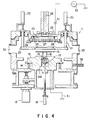
- Fig. 4 is a view showing one example of a plasma etching apparatus to which the present invention is applied.
- This apparatus comprises a processing chamber 11 whose inside is maintained to be substantially air-tight.
- the processing chamber 11 is formed of, for example aluminum the surface of which is anodized.
- the lower electrode 12 is formed of, for example, aluminum the surface of which is anodized.
- the lower electrode 12 there is formed a mounting section having a trapezoidal cross section in its central portion, and a object 15 to be processed, for example, a semiconductor wafer is mounted thereon.
- a surface portion of the electrode 12 except for the portion where the object is mounted are preferably coated with an insulating material, such as Teflon (trade name). Due to the coating, there can be improved a focus effect in which discharging concentrates on the object 15.
- the lower electrode 12 can be lifted by a lifer 13 with a maximum stroke of, for example, 30 mm.
- the airtight in the chamber 11 during lifting the lower electrode 12 is ensured by a bellows 14 made of, for example, stainless steel.
- a space 12a is formed in its central portion.
- a plurality of through holes (for example, four) which are through upward from the space 12a, and a lifter pin 16 made of, for example, stainless steel is inserted into each through hole.
- the lifer pin 16 is connected to a lift mechanism 18 via a plate 17.
- the lifter pin 16 is lifted by the drive of a lift mechanism 18.
- the lifter pin 16 moves up, so that the object 15 is separated from the lower electrode 12 to be in a transferable state.
- the lifter pin 16 moves down, so that the object 15 is mounted on the lower electrode 12.
- the lower electrode 12 and the plate 17 are connected to each other by a coil spring 19.
- a clamp ring 20 is provided above the lower electrode 12.
- the clamp ring 20 is used for uniformly pressing the object 15 to the surface of the lower electrode 12, and fixing the object 15 thereto.
- the central portion of the clamp ring 20 is shaped to correspond to the mounting portion of the lower electrode 12.
- the clamp ring 20 is formed of material having no influence on plasma, for example, aluminum the surface of which is anodized, quarts, and ceramic material such as alumina.
- the clamp ring 20 is held by a plurality of shafts 21 (for example four) which are airtightly through the upper portion of the chamber 11.
- Each shaft is connected to an independent driving mechanism such as an air cylinder 22, and each shaft moves up and down by the corresponding driving mechanism.
- the lower electrode 12 is moved up in a state that the object 15 is mounted on the lower electrode 12. Due to this, the object 15 is brought into contact with the clamp ring 20. Moreover, the lower electrode 12 is moved up, so that the clamp ring 20 clamps the object 15 by pressing force of the air cylinder 22. While necessary pressing force is maintained the clamp ring 20 can be further moved up to a predetermined height, for example, by 5 mm by adjusting the drive of the air cylinder 22.
- a conductive material 23 is provided at the top portion of the chamber 11.
- the conductive material 23 is formed of, for example, aluminum the surface of which is anodized.
- An upper electrode 24, which is electrically connected to the conductive material 23, is provided away from the conductive material 23 with a narrow space 25.
- the upper electrode 24 is formed of, for example, amolphous carbon, aluminum, or aluminum the surface of which is anodized.
- a gas supply pipe 26 communicates with a space 25.
- the gas supply pipe 26 introduces processing gas from a gas supply source (not shown), which is arranged in the outside of the chamber 11, together with carrier gas.
- processing gas there is used a gas containing oxygen or nitrogen is added to halogen element containing gas.
- oxygen or nitrogen may be added to halogen element containing gas after etching advances up to the portion near the SiO2 layer.
- baffles 27 In the space 25, there are formed a plurality of baffles 27 having a plurality of openings in order to uniformly diffuse gas.
- a plurality of holes 28 is formed in the upper electrode 24 in order to supply gas diffused by baffles 27 into the chamber 11.
- a high frequency power supply 30 is connected to the upper electrode 24 via a capacitor 31 and the conductive material 23, and the lower electrode 12 is earthed. High frequency power is supplied to these electrodes from the power supply 30, so that plasma of processing gas generates between the electrodes.
- a plasma mode is a mode which a radical etching is performed.
- the high voltage electrode is used as the lower electrode 12 and the upper electrode 24 is earthed, so that the mode can be in a reactant ion etching (RIE) mode.
- RIE reactant ion etching
- RF electric power whose phase differs at 180 degrees can be supplied between the upper electrode 24 and the lower electrode 12.
- magnetron etching type in which magnet is provided above or around the chamber 11, a crossed electromagnetic field is formed between the electrodes, and etching is performed. By use of magnet, etching treatment can be performed under a low pressure condition with high efficiency.
- a gas exhaust port 35 is formed in the lower side portion of the chamber 11, and the chamber 11 is exhausted from the gas exhaust port 35 by a vacuum pump (not shown).
- an inlet 32 for carrying in the object to be processed and an outlet 33 for carrying out the object are provided.
- load lock chambers 41 and 42 for carrying in and out are formed to be continuous to the inlet 32 and the outlet 33.
- These load lock chambers 41 and 42 have inlet and outlet side gates, respectively, and are able to be exhausted.
- one object to be processed is taken up by a sender (not shown) and inserted into the load lock chamber 41 for carrying in.
- the inlet side gate of the load lock chamber 41 is closed, and the inside thereof is exhausted.
- the outlet side gate is opened, and the object 15 is carried in the portion above the lower electrode 12 by a carrying-in mechanism (not shown).
- the lifter pin 16 is moved up and the object 15 is received at the top end of the lifter pin 16, and the carrying-in mechanism is retracted. Thereafter, the inside of the chamber 11 is made airtight.
- the lifter pin 16 is moved down, so that the object 15 is mounted on the lower electrode 12.
- the lower electrode 12 is moved up, and the surroundings of the object 15 is brought into contact with the clamp ring 20, and the object 15 is fixed to the clamp ring 20.
- the inside of the chamber 11 is exhausted, processing gas is introduced therein via the gas supply pipe 26 from the gas supply source, and the inside of the chamber is made to have a predetermined pressure, for example, 1 Torr or less.
- the lower electrode 12 After etching, as the inside of the chamber 11 is exhausted, the lower electrode 12 is moved down and the lifter pin 16 is moved up, and the object 15 is mounted thereon. Then, the object 15 is carried out via the load lock chamber 42 for carrying out by an carrying-out mechanism (not shown).
- Example 1 explains the case in which a semiconductor wafer is used as a object to be processed, and a polysilicon layer thereof is etched.
- the above-mentioned etching apparatus was used, and HCl of 200 SCCM and HBr of 30 SCCM, both serving as processing gas, were introduced to the chamber.
- the pressure of the inside of the chamber was set to be 50m Torr, and high frequency electric power of 225W was supplied between the electrodes from high frequency power supply of 13. 56 MHz, and a polysilicon layer (having a thickness of 3000 ⁇ ) of the semiconductor wafer was etched.
- the distance between the electrodes was set to be 0.6 cm.
- the etching treatment was made during the time in which the polysilicon layer was all etched in view of the calculation. Thereafter, oxygen or nitrogen containing gas such as O2, CO2, N2O were added to a processing gas at the various flow rates, respectively. An over-etching was performed for 60 min. under the same condition, and a residual portion of the polysilicon layer was removed. For comparison, there was an experiment in which oxygen or nitrogen containing gas is not added in over-etching, and the experimental result was shown in Table 1.
- the flow rate of oxygen or nitrogen containing gas was set to be 1, 3, 5, 10, and 15 SCCM.
- the etching rate of the base SiO2 layer was 120 ⁇ /min in the case in which O2, CO2, and N2O gases were not added.
- the etching rate of the SiO2 layer was reduced to 80 to 54 ⁇ /min even if the flow rate was 1 SCCM.
- the etching rate of the SiO2 layer was considerably reduced when these rates were 3 SCCM or more, and the etching rate of the SiO2 layer was 0 when the rate was 5 SCCM in the case of O2, N2O.
- these flow rates were 10 SCCM or more in the case of all gases, The etching rate of the SiO2 layer was 0.
- the etching rate of the polysilicon layer was about 2500 ⁇ /min.
- the selection ratio of silicon to the base SiO2 layer increased by these additive gases. Particularly, by adding gases at the rate of 3 SCCM or more, the selection rate of about 50 was increased to 100 to infinity.
- the etching shape was slightly deteriorated when the additive gas was 15 SCCM.
- the flow rate of additive gas was favorably 3 to 10 SCCM.
- the flow rate corresponds to the flow rate ratio of 1.3 to 4.2% to the flow rate of the processing gas.
- a curve A is a resist etching rate
- a curve B is an etching rate of the SiO2 layer
- a curve C is an etching rate of the polysilicon layer.
- a curve D is a selection ratio of the polysilicon layer to the SiO2 layer
- a curve E is a selection ratio of the polysilicon to the resist layer
- a curve F is uniformity of the polysilicon layer.
- HCl gas of 200 SCCM and HBr gas of 20 to 40 SCCM were favorably added in order to obtain a favorable etching having a high etching rate of polysilicon and a high selection ratio of the polysilicon layer to SiO2.
- Cl2 gas was used in place of the mixing gas of HCl and HBr as a processing gas.
- an apparatus of RIE type in which the high frequency electric power supply was connected to the lower electrode, and an etching was performed in a state that a magnetic field was applied to the semiconductor wafer in a horizontal direction.
- the flow rate of Cl2 serving as a processing gas was set to 100 SCCM, and the flow rate of O2 was changed in the range of 0 to 3 SCCM. These gases were introduced into the chamber, and the pressure of the chamber was set to 75 m Torr. Then, high frequency electric power of 150 W was supplied between the electrodes from the high frequency power supply of 13.56 MHz, and the polysilicon (having a thickness of 3000 ⁇ ) of the semiconductor wafer was etched.
- An applied magnetic field was set to about 100 gauss, and magnet for generating the magnetic field was rotated along the circumferential direction of the etching apparatus at 20 rpm.
- Table 2 shows an etching rate in each flow rate of O2, and a selection rate of polysilicon to SiO2, and the result is shown in Fig. 8.
- Fig. 8 also shows the etching rates of the polysilicon layer and the resist layer, a selection ratio to the resist layer, and uniformity of the resist layer.
- Table 2 Flow Rate of O2 SiO2 Etching Rate Selection Ratio (to SiO2) 0 SCCM 80 ⁇ /min 20 1 SCCM 70 ⁇ /min 36 3 SCCM 45 ⁇ /min 48
- the present invention relates to the etching method of the silicon content layer, and the etching method is not limited to the plasma etching using the opposing electrodes. It is needless to say that the other method in which, for example, an ECR is used, may be employed.
Landscapes
- Drying Of Semiconductors (AREA)
Applications Claiming Priority (2)
| Application Number | Priority Date | Filing Date | Title |
|---|---|---|---|
| JP3078317A JP2920848B2 (ja) | 1991-03-19 | 1991-03-19 | シリコン層のエッチング方法 |
| JP78317/91 | 1991-03-19 |
Publications (3)
| Publication Number | Publication Date |
|---|---|
| EP0504758A2 true EP0504758A2 (de) | 1992-09-23 |
| EP0504758A3 EP0504758A3 (en) | 1993-06-09 |
| EP0504758B1 EP0504758B1 (de) | 1997-06-18 |
Family
ID=13658565
Family Applications (1)
| Application Number | Title | Priority Date | Filing Date |
|---|---|---|---|
| EP92104397A Expired - Lifetime EP0504758B1 (de) | 1991-03-19 | 1992-03-13 | Plasma-Ätzverfahren einer Silizium enthaltenden Schicht |
Country Status (5)
| Country | Link |
|---|---|
| EP (1) | EP0504758B1 (de) |
| JP (1) | JP2920848B2 (de) |
| KR (1) | KR0175073B1 (de) |
| DE (1) | DE69220398T2 (de) |
| TW (1) | TW201847B (de) |
Cited By (3)
| Publication number | Priority date | Publication date | Assignee | Title |
|---|---|---|---|---|
| US6165375A (en) * | 1997-09-23 | 2000-12-26 | Cypress Semiconductor Corporation | Plasma etching method |
| EP1085563A3 (de) * | 1999-09-13 | 2001-09-19 | Motorola, Inc. | Verfahren zum Ätzen einer isolierenden Schicht und zum Herstellen eines Halbleiterelements |
| CN111508831A (zh) * | 2019-01-30 | 2020-08-07 | 东京毅力科创株式会社 | 蚀刻方法、等离子体处理装置和处理系统 |
Families Citing this family (2)
| Publication number | Priority date | Publication date | Assignee | Title |
|---|---|---|---|---|
| US6794294B1 (en) * | 1999-11-09 | 2004-09-21 | Koninklijke Philips Electronics N.V. | Etch process that resists notching at electrode bottom |
| US8679982B2 (en) * | 2011-08-26 | 2014-03-25 | Applied Materials, Inc. | Selective suppression of dry-etch rate of materials containing both silicon and oxygen |
Family Cites Families (7)
| Publication number | Priority date | Publication date | Assignee | Title |
|---|---|---|---|---|
| US4431477A (en) * | 1983-07-05 | 1984-02-14 | Matheson Gas Products, Inc. | Plasma etching with nitrous oxide and fluoro compound gas mixture |
| US4502915B1 (en) * | 1984-01-23 | 1998-11-03 | Texas Instruments Inc | Two-step plasma process for selective anisotropic etching of polycrystalline silicon without leaving residue |
| US4726879A (en) * | 1986-09-08 | 1988-02-23 | International Business Machines Corporation | RIE process for etching silicon isolation trenches and polycides with vertical surfaces |
| ATE177877T1 (de) * | 1986-12-19 | 1999-04-15 | Applied Materials Inc | Bromine-ätzverfahren für silizium |
| EP0328350B1 (de) * | 1988-02-09 | 1999-04-28 | Fujitsu Limited | Trockenätzen mit Wasserstoffbromid oder Brom |
| US5007982A (en) * | 1988-07-11 | 1991-04-16 | North American Philips Corporation | Reactive ion etching of silicon with hydrogen bromide |
| JP3004699B2 (ja) * | 1990-09-07 | 2000-01-31 | 東京エレクトロン株式会社 | プラズマ処理方法 |
-
1991
- 1991-03-19 JP JP3078317A patent/JP2920848B2/ja not_active Expired - Fee Related
-
1992
- 1992-03-12 TW TW081101894A patent/TW201847B/zh active
- 1992-03-13 DE DE69220398T patent/DE69220398T2/de not_active Expired - Fee Related
- 1992-03-13 EP EP92104397A patent/EP0504758B1/de not_active Expired - Lifetime
- 1992-03-18 KR KR1019920004453A patent/KR0175073B1/ko not_active Expired - Fee Related
Cited By (6)
| Publication number | Priority date | Publication date | Assignee | Title |
|---|---|---|---|---|
| US6165375A (en) * | 1997-09-23 | 2000-12-26 | Cypress Semiconductor Corporation | Plasma etching method |
| US6406640B1 (en) | 1997-09-23 | 2002-06-18 | Cypress Semiconductor Corporation | Plasma etching method |
| EP1085563A3 (de) * | 1999-09-13 | 2001-09-19 | Motorola, Inc. | Verfahren zum Ätzen einer isolierenden Schicht und zum Herstellen eines Halbleiterelements |
| SG93886A1 (en) * | 1999-09-13 | 2003-01-21 | Motorola Inc | Process for etching an insulating layer and forming a semiconductor device |
| CN111508831A (zh) * | 2019-01-30 | 2020-08-07 | 东京毅力科创株式会社 | 蚀刻方法、等离子体处理装置和处理系统 |
| CN111508831B (zh) * | 2019-01-30 | 2024-03-26 | 东京毅力科创株式会社 | 蚀刻方法、等离子体处理装置和处理系统 |
Also Published As
| Publication number | Publication date |
|---|---|
| JP2920848B2 (ja) | 1999-07-19 |
| EP0504758A3 (en) | 1993-06-09 |
| EP0504758B1 (de) | 1997-06-18 |
| KR920018858A (ko) | 1992-10-22 |
| DE69220398T2 (de) | 1997-11-06 |
| DE69220398D1 (de) | 1997-07-24 |
| JPH04290430A (ja) | 1992-10-15 |
| KR0175073B1 (ko) | 1999-04-01 |
| TW201847B (de) | 1993-03-11 |
Similar Documents
| Publication | Publication Date | Title |
|---|---|---|
| EP0776032B1 (de) | Plasma-Ätz-Verfahren | |
| US6828243B2 (en) | Apparatus and method for plasma treatment | |
| KR100582481B1 (ko) | 전자 디바이스 재료의 제조 방법 | |
| JP3535309B2 (ja) | 減圧処理装置 | |
| US7329609B2 (en) | Substrate processing method and substrate processing apparatus | |
| JP3121524B2 (ja) | エッチング装置 | |
| US5560804A (en) | Etching method for silicon containing layer | |
| US20030213561A1 (en) | Atmospheric pressure plasma processing reactor | |
| JP3808902B2 (ja) | プラズマエッチング方法 | |
| JP3204836B2 (ja) | プラズマ処理方法およびプラズマ処理装置 | |
| WO1992007377A1 (en) | Sacrificial metal etchback system | |
| KR20080038311A (ko) | 기판 처리 방법 및 기판 처리 장치 | |
| KR100966927B1 (ko) | 절연막의 제조 방법 및 반도체 장치의 제조 방법 | |
| KR100731331B1 (ko) | 드라이 에칭방법 | |
| US20080233764A1 (en) | Formation of Gate Insulation Film | |
| CN114639602A (zh) | 蚀刻方法和蚀刻装置 | |
| EP0504758A2 (de) | Plasma-Ätzverfahren einer Silizium enthaltenden Schicht | |
| JPH11168090A (ja) | 半導体製造方法 | |
| KR20010043300A (ko) | 플라즈마 에칭 방법 | |
| JP2000082698A (ja) | プラズマ処理装置 | |
| JPH09129611A (ja) | エッチング方法 | |
| JP2004128210A (ja) | プラズマドーピング方法及び装置 | |
| KR100551392B1 (ko) | 드라이 에칭방법 및 장치 | |
| KR100323598B1 (ko) | 플라즈마에칭방법 | |
| KR100246117B1 (ko) | 드라이 에칭 방법 |
Legal Events
| Date | Code | Title | Description |
|---|---|---|---|
| PUAI | Public reference made under article 153(3) epc to a published international application that has entered the european phase |
Free format text: ORIGINAL CODE: 0009012 |
|
| 17P | Request for examination filed |
Effective date: 19920313 |
|
| AK | Designated contracting states |
Kind code of ref document: A2 Designated state(s): DE FR GB IT NL |
|
| PUAL | Search report despatched |
Free format text: ORIGINAL CODE: 0009013 |
|
| AK | Designated contracting states |
Kind code of ref document: A3 Designated state(s): DE FR GB IT NL |
|
| 17Q | First examination report despatched |
Effective date: 19931210 |
|
| GRAG | Despatch of communication of intention to grant |
Free format text: ORIGINAL CODE: EPIDOS AGRA |
|
| GRAH | Despatch of communication of intention to grant a patent |
Free format text: ORIGINAL CODE: EPIDOS IGRA |
|
| RAP1 | Party data changed (applicant data changed or rights of an application transferred) |
Owner name: TOKYO ELECTRON LIMITED |
|
| RAP1 | Party data changed (applicant data changed or rights of an application transferred) |
Owner name: TOKYO ELECTRON LIMITED |
|
| GRAH | Despatch of communication of intention to grant a patent |
Free format text: ORIGINAL CODE: EPIDOS IGRA |
|
| GRAA | (expected) grant |
Free format text: ORIGINAL CODE: 0009210 |
|
| RBV | Designated contracting states (corrected) |
Designated state(s): DE GB |
|
| AK | Designated contracting states |
Kind code of ref document: B1 Designated state(s): DE GB |
|
| REF | Corresponds to: |
Ref document number: 69220398 Country of ref document: DE Date of ref document: 19970724 |
|
| PLBE | No opposition filed within time limit |
Free format text: ORIGINAL CODE: 0009261 |
|
| STAA | Information on the status of an ep patent application or granted ep patent |
Free format text: STATUS: NO OPPOSITION FILED WITHIN TIME LIMIT |
|
| 26N | No opposition filed | ||
| REG | Reference to a national code |
Ref country code: GB Ref legal event code: IF02 |
|
| PGFP | Annual fee paid to national office [announced via postgrant information from national office to epo] |
Ref country code: GB Payment date: 20020313 Year of fee payment: 11 |
|
| PG25 | Lapsed in a contracting state [announced via postgrant information from national office to epo] |
Ref country code: GB Free format text: LAPSE BECAUSE OF NON-PAYMENT OF DUE FEES Effective date: 20030313 |
|
| GBPC | Gb: european patent ceased through non-payment of renewal fee |
Effective date: 20030313 |
|
| PGFP | Annual fee paid to national office [announced via postgrant information from national office to epo] |
Ref country code: DE Payment date: 20050310 Year of fee payment: 14 |
|
| PG25 | Lapsed in a contracting state [announced via postgrant information from national office to epo] |
Ref country code: DE Free format text: LAPSE BECAUSE OF NON-PAYMENT OF DUE FEES Effective date: 20061003 |