EP0504368B1 - Vliesstoff mit wasserstrahlen verfestigt und verfahren zur herstellung - Google Patents
Vliesstoff mit wasserstrahlen verfestigt und verfahren zur herstellung Download PDFInfo
- Publication number
- EP0504368B1 EP0504368B1 EP91918188A EP91918188A EP0504368B1 EP 0504368 B1 EP0504368 B1 EP 0504368B1 EP 91918188 A EP91918188 A EP 91918188A EP 91918188 A EP91918188 A EP 91918188A EP 0504368 B1 EP0504368 B1 EP 0504368B1
- Authority
- EP
- European Patent Office
- Prior art keywords
- fibers
- nonwoven
- wood pulp
- synthetic fibers
- pct
- Prior art date
- Legal status (The legal status is an assumption and is not a legal conclusion. Google has not performed a legal analysis and makes no representation as to the accuracy of the status listed.)
- Expired - Lifetime
Links
- 238000004519 manufacturing process Methods 0.000 title claims description 7
- 229920002994 synthetic fiber Polymers 0.000 claims abstract description 28
- 238000000034 method Methods 0.000 claims abstract description 22
- 229920001131 Pulp (paper) Polymers 0.000 claims abstract description 18
- 239000008240 homogeneous mixture Substances 0.000 claims abstract description 6
- XLYOFNOQVPJJNP-UHFFFAOYSA-N water Substances O XLYOFNOQVPJJNP-UHFFFAOYSA-N 0.000 claims description 22
- 230000008569 process Effects 0.000 claims description 13
- 230000002745 absorbent Effects 0.000 claims description 12
- 239000002250 absorbent Substances 0.000 claims description 12
- 238000010438 heat treatment Methods 0.000 claims description 8
- 230000004927 fusion Effects 0.000 claims description 4
- 239000012209 synthetic fiber Substances 0.000 abstract description 23
- 239000000203 mixture Substances 0.000 abstract description 16
- 239000004744 fabric Substances 0.000 abstract description 12
- 238000002844 melting Methods 0.000 abstract description 7
- 230000008018 melting Effects 0.000 abstract description 7
- 239000000835 fiber Substances 0.000 description 54
- 239000004698 Polyethylene Substances 0.000 description 13
- 230000009102 absorption Effects 0.000 description 11
- 238000010521 absorption reaction Methods 0.000 description 11
- -1 polyethylene Polymers 0.000 description 10
- 238000012360 testing method Methods 0.000 description 10
- 239000004743 Polypropylene Substances 0.000 description 9
- 239000011230 binding agent Substances 0.000 description 8
- 239000007788 liquid Substances 0.000 description 8
- 239000004745 nonwoven fabric Substances 0.000 description 8
- 229920000573 polyethylene Polymers 0.000 description 7
- 239000004753 textile Substances 0.000 description 6
- 238000001035 drying Methods 0.000 description 5
- 239000004816 latex Substances 0.000 description 5
- 229920000126 latex Polymers 0.000 description 5
- 229920000728 polyester Polymers 0.000 description 5
- 229920001169 thermoplastic Polymers 0.000 description 5
- 239000004416 thermosoftening plastic Substances 0.000 description 5
- 230000000052 comparative effect Effects 0.000 description 3
- 238000005259 measurement Methods 0.000 description 3
- 239000002184 metal Substances 0.000 description 3
- 229920001155 polypropylene Polymers 0.000 description 3
- 230000000717 retained effect Effects 0.000 description 3
- 239000000126 substance Substances 0.000 description 3
- 230000015572 biosynthetic process Effects 0.000 description 2
- 238000003490 calendering Methods 0.000 description 2
- 229920002678 cellulose Polymers 0.000 description 2
- 239000001913 cellulose Substances 0.000 description 2
- 238000001816 cooling Methods 0.000 description 2
- 238000004049 embossing Methods 0.000 description 2
- 238000009434 installation Methods 0.000 description 2
- 230000014759 maintenance of location Effects 0.000 description 2
- 239000008267 milk Substances 0.000 description 2
- 235000013336 milk Nutrition 0.000 description 2
- 210000004080 milk Anatomy 0.000 description 2
- 238000003756 stirring Methods 0.000 description 2
- 239000000725 suspension Substances 0.000 description 2
- 229920013683 Celanese Polymers 0.000 description 1
- 241000876833 Emberizinae Species 0.000 description 1
- 102220632628 Immunoglobulin heavy variable 1-69_E22A_mutation Human genes 0.000 description 1
- 239000004166 Lanolin Substances 0.000 description 1
- 230000009471 action Effects 0.000 description 1
- 230000004888 barrier function Effects 0.000 description 1
- 238000007664 blowing Methods 0.000 description 1
- 230000006835 compression Effects 0.000 description 1
- 238000007906 compression Methods 0.000 description 1
- 238000007596 consolidation process Methods 0.000 description 1
- 238000007796 conventional method Methods 0.000 description 1
- 238000006073 displacement reaction Methods 0.000 description 1
- 239000002657 fibrous material Substances 0.000 description 1
- 239000012530 fluid Substances 0.000 description 1
- 239000011521 glass Substances 0.000 description 1
- 239000007970 homogeneous dispersion Substances 0.000 description 1
- 239000012943 hotmelt Substances 0.000 description 1
- 230000006872 improvement Effects 0.000 description 1
- 238000010348 incorporation Methods 0.000 description 1
- 229940039717 lanolin Drugs 0.000 description 1
- 235000019388 lanolin Nutrition 0.000 description 1
- 230000000737 periodic effect Effects 0.000 description 1
- 239000004033 plastic Substances 0.000 description 1
- 229920003023 plastic Polymers 0.000 description 1
- 230000009103 reabsorption Effects 0.000 description 1
- 102220215119 rs1060503548 Human genes 0.000 description 1
- 102200082881 rs33936254 Human genes 0.000 description 1
- 238000005507 spraying Methods 0.000 description 1
- 238000007725 thermal activation Methods 0.000 description 1
- 238000012549 training Methods 0.000 description 1
- 239000001993 wax Substances 0.000 description 1
- 239000002759 woven fabric Substances 0.000 description 1
Images



Classifications
-
- D—TEXTILES; PAPER
- D04—BRAIDING; LACE-MAKING; KNITTING; TRIMMINGS; NON-WOVEN FABRICS
- D04H—MAKING TEXTILE FABRICS, e.g. FROM FIBRES OR FILAMENTARY MATERIAL; FABRICS MADE BY SUCH PROCESSES OR APPARATUS, e.g. FELTS, NON-WOVEN FABRICS; COTTON-WOOL; WADDING ; NON-WOVEN FABRICS FROM STAPLE FIBRES, FILAMENTS OR YARNS, BONDED WITH AT LEAST ONE WEB-LIKE MATERIAL DURING THEIR CONSOLIDATION
- D04H1/00—Non-woven fabrics formed wholly or mainly of staple fibres or like relatively short fibres
- D04H1/40—Non-woven fabrics formed wholly or mainly of staple fibres or like relatively short fibres from fleeces or layers composed of fibres without existing or potential cohesive properties
- D04H1/44—Non-woven fabrics formed wholly or mainly of staple fibres or like relatively short fibres from fleeces or layers composed of fibres without existing or potential cohesive properties the fleeces or layers being consolidated by mechanical means, e.g. by rolling
- D04H1/46—Non-woven fabrics formed wholly or mainly of staple fibres or like relatively short fibres from fleeces or layers composed of fibres without existing or potential cohesive properties the fleeces or layers being consolidated by mechanical means, e.g. by rolling by needling or like operations to cause entanglement of fibres
- D04H1/48—Non-woven fabrics formed wholly or mainly of staple fibres or like relatively short fibres from fleeces or layers composed of fibres without existing or potential cohesive properties the fleeces or layers being consolidated by mechanical means, e.g. by rolling by needling or like operations to cause entanglement of fibres in combination with at least one other method of consolidation
- D04H1/49—Non-woven fabrics formed wholly or mainly of staple fibres or like relatively short fibres from fleeces or layers composed of fibres without existing or potential cohesive properties the fleeces or layers being consolidated by mechanical means, e.g. by rolling by needling or like operations to cause entanglement of fibres in combination with at least one other method of consolidation entanglement by fluid jet in combination with another consolidation means
-
- D—TEXTILES; PAPER
- D04—BRAIDING; LACE-MAKING; KNITTING; TRIMMINGS; NON-WOVEN FABRICS
- D04H—MAKING TEXTILE FABRICS, e.g. FROM FIBRES OR FILAMENTARY MATERIAL; FABRICS MADE BY SUCH PROCESSES OR APPARATUS, e.g. FELTS, NON-WOVEN FABRICS; COTTON-WOOL; WADDING ; NON-WOVEN FABRICS FROM STAPLE FIBRES, FILAMENTS OR YARNS, BONDED WITH AT LEAST ONE WEB-LIKE MATERIAL DURING THEIR CONSOLIDATION
- D04H1/00—Non-woven fabrics formed wholly or mainly of staple fibres or like relatively short fibres
- D04H1/40—Non-woven fabrics formed wholly or mainly of staple fibres or like relatively short fibres from fleeces or layers composed of fibres without existing or potential cohesive properties
- D04H1/54—Non-woven fabrics formed wholly or mainly of staple fibres or like relatively short fibres from fleeces or layers composed of fibres without existing or potential cohesive properties by welding together the fibres, e.g. by partially melting or dissolving
- D04H1/541—Composite fibres, e.g. sheath-core, sea-island or side-by-side; Mixed fibres
- D04H1/5412—Composite fibres, e.g. sheath-core, sea-island or side-by-side; Mixed fibres sheath-core
-
- D—TEXTILES; PAPER
- D04—BRAIDING; LACE-MAKING; KNITTING; TRIMMINGS; NON-WOVEN FABRICS
- D04H—MAKING TEXTILE FABRICS, e.g. FROM FIBRES OR FILAMENTARY MATERIAL; FABRICS MADE BY SUCH PROCESSES OR APPARATUS, e.g. FELTS, NON-WOVEN FABRICS; COTTON-WOOL; WADDING ; NON-WOVEN FABRICS FROM STAPLE FIBRES, FILAMENTS OR YARNS, BONDED WITH AT LEAST ONE WEB-LIKE MATERIAL DURING THEIR CONSOLIDATION
- D04H1/00—Non-woven fabrics formed wholly or mainly of staple fibres or like relatively short fibres
- D04H1/40—Non-woven fabrics formed wholly or mainly of staple fibres or like relatively short fibres from fleeces or layers composed of fibres without existing or potential cohesive properties
- D04H1/54—Non-woven fabrics formed wholly or mainly of staple fibres or like relatively short fibres from fleeces or layers composed of fibres without existing or potential cohesive properties by welding together the fibres, e.g. by partially melting or dissolving
- D04H1/541—Composite fibres, e.g. sheath-core, sea-island or side-by-side; Mixed fibres
- D04H1/5414—Composite fibres, e.g. sheath-core, sea-island or side-by-side; Mixed fibres side-by-side
-
- D—TEXTILES; PAPER
- D04—BRAIDING; LACE-MAKING; KNITTING; TRIMMINGS; NON-WOVEN FABRICS
- D04H—MAKING TEXTILE FABRICS, e.g. FROM FIBRES OR FILAMENTARY MATERIAL; FABRICS MADE BY SUCH PROCESSES OR APPARATUS, e.g. FELTS, NON-WOVEN FABRICS; COTTON-WOOL; WADDING ; NON-WOVEN FABRICS FROM STAPLE FIBRES, FILAMENTS OR YARNS, BONDED WITH AT LEAST ONE WEB-LIKE MATERIAL DURING THEIR CONSOLIDATION
- D04H1/00—Non-woven fabrics formed wholly or mainly of staple fibres or like relatively short fibres
- D04H1/40—Non-woven fabrics formed wholly or mainly of staple fibres or like relatively short fibres from fleeces or layers composed of fibres without existing or potential cohesive properties
- D04H1/54—Non-woven fabrics formed wholly or mainly of staple fibres or like relatively short fibres from fleeces or layers composed of fibres without existing or potential cohesive properties by welding together the fibres, e.g. by partially melting or dissolving
- D04H1/541—Composite fibres, e.g. sheath-core, sea-island or side-by-side; Mixed fibres
- D04H1/5418—Mixed fibres, e.g. at least two chemically different fibres or fibre blends
-
- D—TEXTILES; PAPER
- D04—BRAIDING; LACE-MAKING; KNITTING; TRIMMINGS; NON-WOVEN FABRICS
- D04H—MAKING TEXTILE FABRICS, e.g. FROM FIBRES OR FILAMENTARY MATERIAL; FABRICS MADE BY SUCH PROCESSES OR APPARATUS, e.g. FELTS, NON-WOVEN FABRICS; COTTON-WOOL; WADDING ; NON-WOVEN FABRICS FROM STAPLE FIBRES, FILAMENTS OR YARNS, BONDED WITH AT LEAST ONE WEB-LIKE MATERIAL DURING THEIR CONSOLIDATION
- D04H1/00—Non-woven fabrics formed wholly or mainly of staple fibres or like relatively short fibres
- D04H1/40—Non-woven fabrics formed wholly or mainly of staple fibres or like relatively short fibres from fleeces or layers composed of fibres without existing or potential cohesive properties
- D04H1/54—Non-woven fabrics formed wholly or mainly of staple fibres or like relatively short fibres from fleeces or layers composed of fibres without existing or potential cohesive properties by welding together the fibres, e.g. by partially melting or dissolving
- D04H1/542—Adhesive fibres
- D04H1/544—Olefin series
-
- D—TEXTILES; PAPER
- D04—BRAIDING; LACE-MAKING; KNITTING; TRIMMINGS; NON-WOVEN FABRICS
- D04H—MAKING TEXTILE FABRICS, e.g. FROM FIBRES OR FILAMENTARY MATERIAL; FABRICS MADE BY SUCH PROCESSES OR APPARATUS, e.g. FELTS, NON-WOVEN FABRICS; COTTON-WOOL; WADDING ; NON-WOVEN FABRICS FROM STAPLE FIBRES, FILAMENTS OR YARNS, BONDED WITH AT LEAST ONE WEB-LIKE MATERIAL DURING THEIR CONSOLIDATION
- D04H1/00—Non-woven fabrics formed wholly or mainly of staple fibres or like relatively short fibres
- D04H1/70—Non-woven fabrics formed wholly or mainly of staple fibres or like relatively short fibres characterised by the method of forming fleeces or layers, e.g. reorientation of fibres
- D04H1/74—Non-woven fabrics formed wholly or mainly of staple fibres or like relatively short fibres characterised by the method of forming fleeces or layers, e.g. reorientation of fibres the fibres being orientated, e.g. in parallel (anisotropic fleeces)
-
- Y—GENERAL TAGGING OF NEW TECHNOLOGICAL DEVELOPMENTS; GENERAL TAGGING OF CROSS-SECTIONAL TECHNOLOGIES SPANNING OVER SEVERAL SECTIONS OF THE IPC; TECHNICAL SUBJECTS COVERED BY FORMER USPC CROSS-REFERENCE ART COLLECTIONS [XRACs] AND DIGESTS
- Y10—TECHNICAL SUBJECTS COVERED BY FORMER USPC
- Y10T—TECHNICAL SUBJECTS COVERED BY FORMER US CLASSIFICATION
- Y10T156/00—Adhesive bonding and miscellaneous chemical manufacture
- Y10T156/10—Methods of surface bonding and/or assembly therefor
- Y10T156/1002—Methods of surface bonding and/or assembly therefor with permanent bending or reshaping or surface deformation of self sustaining lamina
- Y10T156/1007—Running or continuous length work
- Y10T156/1008—Longitudinal bending
- Y10T156/1011—Overedge bending or overedge folding
Definitions
- the invention relates to an absorbent nonwoven product consisting mainly of short absorbent fibers, such as wood pulp fibers, and of longer synthetic fibers, the nonwoven being obtained by hydraulic bonding.
- a suspension of fibers in water is produced from which a sheet is formed.
- various qualities of paper are obtained, including cellulose wadding. This one finds many applications like household paper, for the care of the body, the wiping, etc.
- the cellulose wadding presents a weak mechanical resistance especially in the wet state which does not allow its application in the field of industrial or household wiping for example.
- the fibers are suspended in a gas flow, and they are deposited in a sheet on a permeable fabric.
- a binder generally a latex
- This product has substantially the same applications as the latter.
- the incorporation of a binder such as latex has drawbacks. For example, it increases the rigidity of the product and can react chemically with the fluids with which it is likely to come into contact. This is particularly the case when it is desired to make wipes impregnated with a liquid such as toilet milk or the like.
- thermoplastic synthetic fibers which perform the function of binder by thermal activation.
- CHICOPEE thermoplastic synthetic fibers which perform the function of binder by thermal activation.
- CHICOPEE thermally bonded absorbent nonwoven whose density is low, less than 0.15 g / cm3 (0.06 g / cm3 according to the examples reported), and composed of absorbent fibers of the papermaking type mixed with synthetic fibers conjugated to two components: polyethylene and polyester.
- the manufacturing process consists in preparing a sheet from a homogeneous mixture of absorbent fibers and conjugated fibers; then subjecting it to a heat treatment in the mass, under low pressure, at a temperature sufficient to melt the polyethylene located on the surface of the synthetic fibers but not the polyester. In this way, after cooling, a low density nonwoven is obtained, the synthetic material component of which has retained its fibrous character.
- the fact that synthetic fibers retain their integrity is an important factor according to the patent for obtaining a product of high mass volume, with high absorption capacity.
- the envisaged applications consequently aim to use in particular as an absorbent body in hygiene articles, periodic towel for example.
- a consolidation post-treatment (calendering, embossing), or the association with another more resistant veil, seems necessary if one wishes to use this nonwoven in an application such as wiping where the mechanical stresses are great.
- Patent application EP 0326771 describes an absorbent and resistant nonwoven, composed of wood pulp fibers and textile fibers, free of any binder.
- This nonwoven is produced from one or more veils, previously formed by the wet method using the papermaking technique, and consisting of a homogeneous mixture of fibers containing 50 to 75% by weight of wood pulp and 25 to 50% by weight of synthetic fibers of textile length.
- the veil (s) have also been subjected to a binding treatment by water jets, known per se, with sufficient energy to form a relatively dense, uniform nonwoven fabric, with good cohesion of the fibers between them.
- US Patent 3620903 relates to a light nonwoven of the type bound by water jets, comprising at least 20% of synthetic fibers and up to 80% of paper fibers. It is noted that the grammage of the product is a maximum of 57 g / m 2 and that it is intended for a textile application. This product compares favorably in terms of resistance, appearance and drape with conventional textiles for clothing items.
- Patent EP 171 806 relates to a nonwoven, comprising at least 10% of conjugated fibers, bound by water jets and having undergone heating up to the partial melting temperature thereof.
- the other fibers can be any, synthetic or natural, short or long (6 to 50 mm).
- the invention relates to a method of manufacturing an absorbent nonwoven consisting of wood pulp fibers and synthetic fibers, using a binding treatment using water jets.
- the invention is characterized in that the binding treatment by water jets is carried out on a sheet, consisting of a homogeneous mixture of unbound fibers of wood pulp and synthetic fibers, hot-melt at least in part and of length less than 20 mm, formed by air flow and in that the nonwoven is then subjected to heating at a temperature sufficient to cause at least partial fusion of the synthetic fibers.
- the formation of the web is ensured by any conventional method known to those skilled in the art. It consists in preparing metered quantities, on the one hand of synthetic fibers by opening and individualizing them, on the other hand of paper fibers obtained by dry defibration of paper pulp; then driving them by air, suspended in an air flow in a cyclone type mixer for example. The homogeneous mixture resulting from the latter is then entrained, still in suspension in an air flow, towards a head for forming the sheet from which the fibers are deposited uniformly on a support fabric traveling at a determined continuous speed.
- the mixture produced will preferably comprise at least 70% by weight of wood pulp fibers, the remainder consisting of synthetic fibers.
- An advantageous mixture will be composed of 70 to 90% by weight of wood pulp fibers and 30 to 10% of synthetic fibers. If you introduce too little fiber synthetic in the mass of wood pulp fibers, it is difficult to obtain a homogeneous dispersion, and the grammage of the tablecloth lacks regularity. In addition, the subsequent binding is not carried out satisfactorily.
- Synthetic fibers can be of various natures; they will preferably have a length less than 20 mm and a titer between 1.2 and 3.3 dtex.
- the binding treatment by water jets is also known per se to those skilled in the art.
- An example of a process is described in patents US 3,485,706 (EVANS) or US 3,560,326 (BUNTING). It consists in passing through fine jets of high energy liquid through the fibrous sheet to be treated which is arranged by a support, in horizontal displacement, consisting of a perforated plate or else of a suitably chosen woven fabric. The intertwining of the fibers produced by the action of the water jets, leads to consolidating the sheet and gives it a textile appearance.
- the process allows the production of a nonwoven having a basis weight between 20 and 200 g / m 2 , preferably it will be 40 to 100 g / m 2 .
- the upper limit will depend on the ability of the water jets to cross the sheet and interleave the fibers.
- thermoplastic synthetic fibers and by subjecting the nonwoven, originating from the hydraulic bonding station, to a thermal bonding treatment by which the thermoplastic fibers are melted, partially at least, and ensure, after cooling , the formation of bonding zones between the fibers.
- these fibers are two-component fibers of which the one with the lowest melting point is at the surface. The heating temperature is determined so as to be sufficient to melt that of the two components which is at a lower melting point but not the other. These fibers thus allow a lower thermobonding temperature and the fibrous structure is preserved.
- the process therefore makes it possible to obtain a product having a textile appearance, absorbent, resistant to tearing, and therefore the surface does not tend to fluff. It can be used as a disposable or short-term product, as a household, industrial wiping cloth or in catering. By its absence of any chemical binder, it can serve as a support for impregnating liquids: toilet milk, lanolin, wax, etc., and can be used as an impregnated wipe. It can also be used in the medical, surgical, or hygienic field, if necessary, it is possible to subject the nonwoven to a chemical or mechanical softening post-treatment.
- FIG. 1 represents an installation allowing the implementation of the method of the invention.
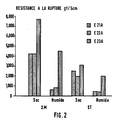
- Figures 2 and 3 are graphs illustrating the tensile strength of nonwovens obtained according to the method of the invention.
- FIG. 4 is a graph illustrating a comparative test with a dry bonded nonwoven by latex and a thermally bonded nonwoven.
- the installation shown in Figure 1 comprises a receiving station for synthetic fibers (2) with a loader to feed a card (4) necessary when the fibers must be opened.
- the card itself feeds a mixer (5) which can be of the cyclone type.
- the mixer is also supplied with wood pulp fibers from a station (3) for dry defibering of paper pulp which is delivered in the form of sheets in a roll.
- the fibers, intimately mixed in the cyclone, are suspended in an air flow which carries them towards a head for forming the sheet (6).
- It may be a device of the type described in patent application EP 032772 (SCANWEB), or an equivalent device.
- This consists of two rotary cylinders (61,62), parallel, perforated wall, and arranged transversely relative to an endless receiving fabric (8), which is itself permeable to air. Inside each cylinder, there is a rod (63) for stirring the fibers provided with fins rubbing against their internal wall when they are rotating.
- the fluidized fibrous material is introduced inside the cylinders (61, 62) by one end, and is sucked through their perforated wall by a depression generated by a vacuum box (10) disposed under the receiving fabric (8 ) opposite the training head (6).
- the stirring rods ensure the progression of the mass of fibers axially inside the cylinders, and help in the division of the aggregates possibly formed as well as in the passage of the fibers to the through walls.
- This station comprises an endless cloth (21) stretched horizontally between rollers (22), at least one of which is driven by suitable means.
- the mesh of the canvas made of metal or plastic threads, is chosen in particular according to the texture, open or not, desired for the nonwoven; a perforated continuous sheet is also suitable.
- the canvas conveys the sheet through a set of ramps of water jets oriented transversely to its direction of movement. The number of ramps depends on the chosen stage of pressures. In the example produced on equipment supplied by the Perfojet Company, there are four.
- the water jets are produced from tubular distributors (24,26,28,30), arranged across the top of the fabric.
- Each distributor feeds a ramp of 40 to 60 injectors consisting of a plate pierced with calibrated orifices.
- the distributors are supplied with pressurized water and deliver high energy water jets on the fibrous web. After having dissipated its energy through the tablecloth, the water is recovered by suction boxes (25,27,29,31) arranged under the fabric opposite each ramp.
- the sheet after having been tied, is wrung by passage over vacuum slots and is then drawn to a drying device (40).
- a drying device (40).
- the one shown in the figure is a through-blowing oven, the temperature of the heating gas of which can be adjusted so as to be able to ensure, in addition to drying, if necessary, the melting of the thermoplastic fibers contained in the sheet.
- the heating conditions in the oven were chosen so as to allow the drying of the nonwoven and the melting of the polyethylene of the synthetic fibers but not that of the polypropylenes In this way, the latter have retained their integrity, while ensuring the bonding of the fibers which are in contact with them.
- the measurements were made according to EDANA standards.
- the test for measuring the breaking strength 20.2-89 consists in subjecting the nonwoven to a tensile force at constant speed (100 mm / min) and in measuring the maximum load before breaking. The elongation corresponds to the extension of the sample measured at this point.
- the absorption capacity measurement test 10.1-72 consists in measuring, on the one hand, the time necessary for a nonwoven to be completely impregnated with a liquid, and on the other hand, the quantity of liquid absorbed during a determined time reduced to the weight of the nonwoven.
- polyethylene / polyester fibers such as those sold under the brand name CELANESE reference K 56 (uncrimped, 10 mm, 2.2 dtex) or else under the SOLSTAR brand (uncrimped, 10 mm, 2.2 dtex) or Polyester / polyester fibers as sold under the brand DUPONT reference 271P (uncrimped, 12 mm, 2.2 dtex) or under the brand UNITIKA reference Melty ( crimped, 10-15 mm, 1.5 / 2 dtex) or polyethylene / polypropylene fibers as sold under the brand DAIWABO reference NBF (uncrimped, 10 mm, 2 dtex).
- CELANESE reference K 56 uncrimped, 10 mm, 2.2 dtex
- SOLSTAR brand uncrimped, 10 mm, 2.2 dtex
- Polyester / polyester fibers as sold under the brand DUPONT reference 271P (uncrimped, 12 mm, 2.2 dtex) or under the brand UNITIKA reference Melty ( crimped
- fibers of the S / S type side / side
- polyethylene fiber sold under the brand STEEN reference Polysteen uncrimped, 12 mm, 2.8 dtex).
- Example 1 In the third case, the conditions of Example 1 were reproduced (tests E23A and E23B).
- the first E31 is a dry type product, the bond between the fibers was obtained by spraying with latex.
- the nonwoven contains 20% by weight of binder.
- the second E32 is a nonwoven, of the dry process type bonded by embossing, with a binder consisting of DANAKLON ESF thermoplastic fibers (see example 1) at a rate of 20%.
- the third E33 is a product produced under the conditions of Example 1 with mixture A.
- Example 1 obtained from mixtures D, E and F according to the process of the invention and a dry nonwoven bonded with latex (15%) as sold under the brand HOMECEL reference P050.
- the test consisted in particular in placing a sample on an absorption plate made of porous sintered glass through which it is moistened.
- the tray is connected by a flexible tube to a tank placed on a scale, and it can be moved along a vertical rail.
- the measurements are taken from the weight indications by the balance, the absorption capacity of the sample of which can be calculated in grams of liquid per gram of sample, after a determined time, and also the speed of initial absorption.
Landscapes
- Engineering & Computer Science (AREA)
- Textile Engineering (AREA)
- Mechanical Engineering (AREA)
- Nonwoven Fabrics (AREA)
- Adornments (AREA)
- Materials For Medical Uses (AREA)
- Absorbent Articles And Supports Therefor (AREA)
Claims (4)
- Verfahren zum Herstellen eines absorbierenden Nonwovens gebildet aus Fasern von Holzzellstoff und mehr als 30 % synthetischer Fasern, indem man eine an sich bekannte Bindungsbehandlung durch Wasserstrahlen ausführt, dadurch gekennzeichnet, daß die Bindungsbehandlung durch Wasserstrahlen auf einem Vlies vorgenommen wird, das von einer homogenen Mischung nicht verbundener Fasern aus Zellulose und von synthetischen, wärmeschmelzbaren Fasern mit zumindest teilweise einer Länge von weniger als 20 mm gebildet ist, das auf lufttechnischem Wege geformt ist, und daß danach das Nonwoven einer Erhitzung auf eine Temperatur unterworfen wird, die ausreichend ist, um eine zumindest teilweise Verschmelzung der synthetischen Fasern zur Folge zu haben.
- Verfahren gemäß einem der vorstehenden Ansprüche, dadurch gekennzeichnet, daß die synthetischen Fasern Bikomponentenfasern enthalten.
- Verfahren gemäß einem der vorstehenden Ansprüche, dadurch gekennzeichnet, daß das Nonwoven ein Flächengewicht enthalten zwischen 20 und 200 g/m2 und vorzugsweise von 30 und 100 g/m2 aufweist.
- Verfahren gemäß Anspruch 2, dadurch gekennzeichnet, daß die Temperatur ausreichend ist, um das Schmelzen der Komponente nach sich zu ziehen, deren Schmelztemperatur niedriger ist, aber nicht das Schmelzen der anderen Komponente.
Applications Claiming Priority (3)
| Application Number | Priority Date | Filing Date | Title |
|---|---|---|---|
| FR9012348 | 1990-10-08 | ||
| FR9012348A FR2667622B1 (fr) | 1990-10-08 | 1990-10-08 | Montisse lie hydrauliquement et son procede de fabrication. |
| PCT/FR1991/000783 WO1992006237A1 (fr) | 1990-10-08 | 1991-10-04 | Nontisse lie hydrauliquement et son procede de fabrication |
Publications (2)
| Publication Number | Publication Date |
|---|---|
| EP0504368A1 EP0504368A1 (de) | 1992-09-23 |
| EP0504368B1 true EP0504368B1 (de) | 1996-08-28 |
Family
ID=9400998
Family Applications (1)
| Application Number | Title | Priority Date | Filing Date |
|---|---|---|---|
| EP91918188A Expired - Lifetime EP0504368B1 (de) | 1990-10-08 | 1991-10-04 | Vliesstoff mit wasserstrahlen verfestigt und verfahren zur herstellung |
Country Status (7)
| Country | Link |
|---|---|
| US (1) | US5375306A (de) |
| EP (1) | EP0504368B1 (de) |
| AT (1) | ATE141964T1 (de) |
| CA (1) | CA2070773C (de) |
| DE (1) | DE69121694T2 (de) |
| FR (1) | FR2667622B1 (de) |
| WO (1) | WO1992006237A1 (de) |
Families Citing this family (37)
| Publication number | Priority date | Publication date | Assignee | Title |
|---|---|---|---|---|
| DE4444206A1 (de) * | 1994-12-13 | 1996-06-20 | Fleissner Maschf Gmbh Co | Verfahren und Vorrichtung zum Veredeln von Krempelvliesen |
| FI110326B (fi) * | 1995-06-06 | 2002-12-31 | Bki Holding Corp | Menetelmä kuitukankaan valmistamiseksi |
| US6419789B1 (en) † | 1996-10-11 | 2002-07-16 | Fort James Corporation | Method of making a non compacted paper web containing refined long fiber using a charge controlled headbox and a single ply towel made by the process |
| FR2761901B1 (fr) * | 1997-04-10 | 1999-05-14 | Valeo | Procede de realisation d'un dispositif de filtration et dispositif de filtration en particulier pour l'aeration et/ou la climatisation de locaux ou de vehicules |
| EP1023478B1 (de) | 1997-10-13 | 2011-03-02 | Oerlikon Textile GmbH & Co. KG | Anlage zur erzeugung eines faservlieses aus kunstoff und zellstoff fasern |
| JP2000034660A (ja) * | 1998-07-17 | 2000-02-02 | Uni Charm Corp | 湿式不織布の製造方法および製造装置 |
| FR2781818B1 (fr) * | 1998-07-31 | 2000-09-01 | Icbt Perfojet Sa | Procede pour la realisation d'un materiau non-tisse complexe et nouveau type de materiau ainsi obtenu |
| US6893522B1 (en) * | 1999-10-05 | 2005-05-17 | Polymer Group, Inc. | High bulk non-woven composite fabric |
| DE10001957A1 (de) * | 2000-01-18 | 2001-07-19 | Fleissner Maschf Gmbh Co | Verfahren und Vorrichtung zur Verfestigung eines nach dem Luftlegeverfahren hergestellten Vlieses |
| EP1268907B1 (de) * | 2000-01-20 | 2011-04-06 | Polymer Group, Inc. | Vliesstoff mit beständigem bild |
| US6534174B1 (en) * | 2000-08-21 | 2003-03-18 | The Procter & Gamble Company | Surface bonded entangled fibrous web and method of making and using |
| WO2002055774A2 (en) * | 2000-11-14 | 2002-07-18 | Weyerhaeuser Co | Crosslinked cellulosic product formed by extrusion process |
| AU2001219967A1 (en) * | 2000-12-19 | 2002-07-01 | M And J Fibretech A/S | Method and plant for without a base web producing an air-laid hydroentangled fibre web |
| US20040260034A1 (en) | 2003-06-19 | 2004-12-23 | Haile William Alston | Water-dispersible fibers and fibrous articles |
| US7892993B2 (en) | 2003-06-19 | 2011-02-22 | Eastman Chemical Company | Water-dispersible and multicomponent fibers from sulfopolyesters |
| US8513147B2 (en) | 2003-06-19 | 2013-08-20 | Eastman Chemical Company | Nonwovens produced from multicomponent fibers |
| BRPI0419263A (pt) * | 2004-12-29 | 2007-12-18 | Sca Hygiene Prod Ab | meios de fixação em forma de um cinto para um artigo absorvente |
| US8921244B2 (en) | 2005-08-22 | 2014-12-30 | The Procter & Gamble Company | Hydroxyl polymer fiber fibrous structures and processes for making same |
| US8852474B2 (en) | 2007-07-17 | 2014-10-07 | The Procter & Gamble Company | Process for making fibrous structures |
| US20090022983A1 (en) | 2007-07-17 | 2009-01-22 | David William Cabell | Fibrous structures |
| US10024000B2 (en) | 2007-07-17 | 2018-07-17 | The Procter & Gamble Company | Fibrous structures and methods for making same |
| US7972986B2 (en) | 2007-07-17 | 2011-07-05 | The Procter & Gamble Company | Fibrous structures and methods for making same |
| US8512519B2 (en) | 2009-04-24 | 2013-08-20 | Eastman Chemical Company | Sulfopolyesters for paper strength and process |
| CA2779719C (en) * | 2009-11-02 | 2014-05-27 | The Proctor & Gamble Company | Fibrous elements and fibrous structures employing same |
| AU2010313205B2 (en) * | 2009-11-02 | 2014-02-13 | The Procter & Gamble Company | Polypropylene fibrous elements and processes for making same |
| PL2496768T3 (pl) * | 2009-11-02 | 2015-12-31 | Procter & Gamble | Drobne kłaczki o włóknistych strukturach i sposoby ich wytwarzania |
| MX2012005111A (es) | 2009-11-02 | 2012-05-22 | Procter & Gamble | Estructuras fibrosas y metodos para elaborarlas. |
| GB2493292B (en) | 2010-03-31 | 2014-02-26 | Procter & Gamble | Fibrous structures |
| US9273417B2 (en) | 2010-10-21 | 2016-03-01 | Eastman Chemical Company | Wet-Laid process to produce a bound nonwoven article |
| US8840757B2 (en) | 2012-01-31 | 2014-09-23 | Eastman Chemical Company | Processes to produce short cut microfibers |
| CN102926131A (zh) * | 2012-10-08 | 2013-02-13 | 稳健实业(深圳)有限公司 | 一种手术巾及其生产方法 |
| TW201420054A (zh) * | 2012-11-21 | 2014-06-01 | Kang Na Hsiung Entpr Co Ltd | 吸濕用不織布及其製法 |
| US9303357B2 (en) | 2013-04-19 | 2016-04-05 | Eastman Chemical Company | Paper and nonwoven articles comprising synthetic microfiber binders |
| US9598802B2 (en) | 2013-12-17 | 2017-03-21 | Eastman Chemical Company | Ultrafiltration process for producing a sulfopolyester concentrate |
| US9605126B2 (en) | 2013-12-17 | 2017-03-28 | Eastman Chemical Company | Ultrafiltration process for the recovery of concentrated sulfopolyester dispersion |
| JP6269181B2 (ja) * | 2014-03-07 | 2018-01-31 | セイコーエプソン株式会社 | シート製造装置 |
| DE102015010105B4 (de) * | 2015-08-03 | 2017-08-24 | Sandler Ag | Dehnbarer Vliesstoff, Verfahren zur Herstellung eines dehnbaren Vliesstoffes und Verwendung desselben |
Family Cites Families (21)
| Publication number | Priority date | Publication date | Assignee | Title |
|---|---|---|---|---|
| NL70708C (de) * | 1941-03-01 | |||
| US2464301A (en) * | 1943-12-18 | 1949-03-15 | American Viscose Corp | Textile fibrous product |
| US3620903A (en) * | 1962-07-06 | 1971-11-16 | Du Pont | Lightweight nonpatterned nonwoven fabric |
| US4442161A (en) * | 1982-11-04 | 1984-04-10 | E. I. Du Pont De Nemours And Company | Woodpulp-polyester spunlaced fabrics |
| DE3403670A1 (de) * | 1984-02-03 | 1985-08-08 | Casimir Kast Gmbh & Co Kg, 7562 Gernsbach | Verfahren und anlage zum herstellen von fasermatten als ausgangsmaterial fuer pressformteile |
| JPS6147186A (ja) * | 1984-08-09 | 1986-03-07 | Chemo Sero Therapeut Res Inst | インフルエンザウイルスの精製方法 |
| EP0171806A3 (de) * | 1984-08-16 | 1987-06-16 | Chicopee | Bikomponentenfasern enthaltende, nichtgewobene verflochtene Stoffbahn und Verfahren zur Herstellung derselben |
| US4555430A (en) * | 1984-08-16 | 1985-11-26 | Chicopee | Entangled nonwoven fabric made of two fibers having different lengths in which the shorter fiber is a conjugate fiber in which an exposed component thereof has a lower melting temperature than the longer fiber and method of making same |
| US5017312A (en) * | 1984-12-27 | 1991-05-21 | The Coe Manufacturing Company | Oriented chopped fiber mats and method and apparatus for making same |
| US4661132A (en) * | 1985-08-15 | 1987-04-28 | Allied Corporation | Themally formed gradient density filter |
| US4767586A (en) * | 1986-01-13 | 1988-08-30 | Kimberly-Clark Corporation | Apparatus and method for forming a multicomponent integral laid fibrous web with discrete homogeneous compositional zones, and fibrous web produced thereby |
| US4808467A (en) * | 1987-09-15 | 1989-02-28 | James River Corporation Of Virginia | High strength hydroentangled nonwoven fabric |
| US4775579A (en) * | 1987-11-05 | 1988-10-04 | James River Corporation Of Virginia | Hydroentangled elastic and nonelastic filaments |
| US4902564A (en) * | 1988-02-03 | 1990-02-20 | James River Corporation Of Virginia | Highly absorbent nonwoven fabric |
| US4931355A (en) * | 1988-03-18 | 1990-06-05 | Radwanski Fred R | Nonwoven fibrous hydraulically entangled non-elastic coform material and method of formation thereof |
| DE3814996A1 (de) * | 1988-05-03 | 1989-11-16 | Kast Casimir Formteile | Verfahren zur herstellung einer fasermatte |
| JP2577977B2 (ja) * | 1988-10-28 | 1997-02-05 | チッソ株式会社 | 伸縮性不織布及びその製造方法 |
| EP0373974A3 (de) * | 1988-12-15 | 1990-09-05 | Fiberweb North America, Inc. | Verfahren zur Herstellung eines hochsaugfähigen, nichtgewebten Stoffes |
| US5229052A (en) * | 1990-02-23 | 1993-07-20 | Wellman Machinery Of Michigan, Inc. | Apparatus and method for applying multiple type fibers to a foraminous surface |
| US5088910A (en) * | 1990-03-14 | 1992-02-18 | Advanced Environmental Recycling Technologies, Inc. | System for making synthetic wood products from recycled materials |
| US5240764A (en) * | 1992-05-13 | 1993-08-31 | E. I. Du Pont De Nemours And Company | Process for making spunlaced nonwoven fabrics |
-
1990
- 1990-10-08 FR FR9012348A patent/FR2667622B1/fr not_active Expired - Lifetime
-
1991
- 1991-10-04 DE DE69121694T patent/DE69121694T2/de not_active Expired - Lifetime
- 1991-10-04 AT AT91918188T patent/ATE141964T1/de not_active IP Right Cessation
- 1991-10-04 CA CA002070773A patent/CA2070773C/fr not_active Expired - Lifetime
- 1991-10-04 US US07/852,262 patent/US5375306A/en not_active Expired - Lifetime
- 1991-10-04 WO PCT/FR1991/000783 patent/WO1992006237A1/fr not_active Ceased
- 1991-10-04 EP EP91918188A patent/EP0504368B1/de not_active Expired - Lifetime
Also Published As
| Publication number | Publication date |
|---|---|
| FR2667622B1 (fr) | 1994-10-07 |
| WO1992006237A1 (fr) | 1992-04-16 |
| EP0504368A1 (de) | 1992-09-23 |
| DE69121694T2 (de) | 1997-01-23 |
| CA2070773C (fr) | 2002-12-10 |
| US5375306A (en) | 1994-12-27 |
| CA2070773A1 (fr) | 1992-04-09 |
| DE69121694D1 (de) | 1996-10-02 |
| ATE141964T1 (de) | 1996-09-15 |
| FR2667622A1 (fr) | 1992-04-10 |
Similar Documents
| Publication | Publication Date | Title |
|---|---|---|
| EP0504368B1 (de) | Vliesstoff mit wasserstrahlen verfestigt und verfahren zur herstellung | |
| EP1117860B1 (de) | Verfahren zur herstellung von komplexen vliesen und hergestellte vliese | |
| EP1246958B1 (de) | Verfahren zur herstellung eines verbundvliesmaterials und hergestelltes material | |
| EP1192306B1 (de) | Verfahren zur herstellung eines vliesstoffes, anlage zur durchführung dieses verfahren, hergestellter vliesstoff | |
| EP1226297B1 (de) | Verfahren zur herstellung eines vliesstoffes mit hydrodynamischer vernadelung | |
| BE897109A (fr) | Etoffe de barrage impermeable et absorbante comportant des films et des nappes fibreuses et procede pour sa fabrication | |
| FR2705698A1 (fr) | Procédé de fabrication d'une nappe de non-tissé constituée de filaments continus liés entre eux et nappe ainsi obtenue. | |
| KR20010031362A (ko) | 부직 재료의 제조방법 | |
| WO2006118492A1 (en) | Hydroentangled integrated composite nonwoven material | |
| EP0826811B1 (de) | Absorbierender Verbundvliesstoff mit einer weichen Fläche und einer rauhen Fläche und Verfahren zur Herstellung | |
| CA2061805C (fr) | Textile d'entoilage composite et son procede de fabrication | |
| FR2588285A1 (fr) | Textile non tisse multicouche | |
| WO1978000012A1 (fr) | Materiau de garnissage fibreux et procede pour son obtention | |
| JP2002285466A (ja) | 不織材料の製造方法 | |
| US20030207636A1 (en) | Nonwoven laminate wiping product and proces for its manufacture | |
| CA2080487C (fr) | Procede d'impregnation d'une nappe textile | |
| FR2588286A1 (fr) | Voile non tisse ayant une douceur amelioree | |
| EP1027499B1 (de) | Heisssiegel-infusionspapier und verfahren zu seiner herstellung | |
| EP0371847B1 (de) | Verbundmaterial aus Mineralfasern, Anlage für die Erzeugung und Verwendung des Verbundmaterials | |
| US7290314B2 (en) | Method for producing a complex nonwoven fabric and resulting novel fabric | |
| WO2001053590A1 (en) | Nonwoven laminate wiping product and process for its manufacture | |
| FR2529918A1 (fr) | Procede pour la fabrication de non-tisses aiguilletes en fibres minerales, en particulier refractaires, et non-tisses realises selon ce procede | |
| EP0466563B1 (de) | Thermoplastischer Futterstoff aus Mikrofasern und Verfahren für die Herstellung | |
| WO1996023922A1 (fr) | Procede de traitement d'une nappe de fibres cellulosiques | |
| EP1851372B1 (de) | Imprägniertes faserpad |
Legal Events
| Date | Code | Title | Description |
|---|---|---|---|
| PUAI | Public reference made under article 153(3) epc to a published international application that has entered the european phase |
Free format text: ORIGINAL CODE: 0009012 |
|
| 17P | Request for examination filed |
Effective date: 19920603 |
|
| AK | Designated contracting states |
Kind code of ref document: A1 Designated state(s): AT BE CH DE DK ES FR GB GR IT LI LU NL SE |
|
| 17Q | First examination report despatched |
Effective date: 19941121 |
|
| GRAH | Despatch of communication of intention to grant a patent |
Free format text: ORIGINAL CODE: EPIDOS IGRA |
|
| GRAH | Despatch of communication of intention to grant a patent |
Free format text: ORIGINAL CODE: EPIDOS IGRA |
|
| RAP1 | Party data changed (applicant data changed or rights of an application transferred) |
Owner name: KAYSERSBERG |
|
| GRAA | (expected) grant |
Free format text: ORIGINAL CODE: 0009210 |
|
| RAP1 | Party data changed (applicant data changed or rights of an application transferred) |
Owner name: KAYSERSBERG |
|
| AK | Designated contracting states |
Kind code of ref document: B1 Designated state(s): AT BE CH DE DK ES FR GB GR IT LI LU NL SE |
|
| PG25 | Lapsed in a contracting state [announced via postgrant information from national office to epo] |
Ref country code: AT Effective date: 19960828 Ref country code: ES Free format text: THE PATENT HAS BEEN ANNULLED BY A DECISION OF A NATIONAL AUTHORITY Effective date: 19960828 Ref country code: GR Free format text: LAPSE BECAUSE OF FAILURE TO SUBMIT A TRANSLATION OF THE DESCRIPTION OR TO PAY THE FEE WITHIN THE PRESCRIBED TIME-LIMIT Effective date: 19960828 Ref country code: DK Effective date: 19960828 Ref country code: NL Free format text: LAPSE BECAUSE OF FAILURE TO SUBMIT A TRANSLATION OF THE DESCRIPTION OR TO PAY THE FEE WITHIN THE PRESCRIBED TIME-LIMIT Effective date: 19960828 |
|
| REF | Corresponds to: |
Ref document number: 141964 Country of ref document: AT Date of ref document: 19960915 Kind code of ref document: T |
|
| ITF | It: translation for a ep patent filed | ||
| GBT | Gb: translation of ep patent filed (gb section 77(6)(a)/1977) |
Effective date: 19960906 |
|
| REF | Corresponds to: |
Ref document number: 69121694 Country of ref document: DE Date of ref document: 19961002 |
|
| PG25 | Lapsed in a contracting state [announced via postgrant information from national office to epo] |
Ref country code: LI Effective date: 19961031 Ref country code: LU Free format text: LAPSE BECAUSE OF NON-PAYMENT OF DUE FEES Effective date: 19961031 Ref country code: BE Effective date: 19961031 Ref country code: CH Effective date: 19961031 |
|
| PG25 | Lapsed in a contracting state [announced via postgrant information from national office to epo] |
Ref country code: SE Effective date: 19961128 |
|
| NLV1 | Nl: lapsed or annulled due to failure to fulfill the requirements of art. 29p and 29m of the patents act | ||
| BERE | Be: lapsed |
Owner name: KAYSERSBERG Effective date: 19961031 |
|
| PLBQ | Unpublished change to opponent data |
Free format text: ORIGINAL CODE: EPIDOS OPPO |
|
| PLBI | Opposition filed |
Free format text: ORIGINAL CODE: 0009260 |
|
| REG | Reference to a national code |
Ref country code: CH Ref legal event code: PL |
|
| PLBF | Reply of patent proprietor to notice(s) of opposition |
Free format text: ORIGINAL CODE: EPIDOS OBSO |
|
| PLBF | Reply of patent proprietor to notice(s) of opposition |
Free format text: ORIGINAL CODE: EPIDOS OBSO |
|
| 26 | Opposition filed |
Opponent name: THE PROCTER & GAMBLE COMPANY Effective date: 19970528 |
|
| PLBF | Reply of patent proprietor to notice(s) of opposition |
Free format text: ORIGINAL CODE: EPIDOS OBSO |
|
| PLBF | Reply of patent proprietor to notice(s) of opposition |
Free format text: ORIGINAL CODE: EPIDOS OBSO |
|
| PLBQ | Unpublished change to opponent data |
Free format text: ORIGINAL CODE: EPIDOS OPPO |
|
| PLAB | Opposition data, opponent's data or that of the opponent's representative modified |
Free format text: ORIGINAL CODE: 0009299OPPO |
|
| RAP2 | Party data changed (patent owner data changed or rights of a patent transferred) |
Owner name: FORT JAMES FRANCE |
|
| R26 | Opposition filed (corrected) |
Opponent name: THE PROCTER & GAMBLE COMPANY Effective date: 19970528 |
|
| REG | Reference to a national code |
Ref country code: FR Ref legal event code: CJ Ref country code: FR Ref legal event code: CD |
|
| PLBO | Opposition rejected |
Free format text: ORIGINAL CODE: EPIDOS REJO |
|
| PLBN | Opposition rejected |
Free format text: ORIGINAL CODE: 0009273 |
|
| STAA | Information on the status of an ep patent application or granted ep patent |
Free format text: STATUS: OPPOSITION REJECTED |
|
| 27O | Opposition rejected |
Effective date: 19981130 |
|
| REG | Reference to a national code |
Ref country code: FR Ref legal event code: CD |
|
| REG | Reference to a national code |
Ref country code: GB Ref legal event code: IF02 |
|
| PLAB | Opposition data, opponent's data or that of the opponent's representative modified |
Free format text: ORIGINAL CODE: 0009299OPPO |
|
| PGFP | Annual fee paid to national office [announced via postgrant information from national office to epo] |
Ref country code: GB Payment date: 20090928 Year of fee payment: 19 |
|
| PGFP | Annual fee paid to national office [announced via postgrant information from national office to epo] |
Ref country code: DE Payment date: 20091118 Year of fee payment: 19 |
|
| PGFP | Annual fee paid to national office [announced via postgrant information from national office to epo] |
Ref country code: IT Payment date: 20091007 Year of fee payment: 19 Ref country code: FR Payment date: 20091201 Year of fee payment: 19 |
|
| GBPC | Gb: european patent ceased through non-payment of renewal fee |
Effective date: 20101004 |
|
| PG25 | Lapsed in a contracting state [announced via postgrant information from national office to epo] |
Ref country code: FR Free format text: LAPSE BECAUSE OF NON-PAYMENT OF DUE FEES Effective date: 20101102 |
|
| REG | Reference to a national code |
Ref country code: FR Ref legal event code: ST Effective date: 20110630 |
|
| PG25 | Lapsed in a contracting state [announced via postgrant information from national office to epo] |
Ref country code: GB Free format text: LAPSE BECAUSE OF NON-PAYMENT OF DUE FEES Effective date: 20101004 |
|
| REG | Reference to a national code |
Ref country code: DE Ref legal event code: R119 Ref document number: 69121694 Country of ref document: DE Effective date: 20110502 |
|
| PG25 | Lapsed in a contracting state [announced via postgrant information from national office to epo] |
Ref country code: IT Free format text: LAPSE BECAUSE OF NON-PAYMENT OF DUE FEES Effective date: 20101004 |
|
| PG25 | Lapsed in a contracting state [announced via postgrant information from national office to epo] |
Ref country code: DE Free format text: LAPSE BECAUSE OF NON-PAYMENT OF DUE FEES Effective date: 20110502 |