EP0482333B1 - Tisch mit beweglicher Arbeitsplatte - Google Patents
Tisch mit beweglicher Arbeitsplatte Download PDFInfo
- Publication number
- EP0482333B1 EP0482333B1 EP91115299A EP91115299A EP0482333B1 EP 0482333 B1 EP0482333 B1 EP 0482333B1 EP 91115299 A EP91115299 A EP 91115299A EP 91115299 A EP91115299 A EP 91115299A EP 0482333 B1 EP0482333 B1 EP 0482333B1
- Authority
- EP
- European Patent Office
- Prior art keywords
- worktop
- running strip
- table according
- running
- trestle
- Prior art date
- Legal status (The legal status is an assumption and is not a legal conclusion. Google has not performed a legal analysis and makes no representation as to the accuracy of the status listed.)
- Expired - Lifetime
Links
- 239000007787 solid Substances 0.000 claims description 8
- 239000002023 wood Substances 0.000 claims description 5
- 230000000295 complement effect Effects 0.000 claims description 3
- 230000000284 resting effect Effects 0.000 abstract 2
- 210000002414 leg Anatomy 0.000 description 8
- 230000007246 mechanism Effects 0.000 description 4
- 239000004033 plastic Substances 0.000 description 3
- 238000010276 construction Methods 0.000 description 2
- 230000006378 damage Effects 0.000 description 2
- 230000002349 favourable effect Effects 0.000 description 2
- 239000000463 material Substances 0.000 description 2
- 230000001364 causal effect Effects 0.000 description 1
- 239000011093 chipboard Substances 0.000 description 1
- 230000001419 dependent effect Effects 0.000 description 1
- 238000010586 diagram Methods 0.000 description 1
- 238000006073 displacement reaction Methods 0.000 description 1
- 230000000694 effects Effects 0.000 description 1
- 238000004880 explosion Methods 0.000 description 1
- 230000005484 gravity Effects 0.000 description 1
- 238000004519 manufacturing process Methods 0.000 description 1
- 239000002184 metal Substances 0.000 description 1
- 238000000034 method Methods 0.000 description 1
- 230000008092 positive effect Effects 0.000 description 1
- 238000003825 pressing Methods 0.000 description 1
- 210000000689 upper leg Anatomy 0.000 description 1
Images

Classifications
-
- B—PERFORMING OPERATIONS; TRANSPORTING
- B25—HAND TOOLS; PORTABLE POWER-DRIVEN TOOLS; MANIPULATORS
- B25H—WORKSHOP EQUIPMENT, e.g. FOR MARKING-OUT WORK; STORAGE MEANS FOR WORKSHOPS
- B25H1/00—Work benches; Portable stands or supports for positioning portable tools or work to be operated on thereby
- B25H1/14—Work benches; Portable stands or supports for positioning portable tools or work to be operated on thereby with provision for adjusting the bench top
- B25H1/18—Work benches; Portable stands or supports for positioning portable tools or work to be operated on thereby with provision for adjusting the bench top in inclination
-
- A—HUMAN NECESSITIES
- A47—FURNITURE; DOMESTIC ARTICLES OR APPLIANCES; COFFEE MILLS; SPICE MILLS; SUCTION CLEANERS IN GENERAL
- A47B—TABLES; DESKS; OFFICE FURNITURE; CABINETS; DRAWERS; GENERAL DETAILS OF FURNITURE
- A47B13/00—Details of tables or desks
- A47B13/08—Table tops; Rims therefor
- A47B13/081—Movable, extending, sliding table tops
-
- A—HUMAN NECESSITIES
- A47—FURNITURE; DOMESTIC ARTICLES OR APPLIANCES; COFFEE MILLS; SPICE MILLS; SUCTION CLEANERS IN GENERAL
- A47B—TABLES; DESKS; OFFICE FURNITURE; CABINETS; DRAWERS; GENERAL DETAILS OF FURNITURE
- A47B19/00—Reading-desks; Lecterns; Pulpits, i.e. free-standing
- A47B19/06—Reading-desks; Lecterns; Pulpits, i.e. free-standing with adjustable top leaf
-
- A—HUMAN NECESSITIES
- A47—FURNITURE; DOMESTIC ARTICLES OR APPLIANCES; COFFEE MILLS; SPICE MILLS; SUCTION CLEANERS IN GENERAL
- A47B—TABLES; DESKS; OFFICE FURNITURE; CABINETS; DRAWERS; GENERAL DETAILS OF FURNITURE
- A47B27/00—Drawing desks or tables; Carriers for drawing-boards
- A47B27/02—Adjustable drawing tables without balancing means
-
- A—HUMAN NECESSITIES
- A47—FURNITURE; DOMESTIC ARTICLES OR APPLIANCES; COFFEE MILLS; SPICE MILLS; SUCTION CLEANERS IN GENERAL
- A47B—TABLES; DESKS; OFFICE FURNITURE; CABINETS; DRAWERS; GENERAL DETAILS OF FURNITURE
- A47B85/00—Furniture convertible into other kinds of furniture
- A47B85/02—Tables convertible into drawing-desks
-
- A—HUMAN NECESSITIES
- A47—FURNITURE; DOMESTIC ARTICLES OR APPLIANCES; COFFEE MILLS; SPICE MILLS; SUCTION CLEANERS IN GENERAL
- A47B—TABLES; DESKS; OFFICE FURNITURE; CABINETS; DRAWERS; GENERAL DETAILS OF FURNITURE
- A47B2200/00—General construction of tables or desks
- A47B2200/0035—Tables or desks with features relating to adjustability or folding
- A47B2200/004—Top adjustment
- A47B2200/0044—Inclinable work surface around a mobile axis
Definitions
- the invention relates to a table with a movable worktop on a legged table frame, the worktop being displaceable in a horizontal plane with respect to the table frame in a track arrangement and being fixable from the horizontal plane into an angled position about a pivot point at the front end of the track arrangement by a locking element .
- Plastic drawing tables in particular nowadays have simple folding mechanisms that enable a certain inclination, for example by folding up the worktop and locking them with locking elements.
- tilting and folding devices according to the prior art there is a risk of failure of these elements evident, what came to be causal for the damage or the destruction of the tilting or folding mechanism with particularly heavy solid worktops or tables, eg solid wood.
- solid wood In the course of creating a healthy working environment, the use of natural materials such as solid wood is particularly desirable.
- the invention is based on the problem of developing a table with a movable worktop over the prior art so that even heavy solid worktops, in particular made of solid wood, with a certain inclination and in the horizontal relative to the support plane on the table frame are safe and at the same time easier and more energy-efficient Handling can be fixed in order to achieve ergonomically favorable working conditions for the user.
- the design should be as simple and economical to produce as possible.
- the table frame has on two opposite sides in each case a roller strip arrangement, which interacts positively with a ridge strip attached to the underside of the worktop and the roller strip arrangement is divided into two roller strip elements, one of which The roller bar element is fixedly mounted on the table frame, and the other roller bar element is rotatably articulated at a pivot point opposite the fixed roller bar element, the fixed roller bar element on its end facing the pivot point having an inclined bearing surface on which the movable roller bar element in the flat position of the worktop rests, and the ridge has a movable and supporting element on the underside which engages behind the holding and sliding element, which, when the worktop is in use, either under the fixed barrel Istenelement is arranged or rests on the sloping contact surface of the fixed roller element with tilting of the worktop.
- the worktop can be guided cleanly and precisely in a level position, as well as being effortless and easy to erect in a sliding / tilting process at a defined angle.
- a runner element located away from the seating position is firmly attached to the table support, e.g. connected by screws or other fastening means with, for example, a rear table leg and an intermediate element connecting the two table legs arranged on the respective narrow side.
- the tread element located at the front of the table can be folded upwards with its front end around its rear end, so that the rear end of the tread element is designed to be pivoted. Therefore, the tread bar element can serve with its front end in the folded-up state as a support for the worktop, wherein the worktop can assume such a steeply inclined position that it can serve as a drawing board.
- the ability of the running bar element to be folded down is avoided by holding it in its horizontal position, for example by means of a pin or another fixing element.
- the swivel joint can consist of a locking element, for example a rotary knob handle.
- the rear first roller bar element defines the sloping position of the inclined table top by its front side which faces the front of the table and slopes upwards from the bottom to the back of the table, or by its maximum height.
- the rear tread element it is expedient not only to provide the rear tread element with a slope, but also the front tread element on its side facing the back of the table with an incline which slopes downwards from the top to the front of the table, the slopes of the two tread elements of the respective Narrow side of the table are essentially complementary to each other.
- the two track strips can advantageously be produced from a single rectangular strip with a separating step.
- the slide rails it is possible to manufacture the slide rails from any suitable material, but in particular also from a plastic.
- the ridge strip has on its underside a profile which rises towards the front of the table and reinforces the ridge strip and which is optionally designed to rise in several stages.
- the worktop can be set at different angles or levels of inclination, both continuously with continuously inclined profiling or gradually with profiling in batches.
- the ridge bars which, in conjunction with the roller bar elements, ensure the simple and safe guidance of the worktop on the table frame, with elongated hole guides which extend parallel to the longitudinal groove in each ridge bar and which are connected to the longitudinal grooves.
- the elongated hole guides extend in their length from a region near the front of the table to approximately a region in the ridge rails corresponding to the end of the second roller element remote from the front of the table.
- the rear end of the elongated hole in the ridge must be at least as far from the front end of the elongated hole that at least the first rear track element when pushing in the worktop is completely released from the ridge bar. This is the only way to make the worktop tilt.
- the ridge strips are particularly conveniently connected to the worktop via a dovetail guide, as this ensures high stability of the overall construction.
- the entire work or table top is not designed to be displaceable or foldable, but rather only a cut-out part of the work or table top.
- a locking element is required in order to move the worktop from its foremost position, which is forced onto the front of the table top, into a fixed, self-supporting position.
- This advantageously engages through the elongated hole in the ridge bar and the second roller bar element into the table frame and thereby defines a perpendicular axis of rotation about the second roller bar, about which the second roller bar is pivotally arranged, while at the same time essentially stationary design of the second roller bar element coaxial to the ridge bar.
- the locking element expediently has a nut element, a bolt element and a locking handle, the bolt element extending through the elongated hole guide in the ridge bar and through the second running bar element into the table frame, being stored there by the nut element and at the same time at another end on the ridge bar the locking element can be locked.
- the locking element which can be designed, for example, as a toggle screw or twist grip, the worktop is held firmly and securely either in its flat or in its inclined position.
- the table with its movable worktop is made of solid wood. Basically, the table can also be made of pressed chipboard, plastic or metal.
- FIGS. 1 to 6 A particularly advantageous embodiment is explained on the basis of FIGS. 1 to 6 with reference to the reference numerals.
- the orientation in the description of the invention is based on the seating position of a person at the work table 1.
- the side of the work surface facing the seating position for example, is referred to as the front, the corresponding direction as near the front of the table. Similar definitions apply to the reverse direction.
- the two sides of the table that are not the front or back are referred to as the narrow sides of the table.
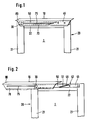
- FIG. 1 shows a work table 1 in a side view.
- This has a table frame 20 with table legs 21.
- the two visible table legs 21 are connected and stabilized in their upper region by a cross strut 22.
- the worktop 10 is arranged on the table frame 20, which can have a front bevelled end 80 and a rear bevelled end 81.
- a ridge bar 70 is provided parallel to the narrow side of the table 1, in which an elongated hole 75 can be seen.
- the elongated hole 75 extends from an area which corresponds to the front table leg 21 to an area located in the rear half of the ridge bar 70 with respect to the back of the table.
- the dashed line shows the two-part track bar 40 received by the ridge bar 70, which surrounds a first track bar element 45 near the rear of the table and a second track bar element 50 near the front of the table.
- the track bar elements 45, 50 are arranged parallel to the ridge bar 70 between the table frame 20 and ridge bar 70.
- the two-part roller track 40 is overall shorter than the narrow side of the work table 1.
- first roller element 45 is fixedly connected to the table frame 20, partly with a table leg 21 and partly with the cross strut 22 by means of two fastening elements or screw connections 47.
- FIG. 1 shows a locking element 60 which, in the flat basic position of the worktop 1 shown, engages through the outermost point of the elongated hole guide 75 in the ridge ledge 70 through the second running ledge element 50 into the table frame 20 or into the table leg 21 and the worktop 10 is fixed in its normal position shown in FIG. 1.
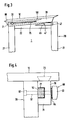
- FIGS. 4 and 5 The structure of a locking element 60 as well as the structure and fastening of a burr bar 70 can best be seen from FIGS. 4 and 5.
- the ridge bar 70 has a longitudinal groove 77 pointing towards the narrow table side. This is adapted in its profile to the roller bar 40.
- the longitudinal groove 77 extends over the entire length of the ridge bar 70.
- the lower side of the ridge bar 70 which also delimits the underside of the longitudinal groove 77, can optionally be provided.
- this part of the ridge bar 70 can be designed as a holding and driving element 71, for example by at least one pin which engages on the underside of the movable roller bar element 50 and thus forms the lower boundary of the longitudinal groove 77. In any case, it must be ensured that the movable track element 50 can fold down either in the advanced or retracted state of the worktop 10.
- the ridge bar 70 is preferably anchored in the underside of the worktop by means of a dovetail guide 73 in such a way that the longitudinal groove 77 precisely receives the running bar 40, both the distance between the ridge bar 70 and the table frame 20 and the distance from the worktop 10 to the runner 40 are precisely defined by this special arrangement and easy movement of the guided worktop 10 is made possible.
- the ridge bar 70 can have on its underside a profile that rises to the front of the table 1 and reinforces the ridge bar 70, which can be designed to rise in several stages, as indicated by the dash-dot line in FIG. 2.
- the locking element 60 has a nut element 61, a bolt element 62, a locking element 63, and advantageously at least one washer 64.
- the impact screw 61 shown is fastened on the opposite side of the table frame 20 which corresponds to the roller bar element 50.
- a screw bolt 62 in conjunction with the toggle screw 63 and a washer 64 allows the ridge bar 70 and thus the entire worktop 10 to be locked in the desired position.
- the locking element 60 is first released so far that the parts of the locking element accessible from the outside, for example the toggle screw or a grip element, exert the contact pressure exerted on the table frame 20, the second running bar element 50 and the burr bar 70 is canceled. Then the worktop can be pulled manually from the position shown in FIG. 1 into the position shown in FIG. 2 toward the front of the table using little force. The worktop is guided by the roller bars 40. The worktop must be moved at least so far forward in the direction of the front of the table relative to the table frame 20 that the first rear running bar element 45 is completely released from the burr bar 70.
- the worktop 10 is in the position shown in FIG. 2, the worktop is rotated at the pivot point 30 by gentle pressure on the top of the worktop in the area protruding from the worktop 20. With simultaneous exertion of downward and backward compressive force, the worktop 1 slides smoothly in the direction of the back of the table. The sliding movement of the table top 10 is guided by the running bars 50 and the burr bars 70. Since the first roller strip element 50, like the worktop 10, has been pivoted at the pivot point 30 about an axis of rotation, which is defined by the connecting line of the two screw bolts 62 facing each other, the ridge rail slides when the worktop is pushed back onto the inclined end face 46 of the first roller strip element 40.
- the worktop is raised in its rear region by the height of the runner 40, in particular the second runner element 45, while the front region of the worktop 10 remains at its original height.
- the maximum displacement distance of the worktop to the rear is in turn determined by the elongated hole 75 in the ridge bar 70 in cooperation with the locking element 60.
- the resulting inclination of the worktop can now be frozen again by actuating the locking element 60, ie by tightening the toggle screw 63.
- FIG. 6 shows a basic illustration of the possible directions of movement of the worktop 10 shown by the arrows, which can be taken individually or in combination with one another.
- This described construction enables easy, energy-saving and safe moving and inclining even heavy, solid worktops.
Landscapes
- Engineering & Computer Science (AREA)
- Mechanical Engineering (AREA)
- Workshop Equipment, Work Benches, Supports, Or Storage Means (AREA)
- Tables And Desks Characterized By Structural Shape (AREA)
- Constituent Portions Of Griding Lathes, Driving, Sensing And Control (AREA)
- Machine Tool Units (AREA)
- Automatic Analysis And Handling Materials Therefor (AREA)
- Forklifts And Lifting Vehicles (AREA)
- Accommodation For Nursing Or Treatment Tables (AREA)
- Electrical Discharge Machining, Electrochemical Machining, And Combined Machining (AREA)
- Bending Of Plates, Rods, And Pipes (AREA)
- Medicines Containing Antibodies Or Antigens For Use As Internal Diagnostic Agents (AREA)
- Peptides Or Proteins (AREA)
- Medicines Containing Material From Animals Or Micro-Organisms (AREA)
- Electric Cable Installation (AREA)
- Sewing Machines And Sewing (AREA)
Applications Claiming Priority (4)
| Application Number | Priority Date | Filing Date | Title |
|---|---|---|---|
| DE9014828U | 1990-10-26 | ||
| DE9014828U DE9014828U1 (de) | 1990-10-26 | 1990-10-26 | Tisch mit beweglicher Arbeitsplatte |
| DE4123240A DE4123240A1 (de) | 1990-10-26 | 1991-07-13 | Tisch mit beweglicher arbeitsplatte |
| DE4123240 | 1991-07-13 |
Publications (2)
| Publication Number | Publication Date |
|---|---|
| EP0482333A1 EP0482333A1 (de) | 1992-04-29 |
| EP0482333B1 true EP0482333B1 (de) | 1994-09-14 |
Family
ID=25905448
Family Applications (1)
| Application Number | Title | Priority Date | Filing Date |
|---|---|---|---|
| EP91115299A Expired - Lifetime EP0482333B1 (de) | 1990-10-26 | 1991-09-10 | Tisch mit beweglicher Arbeitsplatte |
Country Status (10)
| Country | Link |
|---|---|
| US (1) | US5172641A (da) |
| EP (1) | EP0482333B1 (da) |
| JP (1) | JPH0683687B2 (da) |
| AT (1) | ATE111316T1 (da) |
| CS (1) | CS321891A3 (da) |
| DE (2) | DE4123240A1 (da) |
| DK (1) | DK0482333T3 (da) |
| FI (1) | FI915038A7 (da) |
| HU (1) | HUT61886A (da) |
| NO (1) | NO172563C (da) |
Families Citing this family (35)
| Publication number | Priority date | Publication date | Assignee | Title |
|---|---|---|---|---|
| JP2700903B2 (ja) * | 1988-09-30 | 1998-01-21 | シャープ株式会社 | 液晶表示装置 |
| CH682294A5 (da) * | 1991-10-01 | 1993-08-31 | Mantel Embru Werke | |
| DE9209817U1 (de) * | 1992-07-22 | 1992-09-17 | Auer, Gerhard, 6791 Hermersberg | Tisch mit einer beweglichen Arbeitsplatte |
| US5483898A (en) * | 1994-02-24 | 1996-01-16 | Krueger International | Tilting and sliding surface assembly for a table |
| AT182U1 (de) * | 1994-06-06 | 1995-04-25 | Georg Meilinger Geor Meilinger | Unsichtbare gratverbindung |
| US6612666B1 (en) | 2001-11-16 | 2003-09-02 | Kathryn B. Berning | Craft work apparatus |
| US7690317B2 (en) * | 2003-03-19 | 2010-04-06 | Herman Miller, Inc. | Computer workstation with moveable monitor support |
| SE0400994L (sv) * | 2004-04-19 | 2005-11-01 | Implementum Service Ab | Anordning vid ett vippfritt bord |
| US7721658B2 (en) * | 2005-01-26 | 2010-05-25 | Herman Miller, Inc. | Computer workstation with movable monitor support |
| US20060252553A1 (en) * | 2005-05-09 | 2006-11-09 | Goode Larry S | Video game stand device |
| WO2006128218A1 (en) * | 2005-05-31 | 2006-12-07 | Life Order Design Pty Ltd. | Desk assembly |
| KR100701232B1 (ko) * | 2006-03-15 | 2007-03-29 | 주식회사 코아스웰 | 책상용 상판의 슬라이드 결합구조 |
| US7703488B1 (en) | 2006-04-14 | 2010-04-27 | Douglas Lawrence M | Through dovetailing jig assembly |
| US8371237B2 (en) * | 2008-07-30 | 2013-02-12 | Herman Miller, Inc. | Computer work station with moveable monitor support |
| USD644455S1 (en) | 2010-05-03 | 2011-09-06 | Steelcase Inc. | Table |
| USD644457S1 (en) | 2010-05-03 | 2011-09-06 | Steelcase Inc. | Table |
| US9210999B2 (en) | 2010-06-02 | 2015-12-15 | Steelcase Inc. | Frame type table assemblies |
| US8689705B2 (en) | 2010-06-02 | 2014-04-08 | Steelcase, Inc. | Reconfigurable table assemblies |
| US8667908B2 (en) | 2010-06-02 | 2014-03-11 | Steelcase Inc. | Frame type table assemblies |
| US9185974B2 (en) | 2010-06-02 | 2015-11-17 | Steelcase Inc. | Frame type workstation configurations |
| US8918933B2 (en) * | 2011-07-27 | 2014-12-30 | Baby Squared, Llc | Mobile feeding and changing table |
| RU2508035C1 (ru) * | 2012-08-31 | 2014-02-27 | Семен Абрамович Шмулевич | Функциональная одноместная школьная парта |
| US12376677B1 (en) | 2012-10-10 | 2025-08-05 | Steelcase Inc. | Ergonomic seating system, tilt-lock control and remote powering method and apparatus |
| US9010254B1 (en) * | 2013-10-04 | 2015-04-21 | Daniel W. Kyler | Door blocking desk |
| US9301599B1 (en) * | 2015-01-09 | 2016-04-05 | Rick Ritchie | Inclinable desk device |
| US9936800B2 (en) * | 2015-07-28 | 2018-04-10 | The Lovesac Company | Leisure seating workstation |
| CN105394949A (zh) * | 2015-11-09 | 2016-03-16 | 重庆文理学院 | 全自动多功能绘画桌 |
| WO2017197395A1 (en) | 2016-05-13 | 2017-11-16 | Steelcase Inc. | Multi-tiered workstation assembly |
| US10517392B2 (en) | 2016-05-13 | 2019-12-31 | Steelcase Inc. | Multi-tiered workstation assembly |
| CN106923504A (zh) * | 2017-03-23 | 2017-07-07 | 叶先 | 中学生几何学绘图板 |
| CN108789288A (zh) * | 2018-06-29 | 2018-11-13 | 聂超 | 一种机械设备用检修支架 |
| DE102018126099A1 (de) * | 2018-10-19 | 2020-04-23 | Kesseböhmer Produktions GmbH & Co. KG | Tisch |
| US11499909B2 (en) * | 2019-09-17 | 2022-11-15 | University of Alaska—Anchorage | Adjustable atmospheric corrosion test rack |
| DE102020204122A1 (de) | 2020-03-30 | 2021-09-30 | Sedus Stoll Aktiengesellschaft | Tisch und verfahren zur herstellung eines tischs |
| US11627799B2 (en) | 2020-12-04 | 2023-04-18 | Keith McRobert | Slidable work surface |
Family Cites Families (10)
| Publication number | Priority date | Publication date | Assignee | Title |
|---|---|---|---|---|
| US1560131A (en) * | 1923-02-12 | 1925-11-03 | Aaron M Achenbach | Desk |
| US1793709A (en) * | 1928-03-12 | 1931-02-24 | Sun Glow Ind Inc | Furniture |
| GB377598A (en) * | 1932-02-23 | 1932-07-28 | Educational Supply Ass Ltd | Improvements in and relating to scholars desks |
| US2027609A (en) * | 1935-03-25 | 1936-01-14 | Manville R Nelson | Folding table |
| US2194889A (en) * | 1938-01-21 | 1940-03-26 | Lisle Harold L De | Drafting means |
| US2686096A (en) * | 1951-10-20 | 1954-08-10 | Jr John B Barnes | Fastening means for furniture legs, frames, and tops |
| DE3301467C2 (de) * | 1983-01-18 | 1985-10-03 | Nixdorf Computer Ag, 4790 Paderborn | Trägeranordnung für ein Datensichtgerät |
| GB2168246B (en) * | 1984-12-11 | 1988-10-12 | Judy Valerie Cousins | Retractable table |
| US4781126A (en) * | 1987-08-24 | 1988-11-01 | Lochridge Edwin P | Adjustable desk-top assembly |
| DE3838763A1 (de) * | 1988-11-16 | 1990-05-23 | Veyhl Gmbh & Co | Tisch mit verstellbarer tischplatte |
-
1991
- 1991-07-13 DE DE4123240A patent/DE4123240A1/de not_active Ceased
- 1991-09-10 DE DE59102924T patent/DE59102924D1/de not_active Expired - Fee Related
- 1991-09-10 AT AT91115299T patent/ATE111316T1/de not_active IP Right Cessation
- 1991-09-10 EP EP91115299A patent/EP0482333B1/de not_active Expired - Lifetime
- 1991-09-10 DK DK91115299.9T patent/DK0482333T3/da active
- 1991-09-12 NO NO913597A patent/NO172563C/no unknown
- 1991-10-09 HU HU913197A patent/HUT61886A/hu unknown
- 1991-10-23 CS CS913218A patent/CS321891A3/cs unknown
- 1991-10-24 JP JP3305439A patent/JPH0683687B2/ja not_active Expired - Lifetime
- 1991-10-25 FI FI915038A patent/FI915038A7/fi not_active Application Discontinuation
- 1991-10-28 US US07/782,992 patent/US5172641A/en not_active Expired - Fee Related
Also Published As
| Publication number | Publication date |
|---|---|
| NO172563C (no) | 1993-08-11 |
| ATE111316T1 (de) | 1994-09-15 |
| JPH0670815A (ja) | 1994-03-15 |
| NO172563B (no) | 1993-05-03 |
| FI915038A0 (fi) | 1991-10-25 |
| DK0482333T3 (da) | 1995-03-27 |
| NO913597L (no) | 1992-04-27 |
| US5172641A (en) | 1992-12-22 |
| FI915038A7 (fi) | 1992-04-27 |
| DE4123240A1 (de) | 1992-04-30 |
| EP0482333A1 (de) | 1992-04-29 |
| NO913597D0 (no) | 1991-09-12 |
| CS321891A3 (en) | 1992-05-13 |
| DE59102924D1 (de) | 1994-10-20 |
| HUT61886A (en) | 1993-03-29 |
| HU913197D0 (en) | 1992-01-28 |
| JPH0683687B2 (ja) | 1994-10-26 |
Similar Documents
| Publication | Publication Date | Title |
|---|---|---|
| EP0482333B1 (de) | Tisch mit beweglicher Arbeitsplatte | |
| DE8690010U1 (de) | Vorrichtung zum Eindrehen von Schrauben mit Unterlegscheiben | |
| DE3705330A1 (de) | Tisch | |
| DE19945118A1 (de) | Sessel mit Aufstehhilfe | |
| DE3613005A1 (de) | Metalltisch | |
| DE3636979C2 (da) | ||
| EP0372398A2 (de) | Stehpult | |
| DE102019112984A1 (de) | Höhenverstellbarer Tisch | |
| EP3536191B1 (de) | Einstellbarer tisch | |
| EP0274569B1 (de) | Schreibtisch mit einer zusätzlichen Pultplatte | |
| EP0580077B1 (de) | Tisch mit einer beweglichen Arbeitsplatte | |
| DE9014828U1 (de) | Tisch mit beweglicher Arbeitsplatte | |
| DE19635635C1 (de) | Sitzmöbel | |
| DE3111920A1 (de) | Arbeitstisch mit hoehenverstellbarer tischplatte | |
| EP2596721B1 (de) | Stuhl und Sitz-Anordnung | |
| DE3202848C1 (de) | Fußstütze | |
| DE19616600A1 (de) | Tischsäge, insbesondere Tischkreissäge | |
| DE2401839C3 (de) | Ausziehtisch mit einer festen Mittelplatte, wenigstens einer Ausziehplatte und zwei Schlitten | |
| EP0986975A1 (de) | Traggestell, insbesondere für ein Bildschirmgerät | |
| DE19844240A1 (de) | Sessel mit Aufstehhilfe | |
| EP1068819A1 (de) | Schreibmöbel mit integrierter Fussstütze | |
| EP1813170B1 (de) | Sitz- oder Liegemöbel | |
| DE20011506U1 (de) | Sitzmöbel | |
| DE9012558U1 (de) | Couchliege | |
| DE10031997C2 (de) | Sitzmöbel |
Legal Events
| Date | Code | Title | Description |
|---|---|---|---|
| PUAI | Public reference made under article 153(3) epc to a published international application that has entered the european phase |
Free format text: ORIGINAL CODE: 0009012 |
|
| AK | Designated contracting states |
Kind code of ref document: A1 Designated state(s): AT BE CH DE DK ES FR GB GR IT LI LU NL SE |
|
| 17P | Request for examination filed |
Effective date: 19921006 |
|
| 17Q | First examination report despatched |
Effective date: 19931026 |
|
| RBV | Designated contracting states (corrected) |
Designated state(s): AT BE CH DE DK FR GB LI LU NL SE |
|
| GRAA | (expected) grant |
Free format text: ORIGINAL CODE: 0009210 |
|
| AK | Designated contracting states |
Kind code of ref document: B1 Designated state(s): AT BE CH DE DK FR GB LI LU NL SE |
|
| REF | Corresponds to: |
Ref document number: 111316 Country of ref document: AT Date of ref document: 19940915 Kind code of ref document: T |
|
| REF | Corresponds to: |
Ref document number: 59102924 Country of ref document: DE Date of ref document: 19941020 |
|
| ET | Fr: translation filed | ||
| GBT | Gb: translation of ep patent filed (gb section 77(6)(a)/1977) |
Effective date: 19941223 |
|
| EAL | Se: european patent in force in sweden |
Ref document number: 91115299.9 |
|
| REG | Reference to a national code |
Ref country code: DK Ref legal event code: T3 |
|
| PLBE | No opposition filed within time limit |
Free format text: ORIGINAL CODE: 0009261 |
|
| STAA | Information on the status of an ep patent application or granted ep patent |
Free format text: STATUS: NO OPPOSITION FILED WITHIN TIME LIMIT |
|
| 26N | No opposition filed | ||
| PG25 | Lapsed in a contracting state [announced via postgrant information from national office to epo] |
Ref country code: GB Effective date: 19950910 Ref country code: DK Effective date: 19950910 |
|
| REG | Reference to a national code |
Ref country code: DK Ref legal event code: EBP |
|
| PG25 | Lapsed in a contracting state [announced via postgrant information from national office to epo] |
Ref country code: SE Effective date: 19950911 |
|
| PG25 | Lapsed in a contracting state [announced via postgrant information from national office to epo] |
Ref country code: LU Free format text: LAPSE BECAUSE OF NON-PAYMENT OF DUE FEES Effective date: 19950930 Ref country code: BE Effective date: 19950930 |
|
| BERE | Be: lapsed |
Owner name: WASA MASSIVHOLZMOBEL G.M.B.H. Effective date: 19950930 |
|
| GBPC | Gb: european patent ceased through non-payment of renewal fee |
Effective date: 19950910 |
|
| PG25 | Lapsed in a contracting state [announced via postgrant information from national office to epo] |
Ref country code: FR Effective date: 19960531 |
|
| EUG | Se: european patent has lapsed |
Ref document number: 91115299.9 |
|
| REG | Reference to a national code |
Ref country code: FR Ref legal event code: ST |
|
| PGFP | Annual fee paid to national office [announced via postgrant information from national office to epo] |
Ref country code: AT Payment date: 19960919 Year of fee payment: 6 |
|
| PGFP | Annual fee paid to national office [announced via postgrant information from national office to epo] |
Ref country code: CH Payment date: 19960923 Year of fee payment: 6 |
|
| PGFP | Annual fee paid to national office [announced via postgrant information from national office to epo] |
Ref country code: NL Payment date: 19960930 Year of fee payment: 6 |
|
| PG25 | Lapsed in a contracting state [announced via postgrant information from national office to epo] |
Ref country code: AT Free format text: LAPSE BECAUSE OF NON-PAYMENT OF DUE FEES Effective date: 19970910 |
|
| PG25 | Lapsed in a contracting state [announced via postgrant information from national office to epo] |
Ref country code: LI Free format text: LAPSE BECAUSE OF NON-PAYMENT OF DUE FEES Effective date: 19970930 Ref country code: CH Free format text: LAPSE BECAUSE OF NON-PAYMENT OF DUE FEES Effective date: 19970930 |
|
| PG25 | Lapsed in a contracting state [announced via postgrant information from national office to epo] |
Ref country code: NL Free format text: LAPSE BECAUSE OF NON-PAYMENT OF DUE FEES Effective date: 19980401 |
|
| REG | Reference to a national code |
Ref country code: CH Ref legal event code: PL |
|
| NLV4 | Nl: lapsed or anulled due to non-payment of the annual fee |
Effective date: 19980401 |
|
| PGFP | Annual fee paid to national office [announced via postgrant information from national office to epo] |
Ref country code: DE Payment date: 19991117 Year of fee payment: 9 |
|
| PG25 | Lapsed in a contracting state [announced via postgrant information from national office to epo] |
Ref country code: DE Free format text: LAPSE BECAUSE OF NON-PAYMENT OF DUE FEES Effective date: 20010601 |