EP0467168A2 - Wässrige Zubereitungen aus Copolymerlatices und Polyisocyanat-Dispersionen - Google Patents
Wässrige Zubereitungen aus Copolymerlatices und Polyisocyanat-Dispersionen Download PDFInfo
- Publication number
- EP0467168A2 EP0467168A2 EP91111178A EP91111178A EP0467168A2 EP 0467168 A2 EP0467168 A2 EP 0467168A2 EP 91111178 A EP91111178 A EP 91111178A EP 91111178 A EP91111178 A EP 91111178A EP 0467168 A2 EP0467168 A2 EP 0467168A2
- Authority
- EP
- European Patent Office
- Prior art keywords
- polyisocyanate
- bis
- aqueous preparations
- groups
- group
- Prior art date
- Legal status (The legal status is an assumption and is not a legal conclusion. Google has not performed a legal analysis and makes no representation as to the accuracy of the status listed.)
- Withdrawn
Links
Classifications
-
- D—TEXTILES; PAPER
- D06—TREATMENT OF TEXTILES OR THE LIKE; LAUNDERING; FLEXIBLE MATERIALS NOT OTHERWISE PROVIDED FOR
- D06N—WALL, FLOOR, OR LIKE COVERING MATERIALS, e.g. LINOLEUM, OILCLOTH, ARTIFICIAL LEATHER, ROOFING FELT, CONSISTING OF A FIBROUS WEB COATED WITH A LAYER OF MACROMOLECULAR MATERIAL; FLEXIBLE SHEET MATERIAL NOT OTHERWISE PROVIDED FOR
- D06N3/00—Artificial leather, oilcloth or other material obtained by covering fibrous webs with macromolecular material, e.g. resins, rubber or derivatives thereof
- D06N3/12—Artificial leather, oilcloth or other material obtained by covering fibrous webs with macromolecular material, e.g. resins, rubber or derivatives thereof with macromolecular compounds obtained otherwise than by reactions only involving carbon-to-carbon unsaturated bonds, e.g. gelatine proteins
- D06N3/14—Artificial leather, oilcloth or other material obtained by covering fibrous webs with macromolecular material, e.g. resins, rubber or derivatives thereof with macromolecular compounds obtained otherwise than by reactions only involving carbon-to-carbon unsaturated bonds, e.g. gelatine proteins with polyurethanes
- D06N3/142—Artificial leather, oilcloth or other material obtained by covering fibrous webs with macromolecular material, e.g. resins, rubber or derivatives thereof with macromolecular compounds obtained otherwise than by reactions only involving carbon-to-carbon unsaturated bonds, e.g. gelatine proteins with polyurethanes mixture of polyurethanes with other resins in the same layer
- D06N3/144—Artificial leather, oilcloth or other material obtained by covering fibrous webs with macromolecular material, e.g. resins, rubber or derivatives thereof with macromolecular compounds obtained otherwise than by reactions only involving carbon-to-carbon unsaturated bonds, e.g. gelatine proteins with polyurethanes mixture of polyurethanes with other resins in the same layer with polyurethane and polymerisation products, e.g. acrylics, PVC
-
- C—CHEMISTRY; METALLURGY
- C08—ORGANIC MACROMOLECULAR COMPOUNDS; THEIR PREPARATION OR CHEMICAL WORKING-UP; COMPOSITIONS BASED THEREON
- C08G—MACROMOLECULAR COMPOUNDS OBTAINED OTHERWISE THAN BY REACTIONS ONLY INVOLVING UNSATURATED CARBON-TO-CARBON BONDS
- C08G18/00—Polymeric products of isocyanates or isothiocyanates
- C08G18/06—Polymeric products of isocyanates or isothiocyanates with compounds having active hydrogen
- C08G18/28—Polymeric products of isocyanates or isothiocyanates with compounds having active hydrogen characterised by the compounds used containing active hydrogen
- C08G18/40—High-molecular-weight compounds
- C08G18/62—Polymers of compounds having carbon-to-carbon double bonds
- C08G18/6216—Polymers of alpha-beta ethylenically unsaturated carboxylic acids or of derivatives thereof
-
- C—CHEMISTRY; METALLURGY
- C08—ORGANIC MACROMOLECULAR COMPOUNDS; THEIR PREPARATION OR CHEMICAL WORKING-UP; COMPOSITIONS BASED THEREON
- C08G—MACROMOLECULAR COMPOUNDS OBTAINED OTHERWISE THAN BY REACTIONS ONLY INVOLVING UNSATURATED CARBON-TO-CARBON BONDS
- C08G18/00—Polymeric products of isocyanates or isothiocyanates
- C08G18/06—Polymeric products of isocyanates or isothiocyanates with compounds having active hydrogen
- C08G18/70—Polymeric products of isocyanates or isothiocyanates with compounds having active hydrogen characterised by the isocyanates or isothiocyanates used
- C08G18/703—Isocyanates or isothiocyanates transformed in a latent form by physical means
- C08G18/705—Dispersions of isocyanates or isothiocyanates in a liquid medium
-
- C—CHEMISTRY; METALLURGY
- C08—ORGANIC MACROMOLECULAR COMPOUNDS; THEIR PREPARATION OR CHEMICAL WORKING-UP; COMPOSITIONS BASED THEREON
- C08G—MACROMOLECULAR COMPOUNDS OBTAINED OTHERWISE THAN BY REACTIONS ONLY INVOLVING UNSATURATED CARBON-TO-CARBON BONDS
- C08G18/00—Polymeric products of isocyanates or isothiocyanates
- C08G18/06—Polymeric products of isocyanates or isothiocyanates with compounds having active hydrogen
- C08G18/70—Polymeric products of isocyanates or isothiocyanates with compounds having active hydrogen characterised by the isocyanates or isothiocyanates used
- C08G18/72—Polyisocyanates or polyisothiocyanates
- C08G18/80—Masked polyisocyanates
-
- D—TEXTILES; PAPER
- D06—TREATMENT OF TEXTILES OR THE LIKE; LAUNDERING; FLEXIBLE MATERIALS NOT OTHERWISE PROVIDED FOR
- D06M—TREATMENT, NOT PROVIDED FOR ELSEWHERE IN CLASS D06, OF FIBRES, THREADS, YARNS, FABRICS, FEATHERS OR FIBROUS GOODS MADE FROM SUCH MATERIALS
- D06M11/00—Treating fibres, threads, yarns, fabrics or fibrous goods made from such materials, with inorganic substances or complexes thereof; Such treatment combined with mechanical treatment, e.g. mercerising
- D06M11/32—Treating fibres, threads, yarns, fabrics or fibrous goods made from such materials, with inorganic substances or complexes thereof; Such treatment combined with mechanical treatment, e.g. mercerising with oxygen, ozone, ozonides, oxides, hydroxides or percompounds; Salts derived from anions with an amphoteric element-oxygen bond
- D06M11/36—Treating fibres, threads, yarns, fabrics or fibrous goods made from such materials, with inorganic substances or complexes thereof; Such treatment combined with mechanical treatment, e.g. mercerising with oxygen, ozone, ozonides, oxides, hydroxides or percompounds; Salts derived from anions with an amphoteric element-oxygen bond with oxides, hydroxides or mixed oxides; with salts derived from anions with an amphoteric element-oxygen bond
- D06M11/45—Oxides or hydroxides of elements of Groups 3 or 13 of the Periodic Table; Aluminates
-
- D—TEXTILES; PAPER
- D06—TREATMENT OF TEXTILES OR THE LIKE; LAUNDERING; FLEXIBLE MATERIALS NOT OTHERWISE PROVIDED FOR
- D06M—TREATMENT, NOT PROVIDED FOR ELSEWHERE IN CLASS D06, OF FIBRES, THREADS, YARNS, FABRICS, FEATHERS OR FIBROUS GOODS MADE FROM SUCH MATERIALS
- D06M11/00—Treating fibres, threads, yarns, fabrics or fibrous goods made from such materials, with inorganic substances or complexes thereof; Such treatment combined with mechanical treatment, e.g. mercerising
- D06M11/32—Treating fibres, threads, yarns, fabrics or fibrous goods made from such materials, with inorganic substances or complexes thereof; Such treatment combined with mechanical treatment, e.g. mercerising with oxygen, ozone, ozonides, oxides, hydroxides or percompounds; Salts derived from anions with an amphoteric element-oxygen bond
- D06M11/36—Treating fibres, threads, yarns, fabrics or fibrous goods made from such materials, with inorganic substances or complexes thereof; Such treatment combined with mechanical treatment, e.g. mercerising with oxygen, ozone, ozonides, oxides, hydroxides or percompounds; Salts derived from anions with an amphoteric element-oxygen bond with oxides, hydroxides or mixed oxides; with salts derived from anions with an amphoteric element-oxygen bond
- D06M11/46—Oxides or hydroxides of elements of Groups 4 or 14 of the Periodic Table; Titanates; Zirconates; Stannates; Plumbates
-
- D—TEXTILES; PAPER
- D06—TREATMENT OF TEXTILES OR THE LIKE; LAUNDERING; FLEXIBLE MATERIALS NOT OTHERWISE PROVIDED FOR
- D06M—TREATMENT, NOT PROVIDED FOR ELSEWHERE IN CLASS D06, OF FIBRES, THREADS, YARNS, FABRICS, FEATHERS OR FIBROUS GOODS MADE FROM SUCH MATERIALS
- D06M11/00—Treating fibres, threads, yarns, fabrics or fibrous goods made from such materials, with inorganic substances or complexes thereof; Such treatment combined with mechanical treatment, e.g. mercerising
- D06M11/51—Treating fibres, threads, yarns, fabrics or fibrous goods made from such materials, with inorganic substances or complexes thereof; Such treatment combined with mechanical treatment, e.g. mercerising with sulfur, selenium, tellurium, polonium or compounds thereof
- D06M11/55—Treating fibres, threads, yarns, fabrics or fibrous goods made from such materials, with inorganic substances or complexes thereof; Such treatment combined with mechanical treatment, e.g. mercerising with sulfur, selenium, tellurium, polonium or compounds thereof with sulfur trioxide; with sulfuric acid or thiosulfuric acid or their salts
- D06M11/56—Sulfates or thiosulfates other than of elements of Groups 3 or 13 of the Periodic Table
-
- D—TEXTILES; PAPER
- D06—TREATMENT OF TEXTILES OR THE LIKE; LAUNDERING; FLEXIBLE MATERIALS NOT OTHERWISE PROVIDED FOR
- D06M—TREATMENT, NOT PROVIDED FOR ELSEWHERE IN CLASS D06, OF FIBRES, THREADS, YARNS, FABRICS, FEATHERS OR FIBROUS GOODS MADE FROM SUCH MATERIALS
- D06M15/00—Treating fibres, threads, yarns, fabrics, or fibrous goods made from such materials, with macromolecular compounds; Such treatment combined with mechanical treatment
- D06M15/19—Treating fibres, threads, yarns, fabrics, or fibrous goods made from such materials, with macromolecular compounds; Such treatment combined with mechanical treatment with synthetic macromolecular compounds
- D06M15/37—Macromolecular compounds obtained otherwise than by reactions only involving carbon-to-carbon unsaturated bonds
- D06M15/564—Polyureas, polyurethanes or other polymers having ureide or urethane links; Precondensation products forming them
-
- D—TEXTILES; PAPER
- D06—TREATMENT OF TEXTILES OR THE LIKE; LAUNDERING; FLEXIBLE MATERIALS NOT OTHERWISE PROVIDED FOR
- D06M—TREATMENT, NOT PROVIDED FOR ELSEWHERE IN CLASS D06, OF FIBRES, THREADS, YARNS, FABRICS, FEATHERS OR FIBROUS GOODS MADE FROM SUCH MATERIALS
- D06M15/00—Treating fibres, threads, yarns, fabrics, or fibrous goods made from such materials, with macromolecular compounds; Such treatment combined with mechanical treatment
- D06M15/693—Treating fibres, threads, yarns, fabrics, or fibrous goods made from such materials, with macromolecular compounds; Such treatment combined with mechanical treatment with natural or synthetic rubber, or derivatives thereof
-
- D—TEXTILES; PAPER
- D06—TREATMENT OF TEXTILES OR THE LIKE; LAUNDERING; FLEXIBLE MATERIALS NOT OTHERWISE PROVIDED FOR
- D06M—TREATMENT, NOT PROVIDED FOR ELSEWHERE IN CLASS D06, OF FIBRES, THREADS, YARNS, FABRICS, FEATHERS OR FIBROUS GOODS MADE FROM SUCH MATERIALS
- D06M23/00—Treatment of fibres, threads, yarns, fabrics or fibrous goods made from such materials, characterised by the process
- D06M23/04—Processes in which the treating agent is applied in the form of a foam
-
- D—TEXTILES; PAPER
- D06—TREATMENT OF TEXTILES OR THE LIKE; LAUNDERING; FLEXIBLE MATERIALS NOT OTHERWISE PROVIDED FOR
- D06N—WALL, FLOOR, OR LIKE COVERING MATERIALS, e.g. LINOLEUM, OILCLOTH, ARTIFICIAL LEATHER, ROOFING FELT, CONSISTING OF A FIBROUS WEB COATED WITH A LAYER OF MACROMOLECULAR MATERIAL; FLEXIBLE SHEET MATERIAL NOT OTHERWISE PROVIDED FOR
- D06N3/00—Artificial leather, oilcloth or other material obtained by covering fibrous webs with macromolecular material, e.g. resins, rubber or derivatives thereof
- D06N3/04—Artificial leather, oilcloth or other material obtained by covering fibrous webs with macromolecular material, e.g. resins, rubber or derivatives thereof with macromolecular compounds obtained by reactions only involving carbon-to-carbon unsaturated bonds
-
- D—TEXTILES; PAPER
- D06—TREATMENT OF TEXTILES OR THE LIKE; LAUNDERING; FLEXIBLE MATERIALS NOT OTHERWISE PROVIDED FOR
- D06M—TREATMENT, NOT PROVIDED FOR ELSEWHERE IN CLASS D06, OF FIBRES, THREADS, YARNS, FABRICS, FEATHERS OR FIBROUS GOODS MADE FROM SUCH MATERIALS
- D06M2101/00—Chemical constitution of the fibres, threads, yarns, fabrics or fibrous goods made from such materials, to be treated
- D06M2101/02—Natural fibres, other than mineral fibres
- D06M2101/04—Vegetal fibres
- D06M2101/06—Vegetal fibres cellulosic
-
- D—TEXTILES; PAPER
- D06—TREATMENT OF TEXTILES OR THE LIKE; LAUNDERING; FLEXIBLE MATERIALS NOT OTHERWISE PROVIDED FOR
- D06M—TREATMENT, NOT PROVIDED FOR ELSEWHERE IN CLASS D06, OF FIBRES, THREADS, YARNS, FABRICS, FEATHERS OR FIBROUS GOODS MADE FROM SUCH MATERIALS
- D06M2101/00—Chemical constitution of the fibres, threads, yarns, fabrics or fibrous goods made from such materials, to be treated
- D06M2101/16—Synthetic fibres, other than mineral fibres
- D06M2101/18—Synthetic fibres consisting of macromolecular compounds obtained by reactions only involving carbon-to-carbon unsaturated bonds
-
- D—TEXTILES; PAPER
- D06—TREATMENT OF TEXTILES OR THE LIKE; LAUNDERING; FLEXIBLE MATERIALS NOT OTHERWISE PROVIDED FOR
- D06M—TREATMENT, NOT PROVIDED FOR ELSEWHERE IN CLASS D06, OF FIBRES, THREADS, YARNS, FABRICS, FEATHERS OR FIBROUS GOODS MADE FROM SUCH MATERIALS
- D06M2101/00—Chemical constitution of the fibres, threads, yarns, fabrics or fibrous goods made from such materials, to be treated
- D06M2101/16—Synthetic fibres, other than mineral fibres
- D06M2101/30—Synthetic polymers consisting of macromolecular compounds obtained otherwise than by reactions only involving carbon-to-carbon unsaturated bonds
- D06M2101/32—Polyesters
Definitions
- the invention further relates to a process for the preparation of these aqueous preparations and their use as coating compositions for woven and non-woven substrates.
- Coating agents or binders for substrates have the task of giving the substrate improved properties for use.
- the main tasks of a binder are to increase the mechanical strength without significantly changing the stiffness and to reduce the sensitivity to water, i.e. the increase in wet strength.
- Stable systems can be formulated if the polyisocyanates are first reacted with a monofunctional reaction partner.
- the adducts obtained are referred to as blocked or blocked isocyanates if they are less thermostable than the products of the crosslinking reaction which is later intended on the fabric or substrate.
- the capping agent is split off under the action of heat and the polyisocyanate forms the more thermally stable bond when crosslinked.
- Reference DE-A 24 54 253 (2) represents an example of such a development. It describes copolymers of acrylate and / or vinylidene monomers which are prepared by block, suspension, solution or emulsion polymerization of ethylenically unsaturated blocked aromatic diisocyanates will. Oxime, benzimidazole, pyrazoles, benzotriazoles, caprolactam, thiocaprolactam and p-nitroaniline serve as blocking agents for the isocyanate groups. The required wet strength is achieved by crosslinking or vulcanizing these copolymers.
- This method has the disadvantage that the ethylenically unsaturated blocked isocyanates have to be prepared in a complex three-stage process, with all the problems of intermediate insulation, cleaning and process optimization. Furthermore, the stability of these blocked isocyanates is crucial for the reactivity (crosslinking effectiveness) and for the storage stability. Above all, technical and economic disadvantages of such formulations are caused by the capping agent which is split off and which, if it remains in the crosslinked mass, changes its properties or, if it evaporates, has to be recovered or at least removed from the exhaust air.
- EP-A 204 970 (3) relates to a process for producing stable dispersions of finely divided polyisocyanates.
- EP-B 212 511 (4) describes the use of such stable polyisocyanate dispersions as crosslinking agents in textile pigment printing pastes and dyeing liquors.
- the present invention was based on the object of providing coating compositions for woven and non-woven substrates on an aqueous basis which no longer have the disadvantages of the prior art described.
- Groups which are reactive with isocyanates are essentially groups with acidic hydrogen atoms, in particular here the hydroxyl, amino, carboxyl and carboxyamido group to call.
- Examples of compounds Ia are acrylic acid, methacrylic acid, crotonic acid, 2-hydroxyethyl acrylate, 2- Hydroxyethyl methacrylate, 3-hydroxypropyl acrylate, 3-hydroxypropyl methacrylate, 2-aminoethyl acrylate, 2-aminoethyl methacrylate, 3-aminopropyl acrylate, 3-aminopropyl methacrylate, acrylic acid amide, methacrylic acid amide, N- (2-hydroxyethyl) acrylic acid amide and N- (3-hydroxypropyl amide).
- Examples of compounds Ib are maleic acid, fumaric acid, itaconic acid, maleic anhydride and itaconic anhydride, furthermore maleic acid monomethyl ester, maleic acid monoethyl ester, maleic acid monobutyl ester, maleic acid mono-2-ethylhexyl ester, maleic acid monodecyl ester, maleic acid monododesteryl malonate acid, maleic monoesteroate, maleinic acid ester malonate acid
- Examples of compounds Ila are methyl acrylate, ethyl acrylate, propyl acrylate, Acrylklareisopropylester, butyl acrylate, isobutyl acrylate, acrylic acid sec-butyl ester, acrylic acid tert-butyl ester, Acrylklarepentylester, Acrylklareisopentylester, Acrylklareneopentylester, Acrylklarenonylester, Acrylklareisononylester, Acrylklaredecylester, dodecyl acrylate, cyclohexyl acrylate, Acrylklarecyclopentadienylester and Acrylklareadamantylester and the corresponding methacrylic acid esters.
- Examples of compounds IIb are vinyl formate, vinyl acetate and vinyl propionate.
- Examples of compounds IIc are styrene and alkyl-substituted styrenes such as 2-methyl and 4-methylstyrene.
- Examples of compounds Ild are 1-butene, 2-butene, isoprene and butadiene.
- T G glass transition temperature
- hydrophobic comonomers (b) are used or also used, for example tert-butyl methacrylate, n-butyl methacrylate or 2-ethylhexyl acrylate. Cyclopentadienyl or adamantylacrylates or methacrylates also have a favorable effect on water resistance.
- the synthetic resin A can be constructed from one or more of the monomer components (a) and (b). It may be advantageous to use a mixture of monomers (b) which have a lower T G , for example 2-ethylhexyl acrylate, n-butyl acrylate or ethyl acrylate, and monomers (b) which have a higher T G , for example methyl methacrylate, tert-butyl methacrylate, Methyl acrylate, dodecyl acrylate or styrene have to be used together with one or more monomers (a) as components for the synthetic resin A.
- monomers (b) which have a lower T G
- monomers (b) which have a higher T G for example methyl methacrylate, tert-butyl methacrylate, Methyl acrylate, dodecyl acrylate or styrene
- Emulsion polymerization in water has proven to be particularly favorable.
- a batch, semi-continuous or continuous emulsion or monomer feed procedure or a seed polymerization process can be selected.
- the emulsion or monomer feeds can be fed to the reaction vessel in constant succession or overlapping in a step-wise manner, or increasing or decreasing in succession or overlapping in a gradient manner. This information also applies to the initiator feeds if these are metered separately.
- the isocyanate-reactive functional groups are preferably found on the surface and in the regions of the latex particle near the surface. In this way, the greatest possible flexibility is combined with high cross-linking effectiveness, thereby achieving high wet strength and optimum binder viscosity.
- Anionic or non-anionic emulsifiers or protective colloids of a known type or mixtures thereof can be used in the preparation of the suitable latices.
- emulsifiers are nonylphenyl reacted with 25 mol of ethylene oxide and sodium nonylphenol sulfonate reacted with 25 mol of ethylene oxide, starch derivatives such as carboxymethyl cellulose and polyvinyl alcohol derivatives for protective colloids.
- the initiators used in the usual amounts can, depending on the polymerization process, water-soluble or organic phase-soluble initiators such as thermally decomposable alkali metal and ammonium peroxides, e.g. Potassium peroxodisulfate or ammonium peroxodisulfate, organic peroxides, e.g. tert-butyl peroxide, or redox initiators such as hydrogen peroxide / ascorbic acid or tert-butyl hydroperoxide / sodium hydroxymethyl sulfinate.
- water-soluble or organic phase-soluble initiators such as thermally decomposable alkali metal and ammonium peroxides, e.g. Potassium peroxodisulfate or ammonium peroxodisulfate, organic peroxides, e.g. tert-butyl peroxide, or redox initiators such as hydrogen peroxide / ascorbic acid or tert-butyl hydroper
- the polymer content of the copolymer latices is preferably 50 to 55% by weight.
- the decisive factor is the viscosity of these latices, which should be in the range of 200 to 1500 mPas at room temperature in order to obtain sedimentation-free binder compositions with the polyisocyanate dispersion used.
- aqueous stable polyisocyanate dispersions B used is described in detail in references (3) and (4).
- the "passivation" of the polyisocyanate particle surface with respect to the reactant water and with respect to the isocyanate-reactive groups of the synthetic resin A is used to produce storage-stable one-component systems which can be used after storage without loss of reactivity.
- This deactivation of the particle surface or retardation is achieved in that only the isocyanate groups on the surface of the particles react with a deactivating agent and prevent the polyisocyanate molecules contained in the interior of the particle from reacting with the substances. which are known to react with isocyanates. After the deactivation of the polyisocyanates, stable dispersions are obtained directly by dispersing the particles in a dispersion medium.
- araliphatic or aromatic di-, tri- or tetraisocyanates which can be present in their dimeric forms, are used as component B of the aqueous preparations according to the invention as finely divided stabilized polyisocyanates.
- preferred components B are e.g. 1,5-naphthalene diisocyanate, 3,3'-diisocyanato-4,4'-dimethyl-N, N'-diphenylurea, dimeric 1-methyl-2,4-phenylene diisocyanate, dimeric 4,4'-diisocyanatodiphenylmethane and 3,3 ' -Dimethyl-4,4'-diisocyanato-diphenyl.
- the polyisocyanates can be deactivated using the methods described in the above-mentioned documents (3) and (4).
- compounds with hydroxyl groups, carboxyl groups, amide groups and mercaptan groups are suitable for deactivation.
- Compounds of this type form a type of polymer coating on the surface of the polyisocyanate particles by reacting selectively with the isocyanate groups that are located on the particle surface. As a result, the polymer coating is firmly bonded to the polyisocyanate particles without substantial portions of the total isocyanate groups in the polyisocyanate particles being consumed.
- Particularly suitable for deactivating the isocyanate groups on the surface of the polyisocyanate part Chen are reactions that convert the isocyanate groups to urea or polyurea structures.
- Such deactivating agents are, for example, water and primary or secondary amines.
- To deactivate the particle surfaces of the polyisocyanates it is also possible to use bifunctional or multifunctional, low or higher molecular weight compounds with aliphatically bound, primary or secondary amino groups or -CO-NH-NH 2 end groups or hydrazines with a molecular weight of 32 to about 60,000, preferably 60 up to 3,000.
- These are, for example, low-molecular or higher-molecular primary or secondary polyamines, preferably diamines.
- the amino groups are generally attached to aliphatic groups, to cycloaliphatic groups, or to the aliphatic radical of araliphatic groups.
- Hydrazine (usually in the form of hydrazine hydrate) or alkyl-substituted hydrazines such as N, N-dimethylhydrazine can also be used.
- compounds with hydrazine end groups e.g. Dihydrazides such as oxalic acid dihydrazide, adipic acid dihydrazide, terephthalic acid dihydrazide or compounds with hydrazide and semicarbazide, carbamate ester or amino groups, e.g.
- ⁇ -semicarbazidoalanyl hydrazide 2-semicarbazidoethylenecarbazine ester, aminoacetic acid hydrazide, ⁇ -aminopropionic acid hydrazide or ethylene-bis-carbazine ester or ethylene-bis-semicarbazide, and also polyhydrazides which are obtained by hydrazinolysis of polyacrylates.
- aliphatic or cycloaliphatic di- and polyamines which, in addition to the amino groups, may also contain OH groups, tertiary amino groups, ether groups, thioether groups, urethane groups or urea groups.
- higher molecular weight diamines and polyamines can also be used, such as those e.g. can be obtained by aminating polyoxyalkylene glycols with ammonia.
- higher molecular weight polyamines are those obtained by polycondensation from polycarboxylic acids, e.g. polymeric linseed oil fatty acid, with an excess of di- and triamines commercially available substances ("polyamide amines"). These higher molecular weight polyamines have molecular weights of approximately 400 to 6,000, preferably 400 to 3,000. Due to their structure, such higher molecular weight polyamines are particularly suitable for the formation of a non-brittle, "elastic" polyurea coating. They are therefore used, preferably in a mixture with the low molecular weight di- and polyamino compounds, to deactivate the surface of the polyisocyanate particles.
- any combinations of the amine, hydrazine and hydrazide compounds mentioned can be used, e.g. to compensate for adverse side effects of an amine by corresponding advantages of other amines (e.g. low and high molecular weight diamines in common use) or to combine as many advantageous side effects as possible.
- Combinations of fast reacting amines such as Ethylenediamine with amines slowed down by steric hindrance or of low molecular weight amines or hydrazines with high molecular weight amines such as e.g. aliphatic aminopolyethers.
- Catalysts can also be added to control and accelerate the deactivation. Catalysts which selectively accelerate the deactivation are preferred. The deactivation However, catalysts can also be identical to the catalysts which later accelerate or control the intended heat-activated reaction.
- the solid, finely divided polyisocyanates can be dispersed in practically any dispersion medium liquid above 20 C, e.g. in alcohols, polyols, amines, ethers, ketones, esters, carboxylic acids, aliphatic or aromatic hydrocarbons, halogenated hydrocarbons and water.
- aqueous preparations according to the invention containing the finely divided polyisocyanates water or mixtures of paraffin oil, gasoline in the boiling range from 140 to 250 ° C., xylene or toluene with water are preferably used as the dispersion medium. However, water alone is particularly preferred.
- the known finely divided polyisocyanate dispersions have a very broad particle size distribution and are less suitable in this form for the use according to the invention. However, they can very easily be converted into a more suitable form by bringing these polyisocyanate dispersions to an average particle size of 0.1 to 15, preferably 0.5 to 5 ⁇ m (determined using the Joice Label disc centrifuge).
- Such fine-particle polyisocyanate dispersions can be produced very easily by subjecting the known dispersions to fine dispersion or grinding.
- High-speed dissolver or dispersing devices of the rotor / starter type or agitator ball mills, bead and sand mills, ball mills and friction mills are suitable for this.
- the finely divided polyisocyanate dispersions to be used according to the invention are preferably obtained by grinding deactivated, solid, finely divided polyisocyanates. If the grinding of the polyisocyanates is carried out in the presence of substances which react with isocyanate groups, the temperature during the grinding must not exceed 50.degree. The milling is preferably carried out in the temperature range from 0 to 40, in particular 10 to 400 C.
- Surfactants or protective colloids can also be used during grinding to produce particularly stable polyisocyanate dispersions.
- Suitable surfactants are common anionic, cationic or neutral surfactants, e.g. Sorbitan fatty acid esters, polyoxyethylene sorbitan fatty acid esters, arylsulfonates, alkali salts of higher fatty acids, oxyethylated amines such as ethoxylated oleylamine, sulfosuccinic acid esters, soy lecithin, ethoxylated fatty acid esters, propoxylated fatty acid esters as well as condensation products from phenol sulfonic acids, urea and formaldehyde.
- Sorbitan fatty acid esters polyoxyethylene sorbitan fatty acid esters, arylsulfonates, alkali salts of higher fatty acids, oxyethylated amines such as ethoxylated oleylamine,
- viscosity regulators such as cellulose ethers, methyl cellulose, polymeric acids and salts of polymeric acids (e.g. polyacrylic acid), natural and synthetic polysaccharides and protein products, cationic starch, polyacrylamides, polyvinyl alcohols and polyvinyl ethers can be used.
- the above-mentioned surface-active substances or protective colloids which already exist before or during the grinding process, serve as dispersing agents' C, which must be present in an effective amount, which vary depending on the system used and therefore can only be expressed with difficulty in exact numerical ranges
- Polyisocyanates A can be added.
- This also includes the dispersants and emulsifiers which can be added during the preparation of the copolymer latex, e.g. ethoxylated nonylphenol and sodium nonylphenol sulfonate.
- Suitable finely divided fillers D are primarily inert inorganic materials and pigments, e.g. Barium sulfate, aluminum oxide and titanium oxide.
- the aqueous preparations according to the invention contain 5 to 40, preferably 15 to 40% by weight of component A, 0.5 to 5, preferably 0.5 to 3% by weight of component B, 5 to 40, preferably 15 to 40% by weight .-% of component D and dispersant C, at least 20 wt .-%, preferably at least 30 wt .-% water and optionally other conventional dispersing media and auxiliaries.
- the molar ratio of the functional groups contained in synthetic resins A which react with isocyanate groups to the "free", i.e. Isocyanate groups of polyisocyanates B which are not stabilized should be between 2: 1 and 1: 2.
- the weight ratio of the synthetic resin A to the filler D should be from 1: 2 to 2: 1.
- aqueous preparations according to the invention which contain synthetic resins A, polyisocyanates B, dispersant C and fillers D as components, are prepared by mixing the listed components with water and, if appropriate, other conventional dispersing media and auxiliaries.
- Components A to D can be used individually or in subgroups with water, other dispersing media and auxiliaries mixed and then combined, or the mixture of components A to D as a whole can be mixed with water, further dispersing media and auxiliaries.
- the aqueous preparations according to the invention are prepared by mixing the aqueous copolymer latices containing the synthetic resins A with aqueous dispersions of the polyisocyanates B and with dispersants C and then adding the fillers D and, if appropriate, other customary auxiliaries.
- aqueous functionalized copolymer latices with preferably aqueous, retarded polyisocyanate dispersions is particularly suitable for foamed and non-foamed, well-adhering and wet-strength coatings on woven and non-woven substrates.
- textile materials made of cotton, rayon, polyester, polyamide and polypropylene can be used as woven substrates.
- Natural or synthetic leather materials and nonwovens made of polyester, polyamide, polypropylene or cellulose can be used as non-woven substrates.
- the combination according to the invention is crosslinked only at higher temperatures, that is to say after application and / or during drying. Under the usual drying conditions of at least 100-120 C, the isocyanate groups are released and react immediately with the reactive groups of the copolymer.
- the aqueous preparations according to the invention have a number of advantages. Most or all of the preparations do not use organic solvents as dispersing media, which is to be welcomed from an ecological point of view.
- the use of a one-component system instead of the two-component systems which have hitherto usually been used was a significant simplification.
- the aqueous preparations according to the invention have the advantage that during the coating process there is no or only a very small amount of coating quality and health-damaging cleavage products are released from the capping agents.
- polyisocyanate dispersions used only contain solid, non-volatile polyisocyanates, there is no emission of undesired or damaging polyisocyanates or compounds derived therefrom when the coated substrates are heated and dried. Since the retarded polyisocyanate dispersions are used in such amounts that the isocyanate groups react completely or almost completely with the functional groups of the synthetic resin A, an excess of isocyanate in the formulation and thereby the formation of residues are avoided.
- the aqueous dispersions according to the invention have high storage stability; after 6 months, there was still no noticeable increase in viscosity, no sedimentation and no significant loss of reactivity.
- the pot life is 1 to 2 years or even longer.
- the substrates coated with the aqueous dispersions according to the invention have excellent performance properties.
- the foamed or non-foamed coatings have a high wet strength, adhere well to the surface, are flexible and deformable and show a clear sound-insulating effect.
- textile fabrics coated in this way have a lower rigidity and therefore feel softer. When dry cleaning textile fabrics coated in this way, the washout loss is significantly lower.
- the copolymer latex obtained had a solids content of 52% by weight, a viscosity of 550 mPas, a pH of 4.8-5.0 and a light transmittance of 62% (0.01% by weight dispersion) .
- the ratio of the number of moles of the functional groups (COOH, CONH 2 and OH) present in the synthetic resin of the copolymer latex to the number of moles of the "free", ie non-deactivated isocyanate groups present in the polyisocyanate was 1.4: 1.
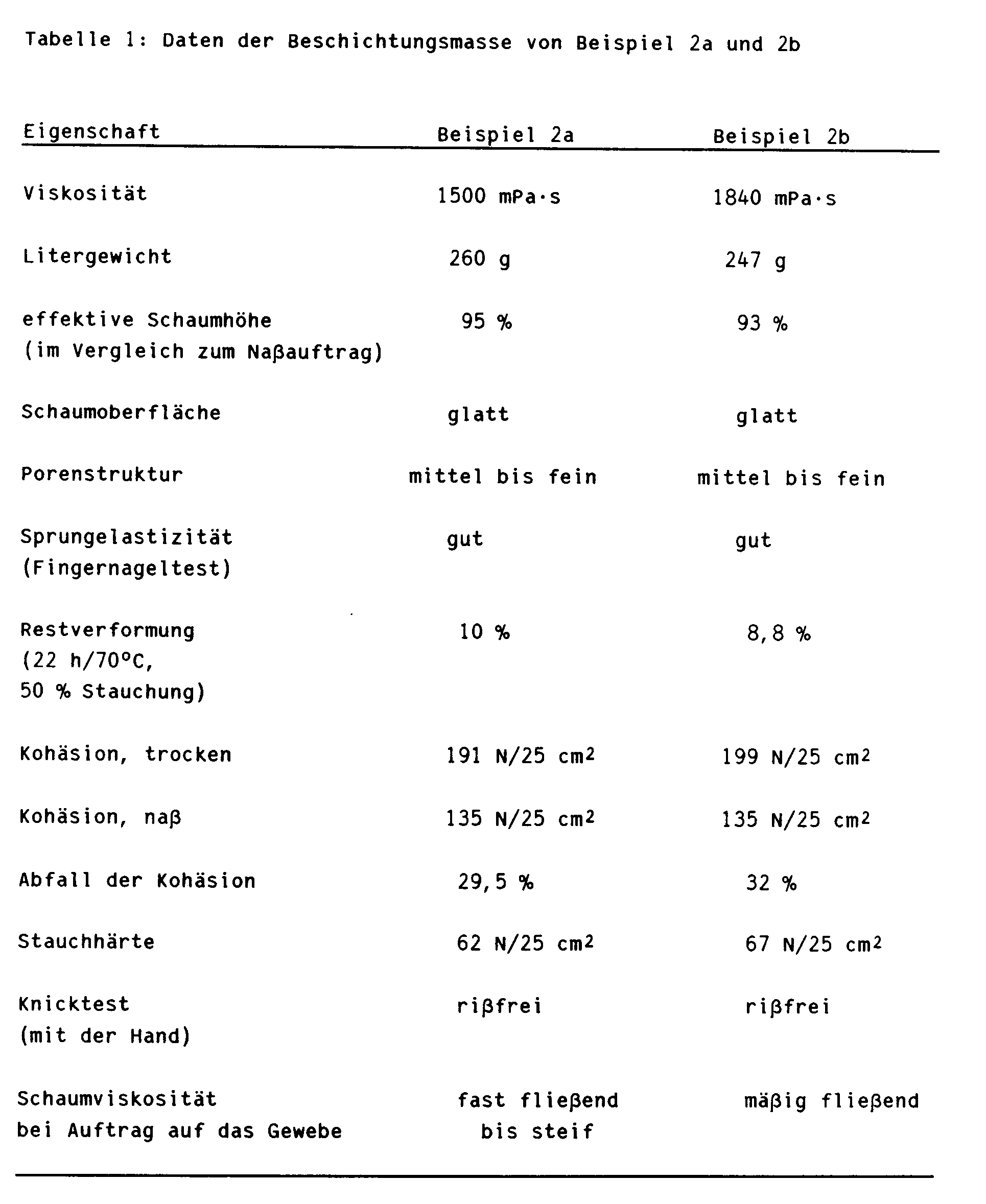
- Table 1 shows the data of the coatings obtained in this way.
- Table 2 shows the data of the fabric obtained compared to fabric coated with commercially available acrylic acid ester / acrylonitrile copolymer.
Landscapes
- Chemical & Material Sciences (AREA)
- Engineering & Computer Science (AREA)
- Textile Engineering (AREA)
- Chemical Kinetics & Catalysis (AREA)
- Health & Medical Sciences (AREA)
- Medicinal Chemistry (AREA)
- Polymers & Plastics (AREA)
- Organic Chemistry (AREA)
- Dispersion Chemistry (AREA)
- Polyurethanes Or Polyureas (AREA)
- Paints Or Removers (AREA)
Abstract
- A) 5 bis 40 Gew.-% wenigstens eines Kunstharzes aus
- (a) 0,1 bis 20 Gew.-Teilen eines oder mehrerer monoolefinisch ungesättigter Monomerer, welche mindestens eine mit Isocyanaten reaktionsfähige Gruppe tragen, und
- (b) 80 bis 99,9 Gew.-Teilen eines oder mehrerer mit (a) copolymerisierbarer mono- oder diolefinisch ungesättigter Monomerer ohne acide Wasserstoffatome,
- B) 0,5 bis 5 Gew.-% wenigstens eines feinteiligen, stabilisierten Polyisocyanates,
- C) wirksame Mengen an Dispergiermitteln und
- D) 5 bis 40 Gew.-% wenigstens eines feinteiligen Füllstoffes.
Description
- Die vorliegende Erfindung betrifft neue wäßrige Zubereitungen aus Copolymerlatices und Polyisocyanat-Dispersionen, enthaltend
- A) 5 bis 40 Gew.-% wenigstens eines Kunstharzes aus
- (a) 0,1 bis 20 Gew.-Teilen eines oder mehrerer monoolefinisch ungesättigter Monomerer, welche mindestens eine mit Isocyanaten reaktionsfähige Gruppe tragen, und
- (b) 80 bis 99,9 Gew.-Teilen eines oder mehrerer mit (a) copolymerisierbarer, mono- oder diolefinisch ungesättigter Monomerer ohne acide Wasserstoffatome,
- B) 0,5 bis 5 Gew.-% wenigstens eines feinteiligen, stabilisierten Polyisocyanates,
- C) wirksame Mengen an Dispergiermitteln und
- D) 5 bis 40 Gew.-% wenigstens eines feinteiligen Füllstoffes.
- Weiterhin betrifft die Erfindung ein Verfahren zur Herstellung dieser wäßrigen Zubereitungen sowie ihre Verwendung als Beschichtungsmittel für gewebte und nichtgewebte Untergründe.
- Beschichtungsmittel oder Bindemittel für Untergründe, insbesondere textile gewebte Untergründe, haben die Aufgabe, dem Untergrund verbesserte Eigenschaften für die Anwendung zu verleihen. Die wichtigsten Aufgaben eines Bindemittels sind Erhöhung der mechanischen Festigkeit, ohne die Steifigkeit deutlich zu ändern, und die Reduzierung der Wasserempfindlichkeit, d.h. die Erhöhung der Naßfestigkeit.
- Die Kombination von Polyisocyanaten mit Polymerisaten, die mit Isocyanatgruppen reaktionsfähige Gruppen enthalten, ist für diesen Zweck bekannt.
- Große Schwierigkeiten bereitet jedoch die Tatsache, daß die Isocyanatgruppen schon bei Raumtemperatur mit den vorgesehenen Reaktionspartnern, z.B. Alkoholen, Aminen oder Carbonsäureamiden reagieren; das bedeutet, es lassen sich keine lagerstabilen Kombinationen formulieren.
- Um diese Schwierigkeit zu umgehen, werden häufig Zweikomponentensysteme verwendet. Die Reaktionspartner werden dabei in separaten Zubereitungen aufbewahrt und erst unmittelbar vor der Applikation gemischt, worauf die Reaktion dann spontan oder wärme- und/oder katalysatorbeschleunigt abläuft, wie z.B. in der US-A 4 029 626 (1) beschrieben.
- Die Nachteile dieses Verfahrens liegen in der Notwendigkeit der getrennten Zubereitung und Lagerung der beiden Komponenten, der Schwierigkeiten beim genauen Dosieren und guten Mischen vor der Applikation und in der Gefahr der Verstopfung der Misch- und Applikationsgeräte durch frühzeitige Reaktion. Durch diese Methode sind außerdem keine wäßrigen Bindemittelsysteme erhältlich, da das Wasser einen Reaktionspartner für Isocyanate darstellt.
- Stabile Systeme lassen sich formulieren, wenn die Polyisocyanate zunächst mit einem monofunktionellen Reaktionspartner umgesetzt werden. Die erhaltenen Addukte werden als verkappte oder blockierte Isocyanate bezeichnet, wenn sie weniger thermostabil sind als die Produkte der später auf dem Gewebe bzw. Untergrund beabsichtigten Vernetzungsreaktion. Unter Hitzeeinwirkung wird das Verkappungsmittel abgespalten und das Polyisocyanat geht unter Vernetzung die thermostabilere Bindung ein.
- Ein Beispiel solch einer Entwicklung stellt die Literaturstelle DE-A 24 54 253 (2) dar. Hierin werden Copolymerisate aus Acrylat- und/oder Vinylidenmonomeren beschrieben, die durch Block-, Suspensions-, Lösungs- oder Emulsionspolymerisation von ethylenisch ungesättigten blockierten aromatischen Diisocyanaten hergestellt werden. Als Blockierungsmittel für die Isocyanatgruppen dienen Oxime, Benzimidazol, Pyrazole, Benztriazole, Caprolactam, Thiocaprolactam und p-Nitroanilin. Die geforderte Naßfestigkeit wird durch Vernetzung oder Vulkanisation dieser Copolymerisate erreicht.
- Diese Methode hat den Nachteil, daß die ethylenisch ungesättigten blockierten Isocyanate in einem aufwendigem Dreistufenprozeß hergestellt werden müssen, mit allen Problemen der Zwischenisolierung, Reinigung und Verfahrensoptimierungen. Weiterhin ist die Stabilität dieser blockierten Isocyanate Angelpunkt für die Reaktivität (Vernetzungseffektivität) und für die Lagerstabilität. Vor allem werden technische und wirtschaftliche Nachteile solcher Formulierungen durch das abgespaltene Verkappungsmittel verursacht, das, wenn es in der vernetzten Masse verbleibt, deren Eigenschaften verändert, oder, wenn es verdampft, zurückgewonnen oder zumindest aus der Abluft entfernt werden muß.
- Die EP-A 204 970 (3) betrifft ein Verfahren zur Herstellung stabiler Dispersionen feinteiliger Polyisocyanate. In der EP-B 212 511 (4) wird die Verwendung derartiger stabiler Polyisocyanat-Dispersionen als Vernetzer in Textilpigmentdruckpasten und Färbeflotten beschrieben.
- Der vorliegenden Erfindung lag die Aufgabe zugrunde, Beschichtungsmittel für gewebte und nichtgewebte Untergründe auf wäßriger Basis bereitzustellen, die die geschilderten Nachteile des Standes der Technik nicht mehr aufweisen.
- Demgemäß wurden die eingangs definierten wäßrigen Zubereitungen aus Copolymerlatices mit isocyanatreaktiven funktionellen Gruppen und wäßrigen stabilen Polyisocyanat-Dispersionen gefunden.
- Unter mit Isocyanaten reaktionsfähigen Gruppen sind im wesentlichen Gruppen mit aciden Wasserstoffatomen zu verstehen, insbesondere sind hier die Hydroxyl-, Amino-, Carboxyl- und Carboxyamido-Gruppe zu nennen.
- Den in den Copolymerlatices enthaltenen Kunstharzen A liegen als Monomere (a) vor allem Verbindungen der allgemeinen Formel I

zugrunde, in der die Variablen folgende Bedeutung haben - R1, R2 Wasserstoff, Methyl oder Ethyl,
- A1, A2 o-, m- oder p-Phenylen, eine divalente Gruppierung der Formel

wobei X und Y für O, S, NH, NCH3 oder NC2Hs stehen und das C-Atom direkt mit der olefinischen Doppelbindung verknüpft ist, oder eine Einfachbindung, - B1, B2 C1- bis C18-Alkylengruppen, die durch ein oder mehrere nicht benachbarte Sauerstoffatome unterbrochen sein und zusätzlich eine Hydroxyl- oder eine Aminogruppe tragen können, oder eine Einfachbindung,
- F1, F2 Wasserstoff, C1- bis C18-Alkylgruppen, die durch ein oder mehrere nicht benachbarte Sauerstoffatome unterbrochen sein und zusätzlich eine Hydroxyl- oder eine Aminogruppe tragen können, sowie Reste der Formeln
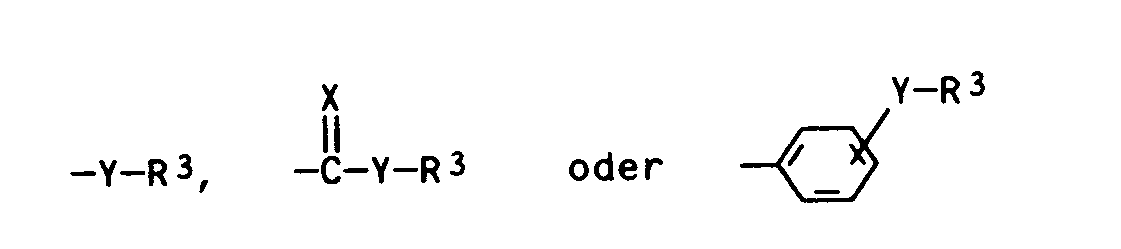
- wobei R3 Wasserstoff oder eine C1- bis C18-Alkylgruppe, die durch ein oder mehrere nicht benachbarte Sauerstoffatome unterbrochen sein und zusätzlich eine Hydroxyl- oder eine Aminogruppe tragen kann, bezeichnet,
- wobei die Gruppierungen A1 und A2 oder A1 und F2 über Y als Brückenglied zu einem fünf- oder sechsgliedrigem Ring verknüpft sein können, mit der Maßgabe, daß die Verbindung I mindestens eine mit Isocyanaten reaktionsfähige Gruppe trägt.
- In einer besonders bevorzugten Ausführungsform ist das Monomer (a) eine Verbindung der allgemeinen Formel la oder Ib


in denen die Variablen folgende Bedeutungen haben - R3, R4 Wasserstoff oder C1- bis C18-Alkylgruppen, die durch ein oder mehrere nicht benachbarte Sauerstoffatome unterbrochen sein und zusätzlich eine Hydroxyl- oder eine Aminogruppe tragen können,
- B3 eine Einfachbindung oder eine C1-C4-Alkylengruppe,
- Beispiele für Verbindungen la sind Acrylsäure, Methacrylsäure, Crotonsäure, 2-Hydroxyethylacrylat, 2-Hydroxyethylmethacrylat, 3-Hydroxypropylacrylat, 3-Hydroxypropylmethacrylat, 2-Aminoethylacrylat, 2-Aminoethylmethacrylat, 3-Aminopropylacrylat, 3-Aminopropylmethacrylat, Acrylsäureamid, Methacrylsäureamid, N-(2-Hydroxyethyl)acrylsäureamid und N-(3-Hydroxypropyl)methacrylsäureamid.
- Beispiele für Verbindungen Ib sind Maleinsäure, Fumarsäure, Itaconsäure, Maleinsäureanhydrid und Itaconsäureanhydrid, weiterhin Maleinsäuremonomethylester,Maleinsäuremonoethylester, Maleinsäuremonobutylester, Maleinsäuremono-2-ethylhexylester, Maleinsäuremonodecylester, Maleinsäuremonododecylester, Maleinsäuremonomyristylester, Maleinsäuremonocetylester, Maleinsäuremonostearylester sowie die entsprechenden Fumarsäuremonoalkylester.
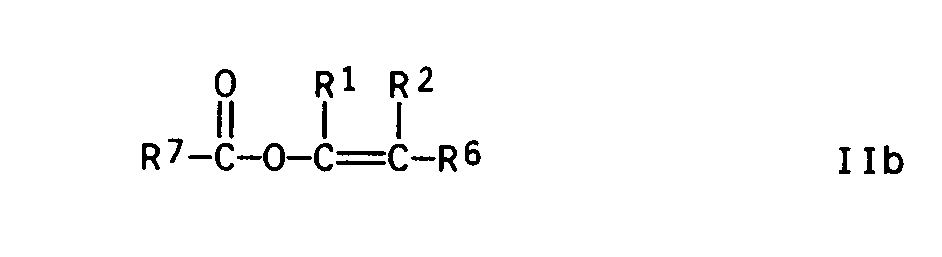
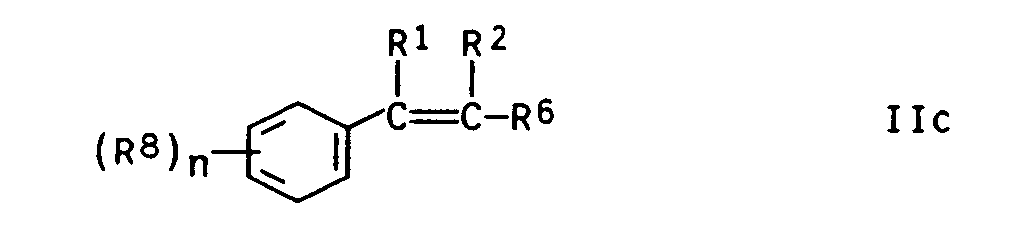
- Den in den Copolymerlatices enthaltenen Kunstharzen A liegen als Monomere (b) vor allem Verbindungen aus den folgenden Substanzklassen vor:
- - a,ß-ungesättigte Carbonsäureester der allgemeinen Formel Ila

- - Vinylester der allgemeinen Formel Ilb

- - Vinylbenzole der allgemeinen Formel Ilc
-


- Die Variablen haben hierbei folgende Bedeutungen:
- R5 eine C1- bis C18-Alkylgruppe, insbesondere eine C1- bis C12-Alkylgruppe, oder eine gesättigte oder ungesättigte C3- bis Cio-Cyloalkylgruppe, insbesondere eine Cyclopentyl-, Cyclohexyl-, Cyclopentadienyl- oder Adamantylgruppe,
- R6, R7 Wasserstoff oder C1- bis C18-Alkylgruppen, insbesondere C1-C12-Alkylgruppen,
- R8 Wasserstoff, Ci- bis C4-Alkylgruppen, insbesondere Methyl- und Ethylgruppen, Ci- bis C4-Alkoxygruppen, insbesondere Methoxy- und Ethoxygruppen, Chlor, Brom, Nitro oder Cyano,
- n 1 oder 2
- Beispiele für Verbindungen Ila sind Acrylsäuremethylester, Acrylsäureethylester, Acrylsäurepropylester, Acrylsäureisopropylester, Acrylsäurebutylester, Acrylsäureisobutylester, Acrylsäure-sec.-butylester, Acrylsäure-tert.-butylester, Acrylsäurepentylester, Acrylsäureisopentylester, Acrylsäureneopentylester, Acrylsäurenonylester, Acrylsäureisononylester, Acrylsäuredecylester, Acrylsäuredodecylester, Acrylsäurecyclohexylester, Acrylsäurecyclopentadienylester und Acrylsäureadamantylester sowie die entsprechenden Methacrylsäureester.
- Beispiele für Verbindungen Ilb sind Vinylformiat, Vinylacetat und Vinylpropionat.
- Beispiele für Verbindungen Ilc sind Styrol und alkylsubstituierte Styrole wie 2-Methyl- und 4-Methylstyrol.
- Beispiele für Verbindungen Ild sind 1-Buten, 2-Buten, Isopren und Butadien.
- Es sollten für das Kunstharz A nur solche Comonomeren (b) gewählt werden, deren entsprechende Homopolymerisate eine Glasübergangstemperatur (TG) zwischen -45 und +50` C aufweisen. Wenn eine kontinuierliche Filmbildung auf den beschichteten Untergründen ohne Weichmacherzusatz erfolgen soll, wird ein TG-Bereich von -45 bis +25°C bevorzugt. Soll zusätzlich eine starke Filmklebrigkeit des Bindemittels vermieden werden, wählt man vorteilhafterweise einen TG-Bereich von -20 bis + 25 C.
- Für eine gute Wasserfestigkeit der beschichteten Untergründe werden hydrophobere Comonomere (b) verwendet oder mitverwendet, beispielsweise tert.-Butylmethacrylat, n-Butylmethacrylat oder 2-Ethylhexylacrylat. Auch Cyclopentadienyl- oder Adamantylacrylate oder -methacrylate wirken sich günstig auf die Wasserfestigkeit aus.
- Das Kunstharz A kann aus jeweils einer oder aus mehreren der Monomer-Komponenten (a) und (b) aufgebaut sein. Es kann vorteilhaft sein, eine Mischung aus Monomeren (b), welche eine niedrigere TG, z.B. 2-Ethylhexylacrylat, n-Butylacrylat oder Ethylacrylat, und Monomeren (b), welche eine höhere TG, z.B. Methylmethacrylat, tert.-Butylmethacrylat, Methylacrylat, Dodecylacrylat oder Styrol, aufweisen, zusammen mit einem oder mehreren Monomeren (a) als Komponenten für das Kunstharz A einzusetzen.
- Bei der Herstellung der das Kunstharz A enthaltenden Copolymerlatices können die bekannten Herstellverfahren eingesetzt werden, um eine den Anforderungen entsprechende Latexpartikel-Morphologie zu erzeugen. Vor allem die folgenden Herstellungsverfahren kommen in Betracht:
- - Dispergieren von Substanzcopolymeren in Wasser
- - Dispergieren von gefällten Lösungscopolymeren in Wasser
- - Suspensionscopolymerisation in Wasser
- - Emulsionscopolymerisation in Wasser
- - Herstellen von Sekundärdispersionen
- Die Emulsionspolymerisation in Wasser hat sich als besonders günstig erwiesen.
- Je nach Herstellverfahren kann man eine Batch-, halbkontinuierliche oder kontinuierliche Emulsion- oder Monomerzulauf-Fahrweise oder ein Saat-Polymerisationsverfahren wählen. Die Emulsion- bzw. Monomerzuläufe können zeitlich konstant aufeinanderfolgend oder zeitlich überlappend in einer Stufenfahrweise oder zeitlich zu- oder abnehmend aufeinanderfolgend oder zeitlich überlappend in einer Gradientenfahrweise dem Reaktionskessel zugeführt werden. Diese Angaben gelten auch für die Initiatorzuläufe, falls diese getrennt dosiert werden.
- Bei einer im Sinne der Erfindung bevorzugten Partikel-Morphologie sind die isocyanatreaktiven funktionellen Gruppen vorzugsweise an der Oberfläche und in den oberflächennahen Regionen des Latex-Partikels zu finden. So werden eine möglichst hohe Flexibilität mit hoher Vernetzungseffektivität verknüpft und dadurch hohe Naßfestigkeit und optimale Bindemittelviskosität erreicht.
- Dem Fachmann ist es bekannt und bedarf deshalb keiner weiteren Erläuterung, wie er je nach Herstellverfahren die verschiedenen Polymerisationsbedingungen einstellen muß, um die genannten bevorzugten Copolymerlatex-Morphologien zu erreichen.
- Bei der Herstellung der geeigneten Latices können anionische oder nichtanionische Emulgatoren oder Schutzkolloide bekannter Art oder Mischungen hieraus verwendet werden. Als Beispiele für Emulgatoren seien mit 25 mol Ethylenoxid umgesetztes Nonylphenyl und mit 25 mol Ethylenoxid umgesetztes Natriumnonylphenolsulfonat, für Schutzkolloide Stärkederivate wie Carboxymethylcellulose und Polyvinylalkohol-Derivate erwähnt.
- Die in den üblichen Mengen verwendeten Initiatoren können je nach Polymerisationsverfahren wasserlösliche oder in der organischen Phase lösliche Initiatoren wie thermisch zersetzbare Alkalimetall- und Ammoniumperoxide, z.B. Kaliumperoxodisulfat oder Ammoniumperoxodisulfat, organische Peroxide, z.B. tert.-Butylperoxid, oder Redoxinitiatoren wie Wasserstoffperoxid/Ascorbinsäure oder tert.-Butylhydroperoxid/Natrium-hydroxymethylsulfinat sein.
- Der Polymergehalt der Copolymerlatices beträgt vorzugsweise 50 bis 55 Gew.-%. Entscheidend ist die Viskosität dieser Latices, die im Bereich von 200 bis 1500 mPas bei Raumtemperatur liegen sollte, um sedimentationsfreie Bindemittelkompositionen mit der verwendeten Polyisocyanat-Dispersion zu erhalten.
- Die Herstellung der verwendeten wäßrigen stabilen Polyisocyanat-Dispersionen B ist in den Literaturstellen (3) und (4) ausführlich beschrieben. Bei der vorliegenden Erfindung wird die "Passivierung" der Polyisocyanat-Teilchenoberfläche gegenüber dem Reaktionspartner Wasser und gegenüber den isocyanatreaktiven Gruppen des Kunstharzes A ausgenutzt, um lagerstabile Einkomponentensysteme, die nach Lagerung ohne Reaktivitätsverlust eingesetzt werden können, herzustellen. Man spricht in diesem Zusammenhang auch von retardierter Reaktivität bzw. von retardierten wäßrigen Polyisocyanat-Dispersionen.
- Diese Desaktivierung der Teilchenoberfläche bzw. Retardierung wird dadurch erreicht, daß nur die auf der Oberfläche der Teilchen befindlichen Isocyanatgruppen mit einem Desaktivierungsmittel reagieren und die im Inneren des Teilchens enthaltenen Polyisocyanatmoleküle an der Reaktion mit den Stoffen hindern, die bekanntermaßen mit Isocyanaten reagieren. Nach der Desaktivierung der Polyisocyanate erhält man durch Dispergieren der Teilchen in einem Dispersionsmedium direkt stabile Dispersionen.
- Als feste feinteilige Polyisocyanate eignen sich diejenigen Stoffe, die einen Schmelzpunkt oberhalb von 25 °C, vorzugsweise oberhalb von 40 °C haben. Hierzu gehören aliphatische, araliphatische, aromatische und heterocyclische Polyisocyanate, Polyphenyl-polymethylen-polyisocyanate, die durch Anilin-Formaldehyd-Kondensation und anschließende Phosgenierung erhalten werden, perchlorierte Arylpolyisocyanate, Carbodiimidgruppen aufweisende Polyisocyanate, Allophanatgruppen aufweisende Polyisocyanate, Isocyanuratgruppen aufweisende Polyisocyanate, Urethan- oder Harnstoffgruppen aufweisende Polyisocyanate, acylierte Harnstoffgruppen aufweisende Polyisocyanate, Biuretgruppen aufweisende Polyisocyanate, durch Telomerisationsreaktion hergestellte Polyisocyanate, Estergruppen aufweisende Polyisocyanate, ferner Uretdiongruppen aufweisende Diisocyanate und Harnstoffgruppen aufweisende Diisocyanate. Als Beispiele für derartige geeignete Polyisocyanate seien im einzelnen genannt:
- p-Xylylendiisocyanat Schmp. 45-46 °C
- 1,5-Diisocyanatomethylnaphthalin 88-89 °C
- 1,3-Phenylendiisocyanat 51 °C
- 1,4-Phenylendiisocyanat 94-96 °C
- 1-Methylbenzol-2,5-diisocyanat 39 °C
- 1,3-Dimethylbenzol-4,6-diisocyanat 70-71 °C
- 1,4-Dimethylbenzol-2,5-diisocyanat 76 °C
- 1-Nitrobenzol-2,5-düsocyanat 59-61 °C
- 1,4-Dichlorbenzol-2,5-diisocyanat 134-137 °C
- 1-Methoxybenzol-2,4-diisocyanat Schmp. 75 °C
- 1-Methoxybenzol-2,5-diisocyanat 89 °C
- 1,3-Dimethoxybenzol-4,6-diisocyanat 125 °C
- Azobenzol-4,4'-diisocyanat 158-161 °C
- Diphenylether-4,4'-diisocyanat 66-68 °C
- Diphenylmethan-4,4'-diisocyanat 42 °C
- Diphenyl-dimethylmethan-4,4'-diisocyanat 92 °C
- Naphthalin-1,5-diisocyanat 130-132 °C
- 3,3'-Dimethylbiphenyl-4,4'-diisocyanat 68-69 °C
- Diphenyldisulfid-4,4'-diisocyanat 58-60 °C
- Diphenylsulfon-4,4'-diisocyanat 154 °C
- 1-Methylbenzol-2,4,6-triisocyanat 75 °C
- 1,3,5-Trimethylbenzol-2,4,6-trüsocyanat 93 °C
- Triphenylmethan-4,4',4"-triisocyanat 89-90 °C
- 4,4'-Diisocyanato-1,2-diphenyl-ethan 88-90 °C
- dimeres 1-Methyl-2,4-phenylendiisocyanat 156 °C
- dimeres 1-Isopropyl-2,4-phenylendiisocyanat 125 °C
- dimeres 1-Chlor-2,4-phenylendiisocyanat 177 °C
- dimeres 2,4'-Diisocyanato-diphenylsulfid 178-180 °C
- dimeres Diphenylmethan-4,4'-diisocyanat
- 3,3'-DÜsocyanato-4,4'-dimethyl-N,N'-diphenylharnstoff
- N,N'-Bis[4(4-Isocyanatophenylmethyl)phenyl]harnstoff
- N,N'-Bis[4(2-Isocyanatophenylmethyl)phenyl]harnstoff
- In einer bevorzugten Ausführungsform werden als Komponente B der erfindungsgemäßen wäßrigen Zubereitungen als feinteilige stabilisierte Polyisocyanate araliphatische oder aromatische Di-, Tri- oder Tetraisocyanate, die in ihren dimeren Formen vorliegen können, eingesetzt. Vertreter dieser bevorzugten Komponenten B sind z.B. 1,5-Naphthalindiisocyanat, 3,3'-Diisocyanato-4,4'-dimethyl-N,N'-diphenylharnstoff, dimeres 1-Methyl-2,4-phenylendiisocyant, dimeres 4,4'-Diisocyanatodiphenylmethan und 3,3'-Dimethyl-4,4'-diisocyanato-diphenyl.
- Die Polyisocyanate können mit den Methoden desaktiviert werden, die in den oben angegebenen Schriften (3) und (4) beschrieben sind. Zur Desaktivierung eignen sich beispielsweise Verbindungen mit Hydroxylgruppen, Carboxylgruppen, Amidgruppen und Mercaptangruppen. Verbindungen dieser Art bilden auf der Oberfläche der Polyisocyanatteilchen eine Art Polymerumhüllung, indem sie selektiv mit den Isocyanatgruppen reagieren, die sich auf der Teilchenoberfläche befinden. Dadurch wird die Polymerumhüllung fest an die Polyisocyanatteilchen gebunden, ohne daß dabei wesentliche Anteile der insgesamt vorhandenen Isocyanatgruppen in den Polyisocyanatteilchen verbraucht werden.
- Besonders geeignet zur Desaktivierung der Isocyanatgruppen an der Oberfläche der Polyisocyanatteilchen sind Reaktionen, die die Isocyanatgruppen zu Harnstoff- bzw. Polyharnstoff-Strukturen umwandeln. Solche Desaktivierungsmittel sind beispielsweise Wasser und primäre oder sekundäre Amine. Zur Desaktivierung der Teilchenoberflächen der Polyisocyanate können auch zwei- oder mehrfunktionelle, nieder- oder höhermolekulare Verbindungen mit aliphatisch gebundenen, primären oder sekundären Aminogruppen oder -CO-NH-NH2-Endgruppen oder Hydrazine mit einem Molekulargewicht von 32 bis etwa 60 000, vorzugsweise 60 bis 3 000, eingesetzt werden. Es sind dies z.B. niedermolekulare oder höhermolekulare primäre oder sekundäre Polyamine, vorzugsweise Diamine. Die Aminogruppen sind dabei im allgemeinen an aliphatische Gruppen, an cycloaliphatische Gruppen, oder an den aliphatischen Rest von araliphatischen Gruppen gebunden.
- Weiterhin können Hydrazin (meist in Form von Hydrazinhydrat), oder Alkylsubstituierte Hydrazine wie N,N-Dimethylhydrazin eingesetzt werden. Zur Desaktivierung der Oberfläche der Polyisocyanate eignen sich außerdem Verbindungen mit Hydrazin-Endgruppen, z.B. Dihydrazide, wie Oxalsäuredihydrazid, Adipinsäuredihydrazid, Terephthalsäuredihydrazid oder Verbindungen mit Hydrazid- und Semicarbazid-, Carbazinester- oder Aminogruppen, z.B. β-Semicarbazidoalanylhydrazid, 2-Semicarbazidoethylencarbazinester, Aminoessigsäurehydrazid, β-Aminopropionsäurehydrazid oder Ethylen-bis-carbazinester bzw. Ethylen-bis-semicarbazid, sowie Polyhydrazide, die durch Hydrazinolyse von Polyacrylaten erhalten werden.
- Bevorzugt sind jedoch im wesentlichen aliphatische bzw. cycloaliphatische Di- und Polyamine, die gegebenenfalls neben den Aminogruppen auch noch OH-Gruppen, tertiäre Aminogruppen, Ethergruppen, Thioethergruppen, Urethangruppen oder Harnstoffgruppen aufweisen können.
- Vorzugsweise werden folgende Di- und Polyamine verwendet:
- - lineare a,m-C2- bis C12-Diaminoalkane, z.B. 1,4-Butandiamin, 1,6-Hexandiamin, 1,10-Decandiamin, 1,11-Undecandiamin oder 1,12-Dodecandiamin;
- - verzweigte a,w-Diaminoalkane, z.B. Neopentandiamin, 2,2,4- oder 2,4,4-Trimethyl-1,6-diaminohexan, 2,5-Dimethyl-2,5-diaminohexan oder 2,2-Dimethyl-1 ,5-diaminopentan;
- - Diaminoalkylcycloalkane, z.B. Bis-aminomethylhexahydro-4,7-methanoindan (TCD-Amin);
- - Mono-, Di- und Trialkyl-cyclohexandiamine, z.B. 1,3- oder 1,4-Cyclohexandiamin, 1-Amino-3,3,5-trimethyl-5-aminomethyl-cyclohexan (Isophorondiamin), 2,4- oder 2,6-Diamino-3,5-diethyl-1-methylcyclohexan;
- - Arylendiamine, z.B. p- oder m-Xylylendiamin;
- - Bis(ω-aminoalkyl)alkylamine, z.B. Bis(3-aminopropyl)methylamin;
- - Triaminoalkane und -cycloalkane, z.B. 1,5,11-Triaminoundecan oder 4-Aminomethyl-1 ,8-diaminooctan;
- - Diamino-dicyclohexylmethane, z.B. 2,4'- oder 4,4'-Diaminodicyclohexylmethan, 3,3-Dimethyl-5,5'-diamino-dicyclohexylmethan oder 3,5-Diisoproypl-3',5'-diethyl-4,4'-diaminodicydohexylmethan;
- - perhydrierte kondensierte Diaminoaromaten, z.B. perhydrierte Diaminonaphthaline oder -anthracene;
- - höherkondensierte aliphatische und cycloaliphatische Amine, z.B. Diethylentriamin oder Tripropylentetramin;
- - N,N'-Dialkyl-alkylendiamine, z.B. N,N'-Dimethylethylendiamin;
- - Piperazin und Piperazinderivate, z.B. Piperazinhydrat, 2-Methylpiperazin, 2-(2-Hydroxyethyl)piperazin;
- - Polyalkylenoxy-diamine, z.B. 4,7-Dioxadecan-1,10-diamin.
- Neben diesen niedermolekularen Diaminen oder im Gemisch mit diesen können auch höhermolekulare Di- und Polyamine verwendet werden, wie sie z.B. durch Aminieren von Polyoxyalkylenglykolen mit Ammoniak erhältlich sind.
- Weitere sehr gut geeignete und deshalb ebenfalls bevorzugte höhermolekulare Polyamine sind die durch Polykondensation aus Polycarbonsäuren, z.B. polymerer Leinölfettsäure, mit einem Überschuß an Di-und Triaminen hergestellten handelsüblichen Stoffe ("Polyamidamine"). Diese höhermolekularen Polyamine besitzen Molekulargewichte von etwa 400 bis 6 000, vorzugsweise 400 bis 3 000. Infolge ihres Aufbaus sind derartige höhermolekulare Polyamine zur Ausbildung einer nichtbrüchigen, "elastischen" Polyharnstoffumhüllung besonders geeignet. Sie werden daher, vorzugsweise in Mischung mit den niedermolekularen Di-und Polyaminoverbindungen, zur Desaktivierung der Oberfläche der Polyisocyanatteilchen eingesetzt.
- Selbstverständlich können beliebige Kombinationen der genannten Amin-, Hydrazin- und Hydrazid-Verbindungen verwendet werden, um z.B. nachteilige Nebeneffekte eines Amines durch entsprechende Vorteile anderer Amine auszugleichen (z.B. nieder- und höhermolekulare Diamine in gemeinsamer Anwendung) oder um möglichst viele vorteilhafte Nebeneffekte zu vereinigen. In Frage kommen z.B. Kombinationen von schnell reagierenden Aminen wie z.B. Ethylendiamin mit durch sterische Hinderung verlangsamten Aminen oder von niedermolekularen Aminen oder Hydrazinen mit hochmolekularen Aminen wie z.B. aliphatischen Aminopolyethern.
- Um die Desaktivierung zu steuern und zu beschleunigen, können auch Katalysatoren zugegeben werden. Bevorzugt sind Katalysatoren, die selektiv die Desaktivierung beschleunigen. Die Desaktivierungskatalysatoren können aber auch identisch sein mit den später die bestimmungsgemäße wärmeaktivierte Reaktion beschleunigenden oder steuernden Katalysatoren.
- Die festen, feinteiligen Polyisocyanate können praktisch in jedem beliebigen oberhalb von 20 C flüssigen Dispersionsmedium dispergiert werden, z.B. in Alkoholen, Polyolen, Aminen, Ethern, Ketonen, Estern, Carbonsäuren, aliphatischen oder aromatischen Kohlenwasserstoffen, halogenierten Kohlenwasserstoffen und Wasser. Für die erfindungsgemäßen, die feinteiligen Polyisocyanate enthaltenden wäßrigen Zubereitungen verwendet man bevorzugt als Dispersionsmedium Wasser oder Mischungen von Paraffinöl, Benzin des Siedebereichs von 140 bis 250 C, Xylol oder Toluol mit Wasser. Besonders bevorzugt wird jedoch Wasser allein.
- Die bekannten feinteiligen Polyisocyanat-Dispersionen haben eine sehr breite Teilchengrößenverteilung und sind in dieser Form für die erfindungsgemäße Verwendung weniger geeignet. Sie können jedoch sehr leicht in eine geeignetere Form übergeführt werden, indem man diese Polyisocyanat-Dispersionen auf eine mittlere Teilchengröße von 0,1 bis 15, vorzugsweise 0,5 bis 5 um bringt (bestimmt mit der Scheibenzentrifuge nach Joice Label). Die Herstellung derartig feinteiliger Polyisocyanat-Dispersionen gelingt sehr einfach, indem man die bekannten Dispersionen einer Feindispergierung oder Mahlung unterwirft. Hierfür eignen sich beispielsweise schnell-laufende Dissolver- oder Dispergiergeräte vom Rotor/Startor-Typ oder Rührwerkskugelmühlen, Perl- und Sandmühlen, Kugelmühlen und Reibspaltmühlen. Vorzugsweise erhält man die erfindungsgemäß zu verwendenden feinteiligen Polyisocyanat-Dispersionen durch Vermahlen von desaktivierten festen, feinteiligen Polyisocyanaten. Falls das Vermahlen der Polyisocyanate in Gegenwart von Stoffen vorgenommen wird, die mit Isocyanatgruppen reagieren, darf die Temperatur beim Mahlen 50 C nicht überschreiten. Vorzugsweise erfolgt das Mahlen im Temperaturbereich von 0 bis 40, insbesondere 10 bis 400 C.
- Beim Erhitzen der feinteiligen Polyisocyanat-Dispersionen auf höhere Temperaturen, z.B. auf Temperaturen oberhalb von 60 C, wird die Desaktivierung der Oberfläche der Polyisocyanatteilchen aufgehoben und es kommt zu einer Reaktion der Polyisocyanate mit den Verbindungen, die mit Isocyanatgruppen reagieren.
- Beim Mahlen kann man zusätzlich grenzflächenaktive Stoffe bzw. Schutzkolloide verwenden, um besonders stabile Polyisocyanat-Dispersionen herzustellen. Geeignete grenzflächenaktive Stoffe sind übliche anionische, kationische oder neutrale Tenside, z.B. Sorbitanfettsäureester, PolyoxyethylensorbitanFettsäureester, Arylsulfonate, Alkalisalze höherer Fettsäuren, oxethylierte Amine wie oxethyliertes Oleylamin, Sulfobernsteinsäureester, Soja-Lecithin, ethoxylierte Fettsäureester, propoxylierte Fettsäureester sowie Kondensationsprodukte aus Phenolsulfonsäuren, Harnstoff und Formaldehyd. Außerdem kann man viskositätsregelnde Stoffe wie Celluloseether, Methylcellulose, polymere Säuren und Salze polymerer Säuren (z.B. Polyacrylsäure), natürliche und synthetische Polysaccharide und Eiweißprodukte, kationische Stärke, Polyacrylamide, Polyvinylalkohole und Polyvinylether verwenden.
- Als Dispergiermittel' C, die in einer wirksamen Menge vorliegen müssen, welche je nach verwendetem System unterschiedlich sein und deshalb nur schwer in exakten Zahlenwertbereichen ausgedrückt werden kann, dienen beispielsweise die oben genannten grenzflächenaktiven Stoffe bzw. Schutzkolloide, welche schon vor oder während des Mahlvorgangs der Polyisocyanate A zugegeben werden können. Hierunter fallen auch die Dispergiermittel und Emulgatoren, welche während der Herstellung des Copolymerlatex zugesetzt werden können, z.B. ethoxyliertes Nonylphenol und Natriumnonylphenolsulfonat.
- Als feinteilige Füllstoffe D eignen sich vor allem inerte anorganische Materialien und Pigmente, z.B. Bariumsulfat, Aluminiumoxid und Titanoxid.
- Die erfindungsgemäßen wäßrigen Zubereitungen enthalten 5 bis 40, vorzugsweise 15 bis 40 Gew.-% der Komponente A, 0,5 bis 5, vorzugsweise 0,5 bis 3 Gew.-% der Komponente B, 5 bis 40, vorzugsweise 15 bis 40 Gew.-% der Komponente D sowie Dispergiermittel C, mindestens 20 Gew.-%, vorzugsweise mindestens 30 Gew.-% Wasser und gegebenenfalls weitere übliche Dispergiermedien und Hilfsstoffe.
- Als weitere übliche Dispergiermedien sind die oben für die Polyisocyanate B aufgeführten anzusehen. Als übliche Hilfsstoffe können beispielsweise die oben genannten viskositätsregelnden Stoffe, übliche Schaumstabilisatoren und übliche Porenregulatoren verwendet werden.
- Das Molverhältnis der in den Kunstharzen A enthaltenen, mit Isocyanatgruppen reagierenden funktionellen Gruppen zu den "freien", d.h. nicht stabilisierten Isocyanatgruppen der Polyisocyanate B sollte zwischen 2:1 und 1:2 liegen.
- Das Gewichtsverhältnis des Kunstharzes A zum Füllstoff D sollte von 1:2 bis 2:1 betragen.
- Die erfindungsgemäßen wäßrigen Zubereitungen, welche als Komponenten Kunstharze A, Polyisocyanate B, Dispergiermittel C und Füllstoffe D enthalten, stellt man durch Mischen der aufgeführten Komponenten mit Wasser und gegebenenfalls weiteren üblichen Dispergiermedien und Hilfsstoffen her. Dabei können die Komponenten A bis D einzeln oder in Untergruppen mit Wasser, weiteren Dispergiermedien und Hilfsstoffen gemischt und danach vereinigt oder es kann die Mischung der Komponenten A bis D als Ganzes mit Wasser, weiteren Dispergiermedien und Hilfsstoffen gemischt werden.
- In einer bevorzugten Ausführungsform stellt man die erfindungsgemäßen wäßrigen Zubereitungen durch Mischen der die Kunstharze A enthaltenden wäßrigen Copolymerlatices mit wäßrigen Dispersionen der Polyisocyanate B und mit Dispergiermitteln C und anschließende Zugabe der Füllstoffe D und gegebenenfalls weiterer üblicher Hilfsstoffe her.
- Die erfindungsgemäße Kombination der wäßrigen funktionalisierten Copolymerlatices mit bevorzugt wäßrigen, retardierten Polyisocyanat-Dispersionen ist besonders geeignet für geschäumte und nichtgeschäumte, gut haftende und naßfeste Beschichtungen auf gewebtem und nichtgewebtem Untergründen.
- Als gewebte Untergründe können vor allem textile Materialien aus Baumwolle, Zellwolle, Polyester, Polyamid und Polypropylen eingesetzt werden. Als nichtgewebte Untergründe können insbesondere natürliche oder synthetische Ledermaterialien und Vliese aus Polyester, Polyamid, Polypropylen oder Zellwolle verwendet werden.
- Die Vernetzung der erfindungsgemäßen Kombination erfolgt erst bei höheren Temperaturen, also nach der Applikation und/oder während des Trocknens. Unter den üblichen Trocknungsbedingungen von mindestens 100-120 C werden die Isocyanatgruppen freigesetzt und reagieren sofort mit den reaktiven Gruppen des Copolymeren ab.
- Die erfindungsgemäßen wäßrigen Zubereitungen weisen eine ganze Reihe von Vorteilen auf. Bei den Zubereitungen wird überwiegend oder ganz auf organische Lösungsmittel als Dispergiermedien verzichtet, was aus ökologischer Sicht begrüßenswert ist. Die Verwendung eines Einkomponentensystems anstelle der bisher üblicherweise auch noch benutzten Zweikomponentensysteme stellte eine deutliche Vereinfachung dar. Gegenüber den vollständig verkappten oder blockierten Isocyanatsystemen des Standes der Technik haben die erfindungsgemäßen wäßrigen Zubereitungen den Vorteil, daß beim Beschichtungsvorgang keine oder nur ganz geringe Mengen an die Beschichtungsqualität vermindernden und gesundheitsschädigenden Abspaltprodukten aus den Verkappungsmitteln freigesetzt werden.
- Da die verwendeten Polyisocyanat-Disperisonen nur feste, nicht flüchtige Polyisocyanate enthalten, erfolgt beim Erwärmen und Trocknen der beschichteten Untergründe keine Emission von unerwünschten oder schädigenden Polyisocyanaten oder daraus abgeleiteten Verbindungen. Da die retardierten Polyisocyanat-Dispersionen in solchen Mengen eingesetzt werden, daß die Isocyanatgruppen vollständig oder nahezu vollständig mit den funktionellen Gruppen des Kunstharzes A abreagieren, wird ein Überschuß an Isocyanat in der Formulierung und dadurch die Bildung von Rückständen vermieden.
- Die erfindungsgemäßen wäßrigen Dispersionen zeigen trotz Vorliegen eines Einkomponentensystems eine hohe Lagerstabilität; so sind nach 6 Monaten noch kein merklicher Anstieg der Viskosität, keine Sedimentationen und kein nennenswerter Reaktivitätsverlust festzustellen. Die Topfzeit beträgt 1 bis 2 Jahre oder noch länger.
- Die mit den erfindungsgemäßen wäßrigen Dispersionen beschichteten Untergründe zeigen hervorragende anwendungstechnische Eigenschaften. Die geschäumten oder nichtgeschäumten Beschichtungen weisen eine hohe Naßfestigkeit auf, haften gut auf dem Untergrund, sind flexibel und verformbar und zeigen eine deutliche schallisolierende Wirkung. Weiterhin haben so beschichtete textile Gewebe eine geringere Steifigkeit und fühlen sich deshalb weicher an. Bei der chemischen Reinigung so beschichteter textiler Gewebe ist der Auswaschverlust deutlich geringer.
- In einem üblichen Polymerisationsreaktor wurde eine wäßrige Emulsion aus
- 3,6 g Acrylsäure
- 1,5 g Acrylsäureamid
- 7,2 g 3-Hydroxypropylacrylat
- 18,5 g Styrol
- 58,0 g 2-Ethylhexylacrylat
- 61,2 g n-Butylacrylat
- 1,8 g mit 25 mol Ethylenoxid umgesetztem Nonylphenol
- 1,8 g mit 25 mol Ethylenoxid umgesetztem Natriumnonylphenolsulfonat in 85 g Wasser
- einer Emulsionspolymerisation unterworfen. Dazu wurden 1% der Emulsion zusammen mit 5 % einer Lösung von 1,3 g Natriumperoxodisulfat in 50 g Wasser und 10 % einer Lösung von 0,6 g Natrium-hydroxymethylsulfinat in 50 g Wasser vorgelegt und 15 min bei 45 C anpolymerisiert. Die restliche Menge der Emulsion wurde zusammen mit 55 % der Natriumperoxodisulfat-Lösung und 50 % der Natrium-hydroxymethylsulfinat-Lösung innerhalb von 80 min bei 45 C zugegeben.
- Danach wurde eine zweite wäßrige Emulsion aus
- 3,6 g Acrylsäure
- 1,5 g Acrylsäureamid
- 4,7 g 3-Hydroxypropylacrylat
- 17,2 g Methylmethacrylat
- 9,1 g Styrol
- 31,1 g 2-Ethylhexylacrylat
- 32,8 g n-Butylacrylat
- 1,8 g mit 25 mol Ethylenoxid umgesetztem Nonylphenol
- 1,8 g mit 25 mol Ethylenoxid umgesetztem Natriumnonylphenolsulfonat in 60 g Wasser innerhalb von 50 min bei 45 C zusammen mit den restlichen Mengen der Natriumperoxodisulfat- und der Natrium-hydroxymethylsulfinat-Lösung zudosiert. Anschließend wurde 2 Stunden bei 70 C nachpolymerisiert und zur Stabilisierung des Dispersion mit jeweils weiteren 2,5 g der beiden o.g. Emulgatoren versetzt.
- Der erhaltene Copolymerlatex hatte einen Feststoffgehalt von 52 Gew.-%, eine Viskosität von 550 mPa•s, einen pH-Wert von 4,8-5,0 und eine Lichtdurchlässigkeit von 62 % (0,01 gew.-%ige Dispersion).
- Textilbeschichtung mit geschäumter Copolymerlatex-Polyisocyanat-Dispersion
- Eine wäßrige Zubereitung aus
- 192 g des Copolymerlatex aus Beispiel 1
- 8,6 g üblicher Schaumstabilisatoren
- 0,3 g eines üblichen Porenregulators
- 80 g Bariumsulfat
- 20 g Aluminiumoxid
- 5 g Titandioxid
- 7,5 g einer 40 gew.-%igen wäßrigen Polyisocyanat-Dispersion, hergestellt aus dimerem 1-Methyl-2,4-phenylendiisocyanat, dessen Isocyanatgruppen zu 20 % mit einem handelsüblichen Polyamidamin desaktiviert vorlagen und das eine mittlere Teilchengröße von 1 bis 5 um aufwies, wurde mit Luft in einem Mixer 2 bis 3 min verschäumt, in einer Stärke von 7 mm auf Baumwollgewebe aufgetragen und 20 min bei 150°C getrocknet, wobei während dieses Trocknungsvorganges die Vernetzung des Mittels erfolgte (Beispiel 2a).
- Das Verhältnis der Molzahl der im Kunstharz des Copolymerlatex vorliegenden funktionellen Gruppen (COOH, CONH2 und OH) zur Molzahl der im Polyisocyanat vorliegenden "freien", d.h. nicht desaktivierten Isocyanatgruppen betrug 1,4:1.
- Der um den Faktor 100 vergrößerte Ansatz wurde im Technikumsmaßstab wiederholt (Beispiel 2b), wobei abweichend vom Versuch im Labormaßstab die Beschichtsstärke 5 mm und die Trocknungsdauer bei 150 °C 15 min betrug.
- Tabelle 1 zeigt die Daten der hierbei erhaltenen Beschichtungen.
- Textilbeschichtung mit nicht geschäumter Copolymerlatex-Polyisocyanat-Dispersion
- Eine wäßrige Zubereitung aus
- 192 g des Copolymerlatex aus Beispiel 1
- 1 g eines üblichen blauen Pigmentfarbstoffes für den Textildruck und die Textilfärbung
- 0,2 g eines üblichen Entschäumers
- 10 g Titandioxid
- 10 g Aluminiumoxid
- 80 g Bariumsulfat
- 7,5 g der Polyisocyanat-Dispersion aus Beispiel 2a
- Tabelle 2 zeigt die Daten des erhaltenen Gewebes im Vergleich zu mit handelsüblichem Acrylsäureester/Acrylnitril-Copolymerisat beschichtetem Gewebe.

wobei die Verbindungen Ib unter Abspaltung der Reste R3 und R4 und einer Gruppierung Y einen fünf- oder sechsgliedrigen Ring bilden können, mit der Maßgabe, daß die Verbindung la bzw. Ib mindestens eine mit Isocyanaten reaktionsfähige Gruppe trägt.
wurde auf Baumwoll-Polyester-Gewebe gleichmäßig in einer Stärke von ca. 40 bis 50 g/m2 aufgetragen und 7 min bei 150° C getrocknet.
Claims (8)

in der die Variablen folgende Bedeutung haben

wobei X und Y für O, S, NH, NCH3 oder NC2Hs stehen und das C-Atom direkt mit der olefinischen Doppelbindung verknüpft ist, oder eine Einfachbindung,


in denen die Variablen folgende Bedeutungen haben
wobei die Verbindungen Ib unter Abspaltung der Reste R3 und R4 und einer Gruppierung Y einen fünf-oder sechsgliedrigen Ring bilden können, eingesetzt wird, mit der Maßgabe, daß die Verbindung la bzw. Ib mindestens eine mit Isocyanaten reaktionsfähige Gruppe trägt.


in denen die Variablen folgende Bedeutung haben
eingesetzt wird.
Applications Claiming Priority (2)
| Application Number | Priority Date | Filing Date | Title |
|---|---|---|---|
| DE4022602A DE4022602A1 (de) | 1990-07-16 | 1990-07-16 | Waessrige zubereitungen aus copolymerlatices und polyisocyanat-dispersionen |
| DE4022602 | 1990-07-16 |
Publications (2)
| Publication Number | Publication Date |
|---|---|
| EP0467168A2 true EP0467168A2 (de) | 1992-01-22 |
| EP0467168A3 EP0467168A3 (en) | 1992-09-23 |
Family
ID=6410385
Family Applications (1)
| Application Number | Title | Priority Date | Filing Date |
|---|---|---|---|
| EP19910111178 Withdrawn EP0467168A3 (en) | 1990-07-16 | 1991-07-05 | Aqueous preparations from copolymer latices and polyisocyanate dispersions |
Country Status (3)
| Country | Link |
|---|---|
| US (1) | US5159011A (de) |
| EP (1) | EP0467168A3 (de) |
| DE (1) | DE4022602A1 (de) |
Cited By (4)
| Publication number | Priority date | Publication date | Assignee | Title |
|---|---|---|---|---|
| EP0557844A1 (de) * | 1992-02-27 | 1993-09-01 | Bayer Ag | Beschichtungsmittel, ein Verfahren zu ihrer Herstellung und ihre Verwendung |
| EP1134245A3 (de) * | 2000-03-16 | 2002-03-20 | Bayer Aktiengesellschaft | Klebstoffzubereitungen |
| EP1600485A1 (de) | 2004-05-28 | 2005-11-30 | Bayer MaterialScience AG | Klebstoffe |
| EP4755936A1 (de) | 2024-12-04 | 2026-06-10 | Sika Technology AG | Einkomponentiger reaktiver dispersionsklebstoff |
Families Citing this family (10)
| Publication number | Priority date | Publication date | Assignee | Title |
|---|---|---|---|---|
| US5612126A (en) * | 1994-01-19 | 1997-03-18 | Burlington Industries, Inc. | Stiff fabric and method of forming the stiff fabric |
| ES2161429T3 (es) * | 1997-12-11 | 2001-12-01 | Bayer Ag | Procedimiento para la obtencion de empleo de capas o polvos estables al almacenaje de reactividad latente, a partir de poliisocianatos solidos desactivados superficialmente y polimeros en dispersion con grupos funcionales. |
| DE59906875D1 (de) * | 1998-05-07 | 2003-10-09 | Jowat Ag | Stoffsystem |
| EP1013690A1 (de) * | 1998-12-21 | 2000-06-28 | Abend, Thomas | Wässerige lagerstabile Dispersionen oder Lösungen enthaltend isocyanatreaktive Polymere und oberflächendesaktivierte feste Polyisocyanate und Verfahren zum Herstellen derselben sowie zum Herstellen einer Schicht |
| JP2002119408A (ja) * | 2000-10-17 | 2002-04-23 | Emulsion Technology Co Ltd | タイル調カーペットの加工方法 |
| DE10140206A1 (de) * | 2001-08-16 | 2003-03-06 | Bayer Ag | Einkomponentige isocyanatvernetzende Zweiphasen-Systeme |
| GB2400104B (en) * | 2003-04-03 | 2007-10-10 | Bostik Findley Ltd | Storage stable adhesive paste compositions |
| JP4455472B2 (ja) * | 2005-09-28 | 2010-04-21 | ローム アンド ハース カンパニー | 二成分アクリル‐ウレタン接着剤 |
| US7455909B2 (en) * | 2005-12-22 | 2008-11-25 | Lubrizol Advanced Materials, Inc. | Latex with isocyanate crosslinker as binder for fibrous substrates |
| JP7064443B2 (ja) * | 2016-11-25 | 2022-05-10 | リケンテクノス株式会社 | 艶消しハードコート形成用塗料、及びこれを用いた化粧シート |
Family Cites Families (9)
| Publication number | Priority date | Publication date | Assignee | Title |
|---|---|---|---|---|
| GB1487766A (en) * | 1974-11-20 | 1977-10-05 | Goodrich Co B F | Aromatic diisocyanates and polymers thereof |
| US4029626A (en) * | 1975-11-24 | 1977-06-14 | Communications Technology Corporation | Polyurethane composition having easy-reentry property |
| NL8401785A (nl) * | 1984-06-04 | 1986-01-02 | Polyvinyl Chemie Holland | Werkwijze voor de bereiding van een waterige dispersie van urethan-acrylaat entcopolymeren, alsmede aldus verkregen stabiele waterige dispersie. |
| DE3427385A1 (de) * | 1984-07-25 | 1986-01-30 | Bayer Ag, 5090 Leverkusen | Vernetzbare polymerisatharze und ihre verwendung als bindemittelkomponente in beschichtungsmitteln |
| DE3517333A1 (de) * | 1985-05-14 | 1986-11-20 | Basf Ag, 6700 Ludwigshafen | Verfahren zur herstellung stabiler dispersionen feinteiliger polyisocyanate und deren verwendung |
| DE3529530A1 (de) * | 1985-08-17 | 1987-02-26 | Basf Ag | Verwendung von stabilen dispersionen fester, feinteiliger polyisocyanate in pigmentdruckpasten und faerbeflotten |
| IT1198254B (it) * | 1986-12-24 | 1988-12-21 | Raffineria Olii Lubirificanti | Procedimento per migliorare la tingibilita' di manufatti tessili tessuti o non tessuti |
| DE3735198A1 (de) * | 1987-10-17 | 1989-05-03 | Bayer Ag | In wasser loesliche oder dispergierbare, blockierte polyisocyanate, ein verfahren zu ihrer herstellung und ihre verwendung |
| DE3829587A1 (de) * | 1988-09-01 | 1990-03-15 | Bayer Ag | Beschichtungsmittel, ein verfahren zu ihrer herstellung und die verwendung von ausgewaehlten zweikomponenten-polyurethansystemen als bindemittel fuer derartige beschichtungsmittel |
-
1990
- 1990-07-16 DE DE4022602A patent/DE4022602A1/de not_active Withdrawn
-
1991
- 1991-07-05 EP EP19910111178 patent/EP0467168A3/de not_active Withdrawn
- 1991-07-16 US US07/730,468 patent/US5159011A/en not_active Expired - Fee Related
Cited By (6)
| Publication number | Priority date | Publication date | Assignee | Title |
|---|---|---|---|---|
| EP0557844A1 (de) * | 1992-02-27 | 1993-09-01 | Bayer Ag | Beschichtungsmittel, ein Verfahren zu ihrer Herstellung und ihre Verwendung |
| EP1134245A3 (de) * | 2000-03-16 | 2002-03-20 | Bayer Aktiengesellschaft | Klebstoffzubereitungen |
| US6506280B2 (en) * | 2000-03-16 | 2003-01-14 | Bayer Aktiengesellschaft | Adhesive compositions |
| EP1600485A1 (de) | 2004-05-28 | 2005-11-30 | Bayer MaterialScience AG | Klebstoffe |
| EP4755936A1 (de) | 2024-12-04 | 2026-06-10 | Sika Technology AG | Einkomponentiger reaktiver dispersionsklebstoff |
| WO2026119739A1 (en) | 2024-12-04 | 2026-06-11 | Sika Technology Ag | A one-component reactive dispersion adhesive |
Also Published As
| Publication number | Publication date |
|---|---|
| US5159011A (en) | 1992-10-27 |
| DE4022602A1 (de) | 1992-01-23 |
| EP0467168A3 (en) | 1992-09-23 |
Similar Documents
| Publication | Publication Date | Title |
|---|---|---|
| EP0212511B1 (de) | Verwendung von stabilen Dispersionen fester, feinteiliger Polyisocyanate in Pigmentdruckpasten und Färbeflotten | |
| EP0486881B1 (de) | Nichtwässrige Polyisocyanatzubereitung | |
| DE1770068C3 (de) | Verfahren zur Herstellung von Polyurethanen Bayer AG, 5090 Leverkusen | |
| DE2136308A1 (de) | Hitzehärtende Überzugsmasse | |
| DE19954500A1 (de) | Carbodiimide mit Carboxyl- oder Caboxylatgruppen | |
| DE2637115A1 (de) | Verfahren zur herstellung von polyurethanharnstoffen | |
| DE2754632A1 (de) | Heisshaertbare imidharze | |
| DE1954090A1 (de) | 2-(beta-Amino-propionamido)-alkan-sulfonsaeuresalze und ihre Verwendung als anionische Aufbaukomponente bei der Herstellung von emulgatorfreien Polyurethandispersionen | |
| DE4022602A1 (de) | Waessrige zubereitungen aus copolymerlatices und polyisocyanat-dispersionen | |
| DE1694152A1 (de) | Verfahren zur Herstellung von mikroporoesen Flaechengebilden | |
| EP0319816B1 (de) | Polyurethanharnstoffe | |
| EP2254694A1 (de) | Mikokapseln mit wänden aus acylharnstoff | |
| DE4217716A1 (de) | Vernetzer für Textildruck-Bindemittel | |
| DE2719720C2 (de) | Verfahren zur Herstellung von Verklebungen | |
| EP1476406B1 (de) | WäSSRIGE DISPERSIONEN, AUFGEBAUT AUS POLYCARBODIIMIDEN | |
| DE69203363T2 (de) | Wässrige Polyisocyanatdispersionen mit reduziertem Isocyanatgehalt und ihre Verwendung zur Herstellung von Glasfasermatten. | |
| EP1000104A1 (de) | Latent vernetzende wässerige dispersionen enthaltend ein polyurethan | |
| DE1282962B (de) | Verfahren zur Herstellung waessriger sedimentierender redispergierbaren Dispersionen vernetzter, Harnstoffgruppe aufweisender Polyadditionsprodukte | |
| WO2003016374A1 (de) | Einkomponentige isocyanatvernetzende zweiphasen-systeme | |
| DE2708442A1 (de) | Verfahren zur herstellung von modifizierten, waessrigen kunststoff- dispersionen | |
| DE2342775C2 (de) | Verfahren zur Herstellung von selbsthärtenden Polymeren | |
| EP0007532B1 (de) | Wässrige Isocyanat-Emulsionen, Verfahren zu deren Herstellung und deren Verwendung für die Verleimung von Holz | |
| DE4012630A1 (de) | Perfluoralkylgruppen enthaltende pfropfcopolymerisate | |
| DE3153333C2 (de) | ||
| DE69301953T2 (de) | Durch Emulsionspolymerisation hergestellte reaktive wässrige Polyharnstoffdispersionen |
Legal Events
| Date | Code | Title | Description |
|---|---|---|---|
| PUAI | Public reference made under article 153(3) epc to a published international application that has entered the european phase |
Free format text: ORIGINAL CODE: 0009012 |
|
| AK | Designated contracting states |
Kind code of ref document: A2 Designated state(s): BE CH DE FR GB IT LI NL |
|
| PUAL | Search report despatched |
Free format text: ORIGINAL CODE: 0009013 |
|
| AK | Designated contracting states |
Kind code of ref document: A3 Designated state(s): BE CH DE FR GB IT LI NL |
|
| 17P | Request for examination filed |
Effective date: 19930203 |
|
| 17Q | First examination report despatched |
Effective date: 19940826 |
|
| STAA | Information on the status of an ep patent application or granted ep patent |
Free format text: STATUS: THE APPLICATION HAS BEEN WITHDRAWN |
|
| 18W | Application withdrawn |
Withdrawal date: 19950628 |