EP0447977A1 - Verfahren zur Herstellung von p-Alkylcalix[4]arenen - Google Patents
Verfahren zur Herstellung von p-Alkylcalix[4]arenen Download PDFInfo
- Publication number
- EP0447977A1 EP0447977A1 EP91104021A EP91104021A EP0447977A1 EP 0447977 A1 EP0447977 A1 EP 0447977A1 EP 91104021 A EP91104021 A EP 91104021A EP 91104021 A EP91104021 A EP 91104021A EP 0447977 A1 EP0447977 A1 EP 0447977A1
- Authority
- EP
- European Patent Office
- Prior art keywords
- mixture
- alkylcalix
- formula
- arene
- arenes
- Prior art date
- Legal status (The legal status is an assumption and is not a legal conclusion. Google has not performed a legal analysis and makes no representation as to the accuracy of the status listed.)
- Ceased
Links
- 150000004945 aromatic hydrocarbons Chemical class 0.000 title claims abstract description 22
- 241001120493 Arene Species 0.000 title claims abstract description 15
- 238000000034 method Methods 0.000 title claims abstract description 15
- 238000004519 manufacturing process Methods 0.000 title description 4
- 239000000203 mixture Substances 0.000 claims abstract description 21
- 238000006243 chemical reaction Methods 0.000 claims abstract description 8
- 229930195733 hydrocarbon Natural products 0.000 claims abstract description 8
- 150000002430 hydrocarbons Chemical class 0.000 claims abstract description 8
- 238000002360 preparation method Methods 0.000 claims abstract description 7
- 150000008044 alkali metal hydroxides Chemical class 0.000 claims abstract description 6
- 229920002866 paraformaldehyde Polymers 0.000 claims abstract description 6
- 229930040373 Paraformaldehyde Natural products 0.000 claims abstract description 5
- 238000000605 extraction Methods 0.000 claims abstract description 4
- 239000007858 starting material Substances 0.000 claims abstract description 4
- WSFSSNUMVMOOMR-NJFSPNSNSA-N methanone Chemical compound O=[14CH2] WSFSSNUMVMOOMR-NJFSPNSNSA-N 0.000 claims abstract description 3
- HEMHJVSKTPXQMS-UHFFFAOYSA-M sodium hydroxide Inorganic materials [OH-].[Na+] HEMHJVSKTPXQMS-UHFFFAOYSA-M 0.000 claims description 14
- WSFSSNUMVMOOMR-UHFFFAOYSA-N Formaldehyde Chemical compound O=C WSFSSNUMVMOOMR-UHFFFAOYSA-N 0.000 claims description 13
- 239000007787 solid Substances 0.000 claims description 11
- 239000000243 solution Substances 0.000 claims description 8
- KWYUFKZDYYNOTN-UHFFFAOYSA-M Potassium hydroxide Chemical compound [OH-].[K+] KWYUFKZDYYNOTN-UHFFFAOYSA-M 0.000 claims description 7
- XLYOFNOQVPJJNP-UHFFFAOYSA-N water Substances O XLYOFNOQVPJJNP-UHFFFAOYSA-N 0.000 claims description 7
- 239000012429 reaction media Substances 0.000 claims description 6
- QVGXLLKOCUKJST-UHFFFAOYSA-N atomic oxygen Chemical compound [O] QVGXLLKOCUKJST-UHFFFAOYSA-N 0.000 claims description 5
- 238000009835 boiling Methods 0.000 claims description 5
- 229910052760 oxygen Inorganic materials 0.000 claims description 5
- 239000001301 oxygen Substances 0.000 claims description 5
- ISWSIDIOOBJBQZ-UHFFFAOYSA-N phenol group Chemical group C1(=CC=CC=C1)O ISWSIDIOOBJBQZ-UHFFFAOYSA-N 0.000 claims description 5
- 239000007864 aqueous solution Substances 0.000 claims description 4
- 230000007717 exclusion Effects 0.000 claims description 4
- 239000003960 organic solvent Substances 0.000 claims description 4
- 239000004215 Carbon black (E152) Substances 0.000 claims description 3
- 229910001854 alkali hydroxide Inorganic materials 0.000 claims description 3
- 125000000113 cyclohexyl group Chemical group [H]C1([H])C([H])([H])C([H])([H])C([H])(*)C([H])([H])C1([H])[H] 0.000 claims description 3
- 238000001816 cooling Methods 0.000 claims description 2
- 239000002808 molecular sieve Substances 0.000 claims description 2
- 239000012188 paraffin wax Substances 0.000 claims description 2
- 239000011541 reaction mixture Substances 0.000 claims description 2
- URGAHOPLAPQHLN-UHFFFAOYSA-N sodium aluminosilicate Chemical compound [Na+].[Al+3].[O-][Si]([O-])=O.[O-][Si]([O-])=O URGAHOPLAPQHLN-UHFFFAOYSA-N 0.000 claims description 2
- DGAQECJNVWCQMB-PUAWFVPOSA-M Ilexoside XXIX Chemical compound C[C@@H]1CC[C@@]2(CC[C@@]3(C(=CC[C@H]4[C@]3(CC[C@@H]5[C@@]4(CC[C@@H](C5(C)C)OS(=O)(=O)[O-])C)C)[C@@H]2[C@]1(C)O)C)C(=O)O[C@H]6[C@@H]([C@H]([C@@H]([C@H](O6)CO)O)O)O.[Na+] DGAQECJNVWCQMB-PUAWFVPOSA-M 0.000 claims 1
- 239000003208 petroleum Substances 0.000 claims 1
- 238000005406 washing Methods 0.000 claims 1
- NVKLTRSBZLYZHK-UHFFFAOYSA-N 4-tert-butylcalix[4]arene Chemical compound C1C(C=2O)=CC(C(C)(C)C)=CC=2CC(C=2O)=CC(C(C)(C)C)=CC=2CC(C=2O)=CC(C(C)(C)C)=CC=2CC2=CC(C(C)(C)C)=CC1=C2O NVKLTRSBZLYZHK-UHFFFAOYSA-N 0.000 abstract description 4
- 150000001875 compounds Chemical class 0.000 abstract description 4
- 239000003054 catalyst Substances 0.000 abstract description 3
- 239000003381 stabilizer Substances 0.000 abstract description 3
- 230000015572 biosynthetic process Effects 0.000 abstract description 2
- 125000000484 butyl group Chemical group [H]C([*])([H])C([H])([H])C([H])([H])C([H])([H])[H] 0.000 abstract description 2
- GQPLZGRPYWLBPW-UHFFFAOYSA-N calix[4]arene Chemical class C1C(C=2)=CC=CC=2CC(C=2)=CC=CC=2CC(C=2)=CC=CC=2CC2=CC=CC1=C2 GQPLZGRPYWLBPW-UHFFFAOYSA-N 0.000 abstract description 2
- 229910021645 metal ion Inorganic materials 0.000 abstract description 2
- 238000003786 synthesis reaction Methods 0.000 abstract description 2
- 239000007859 condensation product Substances 0.000 abstract 1
- 239000002861 polymer material Substances 0.000 abstract 1
- CXWXQJXEFPUFDZ-UHFFFAOYSA-N tetralin Chemical compound C1=CC=C2CCCCC2=C1 CXWXQJXEFPUFDZ-UHFFFAOYSA-N 0.000 description 6
- USIUVYZYUHIAEV-UHFFFAOYSA-N diphenyl ether Chemical compound C=1C=CC=CC=1OC1=CC=CC=C1 USIUVYZYUHIAEV-UHFFFAOYSA-N 0.000 description 4
- 238000006555 catalytic reaction Methods 0.000 description 3
- OLZFZIXORGGLLS-UHFFFAOYSA-N 4-tert-butylcalix[8]arene Chemical compound C1C(C=2O)=CC(C(C)(C)C)=CC=2CC(C=2O)=CC(C(C)(C)C)=CC=2CC(C=2O)=CC(C(C)(C)C)=CC=2CC(C=2O)=CC(C(C)(C)C)=CC=2CC(C=2O)=CC(C(C)(C)C)=CC=2CC(C=2O)=CC(C(C)(C)C)=CC=2CC(C=2O)=CC(C(C)(C)C)=CC=2CC2=CC(C(C)(C)C)=CC1=C2O OLZFZIXORGGLLS-UHFFFAOYSA-N 0.000 description 2
- QHPQWRBYOIRBIT-UHFFFAOYSA-N 4-tert-butylphenol Chemical compound CC(C)(C)C1=CC=C(O)C=C1 QHPQWRBYOIRBIT-UHFFFAOYSA-N 0.000 description 2
- DKGAVHZHDRPRBM-UHFFFAOYSA-N Tert-Butanol Chemical compound CC(C)(C)O DKGAVHZHDRPRBM-UHFFFAOYSA-N 0.000 description 2
- 150000001491 aromatic compounds Chemical class 0.000 description 2
- 239000013078 crystal Substances 0.000 description 2
- 238000001914 filtration Methods 0.000 description 2
- 239000008098 formaldehyde solution Substances 0.000 description 2
- 150000002500 ions Chemical class 0.000 description 2
- 239000007791 liquid phase Substances 0.000 description 2
- 231100000252 nontoxic Toxicity 0.000 description 2
- 230000003000 nontoxic effect Effects 0.000 description 2
- 230000009965 odorless effect Effects 0.000 description 2
- ZLMJMSJWJFRBEC-UHFFFAOYSA-N Potassium Chemical compound [K] ZLMJMSJWJFRBEC-UHFFFAOYSA-N 0.000 description 1
- 229910052783 alkali metal Inorganic materials 0.000 description 1
- 150000001340 alkali metals Chemical class 0.000 description 1
- 238000000354 decomposition reaction Methods 0.000 description 1
- 238000004821 distillation Methods 0.000 description 1
- 239000000463 material Substances 0.000 description 1
- NRZWYNLTFLDQQX-UHFFFAOYSA-N p-tert-Amylphenol Chemical compound CCC(C)(C)C1=CC=C(O)C=C1 NRZWYNLTFLDQQX-UHFFFAOYSA-N 0.000 description 1
- 150000002978 peroxides Chemical class 0.000 description 1
- 239000003209 petroleum derivative Substances 0.000 description 1
- 229920000642 polymer Polymers 0.000 description 1
- 229910052700 potassium Inorganic materials 0.000 description 1
- 239000011591 potassium Substances 0.000 description 1
- LPNYRYFBWFDTMA-UHFFFAOYSA-N potassium tert-butoxide Chemical compound [K+].CC(C)(C)[O-] LPNYRYFBWFDTMA-UHFFFAOYSA-N 0.000 description 1
- 230000001376 precipitating effect Effects 0.000 description 1
- 230000035484 reaction time Effects 0.000 description 1
- 238000007711 solidification Methods 0.000 description 1
- 230000008023 solidification Effects 0.000 description 1
- 230000002269 spontaneous effect Effects 0.000 description 1
- 238000003756 stirring Methods 0.000 description 1
- 125000000999 tert-butyl group Chemical group [H]C([H])([H])C(*)(C([H])([H])[H])C([H])([H])[H] 0.000 description 1
- 231100000331 toxic Toxicity 0.000 description 1
- 230000002588 toxic effect Effects 0.000 description 1
Classifications
-
- C—CHEMISTRY; METALLURGY
- C07—ORGANIC CHEMISTRY
- C07C—ACYCLIC OR CARBOCYCLIC COMPOUNDS
- C07C37/00—Preparation of compounds having hydroxy or O-metal groups bound to a carbon atom of a six-membered aromatic ring
- C07C37/11—Preparation of compounds having hydroxy or O-metal groups bound to a carbon atom of a six-membered aromatic ring by reactions increasing the number of carbon atoms
- C07C37/115—Preparation of compounds having hydroxy or O-metal groups bound to a carbon atom of a six-membered aromatic ring by reactions increasing the number of carbon atoms using acetals
-
- C—CHEMISTRY; METALLURGY
- C07—ORGANIC CHEMISTRY
- C07C—ACYCLIC OR CARBOCYCLIC COMPOUNDS
- C07C37/00—Preparation of compounds having hydroxy or O-metal groups bound to a carbon atom of a six-membered aromatic ring
- C07C37/11—Preparation of compounds having hydroxy or O-metal groups bound to a carbon atom of a six-membered aromatic ring by reactions increasing the number of carbon atoms
- C07C37/20—Preparation of compounds having hydroxy or O-metal groups bound to a carbon atom of a six-membered aromatic ring by reactions increasing the number of carbon atoms using aldehydes or ketones
-
- C—CHEMISTRY; METALLURGY
- C07—ORGANIC CHEMISTRY
- C07C—ACYCLIC OR CARBOCYCLIC COMPOUNDS
- C07C39/00—Compounds having at least one hydroxy or O-metal group bound to a carbon atom of a six-membered aromatic ring
- C07C39/12—Compounds having at least one hydroxy or O-metal group bound to a carbon atom of a six-membered aromatic ring polycyclic with no unsaturation outside the aromatic rings
- C07C39/17—Compounds having at least one hydroxy or O-metal group bound to a carbon atom of a six-membered aromatic ring polycyclic with no unsaturation outside the aromatic rings containing other rings in addition to the six-membered aromatic rings, e.g. cyclohexylphenol
-
- C—CHEMISTRY; METALLURGY
- C07—ORGANIC CHEMISTRY
- C07C—ACYCLIC OR CARBOCYCLIC COMPOUNDS
- C07C2603/00—Systems containing at least three condensed rings
- C07C2603/92—Systems containing at least three condensed rings with a condensed ring system consisting of at least two mutually uncondensed aromatic ring systems, linked by an annular structure formed by carbon chains on non-adjacent positions of the aromatic system, e.g. cyclophanes
Definitions
- the invention relates to a process for the preparation of p-alkylcalix [4] arenes which can be used as stabilizers for polymers or for the production of ion-sensitive electrodes or as macrocyclic synthesis building blocks.
- p-alkylcalix [4] arenes can be prepared by base-catalyzed reaction of p-alkylphenols and paraformaldehyde in tetralin (J. Org. Chem. 43 (1978) 4280).
- tetralin as a reaction medium is that it is toxic as an aromatic compound and that due to its easy autoxidizability it forms peroxides which, due to their spontaneous decomposition at higher temperatures, lead to considerable hazards.
- potassium tert-butoxide is used as a catalyst in this process, which is obtained from potassium and tert-butanol only in a complex process and is too expensive for industrial use.
- the invention is based on the problem of developing a technologically simple and economical process for the preparation of p-alkylcalix [4] arenes, the production using a non-toxic and odorless reaction medium in the presence of readily available basic catalysts.
- an n-paraffin mixture isolated by molecular sieve extraction from a petroleum distillate cut has the composition 2.5 to 10 parts by mass in% n-paraffins C11 to C12, 80 to 90 parts by mass in% n-paraffins C13 to C17 and 0.5 to 10 parts by mass in% n-paraffins C18 bid C20 used.
- Potassium hydroxide or sodium hydroxide is preferably obtained as the alkali hydroxide in a ratio of 2 to 10 molar proportions in% used on phenolic unit used. It is preferably used in the form of an aqueous solution.
- p-alkylcalix [4] arenes are obtained by the process according to the invention in a well crystallized form using an almost odorless, non-toxic reaction medium.
- the p-alkylcalix [4] arenes produced by the process according to the invention can be used for metal ion extraction or for ion-sensitive electrodes, as stabilizers of polymeric materials and as a starting material for calix [4] arene derivatives.
- a precondensate is prepared from 50 g of tert-amylphenol, 70 cm3 of a 30% aqueous formaldehyde solution and 0.6 g of sodium hydroxide. As described in Example 1, this is also suspended in a stirred vessel in 400 cm 3 of a mixture of straight-chain paraffins and processed further. Yield: 22 g (50% based on the phenol used), mp. 308 to 310 ° C.
Landscapes
- Chemical & Material Sciences (AREA)
- Organic Chemistry (AREA)
- Chemical Kinetics & Catalysis (AREA)
- Organic Low-Molecular-Weight Compounds And Preparation Thereof (AREA)
Abstract
Description
- Die Erfindung betrifft ein Verfahren zur Herstellung von p-Alkylcalix[4]arenen, die als Stabilisatoren für Polymere oder zur Herstellung ionensensitiver Elektroden oder als macrocyclische Synthesebausteine verwendbar sind.
- p-Alkylcalix [4]arene haben auf Grund ihrer besonderen Struktur in den letzten Jahren zunehmend an Interesse gewonnen (Top. Curr. Chem. 123 (1984) 1).
- Für einen praktischen Einsatz der p-Alkylcalix[4]arene macht es sich erforderlich, technologisch einfache und wirtschaftliche Herstellungsverfahren für diese Verbindungen zu entwickeln. Gemäß Literatur (J. Org. Chem. 51(1986) 742) wird zur Herstellung der p-Alkylcalix[4]arene durch basenkatalysierte Reaktion der polare Diphenylether als Reaktionsmedium eingesetzt. Der Nachteil dieses Verfahrens besteht darin, daß neben einer erheblichen Geruchsbelästigung durch den Diphenylether, dieser als aromatische Verbindung toxisch bedenklich ist. Außerdem ist eine aufwendige Stufe zur Isolierung der p-Alkylcalix[4]arene bei diesem Verfahren notwendig. Weiterhin können p-Alkylcalix[4]arene durch basenkatalysierte Reaktion von p-Alkylphenolen und Paraformaldehyd in Tetralin hergestellt werden (J. Org. Chem. 43 (1978) 4280).
- Das Tetralin als Reaktionsmedium hat den Nachteil, daß es als aromatische Verbindung toxisch ist und daß es auf Grund seiner leichten Autoxidierbarkeit Peroxide bildet, die durch ihre spontane Zersetzung bei höheren Temperaturen zu erheblichen Gefährdungen führen. Außerdem wird bei diesem Verfahren Kalium-tert.-butylat als Katalysator angewendet, das nur in einem aufwendigen Verfahren aus Kalium und tert.-Butanol erhalten wird und für eine technische Anwendung zu teuer ist.
- Der Erfindung liegt das Problem zugrunde, ein technologisch einfaches und wirtschaftliches Verfahren zur Herstellung von p-Alkylcalix[4]arenen zu entwickeln, wobei die Herstellung unter Verwendung eines nichttoxischen und geruchsfreien Reaktionsmediums in Gegenwart leicht verfügbarer basischer Katalysatoren erfolgen soll.
- Das Problem wird durch ein Verfahren zur Herstellung von p-Alkylcalix[4]arenen der allgemeinen Formel I

gelöst, in welcher - R =
- n-Alkyl C₁ bis C₄; iso-Alkyl C₃ bis C₅; tert.-Alkyl C₄ und C₅; Cyclohexyl und
- n =
- 4
- Als Gemisch geradkettiger Kohlenwasserstoffe der Kettenlänge C₁₁ bis C₂₀ wird ein durch Molsiebextraktion aus einem Erdölmitteldestillatschnitt isoliertes n-Paraffingemisch der Zusammensetzung 2,5 bis 10 Masseteile in % n-Paraffine C₁₁ bis C₁₂, 80 bis 90 Masseanteile in % n-Paraffine C₁₃ bis C₁₇ und 0,5 bis 10 Masseanteile in % n-Paraffine C₁₈ bid C₂₀ eingesetzt. Als Alkalihydroxid wird vorzugsweise Kaliumhydroxid bzw. Natriumhydroxid in einem Verhältnis von 2 bis 10 Stoffmengenanteilen in % bezogen auf verwendete phenolische Einheit eingesetzt. Der Einsatz erfolgt vorzugsweise in Form einer wäßrigen Lösung.
- Nach dem erfindungsgemäßen Verfahren werden überraschenderweise p-Alkylcalix[4]arene in gut kristallisierter Form unter Verwendung eines fast geruchlosen, nichttoxischen Reaktionsmediums erhalten. Verbindungen, die vorzugsweise durch dieses erfindungsgemäße Verfahren hergestellt werden, sind das p-tert.-Butylcalix[4]aren (Formel I, n = 4, R = t.-C₄H₉) und p-tert.-Amylcalix[4]aren (Formel I, n = 4, R = t.-C₅H₁₁). Die nach dem erfindungsgemäßen Verfahren hergestellten p-Alkylcalix[4]arene können zur Metallionenextraktion bzw. für ionensensitive Elektroden, als Stabilisatoren von polymeren Werkstoffen sowie als Syntheseausgangsstoff für Calix[4]arenderivate eingesetzt werden.
- Nachfolgend wird die Erfindung an einigen Beispielen erläutert, ohne sie dadurch einzuschränken.
- 50 g p-tert.-Butylphenol, 70cm³ 30%ige wäßrige Formaldehydlösung und 0,6 g Natriumhydroxid werden in einem offenen Kolben eine Stunde 100 bis 110 °C ausgesetzt. Die erhaltene hochviskose Masse läßt man auf Raumtemperatur abkühlen und zerkleinert sie nach dem Erstarren in kleine Stücke. Diese werden in einem Rührgefäß mit Wasserabscheider in 400 cm³ eines Gemisches geradkettiger Paraffine C₁₁ bis C₂₀ suspendiert und unter Rühren und Sauerstoffausschluß erwärmt. Bei 110 °C beginnt das Abdestillieren des Reaktionswassers. Die Temperatur wird weiter gesteigert, wobei oberhalb 152 °C ein weißer Feststoff zunächst ausfällt. Anschließend wird bei 217 bis 252 °C etwa 5 Stunden zum Sieden erhitzt. Dabei geht der überwiegende Teil des Feststoffes wieder in Lösung.
- Nach den 5 Stunden Reaktionszeit läßt man den verbleibenden Feststoff sich absetzen und zieht bei 100 bis 160 °C die heiße Lösung vom abgesetzten Feststoff ab. Beim Abkühlen der Lösung auf Raumtemperatur scheiden sich Kristalle des p-tert.-Butylcalix[4]arens aus, die durch Filtration isoliert und mit einem Gemisch von Paraffinen C₅ bis C₇ gewaschen werden. Anschließend wird im Vakuum bei 0,5 bis 1,0 kPa getrocknet.
Ausbeute: 32 g (60% bezogen auf Phenol); Fp. 340 bis 345 °C. - 50 g p-tert.-Butylcalix[8]aren (Formel I, n = 8, R = tert.-Butyl) und 0,6 g Natriumhydroxid in 2 ml Wasser werden in einem Rührgefäß mit Wasserabscheider in 400 cm³ eines Gemisches geradkettiger Paraffine der vorzugsweisen Kettenlänge C₁₃ bis C₁₇ suspendiert und unter Sauerstoffausschluß 6 Stunden bei 217 bis 252 °C gerührt. Dabei geht der überwiegende Teil des Feststoffs in Lösung. Nach den 6 Stunden läßt man eventuell unumgesetztes p-tert.-Butylcalix[8]aren sich absetzen und zieht die heiße flüssige Phase vom Feststoff ab. Beim Abkühlen der flüssigen Phase auf Raumtemperatur scheiden sich Kristalle aus, die durch Filtration isoliert und mit einem leichtsiedenden Kohlenwasserstoffgemisch C₅ bis C₇ gewaschen werden. Anschließend erfolgt die Trocknung im Vakuum bei 0,5 bis 1,0 kPa.
Ausbeute: 35 g (70 % bezogen auf t.-Butylcalix[8]aren); Fp. 341 bis 346 °C. - In einem Rührgefäß mit Wasserabscheider werden 50 g p-tert.-Butylphenol, 20 g Paraformaldehyd und 0,8 cm³ 10 n wäßrige Kaliumhydroxidlösung in 500 cm³ eines Gemisches geradkettiger Paraffine unter Sauerstoffausschluß zwei Stunden auf 120 °C erwärmt und anschließend vier Stunden bei 247 °C zum Sieden erhitzt.
- Den nicht umgesetzten Feststoff läßt man sich absetzen und trennt die heiße Reaktionslösung von Feststoff ab. Beim Abkühlen auf 17 bis 27 °C kristallisiert p-tert.-Butylcalix[4]aren aus, das isoliert und mit einem Gemisch von Paraffinen C₅ bis C₇ gewaschen wird. Anschließend trocknet man es im Vakuum bei 0,5 bis 1,0 kPa.
Ausbeute: 17 g (33 % bezogen auf Phenol); Fp. 340 bis 345 °C. - Wie im Beispiel 1 beschrieben, wird aus 50 g tert.-Amylphenol, 70 cm³ einer 30%igen wäßrigen Formaldehydlösung und 0,6 g Natriumhydroxid ein Vorkondensat hergestellt. Dieses wird ebenfalls wie im Beispiel 1 beschrieben in einem Rührgefäß in 400 cm³ eines Gemisches geradkettiger Paraffine suspendiert und weiterverarbeitet.
Ausbeute: 22 g (50 % bezogen auf eingesetztes Phenol), Fp. 308 bis 310 °C.
bedeuten, aus einem Vorkondensat, hergestellt aus dem entsprechenden Alkylphenol der allgemeinen Formel II
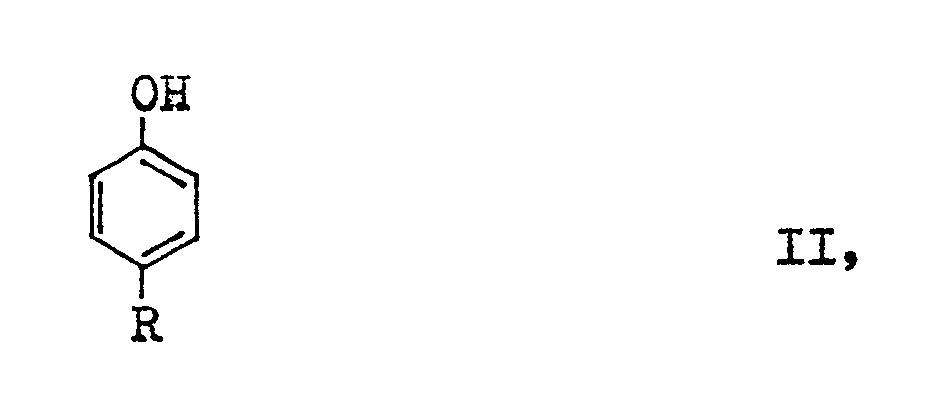
in der R die gleiche Bedeutung wie in Formel I hat, und Formaldehyd in Form einer wäßrigen Lösung mit vorzugsweise 30 bis 40 Masseanteilen in % Formaldehyd, oder aus einem p-Alkylcalix[8]aren der allgemeinen Formel I mit
R wie in Formel I und
n = 8,
oder aus einem Gemisch aus dem p-Alkylphenol der allgemeinen Formel II mit
R wie in Formel I
und Paraformaldehyd durch eine mit Alkalihydroxid katalysierte Reaktion in einem organischen Lösungsmittel als Reaktionsmedium, indem erfindungsgemäß als organisches Lösungsmittel ein Gemisch geradkettiger Kohlenwasserstoffe der Kettenlänge C₁₁ bis C₂₀ und des Siedebereiches 250 bis 260 °C bei Normaldruck eingesetzt wird, in welches man den jeweiligen Ausgangsstoff und das Alkalihydroxid einbringt, 1 bis 10 Stunden bei 217 bis 257 °C unter Sauerstoffausschluß rührt, dabei das entstehende Reaktionswasser abdestilliert, anschließend unumgesetzten Feststoff bei 100 bis 160 °C aus dem Reaktionsgemisch abtrennt, die feststoffreiche Reaktionslösung auf 17 bis 42 °C abkühlt und das ausgefallene, gut kristalline p-Alkylcalix[4]aren in an sich bekannter Weise isoliert, mit einem Kohlenwasserstoffgemisch der Kettenlänge C₅ bis C₇ wäscht und im Vakuum bei 0,5 bis 1,0 kPa trocknet.
Claims (3)
- Verfahren zur Herstellung von p-Alkylcalix[4]arenen der allgemeinen Formel

n = 4 bedeuten,- aus einem Vorkondensat, hergestellt aus dem entsprechenden p-Alkylphenol der allgemeinen Formel - oder aus einem p-Alkylcalix[8]aren der allgemeinen Formel I mit R wie in Formel I und n = 8- oder aus einem Gemisch aus dem p-Alkylphenol der allgemeinen Formel II, in der R die gleiche Bedeutung wie in Formel I hat, und Paraformaldehyddurch eine mit Alkalihydroxid katalysierte Reaktion in einem organischen Lösungsmittel als Reaktionsmedium, dadurch gekennzeichnet, daß als organisches Lösungsmittel ein Gemisch geradkettiger Kohlenwasserstoffe der Kettenlänge C₁₁ bis C₂₀ und des Siedebereiches 250 bis 260 °C bei Normaldruck eingesetzt wird, in welches man den jeweiligen Ausgangsstoff und das Alkalihydroxid einbringt, 1 bis 10 Stunden bei 217 bis 257 °C unter Sauerstoffausschluß rührt, dabei das entstehende Reaktionswasser abdestilliert, anschließend unumgesetzten Feststoff bei 100 bis 160 °C aus dem Reaktionsgemisch abtrennt, die feststoffreie Reaktionslösung auf 17 bis 42 °C abkühlt und das ausgefallene, gut kristalline p-Alkylcalix[4]aren in an sich bekannter Weise isoliert, mit einem Kohlenwasserstoffgemisch der Kettenlänge C₅ bis C₇ wäscht und im Vakuum bei 0,5 bis 1,0 kPa trocknet.
 - Verfahren nach Anspruch 1, dadurch gekennzeichnet, daß als Gemisch geradkettiger Kohlenwasserstoffe der Kettenlänge C₁₁ bis C₂₀ ein durch Molsiebextraktion aus einem Erdölmitteldestillatschnitt isoliertes n-Paraffingemisch der Zusammensetzung 2,5 bis 1o Masseanteile in % n-Paraffine C₁₁ bis C₁₂, 80 bis 90 Masseanteile in % n-Paraffine C₁₃ bis C₁₇ und 0,5 bis 10 Masseanteile in % n-Paraffine C₁₈ bis C₂₀ eingesetzt wird.
- Verfahren nach Anspruch 1, dadurch gekennzeichnet, daß als Alkalihydroxid Natrium- oder Kaliumhydroxid, vorzugsweise in Form einer wäßrigen Lösung in einem Verhältnis von 2 bis 10 Stoffmengenanteilen in % bezogen auf verwendete phenolische Einheit eingesetzt wird.
Applications Claiming Priority (2)
| Application Number | Priority Date | Filing Date | Title |
|---|---|---|---|
| DD90338955A DD292904A5 (de) | 1990-03-22 | 1990-03-22 | Verfahren zur herstellung von p-alkylcalix 4 arenen |
| DD338955 | 1990-03-22 |
Publications (1)
| Publication Number | Publication Date |
|---|---|
| EP0447977A1 true EP0447977A1 (de) | 1991-09-25 |
Family
ID=5617243
Family Applications (1)
| Application Number | Title | Priority Date | Filing Date |
|---|---|---|---|
| EP91104021A Ceased EP0447977A1 (de) | 1990-03-22 | 1991-03-15 | Verfahren zur Herstellung von p-Alkylcalix[4]arenen |
Country Status (2)
| Country | Link |
|---|---|
| EP (1) | EP0447977A1 (de) |
| DD (1) | DD292904A5 (de) |
Cited By (5)
| Publication number | Priority date | Publication date | Assignee | Title |
|---|---|---|---|---|
| EP0480658A3 (en) * | 1990-10-06 | 1993-02-17 | Bp Chemicals Limited | Phenolic resins |
| WO1997037957A1 (en) * | 1996-04-09 | 1997-10-16 | Fillger S.A. | A process for the preparation of calixarenes, and new calixarene compounds |
| US6271337B1 (en) | 1997-04-07 | 2001-08-07 | Fillger S.A. | Process for the preparation of calixarenes and new calixarene compounds |
| WO2019157368A1 (en) | 2018-02-09 | 2019-08-15 | Si Group, Inc. | Processes for preparing calix[4]arenes from calix[8]arenes |
| US10781154B2 (en) | 2018-02-09 | 2020-09-22 | Si Group, Inc. | Processes for preparing calixarenes |
Citations (1)
| Publication number | Priority date | Publication date | Assignee | Title |
|---|---|---|---|---|
| US3677986A (en) * | 1969-02-27 | 1972-07-18 | Monsanto Australia | Production of para-substituted phenol/formaldehyde resins |
-
1990
- 1990-03-22 DD DD90338955A patent/DD292904A5/de not_active IP Right Cessation
-
1991
- 1991-03-15 EP EP91104021A patent/EP0447977A1/de not_active Ceased
Patent Citations (1)
| Publication number | Priority date | Publication date | Assignee | Title |
|---|---|---|---|---|
| US3677986A (en) * | 1969-02-27 | 1972-07-18 | Monsanto Australia | Production of para-substituted phenol/formaldehyde resins |
Non-Patent Citations (2)
| Title |
|---|
| PATENT ABSTRACTS OF JAPAN vol. 8, no. 218 (C-245)(1655) 04 Oktober 1984, & JP-A-59 104333 (HITACHI KASEI) 16 Juni 1984, * |
| Topics in Current Chemistry vol. 123, 1984, Springer Verlag, Berlin, D Seiten 1 - 47; C.D. Gutsche: "The Calixarenes" * |
Cited By (10)
| Publication number | Priority date | Publication date | Assignee | Title |
|---|---|---|---|---|
| EP0480658A3 (en) * | 1990-10-06 | 1993-02-17 | Bp Chemicals Limited | Phenolic resins |
| US5378791A (en) * | 1990-10-06 | 1995-01-03 | Bp Chemicals Limited | Phenolic resins |
| WO1997037957A1 (en) * | 1996-04-09 | 1997-10-16 | Fillger S.A. | A process for the preparation of calixarenes, and new calixarene compounds |
| US6271337B1 (en) | 1997-04-07 | 2001-08-07 | Fillger S.A. | Process for the preparation of calixarenes and new calixarene compounds |
| WO2019157368A1 (en) | 2018-02-09 | 2019-08-15 | Si Group, Inc. | Processes for preparing calix[4]arenes from calix[8]arenes |
| US10781154B2 (en) | 2018-02-09 | 2020-09-22 | Si Group, Inc. | Processes for preparing calixarenes |
| US10843990B2 (en) | 2018-02-09 | 2020-11-24 | Si Group, Inc. | Processes for preparing calix[4]arenes from calix[8]arenes |
| US11072572B2 (en) | 2018-02-09 | 2021-07-27 | Si Group, Inc. | Processes for preparing calixarenes |
| US11225450B2 (en) | 2018-02-09 | 2022-01-18 | Si Group, Inc. | Processes for preparing calixarenes |
| US12049440B2 (en) | 2018-02-09 | 2024-07-30 | Si Group, Inc. | Processes for preparing calixarenes |
Also Published As
| Publication number | Publication date |
|---|---|
| DD292904A5 (de) | 1991-08-14 |
Similar Documents
| Publication | Publication Date | Title |
|---|---|---|
| DE69616615T2 (de) | Cyclische Phenolsulfide und Verfahren zu ihrer Herstellung | |
| DE2612843B2 (de) | Bis-acrylester und Bis-methacrylester, Verfahren zur Herstellung dieser Verbindungen und deren Verwendung | |
| DE2360709A1 (de) | S-triazin-vorpolymerisaten | |
| DE1495948A1 (de) | Polykarbonate sowie Verfahren zu ihrer Herstellung | |
| EP0026318A1 (de) | Verfahren zur Herstellung reiner 4,4'-Dihydroxydiphenylalkane bzw. -cycloalkane | |
| EP0447977A1 (de) | Verfahren zur Herstellung von p-Alkylcalix[4]arenen | |
| EP0137309B1 (de) | Mehrcyclische Kohlensäureester und neue Copolymere erhältlich aus diesen mehrcyclischen Kohlensäureestern und monocyclischen Carbonaten | |
| DE2318001A1 (de) | Neue dienische sulfone | |
| EP0094347B1 (de) | Verfahren zur Herstellung von 1-Hydroxyketonen | |
| DE2111444C3 (de) | Substituierte Dibenzofurane bzw. Dibenzothiophene und Verfahren zu deren Herstellung sowie deren Verwendung als Stabilisatoren | |
| DE68902605T2 (de) | Ester die eine dithiothioacetalgruppe enthalten, ihre herstellung und ihre verwendung in der stabililisierung organischer verbindungen. | |
| DE68928598T2 (de) | Methode zur Synthese epoxidierter Polysulfide | |
| US2097726A (en) | Process for the manufacture of sulphonic acids from aryl ethylenes and the products thereof | |
| DE1668966B1 (de) | Verfahren zur gleichzeitigen Herstellung von 2,6-Dimethyl-phenol und 4-tert.-Butylphenol | |
| DE2424201A1 (de) | 4,4'-thio-bis-(dialkylphenol)-formaldehyd-kondensate, verfahren zu ihrer herstellung und ihre verwendung | |
| DE2645532A1 (de) | Schwefelhaltige harze und verfahren zu ihrer herstellung | |
| AT210874B (de) | Verfahren zur Herstellung von neuen Polysulfosäureestern | |
| DE1911799A1 (de) | Verfahren zur Herstellung halogenhaltiger Arylmono- und -diaether | |
| DE1168445B (de) | Verfahren zur Herstellung reiner 4, 4-Dihydroxydiphenylalkane bzw. -cycloalkane | |
| DE141975C (de) | ||
| DE2425766A1 (de) | Verfahren zur herstellung von 6-isopropyl-1,1,4-trimethylindan | |
| DE2042569A1 (en) | Phenol mixtures contg m-dioxybenzene prepn - by reacting o-or p-chlorophenol with alkali hydroxide under an hydrous conditions | |
| DE2354325A1 (de) | Verfahren zur herstellung von alkalisalzen des carbazols | |
| DE2209840A1 (de) | Antioxidationsmittel | |
| DE2453152A1 (de) | Harz und verfahren zu seiner herstellung |
Legal Events
| Date | Code | Title | Description |
|---|---|---|---|
| PUAI | Public reference made under article 153(3) epc to a published international application that has entered the european phase |
Free format text: ORIGINAL CODE: 0009012 |
|
| AK | Designated contracting states |
Kind code of ref document: A1 Designated state(s): CH DE FR GB IT LI |
|
| 17P | Request for examination filed |
Effective date: 19920114 |
|
| RAP1 | Party data changed (applicant data changed or rights of an application transferred) |
Owner name: GOERMAR, GERHARD, DR. Owner name: LEUNA-WERKE AG |
|
| 17Q | First examination report despatched |
Effective date: 19940504 |
|
| STAA | Information on the status of an ep patent application or granted ep patent |
Free format text: STATUS: THE APPLICATION HAS BEEN REFUSED |
|
| 18R | Application refused |
Effective date: 19941023 |
|
| RTI1 | Title (correction) |
Free format text: METHOD FOR THE PRODUCTION OF P-ALKYLCALIX??4 ARENES |