EP0447327A2 - Heterostruktur-Halbleiteranordnung - Google Patents
Heterostruktur-Halbleiteranordnung Download PDFInfo
- Publication number
- EP0447327A2 EP0447327A2 EP91400711A EP91400711A EP0447327A2 EP 0447327 A2 EP0447327 A2 EP 0447327A2 EP 91400711 A EP91400711 A EP 91400711A EP 91400711 A EP91400711 A EP 91400711A EP 0447327 A2 EP0447327 A2 EP 0447327A2
- Authority
- EP
- European Patent Office
- Prior art keywords
- layer
- major surface
- semiconductor device
- upper major
- barrier layer
- Prior art date
- Legal status (The legal status is an assumption and is not a legal conclusion. Google has not performed a legal analysis and makes no representation as to the accuracy of the status listed.)
- Granted
Links
Images



Classifications
-
- H—ELECTRICITY
- H10—SEMICONDUCTOR DEVICES; ELECTRIC SOLID-STATE DEVICES NOT OTHERWISE PROVIDED FOR
- H10D—INORGANIC ELECTRIC SEMICONDUCTOR DEVICES
- H10D30/00—Field-effect transistors [FET]
- H10D30/40—FETs having zero-dimensional [0D], one-dimensional [1D] or two-dimensional [2D] charge carrier gas channels
- H10D30/47—FETs having zero-dimensional [0D], one-dimensional [1D] or two-dimensional [2D] charge carrier gas channels having 2D charge carrier gas channels, e.g. nanoribbon FETs or high electron mobility transistors [HEMT]
- H10D30/471—High electron mobility transistors [HEMT] or high hole mobility transistors [HHMT]
- H10D30/473—High electron mobility transistors [HEMT] or high hole mobility transistors [HHMT] having confinement of carriers by multiple heterojunctions, e.g. quantum well HEMT
- H10D30/4732—High electron mobility transistors [HEMT] or high hole mobility transistors [HHMT] having confinement of carriers by multiple heterojunctions, e.g. quantum well HEMT using Group III-V semiconductor material
-
- H—ELECTRICITY
- H01—ELECTRIC ELEMENTS
- H01L—SEMICONDUCTOR DEVICES NOT COVERED BY CLASS H10
- H01L21/00—Processes or apparatus adapted for the manufacture or treatment of semiconductor or solid state devices or of parts thereof
- H01L21/02—Manufacture or treatment of semiconductor devices or of parts thereof
- H01L21/02104—Forming layers
- H01L21/02365—Forming inorganic semiconducting materials on a substrate
- H01L21/02367—Substrates
- H01L21/0237—Materials
- H01L21/02373—Group 14 semiconducting materials
- H01L21/02381—Silicon, silicon germanium, germanium
-
- H—ELECTRICITY
- H01—ELECTRIC ELEMENTS
- H01L—SEMICONDUCTOR DEVICES NOT COVERED BY CLASS H10
- H01L21/00—Processes or apparatus adapted for the manufacture or treatment of semiconductor or solid state devices or of parts thereof
- H01L21/02—Manufacture or treatment of semiconductor devices or of parts thereof
- H01L21/02104—Forming layers
- H01L21/02365—Forming inorganic semiconducting materials on a substrate
- H01L21/02436—Intermediate layers between substrates and deposited layers
- H01L21/02439—Materials
- H01L21/02455—Group 13/15 materials
- H01L21/02461—Phosphides
-
- H—ELECTRICITY
- H01—ELECTRIC ELEMENTS
- H01L—SEMICONDUCTOR DEVICES NOT COVERED BY CLASS H10
- H01L21/00—Processes or apparatus adapted for the manufacture or treatment of semiconductor or solid state devices or of parts thereof
- H01L21/02—Manufacture or treatment of semiconductor devices or of parts thereof
- H01L21/02104—Forming layers
- H01L21/02365—Forming inorganic semiconducting materials on a substrate
- H01L21/02436—Intermediate layers between substrates and deposited layers
- H01L21/02439—Materials
- H01L21/02455—Group 13/15 materials
- H01L21/02463—Arsenides
-
- H—ELECTRICITY
- H01—ELECTRIC ELEMENTS
- H01L—SEMICONDUCTOR DEVICES NOT COVERED BY CLASS H10
- H01L21/00—Processes or apparatus adapted for the manufacture or treatment of semiconductor or solid state devices or of parts thereof
- H01L21/02—Manufacture or treatment of semiconductor devices or of parts thereof
- H01L21/02104—Forming layers
- H01L21/02365—Forming inorganic semiconducting materials on a substrate
- H01L21/02436—Intermediate layers between substrates and deposited layers
- H01L21/02494—Structure
- H01L21/02496—Layer structure
- H01L21/02502—Layer structure consisting of two layers
-
- H—ELECTRICITY
- H01—ELECTRIC ELEMENTS
- H01L—SEMICONDUCTOR DEVICES NOT COVERED BY CLASS H10
- H01L21/00—Processes or apparatus adapted for the manufacture or treatment of semiconductor or solid state devices or of parts thereof
- H01L21/02—Manufacture or treatment of semiconductor devices or of parts thereof
- H01L21/02104—Forming layers
- H01L21/02365—Forming inorganic semiconducting materials on a substrate
- H01L21/02436—Intermediate layers between substrates and deposited layers
- H01L21/02494—Structure
- H01L21/02496—Layer structure
- H01L21/02505—Layer structure consisting of more than two layers
-
- H—ELECTRICITY
- H01—ELECTRIC ELEMENTS
- H01L—SEMICONDUCTOR DEVICES NOT COVERED BY CLASS H10
- H01L21/00—Processes or apparatus adapted for the manufacture or treatment of semiconductor or solid state devices or of parts thereof
- H01L21/02—Manufacture or treatment of semiconductor devices or of parts thereof
- H01L21/02104—Forming layers
- H01L21/02365—Forming inorganic semiconducting materials on a substrate
- H01L21/02518—Deposited layers
- H01L21/02521—Materials
- H01L21/02538—Group 13/15 materials
- H01L21/02546—Arsenides
-
- H—ELECTRICITY
- H10—SEMICONDUCTOR DEVICES; ELECTRIC SOLID-STATE DEVICES NOT OTHERWISE PROVIDED FOR
- H10D—INORGANIC ELECTRIC SEMICONDUCTOR DEVICES
- H10D10/00—Bipolar junction transistors [BJT]
- H10D10/60—Lateral BJTs
-
- H—ELECTRICITY
- H10—SEMICONDUCTOR DEVICES; ELECTRIC SOLID-STATE DEVICES NOT OTHERWISE PROVIDED FOR
- H10D—INORGANIC ELECTRIC SEMICONDUCTOR DEVICES
- H10D62/00—Semiconductor bodies, or regions thereof, of devices having potential barriers
- H10D62/10—Shapes, relative sizes or dispositions of the regions of the semiconductor bodies; Shapes of the semiconductor bodies
- H10D62/17—Semiconductor regions connected to electrodes not carrying current to be rectified, amplified or switched, e.g. channel regions
- H10D62/351—Substrate regions of field-effect devices
- H10D62/357—Substrate regions of field-effect devices of FETs
-
- H—ELECTRICITY
- H10—SEMICONDUCTOR DEVICES; ELECTRIC SOLID-STATE DEVICES NOT OTHERWISE PROVIDED FOR
- H10D—INORGANIC ELECTRIC SEMICONDUCTOR DEVICES
- H10D62/00—Semiconductor bodies, or regions thereof, of devices having potential barriers
- H10D62/80—Semiconductor bodies, or regions thereof, of devices having potential barriers characterised by the materials
- H10D62/82—Heterojunctions
-
- H10P14/2905—
-
- H10P14/3218—
-
- H10P14/3221—
-
- H10P14/3248—
-
- H10P14/3251—
-
- H10P14/3421—
Definitions
- the present invention generally relates to semiconductor devices, and in particular to a semiconductor device having a group III-V compound semiconductor substrate.
- the group III-V compound semiconductor materials are characterized by the high electron mobility due to the characteristic band structure pertinent to the material and are suitable for the active layer of fast-speed semiconductor devices.
- GaAs and the mixed crystals thereof have been studied intensively for realizing such fast-speed devices.
- InGaAs has the band structure that provides a performance superior to other devices constructed on the GaAs active layer in terms of the electron mobility and band structure that minimizes the transition of accelerated electrons from the ⁇ -valley corresponding to the ground state to other, excited states wherein the electron mobility is smaller.
- InGaAs forms a two-dimensional electron gas when combined with other appropriate group III-V compound semiconductor layer with sufficient electron density.
- the lattice constant of GaAs is about 4 % larger than that of silicon while the thermal expansion coefficient of GaAs is larger by more than 200 % than that of silicon.
- a simple epitaxial growth of GaAs or other group III-V compound semiconductor material on a silicon wafer is generally not successful.
- the group III-V compound semiconductor layer thus obtained generally involves substantial amount of dislocations and other defects that are formed in the amorphous GaAs buffer layer. It should be noted that these dislocations are created at the boundary between the wafer and the buffer layer at the time when the amorphous layer is crystallized (Akiyama et. al., op cit). Once created, the dislocations propagate into the group III-V compound semiconductor layer, passing through the buffer layer that includes a nucleation layer. Because of this, the dislocation density in the group III-V compound semiconductor layer is intolerably high, in the order of 108cm ⁇ 2 or more. Such a material is useless for the active layer of the high speed semiconductor devices.
- the semiconductor devices formed on the foregoing heteroepitaxial structure has a problem of excessive leakage current flowing from the active layer to the substrate.
- leakage current flows, the electric isolation of devices on the substrate is naturally deteriorated.
- the leakage current is large enough to cause poor device isolation, the substrate can no longer used for the substrate of integrated circuits.
- the side gate effect there occurs an interference between adjacent devices known as the "side gate effect.”
- the threshold voltage of a device such as MESFET may change by the gate voltage applied to an adjacent device.
- the conventional III-V semiconductor layers on the substrate employ undoped GaAs for the buffer layer to secure a high resistivity.
- the conventional III-V semiconductor layers on the substrate employ undoped GaAs for the buffer layer to secure a high resistivity.
- such a measure cannot reduce the leakage current below about 10 ⁇ 3 amperes, which is not satisfactory for the substrate to be used for the compound semiconductor integrated circuits.
- Another and more specific object of the present invention is to provide a semiconductor device having a heteroepitaxial layers on a substrate, wherein propagation of dislocations to an active layer of the semiconductor device from the heteroepitaxial interface between the heteroepitaxial layer and the substrate is minimized.
- Another object of the present invention is to provide a semiconductor device having a heteroepitaxial layer on a substrate, wherein the leakage current flowing from an active layer of the semiconductor device to the substrate is minimized.
- Another object of the present invention is to provide a semiconductor device comprising a substrate of silicon, a buffer layer of a first group III-V compound semiconductor material provided on the substrate, a barrier layer of a second group III-V compound semiconductor material different from the first group III-V compound semiconductor material, provided on the buffer layer in contact therewith, said barrier layer having a resistivity higher than that of the buffer layer and a lattice constant different from that of the buffer layer, an active semiconductor layer provided on the barrier layer, and an active semiconductor device formed in said active semiconductor layer.
- the dislocations created at the boundary between the substrate and the buffer layer are intercepted by the barrier layer that has the lattice constant different from the lattice constant of the buffer layer.
- the barrier layer comprises a group III-V compound semiconductor material having a wide band gap such as InAlAs or AlGaAs that may be not loped by impurities or that may be doped to form deep impurity levels.
- a wide band gap such as InAlAs or AlGaAs that may be not loped by impurities or that may be doped to form deep impurity levels.
- FIG.1 shows the fundamental structure of a heteroepitaxial layers on a substrate proposed according to a first embodiment of the present invention.
- the substrate comprises a silicon base layer 11 on which a buffer layer 12 of GaAs or GaP is grown heteroepitaxially.
- a buffer layer 12 of GaAs or GaP is grown heteroepitaxially.
- the GaAs layer 12 is grown with the thickness of about 1-2 ⁇ m.
- the barrier layer 13 has a band gap that is substantially larger than the band gap of GaAs forming the buffer layer 12.
- GaAs has the band gap of 1.65 eV
- InAlAs having the composition of In 0.1 Al 0.9 As for example, has the band gap of about 1.98 eV.
- GaP on the other hand, has the band gap of 2.26 eV.
- the barrier layer 13 acts as a barrier against the carriers moving therethrough from the active layer 14 to the substrate 11.
- the barrier layer 13 acts as the effective barrier of carriers, it is essential that the barrier layer has a large resistivity at least larger than that of the buffer layer 12, in addition to the large band gap.
- the barrier layer 13 of the foregoing composition is grown in the undoped state.
- Such a material generally has the resistivity of more than 50 ⁇ cm.
- the barrier layer 13 may be doped with a deep dopant such as Cr that causes a deep impurity level in the forbidden band of the barrier layer 13. When doped as such, the barrier layer 13 may show the resistivity of about 100 ⁇ cm or more.
- the barrier layer 13 has a lattice constant that differs slightly from that of the buffer layer 12.
- AlGaAs having the foregoing composition has the lattice constant of about 5.66 ⁇ while GaAs has the lattice constant of 5.654 ⁇ . This minute difference in the lattice constant is enough to induce a strain at the interface between the buffer layer 12 and the barrier layer 13, and the dislocations created at the interface between the buffer layer 12 and the substrate 11 and propagating upward through the buffer layer 12, is effectively reduced.
- the discrepancy in the lattice constant between the barrier layer 13 and the buffer layer 12 is preferred to be less than 10 %, most preferably less than about 5 %.
- a similar reduction of the dislocations can be achieved when the InAlAs barrier layer is used. It should be noted that InAlAs having the foregoing composition has the lattice constant of about 5.70 ⁇ .
- the barrier layer 13 between the buffer layer 12 and the active layer 14, successful electric isolation of the active layer 14 including the active devices formed thereon against the substrate as well as the effective elimination of dislocations from the active layer 14 are achieved.
- the material of the layer 13 is not limited to AlGaAs or InAlAs of the specified composition, but a mixed crystal thereof may be used. Further, any other material having a large band gap, high resistivity and a lattice constant that differs from the lattice constant of the buffer layer but matches to the lattice constant of the active layer, may be employed for the barrier layer 13.
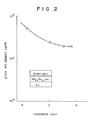
- FIG.2 shows the result of etch pit density measurement undertaken for the heteroepitaxial layer grown on the substrate of FIG.1 wherein a GaAs layer having a thickness of 1 ⁇ m is grown on the foregoing AlGaAs barrier layer having various thicknesses.
- the etch pit density represents the dislocation density in the crystal.
- the GaAs layer was grown with a thickness of 1 ⁇ m as the active layer 14 on the AlGaAs barrier layer 13 having the composition of Al 0.3 Ga 0.7 As of which thickness is changed from 0.35 ⁇ m to 3.6 ⁇ m sample by sample.
- the etch pit density representing the dislocation density in the GaAs active layer 14 decreases with the increasing thickness of the barrier layer 13, demonstrating the effect of interception of the dislocations by the barrier layer 13.
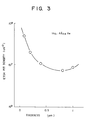
- a similar decrease of dislocation density in the GaAs active layer 14 was observed also in the case where InAlAs having the composition In 0.1 Al 0.9 As was used for the barrier layer 13 as shown in FIG.3.
- the GaAs active layer 14 was grown with the thickness of 1 ⁇ m, while the thickness of the barrier layer 13 was changed from 0.08 ⁇ m to 1 ⁇ m.
- the etch pit density decreases with increasing thickness of the barrier layer 13 and has a minimum at the thickness of about 0.8 ⁇ m.
- FIG.4 a second embodiment of the present invention for a semiconductor device formed on the heteroepitaxial layer grown on a substrate of FIG.1 will be described with reference to FIG.4.
- those parts that correspond to the parts already described with reference to FIG.1 are designated by the same reference numerals and the description thereof will be omitted.
- the semiconductor device forms an HEMT that utilizes the two-dimensional carrier gas formed at the heteroepitaxial interface between the active layer 14 and a doped layer 15 that is provided on the active layer 14.
- the active layer 14 may be made of undoped InGaAs and the doped layer 15 may be made of n-type AlGaAs or n-type InAlAs.
- As the doped layer 15 has a large band gap corresponding to the band gap of the barrier layer 13, there occurs an effective confinement of electrons in the active layer 14.
- a source electrode 9 and a drain electrode 10 are provided on the doped layer 15 with an intervening gate electrode 8 provided between the source electrode 9 and the drain electrode 10 for establishing a Schottky contact to the layer 15.
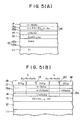
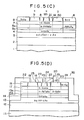
- FIGS.5(A) - 5(D) show the process for fabricating a HEMT according to the third embodiment of the present invention, wherein FIG.5(D) shows the structure of the completed device.
- FIG.5(D) shows the structure of the completed device.
- the buffer layer 12 of GaAs has a first part 12a immediately above the silicon substrate 11 and a second part 12b grown subsequently on the first part 12b.
- the part 12a is grown in the amorphous state at the beginning of deposition of the buffer layer 12b, and the part 12b is grown after the part 12a is crystallized as a result of increase of the temperature.
- the barrier 13 having the composition Al 0.3 Ga 0.7 As is grown epitaxially with the thickness of 0.5 ⁇ m.
- the active layer 14 of In 0.1 Ga 0.9 As is grown epitaxially with a thickness of 100 - 1000 ⁇ as the channel layer of the semiconductor device.
- the doped layer 15 of Al 0.3 Ga 0.7 As is provided on the active layer 14 to form the two-dimensional electron gas in the layer 14 along the heterojunction interface between the layer 14 and the layer 15.
- the doped layer 15 has a thin undoped region 15b along the heterojunction interface.
- the thickness of the layer 15b may be about 30 - 100 ⁇ .
- the remaining, doped region of the layer 15 is designated by a reference numeral 15a.
- the region 15a and the region 15b have the same composition of Al 0.3 Ga 0.7 As except that the former is doped to the n-type while the latter is not doped.
- a cap layer 17 of n-type GaAs is grown epitaxially for facilitating the ohmic contact.
- the layered semiconductor body thus formed is subjected to a process for forming a mesa structure 30 as shown in FIG.5(D) such that the mesa structure 30 extends upward from an intermediate level of the barrier layer 13.
- the mesa structure 30 includes the upper half of the barrier layer 13 and the layers 14 - 17 grown thereabove.
- ohmic electrodes 18 and 19 of Au/Ni/AuGe structure are provided as the source and drain electrodes, and a Schottky electrode 21 of WSi is provided between the electrodes 18 and 19 as the gate electrode.
- the entire surface of the HEMT is covered by a silicon oxide passivation film 22 except for contact holes 23, 24 and 25 respectively exposing the source electrode 18, the gate electrode 21 and the drain electrode 19.
- such a mesa structure 30 isolates the devices formed thereon electrically from other devices formed on other mesa structures, as the semiconductor layers 14 - 17 in the mesa 30 are completely separated from those of other mesa structures by the barrier layer 13.
- the barrier layer 13 that extends between different mesas has a high resistivity because of the large band gap, and the electric interference between the different devices via the barrier layer 13 or the layers such as the buffer layer 12 or the substrate 11 located below the barrier layer 13 is effectively eliminated.
- FIG.6 shows the leakage current measured about the structure of FIG.5(D). The measurement was made by measuring the current flowing between the source and drain in the turned-off state of the HEMT. A number of samples were prepared with the substantially identical structure but changing thickness of the barrier layer 13. As can be seen clearly from FIG.6, the leakage current decreases to about 1/100, as compared to the case where no barrier layer 13 is provided, when the barrier layer 13 is formed with the thickness of 1 ⁇ m. Further, it was shown that the mutual conductance of HEMT, having the normalized gate length of 2 - 10 ⁇ m, is improved from 180 - 230 mS/mm to 250 - 270 mS/mm by the provision of the barrier layer 13. These findings clearly indicate the effect of electrical isolation achieved by the barrier layer 13.
- a silicon substrate having a (100) surface that is offset in the [011] direction by 2 degrees is used for the substrate 11.
- the substrate 11 is at first treated in a HF solution and washed by water.
- the substrate 11 is placed on a susceptor in a reactor of which pressure is held at 76 Torr.
- the substrate 11 is heated at 1000 °C while flowing hydrogen and arsine (AsH3) respectively with the flow rate of 12 SLM and 30 SCCM.
- the oxide film covering the silicon substrate 11 is dissolved by HF and subsequently sublimated in the reactor.
- the flow rate of hydrogen is set at 12 SLM.
- Arsine is introduced for creating an atmosphere containing arsenic for facilitating the growth of GaAs film that is undertaken in the subsequent steps.
- the temperature of the substrate 11 is set at 450 °C and arsine and TMG (trimethyl gallium) are introduced in to the reactor with the flow rate of 0.2 SLM and 13.3 SCCM, respectively.
- the GaAs layer 12a is grown in the amorphous state with the thickness of 50 - 200 ⁇ .
- the temperature is raised to 650 - 700 °C and the amorphous layer 12a is crystallized to a single crystal phase as described previously.
- the flow rate of the arsine and TMG is set to 0.1 SLM and 2.67 SCCM and the growth of the buffer layer 12 is continued until the part 12b thereon reaches the thickness of about 1.2 ⁇ m.
- TMA trimethyl aluminum
- the supply of TMG is reduced and supplying of TMI (trimethyl indium) is started with the flow rate of 1.27 SCCM.
- TMI trimethyl indium
- the active layer 14 of InGaAs having the composition In 0.1 Ga 0.9 As is grown with the thickness of 100 - 200 ⁇ .
- the supply of TMI is stopped and the supply of TMG is resumed with the flow rate of 2.67 SCCM.
- the layer of undoped AlGaAs forming the spacer layer 15b is grown with the thickness of 30 - 50 ⁇ .
- silane (SiH4) is added to TMI with the flow rate of 0.0001 - 0.1 SCCM as the source ofsilicon that acts as the dopant.
- the layer 15a forming the major part of the doped layer 15 is formed with the thickness of 200 - 400 ⁇ .
- the doped layer 15a thus grown has the carrier density of 1017-1018cm ⁇ 3.
- a silicon oxide layer 18 is deposited on the top surface of the cap layer 17 as shown in FIG.5(B) by a CVD process using silane and oxygen at a temperature of 350 - 450 °C. Further, a photoresist (not shown) is deposited on the silicon oxide layer 18 and patterned subsequently to expose the part of the silicon oxide layer 18 corresponding to the source and drain electrodes of HEMT. After an etching process for removing the exposed part of the silicon oxide layer 18, metal layers of gold-germanium alloy, nickel and gold are deposited consecutively to fill the contact holes formed in the silicon oxide layer 18 in correspondence to the source and drain electrodes.
- the metal layers left on the cap layer 17 are subjected to an alloying process at 400 - 450 °C, and thereby the source electrode 19 and the drain electrode 20 forming the ohmic contact with the GaAs cap layer 17 are formed as shown in FIG.5(B). It should be noted that, in the structure of FIG.5(B), the surface of the cap layer 17 that is not covered by the source and drain electrodes 19 and 20 is still covered by the silicon oxide layer 18.
- a photoresist is applied again on the structure of FIG.5(B) and, after the photolithographic patterning of the photoresist, the part of the silicon oxide layer 18 corresponding to where the gate electrode 21 is to be formed is subjected to etching for forming a contact hole for the gate electrode. After the etching, a sputtering process of WSi is accomplished such that the contact hole corresponding to the gate electrode is filled by WSi. With the removal of the remaining photoresist, the structure shown in FIG.5(C) is obtained.
- FIG.5(C) is subjected to the mesa etching for forming the mesa structure 30.
- the mesa structure 30 is formed to extend upward from an intermediate level of the barrier layer 13 as shown in FIG.5(D). Further, the entire surface of the mesa structure 30 including the side wall portion of the mesa 30 is covered by the silicon oxide passivation layer 22 that is deposited by the CVD process. After providing the contact holes 23, 24 and 25 in the passivation layer 22 in correspondence to the source electrode 19, the gate electrode 21 and the drain electrode 20, fabrication of the HEMT is completed.
- FIG.7 shows a hetero-bipolar transistor according to a fourth embodiment of the present invention.
- the GaAs buffer layer 12 and the barrier layer of AlGaAs or InAlAs are grown on the substrate 11 consecutively as already described, and the active layer of InGaAs 14 is grown on the barrier layer 13.
- In the active layer 14 is doped for example to the n-type and forms the base of a bipolar transistor.
- p-type regions 41 and 42 are formed in the active layer 14 by ion implantation as the emitter and source. Thereby, a high-speed bipolar transistor is formed.
- the buffer layer 12 is formed from GaAs.
- group III-V compound semiconductor materials such as GaP may also be used for the buffer layer 12.
- GaP has the lattice constant of 5.4514 ⁇ and shows a lattice discrepancy of 0.37 % against silicon. Thereby, an excellent epitaxial growth on the silicon wafer 11 is possible.
- GaP has a high resistivity of about 102 ⁇ cm and is suitable for the buffer layer.
- the mixed crystal of GaAsP may also be used for the buffer layer.
- barrier layer 13 between the buffer layer 12 and the active layer 14 is not limited to one but a plurality of structures comprising the buffer layer 12 and the barrier layer 13 may be provided between the substrate 11 and the active layer 14.
- the substrate of the present invention is not limited to silicon but germanium or aluminum oxide may be used.
Landscapes
- Engineering & Computer Science (AREA)
- Physics & Mathematics (AREA)
- Condensed Matter Physics & Semiconductors (AREA)
- General Physics & Mathematics (AREA)
- Manufacturing & Machinery (AREA)
- Computer Hardware Design (AREA)
- Microelectronics & Electronic Packaging (AREA)
- Power Engineering (AREA)
- Chemical & Material Sciences (AREA)
- Materials Engineering (AREA)
- Junction Field-Effect Transistors (AREA)
- Recrystallisation Techniques (AREA)
Applications Claiming Priority (2)
| Application Number | Priority Date | Filing Date | Title |
|---|---|---|---|
| JP65124/90 | 1990-03-15 | ||
| JP2065124A JP2817995B2 (ja) | 1990-03-15 | 1990-03-15 | ▲iii▼―▲v▼族化合物半導体ヘテロ構造基板および▲iii▼―▲v▼族化合物ヘテロ構造半導体装置 |
Publications (3)
| Publication Number | Publication Date |
|---|---|
| EP0447327A2 true EP0447327A2 (de) | 1991-09-18 |
| EP0447327A3 EP0447327A3 (en) | 1992-01-15 |
| EP0447327B1 EP0447327B1 (de) | 1996-06-12 |
Family
ID=13277814
Family Applications (1)
| Application Number | Title | Priority Date | Filing Date |
|---|---|---|---|
| EP91400711A Expired - Lifetime EP0447327B1 (de) | 1990-03-15 | 1991-03-15 | Heterostruktur-Halbleiteranordnung |
Country Status (4)
| Country | Link |
|---|---|
| US (1) | US5144379A (de) |
| EP (1) | EP0447327B1 (de) |
| JP (1) | JP2817995B2 (de) |
| DE (1) | DE69120116T2 (de) |
Cited By (3)
| Publication number | Priority date | Publication date | Assignee | Title |
|---|---|---|---|---|
| WO2000059045A3 (en) * | 1999-03-29 | 2001-01-04 | Hughes Electronics Corp | Multilayer semiconductor structure with phosphide-passivated germanium substrate |
| EP1067594A3 (de) * | 1999-07-06 | 2002-07-10 | Sharp Kabushiki Kaisha | Halbleitervorrichtung |
| WO2001086699A3 (en) * | 2000-05-08 | 2003-01-30 | Univ Leland Stanford Junior | Low temperature grown optical detector |
Families Citing this family (38)
| Publication number | Priority date | Publication date | Assignee | Title |
|---|---|---|---|---|
| US5130269A (en) * | 1988-04-27 | 1992-07-14 | Fujitsu Limited | Hetero-epitaxially grown compound semiconductor substrate and a method of growing the same |
| KR100254005B1 (ko) * | 1991-08-02 | 2000-04-15 | 가나이 쓰도무 | 반도체 장치 및 그 제조 방법 |
| FR2689683B1 (fr) * | 1992-04-07 | 1994-05-20 | Thomson Composants Microondes | Dispositif semiconducteur a transistors complementaires. |
| DE69318271T2 (de) * | 1992-12-21 | 1998-12-17 | Nippon Steel Corp., Tokio/Tokyo | Verfahren zum Wachstum von Verbundhalbleitern auf einer Siliziumscheibe |
| JP3036404B2 (ja) * | 1995-05-25 | 2000-04-24 | 株式会社村田製作所 | 半導体装置とその製造方法 |
| US5621227A (en) * | 1995-07-18 | 1997-04-15 | Discovery Semiconductors, Inc. | Method and apparatus for monolithic optoelectronic integrated circuit using selective epitaxy |
| US5912481A (en) | 1997-09-29 | 1999-06-15 | National Scientific Corp. | Heterojunction bipolar transistor having wide bandgap, low interdiffusion base-emitter junction |
| US6423990B1 (en) | 1997-09-29 | 2002-07-23 | National Scientific Corporation | Vertical heterojunction bipolar transistor |
| US6512369B2 (en) * | 2001-05-22 | 2003-01-28 | Delphi Technologies, Inc. | Temperature compensated voltage divider with a magnetoresistor and a reference resistor |
| JP2003007976A (ja) * | 2001-06-25 | 2003-01-10 | Mitsubishi Electric Corp | 半導体装置及びモジュール装置 |
| US6815790B2 (en) * | 2003-01-10 | 2004-11-09 | Rapiscan, Inc. | Position sensing detector for the detection of light within two dimensions |
| US8035183B2 (en) * | 2003-05-05 | 2011-10-11 | Udt Sensors, Inc. | Photodiodes with PN junction on both front and back sides |
| US7655999B2 (en) | 2006-09-15 | 2010-02-02 | Udt Sensors, Inc. | High density photodiodes |
| US7880258B2 (en) * | 2003-05-05 | 2011-02-01 | Udt Sensors, Inc. | Thin wafer detectors with improved radiation damage and crosstalk characteristics |
| US8686529B2 (en) | 2010-01-19 | 2014-04-01 | Osi Optoelectronics, Inc. | Wavelength sensitive sensor photodiodes |
| US7656001B2 (en) * | 2006-11-01 | 2010-02-02 | Udt Sensors, Inc. | Front-side illuminated, back-side contact double-sided PN-junction photodiode arrays |
| US8164151B2 (en) * | 2007-05-07 | 2012-04-24 | Osi Optoelectronics, Inc. | Thin active layer fishbone photodiode and method of manufacturing the same |
| US7279731B1 (en) * | 2006-05-15 | 2007-10-09 | Udt Sensors, Inc. | Edge illuminated photodiodes |
| US8120023B2 (en) | 2006-06-05 | 2012-02-21 | Udt Sensors, Inc. | Low crosstalk, front-side illuminated, back-side contact photodiode array |
| US7709921B2 (en) * | 2008-08-27 | 2010-05-04 | Udt Sensors, Inc. | Photodiode and photodiode array with improved performance characteristics |
| US7057254B2 (en) * | 2003-05-05 | 2006-06-06 | Udt Sensors, Inc. | Front illuminated back side contact thin wafer detectors |
| US7242069B2 (en) * | 2003-05-05 | 2007-07-10 | Udt Sensors, Inc. | Thin wafer detectors with improved radiation damage and crosstalk characteristics |
| US7256470B2 (en) * | 2005-03-16 | 2007-08-14 | Udt Sensors, Inc. | Photodiode with controlled current leakage |
| US7576369B2 (en) * | 2005-10-25 | 2009-08-18 | Udt Sensors, Inc. | Deep diffused thin photodiodes |
| US8519503B2 (en) * | 2006-06-05 | 2013-08-27 | Osi Optoelectronics, Inc. | High speed backside illuminated, front side contact photodiode array |
| EP1834360A2 (de) * | 2004-12-30 | 2007-09-19 | Koninklijke Philips Electronics N.V. | Anreicherungs- verarmungs halbleiterstruktur und herstellungsverfahren dafür |
| JP2007149794A (ja) * | 2005-11-25 | 2007-06-14 | Matsushita Electric Ind Co Ltd | 電界効果トランジスタ |
| US9178092B2 (en) | 2006-11-01 | 2015-11-03 | Osi Optoelectronics, Inc. | Front-side illuminated, back-side contact double-sided PN-junction photodiode arrays |
| US9006707B2 (en) | 2007-02-28 | 2015-04-14 | Intel Corporation | Forming arsenide-based complementary logic on a single substrate |
| US20100053802A1 (en) * | 2008-08-27 | 2010-03-04 | Masaki Yamashita | Low Power Disk-Drive Motor Driver |
| US7687799B2 (en) * | 2008-06-19 | 2010-03-30 | Intel Corporation | Methods of forming buffer layer architecture on silicon and structures formed thereby |
| BRPI0919221A2 (pt) | 2008-09-15 | 2015-12-08 | Osi Optoelectronics Inc | fotodiodo de espinha de peixe de camada ativa fina com uma camada n+ rasa e método de fabricação do mesmo |
| US8399909B2 (en) | 2009-05-12 | 2013-03-19 | Osi Optoelectronics, Inc. | Tetra-lateral position sensing detector |
| US8912615B2 (en) | 2013-01-24 | 2014-12-16 | Osi Optoelectronics, Inc. | Shallow junction photodiode for detecting short wavelength light |
| CN105424234A (zh) * | 2015-12-01 | 2016-03-23 | 成都嘉石科技有限公司 | 一种压力传感器集成器件及其制作方法 |
| DE102018108604A1 (de) * | 2018-04-11 | 2019-10-17 | Aixtron Se | Nukleationsschicht-Abscheideverfahren |
| US20220199817A1 (en) | 2020-12-18 | 2022-06-23 | Innoscience (Suzhou) Technology Co., Ltd. | Semiconductor device and method for manufacturing the same |
| CN113130644B (zh) * | 2020-12-18 | 2023-03-24 | 英诺赛科(苏州)科技有限公司 | 半导体器件以及制造半导体器件的方法 |
Family Cites Families (8)
| Publication number | Priority date | Publication date | Assignee | Title |
|---|---|---|---|---|
| US4157556A (en) * | 1977-01-06 | 1979-06-05 | Varian Associates, Inc. | Heterojunction confinement field effect transistor |
| JPS6012724A (ja) * | 1983-07-01 | 1985-01-23 | Agency Of Ind Science & Technol | 化合物半導体の成長方法 |
| EP0200933B1 (de) * | 1985-04-05 | 1992-11-04 | Nec Corporation | Bipolare Eigenschaften aufweisender Transistor mit Heteroübergang |
| US4916498A (en) * | 1985-09-15 | 1990-04-10 | Trw Inc. | High electron mobility power transistor |
| US4745448A (en) * | 1985-12-24 | 1988-05-17 | Raytheon Company | Semiconductor devices having compensated buffer layers |
| JPH0783028B2 (ja) * | 1986-06-02 | 1995-09-06 | 株式会社日立製作所 | 半導体装置及び製造方法 |
| US4827320A (en) * | 1986-09-19 | 1989-05-02 | University Of Illinois | Semiconductor device with strained InGaAs layer |
| US4987463A (en) * | 1989-08-28 | 1991-01-22 | Motorola, Inc. | FET having a high trap concentration interface layer |
-
1990
- 1990-03-15 JP JP2065124A patent/JP2817995B2/ja not_active Expired - Fee Related
-
1991
- 1991-03-15 DE DE69120116T patent/DE69120116T2/de not_active Expired - Fee Related
- 1991-03-15 EP EP91400711A patent/EP0447327B1/de not_active Expired - Lifetime
- 1991-03-15 US US07/669,980 patent/US5144379A/en not_active Expired - Fee Related
Cited By (6)
| Publication number | Priority date | Publication date | Assignee | Title |
|---|---|---|---|---|
| WO2000059045A3 (en) * | 1999-03-29 | 2001-01-04 | Hughes Electronics Corp | Multilayer semiconductor structure with phosphide-passivated germanium substrate |
| US6380601B1 (en) | 1999-03-29 | 2002-04-30 | Hughes Electronics Corporation | Multilayer semiconductor structure with phosphide-passivated germanium substrate |
| EP1067594A3 (de) * | 1999-07-06 | 2002-07-10 | Sharp Kabushiki Kaisha | Halbleitervorrichtung |
| US6631150B1 (en) | 1999-07-06 | 2003-10-07 | Sharp Kabushiki Kaisha | Semiconductor device |
| WO2001086699A3 (en) * | 2000-05-08 | 2003-01-30 | Univ Leland Stanford Junior | Low temperature grown optical detector |
| US6653706B1 (en) | 2000-05-08 | 2003-11-25 | The Board Of Trustees Of The Leland Stanford Junior University | Low temperature grown optical detector |
Also Published As
| Publication number | Publication date |
|---|---|
| JPH03266439A (ja) | 1991-11-27 |
| EP0447327B1 (de) | 1996-06-12 |
| DE69120116T2 (de) | 1996-10-24 |
| JP2817995B2 (ja) | 1998-10-30 |
| DE69120116D1 (de) | 1996-07-18 |
| EP0447327A3 (en) | 1992-01-15 |
| US5144379A (en) | 1992-09-01 |
Similar Documents
| Publication | Publication Date | Title |
|---|---|---|
| US5144379A (en) | Semiconductor device having a group iii-v epitaxial semiconductor layer on a substrate | |
| US5659188A (en) | Capped anneal | |
| US5311055A (en) | Trenched bipolar transistor structures | |
| JP3428962B2 (ja) | GaN系高移動度トランジスタ | |
| US5238869A (en) | Method of forming an epitaxial layer on a heterointerface | |
| EP0331467B1 (de) | Methode zur Erzeugung einer halbleitenden Dünnschicht | |
| JP2792785B2 (ja) | 半導体デバイスおよびその製造方法 | |
| JP3093904B2 (ja) | 化合物半導体結晶の成長方法 | |
| US5599389A (en) | Compound semiconductor and method of manufacturing the same | |
| EP0740350B1 (de) | Verbindungshalbleiteranordnung mit vermindertem Widerstand | |
| EP0206787B1 (de) | Bipolarer Transistor mit Heteroübergang und Verfahren zu seiner Herstellung | |
| EP0249371B1 (de) | Halbleiteranordnung mit zwei Verbindungshalbleitern und Verfahren zu ihrer Herstellung | |
| US4902643A (en) | Method of selective epitaxial growth for compound semiconductors | |
| US4837178A (en) | Method for producing a semiconductor integrated circuit having an improved isolation structure | |
| JP4429459B2 (ja) | 高抵抗GaN結晶層の製造方法 | |
| EP0405832A1 (de) | Dotierungsverfahren für Halbleiterbauelemente | |
| US5773853A (en) | Compound semiconductor device | |
| US6043143A (en) | Ohmic contact and method of manufacture | |
| JP3227083B2 (ja) | バイポーラトランジスタの作製方法 | |
| JP2703885B2 (ja) | 半導体装置 | |
| JP2808671B2 (ja) | 電界効果トランジスタ | |
| JP2980630B2 (ja) | 化合物半導体装置 | |
| JPH06267867A (ja) | 化合物半導体の結晶成長法およびこれを用いたオーミックコンタクトの形成法 | |
| JP2770586B2 (ja) | ヘテロ接合バイポーラトランジスタの製造方法 | |
| CA1315018C (en) | P-type buffer layers for integrated circuits |
Legal Events
| Date | Code | Title | Description |
|---|---|---|---|
| PUAI | Public reference made under article 153(3) epc to a published international application that has entered the european phase |
Free format text: ORIGINAL CODE: 0009012 |
|
| AK | Designated contracting states |
Kind code of ref document: A2 Designated state(s): DE FR GB |
|
| PUAL | Search report despatched |
Free format text: ORIGINAL CODE: 0009013 |
|
| AK | Designated contracting states |
Kind code of ref document: A3 Designated state(s): DE FR GB |
|
| 17P | Request for examination filed |
Effective date: 19920615 |
|
| 17Q | First examination report despatched |
Effective date: 19940419 |
|
| GRAA | (expected) grant |
Free format text: ORIGINAL CODE: 0009210 |
|
| AK | Designated contracting states |
Kind code of ref document: B1 Designated state(s): DE FR GB |
|
| REF | Corresponds to: |
Ref document number: 69120116 Country of ref document: DE Date of ref document: 19960718 |
|
| ET | Fr: translation filed | ||
| PLBE | No opposition filed within time limit |
Free format text: ORIGINAL CODE: 0009261 |
|
| STAA | Information on the status of an ep patent application or granted ep patent |
Free format text: STATUS: NO OPPOSITION FILED WITHIN TIME LIMIT |
|
| 26N | No opposition filed | ||
| REG | Reference to a national code |
Ref country code: GB Ref legal event code: IF02 |
|
| PGFP | Annual fee paid to national office [announced via postgrant information from national office to epo] |
Ref country code: FR Payment date: 20030310 Year of fee payment: 13 |
|
| PGFP | Annual fee paid to national office [announced via postgrant information from national office to epo] |
Ref country code: GB Payment date: 20030312 Year of fee payment: 13 |
|
| PGFP | Annual fee paid to national office [announced via postgrant information from national office to epo] |
Ref country code: DE Payment date: 20030327 Year of fee payment: 13 |
|
| PG25 | Lapsed in a contracting state [announced via postgrant information from national office to epo] |
Ref country code: GB Free format text: LAPSE BECAUSE OF NON-PAYMENT OF DUE FEES Effective date: 20040315 |
|
| PG25 | Lapsed in a contracting state [announced via postgrant information from national office to epo] |
Ref country code: DE Free format text: LAPSE BECAUSE OF NON-PAYMENT OF DUE FEES Effective date: 20041001 |
|
| GBPC | Gb: european patent ceased through non-payment of renewal fee |
Effective date: 20040315 |
|
| PG25 | Lapsed in a contracting state [announced via postgrant information from national office to epo] |
Ref country code: FR Free format text: LAPSE BECAUSE OF NON-PAYMENT OF DUE FEES Effective date: 20041130 |
|
| REG | Reference to a national code |
Ref country code: FR Ref legal event code: ST |