EP0446833B1 - Anzeigesteuergerät, das eine deutliche Anzeige der Betriebsleistung eines arithmetischen Prozessors ermöglicht - Google Patents
Anzeigesteuergerät, das eine deutliche Anzeige der Betriebsleistung eines arithmetischen Prozessors ermöglicht Download PDFInfo
- Publication number
- EP0446833B1 EP0446833B1 EP91103683A EP91103683A EP0446833B1 EP 0446833 B1 EP0446833 B1 EP 0446833B1 EP 91103683 A EP91103683 A EP 91103683A EP 91103683 A EP91103683 A EP 91103683A EP 0446833 B1 EP0446833 B1 EP 0446833B1
- Authority
- EP
- European Patent Office
- Prior art keywords
- signal
- count
- producing
- counting
- peak
- Prior art date
- Legal status (The legal status is an assumption and is not a legal conclusion. Google has not performed a legal analysis and makes no representation as to the accuracy of the status listed.)
- Expired - Lifetime
Links
Images
Classifications
-
- G—PHYSICS
- G06—COMPUTING OR CALCULATING; COUNTING
- G06F—ELECTRIC DIGITAL DATA PROCESSING
- G06F11/00—Error detection; Error correction; Monitoring
- G06F11/30—Monitoring
- G06F11/32—Monitoring with visual or acoustical indication of the functioning of the machine
- G06F11/324—Display of status information
- G06F11/328—Computer systems status display
-
- G—PHYSICS
- G06—COMPUTING OR CALCULATING; COUNTING
- G06F—ELECTRIC DIGITAL DATA PROCESSING
- G06F11/00—Error detection; Error correction; Monitoring
- G06F11/30—Monitoring
- G06F11/34—Recording or statistical evaluation of computer activity, e.g. of down time, of input/output operation ; Recording or statistical evaluation of user activity, e.g. usability assessment
Definitions
- This invention relates to an apparatus for controlling a display unit which is for displaying the operation performance of an arithmetic processor, such as a supercomputer.
- the arithmetic processor has an operation performance which is generally evaluated by an operation number of operation of the arithmetic processor during a predetermined time interval.
- a display unit is used for displaying the operation number under control by a display control apparatus.
- a conventional display control apparatus includes a determining, a counting, a processing, and a sending circuit.
- the determining circuit is for determining a plurality of consecutive time intervals.
- the counting circuit is for counting the operation number during each of the consecutive time intervals to produce a count signal representative of the operation number.
- the processing circuit processes the count signal into a performance signal representative of the operation performance.
- the display unit visibly expresses the operation number in each of the time intervals. In this event, it is important for evaluation of the operation performance to discriminate the operation number that is relatively great and that will be called a peak operation number.
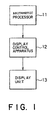
- the system comprises an arithmetic processor 11, a display control apparatus 12 according to an embodiment of the present invention, and a display unit 13.
- the arithmetic processor 11 is, for example, a supercomputer. Whenever an operation comes to an end, the arithmetic processor 11 produces an end signal in the manner known in the art. The end signal is representative of the end of the operation and is supplied to the display control apparatus 12. Supplied with the end signal, the display control apparatus 12 produces a performance signal representative of the operation performance of the arithmetic processor 11. The performance signal is sent to the display unit 13. Responsive to the performance signal, the display unit 13 visually display a picture or display related to the operation performance.
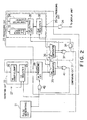
- the display control apparatus 12 comprises pulse generating, counting, processing, and sending circuits 21, 22, 23, and 24 which will be described as the description proceeds.
- the pulse generating circuit 21 is for generating first and second pulse signals.
- the first pulse signal is intermittently generated at a first predetermined period (T) of, for example, 4ms and is supplied to the processing circuit 23.
- the second pulse signal is intermittently generated at a second predetermined period (t) which is shorter than the first predetermined period and which is of, for example, 128 ⁇ s.
- the second pulse signal is supplied to the counting and the processing circuits 22 and 23.
- the pulse generating circuit 21 is referred to as a determining arrangement for determining a plurality of consecutive time intervals. Each time interval may be equal to the second predetermined period.
- the counting circuit 22 is for counting an operation number of operations of the arithmetic processor 11 during each of the time intervals and comprises a first register 25 and a first adder element 26.
- the first register 25 is connected to the pulse generating circuit 21 and an apparatus input terminal 27 which is connected to the arithmetic processor 11.
- the first adder element 26 is connected to the first register 25 and is operable in the manner which will presently be described.
- the first register 25 is for memorizing a first number and is supplied with the end signal through the apparatus input terminal 27 from the arithmetic processor 11. Whenever the end signal is supplied to the first register 25, the first adder element 26 adds a predetermined decimal number, for example, one to the first number into a counting circuit sum. The first number is cleared in the first register 25 whenever the second pulse signal is intermittently generated. As a result, the first register 25 produces a count signal representative of the operation number.
- the processing circuit 23 is supplied with the count signal and comprises first producing, second producing, and comparing circuits 28, 29, and 31 which will be described in the following.
- the first producing circuit 28 is connected to the first register 25 and is for producing a peak signal representative of a peak number of the operation number represented by the count signal. The peak number is renewed in the manner which will later become clear. The peak number is kept in the first producing circuit 28. It is preferable that the first producing circuit 28 is a register known in the art.
- the second producing circuit 29 is for producing the above-mentioned performance signal and comprises a second register 32, a second adder element 33, a subtractor element 34, and a selecting circuit 35.
- the second register 32 is connected to the comparing and the selecting circuits 31 and 35.
- the second adder and the subtractor elements 33 and 34 are supplied from the second register 32 with a second number which is memorized in the second register 32.
- the selecting circuit 35 is connected to the comparing circuit 31, the second adder element 33, and the subtractor element 34.
- the second register 32 is supplied from the comparing circuit 31 with a local signal which will later become clear.
- the second adder element 33 is for counting up, whenever the local signal is supplied to the second register 32, a first count representative of how many times the local signal is produced.
- the second adder element 33 produces a count up signal representative of the first count.
- the subtractor element 34 is for counting down, whenever the local signal is supplied to the second register 32, a second count representative of how many times the local signal is produced.
- the subtractor 34 produces a count down signal representative of the second count.
- the selecting circuit 35 is for selecting one of the second adder and the subtractor elements 33 and 34 in compliance with an internal signal produced by the comparing circuit 31 in the manner which will later be described.
- the internal signal is represented by one of logic "0" and "1" levels.
- the selecting circuit 35 connects the second adder element 33 to the second register 32.
- a predetermined decimal number for example, one is added to the second number whenever the local signal is supplied to the second register 32.
- the selecting circuit 35 connects the subtractor element 34 to the second register 32.
- the subtractor element 34 When the subtractor element 34 is selected, the predetermined decimal number is subtracted from the second number whenever the local signal is supplied to the second register 32.
- the second register 32 produces the performance signal that is representative of the second number.
- the second register 32 will be referred to as an internal producing arrangement.
- the second adder element 33 will be called a counting up arrangement.
- the subtractor element 34 will be named a counting down arrangement.
- the performance signal is sent to the display unit 13 through the sending circuit 24.
- the sending circuit 24 is a buffer gate known in the art.
- the comparing circuit 31 is for carrying out comparison between the peak signal and the performance signal to produce, as the local signal, a first result signal representative of a result of the comparison.
- the comparing circuit 31 comprises a first comparator 36, a first OR element 37, and a first AND element 38.
- the first comparator 36 is connected to the first producing circuit 28 and the second register 32 and has a first, a second, and a third output terminal.
- the first output terminal is connected to the selecting circuit 35.
- the first OR element 37 is connected to the first and the second output terminals of the first comparator 36.
- the third output terminal is used in the manner which will presently be described.
- the first AND element 38 is connected to the first OR element 37, the pulse generating circuit 21, and the second register 32.
- the first comparator 36 is for carrying out a comparison between the peak and the performance signals to produce the internal signal. Namely, the first comparator 36 will be referred to as an internal comparing arrangement. When the peak number is less than the second number, the internal signal is sent to the first output terminal with a logic "1" level. Otherwise, the internal signal is given a logic "0" level at the first output terminal. In both events, the internal signal is supplied to the selecting circuit 35 and the first OR element 37 through the first output terminal.
- the internal signal When the peak number is greater than the second number, the internal signal is sent to the second output terminal with the logic “1" level and is supplied to the first OR element 37. Otherwise, the internal signal has the logic "0" level at the second output terminal.
- the first OR element 37 When the internal signal has the logic "1" level either at one of or at both of the first and the second output terminals, the first OR element 37 produces a first OR signal having a logic "1” level. Otherwise, the first OR signal is given a logic "0" level.
- the first AND element 38 produces the first result signal of a logic "1" level in response to the first pulse signal. Otherwise, the first result signal is given a logic "0" level even if the first pulse signal is intermittently supplied to the first AND element 38. Responsive to the first result signal, the second register 32 renews the second number to zero.
- a combination of the first OR and the first AND elements 37 and 38 will be referred to as an internal processing arrangement.
- the internal signal is sent to the third output terminal with the logic "1" level. Otherwise, the internal signal is given the logic "0" level at the third output terminal.
- the processing circuit 23 further comprises a second comparator 39, a second OR element 41, and a second AND element 42.
- the second comparator 39 is connected to the first register 25 and the first producing circuit 28.
- the second OR element 41 is connected to the second comparator 39 and the third output terminal of the first comparator 36.
- the second AND element 42 is connected to the second OR element 41, the pulse generating circuit 21, and the first producing circuit 28.
- the second comparator 39 is for carrying out comparison between the count and the peak signals to produce a second result signal representative of a result of the comparison.
- the second result signal represents one of logic "0" and "1" levels. When the first number is greater than the peak number, the second result signal is given the logic "1" level. Otherwise, the second result signal has the logic "0" level.
- the second OR element 41 When the logic "1" level is given to at least one of the second result signal and the internal signal that is supplied to the second OR element 41, the second OR element 41 produces a second OR signal having the logic "1" level. Otherwise, the second OR signal has the logic "0" level.
- the second AND element 42 When the second OR signal has the logic "1" level, the second AND element 42 produces a control signal of a logic "1" level when supplied with the second pulse signal. Otherwise, the control signal has the logic "0" level even if the second pulse signal is intermittently supplied to the second AND element 42. Responsive to the control signal, the first producing circuit 28 resets the peak number to zero.
- a combination of the second OR and the second AND elements 41 and 42 will be referred to as a control arrangement.
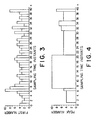
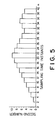
- the consecutive time intervals are defined by a succession of sampling time instants which are depicted in each of Figs. 3 through 5 and are indicated by consecutive integers. It will be assumed merely for convenience of the description that the first predetermined period is twice as long as the second predetermined period. It may be mentioned here that the sampling time instants are spaced apart in Fig. 5 by the first predetermined period.
- the first number changes as exemplified in Fig. 3.
- the first number is memorized in the first register 25. It is to be noted that the first number has a higher value during a particular time interval defined between adjacent ones (6) and (7) of the sampling time instants. Such a time interval will be referred to in the following as the time instant (6). In the example, the higher value is equal to ten.
- the peak number is memorized in the first producing circuit 28.
- the peak number is compared with the first number in the second comparator 39.
- the peak number is less than the first number, the latter number is used as the peak number. Otherwise, the peak number is held constant.
- the peak number is equal to four at the sampling time instants (1) through (5). This is because the first number is equal to four at the sampling time instant (0) and is less than four at the sampling time instants (1) through (4).
- the peak number is renewed to five at the sampling time instant (6) because the first number is equal to five at the sampling time instant (5).
- the peak number becomes equal to ten at the sampling time instant (7) because the first number is ten at the sampling time instant (6).
- the peak number is held equal to ten at the sampling time instants (7) through (20). This is because the first number is not greater than ten at the sampling time instants (7) through (19).
- the peak number is cleared at the sampling time instant (21).
- the second number is memorized in the second register 32.
- the second number is compared with the peak number in the first comparator 36.
- the predetermined decimal number is added to the second number.
- the second number increases to the peak number. For example, one is added to the second number at each of even-numbered ones of the sampling time instants (2) through (20). This is because the second number is less than the peak number at the sampling time instants (1) through (19).
- the peak number is cleared when the second number becomes equal to the peak number.
- the first number is used as the peak number.
- the peak number is cleared at the sampling time instant (21) because the second number is equal to ten at the sampling time instant (20).
- the peak number becomes equal to five because the first number is five at the sampling time instant (20).
- the peak number is held equal to five at the sampling time instants (21) through (30). This is because the first number is not greater than five at the sampling time instants (21) through (29).
- the second number is compared with the peak number in the first comparator 36.
- the predetermined decimal number is subtracted from the second number.
- the second number decreases towards the peak number. For example, one is subtracted from the second number at each of even-numbered ones of the sampling time instants (22) through (30). This is because the second number is greater than the peak number at the sampling time instants (22) through (30).
- the peak number is cleared when the second number becomes equal to the peak number.
- the first number is used as the peak number.
- the peak number is cleared at the sampling time instant (31) because the second number becomes equal to the peak number at the sampling time instant (30).
- the peak number becomes equal to six because the first number is six at the sampling time instant (30).
Landscapes
- Engineering & Computer Science (AREA)
- General Engineering & Computer Science (AREA)
- Theoretical Computer Science (AREA)
- Computer Hardware Design (AREA)
- Computing Systems (AREA)
- Quality & Reliability (AREA)
- Physics & Mathematics (AREA)
- General Physics & Mathematics (AREA)
- Measurement Of Current Or Voltage (AREA)
- Debugging And Monitoring (AREA)
- Control Of Indicators Other Than Cathode Ray Tubes (AREA)
Claims (5)
- Anzeigesteuervorrichtung zum Steuern einer Anzeigeeinheit zum Anzeigen der Operationsleistung eines arithmetischen Prozessors, der ein geeignetes Signal bei jeder Operation des arithmetischen Prozessors erzeugt, wobei die Anzeigesteuervorrichtung aufweist:a) eine Bestimmungseinrichtung (21) zum Bestimmen mehrerer aufeinanderfolgender erster Zeitintervalle,b) eine Zähleinrichtung (22), die auf das geeignete Signal reagiert, zum Zählen einer Anzahl von Operationen des arithmetischen Prozessors während jedes der ersten Zeitintervalle, um ein Zählungssignal als Darstellung der Operationsanzahl zu erzeugen, undc) eine Verarbeitungseinrichtung (23) zum Verarbeiten des Zählungssignals entsprechend den ersten Zeitintervallen, um ein verarbeitetes Signal zu erzeugen, das die Operationsleistung darstellt und zu der Anzeigeeinheit geführt wird,dadurch gekennzeichnet, daß die Verarbeitungseinrichtung (23) aufweist:c1) eine erste Erzeugungseinrichtung (28), die mit der Zähleinrichtung verbunden ist, zum Erzeugen eines Spitzensignals in Übereinstimmung mit dem Zählungssignal, wobei das Spitzensignal an die Stelle des Zählungssignals nur tritt, wenn das Spitzensignal kleiner als das Zählungssignal während jedes der ersten Zeitintervalle ist;c2) eine Vergleichseinrichtung (31), die mit der ersten Erzeugungseinrichtung (28) verbunden ist, zum Vergleichen des Spitzensignals mit einem Vergleichssignal, um ein Auswahlsignal zu erzeugen;c3) eine zweite Erzeugungseinrichtung (29), die mit der Vergleichseinrichtung (31) verbunden ist, zum Erzeugen des verarbeiteten Signals, wobei als Reaktion auf das Auswahlsignal- eine erste Zählung zu dem verarbeiteten Signal nach jedem zweiten Zeitintervall addiert wird, wenn das verarbeitete Signal kleiner als das Spitzensignal ist;- eine zweite Zählung von jedem verarbeiteten Signal nach jedem zweiten Zeitintervall subtrahiert wird, wenn das verarbeitete Signal größer als das Spitzensignal ist;und die Spitzenanzahl durch das Zählungssignal ersetzt wird, wenn das verarbeitete Signal gleich der Spitzenanzahl wird; undc4) eine Zufuhreinrichtung, die mit der Vergleichs- und der zweiten Erzeugungseinrichtung verbunden ist, zum Zuführen des verarbeiteten Signals zu der Vergleichseinrichtung als das Vergleichssignal.
- Anzeigesteuervorrichtung nach Anspruch 1, wobei der arithmetische Prozessor zum Erzeugen eines Endesignals als Darstellung eines Endes der Operation dient, wobei die Zähleinrichtung mit dem arithmetischen Prozessor zum Zählen einer Zählung des Endesignals als die Operationsanzahl während jedes der Zeitintervalle verbunden ist, um das Zählungssignal zu erzeugen.
- Anzeigesteuervorrichtung nach Anspruch 1 oder 2, wobei die Bestimmungseinrichtung (21) eine erste Generatoreinrichtung zum intermittierenden Generieren eines ersten Impulssignals mit einer ersten vorbestimmten Periode aufweist, die gleich mehreren der aufeinanderfolgenden ersten Zeitintervalle ist, wobei die Vergleichseinrichtung (31) aufweist:
eine interne Vergleichseinrichtung (36), die mit der ersten (28) und der zweiten Erzeugungseinrichtung (29) verbunden ist, zum Durchführen eines Vergleichs zwischen dem Spitzensignal und dem verarbeiteten Signal, um ein internes Signal zu erzeugen; und eine interne Verarbeitungseinrichtung, die mit der internen Vergleichs-, der ersten Generator- und der zweiten Erzeugungseinrichtung (29) verbunden ist, zum Verarbeiten des internen Signals zu dem Auswahlsignal in Übereinstimmung mit dem ersten Impulssignal. - Anzeigesteuervorrichtung nach Anspruch 3, wobei die Bestimmungseinrichtung (21) ferner eine zweite Generatoreinrichtung zum intermittierenden Generieren eines zweiten Impulssignals mit einer zweiten vorbestimmten Periode aufweist, die kürzer als die erste vorbestimmte Periode ist, wobei die Verarbeitungseinrichtung ferner aufweist:
eine zusätzliche Vergleichseinrichtung, die mit der Zähl- und der ersten Erzeugungseinrichtung verbunden ist, zum Durchführen eines zusätzlichen Vergleichs zwischen dem Zählungs- und dem Spitzensignal, um ein zusätzliches Ergebnissignal als Darstellung eines Ergebnisses des zusätzlichen Vergleichs zu erzeugen; und eine Steuereinrichtung, die mit der zusätzlichen Vergleichs-, der zweiten Generator-, der internen Vergleichs- und der ersten Erzeugungseinrichtung verbunden ist, zum Steuern des Betriebs der ersten Erzeugungseinrichtung in Übereinstimmung mit dem zusätzlichen Ergebnis-, dem ersten Impuls- und dem internen Signal. - Anzeigesteuervorrichtung nach Anspruch 3 oder 4, wobei die zweite Erzeugungseinrichtung (29) aufweist:eine Aufwärtszähleinrichtung (33), die mit der internen Verarbeitungseinrichtung verbunden ist, zum Aufwärtszählen einer ersten Zählung bei jeder Erzeugung des Auswahlsignals als Darstellung, wie oft das Auswahlsignal erzeugt wird, wobei die Aufwärtszähleinrichtung ein Aufwärtszählungssignal als Darstellung der ersten Zählung erzeugt;eine Abwärtszähleinrichtung (34), die mit der internen Verarbeitungseinrichtung verbunden ist, zum Abwärtszählen einer zweiten Zählung bei jeder Erzeugung des Auswahlsignals als Darstellung, wie oft das Auswahlsignal erzeugt wird, wobei die Abwärtszähleinrichtung ein Abwärtszählungssignal als Darstellung der zweiten Zählung erzeugt;eine Auswahleinrichtung (35), die mit der internen Vergleichseinrichtung (36) verbunden ist, zum Auswählen der Aufwärtszähl- oder der Abwärtszähleinrichtung in Übereinstimmung mit dem internen Signal und zum Erzeugen des Aufwärtszählungs- oder des Abwärtszählungssignals als ausgewähltes Zählungssignal; undeine interne Erzeugungseinrichtung (32), die mit der Auswahl- und der internen Verarbeitungseinrichtung sowie der Anzeigeeinheit verbunden ist, zum Erzeugen des verarbeiteten Signals in Übereinstimmung mit dem ausgewählten Zählungssignal, um das verarbeitete Signal zu der Anzeigeeinheit zu führen.
Applications Claiming Priority (2)
| Application Number | Priority Date | Filing Date | Title |
|---|---|---|---|
| JP2060174A JP2682189B2 (ja) | 1990-03-12 | 1990-03-12 | 表示制御回路 |
| JP60174/90 | 1990-03-12 |
Publications (3)
| Publication Number | Publication Date |
|---|---|
| EP0446833A2 EP0446833A2 (de) | 1991-09-18 |
| EP0446833A3 EP0446833A3 (en) | 1992-10-07 |
| EP0446833B1 true EP0446833B1 (de) | 1997-07-30 |
Family
ID=13134530
Family Applications (1)
| Application Number | Title | Priority Date | Filing Date |
|---|---|---|---|
| EP91103683A Expired - Lifetime EP0446833B1 (de) | 1990-03-12 | 1991-03-11 | Anzeigesteuergerät, das eine deutliche Anzeige der Betriebsleistung eines arithmetischen Prozessors ermöglicht |
Country Status (6)
| Country | Link |
|---|---|
| US (1) | US5243321A (de) |
| EP (1) | EP0446833B1 (de) |
| JP (1) | JP2682189B2 (de) |
| AU (1) | AU646022B2 (de) |
| CA (1) | CA2037977C (de) |
| DE (1) | DE69127008T2 (de) |
Families Citing this family (3)
| Publication number | Priority date | Publication date | Assignee | Title |
|---|---|---|---|---|
| US6246306B1 (en) * | 1999-02-04 | 2001-06-12 | Klaus A. Gruner | Electromagnetic relay with pressure spring |
| US6707542B1 (en) * | 2000-01-28 | 2004-03-16 | Reichert, Inc. | Refractometer for monitoring water content in fluids |
| US7216579B2 (en) | 2001-10-17 | 2007-05-15 | Lonmore, L.C. | Variable flow control devices, related applications, and related methods |
Family Cites Families (11)
| Publication number | Priority date | Publication date | Assignee | Title |
|---|---|---|---|---|
| US3600565A (en) * | 1969-01-02 | 1971-08-17 | Us Navy | Signal tracker and analyzer |
| US3538316A (en) * | 1969-04-21 | 1970-11-03 | Us Navy | Tolerance computer |
| US4199729A (en) * | 1975-03-20 | 1980-04-22 | Compagnie Industrielle des Telecommunications Cit-Aicatel | Variable peak detector |
| US4034353A (en) * | 1975-09-15 | 1977-07-05 | Burroughs Corporation | Computer system performance indicator |
| JPS5621191A (en) * | 1979-07-30 | 1981-02-27 | Nippon Electric Co | Display unit |
| US4509044A (en) * | 1981-05-13 | 1985-04-02 | Nippon Seiki Kabushiki Kaisha | Device which accurately displays changes in a quantity to be measured |
| US4503549A (en) * | 1982-07-16 | 1985-03-05 | The Babcock & Wilcox Company | Interpolating function generator for transmitter square root extraction |
| US4567572A (en) * | 1983-02-22 | 1986-01-28 | The United States Of America As Represented By The Director Of The National Security Agency | Fast parallel sorting processor |
| DE3521610A1 (de) * | 1985-06-15 | 1986-12-18 | Messerschmitt-Bölkow-Blohm GmbH, 8012 Ottobrunn | Geraet zum erkennen relativer extrema |
| JPS63193216A (ja) * | 1987-02-06 | 1988-08-10 | Hitachi Ltd | 階層型救援方式 |
| AU606559B2 (en) * | 1987-12-24 | 1991-02-07 | Nec Corporation | Circuit for comparing a plurality of binary inputs |
-
1990
- 1990-03-12 JP JP2060174A patent/JP2682189B2/ja not_active Expired - Lifetime
-
1991
- 1991-03-11 DE DE69127008T patent/DE69127008T2/de not_active Expired - Fee Related
- 1991-03-11 CA CA002037977A patent/CA2037977C/en not_active Expired - Fee Related
- 1991-03-11 EP EP91103683A patent/EP0446833B1/de not_active Expired - Lifetime
- 1991-03-12 US US07/667,310 patent/US5243321A/en not_active Expired - Fee Related
- 1991-03-12 AU AU72840/91A patent/AU646022B2/en not_active Ceased
Also Published As
| Publication number | Publication date |
|---|---|
| US5243321A (en) | 1993-09-07 |
| EP0446833A3 (en) | 1992-10-07 |
| EP0446833A2 (de) | 1991-09-18 |
| AU7284091A (en) | 1991-09-12 |
| CA2037977A1 (en) | 1991-09-13 |
| JP2682189B2 (ja) | 1997-11-26 |
| JPH03260848A (ja) | 1991-11-20 |
| DE69127008D1 (de) | 1997-09-04 |
| CA2037977C (en) | 1994-04-05 |
| AU646022B2 (en) | 1994-02-03 |
| DE69127008T2 (de) | 1997-11-20 |
Similar Documents
| Publication | Publication Date | Title |
|---|---|---|
| KR100243799B1 (ko) | 비디오 신호의 기수/우수 필드 검출기 | |
| EP0404395A3 (de) | Bildverarbeitungssystem | |
| US5355397A (en) | Clock start up stabilization for computer systems | |
| EP0534129A1 (de) | Schnittstellenschaltung zur Datenübertragung | |
| EP0446833B1 (de) | Anzeigesteuergerät, das eine deutliche Anzeige der Betriebsleistung eines arithmetischen Prozessors ermöglicht | |
| KR850008593A (ko) | 동기장치 | |
| EP0009488B1 (de) | Vorrichtung zum messen des verhältnisses zwischen einer anzahl von aufeinander folgender zustände einer ersten und zweiten serie von zuständen | |
| KR100232934B1 (ko) | 화상 처리 시스템 | |
| JP2625249B2 (ja) | フレーム検出回路 | |
| JP3190800B2 (ja) | 転送速度切り替え機能付き非同期転送回路 | |
| JP2862926B2 (ja) | フレーム同期保護回路 | |
| JPH0730409A (ja) | 急速復帰計数デバイス | |
| JP2897404B2 (ja) | データ伝送装置及び方法 | |
| JPH066835A (ja) | 水平周波数測定回路 | |
| JP3049029B1 (ja) | 前方後方保護段数の検出方法、その装置および前方後方保護段数の検出方法を記録した記録媒体 | |
| JP3098503B2 (ja) | 前方後方保護段数の検出方法、その装置および前方後方保護段数の検出方法を記録した記録媒体 | |
| JP2870242B2 (ja) | 競合形同期保護回路 | |
| KR0163537B1 (ko) | 정극성 동기 검출기 | |
| JPS6013591B2 (ja) | 多箇所走査方式 | |
| JPH0575562A (ja) | ポインタ処理装置 | |
| JPH0621937A (ja) | フレーム同期保護回路 | |
| JPS61287314A (ja) | スクランブラ・デスクランブラ回路 | |
| JPS63164676A (ja) | 画像処理装置 | |
| JPH06132857A (ja) | 伝送路の品質監視回路 | |
| JPH0714143B2 (ja) | バツフアオシレ−タ回路 |
Legal Events
| Date | Code | Title | Description |
|---|---|---|---|
| PUAI | Public reference made under article 153(3) epc to a published international application that has entered the european phase |
Free format text: ORIGINAL CODE: 0009012 |
|
| 17P | Request for examination filed |
Effective date: 19910403 |
|
| AK | Designated contracting states |
Kind code of ref document: A2 Designated state(s): BE DE FR GB IT NL |
|
| PUAL | Search report despatched |
Free format text: ORIGINAL CODE: 0009013 |
|
| AK | Designated contracting states |
Kind code of ref document: A3 Designated state(s): BE DE FR GB IT NL |
|
| 17Q | First examination report despatched |
Effective date: 19950622 |
|
| GRAG | Despatch of communication of intention to grant |
Free format text: ORIGINAL CODE: EPIDOS AGRA |
|
| GRAH | Despatch of communication of intention to grant a patent |
Free format text: ORIGINAL CODE: EPIDOS IGRA |
|
| GRAH | Despatch of communication of intention to grant a patent |
Free format text: ORIGINAL CODE: EPIDOS IGRA |
|
| GRAA | (expected) grant |
Free format text: ORIGINAL CODE: 0009210 |
|
| AK | Designated contracting states |
Kind code of ref document: B1 Designated state(s): BE DE FR GB IT NL |
|
| PG25 | Lapsed in a contracting state [announced via postgrant information from national office to epo] |
Ref country code: NL Free format text: LAPSE BECAUSE OF FAILURE TO SUBMIT A TRANSLATION OF THE DESCRIPTION OR TO PAY THE FEE WITHIN THE PRESCRIBED TIME-LIMIT Effective date: 19970730 Ref country code: BE Effective date: 19970730 Ref country code: FR Effective date: 19970730 Ref country code: IT Free format text: LAPSE BECAUSE OF FAILURE TO SUBMIT A TRANSLATION OF THE DESCRIPTION OR TO PAY THE FEE WITHIN THE PRE;WARNING: LAPSES OF ITALIAN PATENTS WITH EFFECTIVE DATE BEFORE 2007 MAY HAVE OCCURRED AT ANY TIME BEFORE 2007. THE CORRECT EFFECTIVE DATE MAY BE DIFFERENT FROM THE ONE RECORDED.SCRIBED TIME-LIMIT Effective date: 19970730 |
|
| REF | Corresponds to: |
Ref document number: 69127008 Country of ref document: DE Date of ref document: 19970904 |
|
| EN | Fr: translation not filed | ||
| NLV1 | Nl: lapsed or annulled due to failure to fulfill the requirements of art. 29p and 29m of the patents act | ||
| PG25 | Lapsed in a contracting state [announced via postgrant information from national office to epo] |
Ref country code: GB Free format text: LAPSE BECAUSE OF NON-PAYMENT OF DUE FEES Effective date: 19980311 |
|
| PLBE | No opposition filed within time limit |
Free format text: ORIGINAL CODE: 0009261 |
|
| STAA | Information on the status of an ep patent application or granted ep patent |
Free format text: STATUS: NO OPPOSITION FILED WITHIN TIME LIMIT |
|
| 26N | No opposition filed | ||
| GBPC | Gb: european patent ceased through non-payment of renewal fee |
Effective date: 19980311 |
|
| PGFP | Annual fee paid to national office [announced via postgrant information from national office to epo] |
Ref country code: DE Payment date: 19990319 Year of fee payment: 9 |
|
| PG25 | Lapsed in a contracting state [announced via postgrant information from national office to epo] |
Ref country code: DE Free format text: LAPSE BECAUSE OF NON-PAYMENT OF DUE FEES Effective date: 20010103 |