EP0444677A2 - Röntgenstrahlradiographiesystem - Google Patents
Röntgenstrahlradiographiesystem Download PDFInfo
- Publication number
- EP0444677A2 EP0444677A2 EP91103029A EP91103029A EP0444677A2 EP 0444677 A2 EP0444677 A2 EP 0444677A2 EP 91103029 A EP91103029 A EP 91103029A EP 91103029 A EP91103029 A EP 91103029A EP 0444677 A2 EP0444677 A2 EP 0444677A2
- Authority
- EP
- European Patent Office
- Prior art keywords
- film
- ray
- area
- radiographing system
- holder
- Prior art date
- Legal status (The legal status is an assumption and is not a legal conclusion. Google has not performed a legal analysis and makes no representation as to the accuracy of the status listed.)
- Granted
Links
Images



Classifications
-
- A—HUMAN NECESSITIES
- A61—MEDICAL OR VETERINARY SCIENCE; HYGIENE
- A61B—DIAGNOSIS; SURGERY; IDENTIFICATION
- A61B6/00—Apparatus or devices for radiation diagnosis; Apparatus or devices for radiation diagnosis combined with radiation therapy equipment
- A61B6/42—Arrangements for detecting radiation specially adapted for radiation diagnosis
- A61B6/4283—Arrangements for detecting radiation specially adapted for radiation diagnosis characterised by a detector unit being housed in a cassette
-
- G—PHYSICS
- G21—NUCLEAR PHYSICS; NUCLEAR ENGINEERING
- G21K—TECHNIQUES FOR HANDLING PARTICLES OR IONISING RADIATION NOT OTHERWISE PROVIDED FOR; IRRADIATION DEVICES; GAMMA RAY OR X-RAY MICROSCOPES
- G21K4/00—Conversion screens for the conversion of the spatial distribution of X-rays or particle radiation into visible images, e.g. fluoroscopic screens
Definitions
- the present invention relates to an X-ray radiographing system having a spot-film device transporting an X-ray sheet film between a fluoroscopic area and a radiographing area and, in particular, to an X-ray radiographing system which enables to enlarge a longitudinal (used in the meaning of "in the direction of a body axis of a patient (an axis going through the head and toe of a patient)" hereinafter) radiographic range along a body axis of a patient.
- a longitudinal used in the meaning of "in the direction of a body axis of a patient (an axis going through the head and toe of a patient)" hereinafter
- An X-ray radiographing system disposed in a radiographing chamber is provided with an X-ray generator, and a table which includes a spot-film device inside and a tabletop on the top side on which a patient lies down. Owing to an adequate drive and holder, the X-ray generator and the spot-film device move synchronously (i.e. keeping the same position along the X-ray proceeding direction, here in this specification) and longitudinally, facing each other with the patient on the tabletop therebetween.
- the film holder While a fluoroscopic area and a radiographic area between which a film holder holding an X-ray sheet film shuttles are arranged to each other longitudinally inside the spot-film device, the film holder is transported for radiographing the patient from the fluoroscopic area to the radiographic area.
- the X-ray sheet film is exposed at the radiographic area by the X-ray which has been radiated by the X-ray generator and penetrated the patient.
- the X-ray radiographic system includes an image intensifier (abbreviated as "I.I.” hereinafter), a television camera and an X-ray television monitor, constituting an X-ray television system.
- the X-ray which has penetrated the patient enters the I.I. through the radioraphic area when the film holder is located at the fluoroscopic area.
- the I.I. transduces the incident X-ray to a fluorescent light and outputs this fluorescent light to the television camera.
- the television camera generally has a CCD (Charge Coupled Device) loaded, and the CCD transduces the incident fluorescent light to an electric video signal.
- the video signal generated at the CCD gets input to the X-ray television monitor.
- An operator of the X-ray radiographing system can observe an image of the X-ray-radiated part of the patient on a screen of the X-ray television monitor.
- a large-sized X-ray picture can be taken by using an X-ray film cassette (simply called “cassette” hereinafter), if necessary.
- an X-ray film cassette (simply called "cassette” hereinafter)
- the operator who once has loaded X-ray sheet film to the film holder and operates a console for functioning this X-ray radiographing system outside the radiographing chamber, avoiding X-ray exposure, reenters the radiographing chamber and exchanges the film holder and the cassette holder holding the cassette at the spot-film device.
- the film holder which shuttles longitudinally between both areas cannot transfer entirely to cover the top of the head through the toe of the patient. If the radiographic area covers the top of the head for example at one longitudinal end, then this radiographic area cannot cover the toe at the other longitudinal end, which are covered by the fluoroscopic area. In other words, the operator is unable to carry out the fluoroscopy and radiography concerning the toe of the patient positioned at one end of the table.
- the economical compact table is employed, the diagnostic range with regard to the whole-body radiography is restricted and insufficient. On the other hand, the table becomes large and costly , so as to acquire a sufficient diagnostic range regarding the whole-body radiography.
- the moistener and dryer cannot necessarily control the moisture inside the spot-film device. Furthermore, the moistener and dryer require a water-supplier and drainage, respectively, and end up costly.
- each opening of the feed magazine and take-up magazine contained in the spot-film device is covered by a shutter plate when unused, and opened by sliding and pushing the shutter plate out of the spot-film device when the X-ray sheet film gets pulled out and pushed in therethrough.
- the shutter plate pushed out of the spot-film device hinders the operator from walking around the table containing the spot-film device for the operation.
- the prior suction-cup mechanism mentioned before uses the horizontal chain for transferring the suction cups which have sucked the X-ray sheet film toward the rubber rollers to feed the X-ray sheet films.
- This horizontal chain requires considerable space inside the spot-film device, thus making the spot-film device large and uneconomical.
- An object of the present invention is to substantially elliminate defects or drawbacks encountered in the prior art described above and to provide an X-ray radiographing system including a spot-film device accomplishing a substantially reduced size and a sufficient radiographic range.
- Another object of the present invention is to provide an X-ray radiographing system including a spot-film device which can have both of a film holder and cassette holder loaded at the same time.
- a still further object of the present invention is to provide an X-ray radiographing system including a spot-film device where an X-ray sheet film is carried accurately.
- a still further object of the present invention is to provide an X-ray radiographing system including a spot-film device provided a suction-cup mechanism which enables the spot-film device to be small and inexpensive.
- an X-ray film is referred to as an X-ray sheet film and an X-ray film cassette, and there is provided a film holder holding an X-ray sheet film and rails along which the film holder shuttles between the fluoroscopic area and the radiographic area.
- a collimator 208 which is attached to the X-ray generator 205 in order to define the X-ray radiating area for the patient.
- An I.I. 209 is mounted to the spot-film device 207 on the opposite side of the patient, and a television camera 210 is neighbored with the I.I. 209.
- the television camera 210 is electorically connected to a television monitor CRT.
- the spot-film device 207 is provided with a feed magazine 211 and a take-up magazine 212 which get put into the spot-film device 207 from the front side.
- the X-ray generator 205 radiates an X-ray toward the patient lying on the tabletop 204. This X-ray forwards through the X-ray radiating area defined by the collimator 208 and penetrates the patient lying on the tabletop 204.
- the film holder 213 holding an X-ray sheet film is placed in the fluoroscopic area FA, the X-ray having penetrated the patient goes through the radiographic area RA at the spot-film device 207 and enters the I.I. 209.
- the incident X-ray gets transduced to the fluorescent light inside the I.I. 209. Next, this fluorescent light gets out of the I.I. 209 and goes into the television camera 210.
- An operator watches the television monitor CRT and searches the radiographic part of the patient.
- the operator can move the X-ray generator 205 and I.I. 209 attached to the spot-film device 207 longitudinally to obtain the part suitable to radiograph.
- the operator attains the desired radiographic part, he can take an X-ray picture after conveying the film holder to the radiographic area RA.
- the table 201 contains the spot-film device 107 attached to the support pole 206 inside which travels synchronously with the X-ray generator 205 by means of a motor M between the longitudinal ends of the table 101.
- the spot-film device 107 is provided with a feed magazine 111 and take-up magazine 112 storing, respectively, unexposed X-ray sheet films and exposed X-ray sheet films, which get put into the spot-film device 107 from the front side.
- this X-ray radiographing system 100 is able to radiograph a patient P at the various angle by tilting the table 201 through the work of the motor M. It is also possible to use separate motors for tilting the table 201 and for sliding the support pole 206 supporting the X-ray generator 205 and the spot-film device 107.
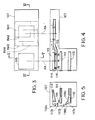
- Fig. 3 is a schematic illustration of the spot-film device 107.
- Figs. 4 and 5 are sectional views taken along the lines IV-IV and V-V, respectively, in Fig. 3.
- a film holder 113 is conveyed between the fluoroscopic area FA and the radiographic area RA traversely (used in the meaning of "in the direction orthogonal to the body axis of the patient" hereinafter).
- the traverse direction and the longitudinal direction are orthogonal each other, and the traverse length of the spot-film device 107, which is equal to the traverse length of the table 101, is much shorter than the longitudinal length of the table 101.
- Casters 114 attached to the film holder 113 slides by means of a film-holder drive unit (not shown) on staged rails 115 having portions lying on different levels and extending traversely.
- the portion at the radiographic area RA is higher (i.e. nearer to the patient P) than that at the fluoroscopic area FA with regard to the staged rails 115.
- Non-staged , i.e. straight, rails are able to be used for conveying the film holder 113 as well.
- the unexposed X-ray sheet films piled up and stored inside the feed magazine 111 get sucked and fed by the suction cups 116 from the feed magazine 111 piece by piece.
- the suction cups 116 which have pulled up the unexposed X-ray sheet film feed this unexposed X-ray sheet film to a film carrier 117a.
- the film carrier 117a carries the unexposed X-ray sheet film to the film holder 113 at the fluoroscopic area FA.
- the film holder 113 which has had the unexposed X-ray sheet film loaded conveys this unexposed X-ray sheet film to the radiographic area RA along the staged rails 115, when the radiography is performed.
- the reference code RA1 specifically denotes the radiograpic area for a "whole radiography" where the whole surface of an X-ray sheet film is exposed. If the operator wishes to carry out a "divisional radiography" where an X-ray sheet film is divided into some parts and exposed part by part, the film holder 113 gets transferred to divisional radiograpic areas, RA2, RA3, and RA4, respectively, for example, every time of radiographing.
- the exposed X-ray sheet film is carried through the film carriers 117a, 117b, and 117c, in this order, to the take-up magazine 112.
- the reference numericals 118a, 118b, and 118c are guide plates for facilitating the carrying of the X-ray sheet film.
- the film holder 113 both at the fluoroscopic area FA and radioscopic area RA can travel longitudinally, accompanying the longitudinal movement of the spot-film device 107, up to the very ends of the life-size table 201, because the film holder 113 shuttles traversely between the fluoroscopic area FA and radioscopic area RA. Therefore, even though the compact and economical table is employed, this X-ray radiographing system 100 enables the radiography and fluoroscopy covering from the top of the head to the toe of the patient. This X-ray radiographing system ensures both of the sufficient diagnostic range for a patient and small size.
- Fig. 6 is a front perspective view of a spot-film 120 in accordance with a second embodiment of the present invention.
- a container 121 is mounted detachably to a hole 122 formed on the left side of an outer case 120a of the spot-film device 120.
- the container 121 contains a granular moisture-controlling agent 122.
- the moisture-controlling agent 123 absorbs and discharges the vapor inside the spot film device 120, keeping the moisture inside the spot-film device 120 precisely at a desired level where X-ray sheet films piled up and stored within the feed magazine 111 and take-up magazine 112 never get sticky and adhere each other.
- the moisture-controlling agent 123 does not need any water-supplier or drainage, the spot-film device 107 can be produced compactly and cheaply. The time and labor to manage the water-supplying and draining become unnecessary as well.
- the moisture-controlling agent 123 can be easily disposed and renewed by detaching the container 121.
- the container 121 can be mounted anywhere inside the spot-film device 120, within the feed magazine 111 and take-up magazine 112, etc. Further, any kind of moisture-controlling agent can be used.
- Fig. 7 is an upper view of a feed magazine 125 in accordance with a third embodiment of the present invention.
- the feed magazine 125 is equipped with a casing 126 within which unexposed X-ray sheet films are stored and two shutter plates 127a and 127b.
- the shutter plates 127a and 127b cover the casing 126 half and half, respectively.
- the shutter plate 127a which has a link 128 hooked to a hole 129 of the shutter plate 127a, slides over the other shutter plate 127b through the rotation of the link 128.
- the link 128 rotates around a pin 130 by way of an unshown rotary drive mechanism.
- a reference numerical 131 indicates the handle attached to the casing 126 with which an operator pushes the feed magazine 125 into the spot-film device 107 and pulls the feed magazine 125 out of the spot-film device 107 at a front side of the spot-film device 107.
- the shutter plate 127a slides over the shutter plate 127b and opens the entrance through which the unexposed X-ray sheet film gets pulled out. Since neither shutter plate 127a nor 127b gets out of the spot-film device 107, extending over the casing 126, these shutter plates 127a and 127b do not hinder the operator from walking around the table 201. Needless to say, this opening mechanism using a plurality of the shutter plates 127a, 127b explained in this embodiment is applicable to the take-up magazine 112.
- Fig. 8 is a sectional view of a film carrier 140 in accordance with a fourth embodiment of the present invention.
- the film carrier 140 carries an unexposed X-ray sheet film from the feed magazine 111 to the film holder 113 and an exposed X-ray sheet film from the film holder 113 to the take-up magazine 112.
- the film carrier 140 is provided with support plates 141a, 141b which support shafts 142a, 142b in parallel therebetween through radial bearings 143a, 143b, 143c and 143d.
- the radial bearings 143a, 143b, 143c and 143d are attached to holes located accurately on the support plates 141a and 141b to keep the shafts 142a and 142b strictly parallel with each other.
- Both of rubber drive rollers 144a and 144b are fixed to the shaft 141a.
- Each of rubber driven rollers 145a and 145b are fixed to the shaft 142b opposite to the drive rollers 144a and 144b, respectively.
- the shaft 142a is coupled to the adequate transmission mechanism like a sprocket or pulley, for example. If the X-ray sheet film is 0.2 mm thick, the width of a gap between the drive rollers 144a, 144b and the driven rollers 145a, 145b is preferaby 0.1 mm or less narrower than the thickness of the X-ray sheet film.
- the film carrier 140 of this embodiment keeps the gap between rollers 144a, 144b, 145a and 145b strictly equal and constant since the support plates 141a and 141b are accurately molded in order to position the holes precisely to which the parallel shafts 142a and 142b are inserted. Accordingly, the film carrier 140 can carry the X-ray sheet film smoothly and accurately up to the film holder 113 and take-up magazine 112.
- Fig. 9 is a schematic illustration of a suction-cup mechanism 150 of a fifth embodiment of the present invention.
- a sucking mechanism including a vacuum pump, hoses, etc. which connects to a suction cup is left out.
- shafts 151, 152 are supported in parallel by support plates 153a, 153b which support the feed magazine 109 as well.
- the shaft 151 is inserted to radial bearings 154a and 154b mounted to a hole of the support plates 153a, 153b.
- the shaft 152 is inserted to radial bearings 155c and 155d in the same manner.
- the shaft 151 has a right-thread part 151a and a left-thread part 151b in its right end part and left end part, respectively.
- a right-threaded movable gear 156a and a left-threaded movable gear 156b are geared into the right-thread part 151a and the left-thread part 151b of the shaft 151.
- Upper ends of links 157a and 157b are rotatably coupled to couplers 158a and 158b, resectively, which are secured to the movable gears 156a and 156b, respectively.
- the links 157a and 157b are rotatably crossed through a pin 159 which slides vertically along a slit 160 formed at the upper part of an inverted-T-shaped suction-cup holder 161.
- Suction cups 162a and 162b are mounted to lower ends of the links 157a and 157b, respectively, through pins 163a and 163b.
- the pins 163a and 163b slide horizontally along slits 164a and 164b, respectively, formed at both horizontal ends of the suction-cup holder 161.
- the links 157a, 157b hang the suction-cup holder 161 by means of the pins 163a, 163b as well.
- the suction cup holder 161 is provided with a third suction cup 162c at its central horizontal part.
- the operator When an operator pulls up the unexposed X-ray film from the feed magazine 109, the operator functions the motor 166 to the predetermined rotating direction and to the extent predetermined by the encoder.
- the work of the motor 166 gets transmitted to the shaft 151 through the coupling gear 167 and the fixed gear 165 and makes the shaft 151 rotate.
- the right-threaded gear 156a and left-threaded gear 156b start to move apart each other, corresponding to the rotation of the right-threaded part 151a and left-threaded part 151b of the shaft 151 in this case.
- the right-threaded gear 156a and left-threaded gear 156b can move only to the extent of the backlash, because these gears 156a, 156b are geared into the fixed gears 168a, 168b, respectively.
- the links 157a, 157b enlarge the crossing angle ⁇ through lifting the pin 159 along the slit 160 and lift the suction-cup holder 161 and the suction cups 162a - 162c sucking an unexposed sheet film vertically up to the level corresponding to the moving distance of the gears 156a, 156b.
- suction cups 162a and 162b keep their distance unchanged and do not lean toward any side, because these suction cups 162a, 162b rotate around the pin 163a, 163b and move horizontally in accordance with the slide of the pins 163a, 163b along the slits 164a, 164b.
- the encode motor 169 works.
- the drive of the motor 169 makes the fixed gears 168a, 168b rotate with the shaft 152, through the coupling gear 170. If the fixed gears 168a, 168b rotate, then the fixed gears 156a, 156b geared into this fixed gears 168a, 168b rotate around the shaft 151.
- the suction cups 162a - 162c rotate around the shaft 151, through the rotation of the couplers 158a, 158b, the links 157a, 157b and the suction-cup holder 161, and feed the unexposed X-ray sheet film to the film carrier 117a.
- the suction cups 162a - 162c are made to get back to the original position, stepping reversely.
- the work of the encode motors 166, 169 is controlled by the encode pulse singnal sent from the console.
- Fig. 10 is a schematic illustration of a spot-film device 180 viewed from the upper side in accordance with a sixth embodiment of this invention.
- Fig. 11 is a sectional view taken along the line XI-XI of Fig. 10.
- the cassette holder 181 is transferred to the fluoroscopic area FA1 through an unshown drive unit after getting loaded.
- the operator makes the cassette holder 181 proceed to the radiographic area RA by pressing a conveyance button and expose the X-ray film cassette by pressing a radiography button.
- the cassette holder 181 gets back to th fluoroscopic area FA2 automatically after radiographing.
- the film holder 113 and the cassette holder 181 take the same level at the radiographic area RA so as to prevent either of their magnification ratios from changing.
- the spot-film device 180 can have the cassette holder 181 and the film holder 113 loaded at the same time, because owing to the staged rails 115 the cassette holder 181 and the film holder 113 do not collide with each other during proceedeing to the radiographic area RA. For this reason, it is unnecessary for the operator to reenter the radiographing chamber for exchanging the cassette holder 181 and the film holder 113.
- This spot-film device 180 enables the convenience of the operator and the speed-up of the radiography.
Landscapes
- Health & Medical Sciences (AREA)
- Life Sciences & Earth Sciences (AREA)
- Engineering & Computer Science (AREA)
- Medical Informatics (AREA)
- Physics & Mathematics (AREA)
- High Energy & Nuclear Physics (AREA)
- Radiology & Medical Imaging (AREA)
- Molecular Biology (AREA)
- Optics & Photonics (AREA)
- Pathology (AREA)
- Biophysics (AREA)
- Biomedical Technology (AREA)
- Heart & Thoracic Surgery (AREA)
- Nuclear Medicine, Radiotherapy & Molecular Imaging (AREA)
- Surgery (AREA)
- Animal Behavior & Ethology (AREA)
- General Health & Medical Sciences (AREA)
- Public Health (AREA)
- Veterinary Medicine (AREA)
- General Engineering & Computer Science (AREA)
- Apparatus For Radiation Diagnosis (AREA)
Applications Claiming Priority (2)
| Application Number | Priority Date | Filing Date | Title |
|---|---|---|---|
| JP2047316A JP2577483B2 (ja) | 1990-03-01 | 1990-03-01 | X線透視撮影装置 |
| JP47316/90 | 1990-03-01 |
Publications (3)
| Publication Number | Publication Date |
|---|---|
| EP0444677A2 true EP0444677A2 (de) | 1991-09-04 |
| EP0444677A3 EP0444677A3 (en) | 1992-06-03 |
| EP0444677B1 EP0444677B1 (de) | 1995-09-20 |
Family
ID=12771882
Family Applications (1)
| Application Number | Title | Priority Date | Filing Date |
|---|---|---|---|
| EP91103029A Expired - Lifetime EP0444677B1 (de) | 1990-03-01 | 1991-02-28 | Röntgenstrahlradiographiesystem |
Country Status (5)
| Country | Link |
|---|---|
| US (1) | US5185777A (de) |
| EP (1) | EP0444677B1 (de) |
| JP (1) | JP2577483B2 (de) |
| CN (1) | CN1021860C (de) |
| DE (1) | DE69113082T2 (de) |
Cited By (1)
| Publication number | Priority date | Publication date | Assignee | Title |
|---|---|---|---|---|
| EP1245189A1 (de) * | 2001-03-29 | 2002-10-02 | Shimadzu Corporation | Röntgengerät zur Fluoroskopie und Radiographie |
Families Citing this family (9)
| Publication number | Priority date | Publication date | Assignee | Title |
|---|---|---|---|---|
| US5289012A (en) * | 1992-04-30 | 1994-02-22 | Alvarez Robert E | X-ray image encoding by spatial modulation of a storage phosphor screen |
| US6027247A (en) * | 1995-04-04 | 2000-02-22 | Hitachi Medical Corporation | X-ray photographing apparatus |
| JPH09152670A (ja) * | 1995-11-30 | 1997-06-10 | Shimadzu Corp | カセッテレスx線透視撮影装置 |
| DE19639977C2 (de) * | 1996-09-27 | 2003-03-20 | Siemens Ag | Medizinisches Röntgensystem |
| JP2000509627A (ja) | 1997-02-14 | 2000-08-02 | コーニンクレッカ フィリップス エレクトロニクス エヌ ヴィ | 従来のラジオグラフィ用の手段を有するx線スキャナー |
| WO1998035613A1 (en) * | 1997-02-14 | 1998-08-20 | Koninklijke Philips Electronics N.V. | X-ray scanner with means for conventional radiography |
| JP2002028155A (ja) * | 2000-07-14 | 2002-01-29 | Shimadzu Corp | X線透視撮影台 |
| US9795347B2 (en) * | 2013-10-24 | 2017-10-24 | Institute Of Nuclear Energy Research Atomic Energy Council, Executive Yuan | Scanning system for three-dimensional imaging |
| DE102021118683A1 (de) | 2021-07-20 | 2023-01-26 | Mühlbauer Gmbh & Co. Kg | Vorrichtung und Verfahren zur Verarbeitung einer Membran-Elektroden-Anordnung |
Family Cites Families (16)
| Publication number | Priority date | Publication date | Assignee | Title |
|---|---|---|---|---|
| FR1335544A (fr) * | 1962-06-28 | 1963-08-23 | Radiologie Cie Gle | Perfectionnements aux appareils d'examens radiologiques |
| FR1582951A (de) * | 1968-08-27 | 1969-10-10 | ||
| US4365342A (en) * | 1975-09-26 | 1982-12-21 | Picker International, Inc. | X-Ray film changer for the serial radiography |
| DE2612987A1 (de) * | 1976-03-26 | 1977-09-29 | Siemens Ag | Roentgenuntersuchungsgeraet |
| JPS544584A (en) * | 1977-06-14 | 1979-01-13 | Hitachi Medical Corp | Xxray camera |
| US4282439A (en) * | 1978-08-25 | 1981-08-04 | Tokyo Shibaura Denki Kabushiki Kaisha | X-ray photographing machine using sheet films |
| US4365345A (en) * | 1978-11-21 | 1982-12-21 | The Machlett Laboratories, Incorporated | Servo operated fluoroscopic table |
| DE3003976A1 (de) * | 1980-02-04 | 1981-08-13 | Siemens AG, 1000 Berlin und 8000 München | Stativ fuer ein unter der patientenlagerungsplatte eines roentgenuntersuchungsgeraetes einschiebbares roentgenographisches bilderfassungsgeraet |
| DE3010378C2 (de) * | 1980-03-18 | 1983-04-07 | Siemens AG, 1000 Berlin und 8000 München | Röntgendiagnostikeinrichtung für Aufnahme und Durchleuchtung |
| JPS59224837A (ja) * | 1983-06-03 | 1984-12-17 | Toshiba Corp | X線透視撮影装置 |
| JPS60239731A (ja) * | 1984-05-14 | 1985-11-28 | Toshiba Corp | 放射線診断装置 |
| JPS61295937A (ja) * | 1985-06-21 | 1986-12-26 | Hitachi Medical Corp | カセツテレス速写装置 |
| US4802002A (en) * | 1985-08-08 | 1989-01-31 | Picker International, Inc. | Television camera control in radiation imaging |
| JPS62125342A (ja) * | 1985-11-27 | 1987-06-06 | Toshiba Corp | X線フィルム保持装置 |
| JPH0823665B2 (ja) * | 1985-12-02 | 1996-03-06 | 株式会社東芝 | シートフィルム搬送装置 |
| JPH0786052B2 (ja) * | 1985-12-20 | 1995-09-20 | 株式会社東芝 | X線撮影装置 |
-
1990
- 1990-03-01 JP JP2047316A patent/JP2577483B2/ja not_active Expired - Fee Related
-
1991
- 1991-02-27 US US07/661,187 patent/US5185777A/en not_active Expired - Lifetime
- 1991-02-28 DE DE69113082T patent/DE69113082T2/de not_active Expired - Fee Related
- 1991-02-28 EP EP91103029A patent/EP0444677B1/de not_active Expired - Lifetime
- 1991-03-01 CN CN91101780.1A patent/CN1021860C/zh not_active Expired - Fee Related
Cited By (2)
| Publication number | Priority date | Publication date | Assignee | Title |
|---|---|---|---|---|
| EP1245189A1 (de) * | 2001-03-29 | 2002-10-02 | Shimadzu Corporation | Röntgengerät zur Fluoroskopie und Radiographie |
| US6669365B2 (en) | 2001-03-29 | 2003-12-30 | Shimadzu Corporation | Apparatus for X-ray fluoroscopy and radiography |
Also Published As
| Publication number | Publication date |
|---|---|
| JPH03251838A (ja) | 1991-11-11 |
| EP0444677A3 (en) | 1992-06-03 |
| CN1021860C (zh) | 1993-08-18 |
| DE69113082T2 (de) | 1996-05-30 |
| EP0444677B1 (de) | 1995-09-20 |
| DE69113082D1 (de) | 1995-10-26 |
| JP2577483B2 (ja) | 1997-01-29 |
| US5185777A (en) | 1993-02-09 |
| CN1055245A (zh) | 1991-10-09 |
Similar Documents
| Publication | Publication Date | Title |
|---|---|---|
| US5185777A (en) | X-ray radiographing system with spot-film device | |
| EP1630597B1 (de) | Bildabtastvorrichtung | |
| US6765985B2 (en) | Radiographic apparatus and imaged object support therefor | |
| US4712227A (en) | X-ray film holder and method of operating same for optional fluoroscopic or radiographic examination of a patient | |
| US20080063249A1 (en) | Radiation image recording apparatus | |
| JPH01154041A (ja) | 放射線診断装置 | |
| JPS6199176A (ja) | 現像剤補給装置 | |
| US3971953A (en) | X-ray table | |
| JP2847568B2 (ja) | カセツテレス式x線速写装置 | |
| JPH06335476A (ja) | X線診断装置 | |
| JPH0526582Y2 (de) | ||
| JPH0355954Y2 (de) | ||
| JPH0637415Y2 (ja) | X線速写撮影装置 | |
| JPH0666028B2 (ja) | 医用x線装置 | |
| JP2980383B2 (ja) | X線透視撮影装置 | |
| JPH01198738A (ja) | カセツテレス速写装置 | |
| JPH0418288B2 (de) | ||
| JP2550549Y2 (ja) | X線フィルムチェンジャー | |
| JPH01198737A (ja) | カセツテレス速写装置 | |
| JPS6329747A (ja) | X線画像記録媒体自動搬送システム | |
| JPH01298341A (ja) | カセツテレス速写装置 | |
| JPH05165130A (ja) | フィルム搬送装置 | |
| JPH08137036A (ja) | フィルム搬送装置 | |
| JPH0427934A (ja) | X線撮影装置 | |
| JPH0245452B2 (de) |
Legal Events
| Date | Code | Title | Description |
|---|---|---|---|
| PUAI | Public reference made under article 153(3) epc to a published international application that has entered the european phase |
Free format text: ORIGINAL CODE: 0009012 |
|
| 17P | Request for examination filed |
Effective date: 19910228 |
|
| AK | Designated contracting states |
Kind code of ref document: A2 Designated state(s): DE NL |
|
| PUAL | Search report despatched |
Free format text: ORIGINAL CODE: 0009013 |
|
| AK | Designated contracting states |
Kind code of ref document: A3 Designated state(s): DE NL |
|
| RHK1 | Main classification (correction) |
Ipc: G21K 5/00 |
|
| 17Q | First examination report despatched |
Effective date: 19940616 |
|
| GRAA | (expected) grant |
Free format text: ORIGINAL CODE: 0009210 |
|
| AK | Designated contracting states |
Kind code of ref document: B1 Designated state(s): DE NL |
|
| REF | Corresponds to: |
Ref document number: 69113082 Country of ref document: DE Date of ref document: 19951026 |
|
| PLBE | No opposition filed within time limit |
Free format text: ORIGINAL CODE: 0009261 |
|
| STAA | Information on the status of an ep patent application or granted ep patent |
Free format text: STATUS: NO OPPOSITION FILED WITHIN TIME LIMIT |
|
| 26N | No opposition filed | ||
| PGFP | Annual fee paid to national office [announced via postgrant information from national office to epo] |
Ref country code: DE Payment date: 20080221 Year of fee payment: 18 Ref country code: NL Payment date: 20080203 Year of fee payment: 18 |
|
| NLV4 | Nl: lapsed or anulled due to non-payment of the annual fee |
Effective date: 20090901 |
|
| PG25 | Lapsed in a contracting state [announced via postgrant information from national office to epo] |
Ref country code: NL Free format text: LAPSE BECAUSE OF NON-PAYMENT OF DUE FEES Effective date: 20090901 |
|
| PG25 | Lapsed in a contracting state [announced via postgrant information from national office to epo] |
Ref country code: DE Free format text: LAPSE BECAUSE OF NON-PAYMENT OF DUE FEES Effective date: 20090901 |