EP0442519B2 - Selbstkonservierende flüssige Tensidsysteme - Google Patents
Selbstkonservierende flüssige Tensidsysteme Download PDFInfo
- Publication number
- EP0442519B2 EP0442519B2 EP91102164A EP91102164A EP0442519B2 EP 0442519 B2 EP0442519 B2 EP 0442519B2 EP 91102164 A EP91102164 A EP 91102164A EP 91102164 A EP91102164 A EP 91102164A EP 0442519 B2 EP0442519 B2 EP 0442519B2
- Authority
- EP
- European Patent Office
- Prior art keywords
- surfactant
- alkyl
- weight
- surfactant system
- magnesium chloride
- Prior art date
- Legal status (The legal status is an assumption and is not a legal conclusion. Google has not performed a legal analysis and makes no representation as to the accuracy of the status listed.)
- Expired - Lifetime
Links
- 239000007788 liquid Substances 0.000 title claims abstract description 18
- 239000004094 surface-active agent Substances 0.000 claims abstract description 72
- 150000003839 salts Chemical class 0.000 claims abstract description 25
- XLYOFNOQVPJJNP-UHFFFAOYSA-N water Substances O XLYOFNOQVPJJNP-UHFFFAOYSA-N 0.000 claims abstract description 17
- PEDCQBHIVMGVHV-UHFFFAOYSA-N Glycerine Chemical compound OCC(O)CO PEDCQBHIVMGVHV-UHFFFAOYSA-N 0.000 claims description 33
- TWRXJAOTZQYOKJ-UHFFFAOYSA-L Magnesium chloride Chemical compound [Mg+2].[Cl-].[Cl-] TWRXJAOTZQYOKJ-UHFFFAOYSA-L 0.000 claims description 33
- ULUAUXLGCMPNKK-UHFFFAOYSA-N Sulfobutanedioic acid Chemical compound OC(=O)CC(C(O)=O)S(O)(=O)=O ULUAUXLGCMPNKK-UHFFFAOYSA-N 0.000 claims description 25
- RTZKZFJDLAIYFH-UHFFFAOYSA-N Diethyl ether Chemical compound CCOCC RTZKZFJDLAIYFH-UHFFFAOYSA-N 0.000 claims description 23
- -1 alkyl sulphate Chemical compound 0.000 claims description 21
- 235000014113 dietary fatty acids Nutrition 0.000 claims description 21
- 229930195729 fatty acid Natural products 0.000 claims description 21
- 239000000194 fatty acid Substances 0.000 claims description 21
- 150000004665 fatty acids Chemical class 0.000 claims description 18
- 125000000217 alkyl group Chemical group 0.000 claims description 16
- 229910001629 magnesium chloride Inorganic materials 0.000 claims description 15
- 244000060011 Cocos nucifera Species 0.000 claims description 13
- 235000013162 Cocos nucifera Nutrition 0.000 claims description 13
- 229920001223 polyethylene glycol Polymers 0.000 claims description 12
- 239000002202 Polyethylene glycol Substances 0.000 claims description 10
- DNIAPMSPPWPWGF-UHFFFAOYSA-N Propylene glycol Chemical compound CC(O)CO DNIAPMSPPWPWGF-UHFFFAOYSA-N 0.000 claims description 9
- 150000001875 compounds Chemical class 0.000 claims description 9
- KWIUHFFTVRNATP-UHFFFAOYSA-N glycine betaine Chemical compound C[N+](C)(C)CC([O-])=O KWIUHFFTVRNATP-UHFFFAOYSA-N 0.000 claims description 9
- 239000003945 anionic surfactant Substances 0.000 claims description 7
- 239000002736 nonionic surfactant Substances 0.000 claims description 7
- 229920000151 polyglycol Polymers 0.000 claims description 7
- 239000010695 polyglycol Substances 0.000 claims description 7
- 150000002148 esters Chemical class 0.000 claims description 6
- 239000002304 perfume Substances 0.000 claims description 6
- 229960003237 betaine Drugs 0.000 claims description 5
- 239000003921 oil Substances 0.000 claims description 5
- 239000012459 cleaning agent Substances 0.000 claims description 4
- 239000003599 detergent Substances 0.000 claims description 4
- 238000004851 dishwashing Methods 0.000 claims description 4
- LQZZUXJYWNFBMV-UHFFFAOYSA-N dodecan-1-ol Chemical compound CCCCCCCCCCCCO LQZZUXJYWNFBMV-UHFFFAOYSA-N 0.000 claims description 3
- 229960003656 ricinoleic acid Drugs 0.000 claims description 3
- JRZJOMJEPLMPRA-UHFFFAOYSA-N olefin Natural products CCCCCCCC=C JRZJOMJEPLMPRA-UHFFFAOYSA-N 0.000 claims description 2
- 229910052708 sodium Inorganic materials 0.000 claims description 2
- 229910021653 sulphate ion Inorganic materials 0.000 claims 2
- 125000004178 (C1-C4) alkyl group Chemical group 0.000 claims 1
- QTDIEDOANJISNP-UHFFFAOYSA-N 2-dodecoxyethyl hydrogen sulfate Chemical compound CCCCCCCCCCCCOCCOS(O)(=O)=O QTDIEDOANJISNP-UHFFFAOYSA-N 0.000 claims 1
- 125000003368 amide group Chemical group 0.000 claims 1
- WBHHMMIMDMUBKC-XLNAKTSKSA-N ricinelaidic acid Chemical compound CCCCCC[C@@H](O)C\C=C\CCCCCCCC(O)=O WBHHMMIMDMUBKC-XLNAKTSKSA-N 0.000 claims 1
- FEUQNCSVHBHROZ-UHFFFAOYSA-N ricinoleic acid Natural products CCCCCCC(O[Si](C)(C)C)CC=CCCCCCCCC(=O)OC FEUQNCSVHBHROZ-UHFFFAOYSA-N 0.000 claims 1
- 229910052783 alkali metal Inorganic materials 0.000 abstract description 4
- 150000001340 alkali metals Chemical class 0.000 abstract description 3
- 229910052784 alkaline earth metal Inorganic materials 0.000 abstract description 3
- 150000001342 alkaline earth metals Chemical class 0.000 abstract description 3
- 159000000013 aluminium salts Chemical class 0.000 abstract 1
- 150000001449 anionic compounds Chemical class 0.000 abstract 1
- 150000002891 organic anions Chemical class 0.000 abstract 1
- 238000001556 precipitation Methods 0.000 abstract 1
- 235000002639 sodium chloride Nutrition 0.000 description 25
- 241000894006 Bacteria Species 0.000 description 19
- 239000000203 mixture Substances 0.000 description 17
- 239000000047 product Substances 0.000 description 17
- 244000052616 bacterial pathogen Species 0.000 description 15
- 239000011734 sodium Substances 0.000 description 14
- 240000004808 Saccharomyces cerevisiae Species 0.000 description 13
- 239000000499 gel Substances 0.000 description 11
- 239000011777 magnesium Substances 0.000 description 11
- 238000004321 preservation Methods 0.000 description 11
- 235000011187 glycerol Nutrition 0.000 description 10
- 238000012360 testing method Methods 0.000 description 9
- 244000005700 microbiome Species 0.000 description 8
- 235000001674 Agaricus brunnescens Nutrition 0.000 description 7
- 230000000694 effects Effects 0.000 description 6
- 239000003755 preservative agent Substances 0.000 description 6
- 239000000654 additive Substances 0.000 description 5
- 150000002191 fatty alcohols Chemical class 0.000 description 5
- 238000011081 inoculation Methods 0.000 description 5
- 230000002906 microbiologic effect Effects 0.000 description 5
- 239000002994 raw material Substances 0.000 description 5
- FKKAGFLIPSSCHT-UHFFFAOYSA-N 1-dodecoxydodecane;sulfuric acid Chemical compound OS(O)(=O)=O.CCCCCCCCCCCCOCCCCCCCCCCCC FKKAGFLIPSSCHT-UHFFFAOYSA-N 0.000 description 4
- KWIUHFFTVRNATP-UHFFFAOYSA-O N,N,N-trimethylglycinium Chemical compound C[N+](C)(C)CC(O)=O KWIUHFFTVRNATP-UHFFFAOYSA-O 0.000 description 4
- WPYMKLBDIGXBTP-UHFFFAOYSA-N benzoic acid Chemical compound OC(=O)C1=CC=CC=C1 WPYMKLBDIGXBTP-UHFFFAOYSA-N 0.000 description 4
- 239000003792 electrolyte Substances 0.000 description 4
- 238000009472 formulation Methods 0.000 description 4
- 229960004063 propylene glycol Drugs 0.000 description 4
- 241000222122 Candida albicans Species 0.000 description 3
- WSFSSNUMVMOOMR-UHFFFAOYSA-N Formaldehyde Chemical compound O=C WSFSSNUMVMOOMR-UHFFFAOYSA-N 0.000 description 3
- 241000233866 Fungi Species 0.000 description 3
- 241000589517 Pseudomonas aeruginosa Species 0.000 description 3
- FAPWRFPIFSIZLT-UHFFFAOYSA-M Sodium chloride Chemical compound [Na+].[Cl-] FAPWRFPIFSIZLT-UHFFFAOYSA-M 0.000 description 3
- HEMHJVSKTPXQMS-UHFFFAOYSA-M Sodium hydroxide Chemical compound [OH-].[Na+] HEMHJVSKTPXQMS-UHFFFAOYSA-M 0.000 description 3
- QAOWNCQODCNURD-UHFFFAOYSA-L Sulfate Chemical compound [O-]S([O-])(=O)=O QAOWNCQODCNURD-UHFFFAOYSA-L 0.000 description 3
- 230000000844 anti-bacterial effect Effects 0.000 description 3
- 229940095731 candida albicans Drugs 0.000 description 3
- 239000002537 cosmetic Substances 0.000 description 3
- 230000000855 fungicidal effect Effects 0.000 description 3
- BARWIPMJPCRCTP-CLFAGFIQSA-N oleyl oleate Chemical compound CCCCCCCC\C=C/CCCCCCCCOC(=O)CCCCCCC\C=C/CCCCCCCC BARWIPMJPCRCTP-CLFAGFIQSA-N 0.000 description 3
- 239000002453 shampoo Substances 0.000 description 3
- RPACBEVZENYWOL-XFULWGLBSA-M sodium;(2r)-2-[6-(4-chlorophenoxy)hexyl]oxirane-2-carboxylate Chemical compound [Na+].C=1C=C(Cl)C=CC=1OCCCCCC[C@]1(C(=O)[O-])CO1 RPACBEVZENYWOL-XFULWGLBSA-M 0.000 description 3
- 239000000126 substance Substances 0.000 description 3
- UJTVNVOGXIDHEY-UHFFFAOYSA-N 2,3-dibromo-2,3-dimethylbutanedinitrile Chemical compound BrC(C(C)(C#N)Br)(C)C#N UJTVNVOGXIDHEY-UHFFFAOYSA-N 0.000 description 2
- 239000005711 Benzoic acid Substances 0.000 description 2
- 239000001828 Gelatine Substances 0.000 description 2
- UEEJHVSXFDXPFK-UHFFFAOYSA-N N-dimethylaminoethanol Chemical compound CN(C)CCO UEEJHVSXFDXPFK-UHFFFAOYSA-N 0.000 description 2
- 229920013806 TRITON CG-110 Polymers 0.000 description 2
- 239000002253 acid Substances 0.000 description 2
- 150000001412 amines Chemical class 0.000 description 2
- 239000007864 aqueous solution Substances 0.000 description 2
- 230000001580 bacterial effect Effects 0.000 description 2
- 235000010233 benzoic acid Nutrition 0.000 description 2
- 239000003795 chemical substances by application Substances 0.000 description 2
- 229960002887 deanol Drugs 0.000 description 2
- POULHZVOKOAJMA-UHFFFAOYSA-N dodecanoic acid Chemical compound CCCCCCCCCCCC(O)=O POULHZVOKOAJMA-UHFFFAOYSA-N 0.000 description 2
- SYELZBGXAIXKHU-UHFFFAOYSA-N dodecyldimethylamine N-oxide Chemical compound CCCCCCCCCCCC[N+](C)(C)[O-] SYELZBGXAIXKHU-UHFFFAOYSA-N 0.000 description 2
- 238000002474 experimental method Methods 0.000 description 2
- 229920000159 gelatin Polymers 0.000 description 2
- 235000019322 gelatine Nutrition 0.000 description 2
- 150000002334 glycols Chemical class 0.000 description 2
- 150000002500 ions Chemical class 0.000 description 2
- JVTAAEKCZFNVCJ-UHFFFAOYSA-N lactic acid Chemical compound CC(O)C(O)=O JVTAAEKCZFNVCJ-UHFFFAOYSA-N 0.000 description 2
- 230000009021 linear effect Effects 0.000 description 2
- 239000006210 lotion Substances 0.000 description 2
- BDAGIHXWWSANSR-UHFFFAOYSA-N methanoic acid Natural products OC=O BDAGIHXWWSANSR-UHFFFAOYSA-N 0.000 description 2
- 229920000642 polymer Polymers 0.000 description 2
- 238000009938 salting Methods 0.000 description 2
- 238000005185 salting out Methods 0.000 description 2
- 239000000344 soap Substances 0.000 description 2
- 239000011780 sodium chloride Substances 0.000 description 2
- 239000000243 solution Substances 0.000 description 2
- 239000008399 tap water Substances 0.000 description 2
- 235000020679 tap water Nutrition 0.000 description 2
- 239000004711 α-olefin Substances 0.000 description 2
- QCDWFXQBSFUVSP-UHFFFAOYSA-N 2-phenoxyethanol Chemical compound OCCOC1=CC=CC=C1 QCDWFXQBSFUVSP-UHFFFAOYSA-N 0.000 description 1
- GUUULVAMQJLDSY-UHFFFAOYSA-N 4,5-dihydro-1,2-thiazole Chemical class C1CC=NS1 GUUULVAMQJLDSY-UHFFFAOYSA-N 0.000 description 1
- OSWFIVFLDKOXQC-UHFFFAOYSA-N 4-(3-methoxyphenyl)aniline Chemical compound COC1=CC=CC(C=2C=CC(N)=CC=2)=C1 OSWFIVFLDKOXQC-UHFFFAOYSA-N 0.000 description 1
- 241000251468 Actinopterygii Species 0.000 description 1
- 241000228245 Aspergillus niger Species 0.000 description 1
- 244000063299 Bacillus subtilis Species 0.000 description 1
- 235000014469 Bacillus subtilis Nutrition 0.000 description 1
- VEXZGXHMUGYJMC-UHFFFAOYSA-M Chloride anion Chemical compound [Cl-] VEXZGXHMUGYJMC-UHFFFAOYSA-M 0.000 description 1
- 240000008067 Cucumis sativus Species 0.000 description 1
- 235000009849 Cucumis sativus Nutrition 0.000 description 1
- 241000196324 Embryophyta Species 0.000 description 1
- 206010015150 Erythema Diseases 0.000 description 1
- 241000588724 Escherichia coli Species 0.000 description 1
- 241000192125 Firmicutes Species 0.000 description 1
- VEXZGXHMUGYJMC-UHFFFAOYSA-N Hydrochloric acid Chemical compound Cl VEXZGXHMUGYJMC-UHFFFAOYSA-N 0.000 description 1
- AVXURJPOCDRRFD-UHFFFAOYSA-N Hydroxylamine Chemical compound ON AVXURJPOCDRRFD-UHFFFAOYSA-N 0.000 description 1
- DGAQECJNVWCQMB-PUAWFVPOSA-M Ilexoside XXIX Chemical compound C[C@@H]1CC[C@@]2(CC[C@@]3(C(=CC[C@H]4[C@]3(CC[C@@H]5[C@@]4(CC[C@@H](C5(C)C)OS(=O)(=O)[O-])C)C)[C@@H]2[C@]1(C)O)C)C(=O)O[C@H]6[C@@H]([C@H]([C@@H]([C@H](O6)CO)O)O)O.[Na+] DGAQECJNVWCQMB-PUAWFVPOSA-M 0.000 description 1
- 239000005639 Lauric acid Substances 0.000 description 1
- JLVVSXFLKOJNIY-UHFFFAOYSA-N Magnesium ion Chemical compound [Mg+2] JLVVSXFLKOJNIY-UHFFFAOYSA-N 0.000 description 1
- 230000002378 acidificating effect Effects 0.000 description 1
- 239000013543 active substance Substances 0.000 description 1
- 125000003342 alkenyl group Chemical group 0.000 description 1
- 150000008051 alkyl sulfates Chemical class 0.000 description 1
- 230000002009 allergenic effect Effects 0.000 description 1
- 230000000845 anti-microbial effect Effects 0.000 description 1
- 230000003385 bacteriostatic effect Effects 0.000 description 1
- 230000009286 beneficial effect Effects 0.000 description 1
- 238000009395 breeding Methods 0.000 description 1
- 230000001488 breeding effect Effects 0.000 description 1
- 230000000711 cancerogenic effect Effects 0.000 description 1
- 150000001735 carboxylic acids Chemical class 0.000 description 1
- 231100000315 carcinogenic Toxicity 0.000 description 1
- 150000001768 cations Chemical class 0.000 description 1
- 238000004140 cleaning Methods 0.000 description 1
- 229940096362 cocoamphoacetate Drugs 0.000 description 1
- 229940047648 cocoamphodiacetate Drugs 0.000 description 1
- 230000000295 complement effect Effects 0.000 description 1
- 239000007859 condensation product Substances 0.000 description 1
- 238000005336 cracking Methods 0.000 description 1
- 238000005238 degreasing Methods 0.000 description 1
- 230000001687 destabilization Effects 0.000 description 1
- 125000003438 dodecyl group Chemical group [H]C([H])([H])C([H])([H])C([H])([H])C([H])([H])C([H])([H])C([H])([H])C([H])([H])C([H])([H])C([H])([H])C([H])([H])C([H])([H])C([H])([H])* 0.000 description 1
- 229940043264 dodecyl sulfate Drugs 0.000 description 1
- 238000001035 drying Methods 0.000 description 1
- 231100000321 erythema Toxicity 0.000 description 1
- 238000007046 ethoxylation reaction Methods 0.000 description 1
- 230000001815 facial effect Effects 0.000 description 1
- 238000000855 fermentation Methods 0.000 description 1
- 230000004151 fermentation Effects 0.000 description 1
- 239000002657 fibrous material Substances 0.000 description 1
- 238000005189 flocculation Methods 0.000 description 1
- 230000016615 flocculation Effects 0.000 description 1
- 235000013305 food Nutrition 0.000 description 1
- 235000019253 formic acid Nutrition 0.000 description 1
- 230000001408 fungistatic effect Effects 0.000 description 1
- 229930182478 glucoside Natural products 0.000 description 1
- 150000002314 glycerols Chemical class 0.000 description 1
- ACGUYXCXAPNIKK-UHFFFAOYSA-N hexachlorophene Chemical compound OC1=C(Cl)C=C(Cl)C(Cl)=C1CC1=C(O)C(Cl)=CC(Cl)=C1Cl ACGUYXCXAPNIKK-UHFFFAOYSA-N 0.000 description 1
- 229960004068 hexachlorophene Drugs 0.000 description 1
- 238000010348 incorporation Methods 0.000 description 1
- 229910017053 inorganic salt Inorganic materials 0.000 description 1
- 238000011835 investigation Methods 0.000 description 1
- SUMDYPCJJOFFON-UHFFFAOYSA-N isethionic acid Chemical class OCCS(O)(=O)=O SUMDYPCJJOFFON-UHFFFAOYSA-N 0.000 description 1
- 239000004310 lactic acid Substances 0.000 description 1
- 235000014655 lactic acid Nutrition 0.000 description 1
- 229910001425 magnesium ion Inorganic materials 0.000 description 1
- 235000013372 meat Nutrition 0.000 description 1
- 230000002503 metabolic effect Effects 0.000 description 1
- 230000004060 metabolic process Effects 0.000 description 1
- WSFSSNUMVMOOMR-NJFSPNSNSA-N methanone Chemical compound O=[14CH2] WSFSSNUMVMOOMR-NJFSPNSNSA-N 0.000 description 1
- 238000000034 method Methods 0.000 description 1
- 238000002156 mixing Methods 0.000 description 1
- 235000015097 nutrients Nutrition 0.000 description 1
- ZQPPMHVWECSIRJ-KTKRTIGZSA-N oleic acid group Chemical group C(CCCCCCC\C=C/CCCCCCCC)(=O)O ZQPPMHVWECSIRJ-KTKRTIGZSA-N 0.000 description 1
- 230000003204 osmotic effect Effects 0.000 description 1
- 238000010979 pH adjustment Methods 0.000 description 1
- 239000005022 packaging material Substances 0.000 description 1
- 238000005191 phase separation Methods 0.000 description 1
- ISWSIDIOOBJBQZ-UHFFFAOYSA-N phenol group Chemical group C1(=CC=CC=C1)O ISWSIDIOOBJBQZ-UHFFFAOYSA-N 0.000 description 1
- 229960005323 phenoxyethanol Drugs 0.000 description 1
- 239000008389 polyethoxylated castor oil Substances 0.000 description 1
- 229920000136 polysorbate Polymers 0.000 description 1
- 229910052700 potassium Inorganic materials 0.000 description 1
- 239000000843 powder Substances 0.000 description 1
- 230000002335 preservative effect Effects 0.000 description 1
- 239000003531 protein hydrolysate Substances 0.000 description 1
- 102000004169 proteins and genes Human genes 0.000 description 1
- 108090000623 proteins and genes Proteins 0.000 description 1
- 230000001105 regulatory effect Effects 0.000 description 1
- 210000004761 scalp Anatomy 0.000 description 1
- 230000037380 skin damage Effects 0.000 description 1
- 229910001415 sodium ion Inorganic materials 0.000 description 1
- 210000002023 somite Anatomy 0.000 description 1
- 238000004659 sterilization and disinfection Methods 0.000 description 1
- 150000003445 sucroses Chemical class 0.000 description 1
- BDHFUVZGWQCTTF-UHFFFAOYSA-M sulfonate Chemical compound [O-]S(=O)=O BDHFUVZGWQCTTF-UHFFFAOYSA-M 0.000 description 1
- 150000003871 sulfonates Chemical class 0.000 description 1
- 230000009974 thixotropic effect Effects 0.000 description 1
- 231100000331 toxic Toxicity 0.000 description 1
- 230000002588 toxic effect Effects 0.000 description 1
- 235000013311 vegetables Nutrition 0.000 description 1
- 238000005406 washing Methods 0.000 description 1
- 230000003313 weakening effect Effects 0.000 description 1
Classifications
-
- A—HUMAN NECESSITIES
- A61—MEDICAL OR VETERINARY SCIENCE; HYGIENE
- A61K—PREPARATIONS FOR MEDICAL, DENTAL OR TOILETRY PURPOSES
- A61K8/00—Cosmetics or similar toiletry preparations
- A61K8/18—Cosmetics or similar toiletry preparations characterised by the composition
- A61K8/30—Cosmetics or similar toiletry preparations characterised by the composition containing organic compounds
- A61K8/40—Cosmetics or similar toiletry preparations characterised by the composition containing organic compounds containing nitrogen
- A61K8/44—Aminocarboxylic acids or derivatives thereof, e.g. aminocarboxylic acids containing sulfur; Salts; Esters or N-acylated derivatives thereof
- A61K8/442—Aminocarboxylic acids or derivatives thereof, e.g. aminocarboxylic acids containing sulfur; Salts; Esters or N-acylated derivatives thereof substituted by amido group(s)
-
- A—HUMAN NECESSITIES
- A61—MEDICAL OR VETERINARY SCIENCE; HYGIENE
- A61K—PREPARATIONS FOR MEDICAL, DENTAL OR TOILETRY PURPOSES
- A61K8/00—Cosmetics or similar toiletry preparations
- A61K8/18—Cosmetics or similar toiletry preparations characterised by the composition
- A61K8/19—Cosmetics or similar toiletry preparations characterised by the composition containing inorganic ingredients
-
- A—HUMAN NECESSITIES
- A61—MEDICAL OR VETERINARY SCIENCE; HYGIENE
- A61K—PREPARATIONS FOR MEDICAL, DENTAL OR TOILETRY PURPOSES
- A61K8/00—Cosmetics or similar toiletry preparations
- A61K8/18—Cosmetics or similar toiletry preparations characterised by the composition
- A61K8/19—Cosmetics or similar toiletry preparations characterised by the composition containing inorganic ingredients
- A61K8/26—Aluminium; Compounds thereof
-
- A—HUMAN NECESSITIES
- A61—MEDICAL OR VETERINARY SCIENCE; HYGIENE
- A61K—PREPARATIONS FOR MEDICAL, DENTAL OR TOILETRY PURPOSES
- A61K8/00—Cosmetics or similar toiletry preparations
- A61K8/18—Cosmetics or similar toiletry preparations characterised by the composition
- A61K8/30—Cosmetics or similar toiletry preparations characterised by the composition containing organic compounds
- A61K8/64—Proteins; Peptides; Derivatives or degradation products thereof
-
- A—HUMAN NECESSITIES
- A61—MEDICAL OR VETERINARY SCIENCE; HYGIENE
- A61Q—SPECIFIC USE OF COSMETICS OR SIMILAR TOILETRY PREPARATIONS
- A61Q19/00—Preparations for care of the skin
- A61Q19/10—Washing or bathing preparations
-
- A—HUMAN NECESSITIES
- A61—MEDICAL OR VETERINARY SCIENCE; HYGIENE
- A61Q—SPECIFIC USE OF COSMETICS OR SIMILAR TOILETRY PREPARATIONS
- A61Q5/00—Preparations for care of the hair
- A61Q5/02—Preparations for cleaning the hair
-
- C—CHEMISTRY; METALLURGY
- C11—ANIMAL OR VEGETABLE OILS, FATS, FATTY SUBSTANCES OR WAXES; FATTY ACIDS THEREFROM; DETERGENTS; CANDLES
- C11D—DETERGENT COMPOSITIONS; USE OF SINGLE SUBSTANCES AS DETERGENTS; SOAP OR SOAP-MAKING; RESIN SOAPS; RECOVERY OF GLYCEROL
- C11D1/00—Detergent compositions based essentially on surface-active compounds; Use of these compounds as a detergent
- C11D1/88—Ampholytes; Electroneutral compounds
- C11D1/94—Mixtures with anionic, cationic or non-ionic compounds
-
- C—CHEMISTRY; METALLURGY
- C11—ANIMAL OR VEGETABLE OILS, FATS, FATTY SUBSTANCES OR WAXES; FATTY ACIDS THEREFROM; DETERGENTS; CANDLES
- C11D—DETERGENT COMPOSITIONS; USE OF SINGLE SUBSTANCES AS DETERGENTS; SOAP OR SOAP-MAKING; RESIN SOAPS; RECOVERY OF GLYCEROL
- C11D3/00—Other compounding ingredients of detergent compositions covered in group C11D1/00
- C11D3/02—Inorganic compounds ; Elemental compounds
- C11D3/04—Water-soluble compounds
- C11D3/046—Salts
-
- C—CHEMISTRY; METALLURGY
- C11—ANIMAL OR VEGETABLE OILS, FATS, FATTY SUBSTANCES OR WAXES; FATTY ACIDS THEREFROM; DETERGENTS; CANDLES
- C11D—DETERGENT COMPOSITIONS; USE OF SINGLE SUBSTANCES AS DETERGENTS; SOAP OR SOAP-MAKING; RESIN SOAPS; RECOVERY OF GLYCEROL
- C11D3/00—Other compounding ingredients of detergent compositions covered in group C11D1/00
- C11D3/02—Inorganic compounds ; Elemental compounds
- C11D3/04—Water-soluble compounds
- C11D3/06—Phosphates, including polyphosphates
-
- A—HUMAN NECESSITIES
- A61—MEDICAL OR VETERINARY SCIENCE; HYGIENE
- A61K—PREPARATIONS FOR MEDICAL, DENTAL OR TOILETRY PURPOSES
- A61K2800/00—Properties of cosmetic compositions or active ingredients thereof or formulation aids used therein and process related aspects
- A61K2800/40—Chemical, physico-chemical or functional or structural properties of particular ingredients
- A61K2800/59—Mixtures
- A61K2800/596—Mixtures of surface active compounds
-
- C—CHEMISTRY; METALLURGY
- C11—ANIMAL OR VEGETABLE OILS, FATS, FATTY SUBSTANCES OR WAXES; FATTY ACIDS THEREFROM; DETERGENTS; CANDLES
- C11D—DETERGENT COMPOSITIONS; USE OF SINGLE SUBSTANCES AS DETERGENTS; SOAP OR SOAP-MAKING; RESIN SOAPS; RECOVERY OF GLYCEROL
- C11D1/00—Detergent compositions based essentially on surface-active compounds; Use of these compounds as a detergent
- C11D1/02—Anionic compounds
- C11D1/12—Sulfonic acids or sulfuric acid esters; Salts thereof
- C11D1/123—Sulfonic acids or sulfuric acid esters; Salts thereof derived from carboxylic acids, e.g. sulfosuccinates
-
- C—CHEMISTRY; METALLURGY
- C11—ANIMAL OR VEGETABLE OILS, FATS, FATTY SUBSTANCES OR WAXES; FATTY ACIDS THEREFROM; DETERGENTS; CANDLES
- C11D—DETERGENT COMPOSITIONS; USE OF SINGLE SUBSTANCES AS DETERGENTS; SOAP OR SOAP-MAKING; RESIN SOAPS; RECOVERY OF GLYCEROL
- C11D1/00—Detergent compositions based essentially on surface-active compounds; Use of these compounds as a detergent
- C11D1/02—Anionic compounds
- C11D1/12—Sulfonic acids or sulfuric acid esters; Salts thereof
- C11D1/28—Sulfonation products derived from fatty acids or their derivatives, e.g. esters, amides
Definitions
- the present invention relates to preservative-free, self-preserving, liquid, water-based surfactant systems that have a certain often have only a low content of one or more surfactants and depending on their field of application are formulated differently in the form of body cleansers such as bubble baths, shower baths, shower gels. Hair shampoos, face wash lotions, baby products, liquid soaps, or, Hand dishwashing liquid.
- the invention relates to all such Products whose formulation is generally known to the person skilled in the art and which are in liquid, water-containing, are in particular purely aqueous form.
- microorganisms are found via a chain of factors (water, raw materials, plants, people, packaging materials, Environment) ultimately access to the final products and, due to their high metabolic activity spoil a product in no time.
- the object of the present invention is therefore to provide liquid, water-containing surfactant systems to be provided that are free of preservatives and have self-preserving properties.
- surfactants or surfactant mixtures are capable of metabolism weaken by microorganisms, so they can have a limited self-preserving effect.
- examples are fatty alcohol ether sulfate pastes with a WAS content of 70%.
- liquid detergent compositions with a dispersed, water-insoluble, fine powder, which in addition to anionic surfactants to adjust a highly viscous, thixotropic Systems contain an amphoteric polymer and an inorganic salt.
- DE-OS 37 06 015 describes a liquid, aqueous cleaning agent for the manual cleaning of Tableware, the alkyl glucoside, di-n-alkyl sulfosuccinate and as viscosity regulators sodium chloride, magnesium chloride or contains other salts.
- DE-PS 29 27 278 discloses shampoos which contain inorganic salts for regulating the viscosity can.
- DE-OS 29 36 934 discloses an agent for the treatment of fiber materials, e.g. Hair, which polymers, is said to contain a nonionic surfactant and at least one alkali metal salt.
- GB-P 1 217 322 discloses cleaning agents, in particular for personal care, in which the active substance consists of certain sulfosuccinic acid esters and inorganic ones in certain cases May contain salts, although a larger amount of such electrolytes is undesirable and best is avoided.
- EP-A-287 805 discloses the use of a combination of a) a salt of formic acid, b) Benzoic acid or a salt of benzoic acid and c) an inorganic or aliphatic organic Acid for the preservation of hair and body cleansers.
- the surfactant systems of the present invention generally contain 2 to 50% by weight, preferably 5 to 35% by weight of one or more surfactants.
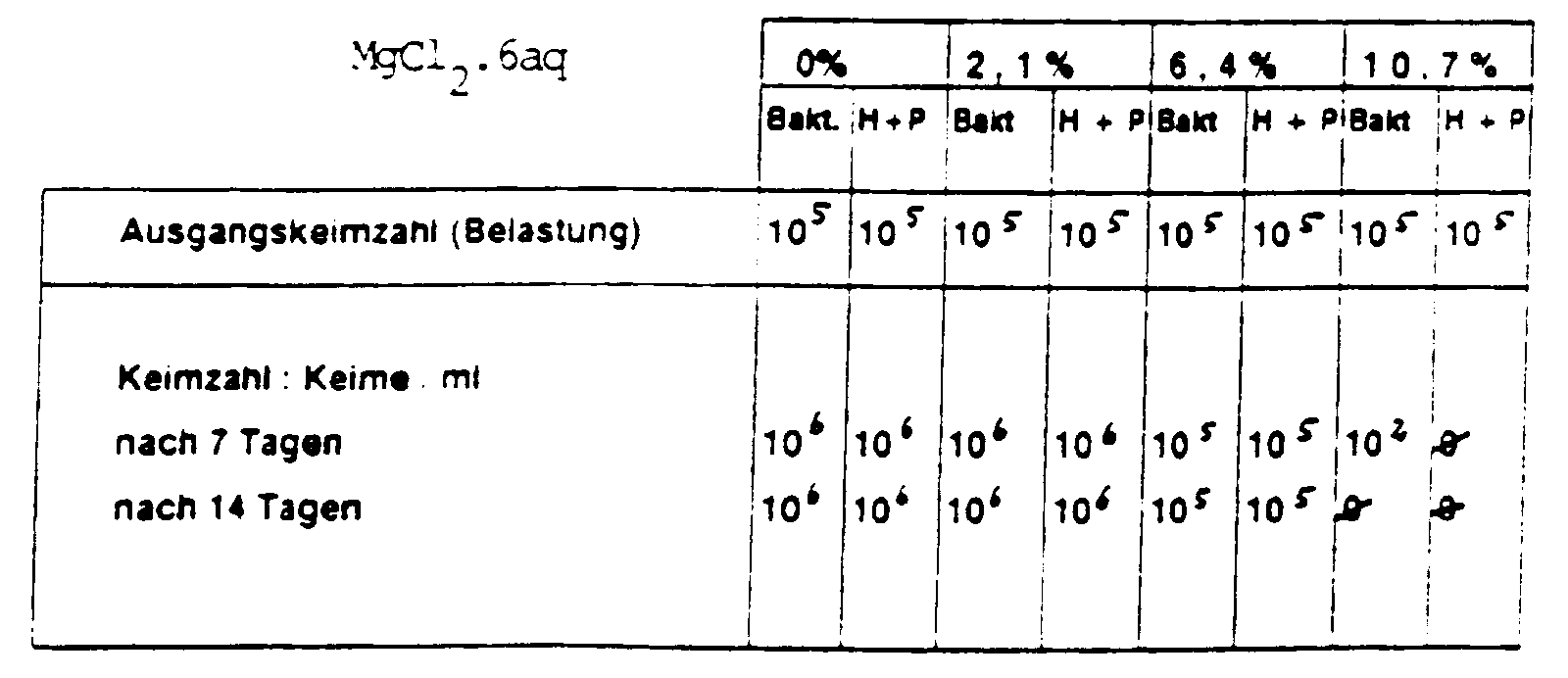
- the invention thus relates to the use of magnesium chloride in an amount of at least 2% by weight. preferably at least 5% by weight (calculated as anhydrous salt), for the preservation of preservative-free, liquid, water-containing surfactant systems of the type mentioned containing 2-50% by weight, preferably 5-35% by weight one or more surfactants.
- a particularly preferred surfactant system contains 2-15, in particular 5-10% by weight magnesium chloride (calculated as anhydrous magnesium chloride). or 4-30 wt .-%, preferably 10-25 wt .-% MgCl 2 (calculated as MgCl 2 .6H 2 O).
- Suitable surfactants are
- the anionic surfactant is in the surfactant combination in an amount of 9-79% by weight, preferably 22-30 % By weight (based on the surfactant combination).
- Suitable anionic surfactants are alkyl sulfates, alkyl ether sulfates, sec. Alkane sulfonates and olefin sulfonates.
- the amphoteric compound is present in the surfactant combination in an amount of 1-10% by weight, preferably 2 - 5 wt .-% (based on the surfactant combination).
- the nonionic surfactant need not necessarily be present. It can be used in an amount of 0 - 5% by weight, preferably 1-2% by weight (based on the surfactant combination).
- Fatty acid glycerol polyethylene glycol esters, fatty acid polyethylene glycol esters are suitable as nonionic surfactants and glycerol ethoxylates.
- the stable, liquid surfactant systems according to the invention are clear to emulsion-like and are in the Viscosity range adjustable from water-thin to liquid gel.
- the surfactant systems according to the invention can also contain other customary additives contain.
- An addition of a small amount of 1,2-propylene glycol and perfume oil can, depending on the intended use be beneficial.
- the surfactant systems according to the invention as body cleansers generally have a pH from 5 to 8, preferably from 5.5 to 7.
- a particularly preferred body cleanser according to the present invention in the form of a shower gel consists of 12 - 30 wt .-% of a surfactant combination 58-62% by weight di-Na lauryl alcohol polyglycol ether sulfosuccinate, 6-8% by weight di-Na coconut fatty acid isopropanolamide polyglycol ether sulfosuccinate, 5-7% by weight di-Na-ricinoleic acid monoethanolamide sulfosuccinate, 22-25% by weight Na lauryl ether sulfate (2-3 mol EO), 2-4% by weight of coconut fatty acid amidopropyl betaine, 0.5-1.5% by weight of glycerol polyethylene glycol oxystearate, 0.5 - 2.0% by weight 1,2-propylene glycol. 0.4 - 1.5% by weight perfume oil, and 2 - 14% by weight magnesium chloride (anhydrous) Rest of water.
- a surfactant combination 58-62% by weight
- a surfactant mixture I according to the invention was compared with a conventional surfactant mixture II with and without the addition of electrolyte (magnesium chloride) when used in a shower gel.
- Surfactant Mixture I (Invention) raw materials % By weight A) Di-Na lauryl alcohol polyglycol ether sulfosuccinate 60.20 B) Di-Na coconut fatty acid isopropanolamide polyglycol ether sulfosuccinate 7.00 C) Di-Na-ricinoleic acid monoethanolamide sulfosuccinate 5.80 D) Na lauryl ether sulfate, 2-3 moles of EO 23.10 E) Coconut fatty acid amidopropyl betaine 2.90 F) Glycerin polyethylene glycol oxystearate 1.00 100.00
- Surfactant mixture II (conventional system) raw materials % By weight Na lauryl ether sulfate, 2-3 moles of EO 89.00 Coconut fatty acid amidopropyl betaine 10.00 Glycerin polyethylene glycol oxystearate 1.00 Total surfactant mixture II 100.00
- the surfactant mixture I according to the invention was different in different amounts in shower gels Composition tested and compared with a conventional surfactant mixture II (B standard II) and one with shower gel preserved with dibromo-dicyanobutane (A-Standard I).
- composition of the shower gels can be found in Table I below. Examination names: raw materials A (standard I)% B (Standard II)% C% F% H % I% Surfactant mixture I - 12.5 12.5 30.0 40.0 Surfactant mixture II 12.5 - - - - 1,2 - propylene glycol - 0.63 0.63 1.5 2.0 Perfume oil 0.41 0.41 0.41 1.0 1.3 Mg chloride - - 12.0 - - Water, germ-free ad 100 ad 100 ad 100 ad 100 ad 100 Total % 100.00 100.00 100.00 100.00 pH conc. (Adjustment with Na OH or HCl) 6.1 6.1 6.1 6.1 6.1 % Surfactant 12.5 12.5 30.0 40.0
- MO microorganisms
- the electrolyte-containing formula F already reduces the germs for yeast after 14 days and bacteria to zero, which remains unchanged even after 28 days. A certain fungicidal effect of the electrolyte-free Recipe C was not reproducible.
- test conditions have been tightened to the extent that they are also very resistant Bacterial strain Bacillus subtilis was worked (spore-forming).
- spore-forming Bacterial strain Bacillus subtilis was worked (spore-forming).
- a shower gel A preserved with dibromodicyanobutane and phenoxyethanol and a non-preserved, standard shower gel B tested as standard.
- formulation F according to the invention was approximately the same in bacterial reduction, in some cases even better, than the conserved formula A, the unconserved, conventionally constructed formula B already showed an increase in the germ content to about 10 6 after 7 days, as expected Germs / ml, which stabilized at this high level after 14, 21 and 28 days.
- formulations according to the invention meet the requirements for adequate preservation according to the minimum requirements of wall houses (cosmetics) as well as those by FIP (dermatics) by far.
- a surfactant system according to the invention was formulated as follows: % tap water 71.47 Genapol LRO 70 (fatty alcohol ether sulfate, Na salt C 12-14 70:30, 3 mol EO 70%, unpreserved) 17.86 MgCl 2 x6H 2 O 10.67 pH (adjusted with 1nHCl) 6.50 total 100.00 Mg salt (anhydrous) 5.00 Surfactant content 12.50
- the product is a bright, colorless gel.
- Test strains Start of experiment 1 day 1 week Pseudomonas aeruginosa 9.6 x 10 4 / ml 260 0 Candida albicans 1.6 x 10 3 / ml 0 0
- Example 3 The product of Example 3 is bare and viscous
- the product of Example 4 is bare and has a viscosity from 706 mPas.
- Test strains Start of experiment Example: 1 day ex. 1 week ex. 3rd 4th 3rd 4th 3rd 4th Pseudomonas aeruginosa 9.6x10 4 9.6x10 4 0 0 0 0 0 0
- Candida albicans 1.6x10 3 1.6x10 3 0 0 0 0 0
Landscapes
- Life Sciences & Earth Sciences (AREA)
- Health & Medical Sciences (AREA)
- Chemical & Material Sciences (AREA)
- Animal Behavior & Ethology (AREA)
- General Health & Medical Sciences (AREA)
- Public Health (AREA)
- Veterinary Medicine (AREA)
- Epidemiology (AREA)
- Birds (AREA)
- Inorganic Chemistry (AREA)
- Engineering & Computer Science (AREA)
- Chemical Kinetics & Catalysis (AREA)
- Oil, Petroleum & Natural Gas (AREA)
- Wood Science & Technology (AREA)
- Organic Chemistry (AREA)
- Dermatology (AREA)
- Agricultural Chemicals And Associated Chemicals (AREA)
- Detergent Compositions (AREA)
- Cosmetics (AREA)
Description
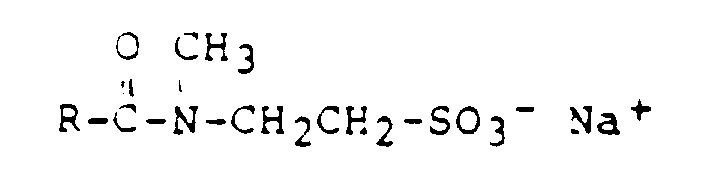
- R =
- Cocos-, Stearinsäure, Ölsäure
- z.B.
- Hostapone CT, STT, TF (Hoechst)
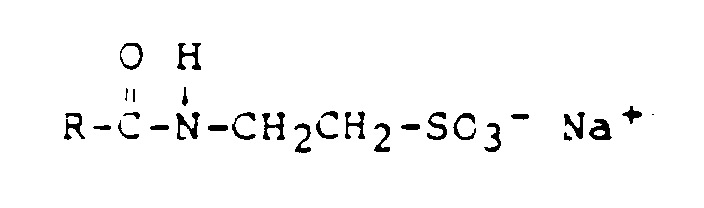
- R =
- Cocosfettsäure
- z.B.
- Hostapon KTW (Hoechst)

- R =
- Cocosfettsäure
- z.B.
- Hostapon KA (Hoechst)

- R =
- Cocosfettsäure, Laurinsäure
- z.B.
- Medialan KF (Hoechst)
Medialan CD (Hoechst)

- R =
- Cocosfettsäure
- n =
- 0 bis 32
- z.B.
- Lamepon S (Henkel)
Lamepon S2 (Henkel)
Lamepon S-TR (Henkel)
Geliderm 3000 (Deutsche Gelatine Fabriken Stoess & Co)

- z.B.
- N-Cocoylglutaminsäure-mono-Na-Salz (Hoechst)
- R =
- Cocos- oder Lauryl bzw. C12-C16
- n =
- 2,5 bis 18
- z.B.
- Marlinale CM (Hüls)
Akypo RLM (Chem-y)
- n =
- 2 bis 18

- z.B.
- Rewoteric AM-2C/NM (Rewo)
Rexoteric XCO-40 (Rexolin)
Miranol CM conc.N.P. (Miranol)
Dehyton G (Henkel)
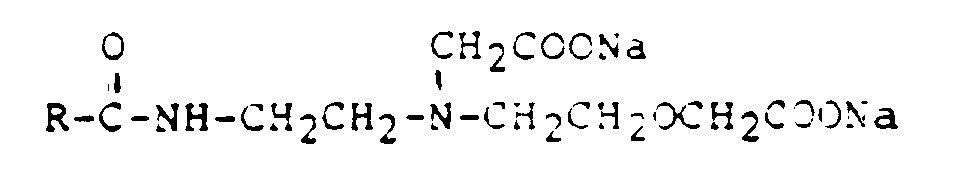
- z.B.
- Rewoteric AM-2C (Rewo)
Miranol C2M conc.N.P. (Miranol)
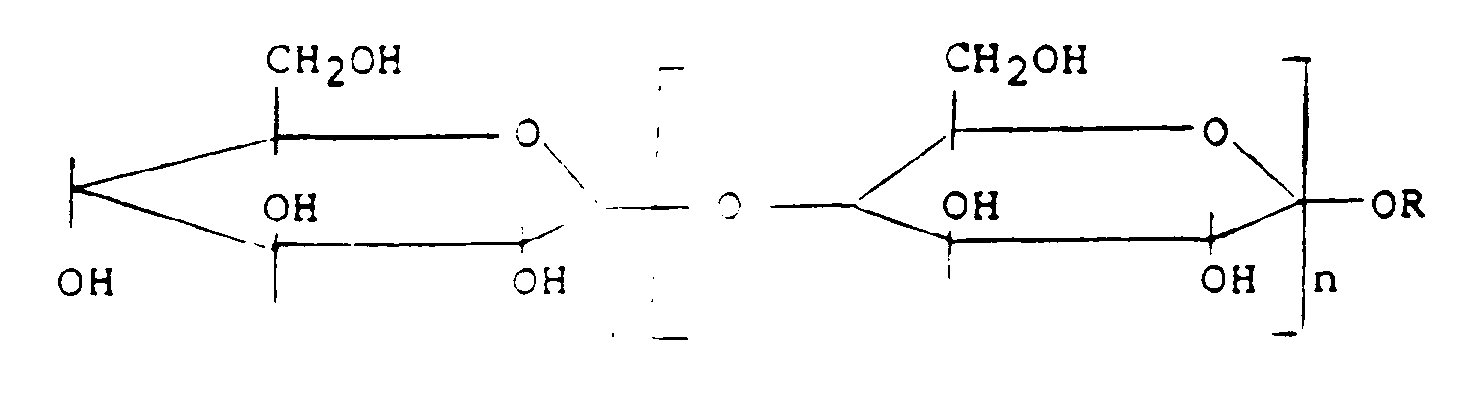
- n =
- vorzugsweise 0 bis 4
- R =
- C8-C12 Alkyl-
- z.B.
- Triton
CG 110 (Rohm & Haas)
Lutensol GD 70 (BASF)
- z.B.
- Grillotene (Grillo-Werke)
- z.B.
- Tween-Reihe (Atlas-Chemie)
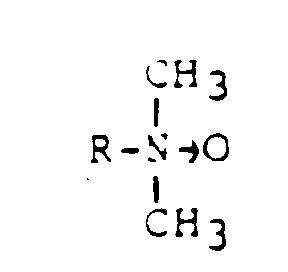
- R =
- C12-C18
- z.B.
- Empigen OB (Albright & Wilson)
Aminoxid WS35 (Th. Godschmidt)




- R =
- Rizinol-Alkyl, m = 0 und n = 1 ist

Fettalkoholsulfate der allgemeinen Formel
sekundäre Alkansulfonate der allgemeinen Formel

α-Olefinsulfonate der allgemeinen Formel
12 - 30 Gew.-% einer Tensidkombination aus
58 - 62 Gew.-% Di-Na-Laurylalkoholpolyglycolethersulfosuccinat,
6 - 8 Gew.-% Di-Na-Cocosfettsäureisopropanolamidpolyglycolethersulfosuccinat,
5 - 7 Gew.-% Di-Na-Rizinolsäuremonoethanolamidsulfosuccinat,
22 - 25 Gew.-% Na-Laurylethersulfat (2-3 Mol EO),
2 - 4 Gew.-% Cocosfettsäure-amidopropylbetain,
0,5 - 1,5 Gew.-% Glycerin-Polyethylenglycoloxystearat,
0,5 - 2,0 Gew.-% 1,2-Propylenglycol.
0,4 - 1,5 Gew.-% Parfümöl,
und
2 - 14 Gew.-% Magnesiumchlorid (wasserfrei)
Rest Wasser.
| Tensidmischung I (Erfindung) | |
| Rohstoffe | Gew.-% |
| A) Di-Na-Laurylalkoholpolyglycolethersulfosuccinat | 60,20 |
| B) Di-Na-Cocosfettsäureisopropanolamidpolyglycolethersulfosuccinat | 7,00 |
| C) Di-Na-Rizinolsäuremonoethanolamidsulfosuccinat | 5,80 |
| D) Na-Laurylethersulfat, 2-3 Mol EO | 23,10 |
| E) Cocosfettsäure-amidopropylbetain | 2,90 |
| F) Glycerin-Polyethylenglycoloxystearat | 1,00 |
| 100,00 |
| Tensidmischung II (konventionelles System) | |
| Rohstoffe | Gew.-% |
| Na-Laurylethersulfat, 2-3 Mol EO | 89,00 |
| Cocosfettsäure-amidopropylbetain | 10,00 |
| Glycerin-Polyethylenglycoloxystearat | 1,00 |
| Summe Tensidmischung II | 100,00 |
| Verauchsbezeichnungen: | ||||||
| Rohstoffe | A (Standard I) % | B (Standard II) % | C % | F % | H % | I % |
| Tensid - Mischung I | - | 12,5 | 12,5 | 30,0 | 40,0 | |
| Tensid - Mischung II | 12,5 | - | - | - | - | |
| 1,2 - Propylenglycol | - | 0,63 | 0,63 | 1,5 | 2,0 | |
| Parfumöl | 0,41 | 0,41 | 0,41 | 1,0 | 1,3 | |
| Mg - Chlorid | - | - | 12,0 | - | - | |
| Wasser, keimfrei | ad 100 | ad 100 | ad 100 | ad 100 | ad 100 | |
| Summe % | 100,00 | 100,00 | 100,00 | 100,00 | 100,00 | |
| pH conc. (Einstellung mit Na OH bzw. HCl) | 6,1 | 6,1 | 6,1 | 6,1 | 6,1 | |
| Tensid -Gehalt % | 12,5 | 12,5 | 12,5 | 30,0 | 40,0 |
| Bezeichnung M.O. | Gruppierung M.O. |
| Staphlococcus aureus = | grampositive Bakterien |
| Pseudomonas aeruginosa = | gramnegative Bakterien |
| Escherichia coli = | gramnegative Bakterien |
| Candida albicans = | Hefen |
| Aspergillus niger = | Schimmelpilze |
- in weniger als 3 Wochen auf weniger als 102 Keime/ml (Wallhäuser)
- nach 14 Tagen auf mindestens 102 Keime/ml (FIP) zurückgehen und die Hefen und Pilze
- in weniger als 3 Wochen auf weniger als 103 Keime/ml (Wallhäuser)
- nach 14 Tagen auf mindestens 104 Keime/ml zurückgehen und nach 28 Tagen keine Vermehrung eintritt (FIP)
| % | |
| Leitungswasser | 71,47 |
| Genapol LRO 70 (Fettalkoholäthersulfat, Na-Salz C12-14 70:30, 3 Mol EO 70 %ig, unkonserviert) | 17,86 |
| MgCl2x6H2O | 10,67 |
| pH (eingestellt mit 1nHCl) | 6,50 |
| Summe | 100,00 |
| Mg-Salz (wasserfrei) | 5,00 |
| Tensidgehalt | 12,50 |
| Teststämme | Versuchsbeginn | 1 Tag | 1 Woche |
| Pseudomonas aeruginosa | 9,6 x 10⁴/ml | 260 | 0 |
| Candida albicans | 1,6 x 10³/ml | 0 | 0 |
| Komponente | Menge % | |
| Beispiel 3 | Beispiel 4 | |
| Leitungswasser | 66,66 | 56,20 |
| Genapol LRO 70 | 12,87 | 10,90 |
| Setacin 103 spez | 6,19 | - |
| Rewoder S1333 | 0,59 | - |
| Rewopol SBZ | 0,59 | - |
| Tego Betain L7 | 1,20 | 4,84 |
| Marlinat CM100 | - | 2,94 |
| NaOH, 4 %ig | - | 4,48 |
| Cetiol HE | - | 0,35 |
| MgCl2x6H2O | 10,67 | 19,06 |
| 1,2 Propylenglykol | 0,63 | 0,63 |
| Cremophor RM410 | 0,13 | 0,13 |
| Parfüm | 0,41 | 0,41 |
| pH Einstellung aus | 6,50 | 6,50 |
| Summe | 100,00 | 100,00 |
| Mg-Salz (wasserfrei) | 5,00 | 8,93 |
| Tensidgehalt | 12,50 | 12,50 |
- Genapol LRO 70
- = Fettalkoholäthersulfat, Na-Salz, C12-14 70:30; 3 Mol EO (70 %ige Ware)
- Setacin 103 spez. (40 %ig)
- = Sulfobernsteinsäure-Ester, Typ A
- Rewoderm S1333 (40 %ig)
- = Sulfobernsteinsäure-Ester, Typ C
- Rewopol SBZ (49 %ig)
- = Sulfobernsteinsäure-Ester, Typ B
- Teo Betain L7 (30 %ig)
- = Alkylamidopropylbetain
- Marlinat CM 100 (91 %ig)
- = Fettalkoholpolyglykolether-Carbonsäure C12/14 70:30; 10 Mol EO
- Cetiol HE (100 %ig)
- = Ethoxylierter Glycerinester
| Teststämme | Versuchsbeginn Beispiel: | 1 Tag Beisp. | 1 Woche Beisp. | |||
| 3 | 4 | 3 | 4 | 3 | 4 | |
| Pseudomonas aeruginosa | 9,6x10⁴ | 9,6x10⁴ | 0 | 0 | 0 | 0 |
| Candida albicans | 1,6x10³ | 1,6x10³ | 0 | 0 | 0 | 0 |
- NLES
- = Na-Laurylethersulfat
- NLS
- = Na - Laurylsulfat
- SAS
- = Sekundäres Alkansulfonat
- AOS
- = α - Olefinsulfonat
- LAS
- = Lineares Alkylbenzolsulfonat
- AAB
- = Alkylamidopropyl - Betain
- SBE Typ A
- = Sulfobernsteinsäure Halbester Typ A
- SBE Typ B
- = Sulfobernsteinsäure Halbester Typ B
- SBE Typ C
- = Sulfobernsteinsäure Halbester Typ C
| SBE | NLES | |
| Ausgangskeimzahl (Belastung) | Bakterien 105 bis 106 | Bakterien 105 bis 106 |
| Keimzahl : Keime / ml | ||
| nach 7 Tagen | 104 | 106 |
| nach 14 Tagen | 105 | 105 |
| nach 28 Tagen | 105 | 106 |
| TENSIDE | SBE - Monosystem % | SBE - Kombination % |
| SBE Typ A (100 %ig) | 100,0 | 82,5 |
| SBE Typ B | 0 | 7,9 |
| SBE Typ C | 0 | 9,6 |
| Summe | 100,0 | 100,0 |
| TENSID (E) % | 12,5 | 12,5 |
| WASSER % | ad 100,0 | ad 100,0 |
| SBE - Monosystem | SBE -Kombinationen | |||
| Ausgangskeimzahl (Befastung) | Bakterien 105 bis 106 | Hefen 105 bis 106 | Bakterien 105 bis 106 | Hefen 105 bis 106 |
| Keimzahl: Keime / ml | ||||
| nach 7 Tagen | 104 | 105 | 40 | 103 |
| nach 14 Tagen | 105 | 105 | ⊘ | 105 |
| nach 28 Tagen | 105 | 105 | ⊘ | 104 |
| TENSIDE | E % |
| SBE Typ A | 60,2 |
| SBE Typ B | 7,0 |
| SBE Typ C | 5,8 |
| Tenside a, b, c, d, e * | 23,1 |
| Glycerin-Polyethylenglycoloxostearat | 1,0 |
| AAB | 2,9 |
| Summe | 100,0 |
| E TENSIDE % | 12,5 |
| WASSER % | ad 100,0 |
| Ausgangskeimzahl (Belastung) | Bakterien | Hefen + Pilze | ||||||||
| a | b | c | d | e | a | b | c | d | e | |
| 105 bis 106 | 105 bis 106 | |||||||||
| Keimzahl : Keime / ml | ||||||||||
| nach 7 Tagen | 106 | 105 | 104 | 106 | 106 | 103 | ⊘ | 102 | 103 | 103 |
| nach 14 Tagen | 105 | 105 | 104 | 106 | 106 | ⊘ | ⊘ | ⊘ | 103 | 103 |
| nach 28 Tagen | 106 | 106 | 105 | 103 | 106 | ⊘ | ⊘ | ⊘ | ⊘ | ⊘ |
| TENSIDE | ohne Mg - Salze % | mit Mg - Salzen % |
| SBE Typ A | 60,2 | 60,2 |
| SBE Typ B | 7,0 | 7,0 |
| SBE Typ C | 5,8 | 5,8 |
| NLES | 23,1 | 23,1 |
| AAB | 2,9 | 2,9 |
| Glycerin-Polyethylenglycoloxostearat | 1,0 | 1,0 |
| Summe | 100,0 | 100,0 |
| TENSIDE % | 12,5 | 12,5 |
| Mg Cl2 x 6 aq | 0 | 19,0 |
| WASSER % | ad 100,0 | ad 100,0 |
| ohne Mg - Salze | mit Mg - Salzen | |||
| Ausgangskeimzahl (Belastung) | Bakterien 105 bis 106 | Hefen + Pilze 105 bis 106 | Bakterien 105 bis 106 | Hefen + Pilze 105 bis 106 |
| Keimzahl : Keime / ml | ||||
| nach 7 Tagen | 106 | 103 | ⊘ | 103 |
| nach 14 Tagen | 105 | ⊘ | ⊘ | 101 |
| nach 28 Tagen | 106 | ⊘ | ⊘ | ⊘ |
| TENSIDE | ohne Mg - Salze % | mit Mg - Salzen % |
| SBE Typ A | 73,0 | 73,0 |
| NLES | 23,1 | 23,1 |
| AAB | 2,9 | 2,9 |
| Glycerin - PEG - oxostearat | 1,0 | 1,0 |
| Summe | 100,0 | 100,0 |
| TENSIDE % | 12,5 | 12,5 |
| Mg Cl2x 6aq % | 0 | 19,0 |
| WASSER % | ad 100,0 | ad 100,0 |
| ohne Mg - Salze | mit Mg - Salzen | |||
| Ausgangskeimzahl (Belastung) | Bakterien 105 bis 106 | Hefen + Pilze 105 bis 106 | Bakterien 105 bis 106 | Hefen + Pilze 105 bis 106 |
| Keimzahl : Keime / ml | ||||
| nach 7 Tagen | 105 | 104 | ⊘ | 103 |
| nach 14 Tagen | 104 | 104 | ⊘ | ⊘ |
| nach 28 Tagen | 105 | 106 | ⊘ | ⊘ |
| TENSIDE | SBE : NLES = 75 : 25 % | SBE : NLES = 25 : 75 % |
| SBE Typ A | 60,2 | 19,8 |
| SBE Typ B | 7,0 | 1,9 |
| SBE Typ C | 5,8 | 2,3 |
| NLES | 23,1 | 72,1 |
| AAB | 2,9 | 2,9 |
| Glycerin - PEG - oxostearat | 1,0 | 1,0 |
| Summe | 100,0 | 100,0 |
| E TENSIDE % | 12,5 | 12,5 |
| Mg Cl2x 6aq % | 19,0 | 19,0 |
| WASSER % | ad 100,0 | ad 100,0 |
| SBE : NLES = 75 : 25 | SBE : NLES = 25 : 75 | |||
| Ausgangskeimzahl (Belastung) | Bakterien 105 bis 106 | Hefen + Pilze 105 bis 106 | Bakterien 105 bis 106 | Hefen + Pilze 105 bis 106 |
| Keimzahl : Keime / ml | ||||
| nach 7 Tagen | ⊘ | 103 | ⊘ | ⊘ |
| nach 14 Tagen | ⊘ | 101 | ⊘ | ⊘ |
| nach 28 Tagen | ⊘ | ⊘ | ⊘ | ⊘ |
Claims (10)
- Verwendung von Magnesiumchlorid in einer Menge von mindestens 2 Gew.%, vorzugsweise mindestens 5 Gew.% (berechnet als wasserfreies Salz), zur Konservierung konservierungsmittelfreier, flüssiger, wasserhaltiger Tensidsysteme in Form eines Körperreinigungsmittels oder Handgeschirrspülmittels enthaltend 2-50 Gew.%, vorzugsweise 5-35 Gew.% eines oder mehrerer Tenside.
- Verwendung von Magnesiumchlorid in einer Menge von 4-30, vorzugsweise 10-25 Gew.-% (berechnet als MgCl2 . 6H2O) gemäß Anspruch 1.
- Konservierungsmittelfreies, selbst konservierendes, flüssiges, wasserhaltiges Tensidsystem in Form eines Körperreinigungsmittels oder Handgeschirrspülmittels enthaltend 2-50 Gew.-%, vorzugsweise 5-35 Gew.-% einer Tensidkombination, dadurch gekennzeichnet, daß die Tensidkombination ausdaß das System 2-25 Gew.-%, vorzugsweise 5-15 Gew.-% (berechnet als wasserfreies Salz) Magnesiumchlorid enthält.a) 20-90 Gew.-%, vorzugsweise 67-75 Gew.-% eines Sulfobernsteinsäure-Halbesters der allgemeinen Formelworin R C7-C17-Alkyl oder Rizinol-Alkyl und n = 2 - 4 bedeuten.
 b) 9-79, vorzugsweise 9-49 Gew.-%, insbesondere 22-30 Gew.-% einer oder mehrerer Verbindungen aus der Gruppe der anionischen Tenside.c) 1-10 Gew.-%, vorzugsweise 2-5 Gew.-% einer oder mehrerer amphoterer Verbindungend) 0-5 Gew.-%, vorzugsweise 1-2 Gew.-% einer oder mehrerer nichtionischen Tenside besteht und weiterhin dadurch gekennzeichnet,
 - Tensidsystem gemäß Anspruch 3, dadurch gekennzeichnet, daß das Magnesiumchlorid in einer Menge von 4-30, vorzugsweise 10-25 Gew.-% (berechnet als MgCl2 . 6H2O) eingesetzt wird.
- Tensidsystem gemäß einem der Ansprüche 3 oder 4, dadurch gekennzeichnet, daß als Sulfobernsteinsäureester (a) eine Kombination der Sulfobernsteinsäure-Halbester vom Typ Amit Derivaten des
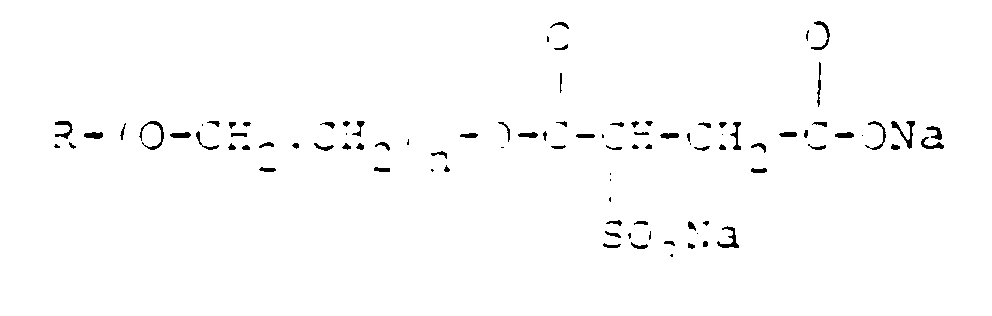
Typs Bund Typs C in einem Verhältnis von A:B:C von (2-15):(1-2):1, vorzugsweise (2-10):1:1 eingesetzt wird.
- Tensidsystem nach einem der Ansprüche 3-5, dadurch gekennzeichnet, daß als anionisches Tensid (b) ein Alkylsulfat. Alkyläthersulfat, sek. Alkansulfonat und/oder Olefinsulfonat verwendet wird.
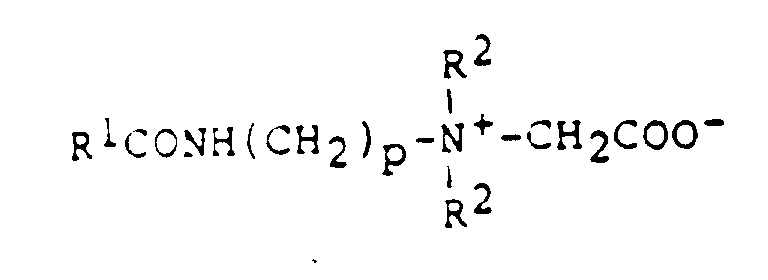
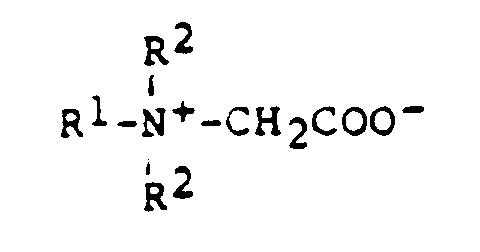
- Tensidsystem nach einem der Ansprüche 3-6, dadurch gekennzeichnet, daß als amphotere Verbindung (c) ein (Amido-)Alkylbetain der allgemeinen Formelworin R1 C7-C17-Alkyl, R2 C1-C4-Alkyl,
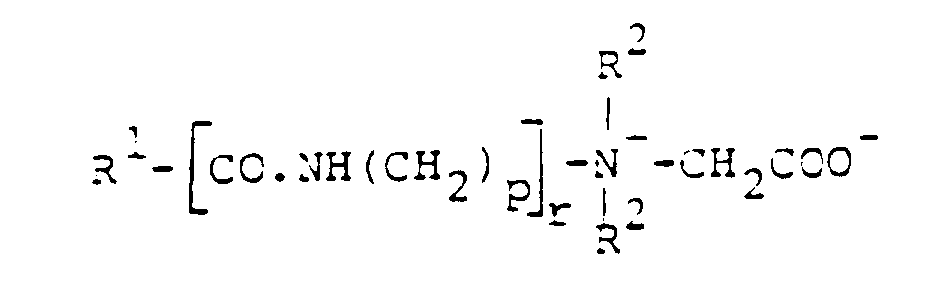
p = 2 oder 3 und r = 0 oder 1 bedeuten, verwendet wird. - Tensidsystem nach einem der Ansprüche 3-7, dadurch gekennzeichnet, daß als nichtionisches Tensid (d) ein Fettsäureglycerinpolyethylenglycolester, Fettsäurepolyethylenglycolester und/oder Glycerinethoxylat verwendetwird.
- Tensidsystem nach einem der Ansprüche 3-8 in Form eines Duschgels.
- Tensidsystem nach Anspruch 9 in Form eines Duschgels bestehend aus 12-30 Gew.-% einer Tensidkombination (T) aus
58-62 Gew.-% Di-Na-Laurylalkoholpolyglycolethersulfosuccinat,
6-8 Gew.-% Di-Na-Cocosfettsäureisopropanolamidpolyglycolethersulfosuccinat,
5-7 Gew.-% Di-Na-Rizinolsäuremonoethanolamidsulfosuccinat,
22-25 Gew.-% Na-Laurylethersulfat (2-3 Mol EO),
2-4 Gew.-% Cocosfettsäure-amidopropylbetain.
0,5-1,5 Gew.-% Glycerin-Polyethylenglycoloxystearat;
0,5-2,0 Gew.-% 1,2-Propylenglycol,
0,4-1,5 Gew.-% Parfümöl,
und
2-14 Gew.-% Magnesiumchlorid (wasserfrei)
Rest Wasser.
Applications Claiming Priority (4)
| Application Number | Priority Date | Filing Date | Title |
|---|---|---|---|
| DE19904005054 DE4005054A1 (de) | 1990-02-16 | 1990-02-16 | Konservierungsmittelfreie koerperreinigungsmittel |
| DE4005054 | 1990-02-16 | ||
| DE19904025424 DE4025424A1 (de) | 1990-08-10 | 1990-08-10 | Konservierungsmittelfreies fluessiges tensidsystem |
| DE4025424 | 1990-08-10 |
Publications (4)
| Publication Number | Publication Date |
|---|---|
| EP0442519A2 EP0442519A2 (de) | 1991-08-21 |
| EP0442519A3 EP0442519A3 (en) | 1992-03-04 |
| EP0442519B1 EP0442519B1 (de) | 1994-05-04 |
| EP0442519B2 true EP0442519B2 (de) | 1998-04-15 |
Family
ID=25890257
Family Applications (1)
| Application Number | Title | Priority Date | Filing Date |
|---|---|---|---|
| EP91102164A Expired - Lifetime EP0442519B2 (de) | 1990-02-16 | 1991-02-15 | Selbstkonservierende flüssige Tensidsysteme |
Country Status (6)
| Country | Link |
|---|---|
| EP (1) | EP0442519B2 (de) |
| AT (1) | ATE105180T1 (de) |
| DE (1) | DE59101523D1 (de) |
| DK (1) | DK0442519T4 (de) |
| ES (1) | ES2052290T5 (de) |
| GR (1) | GR3026747T3 (de) |
Families Citing this family (4)
| Publication number | Priority date | Publication date | Assignee | Title |
|---|---|---|---|---|
| DE4126969A1 (de) * | 1991-08-14 | 1993-02-18 | Benckiser Gmbh Joh A | Konservierungsmittelfreie kosmetika |
| DE4304066C2 (de) * | 1993-02-11 | 1995-01-26 | Beiersdorf Ag | Verwendung von hohen Elektrolytkonzentrationen in kosmetischen Reinigungsmitteln |
| PT835096E (pt) * | 1995-06-26 | 2002-02-28 | Procter & Gamble | Composicoes liquidas de limpeza pessoal contendo catioes metalicos polivalentes |
| EP2058277B1 (de) * | 2007-11-09 | 2011-06-22 | Lucent Technologies Inc. | Vorrichtung mit einer Oberfläche mit Zellen, die mit Blasen zu einer verbesserten Flusswiderstandsreduzierung einer Flüssigkeit verbunden sind, und zugehöriges Verfahren |
Family Cites Families (4)
| Publication number | Priority date | Publication date | Assignee | Title |
|---|---|---|---|---|
| US3928249A (en) * | 1972-02-07 | 1975-12-23 | Procter & Gamble | Liquid detergent composition |
| LU85549A1 (fr) * | 1984-09-21 | 1986-04-03 | Oreal | Compositions cosmetiques a base de silicone cationique et de gomme de xanthane |
| DE3713684A1 (de) * | 1987-04-24 | 1988-11-10 | Wella Ag | Konservierte haar- und koerperreinigungsmittel sowie verwendung einer konservierungsstoff-kombination |
| PT89126B (pt) * | 1987-12-02 | 1993-09-30 | Colgate Palmolive Co | Processo para a preparacao de uma composicao de limpeza suave e de condicionamento para amaciamento da pele, contendo baixos niveis de um agente tensio-activo nao ionico e um acido organico |
-
1991
- 1991-02-15 ES ES91102164T patent/ES2052290T5/es not_active Expired - Lifetime
- 1991-02-15 AT AT9191102164T patent/ATE105180T1/de active
- 1991-02-15 DE DE59101523T patent/DE59101523D1/de not_active Expired - Lifetime
- 1991-02-15 DK DK91102164T patent/DK0442519T4/da active
- 1991-02-15 EP EP91102164A patent/EP0442519B2/de not_active Expired - Lifetime
-
1998
- 1998-04-28 GR GR980400940T patent/GR3026747T3/el unknown
Also Published As
| Publication number | Publication date |
|---|---|
| ATE105180T1 (de) | 1994-05-15 |
| DK0442519T3 (da) | 1994-06-13 |
| EP0442519A2 (de) | 1991-08-21 |
| EP0442519B1 (de) | 1994-05-04 |
| GR3026747T3 (en) | 1998-07-31 |
| EP0442519A3 (en) | 1992-03-04 |
| DK0442519T4 (da) | 1998-08-31 |
| ES2052290T3 (es) | 1994-07-01 |
| ES2052290T5 (es) | 1998-06-16 |
| DE59101523D1 (de) | 1994-06-09 |
Similar Documents
| Publication | Publication Date | Title |
|---|---|---|
| EP2990026B1 (de) | Wässrige Tensid-Zusammensetzungen | |
| EP0967971B1 (de) | Kosmetische zubereitungen | |
| DE69128614T2 (de) | Reinigungsmittelzusammensetzung | |
| CH654325A5 (de) | Phosphobetain- bzw. phosphitain-haltige reinigungs- und waschmittel. | |
| EP2902011B1 (de) | Wässrige tensid-zusammensetzungen | |
| CH640134A5 (en) | Cosmetic cleansing agent and process for its preparation | |
| CH644892A5 (de) | Wasch- und reinigungsmittel. | |
| DE3730179A1 (de) | Verdickte waessrige tensidloesungen, insbesondere fuer deren einsatz auf dem gebiet kosmetischer praeparate | |
| DE69202771T2 (de) | Flüssiges Waschmittel. | |
| DE2351386A1 (de) | Mittel gegen mikroben und dessen verwendung | |
| DE3724460C2 (de) | ||
| DE69405604T2 (de) | Kosmetische Zusammensetzung enthaltend ein Phosphattensid und ein Cotensid | |
| DE4435495C2 (de) | Pumpfähige wäßrige Tensidkonzentrate | |
| DE19516698C5 (de) | Gefärbte flüssige Reinigungsmittel | |
| EP0442519B1 (de) | Selbstkonservierende flüssige Tensidsysteme | |
| EP0749749B1 (de) | Mehrkomponentenkonservierungsmittel für Haar- und Körperreinigungsmittel | |
| DE2024962B2 (de) | Flussige Reinigungsmittelmischung | |
| EP0641377B1 (de) | Milde tensidgemische | |
| EP0371339B1 (de) | Oberflächenaktive Mischungen | |
| DE1201508C2 (de) | Antiseptisches shampoo | |
| DE2534481A1 (de) | Waessrige keimtoetende seifenzusammensetzung | |
| DE1962238A1 (de) | Desinfizierende Wasch- und Antischuppenmittel | |
| DE4025424A1 (de) | Konservierungsmittelfreies fluessiges tensidsystem | |
| EP1086198B1 (de) | Duschgel | |
| DE4005054A1 (de) | Konservierungsmittelfreie koerperreinigungsmittel |
Legal Events
| Date | Code | Title | Description |
|---|---|---|---|
| PUAI | Public reference made under article 153(3) epc to a published international application that has entered the european phase |
Free format text: ORIGINAL CODE: 0009012 |
|
| AK | Designated contracting states |
Kind code of ref document: A2 Designated state(s): AT BE CH DE DK ES FR GB GR IT LI LU NL SE |
|
| PUAL | Search report despatched |
Free format text: ORIGINAL CODE: 0009013 |
|
| AK | Designated contracting states |
Kind code of ref document: A3 Designated state(s): AT BE CH DE DK ES FR GB GR IT LI LU NL SE |
|
| 17P | Request for examination filed |
Effective date: 19920312 |
|
| 17Q | First examination report despatched |
Effective date: 19921203 |
|
| GRAA | (expected) grant |
Free format text: ORIGINAL CODE: 0009210 |
|
| AK | Designated contracting states |
Kind code of ref document: B1 Designated state(s): AT BE CH DE DK ES FR GB GR IT LI LU NL SE |
|
| REF | Corresponds to: |
Ref document number: 105180 Country of ref document: AT Date of ref document: 19940515 Kind code of ref document: T |
|
| ITF | It: translation for a ep patent filed | ||
| REF | Corresponds to: |
Ref document number: 59101523 Country of ref document: DE Date of ref document: 19940609 |
|
| REG | Reference to a national code |
Ref country code: DK Ref legal event code: T3 |
|
| GBT | Gb: translation of ep patent filed (gb section 77(6)(a)/1977) |
Effective date: 19940517 |
|
| REG | Reference to a national code |
Ref country code: ES Ref legal event code: FG2A Ref document number: 2052290 Country of ref document: ES Kind code of ref document: T3 |
|
| ET | Fr: translation filed | ||
| REG | Reference to a national code |
Ref country code: GR Ref legal event code: FG4A Free format text: 3012258 |
|
| EAL | Se: european patent in force in sweden |
Ref document number: 91102164.0 |
|
| PLBI | Opposition filed |
Free format text: ORIGINAL CODE: 0009260 |
|
| 26 | Opposition filed |
Opponent name: GOLDWELL GMBH Effective date: 19950206 Opponent name: HENKEL KOMMANDITGESELLSCHAFT AUF AKTIEN Effective date: 19950206 |
|
| NLR1 | Nl: opposition has been filed with the epo |
Opponent name: HENKEL KG AUF AKTIEN |
|
| PLAW | Interlocutory decision in opposition |
Free format text: ORIGINAL CODE: EPIDOS IDOP |
|
| PLAW | Interlocutory decision in opposition |
Free format text: ORIGINAL CODE: EPIDOS IDOP |
|
| PUAH | Patent maintained in amended form |
Free format text: ORIGINAL CODE: 0009272 |
|
| STAA | Information on the status of an ep patent application or granted ep patent |
Free format text: STATUS: PATENT MAINTAINED AS AMENDED |
|
| 27A | Patent maintained in amended form |
Effective date: 19980415 |
|
| AK | Designated contracting states |
Kind code of ref document: B2 Designated state(s): AT BE CH DE DK ES FR GB GR IT LI LU NL SE |
|
| PG25 | Lapsed in a contracting state [announced via postgrant information from national office to epo] |
Ref country code: GR Free format text: THE PATENT HAS BEEN ANNULLED BY A DECISION OF A NATIONAL AUTHORITY Effective date: 19980428 |
|
| GBTA | Gb: translation of amended ep patent filed (gb section 77(6)(b)/1977) | ||
| ITF | It: translation for a ep patent filed | ||
| REG | Reference to a national code |
Ref country code: ES Ref legal event code: DC2A Kind code of ref document: T5 Effective date: 19980430 |
|
| NLR2 | Nl: decision of opposition | ||
| NLR3 | Nl: receipt of modified translations in the netherlands language after an opposition procedure | ||
| ET3 | Fr: translation filed ** decision concerning opposition | ||
| REG | Reference to a national code |
Ref country code: DK Ref legal event code: T4 |
|
| REG | Reference to a national code |
Ref country code: CH Ref legal event code: PUE Owner name: JOH. A. BENCKISER GMBH TRANSFER- BENCKISER N.V. |
|
| PGFP | Annual fee paid to national office [announced via postgrant information from national office to epo] |
Ref country code: AT Payment date: 19990520 Year of fee payment: 9 Ref country code: BE Payment date: 19990520 Year of fee payment: 9 Ref country code: CH Payment date: 19990520 Year of fee payment: 9 Ref country code: DK Payment date: 19990520 Year of fee payment: 9 Ref country code: LU Payment date: 19990520 Year of fee payment: 9 Ref country code: SE Payment date: 19990520 Year of fee payment: 9 |
|
| PGFP | Annual fee paid to national office [announced via postgrant information from national office to epo] |
Ref country code: GR Payment date: 19990526 Year of fee payment: 9 |
|
| PGFP | Annual fee paid to national office [announced via postgrant information from national office to epo] |
Ref country code: NL Payment date: 19990531 Year of fee payment: 9 |
|
| REG | Reference to a national code |
Ref country code: GB Ref legal event code: 732E |
|
| NLS | Nl: assignments of ep-patents |
Owner name: BENCKISER N.V. |
|
| REG | Reference to a national code |
Ref country code: FR Ref legal event code: TP |
|
| BECA | Be: change of holder's address |
Free format text: 19990409 *BENCKISER N.V.:WORLD TRADE CENTER AA SCHIPHOL BOULEVARD 229, 1118 BH SCHIPHOL |
|
| PG25 | Lapsed in a contracting state [announced via postgrant information from national office to epo] |
Ref country code: LU Free format text: LAPSE BECAUSE OF NON-PAYMENT OF DUE FEES Effective date: 20000215 Ref country code: AT Free format text: LAPSE BECAUSE OF NON-PAYMENT OF DUE FEES Effective date: 20000215 Ref country code: DK Free format text: LAPSE BECAUSE OF NON-PAYMENT OF DUE FEES Effective date: 20000215 |
|
| PG25 | Lapsed in a contracting state [announced via postgrant information from national office to epo] |
Ref country code: SE Free format text: LAPSE BECAUSE OF NON-PAYMENT OF DUE FEES Effective date: 20000216 |
|
| PG25 | Lapsed in a contracting state [announced via postgrant information from national office to epo] |
Ref country code: BE Free format text: LAPSE BECAUSE OF NON-PAYMENT OF DUE FEES Effective date: 20000228 |
|
| PG25 | Lapsed in a contracting state [announced via postgrant information from national office to epo] |
Ref country code: CH Free format text: LAPSE BECAUSE OF NON-PAYMENT OF DUE FEES Effective date: 20000229 Ref country code: LI Free format text: LAPSE BECAUSE OF NON-PAYMENT OF DUE FEES Effective date: 20000229 |
|
| REG | Reference to a national code |
Ref country code: ES Ref legal event code: PC2A |
|
| BERE | Be: lapsed |
Owner name: BENCKISER N.V. Effective date: 20000228 |
|
| PG25 | Lapsed in a contracting state [announced via postgrant information from national office to epo] |
Ref country code: NL Free format text: LAPSE BECAUSE OF NON-PAYMENT OF DUE FEES Effective date: 20000901 |
|
| EUG | Se: european patent has lapsed |
Ref document number: 91102164.0 |
|
| REG | Reference to a national code |
Ref country code: CH Ref legal event code: PL |
|
| REG | Reference to a national code |
Ref country code: DK Ref legal event code: EBP |
|
| NLV4 | Nl: lapsed or anulled due to non-payment of the annual fee |
Effective date: 20000901 |
|
| REG | Reference to a national code |
Ref country code: GB Ref legal event code: IF02 |
|
| REG | Reference to a national code |
Ref country code: FR Ref legal event code: CD Ref country code: FR Ref legal event code: CA |
|
| REG | Reference to a national code |
Ref country code: FR Ref legal event code: CA |
|
| PGFP | Annual fee paid to national office [announced via postgrant information from national office to epo] |
Ref country code: ES Payment date: 20100225 Year of fee payment: 20 |
|
| PGFP | Annual fee paid to national office [announced via postgrant information from national office to epo] |
Ref country code: IT Payment date: 20100224 Year of fee payment: 20 Ref country code: FR Payment date: 20100303 Year of fee payment: 20 |
|
| PGFP | Annual fee paid to national office [announced via postgrant information from national office to epo] |
Ref country code: DE Payment date: 20100226 Year of fee payment: 20 Ref country code: GB Payment date: 20100224 Year of fee payment: 20 |
|
| REG | Reference to a national code |
Ref country code: DE Ref legal event code: R071 Ref document number: 59101523 Country of ref document: DE |
|
| REG | Reference to a national code |
Ref country code: GB Ref legal event code: PE20 Expiry date: 20110214 |
|
| PG25 | Lapsed in a contracting state [announced via postgrant information from national office to epo] |
Ref country code: GB Free format text: LAPSE BECAUSE OF EXPIRATION OF PROTECTION Effective date: 20110214 |
|
| REG | Reference to a national code |
Ref country code: ES Ref legal event code: FD2A Effective date: 20120510 |
|
| PG25 | Lapsed in a contracting state [announced via postgrant information from national office to epo] |
Ref country code: ES Free format text: LAPSE BECAUSE OF EXPIRATION OF PROTECTION Effective date: 20110216 |
|
| PG25 | Lapsed in a contracting state [announced via postgrant information from national office to epo] |
Ref country code: DE Free format text: LAPSE BECAUSE OF EXPIRATION OF PROTECTION Effective date: 20110215 |