EP0426488B1 - Verfahren zur Herstellung modifizierter Superoxid-Dismutase - Google Patents
Verfahren zur Herstellung modifizierter Superoxid-Dismutase Download PDFInfo
- Publication number
- EP0426488B1 EP0426488B1 EP90312027A EP90312027A EP0426488B1 EP 0426488 B1 EP0426488 B1 EP 0426488B1 EP 90312027 A EP90312027 A EP 90312027A EP 90312027 A EP90312027 A EP 90312027A EP 0426488 B1 EP0426488 B1 EP 0426488B1
- Authority
- EP
- European Patent Office
- Prior art keywords
- sod
- peg
- ppg
- reaction
- modified
- Prior art date
- Legal status (The legal status is an assumption and is not a legal conclusion. Google has not performed a legal analysis and makes no representation as to the accuracy of the status listed.)
- Expired - Lifetime
Links
- 102000019197 Superoxide Dismutase Human genes 0.000 title claims description 118
- 108010012715 Superoxide dismutase Proteins 0.000 title claims description 118
- OUUQCZGPVNCOIJ-UHFFFAOYSA-M Superoxide Chemical class [O-][O] OUUQCZGPVNCOIJ-UHFFFAOYSA-M 0.000 title claims description 17
- 238000004519 manufacturing process Methods 0.000 title description 21
- 238000006243 chemical reaction Methods 0.000 claims description 63
- 238000000034 method Methods 0.000 claims description 30
- 239000000872 buffer Substances 0.000 claims description 25
- 229920001223 polyethylene glycol Polymers 0.000 claims description 21
- 239000002202 Polyethylene glycol Substances 0.000 claims description 16
- 229920000642 polymer Polymers 0.000 claims description 15
- 230000008569 process Effects 0.000 claims description 15
- LFKYBJLFJOOKAE-UHFFFAOYSA-N imidazol-2-ylidenemethanone Chemical compound O=C=C1N=CC=N1 LFKYBJLFJOOKAE-UHFFFAOYSA-N 0.000 claims description 12
- LYCAIKOWRPUZTN-UHFFFAOYSA-N Ethylene glycol Chemical compound OCCO LYCAIKOWRPUZTN-UHFFFAOYSA-N 0.000 claims description 10
- PFKFTWBEEFSNDU-UHFFFAOYSA-N carbonyldiimidazole Chemical compound C1=CN=CN1C(=O)N1C=CN=C1 PFKFTWBEEFSNDU-UHFFFAOYSA-N 0.000 claims description 10
- WGCNASOHLSPBMP-UHFFFAOYSA-N hydroxyacetaldehyde Natural products OCC=O WGCNASOHLSPBMP-UHFFFAOYSA-N 0.000 claims description 5
- 239000004743 Polypropylene Substances 0.000 claims description 3
- 229920001155 polypropylene Polymers 0.000 claims description 3
- 239000011541 reaction mixture Substances 0.000 claims description 3
- 238000005571 anion exchange chromatography Methods 0.000 claims 1
- 238000011084 recovery Methods 0.000 claims 1
- 239000000126 substance Substances 0.000 claims 1
- 239000000243 solution Substances 0.000 description 69
- XLYOFNOQVPJJNP-UHFFFAOYSA-N water Substances O XLYOFNOQVPJJNP-UHFFFAOYSA-N 0.000 description 27
- 229920001451 polypropylene glycol Polymers 0.000 description 26
- CDBYLPFSWZWCQE-UHFFFAOYSA-L Sodium Carbonate Chemical compound [Na+].[Na+].[O-]C([O-])=O CDBYLPFSWZWCQE-UHFFFAOYSA-L 0.000 description 20
- 239000003795 chemical substances by application Substances 0.000 description 17
- 210000004369 blood Anatomy 0.000 description 14
- 239000008280 blood Substances 0.000 description 14
- 238000000502 dialysis Methods 0.000 description 12
- 102000004169 proteins and genes Human genes 0.000 description 12
- 108090000623 proteins and genes Proteins 0.000 description 12
- RYHBNJHYFVUHQT-UHFFFAOYSA-N 1,4-Dioxane Chemical compound C1COCCO1 RYHBNJHYFVUHQT-UHFFFAOYSA-N 0.000 description 11
- 238000000108 ultra-filtration Methods 0.000 description 11
- 239000012141 concentrate Substances 0.000 description 10
- 230000004048 modification Effects 0.000 description 10
- 238000012986 modification Methods 0.000 description 10
- 229910000029 sodium carbonate Inorganic materials 0.000 description 10
- FAPWRFPIFSIZLT-UHFFFAOYSA-M Sodium chloride Chemical compound [Na+].[Cl-] FAPWRFPIFSIZLT-UHFFFAOYSA-M 0.000 description 9
- 230000000694 effects Effects 0.000 description 9
- 239000012064 sodium phosphate buffer Substances 0.000 description 9
- VJDVWBDSMDTODO-UHFFFAOYSA-N 2-methoxyethyl 4-amino-4-oxobutanoate Chemical compound COCCOC(=O)CCC(N)=O VJDVWBDSMDTODO-UHFFFAOYSA-N 0.000 description 8
- 238000002474 experimental method Methods 0.000 description 8
- 239000000203 mixture Substances 0.000 description 8
- 108010012938 polyethylene glycol-superoxide dismutase Proteins 0.000 description 8
- 238000003756 stirring Methods 0.000 description 8
- 229920002271 DEAE-Sepharose Polymers 0.000 description 7
- 230000004913 activation Effects 0.000 description 7
- 238000001962 electrophoresis Methods 0.000 description 7
- 238000004108 freeze drying Methods 0.000 description 6
- 238000000746 purification Methods 0.000 description 6
- 241001465754 Metazoa Species 0.000 description 5
- 230000003213 activating effect Effects 0.000 description 5
- 239000000499 gel Substances 0.000 description 5
- 238000006011 modification reaction Methods 0.000 description 5
- 239000000843 powder Substances 0.000 description 5
- 238000001179 sorption measurement Methods 0.000 description 5
- 238000005406 washing Methods 0.000 description 5
- RYGMFSIKBFXOCR-UHFFFAOYSA-N Copper Chemical compound [Cu] RYGMFSIKBFXOCR-UHFFFAOYSA-N 0.000 description 4
- 238000004458 analytical method Methods 0.000 description 4
- 150000001875 compounds Chemical class 0.000 description 4
- 229910052802 copper Inorganic materials 0.000 description 4
- 239000010949 copper Substances 0.000 description 4
- 239000003814 drug Substances 0.000 description 4
- 230000002255 enzymatic effect Effects 0.000 description 4
- 238000011031 large-scale manufacturing process Methods 0.000 description 4
- -1 polyoxyethylene Polymers 0.000 description 4
- 230000002035 prolonged effect Effects 0.000 description 4
- 239000012488 sample solution Substances 0.000 description 4
- 239000011780 sodium chloride Substances 0.000 description 4
- 229920003169 water-soluble polymer Polymers 0.000 description 4
- NHJVRSWLHSJWIN-UHFFFAOYSA-N 2,4,6-trinitrobenzenesulfonic acid Chemical compound OS(=O)(=O)C1=C([N+]([O-])=O)C=C([N+]([O-])=O)C=C1[N+]([O-])=O NHJVRSWLHSJWIN-UHFFFAOYSA-N 0.000 description 3
- HEMHJVSKTPXQMS-UHFFFAOYSA-M Sodium hydroxide Chemical compound [OH-].[Na+] HEMHJVSKTPXQMS-UHFFFAOYSA-M 0.000 description 3
- HCHKCACWOHOZIP-UHFFFAOYSA-N Zinc Chemical compound [Zn] HCHKCACWOHOZIP-UHFFFAOYSA-N 0.000 description 3
- 238000002835 absorbance Methods 0.000 description 3
- 229910021538 borax Inorganic materials 0.000 description 3
- 238000011088 calibration curve Methods 0.000 description 3
- 238000004440 column chromatography Methods 0.000 description 3
- 239000012045 crude solution Substances 0.000 description 3
- 238000010828 elution Methods 0.000 description 3
- 230000006872 improvement Effects 0.000 description 3
- 238000011835 investigation Methods 0.000 description 3
- 230000009467 reduction Effects 0.000 description 3
- 238000011160 research Methods 0.000 description 3
- 235000010339 sodium tetraborate Nutrition 0.000 description 3
- 238000012360 testing method Methods 0.000 description 3
- BSVBQGMMJUBVOD-UHFFFAOYSA-N trisodium borate Chemical compound [Na+].[Na+].[Na+].[O-]B([O-])[O-] BSVBQGMMJUBVOD-UHFFFAOYSA-N 0.000 description 3
- 229910052725 zinc Inorganic materials 0.000 description 3
- 239000011701 zinc Substances 0.000 description 3
- BFSVOASYOCHEOV-UHFFFAOYSA-N 2-diethylaminoethanol Chemical compound CCN(CC)CCO BFSVOASYOCHEOV-UHFFFAOYSA-N 0.000 description 2
- 102000018832 Cytochromes Human genes 0.000 description 2
- 108010052832 Cytochromes Proteins 0.000 description 2
- 241000283973 Oryctolagus cuniculus Species 0.000 description 2
- 102000004316 Oxidoreductases Human genes 0.000 description 2
- 108090000854 Oxidoreductases Proteins 0.000 description 2
- 229920003171 Poly (ethylene oxide) Polymers 0.000 description 2
- 241000700159 Rattus Species 0.000 description 2
- 208000027418 Wounds and injury Diseases 0.000 description 2
- 238000005349 anion exchange Methods 0.000 description 2
- QVGXLLKOCUKJST-UHFFFAOYSA-N atomic oxygen Chemical compound [O] QVGXLLKOCUKJST-UHFFFAOYSA-N 0.000 description 2
- 230000036765 blood level Effects 0.000 description 2
- 230000006378 damage Effects 0.000 description 2
- 230000007547 defect Effects 0.000 description 2
- 125000000524 functional group Chemical group 0.000 description 2
- 150000002334 glycols Chemical class 0.000 description 2
- 238000002347 injection Methods 0.000 description 2
- 239000007924 injection Substances 0.000 description 2
- 208000014674 injury Diseases 0.000 description 2
- 230000014759 maintenance of location Effects 0.000 description 2
- 238000005259 measurement Methods 0.000 description 2
- 229910052760 oxygen Inorganic materials 0.000 description 2
- 239000001301 oxygen Substances 0.000 description 2
- 230000035484 reaction time Effects 0.000 description 2
- 239000002904 solvent Substances 0.000 description 2
- 238000011146 sterile filtration Methods 0.000 description 2
- 125000000229 (C1-C4)alkoxy group Chemical group 0.000 description 1
- FZTLLUYFWAOGGB-UHFFFAOYSA-N 1,4-dioxane dioxane Chemical compound C1COCCO1.C1COCCO1 FZTLLUYFWAOGGB-UHFFFAOYSA-N 0.000 description 1
- 238000013296 A/J mouse Methods 0.000 description 1
- 206010002198 Anaphylactic reaction Diseases 0.000 description 1
- 108091003079 Bovine Serum Albumin Proteins 0.000 description 1
- COXVTLYNGOIATD-HVMBLDELSA-N CC1=C(C=CC(=C1)C1=CC(C)=C(C=C1)\N=N\C1=C(O)C2=C(N)C(=CC(=C2C=C1)S(O)(=O)=O)S(O)(=O)=O)\N=N\C1=CC=C2C(=CC(=C(N)C2=C1O)S(O)(=O)=O)S(O)(=O)=O Chemical compound CC1=C(C=CC(=C1)C1=CC(C)=C(C=C1)\N=N\C1=C(O)C2=C(N)C(=CC(=C2C=C1)S(O)(=O)=O)S(O)(=O)=O)\N=N\C1=CC=C2C(=CC(=C(N)C2=C1O)S(O)(=O)=O)S(O)(=O)=O COXVTLYNGOIATD-HVMBLDELSA-N 0.000 description 1
- 229920002307 Dextran Polymers 0.000 description 1
- 241000196324 Embryophyta Species 0.000 description 1
- 102000004190 Enzymes Human genes 0.000 description 1
- 108090000790 Enzymes Proteins 0.000 description 1
- 101150096839 Fcmr gene Proteins 0.000 description 1
- 229920001202 Inulin Polymers 0.000 description 1
- PWHULOQIROXLJO-UHFFFAOYSA-N Manganese Chemical compound [Mn] PWHULOQIROXLJO-UHFFFAOYSA-N 0.000 description 1
- 241000699670 Mus sp. Species 0.000 description 1
- 229920000463 Poly(ethylene glycol)-block-poly(propylene glycol)-block-poly(ethylene glycol) Polymers 0.000 description 1
- 108010021188 Superoxide Dismutase-1 Proteins 0.000 description 1
- 102000008221 Superoxide Dismutase-1 Human genes 0.000 description 1
- 239000008186 active pharmaceutical agent Substances 0.000 description 1
- 239000000654 additive Substances 0.000 description 1
- 230000000996 additive effect Effects 0.000 description 1
- 239000002671 adjuvant Substances 0.000 description 1
- 125000003545 alkoxy group Chemical group 0.000 description 1
- 230000036783 anaphylactic response Effects 0.000 description 1
- 208000003455 anaphylaxis Diseases 0.000 description 1
- 238000010171 animal model Methods 0.000 description 1
- 150000001450 anions Chemical class 0.000 description 1
- 239000002246 antineoplastic agent Substances 0.000 description 1
- 206010003246 arthritis Diseases 0.000 description 1
- 238000003556 assay Methods 0.000 description 1
- 230000008901 benefit Effects 0.000 description 1
- OHJMTUPIZMNBFR-UHFFFAOYSA-N biuret Chemical compound NC(=O)NC(N)=O OHJMTUPIZMNBFR-UHFFFAOYSA-N 0.000 description 1
- 239000001045 blue dye Substances 0.000 description 1
- 230000037396 body weight Effects 0.000 description 1
- 229940098773 bovine serum albumin Drugs 0.000 description 1
- 239000007853 buffer solution Substances 0.000 description 1
- 230000003139 buffering effect Effects 0.000 description 1
- 238000004364 calculation method Methods 0.000 description 1
- 230000008859 change Effects 0.000 description 1
- 238000007385 chemical modification Methods 0.000 description 1
- 239000003153 chemical reaction reagent Substances 0.000 description 1
- 239000007810 chemical reaction solvent Substances 0.000 description 1
- 238000004587 chromatography analysis Methods 0.000 description 1
- 238000011109 contamination Methods 0.000 description 1
- NKLPQNGYXWVELD-UHFFFAOYSA-M coomassie brilliant blue Chemical compound [Na+].C1=CC(OCC)=CC=C1NC1=CC=C(C(=C2C=CC(C=C2)=[N+](CC)CC=2C=C(C=CC=2)S([O-])(=O)=O)C=2C=CC(=CC=2)N(CC)CC=2C=C(C=CC=2)S([O-])(=O)=O)C=C1 NKLPQNGYXWVELD-UHFFFAOYSA-M 0.000 description 1
- 239000002537 cosmetic Substances 0.000 description 1
- 238000011161 development Methods 0.000 description 1
- 238000010790 dilution Methods 0.000 description 1
- 239000012895 dilution Substances 0.000 description 1
- 230000008034 disappearance Effects 0.000 description 1
- SDCJMBBHNJPYGW-UHFFFAOYSA-L disodium;hydrogen carbonate;chloride Chemical compound [Na+].[Na+].Cl.[O-]C([O-])=O SDCJMBBHNJPYGW-UHFFFAOYSA-L 0.000 description 1
- 229940079593 drug Drugs 0.000 description 1
- 229940088679 drug related substance Drugs 0.000 description 1
- 239000000975 dye Substances 0.000 description 1
- 230000008030 elimination Effects 0.000 description 1
- 238000003379 elimination reaction Methods 0.000 description 1
- 229960003699 evans blue Drugs 0.000 description 1
- 239000011544 gradient gel Substances 0.000 description 1
- JEGUKCSWCFPDGT-UHFFFAOYSA-N h2o hydrate Chemical compound O.O JEGUKCSWCFPDGT-UHFFFAOYSA-N 0.000 description 1
- 238000004128 high performance liquid chromatography Methods 0.000 description 1
- 230000001900 immune effect Effects 0.000 description 1
- 230000003053 immunization Effects 0.000 description 1
- 238000002649 immunization Methods 0.000 description 1
- 239000012442 inert solvent Substances 0.000 description 1
- 230000000977 initiatory effect Effects 0.000 description 1
- 238000007918 intramuscular administration Methods 0.000 description 1
- 238000001990 intravenous administration Methods 0.000 description 1
- 238000010253 intravenous injection Methods 0.000 description 1
- 229940029339 inulin Drugs 0.000 description 1
- JYJIGFIDKWBXDU-MNNPPOADSA-N inulin Chemical compound O[C@H]1[C@H](O)[C@@H](CO)O[C@@]1(CO)OC[C@]1(OC[C@]2(OC[C@]3(OC[C@]4(OC[C@]5(OC[C@]6(OC[C@]7(OC[C@]8(OC[C@]9(OC[C@]%10(OC[C@]%11(OC[C@]%12(OC[C@]%13(OC[C@]%14(OC[C@]%15(OC[C@]%16(OC[C@]%17(OC[C@]%18(OC[C@]%19(OC[C@]%20(OC[C@]%21(OC[C@]%22(OC[C@]%23(OC[C@]%24(OC[C@]%25(OC[C@]%26(OC[C@]%27(OC[C@]%28(OC[C@]%29(OC[C@]%30(OC[C@]%31(OC[C@]%32(OC[C@]%33(OC[C@]%34(OC[C@]%35(OC[C@]%36(O[C@@H]%37[C@@H]([C@@H](O)[C@H](O)[C@@H](CO)O%37)O)[C@H]([C@H](O)[C@@H](CO)O%36)O)[C@H]([C@H](O)[C@@H](CO)O%35)O)[C@H]([C@H](O)[C@@H](CO)O%34)O)[C@H]([C@H](O)[C@@H](CO)O%33)O)[C@H]([C@H](O)[C@@H](CO)O%32)O)[C@H]([C@H](O)[C@@H](CO)O%31)O)[C@H]([C@H](O)[C@@H](CO)O%30)O)[C@H]([C@H](O)[C@@H](CO)O%29)O)[C@H]([C@H](O)[C@@H](CO)O%28)O)[C@H]([C@H](O)[C@@H](CO)O%27)O)[C@H]([C@H](O)[C@@H](CO)O%26)O)[C@H]([C@H](O)[C@@H](CO)O%25)O)[C@H]([C@H](O)[C@@H](CO)O%24)O)[C@H]([C@H](O)[C@@H](CO)O%23)O)[C@H]([C@H](O)[C@@H](CO)O%22)O)[C@H]([C@H](O)[C@@H](CO)O%21)O)[C@H]([C@H](O)[C@@H](CO)O%20)O)[C@H]([C@H](O)[C@@H](CO)O%19)O)[C@H]([C@H](O)[C@@H](CO)O%18)O)[C@H]([C@H](O)[C@@H](CO)O%17)O)[C@H]([C@H](O)[C@@H](CO)O%16)O)[C@H]([C@H](O)[C@@H](CO)O%15)O)[C@H]([C@H](O)[C@@H](CO)O%14)O)[C@H]([C@H](O)[C@@H](CO)O%13)O)[C@H]([C@H](O)[C@@H](CO)O%12)O)[C@H]([C@H](O)[C@@H](CO)O%11)O)[C@H]([C@H](O)[C@@H](CO)O%10)O)[C@H]([C@H](O)[C@@H](CO)O9)O)[C@H]([C@H](O)[C@@H](CO)O8)O)[C@H]([C@H](O)[C@@H](CO)O7)O)[C@H]([C@H](O)[C@@H](CO)O6)O)[C@H]([C@H](O)[C@@H](CO)O5)O)[C@H]([C@H](O)[C@@H](CO)O4)O)[C@H]([C@H](O)[C@@H](CO)O3)O)[C@H]([C@H](O)[C@@H](CO)O2)O)[C@@H](O)[C@H](O)[C@@H](CO)O1 JYJIGFIDKWBXDU-MNNPPOADSA-N 0.000 description 1
- 208000028867 ischemia Diseases 0.000 description 1
- 208000023589 ischemic disease Diseases 0.000 description 1
- 229910052748 manganese Inorganic materials 0.000 description 1
- 239000011572 manganese Substances 0.000 description 1
- 244000005700 microbiome Species 0.000 description 1
- 239000011259 mixed solution Substances 0.000 description 1
- 239000002808 molecular sieve Substances 0.000 description 1
- 230000001590 oxidative effect Effects 0.000 description 1
- 150000002926 oxygen Chemical class 0.000 description 1
- 239000000825 pharmaceutical preparation Substances 0.000 description 1
- 229920002401 polyacrylamide Polymers 0.000 description 1
- 229920001515 polyalkylene glycol Polymers 0.000 description 1
- 230000002265 prevention Effects 0.000 description 1
- 230000005855 radiation Effects 0.000 description 1
- 210000002966 serum Anatomy 0.000 description 1
- URGAHOPLAPQHLN-UHFFFAOYSA-N sodium aluminosilicate Chemical compound [Na+].[Al+3].[O-][Si]([O-])=O.[O-][Si]([O-])=O URGAHOPLAPQHLN-UHFFFAOYSA-N 0.000 description 1
- NCGJACBPALRHNG-UHFFFAOYSA-M sodium;2,4,6-trinitrobenzenesulfonate Chemical compound [Na+].[O-][N+](=O)C1=CC([N+]([O-])=O)=C(S([O-])(=O)=O)C([N+]([O-])=O)=C1 NCGJACBPALRHNG-UHFFFAOYSA-M 0.000 description 1
- QXADHXQCAQTNGW-UHFFFAOYSA-M sodium;boric acid;hydroxide Chemical compound [OH-].[Na+].OB(O)O QXADHXQCAQTNGW-UHFFFAOYSA-M 0.000 description 1
- 241000894007 species Species 0.000 description 1
- 208000037816 tissue injury Diseases 0.000 description 1
- 230000008728 vascular permeability Effects 0.000 description 1
- 210000003462 vein Anatomy 0.000 description 1
- 230000003442 weekly effect Effects 0.000 description 1
Images

Classifications
-
- C—CHEMISTRY; METALLURGY
- C12—BIOCHEMISTRY; BEER; SPIRITS; WINE; VINEGAR; MICROBIOLOGY; ENZYMOLOGY; MUTATION OR GENETIC ENGINEERING
- C12N—MICROORGANISMS OR ENZYMES; COMPOSITIONS THEREOF; PROPAGATING, PRESERVING, OR MAINTAINING MICROORGANISMS; MUTATION OR GENETIC ENGINEERING; CULTURE MEDIA
- C12N9/00—Enzymes; Proenzymes; Compositions thereof; Processes for preparing, activating, inhibiting, separating or purifying enzymes
- C12N9/0004—Oxidoreductases (1.)
- C12N9/0089—Oxidoreductases (1.) acting on superoxide as acceptor (1.15)
-
- A—HUMAN NECESSITIES
- A61—MEDICAL OR VETERINARY SCIENCE; HYGIENE
- A61P—SPECIFIC THERAPEUTIC ACTIVITY OF CHEMICAL COMPOUNDS OR MEDICINAL PREPARATIONS
- A61P25/00—Drugs for disorders of the nervous system
- A61P25/04—Centrally acting analgesics, e.g. opioids
-
- A—HUMAN NECESSITIES
- A61—MEDICAL OR VETERINARY SCIENCE; HYGIENE
- A61P—SPECIFIC THERAPEUTIC ACTIVITY OF CHEMICAL COMPOUNDS OR MEDICINAL PREPARATIONS
- A61P29/00—Non-central analgesic, antipyretic or antiinflammatory agents, e.g. antirheumatic agents; Non-steroidal antiinflammatory drugs [NSAID]
-
- A—HUMAN NECESSITIES
- A61—MEDICAL OR VETERINARY SCIENCE; HYGIENE
- A61P—SPECIFIC THERAPEUTIC ACTIVITY OF CHEMICAL COMPOUNDS OR MEDICINAL PREPARATIONS
- A61P43/00—Drugs for specific purposes, not provided for in groups A61P1/00-A61P41/00
-
- A—HUMAN NECESSITIES
- A61—MEDICAL OR VETERINARY SCIENCE; HYGIENE
- A61P—SPECIFIC THERAPEUTIC ACTIVITY OF CHEMICAL COMPOUNDS OR MEDICINAL PREPARATIONS
- A61P5/00—Drugs for disorders of the endocrine system
- A61P5/38—Drugs for disorders of the endocrine system of the suprarenal hormones
- A61P5/40—Mineralocorticosteroids, e.g. aldosterone; Drugs increasing or potentiating the activity of mineralocorticosteroids
-
- A—HUMAN NECESSITIES
- A61—MEDICAL OR VETERINARY SCIENCE; HYGIENE
- A61P—SPECIFIC THERAPEUTIC ACTIVITY OF CHEMICAL COMPOUNDS OR MEDICINAL PREPARATIONS
- A61P9/00—Drugs for disorders of the cardiovascular system
- A61P9/08—Vasodilators for multiple indications
-
- A—HUMAN NECESSITIES
- A61—MEDICAL OR VETERINARY SCIENCE; HYGIENE
- A61P—SPECIFIC THERAPEUTIC ACTIVITY OF CHEMICAL COMPOUNDS OR MEDICINAL PREPARATIONS
- A61P9/00—Drugs for disorders of the cardiovascular system
- A61P9/10—Drugs for disorders of the cardiovascular system for treating ischaemic or atherosclerotic diseases, e.g. antianginal drugs, coronary vasodilators, drugs for myocardial infarction, retinopathy, cerebrovascula insufficiency, renal arteriosclerosis
-
- C—CHEMISTRY; METALLURGY
- C08—ORGANIC MACROMOLECULAR COMPOUNDS; THEIR PREPARATION OR CHEMICAL WORKING-UP; COMPOSITIONS BASED THEREON
- C08G—MACROMOLECULAR COMPOUNDS OBTAINED OTHERWISE THAN BY REACTIONS ONLY INVOLVING UNSATURATED CARBON-TO-CARBON BONDS
- C08G65/00—Macromolecular compounds obtained by reactions forming an ether link in the main chain of the macromolecule
- C08G65/02—Macromolecular compounds obtained by reactions forming an ether link in the main chain of the macromolecule from cyclic ethers by opening of the heterocyclic ring
- C08G65/32—Polymers modified by chemical after-treatment
- C08G65/329—Polymers modified by chemical after-treatment with organic compounds
- C08G65/333—Polymers modified by chemical after-treatment with organic compounds containing nitrogen
- C08G65/33396—Polymers modified by chemical after-treatment with organic compounds containing nitrogen having oxygen in addition to nitrogen
Definitions
- Modified superoxide dismutases are utilizable as pharmaceuticals, such as treatment agents of ischemic diseases or radiation hazards, and antitumor agents; In cosmetics intended for use in the prevention of oxygen injuries occurring on the skin; and for other purposes.
- SOD Superoxide dismutase
- SOD exists in three different types; SOD containing copper and zinc, SOD having manganese and extracellular SOD being present outside cells, among which the type containing copper and zinc is widely known to the general public. Reports have been made that such different types of SOD are effective for rheumatism and arthritis deformans, and in expectation of preventing injuries by ischemia- recirculation, for example, clinical trials are currently under way but in most cases through administration of SOD in the unmodified state.
- This invention is concerend with a process which can permit modified superoxide dismutases with a high degree of purity having a markedly elongated blood half-life and consequently finding a wide range of clinical application as a drug substance to be produced on a commercial scale in simplified manners and in increased yields.
- a great variety of chemical modifications have been performed in order to provide SOD with a prolonged half-life in the blood.
- modification of SOD was made with high-molecular-weight dextran (W. F. Petrone et al., Proc. Natl. Acad. Sci. U.S.A., 77 , 1159 (1980)), polyethylene glycols (The Japanese Unexamined Patent Publication Nos.
- SOD derivatives have all been developed for the purpose of preventing oxidative tissue injuries in the living body through intravenous and intramuscular administration. Except as stated in the above report by Charles O. Beauchamp et al., all of such derivatives are the high-molecular-weight modified SODs that are produced by use of activated modifying agents having two functional groups derivatives with the result that two molecuiles of SOD are introduced, and consequently, they are provided with an extremley extended half-life in the blood; they present the disadvantage that they remain in the living body for a too much long period of time, although they offer the advantage of having a longer blood half-life than unmodified SOD.
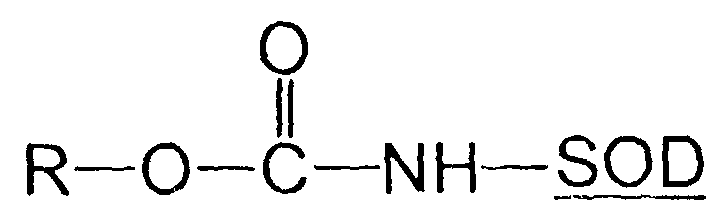
- the present invention is concerned with a process of producing modified superoxide dismutaes represented by the formula: (wherein R is as defined below; SOD is a residue of superoxide dismutase), characterized in that said process comprises reacting a water-soluble polyoxyalkylene polymer having a molecular weight of 2,000 to 10,000 with carbonyldiimidazole to produce a polymeric carbonylimidazole represented by the formula: wherein R is a residue of the polyoxyalkylene polymer, and reacting the polymeric carbonylimidazole with a superoxide dismutase in the presence of a buffer to form the modified superoxide dismutase characterised in that the (molar) concentration ratio of said polymer to said carbonyldiimidazole is from 1:1 to 1:3, the reaction with the carbonyldiimidazole is discontinued through addition of a buffer without bringing about an increase in pH to produce the polymeric carbonylimidazole and the
- said temperature is in the range of 45 to 60°C.
- said concentration is in the range of 0.2 to 0.4 M.
- the polymeric carbonyldiimidazole derivative of the formula (I) can be obtained by reacting said water-soluble polymer having a molecular weight of 2,000 to 10,000 with said carbonyldiimdiazole (CDI) in an inert solvent such as dioxane.
- water-soluble polyoxyalkylene polymer there may be mentioned, for example, polyalkylene glycols having a molecular weight of about 2,000 to 10,000, such as polyethylene glycols, mono-lower-alkoxypolyethylene glycols and mono-lower-alkoxypolyethylene polypropylene polyethylene glycols.
- the above-mentioned lower alkoxies usually are C 1 to C 4 alkoxy groups.
- Preferred examples of the water-soluble polymer include monomethoxypolyethylene glycols having an average molecular weight of 3,500 and monomethoxypolyethylene polypropylene polyethylene glycols having the same molecular weight.
- the water-soluble polymer desirably is added into a reaction solvent in such a quantity as its initial concentration may range from 0.15 to 0.35 M, preferably from 0.25 to 0.3 M, while the initial concentration ratio of the polymer to CDI is 1:1 to 3, preferably 1:1.5 to 2.5.
- the ratio of activation of the polymer can be maintained at a fixed level through addition of a weekly acid buffer having a pH range of 6 to 6.5 to the reaction mixture to thereby allow the reaction to discontinue without increasing its pH.
- the derivative of the formula (I) can be separated from the reaction mixture by use of such separatory means as dialysis and lyophilization.
- Table 1 shows the comparison of an example with this invention and the method of Beauchamp et al.
- the decided differences between the process of the present inventors and the one of Beauchamp et al lie in the concentration of the modifying agent as well as the discontinuation of the reaction through addition of a buffer without bringing about an increase in pH value, as employed and effected individually in the production of the activated modifying agent being shown in (A) of Table 1.
- the improvement of the said two conditions are essential for the stable large-scale production of the activated modifying agent; namely, the optimally increased concentration of the modifying agent facilitates the activation in large quantities.
- the increased concentration of the buffer makes it possible to minimize a change in pH due to a varying amount of the protein and furthermore that a rise in pH can accelerate the reaction rate.
- the buffer desirably shows a pH of 9 to 10 and a concentration of 0.1 to 0.5 M, preferably 0.2 to 0.4 M.
- the composition of the buffer is not particularly limited, buffers being suitable if they have buffering capacity over the pH range of this invention and can be easily prepared.
- Sodium carbonate buffer is preferable, because it is often used as an additive for pharmaceutical preparations and is considered highly safe.
- the present inventors carried out extensive investigation into a large-scale production process in which the modification reaction of SOD with activated PEG or PEG-PPG can be conducted faster, and as a result, found that reaction at temperatures of 30 to 70°C, preferably 45 to 60°C, can lead to completion of the modification within an extremely shortened period of time.
- reaction at temperatures of 30 to 70°C, preferably 45 to 60°C can lead to completion of the modification within an extremely shortened period of time.
- the present invention found that the modification reaction can be carried out with the concentrations of both activated PEG or PEG-PPG and SOD being increased, thus making the commercial, large-scale production practically feasible.
- the unmodified activating agent and the modified SOD have individually different molecular weights of 32,000 and 130,000, it usually is a common practice to employ molecular sieve column chromatography, but the present inventors found that anion exchange column chromatography, being more efficient, is best suited for the said purpose.
- Use can be made of any anion exchangers that possess DEAE groups, but preferably DEAE-Sepharose CL-6B may be usable. It was found that the SOD being modified in this manner with activated PEG or PEG-PPG shows a ratio of modification as constant as 17 to 20% and that such modified SOD can be produced more efficiently than in the case of the method of Beauchamp et al.
- a chemical compound is intended for use as a pharmaceutical, considered to be the most desirable is the production process being capable of securing constancy of results, and in the light of the characteristics as described above, the process according to this invention can be said to fully meet such requirement.
- SOD that is usable in this invention is not particularly limited in terms of its origin or source, but desirably SOD contains copper and zinc.
- the retention (%) of the enzymatic activity of modified SOD was expressed in terms of a proportion on the basis of the enzymatic activity (taken as 100%) of unmodified SOD as assayed against the superoxide generated in the xanthine-xanthine oxidase system.
- TNBS sodium 2, 4.6-trinitrobenzenesulfonate
- the reaction solution was subjected to measurement of absorbance at a wavelength of 367 nm.
- the amount of protein is plotted as abscissa and the absorbance as ordinate to prepare a calibration curve (an inclination:A) for TNBS coloration of unmodified SOD.
- the same procedure was repeated with modified SOD to prepare a calibration curve (an inclination:B) for TNBS coloration of modified SOD.
- the ration (%) of modification was calculated by the equation of [(A-B)/A] x 100.
- Electrophoresis was performed with the use of First System (supplied by Pharmacia Co.), 8 to 25% polyacrylamide concentration-gradient gel, and the protein was stained with Coomassie Brilliant Blue R-250.
- the protein was reacted with divalent copper under alkaline conditions, and the resulting red-purple reaction solution was subjected to measurement of absorbance at a wavelength of 540 nm.
- the protein was determined quantitatively through calculation from a calibration curve prepared with bovine serum albumin used as a standard.
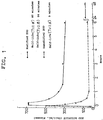
- House rabbits being used as experimental animals, were given intravenously SOD modified with PEG-PPG (a molecular weight of 3,500) and unmodified SOD, as replaced with or dissolved in isotonic saline, at a dose of 38,000 units per 2.5 kg body weight, respectively, followed by time-course determination of the serum SOD levels.
- the results obtained with two house rabbits) are shown in Fig. 1, which indicates that the modified SOD, showing a lowered rate of blood clearance as compared with unmodified SOD, extended the length of the time of SOD activity development in the blood.
- Unmodified SOD or modified SOD (ca. 30 ⁇ g each) was emulsified with Freund Complete Adjuvant (FCA) and was given A/J mice intraperitoneally, followed by additional administration on Day 14 and Day 28 for immunization.
- FCA Freund Complete Adjuvant
- Teh results as shown in Table 2 indicate that unmodified SOD, becasue of its human source, elicited antigenicity, whereas the modified SOD as produced in accordance with this invention did not produce antigenicity in any animal; this experiment, where SOD of human source was used in the animals of a different species, demonstrated that the modification caused a reduction in the proper antigenicity of human SOD.
- OMe-PEG-PPG monomethoxypolyethylene glycol polypropylene glycol polyethylene glycol (an average molecular weight of 3,500, produced by Toho Chemical Co. of Japan.
- EO : PO : EO 1500 : 500 : 1500. hereinafter referred to as "OMe-PEG-PPG") and 10 g of carbonyldiimidazole (hereinafter referred to as "CDI”), and the mixture was stirred for 2 hours at 30°C to produce a solution and simultaneously to allow the reaction to proceed, resulting in a reaction solution containing a CDI derviative of OMe-PEG-PPG (hereinafter referred to as "CDI-PEG-PPG").
- the reaction solution was concentrated under reduced pressure over a water bath at a temperature of lower than 30°C to give about 110 ml of a highly viscous concentrate, to which 0.5 M sodium phosphate buffer (pH 6.5) was then added to make up to 200 ml.
- the diluted solution was subjected to dialysis treatment (the outer solution: water) to give 1,000 ml of the sample solution, followed by lyophilization to produce CDI-PEG-PPG in the form of dried powder, which was stored at -30°C. Yield of 98 %.
- reaction solution containing a CDI derivative of PEG-PPG (CDI-PEG-PPG).
- reaction solution was concentrated under reduced pressure over a water bath at a temperature of lower than 30°C to produce about 600 ml of a highly viscous concentrate, followed by addition of 0.5 M sodium phosphate buffer (pH 6.5) to dilute to 1000 ml.
- the diluted solution was subjected to dialysis treatment (the outer solution: water) to give 5000 ml of a sample solution, followed by lyophylization to produce CDI-PEG-PPG in the form of dried powder.
- the product was stored at -30°C. Yield of 99 %.
- the crude PEG-PPG-SOD solution as obtained under the section (2) was poured for adsorption into a column packed with DEAE-Sepharose CL-6B (produced by Pharmacia Co.) which had been equilibrated through thorough washing with sufficient volume of water, and the column was washed with a volume of water five times the volume of the column to remove unreacted CDT-PEG-PPG.
- the adsorbed PEG-PPG-SOD was eluted with 0.3 M sodium carbonate buffer (pH 9.5), and the eluate was concentrated through ultrafiltration.
- the concentrate obtained through ultrafiltration under the section (3) was adjusted to a concentration of 50 ⁇ 5 mg/ml and subjected to the same procedure as described in the section (2) to give a crude solution of SOD completely modified with PEG-PPG.
- the crude PEG-PPG-SOD solution was chromatographed on a column of DEAE-Sepharose in the same manner as described under the section (3), followed by elution with 2.5 mM sodium phosphate buffer (pH 7.0) containing 0.9 % of sodium chloride, and the eluate was comcentrated through ultrafiltration and sterile filtered to give a pure PEG-PPG-SOD solution. Yield of 29 g or 97 %. The product was found to be a pure and single compound as evidence by electrophoresis analysis.
- the diluted solution was subjected to dialysis treatment (the outer solution: water) to give 950 ml of a sample solution, followed by lyophilization to produce CDI-PEG in the form of dried powder.
- the product was stored at -30°C. Yield of 98 %.
- the crude PEG-SOD solution as obtained under the section (2) was poured for adsorption into a column packed with DEAE-Toyo Pearl (produced by Toso Inc. of Japan) which had been equilibrated through thorough washing with sufficient volume of water, and the column was washed with a volume of water five times the volume of the column to remove unreacted CDIPEG.
- the adsorbed PEG-SOD was eluted with 0.3 M sodium carbonate buffer (pH 9.5), and the eluate was concentrated through ultrafiltration.
- the concentrate obtained through ultrafiltration under the section (3) was adjusted to a concentration of 50 ⁇ 5 mg/ml and subjected to same procedure as described under the section (2) to give a crude solution of SOD completely modified with PEG.
- the crude PEG-SOD solution was further chromatographed on a column of DEAE-Toyo Pearl in the same manner as described in the section (3), followed by elution with 25 mM sodium phosphate buffer (pH 7.0) containing 0.9 % of sodium chloride., and the eluate was concentrated through ultrafiltration and sterile filtered to give a pure PEG-SOD solution. Yield of 4.9 g or 98 %.
- the product was found to be a pure and single compound as evidenced by gel permeation on TSKG 3000 SW and electrophoresis.
- the diluted solution was subjected to dialysis treatment (the outer solution: water) to give 1900 ml of a smple solution, followed by lyophilization to produce CDI-PEG-PPG in the form of dried powder.
- the product was stored at -30°C. Yield of 94 %.
- the crude PEG-PPG-SOD solution as obtained under the section (2) was poured for adsorption into a column packed with DEAE-Sepharose CL-6B (produced by Pharmacia Co.) which had been equilibrated through thorough washing with sufficient volume of water, and the column was washed with a volume of water five times the volume of the column to remove unreacted CDI-PEG-PPG.
- the adsorbed PEG-PPG-SOD was eluted with 0.3 M sodium carbonate buffer (pH 9.5), and the eluate was concentrated through ultrafiltration to give about 220 ml of a concentrate, followed by sterile filtration to give 9.85 g of modified SOD solution. Yield of 98.5 %. Gel permeation on TSK G 3000 SW and electrophoresis showed that unreacted SOD was not detected at all.
- the diluted solution was subjected to dialysis treatment (the outer solution: water) to give 1000 ml of a sample solution, followed by lyophilization to produce CDI-PEG-PPG in the form of dried powder.
- the product was stored at -30°C.
- the crude PEG-PPG-SOD solution as obtained under the section (2) was poured for adsorption into a column packed with DEAE-Sepharose CL-6B (produced by Pharmacia Co.) which had been equilibrated through thorough washing with sufficient volume of water, and the column was washed with a volume of water five times the volume of column to remove unreacted CDI-PEG-PPG.
- the adsorbed PEG-PPG-SOD was eluted with 0.3 M sodium carbonate buffer (pH 9.5), and the eluate was concentrated through ultrafiltration to give 115 ml of a concentrate, followed by sterile filtration to give 4.89 g of a modified SOD solution. Yield of 97.8 %. Gel permeation on TSK G 3000 SW and electrophoresis showed that unmodified SOD was not detected at all.
- Fig. 1 is a graph showing the time-course changes of the blood levels of modified and unmodified superoxide dismutases in the animal experiment as described in Experiment Example 1, while Fig. 2 is a spectrophotogram of the modified superoxide dismutase as purified through gel permeation in Example 1.
Landscapes
- Health & Medical Sciences (AREA)
- Chemical & Material Sciences (AREA)
- Organic Chemistry (AREA)
- Life Sciences & Earth Sciences (AREA)
- Engineering & Computer Science (AREA)
- Bioinformatics & Cheminformatics (AREA)
- Medicinal Chemistry (AREA)
- General Chemical & Material Sciences (AREA)
- Chemical Kinetics & Catalysis (AREA)
- General Health & Medical Sciences (AREA)
- Nuclear Medicine, Radiotherapy & Molecular Imaging (AREA)
- Pharmacology & Pharmacy (AREA)
- Animal Behavior & Ethology (AREA)
- Public Health (AREA)
- Veterinary Medicine (AREA)
- Wood Science & Technology (AREA)
- Genetics & Genomics (AREA)
- Zoology (AREA)
- Biomedical Technology (AREA)
- Molecular Biology (AREA)
- Cardiology (AREA)
- Pain & Pain Management (AREA)
- General Engineering & Computer Science (AREA)
- Biochemistry (AREA)
- Heart & Thoracic Surgery (AREA)
- Polymers & Plastics (AREA)
- Microbiology (AREA)
- Biotechnology (AREA)
- Endocrinology (AREA)
- Diabetes (AREA)
- Rheumatology (AREA)
- Neurosurgery (AREA)
- Vascular Medicine (AREA)
- Neurology (AREA)
- Urology & Nephrology (AREA)
- Medicines That Contain Protein Lipid Enzymes And Other Medicines (AREA)
- Enzymes And Modification Thereof (AREA)
- Cosmetics (AREA)
- Peptides Or Proteins (AREA)
Claims (5)
- Verfahren zur Herstellung modifizierter Superoxid-Dismutase der Formel:

dadurch gekennzeichnet, daß
das (molare) Konzentrationsverhältnis von Polymer zu Carbonyldiimidazol 1:1 bis 1:3 beträgt, man die Reaktion mit Carbonyldiimidazol durch Zugabe eines Puffers unterbricht, ohne einen pH-Anstieg zu bewirken, um das polymere Carbonylimidazol zu erzeugen, und man das polymere Carbonylimidazol mit der Dismutase in Gegenwart eines Puffers mit einem pH von 9,0 bis 11,0 und einer Konzentration von 0,1 bis 0,5 M bei einer Temperatur von 30 bis 70°C über einen Zeitraum umsetzt, der ausreicht, um die modifizierte Superoxid-Dismutase zu bilden. - Verfahren nach Anspruch 1, wobei das polymere Carbonylimidazol ein Carbonylimidazol-Derivat eines Monomethoxypolyethylenglykols mit einem mittleren Molekulargewicht von 3 500 ist.
- Verfahren nach Anspruch 1, wobei das polymere Carbonylimidazol ein Carbonylimidazol-Derivat eines Monomethoxypolyethylen*polypropylen*polyethylenqlykols mit einem mittleren Molekulargewicht von 3 500 ist.
- Verfahren nach einem der vorhergehenden Ansprüche, wobei nach Reaktionabschluß in der Reaktionsmischung enthaltene, nicht umgesetzte Substanzen mit Hilfe von Anionenaustauschchromatographie entfernt werden und anschließend die resultierende modifizierte Superoxid-Dismutase mit einem hohen Reinheitsgrad zurückgewonnen wird.
- Verfahren nach einem der vorhergehenden Ansprüche, wobei die Konzentration des mit Carbonyldiimidazol umgesetzten, löslichen Polyoxyalkylenpolymers 0,15 bis 0,35 M beträgt.
Applications Claiming Priority (2)
| Application Number | Priority Date | Filing Date | Title |
|---|---|---|---|
| JP1286798A JP2978187B2 (ja) | 1989-11-02 | 1989-11-02 | 修飾スーパーオキサイドディスムターゼの製造法 |
| JP286798/89 | 1989-11-02 |
Publications (2)
| Publication Number | Publication Date |
|---|---|
| EP0426488A1 EP0426488A1 (de) | 1991-05-08 |
| EP0426488B1 true EP0426488B1 (de) | 1997-04-23 |
Family
ID=17709182
Family Applications (1)
| Application Number | Title | Priority Date | Filing Date |
|---|---|---|---|
| EP90312027A Expired - Lifetime EP0426488B1 (de) | 1989-11-02 | 1990-11-02 | Verfahren zur Herstellung modifizierter Superoxid-Dismutase |
Country Status (6)
| Country | Link |
|---|---|
| US (1) | US5403731A (de) |
| EP (1) | EP0426488B1 (de) |
| JP (1) | JP2978187B2 (de) |
| CA (1) | CA2029216A1 (de) |
| DE (1) | DE69030553T2 (de) |
| ES (1) | ES2100165T3 (de) |
Cited By (7)
| Publication number | Priority date | Publication date | Assignee | Title |
|---|---|---|---|---|
| US7090835B2 (en) | 1994-10-12 | 2006-08-15 | Amgen, Inc. | N-terminally chemically modified protein compositions and methods |
| US7347976B2 (en) | 2001-12-20 | 2008-03-25 | 3M Innovative Properties Company | Methods and devices for removal of organic molecules from biological mixtures using a hydrophilic solid support in a hydrophobic matrix |
| US7727710B2 (en) | 2003-12-24 | 2010-06-01 | 3M Innovative Properties Company | Materials, methods, and kits for reducing nonspecific binding of molecules to a surface |
| US7871827B2 (en) | 2001-12-20 | 2011-01-18 | 3M Innovative Properties Company | Methods and devices for removal of organic molecules from biological mixtures using anion exchange |
| US7939249B2 (en) | 2003-12-24 | 2011-05-10 | 3M Innovative Properties Company | Methods for nucleic acid isolation and kits using a microfluidic device and concentration step |
| US7981600B2 (en) | 2003-04-17 | 2011-07-19 | 3M Innovative Properties Company | Methods and devices for removal of organic molecules from biological mixtures using an anion exchange material that includes a polyoxyalkylene |
| US8057758B2 (en) | 2003-12-12 | 2011-11-15 | 3M Innovative Properties Company | Variable valve apparatus and methods |
Families Citing this family (9)
| Publication number | Priority date | Publication date | Assignee | Title |
|---|---|---|---|---|
| JPH04248984A (ja) * | 1991-02-05 | 1992-09-04 | Kuraray Co Ltd | スーパーオキシドジスムターゼ誘導体およびその製造方法 |
| JP3125428B2 (ja) * | 1991-03-28 | 2001-01-15 | 和光純薬工業株式会社 | 修飾酵素 |
| US5382657A (en) * | 1992-08-26 | 1995-01-17 | Hoffmann-La Roche Inc. | Peg-interferon conjugates |
| US5650234A (en) * | 1994-09-09 | 1997-07-22 | Surface Engineering Technologies, Division Of Innerdyne, Inc. | Electrophilic polyethylene oxides for the modification of polysaccharides, polypeptides (proteins) and surfaces |
| DE69628731T3 (de) * | 1995-11-01 | 2012-09-20 | Bracco Suisse S.A. | Gezielte magnetisch markierte molekularmarkersysteme als nmr-bilderzeugungsmittel |
| US6190658B1 (en) | 1998-05-08 | 2001-02-20 | Webb-Waring Institute For Biomedical Research | Genetically modified manganese superoxide dismutase for treating oxidative damage |
| WO2002100293A2 (en) * | 2001-06-13 | 2002-12-19 | Webb-Waring Institute For Biomedical Research | A diagnostic and prognostic method for evaluating ocular inflammation and oxidative stress and the treatment of the same |
| DE102006040724A1 (de) * | 2006-08-31 | 2008-03-06 | Siemens Ag | Verfahren und Vorrichtung zum Herstellen eines elektronischen Moduls und elektronisches Modul |
| CN109112119B (zh) * | 2018-08-28 | 2022-04-26 | 佛山科学技术学院 | 经化学修饰的鸭血sod制剂的制备方法 |
Family Cites Families (5)
| Publication number | Priority date | Publication date | Assignee | Title |
|---|---|---|---|---|
| US4563349A (en) * | 1980-07-30 | 1986-01-07 | Takeda Chemical Industries, Ltd. | Superoxide dismutase, its immobilized form, and their production and use |
| US4496689A (en) * | 1983-12-27 | 1985-01-29 | Miles Laboratories, Inc. | Covalently attached complex of alpha-1-proteinase inhibitor with a water soluble polymer |
| JPH084504B2 (ja) * | 1985-04-26 | 1996-01-24 | 味の素株式会社 | 安定化ス−パ−オキサイドジスムタ−ゼ |
| JPS6279778A (ja) * | 1985-10-04 | 1987-04-13 | Suntory Ltd | 新規ス−パ−オキシドデイスムタ−ゼ及びその製造方法 |
| US5006333A (en) * | 1987-08-03 | 1991-04-09 | Ddi Pharmaceuticals, Inc. | Conjugates of superoxide dismutase coupled to high molecular weight polyalkylene glycols |
-
1989
- 1989-11-02 JP JP1286798A patent/JP2978187B2/ja not_active Expired - Lifetime
-
1990
- 1990-11-02 ES ES90312027T patent/ES2100165T3/es not_active Expired - Lifetime
- 1990-11-02 DE DE69030553T patent/DE69030553T2/de not_active Expired - Fee Related
- 1990-11-02 CA CA002029216A patent/CA2029216A1/en not_active Abandoned
- 1990-11-02 EP EP90312027A patent/EP0426488B1/de not_active Expired - Lifetime
-
1993
- 1993-12-03 US US08/162,382 patent/US5403731A/en not_active Expired - Fee Related
Cited By (7)
| Publication number | Priority date | Publication date | Assignee | Title |
|---|---|---|---|---|
| US7090835B2 (en) | 1994-10-12 | 2006-08-15 | Amgen, Inc. | N-terminally chemically modified protein compositions and methods |
| US7347976B2 (en) | 2001-12-20 | 2008-03-25 | 3M Innovative Properties Company | Methods and devices for removal of organic molecules from biological mixtures using a hydrophilic solid support in a hydrophobic matrix |
| US7871827B2 (en) | 2001-12-20 | 2011-01-18 | 3M Innovative Properties Company | Methods and devices for removal of organic molecules from biological mixtures using anion exchange |
| US7981600B2 (en) | 2003-04-17 | 2011-07-19 | 3M Innovative Properties Company | Methods and devices for removal of organic molecules from biological mixtures using an anion exchange material that includes a polyoxyalkylene |
| US8057758B2 (en) | 2003-12-12 | 2011-11-15 | 3M Innovative Properties Company | Variable valve apparatus and methods |
| US7727710B2 (en) | 2003-12-24 | 2010-06-01 | 3M Innovative Properties Company | Materials, methods, and kits for reducing nonspecific binding of molecules to a surface |
| US7939249B2 (en) | 2003-12-24 | 2011-05-10 | 3M Innovative Properties Company | Methods for nucleic acid isolation and kits using a microfluidic device and concentration step |
Also Published As
| Publication number | Publication date |
|---|---|
| ES2100165T3 (es) | 1997-06-16 |
| JP2978187B2 (ja) | 1999-11-15 |
| DE69030553D1 (de) | 1997-05-28 |
| JPH03147784A (ja) | 1991-06-24 |
| DE69030553T2 (de) | 1998-01-22 |
| EP0426488A1 (de) | 1991-05-08 |
| CA2029216A1 (en) | 1991-05-03 |
| US5403731A (en) | 1995-04-04 |
Similar Documents
| Publication | Publication Date | Title |
|---|---|---|
| EP0426488B1 (de) | Verfahren zur Herstellung modifizierter Superoxid-Dismutase | |
| Boccu et al. | Pharmacokinetic properties of polyethylene glycol derivatized superoxide dismutase | |
| EP0200467B1 (de) | Mit einem Poly(alkylenoxid) kombinierte Superoxid-Dismutase | |
| US6962972B2 (en) | Derivatization of proteins | |
| DE69835515T2 (de) | Modifizierte arginindeiminase | |
| US5932462A (en) | Multiarmed, monofunctional, polymer for coupling to molecules and surfaces | |
| JP3195336B2 (ja) | 分画化方法 | |
| Bomalaski et al. | Uricase formulated with polyethylene glycol (uricase-PEG 20): biochemical rationale and preclinical studies. | |
| DE69625085T2 (de) | Konjugate eines polypeptids und eines biologisch verträglichem polymer | |
| EP0675727B1 (de) | Glycolipid enzym-polymer konjugate | |
| EP0875253B1 (de) | Chondroitinase enthaltende Zusammensetzungen | |
| MXPA02007545A (es) | Urato oxidasa libre de agregados, para preparacion de conjugado de polimero no-inmunogenicos. | |
| EP0377613B1 (de) | Konjugate von superoxiddismutase | |
| EP0172577B1 (de) | Superoxid-Dismutase, ihre Herstellung und dieselbe enthaltende pharmazeutische Zusammensetzungen | |
| CA1182061A (en) | Superoxide dismutase, its production and use | |
| CN111909908A (zh) | 聚乙二醇化单修饰重组谷胱甘肽过氧化物酶gpx4突变体、制备方法及其应用 | |
| EP1725583B1 (de) | Methoden zur steigerung der protein polyethylenglykol (peg) konjugation | |
| ES2395894T3 (es) | Hemoglobinas de mamífero compatibles con plasma sanguíneo, reticuladas y conjugadas con poli(óxidos de alquileno) como portadores de oxígeno médicos artificiales, su preparación y su uso | |
| Hadley et al. | Catalytic activity of administered gulonolactone oxidase polyethylene glycol conjugates | |
| EP2021032B1 (de) | Peg-modifizierte arginin/lysin-oxidoreduktase | |
| JPS6360938A (ja) | 修飾組織型プラスミノ−ゲン活性化因子およびその製造方法 | |
| JPH0195774A (ja) | 修飾スーパーオキサイド・ジスムターゼ | |
| JPH02231075A (ja) | デキストラン硫酸修飾スーパーオキシドジスムターゼ | |
| JPS61103824A (ja) | ポリリボイノシン酸・ポリリボシチヂル酸・ポリ−レ−リジン複合体の注射用製剤の新規調製法 | |
| JPS62252800A (ja) | 化学修飾タンパク質の製法 |
Legal Events
| Date | Code | Title | Description |
|---|---|---|---|
| PUAI | Public reference made under article 153(3) epc to a published international application that has entered the european phase |
Free format text: ORIGINAL CODE: 0009012 |
|
| 17P | Request for examination filed |
Effective date: 19901214 |
|
| AK | Designated contracting states |
Kind code of ref document: A1 Designated state(s): CH DE ES FR GB IT LI |
|
| RAP1 | Party data changed (applicant data changed or rights of an application transferred) |
Owner name: NIHON CHEMICAL RESEARCH KABUSHIKI KAISHA ALSO KNOW |
|
| 17Q | First examination report despatched |
Effective date: 19940720 |
|
| GRAG | Despatch of communication of intention to grant |
Free format text: ORIGINAL CODE: EPIDOS AGRA |
|
| GRAH | Despatch of communication of intention to grant a patent |
Free format text: ORIGINAL CODE: EPIDOS IGRA |
|
| GRAH | Despatch of communication of intention to grant a patent |
Free format text: ORIGINAL CODE: EPIDOS IGRA |
|
| ITF | It: translation for a ep patent filed | ||
| GRAA | (expected) grant |
Free format text: ORIGINAL CODE: 0009210 |
|
| AK | Designated contracting states |
Kind code of ref document: B1 Designated state(s): CH DE ES FR GB IT LI |
|
| REG | Reference to a national code |
Ref country code: CH Ref legal event code: EP |
|
| REF | Corresponds to: |
Ref document number: 69030553 Country of ref document: DE Date of ref document: 19970528 |
|
| RAP2 | Party data changed (patent owner data changed or rights of a patent transferred) |
Owner name: NIHON CHEMICAL RESEARCH KABUSHIKI KAISHA ALSO KNOW |
|
| REG | Reference to a national code |
Ref country code: CH Ref legal event code: NV Representative=s name: KATZAROV S.A. |
|
| REG | Reference to a national code |
Ref country code: ES Ref legal event code: FG2A Ref document number: 2100165 Country of ref document: ES Kind code of ref document: T3 |
|
| ET | Fr: translation filed | ||
| RAP2 | Party data changed (patent owner data changed or rights of a patent transferred) |
Owner name: NIHON CHEMICAL RESEARCH KABUSHIKI KAISHA ALSO KNOW |
|
| PGFP | Annual fee paid to national office [announced via postgrant information from national office to epo] |
Ref country code: GB Payment date: 19971024 Year of fee payment: 8 |
|
| PGFP | Annual fee paid to national office [announced via postgrant information from national office to epo] |
Ref country code: ES Payment date: 19971104 Year of fee payment: 8 |
|
| PGFP | Annual fee paid to national office [announced via postgrant information from national office to epo] |
Ref country code: FR Payment date: 19971125 Year of fee payment: 8 |
|
| PGFP | Annual fee paid to national office [announced via postgrant information from national office to epo] |
Ref country code: DE Payment date: 19980127 Year of fee payment: 8 |
|
| PGFP | Annual fee paid to national office [announced via postgrant information from national office to epo] |
Ref country code: CH Payment date: 19980128 Year of fee payment: 8 |
|
| PLBE | No opposition filed within time limit |
Free format text: ORIGINAL CODE: 0009261 |
|
| STAA | Information on the status of an ep patent application or granted ep patent |
Free format text: STATUS: NO OPPOSITION FILED WITHIN TIME LIMIT |
|
| 26N | No opposition filed | ||
| PG25 | Lapsed in a contracting state [announced via postgrant information from national office to epo] |
Ref country code: GB Free format text: LAPSE BECAUSE OF NON-PAYMENT OF DUE FEES Effective date: 19981102 |
|
| PG25 | Lapsed in a contracting state [announced via postgrant information from national office to epo] |
Ref country code: ES Free format text: LAPSE BECAUSE OF NON-PAYMENT OF DUE FEES Effective date: 19981103 |
|
| PG25 | Lapsed in a contracting state [announced via postgrant information from national office to epo] |
Ref country code: LI Free format text: LAPSE BECAUSE OF NON-PAYMENT OF DUE FEES Effective date: 19981130 Ref country code: CH Free format text: LAPSE BECAUSE OF NON-PAYMENT OF DUE FEES Effective date: 19981130 |
|
| GBPC | Gb: european patent ceased through non-payment of renewal fee |
Effective date: 19981102 |
|
| REG | Reference to a national code |
Ref country code: CH Ref legal event code: PL |
|
| PG25 | Lapsed in a contracting state [announced via postgrant information from national office to epo] |
Ref country code: FR Free format text: LAPSE BECAUSE OF NON-PAYMENT OF DUE FEES Effective date: 19990730 |
|
| REG | Reference to a national code |
Ref country code: FR Ref legal event code: ST |
|
| PG25 | Lapsed in a contracting state [announced via postgrant information from national office to epo] |
Ref country code: DE Free format text: LAPSE BECAUSE OF NON-PAYMENT OF DUE FEES Effective date: 19990901 |
|
| REG | Reference to a national code |
Ref country code: ES Ref legal event code: FD2A Effective date: 19991214 |
|
| PG25 | Lapsed in a contracting state [announced via postgrant information from national office to epo] |
Ref country code: IT Free format text: LAPSE BECAUSE OF NON-PAYMENT OF DUE FEES;WARNING: LAPSES OF ITALIAN PATENTS WITH EFFECTIVE DATE BEFORE 2007 MAY HAVE OCCURRED AT ANY TIME BEFORE 2007. THE CORRECT EFFECTIVE DATE MAY BE DIFFERENT FROM THE ONE RECORDED. Effective date: 20051102 |