EP0425359A1 - Procédé de préparation de dérivés de benzoyl-3 benzofuranne - Google Patents
Procédé de préparation de dérivés de benzoyl-3 benzofuranne Download PDFInfo
- Publication number
- EP0425359A1 EP0425359A1 EP90402967A EP90402967A EP0425359A1 EP 0425359 A1 EP0425359 A1 EP 0425359A1 EP 90402967 A EP90402967 A EP 90402967A EP 90402967 A EP90402967 A EP 90402967A EP 0425359 A1 EP0425359 A1 EP 0425359A1
- Authority
- EP
- European Patent Office
- Prior art keywords
- benzofuran
- benzoyl
- formula
- derivative
- aluminum chloride
- Prior art date
- Legal status (The legal status is an assumption and is not a legal conclusion. Google has not performed a legal analysis and makes no representation as to the accuracy of the status listed.)
- Granted
Links
- 238000000034 method Methods 0.000 title claims abstract description 32
- 238000002360 preparation method Methods 0.000 title claims abstract description 16
- TWWAVGXQPVEBKZ-UHFFFAOYSA-N 1-benzofuran-3-yl(phenyl)methanone Chemical class C=1OC2=CC=CC=C2C=1C(=O)C1=CC=CC=C1 TWWAVGXQPVEBKZ-UHFFFAOYSA-N 0.000 title claims abstract description 13
- VSCWAEJMTAWNJL-UHFFFAOYSA-K aluminium trichloride Chemical compound Cl[Al](Cl)Cl VSCWAEJMTAWNJL-UHFFFAOYSA-K 0.000 claims abstract description 52
- -1 3-benzoylbenzofuran compound Chemical class 0.000 claims abstract description 25
- YGYAWVDWMABLBF-UHFFFAOYSA-N Phosgene Chemical compound ClC(Cl)=O YGYAWVDWMABLBF-UHFFFAOYSA-N 0.000 claims abstract description 13
- CTSLXHKWHWQRSH-UHFFFAOYSA-N oxalyl chloride Chemical compound ClC(=O)C(Cl)=O CTSLXHKWHWQRSH-UHFFFAOYSA-N 0.000 claims abstract description 12
- 150000001907 coumarones Chemical class 0.000 claims abstract description 11
- 238000011065 in-situ storage Methods 0.000 claims abstract description 8
- 238000010992 reflux Methods 0.000 claims description 12
- RDOXTESZEPMUJZ-UHFFFAOYSA-N anisole Chemical compound COC1=CC=CC=C1 RDOXTESZEPMUJZ-UHFFFAOYSA-N 0.000 claims description 10
- 239000003054 catalyst Substances 0.000 claims description 9
- 150000001875 compounds Chemical class 0.000 claims description 8
- 239000001257 hydrogen Substances 0.000 claims description 7
- 229910052739 hydrogen Inorganic materials 0.000 claims description 7
- 230000007062 hydrolysis Effects 0.000 claims description 7
- 238000006460 hydrolysis reaction Methods 0.000 claims description 7
- UFHFLCQGNIYNRP-UHFFFAOYSA-N Hydrogen Chemical compound [H][H] UFHFLCQGNIYNRP-UHFFFAOYSA-N 0.000 claims description 6
- 239000000010 aprotic solvent Substances 0.000 claims description 6
- UZKWTJUDCOPSNM-UHFFFAOYSA-N methoxybenzene Substances CCCCOC=C UZKWTJUDCOPSNM-UHFFFAOYSA-N 0.000 claims description 5
- 125000004108 n-butyl group Chemical group [H]C([H])([H])C([H])([H])C([H])([H])C([H])([H])* 0.000 claims description 5
- 230000017858 demethylation Effects 0.000 claims description 4
- 238000010520 demethylation reaction Methods 0.000 claims description 4
- VZGDMQKNWNREIO-UHFFFAOYSA-N tetrachloromethane Chemical group ClC(Cl)(Cl)Cl VZGDMQKNWNREIO-UHFFFAOYSA-N 0.000 claims description 4
- 125000004178 (C1-C4) alkyl group Chemical group 0.000 claims description 3
- 125000005843 halogen group Chemical group 0.000 claims description 3
- ISWSIDIOOBJBQZ-UHFFFAOYSA-N phenol group Chemical group C1(=CC=CC=C1)O ISWSIDIOOBJBQZ-UHFFFAOYSA-N 0.000 claims description 3
- 125000001997 phenyl group Chemical group [H]C1=C([H])C([H])=C(*)C([H])=C1[H] 0.000 claims description 3
- WCYWZMWISLQXQU-UHFFFAOYSA-N methyl Chemical compound [CH3] WCYWZMWISLQXQU-UHFFFAOYSA-N 0.000 claims description 2
- 125000000449 nitro group Chemical group [O-][N+](*)=O 0.000 claims description 2
- 125000001424 substituent group Chemical group 0.000 claims description 2
- SWWQQSDRUYSMAR-UHFFFAOYSA-N 1-[(4-hydroxyphenyl)methyl]-1,2,3,4-tetrahydroisoquinoline-6,7-diol;hydrochloride Chemical group Cl.C1=CC(O)=CC=C1CC1C2=CC(O)=C(O)C=C2CCN1 SWWQQSDRUYSMAR-UHFFFAOYSA-N 0.000 claims 1
- VEXZGXHMUGYJMC-UHFFFAOYSA-M Chloride anion Chemical compound [Cl-] VEXZGXHMUGYJMC-UHFFFAOYSA-M 0.000 claims 1
- 125000003545 alkoxy group Chemical group 0.000 claims 1
- 125000000217 alkyl group Chemical group 0.000 claims 1
- QUPDWYMUPZLYJZ-UHFFFAOYSA-N ethyl Chemical compound C[CH2] QUPDWYMUPZLYJZ-UHFFFAOYSA-N 0.000 claims 1
- 150000002431 hydrogen Chemical class 0.000 claims 1
- 125000003431 oxalo group Chemical group 0.000 claims 1
- 150000002989 phenols Chemical class 0.000 abstract 1
- YXFVVABEGXRONW-UHFFFAOYSA-N Toluene Chemical compound CC1=CC=CC=C1 YXFVVABEGXRONW-UHFFFAOYSA-N 0.000 description 39
- IANQTJSKSUMEQM-UHFFFAOYSA-N 1-benzofuran Chemical compound C1=CC=C2OC=CC2=C1 IANQTJSKSUMEQM-UHFFFAOYSA-N 0.000 description 27
- XLYOFNOQVPJJNP-UHFFFAOYSA-N water Substances O XLYOFNOQVPJJNP-UHFFFAOYSA-N 0.000 description 17
- 239000000243 solution Substances 0.000 description 14
- 238000006243 chemical reaction Methods 0.000 description 12
- YMWUJEATGCHHMB-UHFFFAOYSA-N Dichloromethane Chemical compound ClCCl YMWUJEATGCHHMB-UHFFFAOYSA-N 0.000 description 9
- 239000000203 mixture Substances 0.000 description 9
- 239000012429 reaction media Substances 0.000 description 9
- CJCYOROSBGBHSU-UHFFFAOYSA-N (3-butyl-1-benzofuran-2-yl)-(4-hydroxyphenyl)methanone Chemical compound C(CCC)C1=C(OC2=C1C=CC=C2)C(C1=CC=C(C=C1)O)=O CJCYOROSBGBHSU-UHFFFAOYSA-N 0.000 description 8
- 238000005727 Friedel-Crafts reaction Methods 0.000 description 8
- 239000002904 solvent Substances 0.000 description 8
- ITPDYQOUSLNIHG-UHFFFAOYSA-N Amiodarone hydrochloride Chemical compound [Cl-].CCCCC=1OC2=CC=CC=C2C=1C(=O)C1=CC(I)=C(OCC[NH+](CC)CC)C(I)=C1 ITPDYQOUSLNIHG-UHFFFAOYSA-N 0.000 description 7
- VEXZGXHMUGYJMC-UHFFFAOYSA-N Hydrochloric acid Chemical compound Cl VEXZGXHMUGYJMC-UHFFFAOYSA-N 0.000 description 7
- HEMHJVSKTPXQMS-UHFFFAOYSA-M Sodium hydroxide Chemical compound [OH-].[Na+] HEMHJVSKTPXQMS-UHFFFAOYSA-M 0.000 description 7
- 125000003236 benzoyl group Chemical group [H]C1=C([H])C([H])=C(C([H])=C1[H])C(*)=O 0.000 description 7
- 150000002576 ketones Chemical class 0.000 description 7
- OKKJLVBELUTLKV-UHFFFAOYSA-N Methanol Chemical compound OC OKKJLVBELUTLKV-UHFFFAOYSA-N 0.000 description 6
- 229960005260 amiodarone Drugs 0.000 description 6
- CZCHIEJNWPNBDE-UHFFFAOYSA-N benziodarone Chemical compound CCC=1OC2=CC=CC=C2C=1C(=O)C1=CC(I)=C(O)C(I)=C1 CZCHIEJNWPNBDE-UHFFFAOYSA-N 0.000 description 6
- 239000008213 purified water Substances 0.000 description 6
- FYSNRJHAOHDILO-UHFFFAOYSA-N thionyl chloride Chemical compound ClS(Cl)=O FYSNRJHAOHDILO-UHFFFAOYSA-N 0.000 description 6
- SCYULBFZEHDVBN-UHFFFAOYSA-N 1,1-Dichloroethane Chemical compound CC(Cl)Cl SCYULBFZEHDVBN-UHFFFAOYSA-N 0.000 description 5
- VYPSYNLAJGMNEJ-UHFFFAOYSA-N Silicium dioxide Chemical compound O=[Si]=O VYPSYNLAJGMNEJ-UHFFFAOYSA-N 0.000 description 5
- WHQCHUCQKNIQEC-UHFFFAOYSA-N benzbromarone Chemical compound CCC=1OC2=CC=CC=C2C=1C(=O)C1=CC(Br)=C(O)C(Br)=C1 WHQCHUCQKNIQEC-UHFFFAOYSA-N 0.000 description 5
- 229960002529 benzbromarone Drugs 0.000 description 5
- 229960004411 benziodarone Drugs 0.000 description 5
- 238000004821 distillation Methods 0.000 description 5
- YKTKSGMDYIJVFC-UHFFFAOYSA-N (3-ethyl-1-benzofuran-2-yl)-(4-hydroxyphenyl)methanone Chemical compound O1C2=CC=CC=C2C(CC)=C1C(=O)C1=CC=C(O)C=C1 YKTKSGMDYIJVFC-UHFFFAOYSA-N 0.000 description 4
- ZEYHEAKUIGZSGI-UHFFFAOYSA-N 4-methoxybenzoic acid Chemical compound COC1=CC=C(C(O)=O)C=C1 ZEYHEAKUIGZSGI-UHFFFAOYSA-N 0.000 description 4
- XKRFYHLGVUSROY-UHFFFAOYSA-N Argon Chemical compound [Ar] XKRFYHLGVUSROY-UHFFFAOYSA-N 0.000 description 4
- WKBOTKDWSSQWDR-UHFFFAOYSA-N Bromine atom Chemical compound [Br] WKBOTKDWSSQWDR-UHFFFAOYSA-N 0.000 description 4
- JUJWROOIHBZHMG-UHFFFAOYSA-N Pyridine Chemical compound C1=CC=NC=C1 JUJWROOIHBZHMG-UHFFFAOYSA-N 0.000 description 4
- PMZURENOXWZQFD-UHFFFAOYSA-L Sodium Sulfate Chemical compound [Na+].[Na+].[O-]S([O-])(=O)=O PMZURENOXWZQFD-UHFFFAOYSA-L 0.000 description 4
- 230000015572 biosynthetic process Effects 0.000 description 4
- 125000001495 ethyl group Chemical group [H]C([H])([H])C([H])([H])* 0.000 description 4
- 125000002496 methyl group Chemical group [H]C([H])([H])* 0.000 description 4
- 238000000746 purification Methods 0.000 description 4
- 238000003756 stirring Methods 0.000 description 4
- LMBFAGIMSUYTBN-MPZNNTNKSA-N teixobactin Chemical compound C([C@H](C(=O)N[C@@H]([C@@H](C)CC)C(=O)N[C@@H](CO)C(=O)N[C@H](CCC(N)=O)C(=O)N[C@H]([C@@H](C)CC)C(=O)N[C@@H]([C@@H](C)CC)C(=O)N[C@@H](CO)C(=O)N[C@H]1C(N[C@@H](C)C(=O)N[C@@H](C[C@@H]2NC(=N)NC2)C(=O)N[C@H](C(=O)O[C@H]1C)[C@@H](C)CC)=O)NC)C1=CC=CC=C1 LMBFAGIMSUYTBN-MPZNNTNKSA-N 0.000 description 4
- DZRJNLPOTUVETG-UHFFFAOYSA-N 1-benzofuran-2-yl(phenyl)methanone Chemical class C=1C2=CC=CC=C2OC=1C(=O)C1=CC=CC=C1 DZRJNLPOTUVETG-UHFFFAOYSA-N 0.000 description 3
- MFJCKQFUMBQBDU-UHFFFAOYSA-N 1-benzofuran-2-yl-(4-hydroxyphenyl)methanone Chemical class C1=CC(O)=CC=C1C(=O)C1=CC2=CC=CC=C2O1 MFJCKQFUMBQBDU-UHFFFAOYSA-N 0.000 description 3
- QTBSBXVTEAMEQO-UHFFFAOYSA-N Acetic acid Chemical compound CC(O)=O QTBSBXVTEAMEQO-UHFFFAOYSA-N 0.000 description 3
- REXJJQDLLTVPDO-UHFFFAOYSA-N C(CCC)C1=C(OC2=C1C=CC=C2)C(C1=CC=C(C=C1)OC)=O Chemical compound C(CCC)C1=C(OC2=C1C=CC=C2)C(C1=CC=C(C=C1)OC)=O REXJJQDLLTVPDO-UHFFFAOYSA-N 0.000 description 3
- UIIMBOGNXHQVGW-UHFFFAOYSA-M Sodium bicarbonate Chemical compound [Na+].OC([O-])=O UIIMBOGNXHQVGW-UHFFFAOYSA-M 0.000 description 3
- MXMOTZIXVICDSD-UHFFFAOYSA-N anisoyl chloride Chemical compound COC1=CC=C(C(Cl)=O)C=C1 MXMOTZIXVICDSD-UHFFFAOYSA-N 0.000 description 3
- GDTBXPJZTBHREO-UHFFFAOYSA-N bromine Substances BrBr GDTBXPJZTBHREO-UHFFFAOYSA-N 0.000 description 3
- 229910052794 bromium Inorganic materials 0.000 description 3
- 238000001704 evaporation Methods 0.000 description 3
- 230000008020 evaporation Effects 0.000 description 3
- 125000002887 hydroxy group Chemical group [H]O* 0.000 description 3
- 239000000543 intermediate Substances 0.000 description 3
- 125000000959 isobutyl group Chemical group [H]C([H])([H])C([H])(C([H])([H])[H])C([H])([H])* 0.000 description 3
- 125000001449 isopropyl group Chemical group [H]C([H])([H])C([H])(*)C([H])([H])[H] 0.000 description 3
- 238000004519 manufacturing process Methods 0.000 description 3
- 125000004123 n-propyl group Chemical group [H]C([H])([H])C([H])([H])C([H])([H])* 0.000 description 3
- 239000012074 organic phase Substances 0.000 description 3
- 229910052938 sodium sulfate Inorganic materials 0.000 description 3
- 235000011152 sodium sulphate Nutrition 0.000 description 3
- OVJKFJDEVKABNF-UHFFFAOYSA-N 2-butyl-1-benzofuran Chemical compound C1=CC=C2OC(CCCC)=CC2=C1 OVJKFJDEVKABNF-UHFFFAOYSA-N 0.000 description 2
- RAGSWDIQBBZLLL-UHFFFAOYSA-N 2-chloroethyl(diethyl)azanium;chloride Chemical compound Cl.CCN(CC)CCCl RAGSWDIQBBZLLL-UHFFFAOYSA-N 0.000 description 2
- ZCYVEMRRCGMTRW-UHFFFAOYSA-N 7553-56-2 Chemical compound [I] ZCYVEMRRCGMTRW-UHFFFAOYSA-N 0.000 description 2
- CURLTUGMZLYLDI-UHFFFAOYSA-N Carbon dioxide Chemical compound O=C=O CURLTUGMZLYLDI-UHFFFAOYSA-N 0.000 description 2
- NLRKCXQQSUWLCH-UHFFFAOYSA-N O=Nc1ccccc1 Chemical compound O=Nc1ccccc1 NLRKCXQQSUWLCH-UHFFFAOYSA-N 0.000 description 2
- DWAQJAXMDSEUJJ-UHFFFAOYSA-M Sodium bisulfite Chemical compound [Na+].OS([O-])=O DWAQJAXMDSEUJJ-UHFFFAOYSA-M 0.000 description 2
- 229910021627 Tin(IV) chloride Inorganic materials 0.000 description 2
- 239000002253 acid Substances 0.000 description 2
- 229910052783 alkali metal Inorganic materials 0.000 description 2
- 150000001340 alkali metals Chemical class 0.000 description 2
- 239000007864 aqueous solution Substances 0.000 description 2
- 229910052786 argon Inorganic materials 0.000 description 2
- 150000008365 aromatic ketones Chemical class 0.000 description 2
- RFRXIWQYSOIBDI-UHFFFAOYSA-N benzarone Chemical compound CCC=1OC2=CC=CC=C2C=1C(=O)C1=CC=C(O)C=C1 RFRXIWQYSOIBDI-UHFFFAOYSA-N 0.000 description 2
- 239000003610 charcoal Substances 0.000 description 2
- MVPPADPHJFYWMZ-UHFFFAOYSA-N chlorobenzene Chemical compound ClC1=CC=CC=C1 MVPPADPHJFYWMZ-UHFFFAOYSA-N 0.000 description 2
- 238000009833 condensation Methods 0.000 description 2
- 230000005494 condensation Effects 0.000 description 2
- 239000012043 crude product Substances 0.000 description 2
- 230000000694 effects Effects 0.000 description 2
- 239000003480 eluent Substances 0.000 description 2
- 239000000706 filtrate Substances 0.000 description 2
- 239000012467 final product Substances 0.000 description 2
- 238000010438 heat treatment Methods 0.000 description 2
- 230000026045 iodination Effects 0.000 description 2
- 238000006192 iodination reaction Methods 0.000 description 2
- 229910052740 iodine Inorganic materials 0.000 description 2
- 239000011630 iodine Substances 0.000 description 2
- 125000000740 n-pentyl group Chemical group [H]C([H])([H])C([H])([H])C([H])([H])C([H])([H])C([H])([H])* 0.000 description 2
- 125000001971 neopentyl group Chemical group [H]C([*])([H])C(C([H])([H])[H])(C([H])([H])[H])C([H])([H])[H] 0.000 description 2
- BWHMMNNQKKPAPP-UHFFFAOYSA-L potassium carbonate Chemical compound [K+].[K+].[O-]C([O-])=O BWHMMNNQKKPAPP-UHFFFAOYSA-L 0.000 description 2
- 239000000047 product Substances 0.000 description 2
- UMJSCPRVCHMLSP-UHFFFAOYSA-N pyridine Natural products COC1=CC=CN=C1 UMJSCPRVCHMLSP-UHFFFAOYSA-N 0.000 description 2
- 239000000377 silicon dioxide Substances 0.000 description 2
- 235000010267 sodium hydrogen sulphite Nutrition 0.000 description 2
- 238000003786 synthesis reaction Methods 0.000 description 2
- HPGGPRDJHPYFRM-UHFFFAOYSA-J tin(iv) chloride Chemical compound Cl[Sn](Cl)(Cl)Cl HPGGPRDJHPYFRM-UHFFFAOYSA-J 0.000 description 2
- UHCUQSBAYHCKGQ-UHFFFAOYSA-N (3-butyl-1-benzofuran-2-yl)-(4-hydroxy-3,5-diiodophenyl)methanone Chemical compound C(CCC)C1=C(OC2=C1C=CC=C2)C(C1=CC(=C(C(=C1)I)O)I)=O UHCUQSBAYHCKGQ-UHFFFAOYSA-N 0.000 description 1
- 125000000229 (C1-C4)alkoxy group Chemical group 0.000 description 1
- NBZQDHFJJVOLEP-UHFFFAOYSA-N 1-benzofuran-2-yl-(4-methoxyphenyl)methanone Chemical class C1=CC(OC)=CC=C1C(=O)C1=CC2=CC=CC=C2O1 NBZQDHFJJVOLEP-UHFFFAOYSA-N 0.000 description 1
- BDKLKNJTMLIAFE-UHFFFAOYSA-N 2-(3-fluorophenyl)-1,3-oxazole-4-carbaldehyde Chemical compound FC1=CC=CC(C=2OC=C(C=O)N=2)=C1 BDKLKNJTMLIAFE-UHFFFAOYSA-N 0.000 description 1
- KJHYAEZMOHLVCH-UHFFFAOYSA-N 2-ethyl-1-benzofuran Chemical compound C1=CC=C2OC(CC)=CC2=C1 KJHYAEZMOHLVCH-UHFFFAOYSA-N 0.000 description 1
- IIVWHGMLFGNMOW-UHFFFAOYSA-N 2-methylpropane Chemical compound C[C](C)C IIVWHGMLFGNMOW-UHFFFAOYSA-N 0.000 description 1
- WDYVUKGVKRZQNM-UHFFFAOYSA-N 6-phosphonohexylphosphonic acid Chemical compound OP(O)(=O)CCCCCCP(O)(O)=O WDYVUKGVKRZQNM-UHFFFAOYSA-N 0.000 description 1
- MCHCSMHODATDCJ-UHFFFAOYSA-N C(CCC)C1(CC2=C(O1)C=CC=C2)C(C2=CC(=C(C(=C2)I)O)I)=O Chemical compound C(CCC)C1(CC2=C(O1)C=CC=C2)C(C2=CC(=C(C(=C2)I)O)I)=O MCHCSMHODATDCJ-UHFFFAOYSA-N 0.000 description 1
- QGJOPFRUJISHPQ-UHFFFAOYSA-N Carbon disulfide Chemical compound S=C=S QGJOPFRUJISHPQ-UHFFFAOYSA-N 0.000 description 1
- ZAMOUSCENKQFHK-UHFFFAOYSA-N Chlorine atom Chemical compound [Cl] ZAMOUSCENKQFHK-UHFFFAOYSA-N 0.000 description 1
- PXGOKWXKJXAPGV-UHFFFAOYSA-N Fluorine Chemical compound FF PXGOKWXKJXAPGV-UHFFFAOYSA-N 0.000 description 1
- AGIQVFPCPDUGCH-UHFFFAOYSA-N IC1(C(OC2=C1C(C(C=C2)(NCC)I)C(C2=CC=CC=C2)=O)OCC)NCC Chemical compound IC1(C(OC2=C1C(C(C=C2)(NCC)I)C(C2=CC=CC=C2)=O)OCC)NCC AGIQVFPCPDUGCH-UHFFFAOYSA-N 0.000 description 1
- 229910021578 Iron(III) chloride Inorganic materials 0.000 description 1
- 239000005909 Kieselgur Substances 0.000 description 1
- FAPWRFPIFSIZLT-UHFFFAOYSA-M Sodium chloride Chemical compound [Na+].[Cl-] FAPWRFPIFSIZLT-UHFFFAOYSA-M 0.000 description 1
- 239000008351 acetate buffer Substances 0.000 description 1
- WETWJCDKMRHUPV-UHFFFAOYSA-N acetyl chloride Chemical compound CC(Cl)=O WETWJCDKMRHUPV-UHFFFAOYSA-N 0.000 description 1
- 239000012346 acetyl chloride Substances 0.000 description 1
- 230000002378 acidificating effect Effects 0.000 description 1
- 229910000288 alkali metal carbonate Inorganic materials 0.000 description 1
- 150000008041 alkali metal carbonates Chemical class 0.000 description 1
- 229960003234 amiodarone hydrochloride Drugs 0.000 description 1
- 230000003288 anthiarrhythmic effect Effects 0.000 description 1
- 230000003257 anti-anginal effect Effects 0.000 description 1
- 239000003416 antiarrhythmic agent Substances 0.000 description 1
- 239000008346 aqueous phase Substances 0.000 description 1
- 150000001491 aromatic compounds Chemical class 0.000 description 1
- 125000003118 aryl group Chemical group 0.000 description 1
- 239000002585 base Substances 0.000 description 1
- 229960003545 benzarone Drugs 0.000 description 1
- 230000031709 bromination Effects 0.000 description 1
- 238000005893 bromination reaction Methods 0.000 description 1
- 239000007853 buffer solution Substances 0.000 description 1
- 239000001569 carbon dioxide Substances 0.000 description 1
- 229910002092 carbon dioxide Inorganic materials 0.000 description 1
- DXHPZXWIPWDXHJ-UHFFFAOYSA-N carbon monosulfide Chemical compound [S+]#[C-] DXHPZXWIPWDXHJ-UHFFFAOYSA-N 0.000 description 1
- 230000000747 cardiac effect Effects 0.000 description 1
- 239000003795 chemical substances by application Substances 0.000 description 1
- 229910052801 chlorine Inorganic materials 0.000 description 1
- 239000000460 chlorine Substances 0.000 description 1
- 125000001559 cyclopropyl group Chemical group [H]C1([H])C([H])([H])C1([H])* 0.000 description 1
- 239000012649 demethylating agent Substances 0.000 description 1
- 238000002845 discoloration Methods 0.000 description 1
- 239000003814 drug Substances 0.000 description 1
- 230000008030 elimination Effects 0.000 description 1
- 238000003379 elimination reaction Methods 0.000 description 1
- 238000006266 etherification reaction Methods 0.000 description 1
- NLFBCYMMUAKCPC-KQQUZDAGSA-N ethyl (e)-3-[3-amino-2-cyano-1-[(e)-3-ethoxy-3-oxoprop-1-enyl]sulfanyl-3-oxoprop-1-enyl]sulfanylprop-2-enoate Chemical compound CCOC(=O)\C=C\SC(=C(C#N)C(N)=O)S\C=C\C(=O)OCC NLFBCYMMUAKCPC-KQQUZDAGSA-N 0.000 description 1
- 229910052731 fluorine Inorganic materials 0.000 description 1
- 239000011737 fluorine Substances 0.000 description 1
- 239000007789 gas Substances 0.000 description 1
- 230000002757 inflammatory effect Effects 0.000 description 1
- 239000013067 intermediate product Substances 0.000 description 1
- RBTARNINKXHZNM-UHFFFAOYSA-K iron trichloride Chemical compound Cl[Fe](Cl)Cl RBTARNINKXHZNM-UHFFFAOYSA-K 0.000 description 1
- 238000002955 isolation Methods 0.000 description 1
- 238000011068 loading method Methods 0.000 description 1
- 150000005573 methoxybenzenes Chemical class 0.000 description 1
- 125000001280 n-hexyl group Chemical group C(CCCCC)* 0.000 description 1
- 239000012071 phase Substances 0.000 description 1
- 229910000027 potassium carbonate Inorganic materials 0.000 description 1
- 239000002244 precipitate Substances 0.000 description 1
- 150000003254 radicals Chemical class 0.000 description 1
- 239000000376 reactant Substances 0.000 description 1
- 230000008929 regeneration Effects 0.000 description 1
- 238000011069 regeneration method Methods 0.000 description 1
- 239000012047 saturated solution Substances 0.000 description 1
- 125000002914 sec-butyl group Chemical group [H]C([H])([H])C([H])([H])C([H])(*)C([H])([H])[H] 0.000 description 1
- 238000000926 separation method Methods 0.000 description 1
- 235000017281 sodium acetate Nutrition 0.000 description 1
- 229940087562 sodium acetate trihydrate Drugs 0.000 description 1
- 229910000030 sodium bicarbonate Inorganic materials 0.000 description 1
- 235000017557 sodium bicarbonate Nutrition 0.000 description 1
- 239000011780 sodium chloride Substances 0.000 description 1
- 159000000000 sodium salts Chemical class 0.000 description 1
- 239000000126 substance Substances 0.000 description 1
- 239000000758 substrate Substances 0.000 description 1
- AKEJUJNQAAGONA-UHFFFAOYSA-N sulfur trioxide Inorganic materials O=S(=O)=O AKEJUJNQAAGONA-UHFFFAOYSA-N 0.000 description 1
- YBBRCQOCSYXUOC-UHFFFAOYSA-N sulfuryl dichloride Chemical compound ClS(Cl)(=O)=O YBBRCQOCSYXUOC-UHFFFAOYSA-N 0.000 description 1
- 125000000999 tert-butyl group Chemical group [H]C([H])([H])C(*)(C([H])([H])[H])C([H])([H])[H] 0.000 description 1
- 229940124597 therapeutic agent Drugs 0.000 description 1
- 230000001225 therapeutic effect Effects 0.000 description 1
- 125000003944 tolyl group Chemical group 0.000 description 1
Classifications
-
- C—CHEMISTRY; METALLURGY
- C07—ORGANIC CHEMISTRY
- C07D—HETEROCYCLIC COMPOUNDS
- C07D307/00—Heterocyclic compounds containing five-membered rings having one oxygen atom as the only ring hetero atom
- C07D307/77—Heterocyclic compounds containing five-membered rings having one oxygen atom as the only ring hetero atom ortho- or peri-condensed with carbocyclic rings or ring systems
- C07D307/78—Benzo [b] furans; Hydrogenated benzo [b] furans
- C07D307/79—Benzo [b] furans; Hydrogenated benzo [b] furans with only hydrogen atoms, hydrocarbon or substituted hydrocarbon radicals, directly attached to carbon atoms of the hetero ring
- C07D307/80—Radicals substituted by oxygen atoms
Definitions
- the present invention relates, in general, to a new process for the preparation of benzoyl-benzofuran derivatives.
- the subject of the invention is a new process for the preparation of 3-benzoyl benzofuran derivatives of general formula: in which R is chosen from a linear or branched C1-C8 alkyl radical, a C3-C6 cycloalkyl radical and a phenyl group unsubstituted or substituted by one or more identical or different substituents, chosen from halogen atoms, for example fluorine , chlorine or bromine and C1-C4 alkyl, C1-C4 alkoxy and nitro groups, Z is chosen from hydrogen and the methyl radical.
- R is chosen from a linear or branched C1-C8 alkyl radical, a C3-C6 cycloalkyl radical and a phenyl group unsubstituted or substituted by one or more identical or different substituents, chosen from halogen atoms, for example fluorine , chlorine or bromine and C1-C4 alkyl, C1-C4 alkoxy and nitro
- linear or branched C1-C8 alkyl radical is meant in particular methyl, ethyl, n-propyl, isopropyl, n-butyl, isobutyl, tertiobutyl, n-pentyl, neopentyl, n-hexyl, n-heptyl radicals or n-octyl.
- C3-C6 cycloalkyl radical is meant in particular the cyclopropyl or cyclohexyl radicals.
- R can represent in particular a radical methyl, ethyl, n-propyl, isopropyl, n-butyl, isobutyl, tert-butyl, 1-methyl propyl, n-pentyl, neopentyl, phenyl, mono-fluoro-, mono-chloro- or mono-bromo-phenyl, difluoro-, dichloro- or dibromo-phenyl, mono-methyl- or di-methyl-phenyl, mono-methoxy- or di-methoxy-phenyl or a methyl-phenyl radical substituted by a halogen atom.
- C1-C4 alkyl radical is meant more particularly a methyl, ethyl, n-propyl, isopropyl, n-butyl, isobutyl or tert-butyl radical.
- C1-C4 ⁇ alkoxy radical is meant a hydroxyl group substituted by a C1-C4 alkyl radical as explained above.
- 3-benzoyl benzofuran derivatives of formula I can be widely used as intermediates, in particular for the final synthesis of benzofuran derivatives described in French patents Nos. 1,260,578 and 1,339,389.
- Such derivatives are in particular benziodarone or 2-ethyl (3,5-diiodo-4-hydroxy-benzoyl) -3 benzofuran, benzbromarone or 2-ethyl (3,5-dibromo-4-hydroxy-4-benzoyl) -3 benzofuran and amiodarone or n-butyl-2 (diiodo-3,5 ⁇ -diethylaminoethoxy-4 benzoyl) -3 benzofuran.
- benziodarone has been shown to be useful by its coronarodilator and hypouricemiant action, benzbromarone by its hypouricemiant effect and amiodarone by its antianginal and antiarrhythmic cardiac properties.
- Lewis catalysts have been described in the Friedel-Crafts reaction, among which mention may be made, for example, of ferric chloride (patent application EP-A-0 210 156) or aluminum chloride.
- Friedel-Crafts reaction can also be carried out using phosgene or oxalyl chloride on an aromatic substrate Ar.
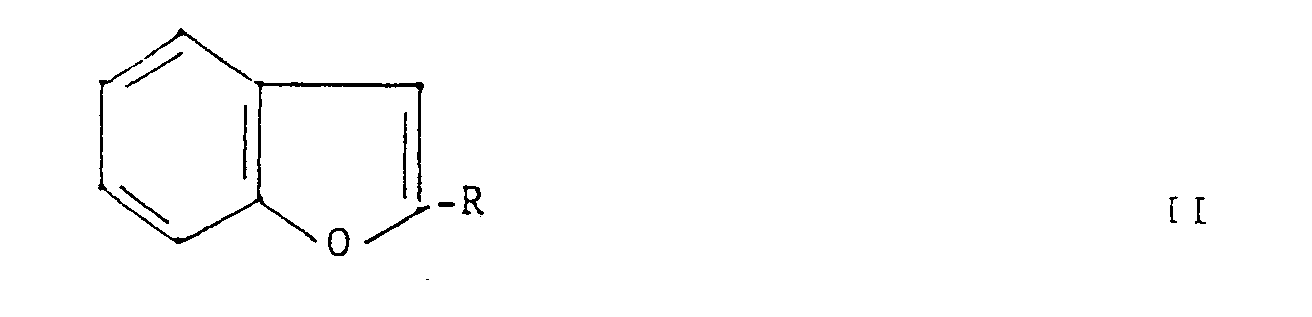
- the compounds of formula I are prepared by reacting in situ in the presence of aluminum chloride as catalyst, at a temperature between -25 ° C. and room temperature and in an apolar aprotic solvent, a benzofuran derivative of general formula: in which R has the same meaning as above, first with phosgene or oxalyl chloride then with a phenolic derivative of general formula: in which Z has the same meaning as above, to obtain a complex which is hydrolyzed to form the desired compound of formula I.
- the apolar aprotic solvent used in the process of the invention is preferably carbon tetrachloride or a C1-C4 alkyl halide such as dichloromethane or dichloroethane.
- the process of the invention can be carried out by loading the benzofuran derivative of formula II, phosgene, the catalyst and the chosen solvent into a reactor at a temperature of the order of -20 ° C., and carrying out then the reaction at room temperature for several hours, for example from 20 to 24 hours.
- the derivative of formula III is then introduced into the reaction medium at a temperature of about -20 ° C, then reheated to carry out the reaction at room temperature for 2 to 3 hours and the reaction medium is poured into water to carry out the hydrolysis of the complex.
- n-butyl-2 (4-methoxy benzoyl) -3 benzofuran can be produced, according to the invention, with yields greater than 75%.
- the process of the invention has, over previous processes, the undeniable advantage, of avoiding the extemporaneous preparation of a chlorocarbonyl derivative and thus considerably reducing the number of steps.
- the benzoyl-3 benzofuran derivatives of formula I in which Z represents hydrogen can, in addition, be prepared from a compound of formula II in which Z represents the methyl group followed by in situ demethylation of the complex formed using aluminum chloride, the reaction medium being at reflux temperature.
- a benzofuran derivative of formula II reacting in situ in the presence of aluminum chloride nium as catalyst at a temperature between -25 ° C. and room temperature and in an apolar aprotic solvent, a benzofuran derivative of formula II, first with phosgene or oxalyl chloride, then with anisole for obtaining a complex which is demethylated in situ at the reflux temperature of the medium and in the presence of aluminum chloride, then hydrolysis is carried out to obtain the 3-benzoyl benzofuran derivatives of formula I in which Z represents hydrogen.
- the quantity of aluminum chloride necessary for the Friedel-Crafts reactions is as indicated above from 1 to 1.5 equivalent per equivalent of compound of formula II while the quantity of aluminum chloride necessary for demethylation is of one equivalent per equivalent of compound of formula II.
- This variant of the process has the particular advantage of being able to carry out all of the reactions necessary for obtaining the (4-hydroxy-benzoyl) -3 benzofuran derivatives of formula I in a single reaction medium, without any isolation of intermediate product.
- 3-benzoyl benzofuran derivatives of formula I can be used for the preparation of benziodarone, benzbromarone or amiodarone.
- benziodarone and benzbromarone can be prepared, in particular, by iodination or bromination of respective ethyl-2 (4-hydroxy-benzoyl) -3 benzofuran in homogeneous phase and in the presence of an alkali metal acetate buffer solution / acetic acid and amiodarone can be obtained by iodination of n-butyl-2 (4-hydroxy-benzoyl) -3 benzofuran, in a similar way to that described above, to obtain n-butyl-2 (diiodo-3,5 hydroxy -4 benzoyl) -3 benzofuran followed by etherification with 1-diethylamino-2-chloroethane hydrochloride in the presence of an alkali metal carbonate / alkali metal bicarbonate buffer solution.
- the mixture is stirred for 2 hours and 1.9 g (14.23 mmol) of aluminum chloride are added.
- the mixture is brought to reflux for 8 hours. After returning to approximately 40 ° C., it is poured into the reaction medium in 100 ml of water and the mixture is stirred for 30 min. We dry then protects the organic phase, washed with 30 ml of a saturated sodium bicarbonate solution and then with 40 ml of water. It is dried over sodium sulphate and discoloration is carried out.
- the aqueous saline layer is decanted at 75 ⁇ 5 ° C and the toluene layer is washed at this temperature with 4 fractions each of 800 g of purified water.
- the toluene solution is treated with 20.5 g of charcoal active, it is filtered, rinsed with about 220 g of toluene and the filtrates are combined.
- n-butyl-2 hydrochloride (3,5-diiodo-3,5 ⁇ -diethylaminoethoxy-benzoyl) -3 benzofuran or amiodarone hydrochloride are thus obtained.
Landscapes
- Chemical & Material Sciences (AREA)
- Organic Chemistry (AREA)
- Furan Compounds (AREA)
- Pharmaceuticals Containing Other Organic And Inorganic Compounds (AREA)
Abstract

Description
- La présente invention se rapporte, d'une manière générale, à un nouveau procédé de préparation de dérivés de benzoyl-benzofuranne.
- Plus précisément, l'invention a pour objet un nouveau procédé de préparation de dérivés de benzoyl-3 benzofuranne de formule générale :

R est choisi parmi un radical alkyle linéaire ou ramifié en C₁-C₈, un radical cycloalkyle en C₃-C₆ et un groupe phényle non substitué ou substitué par un ou plusieurs substituants identiques ou différents, choisis parmi des atomes d'halogène, par exemple fluor, chlore ou brome et des groupes alkyle en C₁-C₄, alkoxy en C₁-C₄ et nitro,
Z est choisi parmi l'hydrogène et le radical méthyle. - Par "radical alkyle linéaire ou ramifié en C₁-C₈", on désigne notamment les radicaux méthyle, éthyle, n-propyle, isopropyle, n-butyle, isobutyle, tertiobutyle, n-pentyle, néopentyle, n-hexyle, n-heptyle ou n-octyle.
- De même, par "radical cycloalkyle en C₃-C₆", on entend notamment les radicaux cyclopropyle ou cyclohexyle.
- Ainsi, en tenant compte des valeurs données ci-dessus, R peut représenter notamment un radical méthyle, éthyle, n-propyle, isopropyle, n-butyle, isobutyle, tertiobutyle, méthyl-1 propyle, n-pentyle, néopentyle, phényle, mono-fluoro-, mono-chloro- ou mono-bromo-phényle, difluoro-, dichloro- ou dibromo-phényle, mono-méthyl- ou di-méthyl- phényle, mono-méthoxy- ou di-méthoxy-phényle ou un radical méthyl-phényle substitué par un atome d'halogène.
- Par "radical alkyle en C₁-C₄", on entend plus particulièrement, un radical méthyle, éthyle, n-propyle, isopropyle, n-butyle, isobutyle ou tertiobutyle.
- Par "radical alkoxy en C₁-C₄¨, on désigne un groupement hydroxyle substitué par un radical alkyle en C₁-C₄ tel qu'explicité ci-dessus.
- Parmi les composés de formule I, ceux dans laquelle R représente un radical éthyle ou n-butyle constituent des composés préférés.
- Les dérivés de benzoyl-3 benzofuranne de formule I peuvent être largement utilisés comme produits intermédiaires notamment pour la synthèse finale de dérivés de benzofuranne décrits dans les brevets français n° 1 260 578 et 1 339 389.
- De tels dérivés sont notamment la benziodarone ou éthyl-2 (diiodo-3,5 hydroxy-4 benzoyl)-3 benzofuranne, la benzbromarone ou éthyl-2 (dibromo-3,5 hydroxy-4 benzoyl)-3 benzofuranne et l'amiodarone ou n-butyl-2 (diiodo-3,5β-diéthylaminoéthoxy-4 benzoyl)-3 benzofuranne.
- Ces composés se sont révélés particulièrement intéressants pour leurs applications thérapeutiques.
- Ainsi, la benziodarone s'est montrée utile par son action coronarodilatatrice et hypouricémiante, la benzbromarone par son effet hypouricémiant et l'amiodarone par ses propriétés antiangineuses et antiarythmiques cardiaques.
- Certains dérivés de formule I se sont également révélés utiles comme agents thérapeutiques. On peut citer par exemple l'éthyl-2 (hydroxy-4 benzoyl)-3 benzofuranne ou benzarone qui s'est montrée efficace par son effet phlébotonique et freinateur des réactions inflammatoires capillaroveineuses.
- La préparation de dérivés d'anisoyl-3 ou benzoyl-3 benzofuranne, par réaction de Friedel-Crafts, est largement connue dans la littérature chimique.
- A titre d'exemple, on peut citer :
- le brevet français n° 1 260 578 qui fait état de la réaction entre un alkyl-2 benzofuranne et le chlorure d'anisoyle en présence de chlorure stannique comme catalyseur et dans le sulfure de carbone comme solvant. - Le chlorure d'anisoyle peut être obteu par exemple à partir d'acide anisique et de chlorure de thionyle.
- Eur. J. Med. Chem. -Chimica Therapeutica 1974, 9, N° 1, pp. 19-25 qui décrit la condensation d'un dérivé alkyl-2 chlorocarbonyl-3 bennzofuranne avec un dialkyl-3,5 anisole en présence de chlorure d'aluminium comme catalyseur et dans le dichloréthane comme solvant, le dérivé chlorocarbonyl-3 étant obtenu selon la suite d'étapes suivantes : - a) réaction d'un alkyl-2 benzofuranne avec le chlorure d'acétyle en présence de chlorure stannique,
- b) réaction de l'alkyl-2 acétyl-3 benzofuranne obtenu, avec le brome ou le chlorure de sulfuryle,
- c) chauffage, dans la pyridine, de l'alkyl-2 haloacétyl-3 benzofuranne obtenu,
- d) hydrolyse, en présence d'hydroxyde de sodium, de l'alkyl-2 ω - halopyridylium-acétyl-3 benzofuranne obtenu,
- e) régénération de l'acide alkyl-2 benzofuranne carboxylique-3 à partir de son sel sodique ainsi obtenu,
- f) réaction de l'acide alkyl-2 benzofuranne carboxylique-3 avec le chlorure de thionyle pour fournir l'alkyl-2 chlorocarbonyl-3 benzofuranne.
- D'autres catalyseurs de Lewis ont été décrits dans la réaction de Friedel-Crafts parmi lesquels on peut citer, par exemple, le chlorure ferrique (demande de brevet EP-A-0 210 156) ou le chlorure d'aluminium.
- Ce dernier a été utilisé dans un procédé rapporté dans le brevet hongrois n° 175 906 (Chem. Abstr. 94, 192122b) selon lequel, on prépare l'éthyl-2 (hydroxy-4 benzoyl)-3 benzofuranne de la manière suivante :
- a) on effectue la réaction d'un équivalent d'ethyle-2 benzofuranne avec un équivalent de chlorure d'anisoyle (préparé extemporanément à partir d'acide anisique et de chlorure de thionyle) en présence de 1,02 équivalent de chlorure d'aluminium dans le chlorobenzène à 0°C,
- b) on déméthyle le complexe obtenu par ajout de 3,08 équivalents de chlorure d'aluminium et on chauffe à 70°C,
- c) on hydrolyse, à température ambiante pour obtenir, après purification et séparation, le composé désiré avec un rendement de 50,5%.
- En conclusion, les méthodes évoquées ci-des sus font toutes appel à un procédé mettant en oeuvre pour la formation de la cétone finale, une seule réaction de Friedel-Crafts, le substituant chlorocarbonyle nécessaire à la condensation étant fixé au départ soit sur le dérivé de benzofuranne soit sur le dérivé de méthoxybenzène.
- En conséquence, ces procédés antérieurs nécessitent la préparation intermédiaire du dérivé chlorocarbonyle approprié, ce qui peut, dans certains cas, augmenter considérablement le nombre total d'étapes du procédé et, corollairement, le prix de revient du produit final.
- La recherche d'un procédé industriel mettant en oeuvre des intermédiaires de synthèse d'accès facile et peu onéreux ainsi qu'un nombre restreint d'étapes et un rendement satisfaisant en produit final reste, par conséquent, d'un intérêt incontestable.
- On sait, par ailleurs, que la réaction de Friedel-Crafts peut être accomplie également à partir du phosgène ou du chlorure d'oxalyle sur un substrat aromatique Ar.
- Dans ce cas, on obtient la cétone symétrique Ar-CO-Ar comme produit majoritaire accompagnée d'une très faible quantité d'acide ArCO₂H selon le schéma :

- La seule méthode pour obtenir l'acide avec un bon rendement consiste à utiliser le sulfure de carbone comme solvant car le complexe /ArCOCl : AlCl₃/ n'y étant pas soluble, précipite et ne peut donc réagir avec une deuxième molécule d'ArH pour donner la cétone symétrique.
- L'obtention de cétones symétriques dans ce type de réaction limite, par conséquent, la portée d'un procédé de préparation de cétones par double réaction de Friedel-Crafts entre deux composés aromatiques différents et le phosgène.
- Dans l'état actuel des connaissances, il n'existerait pas d'exemple de préparation de cétones aromatiques non symétriques basé sur ce type de procédé.
- Or, on a maintenant trouvé selon l'invention, qu'il est possible d'obtenir des cétones aromatiques non symétriques en l'occurence les dérivés de benzoyl-3 benzofuranne de formule I par double réaction de Friedel-Crafts mettant en oeuvre le phosgène et deux composés aromatiques différents.
- Ainsi, selon l'invention, on prépare les composés de formule I en faisant réagir in situ en présence de chlorure d'aluminium comme catalyseur,à une température comprise entre -25°C et la température ambiante et dans un solvant aprotique apolaire, un dérivé de benzofuranne de formule générale :


- On a remarqué que les proportions relatives des divers réactifs en présence jouent un rôle non négligeable sur la formation de produits secondaires représentés par des cétones symétriques.
- Les rapports molaires les plus convenables utilisés dans le procédé de l'invention en vue de favoriser la production de cétones non symétriques se sont révélés comme suit :
composé de formule II ou III/phosgène ou chlorure d'oxalyle/chlorure d'aluminium: 1 / 2 à 4 / 1 à 1,5 avec un préférence pour le rapport 1 / 3 / 1,5, les composés de formule II et III étant en quantité stoéchiométrique. - Le solvant aprotique apolaire utilisé dans le procédé de l'invention est, de préférence, le tétrachlorure de carbone ou un halogénure d'alkyle en C₁-C₄ tel que le dichlorométhane ou le dichloroéthane.
- Quant à l'hydrolyse, celle-ci a lieu à une température comprise entre la température ambiante et 50°C, de préférence à la température ambiante.
- Le procédé de l'invention peut être mis en oeuvre en chargeant dans un réacteur à une température de l'ordre de -20°C, le dérivé de benzofuranne de formule II, le phosgène, le catalyseur et le solvant choisi, et en effectuant ensuite la réaction à température ambiante pendant plusieurs heures, par exemple de 20 à 24 heures.
- On introduit alors le dérivé de formule III dans le milieu réactionnel à une température de l'ordre de -20°C, puis on réchauffe pour effectuer la réaction à température ambiante pendant 2 à 3 heures et on verse le milieu réactionnel dans l'eau pour réaliser l'hydrolyse du complexe.
- Le dérivé de benzoyl-3 benzofuranne de formule I ainsi obtenu peut être ensuite séparé de manière classique.
- Le procédé de l'invention, ainsi décrit permet d'obtenir les dérivés de benzoyl-3 benzofuranne de formule I avec facilité et excellents rendements. Par exemple, le n-butyl-2 (méthoxy-4 benzoyl)-3 benzofuranne peut être produit, selon l'invention, avec des rendements supérieurs à 75%.
- En outre, le procédé de l'invention présente, sur les procédés antérieurs, l'avantage incontestable, d'éviter la préparation extemporanée d'un dérivé chlorocarbonyle et d'ainsi réduire considérablement le nombre d'étapes.
- On peut également préparer un dérivé de formule I dans laquelle Z représente l'hydrogène à partir du dérivé de (méthoxy-4 benzoyl)-3 benzofuranne de formule I que l'on déméthyle en dérivé d'(hydroxy-4 benzoyl)-3 benzofuranne par exemple par application de la méthode décrite dans le brevet EP-A-0 210 156, c'est-à-dire en faisant intervenir le chlorure d'aluminium comme agent de déméthylation à la température de reflux du milieu réactionnel.
- Les dérivés de benzoyl-3 benzofuranne de formule I dans laquelle Z représente l'hydrogène peuvent, en outre, être préparés à partir d'un composé de formule II dans laquelle Z représente le groupe méthyle suivie d'une déméthylation in situ du complexe formé au moyen de chlorure d'aluminium, le milieu réactionnel étant à la température de reflux.
- Ainsi, selon cette variante du procédé, on fait réagir in situ en présence de chlorure d'alumi nium comme catalyseur à une température comprise entre -25°C et la température ambiante et dans un solvant aprotique apolaire, un dérivé de benzofuranne de formule II, d'abord avec le phosgène ou le chlorure d'oxalyle, ensuite avec l'anisole pour obtenir un complexe que l'on déméthyle in situ à la température de reflux du milieu et en présence de chlorure d'aluminium puis on effectue une hydrolyse pour obtenir les dérivés de benzoyl-3 benzofuranne de formule I dans laquelle Z représente l'hydrogène.
- La quantité de chlorure d'aluminium nécessaire aux réactions de Friedel-Crafts est comme indiqué précédemment de 1 à 1,5 équivalent par équivalent de composé de formule II tandis que la quantité de chlorure d'aluminium nécessaire à la déméthylation est d'un équivalent par équivalent de composé de formule II.
- Cette variante du procédé présente notamment l'avantage de pouvoir réaliser l'ensemble des réactions nécessaires à l'obtention des dérivés (hydroxy-4 benzoyl)-3 benzofuranne de formule I dans un seul milieu réactionnel, sans aucun isolement de produit intermédiaire.
- En outre, puisque l'on utilise le chlorure d'aluminium à la fois pour les réactions de Friedel-Crafts et pour la déméthylation, on peut diminuer de manière très sensible la quantité de cet agent par rapport aux quantités préconisées dans le brevet hongrois n° 175.906 qui prévoit l'utilisation de 4 équivalents de chlorure d'aluminium au total.
- La variante de procédé ainsi décrite permet de préparer les dérivés d'(hydroxy-4 benzoyl)-3 benzofuranne de formule I avec de très bons rendements. Dans le cas notamment de la préparation du n-butyl-2 (hydroxy-4 benzoyl)-3 benzofuranne, on a pu, en appliquant cette variante du procédé, obtenir des rendements d'au moins 70%.
- Comme indiqué précédemment, les dérivés de benzoyl-3 benzofuranne de formule I peuvent être utilisés pour la préparation de la benziodarone, de la benzbromarone ou de l'amiodarone.
- Par exemple, la benziodarone et la benzbromarone peuvent être préparées, notamment, par iodation ou bromation respective de l'éthyl-2 (hydroxy-4 benzoyl)-3 benzofuranne en phase homogène et en présence d'une solution tampon acétate de métal alcalin/acide acétique et l'amiodarone peut être obtenue par iodation du n-butyl-2 (hydroxy-4 benzoyl)-3 benzofuranne, de manière analogue à celle décrite précédemment, pour obtenir le n-butyl-2 (diiodo-3,5 hydroxy-4 benzoyl)-3 benzofuranne suivie d'une éthérification par le chlorhydrate de diéthylamino-1 chloro-2 éthane en présence d'une solution tampon carbonate de métal alcalin/bicarbonate de métal alcalin.
- Les exemples suivants illustrent l'invention et la préparation de l'amiodarone.
- On place dans un réacteur, sous argon, 40 ml de dichloréthane anhydre et on refroidit à -20°C. On introduit alors successivement 3 ml (41,87 mmoles) de phosgène, 2,5 ml (14,2 mmoles) de n-butyl-2 benzofuranne et 2,13 g (15,96 mmoles) de chlorure d'aluminium dans le réacteur. On réchauffe la solution progressivement à température ambiante, agite durant 24 heures et refroidit à -20°C.
- On ajoute alors 1,55 ml (14,25 mmoles) d'anisole puis on réchauffe la solution à la température ambiante, agite pendant 2 heures et verse dans 100 ml d'eau. Après 30 mn sous agitation vive, on sépare la phase organique, lave avec une solution saturée de 30 ml de bicarbonate de sodium avec 40 ml d'eau puis on sèche sur sulfate de sodium.
- Après évaporation du solvant et purification du produit brut obtenu sur une colonne de silice (éluant : chlorure de méthylène/hexane 1/1), on obtient 3,44 g (11,17 mmoles) de n-butyl-2 (méthoxy-4 benzoyl)-3 benzofuranne.
Rendement : 78,7 %. - Dans un ballon sec, on place, sous argon, 40 ml de dichloréthane anhydre et on refroidit à -20°C. On introduit alors successivement dans le ballon 3 ml (41,87 mmoles) de phosgène, 2,5 ml (14,2 mmoles) de n-butyl-2 benzofuranne et 2,13 g (15,96 mmoles) de chlorure d'aluminium.
- On réchauffe la solution à température ambiante, agite durant 24 heures et refroidit à -20°C. On ajoute ensuite 1,55 ml (14,25 mmoles) d'anisole puis on réchauffe la solution à 25°C.
- On agite pendant 2 heures et on ajoute 1,9 g (14,23 mmoles) de chlorure d'aluminium. On porte le mélange au reflux pendant 8 heures. Après retour à 40°C environ, on vers le milieu réactionnel dans 100 ml d'eau et on agite le mélange pendant 30 mn. On sé pare alors la phase organique, lave avec 30 ml d'une solution saturée de bicarbonate de sodium puis avec 40 ml d'eau. On sèche sur sulfate de sodium et on effectue une décoloration. Après évaporation du solvant et purification du produit brut obtenu sur une colonne de silice (éluant : chlorure de méthylène), on obtient 2,9 g (9,87 mmoles) de n-butyl-2 (hydroxy-4 benzoyl)-3 benzofuranne.
Rendement : 70%
P.F. : 120°C. - A une solution de 2 g (6,5 mmoles) de n-butyl-2 (méthoxy-4 benzoyl)-3 benzofuranne dans 30 ml de dichloréthane, on ajoute, sous argon, 1,82 g (13,6 mmoles) de chlorure d'aluminium. On chauffe le mélange durant 9 heures à reflux puis on refroidit à température ambiante. On verse alors le milieu réactionnel dans 50 ml d'eau, on agite ensemble vigoureusement durant 30 minutes puis on sépare la phase organique. On lave 3 fois avec 30 ml d'eau, sèche sur sulfate de sodium et décolore sur terre de diatomées. Après évaporation du solvant, on obtient 1,9 g (6,5 mmoles) de n-butyl-2 (hydroxy-4 benzoyl)-3 benzofuranne.
Rendement : 100%
P.F. : 119-120°C. -
- Dans un réacteur de 4l, on introduit 540 g de méthanol. Sous agitation, on ajoute alors successivement 300 g (2,4 moles) d'acétate de sodium trihydraté, 286 g d'iode et 424 g d'iode récupéré humide (2,3 moles au total). On amène le milieu réactionnel à 30 à 35°C et on introduit en une fois 294 g (1 mole) de n-butyl-2 (hydroxy-4 benzoyl)-3 benzofuranne.
- On rince avec 60g de méthanol et on porte le mélange au reflux en 30 à 45 mn (température dans la masse : 70 à 74°C). On arrête le chauffage et on introduit, en 10 mn environ, une solution préalablement préparée de 90g (2,2 moles) d'hydroxyde de sodium en écailles dans 400 g d'eau épurée. L'exothermicité de la réaction maintient le reflux (76/77°C dans la masse) pendant le temps d'introduction. On maintient pendant 2 h à reflux puis on modifie l'appareil en un appareil de distillation à pression atmosphérique. On introduit, en 20 mn environ, une solution aqueuse de 320 g de bisulfite de sodium (35°Bé) et on poursuit la distillation jusqu'à atteindre 97 à 100°C dans la masse (température de tête : 87°C). On distille ainsi environ 800 ml (environ 680g) de solvant. On refroidit au moyen d'un bain d'eau à 75 à 80°C et on introduit successivement et dans l'ordre 200 g d'eau épurée, 215 g d'acide chlorhydrique à 36% et 1600 g de toluène. On porte au reflux pendant 10 mn (température de la masse : 84°C - dégagement d'anhydride sulfurique) et on décante la phase aqueuse inférieure. On lave la couche toluénique à 75 à 80°C successivement avec 400 g d'eau épurée, 100 g d'une solution aqueuse de bisulfite de sodium et 2 fractions chacune de 400 g d'eau épurée. On décante au maximum après le dernier lavage et on traite avec 22 g de charbon actif durant 30 mn au reflux. On filtre à chaud, on rince avec 380 g de toluène chaud et on réunit les filtrats.
- On obtient ainsi une solution toluénique de n-butyl-2 (diiodo-3,5 hydroxy-4 benzoyl)-3 benzofuranne que l'on utilise telle quelle.
- De la même manière que celle décrite précédemment mais à partir de 266,3 g (1 mole) d'éthyl-2 (hydroxy-4 benzoyl)-3 benzofuranne, on obtient l'éthyl-2 (diiodo-3,5 hydroxy-4 benzoyl)-3 benzofuranne ou benziodarone après élimination du toluène par distillation.
- De même, à partir de 266,3 g (1 mole) d'ethyl-2 (hydroxy-4 benzoyl)-3 benzofuranne et de brome, on obtient l'éthyl-2 (dibromo-3,5 hydroxy-4 benzoyl)-3 benzofuranne ou benzbromarone après élimination du toluène par distillation.
- Dans un réacteur, on introduit la solution toluénique de n-butyl-2 (diiodo-3,5 hydroxy-4 benzoyl)-3 benzofuranne obtenue au paragraphe b) ainsi que 800 g d'eau épurée et 177,3 g (1,03 mole) de chlorhydrate de diéthylamino-1 chloro-2 éthane. Sous agitation, on amène le milieu réactionnel à 40 ± 2°C et on l'y maintient durant 15 mn. En contrôlant le départ d'anhydride carbonique, on introduit alors lentement en pluie 416 g (3 moles) de carbonate de potassium anhydre. On élève progressivement la température pour atteindre le reflux en 1 h. On maintient durant 3 h à cette température, on décante la couche aqueuse saline à 75 ± 5°C et on lave la couche toluénique, à cette température, avec 4 fractions chacune de 800 g d'eau épurée. A la température de 60°C, on traite la solution toluénique avec 20,5 g de charbon actif, on filtre, on rince avec environ 220g de toluéne et on réunit les filtrats.
- On obtient ainsi une solution toluénique de n-butyl-2 (diiodo-3,5 β -diéthylaminoéthoxy-4 benzoyl)-3 benzofuranne sous forme de base ou amiodarone.
- On amène à 60°C la solution de n-butyl-2 (diiodo-3,5 β -diéthylaminoéthoxy-4 benzoyl)-3 benzofuranne obtenue au paragraphe c) et on introduit en 45 mn 38,5 g de gaz chlorhydrique au moyen d'un tube plongeant. On laisse la température de la masse s'élever suite à l'exothermicité de la réaction sans toutefois dépasser 75°C.
- On vérifie que le pH est franchement acide en fin d'introduction et après 30 mn de contact à 70 ± 5°C.
On met progressivement sous vide de la trompe à l'eau et on distille environ 400 ml de toluène/eau/acide chlorhydrique (fin de distillation : pression résiduelle ≦ 150 mm; température de la masse ≦ 75°C. On cristallise sous agitation lente avec bain d'eau durant environ 8 heures et on essore à 10 à 15°C. On rince avec 4 fractions chacune de 180 ml de toluène filtré et on sèche en étuve ventilée à 60°C jusqu'à ce que le poids soit constant. - On obtient ainsi environ 647,5 g de chlorhydrate de n-butyl-2 (diiodo-3,5 β -diéthylaminoéthoxy-4 benzoyl)-3 benzofuranne ou chlorhydrate d'amiodarone.
- Rendement : environ 95% (par rapport au n-butyl-2 (hydroxy-4 benzoyl)-3 benzofuranne).
Claims (10)

R est choisi parmi un radical alkyle linéaire ou ramifié en C₁-C₈, un radical cycloalkyle en C₃-C₆ et un groupe phényle non substitué ou substitué par un ou plusieurs substituants identiques ou différents, choisis parmi des atomes d'halogène, des groupes alkyle en C₁-C₄, alkoxy en C₁-C₄ et nitro,
Z est choisi parmi l'hydrogène et le radical méthyle, caractérisé en ce que l'on fait réagir successivement in situ, en présence de chlorure d'aluminium comme catalyseur, à une température comprise entre -25°C et la température ambiante et dans un solvant aprotique apolaire, un dérivé de benzofuranne de formule générale :


Applications Claiming Priority (2)
| Application Number | Priority Date | Filing Date | Title |
|---|---|---|---|
| FR8913851 | 1989-10-23 | ||
| FR8913851A FR2653431B1 (fr) | 1989-10-23 | 1989-10-23 | Procede de preparation de derives de benzoyl-3 benzofuranne. |
Publications (2)
| Publication Number | Publication Date |
|---|---|
| EP0425359A1 true EP0425359A1 (fr) | 1991-05-02 |
| EP0425359B1 EP0425359B1 (fr) | 1995-10-11 |
Family
ID=9386667
Family Applications (1)
| Application Number | Title | Priority Date | Filing Date |
|---|---|---|---|
| EP90402967A Expired - Lifetime EP0425359B1 (fr) | 1989-10-23 | 1990-10-22 | Procédé de préparation de dérivés de benzoyl-3 benzofuranne |
Country Status (9)
| Country | Link |
|---|---|
| US (1) | US5266711A (fr) |
| EP (1) | EP0425359B1 (fr) |
| JP (1) | JPH03169874A (fr) |
| AT (1) | ATE128973T1 (fr) |
| DE (1) | DE69022949T2 (fr) |
| DK (1) | DK0425359T3 (fr) |
| ES (1) | ES2078959T3 (fr) |
| FR (1) | FR2653431B1 (fr) |
| GR (1) | GR3018227T3 (fr) |
Cited By (4)
| Publication number | Priority date | Publication date | Assignee | Title |
|---|---|---|---|---|
| WO1999058519A1 (fr) * | 1998-05-12 | 1999-11-18 | American Home Products Corporation | Acides phenyl-oxo-acetiques utiles dans le traitement de l'insulinoresistance et de l'hyperglycemie |
| WO2007011835A3 (fr) * | 2005-07-15 | 2007-03-29 | Aryx Therapeutics | Composes precurseurs antiarythmiques, leurs procedes de synthese et leurs procedes d'utilisation |
| EP2452938A1 (fr) | 2010-11-12 | 2012-05-16 | LEK Pharmaceuticals d.d. | Procédé pour la préparation de dérivés de 3-aroyl-5-aminobenzofurane |
| CN106946822A (zh) * | 2017-03-21 | 2017-07-14 | 华中科技大学 | 一种2‑丁基‑3‑(4‑羟基苯甲酰基)苯并呋喃的制备方法 |
Families Citing this family (10)
| Publication number | Priority date | Publication date | Assignee | Title |
|---|---|---|---|---|
| US6166069A (en) | 1998-05-12 | 2000-12-26 | American Home Products Corporation | Phenyl oxo-acetic acids useful in the treatment of insulin resistance and hyperglycemia |
| US20030113330A1 (en) * | 1999-11-08 | 2003-06-19 | Uhal Bruce D. | Methods for treating pulmonary fibrosis |
| RU2186063C1 (ru) * | 2001-06-18 | 2002-07-27 | Федеральное государственное унитарное предприятие "Новокузнецкий научно-исследовательский химико-фармацевтический институт" | Способ получения 2-бутил-3-(3,5-дийод-4-оксибензоил)бензофурана |
| AU2003210904A1 (en) * | 2002-02-07 | 2003-09-02 | Galileo Lab Inc | Cytoprotective benzofuran derivatives |
| US7078541B2 (en) * | 2002-02-07 | 2006-07-18 | Galileo Pharmaceuticals, Inc. | Benzofuran derivatives |
| FR2864536B1 (fr) * | 2003-12-24 | 2006-03-17 | Clariant France Sa | Procede de preparation de n-alkyl-2 (hydroxy-4-benzoyl)-3 benzofurannes et intermediaires pour sa mise en oeuvre |
| JP5844376B2 (ja) * | 2010-10-06 | 2016-01-13 | ジェイファーマ株式会社 | 強力な尿酸トランスポーター阻害剤の開発:それらの尿酸排泄効果のために設計された化合物 |
| CN104262304A (zh) * | 2014-09-12 | 2015-01-07 | 杨俊� | 一种盐酸胺碘酮的合成方法 |
| CN104311516B (zh) * | 2014-09-16 | 2017-01-11 | 东北制药集团股份有限公司 | 一种苯溴马隆晶型b及其制备方法 |
| CN106065010B (zh) * | 2015-04-23 | 2019-01-01 | 镇江新元素医药科技有限公司 | 用于治疗或预防高尿酸血症或痛风的化合物 |
Citations (1)
| Publication number | Priority date | Publication date | Assignee | Title |
|---|---|---|---|---|
| EP0210156A1 (fr) * | 1985-06-25 | 1987-01-28 | Sanofi | Complexes moléculaires formés d'un dérivé de benzofuranne et de chlorure d'aluminium, leur préparation et leur utilisation |
Family Cites Families (3)
| Publication number | Priority date | Publication date | Assignee | Title |
|---|---|---|---|---|
| US3950355A (en) * | 1972-08-03 | 1976-04-13 | Mcneil Laboratories, Inc. | 5-chlorocarbonyl |
| US3947470A (en) * | 1974-06-20 | 1976-03-30 | Smithkline Corporation | Substituted benzofurans and benzothiophenes |
| US4780480A (en) * | 1983-07-14 | 1988-10-25 | Syntex (U.S.A.) Inc. | Aroyl benzofuran and benzothiophene acetic and propionic acids |
-
1989
- 1989-10-23 FR FR8913851A patent/FR2653431B1/fr not_active Expired - Fee Related
-
1990
- 1990-10-16 US US07/597,684 patent/US5266711A/en not_active Expired - Fee Related
- 1990-10-22 DE DE69022949T patent/DE69022949T2/de not_active Expired - Fee Related
- 1990-10-22 JP JP2285702A patent/JPH03169874A/ja active Pending
- 1990-10-22 AT AT90402967T patent/ATE128973T1/de not_active IP Right Cessation
- 1990-10-22 EP EP90402967A patent/EP0425359B1/fr not_active Expired - Lifetime
- 1990-10-22 DK DK90402967.5T patent/DK0425359T3/da active
- 1990-10-22 ES ES90402967T patent/ES2078959T3/es not_active Expired - Lifetime
-
1995
- 1995-11-29 GR GR950403346T patent/GR3018227T3/el unknown
Patent Citations (1)
| Publication number | Priority date | Publication date | Assignee | Title |
|---|---|---|---|---|
| EP0210156A1 (fr) * | 1985-06-25 | 1987-01-28 | Sanofi | Complexes moléculaires formés d'un dérivé de benzofuranne et de chlorure d'aluminium, leur préparation et leur utilisation |
Non-Patent Citations (2)
| Title |
|---|
| CHEMICAL ABSTRACTS, vol. 94, no. 23, 8 juin 1981, page 640, résumé no. 192122b, Columbus, Ohio, US; & HU-A-18 236 (E. GY. T. GYOGYSZERVEGYESZETI GYAR) 28-05-1980 * |
| JOURNAL OF ORGANIC CHEMISTRY, vol. 48, no. 19, 23 septembre 1983, pages 3214-3219, American Chemical Society, Easton, US; M. KAKUSHIMA et al.: "Regioselective synthesis of acylpyrroles" * |
Cited By (9)
| Publication number | Priority date | Publication date | Assignee | Title |
|---|---|---|---|---|
| WO1999058519A1 (fr) * | 1998-05-12 | 1999-11-18 | American Home Products Corporation | Acides phenyl-oxo-acetiques utiles dans le traitement de l'insulinoresistance et de l'hyperglycemie |
| WO2007011835A3 (fr) * | 2005-07-15 | 2007-03-29 | Aryx Therapeutics | Composes precurseurs antiarythmiques, leurs procedes de synthese et leurs procedes d'utilisation |
| US7498449B2 (en) | 2005-07-15 | 2009-03-03 | Aryx Therapeutics | Antiarrhythmic precursor compounds, methods of synthesis and methods of use |
| RU2422447C2 (ru) * | 2005-07-15 | 2011-06-27 | Арикс Терапьютикс, Инк. | Предшественники антиаритмических соединений, способы синтеза и способы применения |
| NO341172B1 (no) * | 2005-07-15 | 2017-09-04 | Armetheon Inc | Anti-arytmiforløperforbindelser og fremgangsmåter for syntese |
| EP2452938A1 (fr) | 2010-11-12 | 2012-05-16 | LEK Pharmaceuticals d.d. | Procédé pour la préparation de dérivés de 3-aroyl-5-aminobenzofurane |
| WO2012062918A1 (fr) | 2010-11-12 | 2012-05-18 | Lek Pharmaceuticals D.D. | Procédé pour la préparation de dérivés de 3-aroyl-5-aminobenzofuranne |
| CN106946822A (zh) * | 2017-03-21 | 2017-07-14 | 华中科技大学 | 一种2‑丁基‑3‑(4‑羟基苯甲酰基)苯并呋喃的制备方法 |
| CN106946822B (zh) * | 2017-03-21 | 2019-03-05 | 华中科技大学 | 一种2-丁基-3-(4-羟基苯甲酰基)苯并呋喃的制备方法 |
Also Published As
| Publication number | Publication date |
|---|---|
| ES2078959T3 (es) | 1996-01-01 |
| DE69022949T2 (de) | 1996-05-15 |
| DK0425359T3 (da) | 1996-01-22 |
| ATE128973T1 (de) | 1995-10-15 |
| GR3018227T3 (en) | 1996-02-29 |
| JPH03169874A (ja) | 1991-07-23 |
| FR2653431B1 (fr) | 1994-05-27 |
| FR2653431A1 (fr) | 1991-04-26 |
| US5266711A (en) | 1993-11-30 |
| EP0425359B1 (fr) | 1995-10-11 |
| DE69022949D1 (de) | 1995-11-16 |
Similar Documents
| Publication | Publication Date | Title |
|---|---|---|
| EP0425359B1 (fr) | Procédé de préparation de dérivés de benzoyl-3 benzofuranne | |
| EP1644312B1 (fr) | Preparation de derives de 1,3-diphenylprop-2-en-1-one | |
| FR2817865A1 (fr) | Derive aminoalkoxybenzoyle sous forme de sel, son procede de preparation et son utilisation comme intermediaire de synthese | |
| EP0245156A1 (fr) | Nouveau procédé de préparation de fibrates | |
| EP0082049B1 (fr) | Nouveaux éthers dont les restes organiques comportent des atomes chiraux, leur préparation, leur application au dédoublement d'alcools ou de certains composés hémiacétaliques et les nouveaux produits dédoublés obtenus | |
| EP0377381A1 (fr) | Procédé de préparation du phényl-1 diéthylaminocarbonyl-1 phtalimidométhyl-2 cyclopropane Z | |
| EP0210156B1 (fr) | Complexes moléculaires formés d'un dérivé de benzofuranne et de chlorure d'aluminium, leur préparation et leur utilisation | |
| JP4272271B2 (ja) | ハロゲノ−o−ヒドロキシジフェニル化合物の製造方法 | |
| EP0200840B1 (fr) | Procédé de préparation d'acides 6-alkoxy(inférieur)-1-naphtoiques, éventuellement halogénés en 5 et des esters correspondants | |
| EP0023459B1 (fr) | Procédé de préparation d'acides hydroxyarylglycoliques racémiques | |
| CH615414A5 (fr) | ||
| EP0694029B1 (fr) | Nouveau procede de preparation d'acide beta-alcoxy acrylique | |
| FR2759079A1 (fr) | Procede de preparation d'anthraquinones substituees et application a la preparation de rheines | |
| EP0097578B1 (fr) | Procédé de préparation de l'acide 3-méthyl 3-hydroxy glutarique et produit intermédiaire nécessaire à cette préparation | |
| CA1253878A (fr) | Procede de preparation de mono et dicarboxylates de monohalogenohydroquinone | |
| FR2735468A1 (fr) | Procede de preparation d'un compose aromatique di-ou polyhydroxyle | |
| CA1297098C (fr) | Composes aromatiques substitues et leur procede de preparation | |
| BE776316R (fr) | Nouveaux derives d'acides phenyl-acetiques substitues et procede pour leur | |
| CH627148A5 (fr) | ||
| BE852030A (fr) | Derives d'acide acetique aromatique ayant un atome de soufre a la position alpha et procede pour leur preparation | |
| FR2759697A1 (fr) | Preparation du 4-cyano-4'-hydroxy biphenyle | |
| FR2647106A1 (fr) | Procede de synthese de derives aromatiques fluores | |
| FR2616431A1 (fr) | Procede de preparation de derives de la (trans)-4-phenyl-l-proline | |
| FR2470127A1 (fr) | Thienyl-2-glycolate de sodium racemique cristallise, son procede de preparation et son application a la fabrication de l'acide thienyl-2 acetique | |
| FR2824555A1 (fr) | Procede de synthese de para-alcoxybenzaldehydes |
Legal Events
| Date | Code | Title | Description |
|---|---|---|---|
| PUAI | Public reference made under article 153(3) epc to a published international application that has entered the european phase |
Free format text: ORIGINAL CODE: 0009012 |
|
| AK | Designated contracting states |
Kind code of ref document: A1 Designated state(s): AT BE CH DE DK ES FR GB GR IT LI LU NL SE |
|
| 17P | Request for examination filed |
Effective date: 19910902 |
|
| RAP1 | Party data changed (applicant data changed or rights of an application transferred) |
Owner name: ELF SANOFI |
|
| 17Q | First examination report despatched |
Effective date: 19940118 |
|
| RAP1 | Party data changed (applicant data changed or rights of an application transferred) |
Owner name: SANOFI |
|
| 18W | Application withdrawn |
Withdrawal date: 19950505 |
|
| R18W | Application withdrawn (corrected) |
Effective date: 19950505 |
|
| D18W | Application withdrawn (deleted) | ||
| GRAA | (expected) grant |
Free format text: ORIGINAL CODE: 0009210 |
|
| REG | Reference to a national code |
Ref country code: DE Ref legal event code: 8570 |
|
| AK | Designated contracting states |
Kind code of ref document: B1 Designated state(s): AT BE CH DE DK ES FR GB GR IT LI LU NL SE |
|
| REF | Corresponds to: |
Ref document number: 128973 Country of ref document: AT Date of ref document: 19951015 Kind code of ref document: T |
|
| ITF | It: translation for a ep patent filed | ||
| REF | Corresponds to: |
Ref document number: 69022949 Country of ref document: DE Date of ref document: 19951116 |
|
| REG | Reference to a national code |
Ref country code: ES Ref legal event code: FG2A Ref document number: 2078959 Country of ref document: ES Kind code of ref document: T3 |
|
| REG | Reference to a national code |
Ref country code: DK Ref legal event code: T3 |
|
| REG | Reference to a national code |
Ref country code: GR Ref legal event code: FG4A Free format text: 3018227 |
|
| GBT | Gb: translation of ep patent filed (gb section 77(6)(a)/1977) |
Effective date: 19960112 |
|
| PLBE | No opposition filed within time limit |
Free format text: ORIGINAL CODE: 0009261 |
|
| STAA | Information on the status of an ep patent application or granted ep patent |
Free format text: STATUS: NO OPPOSITION FILED WITHIN TIME LIMIT |
|
| 26N | No opposition filed | ||
| PGFP | Annual fee paid to national office [announced via postgrant information from national office to epo] |
Ref country code: DK Payment date: 19970919 Year of fee payment: 8 Ref country code: DE Payment date: 19970919 Year of fee payment: 8 |
|
| PGFP | Annual fee paid to national office [announced via postgrant information from national office to epo] |
Ref country code: CH Payment date: 19970923 Year of fee payment: 8 Ref country code: AT Payment date: 19970923 Year of fee payment: 8 |
|
| PGFP | Annual fee paid to national office [announced via postgrant information from national office to epo] |
Ref country code: LU Payment date: 19970924 Year of fee payment: 8 |
|
| PGFP | Annual fee paid to national office [announced via postgrant information from national office to epo] |
Ref country code: NL Payment date: 19970925 Year of fee payment: 8 |
|
| PGFP | Annual fee paid to national office [announced via postgrant information from national office to epo] |
Ref country code: GR Payment date: 19970930 Year of fee payment: 8 |
|
| PGFP | Annual fee paid to national office [announced via postgrant information from national office to epo] |
Ref country code: GB Payment date: 19971014 Year of fee payment: 8 |
|
| PGFP | Annual fee paid to national office [announced via postgrant information from national office to epo] |
Ref country code: ES Payment date: 19971017 Year of fee payment: 8 |
|
| PGFP | Annual fee paid to national office [announced via postgrant information from national office to epo] |
Ref country code: SE Payment date: 19971027 Year of fee payment: 8 |
|
| PGFP | Annual fee paid to national office [announced via postgrant information from national office to epo] |
Ref country code: FR Payment date: 19971030 Year of fee payment: 8 |
|
| PGFP | Annual fee paid to national office [announced via postgrant information from national office to epo] |
Ref country code: BE Payment date: 19971118 Year of fee payment: 8 |
|
| PG25 | Lapsed in a contracting state [announced via postgrant information from national office to epo] |
Ref country code: LU Free format text: LAPSE BECAUSE OF NON-PAYMENT OF DUE FEES Effective date: 19981022 Ref country code: GB Free format text: LAPSE BECAUSE OF NON-PAYMENT OF DUE FEES Effective date: 19981022 Ref country code: DK Free format text: LAPSE BECAUSE OF NON-PAYMENT OF DUE FEES Effective date: 19981022 Ref country code: AT Free format text: LAPSE BECAUSE OF NON-PAYMENT OF DUE FEES Effective date: 19981022 |
|
| PG25 | Lapsed in a contracting state [announced via postgrant information from national office to epo] |
Ref country code: SE Free format text: LAPSE BECAUSE OF NON-PAYMENT OF DUE FEES Effective date: 19981023 Ref country code: ES Free format text: LAPSE BECAUSE OF EXPIRATION OF PROTECTION Effective date: 19981023 |
|
| PG25 | Lapsed in a contracting state [announced via postgrant information from national office to epo] |
Ref country code: LI Free format text: LAPSE BECAUSE OF NON-PAYMENT OF DUE FEES Effective date: 19981031 Ref country code: GR Free format text: LAPSE BECAUSE OF NON-PAYMENT OF DUE FEES Effective date: 19981031 Ref country code: CH Free format text: LAPSE BECAUSE OF NON-PAYMENT OF DUE FEES Effective date: 19981031 Ref country code: BE Free format text: LAPSE BECAUSE OF NON-PAYMENT OF DUE FEES Effective date: 19981031 |
|
| BERE | Be: lapsed |
Owner name: SANOFI Effective date: 19981031 |
|
| PG25 | Lapsed in a contracting state [announced via postgrant information from national office to epo] |
Ref country code: NL Free format text: LAPSE BECAUSE OF NON-PAYMENT OF DUE FEES Effective date: 19990501 |
|
| GBPC | Gb: european patent ceased through non-payment of renewal fee |
Effective date: 19981022 |
|
| REG | Reference to a national code |
Ref country code: CH Ref legal event code: PL |
|
| EUG | Se: european patent has lapsed |
Ref document number: 90402967.5 |
|
| PG25 | Lapsed in a contracting state [announced via postgrant information from national office to epo] |
Ref country code: FR Free format text: LAPSE BECAUSE OF NON-PAYMENT OF DUE FEES Effective date: 19990630 |
|
| NLV4 | Nl: lapsed or anulled due to non-payment of the annual fee |
Effective date: 19990501 |
|
| REG | Reference to a national code |
Ref country code: FR Ref legal event code: ST |
|
| PG25 | Lapsed in a contracting state [announced via postgrant information from national office to epo] |
Ref country code: DE Free format text: LAPSE BECAUSE OF NON-PAYMENT OF DUE FEES Effective date: 19990803 |
|
| REG | Reference to a national code |
Ref country code: DK Ref legal event code: EBP |
|
| REG | Reference to a national code |
Ref country code: ES Ref legal event code: FD2A Effective date: 20010201 |
|
| PG25 | Lapsed in a contracting state [announced via postgrant information from national office to epo] |
Ref country code: IT Free format text: LAPSE BECAUSE OF NON-PAYMENT OF DUE FEES;WARNING: LAPSES OF ITALIAN PATENTS WITH EFFECTIVE DATE BEFORE 2007 MAY HAVE OCCURRED AT ANY TIME BEFORE 2007. THE CORRECT EFFECTIVE DATE MAY BE DIFFERENT FROM THE ONE RECORDED. Effective date: 20051022 |