EP0416789B1 - Noncircular cross-section carbon fibres, process for producing the same and composite containing them - Google Patents
Noncircular cross-section carbon fibres, process for producing the same and composite containing them Download PDFInfo
- Publication number
- EP0416789B1 EP0416789B1 EP90309310A EP90309310A EP0416789B1 EP 0416789 B1 EP0416789 B1 EP 0416789B1 EP 90309310 A EP90309310 A EP 90309310A EP 90309310 A EP90309310 A EP 90309310A EP 0416789 B1 EP0416789 B1 EP 0416789B1
- Authority
- EP
- European Patent Office
- Prior art keywords
- carbon fiber
- section
- fiber
- cross
- resin
- Prior art date
- Legal status (The legal status is an assumption and is not a legal conclusion. Google has not performed a legal analysis and makes no representation as to the accuracy of the status listed.)
- Expired - Lifetime
Links
Images

Classifications
-
- D—TEXTILES; PAPER
- D01—NATURAL OR MAN-MADE THREADS OR FIBRES; SPINNING
- D01F—CHEMICAL FEATURES IN THE MANUFACTURE OF ARTIFICIAL FILAMENTS, THREADS, FIBRES, BRISTLES OR RIBBONS; APPARATUS SPECIALLY ADAPTED FOR THE MANUFACTURE OF CARBON FILAMENTS
- D01F9/00—Artificial filaments or the like of other substances; Manufacture thereof; Apparatus specially adapted for the manufacture of carbon filaments
- D01F9/08—Artificial filaments or the like of other substances; Manufacture thereof; Apparatus specially adapted for the manufacture of carbon filaments of inorganic material
- D01F9/12—Carbon filaments; Apparatus specially adapted for the manufacture thereof
- D01F9/14—Carbon filaments; Apparatus specially adapted for the manufacture thereof by decomposition of organic filaments
- D01F9/20—Carbon filaments; Apparatus specially adapted for the manufacture thereof by decomposition of organic filaments from polyaddition, polycondensation or polymerisation products
- D01F9/21—Carbon filaments; Apparatus specially adapted for the manufacture thereof by decomposition of organic filaments from polyaddition, polycondensation or polymerisation products from macromolecular compounds obtained by reactions only involving carbon-to-carbon unsaturated bonds
- D01F9/22—Carbon filaments; Apparatus specially adapted for the manufacture thereof by decomposition of organic filaments from polyaddition, polycondensation or polymerisation products from macromolecular compounds obtained by reactions only involving carbon-to-carbon unsaturated bonds from polyacrylonitriles
-
- D—TEXTILES; PAPER
- D01—NATURAL OR MAN-MADE THREADS OR FIBRES; SPINNING
- D01D—MECHANICAL METHODS OR APPARATUS IN THE MANUFACTURE OF ARTIFICIAL FILAMENTS, THREADS, FIBRES, BRISTLES OR RIBBONS
- D01D5/00—Formation of filaments, threads, or the like
- D01D5/253—Formation of filaments, threads, or the like with a non-circular cross section; Spinnerette packs therefor
-
- Y—GENERAL TAGGING OF NEW TECHNOLOGICAL DEVELOPMENTS; GENERAL TAGGING OF CROSS-SECTIONAL TECHNOLOGIES SPANNING OVER SEVERAL SECTIONS OF THE IPC; TECHNICAL SUBJECTS COVERED BY FORMER USPC CROSS-REFERENCE ART COLLECTIONS [XRACs] AND DIGESTS
- Y10—TECHNICAL SUBJECTS COVERED BY FORMER USPC
- Y10T—TECHNICAL SUBJECTS COVERED BY FORMER US CLASSIFICATION
- Y10T428/00—Stock material or miscellaneous articles
- Y10T428/25—Web or sheet containing structurally defined element or component and including a second component containing structurally defined particles
-
- Y—GENERAL TAGGING OF NEW TECHNOLOGICAL DEVELOPMENTS; GENERAL TAGGING OF CROSS-SECTIONAL TECHNOLOGIES SPANNING OVER SEVERAL SECTIONS OF THE IPC; TECHNICAL SUBJECTS COVERED BY FORMER USPC CROSS-REFERENCE ART COLLECTIONS [XRACs] AND DIGESTS
- Y10—TECHNICAL SUBJECTS COVERED BY FORMER USPC
- Y10T—TECHNICAL SUBJECTS COVERED BY FORMER US CLASSIFICATION
- Y10T428/00—Stock material or miscellaneous articles
- Y10T428/29—Coated or structually defined flake, particle, cell, strand, strand portion, rod, filament, macroscopic fiber or mass thereof
- Y10T428/2913—Rod, strand, filament or fiber
- Y10T428/2918—Rod, strand, filament or fiber including free carbon or carbide or therewith [not as steel]
-
- Y—GENERAL TAGGING OF NEW TECHNOLOGICAL DEVELOPMENTS; GENERAL TAGGING OF CROSS-SECTIONAL TECHNOLOGIES SPANNING OVER SEVERAL SECTIONS OF THE IPC; TECHNICAL SUBJECTS COVERED BY FORMER USPC CROSS-REFERENCE ART COLLECTIONS [XRACs] AND DIGESTS
- Y10—TECHNICAL SUBJECTS COVERED BY FORMER USPC
- Y10T—TECHNICAL SUBJECTS COVERED BY FORMER US CLASSIFICATION
- Y10T428/00—Stock material or miscellaneous articles
- Y10T428/30—Self-sustaining carbon mass or layer with impregnant or other layer
Definitions
- This invention relates to a noncircular cross-section carbon fiber, a process for producing the carbon fiber and a composite of the carbon fiber with a resin, and more particularly, a noncircular cross-section carbon fiber which can give an excellent reinforcing effect to a composite of the carbon fiber with a resin, a process for producing such carbon fiber, and a composite of such carbon fiber with a resin.
- carbon fiber is excellent in both specific strength and specific modulus when compared with other fibers, it is extensively used in the industry as a reinforcing fiber for a composite with resin by virtue of its excellent mechanical properties. Recently, the usefulness of a carbon fiber composite is increasing, and it is demanded that the performances of carbon fiber for especially sports, aircraft and aerospace uses be further heightened.
- EP-A-0279687 discloses a fibre made from polyacrylonitrile and produced by a dry-jet wet spinning process, leading to a small improvement in the compressive strength.
- Such techniques of giving a non circular section to carbon fibre are heretofore well known concerning pitch-derived carbon fibre as described in for example Japanese patent application Kokai publications No. 61-6313, No. 62-117821, No. 62-231024 and No. 62-131034.
- the non-circular cross-sections proposed by these disclosed techniques are those intended as means for improving a pitch-derived carbon fiber whose strength and modulus are low due to the heterogeneous crystalline structure as a lamellar structure inherent therein.
- the heterogeneous crystalline structure is decreased in amount, it still remains inside carbon fiber, so that the techniques are not those for improving the basic properties of a composite.
- a polygonal cross-section carbon fiber produced from a polygonal cross-section PAN fiber as a precursor obtained by the wet spinning process is disclosed in Japanese patent application Kokai publication No. 57-42927.
- the polygonal cross-section carbon fiber thus produced cannot give a laminate having an increased availability of the strength of the fiber, so that it has a drawback that the basic properties of a composite such as tensile strength and compressive strength cannot be sufficiently increased.
- An object of this invention is to provide a non-circular cross-section carbon fiber having an increased effect of reinforcing a composite and thereby being capable of further improving the basic properties of a composite, such as ILSS, compressive strength and bending strength.
- Another object of this invention is to provide a process for producing a noncircular cross-section carbon fiber thus having an improved effect of reinforcing a composite.
- Still another object of the invention is to provide a carbon fiber composite having further improved basic properties such as ILSS, compressive strength and bending strength.
- the noncircular cross-section carbon fiber having the above-mentioned characteristics can be produced from a noncircular cross-section precursor fiber produced by dry-jet wet spinning an acrylonitrile copolymer (hereinafter referred to as PAN polymer), which spinning will be described hereinafter, oxidizing the precursor in an oxidizing atmosphere and carbonizing the oxidized precursor in an inert atmosphere.
- PAN polymer acrylonitrile copolymer
- the above-mentioned precursor can be produced by the so-called dry-jet wet spinning process, which comprises spinning a spinning dope comprising a PAN polymer containing at least 95 mol % of acrylonitrile and a solvent therefor through a spinneret having noncircular cross-section holes temporarily into air or an inert gas atmosphere, coagulating the spun fiber by immediately immersing it in a coagulation bath comprising the above-mentioned solvent and a coagulant, washing the fiber with water and drawing it.
- dry-jet wet spinning process which comprises spinning a spinning dope comprising a PAN polymer containing at least 95 mol % of acrylonitrile and a solvent therefor through a spinneret having noncircular cross-section holes temporarily into air or an inert gas atmosphere, coagulating the spun fiber by immediately immersing it in a coagulation bath comprising the above-mentioned solvent and a coagulant, washing the fiber with water and drawing it.
- the noncircular cross-section carbon fiber obtained in this way can give a resin composite of an improved availability of the strength of the fiber because the excellent mechanical properties inherent in the carbon fiber can be reflected in the composite. Therefore, it is possible to improve the basic properties of the composite such as bending strength, compressive strength and ILSS.
- the carbon fiber of this invention is such a one in which the cross-section is a noncircular one having a certain symmetry.
- the noncircular cross-section carbon fiber can contribute much to the improved bending strength of a composite because it has a large geometrical moment of inertia as compared with a circular cross-section carbon fiber. Because this noncircular cross-section is symmetrical, the distribution of a stress in the direction of the section against a strain in the longitudinal direction of a composite (in the lengthwise direction of the fiber) can be made uniform. As a result of combination of these actions, the excellent mechanical properties of the carbon fiber can be reflected on the composite.
- the internal structure of the carbon fiber is a homogeneous crystalline one free of a lamellar structure
- the effect of reflecting the properties of the carbon fiber on the composite can be further improved, and it can be further heightened by a surface smoothness of S ⁇ 1.16 of the fiber, in other words, a high smoothness free of fine irregularities, because such surface smoothness can delocalize stress on fiber surface.
- This effect of reflecting the properties of the carbon fiber on the composite can be made more marked by setting the tensile strength and tensile modulus of the carbon fiber in the form of a resin-impregnated strand to 2.94 GPa (300kg/mm 2 ) or above, desirably 3.14 GPa (320kg/mm 2 ) or above, and 196 GPa (20ton/mm 2 ) or above, desirably 215 GPa (22ton/mm 2 ) or above, respectively.
- the state of rotational symmetry of the cross-section of the fiber used in this invention means that quite the same figure appears repeatedly when it is turned by an angle ⁇ about the centroid, and the angle ⁇ of rotation at that time is referred to as the angle of rotational symmetry.
- the plane of symmetry means a boundary plane along which the right-hand and left-hand figures are the same when a mirror operation or reflection is effected in the cross-section of a fiber.
- n in the definition of the angle ⁇ of rotational symmetry is equal to the number of corners, and so is the number of planes of symmetry.
- the value of n in the case of an equilateral triangle of Fig. 2A or a regular trifoliate figure of Fig. 2B the value of n is 3, and so is the number of planes of symmetry.
- the value of n and the number of planes of symmetry have values varying according to the irregularity.
- n 1, and so is the number of planes of symmetry.
- n 2
- n 2
- n which defines the angle ⁇ of rotational symmetry be 10, desirably 5. This is because when n is excessively large, the cross-section of the fiber approximates a circle to diminish the effect of the noncircular cross-section of this invention.
- the noncircular cross-section of the carbon fiber have a degree of deformation within a specified range in addition to the above-mentioned symmetry.
- an elongated flattened section which is extremely different from a circular cross-section prevents the carbon fiber from being homogeneously dispersed in resin when it is made into a composite, thus giving lowered basic properties of the composite.
- this degree D is within a range of desirably 1.1 to 7.0, more desirably 1.2 to 6.0, still more desirably 1.3 to 5.0.
- the carbon fiber of this invention must have an internal structure which is a homogeneous crystalline one free of a lamellar structure in order to improve the basic properties of a laminate made therefrom.
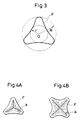
- the lamellar structure is a leaf-like crystalline orientation a extending radially along the cross-section of a carbon fiber.
- SEM scanning electron microscope
- the carbon fiber of this invention is characterized by having a surface smoothness S of 1.16 or below, being free from fine irregularities on the fiber surface and having a very high smoothness. If the fiber has fine irregularities on the surface, the irregularities are apt to act as fracture initiating points because of the concentration of stress on them, which causes decreases in the compressive strength and the bending strength of especially a composite made therefrom.
- Such a carbon fiber of a surface smoothness S ⁇ 1.16 can be easily produced from a PAN precursor produced by the dry-jet wet spinning process. Although such a high surface smoothness can be attained also by the dry spinning or melt spinning process, it is difficult to properly control the above-mentioned degree D of deformation of the cross-section of the fiber because a precursor produced by the dry spinning process has a large volume shrinkage caused by the evaporation of the solvent from the spinning dope, so that there is a tendency that the cross-section of the fiber is markedly different from the shape of the noncircular cross-section hole of a spinneret. Further, as described above, it is impossible to produce a good carbon fiber by the melt spinning process.
- the above described noncircular cross-section carbon fiber of this invention can be produced from a PAN precursor produced by the dry-jet wet spinning process and subjecting this precursor to an oxidation step and a carbonzation step.
- the dry-jet wet spinning process herein mentioned is a process comprising spinning temporarily a dope through the holes of a spinneret into air or an inert atmosphere and immediately coagulating the extrudate by immersing in a coagulation bath.
- the process for producing a carbon fiber will now be described in more detail.
- the precursor of the acrylic fiber used in the production of the carbon fiber in this invention is produced from a PAN polymer prepared from 95 mol % or above, desirably 98 mol % or above, of acrylonitrile (hereinafter referred to as AN) and desirably 5 mol % or below, particularly desirably 2 mol % or below, of a vinyl compound (hereinafter referred to as vinyl monomer) having copolymerizability with AN and being capable of accelerating the oxidation.
- AN acrylonitrile
- vinyl monomer a vinyl compound having copolymerizability with AN and being capable of accelerating the oxidation.
- vinyl monomer promoting the oxidation examples include acrylic acid, methacrylic acid, itaconic acid, and alkali metal salts and ammonium salts thereof, ⁇ -(1-hydroxylethyl)acrylonitrile, and hydroxylated esters of acrylic acid. Further, in order to improve the spinnability, yarn forming property, etc.
- a PAN polymer it is also possible to copolymerize 5 mol % or below, desirably 2 mol % or below (in terms of the total amount of the comonomers) of a third component such as lower alkyl esters of the above-mentioned acrylic acid and methacrylic acid, allylsulfonic acid, methallylsufonic acid, styrenesulfonic acid, and alkali metal salts thereof, vinyl acetate or vinyl chloride in addition to these vinyl monomers promoting the oxidation.
- a third component such as lower alkyl esters of the above-mentioned acrylic acid and methacrylic acid, allylsulfonic acid, methallylsufonic acid, styrenesulfonic acid, and alkali metal salts thereof, vinyl acetate or vinyl chloride in addition to these vinyl monomers promoting the oxidation.
- Such PAN polymers can be prepared by for exmaple emulsion, suspension, bulk or solution polymerization.
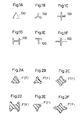
- Examples of the shape of the hole are those represented by the numeral 100 in Figs. 1A to 1F.
- the cross-section of the fiber obtained by spinning through any of the holes 100 of Figs. 1A to 1F will have any of the shapes represented by F' in Figs. 2A to 2F.
- These cross-sections, even when the fibers are converted into carbon fibers F by calcination, are kept without being substantially changed. Therefore, it is suitable that the degree D of deformation of the cross-section of the fiber to be used as a precursor, like the above-mentioned carbon fiber, is within a range of desirably 1.1 to 7.0, more desirably 1.2 to 6.0, still more desirably 1.3 to 5.0.
- the dope extruded from the hole is temporarily spun into air or an inert atmosphere and immediately immersed in a coagulation bath.
- the coagulation bath is constituted of a solvent for PAN and a coagulant.
- Suitable examples of the coagulant include water, methanol and acetone, and especially water is preferably from the viewpoints of safety and recoverability.
- the coagulated fibre is washed with water, drawn in hot water and given 0.2 to 1.5 wt % of a process lubricant per unit weight of the dry fibre.
- a silicone compound or a modified silicone compound effective especially in preventing single-filaments from being fused with each other during calcination as a component of the lubricant.
- the fibre After being given the process lubricant, the fibre is dried and densified to give a densified fibre. This fibre is then optionally subjected to a secondary drawing in for example steam.
- the single-filament fineness of the precursor obtained in this way is a very important factor for determining the properties of the non circular cross-section carbon fibre to be obtained. In this invention, it is desirably 0.11 to 2.78 dtex (0.1 to 2.5 denier), more desirably 0.22 to 2.22 dtex (0.2 to 2.0 denier), still more desirably 0.33 to 1.67 dtex (0.3 to 1.5 denier). When it is below 0.11 dtex (0.1 denier), breaking of single-filament frequently occurs.
- the precursor of the acrylic fiber spun in this way is converted into carbon fiber by calcination.
- the calcination of the precursor consists of an oxidation step, a carbonization step and optionally a graphitization step.
- the conditions of these steps are not particularly limited, it is desirable to adopt conditions under which structural defects such as voids are difficultly formed inside the fiber.
- condition of the step of carbonization in an inert atmosphere such as nitrogen is desirably such that the rate of temperature rise in the temperature ranges of 300 to 700° C and 1000 to 1200° C is 1000° C/min or below, desirably 500° C/min or below.
- an inert atmosphere such as nitrogen
- noncircular cross-section carbon fiber obtained in this way it is desirable to subject the noncircular cross-section carbon fiber obtained in this way to electrolytic oxidation in an electrolytic bath comprising an aqueous sulfuric acid solution or an aqueous nitric acid solution, or to oxidation in the vapor or liquid phase.
- an electrolytic bath comprising an aqueous sulfuric acid solution or an aqueous nitric acid solution, or to oxidation in the vapor or liquid phase.
- the carbon fiber obtained by the above-mentioned process of this invention is a one having a cross-section which is a noncircular one having symmetry and having a lamellar structure-free substantially uniform crystalline structure.
- the strength and the modulus inherent in the carbon fiber lead to excellent properties such as the tensile strength and the tensile modulus of the fiber in the form of a composite of 2.94 GPa (300 kg/mm 2 ) or above and 196 GPa (20ton/mm 2 ) or above, respectively. Therefore, by forming this carbon fiber into a composite, the basic properties of the obtained composite, such as ILSS, compressive strength and bending strength can be improved.
- the matrix resins to be used in the carbon fiber composites of this invention may be any of thermo-setting and thermoplastic resins, and examples thereof include epoxy, phenolic, polyimide, polyester and polyamide resins.
- the carbon fiber composites can be produced by first processing the above-mentioned carbon fiber into prepregs, sheet molding compounds (SMC) or chopped fibers and molding the products by for example hand lay-up, autoclaving or protrusion.
- a mold was filled with a carbon fiber wound around a metallic frame in a volume fraction (Vf) of carbon fiber of 60 %, and a resin having the following composition was poured into the mold and vacuum-deaerated by heating under the following molding conditions. After being deaerated, the resin was cured by heating with a press under an applied pressure to prepare test pieces. The test pieces were tested on an "Instron" tester. The measured value was represented in terms of a value when Vf was 60 %.
- a prepreg sheet was produced by unidirectionally arranging carbon fibers on a resin film produced by coating a silicone resin-coated paper with #3620 resin (a product of Toray Industries, Inc., comprising an epoxy compound and a diamine), laying the same resin film as above on the carbon fibers and infiltrating the resin among the carbon fibers by using a press roll.
- Such prepreg sheets were laminated in such a manner that the fiber axes of the sheets might be the same, and autoclaved for 2 hours under a pressure of 0.59 MPa (6kg/cm 2 ) to cure the resin to make a flat plate of thickness of about 1 mm.
- This flat plate was cut with a diamond cutter to prepare a test piece which was 80 mm long inthe direction of the fiber axis and 12 mm wide in the direction perpendicular to the fiber axis.
- a test piece for the measurement of the compressive strength was prepared by bonding tabs of a thickness of about 1 mm comprising a composite of carbon fibers and an epoxy resin to both sides of each end of this test piece so as to leave a 5 mm unbonded middle part.
- Ammonia was blown into a dimethyl sulfoxide (DMSO) solution of an AN copolymer of an intrinsic viscosity [ ⁇ ] of 1.80 comprising 99.5 mol % of AN and 0.5 mol % of itaconic acid to modify the copolymer by substituting ammonium groups for the carboxyl terminals of the copolymer to thereby prepare a DMSO solution having a concentration of the modified copolymer of 20 wt %, and this solution was used as a spinning dope.
- DMSO dimethyl sulfoxide
- This spinning dope was spun by the dry-jet wet spinning process in such a way that the dope was spun through each of spinnerets having 1500 holes each having a slit width of 0.03 mm and being Y-, +-, H- or T-shaped temporarily into air in a 3 mm-wide space, and then immersed in a 30% aqueous DMSO solution at 10°C to form a coagulated fibre (Examples 1 to 4).
- a coagulated fibre was formed also by spinning the above-mentioned spinning dope by the dry-jet wet spinning process through a conventional spinneret having circular cross-section holes of a diameter of 0.06 mm (Comparative Example 1).
- Each coagulated fibre was washed with water and subjected to four-stage drawing in hot water to give a bath-drawn fibre.
- the overall draw ratio was 3.5, and the maximum temperature of the drawing bath was 70°C.
- the bath-drawn fibre was given a lubricant based on a modified silicone compound and dried with a heating roll at 130°C.
- the densified fibre was further drawn at a ratio of 2.5 in high-pressure steam to give acrylic fibre filaments of a single-filament fineness of 1.11 dtex (1.0 denier) and a total fineness of 1666.67 dtex (1500 denier).
- the obtained filament was oxidized while drawing it at a draw ratio of 1.05 in air at 240 to 260° C, and was converted into a carbon fiber by calcinating it in a carbonization furnace under a nitrogen atmosphere at a maximum temperature of 1400° C, a rate of temperature rise of 250° C/min in a temperature range of 300 to 700° C, and a rate of temperature rise of 400° C/min in a temperature range of 1000 to 1200° C.
- the obtained crbon fiber was further graphitized in a Tammann furnace at 1600 to 3000° C.
- the carbon fiber was optionally anodized in an electric bath containing an aqueous sulfuric acid or nitric acid solution as an electrolyte in order to improve the affinity for resin.
- a single-filament of the obtained noncircular cross-section carbon fiber was broken in water, and the fracture was observed with SEM, whereupon a leaf-like lamellar structure was observed in none of them.
- Table 1 gives the properties of resin-impregnated strands and composites of the carbon fibers obtained in this way.
- Table 1 shows that the noncircular cross-section carbon fibers such as Y-, +-, H- and T-section fibers of Examples 1 to 4 show composite properties exceeding those of the circular cross-section carbon fiber of Comparative Example 1.
- the availability of the strength of the circular cross-section carbon fiber having a resin-impregnated strand strength of 5.20 GPa (530kg/mm 2 ) in Comparative Example 1 was about 46 % because the fiber showed a tensile strength of 2.40 GPa (245kg/mm 2 ) as measured in the form of a composite.
- Example 1 the availability of the strength of carbon fiber in Example 1 was about 50 % because the Y cross-section carbon fiber having a resin-impregnated strand strength of 5.30 GPa (540kg/mm 2 ) showed a tensile strength of 2.68 GPa (273kg/mm 2 ) as measured in the form of a composite; the availability in Example 2 was about 50 % because the + cross-section carbon fiber having a resin-impregnated strand strength of 5.25 GPa (535kg/mm 2 ) showed a tensile strength of 2.65 GPa (270kg/mm 2 ) as measured in the form of a composite; the availability in Example 3 was about 52 % because the H cross-section carbon fiber having a resin-impregnated strand strength of 5.10 GPa (520kg/mm 2 ) showed a tensile strength of 2.65 GPa (270kg/mm 2 ) as measured in the form of a composite; and the availability in Example 4 was about 50 % because the T cross-
- Carbon fibers were produced under the same conditions as those of Example 1 and Comparative Example 1 except that in the cases of the spinneret having Y-shaped holes of Example 1 and the spinneret having circular holes of Comparative Example 1, the coagulation bath was a 55 % aqueous DMSO solution at 55° C, the above spinnerets were dipped in the coagulation bath for executing the wet spinning, the drawing in hot water was conducted in four stages, the overall draw ratio was 3, the maximum temperature of the drawing bath was 95° C, and the draw ratio in the high-pressure steam was 3.3.
- a non circular cross-section carbon fibre was produced under the same conditions as those of Example 1 except that a spinneret having 100 holes each of which was composed of a central circular pore of a diameter of 0.05 mm and 10 slits of a width of 0.02 mm and a length of 0.06 mm equidistantly and radially arranged from the positions 0.05 mm distant from the centre of the pore was used, the air gap between the spinneret and the coagulating bath was 1.5 mm, the single-filament fineness was 1.67 dtex (1.5 denier), the total fineness was 166.67 dtex (150 denier), and four multifilaments were combined for oxidation for a period of 1.5 times as long (Example 5).
- Example 4 For comparison, a non circular cross-section carbon fibre was produced under the same conditions as those of Example 5 except that 12 slits were equidistantly and radially arranged (Comparative Example 4).
- Example 5 Furthermore, a circular cross-section carbon fibre was produced under the same conditions as those of Example 5 except that a spinneret having 100 circular holes of a diameter of 0.12 mm was used (Comparative Example 5).
- Fig. 5 shows the relationship between the modulus of the resin-impregnated strand and the compressive strength of the composite of each of the above carbon fibers.
- the noncircular cross-section carbon fiber of this invention shows a, compressive strength exceeding that of the circular cross-section carbon fiber.
Landscapes
- Engineering & Computer Science (AREA)
- Textile Engineering (AREA)
- Mechanical Engineering (AREA)
- Chemical & Material Sciences (AREA)
- Chemical Kinetics & Catalysis (AREA)
- General Chemical & Material Sciences (AREA)
- Inorganic Fibers (AREA)
Applications Claiming Priority (3)
| Application Number | Priority Date | Filing Date | Title |
|---|---|---|---|
| JP22957889 | 1989-09-05 | ||
| JP22957889 | 1989-09-05 | ||
| JP229578/89 | 1989-09-05 |
Publications (3)
| Publication Number | Publication Date |
|---|---|
| EP0416789A2 EP0416789A2 (en) | 1991-03-13 |
| EP0416789A3 EP0416789A3 (en) | 1991-09-18 |
| EP0416789B1 true EP0416789B1 (en) | 1999-07-28 |
Family
ID=16894374
Family Applications (1)
| Application Number | Title | Priority Date | Filing Date |
|---|---|---|---|
| EP90309310A Expired - Lifetime EP0416789B1 (en) | 1989-09-05 | 1990-08-24 | Noncircular cross-section carbon fibres, process for producing the same and composite containing them |
Country Status (4)
| Country | Link |
|---|---|
| US (1) | US5227237A (OSRAM) |
| EP (1) | EP0416789B1 (OSRAM) |
| KR (1) | KR0156870B1 (OSRAM) |
| DE (1) | DE69033221T2 (OSRAM) |
Families Citing this family (13)
| Publication number | Priority date | Publication date | Assignee | Title |
|---|---|---|---|---|
| US5677372A (en) * | 1993-04-06 | 1997-10-14 | Sumitomo Electric Industries, Ltd. | Diamond reinforced composite material |
| JP3175801B2 (ja) * | 1993-09-17 | 2001-06-11 | 株式会社東芝 | 二次電池用負極 |
| US5366798A (en) * | 1993-11-30 | 1994-11-22 | Wangner Systems Corporation | Multi-layered papermaking fabric having stabilized stacked weft yarn |
| EP0750004B1 (en) * | 1995-01-09 | 2004-07-07 | Toray Industries, Inc. | Prepregs and carbon fiber-reinforced composite material |
| US5518836A (en) * | 1995-01-13 | 1996-05-21 | Mccullough; Francis P. | Flexible carbon fiber, carbon fiber electrode and secondary energy storage devices |
| HU227286B1 (en) | 2000-06-23 | 2011-01-28 | Mitsubishi Rayon Co | Carbon fiber precursor fiber bundle and process for making it |
| US20090013538A1 (en) * | 2007-03-29 | 2009-01-15 | Acme United Corporation | Cutting instrument |
| TWI553175B (zh) | 2010-10-13 | 2016-10-11 | 三菱麗陽股份有限公司 | 碳纖維前驅體丙烯酸系纖維束、防焰處理方法、碳纖維束及其製造方法、碳纖維預浸體、單方向性纖維強化織物以及纖維強化塑膠的成形方法 |
| JP5842916B2 (ja) * | 2012-03-29 | 2016-01-13 | 三菱レイヨン株式会社 | 炭素繊維熱可塑性樹脂プリプレグ、炭素繊維複合材料、ならびに製造方法 |
| US9314885B2 (en) * | 2012-05-11 | 2016-04-19 | Empire Technology Development Llc | Shape memory alloy composite flexible substrates |
| TW201802311A (zh) * | 2016-07-02 | 2018-01-16 | 瑞來斯實業公司 | 一種用於擠壓纖維的噴絲板 |
| CN110257936A (zh) * | 2019-06-18 | 2019-09-20 | 桐昆集团浙江恒盛化纤有限公司 | 一种t形纤维 |
| US20230001618A1 (en) * | 2021-06-30 | 2023-01-05 | Connie Jackson | Carbon-fiber fuel tank |
Family Cites Families (12)
| Publication number | Priority date | Publication date | Assignee | Title |
|---|---|---|---|---|
| US3600491A (en) * | 1968-02-14 | 1971-08-17 | Japan Exlan Co Ltd | Production of hollow acrylic fibers |
| ZA702622B (en) * | 1969-05-12 | 1971-05-27 | American Cyanamid Co | Process for producing an acrylic synthetic fiber having a non-circular cross-section |
| USRE30414E (en) * | 1974-10-21 | 1980-10-07 | Toray Industries, Inc. | Process for producing a high tensile strength, high Young's modulus carbon fiber having excellent internal structure homogeneity |
| JPS59168126A (ja) * | 1983-03-14 | 1984-09-21 | Toray Ind Inc | ピツチ系炭素繊維の製造方法 |
| JPS59199809A (ja) * | 1983-04-20 | 1984-11-13 | Japan Exlan Co Ltd | 高強力ポリアクリロニトリル系繊維及びその製造法 |
| US4628001A (en) * | 1984-06-20 | 1986-12-09 | Teijin Limited | Pitch-based carbon or graphite fiber and process for preparation thereof |
| US4695415A (en) * | 1985-01-24 | 1987-09-22 | Mitsubishi Rayon Co., Ltd. | Method for producing acrylic fiber precursors |
| US5154908A (en) * | 1985-09-12 | 1992-10-13 | Clemson University | Carbon fibers and method for producing same |
| DE3783675T2 (de) * | 1986-07-28 | 1993-07-01 | Mitsubishi Rayon Co | Verfahren zur herstellung von acrylfasern mit hohen fasereigenschaften. |
| JPS63211326A (ja) * | 1987-02-20 | 1988-09-02 | Toray Ind Inc | 高い圧縮強度を有する黒鉛繊維 |
| US4935180A (en) * | 1988-08-25 | 1990-06-19 | Basf Aktiengesellschaft | Formation of melt-spun acrylic fibers possessing a highly uniform internal structure which are particularly suited for thermal conversion to quality carbon fibers |
| JPH0321916A (ja) * | 1989-06-19 | 1991-01-30 | Japan Aviation Electron Ind Ltd | 光変調器 |
-
1990
- 1990-08-22 KR KR1019900012986A patent/KR0156870B1/ko not_active Expired - Fee Related
- 1990-08-24 DE DE69033221T patent/DE69033221T2/de not_active Expired - Fee Related
- 1990-08-24 EP EP90309310A patent/EP0416789B1/en not_active Expired - Lifetime
- 1990-08-31 US US07/575,709 patent/US5227237A/en not_active Expired - Lifetime
Also Published As
| Publication number | Publication date |
|---|---|
| KR0156870B1 (ko) | 1998-12-01 |
| US5227237A (en) | 1993-07-13 |
| EP0416789A3 (en) | 1991-09-18 |
| DE69033221T2 (de) | 2000-02-03 |
| DE69033221D1 (de) | 1999-09-02 |
| KR910006523A (OSRAM) | 1991-04-29 |
| EP0416789A2 (en) | 1991-03-13 |
Similar Documents
| Publication | Publication Date | Title |
|---|---|---|
| EP0416789B1 (en) | Noncircular cross-section carbon fibres, process for producing the same and composite containing them | |
| US10370507B2 (en) | Carbon fiber thermoplastic resin prepreg, carbon fiber composite material and producing method | |
| KR101335140B1 (ko) | 탄소 섬유, 탄소 섬유 제조용 폴리아크릴로니트릴계 전구체섬유의 제조 방법, 및 탄소 섬유의 제조 방법 | |
| EP2208812B1 (en) | Carbon fiber strand and process for producing the same | |
| JPH11241230A (ja) | 炭素繊維、炭素繊維用前駆体繊維、複合材料および炭素繊 維の製造方法 | |
| US20130130028A1 (en) | Method for preparing carbon fiber precursor | |
| JP5434187B2 (ja) | ポリアクリロニトリル系連続炭素繊維束およびその製造方法 | |
| KR100383455B1 (ko) | 프리프래그및탄소섬유강화복합재료 | |
| US20100266827A1 (en) | Carbon fiber and composite material using the same | |
| JP2003073932A (ja) | 炭素繊維 | |
| JP2005133274A (ja) | 炭素繊維と同炭素繊維を含む複合材料 | |
| JP2892127B2 (ja) | 非円形断面炭素繊維、その製造方法および炭素繊維複合材料 | |
| EP0178890B1 (en) | A proces for preparing a carbon fiber of high strength | |
| JP2000160436A (ja) | 炭素繊維、及び炭素繊維用プリカーサーの製造方法 | |
| JP4975217B2 (ja) | 炭素繊維とその製造方法、炭素繊維用前駆体繊維の製造方法並びにプリプレグ | |
| JP6119321B2 (ja) | 繊維強化複合材料 | |
| JPH0397918A (ja) | 異形断面炭素繊維の製造法 | |
| WO2020071445A1 (ja) | 前駆体繊維束の製造方法及び炭素繊維束の製造方法並びに炭素繊維束 | |
| JP2004232155A (ja) | 軽量化ポリアクリロニトリル系炭素繊維及びその製造方法 | |
| KR102197333B1 (ko) | 폴리아크릴로니트릴계 내염화 섬유, 탄소섬유 및 그의 제조방법 | |
| JPH08296124A (ja) | 非円形断面炭素繊維および炭素繊維強化複合材料 | |
| JPH1088430A (ja) | 炭素繊維、炭素繊維製造用プリカーサーおよびその製造方法 | |
| JPH11124743A (ja) | 炭素繊維および炭素繊維強化複合材料 | |
| JP4238436B2 (ja) | 炭素繊維の製造方法 | |
| JPH0397917A (ja) | 異形断面炭素繊維およびその製造方法 |
Legal Events
| Date | Code | Title | Description |
|---|---|---|---|
| PUAI | Public reference made under article 153(3) epc to a published international application that has entered the european phase |
Free format text: ORIGINAL CODE: 0009012 |
|
| 17P | Request for examination filed |
Effective date: 19901220 |
|
| AK | Designated contracting states |
Kind code of ref document: A2 Designated state(s): DE FR GB IT |
|
| PUAL | Search report despatched |
Free format text: ORIGINAL CODE: 0009013 |
|
| AK | Designated contracting states |
Kind code of ref document: A3 Designated state(s): DE FR GB IT |
|
| 17Q | First examination report despatched |
Effective date: 19961220 |
|
| GRAG | Despatch of communication of intention to grant |
Free format text: ORIGINAL CODE: EPIDOS AGRA |
|
| GRAG | Despatch of communication of intention to grant |
Free format text: ORIGINAL CODE: EPIDOS AGRA |
|
| GRAH | Despatch of communication of intention to grant a patent |
Free format text: ORIGINAL CODE: EPIDOS IGRA |
|
| GRAH | Despatch of communication of intention to grant a patent |
Free format text: ORIGINAL CODE: EPIDOS IGRA |
|
| GRAA | (expected) grant |
Free format text: ORIGINAL CODE: 0009210 |
|
| AK | Designated contracting states |
Kind code of ref document: B1 Designated state(s): DE FR GB IT |
|
| PG25 | Lapsed in a contracting state [announced via postgrant information from national office to epo] |
Ref country code: IT Free format text: LAPSE BECAUSE OF FAILURE TO SUBMIT A TRANSLATION OF THE DESCRIPTION OR TO PAY THE FEE WITHIN THE PRE;WARNING: LAPSES OF ITALIAN PATENTS WITH EFFECTIVE DATE BEFORE 2007 MAY HAVE OCCURRED AT ANY TIME BEFORE 2007. THE CORRECT EFFECTIVE DATE MAY BE DIFFERENT FROM THE ONE RECORDED.SCRIBED TIME-LIMIT Effective date: 19990728 |
|
| REF | Corresponds to: |
Ref document number: 69033221 Country of ref document: DE Date of ref document: 19990902 |
|
| ET | Fr: translation filed | ||
| PLBE | No opposition filed within time limit |
Free format text: ORIGINAL CODE: 0009261 |
|
| STAA | Information on the status of an ep patent application or granted ep patent |
Free format text: STATUS: NO OPPOSITION FILED WITHIN TIME LIMIT |
|
| 26N | No opposition filed | ||
| REG | Reference to a national code |
Ref country code: GB Ref legal event code: IF02 |
|
| PGFP | Annual fee paid to national office [announced via postgrant information from national office to epo] |
Ref country code: FR Payment date: 20060808 Year of fee payment: 17 |
|
| PGFP | Annual fee paid to national office [announced via postgrant information from national office to epo] |
Ref country code: DE Payment date: 20060817 Year of fee payment: 17 |
|
| PGFP | Annual fee paid to national office [announced via postgrant information from national office to epo] |
Ref country code: GB Payment date: 20060823 Year of fee payment: 17 |
|
| GBPC | Gb: european patent ceased through non-payment of renewal fee |
Effective date: 20070824 |
|
| REG | Reference to a national code |
Ref country code: FR Ref legal event code: ST Effective date: 20080430 |
|
| PG25 | Lapsed in a contracting state [announced via postgrant information from national office to epo] |
Ref country code: DE Free format text: LAPSE BECAUSE OF NON-PAYMENT OF DUE FEES Effective date: 20080301 |
|
| PG25 | Lapsed in a contracting state [announced via postgrant information from national office to epo] |
Ref country code: FR Free format text: LAPSE BECAUSE OF NON-PAYMENT OF DUE FEES Effective date: 20070831 |
|
| PG25 | Lapsed in a contracting state [announced via postgrant information from national office to epo] |
Ref country code: GB Free format text: LAPSE BECAUSE OF NON-PAYMENT OF DUE FEES Effective date: 20070824 |