EP0410050A2 - Behandlung von Petroleumkoks, um das Aufblähen zu verhindern - Google Patents
Behandlung von Petroleumkoks, um das Aufblähen zu verhindern Download PDFInfo
- Publication number
- EP0410050A2 EP0410050A2 EP89307474.0A EP89307474A EP0410050A2 EP 0410050 A2 EP0410050 A2 EP 0410050A2 EP 89307474 A EP89307474 A EP 89307474A EP 0410050 A2 EP0410050 A2 EP 0410050A2
- Authority
- EP
- European Patent Office
- Prior art keywords
- coke particles
- particles
- coke
- sodium carbonate
- calcined
- Prior art date
- Legal status (The legal status is an assumption and is not a legal conclusion. Google has not performed a legal analysis and makes no representation as to the accuracy of the status listed.)
- Granted
Links
- 239000000571 coke Substances 0.000 title claims abstract description 143
- 230000001007 puffing effect Effects 0.000 title claims abstract description 62
- 239000002006 petroleum coke Substances 0.000 title claims abstract description 49
- 239000002245 particle Substances 0.000 claims abstract description 168
- 238000000034 method Methods 0.000 claims abstract description 54
- DGAQECJNVWCQMB-PUAWFVPOSA-M Ilexoside XXIX Chemical compound C[C@@H]1CC[C@@]2(CC[C@@]3(C(=CC[C@H]4[C@]3(CC[C@@H]5[C@@]4(CC[C@@H](C5(C)C)OS(=O)(=O)[O-])C)C)[C@@H]2[C@]1(C)O)C)C(=O)O[C@H]6[C@@H]([C@H]([C@@H]([C@H](O6)CO)O)O)O.[Na+] DGAQECJNVWCQMB-PUAWFVPOSA-M 0.000 claims abstract description 49
- 239000011734 sodium Substances 0.000 claims abstract description 48
- 229910052708 sodium Inorganic materials 0.000 claims abstract description 48
- 230000008569 process Effects 0.000 claims abstract description 45
- NINIDFKCEFEMDL-UHFFFAOYSA-N Sulfur Chemical compound [S] NINIDFKCEFEMDL-UHFFFAOYSA-N 0.000 claims abstract description 43
- 239000011593 sulfur Substances 0.000 claims abstract description 43
- 229910052717 sulfur Inorganic materials 0.000 claims abstract description 43
- OKTJSMMVPCPJKN-UHFFFAOYSA-N Carbon Chemical compound [C] OKTJSMMVPCPJKN-UHFFFAOYSA-N 0.000 claims abstract description 41
- 238000006243 chemical reaction Methods 0.000 claims abstract description 26
- 229910052799 carbon Inorganic materials 0.000 claims abstract description 24
- 150000001875 compounds Chemical class 0.000 claims abstract description 20
- 150000001339 alkali metal compounds Chemical class 0.000 claims abstract description 18
- 238000001816 cooling Methods 0.000 claims abstract description 12
- ZLMJMSJWJFRBEC-UHFFFAOYSA-N Potassium Chemical compound [K] ZLMJMSJWJFRBEC-UHFFFAOYSA-N 0.000 claims abstract description 9
- 239000011591 potassium Substances 0.000 claims abstract description 9
- 229910052700 potassium Inorganic materials 0.000 claims abstract description 9
- CDBYLPFSWZWCQE-UHFFFAOYSA-L Sodium Carbonate Chemical compound [Na+].[Na+].[O-]C([O-])=O CDBYLPFSWZWCQE-UHFFFAOYSA-L 0.000 claims description 127
- 229910000029 sodium carbonate Inorganic materials 0.000 claims description 65
- 239000003112 inhibitor Substances 0.000 claims description 49
- 239000011329 calcined coke Substances 0.000 claims description 45
- 238000001354 calcination Methods 0.000 claims description 37
- 239000000843 powder Substances 0.000 claims description 21
- 239000000203 mixture Substances 0.000 claims description 20
- 238000004519 manufacturing process Methods 0.000 claims description 11
- 239000011230 binding agent Substances 0.000 claims description 10
- 238000010438 heat treatment Methods 0.000 claims description 9
- 239000003795 chemical substances by application Substances 0.000 claims description 8
- 239000000945 filler Substances 0.000 claims description 8
- 230000002401 inhibitory effect Effects 0.000 claims description 8
- 230000014759 maintenance of location Effects 0.000 claims description 7
- VNWKTOKETHGBQD-UHFFFAOYSA-N methane Chemical compound C VNWKTOKETHGBQD-UHFFFAOYSA-N 0.000 claims description 4
- BWHMMNNQKKPAPP-UHFFFAOYSA-L potassium carbonate Chemical compound [K+].[K+].[O-]C([O-])=O BWHMMNNQKKPAPP-UHFFFAOYSA-L 0.000 claims description 4
- 229910052783 alkali metal Inorganic materials 0.000 claims description 3
- 150000001340 alkali metals Chemical class 0.000 claims description 3
- 229910000027 potassium carbonate Inorganic materials 0.000 claims description 2
- 239000007864 aqueous solution Substances 0.000 claims 1
- 229910052784 alkaline earth metal Inorganic materials 0.000 abstract description 16
- 239000003513 alkali Substances 0.000 abstract description 15
- 150000001341 alkaline earth metal compounds Chemical class 0.000 abstract description 8
- 150000001342 alkaline earth metals Chemical class 0.000 abstract description 8
- OYPRJOBELJOOCE-UHFFFAOYSA-N Calcium Chemical compound [Ca] OYPRJOBELJOOCE-UHFFFAOYSA-N 0.000 abstract description 3
- FYYHWMGAXLPEAU-UHFFFAOYSA-N Magnesium Chemical compound [Mg] FYYHWMGAXLPEAU-UHFFFAOYSA-N 0.000 abstract description 3
- 239000011575 calcium Substances 0.000 abstract description 3
- 229910052791 calcium Inorganic materials 0.000 abstract description 3
- 239000011777 magnesium Substances 0.000 abstract description 3
- 229910052749 magnesium Inorganic materials 0.000 abstract description 3
- 229910002804 graphite Inorganic materials 0.000 description 18
- 239000010439 graphite Substances 0.000 description 18
- UQSXHKLRYXJYBZ-UHFFFAOYSA-N Iron oxide Chemical compound [Fe]=O UQSXHKLRYXJYBZ-UHFFFAOYSA-N 0.000 description 14
- XLYOFNOQVPJJNP-UHFFFAOYSA-N water Substances O XLYOFNOQVPJJNP-UHFFFAOYSA-N 0.000 description 12
- 238000012360 testing method Methods 0.000 description 9
- 238000002149 energy-dispersive X-ray emission spectroscopy Methods 0.000 description 8
- 238000000724 energy-dispersive X-ray spectrum Methods 0.000 description 6
- 238000001125 extrusion Methods 0.000 description 6
- 239000011148 porous material Substances 0.000 description 6
- 239000002008 calcined petroleum coke Substances 0.000 description 5
- 239000007789 gas Substances 0.000 description 5
- 238000010791 quenching Methods 0.000 description 5
- 238000009826 distribution Methods 0.000 description 4
- 238000002474 experimental method Methods 0.000 description 4
- 238000000227 grinding Methods 0.000 description 4
- 239000011331 needle coke Substances 0.000 description 4
- 238000012545 processing Methods 0.000 description 4
- 238000005507 spraying Methods 0.000 description 4
- -1 that is Substances 0.000 description 4
- 238000004458 analytical method Methods 0.000 description 3
- 238000013459 approach Methods 0.000 description 3
- 230000008901 benefit Effects 0.000 description 3
- 238000002386 leaching Methods 0.000 description 3
- 230000035515 penetration Effects 0.000 description 3
- 239000003208 petroleum Substances 0.000 description 3
- 238000006722 reduction reaction Methods 0.000 description 3
- 230000001629 suppression Effects 0.000 description 3
- 229910000831 Steel Inorganic materials 0.000 description 2
- 239000000567 combustion gas Substances 0.000 description 2
- 239000000428 dust Substances 0.000 description 2
- 238000005087 graphitization Methods 0.000 description 2
- 230000005484 gravity Effects 0.000 description 2
- 230000005764 inhibitory process Effects 0.000 description 2
- 239000000463 material Substances 0.000 description 2
- 230000000171 quenching effect Effects 0.000 description 2
- 230000009467 reduction Effects 0.000 description 2
- 150000003839 salts Chemical class 0.000 description 2
- 239000002002 slurry Substances 0.000 description 2
- 238000001228 spectrum Methods 0.000 description 2
- 239000007921 spray Substances 0.000 description 2
- 239000010959 steel Substances 0.000 description 2
- 239000000126 substance Substances 0.000 description 2
- UGFAIRIUMAVXCW-UHFFFAOYSA-N Carbon monoxide Chemical compound [O+]#[C-] UGFAIRIUMAVXCW-UHFFFAOYSA-N 0.000 description 1
- 239000004593 Epoxy Substances 0.000 description 1
- 241001137350 Fratercula Species 0.000 description 1
- OAICVXFJPJFONN-UHFFFAOYSA-N Phosphorus Chemical compound [P] OAICVXFJPJFONN-UHFFFAOYSA-N 0.000 description 1
- 230000002378 acidificating effect Effects 0.000 description 1
- 230000009471 action Effects 0.000 description 1
- 238000003915 air pollution Methods 0.000 description 1
- 239000002956 ash Substances 0.000 description 1
- 229910002091 carbon monoxide Inorganic materials 0.000 description 1
- 239000011233 carbonaceous binding agent Substances 0.000 description 1
- 150000003841 chloride salts Chemical class 0.000 description 1
- 238000004939 coking Methods 0.000 description 1
- 238000005260 corrosion Methods 0.000 description 1
- 230000007797 corrosion Effects 0.000 description 1
- 230000005574 cross-species transmission Effects 0.000 description 1
- 235000014113 dietary fatty acids Nutrition 0.000 description 1
- 238000009792 diffusion process Methods 0.000 description 1
- 238000010410 dusting Methods 0.000 description 1
- 230000000694 effects Effects 0.000 description 1
- 238000010891 electric arc Methods 0.000 description 1
- 238000005516 engineering process Methods 0.000 description 1
- 230000007613 environmental effect Effects 0.000 description 1
- 239000000194 fatty acid Substances 0.000 description 1
- 229930195729 fatty acid Natural products 0.000 description 1
- 150000004665 fatty acids Chemical class 0.000 description 1
- 239000003546 flue gas Substances 0.000 description 1
- 239000000446 fuel Substances 0.000 description 1
- 238000002309 gasification Methods 0.000 description 1
- 238000010348 incorporation Methods 0.000 description 1
- 230000003993 interaction Effects 0.000 description 1
- 230000002427 irreversible effect Effects 0.000 description 1
- 238000009533 lab test Methods 0.000 description 1
- 239000007788 liquid Substances 0.000 description 1
- 238000005259 measurement Methods 0.000 description 1
- 239000000155 melt Substances 0.000 description 1
- 229910052751 metal Inorganic materials 0.000 description 1
- 239000002184 metal Substances 0.000 description 1
- 150000002736 metal compounds Chemical class 0.000 description 1
- 238000000465 moulding Methods 0.000 description 1
- 239000003345 natural gas Substances 0.000 description 1
- 230000001590 oxidative effect Effects 0.000 description 1
- 230000000737 periodic effect Effects 0.000 description 1
- 239000011574 phosphorus Substances 0.000 description 1
- 229910052698 phosphorus Inorganic materials 0.000 description 1
- 239000000376 reactant Substances 0.000 description 1
- 230000035484 reaction time Effects 0.000 description 1
- 238000001878 scanning electron micrograph Methods 0.000 description 1
- 239000010703 silicon Substances 0.000 description 1
- 229910052710 silicon Inorganic materials 0.000 description 1
- 239000007787 solid Substances 0.000 description 1
- 238000003860 storage Methods 0.000 description 1
- 150000003467 sulfuric acid derivatives Chemical class 0.000 description 1
- 230000032258 transport Effects 0.000 description 1
- 238000009827 uniform distribution Methods 0.000 description 1
- 238000011144 upstream manufacturing Methods 0.000 description 1
- 239000003039 volatile agent Substances 0.000 description 1
Images





Definitions
- the present invention relates to treating high sulfur petroleum coke particles. It also relates to carbon and graphite articles, particularly electric furnace electrodes, and to a process for producing such electrodes of improved quality using high sulfur petroleum cokes. More particularly, the invention relates to a process for treating calcined petroleum cokes with a puffing inhibitor prior to incorporating the coke into a carbonaceous mix. In an important aspect, the invention relates to a carbonaceous filler or aggregate containing discrete particles of a calcined petroleum coke having a high sulfur content and having a puffing inhibiting agent distributed throughout the mass of the particles, the inhibiting agent serving to reduce or eliminate coke puffing during manufacture and use of graphite and carbon articles.
- Petroleum coke particles have a tendency to "puff", that is, to expand and even to split when heated to temperatures above about 1500°C, if they contain more than about 0.3% by weight sulfur. Electrodes made from such cokes lose density and strength and sometimes split lengthwise when heated to these high temperatures. As indicated, graphite electrodes are normally heated to at least 2800°C during their manufacturing process. Carbon electrodes, which are not graphitized during the manufacturing process, reach temperatures between about 2000°C and 2500°C during their use in silicon or phosphorus furnaces.
- Puffing is associated with the release of sulfur from its bond with carbon inside the coke particles. If the sulfur containing vapors cannot escape from the particles or from the electrode fast enough, they create internal pressure which, in turn, increases the volume of the particles and may cause the electrode to split.
- the conventional remedy for puffing has been to add an inhibitor such as iron oxide or other metal compound to the coke-pitch mixture before the electrodes have been formed. It has been shown, for example, that about 2 weight percent iron oxide can be effective to reduce coke puffing. Some cokes that have a higher tendency to puff or start puffing at a lower temperture cannot be adequately controlled by iron oxide.
- the puffing inhibitor may be introduced by dusting fine powders of the inhibitor onto the granular petroleum coke or an aqueous slurry containing the inhibitor may be prepared and sprayed onto the coke before heating the coke particles to puffing temperatures.
- the coke particles are then cooled to about ambient temperatures and blended with a pitch binder to form a conventional carbonaceous mix.
- the puffing inhibitor combines with the sulfur and is volatilized when the coke is heated to puffing temperatures and above.
- the problem with this approach is that the process requires heating the coke particles to temperatures tht are significantly higher than those ordinarily employed during the usual calcining process. Consequently, this treatment can only be carried out with a process which is different from ordinary calcining practices, consuming more energy and requiring more expensive equipment.
- the present invention is directed to an improved process for treating high sulfur petroleum coke with a puffing inhibitor prior to incorporating the coke into a carbonaceous mix.
- the improved process comprises contacting particles of the high sulfur petroleum coke with a compound containing an alkali or alkaline earth metal selected from the group consisting of sodium, potassium, calcium and magnesium, at an elevated temperature above that at which the alkali or alkaline earth metal compound begins to react with carbon, but below the temperature at which the coke particles would begin to puff in the absence of the compound; maintaining the coke particles at the elevated temperature for a sufficient period of time to permit the reaction to proceed and allow products of reaction to penetrate the particles and form an alkali or alkaline earth metal containing deposit throughout the mass of the particles; and then cooling the so-treated coke particles.
- the process of the present invention is preferably carried out at an elevated temperature between about 1200°C and 1400 C. However, it has been found that temperatures as low as 750°C are adequate to promote the required reaction between the puffing inhibitor and coke particles and can be employed.
- the puffing inhibitor used in the process of the present invention may be a salt of the alkali or alkaline earth metal, and preferably is sodium carbonate.
- the inhibitor may be admixed with the petroleum coke particles before or after heating during the usual calcining process, and may be incorporated with the coke particles in the form of dry, granulated powders or as a solution containing the inhibitor which can be sprayed onto the particles.
- the inhibitor is employed in amounts greater than about 0.2 percent by weight of the coke.
- the improved process for treating high sulfur petroleum coke particles comprises:
- a carbonaceous filler or aggregate for use in the production of carbon or graphite articles which comprises discrete particles of petroleum coke having a high sulfur content and having a puffing inhibiting agent distributed throughout the mass of the particles.
- the puffing inhibiting agent comprises a water-insoluble compound of an alkali or alkaline earth metal selected from the group consisting of sodium, potassium, calcium and magnesium; the average amount of the metal in the particles being greater than about 0.15 percent by weight.
- Petroleum coke is produced by coking heavy petroleum residues, as is well known in the prior art.
- Raw petroleum coke that is, petroleum coke that has not been calcined, usually has a volatile matter content of between about 6 and 14 percent.
- the volatile matter is typically removed by heating the raw petroleum coke in a calciner to temperatures of between about 1200 C and about 1400' C. Occasionally, calcining temperatures as high as 1500 C may be employed.
- the volatile matter content of a coke after calcination is usually less than about one percent by weight.
- Raw petroleum coke is ordinarily reduced in size to particles 4" or less prior to calcining.
- the starting coke material may be either a raw petroleum coke or a petroleum coke that has been calcined by conventional methode:
- the petroleum cokes to which the present invention is particularly directed are the so called "high sulfur" petroleum cokes which ordinarily contain more than about 0.7 percent by weight sulfur.
- These high sulfur petroleum cokes ordinarily cannot be adequately controlled by puffing inhibition methods that are presently known in the art. Although these cokes cost less, their use for production of carbon or graphite articles is either limited or requires modified, more expensive processing technology.
- Sulfur is released from its chemical bond with carbon when a petroleum coke is heated to temperatures higher than about 1500°C, and in most cases to at least about 1600°C. which is higher than ordinary calcining temperatures. If this release of sulfur is not inhibited or the sulfur is not tied up chemically inside the coke structure, then the rapid escape of sulfur-containing vapors will create internal pressure in the coke particles which tends to expand the particles, sometimes even splitting them or splitting the articles made therefrom. This phenomenon is called puffing.
- puffing of the formed carbon or graphite article can be significantly reduced or eliminated by treating the petroleum coke particles with an alkali or alkaline earth metal compound and especially a salt of sodium or potassium, such as sodium or potassium carbonate, at temperatures which are well below the temperature at which the coke begins to puff, prior to incorporating the coke particles into a carbonaceous mix.
- an alkali metal compound e.g..
- sodium carbonate can be effectively reduced with carbon in a high-temperature reactor to produce alkali metal vapors and carbon monoxide. It has been surprisingly found according to the invention that if the alkali or alkaline earth metal compound is allowed to stand in content with the petroleum coke particles for a sufficiently long period of time, e.g. about one minute or more, while maintaining the temperature above that at which this reduction reaction occurs, e.g. about 750 ° C in the case of sodium carbonate, then the alkali or alkaline earth metal, so produced, will penetrate and form an alkali or alkaline earth metal containing deposit throughout the mass of the coke particles not just into their pores. A residence time of 30 seconds has been shown in the laboratory to be effective for suppression of puffing. In production scale trials the residence time at the reaction temperature was maintained longer than one minute.
- the inhibiting agent is deposited inside the coke particle, it has no contact with the pitch during processing of the carbonaceous mix and does not interfere with any extrusion aids such as fatty acids.
- the alkali or alkaline earth metal compound may be placed in contact with the petroleum coke particles either before or after heating the coke particles to the required temperatures for carrying out the reaction, it is highly advantageous to add the inhibitor compound to the coke particles in the form of dry, granulated powder after the coke particles have been heated to calcining temperatures between about 1200 * C and about 1400 * C.
- the dry, granulated powder of inhibitor compound is added to the calcined coke particles at the discharge end of the calciner. It is also possible to add the inhibitor compound to the raw coek in the form of dry powder or to spray the coke with a solution or slurry containing the inhibitor prior to calcination.
- the alkali or alkaline earth metal compound e.g. sodium carbonate
- the alkali or alkaline earth metal compound is admixed with the petroleum coke particles in amounts greater than about 0.2 percent by weight.
- the inhibitor is used in amounts ranging from about 0.5 to about 2.5 percent by weight of the coke.
- the calcining apparatus includes an elongated, cylindrical, rotary calcining kiln 10 having an inlet end 12 and an outlet end 14.
- the inlet end 12 of the calcining kiln 10 is mounted for rotation within a stationary coke entrance chamber 16 having a vertical stack or chimney 18 for the escape of flue gases from inside the calciner.
- the outlet end 14 of the calcining kiln 10 is similarly mounted for rotation within a stationary coke discharge chamber 20 including a conventional clinker box 22 disposed vertically below the chamber 20.
- Raw petroleum coke particles 24 are supplied to the calcining apparatus via a horizontal conveyor 26 and are fed down a coke chute 28 into the inlet end 12 of the rotary calcining kiln 10.
- the kiln 10 is inclined at a small angle along its longitudinal axis from its inlet end 12 down to its outlet end 14.
- the coke particles 24 enter the kiln 10 they are forced by gravity to move slowly along the length of the kiln 10 as it rotates until they reach the outlet end 14 from whence they are discharged to the chamber 20.
- a fuel such as natural gas
- the combustion gas passes through the kiln 10 counter-currently to the flow of coke particles 24.
- the hot combustion gases heat the coke particles 24 and cause the volatiles contained therein to vaporize and burn.
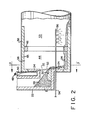
- the hot calcined coke particles 24 drop from the chamber 20 into the clinker box 22 where they flow over the refractory block 30 ( Figure 2).
- the block 30 is located in the bottom of a rectangular outlet opening 32 provided in the stationary head 34 of the cooler 36.
- An elongated, cylindrical, rotary cooler 36 is positioned beneath the discharge chamber 20.
- the cooler 36 has an inlet end 38 which is mounted for rotation around the stationary hed 34 of the clinker box 22.
- the outlet end 40 of the cooler 36 is mounted for-rotation within a stationary coke delivery chamber 42.
- the elongated, cylindrical, cooler 36 is also inclined downwardly at a slight angle from its inlet end 38 to its outlet end 40.
- the hot calcined coke particles 24 collect in a body at the bottom of the clinker box 22 behind the refractory block 30 and eventually spill over the edge of the block 30 and fall into the inlet end 38 of the rotary cooler 36.
- the coke particles are then forced by gravity and rotation of the cooler to move slowly down the length of the cooler 36 until they reach the outlet end 40 from whence the particles enter and collect within the coke supply chamber 42.
- calciners may employ indirect cooling, e.g. through the steel shell of the cooler 36, most calciners quench the hot, calcined coke directly by spraying it with water. This direct spraying reduces the temperature of the hot coke particles immediately after they leave the clinker box 22.
- a series of nozzles are provided just below the outlet opening 32 of the clinker box 22.
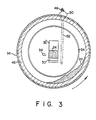
- a conventional calcining apparatus can be modified to carry out the process of the present invention by incorporating a hot zone 44 inside the inlet end 38 of the cooler 36.
- the hot zone is formed in accordance with the present invention by locating a circular refractory ring 46 a predetermined distance down stream from the clinker box outlet 32 and by moving the quench-water spray nezzles 56 downstream of the refractory ring 46.
- the ring 46 is mounted against the refractory lining 45 which is placed adjacent to the interior cylindrical side walls of the cooler 36.
- the refractory retention ring 46 increases the depth of the coke layer in the hot zone 44 and thereby increases the coke residence time.
- the temperature of the coke particles 24 as they enter the hot zone 44 is somewhat reduced by the process reaction but remains above 1100° C.
- Dry, granulated powder 48 of sodium carbonate is fed into the hot zone 44 through a funnel 50.
- the funnel 50 has an elongated, tubular stem 52 which extends through the side wall 34 of clinker box 22 and deposits the powder on top of the layer of hot calcined coke particles 24 at the bottom of the hot zone44.
- the powder is mixed with the coke particles 24 by the tumbling action occurring inside the rotating cooler 36.
- the powdered sodium carbonate melts upon contact with the hot coke particles 24 and reacts with the coke according to the following endothermic reaction:
- a pipe 54 carrying quenching water to a series of nozzles 56 and its outer end is mounted in the usual manner within the lower portion of the side wall 34 of clinker box 22 but in this case the pipe 54 is made longer so as to extend completely through the hot zone 44 and into the cooling section 53.
- the water is sprayed from the nozzles 56 directly onto the hot coke particles as they leave the hot zone 44 to quench the particles and significantly reduce their temperature.
- the quenched or cooled, treated, calcined coke particles are then discharged from the chamber 42 onto a moving conveyor 58 which transports the coke particles to a storage area.
- Steam, produced in the cooler from the quenching water, is removed from the cooler together with some air by a fan 62 and blown to atmosphere.
- the steam/air mixture passes through a dust collector 60 where coke dust is trapped to prevent air pollution.
- FIGS 4 and 5 show a calcining apparatus which is constructed specifically for use in treating petroleum coke according to the present invention.
- This calcining apparatus is equipped with a retention chamber comprising a separate reactor vessel 68.
- This reactor vesel is located downstream from the calciner and upstream from the cooler and can be designed for a long residence time.
- Calcined coke particles are fed from the discharge chamber 20 to the reactor vesel 68 where they are treated with dry, granular powders of the alkali or alkaline earth metal compound, e.g., sodium carbonate, which is supplied simultaneously through the inlet 70.
- the hot coke particles pass out through the outlet 72 in reactor vessel 68 and enter the inlet end 38 of the rotary cooler 36.
- the graphite container was pulled out of the furnace and the coke quenched by spraying water on it and raking it at the same time.
- the time required to reduce the coke temperature to between 300 ° C and 500 C ranged from about 30 seconds to about 90 seconds.
- the experimental reaction time reported was counted from the moment of dropping the inhibitor onto the coke to the moment when the water-quenching was started.
- the quenched coke was allowed to cool to ambient temperature without further water spraying.
- the cooled coke samples were then tested for puffing, i.e., the irreversible expansion occurring in sulfur-containing cokes when heated to between about 1600°C and 2200 C.
- Puffing was measured on a specimen prepared from the coke and placed in a dilatometer assembly made from a low-expansion graphite.
- the assembly containing the specimen was placed in a tube furnace and heated at 450 C per hour to 2400 C. After the temperature had reached 1000°C, the differential expansion of the specimen over that of the graphite container was recorded at 15 minute intervals.
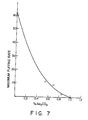
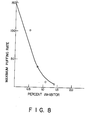
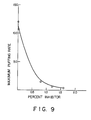
- Figures 6 through 9 show relationships between the highest puffin grate and the amount of inhibitor used.
- the unit of puffing rate in those figures is 10- 4 m/m per 15 minutes at a heating rate of 450° C per hour.
- the temperature at which the puffing rate of these particular cokes attained its highest value was at about 1750 °C.
- Figure 6 is a graph showing the relationship between the maximum puffing rate as determined in the above experiment and the amount of inhibitor used.
- Curve A shows this relationship in the case of a needle coke, coke D 1 , containing 1.05 percent by weight sulfur and using different amounts of sodium carbonate as the inhibitor.
- a puffing rate of about ten is the desired limit for processing the coke into graphite electrodes by modern graphitization methods. It will be seen from Curve A that this permissible puffing rate is achieved with only one percent by weight of the sodium carbonate inhibitor.
- Graphite electric furnace electrodes measuring 20 inches in diameter and 96 inches in length were made using one of the high sulfur petroleum needle cokes calcined and treated in the above described experimental trials.
- the calcined and treated coke was used as an aggregate or filler and mixed with a pitch binder and the usual extrusion aids to form a carbonaceous mix.
- the mix was then extruded, baked at about 800 C and then graphitized to temperatures of about 3000 C. There were no processing problems during extrusion and baking and there was no evidence of any puffing problems.
- the electrodes were subsequently tested experimentally on an electric-arc steel furnace and performed comparably to electrodes made from more expensive, low puffing premium needle cokes.
- the data shows (1) that addition of 0.55% sodium carbonate reduced the puffing of this coke to an acceptable level, while 0.25% did not; (2) that the sodium content in the coke was proportional to the amount of sodium carbonate added during the treatment within experimental error, and (3) that 0.18% sodium content, corresponding to 0.55% of Na ⁇ CO ⁇ added, reduced the puffing of this particular coke to an acceptable level, while 0.12% sodium in the coke was not sufficient.
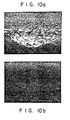
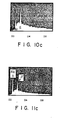
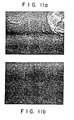
- Figure 10a-13a there are shown a series of photomicrographs taken at different magnifications (i.e., 200X, 45X, 50X and 200X, respectively,) and showing SEM images of three areas of an internal plane produced by grinding a quarter-inch coke particle.
- the area shown in Figure 10a is near the edge of the internal plane, the area shown in Figure 11 a is close to the center of the plane, and the area shown in Figure 12a is in the center of the ground plane.
- the fourth area shown in Figure 13a is also close to the center of the plane, similar to the area shown in Figure 11a.
- the location and distribution of sodium at the internal plane is shown in the photomicrographs in Figures 10b-13b, inclusive.
- the photomicrographs were produced at the same magnifications indicated above by EDX analysis for sodium using a Scanning Electron Microscope.
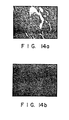
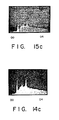
- Figure 14b demonstrates that the sodium was distributed essentially uniformly at the ground internal plane and also substantially uniformly, but at a much higher concentration, on the exposed original surface of the pore.
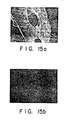
- Figure 15b shows that after leaching, the penetration and distribution of the sodium at the internal plane remained essentially unchanged, but the sodium concentration on the original pore surface was reduced to approximately the same level as on the internal plane and its distribution was essentially uniform.
- insoluble sodium is the product of the interaction between sodium and coke, while the water-soluble sodium, found only on the original surface but not inside the body of the particle, is unreacted sodium carbonate.
- the present invention provides an improved method for treating calcined petroleum coke in order to reduce or eliminate puffing wherein the coke particles are heated in the presence of an alkali or alkaline earth metal compound, preferably sodium carbonate, at temperatures of above about 750 C and preferably between about 1200°C and 1400°C.
- the inhibitor should be maintained in contact with the coke particles for a sufficiently long period of time, e.g., one minute or more, to allow the inhibitor to react with carbon and to allow products of the reaction to penetrate deeply into the mass of the coke particles.
- it is possible to add the inhibitor directly to the raw coke prior to heating or calcining it is preferred to add the inhibitor immediately after the coke particles have been discharged from the calciner. This avoids possible environmental problems and also has the advantage of reducing the off-gas acidity, as explained hereinabove.
- the present invention further provides an improved method for producing carbon and graphite articles such as electric furnace electrodes wherein the treated coke is incorporated with a conventional pitch binder to form a carbonaceous mix which is then shaped or extruded, baked to carbonize the binder and, if desired, graphitized.
- the principal advantage offered by this improved process is that the manufacturer of carbon and graphite articles or electrodes can now employ lower-priced, high sulfur petroleum cokes and yet produce high-quality electrodes.
Priority Applications (2)
| Application Number | Priority Date | Filing Date | Title |
|---|---|---|---|
| DE1989610820 DE68910820T2 (de) | 1989-07-22 | 1989-07-22 | Behandlung von Petroleumkoks, um das Aufblähen zu verhindern. |
| AT89307474T ATE97439T1 (de) | 1989-07-22 | 1989-07-22 | Behandlung von petroleumkoks, um das aufblaehen zu verhindern. |
Applications Claiming Priority (2)
| Application Number | Priority Date | Filing Date | Title |
|---|---|---|---|
| US07/164,749 US4875979A (en) | 1988-03-07 | 1988-03-07 | Treatment of petroleum cokes to inhibit coke puffing |
| CA000606419A CA1322184C (en) | 1988-03-07 | 1989-07-24 | Treatment of petroleum cokes to inhibit coke puffing |
Publications (4)
| Publication Number | Publication Date |
|---|---|
| EP0410050A2 true EP0410050A2 (de) | 1991-01-30 |
| EP0410050A1 EP0410050A1 (de) | 1991-01-30 |
| EP0410050A3 EP0410050A3 (de) | 1991-04-10 |
| EP0410050B1 EP0410050B1 (de) | 1993-11-18 |
Family
ID=25672903
Family Applications (1)
| Application Number | Title | Priority Date | Filing Date |
|---|---|---|---|
| EP89307474A Expired - Lifetime EP0410050B1 (de) | 1988-03-07 | 1989-07-22 | Behandlung von Petroleumkoks, um das Aufblähen zu verhindern |
Country Status (5)
| Country | Link |
|---|---|
| US (1) | US4875979A (de) |
| EP (1) | EP0410050B1 (de) |
| AU (1) | AU616783B2 (de) |
| CA (1) | CA1322184C (de) |
| ES (1) | ES2050242T3 (de) |
Families Citing this family (11)
| Publication number | Priority date | Publication date | Assignee | Title |
|---|---|---|---|---|
| DE3907156A1 (de) * | 1989-03-06 | 1990-09-13 | Sigri Gmbh | Verfahren zur inhibierung des puffing von aus steinkohlenteerpechen hergestellten koksen |
| DE3907158C1 (de) * | 1989-03-06 | 1990-04-19 | Sigri Gmbh, 8901 Meitingen, De | |
| AU639356B2 (en) * | 1989-07-24 | 1993-07-22 | Union Carbide Corporation | Treatment of petroleum cokes to inhibit coke puffing |
| EP0491442B1 (de) * | 1990-12-17 | 1994-06-01 | Ucar Carbon Technology Corporation | Vorrichtung zur Behandlung von Petroleumkoks mit einem Aufblähinhibitor in einem Drehherdofen |
| US5628878A (en) * | 1994-05-12 | 1997-05-13 | Reynolds Metals Company | Method of reducing airburning in petroleum coke |
| JP2001011471A (ja) * | 1999-04-30 | 2001-01-16 | Nippon Steel Chem Co Ltd | 黒鉛電極用ニードルコークス及びその製造方法 |
| US6849989B2 (en) * | 2002-10-31 | 2005-02-01 | Andreas Schmid | Translation and rotation positioning motor |
| US20120186968A1 (en) * | 2011-01-26 | 2012-07-26 | Orac Thomas H | Long-lasting internal retention dam/ring for coke calcining kilns |
| US12122907B2 (en) * | 2019-03-08 | 2024-10-22 | Tata Steel Limited | Compounds, compositions and methods for utilization of non-coking coal |
| RU2745787C1 (ru) * | 2020-06-15 | 2021-03-31 | Публичное акционерное общество "Северсталь" (ПАО "Северсталь") | Способ получения кокса для доменного производства |
| CN118579760B (zh) * | 2024-08-07 | 2024-10-15 | 山东汇宇新材料有限公司 | 一种煅烧石油焦及其制备方法和应用 |
Family Cites Families (5)
| Publication number | Priority date | Publication date | Assignee | Title |
|---|---|---|---|---|
| US2814076A (en) * | 1953-10-27 | 1957-11-26 | Union Carbide Corp | Sulphur sequestration of high sulphur coke |
| US3506745A (en) * | 1969-05-29 | 1970-04-14 | Great Lakes Carbon Corp | Method of eliminating puffing in the manufacture of electrodes from puffing petroleum coke |
| US3642962A (en) * | 1970-05-19 | 1972-02-15 | Air Reduction | Method of inhibiting puffing in the manufacture of graphite articles from sulfur-containing petroleum coke |
| GB1331524A (en) * | 1971-08-04 | 1973-09-26 | Continental Oil Co | Desulphurising coke |
| JPS5825392B2 (ja) * | 1979-03-08 | 1983-05-27 | 興亜石油株式会社 | コ−クス「か」焼法 |
-
1988
- 1988-03-07 US US07/164,749 patent/US4875979A/en not_active Expired - Lifetime
-
1989
- 1989-07-22 EP EP89307474A patent/EP0410050B1/de not_active Expired - Lifetime
- 1989-07-22 ES ES89307474T patent/ES2050242T3/es not_active Expired - Lifetime
- 1989-07-24 AU AU38884/89A patent/AU616783B2/en not_active Ceased
- 1989-07-24 CA CA000606419A patent/CA1322184C/en not_active Expired - Fee Related
Similar Documents
| Publication | Publication Date | Title |
|---|---|---|
| DE3000621C2 (de) | Verfahren zum Herstellen von gehärteten Pellets aus einem feinzerteilte Eisenoxide enthaltenden Material | |
| US4875979A (en) | Treatment of petroleum cokes to inhibit coke puffing | |
| EP0410050A2 (de) | Behandlung von Petroleumkoks, um das Aufblähen zu verhindern | |
| US5118287A (en) | Treatment of petroleum cokes to inhibit coke puffing | |
| WO2012113826A1 (de) | Verfahren zum aufarbeiten von verbrauchtem kohlenstoffhaltigen kathodenmaterial | |
| FR2664297A1 (fr) | Procede de traitement par choc thermique de brasquages uses provenant de cuves d'electrolyse hall-heroult. | |
| US5110359A (en) | Treatment of petroleum cokes to inhibit coke puffing | |
| KR890003015B1 (ko) | 펠릿의 제조법 | |
| KR930011930B1 (ko) | 코우크스팽창을 억제하기 위한 석유코우크스의 처리방법 | |
| DE68910820T2 (de) | Behandlung von Petroleumkoks, um das Aufblähen zu verhindern. | |
| JPH075890B2 (ja) | コークスパッフィングを抑制するための石油コークスの処理法 | |
| HRP920446A2 (hr) | Tretiranje petrol kokseva za inhibiranje napuhavanja koksa | |
| PL163084B1 (pl) | Sposób I urządzenie do wytwarzania wypełniacza węglowego oraz wypełniacz węglowy do elektrod węglowych | |
| SK452489A3 (en) | Process for treating high sulphur petroleum coke particles, carbonaceous filler used in carbonaceous electrode production, and apparatus for said process | |
| RU2081152C1 (ru) | Способ обработки частиц нефтяного кокса с высоким содержанием серы и устройство для его осуществления | |
| CN1029129C (zh) | 一种处理高硫石油焦以抑制爆烈的方法 | |
| DE1951567B2 (de) | Schachtofen zum schmelzen und verfahren zum betreiben des selben | |
| BG60565B1 (bg) | Метод за обработване на нефтен кокс за предотвратяване на напукването му | |
| NO302024B1 (no) | Karbonholdig fyllstoff for bruk ved fremst. av karbonelektroder, fremg. for behandling av höysvovelpetroleumkokspartikler, en fremg. for fremst. av karbongjenstander fra höysvovel-petroleumkoks samt en apparatur for behandling av råpetroleumkoks | |
| RO106118B1 (ro) | Procedeu pentru tratarea cocsului din petrol cu conținut ridicat de sulf, in vederea obținerii electrozilor, si aparat pentru realizarea acestuia | |
| DE69102253T2 (de) | Vorrichtung zur Behandlung von Petroleumkoks mit einem Aufblähinhibitor in einem Drehherdofen. | |
| KR102227828B1 (ko) | 코크스 및 그 제조방법 | |
| Shevlin et al. | Microstructural analysis of metallurgical cokes and intercalated species | |
| DE1101465B (de) | Verfahren zum trockenen Reduzieren von Eisenoxyd zu Eisenschwamm oder koernigen Massen ohne Schmelzen oder Sintern der Beschickung | |
| PL75371B1 (de) |
Legal Events
| Date | Code | Title | Description |
|---|---|---|---|
| AK | Designated contracting states: |
Kind code of ref document: A1 Designated state(s): AT DE ES FR GB IT NL |
|
| 17P | Request for examination filed |
Effective date: 19901217 |
|
| D17D | Search report (deleted) | ||
| 17Q | First examination report |
Effective date: 19911024 |
|
| RAP1 | Transfer of rights of an ep application |
Owner name: UCAR CARBON TECHNOLOGY CORP. |
|
| AK | Designated contracting states: |
Kind code of ref document: B1 Designated state(s): AT DE ES FR GB IT NL |
|
| PG25 | Lapsed in a contracting state announced via postgrant inform. from nat. office to epo |
Ref country code: AT Effective date: 19931118 Ref country code: FR Free format text: THE PATENT HAS BEEN ANNULLED BY A DECISION OF A NATIONAL AUTHORITY Effective date: 19931118 |
|
| REF | Corresponds to: |
Ref document number: 97439 Country of ref document: AT Date of ref document: 19931215 Kind code of ref document: T Format of ref document f/p: P |
|
| REF | Corresponds to: |
Ref document number: 68910820 Country of ref document: DE Date of ref document: 19931223 Format of ref document f/p: P |
|
| ITF | It: translation for a ep patent filed |
Owner name: BARZANO E ZANARDO ROMA S.P.A. |
|
| REG | Reference to a national code |
Ref country code: ES Ref legal event code: FG2A Ref document number: 2050242 Country of ref document: ES Kind code of ref document: T3 Format of ref document f/p: P |
|
| 26N | No opposition filed | ||
| PGFP | Postgrant: annual fees paid to national office |
Ref country code: NL Payment date: 19970625 Year of fee payment: 09 |
|
| PG25 | Lapsed in a contracting state announced via postgrant inform. from nat. office to epo |
Ref country code: NL Free format text: LAPSE BECAUSE OF NON-PAYMENT OF DUE FEES Effective date: 19990201 |
|
| NLV4 | Nl: lapsed or anulled due to non-payment of the annual fee |
Effective date: 19990201 |
|
| REG | Reference to a national code |
Ref country code: GB Ref legal event code: IF02 |
|
| PG25 | Lapsed in a contracting state announced via postgrant inform. from nat. office to epo |
Ref country code: IT Free format text: LAPSE BECAUSE OF NON-PAYMENT OF DUE FEES Effective date: 20050722 |
|
| PGFP | Postgrant: annual fees paid to national office |
Ref country code: GB Payment date: 20060726 Year of fee payment: 18 |
|
| PGFP | Postgrant: annual fees paid to national office |
Ref country code: ES Payment date: 20070726 Year of fee payment: 19 |
|
| PGFP | Postgrant: annual fees paid to national office |
Ref country code: DE Payment date: 20070831 Year of fee payment: 19 |
|
| PGFP | Postgrant: annual fees paid to national office |
Ref country code: GB Payment date: 20070727 Year of fee payment: 19 |
|
| PGFP | Postgrant: annual fees paid to national office |
Ref country code: GB Payment date: 20050713 Year of fee payment: 17 |
|
| GBPC | Gb: european patent ceased through non-payment of renewal fee |
Effective date: 20080722 |
|
| PG25 | Lapsed in a contracting state announced via postgrant inform. from nat. office to epo |
Ref country code: DE Free format text: LAPSE BECAUSE OF NON-PAYMENT OF DUE FEES Effective date: 20090203 |
|
| PG25 | Lapsed in a contracting state announced via postgrant inform. from nat. office to epo |
Ref country code: GB Free format text: LAPSE BECAUSE OF NON-PAYMENT OF DUE FEES Effective date: 20080722 |
|
| REG | Reference to a national code |
Ref country code: ES Ref legal event code: FD2A Effective date: 20080723 |
|
| PG25 | Lapsed in a contracting state announced via postgrant inform. from nat. office to epo |
Ref country code: ES Free format text: LAPSE BECAUSE OF NON-PAYMENT OF DUE FEES Effective date: 20080723 |