EP0406252B1 - SENSORELEMENT FÜR GRENZSTROMSENSOREN ZUR BESTIMMUNG DES $g(l)-WERTES VON GASGEMISCHEN - Google Patents
SENSORELEMENT FÜR GRENZSTROMSENSOREN ZUR BESTIMMUNG DES $g(l)-WERTES VON GASGEMISCHEN Download PDFInfo
- Publication number
- EP0406252B1 EP0406252B1 EP89902373A EP89902373A EP0406252B1 EP 0406252 B1 EP0406252 B1 EP 0406252B1 EP 89902373 A EP89902373 A EP 89902373A EP 89902373 A EP89902373 A EP 89902373A EP 0406252 B1 EP0406252 B1 EP 0406252B1
- Authority
- EP
- European Patent Office
- Prior art keywords
- sensor element
- electrode
- element according
- diffusion
- pumping electrode
- Prior art date
- Legal status (The legal status is an assumption and is not a legal conclusion. Google has not performed a legal analysis and makes no representation as to the accuracy of the status listed.)
- Expired - Lifetime
Links
- 239000000203 mixture Substances 0.000 title claims description 8
- 238000009792 diffusion process Methods 0.000 claims abstract description 57
- 238000007650 screen-printing Methods 0.000 claims abstract description 12
- 239000007789 gas Substances 0.000 claims description 29
- BASFCYQUMIYNBI-UHFFFAOYSA-N platinum Chemical compound [Pt] BASFCYQUMIYNBI-UHFFFAOYSA-N 0.000 claims description 25
- 239000007784 solid electrolyte Substances 0.000 claims description 16
- 239000004020 conductor Substances 0.000 claims description 15
- 230000004888 barrier function Effects 0.000 claims description 14
- 229910052751 metal Inorganic materials 0.000 claims description 12
- 239000002184 metal Substances 0.000 claims description 12
- 238000000034 method Methods 0.000 claims description 10
- 239000011148 porous material Substances 0.000 claims description 10
- 229910052697 platinum Inorganic materials 0.000 claims description 9
- 229910044991 metal oxide Inorganic materials 0.000 claims description 5
- 150000004706 metal oxides Chemical class 0.000 claims description 5
- 238000002485 combustion reaction Methods 0.000 claims description 3
- 238000005086 pumping Methods 0.000 claims 12
- 239000010970 precious metal Substances 0.000 claims 2
- 238000005516 engineering process Methods 0.000 abstract description 10
- 239000000919 ceramic Substances 0.000 abstract description 8
- 238000004519 manufacturing process Methods 0.000 abstract description 7
- 238000003475 lamination Methods 0.000 abstract description 2
- 229910000510 noble metal Inorganic materials 0.000 abstract 1
- 239000007787 solid Substances 0.000 abstract 1
- YAPQBXQYLJRXSA-UHFFFAOYSA-N theobromine Chemical compound CN1C(=O)NC(=O)C2=C1N=CN2C YAPQBXQYLJRXSA-UHFFFAOYSA-N 0.000 description 14
- 239000011888 foil Substances 0.000 description 11
- MCMNRKCIXSYSNV-UHFFFAOYSA-N Zirconium dioxide Chemical compound O=[Zr]=O MCMNRKCIXSYSNV-UHFFFAOYSA-N 0.000 description 10
- 238000005245 sintering Methods 0.000 description 8
- 239000000463 material Substances 0.000 description 7
- 238000005259 measurement Methods 0.000 description 7
- 229960004559 theobromine Drugs 0.000 description 7
- PNEYBMLMFCGWSK-UHFFFAOYSA-N aluminium oxide Inorganic materials [O-2].[O-2].[O-2].[Al+3].[Al+3] PNEYBMLMFCGWSK-UHFFFAOYSA-N 0.000 description 5
- QVGXLLKOCUKJST-UHFFFAOYSA-N atomic oxygen Chemical compound [O] QVGXLLKOCUKJST-UHFFFAOYSA-N 0.000 description 5
- 229910052593 corundum Inorganic materials 0.000 description 5
- 229910052760 oxygen Inorganic materials 0.000 description 5
- 239000001301 oxygen Substances 0.000 description 5
- 239000000843 powder Substances 0.000 description 5
- 229910001845 yogo sapphire Inorganic materials 0.000 description 5
- 239000000446 fuel Substances 0.000 description 4
- 239000011777 magnesium Substances 0.000 description 4
- 239000000523 sample Substances 0.000 description 4
- 229910052596 spinel Inorganic materials 0.000 description 4
- 239000011029 spinel Substances 0.000 description 4
- 229910045601 alloy Inorganic materials 0.000 description 3
- 239000000956 alloy Substances 0.000 description 3
- 238000009413 insulation Methods 0.000 description 3
- 150000002739 metals Chemical class 0.000 description 3
- 239000000758 substrate Substances 0.000 description 3
- ATRRKUHOCOJYRX-UHFFFAOYSA-N Ammonium bicarbonate Chemical compound [NH4+].OC([O-])=O ATRRKUHOCOJYRX-UHFFFAOYSA-N 0.000 description 2
- FYYHWMGAXLPEAU-UHFFFAOYSA-N Magnesium Chemical compound [Mg] FYYHWMGAXLPEAU-UHFFFAOYSA-N 0.000 description 2
- 229910001260 Pt alloy Inorganic materials 0.000 description 2
- GWEVSGVZZGPLCZ-UHFFFAOYSA-N Titan oxide Chemical compound O=[Ti]=O GWEVSGVZZGPLCZ-UHFFFAOYSA-N 0.000 description 2
- 235000012501 ammonium carbonate Nutrition 0.000 description 2
- 239000001099 ammonium carbonate Substances 0.000 description 2
- 239000006229 carbon black Substances 0.000 description 2
- CETPSERCERDGAM-UHFFFAOYSA-N ceric oxide Chemical compound O=[Ce]=O CETPSERCERDGAM-UHFFFAOYSA-N 0.000 description 2
- 229910000422 cerium(IV) oxide Inorganic materials 0.000 description 2
- 238000010438 heat treatment Methods 0.000 description 2
- 229910052749 magnesium Inorganic materials 0.000 description 2
- RVTZCBVAJQQJTK-UHFFFAOYSA-N oxygen(2-);zirconium(4+) Chemical compound [O-2].[O-2].[Zr+4] RVTZCBVAJQQJTK-UHFFFAOYSA-N 0.000 description 2
- 229910002076 stabilized zirconia Inorganic materials 0.000 description 2
- 229910052727 yttrium Inorganic materials 0.000 description 2
- VWQVUPCCIRVNHF-UHFFFAOYSA-N yttrium atom Chemical compound [Y] VWQVUPCCIRVNHF-UHFFFAOYSA-N 0.000 description 2
- 229910004369 ThO2 Inorganic materials 0.000 description 1
- BKTIBMYPJBJMNV-UHFFFAOYSA-N [U+6].[O-2].[Sc+3] Chemical class [U+6].[O-2].[Sc+3] BKTIBMYPJBJMNV-UHFFFAOYSA-N 0.000 description 1
- 239000000654 additive Substances 0.000 description 1
- 239000011230 binding agent Substances 0.000 description 1
- 150000004649 carbonic acid derivatives Chemical class 0.000 description 1
- 239000000969 carrier Substances 0.000 description 1
- 239000011195 cermet Substances 0.000 description 1
- 238000006243 chemical reaction Methods 0.000 description 1
- 238000000354 decomposition reaction Methods 0.000 description 1
- 230000001419 dependent effect Effects 0.000 description 1
- 230000000694 effects Effects 0.000 description 1
- 239000003792 electrolyte Substances 0.000 description 1
- CJNBYAVZURUTKZ-UHFFFAOYSA-N hafnium(IV) oxide Inorganic materials O=[Hf]=O CJNBYAVZURUTKZ-UHFFFAOYSA-N 0.000 description 1
- 150000002500 ions Chemical class 0.000 description 1
- 229910001092 metal group alloy Inorganic materials 0.000 description 1
- 239000002245 particle Substances 0.000 description 1
- 230000010287 polarization Effects 0.000 description 1
- 238000003825 pressing Methods 0.000 description 1
- 238000007639 printing Methods 0.000 description 1
- 229910001404 rare earth metal oxide Inorganic materials 0.000 description 1
- 230000001105 regulatory effect Effects 0.000 description 1
- 239000004071 soot Substances 0.000 description 1
- ZCUFMDLYAMJYST-UHFFFAOYSA-N thorium dioxide Chemical compound O=[Th]=O ZCUFMDLYAMJYST-UHFFFAOYSA-N 0.000 description 1
Images
Classifications
-
- G—PHYSICS
- G01—MEASURING; TESTING
- G01N—INVESTIGATING OR ANALYSING MATERIALS BY DETERMINING THEIR CHEMICAL OR PHYSICAL PROPERTIES
- G01N27/00—Investigating or analysing materials by the use of electric, electrochemical, or magnetic means
- G01N27/26—Investigating or analysing materials by the use of electric, electrochemical, or magnetic means by investigating electrochemical variables; by using electrolysis or electrophoresis
- G01N27/416—Systems
-
- G—PHYSICS
- G01—MEASURING; TESTING
- G01N—INVESTIGATING OR ANALYSING MATERIALS BY DETERMINING THEIR CHEMICAL OR PHYSICAL PROPERTIES
- G01N27/00—Investigating or analysing materials by the use of electric, electrochemical, or magnetic means
-
- G—PHYSICS
- G01—MEASURING; TESTING
- G01N—INVESTIGATING OR ANALYSING MATERIALS BY DETERMINING THEIR CHEMICAL OR PHYSICAL PROPERTIES
- G01N27/00—Investigating or analysing materials by the use of electric, electrochemical, or magnetic means
- G01N27/26—Investigating or analysing materials by the use of electric, electrochemical, or magnetic means by investigating electrochemical variables; by using electrolysis or electrophoresis
- G01N27/403—Cells and electrode assemblies
- G01N27/406—Cells and probes with solid electrolytes
- G01N27/407—Cells and probes with solid electrolytes for investigating or analysing gases
- G01N27/4071—Cells and probes with solid electrolytes for investigating or analysing gases using sensor elements of laminated structure
-
- G—PHYSICS
- G01—MEASURING; TESTING
- G01N—INVESTIGATING OR ANALYSING MATERIALS BY DETERMINING THEIR CHEMICAL OR PHYSICAL PROPERTIES
- G01N27/00—Investigating or analysing materials by the use of electric, electrochemical, or magnetic means
- G01N27/26—Investigating or analysing materials by the use of electric, electrochemical, or magnetic means by investigating electrochemical variables; by using electrolysis or electrophoresis
- G01N27/403—Cells and electrode assemblies
- G01N27/406—Cells and probes with solid electrolytes
- G01N27/407—Cells and probes with solid electrolytes for investigating or analysing gases
- G01N27/4071—Cells and probes with solid electrolytes for investigating or analysing gases using sensor elements of laminated structure
- G01N27/4072—Cells and probes with solid electrolytes for investigating or analysing gases using sensor elements of laminated structure characterized by the diffusion barrier
Definitions
- the invention is based on a sensor element for limit current sensors according to the preamble of the main claim.
- sensor elements of this type which operate according to the diffusion limit current principle
- the diffusion limit current is measured at a constant voltage applied to the two electrodes of the sensor element. This current is dependent on the oxygen concentration in an exhaust gas generated during combustion processes, as long as the diffusion of the gas to the pump electrode determines the speed of the reaction taking place.
- the known limit current sensors are generally used to determine the ⁇ value of gas mixtures, which denotes the ratio "total oxygen / oxygen required for complete combustion of the fuel" of the air / fuel mixture burning in a cylinder, the sensors determining the oxygen content of the exhaust gas via an electrochemical Determine pump current measurement.
- planar sensor elements can be started from platelet-shaped or foil-shaped oxygen-conducting solid electrolytes, e.g. Made of stabilized zirconia, which are coated on both sides with an inner and outer pump electrode with associated conductor tracks.
- the inner pump electrode is advantageously located in the edge region of a diffusion channel through which the measurement gas is supplied and which serves as a gas diffusion resistor.
- sensor elements and detectors which have in common that they each have a pump cell and a sensor cell made of platelet or consist of film-shaped oxygen-conducting solid electrolytes and two electrodes arranged thereon and have a common diffusion channel.
- the broadband sensor known from DE-OS 35 43 759 and constructed using planar technology, has a pump cell and a concentration cell arranged parallel thereto, which delimit an intermediate diffusion channel. Layer thicknesses of about 20 ⁇ m are given for the electrodes, compared to about 0.1 mm for the diffusion channel. The electrodes, and thus the inner pump electrode, are therefore thin in comparison to the diffusion channel.
- the broadband sensor described functions in a known manner by regulating the current flowing through the pump cell so that the voltage across the concentration cell is constant.
- the current flowing through the pump cell provides the output signal.
- EP-A 0 141 993 describes several variants of planar probes for oxygen measurement, including an embodiment with a pump cell and concentration cell, an inner electrode of the pump cell and an electrode of the concentration cell being arranged in a diffusion channel for the measurement gas.
- the electrode layer thickness is small compared to the height of the diffusion channel.
- a disadvantage of sensor elements according to the preamble of the main claim is that the front part of the inner pump electrode facing the supplied measuring gas is subjected to greater stress than the rear part of the pump electrode facing away from the measuring gas supplied. This leads to a high electrode polarization, which requires a high pump voltage. The latter in turn harbors the risk of electrolyte decomposition in the area of the inner pump electrode.
- the sensor element according to the invention with the characterizing features of the main claim has the advantage that the resilience is increased by the special design of the inner pump electrode due to its larger electrode area and the life of the sensor element is improved. Another advantage results from the fact that the inner pump electrode assumes a supporting function in the production of the sensor element in ceramic foil and screen printing technology during lamination and pressing.
- the sensor element according to the invention can be used in place of known sensor elements with a planar structure in limit current sensors of conventional design. Broadband sensors ( ⁇ ⁇ 1) and lean sensors ( ⁇ > 1) come into question.
- the sensor element according to the invention can thus be designed as a pump cell, optionally with a heating element, for. B. as a lean sensor for diesel engines, and as such in a conventional sensor housing, for. B. of the type known from DE-OS 32 06 903 and 35 37 051 installed and used to measure the air-fuel ratio in a lean exhaust gas.
- the sensor element according to the invention can also additionally have a sensor cell (Nernst cell) which is provided with an additional air reference channel and whose one electrode is arranged in the region of the pump electrode in the diffusion channel of the pump cell and whose other electrode is located in the air reference channel and for measurement of the air-fuel ratio be used in a lean or rich exhaust gas.
- a sensor cell Nest cell
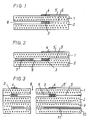
- FIG. 1 is a schematic, greatly enlarged illustration of a section through a sensor element according to the invention that can be produced in ceramic film and screen printing technology. It essentially consists of ceramic films 1 and 2, onto which the inner three-dimensional pump electrode 3 and the outer pump electrode are screened 4 and associated conductor tracks 5, 5 'have been printed on and which are laminated together by means of a customary interlaminar binder, forming the diffusion channel 6 forming a tunnel.
- the sensor element shown schematically in FIG. 2 differs from the sensor element shown in FIG. 1 only in that a porous filling 7 is provided in the diffusion channel 6, which serves as a diffusion barrier for the measuring gas.
- FIG. 3 is a further schematic, greatly enlarged illustration of a section through another advantageous embodiment of a sensor element according to the invention that can be produced in ceramic film and screen printing technology, in which the inner three-dimensional pump electrode 3 and the outer pump electrode 4 are arranged in a ring around the sample gas supply 8 . It essentially consists of four solid electrolyte foils 1, 2, 9 and 10 laminated together with the punched-out sample gas supply 8, the ring-shaped outer pump electrode 4 and the three-dimensional inner pump electrode 3 arranged in the diffusion channel 6.
- the sensor element also has a heater 11. The slides 9 and 10 with the heater are not absolutely necessary.
- the annular electrodes 3 and 4 are connected to conductor tracks 5 and 5 ', which are compared to the solid electrolyte foils by means of insulating layers, not shown in the drawing, for. B. Al2O3 layers are isolated.
- the conductor tracks are connected to a voltage source, not shown, for. B. a battery with a constant working voltage in the range of 0.5 to 1.0 volts.
- the outer pump electrode 4 and the associated conductor 5 ' are again with a porous cover layer, not shown, for. B. made of magnesium spinel covered.
- oxygen-ion-conducting solid electrolytes are in particular those based on ZrO2, HfO2, CeO2 and ThO2.
- YSZ zirconium dioxide
- the platelets and foils preferably have a thickness of 0.25 to 0.3 mm.
- the outer pump electrode 4 preferably consists of a metal from the platinum group, in particular platinum, or from alloys of metals from the platinum group or alloys from metals from the platinum group with other metals.
- the electrode can optionally also contain a ceramic scaffold material, as is also used to produce the inner pump electrode.
- the outer pump electrode 4 is, however, more of a two-dimensional two-dimensional electrode, ie an electrode of the usual type, which is generally thinner than the inner pump electrode and preferably has a thickness of 8 to 15 ⁇ m.
- the inner, three-dimensional pump electrode 3 preferably consists of a mixture of a metal of the platinum group, in particular platinum, or of an alloy, such as can also be used to produce the outer pump electrode, and a supporting framework material, such as, for. B. with Y2O3 stabilized zirconia.
- the metal of the platinum group can be wholly or partly by an electron-conducting metal or metal oxide, such as. B. TiO2 or Perovskite, or by a mixed conductive (ie electrode and ion conductive) metal oxide, such as. B. CeO2 or other rare earth oxides and mixed oxides such. B. uranium scandium oxides to be replaced.
- the volume fraction of scaffold material is expediently 20 to 60%, preferably 35 to 45%. It has also proven to be advantageous if the degree of porosity of the inner pump electrode is 10 to 40%. At least some of the pores preferably have a pore diameter of greater than 1 ⁇ m. The average pore diameter of the inner pump electrode is preferably 2 to 10 ⁇ m.
- the porous support structure can be produced by using known pore-forming powders, which are added to the mixture of metal component and support structure component and other customary additives used to produce the electrode, and are burned or evaporated during the manufacture of the sensor element. Typical pore formers that can be used successfully are z. B. theobromine and carbon black and carbonates.
- the pore size of the support structure can be controlled by the particle size of the pore former powder used.
- the use of pore formers is not absolutely necessary. Rather, it is also possible, for example, to produce a porous support structure by using a support structure material with comparatively low sintering activity.
- the masses used to produce the electrodes can be prepared by customary known methods and applied, preferably printed, onto the platelet-shaped or foil-shaped solid electrolytes.
- the inner three-dimensional pump electrode 3 is preferably directly opposite the outer pump electrode 4. It can cover the same, a smaller or larger area of the solid electrolyte than the outer pump electrode 4.
- the inner pump electrode 3 can accordingly only fill a comparatively small part of the diffusion channel 6 or a comparatively large part of the diffusion channel 6.
- the inner pump electrode 3 occupies only a part of the space of the diffusion channel 6 and a diffusion barrier 7 is arranged in the diffusion channel 6 in front of the inner pump electrode 3, as is shown schematically in FIG. 2, for example.
- Such a diffusion barrier consists of a porous material, i. H. a material that at the sintering temperature of the substrate, e.g. B. ZrO substrate, not yet dense, e.g. B. from coarse-grained ZrO2, Mg spinel or Al2O3 with a grain size of, for example, about 10 microns.
- pore formers can optionally be added, e.g. B. thermal carbon black that burns out during the sintering process, theobromine or ammonium carbonate.
- a channel system acting as a diffusion barrier for the measurement gas for a mixed diffusion of Knudsen and gas phase diffusion can be arranged in front of the inner pump electrode 3.
- This channel system can e.g. B. consist of porous filled diffusion channels for a Knudsen diffusion and hollow channels for a gas phase diffusion.
- Such channel systems acting as diffusion barriers for the measuring gas are described in more detail in DE-OS 37 28 289.
- the diffusion barrier can advantageously contain platinum or a platinum alloy or another catalytically active metal for the purpose of improving the measurement accuracy in order to achieve an equilibrium in the diffusion channel reaching gas.
- the volume fraction of catalytically active metal or metal alloy can be 10 to 90%.
- the diffusion barrier can occupy the entire space of the diffusion channel, which is left free by the inner pump electrode 3, or only part of the same. For example, a free space can also remain between the inner pump electrode 3 and the diffusion barrier 7.
- the diffusion barrier 7, like the inner pump electrode 3, can advantageously be produced using thick-film technology.
- the conductor tracks 5 and 5 'belonging to the pump electrodes 3 and 4 are preferably also made of platinum or a platinum alloy.
- Pump electrodes and conductor tracks can be applied to the solid electrolyte body by known methods, for example by screen printing. Between the outer pump electrode with a voltage source not shown in the drawing interconnect and the solid electrolyte carrier there is usually an insulation layer, for. B. from Al2O3. For example, it can have a thickness of approximately 15 ⁇ m.
- the inner conductor track is preferably insulated from solid electrolyte carriers in a similar manner.
- the union of the individual, the sensor element forming films or plates can be effected by means of a screen printing technique in the ceramic foil and usual method in which the film brought together and are heated to temperatures of about 100 ° C.
- the diffusion channel can be prepared at the same time. This is advantageously introduced using thick-film technology, for example through a theobromine screen printing layer, the theobromine being evaporated during the later sintering process. Thermal soot powders, for example, which burn out during the sintering process or ammonium carbonate, which evaporates, can also be used to produce the diffusion channel.
- the diffusion channel is to have a porous diffusion barrier
- a theobromine screen printing layer for example a layer of theobromine or another evaporable or combustible material and a material that does not yet sinter tightly at the applied sintering temperature of the solid electrolyte substrate, e.g. B. coarse-grained ZrO2, magnesium spinel or Al2O3 with a grain size of z. B. 10 microns can be used.
- films made of zirconium dioxide stabilized with yttrium and having a layer thickness of 0.3 mm were used.
- the outer pump electrode 4, which is made of platinum, and the inner platinum support frame electrode 3 were applied to the carrier foils using known screen printing technology, the surface of the carrier foil 1 carrying the outer puncture electrode 4 in the region of the conductor track 5 ′ of the outer pump electrode 4 being approximately 20 ⁇ m thick Al2O3 insulation layer was applied.
- the conductor track 5 was also insulated with appropriate insulation layers.
- the ring-shaped pump electrodes 3 and 4 had an outer diameter of 2.8 mm and an inner diameter of 1.4 mm with a thickness of the outer pump electrode of 12 ⁇ m and the inner pump electrode of 40 ⁇ m.
- the inner pump electrode was produced from a screen printing mass, which corresponded to the mass used to produce the outer pump electrode, with the difference that it contained such an amount of ZrO2 stabilized with Y2O3 that an electrode porosity degree of about 30% was achieved.
- the conductor tracks were produced from a conventional Pt cermet paste from 85 parts by weight of Pt powder and 15 parts by weight of YSZ powder.
- the diffusion channel 6 was placed in thick-film technology by a theobromine-screen-printed layer, wherein the theobromine during the subsequent sintering process in the temperature range of 300 o C under a Hinerarteries about 30 microns high and 1.3 mm deep annular gap was evaporated.
- the central sample gas feed opening had a diameter of 0.25 mm.
- the sensor elements produced were installed in the sensor housing of the type known from DE-OS 32 06 903 and 35 37 051 and used to measure the fuel-air ratio in lean and rich exhaust gases.
Landscapes
- Chemical & Material Sciences (AREA)
- Health & Medical Sciences (AREA)
- Life Sciences & Earth Sciences (AREA)
- Analytical Chemistry (AREA)
- Physics & Mathematics (AREA)
- Electrochemistry (AREA)
- Chemical Kinetics & Catalysis (AREA)
- Biochemistry (AREA)
- General Health & Medical Sciences (AREA)
- General Physics & Mathematics (AREA)
- Immunology (AREA)
- Pathology (AREA)
- Molecular Biology (AREA)
- Measuring Oxygen Concentration In Cells (AREA)
- Investigating Or Analyzing Materials By The Use Of Fluid Adsorption Or Reactions (AREA)
Applications Claiming Priority (2)
| Application Number | Priority Date | Filing Date | Title |
|---|---|---|---|
| DE3809154 | 1988-03-18 | ||
| DE3809154A DE3809154C1 (enExample) | 1988-03-18 | 1988-03-18 |
Publications (2)
| Publication Number | Publication Date |
|---|---|
| EP0406252A1 EP0406252A1 (de) | 1991-01-09 |
| EP0406252B1 true EP0406252B1 (de) | 1993-05-05 |
Family
ID=6350114
Family Applications (1)
| Application Number | Title | Priority Date | Filing Date |
|---|---|---|---|
| EP89902373A Expired - Lifetime EP0406252B1 (de) | 1988-03-18 | 1989-02-23 | SENSORELEMENT FÜR GRENZSTROMSENSOREN ZUR BESTIMMUNG DES $g(l)-WERTES VON GASGEMISCHEN |
Country Status (8)
| Country | Link |
|---|---|
| US (1) | US5137615A (enExample) |
| EP (1) | EP0406252B1 (enExample) |
| JP (1) | JP2654212B2 (enExample) |
| KR (1) | KR0148683B1 (enExample) |
| AU (1) | AU613453B2 (enExample) |
| DE (2) | DE3809154C1 (enExample) |
| ES (1) | ES2010896A6 (enExample) |
| WO (1) | WO1989008840A1 (enExample) |
Cited By (1)
| Publication number | Priority date | Publication date | Assignee | Title |
|---|---|---|---|---|
| DE102010012889B4 (de) * | 2009-03-27 | 2021-05-06 | Ngk Spark Plug Co., Ltd. | Gassensor |
Families Citing this family (34)
| Publication number | Priority date | Publication date | Assignee | Title |
|---|---|---|---|---|
| DE3841611A1 (de) * | 1988-12-10 | 1990-06-13 | Bosch Gmbh Robert | Sensorelement fuer grenzstromsensoren zur bestimmung des (lambda)-wertes von gasgemischen |
| DE3908393A1 (de) * | 1989-03-15 | 1990-09-27 | Bosch Gmbh Robert | Sensorelement fuer grenzstromsensoren zur bestimmung des (lambda)-wertes von gasgemischen |
| DE3941837C2 (de) * | 1989-12-19 | 1994-01-13 | Bosch Gmbh Robert | Widerstandsmeßfühler zur Erfassung des Sauerstoffgehaltes in Gasgemischen und Verfahren zu seiner Herstellung |
| DE4032436A1 (de) * | 1990-10-12 | 1992-04-16 | Bosch Gmbh Robert | Sensorelement fuer grenzstromsensoren zur bestimmung des (gamma)-wertes von gasgemischen |
| DE4231966A1 (de) * | 1992-09-24 | 1994-03-31 | Bosch Gmbh Robert | Planare polarograhische Sonde zur Bestimmung des Lambda-Wertes von Gasgemischen |
| DE4238688A1 (de) * | 1992-11-17 | 1994-05-19 | Bosch Gmbh Robert | Gesinterter Festelektrolyt mit hoher Sauerstoffionenleitfähigkeit |
| JP3314426B2 (ja) * | 1992-12-25 | 2002-08-12 | 株式会社デンソー | 酸素センサ |
| WO1997041428A1 (en) * | 1996-04-30 | 1997-11-06 | The Regents Of The University Of California | Solid-state gas sensor |
| ATE385569T1 (de) * | 1996-11-06 | 2008-02-15 | Bosch Gmbh Robert | Elektrochemischer messfühler |
| US5887240A (en) * | 1998-05-11 | 1999-03-23 | General Motors Corporation | Method of manufacturing a platinum electrode |
| DE19834276A1 (de) * | 1998-07-30 | 2000-02-10 | Bosch Gmbh Robert | Abgassonde |
| DE19857471A1 (de) * | 1998-12-14 | 2000-06-15 | Bosch Gmbh Robert | Sensorelement für Grenzstromsonden zur Bestimmung des Lambda-Wertes von Gasgemischen und Verfahren zu dessen Herstellung |
| DE10020082B4 (de) * | 2000-04-22 | 2012-04-05 | Robert Bosch Gmbh | Elektrochemischer Meßfühler |
| DE10033906A1 (de) | 2000-07-12 | 2002-02-28 | Bosch Gmbh Robert | Platinmetallhaltige Cerametelektroden für die elektrochemische Reduktion von Sauerstoff |
| DE10121889C2 (de) * | 2001-05-05 | 2003-07-24 | Bosch Gmbh Robert | Sensorelement |
| DE10122271B4 (de) * | 2001-05-08 | 2006-06-29 | Robert Bosch Gmbh | Sensorelemente |
| DE10146545A1 (de) * | 2001-09-21 | 2003-04-10 | Merck Patent Gmbh | Mikrokomponente |
| JP4416551B2 (ja) * | 2004-03-29 | 2010-02-17 | 日本碍子株式会社 | 多孔質電極及びそれを用いてなる電気化学的セル並びにNOxセンサ素子 |
| EP1605255A1 (en) * | 2004-06-10 | 2005-12-14 | Hitachi, Ltd. | Oxygen-concentration detecting element and method of producing same |
| DE102005006501A1 (de) * | 2005-02-14 | 2006-08-24 | Robert Bosch Gmbh | Gasmessfühler |
| DE102005052430A1 (de) * | 2005-11-03 | 2007-05-10 | Robert Bosch Gmbh | Sensorelement |
| US20070245803A1 (en) * | 2006-02-23 | 2007-10-25 | Tan Siong S | Oxygen sensor with a protective layer |
| DE102007049713A1 (de) | 2006-12-29 | 2008-07-03 | Robert Bosch Gmbh | Sensorelement zur Messung einer Gasgemischzusammensetzung |
| DE102006062056A1 (de) | 2006-12-29 | 2008-07-03 | Robert Bosch Gmbh | Sensorelement mit unterdrückter Fettgasreaktion |
| DE102007049716A1 (de) | 2006-12-29 | 2008-07-03 | Robert Bosch Gmbh | Gassensor mit gasdicht abgeschirmtem Hohlraum |
| DE102007054391A1 (de) | 2007-11-14 | 2009-05-20 | Robert Bosch Gmbh | Gassensor mit zeitlich variierendem Referenzpotential |
| DE102007061947A1 (de) | 2007-12-21 | 2009-06-25 | Robert Bosch Gmbh | Schneller Breitband-Abgassensor |
| DE102007062733A1 (de) | 2007-12-27 | 2009-07-02 | Robert Bosch Gmbh | Sensorelement mit verbesserter Vergiftungsresistenz |
| DE102007062800A1 (de) | 2007-12-27 | 2009-07-02 | Robert Bosch Gmbh | Verfahren zur Bestimmung einer Gaszusammensetzung in einem Messgasraum |
| DE102009026418B4 (de) | 2009-05-22 | 2023-07-13 | Robert Bosch Gmbh | Konditionierung eines Sensorelements in einem Brennerprüferstand bei mindestens 1000°C und Konditionierungsstrom |
| DE102009028755A1 (de) * | 2009-08-20 | 2011-06-09 | Robert Bosch Gmbh | Verfahren zur Herstellung einer porösen Cermet-Elektrode |
| JP5945113B2 (ja) * | 2011-11-11 | 2016-07-05 | 株式会社デンソー | ガスセンサ用電極、及びガスセンサ素子 |
| DE102011086144A1 (de) * | 2011-11-11 | 2013-05-16 | Robert Bosch Gmbh | Verfahren zur Korrektur von Messwerten eines Sensorelements |
| JP5835343B2 (ja) * | 2011-11-24 | 2015-12-24 | トヨタ自動車株式会社 | 空燃比検出装置及び空燃比検出方法 |
Family Cites Families (11)
| Publication number | Priority date | Publication date | Assignee | Title |
|---|---|---|---|---|
| DE2852638C2 (de) * | 1978-12-06 | 1986-01-16 | Robert Bosch Gmbh, 7000 Stuttgart | Gassensor mit Cermet- Elektroden |
| DE2913633C2 (de) * | 1979-04-05 | 1986-01-23 | Robert Bosch Gmbh, 7000 Stuttgart | Elektrochemischer Meßfühler für die Bestimmung des Sauerstoffgehaltes in Gasen, insbesondere in Abgasen von Verbrennungsmotoren sowie Verfahren zur Herstellung desselben |
| US4579643A (en) * | 1983-11-18 | 1986-04-01 | Ngk Insulators, Ltd. | Electrochemical device |
| JPS61138156A (ja) * | 1984-12-11 | 1986-06-25 | Ngk Spark Plug Co Ltd | 空燃比検出装置 |
| JPS61147155A (ja) * | 1984-12-20 | 1986-07-04 | Ngk Insulators Ltd | 電気化学的装置 |
| US4645572A (en) * | 1985-02-23 | 1987-02-24 | Ngk Insulators, Ltd. | Method of determining concentration of a component in gases and electrochemical device suitable for practicing the method |
| JPS61195338A (ja) * | 1985-02-25 | 1986-08-29 | Ngk Spark Plug Co Ltd | 空燃比センサ− |
| JPH065222B2 (ja) * | 1985-05-09 | 1994-01-19 | 日本碍子株式会社 | 電気化学的素子 |
| JPH0664009B2 (ja) * | 1986-03-28 | 1994-08-22 | 日本碍子株式会社 | ガスセンサ−素子 |
| JPS62238455A (ja) * | 1986-04-09 | 1987-10-19 | Ngk Insulators Ltd | 酸素分析方法及び装置 |
| JPS6321549A (ja) * | 1986-07-15 | 1988-01-29 | Ngk Insulators Ltd | 限界電流測定回路 |
-
1988
- 1988-03-18 DE DE3809154A patent/DE3809154C1/de not_active Expired
-
1989
- 1989-02-23 EP EP89902373A patent/EP0406252B1/de not_active Expired - Lifetime
- 1989-02-23 JP JP1502174A patent/JP2654212B2/ja not_active Expired - Fee Related
- 1989-02-23 WO PCT/DE1989/000102 patent/WO1989008840A1/de not_active Ceased
- 1989-02-23 AU AU30618/89A patent/AU613453B2/en not_active Ceased
- 1989-02-23 KR KR1019890702144A patent/KR0148683B1/ko not_active Expired - Fee Related
- 1989-02-23 DE DE8989902373T patent/DE58904290D1/de not_active Expired - Fee Related
- 1989-02-23 US US07/566,376 patent/US5137615A/en not_active Expired - Fee Related
- 1989-03-16 ES ES8900967A patent/ES2010896A6/es not_active Expired
Cited By (1)
| Publication number | Priority date | Publication date | Assignee | Title |
|---|---|---|---|---|
| DE102010012889B4 (de) * | 2009-03-27 | 2021-05-06 | Ngk Spark Plug Co., Ltd. | Gassensor |
Also Published As
| Publication number | Publication date |
|---|---|
| WO1989008840A1 (fr) | 1989-09-21 |
| JPH03503084A (ja) | 1991-07-11 |
| DE3809154C1 (enExample) | 1988-12-08 |
| KR0148683B1 (ko) | 1998-08-17 |
| ES2010896A6 (es) | 1989-12-01 |
| KR900700878A (ko) | 1990-08-17 |
| EP0406252A1 (de) | 1991-01-09 |
| JP2654212B2 (ja) | 1997-09-17 |
| DE58904290D1 (de) | 1993-06-09 |
| AU613453B2 (en) | 1991-08-01 |
| AU3061889A (en) | 1989-10-05 |
| US5137615A (en) | 1992-08-11 |
Similar Documents
| Publication | Publication Date | Title |
|---|---|---|
| DE3809154C1 (enExample) | ||
| EP0386006B1 (de) | Sensorelement für grenzstromsensoren zur bestimmung des lambda wertes von gasgemischen | |
| EP0552174B1 (de) | Sensorelement für grenzstromsensoren zur bestimmung des lambda-wertes von gasgemischen | |
| EP0437433B1 (de) | PLANARE POLAROGRAPHISCHE SONDE ZUR BESTIMMUNG DES $g(l)-WERTES VON GASGEMISCHEN | |
| EP0449846B1 (de) | Sensorelement für grenzstromsensoren zur bestimmung des lambda-wertes von gasgemischen | |
| DE3783103T2 (de) | Elektrochemischer gassensor und verfahren zu seiner herstellung. | |
| DE3876013T2 (de) | Elektrochemische elemente. | |
| EP0519933B1 (de) | Sauerstoffsensor zur bestimmung des lambda-wertes | |
| DE3834987C2 (enExample) | ||
| DE3728289C1 (de) | Nach dem polarographischen Messprinzip arbeitende Grenzstromsonde | |
| EP0462989B1 (de) | SENSORELEMENT FÜR GRENZSTROMSENSOREN ZUR BESTIMMUNG DES $g(l)-WERTES VON GASGEMISCHEN | |
| EP0647319A1 (de) | Sensorelement zur bestimmung der gaskomponentenkonzentration | |
| WO1990003570A1 (de) | Magerastsonde für die bestimmung der sauerstoffkonzentration in abgasen | |
| DE19817012A1 (de) | Sensorelement für Grenzstromsonden zur Bestimmung des Lambda-Wertes von Gasgemischen und Verfahren zu dessen Kalibrierung | |
| DE3942773A1 (de) | Plaettchenfoermige breitbandsonde fuer die bestimmung der sauerstoffkonzentration in abgasen | |
| WO2003096004A1 (de) | Sensor für einen elektrochemischen messfühler |
Legal Events
| Date | Code | Title | Description |
|---|---|---|---|
| PUAI | Public reference made under article 153(3) epc to a published international application that has entered the european phase |
Free format text: ORIGINAL CODE: 0009012 |
|
| 17P | Request for examination filed |
Effective date: 19900831 |
|
| AK | Designated contracting states |
Kind code of ref document: A1 Designated state(s): DE FR GB IT SE |
|
| RAP3 | Party data changed (applicant data changed or rights of an application transferred) |
Owner name: ROBERT BOSCH GMBH |
|
| 17Q | First examination report despatched |
Effective date: 19920410 |
|
| GRAA | (expected) grant |
Free format text: ORIGINAL CODE: 0009210 |
|
| AK | Designated contracting states |
Kind code of ref document: B1 Designated state(s): DE FR GB IT SE |
|
| ET | Fr: translation filed | ||
| GBT | Gb: translation of ep patent filed (gb section 77(6)(a)/1977) |
Effective date: 19930504 |
|
| REF | Corresponds to: |
Ref document number: 58904290 Country of ref document: DE Date of ref document: 19930609 |
|
| ITF | It: translation for a ep patent filed | ||
| PLBE | No opposition filed within time limit |
Free format text: ORIGINAL CODE: 0009261 |
|
| STAA | Information on the status of an ep patent application or granted ep patent |
Free format text: STATUS: NO OPPOSITION FILED WITHIN TIME LIMIT |
|
| 26N | No opposition filed | ||
| EAL | Se: european patent in force in sweden |
Ref document number: 89902373.3 |
|
| PGFP | Annual fee paid to national office [announced via postgrant information from national office to epo] |
Ref country code: GB Payment date: 19980205 Year of fee payment: 10 |
|
| PGFP | Annual fee paid to national office [announced via postgrant information from national office to epo] |
Ref country code: SE Payment date: 19980224 Year of fee payment: 10 |
|
| PGFP | Annual fee paid to national office [announced via postgrant information from national office to epo] |
Ref country code: FR Payment date: 19980225 Year of fee payment: 10 |
|
| PG25 | Lapsed in a contracting state [announced via postgrant information from national office to epo] |
Ref country code: GB Free format text: LAPSE BECAUSE OF NON-PAYMENT OF DUE FEES Effective date: 19990223 |
|
| PG25 | Lapsed in a contracting state [announced via postgrant information from national office to epo] |
Ref country code: SE Free format text: LAPSE BECAUSE OF NON-PAYMENT OF DUE FEES Effective date: 19990224 |
|
| GBPC | Gb: european patent ceased through non-payment of renewal fee |
Effective date: 19990223 |
|
| PG25 | Lapsed in a contracting state [announced via postgrant information from national office to epo] |
Ref country code: FR Free format text: LAPSE BECAUSE OF NON-PAYMENT OF DUE FEES Effective date: 19991029 |
|
| EUG | Se: european patent has lapsed |
Ref document number: 89902373.3 |
|
| REG | Reference to a national code |
Ref country code: FR Ref legal event code: ST |
|
| PGFP | Annual fee paid to national office [announced via postgrant information from national office to epo] |
Ref country code: DE Payment date: 20030325 Year of fee payment: 15 |
|
| PG25 | Lapsed in a contracting state [announced via postgrant information from national office to epo] |
Ref country code: DE Free format text: LAPSE BECAUSE OF NON-PAYMENT OF DUE FEES Effective date: 20040901 |
|
| PG25 | Lapsed in a contracting state [announced via postgrant information from national office to epo] |
Ref country code: IT Free format text: LAPSE BECAUSE OF NON-PAYMENT OF DUE FEES Effective date: 20050223 |